| Content from Wikipedia under the CC BY-SA 4.0 license ⇔ Maps from OpenStreetMap under the ODbL license |
Mexico
United Mexican States Estados Unidos Mexicanos | |
|---|---|
 Flag
 Coat of arms
| |
| Anthem: National Anthem (Himno Nacional) File:Himno Nacional Mexicano instrumental.ogg | |
 | |
| Capital | Mexico City  8,918,653 inhabitants (2012) 19°26′N 99°08′W / 19.433°N 99.133°W |
| Largest city | Mexico City |
| Official languages | Spanish and 67 indigenous languages[nota 1] |
| Demonym | Mexican[1] |
| Government | Federal presidential republic |
| Andrés Manuel López Obrador | |
| Independence from Spain | |
• Declared | September 16, 1810 |
| September 27, 1821 | |
• Recognized | December 28, 1836 |
| Area | |
• Total | 1,964,375 km2 (758,449 sq mi)[2][nota 2] (13th) |
• Water (%) | 2.5 |
• Borders | 4,389 km total[4] • 3,155 km with United States[4] • 958 km with Guatemala[4] • 276 km with Belize[4] |
| Population | |
• 2018 estimate | 123,982,528 (10th) |
• 2010 census | 112,336,538 |
• Density | 57/km2 (147.6/sq mi) |
| GDP (PPP) | 2018 estimate |
• Total | USD 2,548,166 million[5] (11th) |
• Per capita | USD 20,552[5] |
| GDP (nominal) | 2018 estimate |
• Total | USD 1,275,002 million[5] (15th) |
• Per capita | USD 10,283[5] |
| HDI (2018) |  0.774[6] high (74th) |
| Currency | Peso ($) ([[ISO 4217|MXN]]) |
| Time zone | UTC−5 to UTC−8 |
• Summer (DST) | UTC−5 to UTC−7 |
| Calling code | +52 |
| ISO 3166 code | MX |
| Internet TLD | .mx |
Coastline: 9,330 km[4] Economically active population (EAP): 23 million Aircraft registration prefix: XA, XB, XC International vehicle registration code: MEX Radio prefix: 4AA-4CZ, 6DA-6JZ, XAA-XIZ ISO code: 484 / MX / MEX Member of: OAS, UN, OECD, NAFTA, G-20, G-5, APEC, G3, LG, IACN, LU, ABINIA, CELAC, OEI, ACS, Pacific Alliance, MIST, UFC, Interpol, CIJEG, UNESCO | |
Mexico[nota 3] (<phonos file="Mexico.ogg">[ˈmexiko]</phonos>), officially called the United Mexican States (Estados Unidos Mexicanos),[10][11][12][13] is a country in the Americas located in the southern part of North America, with its capital in Mexico City.[14] Politically it is a representative, democratic, federal and secular republic, made up of 32 federal entities (31 states and the federal capital).[15]
Mexican territory has an area of 1,964,375 km²,[4] making it the thirteenth largest country in the world and the third largest in Latin America. It borders the United States of America to the north along a border of 3,155 km, while to the south it has a border of 958 km with Guatemala and 276 km with Belize. The country's coasts border the Pacific Ocean to the west and the Gulf of Mexico and the Caribbean Sea to the east, totaling 9,330 km, making it the American country with the third longest coastline.[4]
Mexico is the eleventh most populous country in the world, with an estimated population of more than 124 million people in 2018.[7] Most of them have Spanish as their mother tongue, which the state recognizes as a national language along with 67 indigenous languages native to the nation,[16] although around 287 languages are spoken in the country.[17] These figures make Mexico the country with the largest number of Spanish speakers,[18] as well as the country with the seventh greatest linguistic diversity in the world.[19]
Human presence in Mexico dates back 14,000 years before the present.[20] As the fruit of thousands of years of cultural development, the Mesoamerican, Aridoamerican and Oasisamerican cultures arose in Mexican territory. The present-day central territory of Mexico was the principal and largest setting of the Mexica people and, in part, of the Maya people, two of the most important civilizations of pre-Columbian America. For 300 years, the entirety of the present territory formed part of the Viceroyalty of New Spain, with its capital in Mexico City, being one of the most important entities of the Spanish Empire in America. After Spanish dominion, New Spain began the struggle for its political independence in 1810, which culminated in 1821. Subsequently, for nearly a century the country was embroiled in a series of internal wars and foreign invasions that had repercussions in all areas of Mexican life. During a good part of the 20th century (mainly the second third) there was a period of great economic growth within the framework of a political system dominated by a single political party.
According to the World Tourism Organization, Mexico is the leading tourist destination in Latin America and the sixth most visited in the world.[21] This is due in large part to the 34 cultural or natural sites that are considered by UNESCO to be World Heritage, and in this respect it is first on the continent and sixth in the world.
In macroeconomic terms, by gross domestic product (GDP) it is the fourteenth largest economy in the world and the eleventh by purchasing power parity (PPP); on a regional scale, it is the second largest economy in Latin America and the fourth on the continent.[22][23] According to the UN's 2018 human development report, it has a high human development index of 0.774 and ranks 74th in the world, which means it has made great advances alongside countries such as Indonesia, Turkey, Thailand and South Africa, considering the fact that in 2010 it had a human development index of 0.743.[24][25][26] However, its inequality-adjusted human development index is 0.608, considered medium.[27]
Mexico is also one of the countries with the greatest diversity of climates in the world; considered one of the 17 megadiverse countries on the planet, it is home to 10–12% of the world's biodiversity[28] and hosts more than 12,000 endemic species.[29]
Toponymy

The first term or proper name with which the country was referred to appeared on November 6, 1813, when the Congress of Anáhuac issued the Solemn Act of the Declaration of Independence of Northern America. This name made clear reference to the name used by the Constitution of Cádiz to delimit the territory of the Spanish Empire corresponding to the Viceroyalty of New Spain and its dependent areas (the Captaincy General of Guatemala, Cuba, Florida, Puerto Rico and the Spanish part of the Island of Santo Domingo —today the Dominican Republic—), thereby assuming that this was the geographical space on which the new nation would be constituted.[30][31][32] Subsequently, the Constitutional Decree for the Liberty of Mexican America of October 22, 1814, changed this name, adapting it with the term Mexico (used as an adjective), and using it as a demonym in some articles.
The documents that preceded the consummation of independence (the Plan of Iguala and the Treaties of Córdoba) used the two aforementioned terms (Northern America and Mexican America), but employed a new one, which they accredited as the official name of the new nation: Imperio Mejicano (Mexican Empire). This name was used definitively by the Act of Independence of the Mexican Empire, signed on September 28, 1821, upon the consummation of independence.[33][34][35]
Since its formation as a federal state, the official name of the country has been Estados Unidos Mexicanos (United Mexican States), although the Constitution of 1824 used the expressions Nación Mexicana (Mexican Nation) and Estados Unidos Mexicanos interchangeably.[36] The Constitution of 1857 made official the use of the name República Mexicana (Mexican Republic),[37] but the expression Estados Unidos Mexicanos is also employed in the text.[38] The current Constitution, promulgated in 1917, establishes that the official name of the country is Estados Unidos Mexicanos. Nevertheless, the widespread use of the shortened form México, common to all the previous names, allowed it to prevail as the common name.
The demonym mexicano (Mexican) has been used in the Spanish language since the contact between Europeans and Americans, with different meanings. For sixteenth-century Spaniards, the Mexicans were the inhabitants of México-Tenochtitlan and their language. During the viceregal period, some criollos and peninsulares residing in New Spain used the demonym to refer to themselves.[39] The leaders of the War of Independence hesitated over the name of both the country and its inhabitants. From the Plan of Iguala onward, the country would definitively adopt the name of Mexico and its inhabitants were all Mexicans.
México is a toponym of Mexican—Nahuatl—origin whose meaning is disputed. It derives from the Nahuatl word «Mēxihco» Nahuatl pronunciation: [[me:ʃiʔko]], which designated the capital of the Mexicas. According to Bernardino de Sahagún (16th century)—who is the oldest documentary source—, the word would mean «the place of Mexi», from «Mexitl», where «metl» (maguey), «citli»/«xitli» (hare) and «-co» (locative):[40] Mexi or Mexitl, who was a legendary Nahua priest, guided his followers in the search for an eagle on a nopal cactus for the founding of their city after leaving the equally legendary location of Aztlán. However, today the most widespread version of the meaning of the word is: «the navel of the moon» or «in the place of the lake of the Moon»,[41] from «Metzxico»: «metz(tli)» (moon), «xic(tli)» (navel, center) and «-co» (locative), according to Cecilio Robelo and Alfonso Caso. Sahagún writes the origin of the word as follows:
This name mexícatl was formerly said mecitli, being composed of me, which is metl for the maguey, and of citli for the hare, and so it should be said mecícatl, and with the c changing into x it is corrupted and is said mexícatl. And the reason for the name, as the old men tell it, is that when the Mexicans came to these parts they brought a leader and lord who was called Mécitl, whom, right after he was born, they called citli, hare; and because instead of a cradle they raised him in a large leaf of a maguey, from then on he was called mecitli, ... , and when he was already a man he was a priest of idols, who spoke personally with the demon (Huitzilopochtli), for which he was highly esteemed and much respected and obeyed by his vassals, who, taking their name from their priest, called themselves mexica, or mexicac, as the ancients tell it;.[42]
Francisco Xavier Clavijero suggested that the toponym should be interpreted as «[in the] place of Mexihtli», that is, of Huitzilopochtli, since Mexihtli was one of his alternative names. In the same text, Clavijero adds in a note that for some time he believed the word meant «in the center of the maguey», but that through knowledge of the history of the Mexicas he came to the conclusion that the toponym refers to the tutelary god of the Aztecs.[nota 4]
History
The present territory of Mexico was discovered and inhabited by groups of hunters and gatherers who were nomadic more than 30,000 years ago. Around the year 9000 BC, the processes were under way that led to the domestication of plants such as squash and the bottle gourd[44] in regions such as the Tehuacán Valley and the Sierra de Tamaulipas. The domestication of maize occurred around the fifth millennium before the common era and was a milestone that later led to the establishment of sedentary villages in Mesoamerica.[45]
Oasisamerica
The Oasisamericans were cultivators, although climatic conditions did not allow them a very efficient agriculture, and for that reason they had to resort to hunting toads and turtles, and to gathering, to supplement their subsistence. They built large villages in New Mexico and the archaeological zone of Casas Grandes, in Chihuahua.[46]
Aridoamerica
The inhabitants of the region known as Aridoamerica continued with their nomadic culture, although they maintained contact with the Mesoamericans. Some sites show continuous occupation since very ancient times, such as the Cueva de la Perra (12000 BC),[47] the Cueva de la Candelaria (8000 BC),[48] El Conchalito (1000 BC)[49] and the caves of the Sierra de San Francisco (10,500 BC).
Mesoamerica
Olmecs


The beginning of Mesoamerican civilization is placed between the year 2500 BC, with the appearance of pottery and the first agricultural villages,[50] and 1500 BC.[51] During the Middle Preclassic (15th–4th century BC) the Olmec culture spread throughout Mesoamerica.[52] Some of its most important centers were La Venta and Tres Zapotes. They devoted themselves to agriculture, mainly the cultivation of maize and cotton.
The Olmecs knew how to use the abundant natural resources of their environment, among them: their houses, their way of feeding and dressing themselves, transporting themselves, eating, trading and developing artistic techniques.
The oldest recorded Olmec center is San Lorenzo; it was built in the year 1150 BC in the present-day municipality of Texistepec, located in the basin of the Coatzacoalcos River, in the State of Veracruz. The beginning of the flourishing of Olmec culture at this site, the period from which most of the sculptures and architectural elements that characterize Olmec culture date, many of which are preserved at the site. San Lorenzo was sacked in the year 900 BC, and the monumental sculptures suffered an attempt at destruction; some were buried, and others were moved to the ceremonial center of La Venta
La Venta was the most important ceremonial center of this culture; this city is the first planned architectural layout in ancient Mexico. Its great monumental architecture stands out, as do its offerings made of jade. It has the oldest pyramid in Mesoamerica, and colossal heads and thrones have also been found, which deserve special recognition for the fact that to build them.
The ceremonial center of Tres Zapotes was the last to develop. It is the best known because it was the one that survived until a closer period, but the Olmec civilization that developed here was a culture already in decline, not the splendor it experienced in the earlier ceremonial centers.
It is thought that the Olmecs were invaded by some rival people, which caused the abandonment and destruction of some cities; for this reason it is thought that Olmec culture spread through migrations. They dispersed to different places: some headed to the Maya region, others went to the center and others to the north. Those who settled in the center went to the City of Cuicuilco, but it disappeared due to the eruption of the Xitle Volcano; for that reason they were forced to travel to other places, and thus they reached parts of the states of Morelos, México, Oaxaca and Chiapas.
Teotihuacans

The Classic period spans from the year 200 to 900 AD; in this period the Mesoamerican civilizations reached their maximum cultural development. The largest pyramidal bases in all of Mesoamerica were built, such as the Pyramid of the Sun in Teotihuacan in the present-day State of Mexico or the Temple of the Two-Headed Serpent in Tikal.
Cities in this period grew a great deal until reaching their maximum population, such as Teotihuacan (State of Mexico), Monte Albán in Oaxaca and Tikal; these cities maintained close marriage, commercial and political alliances among the king-priests, and this is known because at the entrance of each there were stone monuments signifying that the Teotihuacan ambassadors were coming; likewise, Maya and Zapotec products such as pottery, jade beads, shells and sea snails have been found in Teotihuacan.
Teotihuacan became the main city of this period; it was located in the area of the central highlands, which allowed its inhabitants to take advantage of natural resources such as obsidian to make weapons, tools and utensils. In addition, they had gods of rain and fertility such as Quetzalcóatl (which means «feathered serpent») and Tláloc (which means «nectar of the earth», although this god was also venerated in the Maya and Zapotec cultures).
Artisans obtained various materials from the area, such as: jade, gray obsidian, green obsidian, black volcanic glass, shell and bone. With these they made vessels, pots, plates, cups, ornaments, knives, masks, necklaces and various figures.

The Teotihuacans expressed what they saw through sculpture, pottery and painting. On façades they represented the deity Tláloc and the feathered serpent, related to rain and fertility respectively, as well as other figures important to them.
The Teotihuacans were polytheists; they had the following gods:
- Tláloc: He was the god of rain, and there are theories that he was also the god of fertility and the earth. He was represented as human-animal, with a feathered headdress and two large fangs as well as two large, bulging eyes.
- Quetzalcóatl: He was the god of the winds. His name means: The Feathered Serpent; he was represented as a giant serpent.
- Chalchiuhticue: She was the goddess of lakes and rivers. She was represented with a feathered headdress, a necklace and orange skin.
- Huehuetótl: He was the god of fire, husband of Chalchiuhticue. He was represented as an old man. He was the reincarnation of volcanoes and wisdom.
The decline of Teotihuacan culture is unknown; some researchers say it may have been due to the overexploitation of natural resources, invasions by other peoples and some internal conflicts.
Their society was divided into: king-priests, warriors, merchants, farmers, fishermen, artisans, war slaves and sacrificial tributes
Artisans obtained various materials from the area, such as: jade, gray obsidian, green obsidian, black volcanic glass, shell and bone. With these they made vessels, pots, plates, cups, ornaments, knives, masks, necklaces and various figures.
The City of Teotihuacan maintained a close relationship with other cultures, such as the Maya and Zapotec. With the Maya they had marriage alliances, through commercial agreements with Teotihuacan-Palenque and Uxmal. With the Zapotecs they maintained a relationship between Teotihuacan and Monte Albán.
Teotihuacan is considered the main city of Classic Mesoamerica; in addition to the pyramid of the sun and the moon, the temple of Quetzalcóatl also stands out.
Maya

The Maya culture is another important civilization, since they were able to consolidate a writing system and astronomical and mathematical knowledge, among which the invention of the number zero stands out.
It inhabited part of the southern region of Mesoamerica, in the present territories of Guatemala, Belize, Honduras, El Salvador and in the territory comprising five states of southeastern Mexico: Campeche, Chiapas, Quintana Roo, Tabasco and Yucatán. The territory, being so large, was divided into three:
- The northern area: covers the Yucatán Peninsula (comprising the states of Yucatán, Campeche and Quintana Roo); it is also known as Puuc.
- The central area: it is the most extensive; it comprises the basin of El Petén, in Guatemala, and extends toward western Honduras and eastern Chiapas, Tabasco and the south of the Yucatán Peninsula.
- The southern area: located on the Pacific coast, the Highlands of Guatemala, part of Chiapas and of El Salvador. It has a mountainous zone running through the south, southwest and southeast, and includes the Central American Cordillera. On the high plateau there are several lakes that originated in the volcanic activity of the region.
The Maya used limestone to build pyramidal bases, temples, platforms and ballcourts; they also used that material to make various monuments and sculptures, among which the stelae stand out, which were carved stone columns with important figures together with their name, date of birth or date of death.
In their mural painting they represented everyday scenes, such as fishing, festivals and ritual ceremonies related to war.
For aesthetic reasons the Maya customarily deformed the skulls of children and induced strabismus.
Maya religion was polytheistic; the rulers were the ones who directed religious affairs (theocracy); their gods were related to natural elements, the heavenly bodies and human actions. Among the gods who stood out are: Hanub Kú (the creator god of the K'iche' Maya), Itzamná (the creator god of the Yucatec Maya), Ix Chebel Ya (god of embroidery and painting), Kakalcán (Quetzalcóatl) (god of the wind), Kin (god of the sun), Ixchel (goddess of the moon), Chac (god of water), Yum Kaax (god of maize and agriculture), Ah Puch (god of death).
Maya cities were built on the basis of astronomical positions related to the movement of the Sun, the Moon and Venus. The center of some cities was reserved for the family of the rulers to live in; around it lived the nobility, whose buildings were related to commerce; finally, further out were the farmland and the rest of the population.
The Maya used limestone to build pyramids, temples, platforms and ballcourts. They also used it to make various monuments and sculptures, among which the stelae stand out, on which this time they placed glyphs.
Other materials from the region served for their daily life. They used wood, stucco, clay and stones to make masks, necklaces, rings and small sculptures. In addition, they made cotton cloth to dress themselves and wove baskets of fiber to carry seeds.
The Maya came to develop navigation; they built docks, canals and ports such as Xelhá, Xcaret and Tulum, which were important centers where they exchanged products such as salt and fish.
Zapotecs

The Zapotec culture inhabited what is today the state of Oaxaca, southern Guerrero and southern Puebla. It was distinguished by its excellent weavers and potters, and made notable advances in its writing, architecture and calendrical knowledge.
Its foremost city was Monte Albán, which had its splendor from the year 200 until its weakening around 900. The ceremonial city of Monte Albán was built on top of a mountain, with buildings oriented like the heavenly bodies using the talud-tablero technique; pyramidal bases, ballcourts and an arrowhead-shaped observatory were built, oriented toward what is known today as the constellation of Orion. As with Teotihuacan, it is unknown why Monte Albán weakened.
Society was divided into ruler-priests, merchants, warriors, artisans, war slaves and sacrificial tributes. According to each one's duties the economy was controlled, and from this the control of agriculture and the progress of the cities.
They had two calendars:
- Iza: it had 365 days grouped into 18 months and was used for harvests; it was organized into 18 months of 20 days each, with a period of five days at the end.
- Piye: it had 260 days distributed into 13 months and was used to name newborns; it was divided into months of 20 days.
They were polytheists; their main god was called Xipe Totec; other gods were:
- Pitao Cocijo: god of thunder and rain
- Pitao Cozobi: god of maize
- Pitao Cozana: god of the ancestors
- Quetzalcóatl: god of the winds
- Xonaxi Quecuya: god of earthquakes
- Coqui Bezelao: god of the dead
Society was divided into: ruler-priests, merchants, warriors, masons, painters, stone carvers, potters, goldsmiths, peasants and prisoners of war.
Toltecs

The Preclassic period spans from the year 900 to 1521 AD; this period is characterized by a great increase in armed conflicts. The great importance of war can be seen in pottery, codices and writings; in addition, a notable detail is the architectural style of the buildings.
The Toltec culture developed between the years 900 and 1150 AD. The Toltecs dominated the Huasteca region, in part of what is today San Luis Potosí and Zacatecas, as well as central Mexico, such as Hidalgo, where the ceremonial center and capital called Tollan-Xicocotitlan, better known as Tula, was located. The economy was based on an agriculture of extensive fields irrigated by complex canal systems, where maize, beans and amaranth were the main crops. Society was divided into several groups; the most privileged were: the military, officials, the supreme ruler and the priests, who were at the service of the military caste and were in charge of attending to worship, the calendars and the count of time. Traces of a fire have been found in Tula, which is why it is thought that the end of this city was very violent.
Mixtecs

Another Postclassic culture is the Mixtec, which developed from 1300 to 1522 AD, ending with the conquest by the Spaniards. They covered a region called the Mixteca, which comprised the states of Oaxaca, Guerrero and parts of the states of Puebla and Chiapas. According to their mythology, the Mixtecs were descendants of the children of the tree of Apoala. The main deity of the Mixtecs was Dzahui, god of rain and patron of the Mixtec nation; another deity of great importance was Nine Wind-Coo Dzahui, a civilizing hero who gave them the knowledge of agriculture and civilization. During the pre-Hispanic era, Mixtec society was characterized by its high degree of hierarchy. The subsistence of the Mixtecs was based on agriculture; the ecological and topographical conditions of this people's territory conditioned the development of certain crops adapted to the diversity of environments in the Mixteca.
Mexicas

Toward the middle of the 14th century, the Mexicas arrived in the Valley of Mexico; according to myth, they came from a place to the north called Aztlán, and from there they took up elements of other cultures. They were called the people of the sun, since it was what they worshipped, thanks to the military power of the Mexicas (or Aztecs), and they founded their great capital with great military power: México-Tenochtitlan. When they forged a great empire and formed the Triple Alliance with Texcoco and Tlacopan. War was a very common practice in order to extend their empire; the conquered peoples delivered products such as gold, silver, jade and quetzal feathers. They developed knowledge that reflected their religious beliefs.
"War and religion, at least for the Aztecs, were inseparable. They belonged to each other. ... In order to obtain suitable prisoner-victims to sacrifice to the gods, there were incessant small wars, and even their weaponry was designed to incapacitate, not to kill, all to obtain food for the gods: blood and the heart." Words from the book: History of Mexico.
Mexica culture came to an end in the year 1521 with the conquest by the Spaniards.
Spanish conquest and viceregal era

After the expeditions of Francisco Hernández de Córdoba (1517)[53] and Juan de Grijalva (1518),[54] Hernán Cortés and his men arrived at Cozumel and reached the coasts of Tabasco, where they were fought by the Chontales, at Centla.[55] In that region, Cortés founded the Villa de Santa María de la Victoria and received as a gift Malintzin, a slave who served as a valuable interpreter for the foreigners.[56]
The Spaniards headed to the coast of Veracruz, from where they penetrated into the interior of Mesoamerica. They established alliances with some indigenous peoples and advanced on México-Tenochtitlan. Along the way they defeated the allies of the Mexicas, as happened in Cholula. Moctezuma Xocoyotzin received the Spaniards peacefully,[57] but the Massacre of Tóxcatl put the Mexicas on a war footing.[58] Cuitláhuac defeated the invaders in 1520,[59] but died during the huey cocoliztli. Cuauhtémoc, the last Tenochca tlatoani, was captured on August 13, 1521,[60] and executed in 1525.[61] After occupying México-Tenochtitlan, the Spaniards set out to conquer the rest of New Spain in a process that lasted the entire viceregal period. The military conquest was accompanied by the Christianization and acculturation of the indigenous peoples, which resulted in a process of Cultural syncretism.


Once Tenochtitlan was subdued, Hernán Cortés assumed the government as Captain General of New Spain. In 1527 the Audiencia of Mexico was established.[62] The first Viceroy was Antonio de Mendoza y Pacheco, who governed from 1535.[63] New Spain was governed by 63 Viceroys during the nearly 300 years of Spanish dominion. Spanish dominion faced indigenous resistance, which on some occasions manifested itself through arms, as in the Chichimeca War (1546), the Mixtón War (1540–1551), the Rebellion of the Pericúes (1734–1737) and the rebellion of the Maya of Cisteil (1761).[64]
The basis of the economy of New Spain was mining. The discovery of deposits in northern Mexico (notably, Zacatecas and Guanajuato) gradually allowed New Spain to occupy a privileged position. Mining allowed the development of other associated activities, especially textile workshops (obrajes) and agriculture, which turned the regions of the Bajío and the valleys of Mexico and Puebla into prosperous agricultural regions with incipient industrial activity.[65] Minerals were minted exclusively at the Real Casa de Moneda de México; the Real de a 8 became, because of its quantity, high fineness and quality, the coin preferentially used in the international transactions of the Empire.[66]
The commerce of the Viceroyalty was carried out through two ports: Veracruz (Gulf of Mexico) and Acapulco (Pacific Ocean). To the latter came the Nao de China, which transported products from the Philippines to New Spain, and from there they were transported overland, reaching Puebla, where Eastern influence is notable in its handicrafts and in its traditions such as that of the "china poblana", Mexico City and Veracruz, from where they were sent to Spain or to the ports of the Atlantic. Commerce contributed to the flourishing of these ports, of Mexico City and of the intermediate regions. It should be noted that until the end of the 18th century, with the introduction of the Bourbon Reforms, commerce between the Spanish Viceroyalties was not permitted.[67]
The Viceroyalty was the basis of the cultural and racial mosaic of present-day Mexico. Within it, the indigenous and European cultures fused over the course of 300 years. Likewise, a great deal of racial mixing took place. Figures such as Sor Juana Inés de la Cruz and Juan Ruiz de Alarcón stand out as the most notable contributors to the literature of New Spain, as does Manuel Tolsá in architecture. With regard to financial institutions, Pedro Romero de Terreros stood out as founder of the Sacro y Real Monte de Piedad de Ánimas, forerunner of the Nacional Monte de Piedad (also called Monte Pío), the genesis of microcredit worldwide. Also notable are the chemical discoveries of Andrés Manuel del Río, discoverer of erythronium, later renamed vanadium, in the periodic table of the chemical elements.[68]

The society of New Spain for the most part professed the Catholic religion; the Holy Inquisition —which sought the suppression of heresy and apostasy— had its offices established in the territory.[69] The Indians were exempt from inquisitorial jurisdiction, and their matters of faith were handled first by the missionaries and then by a tribunal dependent on the bishops, which judged them with more tolerance because they were considered "neophytes" in the faith.[70]
The territory of New Spain was large enough for a great number of indigenous peoples and a great variety of languages to exist within it, not excluding the Europeans. During the three hundred years of New Spain there were various legal provisions that affected the commerce and prosperity of the people of New Spain. In general, their level of prosperity was the highest in America, especially that of the residents of Mexico City, Puebla de los Ángeles, the Villa Rica de la Veracruz, Acapulco and Zacatecas.[71]
Although as a general rule a policy of integration was proposed, the political reality that imposed the granting of important posts to the Spanish bureaucracy (especially since the arrival of the Bourbons, who advocated the French model of colonization, against which the criollos, or children of Spaniards born in Mexico, began to feel resentment). In addition, divisions as serious as the castes in Yucatán were created. During the viceregal period many of the traditions and institutions arose that have evolved, in accordance with the character of the Mexican people, into many of the Mexican characteristics of the present day.
Independence

The French occupation of Spain triggered several sovereigntist movements in the American possessions. In 1808 a political crisis took place in New Spain that ended with the removal of Viceroy Iturrigaray through a coup d'état.[72] In other parts of the Viceroyalty, conspiracies against Spanish rule were hatched, but they were suppressed. On September 16, 1810, Miguel Hidalgo y Costilla called the people of Dolores (Guanajuato) to insurgency, beginning the war of independence. Hidalgo is credited with the abolition of slavery in Mexico. In 1811, he and the leaders of the movement were captured and shot.[73]
The insurgent movement grew stronger in the center of New Spain under the command of José María Morelos y Pavón, who stood out for his ability as a military strategist. In 1813 he convened the Congress of Anáhuac,[74] which proclaimed the independence of Northern America and gave the country its first constitution, promulgated in Apatzingán. Morelos was captured and shot in 1815.[74]
From 1815 onward, the pro-independence forces entered into a defensive and fragmented war.[75] The campaign of Pedro Moreno and Francisco Xavier Mina in 1817 advanced rapidly from Tamaulipas toward the center of New Spain, but was finally defeated. The pardon offered by Viceroy Apodaca encouraged the desertion of many insurgents. The restoration of the Constitution of Cádiz in 1820 affected the elite of New Spain, which agreed with the insurgents on the independence of the Viceroyalty. Agustín de Iturbide relied on Vicente Guerrero, and together they promulgated the Plan of Iguala in 1821.[76] When Juan O'Donojú —the last appointed Viceroy— arrived in New Spain, he signed the act of independence of Mexico on September 28, 1821.[77]
First Empire

Treaties of Córdoba
Acquisitions (1821–1822)

After the signing of the Treaties of Córdoba, a provisional government was installed, which, in accordance with the aforementioned document, established a parliamentary Monarchy, first installing a regency as the executive power, which functioned until the coronation of Agustín de Iturbide as Emperor in 1822.[78] The economic and political situation of the Empire was fragile and led to the proclamation of the Plan of Casa Mata, which proposed the establishment of a republic. The republican insurrection triumphed in 1823, causing the exile of Iturbide and the separation of Central America.[79]
First Federal Republic
The Constituent Congress promulgated the Constitution of 1824, establishing a republican and federal regime in the country. The first President was Guadalupe Victoria.[80] From Victoria's government onward, the country had a conflictive political life owing to the confrontation of different factions. The central figure throughout the first half of the 19th century was Antonio López de Santa Anna. He rose to power eleven times; five of them as a liberal and the other six as a conservative. The conflicts between liberals and conservatives (in any of their variants as antagonistic camps: republicans against monarchists and federalists against centralists) caused coups d'état, revolts, riots and even civil wars. All of the above forced a large number of elected authorities to resign just a few months after taking on their responsibility, or to appoint a substitute while they reorganized the defense of the country or of the regime.
Centralist Republic
In 1833 President Valentín Gómez Farías ordered a series of liberal reforms that provoked a conservative reaction, which led to the dissolution of the first federal republic and the installation of a centralist republic.[81] The promulgation of the Seven Laws in 1835 provoked separatist movements in several departments, all of them suppressed except in Texas, which consummated its independence in 1836.[82] In 1841 Yucatán separated from Mexico and did not rejoin the country until 1848.
United States intervention
Mexico faced the United States invasion between 1846 and 1848, as a result of the territorial claims of Texas, which had been annexed to the United States in 1845. In the midst of the war, the federalists reinstated the Constitution of 1824. At the end of the conflict, the Mexican government was forced to sign the Treaty of Guadalupe-Hidalgo, by which it handed over more than half of the country to the United States (the present states of California, Arizona, New Mexico, Nevada and Utah; and portions of Colorado, Oklahoma, Kansas and Wyoming).[83] When the war ended, the clashes between political factions continued, which led to Santa Anna's coming to power for the eleventh and last time (1853–1855), a power he exercised in a dictatorial manner. In 1854 the liberals rose up in arms led by Juan Álvarez. The insurrection deposed Santa Anna and installed the liberals in the government.[84]
The Reform and the Second Empire
The promulgation of the Reform Laws, of a liberal character, affected the interests of several groups, particularly the Church. In 1857 the new Mexican Magna Carta was promulgated. Among other things, the document established a secular State in Mexico.[85] After the self-coup of Ignacio Comonfort, Benito Juárez assumed the presidency. Then began the Reform War, which ended with a new defeat of the conservatives.[86] From the following year onward, they would again attempt to seize power, supported by the French intervention that created the Second Mexican Empire, headed by Maximilian of Habsburg. The French invasion and the empire ended in 1867 with the surrender of the conservatives and the execution by firing squad of Maximilian in Santiago de Querétaro.[87]
The Porfiriato
Benito Juárez continued in the presidency until his death in 1872. The last years of his government were harshly criticized by the various liberal factions.[88] Juárez was succeeded by Lerdo de Tejada. After a rebellion provoked by Lerdo's intentions to be reelected, Porfirio Díaz came to the presidency in 1876.[89] Thus began the Porfiriato. During that period, foreign and domestic investment was favored with great privileges by the government, which favored economic development. In contrast, the living conditions of workers and peasants continued without major changes. Political opposition was eliminated by force, and rebels were exiled or forced to work in places such as Valle Nacional, the valley of the Yaqui River or Yucatán.[90]
Mexican Revolution

Some social outbursts, such as the strikes of Cananea (1906) and Río Blanco (1907), revealed the discontent with the regime. The presidential elections of 1910 gave victory to Díaz over Francisco I. Madero, who had been imprisoned. Having escaped from prison, he called to arms in the Plan of San Luis. On November 14 the revolution was brought forward with the taking of Cuchillo Parado. On November 20 numerous groups of various social classes joined the rebellion, raising a variety of banners. Among other leaders of the Revolution are Pascual Orozco, Álvaro Obregón, Francisco Villa, Venustiano Carranza and Emiliano Zapata. Díaz resigned on May 24, 1911, and went into exile in France, where he died and was buried.[91]
In February 1913 the coup d'état of Victoriano Huerta ended with the assassination of Madero and Vice President José María Pino Suárez.[92] Huerta was deposed in 1914.[93] With the aim of unifying the revolutionaries, Carranza convened the Convention of Aguascalientes, which he refused to recognize and defeated in order to reach the presidency. In 1917 Carranza promulgated the Constitution that currently governs Mexico. The conflict between factions culminated in the assassinations of Carranza (Tlaxcalantongo, 1920), Zapata (Chinameca, 1919) and Villa (Parral, 1923).[94]
Contemporary Mexico


Carranza was succeeded by members of the Sonora group, among whom there was no lack of discord. In 1924 Plutarco Elías Calles came to power; he created the Bank of Mexico and faced the Cristero War. At the end of his term, Álvaro Obregón was elected president for the second time, but he was assassinated before taking office. The terms of the three presidents who followed are known as the Maximato, because they governed under the line of Calles, who was called the Jefe Máximo (Supreme Chief) of the Revolution. In 1929 the National Revolutionary Party (PNR) was founded, forerunner of the Institutional Revolutionary Party (PRI). In 1934 Lázaro Cárdenas del Río was elected president for the first six-year term (1934–1940). Cárdenas banished Calles, promoted education and Agrarian Reform, and decreed the nationalization of oil. His successor, Manuel Ávila Camacho, slowed land distribution, reached an accommodation with the emerging industrial bourgeoisie and faced the beginning of the Second World War.
During the 1950s, Mexico experienced a period of great economic development known as the Mexican miracle. This development was favored by the environment of recovery in the framework of the postwar period. In 1960 the electricity industry was nationalized. Economic development was reflected in the growth of infrastructure and of public and social protection services. As a consequence of the strengthening of the State, a series of clientelist corporations associated with the government developed, which caused conflict with independent organizations. This happened during the railroad workers' strike of 1959. The demand for greater political freedoms was expressed in various ways, most notably by the student movement of 1968, which ended with the killing of students by the Army in Tlatelolco, and in the various guerrilla groups that appeared in different parts of the country and were violently repressed by the State.
At the end of the decade of the 1970s, the Mexican economy showed signs of exhaustion that led it to bankruptcy at the beginning of the following decade, in the context of an oil boom. As a result of pressure from the opposition, in 1977 a political reform was introduced that legalized the left-wing opposition. During the following years, most of the state-owned companies were privatized. In 1985, several parts of the center and west of the country were shaken by an earthquake that left thousands dead and missing, most of them in the capital city. During the government of Carlos Salinas de Gortari (1988–1994), Mexico experienced an economic upturn founded on the privatization of State enterprises and the opening to foreign investment. In 1994, when NAFTA came into force, the Zapatista uprising and the assassinations of the official candidate for the presidency of the republic, Luis Donaldo Colosio, and of senator José Francisco Ruiz Massieu shook the political scene in Mexico. The economy entered a recession known as the December error, regarded as the first crisis of globalization.[95]
It came to public light in the Mexican state of Chiapas on January 1, 1994, when a group of armed indigenous people occupied several municipal seats on the same day that the North American Free Trade Agreement came into force, during the government of Carlos Salinas de Gortari, destabilizing the Mexican political system and calling into question its promises of modernity. Its objective was the overthrow of the elected president and the establishment of a participatory democracy. After the military repression to which its revolution was subjected, it decided to undertake political activity while maintaining a radical left character. Its command is called the Clandestine Revolutionary Indigenous Committee-General Command (CCRI-CG) of the EZLN.[96] On December 22, 1997, 45 Tzotzil indigenous people were killed while praying in a church in the community of Acteal, in the state of Chiapas. Those directly responsible for the massacre were paramilitary groups opposed to the Zapatista Army of National Liberation (EZLN).
In 2000 the PRI lost the presidency after 71 years in power, when Vicente Fox won the presidential elections. He was succeeded in government by Felipe Calderón Hinojosa, who came to the presidency amid the disputed presidential elections of 2006. In that same year the war against drug trafficking began, which has left more than 100,000 dead, of whom 15,273 died in 2010.[97] The PRI returned to the presidency in the elections of 2012, on this occasion disputed by the opposition because of the irregular use of economic and media resources by the winning candidate, Enrique Peña Nieto. His six-year term (sexenio) unfolded amid an intensification of the War against organized crime, which reached record levels of violence at the end of his term. At the same time, various officials at different levels, including the president, were involved in significant corruption cases that increased the levels of social discontent.[98][99]
The former Head of Government of the Federal District and presidential candidate of the Left in 2006 and 2012, Andrés Manuel López Obrador, ran once again in a presidential election, on this occasion with the Juntos Haremos Historia coalition; he won in the election of July 1, 2018, with 53.3% of the votes cast, in addition to obtaining a majority in the Chamber of Deputies and the Senate.[100][101][102]
Mexico in the 21st century
In 2000, the PRI lost the presidency after 71 years in power, when Vicente Fox won the presidential elections. He was succeeded in government by Felipe Calderón Hinojosa, who came to the presidency amid the disputed presidential elections of 2006. In that same year the war against drug trafficking began, which has left more than 350,000 dead, of whom 15,273 died in 2010.[103] The PRI returned to the presidency in the elections of 2012, on this occasion disputed by the opposition because of the irregular use of economic and media resources by the winning candidate, Enrique Peña Nieto. His six-year term unfolded amid an intensification of the War against organized crime, which reached record levels of violence at the end of his term. At the same time, various officials at different levels, including the President, were involved in significant corruption cases that increased the levels of social discontent.[104][105]
The former Head of Government of the Federal District and presidential candidate of the Left in 2006 and 2012, Andrés Manuel López Obrador, ran once again in a presidential election, on this occasion with the Juntos Haremos Historia coalition; he won in the election of July 1, 2018, with 53.3% of the votes cast, in addition to obtaining a majority in the chambers of deputies and senators.[106][107][108][109] This period saw progress in social policy and macroeconomic stability. However, there was stagnation in health and security; universal health coverage was not achieved, although vaccination against COVID-19 was notable. On the other hand, despite the reduction of high-impact crimes and the reversal of the homicide rate, violence persists at the levels of the previous decade in a localized manner, especially in areas disputed by organized crime.[110][111][112]
In the elections of 2024, Claudia Sheinbaum, candidate of the Sigamos Haciendo Historia coalition, won with 59.7% of the votes, becoming the first woman to hold the Presidency of the country.
Government and politics

Form of government
Mexico is a republic that is representative, democratic, federal and secular. It is composed of free and sovereign States (which are in turn composed of Municipalities) in all matters concerning their internal regime, and of Mexico City (capital of the country), united in a federation established according to the principles of its Constitution. According to this fundamental law, sovereignty and public power originate in and belong to the people, who choose to exercise them through a system of separation of powers: a President (Executive), the Congress of the Union (Legislative) and a Judicial Power, vested in various institutions headed by the Supreme Court of Justice.[113][114][115][116] The Mexican political system has historically been characterized by the preeminence of the Executive Power over the other two.[117]
The Mexican political system includes autonomous bodies that serve as a counterweight in specific areas (Office of the Attorney General of the Republic, CNDH, Superior Audit Office of the Federation, Bank of Mexico, INEGI, Cofece, IFT and INAI).
Executive Power

The President of the United Mexican States is the holder of the executive power. The President is at the same time head of state and head of government.[118][119] The President is also the supreme commander of the Armed Forces.[120]
The President is elected by direct and universal vote. Once elected, the President takes office on December 1 of the election year. The term lasts six years, with no possibility of reelection;[121] not even in the case of having held the office as interim, provisional or substitute president. The office of President of the Republic may only be resigned for a serious cause, which must be assessed by the Congress of the Union.[122][123] In the event of death, removal or resignation, the Secretary of the Interior immediately and provisionally assumes the office (if the absence occurs on the day of the inauguration, the President of the Senate would be the provisional head of state); afterwards, subject to the provisions of the constitution, it falls to Congress to appoint a substitute or interim president. Andrés Manuel López Obrador is the President of Mexico for the 2018–2024 term.
The current Constitution of 1917 provides for this office in its Title Three, Chapter Three, where it is addressed in fifteen articles. These specify the obligations, powers, requirements and restrictions of the office; specifications ranging from command of the armed forces; responsibility for foreign, economic, social development and public security policy; the promulgation and enforcement of the laws issued by the legislative power; proposing appointments to offices that require the approval of the Senate or the Supreme Court; and various prerogatives granted in other articles of the same constitution and in federal laws.[124]
Legislative Power


The Congress of the Union is the body in which the federal Legislative Power is vested. It consists of a bicameral assembly, divided between the Senate (made up of 128 members) and the Chamber of Deputies (made up of 500 legislators).[125]
The current Constitution of 1917 provides for this body in its Title Three, Chapter II, Sections I, II and III, addressing it in twenty-eight articles. These specify the obligations, powers, requirements and restrictions of the legislative apparatus; chiefly its exclusive power among the powers of the Union (shared between the two chambers) to study, discuss, vote on and issue the initiatives for laws, regulations, codes, norms and the reforms to all of these that are presented to it during its sessions; that is, it holds the deliberative capacity to legislate on all matters of the Mexican State. Its duties also include determining the composition of the political division of the national territory; the power to change the seat of the powers of the Union; approving the President's declaration of war; the approval of initiatives, accountability, the requirement of appearances and the eventual removal of the heads or members of the three powers of the Union, including the President of the Republic; the election of the interim or substitute for the latter; and various prerogatives granted to it by other articles of the constitution and federal laws.[126]
The exclusive powers of the Chamber of Deputies include publishing the official declaration of President-elect issued by the Electoral Tribunal; coordinating and evaluating the Superior Audit Office of the Federation; ratifying the appointment of the Secretary of Finance; approving the National Development Plan; legislative authority over the budget and revenues proposed by the executive power; the power to decide whether or not to proceed against any member of the powers of the Union (except the President, a matter that corresponds to the Senate) in the event of committing a crime, under the terms of Article 111 of the constitution; and appointing the heads of the autonomous bodies (INE, CNDH, Superior Audit Office, Bank of Mexico, INEGI, Cofece and IFT).[127][128]
The exclusive powers of the Senate include legislating on foreign policy; approving or rejecting the international treaties and agreements signed by the President of the Republic; authorizing all types of movement of the Armed Forces, whether within the national territory (through the National Guard) or outside it, as well as the transit of foreign troops within the country; ratifying all appointments made by the executive in matters of the Armed Forces and foreign policy; declaring the disappearance of state powers, designating an interim government and establishing the methods for its eventual replacement; appointing the Justices of the Supreme Court, from the shortlist of three proposed by the executive; legislating on national security, including the approval of the proposed government policy; appointing the Attorney General of the Republic; deciding by decree on the boundaries between the states; and the power to decide whether or not to proceed against the President of the Republic in the event of committing a crime, under the terms of Article 110 of the constitution.[129]
Judicial Power

The Judicial Power of the Federation is made up of the Supreme Court of Justice of the Nation, the Federal Electoral Tribunal, the Federal Judicature Council, the District Courts, the Collegiate Circuit Courts and the Unitary Circuit Courts. Its foundations are found in Title III, Chapter IV (comprising fourteen articles) of the Political Constitution of the United Mexican States and in the Organic Law of the Judicial Power of the Federation. The Federal Citizens' Jury and the courts of the States and of Mexico City may act in support of Federal Justice in the cases provided for by the Constitution and the laws. The administration, oversight and discipline of the Judicial Power of the Federation, with the exception of the Supreme Court of Justice and the Electoral Tribunal, is the responsibility of the Federal Judicature Council. This power and its set of bodies are vested with the authority to administer justice in all institutional aspects of the Mexican state; the application of legal norms and principles in the resolution of conflicts; and in all areas of the application of Law and the interpretation of the laws in society (civil, criminal, constitutional, commercial, labor, administrative, tax, procedural, etc.).[130][131][132]
The Supreme Court of Justice of the Nation is the highest judicial body, the constitutional court and the head of the Federal Judicial Power. It is made up of eleven Judges or Magistrates, called Ministers; one of whom is designated, for a four-year term, as its President, being responsible for the direction of the body and acting as its highest representative before the other powers.[133]
The current Constitution of 1917 provides for this body in its Title Three, Chapter IV, addressing it in five articles. These specify the obligations, powers, requirements and restrictions of the court; chiefly its exclusive power, among the bodies of the same judicial system, to study, discuss and issue final rulings in constitutional controversies or actions of unconstitutionality arising between the powers of the Union, the state powers, municipal authorities, the autonomous bodies, or from the contradiction of a norm with the constitution. That is, it is responsible for ensuring the order established by the Constitution and for maintaining the balance among the various institutions of government. Its duties also include, as the last legal instance, definitively resolving judicial matters of great social relevance through the jurisdictional rulings it issues. For these reasons, and as the principal and highest court of a constitutional nature, there is no body or authority above it, nor any legal remedy that can be filed against its decisions.[134][135][136]
Governments of the federal entities
The entities of the Mexican Federation are free and sovereign, autonomous in their internal regime. They have the power to govern themselves according to their own laws; they have their own constitution, which must not contradict the principles of the federal constitution. The powers of their executive and legislative branches are understood as those that are rights of the entities, such as command of the public force (state police and the assigned National Guard); the direction and regulation of their own economic, social development and public security policies; and the administration of the resources arising from their local taxes or own revenues.
The states may not form alliances with other states, nor with any independent nation, without the permission of the federation. They are likewise prohibited from minting currency; taxing goods or the transit of Mexicans and foreigners; contracting foreign debt; legislating on tax matters for those economic aspects that are exclusive to the federal government; and possessing their own Armed Forces.
The political organization of each state is based on a separation of powers: the legislative power rests with a unicameral congress; the executive power rests with a governor elected by universal suffrage; and the judicial power rests with a Superior Court of Justice. Since the states have legal autonomy, each has its own civil and criminal codes, as well as public security forces.[137] Nevertheless, it falls to the Senate to settle disputes over territorial boundaries or to declare the disappearance of powers in the event of a serious disturbance of order; and to the Supreme Court of Justice to resolve constitutional controversies between the entities, or between these and their municipalities, the federal powers and the autonomous bodies.[138][139]
The states are internally divided into municipalities (or demarcations, in the case of Mexico City). Each municipality enjoys autonomy in its capacity to elect its own ayuntamiento (municipal council), which is responsible, in most cases, for providing all the public services its population requires. This concept, which arose from the Mexican Revolution, is known as the municipio libre (free municipality). The ayuntamiento is headed by a municipal president, elected every three years. Each municipality has a cabildo (council) made up of regidores (councilors) according to its population size and of síndicos according to the number established by state law. In total there are 2,466 municipalities in Mexico; the state with the largest number of municipalities is Oaxaca, with 570, and the states with the fewest are Baja California and Baja California Sur, with only 5.
At the same time, the municipalities are empowered by the local constitutions to organize themselves territorially; most of them call Delegaciones (delegations) those communities located outside the urban area that constitutes the so-called Cabecera municipal (municipal seat). These, however, have no greater autonomy than the election of their delegate and participation in community development projects, since the functions of these administrative entities merely carry out the decisions of the ayuntamiento.[140]
They are also empowered to coordinate their organization with those municipalities with which they form, according to the categorization of INEGI, a metropolitan area.
Mexico City
Mexico City is the federal entity that is the seat of the Powers of the Union and Capital of the United Mexican States; it enjoys autonomy in all matters concerning its internal regime and its political and administrative organization. In keeping with the characteristics of the states, the capital of the country vests its local powers in a Head of Government, a Congress and a Superior Court of Justice. It is divided into Demarcations that have the same executive powers as a municipality, but without their legislative powers (ayuntamiento).[141][142]
Territorial organization
The current structure and management of the territorial organization correspond to those of a Federation, that is, sovereign territorial units; in addition, the central government is directly responsible for those territorial components assigned to it by law (airspace, seas and adjacent islands). Understanding this concept as an arrangement of political division, the country is made up of 32 federal entities (31 states and Mexico City, capital of the republic). These in turn are divided into Municipalities.[143]
| Territorial division of Mexico | |||||
|---|---|---|---|---|---|
| Federal entity | Abbreviation (ISO) |
Capital | Year of creation | Population | Area |
| Aguascalientes | MX-AGS | Aguascalientes | 1857 | 1,184,996 | 5,625 |
| Baja California | MX-BCN | Mexicali | 1952 | 3,155,070 | 71,546 |
| Baja California Sur | MX-BCS | La Paz | 1974 | 637,026 | 73,943 |
| Campeche | MX-CAM | San Francisco de Campeche | 1863 | 822,441 | 57,727 |
| Chiapas | MX-CHP | Tuxtla Gutiérrez | 1824 | 4,796,580 | 73,681 |
| Chihuahua | MX-CHI | Chihuahua | 3,406,465 | 247,487 | |
| Mexico City | MX-DIF | Not applicable | 8,851,080 | 1,479 | |
| Coahuila | MX-COA | Saltillo | 3,055,395 | 151,571 | |
| Colima | MX-COL | Colima | 1856 | 650,555 | 5,627 |
| Durango | MX-DUR | Victoria de Durango | 1824 | 1,632,934 | 123,367 |
| Guanajuato | MX-GTO | Guanajuato | 1823 | 5,486,372 | 30,621 |
| Guerrero | MX-GRO | Chilpancingo de los Bravo | 1849 | 3,388,768 | 63,794 |
| Hidalgo | MX-HGO | Pachuca de Soto | 1869 | 2,665,018 | 20,856 |
| Jalisco | MX-JAL | Guadalajara | 1823 | 7,350,682 | 78,630 |
| México | MX-MEX | Toluca de Lerdo | 15,175,862 | 22,333 | |
| Michoacán | MX-MIC | Morelia | 4,351,037 | 58,667 | |
| Morelos | MX-MOR | Cuernavaca | 1869 | 1,777,227 | 4,892 |
| Nayarit | MX-NAY | Tepic | 1917 | 1,084,979 | 27,862 |
| Nuevo León | MX-NLE | Monterrey | 1824 | 4,653,458 | 64,203 |
| Oaxaca | MX-OAX | Oaxaca de Juárez | 1823 | 3,801,962 | 93,343 |
| Puebla | MX-PUE | Puebla de Zaragoza | 5,779,829 | 34,251 | |
| Querétaro | MX-QRO | Santiago de Querétaro | 1,827,937 | 11,658 | |
| Quintana Roo | MX-ROO | Chetumal | 1974 | 1,325,578 | 42,535 |
| San Luis Potosí | MX-SLP | San Luis Potosí | 1823 | 2,585,518 | 61,165 |
| Sinaloa | MX-SIN | Culiacán Rosales | 1830 | 2,767,761 | 57,331 |
| Sonora | MX-SON | Hermosillo | 1824 | 2,662,480 | 184,946 |
| Tabasco | MX-TAB | Villahermosa | 2,238,603 | 24,747 | |
| Tamaulipas | MX-TAM | Ciudad Victoria | 3,268,554 | 80,148 | |
| Tlaxcala | MX-TLX | Tlaxcala de Xicohténcatl | 1856 | 1,169,936 | 4,016 |
| Veracruz | MX-VER | Xalapa-Enríquez | 1823 | 7,643,194 | 71,856 |
| Yucatán | MX-YUC | Mérida | 1,955,577 | 39,671 | |
| Zacatecas | MX-ZAC | Zacatecas | 1,490,668 | 75,416 | |
Electoral politics
The representativeness of public power is mainly vested in a multi-party system, in which political parties are the main vehicle of citizen participation; all of this is regulated by autonomous electoral institutions (the National Electoral Institute, the Electoral Tribunal and the Electoral Prosecutor's Office). The INE (under its former name IFE) was created with the purpose of making the organization of elections in the country more transparent,[144] following the controversial federal electoral process of July 1988,[145] in which the opposition parties accused the Secretariat of the Interior of manipulating the figures.[146] Under its model, each state created an autonomous body for the purpose of organizing local elections.[147] Among other functions, the INE is in charge of matters relating to the Electoral Register and of registering the political parties that take part in federal elections.
In 2019, seven national parties were registered with the INE. These parties are the Party of the Democratic Revolution (PRD), the National Action Party (PAN), the Institutional Revolutionary Party (PRI), the Labor Party (PT), the Ecologist Green Party of Mexico (Verde), the Citizens' Movement party (MC) and the MORENA Party (National Regeneration Movement). If it obtains less than three percent of the votes cast in the elections, a party may lose its registration.[148][149]
Foreign relations


In its foreign policy, the Mexican State upholds several principles that are defined in the country's Constitution. These principles are the right of self-determination, the principle of non-intervention, the peaceful settlement of disputes, the prohibition of the threat or use of force in international relations, the legal equality of states, international cooperation for development, and the struggle for international peace and security. The President has the power to represent the country in concluding international treaties and in all matters relating to foreign policy.[150][151][152]
In many respects, the principles of Mexican foreign policy originate in the difficulties the country faced during much of the 19th century in seeking international recognition, particularly from the European powers and the United States. For this reason, in accordance with the Estrada Doctrine, Mexico refuses to judge other governments favorably or unfavorably, since it considers that this practice infringes the sovereignty of other States. In other words, it rejects the practice of recognizing de facto governments, but reserves the right of legation, that is, to maintain or break off diplomatic relations with other governments in pursuit of its national interest or of the causes with which the country is in solidarity.[153][154]
Throughout the 20th century, Mexico became a political point of reference in Latin America. In observance of the Estrada Doctrine, the country maintained political relations with Cuba after the socialist Revolution in that country; by contrast, it broke off relations with the dictatorships of South America. During the 1970s it supported the causes of the Non-Aligned Movement.Levy 2009, p. 132 In the 1980s, Mexico took part in the Contadora Group, which mediated the peace processes in El Salvador, Guatemala and Nicaragua.Arriola 1986, pp. 109–115[155][156]
Since the administration of Vicente Fox (2000–2006), Mexico's foreign policy has been oriented toward projecting a new image of Mexico to the world and favoring the relationship with the United States. Mexico sought prominence where, by its own decision, it had not had it before, for example by unsuccessfully nominating Luis Ernesto Derbez for Secretary General of the Organization of American States (OAS). The Fox administration's rapprochement with the United States was accompanied by a distancing from Latin America. With Calderón's arrival in the presidency there was a certain rapprochement with Latin America (particularly with Cuba, Venezuela, Bolivia and Ecuador).Levy 2009, pp. 123–129 Both administrations gave priority to the economic aspect of Mexican foreign relations.
Mexico maintains diplomatic relations of varying level and intensity with the other 192 UN members, the Holy See, Palestine and the European Union; in addition to representative links with Catalonia, the Basque Country, Puerto Rico, Quebec and Taiwan. It is a full member of the OAS, the UN (and all related bodies of the United Nations system), the OECD, NAFTA, the G-20, the G-5, APEC, the G3, the LG, the CIN, the LU, ABINIA, CELAC, the OEI, the ACS, the Pacific Alliance, MIST, UFC, Interpol, CIJEG and UNESCO.
The country has 80 embassies, 67 consulates, 7 Permanent Missions to international organizations around the world and 3 Liaison Offices. Mexico maintains a significant global presence with more than 150 diplomatic representations, including 50 consulates in the United States (no other country in the world has a similar number in a single host nation). Within the national territory, there are 87 embassies, 7 representative offices and 66 consulates. In addition, both in the country and abroad there are concurrent representations of countries that do not have an embassy in Mexico and vice versa.[157][158][159][160][161]
Armed Forces


The Mexican Armed Forces are the set of military institutions legally constituted to guarantee the sovereignty, territorial integrity, independence and internal security of the country; in addition to collaborating with the authorities to assist the population in situations of social emergency, as well as promoting civic or community-benefit actions. The President of Mexico is the Supreme Commander of the Armed Forces, which makes the President the only one empowered to dispose of them; however, the regulatory legislation and the authorization of their actions are subject to the Senate of the Republic.[162][163][164][165]
They are made up of 279,010 personnel in total, divided into three permanent military institutions, grouped under two Secretariats of State, which are:[166] the Secretariat of National Defense (in charge of the Mexican Army and the Mexican Air Force)[167] and the Secretariat of the Navy (in charge of the Mexican Navy).[168]
The Supreme Command, and the only one empowered to dispose of the three forces, partially or totally, is the President of Mexico. However, the administration and high command correspond to the General Secretary of Defense (for the first two branches) and to the Admiral Secretary of the Navy. The operations of the Army and the Air Force are in the charge of the Chief of Staff of the Army and the Commander of the Air Force respectively; and in the case of the Navy, of the Chief of the General Staff of the Navy. Accordingly, the President may at any time coordinate any one of them with the other two branches, or with any police authority, for the fulfillment of their general missions.[169][170]
 Mexican Army: 183,562 soldiers (2019)[171] It is the land branch of the Mexican Armed Forces and depends on the Secretariat of National Defense. It is responsible for the defense of the national territory and sovereignty, guaranteeing internal security and implementing the Plan DN-III-E in the event of disasters. Its members come from voluntary military service and from the national military service, which is also its reserve force.

 Mexican Navy: 64,853 sailors (2019).[172] It is the maritime branch of the Mexican Armed Forces and depends on the Secretariat of the Navy. It is responsible for the surveillance and safeguarding of the coasts, the territorial sea, the exclusive economic zone and the maritime airspace of Mexico, in order to guarantee national sovereignty and internal security; it is also in charge of inspecting inland waters and navigable river and lake waterways, and implementing the Plan Marina in the event of disasters.

 Mexican Air Force (FAM): 30,595 (2019).[173] It is the air branch of the Mexican Armed Forces and depends on the Secretariat of National Defense. It is responsible for the defense of the airspace, the national territory and sovereignty, guaranteeing internal security and implementing the Plan DN-III-E in the event of disasters.

This is the only branch of the Mexican Armed Forces that has taken part in military actions outside the national territory in a foreign conflict. This occurred when Escuadrón 201 was constituted as the Mexican Expeditionary Air Force and saw combat during the Battle of Luzon, in the context of the Second World War.
Armed Forces budget
For 2019, the allocated budget was 123,753 million pesos: 93,670 million pesos for SEDENA and 32,083 million for SEMAR.[174]
Human rights
Geography

Mexico lies between coordinates 32° and 14° north and 86° and 118° west;[176] almost the entire surface of the country lies on the North American Plate, although with some parts of Chiapas on the Caribbean Plate and of the Baja California Peninsula on the Cocos Plate and the Pacific Plate.[177] Geophysically, some geographers include the territory east of the Isthmus of Tehuantepec in Central America.[178] However, geopolitically, Mexico is considered part of North America, together with Canada and the United States.[179]
The country covers a total area of 1,964,375 km²,[180] of which 1,959,248 km² correspond to its continental area and 5,127 km² to its insular area.[181] It also has 3,269,386 km² of water in its exclusive economic zone,[182] which borders the exclusive economic zones of five countries: the United States, Guatemala, Belize, Honduras and Cuba.[183] On land, it borders the United States to the north along 3,155 km, while to the southeast it shares a border of 958 km with Guatemala and 276 km with Belize.[184][185] It has 9,330 km of continental coastline,[186] which places it second on the American continent, behind only Canada;[187] its coasts are divided between two slopes: to the west, the Pacific Ocean and the Gulf of California; and to the east, the Gulf of Mexico and the Caribbean Sea, which form part of the basin of the Atlantic Ocean.[188] On the Atlantic Ocean the country has 3,117.7 linear kilometers of coastline, and a further 8,475.1 km on the Pacific Ocean, including the Sea of Cortés. Seventeen of the 32 federal entities of Mexico have a coastline: Baja California, Baja California Sur, Colima, Chiapas, Guerrero, Jalisco, Michoacán, Nayarit, Oaxaca, Sinaloa, Sonora, Yucatán, Tamaulipas, Veracruz, Tabasco, Campeche and Quintana Roo; the first eleven on the Pacific Ocean. These 17 coastal states make up 56.3% of the country's continental area, and they contain 153 municipalities with a coastal frontage, made up of 35,626 localities.
Relief


Mexican relief is characterized by being very rugged and by hosting multiple volcanoes.[189] By its geomorphology, the country is divided into 15 physiographic provinces,[190] which are the Baja California Peninsula, the Sonoran Plain, the Sierra Madre Occidental, the Sierras and Plains of North America, the Sierra Madre Oriental, the Great Plain of North America, the Pacific Coastal Plain, the Northern Gulf Coastal Plain, the Mesa del Centro, the Trans-Mexican Volcanic Belt, the Yucatán Peninsula, the Sierra Madre del Sur, the Southern Gulf Coastal Plain, the Sierras of Chiapas and Guatemala and the Central American Cordillera.[191]
The territory is crossed by the Sierra Madre Oriental and the Sierra Madre Occidental, which are an extension of the Rocky Mountains. The Sierra Madre Occidental ends in Nayarit, at its confluence with the Trans-Mexican Volcanic Belt. From there, parallel to the Pacific coast, runs the Sierra Madre del Sur.
The Trans-Mexican Volcanic Belt crosses the territory from west to east, until it joins the Sierra Madre Oriental at the Mixtec Shield or Zempoaltépetl (at an altitude of 3,395 m above sea level). In the Trans-Mexican Volcanic Belt, of great volcanic activity as its name indicates, lie the highest peaks in Mexico: Pico de Orizaba or Citlaltépetl (5,610 m), Popocatépetl (5,462 m), Iztaccíhuatl (5,286 m), Nevado de Toluca (4,690 m), La Malinche (4,461 m) and the Nevado de Colima (4,340 m). This geological province saw the birth of Parícutin, the youngest volcano in the world.
The southeastern extensions of the Sierra Madre Oriental are known as the Sierra Madre of Oaxaca or of Juárez, which meets the Sierra Madre del Sur at the Isthmus of Tehuantepec. To the east of this region extend the Central Plateau of Chiapas and the Sierra Madre de Chiapas, whose highest point is the Tacaná volcano (4,117 m).
The most visible geographic features of Mexican territory are the Baja California peninsula, in the northwest, and the Yucatán Peninsula, in the east. The former is crossed from north to south by a mountain range that goes by the names of Sierra de Baja California, Sierra de San Francisco or Sierra de la Giganta. Its highest point is the Tres Vírgenes volcano (2,054 m). The Yucatán Peninsula, by contrast, is an almost completely flat limestone platform.
Located between the Sierra Madre Oriental and Occidental and the Trans-Mexican Volcanic Belt is the Mexican Altiplano, which in turn is divided into two parts by small mountain ranges such as those of Zacatecas and San Luis. The northern part is more arid and lower than the southern part. In it lie the Chihuahuan Desert and the semi-desert of Zacatecas. To the south of the transverse ranges lies the fertile region of the Bajío and numerous valleys of cold or temperate land, such as the Tarascan Plateau and the valleys of Toluca, Mexico and Puebla-Tlaxcala. Most of the Mexican population is concentrated in this southern half of the plateau.
Between the Trans-Mexican Volcanic Belt and the Sierra Madre del Sur lie the Balsas Depression and the Tierra Caliente of Michoacán, Jalisco and Guerrero. To the east, across the intricate Sierra Mixteca, are the Central Valleys of Oaxaca, surrounded by steep mountains that complicate access and communications.
Spread across its territorial sea are numerous islands, among which the following stand out: the archipelagos of Revillagigedo (Socorro, Clarión, San Benedicto, Roca Partida) and the Islas Marías, in the Pacific; the islands of Guadalupe, Cedros, Ángel de la Guarda, Coronado, the Alijos Rocks, Tiburón Island and Isla del Carmen, off the Baja California Peninsula and the coast of Sonora; and those of Ciudad del Carmen, Cozumel, Mujeres and the Alacranes Reef, in the Atlantic basin. Together they cover an area of 5,073 km².
Climate
Mexico is a country with great climatic diversity. The country's geographic position places it in two clearly differentiated areas, separated by the Tropic of Cancer. This parallel divides the country into two zones whose climates would be clearly distinct (a tropical zone and a temperate one) were it not for the fact that the relief and the presence of the oceans greatly influence the configuration of the country's climate map.
Thus, in Mexico it is possible to find cold high-mountain climates a few hundred kilometers from the hottest climates of the coastal plain. The most notable for its variations is the climate of the state of Chihuahua, where the lowest temperatures in the country occur, sometimes reaching –30 °C, and the highest in the desert of Mexicali, Baja California, which sometimes exceeds 50 °C. The hot rainy zone comprises the low coastal plain of the Gulf of Mexico and of the Pacific. In this region temperatures range between 15.6 °C and 40 °C. A warm zone comprises the lands located between 614 and 830 m above sea level. Here, temperatures range from 16.7 °C in January to 21.1 °C in July. The cold zone runs from 1,830 m above sea level up to 2,745 meters.
The temperate sub-humid or semi-dry climate reaches temperatures ranging between 10 and 20 °C, with precipitation of no more than 1,000 mm a year. At altitudes above 1,500 meters, the presence of this climate depends on the latitude of the region. In areas with this type of climate, frosts are a constant that occurs every year, as is the presence of sleet and annual snowfalls, which tend to be more common in the north of the country and in mountainous areas.
A second type of climate is constituted by the hot-humid and the hot-sub-humid. In zones with this climate, it rains during the summer or throughout the year. Rainfall reaches 1,500 mm, with a mean annual temperature ranging between 24 and 26 °C. Zones with this type of climate are located on the coastal plains of the Gulf of Mexico and the Pacific Ocean, the Isthmus of Tehuantepec, northern Chiapas and the Yucatán Peninsula.
The dry tropics present varieties of the preceding climates. They are found on the slopes of the Sierra Madre Occidental and Oriental, the upper basins of the Balsas and Papaloapan rivers, as well as in certain regions of the Isthmus of Tehuantepec, the Yucatán Peninsula and the state of Chiapas. The dry tropics are therefore the most extensive zone of extreme hot climates in Mexico.
The temperate zones are the regions where annual precipitation is less than 350 mm. The annual temperature varies between 15 and 25 °C, and their precipitation rate is also extremely variable. Most of Mexican territory, located north of the Tropic of Cancer, is a zone with this type of characteristics.
The wet season extends between the months of May and October. On average it rains 70 days a year. The dominant feature, however, is the scarcity of rain in most of the territory, a fact related to the obstacles posed to rain clouds by the high mountains that frame the Mexican Altiplano. In the temperate highland zone of the country, average rainfall is 635 mm a year. The coldest, high-mountain zone records rates of 460 mm. Meanwhile, the semi-desert of the northern Altiplano barely reaches 254 mm of rain a year. In contrast with the aridity of this territory (which concentrates 80% of the Mexican population), there are some regions that may receive almost 1,000 mm and even up to 3,000 mm.
The average temperature for the country is about 19 °C. However, Mexico City shows its extreme averages in the months of January (12 °C) and July (16.1 °C). This contrasts with Ciudad Juárez, Mexicali, Culiacán, San Luis Potosí, Hermosillo, Chihuahua, Torreón, Saltillo and Monterrey, where temperatures are truly extreme.
- Bioclimatic landscapes of Mexico
-

-

-

-
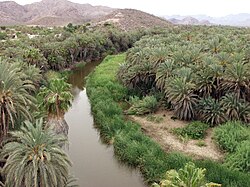
-

-

-

-

-

-

-

-
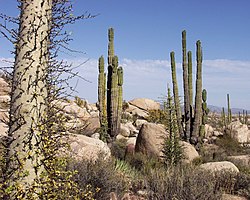


Hydrography


The rivers of Mexico are grouped into three drainage slopes: the Pacific slope, the Gulf slope and the interior slope. The longest of the Mexican rivers is the Bravo, on the Gulf slope. It has a length of 3,034 km (1,885 miles) and serves as the border with the United States. Other important rivers are: the Usumacinta, which carries the largest flow in Mexico and serves as the international border with Guatemala; the Grijalva River, the second largest in flow in the country; both rivers join on the plain of Tabasco, forming the basin with the largest flow in Mexico; and the Pánuco River, to whose basin the Valley of Mexico belongs.
Flowing into the Pacific are the Lerma, Santiago and Balsas rivers, of vital importance for the cities of the Mexican highlands; the Sonora, Fuerte, Mayo, Yaqui and Piaxtla rivers, which sustain the prosperous agriculture of the northwest of the country; and the Colorado River, shared with the United States. The interior rivers, that is, those that do not flow into the sea, tend to be short and of low flow. Notable among them are the Casas Grandes River in Chihuahua and the Nazas, in Durango. Most of Mexico's rivers have little flow, and almost none of them are navigable.
Mexico has numerous lakes and lagoons in its territory, but of modest size. The most important inland body of water is Lake Chapala, in the state of Jalisco, which is at risk of disappearing because of overexploitation. Other important lakes are Lake Pátzcuaro, Zirahuén and Cuitzeo, all of them in Michoacán. In addition, the construction of dams has led to the formation of artificial lakes, such as that of the Mil Islas (Thousand Islands), in Oaxaca.
Biodiversity
Mexico is one of the 17 megadiverse countries of the world. With about 200,000 different species, Mexico is home to 10 to 12 percent of the world's biodiversity.[28] Mexico ranks first in biodiversity of reptiles with 733 known species, second in mammals with 448 species, fourth in amphibians with 290 species, and fourth in flora, with 26,000 different species.[192] Mexico is also considered the second country in the world in ecosystems and the fourth in total species.[193] Approximately 2,500 species are protected by Mexican legislation.[193] The Mexican government created the National Biodiversity Information System, which is responsible for studying and promoting the substantial use of ecosystems.
In Mexico, 170,000 square kilometers are considered "Protected Natural Areas". These include 34 biosphere reserves (unaltered ecosystems), 64 national parks, 4 natural monuments, 26 areas for the protection of flora and fauna, 4 areas for natural protection and 17 sanctuaries (zones with a rich diversity of species).[28]
One of the most striking cases is the reintroduction of the American bison to Mexico. Through ignorance, ranchers managed to exterminate all the bison on the plains of the north of the country; the last native specimen was observed in 1922 in the state of Chihuahua, and for almost a century it was thought in the country that this animal was native to the United States, and there had been no attempts to recover the species. In 2005 the government of the United States donated calves and some specimens to the Mexican government to reintroduce 23 bison (20 females and 3 males) into the wild. These specimens came from the Wyan Cane reserve, South Dakota, for the reintroduction of the American buffalo in the Mexican nature reserve of El Uno in the municipality of Janos, Chihuahua, near the grasslands bordering New Mexico.[194] On May 13, 2010, the first calf of the specimens donated by the government of South Dakota was born on Chihuahuan territory; the genetic studies carried out in both countries published the type of bison that inhabited Mexico until the early 20th century.
- Fauna and flora of Mexico
-

-
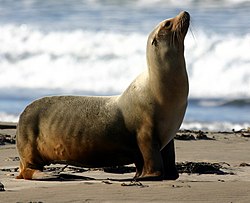
-

-

-

-

-

-

-

-

-
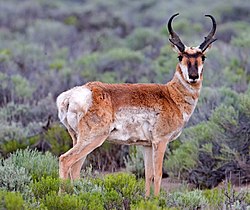
-

-

-

-
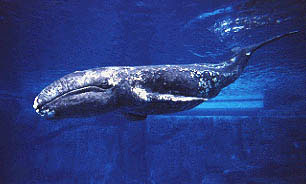
-
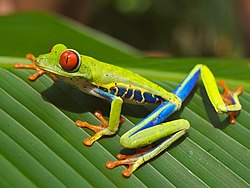
-

-

-
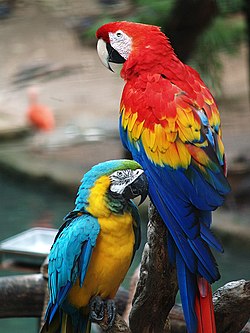
-

-

-

-

-

-

-

-

-

-

-

-

-


Economy

Economic history
During the viceregal era and the 19th century, Mexico was a country devoted to agriculture. Most of its income from foreign sales came from mining, especially of silver. Mexico has ranked first in the world in the production of this mineral for more than two centuries.
The process of industrialization in Mexico during the Viceroyalty and the first century of independent life was extremely slow. Between the 16th and 18th centuries, colonial laws prevented the development of manufacturing in New Spain, as in the rest of the Spanish Empire. Manufactured goods had to be imported from the metropole, which in turn acquired them mostly from the industrialized nations of northern Europe. Throughout the 19th century there were attempts to give the country an industrial base. Governments tried to attract foreign entrepreneurs, without much success. During the 1830s, Lucas Alamán established the Banco de Avío, intended to promote industry. However, all of these attempts bore little fruit.
At the end of the 19th century, during the Porfiriato, the textile industry was the most developed. It had been established in the Puebla Valley, in the region of Orizaba and in the Valley of Mexico. The government of Porfirio Díaz granted great privileges to foreign capital with the intention of attracting direct investment in the construction of communications and transportation infrastructure, and in the growth of the industrial base. However, the benefits went to a few foreigners, while most Mexicans lived in conditions of poverty and exploitation.
In that period of more than thirty years, between 1876 and 1910, the railroad network grew intensively, reaching 20,000 km of track. In addition, the nation's first hydroelectric plant, called Necaxa, was built in Puebla, and the exploitation of oil deposits began, which placed Mexico first in the world in oil exports in the 1910s. It is worth mentioning that the rich oil fields of Faja de Oro and Cerro Azul, located in the north of the state of Veracruz, were brutally depleted by the Standard Oil Company, Royal Dutch Shell and their Mexican subsidiaries, with meager benefit for the Mexican treasury.
After the triumph of the Revolution, a second period of industrial expansion began in Mexico, favored, among other things, by the nationalization of oil and World War II. In the decades following the end of that international conflict, the Mexican economy had a mixed character; that is, investment came from both private enterprise and the State. The strategic sectors were converted into parastatal industries, as was the case with mining, the steel industry, electricity production and road infrastructure. With the intention of favoring technology transfer, the government allowed many international firms to establish subsidiaries in the country, although always in association with national capital. Agriculture, on the other hand, was heavily subsidized by the State, which became the main intermediary for agricultural and livestock products. During the period between 1940 and 1970, Mexico's economy grew at a rate of 6.27% per year, in what came to be called the Mexican Miracle.
However, protectionism and the closing of the Mexican market, as well as the borrowing fever of the 1970s that ended with the debt crisis of the eighties, brought an end to the period of growth of the Mexican economy. In 1983, the country was bankrupt and unable to pay its international debts. Something similar was happening in the rest of Latin America. To get out of the crisis, the government changed its policies and began the period known in Mexico as that of the technocrats, within the framework of neoliberal policies; this period was marked by austerity in social spending, the push given to the privatization of the large parastatal companies (of which only two remain to date: Pemex and the Federal Electricity Commission), and economic growth dependent on exports of manufactured goods (basically to the United States).
| Exports to | Imports from | ||
|---|---|---|---|
| Country | Percentage | Country | Percentage |
| United States | 81.20% | United States | 47.30% |
| Canada | 2.80% | China | 17.70% |
| China | 1.30% | Japan | 4.40% |
| Brazil | 1.00% | South Korea | 3.70% |
| Colombia | 1.00% | Germany | 3.50% |
| Germany | 0.90% | Canada | 2.50% |
| Other countries | 11.80% | Other countries | 20.90% |
| Source: SAT, SE, BANXICO, INEGI, Balanza Comercial de Mercancías de México 2015[195] | |||
| The European Union is disregarded in calculating Others. | |||
The technocratic era has not been free of upheavals. After the presidential handover of 1994, Mexico was plunged into a new crisis, stemming from what former president Salinas de Gortari called "the December mistake". The economy did not recover until three years later. From then on, growth has averaged 4.85% per year, and the average increase in the six-year term of Vicente Fox, which concluded on November 30, 2006. In 2006 the Mexican economy grew by more than 4.5%, the highest figure in the six years of former president Vicente Fox's term, achieved thanks to economic stability, high oil prices and the dynamism of exports and domestic demand.
Macroeconomic results strengthened, with low interest rates and inflation, which averaged between 3.5 and 4%. A favorable factor for Mexico was the so-called oil bonanza, owing to high crude prices, which reached 70 dollars per barrel during that period.
Nevertheless, various analysts criticize the Government for having squandered the extraordinary revenues from the sale of oil and for using them only to balance public spending, to the detriment of investment. The state company Pemex expects total revenues for this year of some 100,000 million dollars from its sales in domestic and foreign markets, which will benefit the treasury by some 70,000 million dollars.
Likewise, the inflow of remittances from Mexicans abroad in 2006 exceeded 20,000 million dollars, a figure higher than that of the previous year and one that exceeds foreign direct investment and revenues from tourism.
Analysts estimate that Gross domestic product growth will reach 4.54% in 2008, a figure that exceeds the increases achieved during the whole of the present year.
Job creation also showed positive results in 2006, with nearly 0.9 million new jobs, a figure which, although it does not cover current demand, is higher than that of previous years, when barely 0.5 million jobs were being created.
Of the 44.4 million people who make up the economically active population, some 18 million have precarious employment or work in the underground economy. The number of unemployed stands at almost two million people.
In addition, 2006 closed with a current account deficit of some 2,600 million dollars and a trade deficit of some 5,700 million dollars.
The Mexican macroeconomy has strengths and weaknesses, and in 2006 it managed to stay afloat thanks to extraordinary revenues from oil and remittances. However, analysts point out that the weaknesses of these foundations may generate greater conflicts, in particular because of the enormous inequalities that exist among the different regions and among social groups.
According to the Secretariat of Finance and Public Credit, foreign debt as of September 2010 was 51,217.4 million dollars,[196][197] while international reserves as of April 17, 2012 amounted to 151,480 million dollars,[198][199] and the country also has a flexible credit line of 72,000 million dollars from the International Monetary Fund, usable in the event of macroeconomic contingencies.[200][201]

Indicators of the Mexican economy
| Agricultural and livestock production of Mexico | ||
| Product | Prod. (t) | 1 |
|---|---|---|
| Avocados | 1,040,390 | 1 |
| Onions and chayotes | 1,130,660 | 1 |
| Lemons and limes | 1,824,890 | 1 |
| Safflower seed | 212,765 | 1 |
| Beef | 79,507 | 2 |
| Nuts | 95,150 | 2 |
| Papaya | 955,694 | 2 |
| Fresh chili peppers | 1,853,610 | 2 |
| Unshelled beans | 93,000 | 3 |
| Oranges | 3,969,810 | 3 |
| Anise and fennel | 32,500 | 3 |
| Chicken meat | 2,245,000 | 3 |
| Asparagus | 67,247 | 4 |
| Mangoes | 1,503,010 | 4 |
| Maize | 20,000,000 | 4 |
| 1World ranking | ||
| Source: FAO (2004)[202] | ||
According to World Bank data, in 2005 Mexico had the highest gross national income per capita in Latin America,[203] as well as the highest Gross National Income in nominal terms in this region that year,[204] consolidating itself as an upper-middle-income country. Meanwhile, the IMF reported that in 2006 it had the second-highest GDP per capita in nominal terms after Chile[205] and the fifth-highest by purchasing power parity[206] at the Latin American level.
In addition, in terms of Gross Domestic Product, the Mexican economy was in 2006 the fourteenth largest in the world in nominal values and the twelfth in purchasing power parity. It thus constitutes the second largest nominal GDP in Latin America, surpassed only by that of Brazil.
However, the distribution of the country's wealth is not equitable and the divide between rich and poor is very large. Even so, the country made an incredible recovery from the last financial crisis unleashed in 1994–1995. Mexico is the tenth largest exporter in the world and has recently been called an "emerging economy", as economies whose growth has been sustained in recent years are termed. The country's economic activity depends to a great extent on its trade with the United States of America, which consumes more than 85 percent of Mexican exports and provides work to almost 10 percent of its population. The sending of remittances by international migrants constitutes the country's second most important source of income after oil.
Since the mid-1980s the country has leaned toward a neoliberal economic model with a strong emphasis on trade opening toward other markets, which has made the country the world leader in free trade agreements, having signed agreements of this type with 40 countries in 12 different treaties. Its main trade partnership is the North American Free Trade Agreement (NAFTA, by its English acronym, or TLCAN), which it signed with the United States and Canada. Mexico also has a free trade agreement with the European Union and with the bloc called EFTA (Luxembourg, Switzerland, Liechtenstein and Norway); more recently a similar commitment was also sealed with Japan.
Mexico is the first country in Latin America to be included in the World Government Bond Index, which recognizes credit rating, liquidity and macroeconomic policies.[207]

Oil

The oil industry in Mexico is entirely controlled (exploration, refining, marketing and export) by the state company Pemex (Petróleos Mexicanos), which is the third largest oil-producing company[209] in the world, the sixth in sales, and the largest company in Hispanic America.
At the end of the 1970s, during the six-year term of then-president José López Portillo, Mexico experienced an oil boom, during which it became the world's fourth largest producer of crude. At that time, Pemex was headed by engineer Jorge Díaz Serrano.
In June 2007, former chairman of the United States Federal Reserve Alan Greenspan warned that the decline in oil production in Mexico could cause a major fiscal crisis, and that Mexico would need to increase investment in the energy sector to avoid it.[210]
In February 2009, the companies De Goyler & McNaughton, Netherland & Sewell and Ryder Scott certified that the Chicontepec complex contains reserves comparable to half of the reserves in Saudi Arabia, which would place Mexico third among the countries with the most oil reserves after Saudi Arabia and Canada; however, Mexico lacks the technology to exploit those reserves.[211]
Tourism
Tourism is an important economic activity for the country and makes it one of the most notable nations worldwide, ranking thirteenth in terms of international tourist arrivals, with 23.4 million visitors in 2011 and 2012, and being the leading destination for foreign tourists within Latin America. In 2005, tourism contributed 5.7% of national revenues from the export of goods and services, and represented 14.2% of direct and indirect jobs in the Mexican economy.[212] Revenues from foreign tourists reached USD 11,270 million in 2009, and the country captured 15.25% of the tourism market segment of the Americas in terms of foreign tourist arrivals, ranking second on the continent, behind only the United States.[213]
Mexico's main tourist attractions are the ancient ruins of the Mesoamerican cultures, the colonial cities and the beach resorts. The country's temperate climate, together with its historical and cultural heritage—the fusion of European culture (particularly Spanish) with Mesoamerican culture—also make Mexico an attractive tourist destination worldwide. The great majority of foreign tourists who visit Mexico come from the United States and Canada. The next most important group are visitors from Europe and Asia. A small number of tourists also come from the countries of Latin America.[214] However, Mexican tourism has generated an important economic spillover for the country, where service providers seek greater outreach to and attention toward domestic tourists, creating new tourist and recreational hubs sponsored by FONATUR, which has taken on the task of studying the preferences and tastes of Mexicans on their days off; communication and transportation routes have been improved and rehabilitated, the busiest airports have been remodeled, telecommunications systems have been updated, credit has been opened for new hotel and service infrastructure, casinos or betting houses have been opened, and sanitation and security have been improved in recreational areas.
In the 2011 ranking of the Travel and Tourism Competitiveness Index (TTCI), which measures the factors that make it attractive to invest or develop business in the travel and tourism sector of a specific country, Mexico reached 43rd place worldwide, ranking first among the countries of Latin America and fourth on the American continent.[215][216]
- Main tourist destinations of Mexico
-

-

-

-

-

-

-

-

-
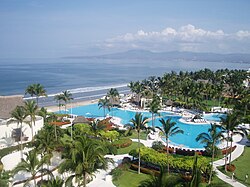
-

-

-

-

-

-

-

-

-

-

-

-

-

-

-

-

-

-

-

-

-


Mexico's Secretariat of Tourism reformulated its economic recovery policies after the great losses suffered in 2009 caused by the global economic crisis and the influenza A (H1N1) problem. In 2010 that agency promoted an international campaign to improve Mexico's image in matters of health and security; it attempted to show that the problems of insecurity are the product of a poor projection of the country's image through local and foreign media, and also of discredit arising from what happened in some places in the country. Among the Mexican government's claims to the outside world are that insecurity and violence are not a quality peculiar to Mexico, but rather that they manifest themselves simultaneously in other nations of the world, and that the crime rate in some Mexican cities does not reflect a generalized picture throughout the country. The aim is to regain the confidence of international tourism and investors, clean beaches to international specifications, invest in eco-tourism and in indigenous communities for sustainable development, seek security measures that protect tourists, and monitor inappropriate behavior by foreigners on Mexican soil with regard to vandalism, drug use, human trafficking and the sexual abuse of minors.[217][218][219]
Owing to complaints from Mexican citizens and tourists in countries of Asia, Central America, South America and Europe over the Influenza A (H1N1) phenomenon, the Mexican government is developing various programs to give greater attention to domestic tourism, in a manner similar to United States policies on tourism. One of these programs is the operation of Mexican cruise ships that tour the islands and main tourist ports of the country, with the aim that Mexicans no longer have to go through tedious procedures to obtain visas or spend money on medical certifications that might prevent them from entering a nation; the cruises must charge fares in national currency and offer all the comforts needed by the most demanding Mexican tourists.[220]
The then secretary of tourism of Mexico City, Alejandro Rojas Díaz Durán, stated that the Mexican capital would become a gay friendly tourist attraction, as is the case in cities of the United States, South America and Europe, so that homosexual couples could hold their marriage, honeymoon and leisure in this city. He emphasized that of the 5,000 million dollars of economic spillover generated by the tourism sector in the city, 8% corresponds to gay tourism, while stating that in Mexico City freedom and tolerance are lived and the rights of all are respected; however, this case has caused strong controversy within Mexican society, and some fear that the same will develop in other tourist cities of the country.[221]
Although mass tourism is the main national income per capita, Mexican authorities seek to attract the attention of educated tourists who are conscious of caring for the environment and culture. The Revillagigedo Islands, also popularly called the Mexican Galápagos, are a new alternative option for tourism; they have been developed with special attention to ecotourism. Because of the fragility and delicacy of the island ecosystem of the Mexican Pacific, service providers limit themselves to running excursions with small groups to contemplate the natural beauty of the islands and the underwater world that surrounds them. Diving and hiking are the activities carried out, following the instructions of the national guard; the vessels that take visitors to these islands set sail from the ports of Manzanillo and Cabo San Lucas.[222][223]
Poverty in Mexico

Mexico uses a more demanding method to measure poverty compared with other countries of Latin America. In addition to using income, the country uses other factors such as the right to education, health services, social security, access to food, quality of and space in housing such as solid floors and roofing and wall materials, and access to basic services such as drainage, electricity, gas or piped water. This is a more truthful and demanding method than that of other countries of the region, which use only income to measure poverty.[224]
In Mexico, 43.6% of all Mexican inhabitants live in poverty, according to the 2016 Measurement of Poverty in Mexico carried out by the National Council for the Evaluation of Social Development Policy (Coneval), which is equal to 53,418,151 people living in poverty. On the other hand, the share of people in extreme poverty is equivalent to 7.6% of all inhabitants, which is the same as 375,581 Mexicans. CONEVAL classifies 22.6% of the Mexican population as neither poor nor vulnerable, according to figures from the same year.[225]
Infrastructure
Energy

In Mexico, power generation is in the hands of a parastatal company, the Federal Electricity Commission (CFE), a body which since October 2009, in an action that generated much controversy, took control of the geographical area (the center of the country) that until then had been administered by the Compañía de Luz y Fuerza del Centro (LFC). The CFE is in charge, as its name indicates, of operating the electricity generating plants and of distribution throughout the national territory. The other company in charge of exploiting energy resources is Petróleos Mexicanos (Pemex), organized into divisions responsible for specific aspects of the oil industry.
The main form of power generation in the country is thermoelectric, which in 2004 produced 23,830 megawatts. Among the most important plants of this type is Los Azufres, in the state of Michoacán, and its infrastructure represented 51.9% of the total. It is followed, at a distance, by hydroelectric power, with a volume of 9,900 megawatts in the same year and 21.6% of the power generation structure. Other types of generation are nuclear-electric, geothermal, coal-fired and wind, which together produce less than 5,000 megawatts.[226] In 2003, average energy consumption per inhabitant in the country was 5.95 megawatts per hour, at a cost of 1.35 Mexican pesos per kWh.
Mexico has an installed capacity to produce 959.50 MW (as of December 2007) of geothermal energy. This represents 3.24% of the total electricity generated in the country. It has the largest geothermal power station in the world, the Cerro Prieto geothermal power plant.[227][228][229]
Dams

According to the National Water Commission, there are more than 4,000 dams in Mexico, of which 667 are classified as large, with a storage volume of more than 150,000 million cubic meters of water.[230] The most important dams are located in the state of Chiapas; La Angostura Dam has the largest reservoir in the country.[230] In terms of electricity generation, Chicoasén Dam is the most powerful in the country, with 2,400 megawatts,[231] and it has one of the tallest dam walls in the world. According to data from the Secretariat of Energy, in 2011 the country generated 35,796 gigawatts through hydroelectric power.[232]
Petrochemicals
In Mexico, oil exploitation is in the hands of the public parastatal company Petróleos Mexicanos (PEMEX), which is one of the main exporters of oil in the world, although it is not a member of OPEC. Its main market is the United States. In 2004 it produced 3,826 million barrels per day, extracted mainly from the coast of the Gulf of Mexico, the coast of Tabasco and the so-called Campeche Sound, an underwater deposit located in the Bay of Campeche. Proven oil reserves in 2005 totaled 12,000,882,000 barrels, which places them fourteenth in the world. Estimates of the approximate life of these deposits are twenty years, if exploitation continues at the current rate.
Transportation
| Transportation statistics in Mexico | |
| Roads | |
|---|---|
| Type | Length (km) |
| Total | 352,072 |
| Dirt tracks | 55,984 |
| Unpaved roads | 22,663 |
| Surfaced | 152,089 |
| Two lanes | 110,367 |
| Four lanes or more | 10,969 |
| Railroads | |
| Total railroad track | 26,662 |
| Airports | |
| Type | Total |
| International | 47 |
| Domestic | 14 |
| Ports | |
| Total | 108 |
| Source: SCT (2004)[233] | |
The total length of the country's road network was 366,095 kilometers in 2008.[234] Of these, one third corresponds to surfaced tracks, and just over 10,000 kilometers corresponds to four-lane highways. Roads in Mexico are classified as federal, which are in the charge of the SCT, are toll-free and make up just over 40,000 kilometers;[235] state highways, which are toll-free and built by the state governments; and toll highways, administered by a consortium called Caminos y Puentes Federales (CAPUFE), which collects the toll revenue that is reinvested in maintaining the highways. Some of these high-speed roads are the most expensive in Mexico, such as the one that links Mexico City with Toluca, capital of the State of Mexico, or the Autopista del Sol, which links Mexico City with the port of Acapulco.

Significant works were recently built with the purpose of speeding up land transportation between the different regions of the country. Perhaps the most emblematic of these works is the Chiapas Bridge, built over the Malpaso Dam on the Grijalva River, which saves up to six hours on the trip from Mexico City to Tuxtla Gutiérrez, the capital of Chiapas.
Most of the railroad network currently serves for freight transport. After the privatization of Ferrocarriles Nacionales de México, the parastatal company formed after the nationalization of this transportation system for the purpose of operating and maintaining the railroad network, the concessionaires devoted themselves exclusively to freight transport, and the network has remained practically without expansion for more than two decades. The country had a total of 17,166 kilometers of railroad track in 2010.[236] The Chihuahua al Pacífico Railway carries passengers, taking advantage of the fact that the route through the Sierra Madre Occidental has important tourist value for its natural landscapes. In the 21st century, Mexico is returning to passenger rail transport because of vehicle traffic congestion; the pilot program of the suburban train of the State of Mexico and the Federal District has led to new plans in other parts of the country, such as the suburban train projects Jardines de Morelos-Reyes-Ecatepec-Martín Carrera,[237] Tula-Buanavista,[238] Pachuca-Buenavista[239] Tlajomulco de Zúñiga-Guadalajara-Zapopan,[240] and the longest suburban train line, Adames-Aguascalientes-Peñuelas, 80 kilometers long, running across the whole state from north to south.[241] Other plans are the interurban trains Guanajuato-Querétaro, Tijuana-Mexicali, Querétaro-San Luis Potosí and Coatzacoalcos-Salina Cruz, which are being studied in order to recover the railroad infrastructure and reduce the transportation time for passengers and goods, for ecological and technological purposes.
Like the rest of the transportation systems, airports and seaports were also privatized during the six-year term of Carlos Salinas de Gortari. In 2010 it was the country with the third most landing strips in the world, after only the United States and Brazil, with 1,819 of these structures.[242] Among the airports, the most important by the number of people who use them and by air traffic are Mexico City International Airport and Cancún International Airport. The former is going through serious saturation problems, and in 2016 the construction of the New Mexico City International Airport was proposed in the federal zone of Lake Texcoco; however, in 2018, after 10% of the work had been completed and after a failed national consultation, in addition to political and environmental issues, President Andrés Manuel López Obrador canceled the work and moved the project to the Santa Lucía air base in Zumpango, State of Mexico, five days before taking the oath of office as president of Mexico.
On February 14, 2007, the Senate of Mexico approved the creation of the Mexican Space Agency, successor to the National Commission of Outer Space, which will be provided with a budget for the creation of its initial facilities.
As with the railroads, most maritime traffic is freight. Mexico has 108 ports, fifty-four on the Gulf and as many on the Pacific. The most important are Veracruz, on the Atlantic coast, and Manzanillo, in the state of Colima on the Pacific coast.
Communications
The communications media in Mexico also passed into the hands of private enterprise starting in the 1990s. Previously they were operated by parastatal companies, such as Teléfonos de México and Telégrafos de México. The Mexican Postal Service remains in the hands of the State. As regards television, there was the Mexican Institute of Television (Imevisión), although from the beginning private parties had the right to concessions. At present, there are three private television companies that take up most of the market (Televisa, TV Azteca and Imagen Televisión). The federal government operates Canal 22 of the Secretariat of Culture, Canal Catorce of the Public Broadcasting System of the Mexican State and Canal Once; the latter through the National Polytechnic Institute, attached to the Secretariat of Public Education. Likewise, the states have the power to operate television stations through decentralized bodies created for that purpose. There are 733 television stations in Mexico, some of them with national coverage.
In radio, there are multiple private companies. The most important of them are headquartered in Mexico City. In many cities of the republic there are local stations. The Federation operates the Mexican Institute of Radio (IMER), and some of its agencies operate other stations, such as Radio Educación, dependent on the Secretariat of Public Education, and the many indigenist radio stations, which depended on the National Indigenist Institute, now converted into the National Commission for the Development of Indigenous Peoples. Several universities also have their own radio stations, among which Radio Universidad Nacional Autónoma de México, of the UNAM, stands out; its coverage reaches almost the entire national territory, and it can be heard on the international band and on the Internet. There are 854 amplitude modulation radio stations and 634 frequency modulation stations in Mexico.
Landline telephone service is operated by a few companies, of which Telmex is by far the largest. Telephone coverage has also been steadily increasing. It is estimated that 80% of Mexican households have a landline telephone, and in many small communities there are community telephone booths. In long distance (national and international), the total time of calls in 2004 amounted to 32,302 million minutes. The number of cell phone users in this year 2007 is approximately 56 million people, served by 13 private companies.
As regards the use of new communication technologies (the Internet), the number of users in Mexico was 40.6 million in 2011.[243] To increase coverage, the government of Mexico has implemented the Plazas comunitarias (Community Plazas) program, which are stations equipped with computers and an Internet connection, established in the most marginalized regions of the country.[244]
Broadcast media
The main private television networks in Mexico are the duopoly of Televisa and TV Azteca. Televisa is also the largest producer of Spanish-language content in the world, mainly of the traditional telenovelas. Grupo Imagen Multimedia is a media conglomerate that owns the third national television network: Imagen Televisión. Grupo Multimedios is another Spanish-language media conglomerate that broadcasts in Mexico, Spain and the United States. Various foreign TV program formats are bought after they prove successful (100 mexicanos dijeron and Qué dice la gente), Big Brother, Operación Triunfo and La Voz... México. National news shows, such as Adela's news on Televisa, resemble a hybrid between Donahue and Nightline (American programs). The border cities receive American television and radio stations.
Mass media
Mexico tops the list of the highest concentration of mass media in the world and ranks third among the OECD countries that offer the most expensive services. In this context, the telecommunications market in Mexico is dominated by Grupo Televisa and Grupo Carso.[245]
Newspapers
In Mexico the newspapers with the largest circulation (in alphabetical order) are El Universal, La Jornada and Diario Reforma, with center, left and right editorial lines, respectively. In the most important states and cities there are local newspapers with greater circulation than the national ones. For example, in the Port of Veracruz, Notiver and Dictamen are published, the latter claiming to be "the dean of the national press". There are widely read popular dailies, such as El Gráfico, Metro and La Prensa. The main sports daily is called Récord, with print runs even higher than those of the general-information dailies. There are also free newspapers that provide a summary of the most important events of the day and are handed out by so-called "volanteros" (flyer distributors). Examples are La Crónica and El Publimetro.[citation needed]
Television
In Mexico, broadcast television stations are operated mostly by the private companies Televisa, Televisión Azteca and Grupo Imagen. There is also the decentralized public body Public Broadcasting System of the Mexican State (SPR). In addition to the private companies, there are other operators, both public and private, with networks of lesser coverage (notably Multimedios Televisión and Canal 13.1 HD of Telsusa), as well as various local operators, including state governments and universities. The programming of the television stations is controlled for broadcast through the General Directorate of Radio, Television and Cinematography, an institute dependent on the Secretariat of the Interior of Mexico, which determines the schedules for the broadcast of recorded material.[246]
The main television networks are shown in the following table:
| Coverage type | Televisa | TV Azteca | Grupo Imagen | Grupo Multimedios | Others | Public television |
|---|---|---|---|---|---|---|
| National[247] | Las Estrellas | Azteca Uno | Imagen Televisión | • | • | Canal Once (and Canal Once Niños)* |
| Canal Catorce | ||||||
| Azteca 7 | Ingenio Tv | |||||
| Canal 22 (and Canal 22.2) | ||||||
| Canal 5 | adn40 | TV UNAM | ||||
| Canal del Congreso | ||||||
| a+ 7.2** | Canal Judicial | |||||
| Regional or limited | Canal 9 | • | Excélsior tv | Multimedios Televisión | Canal 13.1 HD (Telsusa) | State and university public TV |
| Foro TV | MVS tv | |||||
| Televisa Regional*** | Milenio Televisión | El canal de las noticias |
- *Canal Once is rebroadcast through a network of stations owned by the IPN and on several stations of the SPR network.
- **"a+" is a network of TV Azteca stations with a local focus and local programming. However, since they share common programming and identity, it is considered a national network.
- ***Televisa operates a network of local stations known as Televisa Regional, which includes some stations of the "NU9VE" network.
- Even though most of these channels are rebroadcast by the SPR network of stations, they do not achieve national coverage; however, they are considered national because they are produced by federal bodies, and their retransmission by pay TV systems is mandatory.[248]
Radio
There are around 1,585 radio stations in Mexico, of which 5 are shortwave stations (4 are in Mexico City and only 1 is in San Luis Potosí), 852 stations are Amplitude Modulation and 728 stations are Frequency Modulation. The states with the most stations are Sonora and Oaxaca (they have up to 100 stations throughout the state). The state with the fewest radio stations is Tlaxcala (only six).
In some cities of Mexico there are radio groups that occupy all the frequencies for their stations, as in Mexico City, Guadalajara and Monterrey. The three cities of Baja California (Ensenada, Mexicali and Tijuana) also have their respective stations on all frequencies.
Radio in Mexico is diverse in content, but it has been documented that the industry is dominated by approximately seven families that operate radio groups. They are:
- Grupo ACIR: it has a news format called "Información que sirve", a romantic format called "Amor" and a format that broadcasts English-language music called "Mix", among others.
- Grupo Radiorama: a group with more than 300 radio stations in Mexico, which formed alliances with Grupo Fórmula, Televisa Radio and Radio S.A. to link its networks across the whole republic.
- Televisa Radio: formerly known as Grupo Radiopolis; XEW stands out, whose motto is "la voz de América Latina" ("the voice of Latin America"). It is the concessionaire of Ke Buena, Los 40 Principales México and W Radio.
- MVS Radio: it is the concessionaire of a network with coverage of up to 50 cities in Mexico, the network being "Exa FM" (formerly FM Globo), and it also has another format that has existed over the years. This network was known as "Stereorey", but by 2002 it was known as "Best FM", and in 2004 several stations already had another format called "La Mejor FM". They are currently in 23 cities in Mexico but have had poor results with the La Mejor network.
- Grupo Fórmula has two formats that broadcast news to all of Mexico and the United States; its announcers are those who work in television.
- Grupo Radio Centro: this radio group is the concessionaire of 11 radio stations in the Federal District, but it links 130 stations throughout Mexico to broadcast the newscast aired at 1 in the afternoon, among others.
- Mexican Institute of Radio: it is the concessionaire of the first Mexican radio station, XEB, which still broadcasts today under the tutelage of the government. This indicates that it is a public medium. In some states there are state radio networks belonging to the local governments; there are also stations operated by IMER, or stations that broadcast in indigenous communities.
Mobile telephony
Five mobile network operators operate in Mexico, with their respective customer service centers, among them:
- Telcel: With the corporate name Radio Móvil DIPSA, it is a company founded in June 1926 as a distributor of telephone directories. It changed its industry to operate mobile telephony in 1977. It is owned by América Móvil, which in turn belongs to Grupo Carso.
- AT&T Mexico: It was founded in 1987 as Iusacell, originally belonging to Grupo IUSA. Because of the December mistake that devalued the Mexican peso, Iusacell suffered an enormous debt due to its postpaid system. It was bought in 2001 by Vodafone and its subsidiary Verizon Communications. It was owned by Grupo Salinas until 2014, when it was sold to the American company AT&T.
- Unefón: A company founded in 1998 by Ricardo Salinas Pliego that operated independently until 2006, belonging to Grupo Saba. In 2007 it began to use the Iusacell network. Thanks to this, they share the same network and have intercompatible telephone handsets. In essence, Iusacell and Unefón were the same company. After the transition of the former to become AT&T Mexico, Unefón continues to operate as the prepaid brand of the American firm.
- Movistar Mexico: A company founded in 2000, formed through the merger of Cedetel, BajaCel, Norcel, Movitel and Pegaso PCS. It belongs to Grupo Telefónica. Its facilities are located in Monterrey, Nuevo León.
- Virgin Mobile Mexico: It is a mobile virtual network operator that offers mobile telephone services under the Virgin Mobile brand in Mexico. It is part of the Virgin Group conglomerate, owned by British magnate Sir Richard Branson. It began operations in June 2014.
Drinking water and sanitation
Drinking water, sewerage and sanitation services are operated by micro-enterprises that work exclusively with each city of the nation, and which administer storage facilities such as dams, wells and water towers, among others. Although Mexico prides itself on having some of the best drinking water and sanitation utilities in Latin America, it also has some whose performance is poor. Access to, and the efficiency and quality of, water and sanitation services vary greatly from one locality to another, largely reflecting the different levels of development throughout the country. In general, the Mexican water and sanitation sector is marked by the following problems:[citation needed]
- Low technical and commercial efficiency in the provision of services;
- Inadequate quality of water supply services;
- Poor quality of sanitation services, especially with regard to wastewater treatment;
- Insufficient coverage in the poorest rural areas.
Demographics
Throughout the 19th century, the population of Mexico had barely doubled. This trend continued during the first two decades of the 20th century, and the 1920 census even recorded a loss of about 2 million inhabitants. This can be explained by the fact that the Mexican Revolution took place between 1910 and 1920.
The growth rate rose sharply between the 1930s and the 1980s, when the country recorded growth rates above 3% (1950–1980). The Mexican population was doubling every twenty years, and at that pace it was expected that by 2000 there would be 120 million Mexicans. In response, the federal government created the National Population Council (CONAPO), with the mission of establishing birth control policies and conducting research on the country's population. The measures were successful, and the growth rate fell to 1.6 in the period from 1995 to 2000. Life expectancy rose from 36 years (in 1895) to 72 years (in 2000).
The face of the Mexican people also changed. At the beginning of the 20th century, about 90% of the population lived in rural localities (villages, rancherías, hamlets). The 1960 census showed that, for the first time, the urban population was larger than the rural population (50.6% of the total). In 1895, the number of people living in their native state made up 96.6% of the country's total population. In the 1920 census they amounted to just over 90%. Thirty years later they made up 80%, and today just over 18% of Mexicans live outside the state in which they were born. Both trends can be explained by the industrialization of large and medium-sized cities, as well as by the gradual impoverishment of the countryside caused by the recession in agricultural and livestock activities. The federal entities with the largest populations are the State of Mexico, Mexico City, Veracruz, Jalisco and Puebla. By contrast, the least populated are Baja California Sur, Campeche and Quintana Roo. The last of these is one of the states with the highest population growth rates in the country, owing to the tourism industry of Cancún, which is home to 50% of the population of Quintana Roo.
- Indigenous peoples: On the other hand, the population speaking indigenous languages (the only criterion used in INEGI's methodology to count the country's indigenous population) fell from 17% in 1895 to just 7% in 2000. In absolute numbers, however, there was an increase, from just over one million to seven million in the 2000 census. It is the indigenous communities that send out the most emigrants. Until 1980, indigenous emigration was directed mainly toward the medium-sized and large cities near the regions of origin. Beginning in the 1990s, indigenous migration took on an international character, and today it is directed mainly toward the United States.

| Mexicans abroad | |||||||
|---|---|---|---|---|---|---|---|
| No. | Country | Pop. | |||||
| 1 |  United States |
11,500,000 | |||||
| 2 |  Canada |
61,505 | |||||
| 3 |  Spain |
21,107 | |||||
| 4 | Guatemala | 14,481 | |||||
| 5 |  Germany |
9,225 | |||||
| 6 |  Italy |
6,798 | |||||
| 7 |  Brazil |
6,625 | |||||
| 8 |  United Kingdom |
5,297 | |||||
| 9 |  Paraguay |
4,187 | |||||
| 10 |  Costa Rica |
4,131 | |||||
| 11 |  Netherlands |
3,040 | |||||
| 12 | Panama | 2,874 | |||||
- Migration: The United States is the country where the most Mexicans live after Mexico; some of the Mexicans in that country are of indigenous origin because they find better opportunities there than in the rural areas of Mexico. The Mexican presence in its northern neighbor begins with the annexation of the northern half of the country's territory in 1847. Some of the Mexicans who were left on the other side of the border returned to Mexico, but others stayed there (this happened mainly in New Mexico) and preserved their language and customs. They were joined by a good number of braceros, who went to settle in the United States, some temporarily, under a labor agreement between the governments in Washington and Mexico. The most recent economic crises in Mexico have encouraged emigration to the north, and it is estimated that at the beginning of the 21st century, about 38 million Mexicans or descendants of Mexicans lived in the United States. Most of them are concentrated in California, Texas, New Mexico and Illinois. The second destination is Canada, where Mexicans rank 62nd among foreign communities with 36,575[249] Mexicans; the European country with the largest number of Mexicans is Spain, the third destination, which in 2009 had 14,399 Mexican residents, mainly for family, marital and educational reasons; according to the Institute of Mexicans Abroad (2010), the fourth country in the world with the most Mexicans is neighboring Guatemala, with about 11,481 individuals, mainly engaged in business, commercial, industrial and tourism activities; the fifth destination is Germany, the second in Europe with the largest number of Mexican residents: in 2005 there were 7,092 Mexicans, ranking 45th among foreign communities,[250] in 2008 a total of 8,908 Mexicans was recorded,[251] and in 2010 there were 9,225 Mexicans residing in that country, above all in the southern states and in large metropolitan areas. Italy is the sixth destination and one that has grown rapidly in a short time. Other important Mexican communities abroad are those in Brazil, Argentina, the United Kingdom, France, the Netherlands and Japan; recently the Mexican communities in Costa Rica, Panama, the Dominican Republic, Chile, Venezuela and Cuba have been growing. The presence of Mexicans in Paraguay and Bolivia is due to the fact that they are mostly Mexican Mennonites who have decided to emigrate to these countries, which have a large presence of Mennonite communities throughout Latin America.
Metropolitan areas
Metropolitan areas have traditionally been defined as the group of municipalities or cities that interact strongly with one another, usually around a core city.[252] In 2004, in a joint effort by CONAPO, INEGI and SEDESOL, it was agreed to define metropolitan areas as:[252]
- The group of two or more municipalities in which a city with a population of at least 50,000 has an urban area that extends beyond the boundary of the municipality that originally contained the central city, incorporating, either physically or by virtue of its area of direct influence, other adjacent municipalities that have a high degree of social and economic integration or are relevant to urban policy and administration.
- A single municipality in which a city with a population of at least one million is fully contained (that is, it does not extend beyond the boundaries of a single municipality).
- A city with a population of at least 250,000 that forms a conurbation with other cities in the United States.
It should be noted, however, that the northwestern and southeastern states are divided into a small number of large municipalities, while the central states are divided into a large number of smaller municipalities. As such, metropolitan areas in the northwest generally do not extend over more than one municipality, while metropolitan areas in the center extend over many municipalities.
Few metropolitan areas extend beyond the boundaries of a single state: Mexico City, the State of Mexico and Hidalgo; Puebla-Tlaxcala; the Comarca Lagunera (Coahuila and Durango); and Tampico (Tamaulipas and Veracruz).
The following is a list of the main metropolitan areas of Mexico, as reported in the 2010 census.
| Main metropolitan areas of Mexico | ||||||||||
|---|---|---|---|---|---|---|---|---|---|---|
| City | State | Population | City | State | Population | |||||
| 1 | Mexico City | CDMX, Méx, Hgo | 20,116,842 | 11 | San Luis Potosí | San Luis Potosí | 1,040,443 | |||
| 2 | Guadalajara | Jalisco | 4,434,878 | 12 | Mérida | Yucatán | 973,046 | |||
| 3 | Monterrey | Nuevo León | 4,106,054 | 13 | Mexicali | Baja California | 936,826 | |||
| 4 | Puebla | Pue, Tlax | 2,728,790 | 14 | Aguascalientes | Aguascalientes | 932,369 | |||
| 5 | Toluca | State of Mexico | 1,936,126 | 15 | Cuernavaca | Morelos | 924,964 | |||
| 6 | Tijuana | Baja California | 1,751,430 | 16 | Acapulco | Guerrero | 863,431 | |||
| 7 | León | Guanajuato | 1,609,504 | 17 | Tampico | Tamps, Ver | 859,419 | |||
| 8 | Ciudad Juárez | Chihuahua | 1,332,131 | 18 | Chihuahua | Chihuahua | 852,533 | |||
| 9 | La Laguna | Coah, Dgo | 1,215,817 | 19 | Morelia | Michoacán | 829,625 | |||
| 10 | Querétaro | Querétaro | 1,097,025 | 20 | Saltillo | Coahuila | 823,128 | |||
| Source: INEGI[253] | ||||||||||


Most populous municipalities and boroughs
If municipalities are considered as isolated entities unrelated to metropolitan areas, the most populous municipality in the country is Ecatepec, with more than 1,640,000 inhabitants, followed by the municipality of Guadalajara with 1,600,940 inhabitants; Puebla has more than 1,400,000 inhabitants, a figure very similar to that of the municipality of Juárez. Iztapalapa, a territorial demarcation of Mexico City, surpasses the most populous of the municipalities with more than 1.8 million inhabitants.[254] At the opposite extreme are several municipalities in the state of Oaxaca, whose populations do not exceed a thousand people.
Ethnic groups
| Main indigenous groups of Mexico | |
| Group | Population |
|---|---|
| Nahuas | 2,248,270 |
| Maya | 1,403,636 |
| Zapotec | 682,552 |
| Mixtec | 662,363 |
| Otomi | 526,876 |
| Tzeltal | 482,244 |
| Tzotzil | 429,964 |
| Totonac | 377,901 |
| Mazatec | 293,762 |
| Mazahua | 283,005 |
| Source: CDI (2005)[255] | |
Mexico is ethnically diverse. Article 2 of the Mexican Constitution defines the country as a pluricultural nation founded on the principle of the indigenous peoples. The institutional discourse in the construction of the Mexican identity imaginary is based on the idea of the "mestizo nation" or, inspired by the expression of José Vasconcelos Calderón (1925), a "melting pot of all races," which identifies the construction with mestizaje as the basis of homogenization, both cultural and from the ethnic point of view. This idea has been criticized by academic experts in studies on the construction of raciality, who consider it a form of social engineering to determine a racial policy that ends up being exclusionary.[256]

The predominant policy of Mexico's first century of independent life was racist in character. After the triumph of the Revolution, several thinkers considered Mexico to be a culturally mestizo nation, and social policies were then directed at assimilating indigenous particularities into the construction of a new national culture in the republican style. The consequences were a reduction, in absolute and relative terms, of the people who spoke indigenous languages and of the Afro-Mexican peoples.
The language criterion has been used to determine the number of indigenous people in the country. However, this has been criticized, since ethnic identity is not given solely by linguistic identity, as Guillermo Bonfil Batalla pointed out in his work México profundo.
The figures offered by the National Institute of Statistics and Geography (INEGI) and by the National Commission for the Development of Indigenous Peoples (formerly the National Indigenist Institute) (INI) diverge. For the former, the indigenous population is about 6 percent of the total, while the INI presented a population of between 10 and 14 percent. On the commission's website, the figure given is 10,220,000 indigenous people in the country in 2000, which would amount to about 11 percent of the Mexican population. The criteria used by the commission for its calculation include, in addition to the linguistic one, place of origin, the ethnic identity of one or both parents and the individual assumption of indigenous identity, among others.
The commission recognizes only 65 indigenous ethnic groups, distinguished from one another on the basis of the linguistic criterion. The largest, in demographic terms, are the Nahua, the Maya, the Zapotec, the Mixtec, the Otomi and the Purépecha. All of them are descendants of the ancient Mesoamerican peoples. The smallest groups are the Kiliwa, settled in the north of Baja California, and the Lacandon of Chiapas, with barely a few dozen members.
There are also 1,381,853 people of African descent in Mexico (1 in every 100 inhabitants) according to the Encuesta Intercensal 2015 (2015 Intercensal Survey) of INEGI, most of them in communities of the Costa Chica of Guerrero and Oaxaca.[257]
Immigration in Mexico
| Foreign population (2010)[258] | |||||||
|---|---|---|---|---|---|---|---|
| No. | Country | Pop. | |||||
| 1 | United States |
738,103 | |||||
| 2 | Spain[259] |
77,069 | |||||
| 3 | Guatemala | 35,322 | |||||
| 4 |  Colombia |
13,922 | |||||
| 5 | Italy[260] |
13,735 | |||||
| 6 |  Argentina |
13,696 | |||||
| 7 |  Cuba |
10,215 | |||||
| 8 |  Honduras |
10,991 | |||||
| 9 |  Venezuela |
10,063 | |||||
| 10 |  El Salvador |
8,088 | |||||
| 11 | Canada |
7,943 | |||||
| 12 |  France |
7,163 | |||||
| 13 |  China |
6,655 | |||||
| 14 | Germany |
6,214 | |||||
| 15 |  Peru |
5,886 | |||||
| 16 |  Chile |
5,267 | |||||
| 17 | Brazil |
4,532 | |||||
| 18 | South Korea | 3,960 | |||||
| 19 |  Nicaragua |
3,572 | |||||
| 20 | Other countries | 43,799 | |||||


Immigration to Mexico was not massive as in the United States, Canada, Argentina, Brazil or Uruguay, but the country received countless communities from very distant nations, for example from the Asian continent. Immigration to Mexico is rather comparable to that of other Latin American countries such as Peru, Chile, Colombia, Venezuela and Paraguay. Among the main foreign communities with a strong presence in the national territory for many years are the American, Spanish, Portuguese, German, Italian, British, Cuban, French, Chinese, Russian, Lebanese, Jewish, Romani, Japanese, Chilean, Peruvian, Korean, Filipino, Greek, Irish, Swiss, Hungarian, Polish, Syrian and Turkish communities, among others.
Immigration in Mexico has not had an overwhelming impact on the total population compared with other countries, but there has been a considerable increase in the foreign population since Mexico consolidated itself as an independent nation; Mexico has been a country of growing immigration in recent years. Because of Mexico's geographic position, immigrants come to the national territory for family, educational, economic, climatic and cultural reasons and for transit, which has led to foreigners settling throughout the territory. Historically the country has not sought mass immigration, but this has begun to arise suddenly; in previous years it had sought to attract a more selective foreign immigration, to which was added an old tradition of political asylum for religious or ideological persecution; for this reason intellectuals, scientists and artists from other nations reside in Mexico and have contributed to various scientific and artistic fields of the country, alongside the Mexicans who stand out in the same areas.
Mexico is also a country of emigrants, a peculiar case: 75% of emigrants seek the United States as their final destination, and for every ten Mexicans who leave their country, four foreigners enter Mexico, legally and illegally, and decide to remain in the country indefinitely. The National Immigration Institute and INEGI are the only institutions that compile official statistics on foreigners who have had a legal stay of more than six months since entering the country; however, the difficult situation of control at the national borders and customs posts prevents an exact count of the entry of foreigners, their origin and their destination. 80% of the foreigners living in Mexico come from neighboring countries (the United States and Guatemala); other important communities come mainly from Spanish-speaking nations, among which the Spanish, Colombian, Argentine and Cuban communities, among others, stand out; the rest of the immigration comes from various regions of the world. The entity with the largest foreign population is Baja California, followed by Nuevo León, Jalisco, the Federal District, Tamaulipas, Chihuahua, Chiapas, the State of Mexico, Baja California Sur and Sonora.[258]
At the beginning of the 21st century there were important changes in Mexico's policy that led to an increase in foreign residents and naturalized citizens. Mexico has often not been a country of final destination as the United States is, but it has an important geographic and strategic location that has generated bilateral and international relations with the United States and Canada regarding migration control. Globalization, multiculturalism, work and an accelerated rate of human mobility will continue to increase the foreign population, legally and illegally, within Mexican territory.
Violence in Mexico
Mexico is the country that contributes the second-largest number of violent deaths to the total of intentional homicides committed in the world; official statistics of the Mexican National Public Security System estimate the number at 20,824 intentional homicides in 2016. However, the London-based International Institute for Strategic Studies (IISS) disagrees with the figure, as it recorded the deaths of 23,000 people in 2016.[261]
In 2017 Mexico experienced its most violent year, with 25,339 homicides, according to figures from the NGO Citizens' Council for Public Security and Criminal Justice;[262] that NGO's figures differ slightly from those provided by the Executive Secretariat of the National Public Security System (SESNSP), which reports 25,324 intentional homicides.[263]
Religion in Mexico
| Religion in Mexico | |
| Religion | Total population1 |
|---|---|
| Catholic | 96,580,848 |
| Protestant and Evangelical Historical
|
10,996,829 820,744
|
| Non-Evangelical Biblical |
2,537,896 661,878
|
| Jewish | 67,476 |
| Other religions | 1,553,899 |
| No religion | 5,617,945 |
| Not specified | 3,227,330 |
| 1Includes an estimated population of 1,344,585 people corresponding to 448,195 dwellings with no information on occupants at the time of the census. | |
| Source: INEGI, 2010 Census.[264] | |

Mexico is the country with the second-largest number of Catholics in the world, after Brazil.[265][266] Despite this, the Mexican State has been officially secular since the separation between religious institutions and the political administration of the nation was enshrined in the Constitution of 1857, and it was ratified in the Constitution of 1917, which is in force today. José María Morelos stated in his writings that there should be no tolerance for any other religion, and the Constitution of 1824 declared that the official religion of the Republic would be Catholicism; from the second half of the 20th century, a process of introduction of creeds other than Catholicism began.
The 1920s were marked by a religious conflict known as the Cristero War, in which many peasants encouraged by the clergy confronted the federal government, which had decided to enforce the constitutional laws of 1917. Among the measures provided for by the Constitution were the suppression of the monastic orders and the cancellation of all religious worship. The war ended with an agreement between the parties in conflict (the Catholic Church and the State), through which their respective fields of action were defined. Until the mid-1990s, the Mexican constitution did not recognize the existence of any religious group. In 1993 a law was enacted through which the State granted them legal personality as religious associations. This allowed the reestablishment of diplomatic relations with the Holy See, which the Mexican State had not recognized as a political entity.
According to figures from INEGI, most Mexicans declare themselves Christians, the majority of them Catholics (almost 93 million adherents according to the 2010 census).[264] The second Christian group is the Jehovah's Witnesses, who number more than 1 million adherents, making the Mexican congregation of this Christian branch the second largest in the world.[citation needed] In third place is The Church of Jesus Christ of Latter-day Saints, whose members are known as Mormons; it is followed by the Church of La Luz del Mundo, with its world headquarters in Guadalajara. Pentecostal Evangelical denominations also have a significant presence, especially in the border cities and in indigenous communities. In fact, the Pentecostal Evangelical churches together total more than 1.3 million adherents, which in net numbers places them as the second Christian creed in Mexico. The situation changes when the various Pentecostal denominations are considered as separate entities. Other groups are growing, such as the Apostolic Church of the Faith in Christ Jesus, the Mennonites, the Seventh-day Adventists and the Church of God (Seventh Day). Migratory phenomena have led to the proliferation of different branches of Christianity, including historical Protestant branches (such as the Anglican, Presbyterian, Methodist and Baptist Churches), Eastern-rite Christianity and the Orthodox churches.
According to Jacobo Grinberg-Zylberbaum (in texts published by the National Autonomous University of Mexico), the survival of magical-religious rituals of the ancient indigenous groups is notable, not only among present-day indigenous people but also among the mestizos and whites who make up rural and urban Mexican society. There is frequently a syncretism between shamanism and the Catholic tradition. Another popular syncretic religion in Mexico (especially in recent years) is Santería. This is mainly due to the large number of Cubans who settled in the territory after the Cuban Revolution (mainly in states such as Veracruz and Yucatán). Although Mexico also received Black slaves from Africa in the 16th century, the heyday of these cults is relatively new.[267]
The proportion of Catholics varies across different social settings. In cities it tends to be lower, although there are some indigenous regions where members of Protestant creeds reach 30 percent. In some areas of Chiapas, the community of indigenous Muslims even numbers some 5,000 believers. The greatest religious diversity is found in the northern part of the country, bordering the United States, and in the southeast, whose population has a strong indigenous component. The center, and especially the Bajío region, is a region with an almost absolute Catholic predominance; for example, in the state of Guanajuato 93.8 percent declare themselves Catholic, while in Zacatecas 93.4 percent and in Aguascalientes 93 percent are Catholic.[268] The number of people who profess no religion is also significant. They number more than 2 million out of a total of 84 million people over the age of 5 (about 3 percent of the universe covered in INEGI's tabulations).
In certain regions, professing a creed other than Catholicism is seen as a threat to community unity. It is argued that the Catholic religion forms part of ethnic identity, and that Protestants are not willing to take part in traditional practices and customs (the tequio or communal work, participation in patron saint festivals and similar matters). The Protestants' refusal is due to the fact that their religious beliefs do not allow them to take part in the veneration of images. In extreme cases, tension between Catholics and Protestants has led to the expulsion or even the murder of Protestants in several villages. The best-known cases are those of San Juan Chamula,[269][270] in Chiapas, and San Nicolás, in Ixmiquilpan,[271] Hidalgo.

A similar argument was put forward by a committee of anthropologists in 1979 to ask the government of the Republic to expel the Summer Institute of Linguistics (SIL), which was accused of promoting division among indigenous peoples by translating the Bible into vernacular languages and evangelizing in a Protestant creed that threatened the integrity of popular cultures. The Mexican government heeded the anthropologists' call and canceled the agreement it had concluded with the SIL. Conflicts have also arisen in other areas of social life. For example, since Jehovah's Witnesses are forbidden to pay honors to the national symbols (something done every Monday in Mexican public schools), children raised in that religion used to be expelled from public schools. Problems of this kind are only resolved through the intervention of the National Commission on Human Rights, and not always with favorable results for the children.
There are some religious minorities, such as followers of the Muslim faith, who are growing steadily, with an estimated 18,000 believers from countries such as Indonesia, Iraq, Iran, Egypt, Palestine, Lebanon, Morocco, Chile and Spain.[272] The first mosque in Mexico was built in the city of Torreón, Coahuila, under the sponsorship of a Lebanese businessman.[273] The acceptance of the Muslim faith among indigenous communities in San Cristóbal de las Casas is striking; since 1992 there has been an Islamic presence among 500 Tzotzil and Tzeltal indigenous people who after having been Catholics or Evangelicals.[citation needed] Thus began new studies on the abuse of religious leaders within indigenous communities; although Islam did not disappear, greater civil and judicial oversight of these cases began after the expulsion of the Spanish Muslim.[274]
Also recognized is a strong presence, more qualitative than quantitative, of followers of the Jewish religion, estimated at a population of 67,400 individuals, above all in the capital and its metropolitan area (in Polanco, Tecamachalco, Interlomas, Santa Fe, Satélite and the Historic Center), in large urban centers such as Guadalajara and Monterrey, and in some coastal port areas such as Veracruz and Cancún.[275]
In the north of the Republic there are somewhat closed Mormon communities in states such as Chihuahua and Puebla; there is also a strong presence of Mennonites, whose largest concentration is in Ciudad Cuauhtémoc, Chihuahua, although there are also important communities in other cities of the north and southeast of the Republic, as well as in the nation's capital.
In many parts of the country, but more frequently in the cities, there are practitioners of religious confessions other than the traditional variants of Christianity, such as Buddhism (Zen and Tibetan), Hinduism, Sikhism, Sufi Islam, Hare Krishna, Unitarian Universalism, Rastafarianism, pranic healing movements, etc.
The impact of the Catholic religion in Mexico has also brought about a fusion of elements. Beyond churches and religious denominations, there persists in Mexico a phenomenon that some anthropologists and sociologists call popular religion, that is, religion as the people practice and understand it. In Mexico, one of the religious components of everyday life is the Catholic religion, to which elements of other beliefs have been added, whether of pre-Hispanic, African or Asian origin. In general, popular religiosity is frowned upon by institutionally structured religions. One of the most exemplary cases of popular religiosity is the cult of the Santa Muerte. The Catholic hierarchy insists on describing it as a satanic cult. However, most of the people who profess this cult declare themselves Catholic believers and consider that there is no contradiction between the homage they pay to the Niña Blanca (White Girl) and the worship of God. Other examples are the representations of the Passion of Christ and the celebration of the Day of the Dead, which take place within the framework of the Catholic Christian imaginary, but under a very particular reinterpretation of their protagonists.
Languages
| Main native languages of Mexico1 | |
 | |
|---|---|
| Language | Speakers |
| Nahuatl (Nāhuatlahtōlli) | 1,544,968 |
| Maya (Maaya t'aan) | 786,113 |
| Mixtec (Tu'un sávi) | 471,710 |
| Tzeltal (K'op o winik atel) | 445,856 |
| Zapotec (Diidxazá) | 425,123 |
| Tzotzil (Batsil k'op) | 404,704 |
| Otomi (Hñä hñü) | 284,992 |
| Totonac (Tachihuiin) | 244,033 |
| Mazatec (Ha shuta enima) | 223,073 |
| Chol (Ch'ol) | 212,117 |
|
1 Does not include Spanish, spoken by 97% of the population. | |
| Source: INEGI (2010) | |
National languages
The General Law of Linguistic Rights of Indigenous Peoples recognizes Spanish and 67 Mexican indigenous languages as national languages.[276] Spanish is the dominant language in official affairs and is the mother tongue of most Mexicans.
About 7% of the population speaks an indigenous language. The government officially recognizes 67 indigenous languages, grouping together similar varieties that some linguists believe should be considered different languages. Among the indigenous languages, those with the largest number of speakers are Nahuatl and Yucatec Maya; together they total more than two million people. The opposite case is that of Lacandon Maya, whose number of speakers does not reach 100. Even more striking is the case of languages such as Kiliwa, whose speakers are estimated at between 10 and 50 individuals (the information varies according to the different sources), a problem accentuated by the geographic isolation of Kiliwa families;[277] equally significant is the case of the speakers of the Ayapaneco Zoque dialect,[278] of whom, according to recent research, only two individuals are known to remain, who moreover do not use the language, and it is therefore considered extinct. The SEP has established bilingual education systems in indigenous and rural communities because of the need for communication with the Spanish-speaking majority that arose de facto; a considerable percentage of the indigenous population is bilingual or trilingual.
Non-native languages
Because of its proximity to the United States, the presence of English is constant, especially in urban centers, in music and in film; it is also very common in the business environment owing to the economic activities Mexico has with the rest of the world.
Of the languages brought to Mexico by non-Spanish European immigrants, the case of Chipilo Venetian stands out; it is spoken in Chipilo, a town in Puebla founded in 1882 by Italian immigrants. Today almost all the residents of the town use Venetian in their daily activities. Venetian is also heard in Veracruz, in Huatusco and Colonia Manuel González. Mexico has the dialectal variant most similar to the language currently spoken in Venice; moreover, Mexico is among the leading countries in number of Venetian speakers, alongside Italy, Slovenia and Croatia.
Another similar case is that of Plautdietsch (or Plattdeutsch), a language classified as Low Saxon (or "Low German") that is spoken in the Mennonite communities in the states of Chihuahua, Zacatecas, Durango and Campeche.[279]
| Autochthonous languages of Mexico | |
| Language | Mexico |
|---|---|
| Spanish | México |
| Nahuatl | Mexihco |
| Maya | Mexikoo |
| Mixtec | Nuuyo |
| Zapotec | México |
| Otomi | M'onda |
| Tzotzil | Méxiko |
| Tzeltal | Méxiko |
| Totonac | Méjiko |
| Mazahua | B'onro |
| Mazatec | Méjiko |
| Amuzgo | Mejiku |
| Chol | Mexiku |
| Huastec | Labtom |
| Kiliwa | Maay Tay Ñia’k |
| Mixe | Nüviinm |
| Matlatzinca | Intojati |
| Purépecha | Mejiku |
| Tarahumara | Méjiko |
| Tojolabal | Mejiko |
| Yaqui | Mehiko |
| Non-native languages of Mexico | |
| Mennonite German language | Mexiko |
| Chipilo Venetian language | Mésico |
| Sign languages in Mexico | |
| Mexican Sign Language | Mexico in LSM |
| Yucatec Maya Sign Language | Mexico in MSD |
| American Sign Language | Mexico in ASL |
| Spanish Sign Language | Mexico in LSE |
| Braille in Mexico | |
| Spanish Braille | ⠨⠍⠮⠭⠊⠉⠕ |
| English Braille | ⠨⠍⠑⠭⠊⠉⠕ |
| National Indigenist Institute National Institute of Indigenous Languages Summer Institute of Linguistics | |
French is also heard in the state of Veracruz, where there was French colonization, particularly in the towns of Jicaltepec, Perote, San Rafael and Mentidero. Italian is spoken in Zentla, the Riviera Maya, the Baja California Peninsula and Mexico City. Another case is German in the Soconusco area of Chiapas, where German colonies settled, and in the capital of the state of Puebla,[citation needed] since the Volkswagen assembly plant is located there; there is also a presence of German communities in Sinaloa, such as those of Mazatlán and Culiacán.
There is a significant presence of bilingual Spaniards in Mexican territory;[citation needed] this came about during the Spanish Civil War under the governments of former presidents Lázaro Cárdenas del Río and Manuel Ávila Camacho. In recent years new Spanish migrants have arrived, and among them the Catalan speakers stand out as the most numerous, with almost 7,500 bilingual speakers concentrated in Mexico City, Puebla and Quintana Roo, followed by Basque speakers, with almost 5,000 bilingual speakers concentrated in Mexico City, Nuevo León and Colima, and on a smaller scale there are bilingual Galicians, who number some 5,000 speakers in Mexico City, the State of Mexico, Veracruz and Jalisco.[citation needed] These languages can still be learned and taught in Mexico thanks to the efforts of the Spanish embassy: Catalan can be learned at the CELE in the University City of the UNAM or at the Orfeó Català, Basque at the Casa Vasca located in Polanco, and Galician at the centers of La Galleguidad located in Mexico City and in Guadalajara.
The number of Arabic speakers is estimated at more than ten thousand, almost all of them from Lebanon and most of them bilingual. There are also Syrian, Moroccan, Egyptian, Algerian, Palestinian and Iraqi minorities. There is also a high number of speakers of Hebrew, Yiddish and Ladino, since the Jewish community has a large presence in the country, with a total population estimated at more than 50,000 individuals.[280] They are likewise bilingual.
There are also large colonies of Chinese in Mexico City, Mexicali, Tijuana, Ensenada, Rosarito, Tecate, San Felipe and San Quintín; and of Japanese, Koreans and Filipinos, mainly in the capital; where the language of origin and Spanish are spoken.
Apart from Castilian, no other European language is considered a national language, even if its number of speakers were greater than that of some indigenous language. Therefore, they are not taken into account in matters such as public education or the administration of justice.
Sign language
It is estimated that between 87,000 and 100,000 people use Mexican Sign Language,[281] between 400 and 500 Yucatec Maya Sign Language[282] and 13 Tijuana Sign Language.[283]
So far there is no estimate of the number of users of American Sign Language, used by American and Canadian residents, as well as by the children of Mexican immigrants.
Spanish Braille
In 2010, there were a total of 1,292,201 people with some degree of visual impairment (27.2% of all people with disabilities nationwide),[284] so it is believed that only 10 percent of these people read the Spanish Braille alphabet, that is, approximately 130,000. The number of readers of English Braille residing in the country is unknown.
Education


Mexico has one of the oldest educational traditions in the world, dating back to the Mexica Empire, which was the first recorded civilization to impose compulsory universal education for all its citizens,[285] though with differences according to the sex of individuals.[286] Although the Mexica and the Maya already had their own writing, language, art and culture, it was after the Spanish conquest, in the 16th century, that the Spanish language was introduced; in addition, from that century onward, an entire European-style educational system was created, replacing the Aztec system.[285]
The Constitution of Mexico establishes in its third article that the State shall provide preschool, primary, secondary and upper secondary education on a secular, free and compulsory basis;[287] to this end, the Secretariat of Public Education was created on October 3, 1921.[288]
Mexico has one of the highest student-to-teacher ratios in the world, with 26 students per teacher nationwide.[289] The country's students rank 48th among the 65 most developed countries,[290] and third in Latin America, after Chile and Uruguay, according to the PISA report of 2009.[291] According to the Organisation for Economic Co-operation and Development, Mexico ranks last in educational quality, and also has one of the lowest levels of investment as a percentage of GDP, approximately 5% per year. The average Mexican reads half a book per year, and a teacher's salary is 20 times less than that of a legislator.[292]
Levels of illiteracy in the country have fallen significantly over the last 40 years, from 25.8% in 1970 to 8.4% in 2005,[293] which places the country close to achieving the Millennium Development Goals on literacy according to the SEP and UNESCO.[294] The illiterate population was 7.3% in 2010,[295] although it is estimated that there are 33 million (29% of the population) functional illiterates in the country.[296]
On September 21, 1551, the first university in Mexico was created, the Royal and Pontifical University of Mexico, which began its courses on January 25, 1553.[297] On September 22, 1910, the National Autonomous University of Mexico was founded under the name of the National University of Mexico;[298] it is considered the country's foremost institution of higher learning,[299] and it currently counts three Nobel Prize laureates: Octavio Paz (literature), Alfonso García Robles (peace) and Mario J. Molina (chemistry).[300] UNAM is currently considered the second-best university in Ibero-America.[301] In higher education, the National Polytechnic Institute and the Metropolitan Autonomous University in the nation's capital also stand out, while in the interior of the country the University of Guadalajara, the Autonomous University of Nuevo León, the Autonomous University of Puebla, the Tecnológico de Monterrey, the University of Guanajuato, the Universidad Michoacana de San Nicolás de Hidalgo, the Autonomous University of the State of Morelos, the Autonomous University of San Luis Potosí and the Autonomous University of Baja California stand out, all of them ranked among the 100 best in Latin America.[301] The educational model of the technological universities is a link in the Mexican higher education system, the product of studies carried out by the SEP, which compared teaching schemes in Mexico with those used by developed countries.[302] By 2010 there were 123 technological universities throughout the country.[303]
Culture
National symbols

The Mexican National Anthem, the flag of Mexico and the National Coat of Arms of Mexico are the national symbols of Mexico; they represent the identity of the homeland and reinforce a sense of belonging that seeks to unite those who live in the country. This category groups the symbols that the Political Constitution of the United Mexican States recognizes as belonging to the Mexican Nation, which have changed over the course of history.[304]
Mexicanness
In ethnic and cultural terms, the Mexican corresponds solely to everything that refers to Mexica culture; therefore, ethnically, Mexicans are those who are also known as the Nahua peoples and whose language is the Mexican language.[305] There is intense debate over how to define what is Mexican; there are two completely divided strands: the ethnic and cultural one, which focuses exclusively on the Mesoamerican people called the Mexica people, and the legal-administrative strand concerning the territory called Mexico. In legal terms and in accordance with the Constitution, a Mexican is any citizen, man or woman, who was born within the territory of the United Mexican States or who has chosen to adopt Mexican citizenship.
Mexicanness could be that which characterizes the being of Mexico and its people; however, it is an ethnic concept that only defines the mestizo identity that had long been associated with it, and it is limited with respect to the ethnic diversity of the country. It is an intellectual construction resulting from specialists' approaches to the country's cultural reality.[citation needed] In trying to capture the multicultural reality of Mexico in a single figure, the result of the intellectual analysis has produced a series of stereotypes and commonplaces about what it is to be Mexican.[citation needed]
The intellectual construction of the mestizo is in dialogue with the triumph of revolutionary nationalism, which was born after the Revolution of 1910. Those who have taken part in the reflection on the subject (the character of the Mexican, Mexicanness, the definition of what is Mexican) include, among others: José Vasconcelos,[306] Samuel Ramos,[307] Emilio Uranga,[308] José Gaos, Leopoldo Zea, Jorge Portilla, Santiago Ramírez, Salvador Pérez Nevares, Roger Bartra, José del Val, Arturo Warman, Aniceto Aramoni, Rogelio Díaz Guerrero, Ezequiel Adeodato Chávez Lavista, Mauro Rodríguez Estrada and Carlos Chilpa Navarrete.[309] On this specific subject, a privileged place is held by Octavio Paz, author of The Labyrinth of Solitude.
Music
Art music

Some of the best-known Mexican composers of art music are, in alphabetical order:
- Julián Carrillo[310]
- Ricardo Castro
- Sofía Cancino de Cuevas
- Daniel Catán
- Carlos Chávez
- Manuel de Sumaya
- Manuel Enríquez
- Julio Estrada
- Hernando Franco
- Juan Gutiérrez de Padilla
- Luis Herrera de la Fuente
- Federico Ibarra
- Mario Lavista
- Francisco López Capillas
- Arturo Márquez
- José Pablo Moncayo[311]
- Melesio Morales
- Aniceto Ortega
- Gabriela Ortiz
- Manuel M. Ponce
- Silvestre Revueltas[310]
- Juventino Rosas
- Felipe Villanueva
Opera
In the year 1711 the opera La Parténope premiered in Mexico City, with music by Manuel de Sumaya,[312] chapel master of the cathedral alongside Francisco López Capillas and Juan Gutiérrez de Padilla, one of the greatest Mexican Baroque composers. The special importance of this opera is that it is the first composed in North America; this opera marks the beginning of the fertile and still little-studied history of Mexican operatic creation, uninterrupted since then for three hundred years.
The opera Guatemotzín, by Aniceto Ortega, is the first conscious attempt to incorporate native elements into the formal characteristics of opera. Within 19th-century Mexican operatic production, notable works include the opera Agorante, rey de la Nubia by Miguel Meneses, premiered during the festivities commemorating the birthday of Emperor Maximilian I; the operas Pirro de Aragón by Leonardo Canales and Keofar by Felipe Villanueva; and above all the operatic production of Melesio Morales, the most important Mexican opera composer of the 19th century, whose works were very successful with the public of Mexico City and some of which even premiered in Europe. In the first half of the 20th century, prominent figures in Mexican operatic creation include Julián Carrillo, Sofía Cancino de Cuevas and José F. Vásquez, among others; all of them were sidelined by official music historiography, which recognized only the work of the nationalist composers.
Since the end of the 20th century there has been growing interest among composers in writing opera. Among the Mexican composers of the early 21st century who stand out for their operas, mention should be made of Federico Ibarra, Daniel Catán, Víctor Rasgado, Luis Jaime Cortez, Julio Estrada and Gabriela Ortiz, among others.
The dissemination of Mexican opera is almost nil for several reasons, of which two stand out. During the period immediately following the Mexican Revolution, governments made up mostly of people with very little education, and even illiterate ones, ordered the existing opera houses in Mexico City destroyed. The second factor behind the limited dissemination of Mexican operatic culture is that the relevant authorities do not program the works. Even after the end of the Perfect Dictatorship and the restoration of Democracy in Mexico in the year 2000, the cultural authorities have not bothered to amend this policy of neglect of Mexican operatic culture. Finally, there is the lack of an opera house devoted exclusively to the dissemination of Mexican operatic culture; and lastly it must be added that 98% of the music composed in Mexico has never been published, from which it follows that one of the greatest needs is a special program for the recovery, editing and publication of the music of Mexican composers.
Instrumental music and jazz
Some prominent artists have been the trumpeter Rafael Méndez, the keyboardist and composer Juan García Esquivel, the drummer Tino Contreras, the pianist and composer Eugenio Toussaint and the drummer Antonio Sánchez.[citation needed]
Popular and folk music

Mexican music is the result of diverse influences. Very little is known about pre-Hispanic music, although groups claiming that tradition are plentiful throughout the country. The deer dance of the Yaqui Indians of Sonora and the Mayo Indians of Sonora and Sinaloa is one of the few testimonies of pre-Hispanic music that have survived to the present day, both in its instrumentation and in its lyrics; although there are also records of customary sones of other ethnic groups, such as the Tének of San Luis Potosí and their little-jaguar dance, or the Huave of Oaxaca and their turtle sones, etc. Among the pre-Columbian peoples, the only stringed instrument used was the musical bow, and the music was more rhythmic and atmosphere-creating than melodic. The eeneg (monochord), of the chordophone family, is also used by the Komkaak. Among the instruments that were used are the teponaztli and the huehuetl, the former being an idiophone and the latter a membranophone; clay or reed ocarinas and flutes, bone or wooden scrapers, and rattles. After the arrival of the Spaniards, the indigenous people learned European music from the missionaries. Many of the Conquest dances performed in the country's indigenous communities originate from that time, as do certain genres associated with Catholic worship, such as the Matachines dance and the son de Concheros, among others. In Tabasco, in the city of Tenosique, the carnival is held every year, which many say is the strangest in the world, and which begins with the pochó dance. Endemic indigenous music was also strongly influenced by the dances of slaves and of the black maroons, which is most easily appreciated in the music of the indigenous communities of Guerrero, Oaxaca, Chiapas and Tabasco, among others.

Internationally known is the mariachi ensemble, associated with the great figures of Mexican ranchera song, which had its heyday between the 1940s and the 1970s. Originating in western Mexico, specifically in the state of Jalisco, the mariachi was originally a folk and indigenous ensemble, and its attire had nothing to do with that of the charro (that is, the costume of wealthy cattle-ranching hacienda owners). They performed "mariachi sones" until their arrival in Mexico City at the beginning of the 20th century, where they were transformed (and continue to be) and began to play "canciones bravías", corridos and boleros, adapting them to their style. Lucha Reyes was one of the first figures to record hits accompanied by mariachi. In the "Golden Age" of Mexican cinema, mariachis became known to the world through the films of Jorge Negrete and Pedro Infante. With Javier Solís the bolero accompanied by mariachi became fashionable, with Miguel Aceves Mejía the falsetto of the huapango was incorporated, and with José Alfredo Jiménez the provincial values of the poor people in the cities were taken up again. Today, ranchera music accompanied by mariachi continues to have important performers and composers who have crossed national borders, giving rise to a musical genre of its own for which various singers receive awards year after year; among the singers of the moment most recognized for their career and popularity in many parts of the world are Vicente Fernández and Juan Gabriel.
The son is a music in which indigenous, Spanish and African influences, and in some cases even Asian ones, are mixed. It is a genre in 6/8 rhythm whose instrumentation varies from region to region. In addition to the mariachi sones already mentioned, there are the son jarocho, the son huasteco (huapango), the son abajeño and many more. Genres of later appearance are the jarana and the Yucatecan trova, which are cultivated in the Yucatán Peninsula and which received Caribbean influence (especially from the son cubano) and even Andean influence (the Colombian bambuco); and the chilena, originating in the states of Guerrero and Oaxaca; the chilena of the Costa Chica received the influence of the Chilean cueca and the Peruvian marinera.
The jarabe is a continuous succession of sones and dances (something like a Mexican "suite"); the name comes from the time when "boticarios" (apothecaries) made remedies by combining various elements called "jarabes" (syrups). There are the tapatío, Mixtec, del valle, Tlaxcaltec and Michoacán jarabes, etc.

From the beginning of the 20th century until the end of the 1930s, under the influence of late Romanticism, the so-called "canción fina mexicana" (fine Mexican song, a not very clear term) had its heyday; it was very much to popular taste even though it was performed by lyric singers such as Pedro Vargas, Álvaro Carrillo and Nicolás Urcelay. Some of the most notable composers were Agustín Lara, María Grever and Consuelo Velázquez, influenced by the style of Mexican and Italian composers of the late 19th century.
The bolero, which came to Mexico from the Caribbean by way of Yucatán, became one of the public's favorite genres. From the 1940s to the 1960s, many trios of guitars and harmonized voices, such as Los Panchos, were famous. Recently the bolero has regained popularity.
Among the great singers of Mexican folk music are Óscar Chávez, Tehua (María del Rosario Graciela Rayas Trejo), Gabino Palomares, author of the emblematic song La maldición de Malinche, Guillermo Velázquez and Amparo Ochoa, who base their songs on indigenous roots and at the same time compose songs addressing the problems of indigenous cultures. Erasmo Palma is a Rarámuri violinist who has achieved prominence in other countries with his traditional music and songs in his mother tongue and in Castilian.
Other performers of traditional Mexican music are Jaramar, Alejandra Robles, Susana Harp, Geo Meneses and Lila Downs; the latter sings in various languages, mainly Spanish and English. In her musical style she vindicates the roots of the Mexican indigenous peoples, among them the Mixtec, Zapotec, Purépecha, Maya and Nahua, as well as the regional music of Mexico and the world, such as ranchera music, the son, the chilena, Colombian cumbia, the bolero, pop-rock, jazz and bossa nova, among other rhythms and musical genres.
Contemporary popular music


Endogenous music includes mariachi, norteño (grupero), and Durango and Sinaloa banda. Modern music made its appearance in the 1950s, as did the rock and roll movement in Mexico, sung in Castilian as part of the worldwide musical phenomenon. Mexican rock developed through the growing urban culture of the late 1960s, which revolutionized thinking and dance in a free style of expression. Mass events and festivals were born in the 1970s, as in the historic case of the Avándaro festival; from then on, contemporary artistic manifestations were censored and repressed.
Contemporary music, in addition to Mexican rock (or national rock, represented by Maná, El Tri, Molotov, Caifanes, Café Tacvba, Julieta Venegas and Panda, among others), includes heavy metal, electronic music, pop, punk, reggae and alternative music. Hip hop or rap is also widely listened to in Mexico; its main representatives are the group Cartel de Santa, singers such as Pato Machete, C-Kan and MC Davo, and the late Adán Zapata of Mente En Blanco. As part of global multiculturalism, new styles, attitudes and sounds emerged in the 1980s, such as progressive rock fusing symphonic and ethnic instruments, heavy metal, punk, reggae, etc. These came to be combined with Mexican sounds, giving rise to diverse musical manifestations within a single field.
Mariachi in its most commercial form has been modified to give rise to arrangements (mariachi light) and to perform songs more similar to a ballad than to a son or a ranchera song. Its performers are products of the large television companies.
Banda sinaloense music has transformed the traditional "village band" (of brass and winds) into a media and commercial phenomenon, as well as an urban one, owing to the incessant migration of peasants to the large cities. Along with "Banda Sinaloense", the genre most disseminated, according to some musicologists, represents the assimilation of the southern United States, itself "Chicano-ized", and enjoys enormous acceptance throughout the country. It consists of a combination of norteño music with "country" (which some ethnomusicologists claim was born in Coahuila), the ballad of the 1970s, and cumbia, a genre imported and assimilated from Colombia. It emerged during the 1990s with "groups" of performers with Mexican features, dressed as American cowboys, who have been replacing the norteño instruments, the tololoche, redoba and accordion, with the electric bass, drum kit and synthesizer.
Tropical music occupies a large space of popular enthusiasm in several regions of the country, derived mainly from the arrival of tropical rhythms from the island of Cuba from the 1920s onward, popularized in the films of the golden age of Mexican cinema. Thus the cha-cha-cha and the mambo invaded the radio of the 1940s and 1950s, blending into the Mexican idiosyncrasy; Dámaso Pérez Prado composed mambos dedicated to Mexico's largest educational institutions, the UNAM and the IPN, and Sonora Matancera became an icon of Cuba in Mexico. The Mexican musician Tony Camargo is one of the greatest representatives of this music and a pioneer of it in the country; his hit "El año viejo" took him to the top and has remained a classic to this day. However, other tropical rhythms reached the country; the guaguancó and the boogaloo, among others, began to be recorded by Mexican artists, and Sonora Santanera became the most popular by imitating the style of the Cuban orchestras with tropical boleros, among other rhythms. But from the 1960s onward, salsa arrived from other Caribbean countries and also from the United States, and from Colombia came cumbia. All these rhythms together were assimilated by Mexican musical groups, forming the "tropical genre"; its popularity over several decades has led to the formation of local tropical variants that have mixed with Mexican folk music. Examples such as Mexican cumbia are part of this fusion, of which the most successful group in recent years has been Los Ángeles Azules. The sonidero phenomenon and its street dances also derive from this enthusiasm for tropical music in the country.
Dance

The dance of the peoples of Mexico has a sacred understanding of natural phenomena, deities, living beings and the everyday aspects of life. Music or the sound of some object accompanies the bodily movement of the human being to express feeling through the movement of the body. The Deer Dance is a ritual dance performed by the Yaqui and Mayo Indians of the Mexican states of Sinaloa and Sonora. This dance is a dramatization of the hunting of the deer, the cultural hero of these peoples, by the paskolas (hunters).
During the colonial period, Spanish and criollo hacienda owners held magnificent celebrations for Carnival; mestizos and indigenous people were denied access to these celebrations. During the festivities the wealthiest made a show of their riches, wearing clothes laden with ornaments and fabrics.[313] By way of satire, the segregated castes began to make costumes and hold celebrations to parody the whites; for this they used pink masks with a very prominent chin (so as not to be recognized), costumes imitating the sumptuous ones worn by the whites with an exaggerated ornamentation of mirrors, beads and seed beads, as well as conical hats. Among the most notable dances are those of the chinelos in Morelos, the parachicos in Chiapas and the carnivals of Tlaxcala.

During the colonial period the jarabe spread through much of western, central and southeastern Mexico. The reason this name was given both to the dance and to the music that accompanies it is uncertain. It has been suggested, for example, that it is a word of Arabic origin designating happiness or celebration. The possibility has also been raised that the name of the genre comes from its character as a mixture of several musical airs in a single piece. Carnivals are another European cultural legacy with a very marked syncretism of Hispanidad and indigenism; carnivals were the popular expression of troupes and pagan music to manifest the feeling of the people before the start of the Holy Week celebrations. Thus pre-Hispanic roots are shown in the Tenosique Carnival in Tabasco, while the image of the Spanish face is shown in the colonial dances and carnival troupes of the chinelos in Morelos, the huehues in Tlaxcala and the parachicos in Chiapas. Since 1849 the Carnival of Chimalhuacán, one of the oldest in the country, has been held. Other Mexican carnivals of great importance are the Tlaxcala Carnival, which stands out for its Hispanic and indigenous elements.
Of all the Mexican jarabes, perhaps the best known internationally is the jarabe tapatío, originating in Jalisco and performed by the ensemble called mariachi. There are other Mexican jarabes, such as the Michoacán jarabe, the Guerrero jarabe, the Mixtec jarabe or the Mazahua jarabe. During the Porfiriato, rhythms from Europe arrived, such as the polkas and mazurkas danced in Poland and the former Czechoslovakia, which were adapted to the popular dance of the people of northern Mexico; in the Baja California Peninsula the chaveranes, which come from Arkansas in the United States, are danced. The waltz came from Austria and spread among the Mexican society of the time, acquiring an identity of its own in this country. The danzón, the son cubano and the pasodoble were quickly incorporated into the popular dance of Mexicans; orchestras and wind bands accompany the steps of these dances.
Literature

Mexican literature has sheltered diverse writers, both of that nationality and foreigners who, for various reasons, have written and published their works in Mexico. Thus the Mexicans Amado Nervo, Alfonso Reyes, José Juan Tablada, Martín Luis Guzmán, Xavier Villaurrutia, Salvador Novo, Juan Rulfo, Octavio Paz,[314] José Revueltas, Rosario Castellanos, Juan José Arreola, Jaime Sabines, Carlos Monsiváis, Carlos Fuentes, José Agustín, José Emilio Pacheco and Carlos Montemayor have been some of the best exponents of the 20th century and of what has elapsed of the 21st. Alongside them, it is also possible to include the Spanish writer and filmmaker Luis Buñuel and the French novelist Marguerite Duras, who at various times in their lives lived in Mexico and published in Spanish with Mexican publishing houses; in the same way that, in the political sphere, the Marxist theorist Leon Trotsky lived in Mexico City and published his last work. Many of Mexico's great authors have had their work published by the Fondo de Cultura Económica.
In the narrative genre, the writer Joaquín Fernández de Lizardi is considered the author of the first novel in independent Mexico;[315] the most prominent Mexican representatives of this genre in the contemporary period are Juan Rulfo, Juan José Arreola, Carlos Fuentes, Agustín Yáñez, Elena Poniatowska, Fernando del Paso, José Agustín, Rosario Castellanos, Elena Garro, Juan Villoro, Sergio Pitol, Parménides García Saldaña, José Emilio Pacheco, Daniel Sada and Jorge Volpi, among others.[316]
Philosophy
The stages of philosophy in Mexico are subdivided in relation to the history of Mexico and the institutions of the Mexican State, as follows: pre-Columbian thought, colonial thought, 19th-century thought, the Mexican Revolution, and the period of the professionalization of philosophy (from the point at which philosophy reached the universities as a discipline of professional study). Within philosophy in Mexico there is a group of works considered specifically as Mexican philosophy, that which took Mexican social and political reality as its object of study. It is within this group that many of the great Mexican philosophers appear, such as Leopoldo Zea, Luis Villoro, Octavio Paz, Emilio Uranga, Samuel Ramos and José Vasconcelos.[citation needed]
Painting


Painting is one of the oldest arts in Mexico. Rock painting in Mexican territory is some 7,500 years old and has appeared in the caves of the Baja California peninsula. Pre-Hispanic Mexico is present in buildings and caves, in the Mexica codices, in pottery, in attire, and so on; examples include the Maya mural paintings of Bonampak or those of Teotihuacan, Cacaxtla and Monte Albán.
Mural painting flourished significantly during the 16th century, both in religious buildings and in the houses of noble lineages; such is the case of the convents of Acolman, Actopan, Huejotzingo, Tecamachalco and Zinacantepec. It is said that they were mainly painted by indigenous painters directed by friars. These painters also expressed themselves in illustrated manuscripts such as the Codex Mendoza.
For a time it was believed that the first European painter settled in New Spain was Rodrigo de Cifuentes, an apocryphal artist to whom even works such as El bautizo de los caciques de Tlaxcala (The Baptism of the Caciques of Tlaxcala), a painting on the main altarpiece of the former Convent of San Francisco in Tlaxcala, came to be attributed. Among the native painters was Marcos Aquino. The religiosity of the people of New Spain made painting important for the evangelization of society; the friars noticed the graphic skills of the indigenous people, who enriched the Baroque and Mannerist style. Significant was the arrival of numerous European painters and of some pupils from New Spain, such as Juan Correa, Cristóbal Villalpando or Miguel Cabrera, who made walls and altarpieces the artists' main source of ideological and political expression.
19th-century painting had a very marked Romantic influence; landscapes and portraits were the greatest expression of this period. Hermenegildo Bustos is one of the most esteemed painters in the historiography of Mexican art. Also prominent in these years were Santiago Rebull, José Salomé Pina, Félix Parra, Eugenio Landesio and his celebrated disciple, the landscape painter José María Velasco, as well as Julio Ruelas.

20th-century Mexican painting achieved worldwide renown with figures such as David Alfaro Siqueiros, José Clemente Orozco, Joaquín Clausell, Frida Kahlo and Diego Rivera, a generation of idealists who shaped the image of modern Mexico in the face of strong social and economic criticism. The Oaxacan school quickly gained fame and prestige, disseminating an ancestral and modern culture; freedom of design can be observed in the color and texture of the canvases and murals, as a period of transition between the 20th and 21st centuries.
Some of the most prominent painters of the 21st century: Patricia Calvo Guzmán, who studied painting in Beijing; her work, of marked Eastern influence, recalls the cut-paper figures of Mexico and China, mixing them with a rich chromatic range; Eliseo Garza Aguilar, painter and performance artist considered among the main exponents of the provocative and reflective art of the Third Millennium; seeking a critical response from spectators, he combines his pictorial work in performances with theatrical histrionics; Pilar Goutas, a painter who uses oil on amate support, with strong influence from Jackson Pollock and Chinese calligraphy; Rafael Torres Correa settled in Mexico in 2001 and joined the contemporary art workshop "La Polilla" in Guadalajara, where he has carried out various visual-art and set-design projects.
Throughout history, several prominent painters of different nationalities have captured the face of Mexico in their works. Among the most notable are Daniel Thomas Egerton, Carl Nebel, Thomas Moran, Édouard Manet and Leonora Carrington.[317]
Sculpture


Sculpture in Mexico appears solidly in the pre-Columbian Mesoamerican cultures (Maya, Olmec, Toltec, Mixtec, Aztec), generally of a religious nature.
From the Spanish conquest onward, civil and religious sculpture was worked by indigenous artists under the guidance of masters from the Peninsula, which is why some pre-Hispanic features can be seen. From the 17th century, mestizo and criollo sculptors produced works with a marked influence of European classicism.
Romanticism tended to break the strict norms and models of classicism, since it pursued ideas influenced by realism and nationalism. Religious sculpture was reduced to sporadic image-making, while secular sculpture continued in portraits and monumental art of a civic character. Between 1820 and 1880 the predominant themes were, successively: religious images, biblical scenes, allegories of the symbols of the insurgency movement, scenes and figures from pre-Cortesian history, and portraits of the old aristocracy, of the nascent bourgeoisie and of the leaders of the pre-revolution. What was significant was the introduction of civil motifs, the first national types and glimpses of a current of expression of its own.
During the 20th century, great exponents of Mexican sculpture were Juan Soriano, José Luis Cuevas, Enrique Carbajal Sebastián, and Leonora Carrington.
Architecture

The presence of human beings in Mexican territory has left major archaeological finds of the utmost importance for explaining the habitat of primitive man and of contemporary man. The Mesoamerican civilizations achieved great stylistic development and proportion at the human and urban scale; form evolved from simplicity to aesthetic complexity. In the north of the country, adobe and stone architecture appears, with multifamily dwellings such as can be seen at Paquimé, as well as troglodyte dwellings in caves of the Sierra Madre Occidental.
Urbanism developed greatly in the pre-Hispanic cultures, where we can observe the magnitude of the cities of Teotihuacan, Tollan-Xicocotitlan and Mexico-Tenochtitlan; within environmentally integrated urbanism, the Maya cities stand out for the incorporation of their monumental buildings into the density of the jungle and complex networks of roads called sakbés.

With the arrival of the Spaniards, architectural theories of the Greco-Latin order with Arab influences were introduced. Owing to the process of evangelization, when the first churches and monastic convents were built, distinctive models were designed, such as the mendicant monasteries, unique of their kind in architecture. The interaction between Spaniards and indigenous people gave rise to artistic styles such as the one called tequitqui (from Nahuatl: worker or master builder). Years later the Baroque and Mannerism prevailed in great cathedrals and civil buildings, while in rural areas haciendas or seigneurial estates with Mozarabic tendencies were built.
In the 19th century the Neoclassical movement emerged as a response to the objectives of the republican nation; one of its examples is the Hospicio Cabañas, where the strict plastic language of the classical orders is represented in its architectural elements; new religious, civil and military buildings also appeared that demonstrate the presence of Neoclassicism. The Romantics, through a past seen by way of archaeology, displayed images of medieval and Islamic Europe and of pre-Hispanic Mexico in the form of architectural elements in the construction of international fair pavilions, seeking an identity of the national culture's own. Art nouveau and art déco were styles introduced into the design of the Palacio de Bellas Artes to mark the identity of the Mexican nation with Greco-Roman and pre-Hispanic symbolism.

Modern architecture in Mexico has undergone significant development in the plasticity of form and space. José Villagrán García developed a theory of form that set the standard for teaching in many of the country's schools of architecture within functionalism. The emergence of the new Mexican architecture was born as the formal expression of the policies of a nationalist state that sought modernity and differentiation from other nations. Juan O'Gorman was one of the first environmentalist architects in Mexico; he developed the "organic" theory, trying to integrate the building with the landscape along the same lines as Frank Lloyd Wright.[318] In the search for a new architecture that would not resemble the styles of the past, he achieved a combined expression with mural painting and landscaping.
The Jalisco School was a response to those sociopolitical movements that the country demanded. Luis Barragán succeeded in combining the form of space with forms of the vernacular rural architecture of Mexico and of Mediterranean countries (Spain-Morocco), integrating an impressive coloring that handles light and shadow in different tones and opens a view toward international minimalism.
Mexican architecture is a cultural phenomenon born of the ideology of the nationalist governments of the 20th century, which gradually shaped the image of identity through its color and profusion of ornamental elements inherited from ancestral cultures, of classical and monumental forms and, later, the incorporation of modernism and avant-garde trends of an international character.
Cinema

Mexican films from the golden age in the 1940s and 1950s are the greatest examples of Latin American cinema, with an enormous industry comparable to the Hollywood of those years.[320] Mexican films were exported and shown throughout Latin America and Europe. The film María Candelaria (1944) by Emilio Fernández won the Palme d'Or at the Cannes festival. Famous actors and actresses from this period include Dolores del Río, an internationally famous actress of Hollywood silent and sound cinema, the image of Mexican cinema and the pioneer and most important figure of the golden age of Mexican cinema; Pedro Armendáriz, Pedro Infante, Ignacio López Tarso, Lilia Prado, Silvia Pinal, María Félix, Katy Jurado, Jorge Negrete, Fernando Soler, Ninón Sevilla, the silent actors Ramón Novarro and Lupe Vélez, and the comedians Joaquín Pardavé, Cantinflas and Tin Tan. The films of the Golden Age of Mexican cinema make up the majority of the 100 best films of Mexican cinema, a list compiled by the magazine Somos in 1994 with the participation of the most recognized critics of national cinema, such as the writer Carlos Monsiváis and the cinematographer Gabriel Figueroa.
Mention should be made of the Spanish director naturalized Mexican, Luis Buñuel, and his contributions to surrealist cinema: Un Chien Andalou and L'age D'Or, both co-produced with Salvador Dalí and made in France; later, in Mexico, he made Los Olvidados (declared part of the Memory of the World by UNESCO in 2003), which earned him renewed recognition at the Cannes Festival, as well as Subida al cielo, Nazarín and Simón del desierto, which also obtained worldwide recognition through Cannes. In Spain he would make Viridiana, with which he won the Palme d'Or, and he would return to France to film, among others, Le charme discret de la burgeoisie, with which he won the Oscar for best foreign film.
Contemporary Mexican cinema includes notable figures such as the directors Arturo Ripstein and Felipe Cazals, while on the international stage Alejandro González Iñárritu, Guillermo del Toro and Alfonso Cuarón, among others, stand out, as does the cinematographer Emmanuel Lubezki.
Photography
The first Mexican daguerreotypist was named J. M. Díaz González; he was a student at San Carlos and in 1844 opened a studio on Santo Domingo street, Mexico City, where he made oil miniatures and daguerreotypes. Later, once the daguerreotype technique had been superseded, there are records of the use of paper in photography in Mexico from 1851. Prices fell, and the private sphere ceased to be its exclusive space. Photography was also used as political promotion. Following the death of President Benito Juárez, "the firm Cruces y Campa marketed an edition of 20,000 copies of his portrait in carte de visite format". At the beginning of the 20th century, Jesús Hermenegildo Abitia was a studio and outdoor photographer and a cameraman for documentary and fiction films. Agustín Víctor Casasola was a photographer who managed to establish himself as the portraitist par excellence of the ruling class: Porfirio Díaz, Francisco Villa and Huerta, among others. The photographs of Manuel Álvarez Bravo probe into corners, managing to scrutinize what others fail to detect, while the photographer Nacho López was able to carry his scripts and stories over into his photographs. [321]
Gastronomy

In 2005, Mexico submitted the candidacy of its gastronomy as World Heritage of UNESCO, the first time a country had submitted its culinary tradition for that purpose.[323] However, in a first instance the result was negative, as the committee did not place adequate emphasis on the importance of maize in Mexican cuisine.[324] Finally, on November 16, 2010, Mexican gastronomy was recognized as Intangible Cultural Heritage of Humanity.[325]
The origin of present-day Mexican cuisine was established during the Spanish colonization, being a mixture of the foods of Spain and of the native Indians.[326] Of indigenous origin are maize, the chile (known in almost the entire Spanish-speaking world as ají), beans, squashes, avocados, camote, tomatoes, cacao, the guajolote and many more fruits and seasonings. Likewise, some cooking techniques used today are a legacy of the pre-Hispanic peoples, such as the nixtamalization of maize, cooking food in ground-level ovens, and grinding in the molcajete and metate. With the Spaniards came pork, beef and chicken; pepper, sugar, milk and all its derivatives, wheat and rice, citrus fruits and another constellation of ingredients that form part of the everyday diet of Mexicans.
From that encounter between two culinary traditions millennia old were born pozole, mole, barbacoa and tamales in their present forms, chocolate, a varied range of breads, tacos, and the broad repertoire of Mexican antojitos. Beverages were born such as atole, champurrado, chocolate with milk and aguas frescas; desserts such as acitrón (biznaga) and the whole range of crystallized sweets, rompope, cajeta, jericaya and the broad repertoire of delicacies created in convents of nuns all over the country.
Some Mexican beverages have crossed its borders and are consumed daily in Central America, the United States, Canada, Spain and the Philippines; such is the case of agua de Jamaica, rice horchata, agua de raíz, margaritas and tequila itself.
The history of the country and its ties with other peoples allowed the incorporation of other cuisines into Mexican cuisine. The Nao de China, which was in fact a galleon from Manila, brought from the East a range of varied spices and above all rice. A good mole poblano is unthinkable without Mexican-style rice. Arab cuisine reached Mexico indirectly by way of the Spanish conquistadors. The relationship with Latin American countries also left its mark on popular cuisine; perhaps the best-known cases are ceviches and moros con cristianos, indebted to Cuban gastronomy, which have been assimilated and reworked with ingredients native to Mexico.
The invasions left their mark on all of Mexican culture, and cuisine is no exception. The taste for ground beef arrived with the Belgian army of Carlota. Sliced sandwich bread was, according to legend, an invention of the American troops who came to Mexico in 1847. The arrival of immigrants from other latitudes throughout the 19th and 20th centuries also played a part in the construction of Mexican gastronomy. Examples are the Italian cheeses and polenta made today in Chipilo, Puebla; or the French cheeses of Orizaba, as well as their bread, and the German (Mennonite) cheeses of Chihuahua. The English miners of Mexico laid the foundations of the paste, a puff pastry that today is filled as readily with cheese and potatoes as with green mole of pumpkin seeds.
Tortas are sandwiches made with a bread called telera and, like tacos, with various foods such as ham and cheese, al pastor meat, cochinita pibil, or chicken. They are said to have originated during the Reform War, when a way had to be found to distribute food among the Mexican troops.
There are many beverages characteristic of Mexican cuisine: aguas frescas, atoles, chocolate, mezcal, tequila, wine, tepache, charanda, tejuino and beer.
Economic value of Mexican culture
According to a study ("¿Cuánto vale la cultura?", "How much is culture worth?") carried out by the economist Ernesto Piedras, the cultural industries generate 6.7% of Mexico's gross domestic product.[327] The study was presented in 2004 and was published by the National Council for Culture and the Arts. The cultural industries are identified for Mexico as a sector that represents an engine of economic growth and development, surpassed only by the maquila, oil and tourism sectors. In terms of job creation, its share of the economically active population reaches 3.6%. Similarly, the calculation for this sector reports, in terms of foreign trade, a trade balance in surplus and in constant growth.
Mexican Nobel laureates
Mexico has three Nobel Prize laureates:
Cultural heritage
Archaeological zones
In Mexico, according to information from the National Institute of Anthropology and History (I.N.A.H.), in December 2005 there were 37,266 registered archaeological sites in Mexico. Archaeological sites are those where evidence of earlier human occupation has been found, and they do not necessarily correspond to pre-Hispanic sites, although most of them are. For example, in Monterrey, Nuevo León, there is a museum of industrial archaeology. In Mexico City, archaeologists have recovered material remains of a colonial convent that was located on the same site where the Palacio de Bellas Artes now stands. As has been said, there are numerous sites belonging to the pre-Hispanic peoples, thousands of them, although not all are open to the public. The area with the greatest concentration of these sites is the Maya area, followed by Central Mexico and the valleys of Oaxaca.
- Archaeological zones of Mexico
-

-

-

-

-

-

-

-

-

-

-
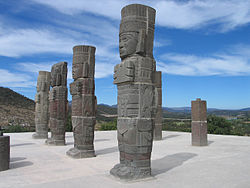
-

-

-

-

-

-

-

-

-
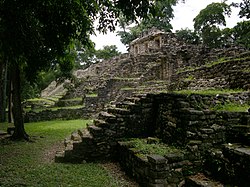
-

-

-

-

-

-

-

-

-

-

-

-

-

-

-

-

-

-

-

-

-

-

-

-

-

-

-

-
 TzinTzunTzan
-

-

-

-


Historical monuments
Mexican law considers historical monuments to be those built between the 16th and 19th centuries, that is, from the arrival of the Spaniards up to the previous century. Both the archaeological zones and the historical monuments are considered heritage of the Mexican nation and are safeguarded by the I.N.A.H. and the National Institute of Fine Arts (I.N.B.A.). The original cores of several important towns and cities of the country form part of the complex of historical monuments, such as Mexico City, Guanajuato, Puebla de Zaragoza, Oaxaca de Juárez and San Francisco de Campeche, all of them also recognized as Cultural Heritage of Humanity by UNESCO. In addition to these large ensembles, there are numerous buildings scattered throughout the country that form part of the I.N.A.H. catalog.[328]
Festivities
| Date | Name | Notes |
|---|---|---|
| January 1 | New Year's Day | |
| February 5 | Anniversary of the promulgation of the Mexican Constitution | Moved to the first available Monday. |
| February 19 | Army Day | Honors the Mexican Army, although the Mexican Air Force and the Mexican Navy have also been included. |
| February 24 | Flag Day | |
| March 18 | Oil Expropriation Day | Commemorates the oil expropriation carried out by President Lázaro Cárdenas |
| March 21 | Birthday of Benito Juárez | Moved to the third available Monday. |
| Varies according to the lunar position | Holy Week | Two weeks of vacation are authorized; the second is not official in the workplace. |
| May 1 | Labor Day | |
| May 5 | Anniversary of the Battle of Puebla | Celebration of the Mexican victory over France. |
| May 10 | Mother's Day | Schools suspend classes; it is not an official day in the workplace. |
| May 15 | Teacher's Day | Teachers across the country have the day off; it is not an official day in the workplace. |
| May 23 | Student's Day | Schools suspend classes or organize events. |
| June 1 | Navy Day | |
| Third Sunday of June | Father's Day | Not an official holiday. |
| September 15 | Anniversary of the Cry of Dolores | |
| September 16 | Anniversary of the beginning of Mexican Independence | The previous day is also celebrated. |
| November 2 | Day of the Dead | The previous day is celebrated, but only this one is a day off. |
| November 20 | Anniversary of the beginning of the Mexican Revolution | Moved to the third Monday of the month. |
| December 1 | Transfer of Federal Executive Power | Only occurs every six years, in election periods. |
| December 12 | Day of the Virgin of Guadalupe | Not an official holiday. |
| December 25 | Christmas | |
| December 31 | New Year | Mexicans usually burn a doll representing the Old Year. |
Science and technology


At the end of the 19th century, the process of industrialization began, which represented great advances in science and technology during the following century. During the 20th century, new research institutes and universities were founded, such as the National Autonomous University of Mexico.
According to data from Scopus, a bibliographic database of abstracts and citations of articles from scientific journals, Mexico ranks 28th in the world in scientific publications, being second in Latin America after Brazil and second among Spanish-speaking countries, after Spain.[330] It also ranks 34th among countries ordered by h-index, with a score of 232.[331] Mexico is one of the countries with the most awards of the UNESCO Science Prize.[332] However, during 2012, Mexico was the OECD country that invested the least in research and development, with approximately 0.47% of GDP.[333]
On April 20, 2010, the Chamber of Deputies approved the initiative for the creation of the Mexican Space Agency; the law was promulgated on July 13, 2010, and was published in the Diario Oficial de la Federación on July 30, 2010.[334]
TITLE: Mexico
Sports
Traditional sports


Charrería is frequently referred to as the national sport of Mexicans.[336] This sport is derived from the tasks of the foremen on cattle haciendas.[337] Its origin dates back to the viceregal era,[338] and the creation of the charro outfit in its definitive form is attributed to Maximilian of Habsburg.[339]
Some sports have their origin in the pre-Hispanic cultures of Mesoamerica. Such is the case of pelota tarasca,[340] pelota purépecha, the pelota mixteca of Oaxaca and the ulama of Sinaloa, all of them linked to the ancient ballgame played by the Mesoamerican peoples.[341] This ballgame dramatized the movement of the heavenly bodies in the firmament, and in theory its present-day descendants do so as well; of course, the defeated teams are no longer sacrificed to the gods. In Chihuahua, the Tarahumara hold ritual races called rarajípara and ariweta. The first is for men and is played in teams that take turns to complete a course of several kilometers through the sierra while kicking a small ball. The second is for women, who must complete the course pushing a hoop.
Although the Secretariat of Public Education includes the teaching of physical education in the schools under its charge, as do the state bodies responsible for instruction, organized sport is not a common activity among the people in the country. The most widespread is perhaps football, although in the north of the country basketball, baseball and softball have a greater presence, the latter two also being very well received in the south of the country; in the south of Mexico City the amateur practice of frontón and Basque pelota is very important and has brought luster to Mexican sport at the international level. With the growing market of both child and youth players, the extreme racquet sport of racquetball enjoys constant development. Figure skating and ice hockey are sports practiced by well-off Mexican youth and show constant growth. Other sports that enjoy great popularity in Mexico are volleyball, which is practiced as one of the basic sports at the school level, as well as American football, which is played in an organized manner in various leagues that are members of the ONEFA.
Professional sports
Football

The most popular and most widespread sport in the country is football or, as it is written and pronounced in the country itself, futbol.[342] The Mexican league is made up of four divisions: the Liga MX,[343] the Liga de Ascenso,[344] the Segunda División,[345] and the Tercera División[346]; in addition to a Women's League.
The senior national football team has taken part in 15 World Cups, its best performances being the quarterfinal stages reached when it was host in 1970 and 1986;[347] it has 10 continental titles in the CONCACAF Gold Cup, being the team with the most titles in the tournament,[348] in addition to holding one international title in the FIFA Confederations Cup in 1999;[349] it has also taken part in the Copa América, where it has been runner-up on two occasions (1993 and 2001) and third place on three occasions.[350] The official stadium for its home games is the Estadio Azteca, home of one of the nationally recognized football teams: Club América, which holds the greatest number of international titles, with ten in total: seven in the CONCACAF Champions League, one in the CONCACAF Giants Cup and two in the Copa Interamericana.[351] In turn, it ranks 14th in the world in terms of the most international titles won.[352]
The Olympic team won the gold medal at the London 2012 Olympic Games, while the under-17 football team was crowned twice in the FIFA U-17 World Cup, at Peru 2005,[353] and Mexico 2011.[354] The under-20 team was runner-up at the World Championship in Tunisia 1977,[355] and third place in Colombia 2011.[356] The beach soccer team took second place at the 2007 World Cup.[357]
Baseball
Note: In the pronunciation and spelling of Mexican Spanish, the variant "beisbol" is used.
Another sport with a great professional tradition is baseball (written and pronounced beisbol locally), which according to the latest surveys is the third most popular sport in Mexico.[358] Baseball is the most popular sport in the northern and southeastern regions. Mexico has several professional leagues, notably the Mexican Baseball League (LMB) and the Mexican Pacific League (LMP). The popularity of the LMB is due to its teams being distributed across almost the entire country; it is the one with the greatest tradition, as it was founded in 1925;[359] it has contributed most of the Mexican ballplayers who reach the Major Leagues, it is affiliated with the Minor Leagues of the United States under the 'AAA' classification, and it has its own talent development academy located in El Carmen, Nuevo León; it is currently made up of 16 teams divided into 2 zones (North Zone and South Zone). The LMP is played in winter, so its season is shorter and it receives some of the ballplayers (Mexican and foreign) who play in the Major Leagues in summer; it is made up of teams from Baja California, Jalisco, Sinaloa and Sonora, and it has national importance because the champion team represents Mexico in the region's biggest baseball event, the Caribbean Series, in which the champions of the leagues of Cuba, Puerto Rico, Dominican Republic and Venezuela also play. This tournament has been won nine times by Mexican teams.
Other recognized leagues in Mexico are the Liga Invernal Veracruzana (LIV), whose champion team represented Mexico in the Serie Latinoamericana,[360][361] the Liga Invernal de Béisbol Nayarita (LIBN), the Liga Norte de México (LNM), the Liga Norte de Sonora (LNS), the Liga Mayor de Béisbol de La Laguna (LMBL), the Liga Estatal de Béisbol de Chihuahua (LEB), the Liga del Norte de Coahuila (LNC), the Liga Invernal Mexicana (LIM), the Liga Peninsular de Béisbol (LPB), the Liga Meridana de Invierno (LMI), the Liga Veracruzana Estatal de Béisbol (LVEB), whose champion team currently represents Mexico in the Serie Latinoamericana,[362] and the Liga Tabasqueña de Béisbol (LTB); these are of a lower level, since most of their players are veterans or developing youngsters who will in the future reach the LMB and the LMP.
At the 2006 World Baseball Classic, the Mexican team gave a pleasant surprise by advancing first in its group, before being eliminated in the next round after losing to Japan and South Korea, but not before eliminating the United States, the host of the event. In the 2009 edition, Mexico hosted the Foro Sol venue in the preliminary round. In the 2017 edition, Mexico again had the opportunity to host in the preliminary round, with the Estadio Panamericano in Zapopan being the venue that hosted the games of Pool D, made up of the national teams of Mexico, Puerto Rico, Venezuela, and Italy.
In the Baseball World Cup, Mexico has 4 silver medals and one bronze, and it hosted the event in the 1951 edition.
Basketball
Note: In the pronunciation and spelling of Mexican Spanish, the variant "basquetbol" is used.

The second most practiced team sport in the country is basketball,[363] (written and pronounced basquetbol in the country itself); however, it is the fourth most popular, after football, boxing and baseball.[358] Currently the most important league in the country in this sport is the National Professional Basketball League (LNBP),[364] and in the women's branch the Liga Mexicana de Baloncesto Profesional Femenil (LMBPF); in addition there are some regional leagues such as the Circuito de Baloncesto de la Costa del Pacífico (CIBACOPA) and the Circuito de Baloncesto del Pacífico (CIBAPAC), which, as their names indicate, are made up of teams from that area, as well as the Liga de Baloncesto del Sureste (LBS), which includes the teams from that part of the country, the Circuito de Básquetbol del Noreste (CIBANE), which, as its name indicates, is made up of teams from that region, the Liga Premier de Baloncesto (LPB) and the Liga de Básquetbol Estatal de Chihuahua (LBE), both based in the state of Chihuahua. These regional leagues take part during the off-season months of the LNBP, which, incidentally, will once again face competition with the imminent return of the Circuito Mexicano de Básquetbol (CIMEBA), which was for a long time the main professional basketball league in Mexico. The greatest success of Mexican basketball is the bronze medal at the Berlin 1936 Olympic Games.
Volleyball
In 2013, the Mexican Volleyball League (LMV) was formed with the endorsement of the Mexican Volleyball Federation (FMVB), and it came into effect in 2014 in both branches, giving rise to the Liga Mexicana de Voleibol Varonil (LMVV) and the Liga Mexicana de Voleibol Femenil (LMVF). This was done with the aim of having both circuits serve as the basis for forming the national teams for the Rio de Janeiro 2016 Olympic cycle, since teams were formed from various parts of the country in order to observe them. However, this was not the first attempt at a professional volleyball league in Mexico, since previously the Liga Premier de Voleibol (LPV) had also been held in both branches.[365] The greatest successes of Mexican volleyball were the gold and silver medals in the women's and men's branches respectively at the 1955 Pan American Games.[366]
American football
Note: In the pronunciation and spelling of Mexican Spanish, the variant "futbol" is used.
In 2016, the Professional American Football League (LFA) was formed with the backing of the Mexican Federation of American Football (FMFA); it came into effect in February of that year with 4 teams, 3 from Mexico City and 1 from the State of Mexico, with its venue at the Estadio Jesús Martínez "Palillo" in the Ciudad Deportiva de La Magdalena Mixiuhca.[367][368] It is currently made up of eight teams, three of them from Mexico City, two from the State of Mexico, one from Coahuila, one from Nuevo León and one more from Puebla.[369][370][371] In addition, in 2018 the Fútbol Americano de México League (FAM) was founded, which is currently made up of five teams from the entities of Chihuahua, Mexico City, the State of Mexico, Jalisco and Querétaro.[372]
In parallel there exists the Organización Nacional Estudiantil de Fútbol Americano, which since 1930, and under different names, has organized national championships in this sport.
Ice hockey
The Mexican Elite Hockey League (LMEH) was inaugurated on October 2, 2010 with the aim of raising Mexican ice hockey to a high international level. This was achieved with the joint participation of private investment and the professional hockey teams already existing in the country.[373] It is currently made up of four teams, all of them from Mexico City.[374]
Basque pelota

Basque pelota has been played in Mexico since approximately 1895 and is represented by the Federación Mexicana de Frontón, A.C. It currently comprises 17 specialties with international participation, and 26 are played in the country in total.
Suffice it to say that a new specialty within pelota, frontenis, arose in Mexico in 1916. Since its beginning, Mexican teams have won in every edition of the 12 World Championships held to date, except Havana 1990.
At present there is a development structure whose base consists of 2 Children's Categories and 3 Youth Categories, made up of athletes between the ages of 8 and 21. A National Championship is held for each Specialty and Category, divided into 3 Phases, thus achieving a total of 120 Annual Events, which also includes the development of the First Division, in some cases the Second and Third, as well as the Veterans; there is a points-based Ranking System which firmly supports us in forming the National Teams and Pre-selections.
The Federación Mexicana de Frontón, A.C. covers two modalities, Doubles and Singles, for the specialties, which are: Cesta Punta (Men's), Cuban Frontón (Men's), Hand Frontón with Hard Ball on Three Walls and in Trinquete (Men's), Pala Corta (Men's), Paleta with Leather Ball on 3 Walls and in Trinquete (Men's), Paleta with Rubber Ball on 3 Walls (Men's) and in Trinquete (Women's and Men's); as well as Frontenis (Women's and Men's).
Mexico City has the largest number of courts for the practice of Basque pelota in the world.[375]
It is the sporting discipline that has brought Mexican sport the most medals and titles in world championships, with a total of 123 medals (50 gold, 41 silver and 32 bronze); half of the gold medals come from the discipline created in Mexico: frontenis.[376] Mexico is one of the three world powers in this sport, along with Spain and France, with whom it always contends for the medal table at the world championships of the specialty. It was an exhibition discipline at the Mexico 1968 Olympic Games and at the Barcelona 1992 Olympic Games. On those occasions Mexico won 2 gold medals and 3 bronze in 1968, as well as 3 gold, 2 silver and 2 bronze in 1992.
Other sports

Boxing and lucha libre likewise enjoy a good reputation and popularity. In the former discipline, Mexican boxers have been world and Olympic champions, such as Salvador Sánchez, Julio César Chávez, José Luis Ramírez, Carlos Zárate, Rubén Olivares, Érik "el Terrible" Morales, among others. Today new world prospects stand out in boxing, such as Saúl "El Canelo" Álvarez and Julio César Chávez Jr. As for lucha libre, it must be said that it is a sport with a large following, full of great legends such as El Santo, the silver-masked one, or his rival Blue Demon; and some wrestlers who are in the middle of their careers, such as Sin Cara and Alberto del Río, although lately the main lucha libre companies have set aside the sporting aspect to turn it into a spectacle, which is no less attractive to the public for that.
Bullfighting is also widely followed, especially in the center of the country, the most important bullring being the Monumental Plaza de Toros de México, better known as the Plaza México.
Other sports practiced in Mexico are horse racing, whose main venue is the Hipódromo de las Américas in Mexico City, and greyhound racing, at the Galgódromo de Agua Caliente in Tijuana and at the Ciudad Juárez track.
Mexico made its first appearance in Olympic skiing at the Sarajevo 1984 Winter Olympic Games, represented by the German-born Mexican Hubertus Von Hohenlohe in the alpine skiing category.[377] The few Mexicans who have competed in the Winter Olympic Games have never won a medal. Skiing in Mexico is considered an elite sport; very few Mexicans practice winter sports because of the lack of publicity and facilities within the country's territory. Ice hockey and ice skating have begun to spread in the national territory, and the first schools and facilities have been forming; at the moment there are only temporary exhibitions with quite young Mexican athletes who are venturing into these sports.
Mexico has hosted the Padel World Championship in 2002, in Mexico City, and in 2010, in Cancún. Mexico also hosted the VIII World Polo Championship 2008.
Motorsports
Among the sports practiced professionally in Mexico is auto racing, whose main venue is the Autódromo Hermanos Rodríguez. Likewise, in recent years official rounds of the official calendar of the World Rally Championship have been held; it is the most important rally-category motor racing competition in the world and has the approval of the FIA (the International Automobile Federation, by its French acronym), and it takes place in the cities of León de los Aldama, Silao de la Victoria and Guanajuato, in the state of Guanajuato. Each year this competition has managed to attract more fans of the category from the country and the world, in addition to generating significant economic spillover for the state.
Since 2015, the Autódromo Hermanos Rodríguez has hosted a Formula 1 race, once again after 23 years of absence.
Mexico's participation in the world
Despite not having a constituted Olympic committee, Mexico took part in the Games for the first time in 1900 in Paris. Three brothers, Manuel, Pablo and Eustaquio Escandón Barrón, took part in the Polo Tournament, obtaining third place in the Grand Prix of the Exposition. This victory is officially considered Mexico's first Olympic medal.[378]
Mexico was the first country in Latin America to host the Summer Olympic Games, in 1968. The opening ceremony was held on October 12, in commemoration of the arrival of Christopher Columbus in the so-called "New World". Among the novelties presented by the Organizing Committee was the fact that the so-called "Olympic flame" was lit for the first time by a woman: Enriqueta Basilio, the gazelle of Baja California, a track athlete. In the Olympic Games, its best showing was precisely on this occasion, when it won nine medals, three of each metal. Perhaps the most remembered of them are those of Felipe "el Tibio" Muñoz, gold in swimming; and that of Sergeant José Pedraza, who won silver in racewalking in a hard-fought race against the Soviets Vladimir Golubnichy and Nikolav Smaga.

Other memorable figures of Mexican Olympism are:
- Joaquín Capilla (diver), the top Mexican Olympic medalist with 4 (1 gold in the 10m platform at Melbourne 1956, 1 silver in the 10m platform at Helsinki 1952 and 2 bronze in the 10m platform and 3m springboard at London 1948 and Melbourne 1956, respectively).
- Humberto Mariles Cortés in equestrianism, who is the only Mexican winner of two gold medals, in the individual jumping and team jumping events at London 1948, in addition to the bronze medal in the team three-day event, which makes him the only Mexican to have won three medals at a single Olympic Games.
- Ernesto Canto, who by winning the gold medal at the world athletics championship in Helsinki 1983 and the gold medal at Los Angeles 1984 became the first Mexican athlete to be Olympic and world champion, in addition to being the only winner of all the official competitions of the so-called Olympic cycle (Central American Games, Pan American Games, World Championship and Olympic Games), by winning gold at Havana 1982 and Caracas 1983.
- María del Rosario Espinoza would be the second to achieve the double crown, with the world championship in Beijing 2007 and the Olympic championship in Beijing 2008, and the second to win all the official competitions, with gold at Mayagüez 2010 and Guadalajara 2011, although unlike Canto, she did not do so in the same Olympic cycle.
Guillermo Pérez, by taking first place in taekwondo, broke the 24-year streak without a men's gold medal since Los Angeles 1984. Among women's achievements are Soraya Jiménez (weightlifter), the first Mexican woman to win a gold medal, at Sydney 2000, and Belem Guerrero, who won an Olympic medal in track cycling at Athens 2004. Another woman with various international achievements is Ana Gabriela Guevara, who in 2002 won the IAAF Golden League in athletics, was the winner of 2 gold medals at the World Cup in Madrid 2002, and won gold at the 2003 World Championships in Athletics in Paris.
On the other hand, Mexico hosted the 1970 FIFA World Cup and also the 1986 FIFA World Cup. The latter had been awarded to Colombia, which could not fulfill the commitment due to an unfortunate natural disaster. In the former, the team of Brazil was crowned champion and kept the Jules Rimet Cup. In 1986, the champion was Argentina. Mexico has also hosted the Pan American Games on 3 occasions: 1955 and 1975 in Mexico City and 2011 in Guadalajara; the Central American and Caribbean Games, in four editions: 1926, 1954 and 1990 in Mexico City and 2014 in Veracruz; and the Universiade of 1979, where it has had notable performances.
Mexico was the first country to organize Olympic Games (1968) and a Football World Championship (1970) within a period of two years (this was later achieved by Germany: Olympic Games in 1972 and 1974 World Cup; the United States: 1994 World Cup and 1996 Olympic Games; and Brazil: 2014 World Cup and 2016 Olympic Games). The Winter Olympic editions in which Mexico has been present are St. Moritz 1928, Sarajevo 1984, Calgary 1988, Albertville 1992, Lillehammer 1994, Salt Lake City 2002 and Vancouver 2010; in the disciplines of Alpine skiing, Bobsleigh, Cross-country skiing, Figure skating and Skeleton.
Mexico has been present at the Summer Paralympic Games in the editions of Heidelberg 1972, Toronto 1976, Arnhem 1980, New York 1984, Seoul 1988, Barcelona 1992, Atlanta 1996, Sydney 2000, Athens 2004, Beijing 2008 and London 2012; and in winter at Turin 2006 and Vancouver 2010. It has attended other sporting events such as the Youth Olympic Games, in their summer edition in Singapore 2010 and winter edition in Innsbruck 2012; and it has also attended several editions of the Chess Olympiads.
See also

- Declaration of Independence of the Mexican Empire
- Constitutive Act of the Mexican Federation
- Flag of Mexico
- Mexican National Anthem
- Pledge to the Flag (Mexico)
- Chemistry in Mexico
- Regions of Mexico
- Rotunda of Illustrious Persons (Mexico)
- Toponymy of Mexico
- Toque de Bandera (Mexico)
References
- ↑ "mexicano". Diccionario de la lengua española (in español). Real Academia Española.
{{cite web}}: Missing or empty|url=(help) - ↑ CIA. "México - Geografía - Libro Mundial de Hechos" (in español). Retrieved January 30, 2017.
- ↑ "EEZ WATERS OF MEXICO". Archived from the original on January 27, 2012. Retrieved January 27, 2012.
- ↑ 4.0 4.1 4.2 4.3 4.4 4.5 4.6 INEGI. "Anuario estadístico y geográfico de los Estados Unidos Mexicanos 2017" (PDF) (in español). Retrieved September 15, 2018.
- ↑ 5.0 5.1 5.2 5.3 INEGI (February 25, 2019). "Producto Interno Bruto de México - 4º Trimestre de 2018 (Incluye cálculo anual)" (PDF). Comunicado de prensa del INEGI (in español). www.inegi.org.mx. Retrieved April 17, 2019.
- ↑ "Informe sobre el desarrollo humano 2017" (PDF). undp.org.
{{cite web}}: Italic or bold markup not allowed in:|publisher=(help) - ↑ 7.0 7.1 "Principales resultados de la Encuesta Intercensal 2018 Estados Unidos Mexicanos" (PDF) (in español). INEGI. Archived from the original (pdf) on December 10, 2015. Retrieved June 28, 2018.
- ↑ INEGI. "México en cifras" (in español). Archived from the original on December 20, 2010. Retrieved May 8, 2015.
- ↑ "México". Diccionario panhispánico de dudas (in español). Real Academia Española.
{{cite web}}: Missing or empty|url=(help) - ↑ Romo, Rafael (November 23, 2012). "After nearly 200 years, Mexico may make the name official". CNN.
- ↑ "About Mexico". Embajada de Mexico en Estados Unidos (Mexican Embassy in the United States). December 3, 2012. Archived from the original on December 2, 2013. Retrieved July 17, 2013.
- ↑ "Official name of the country". Presidency of Mexico. March 31, 2005. Retrieved May 30, 2010.
- ↑ CIA.gov. "CIA World Factbook: México". Retrieved September 15, 2018.
- ↑ "Artículo 44 de la Constitución Política de los Estados Unidos Mexicanos" (PDF) (in español). Retrieved September 15, 2018.
- ↑ Angélica Melín Campos (December 8, 2015). "Aclaran diputados que reforma política del DF no lo convertirá en el estado 32" (in español). Noticias MVS. Retrieved February 10, 2016.
{{cite web}}: CS1 maint: deprecated archival service (link) - ↑ INALI (March 13, 2003). "Ley General de Derechos Lingüísticos de los Pueblos Indígenas" (PDF) (in español). Retrieved November 7, 2010.
- ↑ Ethnologue. "Mexico". Retrieved May 8, 2015.
- ↑ Ethnologue. "Spanish". Retrieved May 8, 2015.
- ↑ Ethnologue. "Summary by country". Retrieved May 8, 2015.
- ↑ Settlement of the Americas
- ↑ "UNWTO Tourism Highlights: 2018 Edition World Tourism Organization". doi:10.18111/9789284419029.
{{cite journal}}: Cite journal requires|journal=(help) - ↑ International Monetary Fund. "Report for Selected Countries and Subjects - Gross domestic product, current prices". Retrieved March 23, 2013.
- ↑ International Monetary Fund. "Report for Selected Countries and Subjects - Gross domestic product based on purchasing-power-parity (PPP) valuation of country GDP". Retrieved March 23, 2013.
- ↑ undp.org. "Informe sobre Desarrollo Humano 2013 El ascenso del Sur: Progreso humano en un mundo diverso" (PDF) (in español). Retrieved March 23, 2013.
- ↑ undp.org. "Indicadores Internacionales sobre desarrollo humano - PNUD" (in español). Archived from the original on April 27, 2013. Retrieved March 23, 2013.
- ↑ Rojas, Laura (March 17, 2013). "El ascenso del sur: la gran oportunidad" (in español). Excelsior. Retrieved May 25, 2016.
- ↑ "Human Development Reports". United Nations Development Programme. 2015. Retrieved July 16, 2018.
- ↑ 28.0 28.1 28.2 "Biodiversidad de México" (in español). SEMARNAT. Archived from the original on October 7, 2007. Retrieved October 7, 2007.
- ↑ Conservation International (2000). "Biodiversity Theme Report". Archived from the original on December 27, 2009. Retrieved March 15, 2010.
{{cite web}}: CS1 maint: numeric names: authors list (link) - ↑ "Artículo 10 de la Constitución Política de la Monarquía Española (Constitución de Cádiz de 1812)" (PDF) (in español). Retrieved August 20, 2018.
- ↑ "Acta solemne de la declaración de la independencia de la América septentrional" (PDF) (in español). Retrieved August 20, 2018.
- ↑ "Decreto Constitucional para la Libertad de la América Mejicana (sic)" (PDF) (in español). Retrieved August 20, 2018.
- ↑ "Plan de Iguala" (PDF) (in español). Retrieved August 20, 2018.
- ↑ "Tratados de Córdoba" (PDF) (in español). Retrieved August 20, 2018.
- ↑ "Acta de Independencia del Imperio Mexicano" (PDF) (in español). Retrieved August 20, 2018.
- ↑ Constitución de los Estados Unidos Mexicanos (1824), passim
- ↑ G. Monzón, Luis (et. al.). "¿República Mexicana o Estados Unidos Mexicanos?" (PDF) (in español). Mexico City: Universidad Nacional Autónoma de México. Retrieved July 6, 2018. Frequently, in popular and even official terms, the term is used interchangeably with the one established by the Constitution. However, its use is historically controversial and at the same time culturally valid and correct.
- ↑ Constitución de la República Mexicana (1857), passim
- ↑ For example, Francisco Xavier Clavijero begins his Historia antigua de México y de su conquista by speaking of the country of Anáhuac in the first chapter, but throughout it he refers interchangeably to the Mexican territory or kingdom of the Mexicans as a broad portion of New Spain that included not only the dominions of the Mexicas, but also Maya and Purépecha territories.
- ↑ Sahagún B. de, Historia general de las Cosas de Nueva España, page 592. Eleventh edition. Porrúa. Mexico
- ↑ "Significado de la palabra "México" | Portal Ciudadano". edomex.gob.mx (in español). Retrieved June 28, 2018.
- ↑ Sahagún B. de, Historia general de las Cosas de Nueva España, page 592. Eleventh edition. Porrúa. Mexico
- ↑ Clavijero 1844, p. 74.
- ↑ Casas y Caballero, 1995: 38.
- ↑ Márquez Morfín y Hernández Espinoza, 2005: 14.
- ↑ Arquelogía Mexicana. "Oasisamérica" (in español). Retrieved February 9, 2019.
- ↑ MacNeish, 1968: t. II.
- ↑ Aveleyra, 1956.
- ↑ Fujita, 2006: 82-98.
- ↑ López Austin y López Luján, 2001.
- ↑ Christian Duverger, 2007.
- ↑ The dates are from Pool, 2007: 10.
- ↑ Thomas, 1993: 115-128
- ↑ Díaz del Castillo, 2007: 15-27
- ↑ Thomas, 1993: 193-210
- ↑ Díaz del Castillo, 2007: 145-148
- ↑ Sahagún, 1999: 702-703.
- ↑ Thomas, 1993: 427-438
- ↑ Díaz del Castillo, 2007: 254-262
- ↑ Díaz del Castillo, 2007: 367-373
- ↑ Sahagún, 1999: 845-848. The exact date of Cuauhtémoc's death is unknown, as is the whereabouts of his remains.
- ↑ Cid Sebastián, 93.
- ↑ Díaz del Castillo, 2007: 541-544
- ↑ Bernabéu Albert, 1994: 171.
- ↑ García Martínez, 2009: 281-288
- ↑ Valdés Lakowski, Vera (1987). De las minas al mar. Historia de la plata mexicana en Asia. 1565-1834 (in español). Fondo de Cultura Económica.
- ↑ García Martínez, 2009: 288-289
- ↑ Jaime González Rodríguez. "Carlos V y la cultura de Nueva España" (HTML) (in español). Universidad Complutense de Madrid. Retrieved April 6, 2008.
- ↑ Manrique, 2009: 440-442
- ↑ Moreno de los Arcos, Roberto. "La inquisición para indios en Nueva España (siglos XVI-XIX)" (PDF) (in español). Retrieved July 21, 2013.
- ↑ García Martínez, 2009: 302-303
- ↑ Pascual Fajardo, 2009.
- ↑ Villoro, 2009: 504-509
- ↑ 74.0 74.1 Villoro, 2009: 511-515
- ↑ Villoro, 2009: 516
- ↑ Villoro, 2009: 519
- ↑ Villoro, 2009: 520
- ↑ Vázquez 2009, p. 529.
- ↑ Vázquez 2009, p. 530.
- ↑ Vázquez 2009, p. 532.
- ↑ Vázquez 2009, p. 538.
- ↑ Vázquez 2009, pp. 544–545.
- ↑ Vázquez 2009, pp. 549–551.
- ↑ Díaz 2009, pp. 590–592.
- ↑ Díaz 2009, pp. 592–595.
- ↑ Díaz 2009, pp. 595–598.
- ↑ Díaz 2009, pp. 615–631.
- ↑ González, 2009: 643
- ↑ González, 2009: 652-656
- ↑ González, 2009: 660-666
- ↑ Ulloa, 2009: 759-762
- ↑ Ulloa, 2009: 774-778
- ↑ Ulloa, 2009: 785-792
- ↑ Ulloa, 2009: 793-799
- ↑ La Primera Crisis de la Globalización - Universidad autónoma metropolitana
- ↑ Decomisa la Sedena Manual político-militar del EZLN
- ↑ "Contabiliza Gobierno federal 15.273 ejecuciones en 2010", Terra, January 12, 2011. Retrieved January 13, 2011.
- ↑ Noticieros Televisa. "Los momentos que marcaron el sexenio de Enrique Peña Nieto" (in español). Retrieved February 9, 2019.
- ↑ Ibero Ciudad de México. "#ANÁLISIS Enrique Peña Nieto y el sexenio que perdimos" (in español). Retrieved February 9, 2019.
- ↑ Instituto Nacional Electoral (2018). "Estadísticas y Resultados Electorales. Elecciones 2018" (in español). Retrieved November 29, 2018.
- ↑ Instituto Nacional Electoral (2018). "Resultados del cómputo a nivel distrito y entidad del Proceso Electoral Federal 2017-2018. Presidencia" (in español). Retrieved November 29, 2018.
- ↑ BBC Mundo (July 2, 2018). "López Obrador gana en México: ¿por qué es histórico el triunfo de AMLO en la elección presidencial mexicana?" (in español). Retrieved February 9, 2019.
- ↑ "Contabiliza Gobierno federal 15.273 ejecuciones en 2010" Archived January 27, 2013, at the Wayback Machine, Terra, January 12, 2011. Retrieved January 13, 2011.
- ↑ Noticieros Televisa. "Los momentos que marcaron el sexenio de Enrique Peña Nieto" (in español). Retrieved February 9, 2019.
- ↑ Ibero Ciudad de México. "#ANÁLISIS Enrique Peña Nieto y el sexenio que perdimos" (in español). Retrieved February 9, 2019.
- ↑ Instituto Nacional Electoral (2018). "Estadísticas y Resultados Electorales. Elecciones 2018" (in español). Retrieved November 29, 2018.
- ↑ Instituto Nacional Electoral (2018). "Resultados del cómputo a nivel distrito y entidad del Proceso Electoral Federal 2017-2018. Presidencia" (in español). Retrieved November 29, 2018.
- ↑ BBC Mundo (July 2, 2018). "López Obrador gana en México: ¿por qué es histórico el triunfo de AMLO en la elección presidencial mexicana?" (in español). Retrieved February 9, 2019.
- ↑ Carlos Betancourt Cid. "México contemporáneo — Cronología (1968-2000)" (PDF). INEHRM (in español). Retrieved October 14, 2023.
- ↑ Alejandro Páez Varela, Álvaro Delgado, Héctor Alejandro Quintanar y Fabrizio Mejía Madrid (September 23, 2024). "AMLO: avances, pendientes: ¿Salud, seguridad, educación? ¿Qué deja el sexenio y qué queda a deber?". Sin Embargo (in español). Archived from the original on October 7, 2024. Retrieved October 1, 2024.
{{cite web}}: CS1 maint: multiple names: authors list (link) - ↑ Alonso Urrutia (September 30, 2024). "Cierra el sexenio con economía estable y política social sólida". La Jornada (in español). Retrieved October 1, 2024.
- ↑ Daniel Pardo (September 30, 2024). "3 asignaturas pendientes que deja AMLO al abandonar la presidencia de México (y qué propone Sheinbaum para solucionarlas)". BBC Mundo (in español). Retrieved October 1, 2024.
- ↑ "Artículo 39 de la Constitución Política de los Estados Unidos Mexicanos" (PDF) (in español). Retrieved August 31, 2018.
- ↑ "Artículo 40 de la Constitución Política de los Estados Unidos Mexicanos" (PDF) (in español). Retrieved August 31, 2018.
- ↑ "Artículo 41 de la Constitución Política de los Estados Unidos Mexicanos" (PDF) (in español). Retrieved August 31, 2018.
- ↑ "Artículo 49 de la Constitución Política de los Estados Unidos Mexicanos" (PDF) (in español). Retrieved August 31, 2018.
- ↑ Carbonell and Salazar, 2006: 125.
- ↑ "Constitución política de los Estados Unidos Mexicanos, Título tercero, Capítulo III, del Poder Ejecutivo, Artículo 80" (PDF) (in español). Retrieved November 8, 2017.
- ↑ "Ley Orgánica de la Administración Pública Federal" (PDF) (in español). Retrieved November 8, 2017.
- ↑ "Ley Orgánica del Ejército y Fuerza Aérea Mexicana, Artículo 11" (PDF) (in español). Retrieved November 8, 2017.
- ↑ Myers Gallardo, Alfonso (2017). "Reelección en México ¿dónde estamos? ¿a dónde vamos?". In Lugo, Alberto y Cienfuegos, David (ed.). Cien años de evolución constitucional. Retos y dilemas de la Constitución mexicana (PDF) (in español). México, Cámara de Diputados: Tirant lo Blanch. p. 259-278. ISBN 978-84-9143-935-6.
{{cite book}}: CS1 maint: multiple names: editors list (link) - ↑ "Constitución política de los Estados Unidos Mexicanos, Título tercero, Capítulo III, del Poder Ejecutivo, Artículo 81" (PDF) (in español). Retrieved November 8.
{{cite web}}: Check date values in:|access-date=(help) - ↑ "Constitución política de los Estados Unidos Mexicanos, Título tercero, Capítulo III, del Poder Ejecutivo, Artículo 86" (PDF) (in español). Retrieved November 8, 2017.
- ↑ "Constitución política de los Estados Unidos Mexicanos, Título tercero, Capítulo III, del Poder Ejecutivo, Artículo 89" (PDF) (in español). Retrieved November 10, 2017.
- ↑ "Artículo 50 de la Constitución Política de los Estados Unidos Mexicanos" (PDF) (in español). Retrieved July 20, 2018.
- ↑ "Artículo 73 de la Constitución Política de los Estados Unidos Mexicanos" (PDF) (in español). Retrieved July 20, 2018.
- ↑ "Artículo 74 de la Constitución Política de los Estados Unidos Mexicanos" (PDF) (in español). Retrieved July 26, 2018.
- ↑ "Los órganos constitucionales autónomos y sus designaciones" (in español). Retrieved July 26, 2018.
- ↑ "Artículo 76 de la Constitución Política de los Estados Unidos Mexicanos" (PDF) (in español). Retrieved July 26, 2018.
- ↑ "Artículo 49 de la Constitución Política de los Estados Unidos Mexicanos" (PDF) (in español). Retrieved July 26, 2018.
- ↑ "Artículo 94 de la Constitución Política de los Estados Unidos Mexicanos" (PDF) (in español). Retrieved July 26, 2018.
- ↑ "Ley Orgánica del Poder Judicial de la Federación" (PDF) (in español). Retrieved July 27, 2018.
- ↑ "Artículo 94 de la Constitución Política de los Estados Unidos Mexicanos" (PDF) (in español). Retrieved July 27, 2018.
- ↑ "Artículo 94 de la Constitución Política de los Estados Unidos Mexicanos" (PDF) (in español). Retrieved July 27, 2018.
- ↑ "Artículo 10 de la Ley Orgánica del Poder Judicial de la Federación" (PDF) (in español). Retrieved July 27, 2018.
- ↑ Suprema Corte de Justicia de la Nación. "Conoce la Corte: ¿Qué es la Suprema Corte Justicia de la Nación?" (in español). Retrieved July 28, 2018.
- ↑ "Artículos del 115 al 121 de la Constitución Política de los Estados Unidos Mexicanos" (PDF) (in español). Retrieved July 26, 2018.
- ↑ "Artículo 76 de la Constitución Política de los Estados Unidos Mexicanos" (PDF) (in español). Retrieved July 26, 2018.
- ↑ "Artículo 105 de la Constitución Política de los Estados Unidos Mexicanos" (PDF) (in español). Retrieved July 20, 2018.
- ↑ "Artículo 115 de la Constitución Política de los Estados Unidos Mexicanos" (PDF) (in español). Retrieved July 26, 2018.
- ↑ "Texto original y reformas al artículo 122 constitucional" (PDF) (in español). Retrieved August 31, 2018.
- ↑ "Texto original y reformas al artículo 44 constitucional" (PDF) (in español). Retrieved August 31, 2018.
- ↑ "Artículo 43 de la Constitución Política de los Estados Unidos Mexicanos" (PDF) (in español). Retrieved August 20, 2018.
- ↑ Instituto Federal Electoral. "Historia del Instituto Federal Electoral" (in español). Archived from the original on May 27, 2012. Retrieved June 22, 2012.
- ↑ Instituto Federal Electoral. "Estudio sobre abstencionismo en México" (in español). Retrieved June 22, 2012.
- ↑ La Jornada. "De la Madrid me ordenó no informar que Cárdenas iba ganando, asegura Bartlett" (in español). Retrieved June 22, 2012.
- ↑ Instituto Federal Electoral. "Estados" (in español). Archived from the original on June 22, 2012. Retrieved June 22, 2012.
- ↑ Instituto Nacional Electoral. "Partidos políticos nacionales con registro ante el INE" (in español). Retrieved September 15, 2018.
- ↑ "Artículo 94 de la Ley General de Partidos Políticos" (PDF) (in español). Retrieved September 15, 2018.
- ↑ "Artículo 89 (Párrafo X) de la Constitución Política de los Estados Unidos Mexicanos" (PDF) (in español). Retrieved September 15, 2018.
- ↑ Diplomáticos escritores. "La Doctrina Estrada y el Principio de la No intervención" (PDF) (in español). Retrieved September 27, 2018.
- ↑ Edmundo Hernández Vela - Revista digital de la SRE. "La Doctrina Carranza en el umbral de una nueva sociedad internacional" (PDF) (in español). Retrieved September 27, 2018.
- ↑ Various authors (2011). Historia de las relaciones internacionales de México, 1821-2010 (in español). México: Dirección General de Acervo Histórico - Secretaría de Relaciones Exteriores. ISBN 978-607-446-024-7.
{{cite book}}:|access-date=requires|url=(help) - ↑ De Rosenzweig Díaz, 1982.
- ↑ Revista Mexicana de Política Exterior. "Marco histórico de la política exterior mexicana" (PDF) (in español). Retrieved September 27, 2018.
- ↑ Las relaciones diplomáticas de México (in español). México: Plaza y Valdés Editores. 2001. ISBN 968-36-8090-9.
{{cite book}}:|access-date=requires|url=(help);|first=missing|last=(help) - ↑ Secretaría de Relaciones Exteriores. "Embajadas de México en el exterior" (in español). Retrieved September 27, 2018.
- ↑ Embajadas.com. "Directorio de Embajadas y Consulados en México" (in español). Retrieved September 27, 2018.
- ↑ Universidad Autónoma de Nuevo León. "Directorio de Consulados y Embajadas en México" (in español). Retrieved September 27, 2018.
- ↑ Secretaría de Relaciones Exteriores. "Registro de Misiones extranjeras en México" (in español). Retrieved September 27, 2018.
- ↑ Secretaría de Relaciones Exteriores. "Registro de Misiones extranjeras en México" (in español). Retrieved September 27, 2018.
- ↑ "Ley de Seguridad Nacional" (PDF) (in español). January 31, 2005. Retrieved September 20, 2018.
Updated edition with the reforms in force published as of December 26, 2005
- ↑ "Artículo 76 de la Constitución Política de los Estados Unidos Mexicanos" (PDF) (in español). Retrieved September 20, 2018.
- ↑ "Artículo 89 de la Constitución Política de los Estados Unidos Mexicanos" (PDF) (in español). Retrieved September 20, 2018.
- ↑ "Artículo 73 de la Constitución Política de los Estados Unidos Mexicanos" (PDF) (in español). Retrieved September 20, 2018.
- ↑ "Artículos 29 y 30 de la Ley de Orgánica de la Administración Pública Federal" (PDF) (in español). December 29, 1976. Retrieved January 3, 2019.
Updated edition with the reforms in force published as of November 30, 2018
- ↑ "Ley Orgánica del Ejército y Fuerza Aérea Mexicanos" (PDF) (in español). December 26, 1986. Retrieved September 20, 2018.
Updated edition with the reforms in force published as of June 21, 2018
- ↑ "Ley Orgánica de la Armada de México" (PDF) (in español). December 30, 2002. Retrieved September 20, 2018.
Updated edition with the reforms in force published as of June 19, 2017
- ↑ "Artículo 1º Ley Orgánica del Ejército y Fuerza Aérea Mexicanos" (PDF) (in español). December 26, 1986. Retrieved September 20, 2018.
Updated edition with the reforms in force published as of June 21, 2018
- ↑ "Ley Orgánica de la Armada de México" (PDF) (in español). December 30, 2002. Retrieved September 25, 2018.
Updated edition with the reforms in force published as of June 19, 2017
- ↑ "Presupuestos de Egresos de la Federación 2019: Analítico de Plazas y Remuneraciones: Ramo 07 Defensa Nacional" (PDF) (in español). México: Secretaría de Hacienda y Crédito Público. January 1, 2019. Retrieved January 3, 2019.
According to the level code, series EM0200 to EM2000 are considered military personnel of the Mexican Army (183,562); series EM2200 to EM2400 are considered military personnel of the Mexican Air Force (30,595 positions); and levels that do not begin with the EM series are considered civilians working in the Secretariat of National Defense (135) and in the Social Security Institute for the Mexican Armed Forces (951), giving the entire National Defense branch a total of 215,243 positions
- ↑ "Presupuestos de Egresos de la Federación 2019: Analítico de Plazas y Remuneraciones: Ramo 13 Marina" (PDF) (in español). México: Secretaría de Hacienda y Crédito Público. January 1, 2019. Retrieved January 3, 2019.
According to the level code, series AM0200 to AM0800 are considered military personnel of the Mexican Navy (64,853); and levels that do not begin with the AM series are considered civilians working in the Secretariat of the Navy (1,652), giving the entire Navy branch a total of 66,505 positions
- ↑ "Presupuestos de Egresos de la Federación 2019: Analítico de Plazas y Remuneraciones: Ramo 07 Defensa Nacional" (PDF) (in español). México: Secretaría de Hacienda y Crédito Público. January 1, 2019. Retrieved January 3, 2019.
According to the level code, series EM0200 to EM2000 are considered military personnel of the Mexican Army (183,562); series EM2200 to EM2400 are considered military personnel of the Mexican Air Force (30,595 positions); and levels that do not begin with the EM series are considered civilians working in the Secretariat of National Defense (135) and in the Social Security Institute for the Mexican Armed Forces (951), giving the entire National Defense branch a total of 215,243 positions
- ↑ Diario Oficial de la Federación (January 1, 2019). "Presupuesto de Egresos de la Federación para 2019" (in español). Retrieved January 3, 2019.
Sum of programmable expenditure for the National Defense and Navy branches
- ↑ El Universal (January 25, 2012). "NASA publica la mejor foto de la Tierra" (in español). Retrieved February 10, 2012.
- ↑ INEGI. "México en el mundo" (in español). Archived from the original on September 28, 2011. Retrieved October 16, 2011.
- ↑ ILCE. "Tectónica Actual de México" (in español). Archived from the original on December 30, 2011. Retrieved October 16, 2011.
- ↑ Gustavo A. Silva. "America for the Americans: las consecuencias que una visión geocéntrica tiene para la traducción" (PDF) (in español). Retrieved October 16, 2011.
- ↑ Gispert, Carlos (1980). América Latina (in español). Ediciones Donae. p. 4. ISBN 9788475050966.
- ↑ INEGI. "Anuario estadístico y geográfico de los Estados Unidos Mexicanos 2017" (PDF) (in español). Retrieved September 15, 2018.
- ↑ INEGI. "Superficie Continental e Insular del Territorio Nacional" (in español). Archived from the original on October 16, 2011. Retrieved October 17, 2011.
- ↑ Sea Around Us Project. "EEZ Waters Of Mexico". Retrieved October 17, 2011.
- ↑ INEGI. "Extensión territorial de México" (in español). Retrieved October 17, 2011.
- ↑ INEGI. "Anuario estadístico y geográfico de los Estados Unidos Mexicanos 2017" (PDF) (in español). Retrieved September 15, 2018.
- ↑ Conferencia Regional Sobre Migración. "México" (in español). Archived from the original on November 17, 2012. Retrieved October 17, 2011.
- ↑ INEGI. "Anuario estadístico y geográfico de los Estados Unidos Mexicanos 2017" (PDF) (in español). Retrieved September 15, 2018.
- ↑ Asociación Mexicana de Asistencia en el Retiro. "Conozca México" (in español). Archived from the original on December 30, 2011. Retrieved October 16, 2011.
- ↑ CONABIO. "El País" (PDF) (in español). Retrieved October 17, 2011.
- ↑ Centro de Exportación e Inversión de la República Dominicana. "Perfil Comercial de México" (PDF) (in español). Retrieved October 18, 2011.
- ↑ INEGI. "Provincia fisiográfica" (in español). Retrieved October 18, 2011.
- ↑ SEMARNAT. "Relieve" (PDF) (in español). Archived from the original (PDF) on November 13, 2012. Retrieved October 18, 2011.
- ↑ "Biodiversidad en México" (in español). CONEVYT. Archived from the original on October 7, 2007. Retrieved October 7, 2007.
- ↑ 193.0 193.1 "Sistema Nacional sobre la Biodiversidad en México" (in español). CONABIO. Retrieved October 7, 2007.
- ↑ Liberan bisontes en Janos, Chihuahua. (in Spanish)
- ↑ "Balanza comercial de las mercancías de México" (pdf) (in español). Retrieved December 17, 2017.
- ↑ hacienda.gob.mx. "Estadísticas oportunas de finanzas públicas" (in español). Archived from the original on August 24, 2010. Retrieved November 2, 2010.
- ↑ hacienda.gob.mx. "Deuda externa del gobierno federal: enero-septiembre de 2010" (in español). Retrieved November 2, 2010.
- ↑ Banco de México (April 17, 2012). "Boletín Semanal sobre el Estado de Cuenta del Banco de México" (PDF) (in español). Retrieved April 17, 2012.
- ↑ elfinanciero.com.mx (April 17, 2012). "Reservas internacionales tocan nuevo máximo" (in español). Retrieved April 17, 2012.
- ↑ cnnexpansion.com. "FMI valida línea de crédito para México" (in español). Retrieved September 28, 2011.
{{cite web}}:|author=has generic name (help) - ↑ Reuters. "FMI aprueba línea de crédito de 72 000 mlns dlrs para México" (in español). Retrieved September 28, 2011.
{{cite web}}:|author=has generic name (help) - ↑ [1] FAO (2004)
- ↑ GNIPC del Banco Mundial
- ↑ Total GNI Atlas Method, World Bank
- ↑ Fuente FMI: World Economic Outlook Database, Actualización: Abril de 2007
- ↑ Fuente FMI: World Economic Outlook Database, Actualización: Abril de 2007
- ↑ Secretaría de Hacienda y Crédito Público (April 4, 2010). "México, primer país de AL en ser incorporado al World Goverment Bond Index (WGBI)" (PDF) (in español). Retrieved April 3, 2012.
- ↑ IMF (April 2011). "Valuation of country GDP". Retrieved June 26, 2011.
PIB PPA y Nominal, trayectoria 1980-2016
- ↑ Pemex, tercera empresa productora del mundo
- ↑ "Mexico oil output drop may spark crisis - Breaking News - Business - Breaking News".
- ↑ "México halla reserva histórica de petróleo - El Universal - Finanzas" (in español).
- ↑ Carmen Altés (2006). "El Turismo en América Latina y el Caribe y la experiencia del BID" (in español). Inter-American Development Bank; Sustainable Development Department, Technical Paper Series ENV-149, Washington, D.C. pp. 9 and 47. Retrieved June 14, 2008.
- ↑ "UNTWO Tourism Highlights 2010 Edition". World Tourism Organization. 2010. Archived from the original on June 7, 2013. Retrieved November 7, 2010.
- ↑ "SECTUR (2006). "Turismo de internación 2001-2005, Visitantes internacionales hacia México" (in español). Secretaría de Turismo (SECTUR). Archived from the original on June 10, 2008. Retrieved July 26, 2008. pp. 5
- ↑ Jennifer Blanke and Thea Chiesa, Editors (2011). "Travel & Tourism Competitiveness Report 2011" (PDF). World Economic Forum, Geneva, Switzerland. Retrieved March 14, 2011.
{{cite web}}:|author=has generic name (help) - ↑ "Resultados de la actividad hotelera. Acumulados Enero - Diciembre 2012" (PDF) (in español). Subsecretaría de planeación turística. Archived from the original (PDF) on March 26, 2014. Retrieved August 21, 2016.
- ↑ Política Turística de México
- ↑ El turismo extranjero no repuntará por la inseguridad.
- ↑ Problemas sociales derivados por turismo en México
- ↑ Cruceros para mexicanos
- ↑ Buscan convertir al DF en destino gay friendly
- ↑ Turismo en las Revillagigedo
- ↑ Caminata y naturaleza en las Islas Revillagigedo
- ↑ "http://www.animalpolitico.com/2015/07/como-se-mide-la-pobreza-en-mexico/" (PDF). 2006.
{{cite web}}: External link in|title= - ↑ CONEVAL. "Resultados de pobreza en México 2016 a nivel nacional y por entidades federativas 2008-2016" (in español). Retrieved September 16, 2018.
{{cite web}}: zero width space character in|title=at position 82 (help) - ↑ Broken link
- ↑ Federal Commission of Electricity of Mexico/Geothermal-electric production 2007
- ↑ Main aspects of geothermal energy in Mexico
- ↑ IGA electricity generation for Mexico
- ↑ 230.0 230.1 Comisión Nacional del Agua (2008). Secretaría de Medio Ambiente y Recursos Naturales (ed.). Estadísticas del Agua en México - Edición 2008 (PDF) (in español). pp. 66, 69. ISBN 978-968-817-895-9. Retrieved February 2, 2012.
- ↑ Comisión Federal de Electricidad (April 5, 2011). "CFE - Listado de centrales generadoras - Hidroeléctricas" (in español). Archived from the original on July 11, 2012. Retrieved November 29, 2012.
- ↑ sener.gob.mx. "Sector Eléctrico Nacional - Generación Bruta" (PDF) (in español). Retrieved November 29, 2012.
- ↑ Broken link
- ↑ CIA. "Country Comparison: Roadways". Retrieved August 3, 2011.
- ↑ Secretaría de Comunicaciones y Transportes. "Comunicado de Prensa No. 125.- Realiza SCT Labor Preventiva en Carreteras por Temporada de Lluvias" (in español). Retrieved August 3, 2011.
- ↑ CIA. "Country Comparison: Railways". Retrieved August 3, 2011.
- ↑ Más redes del suburnano en el Estado de México
- ↑ "Tren México-Toluca podría tener conexión con Buenavista" (in español). Excelsior. Notimex. May 2, 2016. Retrieved July 27, 2016.
- ↑ El tren Suburbano desde Pachuca hasta Buenavista
- ↑ Tren suburbano en Jalisco
- ↑ Tren suburbano en Aguascalientes
- ↑ CIA. "Country Comparison: Airports". Retrieved August 3, 2011.
- ↑ eleconomista.com.mx (May 17, 2012). "Existen 40.6 millones de internautas en México" (in español). Retrieved September 23, 2012.
- ↑ inea.gob.mx. "Plazas Comunitarias" (in español). Retrieved September 23, 2012.
- ↑ "¿Principio del fin del monopolio de Televisa?". Diagonal (in español). July 23, 2013.
- ↑ Página oficial de la Dirección General de Radio, Televisión y Cinematografía
- ↑ http://www.ift.org.mx/comunicacion-y-medios/retransmisiones-de-senales-radiodifundidas
- ↑ http://www.ift.org.mx/sites/default/files/version_integral_de_lineamientos_mc-mo_2017.pdf
- ↑ Población Mexicana en Canadá
- ↑ Mexican population in Germany.
- ↑ Comunidad Mexicana en Alemania[dead link]
- ↑ 252.0 252.1 CONAPO: Áreas metropolitanas Archived May 1, 2011, at the Wayback Machine
- ↑ "Zonas metropolitanas por tamaño poblacional, 2010" (PDF). Delimitación de las Zonas Metropolitanas de México 2010 (in español). INEGI: 41–43. 2012. Retrieved April 26, 2013.
- ↑ Iztapalapa is not a municipality but a political borough (delegación) of the Federal District, subdivisions equivalent to the municipality within the capital's territory, though with more limited legal and political powers; a case similar to that of the Federal District, which has a political status different from that of the federated states of the Union. INEGI counts it in the list of the most populous municipalities in Cuéntame.
- ↑ "Índice de Reemplazo Etnolingüístico" (PDF) (in español). Comisión Nacional para el Desarrollo de los Pueblos Indígenas. 2005. Retrieved May 24, 2016.
{{cite journal}}: Cite journal requires|journal=(help) - ↑ Manrique, Linnete (2016). "Dreaming of a cosmic race: José Vasconcelos and the politics of race in Mexico, 1920s–1930s". Cogent Arts & Humanities. London. Retrieved April 16, 2018.
- ↑ "Presentan publicación sobre perfil de la población afrodescendiente en México" (PDF). Comunicado de prensa (in español) (135/17). Mexico City: INEGI: 1. March 27, 2017. Retrieved April 16, 2018.
- ↑ 258.0 258.1 Source: Sección de Estadística. INEGI (03–01–2011).
- ↑ INE (2010). "Inmigrantes españoles" (PDF) (in español). Retrieved November 17, 2011.
- ↑ INPS (2010). "Annoario Stadistico" (PDF) (in italiano). Retrieved October 22, 2010.
- ↑ DW.com. "Estudio: México es el segundo país más violento del mundo" (in español). Retrieved June 28, 2018.
- ↑ Agencia EFE. "Alertan de una reconfiguración del mapa de la violencia en México" (in español). Retrieved June 28, 2018.
- ↑ Secretariado ejecutivo del sistema nacional de seguridad pública. "Incidencia Delictiva del Fuero Común" (in español). Retrieved June 28, 2018.
- ↑ 264.0 264.1 INEGI
- ↑ CNN Expansión (March 23, 2012). "La iglesia católica en México" (in español). Retrieved April 3, 2012.
{{cite web}}:|author=has generic name (help) - ↑ Reuters (March 23, 2012). "Católicos de México reciben fervorosos al Papa" (in español). Retrieved April 3, 2012.
{{cite web}}:|author=has generic name (help) - ↑ Grinberg Zylberbaum, Jacobo (1989). Los chamanes de México (in español) (Universidad de Texas ed.). México, D.F.: Facultad de Psicología UNAM. ISBN 9686022015. Retrieved July 16, 2015.
- ↑ El Siglo de Torreón (2012). "Afirman que Guanajuato es el estado con mayor población católica" (in español). Retrieved May 30, 2016.
- ↑ En Chamula, cambiar religión se considera delito
- ↑ Detienen en San Juan Chamula a pastor evangélico
- ↑ La tolerancia en un hilo
- ↑ Musulmanes chiapanecos acusan a españoles de maltrato y explotación
- ↑ Islam en México
- ↑ El EZLN y las asociaciones islámicas.
- ↑ "Según el INEGI, 67,400 personas se declaran judías en México" (in español). Enlace judío. March 23, 2012. Retrieved May 31, 2016.
- ↑ diputados.gob.mx. "Ley General de Derechos Lingüísticos de los Pueblos Indígenas" (PDF) (in español). Archived from the original (PDF) on June 11, 2008. Retrieved November 2, 2010.
- ↑ cdi.gob.mx (Comisión Nacional para el Desarrollo de los Pueblos Indígenas). "Lenguas indígenas en riesgo: kiliwa. Cantos de Trinidad Ochurte" (in español). Retrieved November 2, 2010.
- ↑ eluniversal.com.mx. "Ayapaneco confinada a diccionario" (in español). Retrieved November 2, 2010.
- ↑ Menonitas en Campeche, México
- ↑ Tribuna Israelita
- ↑ Mexican Sign Language in: Ethnologue. Retrieved 24-08-2012.
- ↑ (in English) Yucatec Maya Sign Language in: Ethnologue. Retrieved 24-08-2012.
- ↑ "Asociación de Intérpretes y Traductores de Lengua de Señas de Baja California" (in español). Retrieved August 21, 2012..
- ↑ Porcentaje de población con discapacidad por tipo de discapacidad para cada sexo y grupo de edad, 2010.[dead link] in: Estadísticas a propósito del Día Internacional de las Personas con Discapacidad. National Institute of Statistics, Geography and Informatics. Retrieved 03-12-2011.
- ↑ 285.0 285.1 "Mexico: The Challenge of Literacy and Multilingualism". Retrieved July 3, 2011.
- ↑ webcultura.net. "Cultura Azteca" (in español). Retrieved July 3, 2011.
- ↑ Congreso Constituyente. "Artículo 3" (in español). Retrieved June 24, 2012.
{{cite web}}: CS1 maint: numeric names: authors list (link) - ↑ Secretaría de Educación Pública. "Historia de la SEP" (in español). Retrieved June 24, 2012.
- ↑ Photius.com (May 25, 2007). "Students Per Teaching Staff Country Ranks In OECD Countries 2005 – Student to teacher ratio". Retrieved July 3, 2011.
- ↑ CNN México (December 7, 2010). "México ocupa el lugar 48 de 65 en la evaluación de conocimiento de la OCDE" (in español). Retrieved July 3, 2011.
{{cite web}}:|author=has generic name (help) - ↑ OCDE (2009). "Resultados del Informe PISA" (PDF) (in español). Retrieved July 3, 2011.
- ↑ Cano Moreno, Ismael (June 20, 2015). "Para examinar a funcionarios" (in español). La Jornada. La Jornada.
{{cite news}}:|access-date=requires|url=(help) - ↑ INEGI (September 8, 2008). "Estadísticas a propósito del día internacional de la alfabetización" (PDF) (in español). Archived from the original (PDF) on October 23, 2012. Retrieved July 3, 2011.
- ↑ Organización de Estados Iberoamericanos para la Educación, la Ciencia y la Cultura. "México muy cerca de alcanzar los objetivos del milenio en alfabetización y cobertura educativa" (in español). Retrieved July 3, 2011.
- ↑ INEGI (2010). "Alfabetas (1895-2010)" (in español). Retrieved July 3, 2011.
- ↑ El Universal (April 4, 2011). "Analfabetismo y analfabetismo funcional en México" (in español). Retrieved June 24, 2012.
- ↑ Universidad Pontificia de México. "Historia de la Real y Pontificia Universidad de México" (in español). Archived from the original on July 22, 2011. Retrieved July 3, 2011.
- ↑ Prepa 8 de la UNAM. "Encuentro a 100 años" (PDF) (in español). Retrieved July 3, 2011.
{{cite web}}: CS1 maint: numeric names: authors list (link) - ↑ Centro de Investigaciones Interdisciplinarias en Ciencias y Humanidades (UNAM). "Información de la UNAM" (PDF) (in español). Retrieved July 3, 2011.
- ↑ UNAM. "Premios Nobel Mexicanos" (in español). Retrieved July 3, 2011.
- ↑ 301.0 301.1 SCImago Research Group. "Ranking Iberoamericano SIR 2012" (PDF) (in español). Archived from the original (PDF) on June 3, 2012. Retrieved June 23, 2012.
- ↑ Estela Ruiz-Larraguivel (2011). "La educación superior tecnológica en México. Historia, situación actual y perspectivas" (in español). Retrieved July 4, 2011.
- ↑ Dirección General de Educación Superior Tecnológica. "Historia de los Institutos Tecnológicos Descentralizados" (in español). Retrieved July 4, 2011.
- ↑ "Ley sobre el escudo, la bandera y el himno nacionales" (PDF) (in español). Retrieved May 30, 2018.
- ↑ El arte de la lengua mexicana Archived May 15, 2013, at the Wayback Machine
- ↑ Vasconcelos Calderón, 1925.
- ↑ Ramos, 1934.
- ↑ Uranga, 1952.
- ↑ López Ramos, S., coord. (1995). Historia de la psicología en México, tomo I: Cien años de enseñanza de la psicología en México, 1895-1995. México: Centro de Estudios y Atención Psicológica, A.C. (CEAPAC). ISBN 968-7303-03-4.
- ↑ 310.0 310.1 "Música clásica mexicana. Compositores de México" (in español). Retrieved February 12, 2014.
- ↑ "José Pablo Moncayo García (1912-1958)" (PDF) (in español). Congreso de Jalisco. Retrieved February 24, 2017.
- ↑ "Cronología histórica - año 1711" (in español). Retrieved February 12, 2014.
- ↑ Informativo Morelos
- ↑ 314.0 314.1 Nobelprize.org (n.d.). "The Nobel Prize in Literature 1990". nobelprize.org. Retrieved January 13, 2014.
- ↑ Consejo Nacional para la Cultura y las Artes (November 13, 2010). "José Joaquín Fernández de Lizardi prefiguró en su obra el México Independiente" (in español). Retrieved January 13, 2014.
- ↑ Consejo Nacional para la Cultura y las Artes (n.d.). "Narrativa Mexicana Actual" (in español). Retrieved January 13, 2014.
- ↑ México visto por pintores extranjeros.
- ↑ Arquitectura mexicana
- ↑ oscars.org. "Nominees for the 86th Oscars". Retrieved April 11, 2014.
- ↑ Durante la Edad de Oro México fue un imperio de la cinematografía hispana
- ↑ Debroise, Olivier (2005). Fuga mexicana. Un recorrido por la fotografía en México (in español). Gustavo Gili. ISBN 978-84-252-2019-7.
- ↑ El Universal (July 29, 2008). "Consumían olmecas chocolate hace 3000 años" (in español). Retrieved December 19, 2011.
- ↑ La Crónica de Hoy (September 20, 2005). "Presentan en París candidatura de gastronomía mexicana" (in español). Retrieved December 19, 2011.
- ↑ esmas.com (November 25, 2005). "Cocina mexicana, fuera de la UNESCO" (in español). Archived from the original on October 23, 2012. Retrieved December 19, 2011.
- ↑ "Cocina, fiesta y cantos mexicanos reconocidos por UNESCO" (in español). El Universal. November 16, 2010. Retrieved November 16, 2010.
- ↑ University of Puget Sound. "La historia e influencias de comida mexicana" (in español). Archived from the original on December 8, 2011. Retrieved December 19, 2011.
- ↑ Consejo Nacional para la Cultura y las Artes (2004). "Las industrias culturales generan el 6.7 por ciento del producto interno bruto de México" (in español). Archived from the original on March 2, 2008. Retrieved April 3, 2012.
- ↑ Instituto Nacional de Antropología e Historia. "La catalogación de monumentos históricos, de las primeras vocaciones del INAH desde su fundación" (in español). Retrieved April 17, 2019.
- ↑ Scimago Lab, Scopus. "Country search - Mexico". Retrieved November 22, 2013.
- ↑ Scimago Lab, Scopus. "Country Rankings". Retrieved November 22, 2013.
- ↑ Scimago Lab, Scopus. "Country Rankings by H-Index". Retrieved November 22, 2013.
- ↑ "Summary list of UNESCO Prizes" (PDF). UNESCO. Retrieved December 18, 2011.
- ↑ InventMX (November 23, 2012). "México es el que menos invierte en investigación y desarrollo: OCDE" (in español). Retrieved November 22, 2013.
- ↑ Agencia Espacial Mexicana. "Agencia Espacial Mexicana: Antecedentes" (in español). Archived from the original on December 9, 2013. Retrieved November 22, 2013.
- ↑ Federación Mexicana de Charrería. "Historia de la Charrería" (in español). Archived from the original on December 31, 2011. Retrieved December 18, 2011.
- ↑ Secretaría de Turismo (August 25, 2004). "Celebración del Día Mundial del Turismo" (in español). Archived from the original on November 27, 2011. Retrieved December 18, 2011.
- ↑ México Maxico. "La Charrería" (in español). Retrieved December 18, 2011.
- ↑ DeCharros. "Historia de la Charrería" (in español). Retrieved December 18, 2011.
- ↑ nuestraedad.com.mx. "Traje de Charro" (in español). Retrieved December 18, 2011.
- ↑ Jorge Arturo Olivares Benítez. "Pelota Tarasca: Una aportación de Tierra Caliente al deporte mundial" (in español). Archived from the original on November 23, 2011. Retrieved December 18, 2011.
- ↑ Tabasco Hoy (June 11, 2006). "Juego de pelota lúdico ritual prehispánico" (in español). Archived from the original on October 23, 2012. Retrieved December 18, 2011.
- ↑ Terra Networks (October 4, 2007). "Los deportes más populares en México" (in español). Retrieved December 18, 2011.
- ↑ Federación Mexicana de Fútbol. "Clubes Primera División" (in español). Retrieved December 18, 2011.
- ↑ Federación Mexicana de Fútbol. "Clubes Liga de Ascenso" (in español). Retrieved December 18, 2011.
- ↑ Federación Mexicana de Fútbol. "Segunda División" (in español). Archived from the original on September 3, 2011. Retrieved December 18, 2011.
- ↑ Federación Mexicana de Fútbol. "Tercera División" (in español). Retrieved December 18, 2011.
- ↑ Top 7. "Las Selecciones con más participaciones en Mundiales" (in español). Archived from the original on February 21, 2015. Retrieved December 18, 2011.
{{cite web}}: CS1 maint: numeric names: authors list (link) - ↑ Terra Networks (June 25, 2011). "Así llegó México a su noveno título de la Copa Oro" (in español). Retrieved December 18, 2011.
- ↑ Geo Futbol (March 8, 2009). "Final Copa Confederaciones 1999: México 4-3 Brasil" (in español). Retrieved December 18, 2011.
- ↑ fmf.com.mx. "Participación de México en Copa América" (in español). Retrieved December 18, 2011.
- ↑ Raúl Torre (2007). "The Best Clubs of Central and North America". Rec.Sport.Soccer Statistics Foundation (RSSSF). Retrieved May 16, 2008.
- ↑ "SobreFutbol.com: Equipos De Fútbol Con Más Títulos Internacionales". www.sobrefutbol.com (in español). Retrieved October 13, 2016.
- ↑ FIFA (October 3, 2005). "México gana su primer título mundial tras golear a Brasil (3-0)" (in español). Archived from the original on May 14, 2012. Retrieved December 18, 2011.
- ↑ FIFA. "México sí puede y es bicampeón (2-0)!" (in español). Retrieved December 18, 2011.
- ↑ fmf.com.mx. "Mundial Sub-20 Túnez 1977" (in español). Retrieved December 18, 2011.
- ↑ fmf.com.mx. "Mundial Sub-20 Colombia 2011" (in español). Retrieved December 18, 2011.
- ↑ fmf.com.mx. "Participación de México en fútbol de playa" (in español). Retrieved December 18, 2011.
- ↑ 358.0 358.1 Récord (June 16, 2011). "El boxeo, segundo deporte más seguido en México" (in español). Retrieved December 19, 2011.
- ↑ Celebremos el 90 Aniversario de la LMB.
- ↑ Veracruz, sede de la Serie Latinoamericana de Béisbol.
- ↑ Presentan la Serie Latinoamericana.
- ↑ LA LIGA ESTATAL DE BEISBOL, SELECTIVA PARA LA SERIE LATINOAMERICANA.
- ↑ El Universal (July 9, 2009). "El futbol manda, pero el segundo deporte más practicado por los mexicanos es el baloncesto" (in español). Archived from the original on October 11, 2012. Retrieved December 19, 2011.
- ↑ LNBP. "Liga Nacional de Baloncesto Profesional de México" (in español). Archived from the original on February 8, 2015. Retrieved December 19, 2011.
- ↑ Crean Liga Mexicana de Voleibol.
- ↑ "Historia del Voleibol en México - Panorama del Voleibol en México y en el mundo" (in español). Retrieved September 17, 2018.
- ↑ México tendrá Liga de Futbol Americano Profesional.
- ↑ Mancera presenta la Liga de Futbol Americano Profesional.
- ↑ "Monterrey tendrá equipo de futbol americano en la LFA" (in español). Archived from the original on October 3, 2016. Retrieved September 28, 2016.
- ↑ Artilleros, séptimo equipo de la LFA.
- ↑ Osos de Toluca, la nueva franquicia de la LFA.
- ↑ Crean liga alternativa de futbol americano en México que busca equidad.
- ↑ LIGA MEXICANA ELITE DE HOCKEY SOBRE HIELO.
- ↑ Nace la Liga Mexicana Elite de Hockey.
- ↑ Varios. "Historia del Frontón en México" (in español). Archived from the original on September 7, 2013. Retrieved July 18, 2013.
- ↑ "Campeones del mundo" (in español). Retrieved July 18, 2013.
- ↑ [2] Hubertus Von Hohenlohe in Vancouver 2010
- ↑ International Olympic Committee. "Mexico (Mexico Medals)". Retrieved June 23, 2019.
Notes
- ↑ Article 4 of the General Law of Linguistic Rights of Indigenous Peoples.
- ↑ Including 3,269,386 km² of Exclusive Economic Zone, the total area of Mexico is 5,233,761 km².[3]
- ↑ In the Spanish of Spain the spelling Méjico is also used. Although, according to the Diccionario panhispánico de dudas of the Royal Spanish Academy, the form with j is also correct, the spelling with x is recommended, as it is the one used in the country itself and, for the most part, in the rest of Hispanic America.[9]
- ↑ Literally, Clavijero says:[43]
For some time I believed that the true name was México, which means in the center of the maguey or the pita, or the Mexican aloe; but the study of history undeceived me, and now I am certain that México is the same as the place of Mexitli or Huitzilopochtli, that is, the Mars of the Mexicans, on account of the sanctuary that was built for him on that site.
Bibliography
|
|
External links
- Wikimedia
- Wikipedia in Nahuatl
- Test Wikipedia in Maya on Wikimedia Incubator
- Test Wikipedia in Otomi on Wikimedia Incubator
- Test Wikipedia in Mixtec on Wikimedia Incubator

- News about Mexico on Wikinews


- Government
- Official website of the Presidency of the Republic
- Official website of the Senate of the Republic
- Official website of the Chamber of Deputies
- Official website of the Supreme Court of Justice of the Nation
- Autonomous bodies
- Official website of the National Institute for Transparency, Access to Information and Protection of Personal Data
- Official website of the National Electoral Institute
- Official website of the National Institute of Statistics and Geography
| United States | ||
| Pacific Ocean | Mexico | Gulf of Mexico Atlantic Ocean |
| Pacific Ocean Gulf of California |
Pacific Ocean | Guatemala Belize |


