| Content from Wikipedia under the CC BY-SA 4.0 license ⇔ Maps from OpenStreetMap under the ODbL license |
Colombia
Republic of Colombia | |
|---|---|
 Flag
 Coat of arms
| |
| Motto: Libertad y orden | |
| Anthem: National Anthem of the Republic of Colombia File:United States Navy Band - ¡Oh, gloria inmarcesible!.ogg | |
 | |
| Capital and largest city | Bogotá  4°39′N 74°03′W / 4.650°N 74.050°W |
| Official languages | Spanish1 |
| Spoken languages | Considered co-official in their respective territories[1] are around 65 languages, among them indigenous languages, English in San Andrés and Providencia and Palenquero in San Basilio de Palenque[2] |
| Demonym | Colombian |
| Government | Presidential republic |
| Iván Duque Márquez | |
| Marta Lucía Ramírez | |
| Independence from Spain | |
• Declared | July 20, 1810 |
• Recognized | August 7, 1819 |
| Area | |
• Total | 1,142,748 km2 (441,217 sq mi)[3] (26th) |
• Water (%) | 8.8 |
• Borders / coastline | 6,672 km[4] (borders); 3,208 km[4] (coastline) |
| Population | |
• 2019 estimate | 48,258,494 (30th) |
| GDP (PPP) | 2018 estimate |
• Total |  US$744,696 million[5] (31st) |
• Per capita | US$14,943[5] (78th) |
| GDP (nominal) | 2018 estimate |
• Total | US$333,114 million[5] (38th) |
• Per capita | US$6,684[5] (86th) |
| Gini (2005) | 0.553 low inequality (114th) |
| HDI (2017) | 0.747[6] high (90th) |
| Currency | Peso ($) (COP) |
| Time zone | COT (UTC−5)3 |
| Calling code | +57 |
| ISO 3166 code | CO |
| Internet TLD | .co |
Radio call sign prefix: HJA-HKZ, 5JA-5KZVehicle registration code: COAircraft registration prefix: HK and HJISO code: 170 / COL / CO Member of: UN, Latin Union, Pacific Alliance, OAS, CAN, FLAR, FIFA, Mercosur4, UL, CIVETS, ABINIA, IAEA, CABEI, OEI, FAO, G-3, G-77, Rio Group, IADB, IBRD, ICAO, IFAD, IFC, IFRCS, LG, WHO, ILO, IMF, IMO, Interpol, ISO, ITU, NAM, OPANAL, UNCTAD, UNESCO, UNHCR, UNIDO, UPU, WIPO, WMO, WTO UNWTO, ACS, OECD. 1 The languages of the minority ethnic groups (indigenous, Palenquero and Raizal languages) are also official in their territories.[7] 2 Source: International Monetary Fund.[8] 3 The legal time of Colombia, available at horalegal.inm.gov.co, is maintained and coordinated by the National Institute of Metrology.[9] 4 As an associated state. | |
Colombia, officially the Republic of Colombia, is a sovereign country located in the northwestern region of South America, constituted as a unitary, social and democratic state under the rule of law, whose form of government is presidential. It is a republic politically organized into 32 decentralized departments and the Capital District of Bogotá, seat of the national government.[11]
Including Malpelo Island, Roncador Cay and Serrana Bank, the country covers an area of 1,141,748 km²,[3] making it the twenty-sixth largest country in the world and the seventh largest in the Americas. It claims as territorial sea the area up to 12 nautical miles offshore,[4] and maintains a boundary dispute in this regard with Venezuela and Nicaragua.[12][13] It borders Venezuela and Brazil to the East, Peru and Ecuador to the South, and Panama to the Northwest; as for maritime boundaries, it borders Panama, Costa Rica, Nicaragua, Honduras, Jamaica, Haiti, the Dominican Republic and Venezuela in the Caribbean Sea, and Panama, Costa Rica and Ecuador in the Pacific Ocean.[14]
It is the only nation in South America that has coasts on the Pacific Ocean and access to the Atlantic through the Caribbean Sea,[15] in which it possesses various islands such as the Archipelago of San Andrés, Providencia and Santa Catalina.
It is the twenty-eighth most populous country in the world, with an estimated population of 49 million inhabitants,[16] and it is also the nation with the second largest number of Spanish speakers, behind only Mexico.[17] It has a multicultural population, which is, for the most part, the result of mixing between Europeans, indigenous peoples and Africans, with indigenous and Afro-descendant minorities. In the Colombian Caribbean there is a significant number of descendants of people from the Middle East.[18] Colombia's gross domestic product at purchasing power parity ranks fourth in Latin America and 28th worldwide. The Colombian nominal GDP is the fourth largest in Hispanic America and ranks 28th worldwide.[19]
Human presence in Colombia dates back more than 10,000 years. After thousands of years of cultural formation, various pre-Columbian cultures emerged in present-day Colombian territory, such as the Muisca, Tairona, Quimbaya and Zenú, as well as the Inca Empire, which extended into southwestern Colombia. Spain created the Viceroyalty of New Granada with its capital in Bogotá, although for long periods of time it formed part of the Viceroyalty of Peru. In 1810 the War of Independence began, after which the country now known as Colombia emerged. During the 19th and 20th centuries, the country was characterized by its instability and a large number of civil wars;[20] the last of these conflicts, known as the internal armed conflict, arose in 1960. In 2012, after more than fifty years of conflict, the government of then-President Juan Manuel Santos began peace talks with the FARC-EP. In 2016 a final agreement was reached which, despite not being approved in the plebiscite of October 2 of the same year, was implemented with modifications in 2017. To date, the Government of Colombia is moving forward with the process of implementing the agreements and beginning new talks with the ELN, which has expressed its intention to contribute to the end of the conflict.
Colombia has a diversified economy with a significant services component. The country's economic output is dominated by its domestic demand, and household consumption spending is the largest component of GDP.[21] GDP in 2016 was 720,151 million dollars.[22] The Colombian human development index is 0.747 and its life expectancy at birth is 75.1 years.[6][23] Colombia is part of the CIVETS group, considered six major emerging markets. It is a member of the OAS, the Pacific Alliance and other international organizations, and has been invited to join the OECD; it is also the only country in Latin America that is a global partner of NATO. It is the country with the second highest inequality index in Latin America, after Brazil, and tied with Panama, according to the World Bank database.[24]
It is the second most biodiverse nation in the world, with 54,871 registered species;[25] nevertheless, one study places it among the eight countries responsible for half of the destruction of biodiversity in the world.[26] Moreover, it is the country in Latin America with the most ecological conflicts between the local population and multinational companies in areas of special environmental protection.[27][28] To protect its environment the country has instruments such as the National Climate Change Policy and the carbon tax.[29] Electricity production in Colombia comes mainly from renewable energy sources. 69.97% is obtained from hydroelectric generation.[30]
Etymology

The name Colombia comes from the surname of the 15th-century Genoese explorer Christopher Columbus (in Italian Cristoforo Colombo, in Latin Christophorus Columbus). It was adopted on February 15, 1819, during the Congress of Angostura, to name the new State that then comprised the territories of New Granada, Quito and the Captaincy General of Venezuela.[31] The name was proposed by Simón Bolívar in the Jamaica Letter.[32]
In 1830, with the secession of Venezuela and Ecuador, it was renamed the Republic of New Granada. After the adoption of federalism with the constitution of 1858 it was renamed the Granadine Confederation. In 1863 it adopted the name United States of Colombia;[33] which in 1886 were constituted as the Republic of Colombia. At first this name was protested by the congresses of Ecuador and Venezuela, which considered it a unilateral usurpation of the common historical heritage, but the dispute was quickly overcome.[34]
The origin of the name is also mentioned in one of the stanzas of the national anthem:
«The land of Columbus bathes in the blood of heroes».[35]
— Rafael Núñez
History
Pre-Columbian era


The study of the first inhabitants of the territory that today comprises the Nation has been divided into three stages of the pre-Columbian period: the Paleolithic (15,000–7000 BC), the Andean Archaic period (7000 to 2000 BC), and the Formative period, from 2000 BC until the 16th century. The first human beings who arrived in the territory date from approximately 10,000 to 15,000 years ago. The nomadic hunters and gatherers of this era used lithic artifacts, tools and weapons made of stone dating from 10,450 BC, found at El Abra, where it was established that there were inhabitants on the Bogotá savanna in 10,500 BC. In the 15th century there were three great families that populated Colombia. The Carib culture was located on the coast of the Caribbean Sea, the Arawak along the Caquetá, Amazon and Putumayo rivers, and the Muisca in the Sierra Nevada de Santa Marta and the cold climate of the high plateaus of the center of the country. The latter had the most inhabitants and a significant development in agriculture, the use of a calendar, hieroglyphs, and religious rituals.[36][37]
The chiefdom was the predominant social organization before the Christian Era. It was characterized by a social order based on the stratification of society; the tribes were grouped in a way similar to the seigneury. Thus, the cacique was the one who held the greatest power. Evidence from this era has been found, notably funerary practices, evidence of various trades and symbols of command, personal ornaments, temples, statues, irrigation systems and notable advances in agriculture such as cultivation terraces, among others. The San Agustín, Tumaco, Tierradentro, Quimbaya, Zenú, Malagana, Pastos, Quillacingas, Guanes and Pijaos cultures based their social order on the chiefdom. Many of these had already disappeared or were diminished by the time the Spaniards arrived. Cultures more advanced in their social order emerged later in the Upper Formative period, whose organization surpassed that of the chiefdom, since it was similar to federations of villages; their greatest representatives were cultures such as the Tairona and the Muisca.[36][37] The Inca Empire extended from the central Andes to southwestern Colombia.
Hispanic era
Spanish conquest


The first expedition that set sail for what is today Colombia was undertaken in 1499 by Alonso de Ojeda, accompanied by Juan de la Cosa and Amerigo Vespucci.[39] He sailed along the coast of Africa, passed through the Canary Islands until reaching what is known today as Guyana and Venezuela; from there he departed toward Trinidad and then to La Guajira, to return to Spain with a booty consisting mostly of enslaved indigenous people. It was the first occasion on which European explorers sighted and mapped the continental American coast, specifically the Venezuelan and Colombian coast.[40] On his second voyage he founded Santa Cruz in Bahía Honda, the first European colony on the American continent, which did not prosper.[40]
A voyage made by Rodrigo de Bastidas between 1500 and 1501 went from La Guajira to the Gulf of Urabá. During this journey, De Bastidas discovered the mouth of the Magdalena River. For his part, Christopher Columbus, on his last voyage to America, may have reached as far as Cape Tiburón, in the Chocó.[38]
In 1508 Ojeda was appointed governor of Nueva Andalucía, a kingdom that was supposed to extend from the Isthmus of Darién to Punta de la Vela. Therefore he undertook a third expedition departing from Santo Domingo with “two vessels, two brigantines, and three hundred men”, among whom was Francisco Pizarro.[40] He landed in what is today the bay of Cartagena de Indias, where he read the “requerimiento” of submission to the indigenous people of Turbaco. His forces were subsequently decimated by the indigenous people, so he had to keep advancing along the coast of the kingdom he was supposed to govern. He attempted to found another settlement on the Gulf of Urabá, San Sebastián de Urabá, which was quickly abandoned due to the harshness of the terrain and the resistance of the local inhabitants.[40]
In 1510, Vasco Núñez de Balboa founded Santa María la Antigua del Darién and in 1513 he reached the Pacific Ocean, with the help of the indigenous people, who guided the conquistador.[38] The discovery of the Pacific Ocean was reported to Spain, and some time later several ships arrived to explore the area under the command of Pedro Arias Dávila, who was also the governor of the region between Cabo de la Vela and Panama.
At first the modus operandi of the Spaniards was to establish small colonies that were devoted to subjugating, plundering and enslaving the neighboring indigenous peoples, but as the indigenous people died in large numbers or fled the coast, it became increasingly necessary to establish permanent colonies populated by peninsular emigrants.[41]
In 1525 Santa Marta was founded by Rodrigo de Bastidas and, in 1533, Pedro de Heredia founded Cartagena del Poniente. However, the colonization efforts were hard, and cities such as Santa Marta were plunged into misery and near total disappearance. In the midst of desperation, faced with the constant state of war with the indigenous people and the first pirate attacks by French corsairs on those coasts, the then governor of Santa Marta Pedro Fernández de Lugo appointed one of his trusted men, the licentiate Gonzalo Jiménez de Quesada, to organize an expedition that would go up the entire Magdalena River until reaching Peru. The expedition was made up of more than 600 men, a number that exceeded the population of Santa Marta at that time. The expedition set out on April 6, 1536.[42]
The intention of reaching Peru was based on the news that had arrived of the fabulous ransom that the Incas had paid to free their leader Atahualpa, which pointed to the enormous wealth of those lands.[41] Jiménez de Quesada's journey was tortuous and, by the time he reached what is now Bogotá, he had lost at least two thirds of his men. There he would found that city in 1539.
New Kingdom of Granada

In 1550 the New Kingdom of Granada was established as a territorial division of the Viceroyalty of Peru, and the Real Audiencia of Santafé de Bogotá was established, whereby this city became the political and administrative center of New Granada.
With the consolidation of the Spanish colonies both on the coast and in the center of the country, there was a shift from a system based on private concessions, in which the Crown granted governorships to the conquistadors (who had financed the expeditions at their own expense), to a system of government of a strongly centralist character in which the King sought to govern directly through the Council of the Indies.[43] This period was characterized by the imposition of central power from Spain over the native peoples and the settlers of these lands. A social, economic and political system was imposed that excluded a large part of those involved.[38] The institution of the encomienda began to develop around 1549, although belatedly, since this institution was already in decline in Peru and New Spain. Later the mita would grow in importance as a way for the settlers to extract tribute and personal services from the indigenous people.[44]
In 1599 there was a slave rebellion in Cartagena led by Benkos Biohó. Many similar rebellions during the 16th and 17th centuries established independent settlements of freed slaves, which would contribute to the formation of the Raizal and Afro-Colombian cultures.[45]
Viceroyalty of New Granada

During almost the entire viceregal period New Granada was a captaincy of the Viceroyalty of Peru. The Captain of New Granada was to govern what is today Colombia, as well as Venezuela with the exception of Caracas. Cali, Popayán, Nariño and Ecuador were under the authority of the President of Quito, who had functions similar to those of a captaincy.[43] This organization remained without major change until 1717, when the captaincy of New Granada was elevated to a Viceroyalty. In 1723 the changes were reversed and the territories once again became part of the Viceroyalty of Peru; however, in 1739 the Viceroyalty of New Granada was reestablished. The presidencies of Quito and Panama were attached to the Viceroyalty of New Granada. In 1777 the Captaincy General of Venezuela was created, over which the Granadan Viceroys had little control.
Sub-territorial government was carried out by the cabildos or municipal councils. These bodies were not democratically elected, but they were among the few in which the criollos could serve, and they were representative at least in the sense that their members were inhabitants of the territory in question.[43]
The Caribbean area was the target of attacks by corsairs in the service of the British Crown. This culminated in the War of the Asiento, during which the siege of Cartagena de Indias took place. The defeat of the English helped consolidate Spanish rule over New Granada.[46]
Independence

Independence began to take shape at the end of the 18th century with the insurrection of the comuneros, which was the first manifestation of criollo identity, as the insurgents marched on the capital to protest against the new taxes of the Spaniards and to demand their share of the national wealth.[47]
In 1808 Napoleon forced King Charles IV and Crown Prince Ferdinand VII to abdicate the throne and cede the sovereignty of the Spanish Empire to Joseph Bonaparte, Napoleon's brother. As a result, the Supreme Junta of Spain and the Indies was created in Valencia, as a stronghold of the Spanish government in opposition to the sudden French invasion. That junta sought to govern the empire until Ferdinand VII was restored to the throne.
The subsequent political vacuum resulted in a greater involvement of the "criollos" (descendants of Spaniards born in the colonies) in the government of the provinces.[48]
With the total collapse of the Spanish resistance in 1810, Granadan provinces such as Cartagena, Antioquia, Cundinamarca, Venezuela, Panama and many others throughout the continent began to form their own governing juntas, following the example of the Spanish provinces.
Some juntas sought to govern provisionally until the Spanish Government was restored, but some others, driven by politicians such as Antonio Nariño and Camilo Torres, declared themselves independent and republican, influenced by the American Revolution and the French Revolution and inspired by philosophers such as Rousseau and Bentham.
Between 1811 and 1816 the first republican state was established, called the United Provinces, with some provinces such as Santa Marta and Popayán remaining loyal to the Spanish Crown and rejecting the Union.[49] During this period there was a civil war between centralists, federalists and royalists, which is why this era is called the Patria Boba.
After the restoration of the Spanish Monarchy, Ferdinand VII sent an army in 1816 to reconquer the colonies that had declared themselves independent. The resistance to the reconquest was led by Simón Bolívar, who commanded a pro-independence army from Guayana and then from Venezuela, which invaded Colombia from the Eastern Plains with the goal of occupying the Province of Tunja, crossing the mountain range that separates them.[50]
The Liberating Army had 1,300 infantrymen and 800 cavalrymen, and the support of the government of England. Simón Bolívar would meet the troops of General Francisco de Paula Santander on June 12. On July 25 the Battle of Pantano de Vargas took place. The patriot army took Tunja on August 4. Afterwards, José María Barreiro Manjón, in his retreat toward Santa Fe, was surprised by Simón Bolívar at the Boyacá bridge, where the battle of the same name took place on August 7, 1819. Bolívar's triumph meant the end of Spain's rule.[50]
Rivalries over the form of government (1830–1886)
| Transformations in the political and territorial organization | |
|---|---|
 | |
| United Provinces | 1811 - 1816 |
| Gran Colombia | 1819 - 1831 |
| Republic of New Granada | 1832 - 1858 |
| Granadine Confederation | 1858 - 1863 |
| United States of Colombia | 1863 - 1886 |
| Republic of Colombia | since 1886 |
After Bolívar's triumph and the expulsion of the Spaniards from America, the political conflict revived between those who believed that the new nation should be centralist in character and those who believed it should be federal. The difficulty was such that the constituent assembly of Ocaña was unable to draft a constitution for the newly created state of Gran Colombia, made up of the present-day countries of Colombia, Ecuador, Panama and Venezuela. Its official name was the Republic of Colombia, but in historiography it is referred to as Gran Colombia to distinguish it from present-day Colombia.
In 1828 Bolívar's dictatorship was proclaimed, while some of his ministers sought to find a European Prince to govern Gran Colombia in the form of a constitutional monarchy. This resulted in the rebellion of republican political leaders such as José María Córdova in Antioquia and José María Obando in Cauca. In September 1828 a group of political dissidents attempted to assassinate Bolívar, who escaped by jumping out of a window. As a result Santander was accused of taking part in the plot, tried and exiled. Faced with political instability and the failure of the Bolivarian project in Bolivia and Peru, with the imminent independence of Venezuela and Ecuador, Bolívar resigned the Presidency and died shortly afterwards.
Subsequently the centralist Republic of New Granada (1832–1858) was created, made up of present-day Colombia and Panama and organized into provinces. In this period the supporters of centralism would lay the foundations for the creation of the Colombian Conservative Party and would take Bolívar as their symbol, while the federalists would become the Colombian Liberal Party, invoking the memory of Santander. Then came the Granadine Confederation, a federal republic made up of eight federated states that replaced the old New Granadan provinces, from 1858 to 1863.
In 1854, a political-military coup brought the liberal José María Melo to power for a few months.[53] After he was overthrown in the civil war of that year, the reduction of the army was promoted, an important requirement for the federalism established in 1858 to work. However, during the civil war of 1860–1862 there was a rebellion in which the State of Cauca overthrew the government.[54] In 1863 the Rionegro Constitution came into force, with which the country was renamed the United States of Colombia, a federal republic in which territorial autonomy prevailed. It was characterized as a country influenced by liberalism, which imposed a federal system with the creation of regional armies. In 1876 the conservatives rose up in arms in the civil war of 1876 but were defeated by the Government.
The presidential elections of 1880 were won by the liberal Rafael Núñez, who opposed federalism and supported greater state intervention in the economy and in the regions. As a result, the civil war of 1884–1885 broke out in a failed attempt by the radical liberals to overthrow Núñez, who with the help of the conservatives proclaimed the Constitution of 1886, which ended federalism and imposed administrative centralism, giving broad powers to the President of the Republic.
From the Regeneration to the Liberal Republic

The Thousand Days' War took place between 1899 and 1902 as a reaction to the conservative government during the presidencies of Manuel Antonio Sanclemente and José Manuel Marroquín; the war, the subsequent bankruptcy of the country and the economic interest of the United States triggered the separation of Panama in 1903.[55] Once the war was over, Rafael Reyes (1904–1909) was elected; he dissolved Congress in 1905 and replaced it with a Constituent Assembly that granted him dictatorial powers.[56] During his government internal order was normalized, the economy was stabilized and a process of industrialization and modernization of the state began.[57][58]
In 1930, for the first time since 1886, a liberal won the presidential elections. With Enrique Olaya Herrera (1930–1934) began the period in which the liberals held power for 16 consecutive years.[59] During his government the war against Peru took place, which originated in 1932 when a group of Peruvians seized the City of Leticia in the Amazonas.[60] Although Colombia strengthened its military fleet, the conflict was not resolved on the battlefield but through diplomatic channels by means of the Rio de Janeiro Protocol (1934), which ended the boundary dispute.[61]
La Violencia and the National Front

Between 1946 and 1958, the country was plunged into a social and political crisis, an era historically known as «La Violencia». It was characterized as a period of political persecution in the midst of a war between liberals and conservatives. Another problem was the displacement of thousands of peasants, who moved to the city in search of safety. As a consequence, the country ceased to be agrarian and became urban, since in 1959 just over half of the country's population lived in the city. Historically, the displaced regions, mostly agricultural, were acquired at low prices by industrialists of the time. The peasant population displaced from their lands became a salaried agrarian labor force. In this era industrial activity grew, but this was not reflected in the development of the population of that time.[62]
After internal liberal divisions in 1946, the conservatives regained the presidency; not the majorities in Congress. In 1948, with the assassination of the liberal leader Jorge Eliécer Gaitán, the Bogotazo began, from which arose the era of La Violencia, a civil war that lasted until the early 1960s.[63] The conservatives held the presidency until 1953, when the political class (made up of the upper classes, who in most cases held government posts) brought about a coup d'état that handed power to General Gustavo Rojas Pinilla. Most of the guerrillas, attracted by the Government's peace proposals, handed over their weapons, but several of their members were later assassinated. An agreement between the Liberal and Conservative parties put an end to the dictatorship of Rojas Pinilla, and after the Plebiscite of 1957 the National Front was created as a return to formal electoral democracy in which the political parties would alternate in power, putting an end to the decades of war between liberals and conservatives.[64]
The National Front marked the end of the bipartisan violence that had afflicted Colombia for more than a century and brought about the demobilization of some liberal guerrillas. However, the exclusion of other political ideologies caused social, economic and political problems to continue, so that other guerrilla groups emerged, guided by the new ideological directions that were moving through Latin America. In 1964 the Revolutionary Armed Forces of Colombia (FARC) were born, on January 7, 1965 the National Liberation Army (ELN), in July 1967 the Popular Liberation Army (EPL), in 1984 the indigenist movement Quintín Lame (MAQL) and on April 19, 1970 the M-19.[65]
Contemporary era


Since 1960 the nation's history has been characterized by the internal armed conflict waged by the state against various armed actors (far-left guerrillas, far-right paramilitaries, drug trafficking cartels and organized crime), generating violence and forced displacement; making Colombia the country with the second largest number of internally displaced persons in the world after Syria, with 7.9 million people, of whom 7.7 million were internally displaced (2017 figures), according to the United Nations High Commissioner for Refugees.[67]
During the National Front four presidents were elected, two from the Liberal Party and two from the Conservative Party. In 1974 the electoral contest between liberals and conservatives resumed.[68] Although there was peace between the political parties, political violence continued at the hands of insurgent groups such as the FARC, the ELN, the EPL and the M-19; with the last two, peace negotiations were begun that culminated successfully in 1990 with the M-19 and in 1991 with the EPL and the guerrillas that made up the Simón Bolívar Guerrilla Coordinating Board (CGSB), the year in which a new constitution was drafted, which is the one that currently governs the destiny of the nation.
In the 1980s there was a boom in the demand for drugs on the global market, which created an enormous illegal economy in Colombia devoted to drug trafficking, specifically cocaine. The drug traffickers who led the Cali and Medellín cartels acquired enormous power, influencing the country's ruling class with money from illicit business; it even served to finance the electoral campaign of President Ernesto Samper, although Congress absolved him of responsibility in the so-called Proceso 8000, this being the origin of the current problems of corruption in Colombia. Only in the late 1980s and early 1990s did the government begin to pursue and extradite the drug lords. This unleashed a wave of political violence in which hundreds of civilians, politicians and drug traffickers were murdered in what was described by many commentators as a period of narcoterrorism. Drug trafficking money also helped finance guerrilla and paramilitary groups that became embroiled in a violent conflict reminiscent of the old wars between liberals and conservatives, which intensified in the 1990s and 2000s.[69][70]
After the failure of the Caguán peace talks, the Government of Colombia and the United States implemented Plan Colombia.[71] Subsequently, the country stabilized, with a significant reduction in violence as the armed groups were largely subdued and the powerful existing drug trafficking cartels were dismantled.[72][73] With the demobilization of the United Self-Defense Forces of Colombia (AUC) in mid-2006, the so-called Criminal Bands (Bacrim) took over the illicit activities carried out by the paramilitaries, above all those related to drug trafficking.[74][75]
From 2012 to 2016, the government of former President Juan Manuel Santos carried out a peace process with the FARC guerrilla in Havana, Cuba, with the aim of finding a political solution to the conflict. On October 2, 2016, after the parties signed a first peace agreement on September 26 of that year, the government called a plebiscite to ratify the agreements reached with the insurgents, and the NO vote against those agreements won by a narrow margin.[76][77] After a period of negotiation with the promoters of the NO, the government and the FARC agreed on a new text for a definitive peace agreement, which was signed on November 24, 2016.[78]
At present the Colombian State has not fulfilled most of its obligations, such as establishing an integrated presence in rural regions and implementing land restitution and illicit crop substitution programs. Colombia tops the worldwide list of murdered social leaders; according to the latest report of the organization Front Line Defenders, impunity in these cases is 86%. According to the United Nations, 93% of the cases occurred in places where there is no State presence, which represents a major setback for the implementation of the Peace Agreement.[79][80]
Colombia is the country with the largest immigrant population of Venezuelan origin in the world, with 1,626,000 people in 2019.[81]
Since 1960 the nation's history has been characterized by the internal armed conflict (with several stages of escalation, the greatest between 1988 and 2012),[82] between the state and various armed actors (far-left guerrillas, far-right paramilitaries, drug trafficking cartels and organized crime).[83] According to the report «¡Basta ya!: Colombia: memorias de guerra y dignidad» (2013), there were 220,000 deaths from the conflict between 1958 and 2012.[84] As of 2020, according to the Single Registry of Victims, there are 8,989,570 victims of the conflict in 11,202,790 victimizing events or acts.[85]
Colombia is the country with the largest number of displaced persons in the world, with 7,816,500 people who have fled violence according to the Internal Displacement Monitoring Centre (IDMC) in 2019.[86]
During the last four years there have been massive social mobilizations, such as the protests in 2019–2020 and the protests of 2021, against the Government of Iván Duque, mainly motivated by growing inequality, corruption, rising poverty, unpopular tax reforms, the murder of thousands of social leaders and the massacres. Taken together, these protests have been called the «social outburst», which ultimately led to the election of the progressive Gustavo Petro as President in 2022.
According to figures from the World Bank, in 2017 Colombia was the second most unequal country in Latin America and the seventh in the world,[87] out of the total of 194 countries that exist on the planet.[88][89] Despite the sustained economic growth of the gross domestic product, which stood at 6.6% between 2006 and 2014, the inequality index fell during the period of the greatest oil boom.[90]
Government and politics
Colombia is a democracy in which citizens grant power to their rulers through the vote so that they represent them and make decisions concerning the country. Colombians may elect their representatives once they are over eighteen years of age and hold a citizenship card. In Colombia, going to the polls is not compulsory, since its electoral system is based on voluntary suffrage. Compulsory voting is permitted in most countries of Hispanic America. Abstention in the country is one of the highest in the Americas.[91][92][93][94]
Branches of public power
The Political Constitution of 1991 sets out all the norms, rights and duties of Colombians and of the branches of public power.[95] The Political Constitution of Colombia organizes public power into three branches: executive, legislative and judicial. In this way it seeks to prevent the concentration of power. Each branch performs different functions and acts independently but harmoniously, according to the constitution.[95]
Legislative branch: responsible for making laws; it also has the power to amend existing ones. It is represented by the Congress of the Republic.[95]
Executive branch: responsible for enforcing the Constitution and the laws. Its representatives are the President, the Vice President, the ministers, the governors, the mayors and the heads of the administrative departments.[95]
Judicial branch: responsible for administering justice and resolving conflicts among the Colombian population, or between them and the State. Its representatives are the Supreme Court of Justice, the Constitutional Court, the Council of State, the Superior Council of the Judiciary, the tribunals and the judges.[95]
Foreign relations


Foreign relations are functions of the President of the Republic as head of state, which are delegated to the Ministry of Foreign Affairs of Colombia, or chancellery. The chancellery administers the diplomatic missions to other countries and the representations before multilateral bodies.[96] In the 20th century, Colombia pursued a foreign policy of unconditional alliance with the United States, a practice formulated by former President Marco Fidel Suárez as the doctrine of "respice polum", look toward the "North Star". This policy was complemented under the government of Carlos Lleras Restrepo by the doctrine of "respice similia" or "look to your peers", with the aim of diversifying relations with similar countries, and not only with one privileged actor.[97] However, the various governments have combined both strategies, and the country has taken part in the building and development of international organizations.[98]
Colombia joined the WTO through Law 170 of December 1994, and from April 1, 1995, it began its commitments as an active member of that organization. The entry into force of the WTO and accession to it meant that the country accepted all the agreements in the multilateral sphere, with the exception of some reservations in the agreements on aircraft.[99][100]
Defense and security


Defense duties fall to the executive branch, with the President of the nation as Commander in Chief, who delegates his functions to the Ministry of Defense, relying on the Military Forces of Colombia and the National Police of Colombia for defense and security tasks.[101] In addition, the Administrative Department of Security (DAS) was Colombia's main intelligence agency between 1960 and October 2011; it had the autonomy and attributes of any of the ministries that make up the government. Owing to scandals of illegal wiretapping, the DAS was dissolved in 2011; in its place, the National Intelligence Directorate (DNI) was established as the country's new intelligence agency.
The Military Forces of Colombia have a force strength of 431,900 personnel (in 2012), including 20,651 officers, 45,588 non-commissioned officers, 16,170 cadets or students, 194,680 soldiers, and 15,407 civilians. According to the constitution and the law, the Military Forces of Colombia hold the monopoly on coercion; they are made up of the army, the navy and the air force, and they also coordinate the joint task forces.[102] Since September 1981 the army has taken part in the Multinational Force and Observers (MFO) in the Sinai.[103]
- National Army of Colombia. It has eight divisions, as well as specialized units and training schools.[104] It maintains a force strength of 221,496 personnel (in 2012), including 9,663 officers, 32,884 non-commissioned officers, 3,644 cadets or students, 169,428 soldiers, and 5,977 civilians, the latter typically in technical or specialized professional roles, such as Military Medicine and Health.[105]
- National Navy. It exercises presence and sovereignty over the Caribbean Sea, the Pacific Ocean, the river arteries and various land jurisdictions, with the aim of maintaining territorial integrity and constitutional order. In 2012 the National Navy had 34,964 members: 20,596 Marines, 8,748 sailors and non-commissioned officers, 2,427 officers, 1,164 cadets and around 2,029 civilians, assigned to technical or professional specialties.[105]
- Colombian Air Force. It has six air combat commands (CACOM), a Military Air Transport Command (CATAM) and an Air Maintenance Command (CAMAN), which operate throughout Colombian territory, in addition to the Caribbean Air Group (GACAR).[106] It also has three education and training centers: the Instituto Militar Aeronáutico CT. José Edmundo Sandoval (IMA), the Marco Fidel Suárez Military Aviation School (EMAVI) and the Escuela de Suboficiales Capitán Andrés María Díaz Díaz (ESUFA). This component of the military forces has approximately 14,195 personnel (2012), including 2,367 officers, 3,441 non-commissioned officers, 1,333 cadets or students, 4,656 soldiers (mainly base security and Military Police), and 2,598 civilians.[105]
- National Police. It is the police force that operates throughout the national territory; it had 165,950 uniformed personnel in 2012 and is responsible for maintaining and guaranteeing the internal public order of the Nation. Article 2 of Decree number 1355 of 1970. It is governed by the General Directorate DIPON with: (6) service support directorates (administrative), (8) operational directorates, (1) educational-level directorate and (5) advisory offices.[107] It is deconcentrated into (8) police Regions, (7) Metropolitan police forces and (34) police Departments.[105]
Human rights
Corruption

Corruption has traditionally been pointed out by many analysts as one of the country's main political problems. In the 2016 Corruption Perceptions Index (CPI) of the Transparency International agency – which rates from 0 (Very Corrupt) to 100 (Very Transparent) the levels of corruption perceived in the public sector in 175 countries and territories assessed – Colombia obtained a score of 37 points in that study, well below the global average of 43 points, making Colombia one of the most corrupt countries in the world (see chart). Colombia is ranked 98th worldwide, taking as a baseline that New Zealand and Denmark are ranked 1st as the least corrupt countries on the planet.[108][109] The annual cost of corruption in Colombia is estimated at more than 50 trillion pesos; approximately 17 billion dollars a year, it represents 5% of GDP and 21% of the national budget. [110][111]
Crisis of the judicial system
At present the Colombian judicial system faces a deep crisis, since of approximately 8.1 million declared legal needs, 1.1 million are resolved, that is, 13%; of every 100 homicides, eight result in convictions, which produces an impunity rate of 92%. Added to this is the low quality of convictions; it is estimated that there are 1.6 million cases that are not progressing in the country's courts. The Colombian judicial system has an unfavorable image of 80% (2017 figures).[112]
Territorial organization

According to the Constitution of 1991, Colombia is made up of 32 departments and one Capital District.[113] Departmental governments are divided into three powers: the executive branch, exercised by the departmental governor, elected every four years. Each department has its own departmental assembly, a regionally and popularly elected public corporation that enjoys administrative autonomy and its own budget.[114] The departmental assemblies are made up of no fewer than 11 and no more than 50 deputies, popularly elected for a 4-year term. The departmental assemblies issue ordinances that are binding within their territorial jurisdiction or department.[115]
The departments are formed by the association of municipalities. There are currently 1,120 municipalities, among which are the Capital District and the special districts.[116] Each municipality or district is presided over by a Mayor, who is elected for a four-year term, in accordance with the electoral calendar of the National Electoral Council. In representation of the executive branch at the local level, each municipality elects a Council made up of councilors, also elected for four-year terms.
The indigenous territories in Colombia are created by mutual agreement between the government and the indigenous communities.[117] In cases where indigenous territories span more than one department or municipality, the local governments administer them jointly with the indigenous councils in those territories, as established in Articles 329 and 330 of the constitution of Colombia. Indigenous territories may acquire the status of territorial entity when they meet the requirements of the law.[117] The indigenous territories cover an approximate area of 30,845,231 ha, located mostly in the departments of Amazonas, Cauca, La Guajira, Guaviare and Vaupés, among others.[118]
Geography
Colombia is located in the Americas, in the far northwest of South America. The country is crossed by the Andes mountain range and the Amazon plain; it is the only country in South America with coasts on both the Atlantic and Pacific oceans.[15] Its latitudinal position corresponds to 12°27′46″ north and 4°13′30″ south latitude,[119] which corresponds to the intertropical zone. The total area of Colombia is 2,129,748 km², made up of the continental territory and the maritime waters.[120] The continental territory of Colombia is 1,141,748 km²[3] and the maritime territory 988,000 km², of which 658,000 km² are in the Caribbean Sea and 330,000 km² in the Pacific Ocean, where the islands of Gorgona and Malpelo are located.[121]

Climate
Colombia has different climate zones. Below 1,000 meters (3,281 feet) of altitude the climate is hot (tierra caliente), where temperatures are above 24 °C (75.2 °F). About 82.5% of the country's total surface area has a hot climate.[122]
Most of the country's population lives in the temperate climate (tierra templada, between 1,000 and 2,000 meters of altitude (3,284 feet and 6,562 feet), where temperatures range between 17 and 24 °C (62.6 and 75.2 °F)) and in the cold climate (tierra fría, 2,000 to 3,000 meters of altitude (6,565 and 9,843 feet)).[122]
In the "tierra fría" average temperatures range between 11 and 17 °C (53.6 and 62.6 °F). Beyond the tierra fría lie the alpine conditions of the forested zone and then the treeless grasslands of the páramos. Above 4,000 meters of altitude (13,123 feet), where temperatures are below zero, is the tierra helada, a zone of perpetual snow and ice.[122]
Relief

Colombian territory presents a variety of relief: a central mountain system, composed of the three Andean cordilleras; a mountain system independent of the Andes; the inland and coastal plains; and the inter-Andean valleys.[123]
- Valleys and plains: The valleys of the Magdalena, of the Cauca and of the Atrato - San Juan stand out for their extent among the various inter-Andean valleys of Colombia. As for plains, the most notable are the Pacific Plain, the Amazon Plain, the Caribbean Plain and the Eastern Plains.[123]
- Peripheral mountain system: The peripheral mountain system is not part of the Andean cordilleras; this system includes the Serranía de la Macarena to the East; and the Montes de María, the Serranía de Piojó or Pajuancho, the Serranía del Darién, the Sierra Nevada de Santa Marta and the Guajira mountains to the West of the Andean Cordilleras.[123]
- Central mountain system: It is composed of the Western Cordillera, the Central Cordillera and the Eastern Cordillera. The Colombian Andes begin at the Nudo de los Pastos. There are found the volcanoes Galeras, Cumbal and Azufral. At the Nudo de los Pastos the high plateaus of Túquerres and Ipiales separate.[123]
Hydrography
In Colombia there are four hydrographic watersheds: the Pacific Watershed, the Caribbean Watershed, the Catatumbo Watershed and the Atlantic Watershed. The Colombian Massif is of great importance to the country, since the Magdalena, Cauca, Patía and Caquetá rivers rise there. In the Sierra Nevada de Santa Marta rise rivers such as the Don Diego, the Ranchería and the Dibulla, which flow into the Caribbean Sea and make up the Caribbean watershed. The Atrato River, which is part of this watershed, is one of the highest-flowing in the world relative to the size of its basin.[124]
In a place known as the Nudo de los Pastos rise the rivers that make up the Pacific Watershed. A distinctive feature with respect to the other Pacific watersheds in South America: the San Juan River has the greatest flow, and the Patía River is the longest. The Amazon River and the Orinoco River form the Atlantic Watershed, which has an area of 670,000 km². The rivers that make up the Orinoco River come from the Eastern Plains; their flow varies according to climatic changes. The Amazon Watershed is made up of high-flowing jungle rivers, owing to the high rainfall of the area; changes in flow are due to climatic variations. The Catatumbo Watershed has an extent of 18,500 km², formed by the Catatumbo River, which flows into Lake Maracaibo in Venezuela. The Zulia River, Sardinata River, Táchira River and Cucutilla River are part of the Catatumbo Watershed.[124][125] The marshes and lagoons in Colombia are located in the cordilleras, where there are floodable plains. In the country the most extensive marshes are found in the Caribbean Plain.[125]
Biodiversity, environment and natural regions
| Natural regions of Colombia |
|---|
 |
| Amazon Region: part of the basin of the Amazon River and of the Amazon Rainforest. It has a high degree of humidity and rainfall.[126] |
| Andean Region: corresponds to the branches of the Andes, including the inter-Andean valleys of the Cauca and Magdalena rivers.[126] |
| Caribbean Region: comprises the Caribbean Plain and the mountain groups that do not belong to the Andes.[126] |
| Insular Region: comprises the archipelago of San Andrés and Providencia in the Caribbean Sea and the islands of Malpelo and Gorgona in the Pacific Ocean.[126] |
| Orinoquía Region: located in the north of the eastern region, it is a flat, low-altitude zone that is part of the flat basin of the Orinoco River.[126] |
| Pacific Region: comprises the Pacific coastal plains and the mountain groups of the region that do not belong to the Andes. It is a humid region and the one with the highest rainfall on the planet.[126] |
In Colombia five natural regions can be distinguished by their different reliefs, ecosystems and climates.[126] Thanks to the different ecosystems that can be found throughout its territory,[127] the country has the largest number of species per unit of area on the planet, being the second most megadiverse country in the world.[128] In addition, Colombia has approximately 60% of the páramos existing on the planet, and about 31,700 wetlands.[129] It should be noted that the greatest diversity of flora and fauna within its terrestrial biomes is found in the rainforests, located in the Pacific Region, the Amazon rainforest and the Andean forest.[130]
In 1994 Colombia adopted the National Biodiversity Policy, which established the National System of Protected Areas, which is in charge of 42 National Natural Parks, 12 Fauna and Flora Sanctuaries, 2 National Natural Reserves, 1 Park Road and 1 Unique Natural Area.[131] These areas are of the utmost importance for the protection of ecosystems, biological diversity, and water production. It is estimated that the water produced in these zones supplies approximately 25 million people.[132]
According to a report by the World Wide Fund for Nature (WWF), about half of the ecosystems that exist in Colombia are in a critical state or endangered. Likewise, of the 1,853 plant species assessed, 665 (36%) are threatened with extinction, while of 284 terrestrial animal species assessed, 41 are critically endangered, 112 threatened and 131 vulnerable. According to the WWF, environmental degradation in Colombia is due to oil and mineral extraction.[133] Furthermore, in 2015 illegal mining affected 21 of the country's departments,[134] causing considerable environmental damage.[135] As for deforestation, it is estimated that 280,000 hectares of forest are cut down every year.
Although Colombia is not a major emitter of greenhouse gases thanks to having a "clean" electric power generation matrix, the country has reiterated its support for the Paris climate agreement. This despite the fact that the country's electricity production comes mainly from renewable energy sources. 69.97% is obtained from hydroelectric generation.[30] In addition, the government has taken measures to protect its environment, such as the National Climate Change Policy and the carbon tax.[29]
Flora and fauna

Colombia is a medium-sized country; despite this, it has approximately between 10% and 20% of the world's plant species, with between 45,000 and 55,000 plant species.[136] This is a very high figure for a country of this size; Brazil, a country 6.5 times larger than Colombia, has 55,000, and in Africa, specifically south of the Sahara, there are about 30,000 species.[136] Colombia ranks first in variety of orchids, has more than 50,000 species of flowers and around 50 species of carnivorous plants.[137][138]
The country ranks third in living species and first in bird species, with 1,876 species; this is equivalent to 19% of the species in the world and 60% of the species in South America. The national bird of Colombia is the Andean condor, which is represented on the coat of arms of Colombia. In the country there are 14 species and 300 families of butterflies, which makes it the second country with the greatest variety of butterflies, and with a variety of more than 250,000 beetles. Worldwide, Colombia ranks first in amphibian species, having 15%, as well as 25% of crocodiles, among which the C. acutus and the C. intermedius stand out, 30% of turtles and 222 species of snakes. The country ranks fourth worldwide in mammals, with 456 species discovered, and fifth in primate species, with 30 species. In Colombia there are approximately 1,600 freshwater species and 1,200 marine species.
Colombian waters in the Caribbean Sea have a great diversity of coral reefs, seagrass meadows, mangroves, soft bottoms, beaches and estuaries that feed hundreds of species of fauna and flora.
The Biodiversity Information System of Colombia (SIBC), based on the booklet of the Alexander von Humboldt Biological Resources Research Institute, estimates that the number of bird species in the country is 1,885, with a record of 197 migratory species; however, the number of known species keeps changing, since new species are discovered regularly.[139]
Demographics


Demographics are studied by the National Administrative Department of Statistics (DANE). According to data from the 2018 national census, the country has a population of 48,258,494,[140] which makes it the fourth most populous country in the Americas after the United States, Brazil and Mexico. Of these, 51.2% are women and 48.8% are men.[141] Most of the population is found in the center (Andean region) and north (Caribbean region) of the country, while in the east and south (the Eastern Plains region and the Amazon, respectively) there are very extensive areas without large settlements and generally uninhabited. The ten lowland departments of the east (approximately 54% of the total area) have less than 3% of the population and a density of less than one person per square kilometer.[142]
The movement of the rural population toward urban areas and emigration abroad have been significant. The urban population rose from 28% of the total population in 1938 to 75% in 2005; however, in absolute terms the rural population increased from 6 to 10 million in that period. As for emigration, DANE estimates that around 3,331,107 Colombians live abroad, mainly in the United States, Spain, Venezuela and Canada. Those most likely to emigrate are natives of the interior of the country and of some urban centers, notably a significant contingent of intellectuals and talented people who are part of the phenomenon called brain drain.[143]
According to the Human Development Index, Colombia ranked 91st worldwide in the 2012 report, with an HDI of 0.719. However, not all regions of Colombia have the same level of development. The main zone of high development corresponds to the Andean Region, in cities such as Bogotá, Medellín and Cali, which make up the so-called "Golden Triangle", and the city of Bucaramanga in the northeastern Andean region; the Caribbean Region and its main cities, such as Barranquilla, Cartagena and Santa Marta, constitute the second largest pole of development at the national level, notably standing out for their extensive tourism and port industry, as well as their broad population diversity.[144]
Ethnography

| Ethnicity | Percentage |
|---|---|
| Mestizos | 49.0% |
| Whites | 37.0% |
| Afro-Colombians | 10.6% |
| Indigenous | 3.4% |
| Romani | 0.01% |
| Source: DANE[145], Federal Research Division[146] | |
The Census conducted by DANE in 2005 found that 86% of the population does not consider itself part of an ethnic minority, a figure divided into 49% Mestizos and 37% Whites,[18] with 10.6% Afro-Colombians,[147] who represent the fourth largest Black population in the Americas, after the United States, Brazil, Ecuador and Haiti. Indigenous people make up 3.4% of the national population and the Romani 0.01%.[147] Ethnic diversity in Colombia is the result of the mixing of Spaniards, Amerindians and people of African descent. The few indigenous peoples that remain in the country are commonly forgotten, and their customs are slowly disappearing.[148] Genetic studies yield proportions averaging between 44.0% and 65.0% European contribution,[149][150] between 22.0% and 39.0% Amerindian contribution,[150][151] and between 8.1% and 20.3% African contribution.[152][153]
Among the immigrants, who were not many compared with other Latin American countries more open to migration (such as Argentina, Brazil or Mexico), the largest groups are those coming from Spain,[154] the United States, the United Kingdom, the Netherlands and Germany, as well as Jews and Romani. At the end of the 19th century, Barranquilla received a large number of immigrants from Europe and the Middle East (Lebanon, Syria and Turkey), as well as Americans, Cubans and Chinese, among others, who dispersed throughout the national territory. Although a large part of the Middle Eastern migration was Christian (this owing to Colombian immigration policies of the early 20th century), Maicao (Guajira) is home to the largest Arab and Muslim community in Colombia. Descendants of Arab immigrants also have a strong presence in the Department of Córdoba, in Barranquilla, in Valledupar, in Bogotá and in the Valle del Cauca. Immigrants from other Latin American countries such as Brazil, Chile, Ecuador, Argentina, Peru and the Antilles, among others, are also present, though minimally, in Colombia;[155] however, there is currently a significant migratory trend of Venezuelans into the country, mainly because of the economic situation and insecurity in their own country.[156][157][158]
Main cities
Approximately 75% of the population lives in urban areas, a percentage above the world average, which in 2010 stood at 51.3% according to the United Nations. Bogotá is the most populous city and the country's main economic center. Colombia has large urban agglomerations throughout its territory; Medellín and Cali have populations of more than two million inhabitants and Barranquilla more than one million. Another twenty-five cities exceed two hundred thousand inhabitants.[143][159][160]
Education


The Colombian education system is regulated by the State through the Ministry of Education of Colombia. The education system is divided into preschool (for those under six years of age), basic education (lasting nine years, comprising primary and secondary), middle education (lasting two years, comprising the tenth and eleventh grades), and higher education (university). Basic and middle education are assessed through national examinations called Pruebas Saber (ICFES) in grades 3, 5, 9 and 11.[161]
Higher education is offered at two levels: undergraduate and graduate. The undergraduate level in turn has three levels of training: the professional technical level (relating to professional technical programs), the technological level (relating to technological programs), and the professional level (relating to university professional programs). At the graduate level, specializations, master's degrees and doctorates are recognized.[161] Higher education is assessed through the Pruebas Saber (ICFES): the Pruebas Saber TyT assess the generic competencies and the common specific competencies of students in technical and technologist programs who have passed 75% of their academic credits.[162] The Pruebas Saber Pro is an examination that verifies the competencies of students in the final year of undergraduate academic programs at Higher Education institutions (universities).[163] [161]
The ICETEX is a state financing body for access to higher education through the "granting of educational loans and their collection, with its own or third-party resources, to the population with fewer economic means and good academic performance".[164]
The National University of Colombia is the largest university in the nation, with about 53,879 students. Universities are normally divided into faculties.[165] In addition, the National Learning Service (SENA) is an entity that offers free training with technical, technological and complementary programs.[166]
The total adult literacy rate in 2016 was approximately 94.65%, with the rate for men at 94.4% and for women at 94.89%.[167] Colombia ranked 59th among 72 nations assessed in the 2015 PISA tests.[168]
Health
According to the WHO, Colombia ranks 22nd worldwide among 191 countries in terms of the overall performance of its health system.[169] The Colombian health system is characterized by being made up of two coexisting systems: the contributory regime (private) and the subsidized regime (free) through the Sisbén. Both regimes provide universal coverage and equal access to medicines, surgical procedures, and medical and dental services.[170]
The Ministry of Health and Social Protection is responsible for developing health policies, as well as for regulating health in the country. The Health Promoting Entities (EPS) are regional health companies responsible for implementing the objectives set by the Ministry of Health, developing the master guidelines and their protocols, and also supervising the delivery of health care. To fulfill their responsibilities, the EPS must form a service network, for which any health promoting entity may contract clinics, hospitals or a Health care provider institution (IPS) independently and autonomously, or may guarantee access to services with its own network. They must also contract a certain minimum percentage with public service provider institutions.[170]
The Colombian health system is decentralized; the sources of health financing are mainly the General System of Participations (SGP), the contributions of employers and workers to the contributory regime, which are administered by the Administrator of the Resources of the General System of Social Security in Health (ADRES),[171] and the resources obtained from games of chance administered by Coljuegos; there are also other smaller sources of financing.[172]
Colombia is the country in Latin America with the highest health coverage, exceeding 95% of its population.[173] Most Colombians die of chronic diseases. The main cause of death is ischemic heart disease (heart attacks), in 16.3% of deaths, followed by cerebrovascular diseases; the third cause is lung disease due to cigarette smoking.[174]
Colombia's infant mortality rate was 14.8 deaths in 2017.[175]
Languages

Colombia is currently the country with the second largest number of Spanish speakers in the world, after Mexico.[17] Article ten of the Political Constitution of Colombia establishes that the Spanish language is the official language of the country, and that the languages and dialects of the ethnic groups are also official in their respective territories. In the archipelago of San Andrés and Providencia, the English language is spoken by the native inhabitants and is a local official language.[176]
There is a great diversity of Spanish dialects, distinguished by lexical (semantic), morphological, syntactic and intonational differences, although seseo, yeísmo and other features of American Spanish are common to all the dialects. Northern Colombia shares a similar dialect group with other nations of the Hispanic Caribbean, such as Panama, Venezuela, Cuba, the Dominican Republic, Puerto Rico and Nicaragua. The Andean south shares its dialect with the highlands of Ecuador, Peru, Bolivia and Argentina. In the various mountains, valleys and plains there is a great diversity of dialects that include voseo and tuteo.
Science and technology


Science and technology in Colombia began to develop significantly at the beginning of the 20th century, a period in which small inventions of the country's own began, although much earlier great creations from other parts of the world had already arrived. Colombia is recognized worldwide for its quality in medicine, specifically aesthetic medicine, which has positioned it as a power in health tourism.[178][179][178][180][181] Among the most renowned doctors in Colombia are the neurophysiologist Rodolfo Llinás, who has contributed to the search for a cure for Alzheimer's disease[182] and who formulated Llinás's law, and also the immunologist Manuel Elkin Patarroyo, who discovered the first synthetic vaccine against malaria.[183]
Other great medicine-related inventions have been produced in the country, such as the pacemaker, created by the electronic engineer Jorge Reynolds, which has been of great importance for those who suffer from heart failure. In the same way, the following were invented in Colombia: LASIK, one of the most widely used techniques in the world for correcting spherocylindrical ametropias with lasers, and the Hakim Valve, among others that have contributed not only to national medicine but also at the world level.[184] In February 2013, Colombia was the first country in Latin America to perform robotic surgery in pediatric urology; only 10 procedures of this kind have been carried out in the world.[185][186]
The problems the nation has experienced with violence have allowed it to innovate in military technology or war technology, for its army and even for other armies of the world. One of the most striking inventions was the robot 'Arcadio', which is designed to detect explosive devices underground and deactivate them, such as anti-personnel mines.[187][188] Airplanes have also been built in the country for the first time, specifically training aircraft,[189] and other materials such as, for example, the safety cartridge, intended to reduce the rates of deaths and injuries caused by accidental gunshots.[190][191][192]
Colombia is one of eight Latin American countries to have objects in orbit. On April 7, 2007, the picosatellite Libertad I (designed by Sergio Arboleda University in Bogotá) was placed in orbit in one of the launches made from the Baikonur Cosmodrome. Libertad I orbits the planet and, according to projections, will continue to do so for 5 or 6 years. In 1955 Colombia signed a treaty with the United States for the development of nuclear energy for peaceful purposes, and in 1960 it was admitted to the International Atomic Energy Agency. Colombia is one of the few Latin American countries to have a nuclear reactor in operation, the IAN-R1, manufactured in the United States; its function is the production of neutrons for research purposes.[193]
In recent years the country has decided to implement new ways of innovating in technology, advised by countries such as the United States, Russia and South Korea, among others, since it is estimated that Colombia uses less than 0.10% of national GDP for the science and technology sector, and 0.19% of GDP for research and development, precisely because of the need to invest more money in the defense and security sector.[194] In 2006 the Law of Science, Technology and Innovation was approved, with the aim of creating technology-based companies and industries.[195]
Economy

Colombia is an emerging economy and an economic power in the region.[197][198] It is also part of the CIVETS bloc of emerging countries, the World Trade Organization (WTO) and the Organisation for Economic Co-operation and Development (OECD). Its GDP (PPP) ranks fourth in Hispanic America behind Argentina, Mexico and Brazil, and 28th worldwide. Colombia's nominal GDP is the fourth highest in Hispanic America after those of Brazil, Mexico and Argentina, and ranks 29th worldwide. The financial sector in the nation grew 6.7% between 2005 and 2010, owing to the favorable liquidity of the Colombian economy.[199] In 2012 the services sector accounted for 55.1% of Colombia's GDP, while 68% of the 23.08 million Colombians in the labor force worked in this sector.[200]
Colombia's economy has experienced average annual growth of 5.5% since 2002.[201] In 2012, 23.8 million Colombians made up the labor force of the economy, with an average income of US$10,700, producing US$500 billion of the country's Gross Domestic Product (GDP). However, inequality in the distribution of wealth keeps 29.3% (2014) of Colombians living below the national poverty line,[202] compounded by the deficient pension system. Since 2011 unemployment has been in single digits (9.2% in November 2011)[203] and underemployment at 32.7% (November 2011).
The Ministry of Finance and Public Credit defines, formulates and executes the country's economic policy. The national currency is the Colombian peso. The Bank of the Republic is an independent body that controls the amount of money and the exchange control of foreign currency circulating in the economy in order to prevent recessions and unemployment caused by inflation, in addition to controlling interbank credit. Together, the MHCP and the BRC regulate the functioning of the economy at the national level with the support of the Ministry of Commerce, Industry and Tourism (MCIT).[204][205] Colombia's business sector is organized in the National Association of Industrialists (ANDI), which seeks to keep groups of companies from the same economic sector acting in common agreement for development.[206]
Agriculture and livestock

Agriculture is regulated by the Ministry of Agriculture and Rural Development, which plans the development of agriculture and fishing together with the Ministry of Finance and Public Credit for the economic development of the country and the sustenance of the population.[207] Agriculture is characterized by technified crops, by region, of sugarcane, coffee, flowers, cotton, plantain, banana, sorghum, maize, rice, African palm, potato and cassava, among others. Owing to its great variety of climates and terrains, Colombia has a great variety of species of fauna and flora for human consumption or use.[208] Colombian farmers are organized in the Society of Farmers of Colombia (SAC).[209]
Colombian coffee has been a protected geographical indication of the European Union since September 27, 2007.[210] This designation is granted to 100% Arabica coffee (Coffea arabica) produced in the coffee regions of Colombia, delimited between latitude 1° and 11°15 North, longitude 72° to 78° West, and specific altitude ranges that can exceed 2,000 meters above sea level. The term Colombian coffee is also a certification mark registered in the United States on July 7, 1981,[211] and in Canada on July 6, 1990.[212] Likewise, it is recognized as a Protected Designation of Origin in other countries of the world,[213] such as Ecuador,[214] Bolivia[215] and Peru.[216] Worldwide, Colombia is the fourth largest coffee-producing country[217] and the largest producer of mild coffee in the world.[218] The main importers of Colombian coffee are the United States, Germany, Japan, the Netherlands and Sweden.
Livestock farming, for its part, gained importance from the mid-19th century, when the first Durham cattle were introduced into the country. As the century advanced, livestock farming consolidated itself as the second most important line of the economy and gave rise to a large dairy industry.[219] The country has the largest cattle herd in Latin America, with a bovine inventory of 26.9 million head in 2008.[220] The Colombian Brahman, ideal for beef production in tropical conditions, stands out for having high-quality genetics worldwide.[220]
Industry, construction, mining and energy


The industrial sector has shown sustained growth in recent years. In 2000 manufacturing output was US$29,240 million; in 2010 it reached approximately US$80,000 million. Notable in this period is the production of medium- and high-technology goods, which went from 31.7% in 2000 to 34.6% in 2010. The economic opening to foreign markets has favored exports of high- and medium-technology products. These went from US$2,251 million to US$4,868 million in 2010, which represents 35% of the industry's exports.[221]
The construction sector in Colombia, for its part, grew approximately 7.9% in the first decade. By contrast, the GDP of the Colombian economy grew 5.9% in 2011.[222] In the first half of the 2000s, buildings grew 8.3%. In 2009, 2010 and, for 2011, growth of 6.2% was recorded in the first three months of that year. Civil works grew during the first decade at an average of 8.0%; this growth is associated with the country's infrastructure needs.[223]
One of the fastest-growing sectors has been the mining and energy sector, made up of the subsectors of mining, oil, gas and energy. Over the last decade this sector went from US$8,300 million in 2000 to more than US$40,000 million in 2011.[224] The oil sector in Colombia grew 3.4% over the last decade. In recent years exploratory activity has increased: in 2008 it was 15.4%, in 2009 15.4%, in 2010 16.9%, and in the first three months of 2011 it grew 17.7%. During this period the National Hydrocarbons Agency has been strengthened. The energy sector registers growth of 3.0. The mines and quarries sector has grown 6.5%. The contribution to GDP of mining, oil and electric power production would be equivalent to 12.5% of total GDP. But the weight of the different subsectors varies. The oil sector contributes 7.1% of total GDP, mining 2.7%, electricity 2.3% and gas production 0.5%.[224]
The electricity sector is mostly dominated by hydroelectric generation (67% of production) and thermal generation (27.4%) in 2010; electricity generation that year was 56,877.6 GWh. Nevertheless, the country's potential in new renewable energy technologies (mainly wind, solar and biomass) has barely been explored. The country has significant small hydro, wind and solar resources that remain largely untapped. According to a study by the World Bank's Energy Sector Management Assistance Program, exploiting the country's great wind potential could cover more than all of its current energy needs. 80% of Colombia's installed electricity generation capacity comes from renewable energy.[225][226][227]
As for mining, the most exploited minerals are gold, silver, emeralds, platinum, copper, nickel and coal. One of the most important extraction sites is the Cerrejón coal mine in La Guajira, the largest open-pit coal mine in Hispanic America.[228] The exploitation of gold and copper dates back to pre-Columbian times and developed in the Andean zone of the country, with ethnic groups such as the Muisca, the Quimbaya, the Tayrona and the Zenú; these metals are still widely exploited by artisanal methods, with a great deal of illegality,[229] and for some years now multinationals have begun to take part in this business. Worldwide, it is the leading producer of emeralds, whose exploitation is concentrated in the interior of the country, in departments such as Boyacá and Cundinamarca.[230][231] Oil, for its part, is mostly exploited by Ecopetrol. The country's largest oil refinery is located in Barrancabermeja.[232][233]
Foreign trade
In 2012, agriculture contributed 6.8% of national GDP, and 18% of the labor force was engaged in agriculture, livestock farming and fishing.[200] However, Colombia's main export product is oil, whose estimated reserves were 2,377 million barrels in 2012,[234] which are developed by Ecopetrol; in March 2013, 1,013,481 barrels of oil per day were produced.[235]
Also notable are the textile,[236] food,[200] automotive[237] and petrochemical industries.[238] Also food processing and the production of coffee, oil, beverages, cement, gold, coal, emeralds, nickel, cut flowers and bananas, among others.[200] Colombia's exports amounted to US$59.96 billion in 2012.[200] The foreign trade sector, comprising the country's imports and exports, grew by more than 30% in 2011. In recent years the country has signed various trade agreements with other countries, several of them currently in force.[239]
Tourism
The number of tourists went from half a million in 2003 to 1.3 million in 2007, which earned Colombia several international recognitions. In 2006, one of the best travel guide publishers in the world, Lonely Planet, chose Colombia as one of its top 10 world destinations of 2006. The improvements in the country's security were recognized in November 2008 with a revision of the travel advice on Colombia issued by the British Foreign Office. In 2013, 3,747,945 tourists entered the country,[240] most of them from countries of the Americas and Europe.[241] Domestic tourism, for its part, increased 10.3% in 2012 compared with 2011.[242][243]

Among the places of tourist interest are the historic La Candelaria neighborhood in Bogotá, the walled city and the beaches of Cartagena de Indias, the Rosario Islands, the beaches and historic center of Santa Marta, Tayrona National Park, the desert and beaches of La Guajira, the viceregal towns of Santa Fe de Antioquia, Popayán, Tunja, Villa de Leyva and Santa Cruz de Mompox (especially during Holy Week), the Las Lajas cathedral in Nariño and the Salt Cathedral of Zipaquirá. Tourists visit the country during numerous festivals, fairs and carnivals such as the Festival of the Flowers in Medellín, the National Folklore Festival of Ibagué, the Barranquilla Carnival, the Cali Fair, the Manizales Fair, the Blacks and Whites' Carnival of Pasto, the Vallenato Legend Festival of Valledupar, the January 20 Festivities of Sincelejo, the Sea Festivities of Santa Marta, the Ibero-American Theater Festival of Bogotá and the National Beauty Pageant in Cartagena, among others.
The great variety of Colombia's geography, flora and fauna has given rise to the development of an ecotourism industry concentrated in the country's national parks. Among the most important ecotourism destinations are Tayrona Park and Cabo de la Vela on the La Guajira Peninsula (on the Caribbean coast), the Nevado del Ruiz volcano, the Chicamocha Canyon and the Tatacoa Desert (in the Andean Region), Amacayacu National Park in the Amazon River basin, and the islands of Malpelo and Gorgona in the Pacific. Colombia has seven sites declared World Heritage by UNESCO.
Infrastructure


Colombia lags behind in road, oil, mining and technological infrastructure. There are deficiencies or shortages in bridges, airports, seaports, river transport and railways.[246] In response to this situation, and in view of economic growth and trade liberalization, efforts have been made to improve the country's infrastructure, increasing investment in major projects. Notable among them are the Ruta del Sol, a highway that will optimize the connection between the center of the country and the Caribbean coast;[247] the Bogotá–Buenaventura Trunk Road,[248] which includes the longest vehicular tunnel in Latin America[249] and will connect the capital with the main port on the Pacific; and the Transversal de Las Américas,[250] on the Caribbean coast, among other major works. Colombia is the country in the region that invests the most in infrastructure, surpassed only by Brazil.[251]
The government delegates water supply and sewerage services to providers. Water supply infrastructure in Colombia covers 93% of the country, while sewerage coverage is 86%,[252] with an average continuity of 86% recorded in 2003.[253] Average urban water use (l/c/d) in 2006 was 59% according to the SSPD, with 1,188 million cubic meters consumed, of which 80% went to domestic consumption.[254] In 2006 the average urban water and sewerage tariff was US$11.40 per month.[254] The share of wastewater collected and treated was 25%,[254] while annual investment in water and sanitation was US$10 per capita. The percentage of self-financing by public service companies was 26%.[255]
Roads
Transport in Colombia is regulated within the functions of the Ministry of Transport and entities such as the National Roads Institute (INVÍAS), in charge of the National Road Network (13,000 km),[256] the Aerocivil, in charge of civil air transport and airports,[257] and the General Maritime Directorate (DIMAR),[258] among others, under the oversight of the Superintendency of Ports and Transport.[259]
Port system

The Colombian port system, privatized in the 1990s, consists of approximately 122 facilities. There are the regional port companies of Buenaventura (Colombia's main seaport), Barranquilla, Tumaco, Cartagena and Santa Marta. There are another nine port companies for public service, seven private port companies, forty-four approved docks and ten landing stages for small vessels, among other minor ones.[261]
Urban transport

Urban mass transit systems were first developed in Medellín, Bogotá and Pereira. Traffic congestion in Bogotá has been aggravated by the lack of rail transport. However, this problem has been partially alleviated by the development of TransMilenio since 2000 and a vehicle restriction system based on license plate numbers called Pico y Placa[citation needed]. Since 1995, Medellín was the first city in the country to have a mass transit system, besides being the only one with an urban railway, known as the Medellín Metro, which connects most of its metropolitan area. An aerial cable car system, Metrocable, was added in 2004 to link some of the poorest neighborhoods in Medellín's mountains with the Metro. At the end of 2011, an articulated bus system called Metroplús began operating in Medellín. A bus rapid transit system called Transmetro, similar to TransMilenio in Bogotá, began operating in July 2010 in Barranquilla. Besides these cities, the country's third integrated mass transit system was implemented by an intermediate city, Pereira, with Megabús, since 2006, and the longest aerial cable line for mass passenger transport, Megacable, is currently under construction; also Bucaramanga (Metrolínea, since 2009), Cali (Masivo Integrado de Occidente) and Cartagena (Transcaribe, since 2015).
Airports

The Colombian airport system has around 1,101 public and private airports and airfields, of which thirteen are international. The country's main air terminal is El Dorado in Bogotá, which, with around 20 million passengers a year, is one of the most dynamic airports in Latin America. It is currently in the process of expansion and modernization to adapt it to new demand requirements. The country is close to having international airports better suited to passenger service in the current century, with the modernization of multiple passenger terminals and runway improvements and extensions, such as those at Matecaña International Airport of the main city of the Coffee Axis, Pereira; José María Córdova International Airport of Rionegro; El Edén International Airport of Armenia; Alfonso Bonilla Aragón International Airport of Cali; as well as the region's main airfield, El Dorado International Airport of Bogotá, among others. In addition, Antonio Nariño Airport of Pasto and El Caraño of Quibdó, Chocó, are expected to become international airfields.
Media
Telecommunications
Communications in Colombia are regulated within the functions of the Ministry of Information and Communications Technologies of Colombia and the Communications Regulation Commission (CRC). In 2009, 6.8 million[262] landline telephone lines were reported, and in 2011, 47.8 million[263] mobile phone subscribers, equivalent to coverage of 103% of the population. The Internet country code top-level domain (ccTLD) for Colombia is .co; it was administered by the Universidad de los Andes from 1991 until 2004, when the Council of State determined that the Ministry of Communications should be in charge of the Colombian domain. In September 2009 a concession contract was awarded to .CO Internet S.A.S. to administer the domain. In 2011 the number of Internet users was 25 million, with a penetration rate of 56%[264] of the total population, the third highest in Latin America; likewise, the number of broadband subscribers reached 2.3 million, with a penetration rate of 5.1%.
Press

The newspaper with the largest national circulation is El Tiempo, of the Casa Editorial El Tiempo (CEET).[265] The second most important is El Espectador. There are also El Espacio, La República, Portafolio and El Nuevo Siglo. Notable regional newspapers include El Colombiano of Medellín, El País of Cali, El Heraldo of Barranquilla, El Meridiano of Montería, El Nuevo Día of Ibagué, Diario del Sur of Pasto and Vanguardia Liberal of Bucaramanga, among others.
Television
Television in Colombia is in the process of switching from analog to digital broadcasting. In 2008 the DVB-T standard developed by Digital Video Broadcasting (DVB) was chosen by the country. In December 2011 it was upgraded to DVB-T2. The analog switch-off in Colombia is planned for 2019.[266][267] Television in Colombia is regulated by the National Television Authority. The national public channels are Señal Colombia and Señal Institucional; the national private channels are Caracol Televisión and RCN Televisión; and there is one state channel operated by a private consortium, Canal 1. There is one private local channel, called CityTV. The regional public channels are Canal Capital, Telecaribe, Teleantioquia, Telecafé, Telepacífico, Teveandina, Teleislas, Teleboyacá and Televisión Regional del Oriente. The national channels with closed broadcast are ZOOM TV and Canal Congreso.
Colombia is the country in Hispanic America with the greatest cable television coverage, as it reached 84.4% of Colombians in 2013.[268] The main providers of subscription television in Colombia are Claro and UNE, and of satellite television, DirecTV and Colombia Telecomunicaciones.[269]
Radio
In Colombia, commercial radio began in the 1920s.[270] Broadcasting began in September 1929 with the state-run HJN, the predecessor of Radiodifusora Nacional de Colombia, and the privately managed La Voz de Barranquilla (HKD).[271] Since 2011, Colombia has three main national radio networks: the state-run Radiodifusora Nacional de Colombia and the private networks Caracol Radio and RCN Radio, which appeared in the 1940s.[272]
Culture
The indigenous cultures settled in the country at the arrival of the Spaniards, European culture (from Spain and from other places in Europe), and the African cultures brought in during the Viceroyalty are the basis of Colombian culture, which also shares fundamental features with other Hispanic American cultures in manifestations such as religion, music, dances, festivals, traditions and dialect, among others.[273] Culturally, Colombia is a country of regions, in which heterogeneity responds to various factors such as geographic isolation and the difficulty of access between the different zones of the country. The most important subregions or cultural groups are the "cachacos" (located in the Cundiboyacense highlands), the "paisas" (settled in Antioquia and the Coffee Axis), the "llaneros" (inhabitants of the Llanos Orientales), the "vallunos" (area of Valle del Cauca), the "costeños" (located on the Caribbean Coast) and the "santandereanos" (located in the departments of Santander and Norte de Santander), among others, whose customs vary according to their influences and ancestry.[274]
- Colombian culture
-

-

-

-
 The Cali Fair is the most important festival of western Colombia.
-
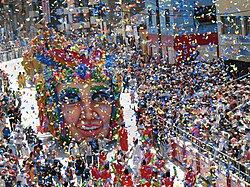


Literature

The origins of Colombian literature date back to the times of Spanish viceregal rule, a period in which Hernando Domínguez Camargo stood out, with the Epic Poem to Saint Ignatius of Loyola, along with Juan Rodríguez Freyle (El Carnero) and the nun Francisca Josefa del Castillo, a representative of mysticism. In post-independence literature linked to Romanticism, Antonio Nariño, José Fernández Madrid, Camilo Torres Tenorio and Francisco Antonio Zea stood out. In the second half of the 19th century and the beginning of the 20th century the costumbrista genre became popular, its foremost exponents being Tomás Carrasquilla, Jorge Isaacs and Rafael Pombo (prominent in the genre of children's literature). Within that period, authors such as José Asunción Silva, José Eustasio Rivera, León de Greiff, Porfirio Barba-Jacob and José María Vargas Vila developed the modernist movement. In 1871 the first academy of the Spanish Language in the Americas was established in Colombia.[275]
Between 1939 and 1940, seven notebooks of poetry with considerable impact in the country were published in Bogotá under the name "Piedra y Cielo", edited by the poet Jorge Rojas.[276] In the following decade, Gonzalo Arango founded the nadaísmo movement in response to the violence of the period,[277] influenced by nihilism, existentialism and the thought of another great Colombian writer, Fernando González Ochoa. During the so-called boom of Latin American literature, successful writers emerged, led by Nobel laureate in Literature Gabriel García Márquez and his magnum opus One Hundred Years of Solitude, along with Eduardo Caballero Calderón, Manuel Mejía Vallejo and Álvaro Mutis, the only Colombian awarded both the Cervantes and the Prince of Asturias prizes. Other notable contemporary authors are Fernando Vallejo, winner of the Rómulo Gallegos Prize, and Germán Castro Caycedo, the writer who sells the largest number of books in Colombia after García Márquez.[278]
Visual arts


In general terms, Colombian visual arts are divided into five periods: pre-Hispanic art (which refers to the art and ways of thinking produced by the original peoples of the Americas, with their way of conceiving the world, the sacred, nature and society),[279] viceregal art (from the Conquest to 1819), republican art (19th century), modern art (from Andrés de Santa María onward) and contemporary art (from the late 1960s to the present day). During the viceregal period there is a cultural fusion between the indigenous, the African contribution and the European religious art of the time. Nineteenth-century Colombian visual arts did not completely break free from viceregal aesthetic conceptions, although the first academicist attempts appeared toward the end of that century.
In 1886 the National School of Fine Arts of Bogotá opened, an institution that trained most of the artists of the early 20th century. The country's most important event on Colombian art is the National Salon of Colombian Artists.[280]
Prominent among the main national painters are the impressionist Andrés de Santa María; the muralist Pedro Nel Gómez; the portraitists Ricardo Acevedo Bernal and Epifanio Garay; the landscape painters Fídolo González Camargo, Roberto Páramo, Jesús María Zamora, Ricardo Gómez Campuzano and Gonzalo Ariza; the hyperrealists Darío Morales or David Manzur; and the expressionists Débora Arango and Ignacio Gómez Jaramillo (also muralists). From the 1940s onward, the painters Alejandro Obregón, Guillermo Wiedemann, Leopoldo Richter and Ómar Rayo stand out. Contemporary artists include Beatriz González, Santiago Cárdenas, Óscar Muñoz, Miguel Ángel Rojas, José Alejandro Restrepo, Álvaro Barrios and Antonio Caro.
In sculpture, Rómulo Rozo, Rodrigo Arenas Betancourt, Édgar Negret, Héctor Lombana, Eduardo Ramírez Villamizar, John Castles and Nadín Ospina stand out. Numerous Colombian artists have developed their work in both painting and sculpture, such as Fernando Botero, famous for his monumental sculpture, Alejandro Obregón, Enrique Grau, Francisco Antonio Cano, Julio Abril, Luis Alberto Acuña and Santiago Martínez Delgado, among others who have achieved international recognition.
In photography, Leo Matiz, Luis García Hevia, Melitón Rodríguez, Hernán Díaz, Abdú Eljaiek, Manuel H., Nereo López, Carlos Caicedo, Ignacio Gaitán, Sady González, Luis Benito Ramos and José Crisanto Lizarazo stand out.
Music
The bambuco (early 20th century), the cumbia (mid-20th century) and the vallenato (late 20th century, early 21st) have been popularly recognized as national rhythms. The different genres of the folk music of Colombia have been influenced by the Spanish, Amerindian and African elements that formed the country's ethnography, as well as by other Latin American and Anglo-Saxon currents that have made Colombian music one of the richest in the region, leading in recent years to the international recognition of several performers. Music is promoted mainly through the support of major record companies and independent companies, and to a lesser extent by the national government through the Ministry of Culture. In a decentralized manner, the National Culture System, through the National Music Council, advises the Government on musical matters, on behalf of each of the country's six regions.[281]
The Society of Authors and Composers of Colombia (Sayco) and the Colombian Association of Performers and Phonographic Producers (Acinpro) are the organizations in charge of collecting and distributing the economic rights generated by the use of works to their affiliated authors and to foreign authors belonging to societies affiliated with the International Confederation of Societies of Authors and Composers (Cisac).[282] Since 1887, the patriotic musical composition that symbolizes Colombia has been the National Anthem of Colombia, which was officially adopted in 1920.[283] Many foreign genres have been commercially successful, becoming widely disseminated through national radio stations. These genres include Dominican merengue, salsa, rock, pop and the romantic ballad, among others. Despite the foreign origin of such genres, in cultural terms they have had a significant influence. In this sense, these genres have prominent musical representatives in the country, many of whom have also been very successful abroad. The musical genre of Colombian origin that has achieved the greatest commercial success today is vallenato.
From fusions among many of these genres, new musical styles have appeared, such as tropipop and champeta. As for jazz, it is notable that the genre appeared in the country from the 1920s, being especially important in cities such as Barranquilla, Cartagena, Bogotá, Cali and Medellín, through radio, cinema and social clubs, as Enrique Luis Muñoz Vélez points out in his text "Jazz en Colombia. Desde los alegres años 20 hasta nuestros días".[284] Various jazz festivals are held in the country, such as Jazz al Parque, a free event held in Bogotá since 1996. There are also festivals that bring together musicians and exponents of Colombian and international jazz, such as the Teatro Libre de Bogotá Jazz Festival, the oldest in the country, Barranquijazz in Barranquilla, the Ajazzgo Festival in Cali and the International Jazz Festival in Medellín, among others.
As for classical music, it is notable that the country has various orchestras, such as the Bogotá Philharmonic, the Medellín Philharmonic, the Cali Philharmonic and the National Symphony of Colombia, among others. The country has witnessed the emergence of countless classical music festivals, in addition to various figures in instrumental music and lyric singing who stand out internationally.[285]
Performing arts


Theater
Theater was introduced during the Spanish colonization starting in 1560, with zarzuela companies.[287] Theater in Colombia is mainly supported by the Ministry of Culture and by various affiliated state or private entities.
The Ibero-American Theater Festival is an international cultural event held every two years in Bogotá. It was directed and produced, until her death in August 2008, by Fanny Mikey, a theater actress and cultural entrepreneur of Argentine origin, naturalized Colombian.[288] It is the most significant cultural event in Colombia and one of the largest performing arts festivals in the world.
Other important theatrical events are the La Fanfarria International Puppet Festival (Medellín), the Manizales International Theater Festival, the Caribbean International Theater Festival (Santa Marta) and the National and International Artistic Festival of Popular Culture "Invasión Cultural" (Bogotá).[289]
Cinema
Colombian cinema has not managed to be profitable as an industry throughout its history, which has prevented continuity in production and in the employment of filmmakers and technicians.[290] During the first decades of the 20th century there were some companies that tried to maintain a constant level of production, but the lack of financial support and strong foreign competition ended up thwarting these initiatives. In the 1980s the state-owned Compañía de Fomento Cinematográfico (Focine) was created, which made some productions possible. However, the company had to be liquidated in the early 1990s.[291] At present there is growing film activity thanks to the Film Law passed in 2003, which has allowed initiatives around filmmaking in the country to be reborn.[292]
Gastronomy
Among Colombia's most representative regional dishes are sancocho, the arepa, ajiaco santafereño, bandeja paisa, mote de queso, lechona tolimense, mamona or llanero-style veal, mute santandereano, the tamal, arroz de lisa and fish dishes, especially in the coastal regions.[293]
Colombian gastronomy is varied and changes according to each region:
- Amazon Region. One of the most representative dishes of this region is patarashca, which consists of seasoning a fish fillet with garlic, bell pepper and onion and grilling it wrapped in banana leaves; it is almost always accompanied by fried plantains and fariña (cassava-based flour). The gastronomy of this region is characterized by being fish-based; one of the most consumed is the pirarucú.[294]
- Paisa Region. Its gastronomy features the bandeja paisa, the typical dish of this region. Popular dishes include sancocho antioqueño, fríjoles antioqueños, hogao, mondongo antioqueño, calentao and pegao. Some varieties of arepa are characteristic of this region, such as the chócolo arepa with quesito antioqueño and the arepa of maíz pelao, among others.[295][296]
- Llanos Orientales. This region is known for llanero-style veal, or mamona; a very popular drink is guarapo, which is sugarcane juice.[297]
- Valle del Cauca. Notable are sancocho de gallina (hen sancocho), lulada, champús, tamal valluno, arroz atollado, marranitas, tortilla soup, cuaresmero, pandebono, pan de yuca, empanadas, aborrajados and chontaduro. In the Pacific zone of Valle del Cauca there is a great variety of fish- and seafood-based dishes.[298]
- Pacific Region. Its gastronomy is influenced by the Pacific Ocean, with a wide diversity of seafood and fish dishes. Notable are shrimp ceviche, fish empanadas, pickled fish and seafood casserole, among others. Tortas, the white yam arepas of Chocó and buñuelos are traditional in this region.[299]
- Cundiboyacense Region. In Tunja, dishes such as wheat cuchuco with pork backbone, cocido boyacense, ullucos or rubas, envuelto and changua stand out, among others. In Boyacá the consumption of mazamorra chiquita, chicha and masato is traditional. In the department of Cundinamarca, potato broth, ajiaco and pork backbone cuchuco stand out, among others.[300][301]
- Insular Region. The gastronomy of this region is influenced by the Caribbean Sea. Notable are the different preparations of fish and seafood accompanied by coconut rice and various spices left by the English when the island was colonized.[302]
- Caribbean Region. The most popular dish is sancocho, which varies in preparation and ingredients: sancocho of tripe, of rib, of pigeon pea with salted meat, of oxtail, of fish, of seafood, of hen and of goat, among others. Very prominent are mote de queso, seafood casserole and grain soups (zaragoza, black-eyed pea, lentils). Various fish-based preparations stand out (bocachico, mojarra, sábalo, lebranche, pargo); rice dishes such as coconut, lisa, black-eyed pea and shrimp rice; arepas; bollos; fried foods such as carimañolas, empanadas and patacones; rice pasteles and hayacas; and wild animals (icotea, duck, mutton, guartinaja, armadillo, rabbit, ñeque).[303]
- Tolima Grande Region. Its most representative dish is lechona, which is prepared by stuffing a suckling pig with rice, pork and various spices. Also representative of this region are the tamal, the arepa, viudo de capaz and achiras, among others.[304]
Religion


The Christian population of Colombia is estimated at 92.5%, of which 89% are Catholic, 10.8% Protestant and 0.2% of other Christian denominations, while 6.6% have no religious affiliation, according to the Pew Research Center in 2010.[305] Catholicism was brought from Spain by missionaries and introduced throughout the viceregal period. In the republican era, the Political Constitution of 1886 established in its Article 38 that "The Catholic, Apostolic, Roman Religion is that of the Nation".[306] It is a predominantly Catholic nation even though the Political Constitution of 1991 established religious freedom and replaced the concept of a Catholic nation with that of a secular one. The archipelago of San Andrés, Providencia, Santa Catalina and other dependencies was initially colonized by English Puritans, in particular by the Providence Island Company;[307] its population remains partly Protestant.[308] In 2004, a survey by the newspaper El Tiempo showed that 10% of the population identified as non-evangelical Christian, 3.5% as evangelical, and 1.9% professed no religious beliefs. 60% of those surveyed acknowledged not actively practicing their faith.[309]
On the other hand, there are syncretic religious forms, the result of the fusion of Catholicism with indigenous and African religions, which can be observed in santería and in the Blacks and Whites' Carnival of Pasto, whose roots lie in pre-Columbian agrarian rituals and African festivals. As in other Latin American countries, Protestant communities of different denominations have appeared in recent years.[308]
Sports

Rio 2016.]]
Sporting activity is regulated at the state and government level by the Colombian Sports Institute (Coldeportes), by the municipal and departmental secretariats of recreation and sports, as well as by independent associations such as federations, institutes and leagues in the various sports disciplines.[310] Government-supported sports are carried out within the framework of education legislation in educational centers such as sports schools, university sports and inter-school games.[311]
The main sports venues are concentrated in the most populous cities, where the Colombian National Games are held periodically.[312] [313]
The national sport of Colombia is tejo or turmequé, an ancestral indigenous game rooted in the Andean Region. Tejo is designated by Law 6132 of 2000 as the national sport of Colombia; it is recognized by Coldeportes and the Colombian Olympic Committee, and is governed by the Colombian Tejo Federation (Fedetejo).[314]
Football is the most popular sport in Colombia. The Colombian league is made up of two divisions, Categoría Primera A (Liga Águila for sponsorship reasons) and Categoría Primera B (Torneo Águila for sponsorship reasons), which compete in three tournaments, one for each division and the Copa Colombia (Copa Águila for sponsorship reasons); in addition, the two annual champions of the Liga Águila play the Superliga de Colombia (Superliga Águila for sponsorship reasons), all under the authority of Dimayor. The Colombian Football Federation, affiliated with FIFA and CONMEBOL, is the governing body of this sport in the country and organizes the national team's participation in international events.[315] The Federation brings together the División Mayor del Fútbol Colombiano (which organizes professional football) and Difútbol (which is in charge of amateur football).
Baseball, popular on the Caribbean Coast, gave the country its first world title in any sport at the 1947 Baseball World Cup held in Cartagena.[316][317] The Colombian national baseball team would retain the amateur world baseball title in 1965, in a tournament also held in Cartagena.[318] The Colombian Professional Baseball League, founded in 1948 and made up of four teams, organizes the main annual competition in the sport. The most prominent Colombians in the Major Leagues have been Édgar Rentería and Orlando Cabrera. Since 2009 there has been a boom of Colombian baseball players in the Major Leagues; in 2013, a total of five Colombians played in that competition.
Boxing is the sport that has produced the most world champions for Colombia; the first to be crowned was Antonio Cervantes "Kid Pambelé" in 1972.[319] Other prominent world champions were Rodrigo Valdez[320] and Miguel "Happy" Lora.[321] Clemente Rojas, Afonso Pérez, Jorge Eliécer Julio and Ingrit Valencia won bronze medals for the country at the Olympic Games; Yuberjen Martínez won silver.[322][323][324]
Another sport that enjoys special popularity in the country is cycling, which since the 1980s has produced figures with outstanding performances in the main European road races (Tour de France, Vuelta a España, Giro d'Italia, among others) and Latin American ones, such as Luis Herrera, Fabio Parra, Santiago Botero, Nairo Quintana, Rigoberto Urán and Egan Bernal. Martín Emilio "Cochise" Rodríguez set the world hour record in 1970 and was crowned world champion in the 4,000-meter individual pursuit in 1971. The main cycling competitions in the country are the Vuelta a Colombia and the Clásico RCN. Cycling is, together with weightlifting, the sport that has given Colombia the most Olympic medals: Mariana Pajón (gold in BMX), Rigoberto Urán (silver in road), María Luisa Calle (bronze in track), Carlos Oquendo (bronze in BMX) and Carlos Ramírez (bronze in BMX).
Between the 1960s and the 1980s, several Colombian long-distance runners stood out in important international races such as the São Silvestre race in São Paulo, Brazil: Álvaro Mejía (winner in 1966),[325] Domingo Tibaduiza (winner in 1977)[326] and Víctor Mora (winner in 1972, 1973, 1975 and 1981).[326][327]
Colombia is considered a world power in inline speed skating, to the point that of the 23 world championships that have been held, Colombia has been the overall winner on 11 occasions. The main figures in this sport have been Luz Mery Tristán, Cecilia Baena, Jorge Botero and Kelly Martínez.[328]
Motorsport also occupies an important place in Colombians' preferences, with Juan Pablo Montoya, who achieved several important results in Formula One in the 2000s, being the most important athlete in this discipline.[329]
Individual disciplines have produced the best results at the Olympic Games. The most outstanding participation in this event was at Rio 2016, where the Colombian Olympic team won eight medals, most notably the three golds won by Mariana Pajón, Óscar Figueroa and Caterine Ibargüen.[330] Before that participation, the best showing had been at London 2012, where eight medals were won, among them a gold won by Mariana Pajón in BMX.[331] The first Colombian Olympic medalist was Helmut Bellingrodt, silver medal in running boar shooting at Munich 1972, a medal he won again at Los Angeles 1984.[332] Colombia has won a total of five gold medals, eight silver and 14 bronze, in various sports such as weightlifting, cycling (road, track and BMX), sport shooting, taekwondo, boxing, wrestling, judo and athletics. At the Paralympic Games, Colombian athletes have won 6 medals in total.
See also
References
- ↑ "Artículo 10". constitucioncolombia.com (in español). Retrieved August 14, 2015.
- ↑ "Las lenguas indígenas de Colombia". Banco de la República (in español). Retrieved June 17, 2016.
- ↑ 3.0 3.1 3.2 "Instituto Colombiano Agustín Codazzi" (in español). Retrieved March 6, 2017.
- ↑ 4.0 4.1 4.2 CIA. "Colombia - Geografía - Libro Mundial de Hechos" (in español). Retrieved February 26, 2017.
- ↑ 5.0 5.1 5.2 5.3 "World Economic Outlook Database, April 2019". IMF.org. International Monetary Fund. Retrieved June 14, 2019.
- ↑ 6.0 6.1 6.2 "Human Development Report 2018" (PDF). Programa de las Naciones Unidas para el Desarrollo. Retrieved September 15, 2018.
- ↑ "Constitución Política de Colombia 1991" (in español).
Artículo 10º.- El español es el idioma oficial, los dialectos de minorías son oficiales en su territorio
- ↑ "Gross domestic product 2010, PPP" (PDF). Banco Mundial. Retrieved March 13, 2013.
- ↑ "Decreto 4175 de 2011" (in español). Presidencia de la República de Colombia. Retrieved October 4, 2015.
Artículo 6
- ↑ "Censo Nacional 2018" (in español). DANE. Retrieved July 4, 2019.
- ↑ "Constitución Política de 1991" (PDF) (in español). Banco de la República. Archived from the original (PDF) on January 11, 2012. Retrieved May 31, 2013.
- "Sistema Político" (in español). Universitat de Barcelona. Retrieved May 31, 2013.
- "Constitución Política de Colombia 1991" (in español). Presidencia de la República de Colombia. Archived from the original on October 29, 2012. Retrieved March 22, 2013.
Artículo 1
- ↑ "Diferendo Limítrofe Con Venezuela". Sociedad Geográfica de Colombia (in español). Colombia Aprende. Retrieved July 20, 2013.
- ↑ "Corte Internacional de Justicia fijó límites marítimos con Nicaragua". El Tiempo (in español). Retrieved March 22, 2013.
- "Posición Astronómica y Geográfica" (in español). Biblioteca Luis Ángel Arango. Archived from the original on May 29, 2008. Retrieved May 9, 2008.
- "Colombia rechazó el fallo de La Haya". Vanguardia (in español). Retrieved March 7, 2013.
- ↑ "Tratados Internacionales" (in español). Armada Nacional de Colombia. Archived from the original on September 27, 2007. Retrieved May 13, 2008.
- "Mapa Tratados Internacionales" (in español). Armada Nacional de Colombia. Archived from the original on May 24, 2011. Retrieved May 13, 2008.
- ↑ 15.0 15.1 Díaz, Juan Manuel (June 24, 2006). "Los dos mares". Semana (in español). Retrieved January 30, 2019.
- ↑ "Colombia: población" (in español). October 29, 2007. Retrieved March 22, 2013.
- ↑ 17.0 17.1 "Colombia, el segundo país de Hispanoamérica con más hablantes nativos de español". El Espectador (in español). November 27, 2017. Retrieved November 27, 2018.
- ↑ 18.0 18.1
- "La visibilización estadística de los grupos étnicos colombianos" (PDF) (in español). Retrieved March 12, 2013.
- Astudillo, Néstor. "Apuntes sobre la inmigración sirio-libanesa en Colombia" (in español). Retrieved March 22, 2013.
- ↑ "Biodiversity Theme Report". Retrieved March 22, 2013.
- ↑ Zambrano, Fabio (July 12, 2010). "Las guerras civiles". Semana (in español). Retrieved November 28, 2018.
- ↑ "¿Cómo está compuesta la economía colombiana?". Dinero (in español). September 29, 2015. Retrieved November 28, 2018.
- ↑ International Monetary Fund. "Report for Selected Countries and Subjects".
- ↑ "Life expectancy at birth (years), 2000-2016". Organización Mundial de la Salud. 2018. Retrieved November 28, 2018.
- ↑ "GINI index (World Bank estimate)".
- ↑ Colciencias. "Colombia, el segundo país más biodiverso del mundo" (in español). Retrieved August 9, 2017.
- ↑ "Ocho países son responsables de más de la mitad del deterioro del planeta" (in español). La Hora. Archived from the original on December 10, 2014. Retrieved December 10, 2014.
- ↑ "Colombia es el país con más conflictos ambientales de América Latina" (in español). semana.com.
- ↑ "Environmental Justice Atlas". ejatlas.org.
- ↑ 29.0 29.1 "Colombia reitera su compromiso frente al cambio climático y lamenta retiro de Estados Unidos del Acuerdo de Parí" (in español). presidencia.gov.co.
- ↑ 30.0 30.1 "Evolución Variables de Generación Diciembre de 2015" (in español). Unidad de Planeación Minero Energética de Colombia.
- ↑ Carrera Damas, Germán (May 22, 2005). "La República de Colombia y el nacimiento del proyecto americano de Bolívar: Causas de la disolución de la Gran Colombia" (in español). Retrieved March 22, 2013.
- ↑ Bolívar, Simón. "Carta de Jamaica" (in español). Archived from the original on June 26, 2007. Retrieved March 22, 2013.
- ↑ "Estados Unidos de Colombia". Cervantesvirtual.com (in español). Retrieved March 22, 2013.
- ↑ "Antiguos problemas con Venezuela y Ecuador" (in español). Archived from the original on March 7, 2013. Retrieved March 22, 2013.
- ↑ Núñez, Rafael. "Himno nacional de Colombia" (in español). Presidencia de la República de Colombia. Retrieved March 22, 2013.
Segunda Estrofa
- ↑ 36.0 36.1 "Primeros Pobladores" (in español). Presidencia de la República de Colombia. Archived from the original on March 26, 2014. Retrieved July 24, 2013.
- ↑ 37.0 37.1 Suárez, Carlos Alberto (2004). Clara Inés Quintín M (ed.). Colombia Andina (in español). Colombia: Norma. pp. 3–4. ISBN 9580468060.
- ↑ 38.0 38.1 38.2 38.3 Suárez, Carlos Alberto (2004). Clara Inés Quintín M (ed.). Colombia Andina (in español). Colombia: Norma. pp. 12–13. ISBN 9580468060.
- ↑ Irving, Washington (1864). Viajes y Descubrimientos de los Compañeros de Colon (PDF) (in español). Madrid: Imprenta de Gaspar y Roig. pp. 14–26. Retrieved October 14, 2015.
- ↑ 40.0 40.1 40.2 40.3 "Biografía de Alonso de Ojeda". www.biografiasyvidas.com (in español). Retrieved October 14, 2015.
- ↑ 41.0 41.1 Gamboa M., Jorge Augusto (July 1, 2013). "La expedición de Gonzalo Jiménez de Quesada por el río Magdalena y el origen del Nuevo Reino de Granada". Credencial Historia No. 283 (in español). Retrieved October 16, 2015.
- ↑ Acosta de Samper, Soledad (1883). Biografías de hombres ilustres o notables, relativas a la época del descubrimiento, conquista y colonización de la parte de América denominada actualmente EE. UU. de Colombia (in español). Retrieved November 28, 2018.
{{cite book}}:|website=ignored (help) - ↑ 43.0 43.1 43.2 Bushnell, David (1994). "1". Colombia Una Nación a Pesar de Sí Misma (in español). Bogotá: Planeta. p. 30. ISBN 9584207490.
{{cite book}}:|access-date=requires|url=(help) - ↑ Ramírez, María Clemencia (1996). "El Rescate, la Encomienda y la Mita Minera". Frontera fluida entre Andes, Piedemonte y Selva (in español). Retrieved October 17, 2015.
- ↑ Camilo, Calderón Schrader,. "Atlas básico de historia de Colombia 7 | banrepcultural.org". www.banrepcultural.org (in español). Retrieved October 27, 2015.
{{cite web}}: CS1 maint: extra punctuation (link) CS1 maint: multiple names: authors list (link) - ↑ 1934-, Vargas Martínez, Gustavo,. "Vernon en Cartagena, 1741: nuevos datos sobre su derrota | banrepcultural.org". www.banrepcultural.org (in español). Retrieved October 27, 2015.
{{cite web}}:|last=has numeric name (help)CS1 maint: extra punctuation (link) CS1 maint: multiple names: authors list (link) - ↑ "La rebelión de los comuneros" (in español). Biblioteca Nacional de Colombia.
- ↑ SENA (2007). "Actualización para periodista - El siglo XIX, de la independencia al estado Nacional". SENA (in español). Retrieved April 19, 2016.
- ↑ Sourdis Nájera, Adelaida (2010). "La independencia del caribe colombiano 1810-1821". Credencial Historia (in español). Retrieved April 19, 2018.
- ↑ 50.0 50.1 Suárez, Carlos Alberto (2004). Clara Inés Quintín M (ed.). Colombia Andina (in español). Colombia: Norma. p. 25. ISBN 9580468060.
- ↑ "La Confederación de las Provincias Unidas de la Nueva Granada" (in español). Biblioteca Luis Ángel Arango. Retrieved January 21, 2011.
- ↑ Suárez, Carlos Alberto (2004). Clara Inés Quintín M (ed.). Colombia Andina (in español). Colombia: Norma. p. 26. ISBN 9580468060.
- ↑ "Golpe de estado en 1854". Archived from the original on February 26, 2009. Retrieved July 8, 2009.
- ↑ "Cuarta guerra civil" (PDF) (in español). Archived from the original (PDF) on March 27, 2009. Retrieved July 8, 2009.
- ↑ Santos, Enrique (June 2004). "Panamá: el último año". Banco de la República, Colombia (in español). Retrieved November 27, 2018.
- ↑ "Rafael reyes Prieto 1849 - 1921 - Archivo Digital de Noticias de Colombia y el Mundo desde 1.990 - eltiempo.com". eltiempo.com (in español). Retrieved April 12, 2016.
- ↑ Valencia, Alvaro (September 11, 1998). "Rafael Reyes". Semana (in español). Retrieved November 27, 2018.
- ↑ 1942-, Santos Molano, Enrique,. "El quinquenio de la modernización | banrepcultural.org". www.banrepcultural.org (in español). Retrieved April 12, 2016.
{{cite web}}:|last=has numeric name (help)CS1 maint: extra punctuation (link) CS1 maint: multiple names: authors list (link) - ↑ Díaz Rivero, Gonzalo (1998). Wilson Acosta Valdeleón (ed.). Orígenes 5 (in español). Santa Fe de Bogotá, DC., Colombia: Libros y Libros S.A. p. 106. ISBN 9589418457.
- ↑ Mariátegui, Aldo (February 15, 2017). "¿Qué propició y cómo fue la guerra entre Perú y Colombia? Mariátegui te lo cuenta". Capital (in español). Retrieved November 19, 2018.
- ↑ "Guerra con el Perú". Radio Nacional (in español). September 27, 2016. Retrieved November 19, 2018.
- ↑ Díaz Rivero, Gonzalo (1998). Wilson Acosta Valdeleón (ed.). Orígenes 5 (in español). Santa Fe de Bogotá, DC., Colombia: Libros y Libros S.A. pp. 112–119. ISBN 9589418457.
- ↑ "El asesinato de Jorge Eliécer Gaitán". Aporrea (in español). April 3, 2008. Retrieved July 9, 2009.
- ↑ Dávila, Andrés (June 2, 2015). "El Frente Nacional: una transición democrática reformista y conservadora". OpenEdition (in español). Retrieved November 19, 2018.
- ↑ Delgado, Wilman (June 1, 2017). "La violencia revolucionaria (1960-1998)". Revista Ejército (in español). Retrieved November 28, 2018.
- ↑ El Tiempo (December 10, 2016). "'El sol de la paz brilla, por fin, en el cielo de Colombia': Santos" (in español). Retrieved August 6, 2018.
- ↑ "Desplazamiento forzado en 2017". Desplazamiento forzado en 2017 (in español). June 19, 2018. Retrieved November 9, 2018.
{{cite journal}}:|first=missing|last=(help) - ↑ "El Frente Nacional | banrepcultural.org". www.banrepcultural.org (in español). Retrieved December 18, 2016.
- ↑ "Historia del narcotráfico en Colombia". ElEspectador (in español). Retrieved December 18, 2016.
- ↑ "Cronología de la guerra". www.semana.com (in español). October 29, 1990. Retrieved December 18, 2016.
- ↑ "Estrategia De Fortalecimiento De La Democracia y El Desarrollo Social" (PDF) (in español). Departamento Nacional De Planeación(DNP) & Dirección De Justicia y Seguridad (DJS). 2007–2013. Archived from the original (PDF) on October 30, 2013. Retrieved March 26, 2013.
{{cite web}}: CS1 maint: date format (link) - ↑ "Policía consolidará estrategia de contención del homicidio ante excelentes resultados del 2012" (in español). Policía Nacional de Colombia. March 26, 2013. Archived from the original on March 26, 2014. Retrieved March 26, 2013.
- ↑ "Colombia triplicará inversión en infraestructura hasta 2014". Portafolio.co (in español). February 20, 2012. Retrieved March 26, 2013.
- ↑ Andreu Guzmán, Federico (March 26, 2013). "Algunas anotaciones sobre Bacrim y paramilitarismo". Equipo Nizkor & Derechos Human Rights (in español). Retrieved March 26, 2013.
- ↑ "Las Bacrim de hoy coinciden con los paras de ayer". La Silla Vacia (in español). March 16, 2011. Retrieved November 28, 2018.
- ↑ "FARC y gobierno de Colombia concluyen ciclo de conversaciones en Cuba" (in español). United Press International. February 11, 2013. Archived from the original on July 6, 2014. Retrieved March 25, 2013.
- ↑ "Con apretón de manos, Santos y 'Timochenko' acuerdan fin de la guerra" (in español). El Tiempo. June 23, 2016. Retrieved June 23, 2016.
- ↑ Vanguardia Liberal (November 30, 2016). "Congreso refrendó el acuerdo de paz con las FARC" (in español). Retrieved August 6, 2018.
- ↑ "Impunidad en asesinatos de líderes sociales es el 86%: ONU" (in español). March 20, 2018.
- ↑ "Colombia, México y Brasil encabezan lista mundial de líderes sociales asesinados" (in español). March 20, 2018.
- ↑ "Todo lo que quiere saber sobre la migración venezolana y no se lo han contado" (in español). Migración Colombia. November 1, 2018. Retrieved November 7, 2018.
- ↑ Restrepo, Jorge Alberto; Vargas, Juan Fernando; Spagat, Michael (September 3, 2004). "La dinámica del conflicto colombiano, 1988-2003" (PDF) (in español). Semana.com. Archived from the original (PDF) on October 6, 2012. Retrieved April 8, 2013.
- ↑ "Colombia, uno de los países más violentos del mundo". El Tiempo (in español). 1991-02-02.
- ↑ El conflicto armado en Colombia deja 220 000 muertos desde 1958.
- ↑ "Registro Único de Víctimas - Unidad para la Víctimas" (in español).
- ↑ "Colombia: el país con más desplazados del mundo". ELESPECTADOR.COM (in español). June 19, 2019. Retrieved April 30, 2020.
- ↑ Semana (2020-12-21). "Pobreza en Colombia: estos son los departamentos más afectados". Semana.com Últimas Noticias de Colombia y el Mundo (in español). Retrieved 2021-08-25.
- ↑ Tiempo, Casa Editorial El (2021-05-31). "En abril, el desempleo en Colombia fue de 15,1 %". El Tiempo (in español). Retrieved 2021-08-25.
- ↑ Semana (2021-08-12). "Según el Dane, desempleo juvenil en Colombia superó el 23 % entre abril y junio". Semana.com Últimas Noticias de Colombia y el Mundo (in español). Retrieved 2021-08-25.
- ↑ Serrano, Mariza (January 23, 2018). "Pese al crecimiento económico, Colombia sigue siendo uno de los países más inequitativos del mundo". Universidad Nacional de Colombia Periódico Digital (in español). web. Archived from the original on November 11, 2019. Retrieved November 11, 2019.
- ↑ "Niveles de participación electoral en América Latina" (in español). Red de Conocimientos Electorales. Retrieved May 25, 2014.
- ↑ "Elecciones en Colombia:Por que no votan" (in español). Revista Semana. Retrieved May 25, 2014.
- ↑ "OEA recomienda a Colombia estudiar fenómeno de abstención" (in español). El Espectador. Retrieved May 25, 2014.
- ↑ "Ley Nacional de Registro Votantes" (in español). Votantes.us. Archived from the original on January 22, 2012. Retrieved May 25, 2014.
- ↑ 95.0 95.1 95.2 95.3 95.4 Oscar, Pulido Cortés (2006). Editorial Norma (ed.). Nuevo identidades 4: sociales (in español). Bogotá, Colombia: Grupo Editorial Norma. pp. 173–176. ISBN 9580483396.
- ↑ "Cancilleria. Ministerio de Relaciones Exteriores" (in español). Ministerio de Relaciones Exteriores de Colombia. Retrieved March 12, 2013.
{{cite web}}: CS1 maint: deprecated archival service (link) - ↑ Bermúdez, César Augusto (2010). "La doctrina réspicepolum ("Mirar hacia el norte") en la práctica de las relaciones internacionales de Colombia durante el siglo XX". Universidad del Norte (in español). Retrieved November 28, 2018.
- ↑ Palacio, Anaís (September 3, 2017). "Los retos de la política exterior colombiana". Razón pública (in español). Retrieved November 28, 2018.
- ↑ "Colombia y la OMC" (in español). Organización Mundial del Comercio.
- ↑ "Colombia en la OMC" (in español). Ministeria de Comercio, Industria y Turismo. [dead link]
- ↑ "Estructura Orgánica" (in español). Ministerio de Defensa Nacional. Retrieved May 22, 2008.
- ↑ "Pie de Fuerza" (PDF) (in español). Ejército Nacional de Colombia. Retrieved March 1, 2013.
- ↑ "Sinaí Misión de paz". Retrieved March 12, 2013.
- ↑ "Divisiones del Ejército" (in español). Ejército Nacional de Colombia. Retrieved May 22, 2008.
- ↑ 105.0 105.1 105.2 105.3 "Pie de Fuerza" (PDF) (in español). Ejército Nacional de Colombia. Retrieved March 1, 2013.
- ↑ "Unidades Aéreas" (in español). Fuerza Aérea de Colombia. Retrieved May 24, 2008.
- ↑ "Decreto número 4222 del 23 de noviembre de 2006" (pdf) (in español). Bogotá: Ministerio de Defensa Nacional.
{{cite web}}: Italic or bold markup not allowed in:|publisher=(help) - ↑ "Conoce el nuevo ranking de corrupción en América Latina". www.rpp.pe/ (in español). Retrieved January 3, 2018.
- ↑ "Corruption Perceptions Index 2016". www.transparency.org/. Retrieved January 3, 2018.
- ↑ "La cruzada para que no se sigan robando el país con corrupción" (in español). Retrieved June 22, 2018.
- ↑ "En sus justas proporciones" (in español). Retrieved June 29, 2018.
- ↑ "La profunda crisis de la Justicia" (in español). March 22, 2017. Retrieved May 16, 2019.
- ↑ "Distribución territorial de Colombia" (PDF) (in español). Retrieved July 9, 2009.
- ↑ "Organización departamental" (in español). Archived from the original on August 5, 2009. Retrieved July 9, 2009.
- ↑ "Artículos 299, 300, 301" (in español). Asamblea Departamental de Bolívar. Retrieved May 10, 2008. [dead link]
- ↑ Political Constitution of Colombia. Article 356. Added by Article 2 of Legislative Act number 1 of August 18, 1993.
- ↑ 117.0 117.1 "Estado, Derecho y Territorio" (in español). Grupo de Investigación -Facultad de Derecho Universidad Libre- Categoría A Colciencias. Retrieved July 22, 2008. [dead link]
- ↑ "Territorios Indígenas, Normatividad Constitucional" (in español). Universidad Libre. Retrieved July 22, 2008. [dead link]
- ↑ "Posición astronómica y geográfica de Colombia". Banco de la República, Colombia (in español). 2017. Retrieved January 30, 2019.
- ↑ Melo Moreno, Vladimir; Rodríguez Alicia T, Claudia; Feo B, José Vicente; Chaustre Aveldaño, Álvaro; Pulido Cortes, Oscar (2005). Nuevo identidades 5: sociales (in español). Bogotá, Colombia: Editorial Norma SA. pp. 19–20. ISBN 958048340X.
- ↑ "Gorgona y Malpelo, dos paraísos por descubrir". KienyKe (in español). July 31, 2017. Retrieved January 31, 2019.
- ↑ 122.0 122.1 122.2 "Generalidades del País". Banco de la República - Colombia (in español). Retrieved August 8, 2015.
- ↑ 123.0 123.1 123.2 123.3 Díaz Rivero, Gonzalo (1998). Wilson Acosta Valdeleón (ed.). Orígenes 5 (in español). Santa Fe de Bogotá, DC., Colombia: Libros y Libros S.A. pp. 177–180. ISBN 9589418457.
- ↑ 124.0 124.1 Iriarte, Helena (2006). Esta es Colombia (in español). Ediciones Gamma S.A. pp. 22–23. ISBN 9589308910.
- ↑ 125.0 125.1 Suárez, Carlos Alberto (2004). Clara Inés Quintín M (ed.). Colombia Andina (in español). Colombia: Norma. pp. 55–56. ISBN 9580468060.
- ↑ 126.0 126.1 126.2 126.3 126.4 126.5 126.6 Iriarte, Helena (2006). Esta es Colombia (in español). Ediciones Gamma S.A. pp. 24–25. ISBN 9589308910.
- ↑ "Colombia hace parte de los 17 países megadiversos del mundo". Colombia.co. Retrieved March 12, 2013.
- ↑ "Colombia, el segundo país más biodiverso del mundo". Colciencias (in español). September 11, 2016. Retrieved January 30, 2019.
- ↑ "Humedales en Colombia". Jardín Botánico de Bogotá (in español). April 15, 2016. Retrieved January 30, 2019.
- ↑ Tobasura, Isaías (August 25, 2006). "Una visión integral de la biodiversidad en colombia" (PDF). Universidad de Caldas (in español). Retrieved January 30, 2019.
- ↑ "Parques Nacionales Naturales de Colombia, patrimonio de los colombianos". Ministerio de Ambiente y Desarrollo Sostenible (in español). Retrieved January 30, 2019.
- ↑ "¿Quieres saber por qué estamos en la semana de los parques naturales?". Gobierno de Colombia (in español). November 6, 2013. Retrieved January 31, 2019.
- ↑ "WWF: mitad de los ecosistemas de Colombia está en riesgo". mundo.sputniknews.com (in español). Retrieved November 19, 2017.
- ↑ "Minería ilegal destruye los ríos de 21 departamentos de Colombia". El Tiempo (in español). May 2, 2015. Retrieved January 31, 2019.
- ↑ "310 mil hectáreas, tasa promedio de deforestación entre 1990-2010" (in español). El Universal. March 26, 2013. Retrieved April 8, 2013.
- ↑ 136.0 136.1 "Política Nacional de Biodiversidad" (PDF). Ministerio de Ambiente y Desarrollo Sostenible (in español). Retrieved January 31, 2019.
- ↑ Cataño, Luz (November 17, 2013). "693 especies de plantas de Colombia, en amenaza". El Mundo (in español). Retrieved January 31, 2019.
- ↑ "Mayor colección de plantas carnívoras en Colombia". El Universo, AFP (in español). December 30, 2010. Retrieved January 31, 2019.
- ↑ "Biodiversidad en cifras" (in español). Sistema de Información sobre Biodiversidad de Colombia. Retrieved January 31, 2019.
- ↑ "¿Cuántos somos?". www.dane.gov.co (in español). Retrieved July 5, 2019.
- ↑ "Censo General 2005, datos desagregados por sexo" (PDF) (in español). Retrieved March 12, 2013.
- ↑ "Densidad de población en los llanos orientales" (in español). Retrieved July 10, 2009.
- ↑ 143.0 143.1 "Resultados del Censo General de Colombia 2005:DANE". DANE (in español). Retrieved April 4, 2013.
- ↑ "Demografía de la lengua española" (PDF) (in español). Francisco Moreno Fernández y Jaime Otero Roth ICEI-Fundación Telefónica. March 2006. Archived from the original (pdf) on January 15, 2013. Retrieved February 7, 2013.
- ↑ "La visibilización estadística de los grupos étnicos colombianos" (PDF) (in español). Retrieved March 12, 2013.
- ↑ "Colombia a country study" (PDF). Retrieved March 12, 2013.
- ↑ 147.0 147.1 "Situación de las mujeres rurales" (PDF) (in español). Organización para la alimentación y la agricultura: División de Género, Equidad y Empleo Rural. Archived from the original (PDF) on June 11, 2008. Retrieved July 2, 2008.
- ↑ "Diversidad étnica en Colombia" (PDF) (in español). Archived from the original (PDF) on July 3, 2009. Retrieved July 10, 2009.
- ↑ National Geographic. "Reference Populations – Geno 2.0 Next Generation". Retrieved April 16, 2017.
- ↑ 150.0 150.1 "http://www.semana.com/nacion/articulo/en-blanco-negro/20988-3" (in español). Retrieved April 3, 2017.
{{cite web}}: External link in|title= - ↑ "Admixture in the Americas: Regional and National Differences". Retrieved April 11, 2017.
- ↑ DNA Tribes. "DNA Tribes SNP Admixture Results by Population (2012, I)" (PDF). Retrieved April 16, 2017.
- ↑ "http://repositorio.unb.br/bitstream/10482/5542/1/2008_NeideMOGodinho.pdf" (PDF) (in português). Retrieved April 3, 2017.
{{cite web}}: External link in|title= - ↑ "Inmigración de árabes hacia Colombia" (in español). Retrieved July 10, 2009.
- ↑ Tovar Pinzón, Hermes. "«Emigración y éxodo en la historia del país»" (in español). Revues. Retrieved July 3, 2008.
- ↑ "Análisis de la migración venezolana a Colombia durante el gobierno de Hugo Chávez" (in español). Retrieved March 6, 2013.
- ↑ "Llegaron los venezolanos" (in español). Revista Semana. Retrieved March 6, 2013.
- ↑ "Llegada de venezolanos a Colombia creció 22 %" (in español). Revista Semana. Retrieved March 6, 2013.
- ↑ Michael Hermelin, ed. (2007). Entorno natural de diez y siete ciudades de Colombia (in español). Medellín, Colombia: Fondo Editorial Universidad EAFIT. pp. 17–21. ISBN 9789588281704.
- ↑ "El 74 % de la población colombiana habita en zonas urbanas" (in español). Dinero.com. March 25, 2012. Retrieved April 5, 2013.
- ↑ 161.0 161.1 161.2 "Niveles de la Educación Superior" (in español). Ministerio de Educación Nacional de la República de Colombia. August 10, 2010. Retrieved April 17, 2013.
- ↑ "¿Cuál es la razón de ser de las pruebas Saber Pro y TyT?". El País (in español). web. November 26, 2017. Retrieved May 7, 2019.
- ↑ "Prueba de Estado Saber Pro" (in español).
- ↑ "¿Quiénes somos?" (in español). ICETEX. Retrieved April 17, 2013.
- ↑ Carlos Bosch (November 13, 2018). "Mejores Universidades de Colombia 2019". Rankia (in español). Retrieved April 7, 2018.
- ↑ "Quiénes somos". Servicio Nacional de Aprendizaje SENA (in español). June 7, 2018. Retrieved January 18, 2019.
- ↑ "Colombia - Tasa de alfabetización" (in español).
- ↑ Tiempo, Casa Editorial El (December 6, 2016). "Colombia avanzó en pruebas Pisa, pero sigue lejos de los mejores". El Tiempo (in español). Retrieved November 15, 2018.
- ↑ Organización Mundial de la Salud. "The world health report 2000" (PDF). p. 152. Retrieved September 13, 2018.
- ↑ 170.0 170.1 "¿Qué es el Sisbén?". Corte Constitucional (in español). July 31, 2018. Retrieved May 7, 2019.
- ↑ "Decreto 546 del 30 de marzo de 2017" (PDF) (in español). Presidencia de la República de Colombia. March 30, 2017. Retrieved November 28, 2017.
- ↑ "Perfil Sistema de Salud en Colombia" (PDF) (in español). Organización Panamericana de la Salud. September 2009. Retrieved July 12, 2013.
- ↑ "¿Qué pasa con la calidad del sistema de salud en Colombia?". Dinero (in español). January 11, 2018. Retrieved May 7, 2019.
- ↑ "¿De qué se mueren los colombianos?". Revista Semana (in español). March 31, 2016. Retrieved May 7, 2019.
- ↑ "Mortalidad Perinatal y Neonatal" (PDF). Boletín Epidemiologico (in español). August 5, 2018. Retrieved May 7, 2019.
- ↑ "Raizales-Protección cultural: Archipiélago de San Andrés-Educación bilingüe/Lengua Oficial" (in español). Senado de la República de Colombia. Retrieved April 9, 2013. [dead link]
- ↑ ""El negocio de la vida es la vida, no el negocio"". Dinero (in español). March 20, 2009. Retrieved January 18, 2019.
- ↑ 178.0 178.1 "Con éxito se practicó primera cirugía robótica pediátrica en Colombia". El Tiempo (in español). Retrieved February 25, 2013.
- ↑ "Colombia se perfila como potencia en turismo de salud" (in español). Portafolio.co. Retrieved March 3, 2013.
- ↑ Tavera Cobos, David. "Colombia, país potencia en cirugías estéticas" (in español). Retrieved March 3, 2013.
- ↑ Robles Castrillo, Roberto. "Colombia ¿una potencia en desarrollo? "Entre el peso simbólico y la esperanza"" (in español). Archived from the original on March 10, 2013. Retrieved March 3, 2013.
- ↑ Vidal, Margarita. "Rodolfo Llinás. ¿Descubrió la cura contra el Alzheimer?" (in español). Retrieved March 3, 2013.
- ↑ Niyireth, Molina. "La vacuna contra la malaria de Manuel Elkin Patarroyo ha sido acreditada con una eficacia del 95 por ciento" (in español). Archived from the original on March 16, 2013. Retrieved March 3, 2013.
- ↑ Montoya, Juan David (May 7, 2011). "El hallazgo del doctor Hakim". El Colombiano (in español).
- ↑ "Con éxito se practicó primera cirugía robótica pediátrica en Colombia". El Tiempo (in español). Retrieved February 25, 2013.
- ↑ "Exitosa la primera cirugía robótica en urología pediátrica en Latinoamérica". RCN Radio (in español). Archived from the original on March 26, 2014. Retrieved February 25, 2013.
- ↑ Argüello, Francisco. "'Arcadio', un robot colombiano que encuentra minas antipersonales" (in español). Retrieved February 25, 2013.
- ↑ "Crean en Colombia a 'Arcadio', robot contra minas antipersona" (in español). RCN Televisión. Archived from the original on October 4, 2013. Retrieved February 25, 2013.
- ↑ "Pilotos de la Fuerza Aérea entrenarán en aviones 100 % construidos en Colombia". El Espectador (in español). Retrieved February 25, 2013.
- ↑ "El Cartucho de Seguridad" (in español). Centro de Estudios Históricos del Ejército. Retrieved July 6, 2013.
- ↑ "El cartucho salvavidas del Ejército". El Tiempo (in español). Retrieved February 25, 2013.
- ↑ "Pilotos de la Fuerza Aérea entrenarán en aviones 100 % construidos en Colombia". El Espectador (in español). April 16, 2010. Retrieved February 25, 2013.
- ↑ "El ININ contribuye a la puesta en operación del Reactor Nuclear Colombiano" (PDF) (in español). Instituto Nacional de Investigaciones Nucleares. Retrieved July 6, 2013.
- ↑ Aristizabal Arango, Camila; Arias Jiménez, Ferney. "Es la clave del futuro y en ciencia y tecnología Colombia está en la niñez" (in español). Retrieved February 25, 2013.
- ↑ "Ley de Ciencia, Tecnología e Innovación cambiará modelo de productividad colombiano" (in español). Ministerio de Educación de Colombia. Retrieved February 25, 2013.
- ↑ "MILA: Latin America's integrated market". theworldfolio.com. Retrieved May 20, 2016.
- ↑ "Colombia puede convertirse en sorpresa de economía mundial: BBVA" (in español). DANE. Retrieved September 18, 2012.
- ↑ "Colombia, la tercera de la región" (in español). DANE. Retrieved December 1, 2012.
- ↑ "Colombia: Balance 2011 y perspectivas 2012.Sector Financiero" (PDF) (in español). ANDI: Asociación Nacional de Empresarios de Colombia. Archived from the original (PDF) on June 5, 2013. Retrieved March 15, 2013.
- ↑ 200.0 200.1 200.2 200.3 200.4 "Economy:Colombia". CIA. Retrieved March 18, 2013.
- ↑ "Uribe y la economía". Dinero.com (in español). 2008. Retrieved January 19, 2008.
- ↑ "Pobreza Monetaria" (pdf) (in español). Bogotá: DANE. September 15, 2014.
- ↑ "Principales Resultados del Mercado Laboral" (PDF) (in español). DANE. Retrieved March 6, 2013.
- ↑ "Quiénes somos, Marco Estratégico del Ministerio de Hacienda y Crédito Público" (in español). Ministerio de Hacienda y Crédito Público. Archived from the original on July 7, 2011. Retrieved July 19, 2008.
- ↑ "La Historia del Banco" (PDF) (in español). Banco de la República de Colombia. Archived from the original (PDF) on August 28, 2008. Retrieved July 19, 2008.
- ↑ "Que hacemos?" (in español). Asociación Nacional de Empresarios. Retrieved June 16, 2008.
- ↑ "Funciones del Ministerio de Agricultura y Desarrollo Rural" (in español). Ministerio de Agricultura y Desarrollo Rural. Archived from the original on June 11, 2008. Retrieved June 16, 2008.
- ↑ "Exportaciones: productos por país" (in español). FAO. Retrieved June 16, 2008.
- ↑ "Reseña Histórica" (in español). Sociedad de Agricultores de Colombia. Retrieved June 16, 2008. [dead link]
- ↑ "Indicación Geográfica Protegida para el Café Colombiano" (in español). Federación Nacional de Cafeteros de Colombia. Retrieved March 15, 2013.
- ↑ "Certification Mark Goods Principal Register Colombian" (PDF). United States Pantend and Trademark Office. Retrieved March 15, 2013.
- ↑ "Colombian Coffee: Certification Mark" (PDF). Canadian Intelectual Property Office. Retrieved March 15, 2013.
- ↑ "Denominación de Origen" (in español). Café de Colombia. Retrieved March 15, 2013.
- ↑ "Dirección Nacional de la Propiedad Industrial de Ecuador" (in español). Instituto Ecuatoriano de Propiedad Intelectual. Retrieved March 15, 2013.
- ↑ "Servicio Nacional de Propiedad Intelectual" (in español). Servicio Nacional de Propiedad Intelectual de Bolivia. Retrieved March 15, 2013.
- ↑ "Resolución 671 de 20 de enero de 2006" (in español). Instituto Nacional de Defensa de la Competencia y de la Protección de la Propiedad Intelectual del Perú. Retrieved March 15, 2013.
- ↑ "País Por productor: Café Verde" (in español). Organización de las Naciones Unidas para la Agricultura - FAO. Retrieved March 15, 2013.
- ↑ "Una mirada al estado actual y al futuro de la producción de Café en Colombia" (in español). Café de Colombia. Retrieved March 15, 2013.
- ↑ José Mojica, Francisco. "El Futuro de la Industria Láctea en Colombia" (in español). Retrieved March 12, 2013.
- ↑ 220.0 220.1 "Sector Agroindustrial Colombiano" (in español). Sociedad de Agricultores de Colombia. Retrieved March 12, 2013.
- ↑ "Colombia: Balance 2011 y perspectivas 2012.Industria" (PDF) (in español). ANDI: Asociación Nacional de Empresarios de Colombia. Archived from the original (PDF) on June 5, 2013. Retrieved March 15, 2013.
- ↑ "Crecimiento del PIB (% anual)" (in español). Grupo del Banco Mundial. Retrieved April 3, 2013.
Colombia
- ↑ "Colombia: Balance 2011 y perspectivas 2012.Sector de la construcción" (PDF) (in español). ANDI: Asociación Nacional de Empresarios de Colombia. Archived from the original (PDF) on June 5, 2013. Retrieved March 15, 2013.
- ↑ 224.0 224.1 "Colombia: Balance 2011 y perspectivas 2012.Sector Minero-Energético" (PDF) (in español). ANDI: Asociación Nacional de Empresarios de Colombia. Archived from the original (PDF) on June 5, 2013. Retrieved March 15, 2013.
- ↑ "Evolución de variables de generación en junio de 2011" (PDF) (in español). Unidad de Planeación minero Energética de Colombia. Retrieved February 28, 2013.
- ↑ "Energías renovables" (in español). EPM. Retrieved April 6, 2013.
- ↑ "Sector Energía Eléctrica" (in español). Ministerio de Minas y Energía de Colombia. Retrieved April 6, 2013.
- ↑ "Sectores Económicos". Economía Colombiana (in español). Embajada de Colombia en Canadá. Archived from the original on November 5, 2013.
- ↑ "Más de un millón de niños son explotados laboralmente en Colombia". El Espectador (in español). Retrieved March 13, 2013.
- ↑ "Esmeraldas colombianas: el embrujo verde" (in español). Colombia Travel. Retrieved March 6, 2013.
- ↑ "Esmeraldas en Colombia". Esmeraldascolombianas.com (in español). Archived from the original on March 17, 2013. Retrieved March 6, 2013.
- ↑ "Colombia planea mantenimiento de mayores refinerías" (in español). Portafolio.com. December 14, 2012. Retrieved June 7, 2013.
- ↑ "Ecopetrol exportó 403 510 barriles diarios en abril, cifra récord en ventas". El Espectador (in español). Retrieved March 6, 2013.
- ↑ "Colombia aumentó sus reservas de crudo en un 5.22 %" (in español). Ministerio de Minas y Energía. April 30, 2013. Retrieved July 20, 2013.
- ↑ "Producción promedio de crudo en Colombia alcanzó 1 millón 13 481 barriles por día en marzo de 2013" (in español). Ministerio de Minas y Energía. Retrieved July 20, 2013.
- ↑ "Mirada al sector textil" (in español). Ministerio de Comercio, Industria y Turismo. Retrieved July 20, 2013. [dead link]
- ↑ "Exporta Colombia vehículos a 10 países latinoamericanos". Azteca Noreste (in español). Archived from the original on May 3, 2015. Retrieved July 20, 2013.
- ↑ "Colombia: Expansión de la producción petroquímica". Oxford Business Broup (in español). August 16, 2012. Retrieved July 20, 2013.
- ↑ "Colombia: Balance 2011 y perspectivas 2012.Comercio Exterior" (PDF) (in español). ANDI: Asociación Nacional de Empresarios de Colombia. Archived from the original (PDF) on June 5, 2013. Retrieved March 15, 2013.
- ↑ Mojica Patiño, José Alberto (September 27, 2014). "El mejor capítulo del turismo en Colombia" (in español). El Tiempo.
- ↑ "Estadísticas" (in español). Asociación Colombiana de Agencias de Viajes y Turismo. Retrieved March 12, 2013.
- ↑ "Guía de Rutas por Colombia" (in español). Ministerio de Comercio, Industria y Turismo. Retrieved May 22, 2008.
- ↑ "Vive Colombia, Viaja Por Ella, incremento seguridad de los colombianos" (in español). Presidencia de la República. Retrieved May 22, 2008.
- ↑ "En Servicio el Túnel de occidente, el más largo del País" (in español). Presidencia de Colombia. Retrieved July 28, 2008.
- ↑ "El Gobierno invertirá en la construcción de más dobles calzadas" (in español). El País. Retrieved January 30, 2013.
- ↑ "El rezago vial colombiano" (in español). Tratado de libre comercio andino - Estados Unidos. Retrieved June 24, 2008.
- ↑ ""Ruta del sol", un gran proyecto vial". La Nota (in español). Archived from the original on December 18, 2010. Retrieved June 19, 2012.
- ↑ "Cruce de la Cordillera Central: un desafío que se hace realidad" (in español). Presidencia de la República de Colombia. Archived from the original on March 27, 2010. Retrieved June 19, 2012.
- ↑ "Hallazgos en el túnel de La Línea" (in español). Portal de Información Minera Colombiana. Archived from the original on July 13, 2011. Retrieved June 19, 2012.
- ↑ "Transversal de Las Américas Sector 1". Transversal de las Américas (in español). Retrieved June 19, 2012. [dead link]
- ↑ "Colombia se convierte en otro de los países de moda en América latina" (in español). infolatam. Archived from the original on May 3, 2012. Retrieved June 19, 2012.
- ↑ "Alcantarillado y distribución de agua" (PDF) (in español). Organización Mundial de la Salud (OMS)/UNICEF. 2006. ISBN 92 4 156325 7. Archived from the original (PDF) on February 27, 2008. Retrieved February 12, 2008.
{{cite web}}: CS1 maint: periodical has ISBN (link) - ↑ Arboleda, Luis Fernando (2006). Breve descripción del sector acueducto y alcantarillado en Colombia (in español).
- ↑ 254.0 254.1 254.2 "Informe Anual de los Servicios Sanitarios en Colombia" (PDF). Superintendencia de Servicios Sanitarios (SSPD) (in español). 2006. pp. 12, 15 and 26. Archived from the original (PDF) on February 27, 2008. Retrieved February 12, 2008.
- ↑ "Desarrollo Económico Reciente en Infraestructura (REDI) en Colombia" (PDF). Banco Mundial (in español). 2004. p. 65. Retrieved February 12, 2008.
- ↑ "INVIAS: funciones" (in español). INVIAS. Retrieved June 18, 2008.
- ↑ "Aerocivil: objetivos" (in español). Aerocivil. Archived from the original on July 7, 2011. Retrieved June 18, 2008.
- ↑ "DIMAR: funciones y Atribuciones" (in español). DIMAR. Retrieved June 18, 2008.
- ↑ "Superintendencia de Puertos y Transporte: funciones" (in español). Superintendencia de Puertos y Transporte. Archived from the original on June 27, 2007. Retrieved June 18, 2008.
- ↑ "Capitanía de Puerto de Buenaventura" (in español). DIMAR. Retrieved January 14, 2018.
- ↑ "Puertos en Colombia" (in español). PROCOLOMBIA. Retrieved July 28, 2008.
- ↑ "Telephones - Main lines in use". www.cia.gov. Central Intelligence Agency (CIA). Retrieved June 19, 2012.
- ↑ "Colombia reporta 47.8 mln abonados activos de telefonía celular" (in español). lta.reuters.com. Retrieved June 19, 2012.
- ↑ "Internet Usage and Population Statistics for South America". Internetworldstats.com. Retrieved June 30, 2012.
- ↑ "Planeta compra El Tiempo de Colombia; Prisa, Radio Chile". La Jornada 2 de agosto de 2007 (in español). 2007. Retrieved December 6, 2008.
- ↑ "Acerca de TDT" (in español). Televisión Digital Terrestre - TDT. Retrieved June 8, 2013.
- ↑ "Panorama del apagón analógico en América Latina" (in español). Cámara Argentina de Agencias de Medios. September 6, 2012. Retrieved June 8, 2013.
- ↑ "Colombia, el país con más usuarios de televisión pagada" (in español). Portafolio.co. Retrieved February 21, 2013.
- ↑ "Televisión por suscripción en Colombia creció 11,3 % en 2012" (in español). portafolio.co. Retrieved June 8, 2013.
- ↑ Merayo, Arturo (2007). Comunicacion Social (ed.). La radio en Iberoamérica: evolución, diagnóstico y prospectiva (in español). p. 138. ISBN 8496082490.
- ↑ "Colombia al aire" (in español). Revista Semana. September 5, 1929. Retrieved February 21, 2013.
- ↑ "RESEÑA HISTÓRICA" (in español). Asomedios. Retrieved February 21, 2013.
- ↑ "De qué se compone la cultura colombiana" (in español). Retrieved July 10, 2009.
- ↑ "Cultura de Colombia" (in español). Retrieved July 10, 2009.
- ↑ Agüero Chaves, Arturo. "Cronología de la Academia Costarricense de la Lengua" (in español). Academia Costarricense de la Lengua. Archived from the original on December 7, 2008. Retrieved June 29, 2008.
- ↑ "Piedra y Cielo a contraluz". Biblioteca Luis Ángel Arango (in español). 2005. Archived from the original on October 21, 2008. Retrieved December 9, 2008.
- ↑ "Boletín Cultural y Bibliográfico, Número 33" (in español). Biblioteca Luis Ángel Arango. 1993. Archived from the original on December 1, 2006. Retrieved December 9, 2008.
- ↑ "Castro Caycedo dio cátedra de periodismo". Universia Colombia (in español). 2006. Archived from the original on July 7, 2011. Retrieved December 9, 2008.
- ↑ "Permanentes" (in español). Museo de Antioquia. Archived from the original on May 18, 2008. Retrieved June 29, 2008.
- ↑ "Primer Salón Nacional de Artistas" (in español). Colombialink.com. Retrieved June 29, 2008.
- ↑ "Consejo Nacional de Música" (in español). Ministerio de Cultura. Archived from the original on June 11, 2008. Retrieved June 16, 2008.
- ↑ "Qué es SAYCO?" (in español). Sociedad de Autores y Compositores de Colombia. Archived from the original on June 7, 2008. Retrieved June 16, 2008.
- ↑ "Himno Nacional de Colombia" (in español). Presidencia de la República. Retrieved January 18, 2011.
- ↑ "Jazz en Colombia" (in español). SOHO. Retrieved March 30, 2013.
- ↑ Sanmiguel, Emilio (July 4, 2012). "Quien es quien en la música clásica de Colombia" (in español). Revista Credencial. Archived from the original on July 3, 2013. Retrieved March 31, 2013.
- ↑ "Historia del Festival" (in español). Festival Iberoamericano de Teatro de Bogotá. Retrieved June 29, 2008. [dead link]
- ↑ "Historia reciente del teatro" (in español). Instituto Internacional de Teatro (ITI). Archived from the original on August 21, 2008. Retrieved June 29, 2008.
- ↑ "Fanny Mikey vino al país tras un amor y se quedó enamorada de Colombia" (in español). Caracol Televisión.
- ↑ "El Teatro:Las Últimas Décadas en la Producción Teatral Colombiana" (in español). Banco de la República.
- ↑ "Historia del Cine en Colombia" (in español). Banco de la República.
- ↑ "Focine: Historia Sin Proyecciones" (in español).
- ↑ "Ley 814 de 2003 - Ley de Cine" (in español). Ministerio de Cultura de Colombia.
- ↑ "La cocina de la abuela" (in español). Revista Semana. Archived from the original on May 5, 2008. Retrieved June 18, 2008.
- ↑ "Gastronomía en el Amazonas colombiano" (in español). PROCOLOMBIA. March 20, 2013. Retrieved March 20, 2013.
- ↑ "Antioquia y Viejo Caldas" (in español). PROCOLOMBIA. March 20, 2013. Retrieved March 20, 2013.
- ↑ Estrada Ochoa, Julián. "Mantel de Cuadros, Crónicas acerca del comer y del beber" (PDF) (in español). Universidad de Antioquia. Archived from the original (PDF) on June 9, 2007. Retrieved June 18, 2008.
- ↑ "Llanos Orientales" (in español). PROCOLOMBIA. March 20, 2013. Retrieved March 20, 2013.
- ↑ "Gastronomía - Valle del Cauca" (in español). Sistema Nacional de Información Cultural. Retrieved September 2, 2009.
- ↑ "Pacífico" (in español). PROCOLOMBIA. March 20, 2013. Retrieved March 20, 2013.
- ↑ "Región cundiboyacense" (in español). PROCOLOMBIA. March 20, 2013. Retrieved March 20, 2013.
- ↑ Andrés, Jácome. "Cocina colombiana, Infinidad de sabores en plena expansión" (in español). Universia. Archived from the original on July 6, 2008. Retrieved June 18, 2008.
- ↑ "Región insular" (in español). PROCOLOMBIA. March 20, 2013. Retrieved March 20, 2013.
- ↑ "Colombia País de regiones" (in español). Santafé de Bogotá, Cinep; Colciencias. 1998. Retrieved June 18, 2008.
- ↑ "Tolima Grande" (in español). PROCOLOMBIA. March 20, 2013. Retrieved March 20, 2013.
- ↑ "Colombia". Pew Research Center. 2012. Retrieved September 20, 2014.
- ↑ Constitución Política de Colombia de 1886. http://www.alcaldiabogota.gov.co/sisjur/normas/Norma1.jsp?i=7153#0 Accessed September 10, 2016.
- ↑ "Economía y medio ambiente del archipiélago de San Andrés, Providencia y Santa Catalina" (in español). Banco de la República. 2016. Retrieved September 27, 2016. [dead link]
- ↑ 308.0 308.1 Kohn, Michael; P. Landon, Robert; Kohnstamm, Thomas B (2006). Colombia. Ediz. Inglese. United States: Loney Planet. pp. 32–33. ISBN 9781741042849.
- ↑ "International Religious Freedom Report 2004". U.S. Department Of State. Retrieved July 5, 2013.
- ↑ "Información Institucional" (in español). Coldeportes. Archived from the original on June 11, 2007. Retrieved July 5, 2008.
- ↑ "Centro de Enseñanza" (in español). Coldeportes. Retrieved July 5, 2008.[dead link]
- ↑ "Juegos Nacionales" (in español). Coldeportes. March 22, 2013. Retrieved March 22, 2013.
- ↑ "Historia" (in español). Federación Colombiana de Fútbol. Archived from the original on July 3, 2008. Retrieved July 5, 2008.
- ↑ "Tejo: historia y aspectos generales" (in español). Retrieved April 18, 2013.
- ↑ "Deportes en Colombia" (in español). Colombialibre.org. Archived from the original on April 30, 2013. Retrieved May 3, 2013.
- ↑ "Colombia, campeón mundial de Béisbol, 20 de diciembre de 1947, en Cartagena" (in español). Retrieved April 18, 2013.
- ↑ "Recordando a nuestras glorias del béisbol" (in español). Retrieved April 18, 2013.[dead link]
- ↑ "Nuestras joyas en el béisbol" (in español). Retrieved April 18, 2013.
- ↑ "Cervantes, Antonio «Kid Pambelé»" (in español). Retrieved April 18, 2013.
- ↑ "Rodrigo Valdez". Retrieved April 18, 2013.
- ↑ "Miguel Lora". Retrieved April 18, 2013.
- ↑ "Clemente Rojas". Retrieved April 18, 2013.
- ↑ "Alfonso Pérez". Retrieved April 18, 2013.
- ↑ "Eliécer Julio". Retrieved April 18, 2013.
- ↑ "Prova Masculina 1960" (in português). Archived from the original on May 15, 2013. Retrieved April 18, 2013.
- ↑ 326.0 326.1 "Prova Masculina 1970" (in português). Archived from the original on May 15, 2013. Retrieved April 18, 2013.
- ↑ "Prova Masculina 1980" (in português). Archived from the original on May 15, 2013. Retrieved April 18, 2013.
- ↑ "Patinaje colombiano, el más ganador del mundo" (in español). Retrieved April 18, 2013.
- ↑ "Juan Pablo Montoya" (in español). Retrieved April 18, 2013.
- ↑ "El 42 % de las medallas olímpicas de Colombia son de Londres-2012". El Tiempo (in español). Archived from the original on November 1, 2012. Retrieved August 10, 2012.
- ↑ "María Isabel Urrutia Ocoró" (in español). Comité Olímpico Colombiano. Retrieved May 22, 2008.
- ↑ "Helmut Bellingrodt Wolf" (in español). Comité Olímpico Colombiano. Retrieved May 22, 2008.
External links


- Government
- Gobierno en línea - Official government portal.
- National Administrative Department of Statistics - Official statistics portal.
- Official portal of Marca Colombia.
- Tourism
- Other
- Colombia Aprende Educational Portal.
- Colombian Olympic Committee.
- FAO country profiles: Colombia.
- Statistics on Colombia in the CIA World Factbook. (in English).
| Panama | Caribbean Sea | Caribbean Sea |
| Pacific Ocean | Colombia | Venezuela |
| Ecuador | Peru | Brazil |


