| Content from Wikipedia under the CC BY-SA 4.0 license ⇔ Maps from OpenStreetMap under the ODbL license |
Uruguay
Oriental Republic of Uruguay República Oriental del Uruguay | |
|---|---|
 Flag
 Coat of arms
| |
| Motto: «Libertad o muerte» "Freedom or Death" | |
| Anthem: National Anthem of Uruguay File:United States Navy Band - National Anthem of Uruguay (complete).ogg | |
 | |
| Capital | Montevideo  Population: 1,319,108 (2011) 34°53′S 56°10′W / 34.883°S 56.167°W |
| Largest city | Montevideo |
| Official languages | Spanish (de facto) |
| Spoken languages | Languages of Uruguay |
| Demonyms | Uruguayan Oriental[1] |
| Government | Unitary presidential republic |
| Formation | |
| March 7, 1813 | |
| January 20, 1817 | |
| August 25, 1825 | |
| August 27, 1828 | |
• • Ratified Exchange of ratifications | October 4, 1828[lower-alpha 2] |
| Area | |
• Total | 176,215 km2 (68,037 sq mi)[2] (89th) |
• Water (%) | 0.68 |
• Borders / coastline | 1,591 km (borders)[3]; 660 km (coastline)[3] |
| Population | |
• 2023 census | 3,499,451 (132nd) |
• Density | 19.9/km2 (51.5/sq mi) |
| GDP (PPP) | 2025 estimate |
• Total |  US$130,209 million[4] (95th) |
• Per capita | US$37,060[4] (61st) (58th) |
| GDP (nominal) | 2025 estimate |
• Total | US$79,731 million[4] (77th) |
• Per capita | US$22,693[4] (44th) (44th) |
| Gini (2022) |  40.6[5] medium inequality |
| HDI (2025) | 0.862[6] very high (48th) |
| Currency | Uruguayan peso ($) (UYU) |
| Time zone | UTC−3 (UTC−3[7]) |
| Calling code | +598 |
| ISO 3166 code | UY |
| Internet TLD | .uy |
Unemployment: 7.4% as of December 2024 Aircraft registration prefix: CX Vehicle registration code: UY Radio call sign prefix: CVA–CXZ ISO code: 858/URY/UY Member of: UN, OAS, Mercosur, Prosur, CELAC, Rio Group, OEI, ASALE, G77, Interpol, IAEA, FAO, IFAD, ICAO, WIPO, WHO, UNIDO, ILO, WTO, IMO, WMO, IMF, ITU, UNCTAD, UNESCO, UPU, UNWTO, ABINIA, OPANAL, IDB, ISO, FLAR, IFRC, D7, TIAR, PROSUR. | |
Uruguay, officially the Oriental Republic of Uruguay (República Oriental del Uruguay), is a country in South America, located in the eastern part of the American Southern Cone. It borders Brazil to the northeast—the state of Rio Grande do Sul—and Argentina to the west and southwest—the provinces of Entre Ríos, Corrientes, Buenos Aires and the Autonomous City of Buenos Aires—and has coasts on the Atlantic Ocean to the south. It covers 176,215 km² and is the second smallest country in South America, after Suriname.[3] According to data from the last census of the INE in 2011, the population of Uruguay is 3,286,314 inhabitants,[9] which places it tenth among South American countries.
It is a presidential republic subdivided into nineteen departments and 112 municipalities. The capital and most populous city of the country is Montevideo, with 1.3 million inhabitants,[10] and its metropolitan area has around 2 million, which represents 56.3% of the national total.[lower-alpha 3]
It is a founding member of the United Nations, Mercosur, the OAS, UNASUR and the G77, and is part of other international organizations.
The present Uruguayan territory was known during the viceregal era as the Banda Oriental, and included part of the present Brazilian state of Rio Grande do Sul.[12] On August 27, 1828, the Preliminary Peace Convention was signed, establishing the creation of an independent state, although without an official name. The name given to the new state in its first Constitution was "Oriental State of Uruguay", which was changed to the present one in the Constitutional Reform of 1918.
It has a temperate climate with an average temperature of 17.5 °C, January being the warmest month, with an average of 22.6 °C, and July the coldest month, with an average of 10.6 °C.[13] Rain is abundant and varies from nearly 1,000 mm per year in the south to 1,500 mm in the north, on the border with Brazil.[14] Precipitation also has seasonal variations, with the autumn and spring months recording the most abundant precipitation.[15]
The main economic resources are agriculture, forestry and livestock farming. Mineral and energy resources are scarce, and the main industries are paper and cardboard, cement and oil refining.
According to the United Nations, it is the country in Latin America with the highest literacy rate.[16] According to the study by the organization Transparency International, it is the country in Latin America with the lowest Corruption Perceptions Index and 23rd in the world.[17] The United Nations Development Programme (UNDP) states that it is the third country in Latin America (after Chile and Argentina) with the highest Human Development Index (HDI) and 54th in the world.[18][19] According to the Economic Commission for Latin America and the Caribbean (ECLAC), it is one of the countries in the region with the most equitable income distribution, with a Gini coefficient of 0.39. It is also the fourth country in Latin America (after Cuba, Costa Rica and Chile) with the highest life expectancy.[20][21] In 2018 it was the third country in Latin America (after Panama and Chile) with the highest GDP (PPP) per capita.
The Latinobarómetro Corporation, in a study carried out in 2008, ranked it as the most peaceful country in Latin America.[22][23] In addition, according to the American magazine International Living, it is the best country in Latin America in which to live.[24] The same publication asserts that it is among the twenty safest countries in the world,[24] while the British publication The Economist places it among the twenty most democratic, being the only South American country considered by that index a "full democracy".[25]
Toponymy

In the viceregal era the country was known as the Banda Oriental. This name comes from its geographical location, as it is the eastern bank, shore or side of the Río de la Plata.[12] In the first years of the pro-independence struggle, it was called the Oriental Province, forming part of the Union of the Free Peoples or Federal League and of the United Provinces of the Río de la Plata. During the Luso-Brazilian Invasion (1816–1828) the occupiers called it the Cisplatine Province. When the country's first Constitution was drafted in 1830, the geographical reference to the Uruguay River was added to the name, and it then came to be called the Oriental State of Uruguay. Finally, in the Constitutional Reform of 1918, the official name was changed to Oriental Republic of Uruguay. Over time, the country came to be known simply as Uruguay, a word that comes from Guarani. There are several theories about its meaning and origin:
- River of the land of the urú or river of the urú. This is the version of the Spanish naturalist Félix de Azara. The "urú quail" or simply urú,[26] is a bird of the family Odontophoridae—or New World quails—that lives in the forests of the upper basin of the Uruguay River, located in northeastern Argentina and southern Brazil, in the region of the Jesuit Missions. Thus, the literal translation from Guarani would be: urú; gua, "of"; and y, "water", water—river—of the urú.
- River of the snails. This interpretation arises from dividing the word into uruguá, "snail" or "sea snail", and y, "water or river", and has several sources. This idea was held independently by the Jesuits Nicolás Durán Mastrilli and Antonio Ruiz de Montoya, who had a deep knowledge of the Guarani language, and later, at the end of the 18th century, by the engineer José María Cabrer, who accompanied Félix de Azara on some of his journeys through the region of the Río de la Plata, the Missions and Paraguay. A 2010 investigation by the National Museum of Natural History also supports this thesis. Irene Cocchi and Rosario Gutiérrez, authors of the book «En el país de los caracoles, Uruguay», also subscribe to this theory. The natives, original inhabitants of the region, would be referring to a species of mollusk abundant in the Uruguay River, Asolene megastoma—a gastropod belonging to the family Ampullariidae. The natives used these snails as food and also in some rites. The large quantities found in native burials would demonstrate the importance that snails had for the ancient inhabitants of this region.[26][27][12]
- River of the birds. This is a version very similar to the first. The affix uru would designate "bird"—urubú, urutaú, jaburú—and guay "water or river". The Pampas version with the guttural tone of "uhay" or "vahy" or even "hy"—Ayuhy, Iyuhy, Paraguay, Queguay, Iraí, Piraí, Ivahy—would have transformed the geographical designation over time.
- River of the painted birds. A poetic interpretation by Juan Zorrilla de San Martín.[26]
Until a few decades ago the inhabitants of the country used to refer to themselves as orientales (Orientals), but this demonym has gradually fallen into disuse, being replaced in most uses by uruguayos (Uruguayans).[12]
Geography
Area


It has a total land area of 176,215 km²,[3] of which 175,015 km² is the sum total of the departments, 1,200 km² comprises the sum of the artificial lakes of the Río Negro,[3] 105 km² the islands of the Uruguay River, and 16,799 km² jurisdictional waters (Uruguay River, Río de la Plata and Laguna Merín). Until August 2016, the area of territorial sea was 125,057 km² (see Extreme points of Uruguay). On August 30, 2016, the United Nations Convention on the Law of the Sea confirmed to Uruguay the new extent of its continental shelf, whereby the country grows by 83,000 square kilometers toward the sea and comes to have more maritime than land territory. From then on, the total area of Uruguayan territory covers 384,272 km².[28]
Contested boundaries
Uruguay maintains two border disputes with Brazil regarding the territories known as Brasilera Island and Rincón de Artigas, in the Artigas Department, which occupy an area of 237 km².[29]
Relief
Uruguayan relief is gently undulating, with plains proper and hill ranges representing a relatively smaller percentage of the territory. It is a transition zone between the Pampas plain and the Brazilian shield.[30]
Although the average elevation of 140 m above sea level may be considered low, the relief does not correspond to a typical plain, given the almost constant presence of cuchillas (ridges); this type of relief is called a peneplain. The elevations are associated with two systems of cuchillas: the Cuchilla de Haedo, north of the Río Negro, and the Cuchilla Grande, south of it. From these two systems branch off cuchillas of smaller size and elevation.[31]
From the Cuchilla de Haedo arise the cuchillas Negra and Santa Ana, which serve as the boundary between Uruguay and Brazil, the Cuchilla de Hospital somewhat further south and between the Negro and Tacuarembó rivers; to the west extend the cuchillas of Belén, Daymán and Queguay.[31] Geologically, this system is composed mainly of basalts and sandstone. Its hills tend to have a flattened shape.[32]
The Cuchilla Grande system is composed of the Cuchilla Grande proper, which runs from north to south. As an extension of it to the north lies the Cuchilla de Dionisio, between the Olimar and Tacuarí rivers. The Cuchilla del Cerro Partido extends eastward between the Cebollatí river and the India Muerta stream. The Sierra de Carapé forms the southern end of the system and has the three highest hills in the country: Cerro Catedral, Cerro de las Ánimas and Cerro Pan de Azúcar. As an extension of the Sierra de Carapé extends the Cuchilla de la Carbonera, parallel to the Atlantic coast. To the west lies the Cuchilla Grande del Durazno, between the Negro and Yi rivers. In the same direction, further south, the Cuchilla Grande Inferior reaches the plains near the mouth of the Uruguay River, branching off from it the cuchillas of Santa Lucía, the Sierras de Mahoma, the Cuchilla del Bizcocho and the Cuchilla de la Colonia.[31] This system is composed mainly of granites and its hills usually have rounded summits.[32]
The highest hill is Catedral, located in the department of Maldonado, at 514 meters. Other notable elevations are Cerro de las Ánimas and Pan de Azúcar in Maldonado, Arequita in Lavalleja, the Cerro of Montevideo with its historic fortress and from which the city's name is supposed to derive, and Batoví, near the Iporá resort, in Tacuarembó.[30]
The plains generally have soil formed by sedimentation that is very fertile. They are found mainly along the littoral of the Uruguay River, the coast of the Río de la Plata and the Atlantic coast, the latter extending to Laguna Merín and the basins of the Olimar and Cebollatí rivers.[33][34]
Hydrography
The rivers and streams of Uruguay form an extensive and dense network that waters the entire extent of the territory. All the watercourses flow into the Atlantic Ocean. These watercourses usually have a slight gradient, which makes them slow-flowing and meandering, favoring the deposit of sediments in their beds. Given the irregularity of precipitation in the region, floods often occur in times of excessive rain, some of them serious.[35][36]
Although most of the country's territory is occupied by grasslands, most of the native forest is concentrated along the banks of watercourses. The importance of this forest lies in the fact that it halts the erosion of riverbank soil, prevents excessive evaporation and dams the watercourses.[37]
There are also important underground water deposits, the north of the country being part of the Guarani Aquifer; other important aquifers are that of Mercedes, in the west of the country, that of Chuy, in the east, and that of Raigón, in the south of the territory.[35][36]
Most of the territory lies within the basin of the Río de la Plata, while the rest of the territory is part of the basin of Laguna Merín and of a series of small watercourses that flow directly into the Atlantic Ocean. For a better study of surface water resources, the Uruguayan State divides the territory into three hydrological regions: that of the Uruguay River, that of Laguna Merín, and that of the Río de la Plata and the maritime front.[38]
The Uruguay River region is the part of that river's basin that lies within Uruguayan territory. It has an approximate extent of 113,600 km² and represents 64% of the country's land area. Of that extent, more than half, 68,200 km², corresponds to the basin of the Río Negro.[39]
The Río de la Plata and maritime front region comprises the basins of rivers and streams that flow into that river, excepting the Uruguay River and its tributaries, and into the Atlantic Ocean. It has an extent of 34,899 km², representing 20% of Uruguay's territorial extent.[40]
The Laguna Merín region is composed of the part of the basin of the same name that lies within Uruguayan territory and extends over 27,892 km², equivalent to 16% of the territory.[41]
Uruguay River region
The Uruguay River, besides being the longest in the country, serves as the boundary with the Argentine Republic and has great economic importance, since the plains surrounding it are highly fertile. On it lies the Salto Grande Dam, upstream of the cities of Salto (Uruguay) and Concordia (Argentina), put into operation on June 21, 1979, which supplies most of the country's electrical energy. The dam's reservoir has created an artificial lake of 783 km², with a length of 140 km, a width of 9 km and a volume of 5,500 hm³. The river's basin has a total approximate extent of 339,000 km², of which 113,600 km² (somewhat more than 33%) lie within Uruguayan territory. In this region, the main tributaries of the Uruguay River are the Cuareim, Arapey, Dayman, Queguay, Negro and San Salvador rivers. It is also important as a communication route, since it is navigable up to the city of Concepción del Uruguay and by shallow-draft vessels up to the cities of Concordia and Salto.[42][43][44][45]
Río Negro basin
The Río Negro basin occupies more than half of the territory of the Uruguay River basin belonging to this country, with an extent of 68,214 km². The Río Negro is the most important tributary of the Uruguay River, with a length of 850 km and an average flow of 520 m³/s. It serves as the boundary of several departments: Cerro Largo, Rivera, Tacuarembó, Río Negro, Flores and Soriano. Its main tributaries are the Tacuarembó River and the Yi River.[45][36]
The Río Negro has great economic importance, since besides being an important source of water for irrigation and for human and animal consumption, it has three dams for electricity generation: the Dr. Gabriel Terra Dam, with an installed capacity of 152 MW at a voltage of kV; the Rincón de Baygorria Dam, with a capacity of 108 MW and a voltage of 150 kV; and the Constitución or Palmar Dam, with a capacity of 333 MW and a voltage of 500 kV. This represents somewhat more than a third of Uruguay's total hydroelectric energy.[46][47]
Río de la Plata and maritime front region
It is formed by a series of rivers and streams of medium or short length, which flow directly into the Río de la Plata or the Atlantic Ocean. This region occupies 20% of the country's continental territory. Within this region, the Santa Lucía River is of special importance; water is drawn from it for treatment into drinking water at Aguas Corrientes, a facility that supplies 1,700,000 people in Montevideo and several towns of the Canelones Department.[48][49]
Mainly toward the east of this region, the watercourses usually flow into coastal lagoons, which are connected to the Río de la Plata or the ocean. The lagoons del Cisne and del Sauce are used for water treatment. Laguna del Sauce supplies up to 300,000 people in the summer season, including the cities of Maldonado, Punta del Este, San Carlos, Piriápolis, Pan de Azúcar and several other smaller towns.[37][50]
Laguna Merín region
It is a basin that covers part of the territory of Uruguay and of Brazil. In Uruguay it occupies 27,892 km², somewhat more than half of its total area. Its main tributary is the Cebollatí River. Many of the rivers and streams that make up this basin cross the plain surrounding the lagoon, forming extensive marshes and wetlands, which makes possible rice cultivation, very widespread in the area. To prevent the seasonality of precipitation from affecting this crop, several dams have been built, among which the India Muerta Dam stands out.[37]
-
 The Río de la Plata washes the shores of Montevideo.
-
 Salto Grande Dam, on the Uruguay River
-
 Río Negro
-
 Railway bridge over the Yi River
-
 Aguas Corrientes reservoir, Santa Lucía River
-
 Laguna del Sauce


Flora

The flora of Uruguay is defined as the approximately 2,500 species of plants distributed in 150 families, whether native or foreign, that exist in that country. 75% of the territory is grassland. Forests are scarce (25% of the territory).
The existence of differentiated zones of species throughout the territory is determined mainly by the presence or absence of artificial irrigation, the lack of which causes natural grassland to predominate in most of the Uruguayan territory. On the other hand, large plant species can be found in ravines, hill ranges, riverbanks and the areas adjacent to them.

Uruguay has the largest grove of ombúes in the world, located at the Laguna de Castillos. Also notable is the enormous palm grove of the species Butia capitata, which covers a large part of the department of Rocha, being the southernmost palm grove in the world, with hundreds of thousands of specimens distributed over tens of square kilometers.
Among the exotic species introduced into the territory are the eucalyptus (introduced in the 19th century), the pine, the araucaria, the oak, the holy cedar, the weeping willow, the birch, the algarrobo, rosemary, hibiscus, ficus, cactus, ivy, tacuara, fruit trees (citrus, guava, apple tree, fig tree, etc.), the grapevine, the palm, Platanus hispanica (for the ornamentation of cities), rushes, climbing plants, and sugarcane, among others.
Fauna

The native fauna of Uruguay is characterized by a large number of aquatic and terrestrial birds, as well as mammals and reptiles. However, human presence has endangered various animal species, partly through the destruction of their natural habitat or due to poaching.
Birds

The avifauna of Uruguay consists of some four hundred and fifty species, twenty-four of which are globally threatened and five are introduced.

Within the group of plumaged birds, the giant wood rail and the chiricote or gray-necked wood rail stand out, two of the best-known species in the country. Also common are Pardirallus, or the plumbeous rail (red-and-blue-billed rail), and the spotted towhee. Of equal importance are the red-legged crake and the green-legged crake, as are smaller species such as the yellow-breasted crake, the spot-winged or blackish crake and finally the speckled crake.
The tero is widespread throughout the territory and is characterized by its speed and its call, from which it gets the common name "Teru-Teru".[51] On the other hand, the ñandú is found in stable numbers, and in recent years its meat has been marketed in foreign markets, so the breeding of this species under special conditions has spread.[52]
The cardinal, present throughout the American continent,[53] and other species such as the monk parakeet, the parrot, the Furnarius rufus, the capercaillie, the black-necked swan, the duck, the heron, the gull, as well as the pelican, the great kiskadee, the gray crow, the crane, the mountain eagle, and the swallow, which lives there in the summer months, are birds present throughout Uruguayan territory, as is the chajá.

Reptiles

It is believed that there are more than 200 species of reptiles in the country, most of them harmless to humans; venomous snakes are found in the north, in the departments of Artigas, Rivera, Salto and Tacuarembó, and in the hilly areas in the south.
Many reptiles stand out, among them several species of lizards such as the Argentine black and white tegu (lagarto overo), turtles such as the morrocoyo, and snakes such as the víbora de la cruz or yarará. The broad-snouted caiman is distributed in northern Uruguay, especially in the Artigas Department along the banks of the Cuareim River and its tributaries; as it is endangered, there is captive breeding at the Cerro Pan de Azúcar reserve.

Amphibians
The fauna of batrachians is rich, with notable examples being the large giant toad, the Creole frog, the escuerzo (ornate horned frog), and several small species, some of them endemic.
Mammals
The terrestrial mammal fauna of Uruguay comprises 77 species grouped into 7 orders and 24 families. Of these, approximately 40 live in the Eastern Wetlands in Rocha. On the other hand, there is certainty of the extinction of at least four species of this group in Uruguay. They are: the giant anteater (Myrmecophaga tridactyla), the jaguar (Felis onca), the collared peccary (Tayassu tajacu) and the marsh deer (Blastoceros dichotomus). The latter was last seen in Rocha in 1957, precisely in the wetlands surrounding the Potrerillo de Santa Teresa.[55]
Aquatic fauna
As for aquatic animals, Uruguay has considerable diversity due to its long ocean coastline on the Atlantic, its mighty rivers, and a series of natural and artificial lakes. On the beaches of Punta del Este, for example, lives the sea lion, which feeds on fish and represents a threat to the fishermen of the area. During the southern winter, that is, from June to September, it is possible to find the occasional whale, and even penguins, on the coast of Montevideo. Uruguay has the second largest colony of sea lions in the world. Most of them are found on Isla de Lobos, near Punta del Este. There are mainly two species of sea lions: Arctophoca australis, commonly known as the "two-haired sea lion", and Otaria flavescens, whose common name is "one-haired sea lion" or "South American sea lion".[56] There are also whales and dolphins.[57]
The fish of Uruguay can be divided into two large groups, both with a notable number of species: freshwater fish and saltwater fish.
Many species are exploited for sport from the coasts, while others sustain an industry linked to their sexual reproduction. Among the many species of this group, a good number of species of sharks stand out in particular.

Among the freshwater fish, several subgroups can be distinguished:
- Fish of the Uruguay River. Possibly the best known are the dorado and the catfish.
- Fish of the Río de la Plata. Of the species in this group, one of the most popular among sport fishermen is the pejerrey.
- Fish of the inland fresh waters. Uruguay is an international destination for sport fishermen seeking, especially, the gigantic tarariras, caught in lentic fluvial environments of the eastern interior.
It is also known among aquarists around the world for its varied ornamental species, many of them endemic, of the families Cichlidae and Rivulidae.
Pests
There are four species that are considered pests, for which reason hunting them is authorized:
- The wild boar, also called "chancho jabalí"; it is not native to Uruguay and was introduced into the country by Aarón de Anchorena (Anchorena Park) on his estancia. As its breeding was not controlled, it spread throughout the territory, particularly in wooded areas. It is hunted, since during the sheep breeding season it attacks them.
- The hare, an introduced species, also causes damage to crops.
- The sparrow, which is not native to Uruguay, was introduced into the territory by some Chinese immigrants. Having no natural predators to control its reproduction, it multiplied and spread throughout the national territory. Hunting it is permitted.
- The parakeet, with the introduction of the very smooth-barked eucalyptus, which some of its predators cannot climb, became a pest, wreaking havoc on crops.
Borders
| Country | Border |
|---|---|
 Argentina |
541 km[3] |
 Brazil |
1,050 km[3] |
| Total | 1,591 km[3] |
Boundaries with Argentina
Boundaries with Brazil
Climate

The climate in Uruguay is temperate and humid (average 17 °C), with warm summers, cool winters, and more or less homogeneous precipitation throughout the year. Uruguay is the only country in South America that lies entirely within the temperate zone. The absence of significant mountain systems contributes to spatial variations in temperature, precipitation and other parameters not being very high.
In Uruguay, where both maritime and continental influences are felt, the distribution of rainfall presents a double rainy season, divided between spring–summer and autumn, with a maximum peak in autumn and a secondary maximum in spring.
Because of its latitude, between 30°S and 35°S, the four seasons are clearly differentiated by temperature. Although there is a tendency to standardize or average Uruguay's climate, there is a clear difference between the north and the south of the territory. The zone in the extreme northwest of the country (Artigas, Salto, Rivera) is considerably warmer, with an average of 18–19 °C and average precipitation of about 1,400 mm per year (the zone of the extreme north has a typical "temperate subtropical" behavior). The south and east (Montevideo, Maldonado, Rocha, Lavalleja), on the other hand, are cooler, with an average of around 16 °C and 1,000 mm per year (these zones have characteristics more similar to "temperate maritime" ones).
Being a flat country (the average elevation of the territory is less than 150 meters), the climate is determined by latitude and the influence of the ocean currents of the Atlantic Ocean. The warm Brazil Current raises the temperature of the Atlantic from the end of January to the beginning of May; the cold current of the Falkland Islands cools its waters from June to September. The effect of both determines an average sea surface temperature (Punta del Este) between 8 °C and 23 °C depending on the time of year. From February to April, the ocean temperature is very pleasant and generally appreciably different from that recorded from June to the end of December, although there is significant interannual variation during the summer.
The cold is generally quite humid, very windy with cloudy days; the heat is not too dry, rather humid and heavy in the southern zone and drier in the north.
Snow has occurred in the southern and central zones of the country; however, meteorological frosts are more common, mostly affecting the south-central and north-central zones of the country. As an example of Uruguay's climatic variability, in the 31 days of a month of July there can be 25 days of frost, as in the city of Florida, 34.1° S 56.2° W, at 54 m above sea level, a mere 90 km from Montevideo (as happened in July 2007), or only 6 days (in July 2006); this shows a great variation between years in the cold season. The summer, unlike the winter, is more uniform. The La Niña phenomenon (year 2007) causes a uniformly cold winter and prolonged droughts (Florida, recorded July 2007 average 6.8 °C), while the El Niño phenomenon causes rain and mild winters (Florida, recorded July 2006 average 13.1 °C).
Uruguay's climate is favorable for livestock production based on natural pastures. It generally has a marked seasonality, with a very significant peak in spring, due to an optimal combination of humidity and temperature, and a very marked deficit in winter in covering nutritional needs, due to the effect of meteorological frosts on the quality and volume of forage. The southern and eastern zone, with maritime characteristics, has a more favorable forage production cycle than the central and northern region.
- Climatic hazards
Strong seasonal winds (the pampero is a cold and occasionally violent wind that blows from the Argentine pampas), droughts, torrential rains; because of the absence of mountains, which act as climatic barriers, all locations are particularly vulnerable to rapid changes in the weather front. Winds of up to 200 km/h may be recorded with a variable frequency of between 30 and 45 years; 120 km/h is a more frequent speed, even every 2 to 5 years.
Maritime territory
- Territorial sea. According to the United Nations Convention on the Law of the Sea (ratified by Uruguay on December 10, 1992), every State has the right to establish the breadth of its territorial sea up to a limit not exceeding 12 nautical miles, measured from baselines determined in accordance with the same Convention.
- Exclusive economic zone, or the area beyond and adjacent to the territorial sea, subject to the specific legal regime established in the Convention. Uruguay has claimed the 200 nautical miles measured from the baselines from which the breadth of the territorial sea is measured. The Uruguayan exclusive economic zone has an area of 132,286 km².[58]
- Continental shelf, the natural prolongation of the continent. According to the Convention, the continental shelf extends throughout the natural prolongation of the territory to the outer edge of the continental margin, or to a distance of 200 nautical miles measured from the baselines from which the breadth of the territorial sea is measured. The fixed points that make up the line of the outer limit of the continental shelf on the seabed must be located at a distance not exceeding 350 nautical miles measured from the baselines from which the breadth of the territorial sea is measured, or 100 nautical miles measured from the 2,500-meter isobath, which is a line connecting depths of 2,500 meters. On August 25, 2009, Uruguay submitted to a UN commission a request to be recognized as having 350 nautical miles of continental shelf. The claim was based on depth and geophysical measurements carried out by the Uruguayan Navy to determine the extent of the Uruguayan continental shelf.[59] In August 2011 the UN commission studying the claim requested more scientific information. On August 30, 2016, the Commission on the Limits of the Continental Shelf (CLCS), a technical body created by the United Nations Convention on the Law of the Sea (UNCLOS), communicated its Recommendation on the establishment of the outer limit of the Uruguayan continental shelf. This Recommendation implies a territorial extension for Uruguay of approximately 83,000 km², covering its entire continental margin and enabling it to establish the country's last frontier at 350 nautical miles.[60]
Presence in Antarctica

Uruguay is a signatory country of the Antarctic Treaty with consultative member status, which means that it has a voice and vote in the treaty's consultative meetings. In its instrument of accession Uruguay reserved the rights that correspond to it in Antarctica in accordance with International Law.
The country has two scientific bases on the Antarctic continent, which are administered by the Uruguayan Antarctic Institute.
The Artigas Antarctic Scientific Base (BCAA), founded on December 22, 1984, on King George Island, is a permanent Antarctic base belonging to Uruguay; it has 13 buildings and a population of 60 people in summer and 9 in winter, and various scientific activities are carried out there.
The Ruperto Elichiribehety Antarctic Scientific Station (ECARE), established on December 22, 1997, by the Uruguayan Antarctic Institute on the Antarctic Peninsula, is a Uruguayan summer scientific station in Antarctica. It serves as a support base for various scientific activities.
History
Viceregal era
The Uruguayan territory has been inhabited for several thousand years,[61] as shown by the cerritos de indios, the Gruta del Palacio in Flores and the recent finds in Mataojo (Salto).[62] Other significant finds are the anthropoliths, zooliths and ornitholiths.[63]
At the time of the Iberian conquest, the inhabitants of Uruguay were mainly the Minuanes, as well as the Charrúas, Guenoas, Bohanes, Arachanes and Chanás. There was also the Yaro people, who belonged to the Gês mixed with or acculturated by the Charrúas. Contrary to what was the prevailing opinion for much of the 19th and 20th centuries, recent archaeological and ethnohistorical research has revealed that the settlement of the Uruguayan territory by the Charrúas was mostly later than the European conquest. More precisely, it took place between the late 17th century and the early 18th century, and was due to their expulsion from the territories of the present-day Argentine provinces of Santa Fe and Entre Ríos, where they had their main dwelling, as part of the great offensive against the indigenous peoples unleashed by the Spanish colonizers after the Guaraní War. It is accepted, however, that some portion of the Uruguayan territory, such as part of the present-day department of Colonia, had a Charrúa presence before that migration. The Minuane ethnic group, on the other hand, would have been the most populous and widespread in the Uruguayan territory, even after that displacement of the Charrúas.[64]

At the same time, the Guaraníes, originally from the territories of the Jesuit Missions, both during the Missions' existence and even more after their dissolution, fled to nearby regions, including the Uruguayan territory. They brought with them the European knowledge transmitted through their contact with the Society of Jesus in those Missions, giving rise to the main Amerindian cultural heritage in the Uruguayan interior, especially with regard to practices relating to animal husbandry, gastronomy, and other customs.
The first European settlement in what was then called the Banda Oriental was the Spanish San Lázaro, founded by Sebastian Cabot on the eastern bank of the Río de la Plata in early 1527.[65] A few weeks later, the Spaniards under Cabot's command founded a second fort at the mouth of the San Salvador River, which takes its European name from the name of the Fort of San Salvador. These settlements were short-lived.
In January 1680, the Portuguese occupied the southern part of the Banda Oriental —in violation of the Treaty of Tordesillas— founding Colonia do Santíssimo Sacramento, opposite the city of Buenos Aires. On November 22, 1723, Maestre de Campo Manuel de Freytas Fonseca founded the fort of Montevieu. On January 22, 1724, the Spaniards of Buenos Aires drove out the Portuguese, who in the north of the Banda Oriental founded the city of Río Grande in 1737, Porto Alegre in 1742 and the Fortress of Santa Teresa in 1762 in Rocha.
After the eviction of the Portuguese in 1723, Montevideo was officially founded on December 24, 1726, by the Spanish Captain Bruno Mauricio de Zabala, called "Iron Arm", commissioned by the authorities established in Buenos Aires. The new foundation was initially named Fort San José, and later San Felipe y Santiago, although the place had long been known to the Spaniards as Montevideu.[citation needed] There are several theories about the origin of the name Montevideo: one hypothesis holds that it could derive from the term "monte vide eu" used by whoever first sighted the hill on its coast. Another widely accepted origin would be the territorial census at the beginning; the position where Montevideo is located being designated at the time as "Monte VI de E a O" —sixth mount from East to West—[citation needed]. At that time Spain held only Montevideo, its surroundings and the departments of San José, Flores, Canelones and Maldonado. 90% of the Banda Oriental had remained Portuguese since 1680. The Portuguese established relations with the Chaná nation and brought to Colonia and later to Montevideo Africans of Bantu nations —from the kingdoms of Benguela, Ngola and Kongo, among others— as slaves.

The Spaniards settled from 1726 onward, when the second founding of Montevideo took place, owing to the advance of Portuguese troops into the present-day Uruguayan territory and their founding of cities. The City of Montevideo was founded for military and mercantile purposes,[citation needed] being an important military stronghold of the Spanish colonial domains in the south during the 18th century and the main port of the Río de la Plata estuary. Montevideo's importance as a port of the Viceroyalty of the Río de la Plata earned it confrontations on several occasions with Buenos Aires, capital of the Viceroyalty.
On November 22, 1749, the King of Spain appointed José Joaquín de Viana as first Governor of Montevideo. He arrived in the Río de la Plata aboard the ship Nuestra Señora de la Concepción on February 3, 1751, disembarking in Buenos Aires, where he swore the office of first Governor before Captain General Andonaegui, and he took possession of it in a solemn session held by the Cabildo of Montevideo on March 14. The Governorate of Montevideo comprised the territories extending from the mouth of the Cufré Stream in the west to Pan de Azúcar hill in the east, reaching north from the sources of the San José and Santa Lucía rivers, following the line of the Cuchilla Grande up to Ojosmín hill, which lies in the present-day Department of Flores. In terms of the present national political subdivision, it corresponds to the current departments of Montevideo, Canelones and part of those of San José, Flores, Florida, Lavalleja and Maldonado.[66]
The first Viceroy of the Río de la Plata, Pedro de Cevallos —or Zevallos— reconquered Montevideo and the Fortress of Santa Teresa as well as the island of Santa Catarina. Finally, in 1777, the same Cevallos, appointed Viceroy of the recently created Viceroyalty of the Río de la Plata, definitively conquered Colonia, a conquest that was ratified by the Treaty of San Ildefonso.
In 1763 the town of San Carlos was founded in Maldonado with Portuguese settlers by Cevallos. In 1798 and between 1806 and 1807 the British Invasions took place. Troops from Montevideo and Buenos Aires jointly repelled the attacks of the English fleet —the first commanded by Commodore Home Riggs Popham and the second by Admiral Charles Stirling— which had come to conquer the territories of the Plata.
Independence


During the May Revolution of 1810 —begun in Buenos Aires— and the revolutionary uprising of the provinces of the Plata, the City of Montevideo remained loyal to the Spanish authorities, although a good part of the rural interior and the smaller towns did not. Prominent from the beginning of this process was the caudillo José Gervasio Artigas, whose intention was to make the Oriental Province the nucleus of a confederation that would encompass the whole of the United Provinces of the Río de la Plata. Artigas took the title of Protector of the Free Peoples, bringing under his military command the Banda Oriental —mostly present-day Uruguay— and the present-day Argentine provinces of Entre Ríos, Misiones, Corrientes, Santa Fe and, briefly, Córdoba. He also sought to integrate the Eastern Missions —which Artigas declared part of the Oriental Province— and the Republic of Paraguay. In 1815 Artigas convened a congress of those provinces —the Congress of Oriente— at Arroyo de la China, present-day Concepción del Uruguay in Entre Ríos, to try to resolve his problems with the government of Buenos Aires. During the Luso-Brazilian invasion Artigas directed his operations from the Purificación Camp.
During his brief period as leader and ruler of the Banda Oriental, Artigas promoted the implementation of an advanced program of social development that included a reform of agrarian structures, through the Provisional Regulation of 1815, which established a distribution of land with a social purpose under the motto that "the most unfortunate shall be the most privileged". Within this category, the regulation mentions Black people, zambos and poor widows with children, among others. Other development projects worth mentioning are the founding of the first public library, the customs regulation for the promotion of national production, and the first attempt to establish a public school. This process came to an end with the invasion of the Portuguese through Brazil. In 1816 the Banda Oriental fell under the power of the United Kingdom of Portugal, Brazil and the Algarves. In 1821 the Cisplatine Congress decided to incorporate the territory into Portugal under the name of Cisplatina Province. In 1825 there was a revolution known as the emancipatory feat of the Thirty-Three Orientals, immediately followed by the War of Brazil, between the Empire and the United Provinces of the Río de la Plata. This concluded with the constitution of the Oriental State of Uruguay in 1828 after the signing of the Preliminary Peace Convention.
The civil wars and the extermination of the indigenous peoples
From Independence onward, Uruguay sought to join the Western world by expelling one of the surviving indigenous peoples, known as the Charrúas, in order to take their lands.[67] On April 18, 1831, with General Fructuoso Rivera as president and General Manuel Oribe as minister of war, the Salsipuedes Massacre took place, in which nearly thirty Charrúas died; it was the most important of a series of battles with the native peoples, and resulted in the emigration of many Charrúas to Brazil and Argentina. This battle was the corollary of a war, predating the arrival of the Spaniards in the Río de la Plata, between the Charrúa nation and the Guaraní nation, the latter protected by General Rivera.
The first forty years of the new country witnessed great political instability. The continual clashes between Blancos and Colorados gave rise to the so-called Guerra Grande and the long siege of Montevideo, with the country divided between two rival governments, years that saw serious interference in its internal affairs by Argentina and Brazil. That war was followed by a series of coups d'état and revolutions, which led Uruguay to take part in the long and costly War of the Triple Alliance against Paraguay. Only after the Revolution of the Lances, in 1872, did a stage of more peaceful resolution of political situations begin, although small civil wars continued to occur until 1904. In 1870 Spain recognized the independence of Uruguay with the signing of the Treaty of Recognition, Peace and Friendship between the Oriental Republic of Uruguay and the Kingdom of Spain.
The Switzerland of America
By the end of the 19th century the country had completed its organization, and during the Batllista era —led by the then President, José Batlle y Ordóñez— it consolidated its democracy and reached high levels of well-being, comparable to those of Europe. Because of this, Uruguay began to be known internationally as "the Switzerland of America".[68][69] Uruguay was one of the first countries to establish by law the right to divorce —1917— and one of the first countries in the world to establish the right of women's suffrage. In addition, it was the second nation in the world that, following the tenets of José Pedro Varela, established by law a free, compulsory and secular education system —1877—.

There was an economic boom brought about by the consequences of the Second World War, when the industrialization of the country began, and for years European manufactured products stopped being imported and began to be made within the national territory. Thus the country had one of the lowest unemployment rates. To all this were added other achievements: the tallest building in Latin America in 1928 —the Palacio Salvo—, excellent infrastructure, health and education at levels higher than European countries and many developing countries of Latin America, its public university, the largest stadium in the world —the Estadio Centenario—, the state public services —electricity, telephones, gas, streetcars, railways, running water, among others—, a Uruguayan peso that tended to appreciate against the dollar, new public institutions, the victories in the football championships at the Olympic Games —Paris 1924 and Amsterdam 1928— and the World Cups of 1930 —whose host was the city of Montevideo— and 1950, in Brazil —called the Maracanazo—, feats that helped perpetuate the myth of Uruguay's "golden age".
During the period between 1940 and 1944, the latter being the year in which Uruguay entered the Second World War, the economy depended excessively on foreign capital. One of Uruguay's problems was that it depended 100% on energy coming from abroad, and for that reason most of the profits obtained flowed back out without bringing any benefit to the country. As a result, Uruguay's growth and development were greatly diminished, since the outflow of capital did not help national investment.
- The export era
At the end of the 19th century, the engine of Uruguay's growth, as with many other countries of Latin America, was exports. The fundamental difference between Uruguay and the others is that it did not depend excessively on a single destination country.
Around the turn of the century —1900— the main goods exported by Uruguay were wool, with 42% of the total, and in second place frozen meat, with 24%. With these two goods alone Uruguay reached 66% of its exports, giving special importance to the agricultural sector. These products went mainly to three markets, Belgium, France and Argentina, although without representing 70% of total exports. With the First World War, exports to these three countries fell and the so-called other countries gained more weight. In 1912 exports to other countries were 30%, and 5 years later they had become 70%.[70]
The fact that its export market was broader was an advantage for the Uruguayan economy, since it did not depend strictly on a few countries importing its products, and it was not vulnerable to changes in demand in these markets. The Uruguayan economy concentrated all its efforts and investments on the production of these two primary products, which were exported with some success since they were scarce in countries, above all European ones, that were devoted to the production of manufactured goods. Uruguayan livestock farming acquired greater weight in the country's economy owing to the technological advances of the time. New methods were introduced that increased the productivity of the herds, such as the breeding method, since in terms of land area it was smaller than neighboring Argentina, which was also one of the largest meat-exporting countries. Although the star product of the Uruguayan economy was wool —46%—, meat exports increased thanks to the use of refrigeration plants, which allowed meat to be better preserved, and to improvements in navigation and transport techniques that facilitated long-distance shipping.
The new features of production brought about a radical change in agricultural structures, giving way to capitalist operations oriented toward the market, and not merely toward domestic consumption, but the organization of land did not produce lasting economic development in the country. The large ranchers were subject to the interests of foreign capitalists, the English among many, who had strong control over production. In the particular case of Uruguay one speaks of extensive growth, in which the use of land was increased and more labor was incorporated without seeking alternatives to the lack of natural resources, as a consequence of the exploitation of the land.
- External shocks and ISI
After the export era, during which Uruguay experienced a period of economic prosperity, international events arrived that shook not only Uruguay's economy but also the world economy. These external shocks are: the First and Second World Wars and the Great Depression of 1929 in the U.S.; all of them events external to Uruguay but which had an impact on its economy.
As already mentioned, the engine of Uruguay's economy was the export sector. With the wars of its trading partners, Uruguay lost part of the foreign demand for its products, and this was reflected in a setback in its growth. During this period, which would last until the early 1950s, Uruguay was at the mercy of what was happening in the rest of the world, as can be seen in the fluctuations of its per capita GDP —rising if there were no major events, and falling if significant events occurred—. Therefore, until the implementation of ISI measures —Import substitution industrialization— around the early 1950s, Uruguay was at the mercy of the international situation.
In 1950 the ideas reached Latin America of ceasing to be economies based on the primary sector and instead producing themselves the manufactures that until then they had imported, or ISI. In Uruguay, because of its limited geographic size and the constraint this posed on developing a strong domestic market, industrialization measures had less impact than in neighboring countries.
Some ISI measures did become reality: the Central Government took sides and promoted numerous enterprises, and an attempt was made to import more capital goods than other types of goods for the change of economic system. But, as mentioned, in Uruguay's case it is not at all clear that the ISI measures were significant enough to bring about a change in the productive model. On the other hand, the public deficit that began here would have consequences later on.
The political and social unrest in Uruguay at this time did not help its economy take off either.
Economic deterioration
Around 1955 an economic crisis began that also affected political institutions. During the 1960s there was a continuous process of social and economic deterioration, with a notable increase in agitation by left-wing union sectors. At the same time, there was activity by some ten revolutionary groups, among which the "Tupamaros" stand out, who opted for urban guerrilla warfare. Also during the 1960s and 1970s, far-right organizations operated, such as the Juventud Uruguaya de Pie —JUP— and the Comando Caza Tupamaros (CCT), known as the Death Squad. The Armed Forces used the deterioration afflicting the country to their advantage, gradually taking on a leading role. These events led, ten years later, to a coup d'état that established a civic-military dictatorship.
Dictatorship


On June 27, 1973, the then president, Juan María Bordaberry, dissolved parliament with the support of the Armed Forces, and months later created a Council of State with legislative and administrative oversight functions and tasked with drafting a constitutional reform "that reaffirms republican-democratic principles"; he restricted freedom of expression of thought and empowered the Armed Forces and the police to ensure the uninterrupted provision of public services.
The coup d'état of June 1973 and the resulting Council of State were immediately resisted by a large part of the citizenry and by the workers grouped in the National Convention of Workers (CNT), as well as by the Student Movement, mainly represented by the Federation of University Students (FEUU) of the University of the Republic, who carried out a general strike lasting 15 days, the longest in history up to that time.[71]
The Armed Forces detained left-wing leaders and other citizens with no political position, accusing them of sedition, throughout the whole time the military dictatorship lasted, that is, until 1985, and also (for brief periods) prominent leaders of the traditional political parties such as Jorge Batlle Ibáñez and Luis Alberto Lacalle de Herrera, among others, who would later become Presidents of the Republic upon the return to democracy.
Members of "left-wing" parties were held in almost total isolation and suffered physical and psychological torture (later verified by bodies such as the International Red Cross), while those of the traditional parties were released, though they remained suspects at all times and were subjected to permanent surveillance. Nearly a hundred political prisoners died in Uruguayan prisons, and another 140 people remain disappeared.[72]
In 1976, when Bordaberry's constitutional term ended, convinced that the political chaos the country had experienced was the responsibility of its political system, he proposed to the Board of Commanders in Chief of the Armed Forces a reform of the country's institutional system, eliminating the political parties and replacing them with "currents of opinion" in a corporatist-style system, an idea not shared by the military. The disagreements between Bordaberry and the military generated the political crisis of June 1976, which culminated in the removal of the president and the interim appointment of Alberto Demicheli to hold the highest office.
Demicheli, who until then had presided over the Council of State, assumed the presidency of the Republic on July 12. As the first measures of his government, he signed Institutional Acts 1 and 2, by which he suspended "until further pronouncement" the calling of general elections (scheduled for November of that same year) and created the "Council of the Nation". As regards economic policy, Demicheli ratified the National Development Plan created in 1972 during the Bordaberry government. The economic policy applied sought a radical reformulation of the bases of the country's economic functioning, a new alliance between the military and the technobureaucracy, aimed at the transformation of the productive structures of foreign trade, of income distribution, of demand and of relative prices, within a framework of broad liberalization and opening of the economy. Finally, on September 1 of the same year, Demichelli handed over the presidency to Aparicio Méndez (former Minister of Public Health), who took office for a five-year term.
Return to democracy

On November 30, 1980, the citizens rejected the constitutional reform project proposed by the dictatorial regime, beginning a slow process of political opening. On September 1, 1981, General Gregorio Álvarez assumed the presidency; in 1984 he called elections, albeit with citizens and political parties proscribed. When these were held that same year, the Colorado Party emerged victorious. During the first days of 1985 Álvarez handed over command to the sitting President of the Supreme Court of Justice, Rafael Addiego Bruno, and finally, on March 1, 1985, the government returned to civilians with the inauguration of Julio María Sanguinetti as President.
In February and March 1985, the majority political parties agreed to pass an amnesty law that extinguished political offenses, and common and military offenses connected with them, committed from January 1, 1962. Excepted from the amnesty were the perpetrators and co-perpetrators of consummated intentional homicide, regarding whom only a review of the sentences by civilian courts was provided for. Expressly excluded were police and military officials who had committed offenses involving inhuman, cruel or degrading treatment or the detention of persons later disappeared, or who had covered up such conduct.
Law 15,848 on the Expiry of the Punitive Claims of the State (popularly known as the "impunity law" or "expiry law"), which covered all members of the Armed Forces accused of human rights violations between 1973 and 1985, was approved by parliament in December 1986. In the following years a signature-gathering campaign was carried out to promote a referendum to annul it. On April 16, 1989, after more than 25% of Uruguayan citizens had enabled the referendum with their signatures, it was held, with a victory for the so-called "yellow vote" (for the color of the ballot), which ratified the law, by a margin of 57% against 43% for the "green vote" for its annulment. The victory of the "yellow vote" meant not annulling the expiry law, and maintaining the amnesty for crimes committed during the military government.
In the elections of November 1989, Luis Alberto Lacalle (of the National Party) was elected. In 1994 Sanguinetti was elected for a second time.
In 1996 a constitutional reform was put before the citizens that established, for the first time, internal (primary) elections and the runoff; this reform was approved by a narrow margin in the plebiscite. Thus, in 1999, Jorge Batlle (of the Colorado Party) won, as a result of this new system.
Economic, political and social crisis of 2002


In July 2002, at one of the most heated moments of the banking crisis, Broad Front senator Alberto Couriel led the interpellation of the then minister Alberto Bensión, in which all the members of the Broad Front and a few of the National Party formally asked him to resign from office. This did not happen, but Rodríguez Batlle was removed.
In mid-July the National Party, until then an ally of the Batlle government, made public its rejection of the economic policy being carried out. It was then that, together with the Broad Front, they again called for Bensión's resignation, and this time they had more success. Bensión left office on August 20 and Alejandro Atchugarry took over,[73] who was then serving as a senator for the Colorado Party. Atchugarry, who had just suffered the loss of his wife after a long illness, was reluctant to take the post. However, Batlle found in him what he was looking for, a minister more political than technical. Batlle put the senator in a compromising situation, telling him that if he did not take office as minister, he would have to resign the presidency and Luis Hierro López would have to take the reins of the country.[74] Finally, he accepted the post, telling him "I love and respect you like a father... well, children don't say no to their parents".[74] When Atchugarry took office, Rosario Medero, the Blanco representative on the board of the Central Bank, resigned at the request of her political faction.
On July 30, a bank holiday was decreed. The Batlle government excused itself by saying that it was an express request of the IMF in order to proceed with the liquidation of the banks of the Peirano group. The aim of this decision was to stop the flight of deposits that the Uruguayan financial market had been suffering since 2001, since many Argentine savers turned to their savings in Uruguay when they found themselves unable to withdraw money in their own country. ATMs ran out of money, and exchange houses sold the dollar at 38 pesos and bought it at 24. The bank holiday ended on Monday, August 5.
The night of July 31 saw the first looting of a supermarket near the Legislative Palace. On August 1 a wave of such incidents shook the city of Montevideo. There were more than thirty, and this time they occurred in marginal areas. Many shopkeepers expressed their intention not to reopen their stores the following day for fear of being looted. The Minister of the Interior, Guillermo Stirling, tried to reassure the population by announcing reinforced police surveillance for future occasions. On August 2 there was no looting at all; however, a wave of rumors swept the city. It was rumored that a horde of people was heading toward downtown Montevideo, looting everything in its path. Shopkeepers closed their doors instantly and the city center was left deserted. A large police operation was deployed and the Air Force flew over the capital in helicopters in search of the horde of looters that never arrived and perhaps never existed.[75]
While chaos reigned in the country, in the United States Isaac Alfie headed the delegation that Batlle had sent to form a working group with delegates of the U.S. government, since Horst Köhler, director of the IMF, had given the order not to lend Uruguay one more dollar. Finally the United States agreed with Uruguay on a bridge loan of 1,500 million dollars intended to capitalize the state banks. That was the beginning of the end of the country's economic crisis.[76]
In November, the National Party decided to withdraw ministers Antonio Mercader, Álvaro Alonso, Carlos Cat, Sergio Abreu and Jaime Trobo from their posts in the Batlle government, since they wanted to dissociate themselves from it.
The 2002 crisis left devastating figures for the country. Such is the case of the suicide rate, which rose by 12.6%, meaning that two Uruguayans committed suicide every day, and many cases of attempted self-harm were recorded.[77]
As a direct economic consequence of this crisis, real wages fell sharply, reaching their floor between 2003 and 2004 with a loss of 22% compared with 2000.[78] For its part, the unemployment rate climbed to a peak of 17% in 2002, rising three and a half percentage points from the time he took office.[79] Toward the end of his government, unemployment rates reversed their trend, standing at figures lower than those at the time he took office. By contrast, the fall suffered by real wages could not be reversed, standing in 2005 at 18.6 percentage points below the figures of 2000.
Broad Front government

In the 2004 presidential elections the socialist and oncologist Tabaré Vázquez was elected, candidate of the left-wing coalition Encuentro Progresista-Frente Amplio-Nueva Mayoría, with 50.6% of the votes, winning in the first round and securing a parliament with absolute majorities. Tabaré Vázquez belonged to the Uruguayan Socialist Party for more than 25 years; he left it in December 2008 over philosophical disagreements concerning his position on the decriminalization of abortion, though without ceasing to be a person of deep socialist ideals. In the 2005 municipal elections the National Party won ten intendancies, the EP-FA-NM won eight and the Colorado Party won one.

In the legislative elections of October 2009 the Broad Front again won a parliamentary majority with 48% of the total votes (counting blank and spoiled votes), while the National Party came second with 29.4% and the Colorado Party third with 17.5%. The Broad Front's vote did not achieve an absolute majority of the total votes cast, including blank and spoiled votes, so the presidential election was decided on November 29, 2009, in a runoff between the leftist José Mujica of the Broad Front and the right-wing former president Luis Alberto Lacalle Herrera of the National Party.
José "Pepe" Mujica was elected President of Uruguay and successor to Tabaré Vázquez. The Broad Front ticket obtained 52.4% of the votes, while the other candidate, the Blanco former president Luis Alberto Lacalle (1990–1995), obtained 43.5%, according to the results of the Electoral Court.[80] Around four percent of the votes were blank or spoiled. In the first round on the previous October 25, Mujica, of the ruling left-wing party Broad Front, and Lacalle, of the National Party, had received the most votes (48% and 29.1% respectively), but neither achieved a majority. In his inauguration speech, delivered on March 1, 2010, Mujica reaffirmed the need for the country to have state policies. He also set as a primary objective of his administration the elimination of destitution and the reduction of poverty by 50%.[81]
In the 2010 departmental elections, the National Party won twelve intendancies (regaining three, losing one), the Broad Front won five (losing four, gaining one) and the Colorado Party won two (gaining one more). In the 2014 Uruguayan presidential elections Tabaré Vázquez was again elected in the second round with 56.62% of the votes.
As a result of the victory of the conservative National Party in the second round of the 2019 presidential elections, in 2020 Tabaré Vázquez was succeeded by the center-right Luis Alberto Lacalle Pou, after 15 years of left-wing governments, as the 42nd President of Uruguay.[82] In the first weeks of its term, the government of Uruguay had to begin dealing with the coronavirus pandemic,[83] followed by the declaration of a health emergency and the adoption of several exceptional measures.[84]
In the 2024 general elections, Yamandú Orsi of the Broad Front was elected, with Carolina Cosse as vice president. It is the fourth victory of the left-wing coalition.
Politics
The Oriental Republic of Uruguay is a democratic and decentralized unitary state with a presidential character.
According to a report published by the British magazine The Economist, Uruguay is considered the most fully democratic country in South America, ranked 27th out of a total of 167 nations,[85] and it is also first in Latin America in the table of countries with the lowest corruption perception index (compiled by the organization Transparency International).
In the area of human rights, the Broad Front governments have led numerous advances. The first, and perhaps most notable, is the search for the disappeared and victims of the military dictatorship of the 1970s. To this end, the executive has authorized the joint work of forensic specialists and anthropologists, who have achieved important and revealing results.
Political structure
Its government is divided into three independent branches:
Executive branch
Executive power is exercised by the President of the Republic, acting in agreement with the respective Minister or Ministers, or with the Council of Ministers. The President is simultaneously head of state and head of government, and is elected together with the Vice President by direct popular election. The President serves a 5-year term without immediate reelection until an equal period has passed since leaving office. They are elected on a single ticket presented by the respective party. If no ticket obtains an absolute majority of the votes, a second round is held between the top two. In that vote the winner is the ticket that obtains a simple majority of the votes.
The President of the Republic appoints the heads of the Ministries and may dismiss them. Likewise, the General Assembly may dismiss Ministers by an absolute majority of votes.
Legislative branch

Legislative power resides in the General Assembly, which consists of a Chamber of Senators of thirty-one members (counting the president of the chamber, who is the Vice President of the Republic) and a Chamber of Representatives of 99 members. Parliamentary elections are held on closed lists simultaneously with the presidential election (votes are not cast for each candidate for Deputy or Senator but for a list presented by each political party). Deputies are elected by department, while senators are elected nationwide, both for five-year terms. Each of Uruguay's 19 departments is headed by a popularly elected intendant. The councilors of the Departmental Board act as the legislative power at the departmental level.

Judicial branch
The judiciary is headed by the Supreme Court of Justice, whose members are appointed by the General Assembly by a two-thirds majority and whose terms last ten years or until they reach 70 years of age. The Supreme Court of Justice is the court of last appeal and is also responsible for ruling on the constitutionality of laws. The judiciary is also made up of Courts of Appeals, Lawyer Courts (Juzgados Letrados) and Justice of the Peace Courts.
Departments and municipalities
- Departmental governments

The governments of each of the 19 departments are organized along the lines of the central government, with two fundamental bodies: the Municipal Intendant (Executive) and the Departmental Board (Legislative). They handle the domestic affairs of the department, transport, upkeep of the cities, waste, public lighting, among other functions. They have their own resources, in particular taxes levied on vehicles registered in the department ("patente de rodados", vehicle registration tax) and on real estate located in it ("contribución inmobiliaria", property tax; lighting fee, sanitation fee, etc.).
- The Intendant is elected directly by the citizens enrolled in the civic register of that department, in elections held in 19 constituencies (one for each department) on a date different from the national election (the second Sunday of the following May).
- The Departmental Boards are unicameral bodies composed of 31 councilors. The political party that obtains a simple majority of votes receives 16 of the seats, and the rest are divided among the other parties in proportion to the votes obtained.
- The constitutional reform of 1997 institutionalized the National Congress of Intendants, in order to coordinate the policies of the Departmental Governments so as to allow them to reach agreements among themselves, with the Executive Power or with other organs of the State.
- Administrative subdivisions
Uruguay is divided into 19 departments and has 89 municipalities, each of which has a population of 5,000 inhabitants or more:
| Administrative divisions of Uruguay | |||||||||||||||||||||||||||||||||||||||||||||||||||||||||||||||||||||||||||||||||||||||
| |||||||||||||||||||||||||||||||||||||||||||||||||||||||||||||||||||||||||||||||||||||||
The main cities by population are: Montevideo, Salto, Ciudad de la Costa, Maldonado, Paysandú, Las Piedras, Rivera, Tacuarembó, Melo and Artigas.
- Municipalities
Law No. 18567 of September 13, 2009, created local entities called municipalities, with five-member bodies. Their president is called "mayor" (alcalde) and the other members "councilors" (concejales). The members are elected by direct vote of the citizens on the same occasion on which the Intendants and the Departmental Boards are elected. Law No. 18,653 of March 15, 2010, defined 89 municipalities, whose territory does not cover the whole country.
The powers of these local bodies are very limited and are based fundamentally on the delegation of functions they receive from the respective departmental governments. The municipalities have neither their own budget nor their own staff, and their resources are those assigned to them by the central government and the departments.
Political parties

Uruguay has a consolidated political party system. Currently five parties have parliamentary representation: Broad Front, Colorado Party, National Party, Independent Party and Popular Assembly. The National and Colorado Parties are two of the oldest political parties in the world, originating in 1836. Nationalists and Colorados dominated the Uruguayan political scene for almost a century and a half. They are popularly known as the "traditional parties". At the same time, throughout the 20th century other parties emerged.
A special feature of the party system is its intense factionalization. This went hand in hand with the electoral legislation, which used the double simultaneous vote system. Not only factions but also several simultaneous presidential candidates characterized this system. By the 1960s, this process of internal fragmentation of the parties was a factor that contributed to the political crisis that would eventually lead to authoritarianism and the dictatorship of 1973.
Once democracy returned in 1985, debate on political-electoral matters gradually intensified, and steps were taken toward giving this political system a new expression. Thus, with the constitutional reform of 1996, a system of internal elections was established, which sought to give more organic cohesion to the functioning of the parties, especially with regard to having a single candidate for the Presidency in the elections. The parties with parliamentary representation are the Broad Front, the National Party, the Colorado Party, the Independent Party and Popular Unity.

 Broad Front. Currently in power, it is a left-wing coalition founded in 1971 by the historic Socialist and Communist parties, the Christian Democratic Party, plus other smaller left-wing factions, as well as dissident Blanco and Colorado groups. Years after the dictatorship, the Tupamaros National Liberation Movement would also join. In the 1989 election the Broad Front won the majority in the Department of Montevideo and since then it has uninterruptedly held the Intendancy of the capital. In 2004 it won the national government, and retained it in the following election of 2009, and in that of 2014, in which it won fifty deputies and fifteen senators.

 National Party, also known as the Blanco Party. Historic adversary of the Colorado Party from its founding until the second half of the 20th century. It is a center-right party. Traditionally victorious in the rural departments. In the 20th century it won on three occasions: 1958, 1962 and 1989; only on the first occasion did it achieve its own parliamentary majority. On one occasion it presented itself as a progressive option, with the most voted candidate of the 1971 elections, Wilson Ferreira Aldunate, and was defeated by the candidate of the conservative right of the Colorado Party, Juan María Bordaberry. In 1989 it won with an electoral proposal of a liberal character at the hands of Herrerism. In that government, under the presidency of Luis Alberto Lacalle, a privatization of public enterprises was proposed that did not prosper and was rejected by 70% of the electorate in a referendum. The winning candidate of the 2009 party primaries was former president Luis Alberto Lacalle who, together with his rival Jorge Larrañaga, formed the presidential ticket for the October 2009 elections. The National Party took second place with 29.1% of the total votes cast in October 2009, qualifying its candidate to contest the second electoral round on November 29, 2009. In the 2014 elections it won thirty-two deputies and ten senators.

 Colorado Party. Most of the governments in Uruguayan history were from the Colorado Party. This party governed uninterruptedly from 1865 to 1959. It then won five more victories, in 1966, 1971, 1984, 1994 and 1999. It is currently the third political force in parliament and third in voting intention. Its ideology is broad, with social democracy, the liberal right, conservatism and humanism coexisting. Of the six candidates in the internal elections held in June 2009, Pedro Bordaberry (Vamos Uruguay), José Amorín Batlle (List 15), Luis Hierro López (Batllista Forum), Daniel Lamas (Renovación y Cambio), Eisenhower Cardoso and Pedro Etchegaray, the first won with 71.7% of the votes. The Colorado Party obtained 17.1% of the total votes cast in the general election of October 2009. The party's top authorities called for a vote for the right-wing Lacalle Herrera in the second round; however, it is estimated that between 1 and 3% of the electorate that voted Colorado in October ultimately leaned toward the leftist José Mujica and approximately 14% voted for Lacalle. In the 2014 elections it won thirteen deputies and four senators.

 Independent Party. It is a centrist party, which emerged in 2004 as a split from the New Space, as a result of the latter joining the Broad Front. In October 2009 it obtained 2.49% of the vote. The PI did not take a position for the second electoral round of November 2009, and its candidate, Pablo Mieres, cast a blank vote, rejecting both positions, that of the Broad Front left and that of the nationalist right. However, it is estimated that around 1.6% of the electorate that voted Independent supported the right-wing Lacalle in the runoff. In the 2014 elections it won three deputies and one senator.
 Popular Unity. It is a coalition of political parties founded in 2013. It presents itself as a radical left-wing grouping dissatisfied with the Broad Front, which it considers to have shifted in the 2000s toward centrist political positions.[87] The party is made up of numerous groups such as Popular Assembly, the 26 March Movement, the Revolutionary Communist Party, the Movement for the Defense of Retirees, the Advance Movement, the Humanist Party, the ProUNIR National Group, the Bolshevik Party of Uruguay, Communist Refoundation, Socialist Intransigence and the Workers' and Peasants' Party of Uruguay (Poycu). In the 2014 elections it won one deputy.
 PERI. Founded in 2013, this group is made up of former Broad Front members and independents; it is a party of an ecologist character.[88] In a primary count by the Electoral Court of Uruguay, PERI obtained 17,835 votes (with all circuits counted). Barely a year after its formation, it had enough votes to take part in the 2014 elections.
 Workers' Party. It was founded in 1984 to take part in the national elections of that year by the Trotskyist group called "Revolutionary Socialism" (SR).[89] For the 2014 elections, the Workers' Party held contacts to run its own list within the Unión Popular party label.
 Concertación Party. Founded in 2013, it is a Uruguayan political party born in Montevideo with the aim of uniting voters of Uruguay's traditional parties, the Colorado Party and the National Party, to run jointly in the departmental and municipal elections in Montevideo in May 2015. On May 10, 2015, in the municipal elections in Montevideo, Novick was the most voted within the Concertación and the second most voted candidate[citation needed]


Democracy index
The Democracy Index is the ranking compiled by the Intelligence Unit of The Economist, through which it seeks to determine the level of democracy in 167 countries.[90]
Uruguay is —together with Costa Rica— the only country in Latin America considered a "full democracy", obtaining high scores in some of the five areas of assessment, although its low score in the area of "political participation" prevents it from rising to the top world positions in the table. Even so, it obtains a better average rating than most countries of the European Union.
Armed forces
The Armed Forces of Uruguay are constitutionally subordinate to the president through the Minister of Defense. In 2003, Uruguay had more than 2,500 soldiers in 12 peace missions of the United Nations. The largest contingents are in the Democratic Republic of the Congo and in Haiti. In the Sinai Peninsula there are 57 members of the armed forces. The armed forces of Uruguay consist of the National Army, the National Navy and the Uruguayan Air Force.
Army

The army consists of some 24,000 personnel[91] organized into four divisions. Its armored force consists of 15 Ti-67 Tiran (battle tanks T-55 captured by Israel in 1967 during the Six-Day War and modernized), 17 M24 Chaffee and 22 M41A1 Walker Bulldog. In addition, 15 BMP-1 infantry fighting vehicles, 100 OT - 64 armored personnel carriers, 55 Thyssen Henschel - Cóndor, 24 M113A2, 15 EE-9 Cascavel, 18 EE-3 Jararaca reconnaissance vehicles, 48 4x4 Vodnik armored vehicles from Russia, and 147 Mowag Piranha.[92]
The current assault rifle used by the army is the FN FAL. An Iranian company (Moldex) bid to replace the FN FAL, but there is a UN embargo on arms imports from Iran. In the end, the tender was won by the Austrian Steyr AUG 5.56 mm rifle, of excellent quality, of which 3,500 units will initially be acquired (in 2009), later reaching 20,000, equipping the entire force.[93]
Navy

The National Navy consists of some 5,000 personnel and is structured into four commands: the Fleet Command, the National Naval Prefecture, the Directorate of Naval Materiel and the Directorate of Naval Personnel.
The Navy includes the Naval Rifle Corps, which consists of four brigades and constitutes Uruguay's marine infantry corps.
It has a Naval Aviation, whose base is located in the Maldonado Department, on the shores of Laguna del Sauce, and is named Aeronaval Base No. 2 "Capitán de Corbeta Carlos A. Curbelo", which gives its name to the airport, which belongs to the National Navy and is currently under concession by government decision in the 1990s, also known as Laguna del Sauce International Airport, where the air assets for the task of Control of Jurisdictional Waters (CAJ) and search and rescue at sea (SAR) are located.
The Naval School is located in Carrasco, a neighborhood of the city of Montevideo. Training consists of 4 years of study, embarking at the end of the final year aboard the training ship ROU 20 Capitán Miranda for a period of approximately one year. This voyage serves as practical experience for the future sailors, who visit various ports around the world while at the same time promoting Uruguay as a tourist destination.
Air Force

The Air Force consists of some 3,000 personnel and is organized into three air brigades. Air Brigade 1 is based at the Cesáreo Berisso air base at Carrasco Airport, where the transport and helicopter squadrons are located. Air Brigade 2 is at the Mario W. Parallada air base at Santa Bernardina Airport and has the fighter and ground-attack squadrons, in addition to the liaison flight and the Advanced Flight Squadron. Air Brigade 3 is based at the Boiso Lanza air base, which houses the observation and liaison squadron.
The combat aircraft consist of the American A-37B Dragonfly. For training they have the Aermacchi SF.260, the B-58 Baron and the PC-7. For transport they use a pair of C-130B Hercules, some C-95 Bandeirante, an EMB-120 Brasilia and some C-212 Aviocar. The observation and liaison aircraft are the 206H Stationair and the T-41D Mescalero. Finally, the helicopters include the UH-1H Iroquois, Twin Hueys, and AS 365 Dauphin.
Foreign relations


Uruguay has traditionally had strong political and cultural ties with its neighboring countries and Europe. The British diplomat Alfred Mitchell-Innes was Minister to Uruguay throughout all the crucial years of the Great War (1913–1919).
With globalization and regional economic problems, its ties with the United States have strengthened. Uruguay is a firm defender of constitutional democracy, political pluralism and individual liberties. Historically, international relations have been guided by the principles of non-intervention, multilateralism, respect for national sovereignty and reliance on law to settle disputes. Uruguay's international relations also reflect its campaign to seek export markets and foreign investment. It is a founding member of MERCOSUR. In June 1991, MERCOSUR and the United States signed the Rose Garden Agreement (also known as the "Four Plus One" Agreement). The agreement was not operational until June 2001, when MERCOSUR invited the U.S. to examine the feasibility of market access negotiations. The first U.S.–MERCOSUR meeting was held on September 24, 2001, and led to the creation of four working groups on industrial trade, electronic commerce, agriculture, and investment.
Uruguay has an FTA with Mexico and is part of the Latin American Reserve Fund, although it does not belong to the Andean Integration System.
After ambivalent positions of the Tabaré Vázquez government on the U.S. offer to sign an FTA, given the lack of full support within the Broad Front, the negotiations culminated in the signing of a Trade and Investment Framework Agreement with the U.S.
Uruguay is a member of the Rio Group, an association of Latin American States that deals with multilateral security issues. It is also a member state of the Inter-American Treaty of Reciprocal Assistance. Uruguay's location between Argentina and Brazil entails close relations with these two larger neighbors. One of the first proponents of the Enterprise for the Americas Initiative, Uruguay has actively participated in the process of periodic follow-up to the Summits of the Americas, especially the Free Trade Area of the Americas (FTAA).
Often regarded as a neutral country, having a professional diplomatic corps, Uruguay is frequently called upon to chair international bodies. More recently, Uruguay was selected to chair the FTAA and agricultural committees of the WTO, and a Uruguayan chairs the General Assembly of the WTO. Uruguay is also a member of the Latin American Integration Association (ALADI), a trade association headquartered in Montevideo that includes 10 South American countries plus Mexico and Cuba.
Mercosur

Uruguay, together with Brazil, Argentina and Paraguay, is a state party[94] and founder of Mercosur,[95] with Chile as the first associate member, and Bolivia, Colombia, Ecuador and Peru as recently associated States. Mercosur began operating with its own legal personality on December 15, 1994, the date the Protocol of Ouro Preto entered into force, Uruguay being part of the initial group of countries that made up this bloc.
Mercosur has legislative powers, through the issuing of Decisions, Resolutions and Directives that are mandatory for the member states (articles 9, 15 and 20 of the Protocol of Ouro Preto).
In Uruguay there are different attitudes toward Mercosur among the various political parties. From the right-wing ranks, former president Luis Alberto Lacalle stated that Mercosur should be limited to trade relations. In contrast, the leftist former president of Uruguay, José Mujica, stated on the day he took office as president that Mercosur should be continued even more deeply, in his own words, "until death do us part".
Mercosur has also been harshly criticized since its beginnings. Some claim that, given Uruguay's comparative size with respect to the other Mercosur partners and considering the constant obstacles that this country's products face in being exported to neighboring countries, the current makeup of Mercosur does not suit Uruguay. On more than one occasion, the relationship between Uruguay and Mercosur was at risk of breaking down; as when, for example, there was the possibility of signing a Free Trade Agreement between Uruguay and the United States.
Economy


The economy of Uruguay is dominated by an export-oriented agricultural sector and by a developed industrial sector. After growing 5% per year during the period 1996–1998, the economy was heavily affected by the economic recessions in Brazil and Argentina, and the currency was devalued at the same time as the Argentine currency. Uruguay is a member of Mercosur, and Montevideo is its headquarters. After the 2002 crisis, the country began a prolonged phase of economic growth at high rates, based mainly on exports of commodities at high prices.
Uruguay is an agro-exporting country, which is why agriculture (rice, wheat, corn, sunflower, sorghum, barley, soybeans, sugarcane (Bella Unión)) and livestock farming (cattle, sheep) are the fundamental resources of the economy. The main industries are meatpacking plants, the dairy industry and its derivatives, textiles, paper and cardboard, fertilizers, alcohols, cement and hydrocarbon refining.
Although mineral and energy resources are scarce, there are large deposits of agates and amethysts in the north of the country (Artigas Department), deposits of granite and marble, and gold mining in the town of Minas de Corrales. Prospecting for diamonds and other minerals is also under study.
The services sector (financial, logistics, transportation, communications) also stands out, as does the thriving information technology industry, particularly software development and related services. Uruguay is also the largest per capita exporter of software in Latin America and the fourth in absolute terms, surpassed only by Mexico, Brazil and Argentina.[96] In recent years, forestry exploitation of Eucalyptus grandis and Eucalyptus globulus has grown in importance, with a view to the production of sawn timber and wood for the production of cellulose pulp. Likewise, a plant belonging to Montes del Plata, the result of the union of the companies Stora Enso and Arauco, is under construction, and there are others at the project stage. A cellulose pulp plant belonging to the Finnish company UPM-Kymmene (formerly Botnia) is in operation, located on the Uruguay River, in the Río Negro Department, near its capital, Fray Bentos.
Another of the country's main sources of economic income is tourism: the nation has a coastline on the Río de la Plata and the Atlantic Ocean dotted with beach resorts, among which Punta del Este and Piriápolis, of international fame, stand out. Agricultural, historical and thermal tourism are also important.
Macroeconomic indicators
After years of growth, in the period 1999–2002 the economy suffered a major recession, which stemmed fundamentally from the indirect effects of the economic problems of its large neighbors, such as Argentina and Brazil. The banking crisis was caused by the massive withdrawal of Argentine citizens' assets from Uruguayan banks. Later, with the intervention of the IMF, Uruguay was able to deal with its problems, including the restructuring of its debt. Average growth in the five-year period 2004–2008 was 8% per year. External debt as of December 31, 2014, according to data from the CIA The World Factbook, reached 24,190 million dollars.[97]
According to IMF estimates, in 2009, following the international financial crisis, the economy grew by 0.6%. According to the Central Bank, with data processed in 2010, the economy grew by 2.9% in 2009 and by 8.5% in 2010. Since 2013 economic activity has stagnated, with declining annual growth: 5.1% (2013), 3.5% (2014) and 1.5% in 2015.[97]
Nominal GDP reached 53,790 million dollars in 2015, while GDP (nominal) per capita, adjusted for purchasing power parity, reached 21,500 dollars in 2015, making it the fourth-largest economy in Latin America, after Argentina, Chile and Mexico. In fact, if GDP per capita at current prices is considered, Uruguay would lead the region with 16,350 dollars per inhabitant, followed by Chile and Argentina. Inflation, or the CPI, was 8.7% in 2015.[97]
- GDP - Growth rate (2017): 2.7%.[98]
- Inflation (2017): 6.55%.[99]
- External debt, approx. (2004): 13,600 million US$.
- Imports (2004): 3,500 million US$.
- Exports (2004): 3,421 million US$.
- Main customer countries: Brazil, Argentina and the United States.
- Main supplier countries: Argentina, Brazil, the United States, China.
Structure of GDP in 2002:
- Distribution of total GDP by economic sector:
- Agriculture, forestry and fishing: 6.6%.
- Industry: 17.6%.
- Manufacturing industries and mining: 17.6%.
- Services and construction: 75.8%.
- Distribution of total GDP by economic sector:
Socioeconomic indicators
According to the United Nations Development Programme (UNDP), Uruguay is the third country in Latin America (after Chile and Argentina) with the highest Human Development Index (HDI) and 54th in the world.[19]
Poverty, measured as the percentage of poor people, stood at 9.7% in 2014, while indigence affected 0.3% of the population.[100] According to the 2011 Social Panorama of Latin America report by ECLAC, Uruguay has the lowest poverty rate in Latin America.[101] Average monthly income per inhabitant, as of January 2015, in Montevideo, is, for households: $5,492 (US$226), and per person: $20,363 (US$838). In the rest of the country, households: $47,215 (US$1,943), persons: $14,386 (US$592) –It does not include income from the year-end bonus (aguinaldo) or imputed rental value (1 dollar = $24.3) January 15, 2015, BCU–.
When comparing the incidence of poverty by ancestry, striking differences can be observed. For the year 2008, while poverty among white people was 19.4%, people of African descent registered 43.1% for the country as a whole.[102]
- Unemployment (Feb. 2006): 12.4%[103]
- Unemployment (Jan. 2014): 6.6%
- Employment (Feb. 2006): 13.8%
- Poverty (2005): 29.8%[104]
- Poverty (2014): 9.7%[104]
- Indigence (2005): 3.5%
- Indigence (2014): 0.2%
Exports and imports

According to the CIA The World Factbook, Uruguayan exports in 2009 totaled 6,320 million dollars and imports some 6,576 million dollars.[97] In 2010, Uruguayan exports, according to the Dirección General de Aduanas and the Instituto Uruguay XXI, amounted to 6,761 million dollars and imports some 6,320 million dollars, and finally in 2011, according to the same institutions, Uruguayan exports amounted to 8,022 million dollars and imports to 8,571 million dollars[105]
Livestock farming
Since its beginnings as a country, livestock farming has been very important for Uruguay. The production of meat and wool has always remained among the country's main lines of activity and export. There are numerous breeding establishments for both cattle (Hereford, Aberdeen Angus and other breeds) and sheep (Corriedale, Australian Merino). In the 20th century the old meat-salting plants (saladeros) gave way to cold-storage plants, from which Uruguayan beef is shipped to a wide variety of destinations around the world.
Livestock farming is also important with regard to dairy cattle. The sector has gone from supplying only local consumption from the traditional dairy farms (tambos) to the situation in the 21st century, in which industrialized dairy products are an important export item. Uruguay currently sells dairy products to European countries.[106]
Sheep production is concentrated in the north of the country, in the departments of Artigas and Salto, although it is spread to a lesser extent throughout the rest of the country, while cattle are found throughout the territory, with greater predominance in the south of the country.
Mining

Mineral production is not one of the country's leading sectors; however, the following can be found: agates and amethysts in the Artigas Department; gold mines in Rivera, Treinta y Tres and Lavalleja; beryl in Colonia; lead, zinc, baryte and dolomites in Lavalleja (the last two can also be found in Maldonado); iron in Rivera, Durazno, Florida and Treinta y Tres; manganese in San José and Rivera; quartz and feldspars in Florida (the latter is also found in Canelones); montmorillonite in Cerro Largo; kaolin in Durazno; talc in Colonia and Lavalleja; ilmenite and peat in Rocha; silts in Montevideo, San José and Maldonado; limestones in Lavalleja, Paysandú and Treinta y Tres; clay in Montevideo, Durazno, Maldonado, San José and Canelones; and gypsum-bearing clay in Río Negro. Likewise, in various parts of the country granite, black granite, sand, gypsum, cobbles, marl, pyrite, ballast, and flagstone (crushed and rough), diorite and granodiorite are extracted. A large-scale open-pit mining project, the first in the country, called the Aratirí project, is under way for the extraction of iron and the export of concentrate with 68% iron in the area of the Cuchilla Grande, in the departments of Treinta y Tres, Durazno and Florida, near Valentines. The extraction of 18 million tons of iron per year is planned for a period of 30 years, with an investment of 3,000 million dollars.
Agriculture

Agriculture still contributes approximately 10% of the country's GDP and is the main source of foreign currency, putting Uruguay in line with other agricultural exporters such as Brazil, Canada and New Zealand. Uruguay is a member of the Cairns Group of agricultural exporters.
In Uruguay, dryland agriculture[107] uses relatively low inputs of labor, technology and capital compared with its irrigated agriculture (rice) and with other countries, which results in comparatively lower yields per hectare, except for rice, but this also opens the door for Uruguay to market its products as "natural" or "ecological." Campaigns such as "Natural grass-fed Uruguayan beef" and "Uruguay Natural" aim to establish Uruguay as a brand in the beef, wine and other food sectors. The suitability of its soils and their characteristics can be freely accessed by consulting Uruguay's national rural cadastre through the following map servers: [3] [4]
Some agricultural export crops in Uruguay are wheat, barley, oats, soybeans, rice, corn, sorghum, sunflower and blueberries.
One of the traditional crops in this country is the grapevine. This crop was introduced by the Spanish settlers in the mid-17th century. Although traditionally there were vineyards planted throughout the national territory, today some areas of concentration of vineyards and wineries stand out, such as the metropolitan area of Montevideo and the surroundings of the city of Colonia and of the city of Bella Unión.
Recently, an industry has emerged around tourist estancias that capitalizes on the traditions or folklore associated with gaucho culture and the remaining resources of the historic estancias of Uruguay's golden age. One example of this industry is tourism related to the world of wine and gastronomy. Given the historical importance of this crop and the country's associative spirit, some wineries have formed the association Los Caminos del Vino, whose aim is to promote wine tourism.
Infrastructure
Energy

Uruguay has no fossil fuel resources of its own for energy generation. Its hydropower potential is relatively small. For this reason, 60% of its energy needs are imported. This especially causes dependence on petroleum imports. The government encourages the use of natural gas, which is imported from Argentina.
Uruguay has three hydroelectric dams on the Río Negro: Rincón del Bonete (1945), Baygorria (1960) and Palmar (1982); and one on the Uruguay River, Salto Grande (1979), the latter shared with Argentina. There are a variety of gas- and fuel-oil-fired power plants, which are used as backup in the event of a lack of water.

Electricity consumption fell in 1999, mainly because of the recession. However, a new increase in consumption is expected in the coming decades. It depends mainly on hydroelectric power plants. A further expansion of electricity generation capacity from hydroelectric plants is very unlikely, since most of the rivers on which significant dams can be built are already dammed. Added to this is the problem of the frequent droughts that affect them.
In 2000 the first experimental wind turbine was installed in the Sierra de los Caracoles, and in 2007 the first commercial wind turbine was installed in Maldonado. In 2016, 1,000 MW of installed capacity was reached.[108]
In addition, new capacity is planned for energy generation from natural gas, biomass, etc. In some of these areas there is already progress or pilot plans. The possibility of opting for generation from a nuclear reactor is also under discussion.
Uruguay's current grid is integrated with that of Argentina to the west, participating in exports and imports of electricity. The project for interconnection with Brazil to the east is currently under way, thereby diversifying energy supplies.
Furthermore, in recent years hydrocarbon exploration campaigns have been carried out both on land (onshore) and on the maritime continental shelf (offshore), achieving significant advances in knowledge in this area.[109]
Transportation
Freight transport is carried out by truck and by rail. As for passengers, there are short-distance (less than 50 km) and long-distance (more than 50 km) bus lines covering the main routes, concentrated in the most important cities, as well as three passenger train lines concentrated in the capital.
- Roads


The national road network has 8,696 km of roads with two or more lanes according to the Ministry of Transport and Public Works, distributed over 176,215 km² of territory,[3] which represents one of the highest rates of access to different parts of a region in Latin America. Its main characteristic is that most roads converge on the capital, Montevideo. The construction project of a ring road (Route 102) that avoids crossing the city, linking the western routes with the eastern ones, has now been completed. In addition, there are several important routes that cross the country, thus facilitating traffic between the interior departments without passing through the capital, for example Route 26, which links Melo with Paysandú via Tacuarembó.
Road surface types:[110]
- 303 km of concrete
- 3,164 km of asphalt surfacing
- 4,220 km of bituminous surface treatment
- 1,009 km of tosca (calcareous gravel)
The main roads, routes and highways of Uruguay are: Route 1, Route 3, Route 5, Route 8, Route 9, Route 26, Route 101, Ruta Interbalnearia, Avenida Italia and Avenida Giannattasio; they have good maintenance and signage, although there are stretches in poor condition. Secondary routes are in variable condition, from very good to poor quality.
- Railways


Uruguayan railways have approximately 2,900 km of lines, all of 1,435 mm gauge, with diesel traction and only 11 km of double track. Half of the network is closed, with freight trains running on the branches Montevideo – Rivera – Livramento, Piedra Sola – Tres Árboles, Sayago – Minas, Verdún – ANCAP Plant, Carnelli – La Teja, Chamberlain – Paysandú – Salto – Concordia and Algorta – Fray Bentos. Work is under way on the reopening of 25 de Agosto – San José – Ombucitos, the section as far as San José having been reopened for passenger services in December 2006.[111]
Passenger services are provided on three suburban lines departing from Montevideo to the North (25 de Agosto, 63 km), West (San José, 96 km, sharing 63 with the line to 25 de Agosto) and Northeast (Ing. Víctor Sudriers, 44 km, sharing the first 8 km with the other two). Since March 1, 2003, passenger trains depart from and arrive at a new, small terminal station located 500 meters north of Montevideo's Central Station, which has remained closed since then. This meant a loss of more than 100,000 passengers for train services.[112]
The Administración de Ferrocarriles del Estado is the current administrator of the network and the operator of the trains. Rolling stock belonging to other companies and institutions is permitted to run, and several have their own cars and locomotives (ANCAP, AUAR, CEFU, CUCP).
- Airports
In Uruguay there are approximately 64 airports or secondary airfields, of which nine have paved runways, the other 55 being secondary airfields or emergency strips with unpaved or lightly paved runways.[113] The two most important are Carrasco International Airport, located in the Canelones Department, within the Montevideo metropolitan area, and Laguna del Sauce International Airport, in the Maldonado Department.

In 2009 work was completed on a new terminal at Carrasco International Airport. The new terminal was inaugurated on November 15, 2009, and began operating on December 29, 2009. The old facilities were left for air cargo service. The transformation of this terminal into a southern South American cargo hub is planned.
Carrasco Airport was originally inaugurated in 1947, and in 2009 Puerta del Sur, the owner and operator of the airport, with an investment of $165 million, commissioned Rafael Viñoly Architects to expand and modernize the existing facilities with a new, spacious passenger terminal to increase capacity and stimulate commercial growth and tourism in the region. [84] [85] The London-based magazine Frontier chose Carrasco International Airport, which serves Montevideo, as one of the four best airports in the world in its 27th edition. The airport can handle up to 4.5 million users per year. PLUNA was Uruguay's flag carrier and was headquartered in Carrasco. Laguna del Sauce Airport, located 15 kilometers (9.3 miles) from Punta del Este, was remodeled in 1997, and the runways have been renovated through a private investment concession.
- Shipping

Port of Montevideo

Uruguay's main ports are located on the shores of the Río de la Plata and the Uruguay River. The two main cargo ports are Montevideo (11 kilotons and 888,000 TEU handled in 2016), Nueva Palmira (7.3 kilotons handled in 2016) and Fray Bentos (2.1 kilotons handled in 2016).[114] As for marinas, Colonia del Sacramento, La Paloma, Piriápolis and Punta del Este stand out.
Communications
In Uruguay, freedom of the press is protected by the Constitution. According to a study by Reporters Without Borders in 2009, the country ranks 29th in the world press freedom index and first among the countries of Latin America.[115]
For every thousand inhabitants there are 293 newspapers in circulation, 603 radio receivers, 530 television sets and 278 telephone lines. Taking a middle-class family of 4 people, all would enjoy these goods.
According to 2005 estimates, there are 93 AM radio stations, 191 FM stations, 7 shortwave stations and 62 television stations.[116]
An acceptance agreement was signed (2007) to adopt the European digital television standard, unlike Brazil, which adopted the Japanese standard. In December 2010 the Japanese-Brazilian standard was established as definitive by a geopolitical decision, framed within the interest of deepening relations with the countries of the region that opted for this standard.
There are 5 major over-the-air broadcast channels in the country:
- Channel 4 - Monte Carlo TV
- Channel 5 - Televisión Nacional Uruguay (state channel)
- Channel 10 - Saeta TV Canal 10
- Channel 12 - Teledoce
- TV Ciudad
To these are added the channels of the interior of the country and their repeaters, as well as cable television and satellite television: DirecTV, Cablevisión Satelital
- Telephony
The Uruguayan telephone system has been 100% digital since 1997, thanks to the improvement efforts of the state monopoly telecommunications company ANTEL. Uruguay was the first country in all of America to achieve this status.[117]
In Uruguay there are more than one million landline telephones,[118] 31.7 fixed lines per 100 inhabitants, which constitutes the second-highest-density landline network in Latin America after that of Costa Rica; this situation is explained mainly by the greater use of ADSL in Uruguayan homes. Half of the telephone system is located in Montevideo. In 2007 the surcharge for calls between two localities was eliminated, so a national long-distance call came to cost the same as a local one. The rate depends only on the time and day of the call.
In June 2014 the number of mobile phones reached 5,358,325 units (more than one device per inhabitant),[119] or 159.2 mobile services per 100 inhabitants, ranking 2nd in Latin America after Panama. There are three companies providing the service: one of them is the public company ANTEL, formerly called Ancel, with 2,674,061 mobile phones, and the remaining ones are the private companies Movistar with 1,854,385 and Claro with 829,879 mobile phones.
Uruguay is the first country in Latin America with a commercial operation in LTE technology,[120] 4G mobile telephony Long Term Evolution, a fourth-generation technology that allows high-capacity wireless broadband transmission. The service began to be provided in the first half of December 2011, initially in Punta del Este and Maldonado, and was later extended to areas of Montevideo.
- Internet
69.5% of Internet connections are mobile and 30.5% fixed, adding up to a total of 2,609,842 services as of June 2014.[119] On that date Uruguay had 795,804 fixed broadband services and 1,814,038 mobile broadband services. ANTEL is the provider of 98% of fixed broadband services.
With a rate of 47.7 Internet users per 100 inhabitants, Uruguay leads Latin America as the country with the highest proportion of Internet users. In an evaluation of 21 Latin American countries, Uruguay has the highest combined penetration of landline, mobile and broadband telephony, with an ICT (Information and communications technology) adoption index[121] of 5.42.
According to the Global Information Technology Report 2012–2013, which also covers information and communications technologies,[122] Uruguay is third in Latin America in ICT, with Chile ranking 34th worldwide, Panama 46th and Uruguay 52nd.
In 2007 the country reached the figure of one million Internet users.[123]
Technology
Uruguay is an important exporter of software, and ranks first in Latin America in per capita income from software and IT services.[124] In 2007 it exported 188 million dollars (0.58% of 2008 GDP); in 2011 Uruguay exported software worth 250 million dollars,[125] and it also has zero unemployment in the information technology sector.
Science
Investment in research has not been a characteristic of Uruguay; for the most part there have been isolated efforts or those of some centers such as the Clemente Estable Biological Research Institute (IIBCE) and the University of the Republic. The main research is in the fields of medicine and mathematics.

Despite the above, in 1986 the Basic Sciences Development Program (PEDECIBA) was created, the result of an agreement between the University of the Republic, the Ministry of Education and Culture and the United Nations Development Programme (UNDP), with the aim of repatriating scientists and launching master's and doctoral programs in the basic sciences, which at that time included Biology, Computer Science, Physics, Mathematics and Chemistry. The first director of PEDECIBA was Dr. Roberto Caldeyro Barcia. Another recent milestone in Uruguayan science is the establishment of the Institut Pasteur de Montevideo, a dependency of the Pasteur Institute of France. The director of this institute is Dr. Guillermo Dighiero.
Several Uruguayan scientists have distinguished themselves in the practice of their profession, such as the engineers Eladio Dieste, recognized worldwide for his use of what he called reinforced ceramics, or the mathematician and engineer José Luis Massera, known for the lemma that bears his name. Another distinguished scientist is Clemente Estable, a teacher and researcher in biology and neurobiology. The Biological Research Institute was named in his honor.
Society
Demographics
| Age group | Men | Women |
|---|---|---|
| 0–4 | 119,321 | 114,031 |
| 5–9 | 124,201 | 118,791 |
| 10–14 | 133,072 | 127,392 |
| 15–19 | 138,862 | 134,107 |
| 20–24 | 129,542 | 126,760 |
| 25–29 | 122,860 | 121,494 |
| 30–34 | 118,935 | 120,978 |
| 35–39 | 118,662 | 121,556 |
| 40–44 | 106,881 | 111,528 |
| 45–49 | 99,544 | 106,274 |
| 50–54 | 98,801 | 106,358 |
| 55–59 | 88,745 | 97,843 |
| 60–64 | 73,183 | 84,313 |
| 65–69 | 61,429 | 75,314 |
| 70–74 | 48,995 | 65,629 |
| 75–79 | 36,705 | 56,498 |
| 80–84 | 25,390 | 46,012 |
| 85+ | 17,755 | 42,394 |
88% of the Uruguayan population is of European descent, mainly Spanish and Italian (more than half of the population has at least one ancestor of Italian origin). Of them, 55,220 hold Italian nationality or are citizens born in Italy. In third place are the descendants of French and Armenians. Mestizos represent 8% of the population and the population of African descent 4%.[127] Uruguay has a high degree of literacy, one of the highest in Latin America. Its rate of demographic growth is among the lowest in the Americas and its life expectancy among the highest. The degree of illiteracy is estimated at 1.6%,[128] and life expectancy at around 77 years.[126]
Demographic evolution of Uruguay since 1800:[129]
|
|
According to the results of the 2011 census, the population of Uruguay amounted to 3,286,314 inhabitants, with an average annual intercensal growth rate of 1.9‰ with respect to the 2004 census. The low intercensal growth rate observed in the period 1996–2004 (3.2‰) is even lower than that recorded between the 1985–1996 censuses, of 6.4‰. This decline corresponds to a progressive decrease in the birth rate and to migratory changes.[132]
The composition and structure of the Uruguayan population distinguish it from the rest of Latin America. Uruguay preceded the rest of the Latin American countries by at least 30 years in the demographic transition; the great majority of them began this process over the course of the '50s and the '60s. It has been estimated that in 1900 Uruguayan women had an average of 6 children; in 1950 this fell to 3, and in 2013 to 1.86 (according to the INE), already below the generational replacement level. In turn, it stands out as the country with the largest elderly population in Latin America, where the group aged 60 or over amounted to 17.7% in 2008. The changes in the birth rate are also due to the great increase in life expectancy, which reaches 76.91 years (73.24 for men, 80.20 for women). The degree of urbanization is high and reaches 96.1% of the population.[126][133]
Main cities of Uruguay
The largest urban agglomeration is the Montevideo Metropolitan Area, with an estimated population of 1.7 million inhabitants, which represents 53% of the national population.[lower-alpha 3]
| Cities of Uruguay | |||||
|---|---|---|---|---|---|
| Rank | City | Department | Population | ||
| 1996 | 2004 | 2011 | |||
| 1 | Montevideo | Montevideo | 1,303,182 | 1,269,552 | 1,305,082 |
| 2 | Ciudad de la Costa[n 1] |  Canelones |
78,576 | 98,916 | 112,449 |
| 3 | Salto |  Salto |
93,117 | 99,072 | 104,028 |
| 4 | Paysandú[n 2] |  Paysandú |
80,751 | 80,740 | 87,068 |
| 5 | Maldonado[n 3] |  Maldonado |
59,570 | 71,736 | 84,809 |
| 6 | Rivera[n 4] |  Rivera |
71,345 | 76,795 | 78,900 |
| 7 | Las Piedras | Canelones |
66,584 | 69,222 | 71,268 |
| 8 | Tacuarembó | Tacuarembó | 45,891 | 51,224 | 54,757 |
| 9 | Melo[n 5] |  Cerro Largo |
46,883 | 50,578 | 53,245 |
| 10 | Artigas[n 6] |  Artigas |
40,244 | 41,687 | 43,567 |
| 11 | Mercedes |  Soriano |
39,320 | 42,032 | 41,975 |
| 12 | Minas |  Lavalleja |
37,146 | 37,925 | 38,446 |
| 13 | San José de Mayo |  San José |
34,552 | 36,339 | 36,747 |
| 14 | Durazno[n 7] |  Durazno |
30,607 | 33,576 | 35,466 |
| 15 | Florida |  Florida |
31,594 | 32,128 | 33,640 |
| 16 | Treinta y Tres[n 8] |  Treinta y Tres |
26,390 | 25,711 | 33,458 |
| 17 | Barros Blancos[n 9] | Canelones |
26,813 | 28,610 | 31,650 |
| 18 | Ciudad del Plata[n 10] | San José |
21,368 | 26,582 | 31,146 |
| 19 | San Carlos | Maldonado |
24,030 | 24,771 | 27,471 |
| 20 | Colonia del Sacramento |  Colonia |
22,200 | 21,714 | 26,231 |
| 21 | Pando | Canelones |
23,384 | 24,004 | 25,949 |
| 22 | Rocha |  Rocha |
26,017 | 25,538 | 25,422 |
| 23 | Fray Bentos[n 11] |  Río Negro |
21,959 | 23,122 | 25,191 |
| 24 | Trinidad |  Flores |
20,031 | 20,982 | 21,429 |
| 25 | La Paz | Canelones |
19,547 | 19,832 | 20,526 |
| 26 | Canelones | Canelones |
19,388 | 19,631 | 19,865 |
| 27 | Dolores[n 12] | Soriano |
14,784 | 15,753 | 19,135 |
| 28 | Carmelo | Colonia |
16,658 | 16,866 | 18,041 |
| 29 | Bella Unión[n 13] | Artigas |
13,537 | 13,187 | 17,377 |
| 30 | Young | Río Negro |
14,567 | 15,759 | 16,756 |
| 31 | Santa Lucía | Canelones |
16,764 | 16,475 | 16,742 |
| 32 | Progreso | Canelones |
14,471 | 15,775 | 16,244 |
| 33 | Río Branco | Cerro Largo |
12,215 | 13,456 | 14,604 |
| 34 | Paso de los Toros | Tacuarembó | 13,315 | 13,231 | 12,985 |
| 35 | Juan Lacaze | Colonia |
12,988 | 13,196 | 12,816 |
| 36 | Punta del Este[n 14] | Maldonado |
10,244 | 9,292 | 12,423 |
| 37 | Nueva Helvecia | Colonia |
9,650 | 10,002 | 10,630 |
| 38 | Libertad | San José |
8,353 | 9,196 | 10,166 |
| 39 | Rosario[n 15] | Colonia |
9,830 | 9,767 | 10,085 |
| 40 | Nueva Palmira | Colonia |
8,339 | 9,239 | 9,857 |
Departmental capital. Capital of the Republic.
- ↑ The population includes the census localities of Haras del Lago, Las Higueritas, Paso Carrasco, San José de Carrasco, Barra de Carrasco, Parque Carrasco, Solymar, El Pinar, Lagomar, Shangrilá, El Bosque, Lomas de Solymar, Colinas de Solymar, Lomas de Carrasco, Carmel, La Asunción, Quintas del Bosque and Altos de la Tahona.[134]
- ↑ The population includes the census localities of Paysandú, Nuevo Paysandú, San Félix and Casablanca.[135]
- ↑ The population includes the census localities of Maldonado, Cerro Pelado, Pinares-Las Delicias, Villa Delia, Los Aromos and La Sonrisa.[136][137]
- ↑ The population includes the census localities of Rivera, Mandubí, La Pedrera, Santa Teresa and Lagunón.[138]
- ↑ The population includes the census localities of Melo (city), barrio Benítez, barrio Hipódromo and barrio La Vinchuca[139]
- ↑ The population of the city of Artigas results from adding to the population of Artigas (city) the following census localities: Pintadito, Cerro del Ejido, Cerro San Eugenio, Cerro Signorelli.[140]
- ↑ The population includes the census localities of Durazno (city) and Santa Bernardina.[141]
- ↑ The population includes the census localities of Treinta y Tres (city), ejido of Treinta y Tres, and Villa Sara.[142]
- ↑ Up to 2004 the population results from adding the census localities of Juan Antonio Artigas and Fracc. Cno. Maldonado.[143]
- ↑ The population includes the census localities of Delta del Tigre y Villas, Santa Mónica, Playa Pascual, Safici and Monte Grande.[144]
- ↑ The population includes the census localities of Fray Bentos (city) and Barrio Anglo.[145]
- ↑ The population includes the census localities of Dolores (city) and Chacras de Dolores.[146]
- ↑ The population of the city of Bella Unión results from adding to the population of Bella Unión (city) the following census localities: Franquia, Cuareim, Las Piedras, Coronado, Portones de Hierro and Campodonico.[147]
- ↑ The population includes the census localities of Punta del Este and San Rafael-El Placer.[148]
- ↑ Up to 2004 the population results from adding the census localities of Rosario and Pastoreo.[143]
Emigration and immigration
Since its independence, in 1830, Uruguay has been a country of emigrants, and it was also a nation receiving immigrants, and it still is, although to a lesser extent than before, above all of Argentine, Brazilian, Peruvian and, recently, Venezuelan citizens.[149][150]

The main groups of immigrants who arrived at the port of Montevideo between 1850 and 1940 came mainly from Spain, above all from Galicia, the Canary Islands, Andalusia, Asturias, the Basque Country and Aragon (see Spanish immigration to Uruguay), and also in great numbers from Italy, from where they initially emigrated from Genoa, Liguria and Piedmont, later becoming generalized, with immigrants received from all parts of Italy (see Italian immigration to Uruguay). Also important were the immigrant contributions from France, above all French Basques, from Germany, and of Jews fleeing the war—among them many from Poland—as well as from Asian countries and Eastern Europe. The period during which the country received the most foreigners was that of Francoism in Spain and that of the wars in Europe. In 2001 there were 52,353 Spaniards residing in Uruguay, a figure that fell to 40,720 in 2007, which makes the country the tenth in the world with the largest Spanish population.[151]
European immigration settled in Uruguay from the end of the 19th century until the middle of the 1960s. From the perspective of international migration, in the second half of the 20th century Uruguay began to consolidate itself as a country of emigration, whether for political or economic reasons, a phenomenon that has significantly influenced population growth in recent decades. Emigration is mainly toward Europe, Argentina and the United States. Spain is the main destination of Uruguayans within Europe, but they also emigrate to Italy, France and Germany. During the '70s there was also a significant migratory flow to Australia.[152][153]
According to publications of the CIA (The World Factbook), the Uruguayan population is fundamentally of European origin, at 88% of the total, followed by mestizos (8%) and the Afro-Uruguayan population (4%). This source further maintains that the indigenous population is practically nonexistent.[97] The successive migratory waves the country experienced have shaped the current population, composed mainly of descendants of Spaniards, closely followed by Italians,[154] and with a significant number of French, Germans, Portuguese, British, Swiss, Russians and Poles, among others. The population of Asian origin is very small.
However, recent research states that 10% of the total population would have some ancestor of Amerindian origin, mainly Charrúa or Guaraní.[155]
As regards emigration, many Spaniards who lived in Uruguay have returned to their country of origin for various reasons, among them the crisis that affected the economy in 2002 and 2004.

Argentina, with 116,592 counted in the 2011 census, is the country with the highest percentage of Uruguayan residents abroad, these representing 3.55% of the total population (see Uruguayan immigration to Argentina). Other countries frequently chosen by Uruguayans to live and work are Spain, Italy, the United States, Brazil, Canada and those of Western Europe.
According to INE data, 55,480 Uruguayans currently reside in Spain: 28,304 men and 27,176 women, of whom 24,363 hold Spanish nationality.[156] The autonomous communities with the largest number of citizens of Uruguay are Galicia, the Canary Islands, Catalonia, the Basque Country, the Valencian Community, Madrid and Andalusia.
In Catalonia there are 17,954 Uruguayans, of whom 6,000 hold Spanish nationality. In the Valencian Community there are 9,246, in the Balearic Islands 5,217, and in Andorra 250.
Influence of European immigrants in Uruguay

Uruguay has the highest proportion of Caucasian population in the Americas (ahead of Canada, the U.S. and Argentina). The country's population is made up essentially of the contributions of immigrant groups. The original indigenous peoples have disappeared, mainly due to a systematic extermination carried out during the 19th century, so that today the vast majority of Uruguayans are descendants of Spaniards and Italians, followed by French, Germans, Poles, Brazilians, Argentines, and people from other European and Latin American countries (approx. 85%), with small minorities of mestizos, Blacks, Jews and Arabs (approx. 15%).[113]
Many Europeans, above all from Spain and Italy, sought refuge in Uruguay after the military victory of fascism in the Spanish Civil War and the ensuing military dictatorship of the mid-20th century.[citation needed] Among them stand out the Catalans Margarita Xirgu, an actress, and the architect Antoni Bonet i Castellana; Enriqueta Compte y Riqué, a teacher from Barcelona; and illustrious families from Catalonia, Galicia and Italy, who made important contributions to the economic, political and social development of the country. The Batlle family, originally from Sitges, would give Uruguay four presidents over three centuries. José Batlle y Ordóñez, son of Lorenzo Batlle y Grau, separated the church from the State, modernized the country and led it into a period of financial prosperity that earned it the name of the "Switzerland of America".[157]
The Pereira-Rossell couple founded the public hospital in Montevideo that today bears their name. Emilio Reus, a businessman from Madrid, invested a great deal of capital in the construction of new buildings intended for commerce and residence. The painter Joaquín Torres García, son of a Catalan father, was one of the most important artistic icons of Uruguay—and of Catalonia—throughout the 20th century. There is also a Casal Catalán of Montevideo, where the Congress of Catalans of the Republics of the Plata was held in 1936.

The construction of an Italian hospital called Hospital Italiano Umberto I at the beginning of the last century reveals the influence of the Italian community in Montevideo. Likewise, the Galicians, considered the most numerous immigrant group, with 36,000 people,[citation needed] together with the Asturians (there are currently 3,000 in Uruguay[158]), founded the "Casa de Galicia", with a medical and hospital service that attends patients who are mostly of that origin.[citation needed]
On the other hand, the implementation of the Italian language as a compulsory subject in the curricula of the humanities baccalaureate, in operation since the 1940s,[159] demonstrates the influence that immigrants from that country exerted on the local culture. In addition, numerous businesses such as ice cream parlors, pizzerias, bakeries and homemade pasta factories began to operate successfully. Without going any further, on the 29th of every month the gnocchi day takes place (pasta made from potato). Also in the gastronomic sphere, the influence of other cultures on the local one stands out, as is the case with Catalan breads and spices, Galician confectionery, or the use in pastry-making of the French word chantilly to refer to whipped cream.
Three great French writers of the 19th and 20th centuries were born in Uruguay: the Comte de Lautréamont, Jules Laforgue and Jules Supervielle. In addition, politicians such as Daisy Tourné, Julio María Sanguinetti, Luis Giannattasio and many others bear French and Italian surnames.
Finally, as regards toponymy, many towns of the interior of Uruguay refer to the place of origin of their founders. Examples of this are: Nuevo Berlín, Cardona, Colonia Valdense, Nueva Helvecia (Colonia Suiza) and Toledo, among others.
Health

Uruguay has a mixed health system (public and private). The Ministry of Public Health (M.S.P.) is responsible for regulating, evaluating and overseeing health care throughout the country, for both public and private care. According to data from the Medical Union of Uruguay, as of June 30, 2010 there were some 14,726 active physicians, with a high average density rate (4.46 physicians per thousand inhabitants).[160]
According to the National Institute of Statistics of Uruguay, in 2006 97.2% of the population residing in localities of 5,000 or more inhabitants had some type of medical care, while 2.8% recorded a total absence of entitlement to health care. This same study revealed that practically 46% of the population is affiliated with a private medical care institution, while 42% receives health care through the Ministry of Public Health or the Hospital de Clínicas (dependent on the University of the Republic). Among the former, more than half (24.4%) also have a mobile emergency service, whereas barely 4.8% of public health users have this service.[161]
Human resources constitute one of the main strengths of health care in Uruguay, since according to a report produced in 2006 by the World Health Organization, the country is second in Latin America in physicians per inhabitant (3.65 per thousand inhabitants), after Cuba (5.91).[162]
- Statistics
- Life expectancy at birth (2006 est.):[113]
- Total population: 76.33 years
- Men: 73.12 years
- Women: 79.65 years
- Maternal mortality:[163] 11 per 100,000 births
- Infant mortality: 12.7 per thousand (2005)[104]
- Under-5 mortality:[163] 18.1 per 1,000
- Literacy: 97.7% (2006)[164]
- Daily calorie consumption: 2,862 per capita
- Drinking water:[165] 98%
Drinking water and sanitation
Uruguay is the only country in Latin America that has achieved almost universal coverage of access to safe drinking water and adequate sanitation,[166][167] with high levels of service quality. Drinking water is available to 99% of the population of the entire country.[168] At present sanitation covers the majority of the population of Montevideo and is expanding toward the metropolitan area. It is in the charge of O.S.E., except in the department of Montevideo, where it is the responsibility of the departmental Intendancy.
In 2004 a constitutional measure against the privatization of running water services was approved. The government's priority is to improve the efficiency of services and to expand access to sewerage service (where relevant) in areas where on-site sanitation is used.
Drugs
During the first government of Tabaré Vázquez, Uruguay became one of the first countries to establish a law prohibiting smoking in enclosed spaces of private establishments and in all offices of the public administration. The World Health Organization places the country fifth worldwide among the countries fighting smoking and lung cancer.[169]
Since the 1970s, the consumption of cannabis has not been penalized. In the term of government that began in 2010, initiatives arose from various political parties to achieve the decriminalization of growing marijuana for personal consumption. On December 10, 2013, a law regulating the cannabis market was approved. The production (which will be controlled by the State), marketing, possession and recreational and medicinal uses of marijuana, as well as its uses for industrial purposes, were thus regulated, the country thereby becoming the first in the world to fully legalize the sale and cultivation of marijuana.
Education

The fundamental principles of Uruguayan public education are secularism, free tuition and compulsory attendance, as proclaimed by José Pedro Varela. The population has access to free education from the first level of kindergarten (Initial Education) up to graduation from university. Public education at the initial, primary, secondary and teacher-training levels is in the charge of the National Administration of Public Education (ANEP). It is governed by the Central Governing Council (CODICEN). The picture of Uruguayan educational services is completed by private educational institutions that range from preschool to university education.
One of the most important achievements of education in the country is the high rate of literacy, which reached 97.7% in 2006 according to the I.N.E., Uruguay standing out as one of the countries with the highest literacy rates in Latin America.[170]
In Uruguay there are public schools and institutes (financed by the State) and private ones. The first kindergarten in the country—and in South America—was founded in 1892 by the Uruguayan-Catalan teacher Enriqueta Compte y Riqué. Primary education, for its part, runs from ages 6 to 11 and is compulsory. Students in public schools must wear a uniform representing the colors of the national flag: a white smock and a blue bow tied at the neck. In private schools, however, each institution's distinctive uniform is worn.
Students of secondary education, from ages 12 to 14, and of the baccalaureate (ages 15 to 17) who study at public institutes generally do not have to wear a uniform, although a certain formality is required, whereas in private ones a uniform is required. Finally, the baccalaureate in Uruguay lasts three years: a common first year and two years in which the student takes tracks of his or her choice, that is, humanities, sciences, biology or arts. The last year of the baccalaureate is in turn divided into options within the track chosen the previous year: law, economics, engineering, architecture, medicine and agronomy. At the end of the year compulsory examinations are held in almost all subjects, with the exception of the few that can be passed if an average of 7 (on a scale of 1 to 12) is reached at the end of the academic year.
In 2008 the government established the program "En el país de Varela yo sí puedo", whose objective was to teach adults to read and write, achieving 8,000 graduates in just one year.
In 2007 the Uruguayan government launched Plan Ceibal, an initiative taken from the OLPC project. This plan allows every teacher and every student of public schools to have a laptop with an Internet connection, entirely free of charge. By 2009, 366,000 computers had been delivered (to 350,000 children and 16,000 teachers). In August 2010 a new stage began, with the start of the distribution of laptops, with more and better features, to public secondary school students. By December 2011, 454,000 laptops had been delivered, approximately 320,000 to primary school children, 120,000 to secondary school adolescents, and the rest to primary teachers and professors.[171]
- Education statistics
Literacy (2003 est. – Source: The World Factbook, CIA):[97]
- Total population: 98%
- Men: 97.6%
- Women: 98.4%
Net school enrollment rate:
- Primary, total: 93%
- Boys: 93%
- Girls: 93%
Secondary:
- Boys: 77%
- Girls: 92%
University: 35%
Primary teachers: one per 21 students
- Promotion (2013)[172]
- Basic Cycle: 69%
- 4th year: 66%
- 5th year: 60%
- 6th year: 45%
Universities
The country has one public university, the University of the Republic, which comprises several faculties and annexed services. For tertiary and technical programs there is the Universidad del Trabajo de Uruguay (UTU). In 2013 the Technological University of Uruguay (UTEC) began operating.
Starting in 1985, private universities began to be founded, the Catholic University of Uruguay being the first of them.
- Catholic University of Uruguay
- ORT University Uruguay
- University of Montevideo
- Universidad de la Empresa
- Instituto Universitario Autónomo del Sur
Human rights
| Treaty | Status |
|---|---|
| International Covenant on Economic, Social and Cultural Rights (CESCR) | Signed and ratified |
| Optional Protocol to the International Covenant on Economic, Social and Cultural Rights (CESCR-OP) | Signed and ratified |
| International Covenant on Civil and Political Rights (CCPR) | Signed and ratified |
| First Optional Protocol to the International Covenant on Civil and Political Rights (CCPR-OP1) | Signed and ratified |
| Second Optional Protocol to the International Covenant on Civil and Political Rights, aiming at the abolition of the death penalty (CCPR-OP2) | Signed and ratified |
| International Convention on the Elimination of All Forms of Racial Discrimination (CERD) | Signed and ratified |
| International Convention for the Protection of All Persons from Enforced Disappearance (CED) | Signed and ratified |
| Convention on the Elimination of All Forms of Discrimination against Women (CEDAW) | Signed and ratified |
| Optional Protocol to the Convention on the Elimination of All Forms of Discrimination against Women (CEDAW-OP) | Signed and ratified |
| Convention against Torture and Other Cruel, Inhuman or Degrading Treatment or Punishment (CAT) | Signed and ratified |
| Optional Protocol to the Convention against Torture (CAT-OP) | Signed and ratified |
| Convention on the Rights of the Child (CRC) | Signed and ratified |
| Optional Protocol to the Convention on the Rights of the Child on the involvement of children in armed conflict (CRC-OP-AC) | Signed and ratified |
| Optional Protocol to the Convention on the Rights of the Child on the sale of children, child prostitution and child pornography (CRC-OP-SC) | Signed and ratified |
| International Convention on the Protection of the Rights of All Migrant Workers and Members of Their Families (MWC) | Signed and ratified |
| Convention on the Rights of Persons with Disabilities (CRPD) | Signed and ratified |
| Optional Protocol to the Convention on the Rights of Persons with Disabilities (CRPD-OP) | Signed and ratified |
Uruguay is one of the very few countries with all rights accepted.
Human rights during the dictatorship

In Uruguay, issues relating to the enforced disappearances that occurred during the military dictatorship have been addressed more and more. Although there are obstacles to holding trials, such as the Ley de la Caducidad de la Pretensión Punitiva del Estado (Law on the Expiry of the Punitive Claims of the State, or Ley de Caducidad) and even the lack of information due to the systematic concealment of information during that regime, much progress has been made in recent years owing to the different application of article 4 of the Ley de Caducidad. (That article empowers the Executive Branch to decide in each case whether or not it is covered by the Law, and accordingly the Justice system must act or archive the matter. During four terms of government, up to 2005, it was systematically resolved that the matters be archived, a policy that was reversed beginning with the government of President Tabaré Vázquez.) In this way trials were carried out in which the most notorious perpetrators of crimes committed during the military dictatorship were convicted. In October 2009, days before the plebiscite on annulling the law, in which 48% of the citizenry voted to annul it (the rest of the population did not vote, since a negative vote was not provided for), there was a ruling by the Supreme Court of Justice (SCJ), which declared the Ley de Caducidad unconstitutional.
A prison that operated and was an emblem of the Dictatorship was Military Detention Center Number 1, popularly known as the Penal de Libertad, because it is near the city of Libertad in the Department of San José in Uruguay.
Legislation on crimes under international law
Legislation was also passed starting in 2005 to cover the omission (pointed out in reports of the Human Rights Committee) of specifically defining torture and other offenses established by international law as crimes. Law No. 18.026 of November 2006[173] amended the Penal Code to create the category of "crimes", which it declared not subject to statutes of limitation, and which it defined as "the offenses within the jurisdiction of the International Criminal Court in accordance with the provisions of article 5 of the Rome Statute, and in addition all those which, owing to their extreme gravity, are governed by special laws, by this Code and by the rules of international law insofar as they are applicable". Art. 22 defined the crime of torture.
LGBTQ rights
In 2004 the first anti-discrimination law was approved, and in 2007, against the opposition of the majority of the National and Colorado Parties, the Catholic Church and other Christian denominations, the Broad Front approved the Unión Concubinaria (concubinary union), which grants partners with more than 5 years of cohabitation most of the rights of marriage (no ceremony is held, the partners appear in documents as single and they cannot adopt; the latter is only contemplated in cases of separation for alimony, etc.). In 2009 Parliament approved (only with Broad Front support and strong rejection from the opposition parties and Christian churches) a reform of the children's code that theoretically allows same-sex families to adopt, but the law contains ambiguities, so same-sex adoption will be left to the discretion of each family judge. The same year (with the support of the Broad Front and of several opposition members) the right to a change of identity in documentation was recognized for transgender persons over 18 years of age.
In 2008 Uruguay signed, along with 65 other countries, a United Nations declaration calling for the worldwide decriminalization of homosexuality. In 2009 President Tabaré Vázquez, against the opposition of military circles and part of the opposition, signed a decree allowing homosexuals to enter the army.
In April 2013 the Chamber of Representatives approved by a broad majority the marriage equality law, which allows marriage between persons of the same sex. Uruguay thus became the 12th country in the world to legislate marriage between persons of the same sex, and the 2nd in Latin America, after Argentina did so in 2010.[174]
Rights of Afro-descendants
According to the book "Población Afrodescendiente y Desigualdades Étnico - Raciales en Uruguay",[175] this group represents 10.2% of the Uruguayan population. "The demographic structure of the Afro-descendant population has a higher fertility than the white one. This means that the Black population has fewer adults to take charge of and transfer resources to the youngest (...). Between 1996–1997 and 2007 the gap between Black and white children and adolescents widened," stated Cabella. Between 1996 and 1997 the poverty gap between the Afro and white populations was 20.6%, and in 2007 it was 28.2%. 50% of Afro-Uruguayan children are in the most disadvantaged sector of society, and only 3.2% are in the most advantaged. In the case of health coverage for children and adolescents, the research indicates that "no racial inequalities are recorded". Afro-descendant children are more likely to spend at least part of their childhood in a single-parent household (with only one parent). In the 2009 presidential elections several Afro-descendants ran for legislative offices, but none of them was elected. Edgardo Ortuño, the first Afro-descendant deputy in Uruguayan history, was not re-elected, but was appointed by President José Mujica as Undersecretary of the Ministry of Industry, Energy and Mining.
Domestic violence
Domestic violence was made a criminal offense in 1995, and in 2002 a specific law against domestic violence was approved. According to the collective "mujeres de negro" (women in black), every 9 days a woman or girl is murdered by her spouse or a relative.
Social security and labor rights
Uruguay was a pioneer in this field. The eight-hour law dates from 1915, and its article 1 establishes: «The effective work of workers in factories, workshops, shipyards, quarries, land construction companies or in the ports, [...] shall not last more than eight hours». Also at the beginning of the 20th century, the prohibition of work by minors under 13 years of age, the right to strike, the protection of trade unions and support for the unemployed were established. For its part, domestic service in Uruguay is regulated and placed on an equal footing with all other labor activities. Retirees and pensioners have won various rights through plebiscites, legal recourses and tax reforms promoted by Parliament.
The wage councils operated from 1985 to 1992 and were reinstated in 2005. The national minimum wage as of January 2018 is 13,430 Uruguayan pesos, equivalent to some USD 470.[176]
Culture
Language

The language spoken in Uruguay is Spanish. In some border regions Portuguese is also spoken, as is Riverense Portuñol, a dialect of Portuguese; neither of the two is recognized in the constitution. Like all languages, Spanish has variants and influences, giving rise to terms or expressions that identify Uruguayans from each part of the country. The Castilian spoken in Uruguay is a variant of Rioplatense Spanish, a dialect of the Castilian language spoken in the area of the Río de la Plata basin, in Argentina and Uruguay and other neighboring regions. Centered on the cities of Buenos Aires, Montevideo and Rosario, the three most important population centers of the region, it extends its cultural influence to geographically distant regions, above all through the mass media, in which it is the standard variety in both countries.
In the past, there used to be a good number of people who spoke Italian or French as their first language, but this has been lost over time and with the end of European immigration to America in recent decades. There is also a considerable minority that speaks Catalan, Valencian, Russian, Yiddish, Corsican, German, Guarani, Lithuanian, Portuguese and Plautdietsch.[177][178]
- "Rioplatense" dialect
Rioplatense Castilian or Rioplatense Spanish is a dialect of the Castilian or Spanish language spoken in the area of the Río de la Plata basin, in Argentina and Uruguay, and other neighboring regions. Centered on the cities of Buenos Aires, Montevideo and Rosario, the three most important population centers of the region, it extends its cultural influence to geographically distant regions, above all through the mass media, in which it is the standard variety in both countries. In general, except in the regions that show close ties of communication with other countries—such as the borders with Chile, Paraguay or Brazil, where the influences of other dialects of Spanish or of Portuguese are notable—or in areas with a relatively stable population since before the migratory waves of the 19th and 20th centuries—with a long mestizo tradition—it is the most widespread form of Spanish in the region.
In the region of the Rocha department bordering Brazil and in parts of the Maldonado department, a variant of Rioplatense Spanish is spoken that dispenses with voseo in favor of tuteo. This peculiarity is supposedly due to the Castilian origin of its original population, although, since the variety of Portuguese of southern Brazil is an archaic variety that uses tuteo (and dispenses with the voseo that is the rule in modern Portuguese), border influence can also be assumed.
- Portuguese dialects
In the northern region of Uruguay there is a set of variants of Portuguese that receive the scientific name of "Uruguayan Portuguese Dialects."[179] Its best-known variant is called Riverense Portuñol (unrelated to Portuñol, the simple mixture of Portuguese and Spanish).[180] It is spoken on the border between Uruguay and Brazil, and more specifically in the area of the twin cities of Rivera and Santana do Livramento, as well as between the cities of Artigas and Quaraí, and in Chuy. This language is used only by Uruguayan citizens.[181]
- Other languages
In addition to Spanish, public education teaches English starting from the last school year (6th grade of primary school) in order to provide basic notions and a foundation for the English studies that continue during secondary education (although students with a good level of English can take a test to be exempted from language studies).
French used to be taught from 1st to 3rd year of liceo (secondary school); Italian used to be taught in 5th and 6th year of liceo in the Humanities and Law tracks respectively.[182]
Music
The Rioplatense music par excellence is tango (whose greatest exponent is Carlos Gardel), and also the milonga. Uruguay also has musical forms such as candombe and Uruguayan murga, which reach their peak in the carnival llamadas (in the case of candombe) and in the Carnival itself, in the case of murga.
Among the prominent musicians and singers are Aníbal Sampayo, Alfredo Zitarrosa, Eduardo Mateo, Julio Sosa, José Carbajal, Daniel Viglietti, Amalia de la Vega, Osiris Rodríguez Castillos, Jaime Roos, Eduardo Darnauchans, Fernando Cabrera, the brothers Hugo Fattoruso and Osvaldo Fattoruso (former members of Los Shakers and Opa), the most important musician of his generation, Jorge Drexler, Rubén Rada, Pablo Estramín, Gastón Ciarlo "Dino", Jorge Lazaroff, Tabaré Arapí, Leo Maslíah, Mariana Ingold, Pablo Sciuto, Quintín Cabrera and groups such as Los Estómagos, El Kinto, Totem, La Chancha, Los Iracundos, Los Olimareños, Los que Iban Cantando La Triple Nelson, La Tabaré Riverock Banda, Traidores, Buitres Después de la Una, El Cuarteto de Nos, No Te Va Gustar, La Vela Puerca, Once Tiros, Trotsky Vengarán, La Trampa, ReyToro, Cursi, Supersónicos, Astroboy, Karibe con K, Sonora Borinquen, El Cubano de América, Márama, Rombai, etc. Also Uruguayan are the composer of the music of the most famous tango in the world (La Cumparsita), Gerardo Matos Rodríguez; Eduardo Fabini, a nationalist composer of the first half of the 20th century; Héctor Tosar, composer, theorist and music teacher; the revolutionizer of classical guitar playing technique, Abel Carlevaro; and the great murga and tango singer Washington Canario Luna, among other great artists.
In opera, the following stand out with international careers: the sopranos Rita Contino, María José Siri and Luz del Alba Rubio; the mezzo-sopranos Raquel Pierotti and Graciela Lassner; the tenors Carlos Ventre, Edgardo Rocha, Gastón Rivero and Juan Carlos Valls; and the baritones Erwin Schrott and Darío Solari. At the national level, the following stand out: the sopranos Sandra Silvera, Sandra Scorza and Marianne Cardoso; the mezzo-sopranos Rina Baffa and Mariella Nocetti; the tenor Gerardo Marandino; and the baritones Federico Sanguinetti and Marcelo Otegui.
In contemporary classical music, the activities of the Núcleo Música Nueva de Montevideo, founded in 1966, stand out.
Theater

Uruguayan theater is one of the most important in Latin America, and it is the country's greatest artistic expression. Uruguay currently has more than 70 theaters, more than 30 of them in Montevideo, where works by national authors are staged, as well as adaptations of world theater.[183]
Carnival

The Carnival of Uruguay, as a typical expression of Uruguayan popular culture, is characterized by being one of the longest in the world, with stages in many parts of the country, and it even has its own museum, the Carnival Museum, where, among other things, its history is collected. Candombe is one of the most representative styles of the country.[184] It was introduced by African slaves in the viceregal era and since then has become very common in every corner of society, among Black people as well as among white people and other ethnic groups. The famous llamadas, organized by the Afro-descendant community in Uruguay, are a parade of groups that celebrate with colors and drums, close to the carnival festivities, to the rhythm of candombe. The festivities of the Montevideo carnival are the longest in the world, lasting 40 days, covering the entire month of February and sometimes part of January and March.[185] In addition to the parades (the aforementioned llamadas, linked to Afro-descendants, and at least one general parade), the festivities are characterized by a kind of street theater, with stages set up especially for the occasion (tablados), although in recent decades growing commercialization and professionalization has led to stages being set up in indoor venues. There are several genres of groups, the most popular being the murga.
Visual arts

- Painting
From the painting in the academic tradition of Juan Manuel Blanes, considered the painter of the homeland, to the latest expressions of young art, Uruguay has numerous notable artists and movements. Contact with the European avant-gardes, as well as study grants abroad awarded by different institutions, constitute the basic heritage of Uruguayan painting.
Notable within it are the constructivism of the master Joaquín Torres García and his disciples José Gurvich, Gonzalo Fonseca, Julio U. Alpuy, Alceu Ribeiro and Edgardo Ribeiro, members of the Taller Torres García.
Within modern art, there is the Madí movement, with Carmelo Arden Quin, Rhod Rothfuss and Rodolfo Ian Uricchio. From other currents emerged geometric artists such as José Pedro Costigliolo and María Freire.
Other Uruguayan painters include Carlos Federico Sáez, Pedro Figari, Alfredo De Simone, José Cuneo Perinetti, Rafael Barradas, Guillermo Laborde, Petrona Viera, Carmelo de Arzadun, Ernesto Laroche, Felipe Seade, Nelson Ramos, Clever Lara and Jorge Páez Vilaró, among others.
- Sculpture
The classical sculptures and monuments in squares and parks stand out, made by Juan Manuel Ferrari, José Belloni and José Luis Zorrilla de San Martín, among others. Among contemporary sculptors, Germán Cabrera, Eduardo Yepes, Gonzalo Fonseca, Octavio Podestá, Águeda Dicancro, Mariví Ugolino and Ricardo Pascale, among others, are worth mentioning.
- Contemporary art and new media
There is a large number of artists and cultural producers of diverse lines who work both in the country and abroad. In addition to its own pavilion at the Venice Biennale in Italy, Uruguayan artists regularly exhibit their works at the biennials of São Paulo, Mercosur and Havana, among others.
Literature

Uruguayan literature was born in the first decade of the 19th century with Bartolomé Hidalgo, author of famous cielitos and creator of a lyrical mode called "Gauchesque Poetry." This current was later cultivated by urban and educated authors who used "gauchesque language" for their compositions, capturing in their works scenes and idiosyncrasies of rural life. Romildo Risso, "El Viejo Pancho", Serafín J. García, Elías Regules, Antonio Lussich and Javier de Viana were great continuers of this tendency, some of whom were grouped around the publication "El Fogón" founded by Orosmán Moratorio and Alcides de María.
Another of the fathers of national literature, though of neoclassical tendency, was Francisco Acuña de Figueroa.
The Romantics are represented in the work of Adolfo Berro and Juan Zorrilla de San Martín. Three French poets were born in Uruguay: the Comte de Lautréamont, Jules Laforgue and Jules Supervielle.

In 1900, Julio Herrera y Reissig was the precursor of Hispanic American modernist poetry. Another important point of reference is José Enrique Rodó. Standing out in this period are the poets Juana de Ibarbourou (also known as Juana de América), María Eugenia Vaz Ferreira and Delmira Agustini. Among the lyric poets, Emilio Frugoni and Emilio Oribe stand out. In narrative, Horacio Quiroga excels with his short stories, especially his Cuentos de amor de locura y de muerte, being considered by many as the South American Poe. In theater, the master of Rioplatense theater, Florencio Sánchez, stands out.
Among the intellectual figures with output in the second half of the 20th century, Juan Carlos Onetti, Francisco Espínola, Felisberto Hernández, Juan José Morosoli, the poet Idea Vilariño, Eduardo Galeano and Mario Benedetti stand out. The writer and singer Osiris Rodríguez Castillos also shone with a particular light of his own.
Among the newest, whose work began to be published at the end of the 20th century, Mauricio Rosencof, Leo Maslíah, Tomás de Mattos, Rafael Courtoisie, Mario Delgado Aparaín, Roberto Echavarren, Fernando Butazzoni, Hugo Fontana, Marosa di Giorgio, Hugo Burel and Mario Levrero, among others, stand out. In theater, Jacobo Langsner stands out from the mid-1960s and Antonio Larreta from the eighties.
Philosophy

Philosophical activity in Uruguay began in 1838 with disputes in the press between non-Uruguayan residents: the Argentine Juan Bautista Alberdi and the director of the Colegio Oriental, at that time a Spaniard. Its development would advance slowly, mixed in with political or intellectual discussions in general. In the 19th century, among others, the controversy between Mariano Soler, a Catholic, and Alfredo Vázquez Acevedo, a positivist, stands out.
In the 20th century the two main names of Uruguayan philosophy appeared, Carlos Vaz Ferreira and Arturo Ardao.
Vaz Ferreira was born in Montevideo on October 15, 1872. He was the brother of the poet María Eugenia Vaz Ferreira. In 1897 he published "Curso expositivo de Psicología elemental" and in 1898 another book on Formal Logic. His main work is "Lógica viva" (1910), in which he identified the errors committed in discussions and in daily life (fallacies, paralogisms). From 1897 he was also professor of Philosophy in Secondary Education, which at that time depended on the University of the Republic. He would later found the Faculty of Humanities and Sciences. He was Dean of this institution and Rector of the University of the Republic.
Ardao studied at this same university, graduating as Doctor of Law and Social Sciences. He remained connected to that institution, devoting himself to Philosophy and opening a new field in the study of the History of Ideas. He was a member of the Central Governing Council of the University. He was Director of the Institute of Philosophy, and later Dean of the Faculty of Humanities and Sciences. His main philosophical works (in addition to those in the field of 'history of ideas') are "Filosofía de lengua española" and "Espacio e inteligencia".
Other significant thinkers in the 20th century were Emilio Oribe, Mario Sambarino and José Luis Rebellato.
Historians
Notable among them are Juan Pivel Devoto, Alfredo Traversoni, Eduardo Acevedo, Francisco Bauzá, Isidoro de María, Alberto Zum Felde, María Schurmann, José Pedro Barrán, Washington Reyes Abadie, Mena Segarra, Lincoln Maiztegui Casas, Benjamín Nahum, Alfredo Castellanos, Setembrino Pereda and Lucía Sala, among others.
Cinema
For decades, Uruguayan film production was characterized by its scarcity of resources and its intermittency. Throughout its history there were moments when a take-off was expected, although this never managed to consolidate. During long periods no fictional feature films were made, as, for example, between 1929 and 1936, 1959 and 1979, and 1983 and 1993. From the mid-1990s there was a steady development in the quantity and quality of feature film production. Likewise, from 2003 a stage of success and professionalization began. Universities created degree programs related to this industry, leading to the training of future directors, screenwriters, etc. In recent years the Uruguayan government has given incentives to filming and productions, exempting them from taxes. Because of this, a large number of production companies were created which, in association with foreign ones, produce films and commercials for the international market. In general, it has been characterized by co-productions with other countries.
The birth of Uruguayan fiction cinema can be considered to have occurred in 1919 with Pervanche, directed by León Ibáñez, a film whose copies were destroyed. However, the first Uruguayan documentary dates from 1898: Carrera de bicicletas en el velódromo de Arroyo Seco by Félix Oliver.
In the following years, the feature films Almas de la costa (1923) by Juan Antonio Borges, El pequeño héroe del Arroyo del Oro (1929) by Carlos Alonso, Radio Candelario (1938) by Rafael Jorge Abellá, with the presence of Eduardo Depauli, Detective a contramano by Adolfo Fabregat, Un vintén p'al Judas (1959) by Ugo Ulive (strictly speaking, a medium-length film, now lost), El Lugar del Humo (1979) by Eva Landeck, and Mataron a Venancio Flores (1982) by Juan Carlos Rodríguez Castro stand out.
From the 1960s a documentary film movement emerged, in which the filmmakers Mario Handler, Mario Jacob and Ugo Ulive stand out.
The stage of expansion that began in 1993 started with La historia casi verdadera de Pepita la Pistolera by Beatriz Flores Silva. Among the main exponents of current Uruguayan cinema are Juan Pablo Rebella and Pablo Stoll, who in 2005 won the Goya Award for best Spanish-language foreign film, and also the FIPRESCI prize at the Cannes Film Festival in 2004 with the film Whisky. The Goya Award had already been won by a Uruguayan in 2003, with the film El último tren. Other notable Uruguayan productions of this period are El dirigible, 25 Watts, El viaje hacia el mar, En la puta vida, El viñedo, Otario, Una forma de bailar, El baño del Papa, Acné, Gigante and Mal día para pescar, among others. In these years, within the documentary genre, Aparte by Mario Handler stands out above all. Other documentaries worthy of mention are A pesar de Treblinka by Gerardo Stawsky and Mala racha by Daniela Speranza.
Also worth highlighting is César Charlone as director of photography of the Brazilian film City of God, for which he was nominated for the Academy Award; and the actor Daniel Hendler, winner of multiple awards such as the Silver Bear at the Berlin festival. We can also mention Israel Adrián Caetano, a famous director of short films and feature films, among which is Crónica de una fuga. Likewise, in February 2005 Jorge Drexler became the first Uruguayan to receive an Academy Award for best song in a language other than English, for the song Al otro lado del río from the film Diarios de motocicleta, based on the life of Che Guevara. Rodrigo Plá won the Lion of the Future award at the 64th Venice Festival (2007) for his feature film La Zona. Gabriela Guillermo, with her medium-length film El Regalo, won an award for cinematographic quality in France. Esteban Schroeder directed the film Matar a todos, in which he revisits the so-called Berríos case.
In 2011, 16 Uruguayan films were released, and of the 2.5 million spectators who went to movie theaters, 142,461 saw national films, the most watched being Artigas - La Redota, Reus, Manyas, Tres Millones and La casa muda.[186] On February 3, 2012, Selkirk, El verdadero Robison Crusoe, directed by Walter Tournier, was released. Also in 2012, 3, a film by Pablo Stoll, was released.
Amerindian heritage


The territory that today includes Uruguay was populated, in the past, by Indigenous tribes that, after the arrival of the European settlers, were severely threatened. The best-known ethnic groups are the Charrúas—from whom the demonym of those born in the country has been inherited—the Guaraní, the Chanás, the Guenoas, the Minuanes, the Bohanes and the Yaros.[187][64]
In the case of the Charrúa Indians, due to the total and indiscriminate slaughter of this tribe during the first presidency of the Republic, that of Fructuoso Rivera, it is not possible to establish exactly to what extent present-day society and the Charrúa have anything in common. Except for small utensils and human remains preserved in museums in Montevideo, nothing remains of this human group.
The Guaraní, on the other hand, who today inhabit almost all of Paraguay and areas of northern Argentina and southern Bolivia, left much evidence of their presence. To begin with, the name of Uruguay (river of the "uru," a small bird that inhabited the area, or "Urugua," river of the snails), as well as the names of Paraguay or Taragüí (in the Argentine province of Corrientes), are of Guaraní origin. Numerous toponyms of Uruguay, such as Tacuarembó, Iporá and Batoví, particularly concentrated in the north of the country, are also of Guaraní origin. Some names, such as, for example, the male given name Tabaré, which is quite common in the country (like the name of President Tabaré Vázquez), are also of Guaraní origin.
The Chanás and the Tapes were gathered into reductions by the Franciscan Order and converted to Catholicism. They are perhaps the only two native ethnic groups with descendants in rural areas of the interior of Uruguay today. However, it is important to make clear that, because many of them mixed with European settlers, their descendants are criollo and mestizo, as are their customs.
Through contact with the neighboring countries, that is, Argentina and Brazil, an important cultural heritage was introduced. It is possible that among the tribes there existed a kind of contact and even of organization and monetary exchange or exchange of raw materials.
When the Spanish and Portuguese settlers arrived in this region of America, they found that the environment was hostile, the humidity very high and the cold very harsh. In the face of such inclemency and the hard work of hunting and building carried out by the nomadic and sedentary Indigenous peoples, the Spaniards had to find out the secret of such endurance on the part of the natives. There they discovered a kind of tree, cultivated in southern Brazil and eastern Paraguay, and decided to establish extensive plantations of this plant, to which time and history have given a privileged place in the region.
The stimulating and curative effects of yerba mate (very similar to those of traditional tea) caused its use to spread rapidly until it reached Uruguay and Argentina. The Quechua Indians then adapted the yerba mate and called the kind of elongated gourd in which the herb and the hot water are placed for drinking "mañana" (glass or container), which has been Hispanicized as "mate".[188]
In Uruguay, unlike other countries of the region, the characteristic mate is the cimarrón.[189] It is served in a container shaped like a hollowed-out gourd, which may be made from a fruit used for this purpose, or else of wood or metal. "Mate" is originally the name of a type of gourd. The infusion takes its name from this hard gourd, hollowed out, dried and cut, which is the traditional container for the yerba (ground yerba mate) with which the drink, consumed hot, is prepared. The yerba mate is placed inside the container after "curing" it (that is, having made it become moistened and attain a color and condition suitable for its proper use). The infusion is produced by adding hot water from a thermos or kettle. It is sucked through a rod with a small filter at its lower end, known locally as a bombilla (a straw, traditionally metallic, generally of silver, although there are also bombillas made of cane. The act of serving mate is known as cebar.[188]
Mate can also have variations according to the taste of the consumer. It is generally bitter, but it can also be sweet (if sugar is added), cocido (boiled and served like tea), with milk, with fruit juice, with orange or lemon peel, etc. The mate most consumed in the interior of Uruguay is the one served in a narrow, cracker-shaped container, hence its name: mate galleta ("cracker mate"), in Spanish.
The habit of drinking mate is a full-fledged Uruguayan custom and tradition, although it is not exclusive, as it also occurs in Argentina, southern Brazil, Paraguay and small parts of Chile and Bolivia. What is characteristic of the Uruguayan custom is its intensity and extent among the population. By way of comparison, it is as important as tea is to the English or coffee to Colombians. It is the national drink par excellence and, although it is grown in Brazil and Paraguay, it is the product most consumed by the population.[190]
European heritage


The European heritage took place in the 20th century. Its influence was reflected in construction, building methods, habits and, above all, in gastronomy. The country was a welcoming setting for investments by wealthy German and French businessmen and for the residence and work of many Spaniards and Italians fleeing the poverty that ravaged their countries. After the Second World War, Uruguay benefited from the number of immigrants who entered the country with the intention of working and living there. With them came their customs.
The Italians opened pizzerias, ice cream parlors and pasta factories. The Spanish escalopa is called "milanesa" in Uruguay, because it was introduced by the Italians.[191] In addition, there is the "Neapolitan" milanesa, which has cheese and tomato sauce with a little oregano. The Spaniards, and especially the Galicians and Asturians, opened bakeries and butcher shops or modest grocery stores or bars. Galician confectionery doughs and pastries, empanadas and pans, shellfish and fresh fish were introduced. The Spanish tortilla gained a certain popularity, while the Andalusian stew pot, Catalan spices, rice pudding and jams spread on a large scale.
The English introduced the first footwear brand in the country, Champion, and that is why sports shoes are known as championes. The French devoted themselves to high-level business and to pastry-making and refining, while the Germans opened beverage and food-processing factories.
Although there is great controversy on the subject, due to local rivalries, it is held that dulce de leche was created in Uruguay by African slaves in the service of Uruguayan or European businessmen. However, it is also said that it was brought to Uruguay and Argentina by the Portuguese, while a fourth hypothesis asserts that it is of Andalusian origin or that it was created in the Argentine countryside in the 18th century. What is certain is that both dulce de leche and the chocolate or sugar confection filled with this sweet, known as alfajor, are very characteristic of the Río de la Plata and form part of its gastronomic heritage, together with tortas fritas made of flour and beef fat in sunflower oil, which tradition says should be eaten on rainy days.
Uruguay and Argentina also share the day of gnocchi, on which, on the 29th of each month, a dish of this potato-based pasta is served, with tomato sauce or, in the case of Uruguay, with caruso sauce or meat tuco or pesto.[192] In Colonia, on the other hand, the production of homemade cheeses and jams of Swiss origin stands out.
Gastronomy

The gastronomy of Uruguay is characterized by having certain parallels with the gastronomy of Argentina and of Rio Grande do Sul (Brazil), and consequently differs from a good part of Latin American cuisine. This factor is due to a greater extent to the contribution made to the country by the early arrival of immigrants of Spanish and Italian origin.

The production of beef and the extensive exploitation of the dairy sector make Uruguayan gastronomy a meat monopoly, with foods derived from livestock predominating, among which are rump steak, asado, ribs, achuras, chinchulines, udder, tongue and sweetbreads. Also notable are foods from pigs and sheep, as well as those obtained from other parts of the cow (see morcilla). Along these lines, chorizos, cold cuts and different varieties of ham (cooked, cured or smoked), shoulder, loin, bacon and pancetta (elsewhere also known as tocineta or bacon) stand out.
Since April 13, 2008, Uruguay has held the Guinness record for having grilled more than 12,000 kilos of beef, among more than 1,250 people and on a grill 1,500 meters long. The country thus entered the Guinness Book of Records for the largest asado in the world.[193]
Also representative is the production of the dairy industry, from which many of the most basic ingredients of national cuisine are obtained: manteca (or butter), double cream, Chantilly cream (whipped cream, or nata in Spain), dulce de leche, different types of cheese—Colonia, semi-hard, low-fat, mozzarella, sandwich cheese, Roquefort, ricotta, spreadable, etc.—yogurt, pasteurized whole or skim milk, and powdered milk.
Bakery and confectionery products are also extremely varied. Some of the varieties of bread produced in the country are known by the following names: flauta, baguette, cañón, pan catalán, marsellés, porteño, tortuga, pan de Viena, pan americano, pan de horma or sandwich bread, galleta (marina/malteada/de campaña/con grasa), miñón, grisines, medialunas, masas or masitas, galletitas (savory/sweet/filled/wafers), etc. Worth highlighting are the very varied alfajores, and bizcochos, a typical product in Uruguayan culture, consumed especially at breakfast or afternoon tea and at gatherings with family or friends.
- Beverages


Grappamiel is an alcoholic beverage originating in Uruguay and consists of mixing grappa and honey from bees. It is obtained from the distillate of pomace and lees from the fermentation of grapes and is then mixed with pure natural bee honey. Grappa with honey generally contains around 25% alcohol.
Another beverage, non-alcoholic and very similar to tea, is mate. Although it is uncommon, it is possible to find "mate cocido" (prepared following the process for tea), mate with milk, or mate with a pinch of honey and rum.
There is currently a large Uruguayan production of wines. Over the last 20 years the country has aimed at quality production, given the impossibility of competing with the wine produced in large quantities in neighboring regions (such as Mendoza in Argentina). A particularity of Uruguay's wine production, especially that marketed internationally, is the use of the Tannat grape variety. Although there are other countries where this variety is produced, including France, where it originated, most of the production comes from Uruguay.
Religion

| Religion | Percentage |
|---|---|
| Catholicism | 45.7% |
| Non-Catholic Christians | 9.0% |
| Non-denominational believers | 30.1% |
| Atheists | 12.0% |
| Agnostics | 2.0% |
| Others | 1.2% |
| Religion | Percentage |
|---|---|
| Catholicism | 41% |
| Non-Catholic Christians | 8% |
| Atheists/Agnostics/no religion | 38% |
| Others | 13% |
The Uruguayan State is secular, with absolute freedom of worship. The separation between the Uruguayan State and the Catholic Church was established in the Constitution of 1919,[195][196] under the influence of the radical Colorado reformer José Batlle y Ordóñez (1903–1911), as part of a process of secularization that had begun in 1861 with the secularization of cemeteries and continued in 1877 with the approval of the Decree-Law on Common Education drafted by José Pedro Varela, which established that religious education in schools was not compulsory. The Constitution and the law prohibit discrimination on religious grounds.[197] [198]
A survey conducted in 2008 by the National Institute of Statistics of Uruguay presented Catholicism as the main religion, with 45.7% of the population, while 9.0% are non-Catholic Christians (Protestants, Pentecostals, Evangelicals, Adventists, Baptists, Mormons, Jehovah's Witnesses), 0.6% are animists or Umbandists (an Afro-Brazilian religion), and 0.4% Jews. 30.1% declared that they believe in a god but do not belong to any religion, while 14% were atheists or agnostics.[194] Among the considerable Armenian community in Montevideo, the predominant religion is Christianity, specifically the Armenian Apostolic Church.[199]
A study conducted in 2014 by the Corporación Latinobarómetro highlights Uruguay as the most secular country in Latin America, with 38% atheists or agnostics, compared with 41% Catholics, 8% Evangelicals and 13% with other metaphysical beliefs.[200]
In agreement with the aforementioned studies, various political observers consider Uruguay the most secular country in the Americas.[201] The secularization of Uruguay began with the relatively minor role of the church in the viceregal era, compared with other parts of the Spanish Empire. Uruguay's small number of Indians and their fierce resistance to proselytism reduced the influence of the ecclesiastical authorities.[196] There is a broad climate of tolerance in society toward the different faiths.
Tourism

Uruguay has tourist destinations among which Punta del Este, Montevideo, Colonia del Sacramento, Salto, Lavalleja and Rocha, among others, stand out. Punta del Este is the most visited compared with the other seaside resorts, although tourists also seek other coastal destinations such as Atlántida or Piriápolis, among others. In order to encourage tourism in Uruguay, the Uruguayan government implemented the so-called "VAT Refund Program for Non-Resident Tourists," which has been in operation since 2009. This benefit applies to the purchase of national products made of leather, knitwear, food, beverages or handicrafts of national origin that the tourist takes abroad, refunding 85% of the VAT. The chacras also stand out as a tourist attraction. In turn, the Uruguayan carnival stands out in attracting visitors in the summer season, above all in Montevideo.
During the 2009–2010 season, 179 cruise ships arrived, with 292,048 people disembarking who spent per capita USD 61.05, for a total of USD 17,830,909. During the 2010–2011 season, 171 cruise ships followed, with 278,627 people disembarking.[202] In the 2011–2012 season, 225 cruise ships arrived in the country, an increase of 31.6% over the previous year; 353,727 visitors disembarked, leaving USD 20,884,091 in foreign currency.[203]
| Country | International tourist arrivals 2010[204] (millions) |
International tourism receipts 2010[204] (millions of USD) |
Average receipts per arrival 2010 (USD/tourist) |
Arrivals per 1000 inhab. (estimated) 2007[204][205] |
Receipts per capita 2005 USD |
Receipts as % of exports of goods and services 2003 |
Tourism receipts as % of GDP 2003 |
% Direct and indirect jobs in tourism 2005 |
World Tourism Competitiveness Ranking[206] TTCI 2011 |
TTCI Index value[206] 2011 |
|---|---|---|---|---|---|---|---|---|---|---|
 Uruguay |
2,407,000 | 1496 | 636 | 525 | 145 | 14.2 | 3.6 | 10.7 | 58 | 4.24 |
- Note (1): Green shading denotes the country with the best indicator in Latin America.
Sports
- Football

The sport with the most followers in Uruguay is football.[207] Historically, football has been a fundamental element in the consolidation of Uruguayan "nationality" and in the international projection of Uruguay's image as a country at the beginning of the 20th century. "La Celeste" (the historic nickname of the Uruguayan national team, deriving from the color of its jersey) dazzled Europe with its Olympic performances and won the admiration and respect of the sporting world, placing South American football on the highest level of consideration at a time when that continent was still ignored on the international football map (Uruguay in particular being unknown on all maps, not only the football one). Uruguay won two consecutive Gold medals at the Olympic Games (Paris 1924 and Amsterdam 1928), being for 80 years the only South American country to occupy the highest Olympic position, an honor now shared with Argentina since Beijing 2008 [208] and with Brazil since Rio de Janeiro 2016.

Between July 13 and 30, 1930, the first world football championship organized by FIFA was held in Uruguay. In its final, Uruguay defeated Argentina 4–2, winning its first world title.
Uruguay holds first place in number of Copa América titles, with 15, followed by Argentina with 14 and Brazil with 8. As for world titles, it won the FIFA World Cup on two occasions (in 1930[209] and 1950,[210] the latter being a historic sporting achievement and one of the most dramatic and unforgettable moments in football history, whose final has since been known by the nickname "Maracanazo"). At club level, Nacional and Peñarol, the two main Uruguayan teams, have represented Uruguay magnificently, winning between them eight Copa Libertadores and six Intercontinental Cups, in addition to an outstanding list (in quantity and quality) of international titles which allowed them to occupy, as of November 2006, first and third positions in the CONMEBOL Club Ranking (Peñarol 1094 pts., Boca Juniors 1023 pts., Nacional 960 pts.).[211]
There are many Uruguayan players who are part of Spanish, Italian and other European and Asian leagues. Among the most prominent are Luis Suárez (all-time top scorer of the Uruguayan national team), Edison Cavani and Diego Forlán.
In 2011 the Uruguayan national team was crowned champion of America for the fifteenth time (a record), winning the Copa América Argentina 2011 by defeating Paraguay 3–0 in the final at the Monumental de Nuñez stadium.
- Basketball

Basketball is the sport with the second-highest attendance in Uruguay, being very popular above all in Montevideo, where many neighborhoods of the city have at least one club. The governing body of this sport in Uruguay is the Uruguayan Basketball Federation, created in 1915 and a member of FIBA since 1936. Among the most important achievements of the Uruguayan basketball team are the bronze medals at the Olympic Games of 1952 and 1956, in Helsinki and Melbourne respectively, as well as several South American championships and participation in Pan American and world tournaments.
At club level, the Liga Uruguaya de Básquetbol is the most important tournament of this sport in the country, in which the best teams compete for the title of Champion. Since its creation in 2003 as a replacement for the Torneo Federal, the popularity of the sport at the national level has been steadily increasing. Defensor Sporting is the oldest club in Uruguayan basketball and the most decorated team, with 20 National Championships won (more than double the second, Welcome, with 9) and 2 South American Championships. For its part, within the Liga Uruguaya de Básquetbol, Malvín is the most successful, with three titles.
- Other sports
Notable are the 4 Group N Rally world championships won by Gustavo Trelles from Minas, as well as the victories achieved by the late Gonzalo Rodríguez in the categories below Formula One.
Other sports that enjoy great popularity are tennis, rugby, handball and rowing, which have lately gained more followers, as well as hockey and cycling, a discipline in which, at the Sydney 2000 Olympic Games, Milton Wynants won a silver medal, putting Uruguay back on the medal table after 36 years.
Uruguay has also had an outstanding participation in Basque pelota, placing 5th in the all-time medal table of the Basque Pelota World Championships with 4 gold medals, 29 silver and 14 bronze. It organized the world championships of 1955, 1966 and 1974, being the only country in South America to host this tournament. Montevideo and Mexico are the only cities in which the world championship has been held three times.
The delegation of Uruguay at the Olympics has won two gold medals in football, in 1924 and 1928. It has also won two silvers and six bronzes in the disciplines of basketball, boxing, cycling and rowing.
Holidays
Because of the secular nature of the Uruguayan state, the Christian festivities (Holy Week and Christmas) officially receive other names (Tourism Week and Family Day). However, except for Holy Week, they are popularly known by their Christian name. The latter is called interchangeably Holy Week, Tourism Week, Criollo Week, or Cycling Tour Week.
In 1933, during the dictatorship of Gabriel Terra, a dozen holidays were abolished in order to reverse the situation caused by the crisis of 1929. Among them, America Day, which had commemorated the May Revolution every May 25 since 1834, was eliminated.[212]
| Date | International name | Official name | Notes |
|---|---|---|---|
| January 1 | New Year's Day | Año nuevo (New Year) | Non-working day. |
| January 6 | Epiphany | Día de los niños (Children's Day) | Working day, not movable. |
| Movable date | Carnival | Carnaval (Carnival) | Working day. Monday and Tuesday of the seventh week before Easter Sunday. |
| Movable date | Holy Week | Semana de Turismo (Tourism Week) | Working day. See Calculation of the date of Easter |
| April 19 | Landing of the Thirty-Three Orientals | Desembarco de los Treinta y Tres Orientales (Landing of the Thirty-Three Orientals) | Working day, movable. |
| May 1 | International Workers' Day | Día de los trabajadores (Workers' Day) | Non-working day. |
| May 18 | Battle of Las Piedras | Batalla de Las Piedras (Battle of Las Piedras) | Working day, movable. |
| June 19 | Birth of José Artigas | Natalicio de José Artigas (Birthday of José Artigas) | Working day, not movable. |
| July 18 | Swearing of the Constitution | Jura de la Constitución (Swearing of the Constitution) | Non-working day. |
| August 25 | Declaration of Independence | Declaratoria de la Independencia (Declaration of Independence) | Non-working day. |
| October 12 | Día de la Raza | Día de la Diversidad Cultural (Day of Cultural Diversity)[215] | Working day, movable. |
| November 2 | All Souls' Day | Día de los difuntos (Day of the Dead) | Working day, not movable. |
| December 25 | Christmas | Día de la familia (Family Day) | Non-working day. |
Notes:
- All non-working holidays are not movable.
- In years in which there is a change of presidential command (those ending in 0 or 5), March 1 is a non-working holiday.
- Moving of holidays:
- Since 1997, under Law No. 16,805, working holidays became movable. If they fall on a Saturday, Sunday or Monday, they are observed on those days. If they fall on a Tuesday or Wednesday, they are observed on the immediately preceding Monday. If they fall on a Thursday or Friday, they are observed on the immediately following Monday. Excluded from this moving are the holidays of Epiphany, Carnival and Tourism Week, which continue to be observed on the day of the week on which they fall, whatever it may be.
- Since 2002, under Law No. 17,414, June 19 and November 2 are also excluded from the moving.
- Only in 2011, and because the 200th anniversary of the Battle of Las Piedras was being commemorated, under Law No. 18,748, May 18 was not moved.
National symbols
By decree of February 18, 1952, the national symbols and their hierarchical ranking, precedence and respect were established:
- National Flag (Pabellón Nacional)
- Coat of Arms of the State
- National Anthem
- Flag of Artigas
- Flag of the Thirty-Three Orientals
- National Cockade
- National Symbols
-
 National Flag
-
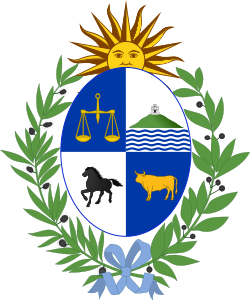 Coat of Arms of the State
-
 National Anthem
-
 Flag of Artigas
-
 Flag of the Thirty-Three
-
 National Cockade


Decree 435/007 established that the National Cockade is for free use, while the cockade identified with the Flag of Artigas is for the exclusive use of the Armed Forces and the one identified with the Flag of the Thirty-Three Orientals is for the exclusive use of the National Police.
The flag of Uruguay or National Flag is the most important national symbol. It was adopted by the laws of December 16, 1828 and July 12, 1830. Its colors are white and blue, with the sun, which occupies the canton, in gold. The arrangement of the nine horizontal stripes distributed over the field represents the first nine departments. The canton is occupied by the Sun of May, which represents the Inca god Inti, symbol of the May Revolution.
The National Coat of Arms of Uruguay is the one approved by the laws of March 19, 1829 and July 12, 1906 and the Decree of October 26, 1908. In accordance with this last decree, the one presented by Mr. Miguel Copetti was established as the official model of the National Coat of Arms.
World Heritage in Uruguay

Cultural and natural properties:
- 1995: Historic Quarter of the City of Colonia del Sacramento[216]
- 2015: Fray Bentos Industrial and Cultural Landscape
Intangible cultural heritage:
Statistics
- According to a study by the Legatum Institute, based in Dubai, United Arab Emirates, and in the 2013 Legatum Prosperity Index,[217] Uruguay is first in Latin America and 30th worldwide in the ranking of high-prosperity countries, which groups the top 30 countries in the world. It is followed by Costa Rica in 31st place and Chile in 35th place at the Latin American level.
- According to a study by the organization Transparency International, it is the country in Latin America with the lowest corruption perception index.[218]
- According to the 2009 report of "Reporters Without Borders," Uruguay is the country with the highest press freedom index in South America.[219]
- According to the Democracy Index of the British newspaper "The Economist," Uruguay and Costa Rica are the only Latin American countries considered a full democracy, placing Uruguay 18th worldwide and first in Latin America.
- In 2013, Uruguay was the second country in the Americas (after Canada) in the ranking of the most peaceful nations in the world; it is first in Latin America and 24th worldwide.
- A report by Reader's Digest magazine places it among the ten greenest countries in the world, occupying ninth position in a list headed by states such as Finland, Iceland and Norway.[220]
- Uruguay ranks fifth in Latin America (after Chile, Panama, Costa Rica and El Salvador) and 53rd worldwide in the Globalization Index.
- According to the 2013 Index of Economic Freedom of the Wall Street Journal and the Heritage Foundation, Uruguay is second in Latin America after Chile, with world position 36 and Chile with 7.[221]
- In the 2010 Ease of Doing Business Index according to the World Bank, it holds third place in South America, after Chile and Peru.
- In the International Property Rights Index, it shares third place in the region with Costa Rica (after Chile and Puerto Rico), and 50th place worldwide in 2010.
International rankings
The ranking is shown in order of Uruguay's index position with respect to the ranking of the countries evaluated in each category. The year shown with the indicator reflects the date of the data used in the evaluation as reported by each source, and does not necessarily correspond to the year of publication.
- (2) Position with respect to the evaluated countries of Latin America (does not include Puerto Rico).
- (3) Because the Gini coefficient used in the ranking corresponds to different years, a country's position is only a reference, since strictly speaking it is not possible to make comparisons between countries given the dispersion of the dates of the data.
- (4) The Life Satisfaction Index was calculated by the Inter-American Development Bank for the 24 IDB member countries in Latin America and the Caribbean, based on the 2006–2007 Gallup World Poll and the World Development Indicators; it is therefore a regional index.
See also
Notes
- ↑ Although it declared independence from Brazil, the law of independence of the declaration specified that it also did so from Portugal and from any foreign power, while with the law of union it was reunited with the United Provinces of the Río de la Plata.
- ↑ Date on which the Preliminary Peace Convention was ratified, by which Brazil and the United Provinces renounced their aspirations of dominion over Uruguay.
- ↑ 3.0 3.1 The localities on pages 25, 26 and 27 of the annexes of the White Book of the Metropolitan Area were taken as the Montevideo Metropolitan Area.[11]
References
- ↑ "oriental". Diccionario de la lengua española (in español). Madrid: Real Academia Española. Retrieved January 28, 2022.
- ↑ CIA. "Argentina - Geografía - Libro Mundial de Hechos" (in español). Retrieved February 17, 2017.
- ↑ 3.0 3.1 3.2 3.3 3.4 3.5 3.6 3.7 3.8 CIA. "Uruguay - Geografía - Libro Mundial de Hechos" (in español). Retrieved January 25, 2017.
- ↑ 4.0 4.1 4.2 4.3 International Monetary Fund. "Report for Selected Countries and Subjects - April 2025". Retrieved April 22, 2025.
- ↑ "GINI index (World Bank estimate) - Uruguay". World Bank. Retrieved February 23, 2025.
- ↑ "Human Development Insights". United Nations Development Programme (UNDP). May 6, 2025. Retrieved November 18, 2025.
- ↑ El País. "Ponen fin a cambio de hora en verano" (in español). Retrieved October 3, 2015.
- ↑ "Censo Nacional 2023 contabilizó 3.499.451 habitantes en Uruguay". Uruguay Presidencia (in español). Retrieved 2024-12-10.
- ↑ www.ine.gub.uy
- ↑ "Indicadores Demográficos del Departamento de Montevideo. Período 1996-2025" (in español). Instituto Nacional de Estadística. Archived from the original on March 4, 2012. Retrieved April 24, 2012.
- ↑ Libro blanco del Área Metropolitana: Anexos Archived November 26, 2016, at the Wayback Machine Retrieved August 3, 2013.
- ↑ 12.0 12.1 12.2 12.3 "¿ORIENTALES O URUGUAYOS?". www.chasque.net (in español). Retrieved April 25, 2019.
- ↑ "Clima Montevideo: Temperatura, Climograma y Tabla climática para Montevideo - Climate-Data.org". es.climate-data.org (in español). Retrieved April 25, 2019.
- ↑ "EL CLIMA Y SU VARIABILIDAD EN URUGUAY". meteorologia.fcien.edu.uy (in español). Retrieved April 25, 2019.
- ↑ "EL COMPORTAMIENTO DE LAS LLUVIAS EN URUGUAY". www.inia.org.uy (in español). Retrieved April 25, 2019.
- ↑ "Informe del Programa de les Nacions Unides per al Desenvolupament del 2005, taula 12" (pdf). Retrieved August 18, 2013.
- ↑ "Índice de Percepción de la Corrupción 2017 de Transparency International" (PDF) (in español).
- ↑ "Uruguay es el tercer mejor país para vivir dentro de América Latina" (in español). elpais.com.uy. November 3, 2011. Archived from the original on November 3, 2011. Retrieved November 3, 2011.
- ↑ 19.0 19.1 PNUD (2018). "Informe sobre Desarrollo Humano 2018" (pdf). Stockholm, Sweden. Retrieved September 14, 2018.
- ↑ "Uruguay se encuentra a la cabeza en el envejecimiento de su población" (in español). Archived from the original on June 8, 2013. Retrieved July 28, 2013.
- ↑ "Artículo del periódico paraguayo ABC Digital" (in español). Retrieved July 28, 2013.
- ↑ "Uruguay es el país más pacífico de América Latina" (in español). Archived from the original on December 11, 2011. Retrieved July 28, 2013.
- ↑ "Uruguay es el país más pacífico de América Latina" (in español). Archived from the original on December 14, 2008. Retrieved December 8, 2008.
- ↑ 24.0 24.1 "Uruguay, el mejor de Iberoamérica" (in español). Archived from the original on March 9, 2010. Retrieved July 28, 2013.
- ↑ "The Economist: ¿Cuáles son los países más democráticos del mundo? Uruguay es el número uno de Latinoamérica" (in español). Retrieved March 20, 2014.
- ↑ 26.0 26.1 26.2 "Presentan tesis del nombre Uruguay" (in español). El País. October 8, 2010. Archived from the original on March 14, 2012. Retrieved April 24, 2012.
- ↑ "Biólogos disertaron y encabezaron actividad en zona del arroyo Sacra" (in español). El Telégrafo. May 27, 2009. Archived from the original on January 19, 2012. Retrieved April 24, 2012.
- ↑ Ministerio de Relaciones Exteriores. "Límite exterior de la plataforma continental uruguaya". www.mrree.gub.uy (in español). Retrieved May 7, 2019.
- ↑ "Frontera Uruguay – Brasil: Límites Contestados » Data DIP" (in español). Retrieved May 7, 2019.
- ↑ 30.0 30.1 "Uruguay: relieve e hidrografía | La guía de Geografía". geografia.laguia2000.com (in español). Retrieved May 6, 2019.
- ↑ 31.0 31.1 31.2 Chebataroff (1969). "Sistemas de cuchillas". Nuestra tierra. Relieve y costas (PDF) (in español). Nuestra Tierra. pp. 21 y 22. Retrieved May 7, 2019.
- ↑ 32.0 32.1 Chebataroff (1969). Nuestra tierra. Relieve y costas (PDF) (in español). Nuestra Tierra. p. 11. Retrieved May 7, 2019.
- ↑ Chebataroff (1969). Nuestra tierra. Relieve y costas (PDF) (in español). Nuestra Tierra. pp. 45, 46 y 47.
- ↑ "Relieve. Geografia del Uruguay. Enciclopedia gratis". www.geografiadeluruguay.eluruguayo.com (in español). Retrieved May 7, 2019.
- ↑ 35.0 35.1 Bellagamba, Jorge Luis. "Recursos Hídricos – Uruguay 2011" (PDF). 2011 (in español). Retrieved June 6, 2019.
- ↑ 36.0 36.1 36.2 Álvarez, Walter; De Souza Rocha, Roberto. "Aguas continentales de Uruguay" (PDF). 2010 (in español). Retrieved June 6, 2019.
- ↑ 37.0 37.1 37.2 Praderi, Raúl; Vivo, Jorge. "Nuestra Tierra - Ríos y Lagunas" (PDF). 1969 (in español). Retrieved June 6, 2019.
- ↑ "Regiones hidrográficas". www.mvotma.gub.uy (in español). Retrieved June 6, 2019.
- ↑ "Región hidrográfica del río Uruguay". www.mvotma.gub.uy (in español). Retrieved June 6, 2019.
- ↑ "Región hidrográfica del Río de la Plata y frente marítimo". www.mvotma.gub.uy (in español). Retrieved June 6, 2019.
- ↑ "Región hidrográfica de la laguna Merín". www.mvotma.gub.uy (in español). Retrieved June 6, 2019.
- ↑ "Salto Grande | Historia". www.saltogrande.org (in español). Retrieved June 6, 2019.
- ↑ "Salto Grande | Río Uruguay". www.saltogrande.org (in español). Retrieved June 6, 2016.
- ↑ "El Río Uruguay en cifras « C.A.R.U. – Comisión Administradora del Río Uruguay" (in español). Retrieved June 6, 2019.
- ↑ 45.0 45.1 "Hidrografía | UruBusca.com" (in español). Retrieved June 6, 2019.
- ↑ "UTE - La energía que nos une | Fuentes de Generación". portal.ute.com.uy (in español). Retrieved June 6, 2019.
- ↑ "Cuenca del río Negro". www.mvotma.gub.uy (in español). Retrieved June 6, 2019.
- ↑ "Región hidrográfica del Río de la Plata y frente marítimo". www.mvotma.gub.uy (in español). Retrieved June 6, 2019.
- ↑ Obras Sanitarias del Estado. "Aguas Corrientes" (PDF). 2012 (in español). Retrieved June 6, 2019.
- ↑ "Comisión de cuenca de la laguna del Sauce". www.mvotma.gub.uy (in español). Retrieved June 6, 2019.
- ↑ www.d11.com.uy, Diseño y desarrollo web: D11,. "Tero | Contenidos educativos digitales". contenidoseducativosdigitales.edu.uy (in español). Retrieved January 30, 2018.
{{cite web}}: CS1 maint: extra punctuation (link) CS1 maint: multiple names: authors list (link) CS1 maint: numeric names: authors list (link) - ↑ "Reserva autóctona natural Pan de Azúcar, y Piriápolis" (in español). Archived from the original on March 4, 2012. Retrieved July 28, 2013.
- ↑ "Gaviota cocinera" (in español). Archived from the original on July 29, 2014. Retrieved July 28, 2013.
- ↑ "Un felino muy ágil y carismático está más presente en Uruguay de lo que se creía". Montevideo Portal (in español). Retrieved February 28, 2019.
- ↑ "Cuadernos del Potrerillo de Santa Teresa" (pdf). 2010 (in español).
- ↑ "Lobos Marinos del Uruguay" (in español). Archived from the original on August 7, 2013. Retrieved July 31, 2013.
- ↑ "Fauna del Uruguay" (in español). Retrieved July 31, 2013.
- ↑ "EEZ Waters Of Uruguay Sea Around Us Proyect". Retrieved November 9, 2010.
- ↑ "Uruguay amplía su zona marítima en 150 millas" (in español). Diario El País. Archived from the original on May 22, 2011. Retrieved November 9, 2010.
- ↑ "Límite exterior de la plataforma continental uruguaya" (in español). Ministerio de Relaciones Exteriores. Retrieved October 17, 2016.
- ↑ "Nuestro pasado indígena". EL PAIS (in español). June 11, 2012. Retrieved March 20, 2014.
- ↑ "Hallazgo prehistórico con repercusión internacional". EL PAÍS (in español). February 21, 2011. Archived from the original on February 24, 2011. Retrieved March 20, 2014.
- ↑ "Uruguay prehistórico" (in español). Retrieved March 20, 2014.
- ↑ 64.0 64.1 "Voces indígenas incorporadas al habla de los uruguayos" (in español). Retrieved February 20, 2014.
- ↑ Andrés López Reilly (June 12, 2015). "Un tour por el puerto de Gaboto" (in español). elpais.com.uy. Retrieved September 9, 2017.
- ↑ Díaz de Guerra, María A. (1998). "Historia de Maldonado. Tomo I" (in español) (Intendencia Municipal de Maldonado ed.). Intendencia de Maldonado. Archived from the original on November 13, 2009.
- ↑ Amondarain, Leopoldo (April 5, 2008). "Genocidio de Salsipuedes. 11.4.831 - Editorial" (in español). La Red 21. Retrieved April 24, 2012.
- ↑ "Gold Flows to 'Switzerland of Americas' Since Korean War". New York Times. January 3, 1951. Retrieved April 24, 2012.
- ↑ "...Uruguay has for most of its history been the 'Switzerland' of South America..." - Thomas J. Knight, Latin America comes of age (Scarecrow Press, 1979), 24.
- ↑ Source: United Kingdom, Statistical Abstract of Principal and other Foreign countries (1907-1918).
- ↑ Martínez, Virginia. Tiempos de dictadura 1973/1985. Hechos, voces, documentos. La represión y la resistencia día a día (in español). Ediciones de la Banda Oriental. Archived from the original on January 18, 2012. Retrieved August 1, 2013.
- ↑ "Lista de desaparecidos en Uruguay" (in español). Archived from the original on July 5, 2014. Retrieved August 18, 2013.
- ↑ La Onda digital (2002). "Alejandro Atchugarry es el nuevo ministro de Economía" (in español). Archived from the original on November 30, 2012. Retrieved August 3, 2013.
- ↑ 74.0 74.1 PAOLILLO, Claudio (2004). "La crucifixión de Atchugarry". Con los días contados (in español). Montevideo: Editorial Búsqueda.
{{cite book}}: CS1 maint: publisher location (link) - ↑ Bolón, Alma (2003). "La voz paralizante:anotaciones sobre el rumor del 2 de agosto 2002" (PDF) (in español). Retrieved August 3, 2013.
- ↑ PAOLILLO, Claudio (2004). "Taylor es de Peñarol". Con los días contados (in español). Montevideo: Editorial Búsqueda.
{{cite book}}: CS1 maint: publisher location (link) - ↑ Iglesia en Marcha (2003). "Aumentan suicidios" (in español).[dead link]
- ↑ Instituto Nacional de Estadística (2008). "Índice de Salario Real - Periodo 1996 - al último dato disponible" (in español). Archived from the original on November 13, 2013. Retrieved August 3, 2013.
- ↑ Instituto Nacional de Estadística (2007). "Tasa de desempleo general (1999 - 2006)" (PDF) (in español). Archived from the original (PDF) on October 29, 2012. Retrieved August 3, 2013.
- ↑ Redacción 180 (November 30, 2009). "Final: Mujica 52,39%; Lacalle 43,51 %" (in español). 180.com.uy. Retrieved December 1, 2009.
{{cite web}}: CS1 maint: numeric names: authors list (link)[dead link] - ↑ "Mujica pidió apoyo a los uruguayos para conformar un país más igualitario" (in español). La República. Retrieved July 31, 2013.
- ↑ "El libertario Luis Lacalle Pou se proclama nuevo presidente de Uruguay" (in español). France 24. November 28, 2019. Retrieved June 24, 2021.
- ↑ Caetano, Gerardo (March 26, 2020). "Uruguay, ¿una isla en el cono sur?". El País (in español). Madrid.
- ↑ "Gobierno declaró emergencia sanitaria por coronavirus y anunció las primeras medidas - Presidencia de la República". www.presidencia.gub.uy (in español). Retrieved March 15, 2020.
- ↑ "The Economist - Democracy index" (PDF). Retrieved August 3, 2013.
- ↑ "Indicadores Demográficos del Uruguay. Período 1996 - 2025" (in español). Instituto Nacional de Estadística. Retrieved May 4, 2013.
- ↑ La Colonia. "Asamblea Popular inauguró local en Nueva Helvecia" (in español). Archived from the original on November 7, 2011. Retrieved May 12, 2009.
- ↑ "La otra sorpresa de las internas: el Partido Ecologista Radical Intransigente" (in español).
- ↑ "Trabajadores conformes con votación alcanzada el domingo 26 de octubre" (in español).
- ↑ Democracy Index 2017 table
- ↑ ElPais. "Para Jefe del Ejército, número de efectivos está en "nivel crítico"". Diario EL PAIS Uruguay (in español). Retrieved January 30, 2018.
- ↑ "Vehículos y armamento" (in español). Retrieved January 30, 2018.
- ↑ "Armamento individual" (in español). Retrieved January 30, 2018.
- ↑ "MERCOSUR - Estados Partes". www.mercosur.int (in español). Retrieved January 30, 2018.
- ↑ "MERCOSUR - Países del MERCOSUR". www.mercosur.int (in español). Retrieved January 30, 2018.
- ↑ "Capítulo 8 América Latina en la industria glabal de software y servicios: Una visión de conjunto" (pdf) (in español). Retrieved July 31, 2013.
- ↑ 97.0 97.1 97.2 97.3 97.4 97.5 "CIA World Uruguay". Retrieved July 31, 2013.
- ↑ "Monitor Macro". aplicaciones.uruguayxxi.gub.uy (in español). Retrieved July 12, 2018.
- ↑ "Comunicado de Prensa IPC diciembre 2017 - INE" (in español).
- ↑ "Indigencia y pobreza en Uruguay bajo en 2014" (in español). Archived from the original on September 24, 2015. Retrieved April 9, 2015.
- ↑ "Panorama social da América Latina 2011" (PDF) (in português). ECLAC. 2011. Archived from the original (PDF) on January 1, 2014. Retrieved May 4, 2013.
- ↑ "Estimaciones de Pobreza por el Método del Ingreso 2008 - I.N.E. Uruguay" (PDF) (in español). Archived from the original (pdf) on June 14, 2013. Retrieved August 18, 2013.
- ↑ "La situación laboral en Uruguay" (in español). Archived from the original on April 11, 2008. Retrieved August 5, 2013.
- ↑ 104.0 104.1 104.2 "Situación Epidemiológica del Uruguay" (PDF) (in español). Archived from the original (PDF) on October 2, 2006. Retrieved November 28, 2013.
- ↑ "En 2011 se cuadruplicó el déficit comercial" (in español). Archived from the original on July 13, 2012. Retrieved August 1, 2013.
- ↑ Depetris, Edith; et al. (2009). "Consistencia de indicadores de especialización en el comercio internacional. Aplicación al caso de la mantequilla en Argentina y Uruguay". Revista de Métodos Cuantitativos para la Economía y la Empresa (in español). 9: 85–105. ISSN 1886-516X.[dead link]
- ↑ Potencial del Riego Extensivo en Cultivos y Pasturas. 1.er Seminario Internacional / Paysandú / Uruguay. Agosto, 2010 [2]
- ↑ Uruguay llegó a 1.000 MW de energía eólica + El Observador, September 28, 2016
- ↑ "Informe Hidrocarburos - Uruguay XXI - Julio 2016" (PDF) (in español). Instituto Uruguay XXI. July 2016.
- ↑ "Vial Nacional - Longitud por tipo de firme" (in español). Archived from the original on January 1, 2014. Retrieved July 31, 2013.
- ↑ "Ferrocarriles del Uruguay" (in español). Retrieved July 31, 2013.
- ↑ "Grupo de Pasajeros en defensa de la Estación Central" (in español). Retrieved July 31, 2013.
- ↑ 113.0 113.1 113.2 "CIA - The World Factbook - Uruguay". Retrieved August 9, 2013.
- ↑ Puerto: en Montevideo subió la actividad y en Nueva Palmira bajó - El País, February 27, 2017
- ↑ "Índice sobre el estado de la libertad de prensa en el mundo" (in español). Archived from the original on February 20, 2007. Retrieved July 31, 2013.
- ↑ "CIA - The World Factbook - Uruguay". Retrieved August 1, 2013.
- ↑ "Antel - Reseña histórica" (in español). Retrieved August 1, 2013.
- ↑ "La telefonía fija llegó al máximo histórico gracias a la banda ancha" (in español). El Observador digital. Retrieved July 31, 2013.
- ↑ 119.0 119.1 "Informe de Mercado Telecomunicaciones - junio 2014" (PDF) (in español). URSEC. Archived from the original (PDF) on April 26, 2015. Retrieved January 19, 2015.
- ↑ "Antel primera en lanzar tecnología LTE en Latinoamérica" (in español). Retrieved August 1, 2013.[dead link]
- ↑ "Uruguay lidera en acceso a tecnologías en la región" (in español). Diario El País. Archived from the original on March 14, 2012. Retrieved July 31, 2013.
- ↑ 122.0 122.1 "Global Information Technology Report 2013". Retrieved July 31, 2013.
- ↑ "Un millón de internautas Un millón de gracias" (in español). Retrieved July 31, 2013.
- ↑ "Crecen las exportaciones de software del Mercosur" (in español). El Clarín. Archived from the original on May 26, 2010. Retrieved July 31, 2013.
- ↑ CUTI. "Cámara Uruguaya de Tecnologías de la Información" (in español). p. 1. Archived from the original on September 18, 2008. Retrieved January 29, 2010.
- ↑ 126.0 126.1 126.2 Instituto Nacional de Estadística, Uruguay (ed.). "Uruguay en cifras 2014" (in español). Retrieved January 9, 2016.
- ↑ "Genética uruguaya" (in español). Retrieved August 7, 2013.
- ↑ Fort, Laura (July 3, 2014). "Uruguay alcanzó un analfabetismo del 1,6 %, una de las más bajas del mundo" (in español). El Diario. Retrieved January 10, 2016.
- ↑ Adella Pelegrino. "Caracterización demográfica del Uruguay". University of the Republic, August 2003, pp. 8. Retrieved August 1, 2013.
- ↑ 130.0 130.1 130.2 Russell H. Fitzgibbon (1956). Uruguay: Portrait of a democracy. London: George Allen & Unwin.
- ↑ Lucio Mendieta y Núñez (1957). Revista mexicana de sociología. No. 19. Mexico: Instituto de Investigaciones Sociales de la Universidad Nacional Autónoma de México, pp. 347.
- ↑ Calvo, Juan José; Pardo, Ignacio (2014). Cuántos y cómo somos (PDF). Nuestro tiempo (in español). Montevideo: Comisión del Bicentenario. p. 8. ISBN 978-9974-712-01-0. Retrieved January 17, 2016.
- ↑ "Uruguay en Cifras 2009 (I.N.E. Uruguay)" (pdf) (in español). Retrieved July 31, 2013.[dead link]
- ↑ "Censos 2011 INE: Departamento de Canelones". (see Zone 3) (in español). Archived from the original on June 16, 2013. Retrieved March 20, 2014.
- ↑ "Intendencia Departamental de Paysandú: Plano de Paysandú" (pdf). Retrieved March 20, 2014.
- ↑ "INEduca". (see Población > Total por departamento > Maldonado > Macrocefalismo (in español). Archived from the original on June 1, 2014. Retrieved March 20, 2014.
- ↑ "Intendencia Departamental de Maldonado: Barrios de Maldonado" (PDF) (in español). Archived from the original (pdf) on March 8, 2014. Retrieved March 20, 2014.
- ↑ "Intendencia Departamental de Rivera: Barrios de Rivera" (PDF) (in español). Archived from the original (PDF) on February 15, 2010. Retrieved March 20, 2014.
- ↑ "Censos 2011 INE: Departamento de Cerro Largo" (in español). Archived from the original on July 7, 2014. Retrieved March 20, 2014.
- ↑ "Censos 2011 INE: Departamento de Cerro Largo" (in español). Archived from the original on September 27, 2014. Retrieved March 20, 2014.
- ↑ "Censos 2011 INE: Departamento de Durazno" (in español). Archived from the original on October 19, 2013. Retrieved March 20, 2014.
- ↑ "Censos 2011 INE: Departamento de Treinta y Tres" (in español). Archived from the original on July 2, 2013. Retrieved March 20, 2014.
- ↑ 143.0 143.1 "INE: Códigos de localidades". (see lines 95 and 96 for Barros Blancos and line 350 for Rosario (in español). Archived from the original (xls) on November 13, 2013. Retrieved March 20, 2014.
- ↑ "Censos 2011 INE: Departamento de San José" (in español). Archived from the original on June 5, 2013. Retrieved March 20, 2014.
- ↑ "Censos 2011 INE: Departamento de Río Negro" (in español). Archived from the original on October 19, 2013. Retrieved March 20, 2014.
- ↑ "Censos 2011 INE: Departamento de Soriano" (in español). Archived from the original on November 20, 2014. Retrieved March 20, 2014.
- ↑ "Censos 2011 INE: Departamento de Artigas" (in español). Archived from the original on September 27, 2014. Retrieved March 20, 2014.
- ↑ Junta Departamental de Maldonado: Planimetría digital de Punta del Este
- ↑ "Uruguay recibe más inmigrantes desde Argentina y Brasil" (in español). Retrieved August 9, 2013.
- ↑ "Cantidad de inmigrantes que solicitan vivir en Uruguay alcanzó un récord histórico y la tendencia es que "siga aumentando". En 2017 se emitieron al menos 13.000 residencias; por primera vez son más los venezolanos que argentinos" (in español). Retrieved February 16, 2018.
- ↑ "Expectación al otro lado del Atlántico" (in español). Retrieved August 9, 2013.
- ↑ Pellegrino, Adela; Cabella, Wanda; Paredes, Mariana; Pollero, Raquel; Varela, Carmen (2007). "De una transición a otra: la dinámica demográfica del Uruguay en el siglo XX" (doc) (in español). Montevideo.
{{cite journal}}: Cite journal requires|journal=(help) - ↑ "La emigración en el Uruguay actual. ¿El último que apague la luz?" (in español). Centro UNESCO de Montevideo. 2003.
{{cite journal}}: Cite journal requires|journal=(help) - ↑ "Italiani nel mondo. Diaspora italiana in cifre" (PDF) (in italiano). Archived from the original (pdf) on February 27, 2008. [dead link]
- ↑ Sans, Mónica (2009). ""Raza", adscripción étnica y genética en Uruguay" (pdf). Runa (in español). 30 (2). Universidad de Buenos Aires, Argentina: 163–174.[dead link]
- ↑ "2Demografía" (pdf) (in español). Retrieved August 11, 2013.
- ↑ "Los catalanes en Uruguay" (in español). Archived from the original on July 15, 2007. [dead link]
- ↑ "Álvarez Areces y Pérez Touriño en cena de honor a Vázquez" (in español). Archived from the original on December 9, 2007. Retrieved August 17, 2013.
- ↑ "Uruguay, lingua italiana alle elementari: ma un'ora e mezza a settimana non basta". Italia chiama Italia (in italiano). April 5, 2018. Retrieved October 30, 2018.
- ↑ Medical Union of Uruguay (June 30, 2010). "Demografía Médica en el Uruguay" (in español). Retrieved July 21, 2013.
- ↑ National Institute of Statistics (Uruguay). "INE - Uruguay en Cifras 2006" (PDF) (in español). Archived from the original (pdf) on June 15, 2013. Retrieved July 21, 2013.
- ↑ World Health Organization (February 20, 2006). "Global distribution of health workers in WHO Member States" (pdf). The World Health Report. Retrieved July 21, 2013.
- ↑ 163.0 163.1 "Perfil de Salud de País. Datos actualizados para 2001" (in español). Retrieved August 9, 2013.
- ↑ "Observa" (in español). Archived from the original on October 10, 2007. [dead link]
- ↑ "Panorama: Uruguay Estadísticas" (in español). Retrieved August 18, 2013.
- ↑ WHO; UNICEF (June 2006). "Coverage Estimates: Improved Drinking Water" (PDF). WHO/UNICEF Joint Monitoring Program for Water Supply and Sanitation. Archived from the original (pdf) on October 5, 2007. Retrieved July 21, 2013.
{{cite web}}: CS1 maint: multiple names: authors list (link) - ↑ WHO; UNICEF (June 2006). "Coverage Estimates: Improved Sanitation" (PDF). WHO/UNICEF Joint Monitoring Program for Water Supply and Sanitation. Archived from the original (pdf) on October 5, 2007. Retrieved July 21, 2013.
{{cite web}}: CS1 maint: multiple names: authors list (link) - ↑ "Depósito de documentos de la FAO:Uruguay" (in español). Retrieved July 31, 2013.
- ↑ "Uruguay es el primer país de la región totalmente libre de humo" (in español). Retrieved August 3, 2013.
- ↑ ""Cuando las letras no dicen nada"" (in español). El País Digital. November 24, 2007. Archived from the original on March 7, 2012. Retrieved July 31, 2013.
- ↑ "Principales figuras del FA acompañaron a Vázquez en almuerzo" (in español). El Observador. Retrieved July 31, 2013.
- ↑ Repetición en el Ciclo Básico se mantiene en el entorno del 30% Archived January 5, 2016, at the Wayback Machine – El País, September 9, 2014
- ↑ "Cooperación con la Corte Penal Internacional en materia de lucha contra el genocidio, los crímenes de guerra y de lesa humanidad" (in español). Archived from the original on August 10, 2011. Retrieved October 10, 2012.
- ↑ "Matrimonio igualitario: se aprobó postergación en el Senado" (in español). Archived from the original on January 1, 2014. Retrieved December 23, 2012.
- ↑ Lucía Scuro Somma (coordinadora) - Marisa Bucheli - Wanda Cabella - Karla Chagas - Amanda Díaz - Javier Díaz - Ana Frega - Óscar Montaño - Rafael Porzecanski - Óscar Rorra - Carolina Ricarte - Susana Rudolf - Natalia Stalla. "Población afrodescendiente y desigualdades étnico-raciales en Uruguay" (in español). Retrieved January 3, 2018.
- ↑ Ejecutivo decretó suba del salario mínimo a $ 13.430 – El Observador, January 17, 2018
- ↑ "Uruguay for Spanish students". Retrieved July 28, 2013.
- ↑ Eastern Michigan University (ed.). "International Linguistics Community Online". Retrieved April 26, 2011.
- ↑ ELIZAINCIN, Adolfo; BEHARES, Luis Ernesto; BARRIOS, Graciela. Nos falemo brasilero. Dialectos portugueses del Uruguay. 1987. Montevideo: Amesur. ISBN B0000D650N.
- ↑ CHAREILLE, Samantha. Aspectos de la situación lingüística de Uruguay: El caso del portuñol. GLOTTOPOL. Revue de sociolinguistique en ligne (Numéro 4, julliet 2004). (in French) Retrieved August 2012
- ↑ CARVALHO, Ana Maria. Variation and difussion of Uruguayan Portuguese in a bilingual border town. University of California at Berkeley USA. (in English) Retrieved August 3, 2013
- ↑ Planes y Programas - Reformulación 2006[dead link] Consejo de Educación Secundaria. Retrieved September 4, 2011.
- ↑ Asociación Uruguaya de Actores. "Teatros de Uruguay" (in español). Archived from the original on March 1, 2013. Retrieved February 12, 2013.
- ↑ "Origen del Candombe" (in español). Retrieved July 28, 2013.
- ↑ "El carnaval más largo del mundo" (in español). Archived from the original on July 7, 2011. Retrieved July 28, 2013.
- ↑ "Nunca se vio tanto cine nacional como en 2011" (in español). Retrieved July 31, 2013.
- ↑ "Historia de los indios americanos en Uruguay" (in español). Retrieved August 18, 2013.
- ↑ 188.0 188.1 "El Mate" (in español). Retrieved August 18, 2013.
- ↑ "El mate uruguayo" (in español). Archived from the original on June 3, 2013.
- ↑ "Hierba mate" (PDF) (in español). Retrieved August 18, 2013.[dead link]
- ↑ "La Milanesa Charrúa, delicia empanizada" (in español). Archived from the original on May 27, 2006. Retrieved August 18, 2013.
- ↑ "Los Ñoquis del 29" (in español). Retrieved August 18, 2013.
- ↑ "Polémica en Uruguay por el 'asado más grande del mundo'" (in español). Retrieved August 18, 2013.
- ↑ 194.0 194.1 194.2 "Encuesta Continua de Hogares 2008 – Religion" (in español). Instituto Nacional de Estadística. Archived from the original on November 14, 2010. Retrieved December 2, 2010.
- ↑ Bureau of Western Hemisphere Affairs. "Background Note: Uruguay". US Department of State. Retrieved February 23, 2011.
- ↑ 196.0 196.1 "Religion – Uruguay". Library of Congress Country Studies. Retrieved February 23, 2011.
- ↑ "U.S. Department of State - International Religious Freedom Report 2006 - Uruguay". Retrieved July 28, 2013.
- ↑ "Datos Generales del Uruguay". Archived from the original on July 14, 2013. Retrieved July 28, 2013.
- ↑ 1/0 Technology Corp. – Paul R. Williams, John Budday Running. "Armenian General Benevolent Union – Publications". Agbu.org. Archived from the original on December 9, 2010. Retrieved December 2, 2010.
{{cite web}}: CS1 maint: numeric names: authors list (link) - ↑ "Latinobarómetro 2014 - Informe sobre religiones" (in español). Retrieved June 30, 2014.
- ↑ "UMM | Latin American Area Studies – Countries". Morris.umn.edu. August 27, 2009. Archived from the original on July 14, 2010. Retrieved June 26, 2010.
- ↑ Ministerio de Turismo, República Oriental del Uruguay. "Temporadas de cruceros: Resultados finales de cada temporada de cruceros" (in español). Archived from the original on July 29, 2013. Retrieved July 21, 2013.
- ↑ "Cruceristas dejaron US$ 20 millones de ingresos en temporada 2011-2012 y 6 de cada 10 mujeres viajan solas" (in español). La Red 21. June 29, 2012. Retrieved July 21, 2013.
- ↑ 204.0 204.1 204.2 World Tourism Organization (2009). "Barómetro OMT del Turismo Mundial, enero 2009" (PDF). UNWTO. Archived from the original (PDF) on October 19, 2013. Retrieved January 12, 2009. Volume 6 No. 2
- ↑ United Nations. "UNData. Country profiles". Retrieved August 9, 2008. Estimated population by country for 2007 (look up each country's profile)
- ↑ 206.0 206.1 Jennifer Blanke and Thea Chiesa, Editors (2011). "Travel & Tourism Competitiveness Report 2011" (PDF). Geneva: World Economic Forum. Retrieved March 14, 2011.
{{cite web}}:|author=has generic name (help) - ↑ "Información sobre Uruguay: Fútbol como el deporte nacional" (in español). Archived from the original on July 28, 2009. Retrieved July 31, 2013.
- ↑ "Olympic.org Official website of the Olympic Movement". Retrieved July 31, 2013.
- ↑ "Notas de fútbol: Uruguay, primer campeón del mundo" (in español). Archived from the original on January 1, 2014. Retrieved July 31, 2013.
- ↑ "Historia de la Copa del Mundo de Fútbol" (pdf). Retrieved July 31, 2013.
- ↑ "Ranquin de Clubs de la CONMEBOL" (in español). Archived from the original on September 12, 2009. Retrieved July 31, 2013.
- ↑ Los Feriados Nacionales - Almanaque 1990 del Banco de Seguros del Estado
- ↑ "Feriados de Uruguay". p. 1. Archived from the original on August 4, 2013. Retrieved July 31, 2013.
- ↑ "En Uruguay: por qué Semana de Turismo y no Semana Santa" (in español). p. 1. Retrieved August 1, 2013.
- ↑ "Se declara el 12 de octubre de cada año: "Día de la Diversidad Cultural"" (in español). September 14, 2014.
- ↑ Unesco. "Colonia patrimonio histórico de la humanidad" (in español). p. 1. Retrieved October 8, 2009.
- ↑ "The 2013 Legatum Prosperity Index". Legatum Institute. Archived from the original on October 12, 2013. Retrieved September 17, 2014.
- ↑ "Índice de Percepción de la Corrupción 2013" (in español). Transparency International. 2013. Retrieved May 4, 2014.
- ↑ "Sin censura" (in español). Retrieved August 18, 2013.[dead link]
- ↑ "Uruguay es el país más verde de América Latina y el noveno en el mundo" (in español). Retrieved July 28, 2013.[dead link]
- ↑ "2013 Index of Economic Freedom". Heritage Foundation. Retrieved May 4, 2013.
- ↑ Reporters Without Borders. "Clasificación Mundial de la Libertad de Prensa 2017" (in español). Retrieved January 3, 2018.
- ↑ the Economist Intelligence Unit (EIU) (ed.). "Democracy Index 2016". Retrieved January 3, 2018.
- ↑ "Uruguay entre los sudamericanos con mejor nivel en el Índice de Paz". El País (in español). Retrieved February 20, 2018.
- ↑ Institute for Economics and Peace. "Global Peace Index 2017" (PDF). Retrieved February 20, 2018.
- ↑ InternationalLiving.com (ed.). "Quality of Life Index 2010". Archived from the original on January 14, 2010. Retrieved April 17, 2013.
- ↑ The Economist Intelligence Unit. "Pocket World in Figures 2008" (PDF). Retrieved January 13, 2012.
- ↑ Legatum Institute (ed.). "The Legatum Prosperity Index 2017". Retrieved January 3, 2017.
- ↑ "Country profiles". Travel and Tourism Competitiveness Report 2017. Retrieved January 3, 2018.
- ↑ Transparency International. "Índice de Percepción de la Corrupción 2016 de Transparency International" (PDF). Retrieved January 3, 2018.
- ↑ The Heritage Foundation; The Wall Street Journal. "Índice 2016 de libertad económica" (PDF) (in español). Retrieved January 3, 2018.
{{cite web}}: CS1 maint: multiple names: authors list (link) - ↑ "The Global Competitiveness Report 2017-2018". World Economic Forum. Retrieved January 3, 2018.
- ↑ United Nations Development Programme. "Informe sobre Desarrollo Humano 2016" (PDF). 2017 (in español). Retrieved January 3, 2018.
- ↑ UNPD Human Development Report 2007/2008. "Inequality in income or expenditure". Archived from the original on March 9, 2008. Retrieved March 14, 2008.
{{cite journal}}: Cite journal requires|journal=(help)CS1 maint: numeric names: authors list (link)
External links


Government links
- Portal of the Uruguayan State
- Presidency of the Oriental Republic of Uruguay
- Legislative Power
- Ministry of Tourism of Uruguay
Cultural links
- Portal of the Museums of Uruguay
- National Museum of Visual Arts (MNAV)
- Juan Manuel Blanes Municipal Museum of Fine Arts
Business links
| Northwest: Argentina |
North: Brazil |
Northeast: Brazil
|
| West: Argentina |
Uruguay | East: Atlantic Ocean |
| Southwest: Río de la Plata | South: Río de la Plata | Southeast: Atlantic Ocean |


