Borders: 1,687 km. These are 956 km to the northwest with Mexico and 203.38 km to the southeast with Honduras and El Salvador.[5] Coastline: 400 km Radio call sign prefix: TGA-TGZ, TDA-TDZ Inequality-adjusted HDI: 0.450[6] Member of:UN, OAS, IOM, SICA, CACM, ECLAC, OEI, ASALE, Parlacen, LG, Rio Group 1Article 143.- Official language. The official language of Guatemala is Spanish. The vernacular languages form part of the cultural heritage of the Nation. 2 Adding the 11,030 km² of Belize, the total area of Guatemalan territory would reach 119,919 km². 3 According to the projection of the National Institute of Statistics of Guatemala (INE).
Guatemala (from NahuatlQuauhtlemallan, 'place of many trees')[7] (officially the Republic of Guatemala) is a sovereign state located in Central America, at its northwestern end.
Guatemala has a broad autochthonous culture, the product of the fusion of the Maya culture and the Hispanic culture that took place during the Spanish viceregal era. It also has the largest and most populous city in Central America, namely its capital, Guatemala City. It is the most populous country in Central America, with more than 17 million inhabitants.[8]
Despite its relatively small territorial extent, Guatemala has a great climatic variety, the product of its mountainous relief, which ranges from sea level up to 4,220 meters above it.[9] This allows the country to have ecosystems as varied as the mangroves of the Pacific wetlands and the high-mountain cloud forests.
The official language is Spanish, although there are twenty-two Mayan languages, as well as the Xinca and Garifuna languages; these two languages are considered 'endangered', and they are also spoken by the Afro-descendant population in the Caribbean department of Izabal.[8]
The territory where Guatemala is currently located forms part of Mesoamerica, and in it, together with the neighboring countries, the Maya culture and the Olmec developed. After the Conquest of America, Guatemala became part of the Viceroyalty of New Spain as a Captaincy General. After its independence from Spain in 1821, the year in which it was constituted as the Kingdom of Guatemala, what is today Guatemala became part of the First Mexican Empire and also of the Federal Republic of Central America; it was not until 1847 that the current republic was established and the country began to open up to its neighboring countries and to establish diplomatic relations with some of the world's powers. After the triumph of a liberal reform in 1871, a series of dictatorial and scarcely democratic regimes were established until 1944, the year in which the Guatemalan Revolution of 1944 took place. That revolution lasted until 1954, the year in which a national liberation movement retook power in the country and plunged the country into a civil war, also called "the internal armed conflict of Guatemala", which ran from 1960 to 1996, during the government of Álvaro Arzu.
In the 21st century, Guatemala had a relatively stable economic policy that currently positions it as the ninth-largest economy in Latin America.[10] Nevertheless, levels of poverty and income inequality remain high,[11] even higher than when the peace accords were signed in 1996.[12][13]
Guatemala is located within the geographic area known as Mesoamerica. Several cultures developed within its territorial limits. Among them was the Maya Civilization, which was notable for achieving a complex social development. It excelled in several scientific disciplines such as architecture, writing, and an advanced reckoning of time by means of mathematics and astronomy. The Maya calendar, according to historians, was more precise than the Gregorian calendar we use today. They were hunters and farmers, practiced fishing, and domesticated animals such as turkeys and ducks; they traveled in canoes to navigate the rivers and to reach nearby islands. They also stood out in painting, sculpture, goldsmithing and copper metallurgy; they wove cotton and agave fiber, and they developed the most complete system of writing in pre-Hispanic America. Among the sports they practiced, the ballgame stands out, which was more a ceremony than a game.
In 1523 the Spanish conquistadors arrived from the west, coming from Mexico under the command of Captain Pedro de Alvarado, with the intention of exploring and colonizing the territories of present-day Guatemala. They first confronted the K'iche', and then briefly allied with the Kaqchikel, founding their first settlement on July 25, 1524, near Iximché (Tecpán), the capital of the Kaqchikel; the town was given the name Santiago de los Caballeros de Guatemala in honor of the patron apostle.
On November 22, 1527, this city was moved to the Valley of Almolonga—located in the modern neighborhood of San Miguel Escobar in Ciudad Vieja, Sacatepéquez—because of the constant siege it suffered from attacks by the natives.
The regular orders of Dominican priests established themselves in 1529, while the Franciscans did so in 1530 and the Mercedarians in 1536.[14] Between 1530 and 1531 Captain Alonso de Ávila, on his route from Ciudad Real to Acalán, accidentally discovered the lagoon and crag of Lacam-Tún. The inhabitants of this area, who traded with the peoples previously conquered by the Spaniards, avoided a direct confrontation by using the jungle as a refuge. There were several unsuccessful attempts to conquer the Lacandones: from New Spain, Juan Enríquez de Guzmán tried; from the Yucatán Peninsula, Francisco de Montejo tried; from Guatemala, Pedro de Alvarado with Captain Francisco Gil Zapata; and from Chiapa, Pedro Solórzano.[15] The Dominicans then attempted a peaceful conversion in the "Lands of War" of Tezulutlán.
The second site of the capital in the Valley of Almolonga (today the neighborhood of San Miguel Escobar in Ciudad Vieja, Sacatepéquez) was destroyed in the early morning of September 11, 1541, by an avalanche of mud and stones that came down from the summit of the Volcán de Agua, or Hunahpú Volcano as the Guatemalan natives knew it, burying the then capital of the region together with most of its inhabitants. Among them was the governor Doña Beatriz de la Cueva, widow of Pedro de Alvarado. This forced the city to be moved once again to the nearby Valley of Panchoy, some 6 kilometers downstream, where the city of Antigua Guatemala stands today.
In 1543 the Royal Audiencia and Chancery of Santiago de Guatemala was created, known simply as the Real Audiencia of Guatemala, which was initially established in another city: "by order of the Council of the Indies of September 13, 1543, the Audiencia is commanded to reside in the town of Valladolid de Comayagua".[16] Then, on May 16, 1544, the Real Audiencia moved to Gracias a Dios in Honduras, and remained there until 1549.[17] By Royal Decrees of October 25, 1548, and June 1, 1549, the transfer of the Real Audiencia to its definitive seat was granted, and it was established in the City of Santiago de Guatemala, being the highest court of the Spanish Crown in the Captaincy General of Guatemala, for the modern territory of Guatemala, El Salvador, Honduras, Nicaragua and Costa Rica and the Mexican state of Chiapas.
The Temple of the Great Jaguar is one of the foremost representative symbols of Guatemala.The demography of Guatemala is composed mostly of indigenous people descended from the Maya, which is why there are multiple Maya constructions throughout its territory; it is considered the Heart of the Maya World. In the photo, Yaxhá, a National Park located in the Petén Department.
Iximché was the last Maya city in the Guatemalan Highlands that the Spaniards managed to conquer; they later made it the first capital of Guatemala.
On January 31, 1676, by Royal Decree of Charles II, the Royal and Pontifical University of San Carlos Borromeo was founded,[18] the third university founded in America, where many important figures of the country studied, among them Friar Francisco Ximénez, discoverer of the Popol Vuh manuscript—who also translated it into Castilian, adapting it to the Catholic religion[19]—and Doctor José Felipe Flores, eminent protomedicus of Guatemala and personal physician of the King of Spain. In the art of the 17th century, the master painter Pedro de Liendo and the master sculptor Quirio Cataño stand out.
The capital of the Kingdom of Guatemala would be located in Santiago de los Caballeros until its transfer in 1775 to the Valley of La Ermita, the present location of the capital. King Philip II of Spain and Portugal granted it the title of "Very noble and very loyal City of Santiago de los Caballeros de Goathemala". During Spanish rule, which lasted almost 300 years, Guatemala was a region of strategic character (Captaincy General of the Kingdom of Guatemala), forming part of the Viceroyalty of New Spain. The Captaincy General of Guatemala extended from the region of Chiapas (today part of Mexico) to present-day Costa Rica. Its political divisions changed frequently, as did the borders between the various provinces. In the mid-17th century, the kingdom as a whole had thirty-two provinces, twelve of which were in the modern territory of the Republic of Guatemala: the Valley of Guatemala, where the city of Santiago de los Caballeros de Guatemala, seat of the Real Audiencia, was located; the Alcaldías Mayores of Amatique, Suchitepéquez and Verapaz; and the Corregimientos of Acasaguastlán, Atitlán, Chiquimula, Escuintla, Guazacapán, Quetzaltenango, Sololá (Tecpán-Atitlán) and Totonicapán.
At the end of the 18th century, when the enlightened reformism of the Bourbons introduced the system of Intendancies in some regions of the Spanish Empire, the number of provinces of the Captaincy General of Guatemala was reduced to 15, of which 9 were in the present territory of Guatemala: the Alcaldías Mayores of Chimaltenango, Escuintla, Sacatepéquez, Sololá, Suchitepéquez, Totonicapán and Verapaz, and the Corregimientos of Chiquimula and Quetzaltenango. When the Constitution of Cádiz was promulgated in 1812, the Kingdom of Guatemala disappeared as a unit and was replaced by two provinces, without subordination between them: the Province of Guatemala, which comprised the territory of Chiapas, El Salvador, Guatemala and Honduras, and the Province of Nicaragua and Costa Rica. In 1821, during the Liberal Triennium in Spain, that Constitution came into force again, and the Provinces of Comayagua (Honduras), Chiapas and El Salvador were separated from the Province of Guatemala.
In 1810José de Bustamante y Guerra was appointed Captain General of Guatemala, at a time of great pro-independence activity; he carried out a reformist policy of an enlightened kind, but in the face of the revolution of Miguel Hidalgo y Costilla and José María Morelos in Mexico he prepared troops in Guatemala and created the "Corps of Volunteers of Ferdinand VII", and from his post he confronted the local constitutionalists, harshly repressing the insurgents; he opposed the liberal constitution of 1812. From October 28, 1813, and after the election of the rector of the Royal and Pontifical University of San Carlos Borromeo,[20] several meetings organized by Friar Juan Nepomuceno de la Concepción had been held in the prior's cell of the Convent of Belén. Those who met there swore to keep secret what was discussed; however, it is likely that they read a proclamation by José María Morelos and discussed the possibility of removing the Captain General of Guatemala, José de Bustamante y Guerra.[20] In November there was another meeting at the house of Cayetano and Mariano Bedoya, younger brothers of Doña Dolores Bedoya de Molina and brothers-in-law of Pedro Molina Mazariegos.[21]
On December 21, 1813, Bustamante y Guerra, having learned that seditious persons were meeting in the Convent of Belén to attempt an uprising, issued an order for Captain Antonio Villar and his aide, Francisco Cáscara, to arrest the religious of that monastery.[22] The Captain General learned of the conspiracy through Lieutenant Yúdice, who was allegedly joined by José de la Llana and Mariano Sánchez.[21] Likewise, Bustamante commissioned his nephew, the Carmelite Friar Manuel de la Madre de Dios, at the post office, to open all correspondence that fell into his hands.[22] Bustamante y Guerra later denounced his appointed successor, Juan Antonio de Tornos, Intendant of Honduras, for alleged liberal tendencies, and thus obtained confirmation in his post from Ferdinand VII in 1814. He was removed in August 1817 and returned to Spain in 1819.[21]
Flag of Guatemala near the National Palace on Independence Day.
In 1820, Atanasio Tzul, in response to his people's interest in ending ecclesiastical taxes and tribute, joined forces with Lucas Aguilar and with the Alcalde Mayor of Totonicapán, Narciso Mallol. Together they fought against the Spanish power, wielded by the Captain General of the Kingdom of Guatemala, the Archbishop of Guatemala Ramón Casaus y Torres, the local ladino elite and the caciques of Totonicapán, who had privileges with respect to the rest of the indigenous population because of their support for the European conquest. The royal tributes had been abolished in 1811 by the Cortes of Cádiz, but were imposed again by King Ferdinand VII. Tzul was flogged for nine days[23] and later imprisoned in Quetzaltenango, after the movement suffered repression at the hands of about a thousand militiamen.[24] On January 25, 1821, he and other leaders requested the grace of a pardon, which was granted to them on March 1, 1821, after a demonstration by people of Totonicapán.[23]
Signing of the Act of Independence of Central America, September 15, 1821, painting by Luis Vergara Ahumada.
In Mexico, the revolution achieved complete triumph and through the Plan of Iguala declared its total independence from the Spanish Empire on February 24, 1821. This news disconcerted the Spanish authorities of Guatemala and at the same time served as a stimulus to the pro-independence cause. On March 9, under pressure from the pro-independence liberals, the captain general left the post so that it could be occupied by the army's sub-inspector, Gabino Gaínza. Gaínza was a man of very advanced age, of weak and fickle character. Under his command, Central America experienced social agitation at intolerable levels, which forced the provincial deputation to ask Gaínza for a meeting to discuss the difficult subject of independence. Captain General Gaínza, then, heeding this call, assembled a council of notables composed of the Archbishop, the deputies, the high military officers, the prelates of the religious orders, and treasury officials. At that memorable meeting, presided over by Gaínza himself, the criollos present expressed their opinions freely. José Cecilio del Valle took the floor and in a long speech demonstrated the necessity and justice of independence, but stated that, in order to proclaim it, the vote of the Provinces must first be heard.
After a brief period of political uncertainty, on January 5, 1822, the Central American provinces were annexed to the Mexican Empire, an idea of Agustín de Iturbide to counter U.S. expansion. The Mexican Empire wanted to be a monarchy that would lead to a union of what had been the inhabitants of the Viceroyalty of New Spain under a single, Catholic and powerful flag. However, a year later, the empire collapsed and republican military men established a democracy and a Mexican state; Guatemala and its provinces separated from it, declaring their independence again and coming to form the United Provinces of Central America in July 1823.
On April 12, 1829, after trying to remain in power by making a pact with the President of the Central American Federation, Manuel José Arce y Fagoaga, the conservatives in Guatemala, led by Mariano de Aycinena y Piñol, signed a Capitulation Agreement with the Honduran liberal general Francisco Morazán, who had succeeded in getting the rest of the Central American provinces to rebel against the conservative power of Guatemala. Aycinena was sent to prison along with his colleagues in government; Morazán, for his part, annulled the document on the 20th of that same month, since his main objective was to eliminate the power of the conservative criollos and of the hierarchy of the Catholic Church in Guatemala, whom the liberal criollos detested for having been under their domination during the Spanish Viceroyalty.[25]Rafael Carrera took part in the fighting as a soldier; he was barely fifteen years old, and his family suffered numerous abuses at the hands of Morazán's troops;[26] also taking part were the poet and soldier José Batres Montúfar and the officer Miguel García Granados, who were taken prisoner by the liberal troops.[27]
Map of Guatemala in 1839. Note the undefined borders with Mexico in Yucatán and Chiapas, and that Belize was still an English settlement.[28]
By 1837, in the State of Guatemala an armed struggle began against the man who governed the State of Guatemala, a liberal like Francisco Morazán: Doctor José Mariano Gálvez. Driven by the liberal reforms and by conservative propaganda, insurgent movements arose in the mountains of Guatemala, and Rafael Carrera y Turcios was their foremost leader; among the rebel troops were numerous indigenous people[29] who fought for two years to achieve Guatemala's secession from the federation. The rebels began by raiding towns, without giving the government troops a chance to engage them, and spread the idea of Gálvez's enemies, which consisted of accusing him of poisoning the river waters in order to spread cholera morbus among the population. However, the government was not guilty of such poisoning: population growth and the limited capacity of the city's sanitary infrastructure contributed to the spread of the disease. This accusation favored Carrera's objectives, turning a large part of the population against Mariano Gálvez and the liberals; even among the liberals themselves people began to attack Gálvez: José Francisco Barrundia and María Josefa García Granados even went so far as to publish satirical newspapers against him.[30]
The area of Los Altos was populated mostly by indigenous people, who had maintained their ancestral traditions and their lands in the cold highlands of western Guatemala.[31] Throughout the viceregal period there had been revolts against the Spanish government.[32] After independence, the local mestizos and criollos favored the liberal party, while the indigenous majority were supporters of the Catholic Church and, therefore, conservative.[33] During the administration of Dr. Mariano Gálvez, Los Altos disapproved of the changes introduced by the head of government, but the region's leaders were not conservatives, but liberals who opposed Gálvez.[34] For their part, the criollos and ladinos of Los Altos held great resentment against the merchants of Guatemala City—the members of the Aycinena Clan—who monopolized trade and flatly opposed the construction of a port on the Pacific and of a road that would allow Los Altos to trade directly with foreign countries.[35]
When the Gálvez government fell, the criollo representatives of Los Altos took the opportunity to separate from the State of Guatemala on February 2, 1838. Governor Valenzuela could do nothing about it, and the congress of the Central American Federation recognized the Sixth State on June 5, 1838, with a provisional governing junta composed of Marcelo Molina Mata, José M. Gálvez and José A. Aguilar, while the Mexican General Agustín Guzmán—a former officer of the army of Vicente Filísola who had settled in Quetzaltenango—was placed in command of the State's army.[36] The flag of Los Altos was a modification of that of the United Provinces of Central America, with a coat of arms in the center showing a volcano in the background and a resplendent quetzal—a local bird that represented freedom—in front.
General Rafael Carrera y Turcios, President for Life of Guatemala. National Museum of History of Guatemala.
On March 18, 1840, the liberal leader Morazán, then head of State of El Salvador, invaded Guatemala with 1,500 soldiers to eliminate once and for all the conservative threat to Central America, which had its main bulwark in Guatemala. Morazán easily seized the capital, since Carrera feigned a retreat. While the invaders were celebrating and beginning to sack the city, Carrera attacked them with 400 soldiers and artillery pieces and counter-besieged the square, having triumphed and recovered the city the following day, March 19. The disaster was such that Morazán had to flee Guatemala with his closest followers shouting "Long live Carrera!" to save his life, while his soldiers remained in the city at the mercy of Carrera's troops.[37] Shortly afterward, Rafael Carrera, on learning that Los Altos had declared itself independent again, believing that Morazán had defeated him, directed his forces against that State and reincorporated it into the State of Guatemala in 1840.[38]
Once in power, Rafael Carrera would begin building a conservative regime, reversing the liberal reforms made previously. During his government, the conservative aristocrats and the High Clergy recovered the power they had lost. The liberals, for their part, accused him of being an illiterate soldier, and said that he signed with the name "Racaraca". For the conservatives, he was better known as the "Beloved Caudillo of the Peoples".[39]
Carrera was named President for life in 1854 and governed Guatemala until his death, which occurred on Holy Thursday, April 14, 1865.[40] Carrera's government was influenced to a certain extent by the war in Yucatán; the discontent of the Maya people had been evident since before the independence of Mexico. The conditions of vassalage in which the Maya indigenous people who had been conquered in the 16th century found themselves, and their enormous numerical superiority in the Yucatán Peninsula, kept the region in a permanent state of social tension. The Caste War arose in Yucatán due, in part, to the precarious living conditions of the Maya indigenous people on the peninsula: only the criollos and some mestizos were Yucatecans with full rights and, in general, they tended to occupy the upper part of the social and economic scale, so that the Maya, belonging to the impoverished class, did not feel part of them; they were simply Maya, foreigners in their own territory, in the land of their ancestors.[41]
In 1854 the Concordat with the Holy See was established, which had been signed in 1852 by Cardinal Jacobo Antonelli, Secretary of State of the Holy See, and Fernando Lorenzana, minister plenipotentiary of Guatemala to the Holy See. Through this treaty, which was designed by the leader of the Aycinena Clan, Juan José de Aycinena y Piñol,[42] Guatemala granted the education of the Guatemalan people to the regular orders of the Catholic Church.[43] The concordat maintained the close relationship between Church and State and remained in force until the fall of the conservative government of Marshal Vicente Cerna y Cerna.[43]
On the death of General Carrera in 1865, he was succeeded by Marshal Vicente Cerna y Cerna, who did not promote any renewal in the country. This circumstance was exploited by the liberals, who had taken refuge in the territory of Los Altos (today Quetzaltenango), and who, led by Miguel García Granados and Justo Rufino Barrios, after receiving aid in war materiel from Mexico (in exchange for recognizing the federation of the State of Chiapas with Mexico, and the territories of the southern zone of the State of Campeche and Soconusco as part of Chiapas), invaded Guatemala under the banner of the Liberal Reform of 1871. Miguel García Granados was provisional President after the overthrow of Cerna, governing until June 4, 1873. His government once again set in motion the anti-conservative reforms, decreeing among other things freedom of the press and freedom of worship, the abolition of tithes and of the religious orders, and expelling the Jesuits, in addition to promoting secular education.
Two important economic developments occurred in this period: large-scale coffee production was introduced. This was because the liberal landowners of the west were the main promoters of the Revolution; and, in order to reward the military men who collaborated with the revolution, the lands of the Indians were expropriated, tracts of land where the Guatemalan indigenous people had lived since the viceregal period. Likewise, rotations of indigenous people among the properties of the new landowners were instituted.[44]
Barrios, meanwhile, held important military posts, succeeding García Granados as President of Guatemala. During his administration he continued the policy begun in the previous presidency, undertaking a vast program of reforms that encompassed, among other aspects, the Church, the economy and education. He founded the Mortgage Bank, the so-called Eastern Hospital, and the Polytechnic School, and ordered the construction of the General Cemetery of Guatemala and the Central Penitentiary of Guatemala. In addition, during his presidency the first telegraph and railway lines were laid in Guatemala, and the contract for the construction of the Southern Railway was signed. In the administrative and legal order, the Penal Code, the Military Code and the Fiscal Code were promulgated. Likewise, the departments of Retalhuleu and Baja Verapaz were created, and free public education was established through schools throughout the country, while at the same time the brotherhoods and religious orders were suppressed. Barrios also promulgated the Constitution of 1879 and, the following year, was reelected President for a six-year term.
Likewise, the Day Laborers Regulations were decreed, labor legislation that placed the indigenous population practically at the disposal of the interests of the new coffee-growing latifundistas and the traditional conservatives.[45] As a result of these regulations, there was a notable increase in exports, and trade with the capitalist countries was activated; both the old conservative aristocrats and the new coffee-growing landowners benefited from these measures.[45] However, there was indeed one conservative landowner that was attacked and stripped of the privileges it had enjoyed during the government of the 30 years: the Catholic Church. The coffee-growing liberals were compelled to attack the Church because of the power it held and its strong opposition to sharing power with the liberals.[45]
On the other hand, Barrios bitterly persecuted the opposition, forcing many Guatemalans to flee into exile from Guatemalan lands. His government was characterized by the plundering of the national coffers, a fortune that was enjoyed by his widow in New York after the general's death.[46] Barrios was also the object of criticism after signing, in 1882, the Herrera–Mariscal Treaty on boundaries with Mexico, by which Guatemala renounced all claims over the region of Soconusco and its credits against Mexico, without receiving any compensation for the country: he had received Mexican weapons during the revolution of 1871 that he used to overthrow Cerna, but nothing more.
At the beginning of the 1880s, the Guatemalan President attempted to reestablish the United Provinces of Central America and, at first, counted on the support of El Salvador and Honduras, but the Salvadoran President Rafael Zaldívar later decided to abandon the union, with the backing of Mexico. The Mexican President, Porfirio Díaz, feared Barrios's liberal reforms and the competition of a strong State in Central America, where Barrios's plan had borne fruit, so the Mexican government fostered and supported the dismemberment of Central America into small nations over which the United Mexican States could exert influence and maintain its geopolitical interests. The United States also opposed the union. Barrios then undertook a military campaign to restore Central American unity by force, obtaining the backing of the President of Honduras Luis Bográn, but Costa Rica, El Salvador and Nicaragua allied to oppose his ambitions. To put his plans into practice, Barrios invaded El Salvador in March 1885, while troops from Costa Rica and Nicaragua prepared to confront those of Honduras. However, Barrios's attempt ended suddenly, as the Guatemalan President died at the Battle of Chalchuapa, shortly after his troops invaded Salvadoran territory.[47]
On the death of Barrios, and following the resignation of the provisional President Alejandro M. Sinibaldi, the National Assembly declared that the second designate to the presidency of the Republic should assume power. The person indicated was General Manuel Lisandro Barillas Bercián, who arrived at the moment of General Justo Rufino Barrios's burial and demanded that power be handed over to him, alleging that a sizable number of troops had come with him and indicating that they were quartered near the city. Before Barillas resorted to that ruse to press for his immediate entry into the presidency, he held the post of political chief of Quetzaltenango. The troops he spoke of did not exist, and so he marched to the Government Palace to assume the first magistracy of the Nation.[48] What was within the law was for Barillas to call elections at a later time, a step he omitted in order to remain in power by imposing a dictatorial government.
During the liberal governments the German colonization of the Verapaz began; the Germans organized themselves into a very close-knit and supportive community. They carried out their social activities at the German Club or Deutsche Verein, in Cobán, founded in 1888. In its beginnings, this group was composed only of German members. The place was remodeled and equipped to provide a pleasant atmosphere, where the Germans would feel as if they were in their own country. It had a library, with books and magazines donated by those who traveled to Germany. Today, where this club used to be, the Beneficence Society now stands. The Germans formed their own world in Alta Verapaz thanks to generous concessions granted by the liberal presidents Manuel Lisandro Barillas Bercián, José María Reina Barrios and Manuel Estrada Cabrera.[46] Because of the growing number of German children from the Verapaz, a German school was formed so that academic education would be more faithful to Deutschtum (Germanization).
Reyna Barrios's main project was the construction of an interoceanic railway that would be attractive to foreign investors, and to promote it, he held the Central American Exposition in 1897. Unfortunately, the railway could not be finished in time and the exposition was a failure, leaving Guatemala with a large foreign debt, mainly with English banks, which from then on was called the "English debt". In order to solve the country's problems, he sought to extend his government, asking the Assembly to amend the Constitution of 1879 for that purpose. Because of the popular discontent caused by the prevailing inflation (due to the holding of the Central American Exposition, to the beautification projects and to Brazil's entry into the coffee market), the Quetzaltenango Revolution of 1897 broke out, which was suppressed and ended with the execution by firing squad of prominent citizens of Quetzaltenango, among them the first mayor of Quetzaltenango, Sinforoso Aguilar, and the philanthropist Juan Aparicio Jr.
In 1898, José María Reina Barrios was assassinated by a British citizen of Swiss origin named Edgar Zollinger (who had been an employee and friend of Aparicio), who was shot down by the police without being given time to state the cause that drove him to commit the assassination. The first designate to the Presidency, Licenciado Manuel Estrada Cabrera, after a skillful political maneuver, seized power.[49][50]
Manuel Estrada Cabrera (known as "Don Manuel", or simply as "Cabrera" by his detractors) governed Guatemala from 1898 to 1920. Thanks to the concessions granted to foreigners, by 1901 the United Fruit Company (UFCO) began to become the main economic force in Guatemala, both political and economic. The government was often subordinated to the interests of the Company (one of the main ones in Central America). UFCO came to control more than 40% of the arable land of the country and of other Central American countries, as well as the port facilities (especially Puerto Barrios). It should be remembered that U.S. economic policy at that time was directed toward the Panama Canal: with the canal under construction since 1903, its main aim was to secure a peaceful and stable atmosphere throughout the Central American region without the intervention of European powers. For this reason there was an increase in the operations of U.S. companies in Central America, including the exponential growth of the operations of the United Fruit Company.[51] In addition, Estrada Cabrera also had another motive for drawing closer to the United States: the main one was that he could ask it for military aid in case England sent a military fleet to demand payment of the debt that Guatemala had with the English banks, which increased after the Barrios government and, especially, after the failure of the Central American Exposition of 1897;[52] and this fit perfectly with the U.S. "Big Stick" policy of the "Banana Wars" promoted by President Theodore Roosevelt to keep the peace in the region and to use its resources.
Another of the countries that tried to influence Guatemalan politics during the government of Estrada Cabrera was Mexico, which was governed by General Porfirio Díaz and which was concerned about the growing U.S. presence, which had increased since the war with Spain over Cuba in 1898 and then with the military aid during the Separation of Panama from Colombia that allowed the Americans to build the Panama Canal. Díaz and the other presidents of the region viewed with concern how Estrada Cabrera had bowed to U.S. interests[53]
The Totoposte War in 1903 caused a shortage of corn in the country, and the labor of Guatemalan workers was hired by the government at very low pay.[54] At the end of this first term of government, the exchange rate with respect to the U.S. dollar stood at $12 per US$1.[55]
On the fall of Estrada Cabrera, the National Assembly selected Carlos Herrera Luna as interim President, who was later declared constitutional president. The interim President Carlos Herrera y Luna inherited fiscal, monetary and banking disorder, with galloping inflation; he refused to ratify several contracts with U.S. companies that Estrada Cabrera had signed and that Herrera considered harmful to the country.
As for education, the Herrera government dissolved the "Estrada Cabrera University", which had been founded in 1918, and replaced it with the Faculty schools of the National University, to which it granted autonomy for the election of its authorities. But at that time there were barely three hundred students in the whole university, and illiteracy in the country was 93%, due mainly to the "Day Laborers Regulations" that Justo Rufino Barrios had instituted and that forced indigenous day laborers to work on the estates, without giving them time for their education.
Herrera was overthrown in December 1921 by General José María Orellana, who ratified all these contracts; this coup d'état would be part of a series of abuses committed in Latin America by the United Fruit Company.[57][58] The governments of Orellana and Chacón undertook an educational reform, granting scholarships abroad to graduates of the Normal School for Boys and other teacher-training schools of the country. Orellana died in office under suspicious circumstances in 1926 and was replaced by his vice president, Lázaro Chacón González.
Liberal government of General Jorge Ubico
General Jorge Ubico Castañeda, President of Guatemala from 1931 to 1944.The National Palace of Guatemala, now the Ministry of Culture of this country, was built during the Ubico government.
After the death of José María Orellana, and after taking part in the elections of 1926, in which he lost to the fellow liberal Lázaro Chacón González, General Jorge Ubico Castañeda retired to private life; but with the instability that arose after General Chacón's resignation at the end of 1930 due to illness, and the economic crisis that existed in the country because of the Great Depression originating in the crash of the New York Stock Exchange in 1929, he became involved in the political arena once again. In December 1930, the interim President Baudilio Palma was overthrown and murdered in a military coup by General Manuel María Orellana Contreras—cousin of General José María Orellana—but the government was not recognized by the President of the United States, a country which by then already had heavy investments in Guatemala. The National Legislative Assembly designated José María Reina Andrade, who had been minister of the Interior during a good part of the Estrada Cabrera government, and he immediately called elections, in which Ubico Castañeda ran as the sole candidate.[59]
At that time, numerous countries were inclined toward authoritarian governments; thus, once in power, Ubico Castañeda assumed dictatorial powers and methods of espionage and repression similar to those of Barrios and Estrada Cabrera, and maintained a puppet legislative Assembly obedient to his commands. Intelligent, dynamic and temperamental, he was obsessed with controlling even the smallest detail of the life of Guatemala,[60] one of his main objectives being to achieve a reorganization of the public administration, for which he appointed several of his close associates, the so-called "Ubiquistas", to key positions in the government.[61] His government was characterized by an effort to stabilize the state's finances by reducing public spending: he proved to be a very capable administrator by cutting the salaries of public employees by 40% to counter the government deficit;[62] he fostered coffee production during the Depression of 1929 by means of the "vagrancy law" and the "roads law", and also through the actions of a police and judiciary that were implacable against crime, corruption and any kind of opposition to the regime.[63] Finally, he completed the centralization of power by replacing the popularly elected mayors with intendants appointed by the president himself. Thanks to the almost free labor made available by his laws, his promotion of public works construction is significant, especially roads, for the benefit of coffee growing, which was dominated by German immigrants in the Verapaz (where he had been Political Chief) and by Guatemalan landowners in the rest of the country. For road construction he used forced labor of indigenous people, supervised by the army corps of engineers. By means of Decree 1995 of 1934 he canceled the unpayable debts that day laborers owed to the hacienda owners. But to counter a potential labor shortage for the estates, he promulgated Decree 1996, "The Vagrancy Law", which obliged every peasant who did not have a minimum of land to work a certain number of days a year in the service of a hacienda owner; if this could not be proven, the day laborer had to work on the roads without pay.
Like many rulers in Latin America, he extended his term and became the caudillo of the country. It was not difficult for him to be reelected: the people who could vote (practically the inhabitants of the capital city and several departmental capitals) were grateful to his administration for the improvement in living conditions.[64] Although he was an admirer of the dictatorial governments of Benito Mussolini, Francisco Franco and Adolf Hitler, he maintained cordial relations with the United States, and it can be said that his administration was sustained thanks to the banana monopoly of the "frutera" (the United Fruit Company). As the events of World War II unfolded, U.S. policy and his commitments to the "frutera" obliged him not only to declare war on the Axis nations—Germany, Italy and Japan—but also to allow the establishment of U.S. bases in Guatemala.[lower-alpha 1] Among the benefits he received from the U.S. government in exchange for his alliance in the war were modern weaponry for the army and training at the Polytechnic School by U.S. military personnel.
Ubico harshly repressed crime with the so-called Ley de Fuga, by means of which those accused of serious crimes were executed extrajudicially by presidential order. He also fought corruption in the State with the creation of the Comptroller General of Accounts of the Nation and the Court of Accounts. With this, the prisons became a deterrent to theft of the public treasury. He forced the legislative assembly to decree a donation of two hundred thousand dollars of the time to his person for his contributions to the homeland. Finally, in his economic approach of increasing the country's production at any cost, he exempted coffee growers and banana companies from criminal liability for mistreatment of their laborers and day workers.
In 1944, after more than 12 years of iron-fisted dictatorship, his government began to show clear signs of weakness. Demonstrations by the population against him multiplied, demanding his resignation. These demonstrations were led mainly by teachers and by students of the National University. On June 25, 1944, during the course of one of these demonstrations, the teacher María Chinchilla was killed, which, together with the "memorandum of the 311" and popular pressure, led to General Ubico's resignation, and on July 1, 1944, he formally agreed to resign from his post: Ubico left power in the hands of a military triumvirate made up of Generals Federico Ponce Vaides, Buenaventura Pineda and Sandoval Ariza, whom he brought out of the ostracism in which he had kept them during his government, and then he departed into political exile in New Orleans, where the headquarters of the United Fruit Company was located.[65]
It is important to point out that with the payment of the "English Debt" that General Ubico Castañeda made at the end of his administration, the revolutionary governments had a solid economic base to carry out their projects.[66]
General Ponce Vaides was in command for only 110 days and continued the repressive manner of governing of his predecessor, instructing the police to attack his adversaries.[67] In those days the newspaper El Imparcial published strong editorials against Federico Ponce Vaides's intentions to perpetuate himself in power. As a consequence of these events, on the first of October the director of El Imparcial, the journalist Alejandro Córdova, was murdered in front of his residence in the capital city. The crime accelerated the preparations for the civic-military movement of October 20, 1944. Days later, Ponce Vaides and the director of the National Police, Colonel Moisés Evaristo Orozco, were accused as the intellectual authors of the murder. All these events finished igniting passions that had been repressed for several years. It was on October 20, 1944, that a popular uprising took place, in which lawyers, teachers, workers, university students and part of the Army participated. The fight was waged against the other part of the Army and the police, who were loyal to General Ponce. After these events, the news spread that Ponce Vaides had requested political asylum in Mexico and that the government had been taken over by a triumvirate composed of one civilian and two military men: the civilian Jorge Toriello Garrido, Major Francisco Javier Arana and Captain Jacobo Arbenz Guzmán.[68]
The main functions of the transitional government were to repeal the decrees made by the previous administration. It convened a National Constituent Assembly that produced a new Magna Carta. The Revolutionary Junta of October 20, 1944, was instituted, with the purpose of guaranteeing Guatemalans a constitutional framework to lead Guatemala to a representative democracy.
The government of the first democratically elected president in the history of Guatemala, Juan José Arévalo, was distinguished by its numerous achievements in education and benefits for the majority of the poorest strata of the population, the middle class and the most consistent intellectuals. However, it faced numerous obstacles. President Arévalo Bermejo began his government in 1945, and according to liberal historians[69] from the beginning he used language that was at times divisive, which began to polarize Guatemalan society, causing among the landowners the feeling that he was only the ruler of one part of the Guatemalans. On the other hand, in Arévalo's autobiographical book Despacho Presidencial, he recounts that his government began with sanctions against the opposition—every time a plot against the government was suspected, civil liberties were restricted, the suspects were arrested and then sent into exile—economic interventionism by the State—with the issuing of the Economic Emergency Law—and decided support for a newly emerged trade-union movement. Thus, the forces opposed to the Arévalo government—moderate revolutionaries and landowners or "ubiquistas"—were little by little marginalized and began to fear the implementation of socialism in the country.[70] On the other hand, it is important to point out that President Arévalo took office with limited power, restricted by the military, who were led by Lieutenant Colonel Arana.[71]
Post Office Palace in Guatemala; during this period it handled the sending of letters to thousands of families.
The front of struggle of the Arévalo government was predominantly urban and, unlike his successor, it did not confront the problems of land tenure and agricultural labor, even though the majority of the population was rural and indigenous, except with regard to the workers of the technified U.S. agriculture established in the vast and fertile regions of Bananera and Tiquisate. On the other hand, the revolutionary regime, driven and led directly and indirectly by members of the middle strata, strengthened their positions and enlarged them; that is, it chose to favor the urban and ladino sectors of the population that make up what some sociologists call "the moral instances of society", namely the university, the secondary schools (which it doubled in the first 6 years), the courts, the bureaucracy (mainly the military one), the press, the churches, the intellectuals, the teachers and the university professionals, who were brought together through compulsory professional association.[72] For its part, the landowning sector organized itself through the associations of farmers, merchants, industrialists, bankers, insurers and financial speculators, etc.[73]
The prices of coffee, the main agricultural product exported by Guatemalans, since bananas were the exclusive business of the Americans, reached the levels they had lost in 1930. And, although the beneficiary in the first instance was the coffee elite, there was enough spillover to open new businesses or expand existing ones in the intermediate social ranks of the capital and some departmental capitals. Likewise, during the Arévalo government there was considerable expansion of the urban and ladino middle classes of the country, which even the newly organized trade unionism favored, since many of the new leaders and worker deputies came from their various strata.[74]
As for the press and the opposition, the government attacked the newspapers El Imparcial and La Hora when they published information that directly attacked government policies; unlike the governments of his predecessors, Arévalo did not use the Central Penitentiary to lock up and torture his political enemies. The custom was to force those who opposed the government to go into exile.[75]
Among the reforms set in motion after the fall of the Ponce Vaides government and which were sought to be consolidated with the Constitution of 1945, the restructuring of the Army was of great importance: the suspension of the rank of general, decreed from the first moments of the triumph of the revolutionary movement, symbolized this transformation, which was completed with a concern to modernize, professionalize and institutionalize the Army. For the first time in the history of the country a Constitution devoted an entire chapter and 13 articles to the subject of the Army, establishing a model that would be taken up again in later Constitutions. The constitutional norm established a reorganization of the Army that proved complex and not always operative: it sought to confirm the functional autonomy that was conferred on it for the first time. It created the Superior Council of National Defense, a consultative and collegiate body made up of 15 members, some by election, which did not include the President of the Republic, even though he was considered commander in chief of the Army.[76]
Not a few rivalries arose between the two leaders during the ten years in which the Constitution of 1945 was in force, such as those that pitted Major Francisco Javier Arana, leader of the right until his assassination in 1949, against Colonel Jacobo Arbenz Guzmán, leader of the left. On the other hand, some interpretations have insisted that it was precisely the legal status and the organizational structure that the Constitution of 1945 granted to the Army that were the factors determining that the officer corps fully entered the political game. In this sense, the votes to make up the Superior Council of National Defense and the very nature of this body encouraged discussion for decision-making on the military policy that the Army of Guatemala should adopt, and turned it into a deliberative estate.[77]
Colonel Jacobo Arbenz Guzmán came to power after winning the elections held in the Republic of Guatemala in 1950. He was supported by the National Renovation and Revolutionary Action parties of the Capital and the National Integration party of Quetzaltenango. Workers, peasants, teachers and students gave him their full backing, and he won the electoral process. When he began his government, Guatemalans seemed condemned not to prosper. In 1950, 76% of the inhabitants owned less than 10% of the land, while 2.2% owned 70%. The United Fruit Company owned more than 50% of the country's arable land, of which it cultivated only 2.6%; and the peasants had miserable wages. On the other hand, since the government of Manuel Estrada Cabrera there had existed U.S. monopolies of UFCO subsidiary companies that were engaged in freight transport by railway and steamships, which departed from Puerto Barrios, Izabal, a port controlled by the frutera. They likewise controlled the generation of electricity and the country's telephones and telegraphs. These companies paid no tax of any kind for the use of national resources, thanks to the generous concessions granted by Estrada Cabrera and ratified by the governments of José María Orellana and Jorge Ubico.[78]
Arbenz was of a nationalist leftist bent and attacked the U.S. monopolies head-on from the beginning of his government.[78] Numerous liberal authors state that he was a communist, because apart from attacking U.S. interests there were other factors: (a) the members of his private circle were leaders of the Guatemalan Party of Labour (PGT), which was the communist party of Guatemala, (b) CIA propaganda accused him of being a "puppet of Moscow", (c) the McCarthyist atmosphere prevailing in the United States after World War II, (d) the work of the State Department's anti-communist official, John Peurifoy, who was appointed U.S. ambassador to Guatemala between November 1953 and July 1954 and coordinated CIA support for Castillo Armas's movement, and (e) after leaving Guatemala, Arbenz went into exile in Czechoslovakia, the Soviet Union, China and Cuba, all of them communist countries, since no other country dared to receive him.[78]
On the basis of his government plan, he carried out (or tried to carry out) the following: he promulgated Decree 900 for an Agrarian Reform that generated significant fears among the large landowners, as well as in certain urban and rural middle sectors, for feeling their interests threatened they joined the campaign that identified the social changes with a political-ideological orientation of the regime toward communism;[79] he began the construction of the highway to the Atlantic[lower-alpha 2] to compete against the railway monopoly, which was controlled by the frutera through its company International Railways of Central America (IRCA); he began the construction of the port of "Santo Tomás de Castilla" where the port of Matías de Gálvez was located, to compete with Puerto Barrios, a port controlled by UFCO through its Great White Fleet; and he began studies for the "Jurún Marinalá" generating plant, to compete with the electric company in American hands.[78]
The executives of the United Fruit Company (UFCO) had worked intensively in the circles of the governments of Harry S. Truman and General Dwight Eisenhower to make them believe that Colonel Arbenz was trying to align Guatemala with the Soviet Bloc. What was happening was that UFCO saw its economic interests threatened by Arbenz's agrarian reform, which took away from it large amounts of idle land, and by the new Labor Code of Guatemala, which no longer allowed it to use the Guatemalan military forces to counter the demands of its workers.[80] As the largest landowner and employer in Guatemala, Decree 900 resulted in the expropriation of 40% of its lands.[81] U.S. government officials had little evidence of the growth of the communist threat in Guatemala,[82] but they did have a strong relationship with UFCO officials, demonstrating the strong influence that corporate interests had over U.S. foreign policy:[83]
After the cancellation of Operation PBFORTUNE, the CIA organized Operation PBSUCCESS, which consisted of training and financing a paramilitary rebel army (the National Liberation Movement (MLN)). This Movement entered through the Republic of Honduras, entrenched itself in Esquipulas and carried out the coup d'état of 1954, overthrowing Colonel Árbenz, who had to leave on a tortuous exile that took him to Czechoslovakia, the Soviet Union, Uruguay, Cuba, Switzerland and Mexico.[lower-alpha 3] Once the coup was consummated, Colonel Carlos Castillo Armas assumed the Headship of State.
Counterrevolutionary governments
On October 10, 1954, the military junta called a plebiscite in which Castillo Armas obtained 99.9% of the favorable vote. The almost unanimous result reflects the absence of alternatives, since in the plebiscite the population was asked whether or not it accepted him as President of the Republic. The vote was public and compulsory, while the count was secret. And the act took place in a climate of terror that affected Arbenz's supporters and the sectors of the leftist opposition in general. In this way Castillo Armas became President of the Republic for the term that was to end on March 15, 1960, as set by the National Constituent Assembly, which was elected at the same time.[84]
Of Arbenz's projects, Castillo Armas repealed only the agrarian reform immediately after taking power, but he had to finish the highway to the Atlantic, under the direction of Engineer Juan Luis Lizarralde, Minister of Public Works, because of the importance it had for the country's economy; the highway was finished in 1959, and after its completion what Árbenz had expected happened: the UFCO railway could not compete against vehicular transport by truck. Likewise, and for the same reason, he continued the planning work for the port of Santo Tomás and the Jurún Marinalá hydroelectric plant, which was finished and inaugurated in 1970. The port was built after the earthquake of 1976, but by then the United Fruit Company had already gone bankrupt and its successor, Chiquita Brands International, no longer had the same power and influence in the government of the United States.
The Castillo Armas regime appointed a new Supreme Court of Justice and began a period of intense political persecution against leaders, intellectuals and suspected communists in general. The rights acquired during the revolution of 1944 were annulled, especially those granted by the Agrarian Reform. The body of anti-communist laws was completed later, when transitory article 6 of the Constitution of 1956 empowered the head of the Executive to expatriate, or prevent the entry into the country for five years of, communists who had sought asylum or gone into exile from Guatemala for political reasons.[85]
Castillo Armas was assassinated in 1957; after his death there was a period of transition. Licenciado Luis Arturo González López was called to be interim President of the Republic, and he governed for less than three months; then Colonel Guillermo Flores Avendaño came to the Government, who governed for five months and called elections. The winner of the elections was the general and engineer Miguel Ydígoras Fuentes, who assumed the First Magistracy on March 2, 1958. During his term Ydígoras Fuentes displayed an apparent democracy, without going to the extremes of the revolutionary governments, but he began a culture of corruption that has remained embedded in the government ever since.
In response to his increasingly autocratic government, a group of lower-ranking military officers, among whom was Marco Antonio Yon Sosa, rebelled, trying to overthrow him in 1960. When they failed, several fled and established close ties with Cuba. This group would become the nucleus of the armed insurgency forces that would fight against the military governments during the following 36 years. Its four main left-wing guerrilla groups carried out economic sabotage and armed attacks against members of the state security forces.
The government of Miguel Ydígoras Fuentes ended on March 30, 1963, after the coup d'état of Colonel Enrique Peralta Azurdia: Dr. Juan José Arévalo had returned to Guatemala on March 29 of that year, after the government of General Miguel Ydígoras Fuentes suggested that he would be allowed to take part again in the presidential elections. The following day, the government was overthrown by the coup d'état led by the then minister of Defense, Colonel Peralta Azurdia, alleging that the corruption of the government was intolerable. Dr. Arévalo went into exile once again.[86]
A short time later there were democratic elections and Licenciado Julio César Méndez Montenegro was elected President in 1966. The renowned journalist Clemente Marroquín Rojas was elected vice president. Although at first a transparent democracy seemed to have been achieved, the army, which oversaw the government, launched a strong campaign against the insurgency that largely broke the guerrilla movement in the countryside and began the civil conflict that was to cause hundreds of thousands of victims. During his government sky blue was established as the color of the National Flag, and in 1967 decree 2795, promulgated by the government of General Jorge Ubico Castañeda, was reinstated, granting coffee estates and banana companies permission to punish the day-laborer tenants: "The owners of estates shall be exempt from criminal liability...".[87]
During his government the possibility of ceding the nickel mines in El Estor, Izabal, to a Canadian company was discussed, but the concession did not materialize.[lower-alpha 5] On the other hand, the railway concession for International Railways of Central America (IRCA), which began in 1904 during the government of Licenciado Manuel Estrada Cabrera,[91][92] came to its end during his government. The company, which had suffered substantial losses after the construction of the highway to the Atlantic during the governments of Jacobo Arbenz Guzmán and Carlos Castillo Armas, deliberately created a state of insolvency so that it would pass into the ownership of the State of Guatemala, a step that was carried out outside of public administrative procedure, which allowed IRCA to avoid liability for the debts it left behind.[93]
When he assumed the presidency, the Guatemalan Army, which was the one that really held power, did not allow him any room for action, and the attempts to reduce the violence of both the extreme right and the extreme left were not sufficient. In fact, during his government political violence increased: the guerrilla had grown stronger, which led the army to implement a major counterinsurgency campaign, above all in the east of the country and in Guatemala City. An event that shocked Guatemalan society during this government was the kidnapping, torture and murder of Miss Guatemala 1958, Rogelia Cruz Martínez, who had joined the leftistguerrilla after the student protests of 1962. She was abducted in December 1967 by government forces and found dead on January 11, 1968, near a bridge close to Escuintla, with terrible signs of torture. The PGT took revenge by attacking a group of U.S. military personnel, killing two and wounding a third.[citation needed][94]
On June 8, 1968, the Guatemalan guerrilla assassinated the United States ambassador to Guatemala, John Gordon Mein, the first U.S. ambassador to be assassinated while serving his country abroad. In retaliation, the Army of Guatemala killed several leaders of the Rebel Armed Forces. Apparently, the Rebel Armed Forces (FAR) tried to kidnap him, but killed him when he tried to flee.
Faced with the advance of the guerrilla, the Army of Guatemala took drastic measures to crush it. The operations against the subversion in the East of the country were effective: its weapons depots and its lines of communication and supply were destroyed.
From then until well into the 1970s the activity of the Guatemalan guerrilla was almost nil, limited to isolated acts of sabotage of little consequence. Among the latter, on February 27, 1970, the minister of Foreign Affairs, Alberto Fuentes Mohr, was kidnapped, and on March 16 the labor attaché of the United States Embassy, Sean Holly. The Rebel Armed Forces (FAR) claimed responsibility for both crimes.
The Jurún Marinalá Hydroelectric Plant was begun and completed during the term of President Julio César Méndez Montenegro; it was a project begun by the government of Colonel Jacobo Arbenz Guzmán before his overthrow in 1954.[95] Likewise, during his government the "Primero de Julio" neighborhood was built on the outskirts of Guatemala City, and in addition the public-access television station was created with the founding of Televisora Nacional de Guatemala, Channel 8, which was the successor of TGW-Channel 8, which had been closed in 1965.
In 1967, the Guatemalan writer Miguel Ángel Asturias won the Nobel Prize in Literature, and the Méndez Montenegro government ordered a bust of the writer to be made in his honor. On February 27, 1970, the minister of Foreign Affairs, Alberto Fuentes Mohr, was kidnapped, and on March 16 the labor attaché of the United States Embassy, Sean Holly. The Rebel Armed Forces (FAR) claimed responsibility for both crimes.
Northern Transversal Strip: a region bounded to the north by an imaginary line between the Vértice de Santiago in Huehuetenango and Puerto Modesto Méndez in Izabal and, to the south, by La Mesilla in Huehuetenango and Lake Izabal. It comprises, from west to east, part of the departments of Huehuetenango, Quiché, Alta Verapaz and Izabal. It has an approximate area of 15,750 square kilometers. In the region there are projects to exploit the wealth of the lands of the area and to create an important road network to facilitate oil and mining operations, which were the source of serious clashes between the Army of Guatemala and the Guerrilla Army of the Poor during the Guatemalan Civil War, especially in Panzós, Chisec and in the jungles of Ixcán between 1976 and 1982.
ColonelCarlos Manuel Arana Osorio (1970–1974), of the far-right party National Liberation Movement, was the first of a long series of military heads of government who, with the excuse of stopping insurgent action, undertook counterterrorist campaigns. In 1970 two new guerrilla groups sponsored by the Soviet Union and Fidel Castro, the EGP and ORPA, intensified the insurgency against the military governments. General Arana was married to Mrs. Alida España, who was his adviser on matters of counterinsurgency security.[lower-alpha 6]
The reason he was chosen as the party's candidate was that he was a fervent anti-communist and because of his notable triumphs against the guerrilla in eastern Guatemala. During his government, to counter the insurgency, extreme rightparamilitary groups proliferated, ushering in a climate of great insecurity and violence. Groups such as the Secret Anticommunist Army (ESA), the New Anticommunist Organization (NOA), the Anticommunist Council of Guatemala (CADEG), the Anti-Guerrilla Repression Committee (CRAG), La Mano Blanca and the Organized Nationalist Action Movement (MANO) began to commit all kinds of actions against any person considered suspicious.[96]
After allowing mining company executives practically to rewrite the Mining Law of Guatemala, the government granted a 40-year concession for the exploitation of nickel to the company Explotaciones y Exploraciones Mineras de Izabal, S.A. (EXMIBAL), a subsidiary of the Canadian company International Nickel Company (INCO).[97] During the government of Julio César Méndez Montenegro the possibility of ceding the nickel mines in Izabal had been discussed, but as soon as General Carlos Arana Osorio began his administration on July 1, 1970, he reopened the EXMIBAL case and began working to grant it the concession. Numerous social sectors opposed it, arguing that it would prove very onerous for the country. One of the main opponents was the Commission that the University of San Carlos created to analyze the matter; among the members of the commission was Licenciado Oscar Adolfo Mijangos López, at that time a deputy in Congress and a respected Guatemalan intellectual.[98] Mijangos López flatly opposed the conditions of the concession that the Government proposed to EXMIBAL; on February 13, 1971, he was murdered by unknown persons as he was leaving his office on 4th Avenue in Zone 1 of Guatemala City.[99][lower-alpha 7] On May 8, 1971, the Arana Osorio government finally granted the concession to EXMIBAL;[100] it covered 385 square kilometers in the area of El Estor, with an initial investment of US$228 million. The mine, built in the mountains of the Q'eqchi' indigenous people, included a residential complex of seven hundred houses, numerous offices, a hospital, a small shopping center, a school, a golf course and a large industrial processing area.[97]
Destruction in Patzicía after the earthquake of February 4.Antigua Guatemala was left in ruins after the earthquakes.
In 1974, General Kjell Lauguerud García defeated General Efraín Ríos Montt in fraudulent presidential elections. During his government the 1976 earthquake occurred; the area most affected by the earthquake covered about 30,000 km², with a population of 2.5 million people. About 23,000 people died and 77,000 were seriously injured. Approximately 258,000 houses were destroyed, leaving about 1.2 million people homeless. 40% of the national hospital infrastructure was destroyed, while other health centers also suffered substantial damage. Guatemala City was in chaos; thousands of people were buried in the rubble, many dead or seriously injured. As the bodies were recovered the magnitude of the disaster became evident; the authorities organized the digging of mass graves. Many bridges, high-voltage towers, light and telephone poles, and roads collapsed or were destroyed, and the rails of the railway lines were twisted. Several departments of the country were affected by the earthquake: Chimaltenango, Chiquimula, El Petén, Guatemala, Izabal and Sacatepéquez, as well as many towns and cities; the port facilities of Puerto Barrios, capital of the Department of Izabal, were destroyed. The Department of Chimaltenango was the most affected, as it recorded almost 14,000 dead, and many towns such as San Martín Jilotepeque were left in ruins.
After the presidential elections of March 5, 1978, the results of the vote gave rise to protests, violence and accusations of fraud. Congress carried out the second-degree election on the 13th of that month, dismissing the evidence of the victory of the former head of state, Colonel Enrique Peralta Azurdia, candidate of the National Liberation Movement (MLN). The tendency toward electoral abstention was accentuated with 63.5% non-voters, resulting in the least-voted electoral ticket in the history of the country, proof of the scant legitimacy of the military model and of the political regime.[101] On July 1, 1978, General Romeo Lucas García assumed power, and his government immediately undertook the construction of pharaonic infrastructure works such as the Chixoy Hydroelectric Plant and the San Juan de Dios General Hospital, and also continued working on the Northern Transversal Strip, where both he and members of the military leadership, politicians and businessmen had strong economic interests because of the wealth in oil, minerals and precious woods in the region.[lower-alpha 8]
Meanwhile, in Nicaragua, after the assassination of Pedro Joaquín Chamorro Cardenal on January 10, 1978, great unrest broke out in the country, and in March 1979 the different factions of the communist guerrilla group Sandinista National Liberation Front signed the unity agreement; then, in June they issued the call for the "Final Offensive" and called a General strike. After intense fighting, the United States was forced to ask for the resignation of Anastasio Somoza Debayle, who left the country on Tuesday, July 17, 1979. The Sandinistas entered Managua on July 19, 1979, putting an end to the Somoza dictatorial period and assuming the responsibilities of government. This triumph meant new hope for the guerrilla fighters of Guatemala and El Salvador, who now saw how they could obtain logistical and military resources not only from Cuba but also from Nicaragua; for this reason, during the Lucas García government there was an intensification of the Guatemalan guerrilla movement.
On Thursday, January 31, 1980, Guatemala's civil war attracted worldwide attention with the burning of the Embassy of Spain, in which 37 people were burned alive, among them several Spanish citizens, the former vice president Eduardo Cáceres Lehnhoff, the former foreign minister and member of the International Court of The Hague Adolfo Molina Orantes, student leaders of the University of San Carlos, peasants and militants of the Guerrilla Army of the Poor.[102] The protest mobilization by a group of indigenous people to Guatemala City, to call the world's attention to the abuses of landowners and the military in El Quiché (the region in which the strongest group of the Guatemalan guerrilla, the Guerrilla Army of the Poor, operated), was the prelude to the case of the burning of the Embassy of Spain.[103]
With the Sandinista triumph in Nicaragua in 1979, the events at the Embassy of Spain and the strike of the sugarcane workers of the South Coast (both promoted by CUC activists), the climate of political and social agitation of the time reached its peak. During the demonstration of May 1, 1980, there were calls to "establish a revolutionary, democratic and popular Government" and to "overthrow the Lucas regime", slogans that were echoed by the insurgent groups, similar to the Final Offensive that the Sandinista National Liberation Front had called for in Nicaragua in mid-1979.[104][lower-alpha 9]
After these events, in the month of June, the forced disappearance of 27 members of the National Workers' Central (CNT) took place. In August, 17 people, including trade unionists and university students who were members of the School of Trade Union Orientation, were also kidnapped from the Emaús retreat estate. These acts of repression marked the high point of the repression against trade unionism, which was finally destroyed.[105]
For its part, the guerrilla intensified its attacks. On September 5, 1980, there was a terrorist attack by the Guerrilla Army of the Poor in front of the National Palace with the intention of dissuading the Guatemalan people from attending a demonstration in support of the government of General Lucas García that was planned for Sunday, September 7, in the Central Park. In that attack six adults and one child died as a result of the explosion of two bombs placed in a vehicle.[106][107]
The guerrilla organizations justified these actions by arguing that, on the one hand, they affected the economic interests of the State and of the productive sectors and, on the other, that they weakened the Army; the EGP said that destroying infrastructure always had an explanation in relation to the war being waged and in relation to the tactical moment, so that the Army could not pass and could not continue its barbarity, to cut off its advance and retreat.[108] And when they blew up electricity supply towers, they said they did it to cut off the power reaching the Army barracks, even though it affected the rest of the population, creating discontent among the people. Later, these acts of sabotage became widespread in order to provoke a total loss of control throughout the country and to prepare the conditions for moving into an almost pre-insurrectionary period.[109]
The government then concentrated its efforts on annihilating the internal enemy, not limiting itself to fighting the guerrilla but systematically attacking the social movement and the population in areas with a strong guerrilla presence, mainly those farthest from Guatemala City,[110] where that presence was strongest. Under the Lucas García government the counterinsurgency strategy concentrated on eliminating the social movement, both urban and rural, which had grown considerably during the previous years, as well as on fighting the guerrilla.[110]
Guerrilla attacks against financial, commercial and agricultural targets increased, since the guerrilla groups considered those institutions to be "bourgeoisreactionaries" and "exploiting millionaires" who collaborated with the "genocidal government" of Lucas García.[111]
To counter the surge of the guerrilla offensive after the triumph of the Sandinista Revolution in Nicaragua in 1979, the Lucas García government began the Scorched Earth offensive in the region where the Guerrilla Army of the Poor operated, in the area of Chajul, Nebaj and Ixcán in Quiché, to eliminate the social base of that guerrilla group. As part of this offensive, there were intense attacks on civilian populations that resulted in massacres recorded by the report of the Historical Clarification Commission.[112][lower-alpha 10] After October 1981 there are more testimonies of massacres, and they are characterized by a more indiscriminate pattern, which suggests that after that date the massacres were more significant, were planned with greater premeditation and carried out a more comprehensive destruction of communities, in keeping with the great offensive developed by the Army from Chimaltenango toward large areas of the Highlands. One in six massacres was carried out on an important day for the community; whether on market day, a feast day, or during religious gatherings, the attacks on special days sought to take advantage of the concentration of population to carry out their actions on a more massive scale, and in some cases had a clear symbolic meaning. This aspect, together with the concentration of the population and the control of the situation shown by the Army, shows that the attacks were planned.[112] However, with the start of the Civil Self-Defense Patrols by the Army, there were also massacres by the guerrillas, who attacked the patrollers by surprise and killed them on the basis of lists they carried for that purpose.[112]
Accordingly, no sector was more affected by violence during the years of the Guatemalan civil war than the peasant population, since it was caught between the fire of the Army and that of the leftist guerrilla; the war left in the countryside a toll of death and destruction without precedent, generating among other reactions the mass flight of thousands of Guatemalan peasants. In the period 1981–82, in which more than four hundred towns and villages were razed and thousands of Guatemalans murdered, the reaction of the survivors trapped between two fires[lower-alpha 11] was to flee, or to place themselves under the control of the Army, forced to take part in the civil self-defense patrols (PAC) or relocated in the "model villages", where they were concentrated. Some fifty thousand totally dispossessed people escaped to jungle areas of the Department of Quiché[lower-alpha 12], spending those years hidden from the outside world and outside government control, forming minimal urban groups that later formed the Communities of Population in Resistance (CPR).[113]
In the first communications[114] it was stated that the military coup d'état was led by a group of "young officers" of the Army of Guatemala, whose objective would be "to put an end to corruption". The rebels took control of Guatemala City and got General Lucas García to surrender to the soldiers who hours earlier had surrounded the National Palace.[115]
After Lucas García's departure, the leaders of the rebels requested the appearance at the palace of General Ríos Montt and of the vice-presidential candidate of the fascist party National Liberation Movement in the recent elections, Lionel Sisniega Otero.[lower-alpha 13]
Once the governing junta was set up, made up of General Ríos Montt, Colonel Horacio Maldonado Shaad and Colonel Francisco Gordillo, it announced that it would call new elections, but did not specify the date. The Junta, it announced, would draw up a "work plan that will be presented to the people as soon as possible".[116] The Governing Junta dissolved Congress and abolished the Constitution after the triumph of the coup. In an appeal broadcast on radio and television, the coup leaders asked for "international understanding" and stated that the military men who had governed Guatemala until March 23, 1982, had fostered an image of the country abroad that did not correspond to the true characteristics of the people. They also asserted that they were democratic and that they respected "the human rights of all Guatemalans".[117]
In June 1983, the United States Department of Defense received a message from its intelligence office in Guatemala explaining that a coup d'état against Ríos Montt was expected, which could occur between June 30—Army Day—and August 2—the day commemorating the uprising of the cadets against the liberacionistas. According to the U.S. communiqué, the Minister of Defense, Oscar Humberto Mejía Víctores, would be replaced by an officer sympathetic to the rebels, who after the overthrow of Ríos Montt would call elections to form a national constituent assembly within sixty days after the coup occurred.[118] The new constituent assembly would be the interim congress while general elections were called, which the Americans considered would take place within three years after the overthrow of Ríos Montt. The reasons why Ríos Montt would be overthrown were listed in the U.S. communiqué:[119]
General Ríos Montt was a very popular public figure who pleased the Guatemalan press, but people had become disillusioned with him. His latest Sunday presidential messages were practically evangelical sermons in which he said his well-remembered phrase "You, Dad! You, Mom!" using numerous variations on the family theme, expressed with growing frenzy until the messages ended.[120]
There was more corruption now than there had been in previous governments.
A Guatemalan who acted as a CIA agent reported that government officials asked him for up to 20% in commissions on the purchases they made from him.
The same agent reported that there were high officials of the Ríos Montt government who had erased the phrase Republic of Guatemala on government purchase orders and had replaced it with the New Guatemala, which referred to the evangelical Christians in power with Ríos Montt and which greatly annoyed the country's Catholic majority.[121]
It was also said that Ríos Montt had won the elections of 1974, in which General Kjell Eugenio Laugerud García fraudulently emerged victorious; however, Ríos Montt accepted defeat in exchange for being appointed military attaché in Spain and receiving secret payments of six thousand dollars a month while he was in that country.[122]
It was also said that the general had been embezzling state funds to support his evangelical church.
Finally, it was said that the twenty-two officers who had plotted the coup d'état of March 23, 1982, and Ríos Montt's wife supported him in the government.
Ríos Montt was overthrown on August 8, 1983, by a coup d'état carried out by General Mejía Víctores, his minister of Defense, who in effect began the transition toward democratic regimes in the country.
General Mejía Víctores allowed a control of democracy in Guatemala, beginning with an election on July 1, 1984, for a Constituent Assembly to draft a democratic constitution. On May 30, 1985, after 9 months of debate, the Constituent Assembly finished drafting a new constitution, which came into force immediately. Vinicio Cerezo, a civilian politician and the presidential candidate of the Christian Democracy party, won the first elections held under the new constitution with almost 70% of the vote, and took office on January 14, 1986.
After taking office in January 1986, President Vinicio Cerezo announced that his priorities would be to end political violence and establish the rule of law. The reforms included new laws of habeas corpus and amparo (court-ordered protection), the creation of a legislative human rights committee, and the establishment in 1987 of the Office of the Human Rights Ombudsman. The Supreme Court also undertook a series of reforms to fight corruption and improve the efficiency of the legal system. In 1979, the Guatemalan currency, the quetzal, was quoted at one U.S. dollar; but by the end of 1985 the exchange rate was Q1.47 per dollar, in 1987 it was Q2.53, and by 1990 it had fallen to Q5.57 per dollar; this phenomenon affected society unequally: on the one hand, for the producers of goods, every change in the exchange rate is quickly transferred to the consumer through the revaluation of prices; on the other, the great working majority of the population has no similar compensation mechanism, and devaluation results in a constant erosion of their incomes.[123] These changes were based on the neoliberal economic approach which holds that by ranking the satisfaction of needs, rationing the use of their scarce resources, freedom of choice is generated for consumers; however, the result was the limitation of their purchasing power.[123]
With Cerezo's election, the military withdrew from government and returned to the more traditional role of providing internal security, specifically fighting armed insurgents. The first 2 years of the Cerezo administration were characterized by a stable economy and a marked decrease in political violence. Dissatisfied military personnel made two coup attempts in May 1988 and May 1989, but the military command supported the constitutional order. The government was strongly criticized for its unwillingness to investigate or prosecute cases of human rights violations.
The last two years of the Cerezo government were also marked by a declining economy, strikes, protest marches and accusations of widespread corruption. The government's inability to deal with many of the national problems—such as infant mortality, illiteracy, deficient health and social welfare, and rising levels of violence—contributed to popular discontent.
On November 11, 1990, parliamentary and presidential elections were held and Engineer Jorge Serrano Elías was elected; he assumed the presidency on January 14, 1991, thus completing the first transition from one democratically elected civilian government to another in the country's history. As his party, the Solidarity Action Movement (MAS), won only 18 of the 116 seats in Congress, Serrano signed a weak alliance with the Christian Democrats and the National Union of the Center (UCN).
On May 25, 1993, Serrano illegally dissolved Congress and the Supreme Court and tried to restrict civil liberties, purportedly to fight corruption. The self-coup failed due to unified and strong protests by most of Guatemalan society and international pressure, so the army, in compliance with the decisions of the Constitutional Court, which ruled against the coup attempt, removed him from power. Serrano fled the country two weeks after this self-coup, which was colloquially called "el Serranazo".
On June 6, 1993, Congress, in accordance with the constitution of 1985, elected the Human Rights Ombudsman, Ramiro de León Carpio, to complete Serrano Elías's presidential term. De León was not a member of any political party and lacked a political base, but he enjoyed strong popular support; he launched an ambitious anti-corruption campaign to "purify" Congress and the Supreme Court, demanding the resignations of all members of both bodies.
Despite considerable resistance from Congress, presidential and popular pressure led to an agreement in November 1993 between the administration and Congress, brokered by the Catholic Church. This package of constitutional reforms was approved by popular referendum on January 30, 1994. In August 1994, a new Congress was elected to complete the unexpired term. It was controlled by the Guatemalan Republican Front (FRG), headed by former General Ríos Montt, and the center-right National Advancement Party (PAN).
Under the De León government the peace process, now with the participation of the United Nations, took on new life. The government and the URNG signed agreements on human rights (March 1994), the resettlement of displaced persons (June 1994), historical clarification (June 1994), and indigenous rights (March 1995). They also made significant progress on a socio-economic and agrarian agreement.
The 1 quetzal coin is inscribed with the word "Paz" (Peace) stylized as a dove, commemorating the signing of the Peace Accords.
In the presidential elections of January 7, 1996, Álvaro Arzú Irigoyen of the PAN defeated Alfonso Portillo of the FRG by only 2% of the votes. Arzú won because of his strength in Guatemala City, where he had previously served as mayor, as well as in the surrounding urban area. Portillo won in all the rural departments except Petén. Under the Arzú administration, the negotiations were concluded and, on December 29, 1996, the government signed the Peace Accords, which ended a 36-year conflict. During this government state institutions were sold to private capital, thus achieving a privatization, which caused entities such as Guatel and Empresa Eléctrica to pass into the hands of private entities.
Guatemala held presidential, legislative and municipal elections on November 7, 1999, and a presidential runoff election on December 26. In the first round the FRG won 63 of 113 legislative seats, while the PAN won 37. The New Nation Alliance (ANN) won 9 legislative seats, and three minority parties won the remaining four. In the runoff of December 26, Alfonso Portillo of the FRG won 68% of the votes against 32% for Óscar Berger of the PAN. Portillo won in 22 departments and in Guatemala City, which was considered the stronghold of the PAN.
Portillo was criticized during the campaign for his relationship with the president of the FRG, former General Ríos Montt, the de facto president of Guatemala in 1982–83; however, Portillo's impressive electoral triumph, with two-thirds of the vote in the second round, expressed a popular clamor for a mandate that would carry out his reform program. President Portillo promised to maintain strong ties with the United States, increase cooperation with Mexico, and participate actively in the process of integration in Central America and the Western Hemisphere. He pledged to support the continued liberalization of the economy, increase investment in human capital and infrastructure, establish an independent central bank, and increase revenues through the imposition of stricter tax collection, rather than raising taxes. Portillo also promised to continue the peace process, appoint a civilian defense minister, reform the armed forces, replace the military presidential security service with a civilian one, and strengthen the protection of human rights. He appointed a pluralist cabinet, even including indigenous members and others not affiliated with the FRG, the governing party.
Progress in carrying out Portillo's reform agenda was slow during his first year in office. Consequently, public support for the government sank to almost record levels in early 2001. Although the administration advanced on such matters as taking state responsibility in past human rights cases and supporting human rights in international forums, it failed to show significant progress in combating impunity in past human rights cases, military reforms, a fiscal pact to help finance the implementation of peace, and legislation to increase political participation.
Portillo became the most detested ruler for the formal economic power of Guatemala in the 21st century, since he confronted that group directly and in a manner that reflected personal satisfaction rather than a political objective.[124] For example, Portillo had the import quotas for chicken meat, flour, sugar and other products opened up to combat the rise in prices of basic consumer goods, which were controlled by monopolistic groups in Guatemala. In addition to the defiant speeches he delivered, which earned him enmities with Guatemalan businessmen, by weakening the fight against drug trafficking and showing himself surly toward diplomatic representatives of the United States he cultivated an animosity that sooner rather than later turned against him.[124]
The monopolies Portillo confronted were those of beer—which had until then been a monopoly of the Castillo family—cement—a Guatemalan monopoly of the Novella family—chicken—a monopoly of the Gutiérrez family—and sugar, importing sugar from Cuba and Brazil at a lower price than that produced in Guatemala by the mills of the Herrera family.[125]
Portillo read the conclusions of an investigation by the Presidential Human Rights Commission (COPREDEH), established in July 1991 by the then President Jorge Antonio Serrano Elías, in which he admitted the responsibility of the State specifically in two massacres committed by the Army in 1982, under the de facto Government of Efraín Ríos Montt at the time: that of the villages of Plan de Sánchez, in the central department of Baja Verapaz, and Dos Erres, in Petén, to the north, where ninety and two hundred civilians respectively were murdered at point-blank range, as well as in eight political crimes committed up to 1990.[126]
The resolution of the murder of Bishop Gerardi Conedera, which occurred during the last months of the government of President Álvaro Arzú Irigoyen, was achieved thanks solely to the determination of some magistrates supported by civil society. In March 2001 the trial began, which was preceded by the murders of prosecution witnesses and death threats against jurists assigned to the case. Overcoming these brutal intimidations, the trial ran its course, and on June 7, 2001, the Third Sentencing Court of Guatemala sentenced three of the accused to thirty years in prison: retired Colonel Byron Disrael Lima Estrada, former director of Military Intelligence; his son, Captain Byron Lima Oliva; and former sergeant José Obdulio Villanueva, a member of the escort service of the Presidential General Staff (EMP).
On June 6, 2003, the Citizens' Registry refused to register the candidacy of General Efraín Ríos Montt, a refusal that was upheld by respective rulings of the TSE on June 16 and of the CSJ on July 5. The aggrieved party then appealed to the Constitutional Court (CC), the supreme judicial magistracy of the country, which ruled in his favor on July 14, revoking the CSJ's ruling and ordering the registration of the candidacy. Everything could have ended there, but on July 18 the opposition party National Unity of Hope (UNE) requested amparo from the CSJ against the CC's ruling, which the former granted two days later, leaving the candidacy in suspense.[126] On July 21, Ríos Montt, irritated, warned of possible "acts of violence" if the CSJ did not let him run in the elections, while at the same time filing a complaint with the CC.[126] On July 24 and 25, hundreds of furious FRG supporters, many hooded, sowed chaos in Guatemala City, attacking media outlets with incendiary bombs, beating journalists, putting up barricades on main arteries and besieging the Palace of Justice and Zones 9 and 10, which had never been affected by this kind of disturbance. The passivity of the National Civil Police was evident, and Portillo decided to bring out the Army to impose order, although he was harshly criticized for not doing so earlier, even though it did not respond as the military governments of the 1970s and 1980s would have done.[126] Ríos Montt got what he wanted: on July 30, after filing a new motion for extension and clarification, he obtained from the CC orders to the CSJ to annul the amparo granted to the UNE and to the TSE to proceed without delay to register the candidacy.[126]
In 2004 Licenciado Óscar Berger Perdomo took office as president. The country was mired in poverty, corruption and crime beyond measure, as denounced by the UN. The expansion of La Aurora Airport was begun, which achieved A certification for the first time; and the Mundo Maya (International), San José (International, as an alternate to La Aurora), Quetzaltenango, Puerto Barrios, Coatepeque and Huehuetenango airports were remodeled. During his government he also revitalized a good part of the road infrastructure, including the expansion of the CA-9 in its first phase, the highway to Antigua Guatemala; the expansion of the Los Altos highway was begun, as well as the expansion of the highway to El Salvador from the junction to Santa Elena Barillas as far as Barberena, and the resurfacing of the route to the Atlantic.
As soon as it took office, the administration of President Berger relentlessly pursued the top leadership of the Alfonso Portillo government, which was accused of having promoted corrupt acts;[127] former President Portillo himself, after losing his immunity as a deputy of the Central American Parliament, escaped from Guatemala and took refuge in Mexico; former vice president Juan Francisco Reyes spent several months in jail charged with intent to defraud the State, and the former minister of Public Finance, Eduardo Weymann, was jailed for signing—when he was no longer an official—minutes supporting an alleged meeting of the Superintendency of Tax Administration at which the transfer of some 30 million quetzales that were stolen from the treasury would have been decided.[127] This persecution raised high expectations that the government would dismantle the corrupt structure of the State, but since that reform was not undertaken, within a few months the president's level of approval among the public collapsed.[127]
Hurricane Stan struck Guatemala with Category I hurricane-force winds in the first days of October 2005 and caused damage and losses to the country of about one billion dollars, according to a study by the Economic Commission for Latin America and the Caribbean (ECLAC). According to the report, the hurricane directly affected fourteen of Guatemala's twenty-two departments; in addition, it caused six hundred seventy deaths, eight hundred fifty missing, and three and a half million people affected.[128]
But it was several high-impact crimes that marked the Berger government: on September 7, 2006, there was a robbery of eight million dollars at La Aurora International Airport;[129] on September 25 of that same year, the security forces commanded by the top leadership of the Ministry of the Interior took over the facilities of the Pavón prison, after which seven inmates of the one thousand six hundred fifty-one prisoners who lived in the prison were killed.[130][131]
On December 12, 2006, the United Nations and the Government of Guatemala signed the Agreement on the establishment of an International Commission against Impunity in Guatemala (CICIG), which, after approval by the Constitutional Court in May 2007, was subsequently ratified by the Congress of the Republic on August 1, 2007. Thus CICIG emerged as an independent body of an international character, whose purpose is to support the Public Ministry, the National Civil Police and other State institutions both in the investigation of crimes committed by members of illegal security forces and clandestine security apparatuses, and in general in actions aimed at dismantling these groups.[132]
But shortly afterward, in February 2007, three Salvadoran deputies of the Central American Parliament (PARLACEN), who had just arrived in Guatemala from El Salvador, were brutally murdered. Four Guatemalan police officers were captured for the crime and were sent to the country's maximum-security prison, El Boquerón, and despite this they were murdered inside the prison. At that time, the Guatemalan authorities accused gang members of being responsible for the multiple homicide of the agents; however, there were prisoners who asserted that there was a kind of operation that included vehicles, in which the killers entered the compound and went directly to where the police officers were held in order to kill them.[133]
On November 4, 2007, Engineer Colom was elected president; he took office on January 14, 2008, and in August 2010 five non-commissioned officers of the Spanish Civil Guard and three Spanish inspectors of the National Police Corps dismantled in Guatemala the former leadership of the Interior Ministry of the Óscar Berger government, who were accused of murders, kidnappings and money laundering.[134] Guatemala had ordered the international search, capture and imprisonment of at least eighteen senior officials of the National Civil Police (PNC) and of the former minister of the Interior, Carlos Vielmann, the former director general of the PNC, Erwin Sperisen, the deputy chief, Javier Figueroa, and the former head of the Investigation Division of the National Police, Soto Diéguez.[135] The inquiries of the Spanish investigators pointed to the possibility that some of the Guatemalan agents had taken part in the execution of hundreds of people.[136]
Colom ended his term in January 2012. Several of his actions were criticized by the population. Among them are the lack of action regarding national security and corruption, the creation of a social assistance plan for low-income families for electoral purposes, and finally the divorce from his then wife Sandra Torres so that she could aspire to the presidential candidacy (as was established after judicial debates, the wife of a President could not be a candidate for the presidency).
On coming to power, the Pérez Molina government privatized the Empresa Portuaria Quetzal in Escuintla on the Wednesday of the first Holy Week they spent as rulers. Afterwards, vice president Roxana Baldetti placed Claudia Méndez Asencio as Customs Intendant at the Superintendency of Tax Administration of Guatemala (SAT). As his government advanced, Pérez Molina took de facto control of the SAT and placed military personnel in the customs offices, alleging that it was to increase revenue and curb smuggling.[137] Later, the Pérez Molina Government sought to privatize customs collection by hiring an Argentine company, but citizen opposition stopped them.[137]
When the PP took the reins of government in 2012, the presence of Baldetti Elías reaffirmed the power role of retired general Luis Francisco Ortega Menaldo[lower-alpha 14] in Guatemala, given the closeness between the two, which was consolidated during the government of Jorge Serrano Elías.[138] Considered the heir to the leadership of the military current known as the "Cofradía", Ortega Menaldo would pull the strings of national politics behind the scenes, something that has not been proven but is persistently rumored in the country.[138] Thus, the two emblematic figures in the current government—Pérez Molina and Baldetti Elías—would be the result of the alliance between the two main military currents that emerged during the Guatemalan Civil War: the "Sindicato" and the "Cofradía". But the appearance of Luis Mendizábal—owner of the Boutique Emilio, where the members of La Línea met—according to the CICIG investigation, confirmed how the third current of the army had also positioned itself within the government: that of retired general Marco Tulio Espinosa Contreras, an Air Force general, who positioned himself during the government of Alvaro Arzú to displace the other two during the period that administration lasted. For his part, the merchant and member of the intelligence community Luis Mendizábal is a figure who has appeared at critical junctures in the history of Guatemala since the Government of Fernando Romeo Lucas García.[138]
The government of the Patriotic Party has gone through a constant crisis of tax collection since 2012, characterized by the failure to meet the collection targets agreed between the SAT and the government. Customs collection fell in 2013 from Q 15.8 billion to Q 15.3 billion, and slowed in 2014; the same happened with the Value Added Tax (VAT) on imports. The fiscal gaps in these years amount to some Q 7 billion, which have been covered through the issuing of treasury bonds and the contracting of loans, increasing the public debt. The financial crisis led the government to consider creating new taxes on telephony, cement and mining activities to finance the 2015 budget, of which the first was provisionally suspended by the Constitutional Court.[139]
In September 2014 retired Captain Byron Lima Oliva, who had been in prison for fifteen years in the Pavoncito jail, convicted for the murder of Bishop Juan José Gerardi, was captured when the International Commission against Impunity in Guatemala (CICIG) discovered that he controlled that prison and that he had practically controlled the penitentiary system of Guatemala.[140] The investigations showed that Lima Oliva came and went as he pleased in armored vehicles and with an escort; when he was captured and taken to the courthouse tower to testify together with the director of prisons—Edgar Josué Camargo—and others captured, he said again and again that he was a friend of President Otto Pérez Molina. CICIG reported that Lima Oliva had allegedly built an empire worth several million dollars by devoting himself to controlling the prison and charging up to twelve thousand dollars for the sale of prison transfers.[140] It was not the first time he had been captured for being involved in illicit acts: in February 2013 he was captured outside the prison while traveling in an armored vehicle with an escort.[140]
In April 2015, the Guatemalan government was discussing requesting from the United Nations a two-year extension of CICIG's mandate.[141] On April 16, a case of corruption in the customs of Guatemala was uncovered by the International Commission against Impunity in Guatemala (CICIG) in 2015. The CICIG investigation implicated several senior officials of the Government of retired general Otto Pérez Molina, including the private secretary of the vice presidency, retired Captain Juan Carlos Monzón.[142] Monzón was in Seoul, South Korea, accompanying the vice president, Roxana Baldetti, who was being awarded an honorary doctorate in that city for her social work, when he learned of the charges against him and fled. On May 9 of that year Baldetti Elías submitted her resignation from office, and after several days of changes and elections in Congress, the magistrate of the Constitutional Court of GuatemalaAlejandro Maldonado Aguirre was designated as the fourteenth Vice President of Guatemala.
On August 21, 2015, the International Commission against Impunity in Guatemala and the Public Ministry issued an arrest warrant against former vice president Roxana Baldetti and a request for pre-trial proceedings against President Pérez Molina for the crimes of passive bribery, illicit association and special case of customs fraud.[143] At the press conference that both entities gave that same day, they reported that evidence obtained during the operations of April 16 showed that Juan Carlos Monzón—former private secretary of the former vice president—was not the leader of the customs fraud network called "La Línea", but that the leaders would have been the President and the former vice president; moreover, they suggested that both would have been involved in the network since before being elected as rulers.[144]
Jimmy Morales Cabrera.
On September 2, 2015, he resigned from the Presidency of the Republic after being stripped of immunity by Congress the day before,[145] and on September 3 he appeared at the Courthouse Tower to face his first hearing in the La Línea case.[146][147]
Transitional government of Alejandro Maldonado Aguirre
On September 3, Licenciado Alejandro Maldonado Aguirre, vice president of Guatemala, was sworn in as the new President of the Republic following the resignation of Pérez Molina. Maldonado Aguirre, aged 79, became the first citizen to serve as vice president and President of Guatemala in the same term without having been elected—previously Licenciado Ramiro de León Carpio had been designated president in 1993, but he had not served as vice president.[148]
Government of Jimmy Morales
He became the fiftieth President of Guatemala on January 14, 2016, succeeding Alejandro Maldonado Aguirre. On October 25, 2015, he was elected President of Guatemala in the second electoral round of 2015, favored by the political climate that arose after the corruption cases uncovered by the International Commission against Impunity in Guatemala beginning in April of that year.[149]
Political Crisis of 2023
The political crisis of 2023 is the name given to events of an anti-democratic nature that occurred in the country. On Sunday, June 25, the general elections were held, in which the President, Mayors and Deputies were elected, leaving as candidates for the second electoral round, in the presidential category, Sandra Torres of the UNE party, a candidate who could be the first woman President of the country, who has been charged with several crimes[150] and who belongs to a party that has been involved in corruption cases, and Bernardo Arévalo of the Movimiento Semilla party, who is a sociologist, philosopher and anthropologist, son of Juan José Arévalo (who is believed to have been the best President of Guatemala), and who belongs to a social-democratic party that was financed by small donations.
These elections were full of controversy, since the TSE (Supreme Electoral Tribunal), which is known to have received money from people close to a party, and which is the body that guarantees democracy in the country, eliminated from the race Carlos Pineda, a businessman and public figure who was the favorite of his followers to advance to the second round.
It was a great surprise for the media, and for the other political parties, that the Movimiento Semilla candidate advanced to the second round. That day, for the first time in years, the people went out to the "Obelisco", a place where Guatemalan representatives who win competitions are celebrated, to celebrate Bernardo Arévalo's qualification for the second electoral round.
On June 30, a coalition of more than 5 parties, including the UNE party, filed an amparo that sought to examine the tally sheets and votes of the different polling stations of the country, since in the second round there is a candidate who will fight against the country's corruption.
On July 1 the Constitutional Court, which is responsible for ensuring compliance with the Constitution, received the amparo and gave the green light for the TSE to evaluate the situation,[151][152] thereby violating the laws written in the Constitution itself. Many people were dissatisfied, since the tally sheets and ballots could be altered over the course of the days. International Observers issued statements on the matter in which they emphasized that the tally sheets match the data they have.
Many important people were concerned about the situation. The Guatemalan CEO of Duolingo, Luis von Ahn, posted: "This is a key moment in the history of Guatemala, in which we decide whether we are a democracy or a kleptodictatorship. It is imperative that the election results be respected." Marcos Antil posted: "If the Constitutional Court approves the amparos it could become a dictatorship. It would be a coup d'état."
Coup d'état attempt
On July 2 the Supreme Electoral Tribunal, under pressure from the Constitutional Court, from the group of parties that requested the amparo, and from payments involved,[153] decided to accept the amparo[154] and examine the tally sheets, setting aside the final results in the presidential category. During this period many sectors of society, both national and international, expressed their concern. The United States Embassy issued a statement expressing its concern about the efforts of the current government to interfere in the outcome of the elections. Presidential candidate Bernardo Arévalo commented through his Twitter account: "We have won the right to participate in the second electoral round through the popular will, and we believe this right may be affected during the processing of this amparo." The institutions involved took advantage of the tweet-limit problems that Twitter implemented during that period[155] and of the Army Day holiday, so that many young people involved in social movements found out only late what was happening.
Technical coup d'état
On July 12, 2023, at exactly 5:43 p.m., the Public Ministry, under pressure from the "Pact of the Corrupt" and through prosecutor Rafael Curruchichi (who appears on the list of corrupt officials compiled by the United States),[156] announced the suspension of the legal personality of Semilla, thanks to the authorization of judge Fredy Raúl Orellana Letona, violating the law that stipulates that a political party cannot be suspended during elections, and which furthermore establishes that the only body in charge of such a process is the Supreme Electoral Tribunal.[157]
The former CICIG named "The Pact of the Corrupt" a group made up of politicians, businessmen, and private and religious entities.[158]
In the same period of time the Supreme Electoral Tribunal was giving a press conference announcing Sandra Torres (UNE) and Bernardo Arévalo (Semilla) as winners of the first electoral round.[157]
During these events the hashtag #GolpeDeEstado became a trend on social media. Arévalo commented that a judge's order to suspend the legal personality of Movimiento Semilla constitutes "a technical coup d'état".[159]
On July 13, the Public Ministry illegally entered the headquarters of the Citizens' Registry and removed paperwork related to the Semilla Party.[160]
The president of the TSE, for the first time in this situation, expressed concern about the events.[161]
On July 19, the United States Department of State updated the Engel List, including public officials linked to corruption cases and connected with the coup d'état. Among those mentioned are judge Orellana, Cinthia Monterros (anti-impunity prosecutor), Edgar Navarro (former president of the administrator of Guatemala's wholesale energy market), Gendri Reyes (former minister of the interior), and Jimi Bremer (judge), among others.[162]
In response to this, the Public Ministry issued a statement expressing its rejection of the international pressure that Guatemala is facing, especially from the United States, by including Guatemalans on lists that, according to the MP, are illegal since they violate the international right to the presumption of innocence.[163]
On July 20, an illegal persecution against the Supreme Electoral Tribunal was begun by the Public Ministry, due to the TSE's refusal to suspend the Semilla party. The TSE argued that it did not have the authority to suspend it, since it was an illegal act outside its competence. In response, the MP issued an arrest warrant against Eleonora Castillo,[164] the current deputy registrar of citizens, ignoring the fact that she enjoys immunity. In addition, prosecutor Rafael Curruchiche requested pre-trial proceedings against the registrar Ramiro Muñoz for the same reason.[165]
The Semilla Case
The Public Ministry accused Semilla of false signatures on the membership documents, in addition to accusing them of giving money in exchange for signatures and of money laundering.[156] Months before the elections the Semilla party discovered that one of the people who supported them had forged a signature, and they themselves, being a party that fights against corruption, filed the corresponding complaint. The Ministry did not follow up on the case until the day on which the TSE was making the results official.[166]
Reactions
The population felt outraged by these events, since their right to democratically elect their ruler was being violated. Various national and international sectors[167][168] showed concern about what was happening in the country. CACIF, which is a business committee, issued its position on this case: "It is imperative to respect the decision of the highest electoral authority and the will of Guatemalans expressed at the ballot box,"[169] although some journalists argued that within this committee there were disputes over whether they should issue a statement.
Second Round of the 2023 Elections
August 20, 2023, was marked as a momentous day in Guatemala, when the second round of the presidential elections was held. Bernardo Arévalo emerged as President-elect in a historic victory that broke participation records in the 21st century. More than 75% of the votes counted led Guatemalans to gather in the emblematic "El Obelisco" plaza, inaugurating a new tradition of celebration around the winner of the election.[170][171]
Arévalo's election was seen as a break with more than 70 years of political and business dominance in Guatemala. His platform based on transparency, social justice and inclusion resonated with citizens eager for profound change. The presence of more than 45 international observers underlined the importance of the electoral process, guaranteeing its legitimacy and strengthening confidence both nationally and internationally.
In the period before the second electoral round in Guatemala, one of the issues that captured public attention was the situation surrounding the candidate Roberto Arzú, who was barred from participating in the contest. Through a video Arzú made known what the next steps might be by which the "Pact of the Corrupt" would manage to prevent Bernardo Arévalo from taking office as President in January 2024.[172] Arzú's initial statements about this plan, as well as the mentions made by other critical journalists, generated a climate of uncertainty and speculation in public opinion.
The incumbent President, Alejandro Giammattei, added an additional element of concern by addressing the issue in an interview. He suggested that if there were no recipient for the transfer of the presidential sash, he would consider leaving it at the Congress of the Republic. This statement heightened the perception of instability and reinforced the rumors in circulation, also attracting the attention of the international community.
On August 28 a series of actions that have been widely criticized by the international community continued. On this day, the political persecution of Juan Francisco Sandoval and Claudia Gonzales, prominent defenders of the fight against corruption and impunity in the Central American country, was carried out.[173]
Juan Francisco Sandoval is recognized for his work as former head of the Special Prosecutor's Office Against Impunity (FECI) in Guatemala. During his time at FECI, Sandoval played a crucial role in the investigation and prosecution of corruption cases at the governmental and business levels. His efforts resulted in the imprisonment of numerous individuals involved in high-profile cases, sending a clear message about accountability in the country.
However, the political persecution against him took a drastic turn. The Public Ministry (MP) carried out a raid on the residence of Sandoval's parents, despite their advanced age and their lack of connection to the accusations against him. This act generated outrage both nationally and internationally, being interpreted as an attempt at intimidation and repression by the state.
Another prominent figure affected by the political persecution on this day was Claudia Gonzales, a lawyer recognized for her commitment to human rights and her work defending individuals in vulnerable situations. Gonzales's arrest was widely criticized, since she was accused of abuse of authority despite never having worked for the state. This detention, considered by many to be illegal, fueled concerns about the state of fundamental rights in Guatemala.
Colosio Plan
On August 24, 2023, the Inter-American Commission on Human Rights (IACHR) issued an official confirmation of the existence of an alleged plot aimed at sabotaging Arévalo's presidential inauguration. In response to this situation, the IACHR granted precautionary measures to Bernardo Arévalo de León and to the vice president-elect, Karin Herrera, because of death threats. In addition, the IACHR made public information about a plan called "Colosio",[174][175] in reference to the assassination of the Mexican PRI presidential candidate in 1994. This plan would allegedly be driven by state agents and criminal groups and would have as its objective the assassination of the individuals mentioned above.[176][177]
On August 25, 2023, the political situation was aggravated by an additional twist when the Attorney General, Consuelo Porras, filed an amparo before the Constitutional Court of Guatemala. This amparo sought authorization to restrict the human rights of those who criticized her, as well as prosecutor Rafael Curruchiche and prosecutor Cinthia Monerroso. These actions were interpreted by many as an attack on freedom of expression, affecting both citizens and the media and generating even more concern about the state of democracy and respect for fundamental rights in the country.[178][179]
The political crisis of 2023 is the name given to the set of institutional tensions and controversies that occurred in Guatemala after the general elections held on June 25, 2023, which were described by analysts, national and international bodies and the media as a threat to the country's democratic order.
On June 30, 2023, a coalition made up of several political parties, among them the National Unity of Hope (UNE), filed an amparo before the Constitutional Court requesting the review of electoral tally sheets, alleging irregularities in the counting process. On July 1, the Court resolved to temporarily suspend the official certification of the results and ordered the TSE to verify the tally sheets, a decision that was the subject of legal and political debate.[180][181]
It ranks 107th on the list of countries by territorial area. Despite being a small country in size, Guatemala is exceptional in terms of biological diversity compared with other countries and regions.
With seven biomes, Guatemala ranks first in Central America in ecoregional diversity, with fourteen ecoregions, and second in the total number of described species, which include mammals, reptiles, amphibians, birds and plants, surpassed only by Costa Rica. In terms of endemic species, Guatemala ranks first in Central America, since more than 13% of its species of mammals, reptiles, amphibians, birds and plants are endemic. This trait is particularly notable in the flora, since more than 15% of the species found in the country are considered endemic. Guatemala is home to more than 9,000 species of plants and vertebrate animals and has the greatest diversity of lungless salamanders (family Plethodonitiadae) in the world, with 41 species, of which 19 are endemic. Approximately 20% of Guatemala's avifauna is made up of migratory species.
Guatemala has seven Ramsar sites, wetlands of international importance. However, according to the National Wetlands Inventory, there are 252 wetland sites, including lakes, lagoons, rivers, swamps, etc.
There are 192 species of native mammals and 486 species of birds (370 species breed in the country, with the additional presence of 116 species). As for the diversity of amphibians, Guatemala has the highest diversity of lungless salamanders in the world.
According to Villar, the amphibian species of Guatemala are grouped into nine families and 27 genera, the most numerous being the anurans (toads and frogs), with 83.
In Guatemala there are approximately 288 volcanoes or structures of volcanic origin. Only 8 of these have reports of activity in historical times, and 3 are the most active today. Even so, 37 are officially recognized as volcanoes by the National Federation of Andinism.
The American continent has been considered the center of origin of a number of important cultivated plants. The center of origin of many of these cultivated plants lies in the region shared by Mexico and Guatemala. This country is considered one of the centers of origin by Nikolai I. Vavilov, who, through the analysis of the origin and source of genetic variation of cultivated plants, regarded Guatemala as one of the richest centers of genetic diversity in the world.
Cultural diversity (exclusively human) must also be considered part of biodiversity, in the same way as genetic or species diversity, some attributes of cultures. Cultural diversity is manifested in the plurality of language, religious beliefs, land management practices, art, music, social structure, choice of crops, and diet.
These native groups possess important knowledge regarding the uses and properties of species, the diversity of genetic resources, and management techniques.
And with 25 socio-linguistic groups, Guatemala's biodiversity goes beyond flora and fauna; its landscapes and its cultural roots and traditions are a great attraction for tourism.
Its ecological diversity places it among the areas of greatest tourist appeal in the region. Its topography gives it a variety of different landscapes and climates, and therefore it has a great wealth of flora and fauna.
Approximately two-thirds of Guatemala's territory consists of mountains, many of them of volcanic origin. The highlands comprise two parallel mountain ranges, the Sierra de los Cuchumatanes and the Sierra Madre system, a continuation of the Sierra Madre de Chiapas, which crosses Guatemala from northwest to southeast.
The northern slope, the Petén Region, ranges from grazing lands to tall forests (tropical rainforests) and is sparsely populated.
The narrow Pacific slope, very humid and fertile in its central part, has the highest population density. An important chain of volcanoes runs parallel to the Pacific coast, although most of them remain inactive; nevertheless, major eruptions have been recorded at Tacaná (4,030 m above sea level), on the border with Mexico. There are also the Pacaya Volcano in the Municipality of San Vicente Pacaya in the Department of Escuintla, the Volcán de Fuego in the Department of Sacatepéquez, and the Santiaguito Volcano, which was born at the beginning of the 20th century and is visited by volcanologists to study its growth.
Guatemala's volcanic chain as it passes through the Guatemalan highlands.
The highest peak in the country is the Tajumulco Volcano (4,220 m above sea level); also notable are Tacaná (4,030 m above sea level) on the Guatemala–Mexico border, Santa María (3,772 m above sea level), Agua (3,766 m above sea level), Fuego (3,763 m above sea level), the Atitlán Volcano (3,537 m above sea level), located next to the lake of the same name, and the Pacaya Volcano (2,552 m above sea level), located next to Lake Amatitlán, in the Department of Guatemala. Earthquakes are frequent in the vicinity of the southern volcanic belt, where numerous towns have been destroyed. On the Atlantic coast, the main commercial outlet on that ocean, lies the largest lake in the country, Izabal.
Rivers of lava are visible at various points in the country.
The longest rivers of Guatemala are: the Motagua River, from the Department of Quiché to the border with Honduras in the Department of Izabal; the Usumacinta River, which rises in the Department of Huehuetenango as the Chixoy River or Negro and then becomes the Usumacinta River in the Departments of Alta Verapaz and Petén; after skirting the entire Department of Petén it flows into the Gulf of Mexico. There are also the Polochic River, the Río Dulce and the Sarstún River.
Except for the coastal areas of the Pacific Ocean, Guatemala is mostly mountainous, with a warm tropical climate, more temperate in the highlands. Most of the main cities are located in the southern part of the country; the main cities are the capital, Guatemala City, Quetzaltenango and Escuintla. The great Lake Izabal is located near the Caribbean coast.
Natural resources
The soil, which is very fertile, is the most important resource of Guatemala, which is essentially a forest country. Some of the minerals the country has, though not all sufficiently exploited, are iron, petroleum, nickel, lead, zinc and chromite; deposits of uranium and mercury have been discovered. In the highlands of the Department of San Marcos, gold has been mined since 2006.
The Petén Region provides timber and medicinal tree species, such as the rubber tree, sapodilla (Manilkara zapota), ebony (Diospyros ebenum), mahogany, palorosa and others; wood and its products are used both for local consumption and for export, and petroleum is also exploited to a lesser degree.
Guatemala is located on a geologically very active landmass, and one sign of this is its current volcanic activity. What is now South America was joined to Africa approximately 160 million years ago. At the end of the Jurassic period, approximately 130 million years ago, part of the ancient continent showed displacement toward the east, thus beginning the separation of what is now South America. Likewise, small islands emerged, the so-called Proto-Antilles, which over time moved to the northeast, forming the Antilles. One hundred million years ago, Africa was completely separated from South America.
Guatemala lies between the North American plate, the Cocos plate and the Caribbean plate.
At the end of the Cretaceous Period, approximately 80 million years ago, some land areas of northern Central America began to emerge, mainly through volcanic activity and the collision of tectonic plates, forming the nucleus of Central America, which includes the highlands of Chiapas, the center and mountainous part of southern Guatemala, Honduras, El Salvador and northern Nicaragua. According to Dengo (1969), the relief of northern Central America increased through emissions of volcanic material from the fissures between the tectonic plates. Slowly, in terms of millions of years, Central America emerged. Some 60 million years ago North America, including northern Central America, was separated from South America by a marine area, which some geologists have called the Central American channel.
With regard to its structure and geological history, northern Central America is part of the North American subcontinent. Later the arc that forms southern Nicaragua and Costa Rica emerged, also through volcanic activity. Mountains are frequently formed when two tectonic plates collide with each other. The Andes and the Cuchumatanes are slowly being uplifted in response to the eastward movement of the Pacific plate.
Present-day southern Central America (southern Nicaragua, Costa Rica and Panama) originated from a submarine promontory on which a series of volcanic islands very similar to the lesser islands formed, as a consequence of the push of the Caribbean crust toward the Pacific. The Central American archipelago continued to emerge to form the rest of Central America, which was completed approximately two million years ago, when Central and South America were finally joined by the "emergence" of a small area that had been submerged and is now Panama.
The appearance of the Mesoamerican Archipelago and then the formation of the Central American landmass allowed the migration of plants and animals from north to south and from south to north. This explains why Central America has a very diverse flora and fauna, coming from both the south and the north.
In general, the Central American relief increased over the course of several million years through emissions of volcanic material from the fissures between the tectonic plates. This explains the volcanic origin of most of the soils of the central platform of Guatemala and Central America, and the scant development of the soils of the flat parts of the Atlantic west, such as the regions of Petén, Belize and Yucatán; that is, the soils of the central platform have several tens of millions of years of formation, during which flora and time have acted on them. The soils of the Department of Petén, many of them karstic, have only a few million years of development, which explains why they are shallow; the rocks of the southern part of Petén are predominantly marine limestones from the Miocene, from approximately 10 million years ago.
The territory of Guatemala lies on three tectonic plates, or parts of them: the Maya block of the North American Plate, the Chortís Block of the Caribbean Plate and the northern part of the Coco or Cocos Plate; the first two are continental and the third oceanic. The Cocos plate collides with the North American Plate, moving beneath it, causing the phenomenon called "subduction," which produces volcanic activity in the coastal plain of the Pacific Ocean. For their part, the Caribbean and North American plates collide, forming mountain ranges in the area of the Sierra de las Minas, taking as their starting point the Motagua River fault in the valley of the same name.
Volcanoes
The highest peak in the country is the Tajumulco Volcano (4,220 m above sea level); also notable are Tacaná (4,092 m above sea level) on the Guatemala–Mexico border, Santa María (3,772 m above sea level), the Volcán de Agua (3,766 m above sea level), the Volcán de Fuego (3,763 m above sea level), the Atitlán Volcano (3,537 m above sea level), located next to the lake of the same name, and the Pacaya Volcano (2,552 m above sea level), located next to Lake Amatitlán, in the department of Guatemala, which is one of the most active volcanoes in the world.
The surprising number of 324 eruptive centers has been identified in Guatemala. Most of these are small cinder and lava cones in the southeastern part of the country. The largest number is in the Department of Jutiapa, with 181 eruptive centers, followed by: Santa Rosa with 42; Jalapa with 31; Chiquimula with 27; Guatemala with 13; Quetzaltenango with 11; Sololá with 7; Escuintla with four; San Marcos and Totonicapán with two; and Chimaltenango, Sacatepéquez, El Progreso and Zacapa with one volcano each. Eleven volcanoes are classified as "active" in the "Catalogue of the Active Volcanoes of the World",[182][183][184][185][186] and three of them, Santiaguito, Fuego and Pacaya, have recorded eruptions in the last ten years.
Guatemala is a country located in the subtropical region of the northern hemisphere, with markedly mountainous relief over almost 60% of its surface. The different ecological zones range from sea level to approximately 4,000 m above sea level, with rainfall varying from one zone to another from 400 to approximately 4,000 mm per year.
The Sierra de los Cuchumatanes and the Sierra Madre extend into Guatemala. The Sierra Madre crosses the country from west to east, runs parallel to the Pacific and continues into Honduras through the Cerro Oscuro. The Sierra de los Cuchumatanes, farther north, extends to the north of the Chixoy River or Negro, where it divides into two groups: the Cuchumatanes to the west and the Sierra de Chamá to the east.
Because of its multiple orographic folds, Guatemala is subject to constant earthquakes and volcanic eruptions. One of the greatest tragedies in the history of this country occurred with the 1976 earthquake, which took place in the early morning of February 4, when at 3:01:43 local time Guatemala was jolted awake by a strong earthquake. The earthquake, with an intensity of 7.6 on the Richter scale, lasted 39 seconds and was followed by several aftershocks.
The Motagua Fault, which crosses Guatemalan territory from east to west, was the one that caused the 1976 earthquake. The epicenter was located 150 kilometers northwest of Guatemala City, near Gualán, in the Department of Zacapa, and the hypocenter at a depth of 5 kilometers. It caused approximately twenty-three thousand deaths and seventy-six thousand injuries, and left more than one million people homeless.
The Cahabón River, one of the most important in the country, as it passes through the Semuc Champey Natural Monument in the department of Alta Verapaz.Lake Atitlán is an important water resource of Guatemala.
The mountain systems determine two great hydrographic regions: that of the rivers that flow into the Pacific Ocean, and that of those that flow into the Atlantic, which in turn are divided into two watersheds: the Caribbean, through the Gulf of Honduras, and the Gulf of Mexico, crossing Yucatán. The rivers that flow into the Gulf of Honduras are long and deep, suitable for navigation and fishing; among the most important are the Motagua River or Río Grande, and the Río Dulce, the natural outlet of Lake Izabal; there are also rivers that are not suitable for navigation and that likewise flow into the Atlantic Ocean, such as the Polochic River and the Sarstún River (the border between Guatemala and Belize).
In the Gulf of Mexico basin, the La Pasión River and the Chixoy or Negro stand out; on the latter is the Chixoy Hydroelectric Plant, which provides 30% of the electricity consumed by Guatemalans, and where the construction of the Xalalá Hydroelectric Plant, now in the bidding process, has been planned. All of these are tributaries of the Usumacinta, the longest and largest river by volume in Central America, and the natural border between Guatemala and Mexico in the Department of El Petén. The rivers of the Pacific basin are characterized by being short, with a fast and impetuous course; among the border rivers are the Suchiate River (the natural border between Mexico and Guatemala, at the level of the Department of San Marcos) and the Paz River (the natural border between El Salvador and Guatemala, at the level of the Department of Jutiapa).
The territory has numerous lakes and lagoons, many of volcanic origin, such as the splendid Lake Atitlán and Amatitlán, with springs of sulfurous water at high temperatures. Of fluvial origin we highlight Lake Petén Itzá, which has several islands, on one of which sits the island city of Flores, and Lake Izabal, the largest in Guatemala, which drains into the Gulf of Honduras through the Río Dulce.
The country's variability across different altitudinal levels leads to a variability of climates, physiography and soils, which are important factors in the diversity of habitats and ecosystems and therefore in the type and variation of vegetation and fauna; this explains the diversity of crops that can be produced and the different biological forms that can be exploited.
Pacific Ocean watershed
Monterrico Beach; Guatemala's black-sand beaches of volcanic origin are located on the Pacific coast.
The rivers of this watershed are short (110 km on average), originate at an average altitude of 3,000 m above sea level and have steep slopes in the upper parts of the basins (> 32%), changing abruptly to minimal slopes in the coastal plain, which creates large areas susceptible to flooding in the lower part when sudden floods of great magnitude and short duration occur. Likewise, during the rainy season and when eruptions occur at the active volcanoes on the northern edge of the watershed, these rivers can carry lahars that cause instability of the riverbeds and flooding in the lower parts. The Pacific watershed occupies 25% of the country in Guatemala.
Rainfall ranges from 1,500 to 4,500 mm per year in the west–east sector of the watershed, being lower in the eastern sector and higher toward the west; while the range for the north–south sector of the watershed is between 700 and 1,500 mm per year, with lower values in the coastal part, increasing with elevation. From this information, a runoff volume of 25,500 million m³/year is estimated.
The Motagua River is one of the country's main rivers.
In this watershed the rivers are much longer, and it includes the longest river in the country, the Motagua River, 486.5 km long. The slopes are gentler and their course is less abrupt, since in the mountainous part the rivers run through large ravines and canyons. Floods last longer and propagation times are also longer. Flows are more constant throughout the year. The Caribbean Sea watershed occupies approximately 35% of the country. Because of its navigation conditions, this watershed contains the main navigable rivers, such as the Sarstún, the Polochic and that of Lake Izabal, the Río Dulce.
As for precipitation, the southern sector of this watershed contains the country's semi-arid zones, where rainfall in some areas of Zacapa, Chiquimula and El Progreso is less than 500 mm/year, in contrast with the central-eastern sector in the Department of Izabal, where the annual rainfall range is between 1,500 and 4,000 mm, and the central-northern sector, which maintains an annual rainfall range of 1,000 to 2,500 mm. Based on this rainfall, the runoff volume is estimated at 31,900 m³/year.
The Usumacinta River, on the border between Mexico and Guatemala.
Like the rivers of the Caribbean watershed, the rivers of this watershed are very long, and they include the rivers with the greatest flow in the country, such as the Usumacinta, the Chixoy and La Pasión. Floods are of long duration, the riverbeds are relatively stable and the courses more sinuous, given that the slopes are relatively gentle compared with the other watersheds. This watershed is the largest in Guatemala and occupies approximately 40% of the country.
For this watershed, annual precipitation in the northern sector, between northern Alta Verapaz and the northern limit of Petén, is between 1,000 and 2,500 mm; while in the central-western sector it varies from 600 mm on the mountain peaks of Huehuetenango, Totonicapán, Quiché and Baja Verapaz, and reaches 5,550 mm per year in regions in the north of Huehuetenango, Quiché and Alta Verapaz mainly; the runoff volume is therefore estimated at 43,300 million m³/year.
There is a consistency in the occurrence of floods based on the slope of the affected area, since 82.4% of events occur in areas with slopes of less than 8%. The Pacific watershed has the highest occurrence of events (60%), followed by the Caribbean Sea watershed with 36%, and the remaining 4% occurs in the Gulf of Mexico watershed. The greatest number of floods occur in the second half of the winter (65.6% between the months of August and November), the most affected basins being those of the María Linda River, Motagua River, Achiguate River and Coyolate River.
Water from wells and springs is an essential and at the same time large source of water supply for consumption. Water from wells and springs is used for agricultural, industrial, public and private purposes. However, the availability of groundwater is highly variable. Continued access to it and the development of reliable and safe groundwater supplies are important issues involving the government of Guatemala as well as many international and private organizations.
Groundwater is generally abundant in sedimentary aquifers throughout the country's plains, valleys and lowlands. However, in mountainous areas water availability varies considerably, from locally abundant to inadequate for use. The two most productive aquifers are the alluvial aquifer of the Pacific coastal plain and the karstic limestone aquifer that extends beneath the Sierra de los Cuchumatanes, the Sierra de Chamá and the Petén lowlands. Other smaller aquifers are locally important.
The mountains of Guatemala have many types of aquifers, including karstic and fractured limestone aquifers; pyroclastic volcanic aquifers and aquifers with lava deposits; and permeable sedimentary, igneous and metamorphic aquifers. The alluvial plains, valleys and lowlands make up 50% of the country but contain approximately 70% of the available groundwater reserves.
The alluvial areas make up approximately 20% of the country and contain approximately 40% of the available groundwater reserves. The areas containing karstic and fractured limestone aquifers make up approximately 30% of the country and are estimated to contain 30% of the available groundwater reserves. The areas containing aquifers formed from pyroclastic volcanic deposits and lava flows make up 20% of the country and contain approximately 20% of the available groundwater reserves. Aquifers with poor permeability make up approximately 30% of the country and roughly 10% of the available groundwater reserves.[187]
Climate
Guatemala is the country with the greatest variety of microclimates in the Americas.
There is a great diversity of climates in Guatemala. The climate on the central plateau is fairly temperate, with an average of 15 °C throughout the year. The climate of the coastal regions has more tropical characteristics; the Atlantic coast is more humid than the Pacific coast, with an average annual temperature of 28.3 °C. The rainy season runs from May to November. Annual rainfall in the northern zone ranges between 1,525 mm and 2,540 mm; Guatemala City, in the southern mountains, receives about 1,320 mm on average per year.
The areas vary in climate, elevation and landscape, so there are marked contrasts between the lowlands, with a warm and humid tropical climate, and the highlands with peaks and valleys, where temperatures are colder.[188]
The climate is hot and humid on the Pacific coast and in the lowlands of Petén (although in the latter it can be hot and dry),[188] while in the highlands and in the Cuchumatanes area the climate is cold mountain, and it is arid and hot in the easternmost areas.
The "El Niño" phenomenon and climate change
One of the climatic events with the greatest impact in Guatemala is the El Niño phenomenon, with important implications for the climate, which has been reflected in the variation of rainfall regimes. During severe events, a significant decrease in accumulated rainfall at the beginning of the rainy season has been recorded.
Unusual snowfalls have also been recorded on the highest peaks in the country. Because Guatemala is located in the tropical zone of the planet, it does not normally experience this phenomenon, but in the last decade it has recorded more frequent and intense snowfalls on some of the country's peaks. The last major snowfall in Guatemala fell on the Tajumulco Volcano on December 19, 2009, with about 20 cm of snow accumulating on the summit of that volcano.
The phenomenon has been associated with a greater incidence of cold fronts and an increase in the number of hurricanes in the Pacific, while they decrease in the Atlantic, the Caribbean and the Gulf of Mexico, as has been observed in recent years. These atmospheric conditions cause major flooding in river basins, mainly those of the Pacific watershed, which is aggravated by the high vulnerability of many populated areas established in high-risk zones, such as riverbanks and slopes prone to landslides.
With regard to the conditions that climate change will bring, it is considered that the impacts will be very strong in all aspects of national life, unless there are substantial improvements in socioeconomic conditions. Guatemala is a highly vulnerable country. The social conditions of the country (high rates of poverty, inequality and social exclusion) mean that a large part of the population easily suffers in situations of political, economic and natural stress, including climatic phenomena.
The National System of Protected Areas (SIGAP) is the set of all the protected areas of the country and the entities that administer them. It was created in 1989 to achieve the objectives of conservation, rehabilitation and protection of the country's biological diversity and natural resources.[lower-alpha 15]
For their optimal administration and management, protected areas in Guatemala are classified as: national parks, biological reserves, biotopes, biosphere reserves, multiple-use areas, springs, forest reserves, wildlife refuges, natural monuments, cultural monuments, scenic routes and roads, historical parks, regional parks, natural recreational areas, private nature reserves and others that may be established in the future for similar purposes. The Guatemalan System of Protected Areas was created within the Protected Areas Law, regardless of the entity, individual or legal person that administers them.
32.09% of the national territory is under the protected area regime, with a total of 243 national, municipal and private protected areas covering an area of 3,493,939.33 hectares.
The National Palace of Culture (Guatemala) served for many years as the seat of the Government of the Republic of Guatemala (located in the Historic Center of Guatemala City, Zone 1)
The current politics of Guatemala are governed by the Political Constitution of the Republic of Guatemala of 1985, amended in 1993, which establishes Guatemala as a free, independent and sovereign State. Its system of government is republican, democratic, representative and organized.
This branch or power is exercised by the Congress of the Republic of Guatemala, which consists of a chamber made up of 158 deputies from the different electoral districts for a term of four years, who may be re-elected by universal and secret suffrage. Its primary function is to represent the people; it also holds legislative power, that is, it is in charge of creating, repealing or amending laws.
This branch is exercised by the Supreme Court of Justice of the Republic of Guatemala, which is made up of 13 magistrates elected by the Congress of the Republic for a term of five years. The function of this branch is established by law, which provides that the Supreme Court of Justice shall administer justice in accordance with the Constitution and the other laws. The current President of the Judicial Branch and the Supreme Court of Justice is Lic. José Arturo Sierra González, Magistrate Member XI. Its seat is in the Palace of Justice in Zone 4 of Guatemala City.
The highest court in constitutional matters is the Constitutional Court, made up of 5 magistrates, who ensure that the Political Constitution of the Republic of Guatemala is upheld. The Judicial Branch currently heads the Justice System in Guatemala.
The Northern Transversal Strip (FTN) is a region of Guatemala bounded to the north by an imaginary line between the Vértice de Santiago in Huehuetenango and Santo Tomás de Castilla in Izabal, and to the south by La Mesilla in Huehuetenango and Lake Izabal. From west to east, it includes part of the departments of Huehuetenango, Quiché, Alta Verapaz and Izabal. It has an approximate area of fifteen thousand seven hundred fifty square kilometers.[191] In the region there are projects to exploit the wealth of the area's lands and to create an important road network to facilitate oil and mining operations. During the Guatemalan Civil War, it was the scene of most of the massacres and the most serious fighting that occurred in the conflict.
The economy of Guatemala is the tenth largest in Latin America and the first in Central America. The largest sector of the Guatemalan economy is agriculture, Guatemala being the world's largest exporter of cardamom, the fifth largest exporter of sugar and the seventh largest producer of coffee. The tourism sector is the second largest generator of foreign currency for the country; industry is an important branch of the Guatemalan economy; and the services sector grows in importance year after year, thus turning the typical Guatemalan economy based on agriculture into an economy based on the provision of services. The sectors that contribute most to GDP in Guatemala are:
Agriculture, livestock and fishing
The agricultural sector makes up a quarter of GDP, two-thirds of exports and half of the labor force. The main agricultural products are coffee, sugarcane, bananas and plantains. Tobacco, cotton, corn, fruits and all kinds of vegetables are also grown. The country stands out for growing non-traditional agricultural products such as broccoli, snow peas, Brussels sprouts, sesame, asparagus and chili, most of which are destined for foreign trade. Guatemala has livestock farming, basically for domestic consumption and a small percentage for export to Honduras and El Salvador. Fishing is important mainly on the southern coast; the main export products are shrimp, lobster and squid. The departments of Escuintla and Retalhuleu are the most important for fishing.
Because of its aridity, the so-called dry corridor, which covers part of the departments of Baja Verapaz, Zacapa, El Progreso, Jalapa, Chiquimula, Jutiapa and Santa Rosa, is very vulnerable to droughts and lacks food security, in addition to having a high degree of extreme poverty.[192]
Mining
In Guatemala there are large quantities of nickel, whose extraction was granted in concession to the foreign company Exploraciones y Explotaciones Mineras de Izabal, S.A. during the government of General Carlos Manuel Arana Osorio; it is mostly destined for export.
There are also large gold and silver mines in the country, as well as jade and copper mines. The largest mine in the country is a gold mine and was granted in concession to the Canadian company Goldcorp, which is dedicated to mining gold for export.
Industry
Manufacturing and construction make up one-fifth of GDP (Gross Domestic Product). The main industries are: food processing, vehicle assembly, electrical appliances, paints, pharmaceuticals, alcoholic and non-alcoholic beverages, publishing and textiles, among others. The Industrial Property Law protects intellectual property rights over invention patents and distinctive signs, which includes designations of origin and certification marks. The country's main industries are foreign-owned, such as American British Tabaco, Menarini, Laprin, Unipharm and Ambev. There are many others with mixed capital, such as Toyota, Hino, Mabe and General Electric, and Guatemalan companies such as Kern's, Cervecería Centroamericana, Cementos Progreso, etc.
Tourism
Tourism became one of the main engines of the economy, an industry that reported more than $1.8 billion in 2008. Guatemala receives around two million tourists annually.
In recent years, many cruise ships have begun calling at Guatemala's important seaports, bringing more tourists to the country.
Its territory contains fascinating Maya archaeological sites (Tikal in Petén, Quiriguá in Izabal, Iximché in Tecpán, Chimaltenango, and in Guatemala City). Destinations of natural beauty include Lake Atitlán and Semuc Champey. For historical tourism there is the viceregal city of Antigua Guatemala, which is a Cultural Heritage site recognized by UNESCO.
Foreign trade
Viceroyalty
During the Viceroyalty (1524–1821), the only port on the Atlantic coast near what is now Guatemala was the Port of Omoa, in present-day Honduras, where all products from Europe arrived and from which exports of indigo and cochineal departed for the Old Continent; to reach the province of Guatemala, small vessels were used, which carried the products that the province needed or exported. Once in Guatemala, the small boats entered via the Motagua River, which was navigable as far as the place known as Gualán, in present-day Zacapa;[lower-alpha 16] the products were then transported in light vessels called piraguas to the town of Tocoy Tzima[lower-alpha 17] in the present-day department of El Progreso, to finally be transported to Guatemala City by ox teams. Along that river route, small settlements formed on the banks of the river, where settlers took up residence and little by little established themselves inland.[193]
Railway line
Map of the railway branches in Guatemala and El Salvador, which were owned by IRCA, the subsidiary of UFCO that controlled the railroad in both countries, while the only port on the Atlantic was controlled by the Great White Fleet, a merchant marine also owned by UFCO.
President General Justo Rufino Barrios planned to connect the capital with the Atlantic coast by means of a railroad, in the same way as had been done with the Pacific coast, so on August 4, 1883, he issued a decree "arousing the patriotism of Guatemalans," so that the Northern Railroad would be built with their own resources as a national enterprise. To that end, a mandatory annual subscription of four pesos for ten years was imposed, to be paid by all persons earning more than eight pesos a month, with the right to become shareholders, thus carrying out the work with funds from Guatemalans themselves. When General Justo Rufino Barrios died in 1885, work on the railroad was suspended; by then only 32 kilometers of track had been laid. Several years later, President José María Reina Barrios took up the project and on July 19, 1895, issued Decree No. 513, published that same day in the official gazette, which ordered the founding of the city of Puerto Barrios. General Reyna Barrios laid the first stone and declared the railroad works inaugurated.
To manage the construction of the railroad, the Reina Barrios government hired Feliciano García,[194] who from a very young age had shown skill in handling public affairs and who had been private secretary to General Justo Rufino Barrios when he was president of Guatemala. The engineer in charge of laying the railway line was Sylvanus Miller.[194] Because of the collapse of the Guatemalan economy following the fall in the price of coffee and silver and the failure of the Central American Exposition in 1897, construction of the railroad came to a halt (the line was completed from Puerto Barrios to the San Agustín ranch, and 90 miles of difficult mountainous terrain remained to reach Guatemala City), and it was not completed until 1908, by President Manuel Estrada Cabrera.[195]
In 1904, taking advantage of the pro-American disposition of President Manuel Estrada Cabrera, associates of Minor Keith[lower-alpha 18] began to gain control of several railroad branches in Guatemala and El Salvador, thanks to generous concessions from the presidents of both countries; that same year, the company International Railways of Central American (IRCA) was incorporated in the state of New Jersey, while the different railway branches continued to operate independently.[195]
The annual activity report of 1912 describes the consolidation of the different branches as follows: "The Guatemalan railroad assumed control of the Central, Western and Ocós branches in 1912, when the workforce of the general offices and of the station and workshops of Zacapa and Guatemala City were consolidated in the buildings of the Central Railroad Company in Guatemala; the union of all this was given the name International Railways of Central America (IRCA). From that moment on, the trains of Guatemala were known as:
Pacific District Railroad: the former Central, Western, Pan-American and Ocós railroads
Pan-American Railroad (under construction by the Central Railroad Company)"[195]
The annual report also reported the construction of the line between La Unión and San Miguel in El Salvador and mentions that the director of IRCA was William C. Van Horne, who had already gained a certain reputation at the Canadian Pacific Railroad.[195]
Keith had the idea of building a Pan-American railroad that would cross all the Central American republics and connect Mexico with Panama and eventually with South America. At that time the construction of the Panama Canal was well advanced, and American interests in the region were growing. IRCA promoted the construction of railway lines along the Pacific coast, connecting with the existing lines and providing the connection with Mexico at Tecún Umán, in Guatemala.[lower-alpha 19] Maps from this period show that there were plans to connect Guatemala's Central line from Santa María in Guatemala to Santa Ana in El Salvador, where it would connect with the Salvadoran railway lines; this line would have given El Salvador direct access to the Mexican lines, but it was never built. IRCA only reached El Salvador via Zacapa, but this line passed through many mountains and made any attempt at commercial rail traffic with Mexico impractical.[195]
The connection between Zacapa and San Salvador was not completed until 1929; it connected the lines that IRCA already had in both countries, reaching as far as La Unión, from where one could cross to Nicaragua by ferry on the Gulf of Fonseca. For its part, the direct route from El Salvador to Puerto Barrios on the Atlantic justified the expense of building through the mountains. With this branch in El Salvador, IRCA had created a narrow-gauge rail empire stretching from Mexico to the Gulf of Fonseca, and from the Atlantic to the Pacific, a system of more than 800 miles of railway line. Indeed, in 1930, United Press reported that with this branch completed, the longest train journey without transfers in North America ran from Hudson Bay in Canada to La Unión in El Salvador, a trip of just over five thousand miles.[195] Until the government of Colonel Jacobo Árbenz Guzmán (1951–1954), the main means of transportation in Guatemala was the railroad, which was administered by the International Railways of Central America (IRCA). The last year IRCA reported a profit was 1957. In 1959, the highway to the Atlantic from Guatemala City to Puerto Barrios was inaugurated, with the result that trucks forced the train to reduce its rates, in addition to which it lost many customers. And in 1964, because of a hurricane and tree diseases, it closed its extensive operation in Tiquisate, leaving IRCA without 10% of its earnings.[195]
Highway to the Atlantic
Lake Izabal seen from space; one of the largest bridges in the country crosses it.Bridge at Río Dulce (Guatemala)
For minor transport, the railroad was not used; instead, navigation on the Motagua was still used, along with the dirt road that is now the Jacobo Arbenz Highway to the Atlantic, and which was then called the "Gulf Highway"; this simple dirt road ran from Guatemala City to Los Amates in Izabal and was originally built during the government of General Jorge Ubico Castañeda (1931–1944), using the free labor of the day laborers of the region by means of the road law and the vagrancy law,[lower-alpha 20] which obliged landless day laborers to complete a certain number of workdays on the country's coffee plantations, and if they could not prove it, they then had to work for free on road construction. The highway was built without heavy machinery, using only shovels and pickaxes.[193]
The highway to the Atlantic was a project undertaken by the government of Colonel Jacobo Árbenz Guzmán in order to compete with IRCA's railroad monopoly. After his overthrow, his successor, Colonel Carlos Castillo Armas, had to continue the project because of the great commercial importance of the highway, despite having accused Árbenz of being a communist for undertaking it. Finally, once the highway was built in 1958, the economic convenience was evident, and the railroad monopoly ceased to be profitable.[195]
Foreign trade today
Graphic representation of the country's export products in 28 color-coded categories.
The total value of exports was US$8,839.8 million at the beginning of December 2010 (some US$808.3 million more than the previous year, with a forecast of US$10,500 million for 2011, according to a report by Banguat as of December 11).
The five main export products represent 26.5% of the country's total exports, amounting to US$1,516.6 million. The growth in the total value of Guatemalan exports increased by 20.1% due to the high revenues from the rise in the price of coffee, petroleum and cardamom on world markets. However, the price and volume of sugar sales decreased considerably.
The CIF value of imports amounted to US$7,482.1 million, US$1,082.6 million higher, equivalent to 16.9%, than that recorded during the first half of 2007. The growth rate of imports in this first half of 2008 was greater than 12.7% (during the same period of 2007). This increase is attributed to the rise in the oil bill.
At the level of consumer goods, whose amount (US$1,795.5 million) absorbed 24.0% of total imports, they increased 5.6%, compared with 15.8% the previous year. This slowdown was largely due to the decrease in imports of durable consumer goods (−6.7%). With respect to imports of fuels and lubricants, their CIF value was US$1,592.8 million, US$510.5 million (47.2%) higher than the amount at the same date the previous year.
During the first six months of 2008, 41.2% of Guatemala's exports went to the market of the United States of America, while 36.3% of imports originated in that same country. The value of exports was US$1,646.3 million, 7.5% higher than those made through June 2007, while imports, which amounted to US$2,712.4 million, were 24.5% higher. As a result, the trade balance with that country showed a deficit of US$1,066.1 million, an increase of US$419.0 million (64.8%) relative to the first half of 2007.
Remittances are Guatemala's main source of foreign currency income, and they reached US$4.3 billion in 2008, surpassing coffee, sugar and other exports. Approximately 1.35 million Guatemalan citizens, or 10% of the population, live in the U.S. Some three and a half million people living in Guatemala depend on these remittances, according to the Central American Institute for Social Studies and Development of Guatemala.
Trade with other countries
As of June 2009, the free trade agreements signed with Central America, Mexico, the Dominican Republic, Taiwan, Panama, Colombia and the United States of America were in full operation.
The coverage of these agreements encompassed 78.2% of exports and 57.5% of imports. Excluding trade with the United States, the amount of exports to the other trading partners during the first half stood at US$1,480.9 million, 23.2% higher than that recorded in the same period of 2007.
For their part, the value of imports was US$1,583.9 million, an increase of 24.0% over the previous year. The consolidated result of the trade balance was negative by US$103.0 million.
Central America. As a result of exports of US$1,158.0 million and imports of US$795.0 million, Guatemala's trade with the other countries of the Central American region during the first six months of this year resulted in a surplus of US$363.0 million, 22.7% higher than that obtained in the same period of the previous year. With El Salvador, Honduras and Nicaragua, the trade balance was favorable by US$127.3, US$173.3 and US$117.7 million, respectively, while with Costa Rica the balance was negative by US$55.4 million.
Mexico. With an amount of US$251.0 million, exports to Mexico increased by 25.2% compared with the first half of the preceding year. The main products exported were precious metals (US$68.3 million); edible fats and oils, US$46.6 million; natural rubber (US$35.6 million); textile materials (US$14.5 million); shrimp and lobster (US$16.9 million); cereal-based preparations, US$5.7 million; and alcoholic beverages, US$5.2 million. For their part, imports, which totaled US$720.3 million with an increase of 28.8%, generated a negative balance of US$469.3 million.
Dominican Republic. During the half-year, exports worth US$60.6 million were made, 35.3% higher than those of the same period of the previous year. Among the variety of products sold, the following stood out: detergents and soaps, US$10.0 million; glass and its manufactures, US$8.4 million; insecticides, US$3.0 million; and cereal preparations, US$4.9 million. Imports were US$12.3 million, and therefore a trade surplus of US$48.3 million was recorded.
Taiwan. Exports to the island were on the order of US$11.3 million, a decrease of 5.3% relative to those of the first half of 2007. The main products exported were: metal waste and scrap, US$4.6 million; coffee, US$2.3 million; sugar, US$2.1 million; and leaf tobacco, US$1.4 million. At the same time, imports, whose amount increased 15.4%, stood at US$56.3 million. The trade balance closed with a negative balance of US$45.0 million.
During the government of Jorge Ubico (1931–1944), American oil companies made their entry into Guatemala,[lower-alpha 21] but after the Revolution of 1944 and the election of Juan José Arévalo as president (1945–1951), the law on oil activity was amended in 1947 and in 1949, requiring that petroleum be exploited by companies with majority Guatemalan capital; this change generated discontent among the multinational oil companies, which left the country.Collectif 2011, p. 10
After the 1954 coup d'état supported by the CIA and U.S. Secretary of State John Foster Dulles, the American oil companies "advised" the new government of Carlos Castillo Armas on the drafting of new oil legislation, which would favor the transnational oil companies in terms of taxes and investment guarantees. In this way, the company Basic Resources began its first oil operations in Guatemala, and then began commercial exploitation of the wells, sending the first exports to the United States.Collectif 2011, p. 10
After the 1982 coup d'état, the de facto military government of Efraín Ríos Montt (1982–1983) drafted the decree-law on hydrocarbons, adopted in 1983, which would encourage the attraction of foreign investment and formed part of the first wave of structural adjustments imposed by the International Monetary Fund (IMF) in exchange for any budgetary aid.Collectif 2011, p. 10
Concession contract No. 2-85 refers to the "Xan field" (with 47 wells drilled), whose exploration began in the early 1950s. This contract is initially linked to the company Basic Resources, founded in the 1960s by John D. Park, one of the lawyers who took part in drafting the Petroleum Code after the 1954 coup d'état. Basic Resources began exploring possible oil deposits in Guatemala during the 1970s and began commercial exploitation in 1980, in the midst of the Guatemalan Civil War. In the 1970s, Basic Resources partnered with a consortium called "Operación Conjunta," led by the French state company Elf Aquitaine.Collectif 2011, p. 8
By 1993, Basic Resources had already established a refinery in La Libertad and a pipeline to the Xan wells in Laguna del Tigre.Collectif 2011, p. 8
On August 13, 1985, Basic Resources signed contract 2-85 with the Ministry of Energy and Mines (MEM), for a term of 25 years.
Basic Resources is also linked to figures of the Guatemalan neoliberal right, such as Manuel Ayau, several times director of Basic Resources, one of the main thinkers of radical neoliberalism and founder of the private Francisco Marroquín University. Other political figures or members of Guatemala's elites have held positions of responsibility at Basic Resources:
Enrique Novella Camacho, who was president of Cementos Progreso, was a director of Basic Resources
Julio Matheu Duchez, who was vice president of the company in 1980, and later Minister of Economy in the government of the military junta and then of the head of State Efraín Ríos Montt, who governed Guatemala from March 23, 1982, to August 1983
Vernon Walters served as an adviser to Basic Resources between 1980 and 1981, after having been deputy director of the CIA. Collectif 2012, p. 9 harvnb error: no target: CITEREFCollectif2012 (help)
From the 1990s onward, and with the enactment of laws on protected areas, civil society began to organize to denounce the negative impacts of oil exploitation in Laguna del Tigre.
Basic Resources' operations in this area have been harshly criticized for their environmental consequences, which it fails to hide despite the implementation of supposed environmental conservation projects.
Finally, at the end of the 1990s, the company Basic Resources was bought by the American company Union Pacific, and sold again in 2001, for 102.5 million dollars, to a private French company, Perenco.Collectif 2011, p. 9
By 2013, the company Citation Resources, which owns 60% of the company Latin American Resources Ltd. operating in Guatemala,Citarion Resources 2013, p. 2 harvnb error: no target: CITEREFCitarion_Resources2013 (help) reported the following about its Atzam Oil fields, located in the jungles of Ixcán:
Currently producing; drilling opportunities have been defined and there is a great possibility of increasing exploration.
Operating infrastructure and equipment already installed.
More than seventy-seven thousand acres to explore in block 1-2005 within the Petén Sur zone in Guatemala.
Production at Atzam 4 began in June 2013, and at Atzam 5 in October 2013.
Negotiations already exist to sell 100% of the product.
Surface equipment was upgraded in the last quarter of 2013.
Production in 2013 was approximately eight hundred barrels per day.Citation Resources 2013, p. 4
The management of the area is as follows:
According to the Constitution of Guatemala, the State of that Central American country is the owner of all natural resources in the subsoil, while the owners of surface properties control the surface and the rights of access to the land.Citation Resources 2013, p. 5
Guatemala has a favorable environment for oil investment:
Basic profit of 20%, which increases with the quality of the oil extracted
The oil extracted from the area is of high quality, at 32°–38° API, located at shallow depth (from 800 to 1,300 meters), and the wells are located less than twenty kilometers from Rubelsanto, the original oil field in the area.Citation Resources 2013, p. 8
Heritage and tourism
The quetzal has been a national symbol and the national bird of Guatemala since 1871.
Tourism in Guatemala has grown gradually since the end of the civil war. The country has become a very attractive destination because of its abundant and varied natural beauty, including extensive beaches of white sand and of dark sand, coral reefs, and abundant flora and fauna. It also offers archaeological treasures, its viceregal history, and its culture as expressed in its customs and traditional cuisine. The international community shows marked interest in Maya archaeological sites such as the city of Tikal.
Guatemala receives many visitors because of its archaeological sites and pre-Hispanic cities. It also attracts visitors to religious tourism centers such as the Basilica of Esquipulas in the City of Esquipulas, and to its beaches on the Pacific and the Atlantic. Other tourist destinations are the national parks and the other protected areas, such as the Maya Biosphere Reserve.
With regard to Intangible Cultural Heritage, Guatemala has several declarations protected by the State. These include the Huelga de Dolores of the University of San Carlos of Guatemala, under Ministerial Agreement 275-2010; the Convite of December 8 of the Municipality of Chichicastenango, under Agreement 347-2010; and the Cofradía of Saint Mark the Evangelist, under Ministerial Agreement 532-2010.
Guatemala has adequate infrastructure. The Ministry of Communications, Infrastructure and Housing is the institution in charge of planning and developing communication, infrastructure and transportation systems.[198]
Railways have a gauge of 0.914 m and a length of 884 kilometers. Of these, 102 kilometers are privately owned and the rest are in disuse.
Roads include 3,616 kilometers of paved roads, of which 140 kilometers are expressways, and 9,484 kilometers of unpaved roads (1996 estimate), for a total of 13,100 km. According to the Guatemalan Chamber of Construction, there were 6,400 new kilometers of paved road by 2008.
Waterways have 260 navigable kilometers, plus another 730 kilometers that are navigable during the high-water season.
Holy Week in Antigua Guatemala commemorates the passion and death of Christ through processions held by the brotherhoods of the city's parishes from Palm Saturday to Easter Sunday. Throughout those days the processions travel through the streets of Antigua Guatemala, and they have become one of the most important tourist attractions in Guatemala. The Holy Week processions transform the city during that period. They are the result of centuries of evolution in the forms, customs and practices of the brotherhoods, whose members come from all social classes. The period of great processions begins on the first Thursday of Lent. It continues with highly representative processions such as that of San Bartolomé Becerra on the fifth Friday of Lent. From that date until Good Friday, processions take place throughout Lent, and especially during Holy Week.
The ruins caused by the earthquake of 1773 were virtually abandoned until the government of Jorge Ubico declared them a National Monument on March 30, 1944. The following images show the damage caused by that abandonment, and the additional destruction caused by the earthquakes of 1917–18 and 1976.
Some ruins, such as Nuestra Señora del Carmen and those of the Society of Jesus, had withstood the earthquakes of 1773. However, abandonment and later earthquakes ruined them completely.
The church of San Francisco withstood the earthquakes of 1773 and 1917 well. It was rebuilt in 1967 when the Franciscans returned to Guatemala, and this protected it from the effects of the 1976 earthquake.
The church of La Merced was practically new in 1773 and has withstood every earthquake since then. The church was not abandoned in 1776. It was abandoned in 1829, however, when General Francisco Morazán expelled the Mercedarians from Central American territory, together with the rest of the regular orders and the members of the conservative party and of the Aycinena clan.[199]
The first organized political state on the American continent, the Kingdom of Kan, a kind of Maya Camelot, was established in that place. This happened at the same time as the Olmecs were beginning their development. Until these cities were discovered, the Olmecs had been considered the mother culture of Mesoamerica. There is conclusive evidence that the Maya of El Mirador developed systems of writing, mathematics, agriculture and astronomy. These made the Maya the most developed and sophisticated culture approximately a thousand years earlier than had been believed and accepted until the 1980s.[200]
Tikal was the capital of a belligerent state that became one of the most powerful kingdoms of the ancient Maya.[203][204] Although the site's monumental architecture dates back to the 4th century BC, Tikal reached its apogee during the Classic Period, between 200 and 900 AD. During this time the city dominated much of the Maya region politically, economically and militarily. It maintained ties with other regions throughout Mesoamerica, including the great metropolis of Teotihuacan in the distant Valley of Mexico.[205]
After the Late Classic, no major monuments were built. Some elite palaces were burned, and the population gradually declined until the site was abandoned at the end of the 10th century. Tikal had a long list of dynastic rulers, and many of their tombs have been discovered and its monuments, temples and palaces have been studied. For these reasons it is probably the best understood of the great Maya cities of the Mesoamerican lowlands.[206]
Uaxactún was inhabited from the Middle Preclassic Period, around 900 BC, and throughout the Classic. It reached its greatest splendor from 500 AD to 900 AD. The earliest inscription, on Stela 9, dates to 328 AD, and the last, on Stela 12, to 899 AD. This indicates that it was the city with the longest occupation in Petén.
For a long time Uaxactún was considered the oldest city. This changed with the discovery of Nakbé and El Mirador, to the northwest, which showed that these cities belonged to the Early Preclassic period (1000 BC – 200 BC). Like many other Classic cities, Uaxactún was abandoned at the beginning of the 10th century and covered by the jungle. Sylvanus Morley discovered it in 1916, at the beginning of the 20th century, during the government of licenciado Manuel Estrada Cabrera.
Uaxactún was where the foundations were laid for research into the Maya civilization. A detailed study of the site began there, carried out mainly, though not exclusively, by the Carnegie Institution of Washington. In fact, the excavations begun by John Lloyd Stephens and Frederick Catherwood[207] made Maya culture popular and known throughout the world.[208][209]
Guatemala in the international context
Guatemala's economy is based on power generation, the oil and textile industries, and the tourism sector. Tourism has developed at a dizzying pace in recent years, thanks to concessions granted to transnational companies. Among the socioeconomic indicators, the growth of its Gross domestic product stands out: it increased by 143% between 2000 and 2011. Over the same period the population grew considerably, by 31.4%, with a fertility rate holding at 3.8 children per woman. On the other hand, there is a large digital divide in the country, since the percentage of the population with internet access, 21%, remains very low.[210]
The population of Guatemala is 15,773,517,[241] of whom 40.8% are between 0 and 14 years old, 55.5% are between 15 and 64, and 3.6% are 65 or older. It is the most populous country in Central America.
The Spanish Crown focused on the catechization of the indigenous people. The congregations founded by the royal missionaries in the New World were called «doctrinas de indios» or simply «doctrinas». Originally, the friars had only a temporary mission: to teach the Catholic faith to the indigenous people, and then give way to secular parishes like those established in Spain; to this end, the friars were to have taught the Gospels and the Spanish language to the natives. Once the indigenous people were catechized and spoke Spanish, they could begin to live in parishes and to contribute the tithe, as the peninsulars did.van Oss (1986), p. 53.
But this plan was never carried out, mainly because the Crown lost control of the regular orders as soon as their members embarked for America. Protected by their apostolic privileges to assist in the conversion of the indigenous people, the missionaries answered only to the authority of their priors and provincials, and not to that of the Spanish authorities or the bishops. The provincials of the orders, in turn, were accountable only to the leaders of their order and not to the Crown. Once they had established a doctrina, they protected their interests in it, even against the interests of the King, and in this way the doctrinas became Indian towns (pueblos de indios) that remained established for the entire rest of the Viceroyalty.
The doctrinas were founded at the discretion of the friars, since they had complete freedom to establish communities to catechize the indigenous people, in the hope that these communities would in time pass to the jurisdiction of a secular parish to which the tithe would be paid. In reality, what happened was that the doctrinas grew without control and never passed to the control of parishesvan Oss (1986), p. 53 The collective administration by the group of friars was the most important characteristic of the doctrinas, since it guaranteed the continuation of the community's system in case one of the leaders died.van Oss (1986), p. 54
The viceregal authorities established in Guatemala tiers or stages by race;Cojtí Cuxil (2005), p. 69 members of lower categories were forbidden to claim the privileges of those in higher categories, which became the role and social position of persons and peoples.Cojtí Cuxil (2005), p. 70
People in the lower parts of the hierarchy were given the opportunity to reach higher tiers, and therefore everyone sought better marital, social and cultural relationships; the inhabitants of the Viceroyalty were in a constant struggle to approach and resemble the traits of the dominant group of the time: the Spaniards and criollos.Cojtí Cuxil (2005), p. 75
English presence
The area occupied by Belize on the Yucatán Peninsula was never occupied by Spain or Guatemala, although Spain carried out some exploratory expeditions in the 16th century that served as a basis for later claiming the area as its own;Woodward (1993), p. 308 Guatemala simply inherited that argument to claim the territory, even though it never sent expeditions to the area after independence because of the wars that took place in Central America between 1821 and 1860.Woodward (1993), p. 308 For their part, the English had established small settlements since the mid-17th century, mainly as bases for buccaneers and later for logging; the settlements were never recognized as British colonies, although they were in some way governed by the English government in Jamaica.Woodward (1993), p. 308. In the 18th century Belize became the main smuggling point in Central America, although the English later recognized Spanish sovereignty over the region through the treaties of 1783 and 1786, in exchange for an end to hostilities with Spain and for the Spaniards authorizing the subjects of the British Crown to exploit the precious woods found in Belize.Woodward (1993), p. 308
After the independence of the Central American region from the Spanish Crown in 1821, Belize became the spearhead of British commercial penetration into the Central American isthmus; English trading houses established themselves in Belize and began prosperous trade routes with the Caribbean ports of Guatemala, Honduras and Nicaragua.Woodward (1993), p. 308
The liberals took power in Guatemala in 1829 after defeating and expelling the members of the Aycinena Clan and the regular clergy of the Catholic Church, and began a formal but fruitless claim over the Belizean region;Woodward (1993) this, despite the fact that, on the other hand, Francisco Morazán—then president of the Central American Federation—personally began commercial dealings with the English, especially the mahogany trade. In Guatemala, Governor Mariano Gálvez granted several territorial concessions to English citizens, among them the best hacienda in Verapaz, the Hacienda de San Jerónimo; these British dealings were exploited by the parish priests in Guatemala—since the secular clergy had not been expelled because it had neither property nor political power—to accuse the liberals of heresy and to start a peasant revolution against the liberal heretics and in favor of the true religion.[lower-alpha 23]González Davison (2008), p. 15-52 When Rafael Carrera came to power in 1840 after the triumph of the revolution, he not only did not continue the claims over Belizean territory, but established a Guatemalan consulate in the region to look after Guatemala's interests at that important commercial point.Woodward (1993), p. 308 Belizean trade was predominant in the region until 1855, when the Colombians built a transoceanic railroad in Panama in 1855, allowing trade to flow more efficiently through the Guatemalan Pacific ports; from that moment on, Belize began to decline in importance.Woodward (1993), p. 308
By 1845, Rafael Carrera was firmly in power, and he began negotiations with the British Crown. Near the town of Salmá stood the old convent abandoned after the expulsion of the Dominicans in 1829, which was finally sold to an Englishman named Bennett thanks to the intervention of the English minister before Governor Gálvez.Woodward (1993), p. 306 Bennett named it Hacienda de San Jerónimo, and it was soon surrounded by sugarcane and coffee plantations, which were maintained thanks to the refurbishment of the old irrigation system; Bennett replaced the Dominicans' vineyards with sugarcane plantations, and the wine was replaced by "Puro de San Gerónimo", a liquor that became famous throughout the Republic.[243]
In order to expel the American filibuster William Walker from Central America for good, President Rafael Carrera was forced to request weapons from England, which in exchange forced him to define the borders with Belize. On April 30, 1859, the convention between the representatives of Great Britain and Guatemala to define the borders with Belize was held, after which a decree was issued in which Guatemala was favored in the seventh article, which stipulates that England would open at its own expense an overland route from the city of Belize to Guatemala City. The road was never built because the conservatives did not agree with the Belizeans on its exact location, and later, when the liberals took power in 1871, they declared the treaty void because the road had not been built.
Belgian colonization of 1844
The colonization began with the expedition of the ship sent by the monarch Leopold I of Belgium in 1842.Faubert & Soldevila (2000), p. 299 harvp error: no target: CITEREFFaubertSoldevila2000 (help) When the Belgians observed the natural riches of the region of Izabal, they decided to settle several colonists in Santo Tomás de Castilla to build infrastructure in the region; the government gave them the region in perpetuity in exchange for the company paying sixteen thousand pesos each year to the government of Guatemala.Compagnie Belge de Colonisation (1844), p. 31-44
In 1844, the district of Santo Tomás de Castilla was colonized by the Community of the Union, sponsored by the Belgian Colonization Company;Compagnie Belge de Colonisation (1844), p. 44 the government of the State of Guatemala had granted the district of Santo Tomás to that company through the decree of the Constituent Assembly of Guatemala of May 4, 1843Compagnie Belge de Colonisation (1844), p. 31. The colonists had to convert to Catholicism and become Guatemalan citizens, but they had the privilege of having their own government.Faubert & Soldevila (2000), p. 299 harvp error: no target: CITEREFFaubertSoldevila2000 (help)
However, by 1850 the colony had already failed due to the inhospitable nature of the region, and the Belgian colonists had dispersed into the interior of the Republic of Guatemala.González Davison (2008), p. 325
The Alta Verapaz Department was home to many Germans; in the photo, the Cathedral of Cobán, seat of the department.
In the second half of the 19th century, President Justo Rufino Barrios (1835–1885) began the allocation of lands in Verapaz to German farmers.Castellanos Cambranes (1992), p. 305; the Germans established a colony in Alta Verapaz thanks to generous concessions also granted by the liberal presidents Manuel Lisandro Barillas Bercián, José María Reyna Barrios and Manuel Estrada Cabrera.[46] German immigration to Guatemala began with Rodolfo Dieseldorff in 1863; after him came groups of German immigrants who were mostly young men who learned the Q'eqchi language, and several of them mixed with some indigenous women. In Cobán, a large community of Germans became concentrated, who came to dominate the coffee-growing lands, where they paid their workers with coins minted by each owner; moreover, the workers could only buy at the estate's store, whereby the employer obtained a sure extra profit.Sandoval (2005)
Decree 170 (or Decree of Redemption of Censos) facilitated the expropriation of lands from the indigenous people in favor of the Germans, by promoting the sale of communal lands at public auction.Castellanos Cambranes (1992), p. 305 From this period on, the main economic activity was agricultural export, especially of coffee, bananas and cardamom.[244] Communal property, devoted to subsistence crops and which had been preserved by the government of General Rafael Carrera, became private property directed toward the large-scale cultivation and marketing of agricultural products. Therefore, the fundamental characteristics of the productive system were, from that time on, the accumulation of property in few hands,Mendizábal P. (1978), p. 76 harvp error: no target: CITEREFMendizábal_P.1978 (help) and a kind of «estate servitude», based on the exploitation of the «mozos colonos».
The Germans organized themselves into a very close-knit and supportive community, holding social activities at the German Club or Deutsche Verein in Cobán, founded in 1888. In its beginnings, this group was made up only of German members. The place was remodeled and equipped to provide a pleasant atmosphere, where the Germans would feel as if they were in their own country. It had a library, with books and magazines donated by those who traveled to Germany.
Because of the growing number of German children in Verapaz, a German school was formed so that academic education would be more faithful to Deutschtum (Germanization). In 1935, Juan Schlatermund was in charge of the committee for the founding of the German School or Deutsche Schule in Cobán. For children who lived on distant estates, dormitories and a dining hall were installed in 1936. In the first year there were 12 students; the following year, there were 30. Julio Justin was the first principal. The school came to have 60 students before it was closed in 1941. Years later, some estates had their own schools, where the children of the Germans—the employers—studied with the children of the Q'eqchi'—the workers. The Germans were allowed dual nationality; the children of Germans could be Guatemalan by being born and living there without ceasing to be German through their parents.
German influence endured in Cobán and Verapaz: descendants, commerce, coffee and cardamom production, as well as infrastructure and agricultural systems. There is a large number of surnames that the Germans passed on to their children, and due to the intermixing with the Maya-Q'eqchi' population, many surnames have remained among Q'eqchi' people.
On August 31, 1901, President Manuel Estrada Cabrera granted «The Central American Improvement Comp.» the operation, maintenance and completion of the northern railroad line. In January 1904, Minor C. Keith of New York—who was the owner of the United Fruit Company—and William C. Van Horn of Montreal acquired this concession, which remained in their hands for ninety-nine years, after which it would pass to the State of Guatemala. It is important to note that American economic policy at that time was known as the «Big Stick of the Banana Wars of American president Teddy Roosevelt» and was directed toward the Panama Canal: with the canal under construction, its main aim was to ensure a peaceful and stable atmosphere throughout the Central American region. For this reason there was an increase in the operations of American companies in Central America, including the exponential growth of the operations of the United Fruit Company in Guatemala. These operations were frequently reinforced by the United States Marines.Buchenau (1996), p. 43 In this way, the American population and American economic and political interference in Guatemala began to increase, especially in the region of Izabal.
Rural population
The population is divided almost equally between rural and urban population, although urbanization is accelerating in the country:Instituto Nacional de Estadística (2011), p. 7 harvp error: multiple targets (2×): CITEREFInstituto_Nacional_de_Estadística2011 (help)
Guatemala has no official religion, since the Political Constitution of 1985 declares the country to be a secular state; this change in the country's official religion first took place in 1829, but after the conservatives regained power in 1838, the Catholic religion was maintained as the predominant one in the country and a Concordat with the Holy See was even established.Aycinena (1854), pp. 1–26 harvp error: multiple targets (2×): CITEREFAycinena1854 (help) After the Liberal Reform in 1871, the radical change in Guatemalan religion took place, and the Constitution of 1879 established that the country was a secular state,Asamblea Nacional Constituyente (1899) which was maintained in the constitutions of 1945, 1956,Asamblea Constituyente (1956) 1963 and 1985.
Nor does the country have an official census on religious affiliation, although statistics indicate that the Christian religion predominates in the territory, reaching between 87[246] and 88%.[247] In contrast to the above, Guatemala—along with Costa Rica—is also one of the least religious countries in Central America: taking together agnostics (0.93%), atheists (0.84%) and the non-religious, altogether they would amount to around 9% of the population.[246] Other beliefs such as ethnic religions (0.84%), spiritists (0.21%) and others would together reach up to 3% of Guatemalans.
A study published by PROLADES reveals the growth of the evangelical religion after the Civil War; of these, 1884–1940, 1978, 1980, 1982, 1986, 1991, 2001 and 2006 are censuses and the rest are CID-Gallup public opinion studies:
Religious evolution in Guatemala (evangelical growth)Similox Salazar (2010), p. 18 harvp error: no target: CITEREFSimilox_Salazar2010 (help)PROLADES (2012), p. 21 harvp error: no target: CITEREFPROLADES2012 (help)
Year
% Catholics
% Evangelicals
% Sects
% Others
% None
1882–1940
97%
2%
0.5
0.4%
0.1%
1978
78.4% ▼
17.98% ▲
0.8% ▲
0.7% ▲
2.2% ▲
1980
75.8% ▼
19.1% ▲
1.2% ▲
1.1% ▲
2.8% ▲
1982
72% ▼
22.34% ▲
1.4% ▲
1.1% =
3.2% ▲
1986
62.9% ▼
30% ▲
1.9% ▲
1% ▼
4.2% ▲
1991
63.6% ▲
21% ▼
1.9% =
1.5% ▲
12% ▲
1992
64.9% ▲
20.6% ▼
1.9% =
1.5% =
11.1% ▼
1995
60.7% ▼
23.6% ▲
2% ▲
1.5% =
11.2% ▲
1996
64.2% ▲
22% ▼
2.1% ▲
1.7% ▲
10% ▼
1998
65% ▲
18.3% ▼
2% ▼
1.6% ▼
13.1% ▲
2001
55.6% ▼
25.27% ▲
3% ▲
2% ▲
14.2% ▲
2006
55.3% ▼
30.7% ▲
2.5% ▼
1.6% ▼
9.9% ▼
2010
47% ▼
36.7% ▲
2% ▼
1% ▼
13.3% ▲
2012
47% =
38.2% ▲
2% =
1.3% ▲
11.6% ▼
The Holy Week processions in Guatemala City and Antigua Guatemala are the greatest expressions of faith of Guatemalans. Thousands of tourists attend these events to witness them.
This was not always so. During the period of the Kingdom of Guatemala, the economic and political power of the orders of the regular clergy of the Catholic Church, then the official religion of the Spanish Empire, was considerable, to the point that the Archbishop of Guatemala was one of the three principal authorities of the Kingdom of Guatemala, together with the president of the Real Audiencia, representative of the Spanish Crown, and the Ayuntamiento, representatives of the Guatemalan criollos. These three powers were in constant disputes, since the criollos considered that the representatives of the Crown were usurping a power that rightfully belonged to them, as direct descendants of the conquistadors.[45] In the capitals of the Kingdom of Guatemala there came to be twenty-four churches of the different orders, not counting the parishes and hermitages of the surrounding areas.
The power of the Catholic Church began to decline when the King of Spain promulgated the Bourbon Reforms in 1765 to reduce the power of the religious in the Empire, and then expelled the Jesuits from all the territories of the Empire in 1767. After the independence of the Kingdom of Guatemala, two parties formed in the region:
Conservative: made up of the criollos of the Province of Guatemala, who were the most powerful during the Viceroyalty because they traded with Spain, and the orders of the regular clergy that still remained in Guatemala and were large landowners;[45] the conservative group was led by the so-called «Aycinena Clan».González Davison (2008), p. 4-15
Liberal: made up of the criollos of the rest of the provinces in the kingdom, who were looked down upon by the Guatemalan criollos for devoting themselves to encomienda work and agriculture.[45]
The struggles fought between liberals and conservatives lasted until 1840, after the liberals had prevailed throughout the Central American Federation and had attacked the economic interests of the regular orders through expropriations of their haciendas, sugar mills, mills and monasteries. In Guatemala, the conservatives found a champion in General Rafael Carrera, who expelled the liberal leader Francisco Morazán from Guatemala, restored their possessions to the regular orders, founded the Republic of Guatemala in 1847 and implemented a regime that lasted until 1871. During this time, the power of the regular orders in Guatemala was considerable, and the Jesuits even returned to Guatemala. The Central American union sought by the liberals had to wait until Carrera died to continue their attempts at integration, since the Guatemalan general could never be defeated.Hernández de León (1930)
When the liberals came to power again in 1871 under the command of Generals Miguel García Granados and Justo Rufino Barrios, they again attacked their conservative rivals of the orders of the regular clergy, this time expelling them definitively, converting the monasteries into public buildings, expropriating their haciendas and businesses to distribute them among the liberal leaders, and granting freedom of worship. Despite this, and the continuous friction between the Guatemalan archbishops and the country's government, the Catholic religion remained the majority religion in Guatemala because the parishes and churches passed into the hands of the secular clergy, which maintained religiosity among Guatemalans, albeit precariously.Hernández de León (1930)Martínez Peláez (1990)
This situation remained until 1954, when the then archbishop Mariano Rossell y Arellano allied himself with the National Liberation Movement in its mercenary struggle to overthrow the socialist government of Jacobo Arbenz Guzmán.Cullather (1999), p. 17 Rossell y Arellano, following the McCarthyist guidelines that prevailed in the United States at the time, accused the government of being communist and atheist, and even ordered the construction of a replica of the Black Christ of Esquipulas, which was carried in pilgrimage throughout Guatemala to pray for the end of communism in the country. After the overthrow of Arbenz, the Catholic Church obtained considerable benefits in the Constitution approved in 1956:
It restored the legal capacity of the Catholic Church to own property
It declared religious education to be of public interest
It obtained State contributions toward the support of religious education
With these benefits, there was a boom in Catholicism in the country, with the construction of lavish private Catholic establishments such as the Marists' Liceo Guatemala and the Jesuits' Liceo Javier[lower-alpha 24] The Jesuits' Rafael Landívar University was also created in 1961.
But by then, Catholic influence on the Guatemalan population had declined considerably, and the boom of the Protestant churches began. These have remained constantly on the rise, despite the pilgrimage visits of Pope John Paul II, who visited Guatemala on three occasions.
Christian worshippers are divided into two large groups: Catholics and evangelicals. The percentage between these two groups varies depending on the source of the surveys; according to data from the 21st Census of Guatemala of 2002, the most professed Christianity was Catholicism; for their part, recent official data from the Catholic Church and the association Aid to the Church in Need show the predominant Christianity when the different Protestant confessions are grouped together, the denomination with the largest number of members being the Pentecostal church.Diario Berea de Guatemala (2009)[248][249] Finally, in recent years surveys have placed Catholic and evangelical Christians at close percentages, although differing in percentage relative to the other Christian denominations; according to data from 2012, there would be between 55 and 60% Catholic Christians and between 35 and 40% evangelical Protestant Christians, while in other surveys published in 2014 the difference would not be so great, with Catholic Christians at 49% and evangelical Christians at 37%.
Currently, although in general Catholicism is the predominant Christianity in the country, there are exceptions where it has ceased to be so due to multiple factors such as poverty, crime and marginalization, among other problems. However, in most areas of Guatemalan territory Catholic traditions are still strongly lived, and they are deeply rooted in the population. The departments with the highest percentage of Catholics according to several studies are Alta Verapaz, Baja Verapaz, Chiquimula, Sacatepéquez and Santa Rosa.
Popular Catholic religiosity in Guatemala is lived with particular fervor in the liturgical seasons of Lent and Holy Week; tradition clothes the Passion of Christ and the sorrows of his mother the Virgin Mary in singular mysticism and devotion. In many parts of the country people dress in lilac and purple, and the passage of solemn processional cortèges over colorful carpets is the center of attention, while funeral marches are heard performed by live bands accompanying the processions.[250]
The evangelical churches are growing strongly and are even beginning to exert pressure in the country's political sphere,Guate 360 (2005) becoming the majority in several sectors of the country. The departments with the most followers of Protestantism are: Izabal, Zacapa, San Marcos, Huehuetenango and Retalhuleu.
Orthodoxy
Several branches of the Orthodox Church are present in the country's territory. The most numerous is the Orthodox Catholic Church of Guatemala (ICOG), with 527,000 faithful,[251][252] with 1 monastery and 334 churches in Guatemala and southern Mexico, 12 priests, 250 lay ministers, 14 seminarians and 380 catechists. It belongs administratively to the Patriarchate of Constantinople. The Orthodox Church of Antioch also has in Guatemala[253] a monastery with an orphanage,[254] near the capital, and a parish.[255]
Religious syncretism and Maya religion
The religious practice of the Guatemalan indigenous people of Maya origin[lower-alpha 25] was polytheistic, meaning that they worshipped many or several gods. The Spanish conquistadors sought to put an end to this with the so-called "process of evangelization"; however, some indigenous people did not entirely abandon their religious practices, and likewise the missionaries did not condemn every native cultural manifestation, or at least did not do so with what they considered good in them, resulting in the survival of some ancestral "Maya" practices but with a new, fully Christian meaning in the eyes of the evangelizers. Thus elements of these two religions merged, creating a religious syncretism;[256] it is difficult to discern who took this as paganism hidden under a Christian appearance and who lived it as an inculturation of the Gospel.
An example of the inculturation of Christianity by the missionaries is the Ethnic dances of Guatemala, which were created by the Dominican friars to assist them in the catechization of the Indians at the time of the conquest. It is not only the indigenous people who use elements of the Catholic Church; in Guatemala, Maya elements are used by devout Catholics during processions or in the making of altars. During Holy Week, maize and other fruits that are common in the ceremonies and rituals performed by indigenous priests are used for making altars.[256] This mixture occurs in most municipalities of western Guatemala; Chichicastenango in Quiché is the most representative municipality.[257]
Apart from those who live syncretism as a Christian inculturation, there is another group interested in recovering the pagan meaning of Maya practices; this group takes up syncretism from a polytheistic perspective in what they call the "Maya religion", irreparably separating itself from Christianity. In the most controversial part of this neopaganism is the cult of Rilaj Maam—the Great Grandfather—called Maximón, or «San Simón», whom they proclaim as the «saint» of prostitutes, drug traffickers, merchants and drunkards.[258] The Catholic Church openly condemns this cult, considering it idolatry and disguised Satanism.[259]
Other religions
In Guatemala there are also small communities of Jews (approximately 1,200 practitioners)[260] who have their own synagogues, and Muslims (also 1,200)[261] with two mosques in the country.[262]
The Popol Vuh is a compilation of mythical, legendary and historical narratives of the K'iche', the Guatemalan Maya people with the largest population. It was found in Chichicastenango, Guatemala.
Spanish is the official language, although it is used as a second language by some ethnic groups in the interior of the Republic. There are twenty-one different Mayan languages, spoken in rural areas, and one non-Mayan Amerindian language, Xinca, spoken in the southeast of the country, as well as an Arawakan language, Garifuna, spoken on the Atlantic coast (Izabal).
Age structure
As of 2000, there were a total of 7,003,337 men and 7,358,328 women, divided by age according to the following statistics:[263]
Age
Total
Percentage
Men
Women
0–14
5,878,677
41.2%
3,027,304
2,851,373
15–64
7,772,024
54.4%
3,682,854
4,089,170
65 and over
620,965
4.4%
293,177
327,788
Rates
According to the national population statistics of 2000, the population growth rate is 2.63% per year. The following statistics show the different components of national population growth.
In Guatemala the female population is larger, with 7,358,328 women, while there are 7,003,337 males, according to the statistics compiled in 2000.
At birth: 1.05 male/female
Under 15 years: 1.04 male/female
15–64 years: 1 male/female
65 years and over: 0.88 male/female
Total population: 1.01 male/female
Births and deaths
Infant mortality rate: 47.03 deaths/1,000 live births (2000 est.).
Life expectancy at birth: total population: 66.18 years (male, 63.53 years and female, 68.96 years, according to 2000 estimates).
Total fertility rate: 4.66 children born/woman (2000 est.).
Literacy
Definition: in Guatemala, the population over 15 years of age that can read and write is part of literacy, that is, it is the way in which people can read, write, think and describe their ideas. 79.6% of the population (male, 80.5%; female: 78.6%) can read and write[citation needed], taking into account all the other people who are still illiterate, who fall into a range different from literacy.
Demographic evolution
The Guatemalan population has undergone great demographic growth since the 20th century. Based on historical censuses, this is the evolution of the Guatemalan population:
Year
Inhabitants
Maya inhabitants
1492
2,000,000 estimated
1778
355,000
248,500
1795
769,503
1880
1,224,602
844,000
1893
1,364,678
883,228
1921
2,004,900
1,299,927
1938
2,400,000
1940
3,283,209
1,820,872
1973
5,160,221
1981
6,054,227
1994
8,331,874
2002
11,237,196
2,123,457
2008
13,654,321
2010
15,361,667
In addition, it is estimated that between 5 and 6 million Guatemalans live in Mexico, the U.S. and Canada.
It is estimated that in the future the elderly population will keep growing, that is, the population will experience gradual aging.
Year
Total population
Population over 60
2000
11,385,300
602,200
2025
19,816,200
1,360,700
2050
26,912,700
3,877,500
Poverty
Poverty in the country of Guatemala stands at 59.3 percent, having increased by 8.1 percentage points compared with 2006, according to the National Survey of Living Conditions (Encovi 2014). This figure means that some 9.6 million Guatemalans live in poverty, taking into account the population projection made by the INE for 2015 of 16.1 million people.
As for national extreme poverty, according to 2014 data it stood at 23.4%, while in 2000 and 2006 it was recorded at 15.7% and 15.3%, respectively, as reported by the Encovi 2014 survey, carried out by the National Institute of Statistics (INE) and supported by the World Bank. [1]
The departments of Alta Verapaz and Sololá show poverty rates above 80%, followed by Totonicapán (77.5%), and those showing the most extreme poverty are the departments of Alta Verapaz (53.6%) and Quiché, Chiquimula and Totonicapán, with approximately 41% extreme poverty each. [2]
Inequality
The Gini coefficient, adjusted for national accounts—which measures income inequality—rises to 0.63, one of the highest indices in the world. This should be borne in mind, since a Gini index above 0.50 is considered a red-flag and critical indicator for resolving the political problems of development.
The current cultures of Guatemala bring together numerous influences from the Maya, Spanish, Afro-Caribbean, Mexican and, to a lesser extent, American cultures, as well as from the rest of the Americas. The influences of the indigenous people and of the Spanish settlers can still be seen throughout Guatemala. "Typical" textiles and some traditional garments are made in the traditional Maya way; however, transculturation has had its influence on clothing, mainly among the young indigenous population. Important archaeological sites with Maya ruins can also be found, as well as some others still undiscovered.
Feast celebrated by the Catholic Church. For some years now, the bricklayers' guild has celebrated May 3 as its day.
May 10
Mother's Day
Day off for working mothers.
June 17
Father's Day
No day off, only a matter of family interest.
June 25
Teacher's Day
No day off; it honors the death of the teacher María Chinchilla in 1944, during the repression of a protest demonstration, when General Jorge Ubico Castañeda was in power.
Patroness of Guatemala: in Guatemala City it is celebrated throughout the month of October and the Minor Basilica of Our Lady of the Rosary is visited in pilgrimage by thousands of faithful; in Quetzaltenango, the feast begins on the last Thursday of September and ends on the last Sunday of October.
Sworn Patroness of Guatemala and tutelary Patroness of Guatemala City. In the church of San Francisco in Guatemala City, the novena is held on the eve of the feast, and on the 8th the rezado is held with the Virgen de los Reyes, which according to Miguel Álvarez, chronicler of Guatemala City, is an image brought from Spain at the end of the 16th century by Fray Antonio Tineo; the image was originally intended for the Convent of San Francisco in the Valley of Almolonga; the religious decided to leave it in the chapel of San Francisco El Grande, in the Valley of Panchoy, an event known as «The Divine Kidnapping». The Virgin of the Conception of San Francisco was considered the patronal image of Nueva Guatemala de la Asunción.[264][265]
In Guatemala, because of its religious tradition, each of its municipalities celebrates the Titular Feast or Patronal Feast. This takes place during the week of veneration of the Patron Saint of each municipality and peaks on the particular day, with a day off for that day and special celebrations. For Guatemala City, for example, it is August 15, in honor of the Virgin of the Assumption.
Holy Week in Guatemala is a festivity of great artistic value, in addition to its religious fervor. The largest processions take place in Antigua Guatemala and in Guatemala City. In these, besides the beauty of the floats, the inhabitants organize themselves to make carpets, which are the greatest attraction of this celebration due to their artistic details characteristic of Guatemala, and which in turn attract tourists who watch their detailed making. The carpets are made of sawdust, fruits, flowers and various materials, and are a complete expression of faith and color. In Huehuetenango and other towns of the country, the live representation of the Passion of Christ draws attention.
Music in the life of the Maya and of the indigenous ethnic groups that inhabited Mesoamerica at the beginning of the 16th century is documented in archaeological remains such as polychrome vessels and other ceramic artifacts.
The 17th century introduced the Baroque with the practice of the villancico in vernacular languages and the instrumental accompaniment of violins and basso continuo, the latter played by vihuela, harp, harpsichord, organ and bass instruments such as the violone and the bajón.
Malacates Trébol Shop is one of the most popular groups in Guatemala.José Castañeda: orchestra conductor trained in Paris. When he returned to Guatemala he founded the Ars Nova Orchestra, made up of professionals and amateurs. At the urging of President Jorge Ubico, this orchestra was turned into the official ensemble of the State, having to take the name Orquesta Progresista (1936). His collaboration with Miguel Ángel Asturias (Nobel Prize in Literature 1967) resulted in stage works such as «Emulo Lipolidón» and «Imágenes de Nacimiento».Lehnhoff (2005), p. 55
Jesús Castillo: musician and composer. He compiled indigenous music in several regions of Guatemala. Among his original works based on indigenous music, the operaQuiché Vinak (1917–1925) stands out; it premiered in 1924 at the Teatro Abril in Guatemala City.Lehnhoff (2005), p. 246-250
Paco Pérez (Francisco Pérez Muñoz; 1917–1951): singer, composer and guitarist; he is the author of Luna de Xelajú, considered by many to be the second National Anthem of Guatemala.[267]
Jorge Sarmientos (1931–2012): musician, composer and orchestra conductor, regarded as the most outstanding in the country's history.[267]
Mariano Valverde (1884–1956): marimba musician and composer. He was director of the Marimba Maderas de mi Tierra, considered the best ensemble of its kind in the world.[268]
Performers
The advent of radio and television fostered the sentimental Latin American romantic song, with various representatives such as Elizabeth de Guatemala, Gustavo Adolfo Palma, Juan de Dios Quezada and Tanya Zea, winner of second place at the 1974 OTI festival. There is also activity by pop musicians such as:
Others: young singers have emerged on the Guatemalan scene, such as the winner of the second season of Latin American Idol, Carlos Peña, Fabiola Rodas and Gaby Moreno, who has succeeded in Los Angeles as a blues and jazz singer.
The main Guatemalan classical dance group, the National Ballet of Guatemala, was established in July 1948. Between 1950 and 1980, great figures joined it and gave it a great boost. During the years of the Cold War it was closed because it was thought that its directors, of Russian nationality, could be agents of international communism. It was reopened in 1955 under the direction of Fabiola Perdomo. From 1962 to 1974, maestro Antonio Crespo headed the Ballet. In this stage, a generation of quality dancers emerged, among them Christa Mertins, Brenda Arévalo, Ana Elsy Aragón, Richard Devaux, Sonia Juárez, Miguel Cuevas and Gladys García. The National School of Dance and Choreography is the main source of the Ballet Guatemala. From the School came Mayra Rodríguez, who began dancing at a very young age and, discovered by Antonio Crespo, reaped several successes in the Ballet. The Ballet Guatemala was recognized as Cultural Heritage of the country in March 1992.
Painting
Guatemala has many painters who have stood out since viceregal times, from Sacred art through Modernism, and currently Primitivism and Abstract art stand out. Some prominent painters are:
Guatemalan viceregal sculpture, which arose in the city of Antigua Guatemala, became from the 17th century onward one of the most renowned in the Viceroyalty, standing out for the richness of its polychromy and estofado and the exquisiteness of its execution. Prominent sculptors were Quirio Cataño, author of the Black Christ of Esquipulas, Mateo de Zúñiga, Alonso de la Paz and Martín Abarca.
Among inventors, Dr. Federico Lehnhoff (1871–1932) stands out; beginning in 1909 he developed soluble coffee. Patented internationally, the invention was very successful, winning its first gold medal at the Universal Exhibition of Ghent, Brussels, in 1913. The First World War put an end to the manufacture of the product, promoted by the company Société du Café Soluble "Belna" in Paris. Later, Dr. Federico Lehnhoff developed the sulfa drug Sulfarsenol, which served as a basis for numerous antibiotics. Julián Paniagua Martínez and Sebastián Hurtado invented and developed the chromatic marimba in Quetzaltenango in 1894. Another inventor has been Dr. Ricardo Bressani Castignoli (1926– ), who developed nutritional products, among them Incaparina. Miguel Ángel Castroconde of Quetzaltenango stands out as the builder of the first and only airplane made in Central America. He began the project with his son, who bears the same name; it is a small aircraft that made its first flight in May 2003. The name of the airplane is "Quetzaltenango 1" in honor of his hometown.
The government runs a number of primary and secondary schools. These schools are free, although the cost of uniforms, books, supplies and transportation makes them less accessible to the poorest segments of society. The country has a total of 15 universities legally authorized to operate and grant degrees and diplomas throughout the Republic of Guatemala, which are:
One public and autonomous university: the University of San Carlos of Guatemala, which ranks as the most important for its long academic history and its commitment to the country's development and the socioeconomic situation of its inhabitants.
Guatemala has six newspapers of national circulation; five national broadcast television newscasts and five national cable television newscasts. Among the best-known radio newscasts are Patrullaje Informativo of Radio Sonora, A Primera Hora of Emisoras Unidas and El Independiente of Radio Nuevo Mundo. The radio spectrum is dominated by six corporations: Emisoras Unidas de Guatemala, Central de Radios, Grupo Radial El Tajín, grupo Radios Rumbos, Radio Grupo Allius and Radio Corporación Nacional, which concentrate, in usufruct, most of the radio frequencies granted by the State.[270]
For their part, the broadcast television newscasts are Noti7, Telediario, Telecentro Trece and TN23Noticias, and the cable ones are Hechos Guatemala, A las 8:45 of Canal Antigua, VEA CANAL, and El Noticiero of Guatevision. In accordance with article 35 of the Political Constitution of the Republic, the expression of thought is free in Guatemala.
However, the ownership structure of the media tends to reproduce the country's social inequality, since the media are highly concentrated: a dozen families dominate the electronic media, controlling all the television stations and almost all the radio stations, and two business groups formed by new families control all the nation's newspapers and 99% of circulation.[272] The most influential media are, in order of relevance: television, radio and the print press. In the case of television, Guatemala is an exceptional case in which a person of Mexican origin owns the four existing private VHF channels; Radio y Televisión de Guatemala of Remigio Ángel González, part of the Albavisión group, has no competition on VHF, since the channels of Congress (channel 9) and of the Academy of Mayan Languages (channel 5) have an assigned frequency but do not broadcast. González's case is the result of the fact that the concessions he uses are the result of political decisions; he also owns one of the country's main radio networks, which allows him not only to influence the shaping of political preferences, but also means that all politicians reach agreements with him to promote their candidacies.[270]
The Emisoras Unidas and Radio Corporación Nacional groups have strong ties to politics: the Emisoras Unidas group owns the cable channel Canal Antigua, the free newspaper Publinews and the weekly magazine Contrapoder. One of its owners, Érick Archivla, was—between January 2012 and May2015—Minister of Energy and Mines, but had to resign after CICIG began its investigations into the La Línea Case.[271]
Some of the recognized journalists in the history of Guatemala are:
About three million Guatemalans lack public drinking water services (2009 data) and approximately six million lack sanitation. In rural areas, drinking water coverage is 60.7% and sanitation coverage 40.5%. The rural areas with the greatest coverage deficit are those with a high indigenous population. On the other hand, it is estimated that only 15% of the water distributed in the country can be considered drinkable and that only 5% of existing sewer systems have some type of wastewater treatment.
Health system
In Guatemala, the Ministry of Public Health and Social Assistance (MSPAS) is the governing body for health. The health system is provided through the public sector, the Guatemalan Social Security Institute (IGSS) and the private system.
↑Which has borne his name since 2012, by decree of President Alvaro Colom.
↑Arbenz died electrocuted in his bathtub when his radio fell into it while he was taking a bath in 1971.
↑The Bay of Pigs Invasion was sponsored by the government of John F. Kennedy and had the logistical support of Generalissimo Rafael Leónidas Trujillo of the Dominican Republic. It failed when Kennedy decided to withdraw the support of the U.S. Navy at the last moment.
↑The concession was finally granted to EXMIBAL by the following government, that of General Carlos Arana Osorio.
↑Because of his military actions, mainly in eastern Guatemala, he was known as "The Jackal of the East".
↑Mijangos López did not believe they would make an attempt on his life, since he had been in a wheelchair since 1958.
↑Lucas García himself owned large territories in the region, specifically in Alta Verapaz, and had been director of the FTN in 1977, just before being elected president.
↑On that occasion 32 participants were kidnapped near the Parque Centenario. The bodies of 28 of them appeared, tortured, days later.
↑For the description of massacre, the report defined collective killings associated with the destruction of communities; most of the massacres recorded correspond to the Department of Quiché; it is followed by Alta Verapaz (63), Huehuetenango (42), Baja Verapaz (16), Petén (10) and Chimaltenango (9), but they also appear in other departments. The data on the forces responsible reveal the importance of the massacres as part of counterinsurgency policy.
↑Between the forces of the army and those of guerrilla elements of the URNG
↑Some in the Ixil Sierra, and others in the Ixcán, bordering Mexico
↑The MLN's presidential candidate was Mario "el Mico" Sandoval Alarcón, who was the strongman of the party and of the previous military governments; however, he suffered from throat cancer and could not speak clearly, so Lionel Sisniega Otero was called in his place.
↑Ortega Menaldo is considered the heir of the general and former president Carlos Manuel Arana Osorio, who was his father-in-law and catapulted him into the spheres of military intelligence in the 1970s. Ortega Menaldo, with the rank of captain, trained at the Regional Telecommunications Center, better known as La Regional, during the Arana government (1970–1974). In 1980, he took command of the newly created Department of Security and Special Investigations of the Ministry of Finance, which became another counterinsurgency "battle" front, but at the same time laid the foundations of the smuggling networks. Under the Cerezo government (1986–1990), the then minister of Defense, Héctor Gramajo, appointed him head of the Directorate of Military Intelligence in 1987, while General Manuel Callejas—considered the head of La Cofradía—took over as Chief of the Defense General Staff. Gramajo relied on them to counter the influence of the Army's hard line (Officers of La Montaña) allied with the far-right party MLN and to contain the coup attempts hatched during that period of government. With the support of the CIA, Ortega Menaldo founded the School of Military Intelligence in 1987, was on the CIA payroll and worked closely with the DEA.[138]
↑At that time, they built a small port, which was located in the present-day neighborhood of La Barca.
↑Which came to be called Morazán on December 15, 1887, when the liberal government of Manuel Lisandro Barillas changed its official name to Morazán in honor of the liberal caudillo Francisco Morazán.
↑Owner of the United Fruit Company, who had already built some railway lines in Central America.
↑The connection with Mexico involved not only a change of rails but also a ferry trip across the Suchiate River; and it was not until the United States entered the Second World War in 1941 that the threat of a possible Japanese attack on the Central American Pacific coast forced the construction of a bridge between Mexico and Guatemala.
↑Issued during the government of General Ubico Castañeda to increase coffee production and thus counteract the effects of the economic crisis caused by the crash of the New York Stock Exchange in 1929.
↑Both cities are larger than Tikal, the superpower of the Maya Classic period.
↑The parish priests were not expelled, but they were weakened when the Gálvez government banned the mandatory tithe.
↑The Liceo Javier was built with a generous donation from a descendant of General Justo Rufino Barrios, who granted it as reparation for the expulsion of the Jesuits during General Barrios's government.
↑The term Maya is used to refer to a Guatemalan indigenous person who is a descendant of the Maya and/or whose mother tongue is one of the 21 Mayan languages spoken in Guatemala.
↑Visita El Salvador (n.d.). "Fronteras de El Salvador". visitaelsalvador.com (in español). El Salvador. Archived from the original on October 22, 2014. Retrieved March 4, 2015.{{cite web}}: CS1 maint: year (link)
↑Escobedo, Juan Carlos (2001). "Guatemala". Lower division cultural sites (in español). Santa Barbara, CA. Archived from the original on January 21, 2001. Retrieved April 5, 2008.
↑Ministerio de Educación - Gobierno de España (May 17, 2004). "Audiencia de Guatemala". Portal de Archivos Españoles (in español). Spain. Archived from the original on May 18, 2015. Retrieved January 27, 2016. {{cite web}}: Invalid |ref=harv (help)
↑Acuña, René (1998). "Temas del Popol Vuh". Ediciones especiales (in español) (10). México: UNAM, Instituto de Investigaciones Filológicas. {{cite journal}}: Invalid |ref=harv (help)
↑ 20.020.1Meléndez Chaverri, Carlos (2000). José Matías Delgado, prócer centroamericano (in español). San Salvador: Dirección de Publicaciones e Impresos. ISBN9992300574. {{cite book}}: Invalid |ref=harv (help)
↑ 22.022.1Collado, Carmen (1988). Centro América (in español). Vol. 2. México D.F.: Instituto de Investigaciones Dr. José Mena Luis Mora. ISBN 9686173749. {{cite book}}: Invalid |ref=harv (help)
↑ 46.046.146.2Martínez Peláez, Severo (1988). Racismo y análisis de la defición del indio guatemalteco (in español). Guatemala: Universitaria, Universidad de San Carlos. {{cite book}}: Invalid |ref=harv (help)
↑Ortiz R., Silverio (1922). Reseña histórica de la parte que el elemento obrero tuvo en el Partido Unionista (in español). Guatemala: Inédito; extractos están publicados en el libro ¡Ecce Pericles! de Rafael Arévalo Martínez. {{cite book}}: Invalid |ref=harv (help)
↑Castellanos Montúfar, Sagrario (2006). "Manuel Colom Argueta"(PDF). Colección Rescate de la Memoria Histórica de la Persona (in español). Guatemala: Procuraduría de los Derechos Humanos de Guatemala. {{cite journal}}: Invalid |ref=harv (help)
↑"Avalancha terrorista en contra de la manifestación de mañana; poder público y transporte extraurbano blancos de ataque". Prensa Libre (in español). Guatemala. September 6, 1980.
↑Font, Juan Luis (April 19, 2015). "La agonía del gobierno". Contrapoder (in español). Guatemala. Archived from the original on April 20, 2015. Retrieved April 19, 2015. {{cite web}}: Invalid |ref=harv (help)
↑Mooser, F.; Meyer-Abich, H.; McBirney, A. R. (1958). "Catalogue of the active volcanoes of the world including solftara fields". Naples, Italy: Napoli International Volcanology Asociation: 1–36. {{cite journal}}: |chapter= ignored (help); Cite journal requires |journal= (help); Invalid |ref=harv (help)
↑Meyer-Abich, H. (1956). "Los volcanes activos de Guatemala y El Salvador". Anal. Serv. Geol. Nac. (in español). Boletín N°. 3. El Salvador: 1–102. {{cite journal}}: Invalid |ref=harv (help)
↑Sapper, Karl (1925). "Los volcanes de la América Central". Estudios sobre América y España. Extra-Serie (in español) (1). Halle: 116. OCLC458950201. {{cite journal}}: Invalid |ref=harv (help)
↑Williams, H. (1960). "Volcanic history of the Guatemalan highlands". Geol. Sci. 38. Univ. California Publ.: 1–86. {{cite journal}}: Invalid |ref=harv (help)
↑Williams, H.; McBirney, A.R.; Dengo, G. (1964). "Geologic reconnaissance in southeastern Guatemala". Geol. Sci. 50. Univ. California Publ.: 1–56. {{cite journal}}: Invalid |ref=harv (help)
↑United States Corps of Engineers (2000). Evaluación de los recursos de agua de Guatemala (in español). Guatemala. {{cite book}}: Invalid |ref=harv (help)CS1 maint: location missing publisher (link)
↑"Superficie en Guatemala". World Bank. 2013. Archived from the original on September 22, 2009. Retrieved July 17, 2015. {{cite web}}: |archive-date= / |archive-url= timestamp mismatch; September 22, 2013 suggested (help)
↑Tapias Lawatt, Anwar (2010). "Falsificando una devoción". Católicos firmes en su fe (in español). Archived from the original on May 22, 2014. Retrieved May 21, 2014.
↑Joachin, Diego (2009). "Maximón es satán" (in español). Archived from the original on July 8, 2014. Retrieved May 21, 2014.
↑Aguilar Balsells, María (2009). "Notas de guarimba; Obra de Wotzbelí Aguilar" (in español) (INF-2009-008). Guatemala: Dirección general de investigación, Universidad de San Carlos. {{cite journal}}: Check |url= value (help); Cite journal requires |journal= (help)
↑ 267.0267.1Móbil, A. (2002). Historia del Arte Guatemalteco (in español). Guatemala: Serviprensa Centroamericana.
↑"Connotados quetzaltecos". El Quetzalteco (in español). August 26, 2010. Archived from the original on August 29, 2010. Retrieved September 23, 2013. La historia narra que Valverde volvió a Quetzaltenango y encontró un panorama desolador que le inspiró a componer Noche de luna entre ruinas.
↑"Introducción". Shery, sitio oficial (in español). n.d. Archived from the original on December 19, 2014. Retrieved December 8, 2014.
Asociación de Amigos del País (1992–1999). Historia General de Guatemala (in español). Guatemala: Amigos del País.
— (2004). Diccionario histórico biográfico de Guatemala (in español) (1st ed.). Guatemala: Amigos del País, Fundación para la Cultura y el Desarrollo. ISBN99922-44-01-1.
Bucheli, Marcelo (2008). "Multinational Corporations, Totalitarian Regimes, and Economic Nationalism: United Fruit Company in Central America, 1899-1975". Business History. 50 (4): 433–454. doi:10.1080/00076790802106315.
Buchenau, J. (1996). In the Shadow of the Giant: the making of Mexico's Policy for Central America (1876-1930). Birmingham, Alabama, U.S.: University of Alabama.
Castellanos Cambranes, Julio (1992). "Tendencias del desarrollo agrario, en 500 años de lucha por la tierra" (in español). Vol 1. Guatemala: FLACSO. {{cite journal}}: |volume= has extra text (help); Cite journal requires |journal= (help)
CICIG (2012). "Mandato". Comisión Internacional contra la Impunidad en Guatemala (in español). Guatemala. Archived from the original on March 19, 2012.
CIDOB (n.d.). "Biografía de Oscar Berger". Centro de Investigaciones de Relaciones Internacionales y Desarrollo (in español).{{cite web}}: CS1 maint: year (link)
Cojtí Cuxil, Waqi' Q'anil Demetrio (2005). El racismo contra los pueblos indígenas de Guatemala (in español). Guatemala: Consejo Nacional de Educación Maya y Agencia Noruega de Cooperación para el Desarrollo.
— (1999). "Atentados contra sedes municipales". Guatemala: memoria del silencio (in español). Programa de Ciencia y Derechos Humanos, Asociación Americana del Avance de la Ciencia. Archived from the original(online edition) on May 6, 2013. Retrieved September 20, 2014.
Cullather, Nick (1999). Secret History: The CIA's classified account of its operations in Guatemala, 1952-1954. California, United States: Stanford University Press. ISBN0-8047-3311-2.
De los Ríos, Efraín (1948). Ombres contra Hombres (in español) (3rd ed.). Mexico: Fondo de la Cultura de la Universidad de México.
Gleijeses, Piero (1991). Shattered Hope: The Guatemalan Revolution and the United States, 1944-1954. New Jersey, United States: Princeton University Press.
Hernández de León, Federico (April 30, 1959). "El Capítulo de las Efemérides: Convención de límites con Belice". Diario La Hora (in español). Guatemala.
Hernández de León, Federico (1930). El libro de las efemérides (in español). Vol. Volume III. Guatemala: Tipografía Sánchez y de Guise. {{cite book}}: |volume= has extra text (help)
Instituto Nacional de Estadística (2011). "República de Guatemala"(PDF). Gobierno de Guatemala (in español). Guatemala. Archived from the original(PDF) on August 8, 2004. Retrieved August 25, 2014. {{cite web}}: |archive-date= / |archive-url= timestamp mismatch; August 8, 2014 suggested (help)
Morazán, Francisco (1942) [1842]. Testamento y memorias (in español). Honduras: Talleres tipográficos nacionales. p. 60. Testamento y memorias del general Francisco Morazán: discursos y artículos relativos al héroe. Publicación conmemorativa del primer centenario de su muerte{{cite book}}: Invalid |ref=harv (help)
Pérez, Erwin (2006). "La quiebra forzada de BANCAFE". América Latina en Movimiento (in español). Guatemala. Archived from the original on February 27, 2015. Retrieved February 27, 2015.
Polo Sifontes, Francis (1996). Historia de Guatemala (in español). Guatemala: Editorial Everest.
Sabino, Carlos (2007). "Guatemala, la historia silenciada (1944-1989) Tomo I: Revolución y Liberación" (in español). Guatemala: Fondo de Cultura Económica. ISBN9789992248522. {{cite journal}}: Cite journal requires |journal= (help)CS1 maint: periodical has ISBN (link)
Schmidt, Hans (1987). Maverick Marine: General Smedley D. Butler and the Contradictions of American Military History. Lexington, Kentucky: University Press of Kentucky. ISBN0-8131-1619-8.
Congreso de la República de Guatemala (1952). "Decreto 900"(PDF) (in español). Guatemala. Archived from the original(PDF) on August 13, 2014. Retrieved August 13, 2014. {{cite journal}}: Cite journal requires |journal= (help); Invalid |ref=harv (help)
Dosal, Paul J. (1993). Doing Business with the Dictators: A Political History of United Fruit in Guatemala 1899-1944. Wilmington, Delaware, U.S.: Scholarly Resources. {{cite book}}: Invalid |ref=harv (help)
Grandin, Greg (2004). The Last Colonial Massacre: Latin America in the Cold War. Chicago. {{cite book}}: Invalid |ref=harv (help)CS1 maint: location missing publisher (link)
Immerman, R. H. (1982). The CIA in Guatemala: The Foreign Policy of Intervention. Austin, Texas, U.S.: University of Texas Press. {{cite book}}: Invalid |ref=harv (help)
Selser, Gregorio (2001) [1994]. Cronología de las Intervenciones Extranjeras en América Latina (1776-1945 (in español). co-published by the Universidad Nacional Autónoma de México, Universidad Obrera de México, Universidad Autónoma Metropolitana-Atzcapozalco and Universidad de Guadalajara, Mexico. {{cite book}}: Invalid |ref=harv (help)


 0.650
 Mexico and 203.38 km to the southeast with
 Honduras and
 El Salvador.[5]


 Volcán de Agua seen from Antigua Guatemala
 Tajumulco Volcano, the highest in Central America


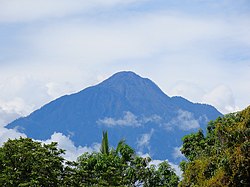


 United States
 European Union
 Costa Rica
 Nicaragua


 [2]


