| Content from Wikipedia under the CC BY-SA 4.0 license ⇔ Maps from OpenStreetMap under the ODbL license |
Honduras
Republic of Honduras República de Honduras | |
|---|---|
 Flag
 Coat of arms
| |
| Motto: «Libre, Soberana e Independiente» ("Free, Sovereign and Independent") | |
| Anthem: National Anthem of Honduras File:Honduras National Anthem.ogg | |
 | |
| Capital and largest city | Tegucigalpa |
| Official languages | Spanish[1] |
| Demonym | Honduran |
| Government | Presidential republic |
| Juan Orlando Hernández | |
| Ricardo Antonio Álvarez Arias | |
| Independence from Spain | |
• Declared | September 15, 1821 |
| 1821–1823 | |
| 1823–1824 | |
| 1824–1838 | |
• Republic | October 26, 1838 |
| Area | |
• Total | 112,492 km2 (43,433 sq mi)[2] (102) |
• Water (%) | 0.18 |
| Population | |
• 2019 estimate | 9,005,180[3] |
| GDP (PPP) | 2019 estimate |
• Total |  51,856 million[3] (98) |
• Per capita | USD 8,068[3] |
| GDP (nominal) | 2019 estimate |
• Total | USD 24,496 million[3] (101) |
• Per capita | 2,869[3] |
| HDI (2018) | 0.617[4][5] medium (133) |
| Currency | Lempira (HNL) |
| Time zone | UTC –6:00 |
• Summer (DST) | Not applicable |
| Calling code | +504 |
| ISO 3166 code | HN |
| Internet TLD | .hn |
The Constitution establishes in its articles 8 and 295 that the Central District, officially named Municipality of the Central District, formed by the former municipalities of Tegucigalpa and Comayagüela, is the capital of the country.[1] | |
Honduras is a country located in north-central Central America; its official name is the Republic of Honduras and its capital is the Central District, formed by the cities of Tegucigalpa and Comayagüela.[6][7]
Honduras is a unitary state and defines itself as free, sovereign and independent, unitary and indivisible. It is bordered to the north and east by the Caribbean Sea, to the southeast by Nicaragua, to the south by the Gulf of Fonseca and El Salvador, and to the west by Guatemala.[8] The territorial extent of Honduras, including all its islands, is 112,492 km².[2]
The territorial organization of Honduras divides the country, politically and administratively, into 18 departments, and these into 298 municipalities. The form of government is republican, democratic and representative. It is exercised by three powers: Legislative, Executive and Judicial, which are complementary and independent and without relations of subordination.[9][10]
The population of Honduras exceeds 9 million inhabitants,[11] [12][13] devoted for the most part to agricultural and livestock activities, in addition to commerce, manufacturing, and public services, among other activities. The department of Honduras with the highest population density is Cortés, with 400.3 inhabitants/km².[11] The country is multiethnic and consists of four large ethnic families: the whites or mestizos, who are the majority; the indigenous peoples (Lencas, Miskitos, Tolupans, Ch'ortis, Pech, Tawahkas); the Garifunas; and English-speaking Creoles.
The territory of Honduras is very rugged; it is made up of high mountain ranges, elevated plateaus, and deep valleys containing extensive and fertile plains crossed by rivers of greater or lesser flow, some of them navigable,[14] all of which contributes to its rich biodiversity.[15] It is estimated that some 8,000 species of plants, around 250 of reptiles and amphibians, more than 700 species of birds and 110 species of mammals exist in Honduras, distributed across its different regions.
For Honduras, the period of the federation had been disastrous. Local rivalries and ideological disputes had produced political chaos and disrupted the economy.
Honduras declared its Independence from Central America on September 15, 1821. In January 1839, the country's first constitution was formally adopted. General Francisco Ferrera became the first president (1841–42) of the country after presenting himself as the sole candidate. This period was followed by a second term (1842–44). At the end of his term he handed over command to Coronado Chávez (1845–47).
Once Chávez's term had ended, General Ferrera wanted to return to power but found no support, and in his place the Congress appointed the conservative Juan Lindo. During Lindo's presidency, a new constitution was adopted in 1848. Lindo made an effort to promote education and to improve the administrative situation of the country.
In 1852, Juan Lindo handed power to the liberal José Trinidad Cabañas (1852–55). Three years later, the Guatemalan government of Rafael Carrera invaded Honduras and expelled Cabañas, installing in his place the conservative leader José Santos Guardiola.[16]
History
Pre-Hispanic societies in Honduras


Before the Spanish conquest, the present territory of Honduras was inhabited by indigenous peoples characterized by two different cultural types, formed as a product of the migrations that populated the American continent in the pre-Columbian era.[17][18] The Maya and Aztec cultures were governed by the so-called "Asiatic mode of production," whose most outstanding characteristic was the existence of a sedentary economy based on agricultural production, with collective relations of production centralized in a single power exercised by a body of civil, religious and military officials. They were therefore not egalitarian societies. The division of classes was established between those who exercised power and the majority of the people.[18][19]

These cultures achieved great progress in the various fields of human knowledge, driven by the development of a varied agriculture (beans, cacao, chili, etc.), and they had large irrigation systems. In this way they guaranteed adequate food for their numerous populations. They also applied techniques of great perfection in textiles and ceramics. They developed an intense and varied trade. They reached a high level of scientific development in mathematics and astronomy, as well as in architecture and sculpture, which they employed in the construction of great cities.[19]
In the northwestern section of Honduras, the predominant peoples were the Ch'ortis, a Mayan group located in Copán and Ocotepeque, and the Lencas, who extended through the departments of Santa Bárbara, Lempira, Intibucá, La Paz, Comayagua, Francisco Morazán and Valle, and part of what today comprises the territory of El Salvador.[18]
The rest of Honduran territory was inhabited by peoples coming from the south of the continent, with a nomadic and semi-nomadic culture, governed by primitive communal relations of production. Among these peoples were the Tolupans (also called Xicaques), the Pech (also called "Payas"), the Tawahkas and the Miskitos, who together formed the majority of the country's population.[20] It was not until after the second half of the 1700s that other ethnic groups formed along the coastal zone of the Caribbean shore: the Garifunas and the English Creole-speaking Black people.[18]

The most numerous population was that of the Lencas, who, at the time of the arrival of the Spaniards, were the most widespread and organized of the country's groups. They lived in settlements of considerable size, with an average of 350 houses and well over 500 inhabitants.[21] Although there are scientific controversies about the ancestry and origin of the Lencas, according to Rodolfo Barón Castro they are the direct remaining heirs of the Maya who did not follow the exodus that brought the Old Empire to an end. Other studies indicate that they are descendants of Olmec groups who arrived migrating in the Preclassic period from southern Mexico. At the arrival of the Spaniards, they were established in the territory that today comprises the Republics of El Salvador and Honduras.[22]
The Maya area comprises what are today the countries of Honduras, Guatemala, El Salvador and southern Mexico.[23] The Maya flourished in these countries in the first fifteen centuries of the Christian era.[24] Causes unknown to this day brought about the abandonment and destruction of Copán and other Maya cities, which by the time of the Spanish conquest were nothing more than ruins. Hunger, plagues and internal wars have been proposed as the causes of the abandonment.[25]
Spanish Conquest


In March 1524, Gil González Dávila became the first Spaniard to arrive in Honduras with the purpose of conquest. He founded the Villa de San Gil de Buena Vista and pushed into Honduran territory, pacifying the Indians, fighting against the Spaniards who disputed the territory with him, and also hoping to find the outlet of Lake Nicaragua.[9][26]
Then Hernán Cortés, moved by the reports he had received about the great wealth of the country, sent two expeditions, one by land and another by sea. He entrusted the first to Pedro de Alvarado and the second to Cristóbal de Olid. But the latter betrayed him.[9] For this reason, Cortés left Mexico at the head of an expedition that lasted nearly two years and ended, after thousands of dangers and privations, in Trujillo (Honduras).[27]
Cortés introduced cattle and founded the villa of La Natividad de Nuestra Señora, near Puerto Caballos. Before his return to Mexico (1526), he appointed Hernando de Saavedra Governor of Honduras and left instructions to treat the natives well.
On October 26, 1526, Diego López de Salcedo was appointed by the Spanish Crown as Governor of Honduras, replacing Saavedra. The following decade was marked by the personal ambitions of the rulers and the conquistadors interfering with the governmental organization. The established Spaniards rebelled against their leaders, and the Indians rebelled against their masters and against mistreatment.[9] [28]
Upon Salcedo's death (1530), the Spaniards of European origin became the arbiters of power. They installed and removed governors. Faced with this situation, the settlers themselves asked Pedro de Alvarado to put an end to the anarchy. With Alvarado's arrival in 1536, the chaos diminished, and Honduras came under authority.[9]
In 1537, Francisco de Montejo was appointed governor. Upon arriving in Honduras, he annulled the land distributions made by Alvarado. His captain, Alonso de Cáceres, was responsible for suppressing the indigenous insurrection of 1537 and 1538, led by the cacique Lempira.[9]
In 1539 Montejo and Alvarado had serious disagreements over the region, which drew the attention of the Council of the Indies. Montejo left for Chiapas, and Alvarado became governor of Honduras. [28] This done, Pedro de Alvarado, with the approval of the King, annexed Honduras to Guatemala.[9]
Hispanic Honduras

The defeat of Lempira and the reduction of rival struggles among Spaniards contributed to the conquest and to the increase of economic activity in Honduras. By the end of 1540, Honduras seemed headed toward development and prosperity, with the establishment of Gracias as the capital of the regional Audiencia of Guatemala. However, this decision created resentment in the more populated centers of Guatemala and El Salvador. In 1549, the capital of the Audiencia was moved to Antigua, Guatemala, and thus Honduras remained a province within the Captaincy General of Guatemala until 1821.[29]
The country's first mining centers were located in Gracias. In 1538 these centers produced significant quantities of gold. In 1540 this changed with the discovery of gold and silver in the valley of the Guayape River. This contributed to the decline of Gracias and to the rise of Comayagua as the main population center of Honduras. The demand for labor increased, and this accelerated the decline of the native population. As a result, slaves from Africa were introduced into the country. Other gold deposits were found near San Pedro Sula and the port of Trujillo.

Mining production began to decline in 1560, and with it the importance of Honduras to the Crown. In early 1569, new silver discoveries briefly revived the economy, which led to the founding of Tegucigalpa, which soon began to rival Comayagua as the most important city of the province. The silver boom reached its peak in 1584, and economic depression returned shortly afterward. Mining efforts in Honduras were hindered by the lack of capital and labor and by topographical difficulties. Mercury, vital for silver production, was scarce, in addition to the negligence of officials.[29]


One of the great problems for the Spanish rulers of Honduras was the activity of the English in northern Honduras. These activities began in the 16th century and continued until the 19th century. In the early years, European pirates frequently attacked the settlements of the Honduran Caribbean, for example the Battle of Puerto Caballos (1603), part of the Anglo-Spanish War (1585–1604). In 1643 an English expedition destroyed the city of Trujillo, the main port of Honduras. In addition, the English made enormous efforts from the 17th century onward to establish colonies on the Bay Islands and in northern Honduras with the help of the Sambos and the Miskitos, who attacked the Spanish settlements.[9]
At the beginning of the 18th century, the Bourbon dynasty, linked to the rulers of France, replaced the Habsburgs on the throne of Spain. The new dynasty began a series of reforms throughout the empire, designed to make the administration more efficient and profitable and to facilitate the defense of the colonies. Among these reforms were a reduction of the tax on precious minerals and in the cost of mercury, which was a royal monopoly. In Honduras, these reforms contributed to the resurgence of the mining industry in the 1730s. Under the Bourbons, the Spanish government made several efforts to regain control over the Caribbean coast.[29]
In 1752, the fortress of San Fernando de Omoa was built. In 1780, the Spaniards returned to Trujillo, which began to develop as a base of operations against the British settlements to the east. During the 1780s, the Spaniards regained control over the Bay Islands and drove most of the British and their allies out of the Río Negro area. The Anglo-Spanish Convention of 1786 established the definitive recognition of Spanish sovereignty over the Caribbean coast.[9]
Independence


For nearly three centuries Honduras was part of the Captaincy General of Guatemala, so its independence revolved around the pro-independence events in the other provinces. After the occupation of Spain by the French, the first acts of insurrection in favor of the independence of Central America took place in Nicaragua, El Salvador and Guatemala (1811–1813).[30] In Honduras, the Spaniards resorted to perpetuating themselves in power with the purpose of stifling the pro-independence cause.[9]
From 1813 until 1820, no other notable events related to independence occurred in Central America. It was not until early 1821 that Mexico, through the Plan of Iguala, declared its total independence from Spain on February 24.[31] This event accelerated the independence of Central America, which was consummated on September 15, 1821 with a declaration drafted by José Cecilio del Valle.[32]
The euphoria of independence lasted very little, since in January 1822, on the initiative of the conservatives[33] and of Emperor Agustín de Iturbide, the united provinces of Central America joined the Mexican Empire. This union lasted until the fall of Iturbide himself in March 1823.

In March 1824, a congress met in Guatemala and the Federal Republic of Central America was founded, composed of Guatemala, Honduras, El Salvador, Nicaragua and Costa Rica.[34] The new Republic had a short existence, and after several civil wars the Union was dissolved on October 26, 1838, and the five states of the Republic established themselves as five independent states.
Some of the Central American states attempted several times to reconstitute the Federal Republic of Central America. But these attempts failed and cost the lives of several of their initiators. A last attempt was carried out through the influence of Dr. Policarpo Bonilla, President of Honduras: a treaty was concluded with Nicaragua and El Salvador, according to which the three republics constituted a federation under the name of the Greater Republic of Central America.[35]
The three republics became states, and the sovereignty of the federation rested with a Diet composed of three members, one for each state, which was to meet every year in the capital of the federal states. At the invitation of this Diet, the three states appointed a delegation that met as a Constituent Assembly in Managua and established a Constitution, under whose terms the three states took the name of the United States of Central America, on November 1, 1898.[36]
This Constitution, which in the minds of those who had framed it meant a consolidation of the three federal states and a prompt reorganization of the great Republic of Central America dreamed of by Francisco Morazán, came to a sad end. The day after the Constituent Assembly had met, a revolutionary movement hostile to the new federation took place in San Salvador, which resulted in a new administration in that state. Its first step was to withdraw from the Union, and this separation brought about the dissolution of the United States of Central America, since, following the example of El Salvador, the states of Honduras and Nicaragua resumed their sovereignty. [37]
Establishment of the Federal Republic

The states of the Isthmus, from Panama to Guatemala, will perhaps form a confederation. This magnificent location between the two great oceans could, in time, become the emporium of the world. Its canals will shorten distances, strengthen commercial ties with Europe, America and Asia, and bring to that fortunate region tributes from all over the world. Perhaps one day the capital of the world will be located there, just as Constantine the Great claimed that Constantinople was the capital of the ancient world. Simón Bolívar (1815)
In March 1824, a congress met in Guatemala and the Federal Republic of Central America was founded, composed of Guatemala, Honduras, El Salvador, Nicaragua and Costa Rica.[40] The new Republic had a short existence, and after several civil wars the Union was dissolved on October 26, 1838, and the five states of the Republic established themselves as five independent states.
Some of the Central American states attempted several times to reconstitute the Federal Republic of Central America. But these attempts failed and cost the lives of several of their initiators. A last attempt was carried out through the influence of Policarpo Bonilla, President of Honduras, in 1895. On this occasion a treaty was concluded with Nicaragua and El Salvador,[41] according to which the three republics constituted a federation under the name of the Greater Republic of Central America.[42]
The three republics became states, and the sovereignty of the federation rested with a Diet composed of three members, one for each state, which was to meet every year in the capital of the federal states. At the invitation of this diet, the three States appointed a delegation that met as a Constituent Assembly in Managua and established a Constitution, under whose terms the three states took the name of the United States of Central America, on November 1, 1898.[43]
This Constitution, which in the minds of those who had framed it meant a consolidation of the three federal states and a prompt reorganization of the great Republic of Central America dreamed of by Francisco Morazán, came to a sad end. The day after the Constituent Assembly had met, a revolutionary movement hostile to the new federation took place in San Salvador, which resulted in a new administration in that state. Its first step was to withdraw from the Union, and this separation brought about the dissolution of the United States of Central America, since, following the example of El Salvador, the states of Honduras and Nicaragua resumed their sovereignty.[37]
Presidency of Santos Guardiola

After the overthrow of Cabañas, "General José Santos Guardiola moved to Honduras. On November 10 he arrived in Tegucigalpa and launched his candidacy for the presidency. Elections were held, and since no citizen was elected by an absolute majority of votes, the General Chamber elected as President and Vice-President, respectively, the conservative General Santos Guardiola and Don José María Lazo." "General José Santos Guardiola ascended to the presidency of Honduras on February 17, 1856, thus culminating a firm aspiration held for so long and frustrated several times."
During Guardiola's administration the country's economy was precarious, to such a degree that the president was forced to issue copper coins. In other matters, the Guardiola administration was one of the most liberal in the history of Honduras; despite being a member of the conservative party, Santos Guardiola granted freedom of the press. He also broadened individual freedom of expression and included among the voters the landowners who were members of the middle class, in addition to regulating relations between the state and the church.[44] But his most important achievement was the treaty by which the British government handed over the Bay Islands and the territory of 'La Mosquitia' to Honduras.[45]
Finally, Guardiola's open anticlericalism led him to start the so-called "War of the Priests" in April 1861.[44] This in turn contributed to his assassination on January 11, 1862,[46] at the hands of his own presidential honor guard. This crime shook the country profoundly. Senator José Francisco Montes Fonseca took charge of command, but shortly delegated it to General José María Medina, and from his hands it passed soon afterward, as the law prescribed, to the vice president, Victoriano Castellanos Cortés.[47]
Owing to the constant wars and struggles for power, Honduras was sunk in backwardness. Castellanos "worked to calm spirits, instill confidence and promote what progress was possible ... and he would have done much had death not surprised him... on December 11 of that same year."[47]
The Constitution of 1865 and the end of the century

After the death of Victoriano Castellanos, Francisco Montes took power again. But when war broke out between El Salvador and Guatemala in 1863, Montes allied himself with the Salvadoran liberal cause. Troops of the Guatemalan government of Rafael Carrera invaded Honduras and in June 1863 proclaimed as president General José María Medina, who accompanied the invaders.[47]
"Medina convenes a National Constituent Assembly that repeals the Constitution of 1840."[48] In its place the Constitution of 1865 was adopted. In this Constitution, the designation 'Republic' was adopted for the country for the first time. The bicameral legislative system introduced by Juan Lindo was abolished and the unicameral system was installed. For the first time in Honduran constitutional law, the non-reelection of the President of the Republic was established.
In December of that same year, Medina handed the presidency to Senator Francisco Inestroza so that elections could be held. As was to be expected, the elections favored General Medina. General Florencio Xatruch was chosen as vice president. Medina assumed his presidential term on February 15, 1864 in Gracias.[49]
During his first presidential term, "Medina was opposed in 1865 by the rebels of Olancho; and to subdue them and radically cut out the evil, he had the rebels pursued relentlessly, and many of them shot or hanged."[47]
As the end of his term approached, Medina sought to amend article 33 of the constitutional law, which prevented his reelection. To that end, he urged the municipalities to submit a petition to the executive to amend that article. Accordingly, he installed an extraordinary Congress, which in turn convened a constituent assembly. On August 8, 1869, the article was amended, which allowed Medina to be reelected.[44][50]
During his second term, the department of La Mosquitia was created on November 22, 1868. There also occurred what was one of the first acts of corruption in the country.[47] There was negotiated "in Europe, under very unfavorable conditions for Honduras, a loan intended to build the interoceanic railroad; it barely allowed one section of that railway to be built, and it caused Honduran credit to suffer greatly abroad."[47]
After Medina's two presidential terms, there was widespread discontent in the country. Even so, the president was not willing to leave power and resorted to a plebiscite of open town councils to keep himself in power. The result of the plebiscite was the one General Medina desired. On March 26, 1870, he took power once again.
However, in 1883, Dr. Soto also fell out of favor with Barrios and was forced to resign. His successor, General Luis Bográn, survived in office until 1891, when General Ponciano Leiva —who governed briefly on three occasions, 1873–76— returned to power in rigged elections. Despite being a liberal, Leiva attempted to govern as an absolute dictator. Leiva dissolved the Liberal Party of Honduras (PLH) and deported its leaders.[51][16]
The result of this was a new round of conflicts in which the reconstituted Liberal Party finally emerged victorious. The PLH was led by Policarpo Bonilla, with the support of the liberal dictator of Nicaragua, José Santos Zelaya.[51]
When Bonilla assumed power in 1894, he began to implement a certain degree of order on the Honduran political scene.
20th century

President Terencio Sierra was the first ruler of Honduras of the 20th century, after receiving the presidency from Policarpo Bonilla in 1899. During his administration, one of the most important historical events in the economic and political life of the country took place. "The Vaccaro brothers, a family of Italian origin who traded bananas in New Orleans, received land concessions on the North Coast... The Vaccaro company, as other concessionaires on the North Coast later did, took advantage of the privileges granted by the concessions to export bananas from La Ceiba."[52][53]
Once his presidential term was over, Sierra made efforts to perpetuate himself in power, but he was overthrown by General Manuel Bonilla. This ruler turned out to be a better friend of the banana companies than Terencio Sierra himself. During his administration these companies won tax exemptions and permission to build docks and roads. They also obtained concessions to build artificial channels to transport bananas and to channel the Salado and El Porvenir rivers, as well as permission to obtain the charters for the construction of the new railroad.[51][52]
Dictatorship of Carías Andino

Despite growing unrest and serious economic strains, the elections of 1932 were relatively peaceful and fair. "In February 1932, the National Party of Honduras (PNH) nominated Carías as its presidential candidate; it had initially elected Venancio Callejas for the vice presidency, but when he declined, Abraham Williams was named."[54] The liberals, for their part, named Ángel Zúñiga Huete as their candidate. At the end of the electoral contest, Carías won the elections by a margin of some 20,000 votes. The General took office on November 16, 1932, in what would later be the longest period of a single government in the history of Honduras.[51]
At first it was thought that Carías's government, like those of his predecessors, was not destined to survive for long. Shortly before his inauguration, liberal dissidents had risen in rebellion. Carías himself took command of the government forces, obtained weapons in El Salvador and in a short time crushed the uprising.[51]
During the first part of his administration, Carías focused on avoiding financial collapse, improving the armed forces and building roads. At the same time, he was laying the groundwork for prolonging his stay in power.
The economic situation remained depressing throughout the 1930s. In addition to the drastic fall in banana exports caused by the depression, the banana industry was threatened in 1935 by epidemics such as sigatoka. Within a year, extensive areas, including those in the Trujillo zone, were abandoned, and thousands of Hondurans were left without work. By 1937 the blight had been controlled, but many affected areas remained out of production. Because of this, Honduras lost a large part of the international market.
Carías had made efforts to improve the Armed Forces even before becoming president. Once in power, his motivation to continue this work increased. He paid special attention to the decaying Air Force, for which he founded the Military Aviation School (1934), with an American colonel as its commander.[55]
Over time, Carías moved slowly but steadily to strengthen himself in power. He won the support of the banana companies through his opposition to strikes and other labor disturbances. He strengthened his position in national and foreign financial circles through conservative economic policies. Even at the height of the depression, he continued to make regular payments on the foreign debt, adhering strictly to the terms of the agreement with the British bondholders. He likewise satisfied the other creditors. Two small loans were paid off completely in 1935.
Mid-20th century


American companies such as the United Fruit Company, the Standard Fruit Company and the Cuyamel Fruit Company dominated the Honduran economy and established enormous banana plantations along the north coast.[56][57][58] These companies quickly made bananas the main export of Honduras in exchange for large concessions.[59] In this way, foreign capital, life on the banana plantations, and the conservatives were determining factors in the politics of Honduras from the late 19th century until the mid-20th century.
General Tiburcio Carías Andino controlled Honduras dictatorially during the Great Depression, until 1948. In 1955, after two authoritarian administrations and a strike of banana workers, young military reformists organized a coup d'état that installed a provisional junta and paved the way for elections to the constituent assembly in 1957.[60]
This assembly appointed Ramón Villeda Morales as President and transformed itself into a national legislature with a 6-year mandate. In 1963, conservative military officers moved ahead of the constitutional elections and deposed Villeda in a bloody coup. General Oswaldo López Arellano led the armed forces and governed until 1970.[61]
Popular discontent continued.[62]
The War of 1969
In 1968 the López Arellano regime appeared to be in serious trouble. The dreadful economic situation produced labor conflicts, political unrest, and even criticism from conservative groups such as FENAGH. The political situation deteriorated; the Honduran government and some private groups blamed the country's economic problems on the roughly 300,000 undocumented Salvadoran immigrants in Honduras. FENAGH accused the Salvadoran immigrants of illegal land invasions.[63]
Tensions rose in June 1969, when the national teams of the two countries were preparing to face each other with a view to the 1970 World Cup. During the first match, held in Tegucigalpa, there were some disturbances. But the situation became much worse during the return match held in San Salvador. Honduran fans were mistreated, the flag and national anthem of Honduras were insulted, and emotions in the two countries became extremely agitated.[51]
In retaliation, Hondurans acted violently against many Salvadoran residents in Honduras, including several vice consuls. The press of both nations contributed to a growing climate of hysteria, and so, on June 27, 1969, Honduras broke off diplomatic relations with El Salvador. Early in the morning of July 14, 1969, a concerted military action began, which became known as "the Football War." The Salvadoran air force attacked targets inside Honduras. Likewise, the Salvadoran army launched major offensives along the main highway connecting the two nations and against the Honduran islands in the Gulf of Fonseca.
Increasing after the 1969 border war with El Salvador, known as "the Football War" or the "Hundred Hours' War" (because it lasted four days and coincided with a football match between the two countries). On that occasion the Honduran F4U-5 Corsair aircraft, registration FAH 609, became famous; with it Colonel Fernando Soto Henríquez shot down three Salvadoran Mustang F-51 aircraft (there were some twenty aircraft, but this one is preserved[64]). A civilian President, Ramón Ernesto Cruz, of the National Party, took power briefly in 1971, but was unable to manage the government. In 1971 the United States handed over the Swan Islands to Honduras after signing the Swan Islands Treaty.
In 1972, General López organized another coup. López adopted more progressive policies, including agrarian reform, but in the mid-1970s corruption scandals brought down his regime.[65]
The regimes of General Juan Alberto Melgar Castro (1975–1978) and General Policarpo Paz García (1978–1982) built to a large extent the current physical infrastructure and telecommunications system of Honduras.[66]
The country also enjoyed its fastest economic growth during this period, given the greater international demand for its products and the availability of foreign commercial loans.[60]
In 1982, a new constitution was established in order to restore the rule of law. This constitution was the fruit of negotiations between the political forces and the military. The presidential term was shortened, non-reelection was established, and the Armed Forces of Honduras were given guardianship of the system in case anyone sought to threaten democracy and suppress the Constitution of Honduras of 1982.[67]
The Constitution of 1982[68]
Under the new constitution, the liberal Roberto Suazo Córdova was elected constitutional president; he promised a revolution of honesty and work. However, his presidency revolved around the events aimed at curbing Soviet expansionism in the region on the part of the United States. After the triumph of the Sandinistas in Nicaragua and the political instability in El Salvador, the President of the United States, Ronald Reagan, determined not to tolerate socialist regimes in the region, saw in Honduras the perfect platform for launching a counterrevolution.[69]
With the complicity of Suazo Córdova and the Commander of the armed forces, Gustavo Álvarez Martínez, the CIA financed and directed the formation of a Nicaraguan counterrevolutionary army from Olancho and El Paraíso, with the purpose of harassing the Sandinista government. Likewise, this American agency helped the Salvadoran military in its fight against the leftist rebels.[70]

Roberto Suazo Córdova passed on the problem of the "Contras" to his liberal successor, José Azcona del Hoyo, who was unable to shake it off. His administration limited itself to admitting the presence of the Contras on Honduran territory, avoiding a direct confrontation with Nicaragua, and closing the information office of the Nicaraguan Democratic Force in Tegucigalpa after the eruption of the Iran-Contra scandal in the United States. Azcona's presidency ended with a general sense of a "leaden balance, scant in achievements and, in fact, rather monotonous."[71]
The influence of the United States is so strong that the term "proconsul" is used to refer to its ambassador. While noting internally that Honduran government forces committed "hundreds of human rights violations (...), most of them politically motivated," the CIA supported the death squads, in particular Battalion 3-16, which tortured, murdered or disappeared dozens of trade unionists, academics, peasants and students. Declassified documents indicate that Ambassador John Negroponte intervened personally to block possible revelations of these state crimes, in order to avoid "creating human rights problems in Honduras."[72]

The elections of November 1989 favored the National Party candidate, Rafael Leonardo Callejas. During his government, Callejas implemented in the country the first neoliberal policies designed by the International Monetary Fund and the World Bank.[73] In March 1990 the Structural Adjustment law came into force, through which the Lempira was devalued and tariff barriers were reduced, among other measures.[74] This experiment had rather negative effects on the country's economy.[75][76]
At the end of his term, Callejas's neoliberal policy resulted in a rather modest macroeconomic balance, with annual growth of only 1.5%. On the international level, the Callejas administration achieved an important victory when three quarters of the territories that had remained in dispute with El Salvador since 1969 were awarded to Honduras.[77][78]
In 1994, the liberals returned to power with the victory of Carlos Roberto Reina. The new president "undertook definitive actions to subordinate to civilian power the last mechanisms with which the Armed Forces had held guardianship over the successive constitutional governments." He also created the Civil Police and abolished compulsory military service on April 6, 1995.[79]
"As regards the economy, the balance, which was mixed, was the subject of various interpretations. Reina opted for policies of financial austerity and readjustment of the civil service workforce, in accordance with liberal precepts, though complemented with social programs to alleviate the impact of the slow structural transformations, for which he obtained the acceptance of the IMF."[80]
The liberal Carlos Roberto Flores Facussé took office in 1998. "Flores inaugurated programs of reform and modernization of the Honduran government and the economy, with an emphasis on helping the poorest citizens of Honduras, but his government was affected by the natural catastrophe of Hurricane Mitch, which devastated the country a few months after his term began."[81]
"His diligent management of the reconstruction, which involved copious international aid, mitigated greater humanitarian damage, and his administration was not tarnished by corruption. The economic recovery was faster than expected, but poverty and inequality did not decrease to the same extent. On the other hand, his government also failed to curb the rampant social violence."[81]
Contemporary period

The first elections of the 21st century, held on November 25, 2001, gave power to the businessman Ricardo Maduro, of the National Party, with 52.2% of the votes, against 44.2% for Professor Rafael Pineda Ponce. Maduro's main objective was his fight against the wave of crime that was ravaging the country.[82]
An example of a pro-market politician-businessman, Maduro fought the violence of the youth gangs and achieved more visible successes in stabilizing the economy and reducing the foreign debt. However, he left the problem of poverty untouched. In the international field, Maduro brought Honduras into CAFTA and dispatched the Xatruch Battalion to Iraq.[83]

In January 2006 his four-year term ended, and he was succeeded by the liberal Manuel Zelaya. Once in power, the president carried out an unexpected turn: he governed with a leftist policy, distanced himself from Washington, entered into oil dealings with the Venezuelan Hugo Chávez, and brought Honduras into ALBA.[84]
His next project was to open a constituent process in the image of those already established in other Latin American countries such as Venezuela or Ecuador, obtaining the support of a group of Hondurans followed by the less fortunate, which caused enmity with the traditional powers of the country—politicians of his own party, big businessmen, churches, civil society institutions, the judiciary—who, with the support of the army, removed Manuel Zelaya from office and declared his poll illegal. That day, the military kidnapped Zelaya and expelled him from the country. Congress elected the fellow liberal Roberto Micheletti to replace him.[84][85] This event was described as a "coup d'état" by the international community and divided the country between those who resisted the coup and those who supported it.
The Permanent Council of the Organization of American States (OAS) met urgently and issued a resolution "condemning the coup d'état in Honduras and giving support to the government of President José Manuel Zelaya and to democratic continuity in the Central American country."[86]
Like the OAS, most countries expressed the need to reinstate the removed president and restore the legal order in the country, and did not recognize Micheletti's de facto mandate. Nevertheless, the Honduran congress and Micheletti himself stood firm in their decision, relying on the self-determination of peoples, and Zelaya did not finish his term, after entering the country and taking refuge in the embassy of Brazil.
At the end of 2009, in the midst of this crisis, Honduras held its elections, and the winner was the candidate of the traditional right-wing and conservative National Party, Porfirio Lobo Sosa, an agricultural businessman from the department of Olancho who articulates a centrist and conciliatory discourse. Lobo received a fractured country, highly polarized politically, socially and economically, and also subject to the democratic scrutiny of the international community, part of which (including the OAS) was awaiting the development of the political course to decide whether it would recognize the legitimacy of the new Honduran president.[87][88]
On June 1, 2011, Honduras was readmitted to the OAS.[89]
On October 7, 2015, Banco Continental became the first bank designated by the United States Department of Justice under the Kingpin Act for money laundering and support of drug trafficking.[90] It is currently in a state of forced liquidation.[91]
In the 2017 Honduran general election, Juan Orlando Hernández was reelected,[92] and, amid suspicions of fraud, several days of demonstrations followed, with a toll of 33 deaths.[93] The government declared a state of emergency. According to the United Nations and the Inter-American Commission on Human Rights, "many of them were taken to military facilities, where they were brutally beaten, insulted and sometimes tortured." Hernández was succeeded by Xiomara Castro, leader of the Liberty and Refoundation party and wife of Manuel Zelaya, on January 27, 2022. In 2019 the Department of Justice of the Southern District of New York found the brother of the President of Honduras, Juan "Tony" Antonio Hernández, guilty of drug trafficking and arms trafficking crimes toward the United States.
The Constitution of 1865
The administration of José María Medina

After the death of Castellanos, Francisco Montes took power again. But when war broke out between El Salvador and Guatemala in 1863, Montes allied himself with the Salvadoran liberal cause. Troops of the Guatemalan government of Rafael Carrera invaded Honduras and, in June 1863, proclaimed as president General José María Medina, who was accompanying the invaders.[47]
"Medina convenes a National Constituent Assembly that repeals the Constitution of 1840."[48] In its place the Constitution of 1865 was adopted. In this Constitution, the designation of 'Republic' was adopted for the country for the first time. The bicameral legislative system introduced by Juan Lindo was abolished and a unicameral system was established. For the first time in Honduran constitutional law, the non-reelection of the President of the Republic was enshrined.
In December of that same year, Medina handed the presidency over to Senator Francisco Inestroza so that elections could be held. As was to be expected, the elections favored General Medina. General Florencio Xatruch was chosen as Vice President. Medina began his presidential term on February 15, 1864, in Gracias.[49]
During his first presidential term, "Medina was opposed in 1865 by the factions of Olancho; and in order to subdue them and cut out the evil at its root, he had the rebels pursued relentlessly, and many of them were shot or hanged.[47]
As the end of his term approached, Medina sought to amend Article 33 of the constitutional law, which prevented his reelection. To that end, he urged the municipalities to submit a petition to the executive to amend that article. Accordingly, he convened an extraordinary Congress, which in turn called a constituent assembly. On August 8, 1869, that article was amended, which allowed Medina to be reelected.[44][50]
During his second term, the Department of La Mosquitia was created on November 22, 1868. There also occurred what was one of the first acts of corruption in the country.[47] A loan intended to build the inter-oceanic railroad was negotiated "in Europe on very unfavorable terms for Honduras; it barely allowed one section of that railway to be built, and it caused Honduran credit abroad to suffer greatly."[47]
After Medina's two presidential terms, there was widespread discontent in the country. Even so, the President was not willing to leave power and resorted to a plebiscite of open town councils (cabildos abiertos) to remain in power. The result of the plebiscite was the one desired by Gen. Medina. On March 26, 1870, he took power once again.
20th century

American companies such as the United Fruit Company, the Standard Fruit Company and the Cuyamel Fruit Company dominated the Honduran economy and established enormous banana plantations along the northern coast. [94][95] [96] These companies quickly made bananas Honduras's main export in exchange for large concessions.[59] In this way, foreign capital, life on the banana plantations, and the conservatives were decisive factors in Honduran politics from the late 19th century to the mid-20th century.
General Tiburcio Carías Andino ruled Honduras dictatorially during the Great Depression, until 1948. In 1955, after two authoritarian administrations and a strike by banana workers, young reformist military officers organized a coup d'état that installed a provisional junta and paved the way for elections to a constituent assembly in 1957. [60]
This assembly appointed Ramón Villeda Morales as President and transformed itself into a national legislature with a 6-year mandate. In 1963, conservative military officers preempted the constitutional elections and deposed Villeda in a bloody coup. General Oswaldo López Arellano led the armed forces and governed until 1970.[61]
Popular discontent continued,[97] increasing after the 1969 border war with El Salvador, known as the "Football War" or the "100 Hours War" (because it lasted 4 days and coincided with a football match between the two countries). On that occasion the Honduran F4U-5 Corsair aircraft, registration FAH 609, became famous; with it Colonel Fernando Soto Henríquez shot down three Salvadoran Mustang F-51 aircraft (there were some twenty aircraft, but that one has been preserved[98]). A civilian President, Ramón Ernesto Cruz, of the National Party, took power briefly in 1971, but was unable to manage the government.
In 1972, General López organized another coup. López adopted more progressive policies, including agrarian reform, but in the mid-1970s corruption scandals brought down his regime.[65] The regimes of General Juan Alberto Melgar Castro (1975–1978) and General Policarpo Paz García (1978–1982) built much of Honduras's current physical infrastructure and telecommunications system.[66]
The country also enjoyed its fastest economic growth during this period, given the greater international demand for its products and the availability of foreign commercial loans.[60]
In 1982, a new constitution was established in order to restore the rule of law. This constitution was the fruit of negotiations between the political forces and the military. The presidential term was shortened, non-reelection was established, and the Armed Forces of Honduras were given guardianship of the system in the event that anyone sought to threaten democracy and abolish the Constitution of Honduras of 1982.[67]
The Constitution of 1982
Under the new constitution, the liberal Roberto Suazo Córdova was elected constitutional President; he promised a revolution of honesty and work. However, his presidency revolved around the events aimed by the United States at curbing Soviet expansionism in the region. After the triumph of the Sandinistas in Nicaragua and the political instability in El Salvador, the President of the United States, Ronald Reagan, determined not to tolerate socialist regimes in the region, saw in Honduras the perfect platform for launching a counterrevolution.[99]
With the complicity of Suazo Córdova and the fascist Commander of the armed forces, Gustavo Álvarez Martínez, the CIA financed and directed the formation of a Nicaraguan counterrevolutionary army from Olancho and El Paraíso, with the purpose of harassing the Sandinista government. Likewise, this American agency helped the Salvadoran military in its fight against the leftist rebels.[100]
Roberto Suazo Córdova passed the problem of the "Contras" on to his liberal successor, José Azcona del Hoyo, who was unable to shake it off. His administration limited itself to acknowledging the presence of the Contras on Honduran territory, avoiding a direct confrontation with Nicaragua, and closing the information office of the Nicaraguan Democratic Front in Tegucigalpa after the eruption of the Iran-Contra scandal in the United States. Azcona's presidency ended "with a general sense of a leaden record, scant in achievements and, in fact, rather monotonous".[101]
The elections of November 1989 favored the National Party candidate, Rafael Leonardo Callejas. During his government, Callejas implemented in the country the first neoliberal policies designed by the International Monetary Fund and the World Bank. [73] In March 1990 the Structural Adjustment Law came into force, through which the Lempira was devalued and tariff barriers were reduced, among other measures.[74] This experiment had rather negative effects on the country's economy.[102][103]
At the end of his term, Callejas's neoliberal policy closed with a rather modest macroeconomic record, with annual growth of only 1.5%. Internationally, the Callejas administration achieved an important victory when Honduras was awarded three quarters of the territories that had remained in dispute with El Salvador since 1969.[77][104]
In 1994, the liberals returned to power with the victory of Carlos Roberto Reina. The new President "undertook definitive actions to subordinate to civilian power the last mechanisms with which the Armed Forces had exercised guardianship over the successive constitutional governments". He also created the Civil Police and abolished compulsory military service on April 6, 1995.[79]
"As regards the economy, the mixed record was the subject of various interpretations. Reina opted for policies of financial austerity and readjustment of the civil service workforce, in accordance with liberal precepts, although complemented by social programs to alleviate the impact of the slow structural transformations, for which he obtained the acceptance of the IMF". [80]
The liberal Carlos Roberto Flores Facussé took office in 1998. "Flores launched programs of reform and modernization of the Honduran government and economy, with an emphasis on helping the poorest citizens of Honduras, but his government was affected by the natural catastrophe of Hurricane Mitch, which devastated the country a few months after the start of his term".[105]
"His diligent management of the reconstruction, which involved copious international aid, mitigated greater humanitarian damage, and his administration was not tarnished by corruption. The economic recovery was faster than expected, but poverty and inequality did not decrease to the same extent. On the other hand, his government also failed to curb the rampant social violence".[105]
Contemporary period


The first elections of the 21st century, held on November 25, 2001, gave power to businessman Ricardo Maduro, of the National Party, with 52.2% of the votes, against 44.2% for Professor Rafael Pineda Ponce. Maduro's main objective was his fight against the wave of crime that was ravaging the country.[82]
An example of a pro-market politician-businessman, Maduro fought the violence of the youth gangs, and achieved more visible successes in stabilizing the economy and reducing the external debt. However, he left the problem of poverty untouched. Internationally, Maduro brought Honduras into CAFTA and dispatched the Xatruch Battalion to Iraq."[106]
In January 2006 his four-year term ended, and he was succeeded by the liberal Manuel Zelaya. Once in power, the President made an unexpected turn: he governed with a leftist policy, distanced himself from Washington, entered into oil dealings with the Venezuelan Hugo Chávez, and brought Honduras into ALBA.[107]
His next project was to open a constituent process in the image of those already established in other Latin American countries such as Venezuela or Ecuador, obtaining the support of a group of Hondurans followed by the less fortunate, which caused enmity with the country's traditional powers, politicians of his own party, big business owners, churches, civil society institutions and the judiciary, who, with the support of the army, removed Manuel Zelaya from office and declared his poll illegal. That day, the military kidnapped Zelaya and expelled him from the country. Congress elected the also liberal Roberto Micheletti to replace him.[107][85] This event was described as a "coup d'état" by the international community and divided the country between those who resisted the coup and those who supported it.
The Permanent Council of the OAS (Organization of American States) met urgently and issued a resolution "condemning the coup d'état in Honduras and gave support to the government of President José Manuel Zelaya, and to democratic continuity in the Central American country".[86]
Like the OAS, most countries expressed the need to reinstate the removed President and restore the legal order in the country, and refused to recognize Micheletti's de facto mandate. Nevertheless, the Honduran Congress and Micheletti himself remained firm in their decision, relying on the self-determination of peoples, and Zelaya did not finish his term, after entering the country and taking refuge in the embassy of Brazil.
At the end of 2009, in the midst of this crisis, Honduras held its elections, and the winner was the candidate of the traditional right-wing and conservative National Party, Porfirio Lobo Sosa, an agricultural businessman from the Department of Olancho, who articulates a centrist and conciliatory discourse. Lobo received a country that was fractured and highly polarized politically, socially and economically, and also subject to the democratic scrutiny of the international community, part of which (including the OAS) was awaiting the development of the political course to decide whether it would recognize the legitimacy of the new Honduran President.[108][109]
On June 1, 2011, Honduras was readmitted to the OAS.[110]
On October 7, 2015, Banco Continental became the first bank designated by the United States Department of Justice under the Kingpin Act for money laundering and support for drug trafficking.[111] It is currently in a state of forced liquidation.[91]
In the 2017 Honduran general election, Juan Orlando Hernández was reelected and, amid suspicions of fraud, several days of demonstrations followed, with a toll of 33 deaths.[112] The government declared a state of emergency. According to the United Nations and the Inter-American Commission on Human Rights, "many of them were taken to military facilities, where they were brutally beaten, insulted and sometimes tortured".[113]
Government and politics
Article 4 of the Constitution of the Republic of Honduras establishes that "the form of government is republican, democratic and representative". It is exercised by three branches: legislative, executive and judicial, which are complementary and independent and without relations of subordination. It also adds that alternation in the exercise of the presidency of the Republic is mandatory, and that violation of this rule constitutes the crime of treason against the Homeland.[114]

In Article 5, this same constitution stipulates that the government must be based on the principle of participatory democracy, from which national integration derives, which implies the participation of all political sectors... in order to ensure and strengthen the progress of Honduras based on political stability and national reconciliation.[114]
Legislative power is exercised by a Congress of Deputies, who are elected by direct suffrage. It meets in ordinary sessions in Tegucigalpa on January 25 of each year, without the need for a summons, and closes its sessions on October 31 of the same year. The National Congress has the following powers: to create, decree, interpret, amend and repeal laws; to convene, suspend and close its sessions, as well as to issue its Organic Law and apply the sanctions established therein for those who violate it; and to convene extraordinary sessions in accordance with the Constitution.
The Supreme Court of Justice of Honduras has its seat in Tegucigalpa and is made up of fifteen principal magistrates and seven alternates, elected by the National Congress, and it is divided into chambers, in accordance with the provisions of the Internal Regulations of the Court itself. The Judicial Branch of Honduras is made up of a Supreme Court of Justice, the Courts of Appeals, the Sentencing Courts, the Courts for the Execution of Sentences and the lower courts established by law.[115] The President of the Supreme Court is elected by the National Congress for a term of seven years.
The term of the Magistrates of the Supreme Court of Justice is seven years, and they may be reelected.
| Abbreviation | Name | Founded |
|---|---|---|
| PLH | Liberal Party of Honduras | |
| PNH | National Party of Honduras | |
| PDCH | Christian Democratic Party of Honduras | |
| PINU | Innovation and Unity Party–Social Democrat | |
| PUD | Democratic Unification Party | |
| LIBRE | Liberty and Refoundation Party | |
| PAC | Anti-Corruption Party of Honduras |
National symbols


Budget
The budget of the republic is 185,482 million lempiras (9,000 million US dollars),[117] and it is divided among the three branches of the State of Honduras.
Territorial organization
Honduras is divided into 18 departments, each with a governor appointed by the President; the departments are divided into municipalities, which are in turn divided into towns and villages. The capital of the Republic is Tegucigalpa, which together with the city of Comayagüela forms the Central District, under the jurisdiction of the department of Francisco Morazán. [118]
| Territorial division of Honduras | ||||||||
|---|---|---|---|---|---|---|---|---|
 | ||||||||
| No.1 | Department | Pop. (2010/2011) | Area (km²) | Capital | ||||
| 1 | Bay Islands | 47,158 | 236 | Roatán | ||||
| 2 | Cortés | 2,120,291 | 3,923 | San Pedro Sula | ||||
| 3 | Atlántida | 572,551 | 4,372 | La Ceiba | ||||
| 4 | Colón | 293,540 | 8,249 | Trujillo | ||||
| 5 | Gracias a Dios | 88,314 | 16,997 | Puerto Lempira | ||||
| 6 | Copán | 362,226 | 3,242 | Santa Rosa de Copán | ||||
| 7 | Santa Bárbara | 402,367 | 5,024 | Santa Bárbara | ||||
| 8 | Yoro | 552,100 | 7,781 | Yoro | ||||
| 9 | Olancho | 509,564 | 23,905 | Juticalpa | ||||
| 10 | Ocotepeque | 132,453 | 1,630 | Ocotepeque | ||||
| 11 | Lempira | 315,565 | 4,228 | Gracias | ||||
| 12 | Intibucá | 232,509 | 3,123 | La Esperanza | ||||
| 13 | Comayagua | 442,251 | 5,124 | Comayagua | ||||
| 14 | Francisco Morazán | 1,691,056 | 8,619 | Tegucigalpa | ||||
| 15 | El Paraíso | 427,232 | 7,489 | Yuscarán | ||||
| 16 | La Paz | 196,322 | 2,525 | La Paz | ||||
| 17 | Valle | 171,613 | 1,665 | Nacaome | ||||
| 18 | Choluteca | 605,504 | 4,360 | Choluteca | ||||
| 2010 Census data. Source: INE[119] | ||||||||
Geography
Location and borders

Honduras is located in the widest part of the Central American isthmus. It is bounded to the North by the Atlantic, to the East by the same sea and the Republic of Nicaragua, to the south by Nicaragua, the Gulf of Fonseca and the Republic of El Salvador, and to the West by Guatemala. The surface area of Honduras, including all its islands, is 112,492 km².[2] Its coasts have a total length of 823 km, of which 669 km face the Caribbean Sea and 163 km the Gulf of Fonseca.[2]

The border demarcation with El Salvador was established after the peace agreements signed by both countries in Lima, Peru, in 1980. The boundaries were defined following the agreements established through the ruling of the International Court of Justice in Holland on September 11, 1992. Likewise, this same court ratified in 1960 the border demarcation with Nicaragua, which had been established in 1906 in the arbitral award of Alfonso XIII, King of Spain.
On October 8, 2007, the International Court of Justice fixed the maritime boundary between the two countries at 15 degrees north latitude and 83 degrees west latitude, awarding Honduras sovereignty over the islands of Cayo Bobel, Cayo Port Royal, Cayo Savanna and Cayo del Sur, with Cayo Edimburgo remaining on the Nicaraguan side. The boundaries with Guatemala, meanwhile, were defined by the award of the Hughes tribunal issued in Washington in 1933.
In the Caribbean Sea, Honduras has the archipelago of the Bay Islands, composed of Utila, Roatán and Guanaja. The Swan Islands and the Cayos Cochinos, among others, also belong to Honduras. In the area of the Gulf of Fonseca, which it shares with Nicaragua and El Salvador, Honduras has the islands of Zacate Grande, Isla del Tigre, Garrobo, Exposición, Güegüensi and other smaller islands.
Climate

Honduras is located in a tropical position 15 to 16 degrees north of the equator, and has only two seasons, which are well defined: the dry season and the rainy season. The rainy season begins in May and extends until the month of July, with a pause during the month of August; it generally resumes in September until the month of November, when the dry season begins. This season extends until the month of April or May.
- The average high temperature throughout the country is 32 °C (90 °F), and the average low temperature is 20 °C (68 °F).
- The annual average temperature in the interior of Honduras is 21 °C (70 °F).
- The annual average precipitation is 1,000 mm (40 inches) in the mountains, and in the valleys of the northern coast it is 2,500 mm (100 inches).
- The lowest areas of the coastal region have an annual mean of 27 °C (80 °F) with high levels of humidity.
The Atlantic coastal zone generally has a rainy tropical climate, with a mean temperature of 27 °C, a mean maximum of 30 °C and a mean minimum of 20.7 °C. The rainy season begins in the month of June and generally lasts until the month of December. The annual average rainfall is 2,643 mm. The northern zone, which includes the departments of Cortés and Yoro, receives an annual average rainfall of 1,200 mm over almost 5 months of the year. The average humidity is 75%. The mean annual temperature of this zone is 26 °C, with a maximum of 30 °C and a minimum of 21 °C.
The southern zone of Honduras has a tropical savanna climate. In this zone, a dry climate generally prevails for six months or more. During the rainy season, the southern zone accumulates an average of 1,680 mm. The mean temperature is 29.1 °C, with a maximum of 35 °C and a minimum of 23.4 °C. The central zone, which corresponds to the departments of Francisco Morazán, Comayagua and La Paz, has a mean average temperature of 22.4 °C, a maximum of 27.2 °C and a minimum of 17.4 °C. The average rainfall is approximately 1,000 mm over more than three months of the year.[120]
La Esperanza is known throughout the country as the coldest town in the country; being higher than other towns in Honduras, it has a lower temperature than the average in other areas, and has also recorded minimum temperatures below zero.
The lowest temperature the country has experienced has been −2 °C, on Cerro El Pital, just a few kilometers from Nueva Ocotepeque.
Topography

More than 65% of Honduran territory is mountainous, with an average of 1,000 m a.s.l. The Central American cordillera divides the territory into three regions: the Eastern, Central and Western. Geomorphically, Honduran territory is divided into three zones: the Northern Coastal Plain, the Southern Coastal Plain, and the Mountainous Region (composed of the northern, central and southern cordilleras).[121]
The main sierras of the northern cordillera are: Espíritu Santo, located between the departments of Santa Bárbara and Copán, near the border with Guatemala; Omoa, located between Santa Bárbara and Cortés; and Nombre de Dios, which lies in Yoro and Atlántida, and where the mountain of Pico Bonito rises imposingly at 2,435 m a.s.l.[121][122]
The main sierras of the Central Cordillera are: Montecillos, where the mountains of Meámbar, Maroncho and La Nieve are found. In these sierras, the maximum altitude reaches 2,744 m a.s.l., precisely at Maroncho Peak. Other sierras of the Central Cordillera include: Mico Quemado, Gallinero, Sulaco, Agalta, Comayagua, Atima, La Esperanza, Punta Piedra, Misoco and Almendárez.

In the Southern Cordillera are the sierras of Celaque, where the summit of Cerro Las Minas constitutes the highest elevation in the country at 2,870 m a.s.l.[2] The other sierras of this cordillera are: Dipilto, which extends through the departments of Choluteca, Olancho, Gracias a Dios and El Paraíso; Lepaterique, which is part of Francisco Morazán, El Paraíso and Comayagua; Puca or Opalaca, between Lempira and Santa Bárbara; as well as the Merendón in Ocotepeque, Santa Bárbara and Copán. Not to be forgotten are the Montañas de la Sierra in La Paz and Intibucá.[122]


On the other hand, the Northern Coastal Plain is approximately 670 km long and extends from the border with Guatemala to La Mosquitia, on the boundary with Nicaragua. This strip of land accounts for 16% of Honduran territory and is the most productive agricultural zone in the country.[121][122]
The Pacific Plains occupy only 2% of Honduran territory. Here, the climate is savanna, so it has the two seasons of the year well marked: the dry season and the rainy season. The Choluteca, Nacaome, Goascorán and Negro rivers water the area, thus contributing to the agricultural and livestock development of this zone of Honduras.[121]
| Southern Cordillera | |||

| |||
| Sierra | Maximum altitude (mountains) | m a.s.l. | |
|---|---|---|---|
| Celaque | Pico Celaque | 2849 | |
| Merendon | Cerro El Pital | 2730 | |
| Puca or Opalaca | Montaña de Ojuera | 2347 | |
| Lepaterique | Yerbabuena | 2243 | |
| Dipilto | Cerro Mogotón | 2107 | |
Flora and fauna
Honduras has exceptionally high biodiversity relative to its size. Its privileged tropical location between two oceans and its topographic conditions create a great variety of habitats, from cloud forests to coral reefs, favorable to a high diversity of flora and fauna.[123]
Honduras has 43,352 km² of forests (4,335,200 ha), ranking 74th globally.[124] Its forests consist of 5 different types: humid forest, cloud forest, dry forest, mangrove forest and pine forest.
Notable are the forests of the Río Plátano Biosphere Reserve, which covers an area of 5,251 km², or 390,000 hectares, of tropical rainforest, with abundant flora and fauna, where more than 2,000 indigenous people live. Some of the rivers in the biosphere are the Río Plátano and the basins of the Guampu, Panluya and Sicre rivers.
The forest areas of Honduras decrease every year due to the logging and burning of forests, which are not only reducing biodiversity but also affecting the water sources on which its inhabitants depend. The water surface area of Honduras is only 200 km², the smallest in all of Central America.[125]
According to the National Biodiversity Strategy and Action Plan (ENBRA-SERNA / DBIO, 2001), there are a total of 7,524 species in Honduras, of which 170 have a limited distribution. This total includes 744 species of birds, of which 59 are considered threatened in the country; 231 species of mammals, of which 3 are endemic, 19 threatened and eight endangered; 116 species of amphibians and 200 species of reptiles. In the Atlantic Ocean 197 species of fish are known, and 387 in the Pacific. Since arthropods are the least known taxa in the world, it is estimated that Honduras may have some 30,000 species; so far 2,500 have been identified.[123]
- Biodiversity of Honduras
-

-

-

-

-

-

-

-

-

-

-

-

-

-

-

-


Hydrography


The hydrographic system of Honduras is formed by 19 river systems that rise in the national territory and flow into both oceans. Thirteen systems flow into the Caribbean Sea watershed, with lengths between 550 and 25 km, whose basins represent 82.72% of the national territory, while six systems, representing 17.28%, flow into the Pacific watershed through the Gulf of Fonseca.[126] The rivers of Honduras that flow into the Caribbean Sea are: the Chamelecón, Ulúa, Aguán, Lean, Tinto or Negro, Patuca, Plátano and Segovia, among others. The Choluteca, Negro, Goascorán and Nacaome rivers end up flowing into the Pacific Ocean. The rivers that flow into the Caribbean are the longest and have the greatest flow in the country.

The Coco or Segovia River is 550 km long and covers an area of 5,684 km².[127] The Patuca River, 500 km long, covers the largest basin (23,511 km²). The second in importance is the Ulúa, covering a basin of 21,964 km² with a length of 300 kilometers. The other giants of the country are the Chamelecón, 200 km long, the Tinto or Negro, at 215 km, and the Aguán, which with its 275 km of length covers a basin of more than 10,523 km².[127] Other no less important rivers of the Honduran Caribbean watershed are: the Río Plátano (100 km), the Cangrejal, the Cuyamel and the Motagua, which covers an international basin of 2,008 km².[127]
The main rivers of the Gulf of Fonseca watershed are few, small, and carry less water compared to those of the Caribbean. The longest is the Choluteca River, which runs 250 km, covering a basin of more than 7,500 km² and an agricultural area of 2,132 km². It is followed by the Goascorán River, 115 km long, covering a basin of 1,920 km². The Nacaome is 90 km long and the Negro River 85 km long. On the other hand, the Lempa River covers an international area of 5,612 km².[127]
Lakes


Honduran territory has only one natural lake; however, there are lagoons of considerable size on the country's northern coast. In the center and south of the territory there are small seasonal lagoons, that is, most of them dry up in summer.
Lake Yojoa is the only natural lake Honduras has, and it is located between the departments of Cortés, Comayagua and Santa Bárbara, at an altitude of 650 m a.s.l. It has a perimeter of 50 km and a surface area of approximately 90 km², and it is located in an area of high rainfall, with an annual average of 3,000 mm. The name of the lake originated from the Mayan words "Yoco-Ha", meaning "water accumulated upon the land".
It is fed by underground currents coming from the mountains of Santa Bárbara and Azul Meambar; it has three outlets, one visible to the south, the Jaitique River, and two underground ones, the Zacapa River and the Lindo River to the north, which emerge through the mountain of Peña Blanca. All its outlets flow into the Ulúa River.
There are several artificial lakes in the country as a result of the construction of hydroelectric dams, among which the reservoir of the Humuya River stands out, created after the completion of the Francisco Morazán hydroelectric dam at the site known as El Cajón, the name by which it is also popularly called. At a distance of 17 km are the Pulhapanzak falls, a waterfall 43 meters high on the Lindo River.[128]
Since 2014, drought has been affecting Honduras. This problem is aggravated by the exploitation of natural resources in favor of mining or hydroelectric megaprojects. After the 2009 coup d'état, 89 mining and hydroelectric concessions were granted, often to companies close to the government.[129]
At least 177 rivers have been affected in recent decades. The soils dry out and crops pay less, which leads to the impoverishment of some peasants.[129]
More than 130 environmental activists were murdered between 2009 and 2019, making Honduras one of the most dangerous countries for environmental activists.[129]
Economy
| Exports to (2014) | Imports from (2014)[130] | ||
| Country | Percentage | No.1 | Country |
 United States |
44% | United States
|
21% |
 Germany |
7.2% |  China |
11% |
 El Salvador |
6.1% | Guatemala | 7.5% |
| Guatemala | 5.0% |  Mexico |
6.6% |
 Nicaragua |
4.7% | El Salvador
|
4.0% |


In the late 19th century and throughout the 20th century, agriculture became the backbone of the Honduran economy. Although its importance has declined somewhat, banana and coffee crops made up 30% of the country's exports in recent times (2004). Currently, the government of Honduras is carrying out projects to promote and expand the industrial sector, diversify agriculture, improve means of transportation and develop hydroelectric projects.
In 2006 the Honduran economy grew by 6%, one of the most outstanding rates in Latin America, marking an upward trend that began in 2004 during the administration of President Ricardo Maduro, according to the annual report of ECLAC. At the individual level, productivity per inhabitant in 2006 showed an increase of 2.6%. These figures are largely consistent with abundant liquidity and low interest rates. The growth was mostly due to domestic consumption (8%), which was stimulated by family remittances, which rose by 26%.[131]
In the macroeconomic context, Honduras entered the free trade market with Central America, the Dominican Republic and the United States. It is also very important to highlight the astronomical amount of remittances sent to the country by Hondurans who live and work abroad, especially in the United States. For example, in 2006 the amount sent by these Hondurans was $2,359 million.[132]

In 2009 the Honduran economy experienced its first recession since 1999. It is estimated that Gross Domestic Product (GDP) contracted by 2%, while GDP per inhabitant fell by 5%, owing both to the adverse effects of the global financial crisis and to the internal political crisis. Inflation fell significantly and closed the year at around 3.5%. The slowdown in economic activity translated into a sharp reduction in the current account deficit, which went from 14% in 2008 to 7.9% in 2009. In contrast, the central government deficit widened from the equivalent of 2.4% of GDP to 4.5% of GDP.[133]
Real gross domestic product (GDP) growth in 2010 is estimated at 2.5 percent compared with 1.9% in 2009, supported by the rebound in consumption and domestic investment, as well as in exports thanks to the reactivation of its main external markets such as Mexico, Costa Rica, Europe and the United States.[133] The Central Bank estimates that inflation closed December at levels close to six percent annually, compared with 0.9 percent 12 months earlier, as a result of the economic reactivation and the influence of rising prices of oil and basic foods, especially wheat and rice.[134]
Bananas are the most exported products, accounting for half of exports, 50.1%. The other product on which Honduras's exports are concentrated is precious metals, accounting for 25.9%.

From 1901 to 1913, the U.S. was the country that took practically all of Honduras's exports, exceeding 50% in every year. In 1901 the figure was 66.1%, the lowest, while it reached 92.2% in 1908. The rest of the exports were divided between Germany and Great Britain. For Germany, the level of exports remained more or less constant during the 13 years, from 2.2% to 5.3%.
The Central Bank of Honduras (BCH) forecasts growth of the country's economy in 2011 of between 2.2 and 3.2 percent, after recovering from the 1.9 percent decline it suffered in 2009 due to the international crisis and the internal political conflict. Meanwhile, the Economic Commission for Latin America and the Caribbean (ECLAC), in its document "Preliminary Overview of the Economies of the Region in 2010", forecasts that Honduras will achieve economic growth of 2.0 percent in 2011, which means a decrease relative to 2010.[135]
Agricultural and livestock performance

The items with the greatest weight in the make-up of agricultural and livestock GDP are: a) coffee, b) tuber crops, vegetables, legumes and fruits, c) cattle raising, d) basic grains, e) bananas, f) agro-industrial crops.[136] According to the Secretariat of Agriculture (SAG), in recent decades agricultural and livestock Gross Domestic Product has shown volatile behavior in the face of internal and external shocks. During the period 2000–2010, GDP grew at an average annual rate of 3.7%. In 2009, agricultural and livestock GDP represented 12.7% of total GDP. In the following years, the sector's growth was favored by improvements in planting and harvesting processes, increased productivity and the expansion of cultivated areas.[137]
During the period 2006–2010, agricultural and livestock GDP grew a cumulative 18.6%, at an average annual rate of 4.7%, higher than the increase obtained in the five-year period 2000–2005, which was 10.8%, at an annual growth rate of 2.7%. The behavior of agriculture during the period 2005–2009 was erratic. Between 2006 and 2007 a pronounced increase was recorded with respect to the years 2004–2005, as a result of policies supporting production by small and medium-sized farmers combined with the rise in the prices of agricultural products.[136]
However, the tropical storms that affected the country in October 2008 caused a contraction that led to a fall in the production and export of bananas and, in turn, discouraged the coffee growers' guild from exporting due to low prices and lower external demand. In 2008 growth of 2.4% was recorded, and in 2009 growth of only 0.3%.[136]
Tourism
The Honduran Institute of Tourism (IHT) has as its mission "to lead national tourism development through activities of planning, promotion of the development and diversification of the offering, support for the operation of tourism services, and promotion, coordinating the actions of different bodies and levels of government."[138]
This, according to the IHT's vision, will lead Honduras to be by 2021 "the leading country in tourism activity at the regional level, since it will have developed and diversified its markets, products and destinations. Businesses will be more competitive in the national and international spheres." According to the IHT, "tourism will be recognized as a key element in economic development and its growth will have been based on respect for natural, cultural and social environments, contributing to the strengthening of national identity."[139]
Although Honduras currently ranks last in tourist arrivals in Central America, it ranks fourth in foreign currency generation, after Costa Rica, Panama and Guatemala (2009). [140]
The region that contributes the most tourists to Honduras continues to be Central America, representing a 46% share; the second most important region is North America, with a share of 39% of total tourists, the great majority coming from the United States. 10.1% of tourists come from Europe and 4.2% from other countries of the world.[141]
Honduras has many places that attract the adventurous traveler, from jungle excursions and scuba diving to visits to ancient Maya sites and indigenous villages. In this country there are 40 protected areas, 20 national parks and two sites designated World Heritage Sites by UNESCO: Copán and the Río Plátano Biosphere.[142]
In the Bay Islands, which receive more than 50% of the tourists who visit Honduras, there are world-class hotels and food; to a lesser degree, so do the largest tourist towns, such as Copán Ruinas, Tela, San Pedro Sula, Tegucigalpa, the Lake Yojoa area and La Ceiba. Once tourists go beyond this tourist route, they must be prepared to make do with basic accommodation and less tourist infrastructure. Getting to Honduras is very easy, with many direct flights to San Pedro Sula, Tegucigalpa and Roatán.[143]
- Some tourist destinations in Honduras
-

-

-

-

-

-

-

-
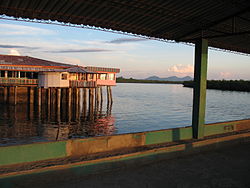
-

-
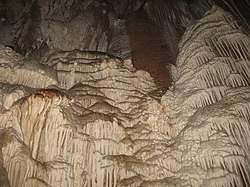
-

-


Infrastructure
Infrastructure works date back to pre-Hispanic times, but they evolved during the conquest and independence of Honduras. The history of urban planning in Honduras dates from the 5th century, in the City of Copán, when the Maya culture was at its height. During the conquest of present-day Honduras new forms of urban planning arrived, which improved after independence.
Transportation


Honduras has more than 15,400 km of roads. The country's main highway runs from Puerto Cortés on the Caribbean, passing through San Pedro Sula, Comayagüela and Tegucigalpa, until it reaches Nacaome and Choluteca in the south of the country, through which the Pan-American Highway also passes.[144]
The country's railway system consists of 785 km of track, divided into two systems. The National Railway of Honduras (FNH) has almost 600 kilometers of track. Half of this system is 1.067-meter gauge (narrow gauge) and the other half is 0.914-meter gauge. The other system is 190 kilometers long and is owned by the Tela Railroad Company, a subsidiary of Chiquita Brands International. Both systems are located in the north-central and northwestern coastal areas of Honduras and serve mainly for the transportation of bananas.[29]
Honduras has 6 seaports: Puerto Cortés, Puerto Castilla, La Ceiba, Roatán and Tela, which are located in the northern part of the country with access to the Atlantic Ocean, and in the south, with access to the Pacific Ocean, only the port of Bocas del Henecan or San Lorenzo. Puerto Cortés is the most important in the country and, together with Puerto Castilla and San Lorenzo, handles almost all of Honduras's maritime trade. The ports of La Ceiba, Roatán and Tela specialize in tourism; every week they are visited by international cruise ships with capacity to carry between 400 and 800 international tourists.
At present, the country has four international airports:
- Ramón Villeda Morales International Airport (SAP) in San Pedro Sula
- Toncontín International Airport (TGU) in Comayagüela,
- Golosón International Airport (LCE).
- Juan Manuel Gálvez International Airport (RTB) in Roatán.
The airports with the most flights are Ramón Villeda Morales and Toncontín; from both cities there are regular nonstop flights to Miami, Houston, New Orleans and the main cities of Mexico and Central America.
Telecommunications
The print press began in Honduras through La Gaceta (Honduras), the government's information organ. Francisco Morazán, who had introduced the first printing press to the country, was the one who issued the first communiqués at the national level in 1830. The oldest newspaper of the modern era is the daily La Prensa, founded on October 26, 1964. This newspaper, together with El Tiempo, produces its editions from San Pedro Sula. Other important newspapers are El Heraldo and La Tribuna of Tegucigalpa. Internet newspapers such as HonduDiario.com and Proceso Digital, among others, are also part of the print press. Most Honduran newspapers can be read free of charge on the internet.
The first telegraph lines in the country were built in 1876. These lines came to connect the cities of Comayagua and La Paz. Later, a telegraph line was built to connect Comayagua with Tegucigalpa, and in 1880 the city of San Pedro Sula was connected to the network. In 1928, the General Directorate of Telegraphs was renamed the General Directorate of Telegraphs and Telephones.[145]
The first telephone service concessions were granted in 1891, but automatic service began in 1932 with the installation of a 1,000-line telephone exchange in Tegucigalpa.[145] In 1976 the Honduran Telecommunications Company (Hondutel) was created, and it began operations the following year. At present, Hondutel offers fixed and wireless telephone services (821,200 lines in 2007),[146] ADSL (asymmetric digital subscriber line) internet service, and prepaid card services, among other services.[147]
With the opening of telecommunications in Honduras, foreign investment has benefited. Today several companies specializing in this field operate in the country, for example Cable Color and Amnet, as well as Tigo and Claro, which provide the population with cellular telephone services.[148]

In 2008, 13.1 out of every 100 Hondurans used the Internet regularly, but only 0.8% were fixed subscribers to this service. This is due to the popularity of internet cafés in the various neighborhoods and residential districts of the country's cities.[149]
The Honduran people began to get their news through television in 1959 with the arrival in the country of TVC Canal 5 of Televicentro. This channel was later joined by TVC Canal 3, TVC Canal 7 and MegaTv; in 2010, TVC-HD (High Definition) was born, available only to Tigo/Amnet and Cablecolor users. Little by little, other channels were added to the country's news network, such as Voz e Imagen Centroamericana, Canal 11 Honduras, Hondured Canal 13, Canal 6 Honduras, Cholusat Sur Canal 36, Televisión Nacional de Honduras and Globo TV, among others.
It is estimated that telecommunications represent 7.1% of GDP in Honduras (2008).[150]
Energy


Honduras obtains its energy from four sources: hydrocarbons, hydropower, wind and biomass. Until 1990, 99% of electric power came from state-owned hydroelectric plants. Although, given the topographic and rainfall conditions, there is enormous potential for hydroelectric generation, it has not been properly exploited.[151]
The lack of public and private investment in renewable energy sources has meant that the energy demand that has arisen in recent years has been covered by thermal plants based on fossil fuels. At present, 65% of the energy consumed comes from these plants.[151]
36% of hydrocarbons are used in the production of electric power; most of the rest is consumed by transportation. Honduras does not produce hydrocarbons, so this dependence greatly affects its trade balance.[152] Honduras consumes some 15 million barrels of oil a year (42,000 a day).[153] The country spends approximately $1,250 million on oil purchases[154] (2006) (13% of its revenue).
There are currently projects for the use of alternative energy sources in addition to hydroelectric power. The National Electric Power Company (ENEE), the body chiefly responsible for the production, commercialization, transmission and distribution of electric power in Honduras, plans the construction of the Patuca III project together with the Patuca I and II projects (cost: $1,200 million) with the aim of generating 600 MW of clean energy.[155]
The first wind farm in Honduras, located at Cerro de Hula, began producing 67 MW of electricity in October 2011. This project (cost: $290 million) now has 102 megawatts of electrical capacity, having been completed in December 2011; likewise, the Jicatuyo and Los Llanitos projects are under way, with a projected investment of $750 million.[152][155][156]
In May 2015, Honduras inaugurated the largest photovoltaic solar power plant in Latin America. With an installed capacity to produce 100 megawatts (MW) per year with two plants of 50 each, and with the possibility, depending on demand, of reaching up to 140, the complex is private and began operating in the village of La Llave, in the Municipality of Nacaome, in the southern Department of Valle. The Honduran photovoltaic plant surpasses those in Chile and Mexico, the leaders in Latin America in this sector.[157]
Demographics

The first census of the Honduran population was carried out by Bishop Fernando Cardiñanos in 1791, resulting in a little more than 90,000 inhabitants. From then on, the number of Hondurans rose consistently. In 1887 Honduras already had 330,000 inhabitants. By 1940, the number of Hondurans had already increased to more than one million. According to data provided by the Central American Population Center of the University of Costa Rica and CEPAL, the population of Honduras is among those registering the highest annual growth in Latin America.[158]
The total population of Honduras was 8,046,000 inhabitants (in 2010). Of this number, 4,128,652 people make up the urban population and 3,917,338 the rural population, according to the population and housing census of the National Statistics Institute of Honduras. The most populous department in Honduras is Francisco Morazán, with 1,691,056. The least populous department in Honduras is Bay Islands, with 49,158 people (25,182 women and 23,976 men).[11]
The bulk of the population is made up of people between 20 and 59 years of age (3,601,947), followed by children between the ages of 0 and 9 (2,114,366), and then by adolescents (10–19) with 1,839,806. This makes Honduras a fairly young population. According to the figures published by this census (INE, Population and Housing Census), only 489,871 make up the senior group (60+).[11]
This rapid demographic growth in Honduras has resulted in a decline in per capita income and increased pressure on access to essential services. This has led thousands of Hondurans to have to emigrate to countries such as Mexico, Belize and some European countries (because of linguistic and cultural ties, and because of the possibility of acquiring dual nationality in a shorter period, Spain is the main European destination), but especially to the U.S. in search of better living conditions. In addition, this population growth has accelerated the process of urbanization in the main cities such as San Pedro Sula and Tegucigalpa.
| Group | Share |
|---|---|
| Mestizos | 81.6% |
| Indians | 7.7% |
| Creoles and Garifuna | 3.3% |
| Mulattoes | 1.7% |
| Whites | 5% |
| Asians | 0.7% |
Urbanization
| Most populous municipalities of Honduras | ||||||||||
| City | Department | Population | City | Department | Population | |||||
|---|---|---|---|---|---|---|---|---|---|---|
| 1 | Tegucigalpa | Francisco Morazán | 1 310 034 | 6 | Danlí | El Paraíso | 181 188 | |||
| 2 | San Pedro Sula | Cortés | 1,100,039 | 7 | Choluteca | Choluteca | 169 113 | |||
| 3 | La Ceiba | Atlántida | 421 831 | 8 | Juticalpa | Olancho | 150 181 | |||
| 4 | El Progreso | Yoro | 300,000 | 9 | Villanueva | Cortés | 137 657 | |||
| 5 | Choloma | Cortés | 276 863 | 10 | Catacamas | Olancho | 129 288 | |||
| 2010 Census. Source: National Statistics Institute of Honduras (INE) | ||||||||||


Ethnic groups and language
| Ethnic groups and their language | |
| Group | Language |
|---|---|
| Lencas | Spanish |
| Ch'orti' | Spanish |
| Garifuna | Garifuna |
| Islanders | English/Spanish |
| Sumos | Tawahka |
| Tolupanes or Xicaques | Tol |
| Pech | Pech |
| Miskito | Miskito |

"Honduras is a multi-ethnic, multicultural and multilingual country made up of four large ethnic families: mestizos or whites, who are the majority; the Indigenous peoples (Lencas, Miskitos, Tolupanes, Ch'orti', Pech or Payas, Tawahkas); the Garifuna; and the English-speaking Creoles. The Indigenous ethnic groups and the Garifuna constitute the cultural heritage of Honduras and represent about 7% of the country's population."[159]
Among the groups with the smallest populations are the Ch'orti', with a population of approximately 38,587,[160] who live in the departments of Copán and Ocotepeque. The Miskitos, approximately 57,000 people, live in the Department of Gracias a Dios. Likewise, the Pech or Payas (4,300) live in Olancho, Colón and Gracias a Dios.[161][162] Meanwhile, the Tawahka population went from 160 people to about 2,758 people during the 21st century.[160] This ethnic group practices itinerant subsistence agriculture.
The Lencas, the most numerous ethnic group (313,000),[160] are located in the departments of La Paz, Comayagua, Intibucá, Lempira and Santa Bárbara. They live in villages and hamlets very close to the roads... "although the Lencas were decimated during the 16th century, some of their present-day communities still have a culture that partially distinguishes them from their peasant or ladino neighbors...".[163] This despite having lost their language.
The Garifuna peoples (98,000) are located along the northern coast of Honduras, from Masca in the Department of Cortés to Tocomacho in the Department of Colón. "Although it is the relatively youngest ethnic group" to have settled in Honduras, they have already become an important part" of the country's "idiosyncrasy".[163]
The Jicaques or Tolupanes (19,000 people) of the departments of Cortés and Atlántida have lost their Jicaque language and culture. They all feel themselves to be ladinos and are fully integrated into Honduran peasant society. The Jicaques of the Montaña de la Flor number some three hundred fifty. 90% of them are monolingual in Jicaque.[164]
The inhabitants of the Bay Islands, commonly called islanders (13,854),[160] "reflect their origins as English slaves; they speak an English dialect characteristic of the western Caribbean, are of the Christian-Evangelical religion, and identify themselves with the Anglo-American culture of the contemporary Caribbean".[165]
As regards the government of the Republic of Honduras, through Article 6 the Constitution establishes that
The official language of Honduras is Spanish. The State shall protect its purity and increase its teaching.
Nevertheless, with the loss of their language by the Lencas and the Ch'orti', and the danger of extinction that exists for languages such as that of the Payas, the Constitution itself deems it necessary, through Article 172:
All the anthropological, archaeological, historical and artistic wealth of Honduras forms part of the cultural heritage of the Nation. The Law shall establish the rules that will serve as the basis for its conservation, restoration, maintenance and restitution, as the case may be. It is the duty of all Hondurans to watch over its conservation and prevent its removal.
Likewise, the Constitution undertakes to preserve and encourage
the native cultures, as well as the genuine expressions of national folklore, popular art and handicrafts
- See the portal dedicated to the linguistic diversity of Honduras Archived December 24, 2013, at the Wayback Machine, with access to the dictionaries of Hondureñismos and of the Lenguas de Honduras DLH of the Honduran Academy of Language (AHL).
Human rights
| Treaty | Status |
|---|---|
| International Covenant on Economic, Social and Cultural Rights (CESCR) | Signed and ratified |
| Optional Protocol to the CESCR (CESCR-OP) | No information |
| International Covenant on Civil and Political Rights (CCPR) | Signed and ratified |
| First Optional Protocol to the CCPR (CCPR-OP1) | Signed but not ratified |
| Second Optional Protocol to the CCPR, aiming at the abolition of the death penalty (CCPR-OP2) | Signed but not ratified |
| International Convention on the Elimination of All Forms of Racial Discrimination (CERD) | Acceded or ratified |
| Convention on the Elimination of All Forms of Discrimination against Women (CEDAW) | Signed and ratified |
| Optional Protocol to the CEDAW (CEDAW-OP) | Neither signed nor ratified |
| Convention against Torture (CAT) | Acceded or ratified |
| Convention on the Rights of the Child (CRC) | Signed and ratified |
| Optional Protocol to the CRC on the involvement of children in armed conflict (CRC-OP-AC) | Acceded or ratified |
| Optional Protocol to the CRC on the sale of children, child prostitution and child pornography (CRC-OP-SC) | Acceded or ratified |
| International Convention on the Protection of the Rights of All Migrant Workers and Members of Their Families (MWC) | Neither signed nor ratified |
| Convention on the Rights of Persons with Disabilities (CRPD) | Signed and ratified |
| Optional Protocol to the CRPD (CRPD-OP) | Signed but not ratified |
Despite this, since the 2009 coup d'état, human rights violations have multiplied in the country, with an increase in threats, coercion, assaults and murders against discriminated groups such as women, homosexuals and transsexuals, and even against the journalists who give them media coverage.[166][167]
As for levels of violence, in Honduras practically one person is murdered every hour. During the three years of the government of President Porfirio Lobo, 20,515 people were murdered. The homicide rate in 2012 was 85.5 per 100,000 inhabitants. The average over the last three years was 561.3 people murdered per month. In 2012, 7,172 people were murdered, exceeding by 68 the figure of 7,104 for 2011 and by 933 that of 6,239 for 2010. In 2010, 2011 and 2012, more than 20 journalists and more than 10 lawyers were murdered. 70% of femicides went unpunished.[168]
Human development
According to the 2019 report, the Human Development Index of Honduras is 0.617, which places this country in 133rd place worldwide (medium human development).[169]
Education

In Honduras, education begins with preschool education, which is given to students between 4 and 6 years of age; students go on to receive primary education, which is free and compulsory for all children between the ages of 6 and 15 and prepares the pupil for secondary studies.[170]
The secondary level comprises two cycles: the common cycle and the diversified cycle. The common cycle of general culture lasts 3 years and is general in nature, of a basic technical type in secretarial studies or pre-vocational. The secondary level is completed with the diversified cycle: 2 years of the baccalaureate in sciences and letters, and 3 years for technical baccalaureates such as business administration, computer technician, social promotion, agricultural technician and others. Likewise, there are 3-year programs in teacher training for primary education, commercial expert and public accountant.[170] [171]
The Directorate of Higher Education is the executive body in charge of the resolutions of the Council of Higher Education. It acts as a liaison with the higher education institutions.[172] The higher education offered by universities ranges from 2 years, as in the case of the schools of agriculture, agricultural science and forestry, up to 7 or 8 years in the case of medicine and the priesthood.[171]
The organization, direction and development of the higher education level is the responsibility of the National Autonomous University of Honduras, through the following bodies: a) Full Assembly, b) Council of Higher Education, c) Technical Council and d) Directorate of Higher Education.[172] Universities that receive state subsidies are autonomous, which empowers them to define their own curriculum and design their study plans. Efforts are made to ensure these are consistent with the national development plans.[172] Private universities that obtain authorization from the Higher Council of Education to be able to offer their professional degree programs must submit their study plans and programs to it.[172]
Culture and the arts
Gastronomy
The gastronomy of Honduras has its roots in pre-Columbian Mesoamerican cuisine, in which various species of plants, animals and fish were used, and these were in turn used as natural remedies or medicines. Some of the widely used plant species were maize, beans, annona, ayote, squash, cassava, tomato, potato, pataste, sweet potato, vanilla, cinnamon and peanuts, among others. Also some fruits such as pineapple, avocado, papaya and guava, which were gathered in the rainforests.
The dishes prepared with these foods have been very well elaborated; among them we can mention tortillas (made with nixtamalized maize), burritos made with cooked beans wrapped in a tortilla, popcorn, tamales, chili, and beverages such as chocolate, pinol and atole.
After the Spanish conquest there was a fusion of cultures in which European gastronomy began to be known in present-day Honduras, and Europe in turn included in its diet fruits and vegetables of American origin, notably the avocado, the potato, the pineapple and tobacco.
On the northern coast of Honduras there is Garifuna, Miskito and Creole food. Instead of corn tortillas, cooked plantains (green or ripe) are eaten, as well as machuca (mashed green plantain with coconut and many other ingredients) and cassava bread.
During the era of the banana companies, these U.S. companies introduced new eating customs in the area. Thus, cornmeal was replaced by wheat flour in most local preparations. One of the unforeseen results has been the emergence of the most typical and favorite food of the northern coast of Honduras, the Baleadas.
Visual arts
Dances by ethnic group
Dances of Lenca origin

- El Baile del Garrobo
- Baile de las Coronas
- El Baile de los Moreno chico
- El Baile de los Huevos
- El Baile del Bandereo
- El Baile de los Diablitos
Garifuna dances
- Punta
- Parrandas
- Mascarones
- El barreño
- El Sueñito
Painting

Painting in the territory of present-day Honduras has existed since pre-Columbian times, which is still in the midst of being discovered, since the resources and will necessary to find these roots of pre-Columbian culture in Honduras have not existed, as shown by the recent research processes on the White City in the Mosquitia region in the east of the country.
With the arrival of the European colonizer came various techniques that were introduced during the Spanish colonization and that underwent modifications as an effect of mestizaje, which after independence deepened even further due to endogenous and exogenous factors as an effect of the transformations prevailing at that juncture.

Honduras is a multi-ethnic country, and consequently a multicultural country. This diversity of the natural and human environment of Honduras has contributed to the emergence of various forms of expression in the different artistic fields, both traditional and contemporary manifestations.[173] The Secretariat of Culture, Arts and Sports is responsible for protecting the historical and cultural heritage of the country.[174] It is likewise the body in charge of promoting artistic, cultural and sports activity at the national level.[175]
The OEI, through the Cultural Census of Honduras, managed to identify 1,496 cultural manifestations distributed across 200 municipalities in the country's 18 departments. These are subdivided into traditional popular manifestations and contemporary manifestations; 1,300 of them correspond to traditional popular manifestations and 196 to contemporary ones.[173] According to the OEI, the traditional popular manifestations of Honduras draw on the contributions of Indigenous and Garifuna groups, while the contemporary manifestations are more linked to urban centers and oriented toward the professionalization of art.[173]
Artists and scholars of Honduran art agree that a historical point of reference for a new stage of national artistic and cultural expression began with the end of the dictatorship that concluded in the middle of the 20th century. This political change meant the beginning of a period of liberation in Honduran artistic and intellectual expression and the introduction of new techniques and trends into national art. Of the 196 contemporary manifestations identified, one can count 29 theatre groups, 5 dance groups, 60 orchestras and choirs, 48 cultural associations, 24 art schools and 31 galleries or alternative spaces.[173]
Museums


Honduras has a wide variety of museums, among which are the Villa Roy Museum of Republican History, the Museum of Honduran Man, the Museum of Anthropology and History, the Honduras Air Museum and the Museum for National Identity, among others.
- National Archive of Honduras
- National Library of Honduras
- Museum of the Presidential House of Honduras,
- San Francisco Barracks military museum,
- Museum of Banco Atlántida S.A.,
- Museum of the Central Bank of Honduras,
- Art gallery of the Central Bank of Honduras,
- Manuel Bonilla National Theater,
- Museum of Anthropology and History (Honduras),
- Museum for National Identity,
- Museum of Honduran Man,
- Honduras Air Museum,
Nobel Prize nominees
The Honduran nation has had two nominations for the Nobel Prize in its history.

Honduran Prince of Asturias Award winners
One Honduran has been recognized internationally for his research in medicine.
Sports
As far as sports are concerned, football occupies a privileged place among Hondurans. Every week the National Football League of Honduras is followed with special interest. The country's top sporting representative at the international level is the senior national football team, which has qualified for three World Cups (1982, 2010 and 2014). It has served as a platform for many of its members to reach the great leagues of the world. Other important sports practiced in the country include baseball, basketball and volleyball. On a smaller scale, table tennis, athletics and swimming, among others, are practiced.
American football in Honduras is also practiced. Despite not having a professional league, it has a very important high-school tradition, and in urban areas there is a large number of children's teams. The National American Football Federation of Honduras (FENAFAH), which is affiliated with the autonomous sports confederation of Honduras, CONDEPAH, has had, since January 2007, official recognition by the National Congress since 2002. The top American football competition in Honduras is at the high-school level, played through the Liga Troyanos de Fútbol Americano, created in 2002. From 1944 to 1951, Steve Van Buren became the first Honduran to play professionally in the National Football League, with the Philadelphia Eagles.
 Honduras national basketball team
 Honduras at the Olympics
 National Professional Football League of Honduras
- Honduran Promotion League


Public holidays
| Date | Name | Description |
| January 1 | New Year's Day | Celebration of the arrival of the New Year |
| January 25 | Honduran Women's Day | |
| February 3 | Day of the Virgin of Suyapa | Patroness of the Republic of Honduras |
| March 19 | Father's Day | Recognition of Honduran fathers |
| April 14 | Day of the Americas | Symbol of sovereignty and of voluntary union in a supracontinental community. |
| May 1 | Workers' Day | International Workers' Day |
| 2nd Sunday of May | Mother's Day | Recognition of all Honduran mothers |
| May 30 | Arbor Day | Celebration of the trees of Honduras and the commitment to protect them |
| July 20 | Day of the Cacique Lempira | |
| September 1 | Day of the Flag of Honduras (national symbol). | |
| September 10 | Children's Day | Recognition of all Honduran children |
| September 15 | Independence Day | Day of the Independence of Central America |
| September 17 | Teachers' Day | Recognition of the Honduran teacher. |
| September 28 | Arrival of the Independence documents | Not a day off. |
| October 3 | Birth of General José Francisco Morazán Quezada. | Commemoration of the national hero and Honduran Soldier's Day. |
| October 12 | Discovery of America | Arrival of Admiral Christopher Columbus |
| October 21 | Day of the Armed Forces of Honduras | Celebration of the Anniversary of the Military Force.[176] |
| December 25 | Christmas | Birth of the Child Jesus. It is celebrated at midnight, the hour of the birth of Jesus. (International celebration). |
Security
Although as of 2014 it was the most unsafe country in the world,[177] this was not the case in its beginnings, having obtained its independence peacefully in 1821. During most of the 20th century the homicide rate was below 10 people per 100,000 inhabitants, making it one of the most peaceful countries on the planet.[178]
Since then the figures have been rising, while drug trafficking was also growing in the country, being another of the main related causes. The influence of the maras or organized crime groups in the country is another significant cause of the high number of homicides, according to studies by the United Nations Organization – UNODC. In 1990 the homicide rate was already 10 homicides per 100,000 inhabitants, and in barely three years the figure tripled, reaching 30 homicides per 100,000 inhabitants according to 1994 data.[179] The increase has been exponential in recent years, reaching an increase of almost 1000% and standing at more than 90 homicides per 100,000 inhabitants in 2012,[180] making it the country with the highest homicide rate in the world, with historic figures for homicides both locally and globally since 1998.[178][181] However, the 2017 statistics of InSight Crime show a 26% reduction compared with 2016, placing the homicide rate at a hopeful 42.8 per 100,000 inhabitants.[182]
The military budget of Honduras has tripled since the 2009 coup d'état. The United States also provides military assistance to the Honduran State and uses military bases in the country as a launching platform for interventions in the region.[183]
References
- ↑ 1.0 1.1 "Constitución de la República de Honduras" (PDF) (in español). Political Database of the Americas. January 11, 1982. Retrieved October 8, 2010.
- ↑ 2.0 2.1 2.2 2.3 2.4 CIA. "Honduras - Geografía - Libro Mundial de Hechos" (in español). Retrieved February 26, 2017.
- ↑ 3.0 3.1 3.2 3.3 3.4 Fondo Monetario Internacional. "Report for Selected Countries and Subjects - Octubre 2018" (in español). Retrieved October 9, 2018.
- ↑ PNUD (September 14, 2018). hdr.undp.org (ed.). "Informe sobre Desarrollo Humano 2018". Stockholm, Sweden. Retrieved June 25, 2018.
{{cite web}}: CS1 maint: year (link) - ↑ PNUD (2018). "Human Development Indices and Indicators" (PDF). Retrieved June 19, 2019.
{{cite journal}}: Cite journal requires|journal=(help) - ↑ According to arts. 8 and 295 of the Political Constitution of Honduras, both cities, together with their rural areas, villages and hamlets, form the capital of the Republic.
- ↑ David Cienfuegos Salgado. "Honduras, régimen municipal" (PDF) (in español). p. 409. Archived from the original (PDF) on January 18, 2012. Retrieved December 8, 2011.
- ↑ Malte-Brun, Conrad (1881). "Nueva geografía universal" (in español). Montaner y Simon editores. Retrieved February 19, 2011.
- ↑ 9.00 9.01 9.02 9.03 9.04 9.05 9.06 9.07 9.08 9.09 Vera, Robustiano, ed. (1899). "Apuntes para la Historia de Honduras" (in español).
{{cite web}}:|access-date=requires|url=(help); Missing or empty|url=(help) - ↑ angelfire.com (ed.). "DE LA ORGANIZACIÓN DEL ESTADO" (in español). Retrieved February 21, 2011.
- ↑ 11.0 11.1 11.2 11.3 Instituto Nacional de Estadísticas de Honduras, ed. (2010). "Población y Vivienda" (in español). Archived from the original on September 22, 2010. Retrieved February 18, 2010.
- ↑ Flores, Manuel Antonio (November 31, 2003). "Estado de la Población de Honduras" (PDF) (in español). UNAH. Archived from the original (PDF) on August 9, 2011.
El crecimiento acelerado de la población...considerada... una de las más elevadas en el contexto latinoamericano
{{cite web}}: Check date values in:|date=(help) - ↑ bbc.co.uk, ed. (2010). "Honduran Country Profile". Retrieved February 18, 2010.
The country has a youthful population; 50% of Hondurans are under the age of 19
- ↑ Ramírez F. Fontecha, Antonio A. (1916). Leo Stanton Rowe (ed.). "Noticia geográfica y estadística de la República de Honduras" (in español). Pan-American Scientific Congress. Retrieved February 19, 2011.
- ↑ roatanonline.com, ed. (2010). "Roatan online". Retrieved February 18, 2010.
- ↑ 16.0 16.1 Vera, Robustiano, ed. (1899). Apuntes para la Historia de Honduras (in español). Santiago de Chile: Imprenta El Correo Delicias. Retrieved December 2010.
Debe Honduras su nombre a las honduras o fondos, que los primeros pilotos hallaron en sus costas y porque al abandonarlas exclamaron: líbrenos Dios de estas honduras
{{cite book}}: Check date values in:|access-date=(help) - ↑ Mario Felipe Martínez (1983). "Documentos Históricos de Honduras" (in español). Tegucigalpa.
{{cite web}}:|access-date=requires|url=(help); Missing or empty|url=(help) - ↑ 18.0 18.1 18.2 18.3 Ramón D. Rivas (1993). "Pueblos indígenas y garífuna de Honduras" (in español). Tegucigalpa: Editorial Universitaria. ISBN 99926-15-53-2. Retrieved February 14, 2011.
{{cite web}}: CS1 maint: periodical has ISBN (link) - ↑ 19.0 19.1 Longino Becerra (1981). "La comunidad primitiva de Honduras" (in español). Editorial Universitaria.
{{cite web}}:|access-date=requires|url=(help); Missing or empty|url=(help) - ↑ Stone, Doris (1940). "Introducción". In Doris Stone (ed.). Demarcación de la culturas pre-colombinas del centro y norte de Honduras (in español). Tegucigalpa.
Introducción
{{cite book}}:|access-date=requires|url=(help)CS1 maint: location missing publisher (link) - ↑ Chapman, Anne (1978). "Introducción". Los Lencas de Honduras (in español). Tegucigalpa.
{{cite book}}:|access-date=requires|url=(help)CS1 maint: location missing publisher (link) - ↑ Baron Castro, Rodolfo (1978). La Población de El Salvador (in español). Tegucigalpa: UCA Editores.
{{cite book}}:|access-date=requires|url=(help) - ↑ angelfire.com (ed.). "Honduras antes de Colon" (in español). Retrieved February 14, 2008.
- ↑ Aplícano Mendieta, Pedro (1969). Los mayas en Honduras (in español). Tegucigalpa: Impr. y Papelería Calderón. Retrieved February 14, 2011.
Los mayas florecieron en estos países en los primeros 15 siglos de la era cristiana
- ↑ Swiggett, Glen Levin (1917). "Introducción". Proceedings of the Second Pan American Scientific Congress. Washington. Retrieved February 14, 2011.
{{cite book}}: CS1 maint: location missing publisher (link) - ↑ Cindy Kilgore & Alan Moore. "Adventure Guide to Copan & Western Honduras". Hunter publishing. Retrieved January 29, 2011.
Spanish conquistadores did not become interested in colonization of Honduras until the 1520s when Cristobal de Olid the first European colony in Triunfo de la Cruz in1524. A previous expedition was headed by Gil Gonzalez Davila
- ↑ Jalhay, Henry, ed. (1899). "Monthly Bulletin Bureau of The American Republics Washington D.C." Retrieved January 19, 2011.
- ↑ 28.0 28.1 Pascal Girot (1994). The Americas. Greenwood Press. pp. 284–285. ISBN 0-415-08836-4. Retrieved January 27, 2011.
- ↑ 29.0 29.1 29.2 29.3 Library of Congress, ed. (2010). "Honduras". Retrieved February 19, 2011.
- ↑ Pietschmann, Horst (2005). Latin America and the Atlantic World. London. ISBN 3-412-26705-8. Retrieved February 7, 2011.
{{cite book}}: CS1 maint: location missing publisher (link) - ↑ Leiva Vivas, Rafael (1980). Vigencia del Sabio (in español). Tegucigalpa.
{{cite book}}:|access-date=requires|url=(help)CS1 maint: location missing publisher (link) - ↑ Rosa, Ramón (1882). Biografía de Don José Cecilio del Valle (in español) (Volume 3 ed.). Tegucigalpa.
Independencia de Centro América
{{cite book}}:|access-date=requires|url=(help)CS1 maint: location missing publisher (link) - ↑ González Saravia, Miguel (1881). D. Appleton & Co. (ed.). Compendio de la historia de Centro-América (in español). Guatemala: D. Appleton. Retrieved February 7, 2011.
Las autoridades españolas y las familias de la aristocracia, simpatizaron con la anexión
- ↑ Pan American Union (1899). Bulletin of the Pan American Union (Volume 6 ed.). Washington: Government Printing Office. Retrieved February 7, 2011.
- ↑ Bonilla, Policarpo (1899). Colección de escritos, recogidos y ordenados (in español) (Volume 3 ed.). Tegucigalpa: Tipografia Nacional. Retrieved February 7, 2011.
- ↑ Smith, Joseph (1897). Joseph Smith (ed.). Bulletin of the International Bureau of the American (Volume 5 ed.). Washington. Retrieved February 7, 2011.
{{cite book}}: CS1 maint: location missing publisher (link) - ↑ 37.0 37.1 Monthly Bulletins, ed. (1899). "Annual Report of the Bureau of the American Republics". Retrieved February 7, 2011.
- ↑ Haggerty 1990, p. 7.
- ↑ Rodríguez 2009, p. 6.
- ↑ Pan American Union (1899). Bulletin of the Pan American Union (Volume 6 ed.). Washington: Government Printing Office. Retrieved February 7, 2011.
- ↑ "Tratado de Unión... República Mayor de Centroamérica" (PDF) (in español).
- ↑ Bonilla, Policarpo (1899). Colección de escritos, recogidos y ordenados (in español) (Volume 3 ed.). Tegucigalpa: Tipografia Nacional. Retrieved February 7, 2011.
- ↑ Smith, Joseph (1897). Joseph Smith (ed.). Bulletin of the International Bureau of the American (Volume 5 ed.). Washington. Retrieved February 7, 2011.
{{cite book}}: CS1 maint: location missing publisher (link) - ↑ 44.0 44.1 44.2 44.3 Leonard, Thomas M. (1895). "The History of Honduras". Santa Barbara, CA. U.S.A.: Greenwood Publishing Group. ISBN 978-0-313-36303-0.
{{cite web}}: ISBN / Date incompatibility (help);|access-date=requires|url=(help); Missing or empty|url=(help)CS1 maint: periodical has ISBN (link) - ↑ Preston Blair, Frank (1853). "History of Central America". James Lusk Printer. Retrieved October 25, 2011.
- ↑ Woldmar Ruoff, Henry (1911). "History of Central America". Chicago: The W.E. Richardson Co. Retrieved October 30, 2011.
- ↑ 47.00 47.01 47.02 47.03 47.04 47.05 47.06 47.07 47.08 47.09 Gómez Carrillo, Agustín (1895). "Crisis histórica del poder político en Honduras" (in español). Madrid: Imprenta de la Viuda de Hernando y C.
{{cite web}}:|access-date=requires|url=(help); Missing or empty|url=(help) - ↑ 48.0 48.1 Posas, Mario (1980). (in español).
Medina convoca a la Asamblea Nacional Constituyente que deroga la Constitución de 1840
{{cite web}}:|access-date=requires|url=(help); Missing or empty|title=(help); Missing or empty|url=(help) - ↑ 49.0 49.1 angelfire.com, ed. (2011). "JOSÉ MARÍA MEDINA" (in español). Retrieved October 31, 2011.
- ↑ 50.0 50.1 García Laguardia, Jorge Mario (1911). "Honduras: evolución político constitucional 1824-1936" (in español). México: UNAM.
{{cite web}}:|access-date=requires|url=(help); Missing or empty|url=(help) - ↑ 51.0 51.1 51.2 51.3 51.4 51.5 Merrill, Tim (ed.) (1995). Honduras: A Country Study. Washington: GPO for the Library of Congress.
{{cite book}}:|author=has generic name (help) - ↑ 52.0 52.1 Barahona, Marvin (1978). "Honduras en el siglo XX: una síntesis histórica" (in español). Tegucigalpa: Guaymuras. ISBN 99926-1598-2. Retrieved February 14, 2005.
{{cite web}}: CS1 maint: periodical has ISBN (link) - ↑ Karnes, Thomas L. (1978). "Tropical Enterprise Standard Fruit Company and steamship Company in Latin America". Latin America Lousiana State University Press. Retrieved February 14, 2011.
- ↑ Argueta, Mario (1989). "Tiburcio Carías: anatomía de una época, 1923-1948" (in español). Tegucigalpa: Guaymuras. ISBN 978-99926-33-73-1. Retrieved February 14, 2005.
{{cite web}}: CS1 maint: periodical has ISBN (link) - ↑ Mac Cameron, Robert (1983). "Bananas, labor, and politics in Honduras, 1954-1963" (in español). Maxwell School of Citizenship and Public Affairs, Syracuse University. ISBN 0915984962. Retrieved November 25, 2011.
{{cite web}}: CS1 maint: periodical has ISBN (link) - ↑ Acuña Ortega, Víctor Hugo (1994). Las repúblicas agroexportadoras: (1870-1945) (in español). Costa Rica: FLACSO.
{{cite book}}:|access-date=requires|url=(help) - ↑ Posas, Mario (1981). Rafael del Cid (ed.). La construcción del sector público y del Estado nacional de Honduras, 1876-1979 (in español). Tegucigalpa: Editorial Universitaria Centroamericana.
{{cite book}}:|access-date=requires|url=(help) - ↑ Anderson, Thomas P. (1988). Politics in Central America: Guatemala, El Salvador, Honduras, and Nicaragua. Greenwood Publishing Group. ISBN 0-275-92805-5.
{{cite book}}:|access-date=requires|url=(help) - ↑ 59.0 59.1 Honduras un Estado Nacional?: Book. By Juan Arancibia C. ISBN 99926-15-98-2.
- ↑ 60.0 60.1 60.2 60.3 Bureau of Western Hemisphere Affairs, Department of State, ed. (August 18, 2010). "Background Note: Honduras". Retrieved February 7, 2011.
- ↑ 61.0 61.1 La Prensa de Honduras, ed. (May 17, 2010). "LA CONSTITUCIÓN DE 1982" (in español). Archived from the original on July 21, 2010. Retrieved February 7, 2011.
- ↑ Bethell, Leslie (1991). Central America since independence. New York: Cambridge Press. p. 214. ISBN 0-521-41307-9. Retrieved February 7, 2011.
- ↑ Anderson, Thomas P. (1988). "Politics and the military in Honduras". New York: Praeger. p. 133. Retrieved January 30, 2012.
The "Mancha Brava", urged on by FENAGH, which sought to divert attention from the land grabs by its members, began anti-Salvadoran activities on a large scale in 1967.
- ↑ "Vuelve a rugir el poderoso avión que derribó tres aeronaves salvadoreñas". Diario La Tribuna Honduras (in español). March 14, 2016. Archived from the original on September 17, 2017. Retrieved September 16, 2017.
- ↑ 65.0 65.1 Douglas Martin, ed. (May 18, 2010). "Oswaldo López Arellano, 88, Two-Time Honduran President". Retrieved February 7, 2011.
- ↑ 66.0 66.1 gtmun.org, ed. (2011). "LA CONSTITUCIÓN DE 1982" (PDF) (in español). Archived from the original (PDF) on July 22, 2011. Retrieved February 7, 2011.
- ↑ 67.0 67.1 Juan Ramón Martínez, ed. (January 23, 2011). "LA CONSTITUCIÓN DE 1982" (in español). Archived from the original on July 17, 2011. Retrieved February 7, 2011.
- ↑ "Constitución Política". todolegal.app (in español). Retrieved 2022-06-03.
- ↑ Humphrey, Chris (1997). Robertson, Amy E. (ed.). Moon Honduras and the Bay Islands. Estados Unidos. ISBN 978-1-59880-222-1. Retrieved February 7, 2011.
{{cite book}}: CS1 maint: location missing publisher (link) - ↑ time.com, ed. (June 13, 1983). "I Will Not Be Blackmailed Honduras President Roberto Suazo Cordova". Archived from the original on December 22, 2008. Retrieved February 12, 2008.
- ↑ Roberto Ortiz de Zárate, ed. (February 15, 2006). "José Azcona Hoyo" (in español). Archived from the original on February 6, 2013. Retrieved February 12, 2008.
- ↑ admin (2018-01-08). "Dirty Elections in Honduras, with Washington's Blessing". Center for Economic and Policy Research.
- ↑ 73.0 73.1 La Tribuna, ed. (2011). "Honduras-FMI, una dura y larga relación de acuerdos y desacuerdos" (in español). Archived from the original on July 17, 2011. Retrieved March 22, 2010.
- ↑ 74.0 74.1 Manuel Ramírez, ed. (2008). "Politica Económica y FMI en Honduras" (PDF) (in español). Archived from the original (PDF) on June 12, 2010. Retrieved February 12, 2008.
- ↑ Vilas, Carlos María (1993). Carlos María Vilas (ed.). Plan de ajuste democracia emergente en Centroamérica (in español). México: Universidad Nacional Autónoma de México. ISBN 9683627269.
{{cite book}}:|access-date=requires|url=(help) - ↑ New York Times, ed. (September 27, 1991). "U.S. to Forgive Honduras Debt". Archived from the original on December 22, 2008. Retrieved February 12, 2008.
- ↑ 77.0 77.1 Historia de Honduras, ed. (2011). "Regreso a la vida democratica" (in español). Retrieved February 12, 2008.
- ↑ Roberto Ortiz de Zárate, ed. (January 1, 2010). "rafael_callejas_romero" (in español). Archived from the original on May 22, 2015. Retrieved February 12, 2008.
- ↑ 79.0 79.1 Roberto Ortiz de Zárate (ed.). "Carlos Roberto Reina Idiáquez" (in español). Retrieved February 12, 2008.
- ↑ 80.0 80.1 angelfire.com, ed. (2011). "Carlos Roberto Reina Idiaquez" (in español). Retrieved February 12, 2008.
- ↑ 81.0 81.1 Roberto Ortiz de Zárate, ed. (January 1, 2010). "Carlos Roberto Flores Facussé" (in español). Archived from the original on April 11, 2009. Retrieved February 12, 2008.
- ↑ 82.0 82.1 The Associated Press, ed. (November 26, 2001). "Crime, poverty vie in Honduras". Retrieved February 12, 2008.
- ↑ Roberto Ortiz de Zárate, ed. (January 1, 2007). "Ricardo Maduro Joest" (in español). Archived from the original on April 6, 2009. Retrieved February 12, 2008.
- ↑ 84.0 84.1 Roberto Ortiz de Zárate, ed. (June 29, 2009). "Manuel Zelaya Rosales" (in español). Archived from the original on November 26, 2012. Retrieved February 12, 2008.
- ↑ 85.0 85.1 El Universal, ed. (January 27, 2010). "Zelaya sale de Honduras" (in español). Retrieved February 12, 2008.
- ↑ 86.0 86.1 BBC, ed. (June 29, 2009). "Golpe en Honduras: rechazo mundial" (in español). Retrieved February 12, 2008.
- ↑ Roberto Ortiz de Zárate, ed. (2009). "Porfirio Lobo Sosa" (in español). Archived from the original on October 23, 2012. Retrieved February 12, 2008.
- ↑ "Página en www.bbc.co.uk" (in español).
- ↑ "Honduras cierra "capítulo" al volver a OEA" (in español). Archived from the original on July 2, 2013.
- ↑ "HONDURAS: CALIFICAN DE APRESURADA LA LIQUIDACIÓN" (in español). Archived from the original on December 16, 2015. Retrieved October 14, 2015.
- ↑ 91.0 91.1 "Honduras cierra un banco incluido en la lista del narco de EE UU" (in español).
- ↑ "Presidente de Honduras" (in español). Archived from the original on August 15, 2019. Retrieved August 15, 2019.
- ↑ "Unas elecciones, un posible fraude electoral y 33 muertos en Honduras" (in español).
- ↑ Acuña Ortega, Víctor Hugo (1994). Las repúblicas agroexportadoras: (1870-1945) (in español). Costa Rica: FLACSO.
{{cite book}}:|access-date=requires|url=(help) - ↑ Posas, Mario (1981). Rafael del Cid (ed.). La construcción del sector público y del Estado nacional de Honduras, 1876-1979 (in español). Tegucigalpa: Editorial Universitaria Centroamericana.
{{cite book}}:|access-date=requires|url=(help) - ↑ Anderson, Thomas P. (1988). Politics in Central America: Guatemala, El Salvador, Honduras, and Nicaragua. Greenwood Publishing Group. ISBN 0-275-92805-5.
{{cite book}}:|access-date=requires|url=(help) - ↑ Bethell, Leslie (1991). Central America since independence. New York: Cambridge Press. p. 214. ISBN 0-521-41307-9. Retrieved February 7, 2011.
- ↑ "Vuelve a rugir el poderoso avión que derribó tres aeronaves salvadoreñas". Diario La Tribuna Honduras (in español). March 14, 2016. Retrieved September 16, 2017.
- ↑ Humphrey, Chris (1997). Robertson, Amy E. (ed.). Moon Honduras and the Bay Islands. United States. ISBN 978-1-59880-222-1. Retrieved February 7, 2011.
{{cite book}}: CS1 maint: location missing publisher (link) - ↑ time.com, ed. (June 13, 1983). "I Will Not Be Blackmailed Honduras President Roberto Suazo Cordova". Retrieved February 12, 2008.
- ↑ Roberto Ortiz de Zárate, ed. (February 15, 2006). "José Azcona Hoyo" (in español). Retrieved February 12, 2008.
- ↑ Vilas, Carlos María (1993). Carlos María Vilas (ed.). Plan de ajuste democracia emergente en Centroamérica (in español). México: Universidad Nacional Autónoma de México. ISBN 9683627269.
{{cite book}}:|access-date=requires|url=(help) - ↑ New York Times, ed. (September 27, 1991). "U.S. to Forgive Honduras Debt". Retrieved February 12, 2008.
- ↑ Roberto Ortiz de Zárate, ed. (January 1, 2010). "rafael_callejas_romero" (in español). Retrieved February 12, 2008.
- ↑ 105.0 105.1 Roberto Ortiz de Zárate, ed. (January 1, 2010). "Carlos Roberto Flores Facussé" (in español). Retrieved February 12, 2008.
- ↑ Roberto Ortiz de Zárate, ed. (January 1, 2007). "Ricardo Maduro Joest" (in español). Retrieved February 12, 2008.
- ↑ 107.0 107.1 Roberto Ortiz de Zárate, ed. (June 29, 2009). "Manuel Zelaya Rosales" (in español). Retrieved February 12, 2008.
- ↑ Roberto Ortiz de Zárate, ed. (2009). "Porfirio Lobo Sosa" (in español). Retrieved February 12, 2008.
- ↑ "Página en www.bbc.co.uk" (in español).
- ↑ "Honduras cierra "capítulo" al volver a OEA" (in español). Archived from the original on July 2, 2013.
- ↑ "HONDURAS: CALIFICAN DE APRESURADA LA LIQUIDACIÓN" (in español).
- ↑ "Unas elecciones, un posible fraude electoral y 33 muertos en Honduras" (in español).
- ↑ http://ici.radio-canada.ca/nouvelle/1074427/mort-12-manifestants-honduras-respect-droits-fondamentaux-election-hernandez-nasralla
- ↑ 114.0 114.1 Constitución de la República de Honduras (PDF) (in español).
- ↑ Organigrama de la Corte Suprema de Justicia de Honduras
- ↑ The national tree of Honduras, as declared in decree no. 429 of 1928, is simply "the Pine that appears symbolically on our Coat of Arms". However, the pine is a genus, not a species; and the current decree on the national coat of arms does not specify which species of pine should appear on the left. The species Pinus oocarpa is usually associated with the national tree, but legally it is not.
- ↑ «Honduras: Congreso Nacional aprueba Presupuesto General para el 2015» Archived September 24, 2015, at the Wayback Machine, article in the newspaper El Heraldo (Tegucigalpa).
- ↑ Oficina Española de Turismo (October 2012). "Ficha de la República de Honduras" (PDF) (in español). México, D.F: Oficina de Información Diplomática. Retrieved July 12, 2013.
- ↑ "Honduras: metropolitan areas". ine.gob.hn. 2010. Archived from the original on March 11, 2011. Retrieved February 18, 2011.
- ↑ WorldWeather.org.
- ↑ 121.0 121.1 121.2 121.3 Gispert, Carlos; d'Angelo Graciela (2001). 'Enciclopedia de Honduras (in español) (Tomo I y II ed.). Madrid: Editorial Océano. ISBN 84-494-1943-3.
Geografía de Honduras
- ↑ 122.0 122.1 122.2 Dirección General de Estadística y Censos, ed. (1904). La República de Honduras: breve reseña para la exposición de San Luis, Missouri (in español).
Geografía de Honduras
- ↑ 123.0 123.1 Daan Vreugdenhil (2001). Paul R. House (ed.). "Rationalisation of the Proteceted areas system of Honduras". Retrieved February 24, 2011.
- ↑ Central Intelligence Agency, The World Fact Book, CIA.
- ↑ United Nations Statistics Division - Main Environmental Indicators, Environment Statistics, UNSTATS.UN.
- ↑ Secretaría de Recurso Naturales de Honduras (ed.). "Hidrografía de Honduras" (in español). Retrieved February 19, 2011.
- ↑ 127.0 127.1 127.2 127.3 Secretaría de Recurso Naturales de Honduras (ed.). "Hidrografía de Honduras" (PDF) (in español). Retrieved February 19, 2011.
- ↑ Primer Informe Nacional sobre la Implementación de la Convención. Prepared by: Dirección General de Biodiversidad. Secretaría de Recursos Naturales y Ambiente SERNA. Tegucigalpa. May 2000.
- ↑ 129.0 129.1 129.2 https://www.france24.com/fr/20190215-reporters-doc-honduras-exil-caravane-migrants-etats-unis-violence-pauvrete-secheresse
- ↑ promexico.gob.mx, ed. (2008). "Relaciones México Honduras" (PDF) (in español). Archived from the original (PDF) on April 7, 2009. Retrieved February 25, 2008.
- ↑ ECLAC Annual Report, [1] Archived October 10, 2007, at the Wayback Machine.
- ↑ Honduras This Week: Business Page,.[2] Archived July 2, 2007, at the Wayback Machine.
- ↑ 133.0 133.1 CEPAL, ed. (2009). "Balance preliminar de las economías de América Latina y el Caribe" (PDF) (in español). Retrieved February 18, 2010.
- ↑ hondudiario.com, ed. (November 22, 2010). "Honduras evolucionó económicamente durante el 2010: CEPAL" (in español). Retrieved February 18, 2011.
- ↑ Proceso.hn, ed. (2010). "Economía de Honduras crecerá 2,5 % en 2010, según Cepal" (in español). Retrieved February 18, 2011.
- ↑ 136.0 136.1 136.2 Honduras, Gobierno (2011). Oportunidades de inversión sector agronegocios (in español). Tegucigalpa: Secretaria de Relaciones Exteriores de Honduras. Retrieved August 2011.
{{cite book}}: Check date values in:|access-date=(help) - ↑ "¿Cuál es el aporte de las actividades agropecuarias al PIB en Honduras?". Productor Agropecuario (in español). June 27, 2017.
- ↑ Instituto Hondureño de Turismo (December 4, 2010). "Misión y Visión" (in español). Tegucigalpa: IHT. Retrieved August 24, 2013.
conducir el desarrollo turístico nacional, mediante las actividades de planeación, impulso al desarrollo y diversificación de la oferta...
- ↑ Instituto Hondureño de Turismo (December 4, 2010). "Misión y Visión" (in español). Tegucigalpa: IHT. Retrieved August 24, 2013.
el turismo será reconocido como pieza clave en el desarrollo económico y su crecimiento se habrá basado en el respeto de los entornos naturales...
- ↑ Instituto Hondureño de Turismo (December 4, 2010). "Boletín de Estadísticas Turísticas 2005-2009" (PDF) (in español). Tegucigalpa: IHT. Archived from the original (PDF) on July 7, 2014. Retrieved August 20, 2010.
Honduras ocupa el último lugar en ingreso de turistas a nivel...
- ↑ Instituto Hondureño de Turismo. "Encuesta del Gasto y Perfil del Turista" (PDF) (in español). Tegucigalpa: IHT. Archived from the original (PDF) on July 7, 2014. Retrieved August 24, 2013.
representando el 46% de participación, la segunda región más importante es Norteamérica, con una participación del 39% del total de turistas, la gran mayoría proveniente de Estados Unidos
- ↑ Fiona Dunlop, Carl Pendle Jane Egginton y Steve Watkins (2000). "Viajes de Aventura, América Central" (in español). Hong Kong: Dai Nippon Printing Co. Ltd.
Hay en Honduras muchos lugares que atraeran al viajero aventurero incluidas 40 zonas protegidas, 20 parques nacionales, y dos lugares calificados como patrimonios de la humanidad por la UNESCO: Copán y Río Plátano. Desde excursiones por la jungla y submarinismo, hasta la visita de antiguos yacimientos mayas y de pueblos indígenas...
{{cite web}}:|access-date=requires|url=(help); Missing or empty|url=(help) - ↑ Benchwick, Greg. "Honduras and the Bay Islands". Retrieved August 25, 2013.
There are high end resorts and world class food in the major resorts of the Bay Islands, and to a lesser degree in the bigger tourist towns of the mainland such as Copan Ruins, Tela, San pedro Sula, Tegucigalpa, the area around Lago de Yojoa and La Ceiba.
- ↑ Honduras.com, ed. (2011). "Honduras statistics". Retrieved February 22, 2011.
- ↑ 145.0 145.1 CEPAL Estudios y Perspectivas, ed. (June 30, 2007). "Competencia y Regulación: El Caso de Honduras" (PDF) (in español). Retrieved February 24, 2011.
- ↑ Central Intelligence Agency, ed. (2011). "Honduras statistics". Retrieved February 24, 2011.
- ↑ HONDUTEL, ed. (2011). "portalhondutel" (in español). Retrieved February 24, 2011.
- ↑ Secretaría de Gobernación y Justicia Honduras, ed. (2002). "Secretaría de Gobernación y Justicia Honduras" (in español). Retrieved February 24, 2011.
- ↑ Internet Usage and Telecoms Report, ed. (2009). "Internet Usage Statistics". Retrieved February 24, 2011.
- ↑ ICT, ed. (2008). "World Bank ICT At-a-Glance". Retrieved February 24, 2011.
- ↑ 151.0 151.1 Programa de las Naciones Unidas para el Desarrollo (February 24, 2011). undp.un.hn (ed.). "Energía y Medio Ambiente" (in español). Archived from the original on December 1, 2010. Retrieved February 24, 2011.
- ↑ 152.0 152.1 Library of Congress, ed. (1995). "Country studies: Honduras". Retrieved February 24, 2011.
- ↑ La Prensa.hn, ed. (November 1, 2006). "Hoy se abren ofertas para licitación de combustibles" (in español). Retrieved March 4, 2011.
- ↑ La Tribuna.hn, ed. (June 24, 2010). "Honduras: Factura petrolera superará los $1.250 millones" (in español). Retrieved March 4, 2011.
- ↑ 155.0 155.1 Empresa Nacional de Energía Eléctrica, ed. (February 24, 2011). "ENEE" (in español). Retrieved February 24, 2011.
- ↑ Matthew Sly (February 24, 2011). Honduras Weekly (ed.). "Honduras's First Wind Park To Power Up in 2012, More To Come". Archived from the original on July 18, 2011. Retrieved February 24, 2011.
- ↑ El País, ed. (2015). "Honduras abre la mayor planta solar de América Latina" (in español).
- ↑ CEPAL, ed. (2005). "Dinamica demográfica en el Caribe y Latinoamérica" (PDF) (in español). Retrieved February 18, 2010.
- ↑ Utta von Gleish, Ernesto Gálvez, ed. (1999). "Pobreza étnica de Honduras" (PDF) (in español). Retrieved February 24, 2011.
- ↑ 160.0 160.1 160.2 160.3 Vallejo Cerna, Antonio Ramon (May 30, 2008). "Historia de la cultura y de la educación" (in español). University of Costa Rica. Retrieved February 24, 2011.
- ↑ Vargas Aguilar, Juan Carlos (January 1, 2006). "Ethno-demography of pech ethnic group, Honduras". Costa Rica: Centro centroamericano de población. Retrieved February 24, 2011.
- ↑ Utta von Gleish, Ernesto Gálvez, ed. (1999). "Pobreza étnica de Honduras" (PDF) (in español). Retrieved February 24, 2011.
- ↑ 163.0 163.1 Salinas, Iris Milady (1991). Pueblos indígenas y garífuna de Honduras (in español). Tegucigalpa: Editorial Guaymuras. ISBN 99926-28-02-2 1991. Retrieved February 24, 2011.
{{cite book}}: Check|isbn=value: length (help) - ↑ Herranz, Atanasio (1991). "Estado, Sociedad y lenguaje" (in español). Tegucigalpa: Editorial Guaymuras. ISBN 99926-15-46-X. Retrieved February 24, 2011.
Todos se sienten ladinos y están totalmente integrados en la sociedad campesina hondureña
{{cite web}}: CS1 maint: periodical has ISBN (link) - ↑ "Negros de habla inglesa o creoles" (PDF) (in español). UNESCO. 1999. Retrieved February 24, 2011.
- ↑ "http://www.derechos.org/nizkor/honduras/".
{{cite web}}: External link in|title= - ↑ "http://www.elheraldo.hn/Secciones-Principales/Pais/Persisten-en-Honduras-las-violaciones-a-derechos-humanos-dice-informe-de-HRW".
{{cite web}}: External link in|title= - ↑ "Honduras: más de veinte mil homocidios en tres años" (in español). Cosecha Roja, red de periodistas judiciales de Latinoamérica. Retrieved January 21, 2013.
- ↑ "Human development reports". United Nations. Retrieved October 8, 2015.
- ↑ 170.0 170.1 Secretaría de Educación (February 26, 2011). Secretaría de Educación (ed.). "Energía y Medio Ambiente" (in español). Archived from the original on April 15, 2011. Retrieved February 24, 2011.
- ↑ 171.0 171.1 dgb.sep.gob.mx, ed. (2010). "Estructura del sistema educativo de Honduras" (in español). Retrieved February 24, 2011.
- ↑ 172.0 172.1 172.2 172.3 oei.es, ed. (2010). "Educachl=enión Superior" (PDF) (in español). Retrieved February 24, 2011.
- ↑ 173.0 173.1 173.2 173.3 oei.es, ed. (2011). "Manifestaciones Culturales" (in español). Retrieved March 4, 2011.
- ↑ Secretaría de Cultura Artes y Deportes, ed. (2011). "Secretaría de Cultura Artes y Deportes" (in español). Archived from the original on January 1, 2011. Retrieved February 3, 2011.
- ↑ Secretaría de Cultura Artes y Deportes, ed. (2011). "Secretaría de Cultura Artes y Deportes" (in español). Archived from the original on December 20, 2010. Retrieved February 3, 2011.
- ↑ (Article 44, clause 4 of the Constitution of the State of Honduras of 1825, when the Head of State was Licenciado Dionisio de Herrera)
- ↑ Organización de Naciones Unidas (ed.). "Informe global de Homicidios 2013" (PDF) (in español). Retrieved September 10, 2014.
- ↑ 178.0 178.1 Diario ABC (ed.). "El país con mayor tasa de homicidios del mundo" (in español). Retrieved September 9, 2014.
- ↑ Roberto Briceño-León (recopilación de Luis Gererado Gabaldón) (2001). Violencia, sociedad y justicia en América Latina (PDF) (in español). CLASCO. p. 258. ISBN 950-9231-81-9. Retrieved September 9, 2014.
- ↑ British Broadcasting Corporation (ed.). "Los cinco países con más y menos homicidios en el mundo" (in español). Retrieved September 10, 2014.
- ↑ Organización de Naciones Unidas (ed.). "Informe global de Homicidios 2011" (PDF). Retrieved September 10, 2014.
- ↑ "InSight Crime's 2017 Homicide Round-Up". InSight Crime. January 19, 2018. Retrieved July 3, 2018.
- ↑ https://www.wsws.org/en/articles/2019/05/02/hond-m02.html
See also
- Education in Honduras
- Culture of Honduras
- Constitution of the Republic of Honduras
- Supreme Court of Justice of Honduras
- National Congress of Honduras
- Executive Branch of Honduras
- Coups d'état in Honduras
- Government of the Republic of Honduras
- Politics of Honduras
- Technical and International Cooperation Secretariat
- Municipalities of Honduras
External links


- Official website of the Government of Honduras
- Official website of Honduras Tourism
- Biographies of Political Leaders of Central America and the Caribbean
- Constitution of the Republic of Honduras
- Maps of Honduras
- River basins of Honduras – SANAA.
- Free Educational Encyclopedia.


