| Content from Wikipedia under the CC BY-SA 4.0 license ⇔ Maps from OpenStreetMap under the ODbL license |
Acapulco
Acapulco
Acapulco de Juárez | |
|---|---|
 Top, from left to right: the Bay of Acapulco, the Diana the Huntress Fountain, the Fort of San Diego, the tourist zone of Acapulco Diamante, the bay of Puerto Marqués, the Cathedral of Our Lady of Solitude, the dives at La Quebrada, La Roqueta Island and a panoramic view of the bay in the Golden Zone. | |
| Nickname: | |
 Interactive map | |
| Coordinates: 16°51′46″N 99°53′13″W / 16.862869°N 99.887009°W | |
| Country |  Mexico |
| State | Guerrero |
| Municipality | Acapulco de Juárez |
| Discovery of the Bay | December 13, 1523[lower-alpha 1] |
| Ciudad de los Reyes | April 25, 1528[lower-alpha 2] |
| Founding of the city | March 12, 1550[lower-alpha 3] |
| City status | November 17, 1599[lower-alpha 4] |
| Part of the State of Mexico | September 27, 1821[lower-alpha 5] |
| Part of Guerrero | October 27, 1849[lower-alpha 6] |
| Acapulco de Juárez | June 27, 1873[lower-alpha 7] |
| Government | |
| • Municipal president | Adela Román Ocampo (  2018-2021) |
| Area | |
• Locality | 119 km2 (46 sq mi) |
| • Rank | 28 |
| Highest elevation | 300 m (980 ft) |
| Lowest elevation | 20 m (66 ft) |
| Population | |
• Locality | 673,479 |
| • Rank | 21 |
| • Density | 7,923/km2 (20,520/sq mi) |
| • Metro | 863,431 |
| • Metro density | 244/km2 (630/sq mi) |
| Demonym(s) | Acapulqueño(a) Porteño (a) |
| Time zone | UTC−6 (Central) |
| • Summer (DST) | UTC−5 (UTC −5) |
| Intercensal growth | +9.2% (2010) |
| Distance to Mexico City | 379 km[4] |
| Distance to Guadalajara | 931 km |
| Distance to Monterrey | 1426 km |
| Language | Spanish |
| Climate | Warm sub-humid |
| Sister cities | 24 cities |
| HDI | 0.749 High (2010) – Rank: 3 |
| Patron saint | The Virgin of Solitude[5] |
| Metropolitan area | Acapulco metropolitan area |
| Airport | Acapulco International Airport |
| Website | www |
Acapulco <phonos file="Acapulco de Juárez - es - mx.ogg">pronunciation</phonos> (from Nahuatl acatl, poloa, co, "reed, destroy or drag, place": "where the reeds were destroyed or swept away") is a Mexican city and port located in the state of Guerrero, on the southern coast of the country, 379 kilometers from Mexico City. It is the largest city in the state, it is also part of the only metropolitan area in the state, and it concentrates the largest population within it. It is the seat of the municipality of the same name and one of the main tourist destinations in Mexico. It is also considered the sixteenth-largest metropolis in the country and the twenty-first most populous city in Mexico. Ciudad Renacimiento is the most extensive and most overpopulated area of the port, according to the latest population censuses.
In addition to having been an important port for the trade of New Spain, it is today one of the first and most important ports of Mexico, as it is a stopover for the shipment and crossing of the lines that run between Panama and San Francisco by means of the transatlantic port. Acapulco gained its worldwide fame in the 1950s,[6] visited above all by Hollywood stars; today Acapulco remains famous for its nightlife and still attracts many tourists, although most of them are domestic, and it has become one of the most important tourist destinations in Mexico, alongside Cancún and Mexico City.[7]
The city has 20 km of beaches, from Barra Vieja to Pie de la Cuesta, which are divided into three large tourist zones: Acapulco Tradicional, Acapulco Dorado and Acapulco Diamante. The first developed between the 1930s and the 1960s: the city center and the International Transatlantic Port are located here, as well as the oldest neighborhoods and subdivisions. The Golden Zone had its hotel boom between the 1960s and the 1980s; it occupies most of the Bay of Santa Lucía and is where the largest number of hotel rooms, the hotel zone and residential condominiums are concentrated, besides being the zone with the greatest tourist influx in the port. The Diamond Zone developed between the 1990s and the 2010s; it is the newest part of the port and the one with the greatest development and investment, it has various commercial and entertainment hubs, and it is made up of exclusive hotels, luxury villas and resorts of international chains. Acapulco belongs to the state's tourist zone called the Triangle of the Sun, together with the beach pairing of Ixtapa-Zihuatanejo and the Pueblo Mágico of Taxco.[8]
The name Acapulco comes from the Nahuatl language; the term de Juárez was officially added in 1873, in honor of Benito Juárez, former President of Mexico.
Representative elements
Toponymy
The word Acapulco comes from Nahuatl: acápolco (acatl, reed; polli, an augmentative grammeme; co, place. So it is: "Place where giant reeds abound"), pul, pol, augmentative, and co (place), which together can be translated as "Place where giant reeds abound".[9]

There is also another version which indicates that it probably comes from: ácatl (cane), pul (augmentative) and co (place), "place of large canes". Although some authors accept the first, the Academic Society of Historians agrees that the second is more faithful to the translation, especially because the so-called reeds—generally bamboo—arrived long after the Spanish conquest, while cane—of maize, obviously—is of native origin.[citation needed] On the other hand, it has been suggested that the word derives from the Latin words acqua (water) and pulchra (clean or beautiful).[citation needed]
On June 27, 1873, the municipality was renamed with the official name of Acapulco de Juárez in tribute to the then recently deceased former president Benito Juárez,[10] who, upon returning from his exile in New Orleans, rejoined in 1855 at this port the ranks of Juan N. Álvarez, who was fighting the Santa Anna dictatorship and striving for the Federal Republic. The coat of arms that identifies the municipality, in accordance with its etymological roots, symbolizes two hands that split or destroy a reed; the stems of the loose leaves are tender green; the buds on the stem, green; orange and yellow at the end, and the hands light and dark brown.[11]
Symbol
The Coat of arms of Acapulco de Juárez symbolizes two hands that split or destroy a reed, which is also the meaning in Nahuatl of the word Acapulco.[12] The coat of arms shows two hands destroying a green reed; the stems of the loose leaves are tender green; the buds on the stem, green; orange and yellow at the end, and the hands light brown. Each hand has a different color to symbolize unity among people of different color; the background is gray and it has a dark gray outline.[13]
History
Pre-Hispanic era

In the 11th century there were new waves of Nahuatl immigration, Coixcas coming from Aztlán in the north of the country. The amphitheater of the bay has been inhabited since 3000 BC, and the first formal settlements arose in the 13th century of our era, by various Olmec tribes that inhabited Tambuco (between Playa Larga and Cerro de la Aguada) and Icacos (between Cerro El Guitarrón, Punta Bruja and the Farallón del Obispo).[14] At Hornos Beach, Pie de la Cuesta and Tambuco, objects of ceramics and carved stone of Maya origin have been found, as the archaeological findings demonstrate.
During the reign of Ahuitzotl, after a four-year military campaign, Acapulco became part of the Aztec Empire, annexed to the tributary province of Tepecuacuilco, although only transitorily and as a region of unconsolidated military administration (i.e. not subjugated), since it was within the territory of the Yopes, who inhabited and defended the region until the arrival of the Spaniards.
Viceregal era
In 1521, once the conquest of Mexico-Tenochtitlan was consummated, Hernán Cortés sent various expeditions to the south in order to locate veins of gold. On December 13, 1523, the Spaniards set foot on the territory under the command of Juan Rodríguez de Villafuerte; on April 25, 1528, by order of King Charles I of Spain,[15] Acapulco came under the direct authority of the Crown, taking the name "Ciudad de los Reyes".[16] During those years there was a distribution of the indigenous population and of the lands of Acapulco, with Juan Rodríguez being the owner of historic Acapulco and Mr. Ibarra the owner of Tres Palos, La Sabana and La Venta.[17]
It was founded by Antonio de Mendoza y Pacheco,[18] first Viceroy of New Spain, when he appointed the first mayor, and Fernando de Santa Ana brought 29 Spanish families from Mexico City to colonize in the year 1550.[19]
In you Spain joins with China,
Italy with Japan, and finally
An entire world in trade and discipline.
— Reference in Grandeza Mexicana (1601) by Bernardo de Balbuena, emphasizing the hegemony of the Acapulco market as a distributor of world order (sic)[20]

During this time Acapulco became a city with a strong Afro-descendant presence, whether through the presence of Black slaves, Black families or free Black people (cimarrones), especially from the migration of free Black men at the beginning of the 17th century who fled from Taxco so as not to fall into the ownership of the Viceroy of the time. The marginal condition of Afro-descendants in Acapulco and areas near the city was part of the daily life of the period; in this connection, Viceroy Luis de Velasco expressed a complaint during the period of Spanish colonization in 1606:
"On the coast of the South Sea, near the port of Acapulco, there are another three rancherías… of risen-up Black people, who they say must be more than 300, from where they go out to commit robberies (on the roads) of the mule trains that go to and come from the unloading of the ships of the Philippines."[21]
Thanks to the historical records of the multiple early migrations of the Black population to Acapulco and the peripheral areas, there is evidence of the demographic makeup of the city, which makes it, up to the present, one of the main cities with an Afro-Mexican population, together with the Costa Chica region.[22]
Shortly afterward, on the King's commission, Friar Andrés de Urdaneta crossed the Pacific Ocean from the archipelago of the Philippines in order to find the best route, which for more than 250 years would connect the Spanish Asian colonies with the Iberian Peninsula. From this arose the famous and mistakenly named Nao de China, which was actually a galleon-type ship that departed from Acapulco and made the tornaviaje from the Philippines. Friar de Urdaneta describes Acapulco as a port "large, safe, very healthy and endowed with good water". From 1571 to 1815, once a year and for almost two months, Acapulco became the most active and dynamic trading point of New Spain, surpassing even the port of Veracruz. The population of the port tripled during the days when the galleons arrived laden with beautiful novelties from the East, such as: China, Japan, Ceylon, Damascus.
Once the period corresponding to the Nao de China had passed, the population residing in Acapulco was composed mostly of Afro-descendants, referred to as Black people or mulattoes, as the Italian traveler Gemelli Carreri attested in 1697:

"It seems to me that it should be given the name of a humble fishing village, rather than the deceptive one of first market of the South Sea and port of call for China ... no one lives there but Black people and mulattoes ... and rarely is anyone born there of olive complexion seen in that place. Once the fair is over ... the Spanish merchants withdraw ... and thus the city is left depopulated."[23]
Throughout the history of the port, frequent proposals were made to move the Acapulco terminal to another port. The reason was that greater accessibility to Mexico City, better climatic conditions and other advantages were sought. The most serious proposals of this kind were to transfer the terminal to San Blas or to Bahía de Banderas on the coast of Jalisco. As the northwestern provinces of the Viceroyalty became more populated in the 18th century, the idea of moving the galleon's terminal to a northern port gained strength. This occurred particularly from the establishment of the Department of San Blas. This port increased in importance owing to its position as a point of departure for new activities along the coast of California and from there to the north. In his instructions to his successor, Viceroy Revilla Gigedo argued for retaining the Acapulco terminal, but the Marquess of Branciforte favored San Blas. However, by that time the Philippine trade had notably entered into decline, and Acapulco was allowed to keep the position it had occupied for two centuries by right of official inertia and by virtue of its incomparable harbor.[24]
During its time as the main port on the Pacific, and because of the riches it held, Acapulco was the target of attacks by pirates and corsairs, which prompted its fortification. This was carried out between 1615 and 1617. A fort was built and named San Diego in honor of Viceroy Diego Fernández de Córdoba, 1st Marquess of Guadalcázar.[25]
On November 28, 1799, Charles IV granted it a Royal Decree (Cédula Real) giving it the title of city.
Independent Mexico
With the beginning of the War of Independence in 1810, a process began that would put an end to communication and trade with Manila through the port of Acapulco. The insurgents' idea of taking the port of Acapulco dates from 1810, when Miguel Hidalgo y Costilla and José María Morelos met in Indaparapeo. The objective of taking the port was to break the Viceroyalty's communications network, isolate the Pacific coast and the Philippines, interrupt the commercial system, profit from the products of the Asian market and establish relations with foreign countries. In November of that same year, Morelos organized a contingent whose purpose was to take Acapulco. Upon arriving they surrounded it to besiege it and cut off all land communication with the capital, including the food supply. In this way, communication between Mexico City and the Pacific coast was interrupted, and consequently with the areas this port connected, such as South America, Central America and the Philippines.
Between 1810 and 1813 there was a process of struggle between insurgents and royalists that resulted in the alteration of the Pacific navigation routes. At times the Fort of San Diego was taken by the insurgents, at others by the royalists. The fairs that were regularly held upon the arrival of the Galleon were interrupted. One consequence of this isolation of the fort was that in 1812 the order was sent to the Nao not to arrive at Acapulco and to head to San Blas, at least until the region was pacified. The fair was held in Tepic, and it was not until 1814 that the Manila galleon was authorized to arrive at Acapulco. The situation deteriorated between 1814 and 1820. The port, which in these years was in the hands of the insurgents, was forgotten by them and received neither support nor supplies. This neglect reached such a degree that Morelos, in 1814, went so far as to announce the dismantling of the port. Despite this order, the port fell back into royalist hands and remained so until the culmination of the War of Independence in 1821.


In the year 1820 there is a report of a high-magnitude earthquake that occurred in Acapulco; this event was of such importance that it earned an illustration called Raz de marée à Acapulco in the book Le fond de la mer by León Sonrel, who writes that this earthquake caused the sea to remain 10 meters away from the normal beach level for two hours; after this time the sea level returned, reaching four and a half meters above normal, with such force that it destroyed the nearby buildings of what was then a small city.[26]
Some important changes in this period were that the Manila galleon no longer docked at San Blas but back at Acapulco, which once a year and for almost two months was the most active and dynamic trading point during the Viceroyalty, surpassing even the port of Veracruz, since the population of the port tripled during the days when the galleons arrived laden with beautiful novelties from China, Japan, Ceylon and Damascus. Later, the Nao—that is, the ship administered by the government—would no longer return, but rather private vessels that had permission to trade in the port. Therefore, the last official Galleon was the Magallanes in 1815.[27]
After the consummation of the independence of Mexico in 1821, Acapulco became part of the State of Mexico. On October 27, 1849, when the state of Guerrero was created, the port became part of it as the seat of the district of Tabares.
The port suffered shortages during the period of the Revolution, and at the end of 1919 the Workers' Party of Acapulco won the elections through Juan R. Escudero.
20th and 21st centuries

In the mid-1940s, the first commercial pier and warehouses were built. In 1949, the Costera Miguel Alemán Avenue was inaugurated, the port's tourist promenade and later the city's main artery, which would mark the beginning of the development of high-end hotel infrastructure in the port.[28] In the same period, the construction company Techo Eterno Eureka, belonging to the businessman Manuel Suárez y Suárez, was commissioned to build the Escénica highway in order to connect Costera Miguel Alemán Avenue with the Cayaco-Puerto Marqués highway and the bay of Puerto Marqués; the road would later serve to connect downtown Acapulco with Acapulco International Airport, built in 1954. Between the 1950s and the 70s, Acapulco was the favorite vacation spot of the so-called jet set. Among the personalities, John F. Kennedy and his wife Jacqueline stand out, who spent their honeymoon there in 1953,[29] as well as the American actress Elizabeth Taylor, who entered into a civil marriage in 1957 with her third husband, Mike Todd.[30] In this context, the port served as a location for some films with international reach such as The Lady from Shanghai (1947), Tarzan and the Mermaids (1948) and Fun in Acapulco (1963), among others. At the end of the 1950s, the Las Brisas and Brisas Guitarrón subdivisions were created, housing the most luxurious homes of national and international businesspeople and artists.
For the 1968 Summer Olympics held in Mexico City, Acapulco hosted the sailing events. The Miss Universe 1978 pageant was held at the Acapulco International Center.
In 1993, the Cuernavaca - Acapulco section of Mexican Federal Highway 95D was inaugurated, a section currently known as the Autopista del Sol.[31]
In the early hours of October 9, 1997, the city was semi-devastated by Hurricane Paulina, which caused one of the greatest tragedies in the region in the last 88 years. Official reports accounted for between 200 and 500 dead and some 10,000 victims.[32][33] Paulina produced record torrential rainfall in Acapulco of 411 mm accumulated in less than 24 h.
Between September 14 and 16, 2013, the rains caused by Tropical Storm Manuel partially affected the port and left it cut off by land and air for about five days, owing to serious damage to the Autopista del Sol, Federal Highway 95, Federal Highway 200 and the General Juan N. Álvarez International Airport of Acapulco. As of September 16, the deaths of 24 people in the municipality and flood damage in 17 neighborhoods were reported, most of them located in the Diamond Zone of the city.[34]

Geography
Climate
Acapulco has a tropical wet and dry climate. The climate is warm; at times the thermometer reaches 36 °C with a heat index of 41 °C. This results from the humidity in the wet seasons, but it varies depending on altitude. The warmest areas are next to the sea. Tropical storms and hurricanes are a threat from May to November. The months with the most days of rain are August and September.
| Climate data for Acapulco | |||||||||||||
|---|---|---|---|---|---|---|---|---|---|---|---|---|---|
| Month | Jan | Feb | Mar | Apr | May | Jun | Jul | Aug | Sep | Oct | Nov | Dec | Year |
| Record high °C (°F) | 39.5 (103.1) |
35.5 (95.9) |
35.5 (95.9) |
37 (99) |
38 (100) |
36 (97) |
37.5 (99.5) |
37.5 (99.5) |
36 (97) |
36 (97) |
35.5 (95.9) |
36.5 (97.7) |
39.5 (103.1) |
| Mean daily maximum °C (°F) | 30.4 (86.7) |
30.5 (86.9) |
30.4 (86.7) |
30.8 (87.4) |
31.6 (88.9) |
31.9 (89.4) |
32.9 (91.2) |
32.3 (90.1) |
31.3 (88.3) |
31.7 (89.1) |
31.5 (88.7) |
31 (88) |
31.3 (88.3) |
| Daily mean °C (°F) | 26.8 (80.2) |
27 (81) |
26.9 (80.4) |
27.4 (81.3) |
28.4 (83.1) |
28.5 (83.3) |
28.7 (83.7) |
28.7 (83.7) |
28.2 (82.8) |
28.4 (83.1) |
28.2 (82.8) |
27.5 (81.5) |
27.9 (82.2) |
| Mean daily minimum °C (°F) | 22 (72) |
22 (72) |
22 (72) |
22 (72) |
24 (75) |
25 (77) |
25 (77) |
25 (77) |
25 (77) |
25 (77) |
23 (73) |
22 (72) |
23 (73) |
| Record low °C (°F) | 17 (63) |
17 (63) |
17 (63) |
17 (63) |
16 (61) |
17 (63) |
17 (63) |
22 (72) |
20 (68) |
18 (64) |
18 (64) |
18 (64) |
16 (61) |
| Average precipitation mm (inches) | 15 (0.6) |
3 (0.1) |
2 (0.1) |
3 (0.1) |
27 (1.1) |
266 (10.5) |
245 (9.6) |
287 (11.3) |
304 (12.0) |
139 (5.5) |
21 (0.8) |
11 (0.4) |
1,324 (52.1) |
| Average precipitation days | 1 | 1 | 0 | 0 | 2 | 12 | 13 | 14 | 15 | 7 | 2 | 1 | 68 |
| Source: Weatherbase[35] | |||||||||||||
- Maximum temperature: 39.5 °C
- Minimum temperature: 16.0 °C
- Rainiest month: September, 304 mm
- Least rainy month: March, 2 mm
Location

Nearby localities
- Texca (7 km), Tres Palos (15.6 km), Kilómetro 30 (22.9 km), Amatillo (28.2 km), Coyuca (36 km), Tixtlancingo (37.6 km), Xaltianguis (40 km) are some of the cities near the City of Acapulco.[36]

 Acapulco
 Texca (7 km)
 Tixtlancingo (37.6 km) Coyuca (36 km) Xaltianguis (40 km) Kilómetro 30 (22.9 km) Tres Palos (15.6 km) Amatillo (28.2 km) Ejido Nuevo (28.2 km)
Distances
Distance from Acapulco to some cities of Mexico[36]
- Chilpancingo (105 km)
- Iguala (212 km)
- Taxco (245 km)
- Zihuatanejo (254 km)
- Ixtapa (260 km)
- Mexico City (379 km)
- Puebla (383 km)
- Tlaxcala (417 km)
- Santiago de Querétaro (590 km)
- Veracruz (725 km)
- León (752 km)
- Guadalajara (931 km)
- Puerto Vallarta (1,227 km)
- Mazatlán (1,386 km)
- Monterrey (1,426 km)
- Mérida (1,573 km)
- Cancún (1,936 km)
- Juárez (2,168 km)
- San José del Cabo (2,220 km)
- Tijuana (3,124 km)
Flora and fauna
The wooded area tends to lose its leaves during the dry winter season, with evergreen pines in the higher areas and, in the lower parts, trees such as pochote, oak, ahuehuete and ceiba. In the urban area fruit trees predominate, among which are the mango, almond, lemon, coconut palm, avocado, banana, and tamarind; in addition, plants such as Colocasia esculenta, fern, Orchidaceae, Strelitzia reginae and Aglaonema proliferate, among other tropical plants that have been introduced and propagated in the region. During spring the Jacaranda trees tint the landscape with their showy colors.
The fauna is made up of small mammals such as the coati, cacomistle, tlacuache, raccoon, gray fox, squirrel, onza, armadillo and peccary, and among larger ones is the white-tailed deer; in the sea we can find the dolphin, and on a few occasions during the winter the humpback whale can be seen. Owing to the warm climate, amphibians (frog) and reptiles predominate, ranging from the small iguana to the American crocodile; the larger snakes have been almost exterminated, but small snakes have proliferated, as is the case of the typhlops; even in the sea we can find reptiles such as the hawksbill sea turtle and the olive ridley sea turtle. There is a great variety of birds such as the gull, the hawk, the sparrow, the chivirín, the cucucha, the pelican, the heron, the dove, the woodpecker, the black vulture, the chachalaca, the American robin, the zanate and the parakeet, among other species. In the sea we can find the crab, lobster, malagua, cazón, snapper, octopus, carp, sailfish and needlefish.
Parks


Papagayo Park
Ignacio Manuel Altamirano Park, better known as Papagayo Park, is a large ecological, recreational and tourist reserve located in the port of Acapulco, Guerrero, in southern Mexico. It has an area of 21.8 ha and houses, in addition to extensive green areas and three artificial lakes, a large number of exotic species in captivity. Furthermore, the park has children's and popular recreation sites such as a fair, sports courts, a skating rink and a library, among many more. Being the only and most extensive green area of the city, it is known as the green lung of Acapulco.
Other points of importance stand out, such as the Municipal Palace of Acapulco in the northern part of the park, with public access via Cuauhtémoc Avenue.
El Veladero National Park
El Veladero National Park is an extensive ecological reserve located in the upper zone or amphitheater of the Bay of Acapulco. It covers an area of 3,159 ha. Within the site lies the locality that bears the same name as the park, from which numerous irregular settlements derive that have on numerous occasions endangered the ecological conservation of the place.
Parque de la Reina
Located on Costera Miguel Alemán s/n (opposite the Fort of San Diego, beside the Maritime Terminal), Centro, Acapulco, Guerrero. An ideal place to enjoy the day, take a stroll, go cycling or simply enjoy the view of the bay. It has outdoor exercise equipment, as well as a small pier for trips in medium-sized boats or recreational fishing.
Demographics
Population dynamics

Acapulco is the most populous city in the state of Guerrero. According to the results of the II Population and Housing Census 2010 carried out by the National Institute of Statistics and Geography (INEGI), with a census date of June 12, 2010, the city then had a total population of 673,479 inhabitants, of whom 324,746 were men and 348,733 women. It is considered the twenty-second most populous city in Mexico and the sixteenth most populous metropolitan area in Mexico.[37] It is also the city with the greatest concentration of population in the municipality of the same name, representing 85.25 percent of its 789,971 inhabitants.[38]
The Acapulco metropolitan area is made up of six localities of the municipality of Acapulco de Juárez and four of the municipality of Coyuca de Benítez. According to the latest official count and delimitation carried out in 2010 jointly by the National Institute of Statistics and Geography, the National Population Council and the Secretariat of Social Development, the Acapulco metropolitan area grouped a total of 863,431 inhabitants over an area of 3,538.5 km², which placed it as the sixteenth most populous in Mexico.[39] According to a study by the National Autonomous University of Mexico on climate and geography, carried out in 2002, it is estimated that between 2015 and 2020 the city of Acapulco will exceed one million inhabitants.[40]
| Year | Pop. | ±% |
|---|---|---|
| 1900 | 4,932 | — |
| 1910 | 5,900 | +19.6% |
| 1921 | 5,768 | −2.2% |
| 1930 | 6,529 | +13.2% |
| 1940 | 9,993 | +53.1% |
| 1950 | 28,512 | +185.3% |
| 1960 | 49,149 | +72.4% |
| 1970 | 174,378 | +254.8% |
| 1980 | 301,902 | +73.1% |
| 1990 | 515,374 | +70.7% |
| 1995 | 592,528 | +15.0% |
| 2000 | 620,656 | +4.7% |
| 2005 | 616,394 | −0.7% |
| 2010 | 673,479 | +9.3% |
| Source: www.inegi.org.mx | ||
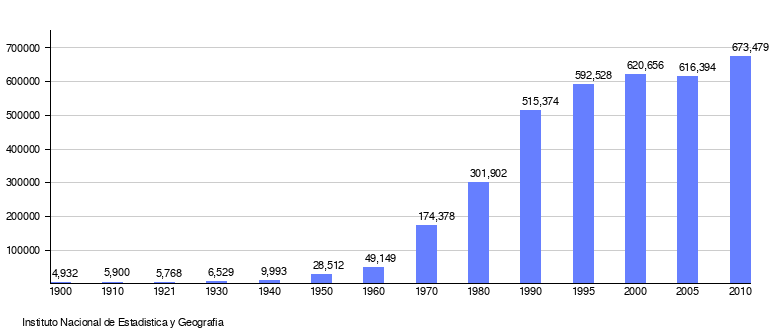
- Notes
Source: National Institute of Statistics and Geography
Metropolitan area
The Acapulco metropolitan area (ZMA) is the metropolitan area made up of the Mexican city and port of Acapulco, its municipality of the same name and that of Coyuca de Benítez in the state of Guerrero. According to the latest official count and delimitation carried out in 2010 jointly by INEGI, CONAPO and SEDESOL,[42] the Acapulco metropolitan area grouped a total of 863,431 inhabitants over an area of 3,538.5 km², which placed it as the sixteenth most populous in Mexico as of that year.

Religion
The 2000 General Population and Housing Census, by INEGI, reports that several religions coexist in the municipality, the main one being Catholic, which had 539,533 faithful in the range of 5 years of age and older; next in importance are those of historic Protestant Christianity such as the Presbyterian Churches (especially, for its historical importance, the Mártires del 75 Church[43]), the Baptist Churches and the Anglican Church, as well as the Churches of evangelical Protestantism, such as the Methodist Churches, the Pentecostal and neo-Pentecostal churches, as well as the Church of God (Seventh Day) and the Seventh-day Adventist Church; likewise there is a strong presence of non-evangelical biblical Christian organizations, such as the La Luz del Mundo Church, The Church of Jesus Christ of Latter-day Saints (Mormons), Jehovah's Witnesses and others which, in the same age range, total more than 85,308 faithful.
Government

The government of Acapulco is currently made up of:
- Municipal President, held by Adela Román Ocampo, for the "Juntos Haremos Historia" coalition, formed by the National Regeneration Movement, the Labor Party and the Social Encounter Party, for the 2018-2021 term.[22]
- Municipal Trustees (Síndicos Procuradores)
- Councilors (Regidores)
Municipal administration
The government of the municipality is made up of an Ayuntamiento, two trustees (síndicos), and a council formed by fourteen councilors elected by relative majority and eight by proportional representation; all are elected through a single slate for a period of three years, not renewable for the immediately following term, but renewable non-consecutively. Elections are held on the first Sunday of October, and the ayuntamiento takes office on January 1 of the year following the election. The municipality is governed by Morena after having won the 2018 state elections.[44] but in the past elections the municipality would pass into the hands of the PRD in December 2012, when the office of mayor is taken up.
Legislative representation
For the election of the local Deputies to the Congress of Guerrero and of the federal Deputies to the Chamber of Deputies of Mexico, Acapulco de Juárez is included in the following electoral districts:
Local:
Federal:
| District | Seat | Deputy | Sections | Party | Ref. |
|---|---|---|---|---|---|
| IV Federal Electoral District of Guerrero | Acapulco | Abelina López Rodríguez |  |
[46] | |
| IX Federal Electoral District of Guerrero | Acapulco | María del Rosario Merlín García |  |
[46] |
Economy


Tourism sector
Acapulco is the city that yields the most to the municipality and to the state, considering that the municipality of Acapulco is the one with the highest GDP in the state, with 38,592,218 million pesos. Tourism is the main activity, as it accounts for more than half of the economy.
The economy of Acapulco revolves above all around the service sector; tourism is an important source of livelihood in this Mexican city. In job creation, tourism also plays an important role.
Agriculture
Agriculture in the rural areas is one of the most important economic activities; it is estimated at some 37,816 thousand of total sown area. Through cultivation of the land, they produce a large part of their food, that of their families and that of the urban population of the state and of other states.[47]
Fishing
Fishing in Acapulco is one of the most popular activities; in addition, visitors can hire one of the various services offering fishing trips and tours for marlin and sailfish.[48]
The Tres Palos Lagoon is one of the main spaces for fishing in Acapulco, thanks to the mangroves that attract countless birds that come to feed in its waters. Another option is Puerto Marqués, where sport fishing for sailfish, snook, skipjack and many more is practiced.
Lovers of fishing in Acapulco will find in the Chautengo Lagoon an optimal place to carry out this activity, since the rivers Copala and Nexpan flow into it, bringing numerous freshwater species that inhabit this beautiful region of Mexico.
Finally, fishing fans in Acapulco can visit the Coyuca Lagoon, one of the most important spaces dedicated to this sport, with species typical of the area. In addition, one can enjoy boat trips and excursions and discover the beauty offered by the Island of the Man with 7 Wives and the Isla de los Pájaros.
Economically active population

The economically active population of the municipality is 50.04%; it had an increase of 4.87% relative to the 1990s. The predominant economic activity is in the tertiary sector, with the services branch concentrating the greatest activity, at 72.92%.
In this activity around 75 thousand people are employed in 10,890 businesses oriented to this productive branch. The secondary sector employs 18.73% of the population, occupying second place in labor absorption. This sector employs 34,323 people.
This is the same percentage it has been employing since 1990. This sector only covers the basic needs of the population, which lives predominantly from the service sector. Finally, there is the primary sector; its labor supply is 13,426 people, which represents 7.38%, with no variation since 1990.
Public debt
At the beginning of his term, Luis Walton declared the tourist port of Acapulco financially bankrupt because he inherited from his predecessor, Manuel Añorve Baños, a debt of 1,571.8 million pesos, plus a deficit as of December of that year of 270 million pesos, totaling 2,142.8 million pesos, which represents an increase of up to 400 percent, for which reason the mayor asked the federal government to carry out a financial bailout.[49] Initially, the 2013 budget was 3,766,884,149 pesos, owing to the debt of 2,142 million pesos.[50]
Adela Román Ocampo inherited a government with a debt of millions, since from January to December of the previous year Acapulco applied for six bank loans; likewise, Acapulco's debt grew 46% in the first year of the government of Evodio Velázquez Aguirre, going from 452,019,763 pesos in 2016 to 661,524,377 pesos in 2017.[51] Because of this, Adela Román requested federal and state resources of 1,500 million pesos in order to cover the year-end expenses.[52]
The city today

The Acapulco conurbation is considered the sixteenth-largest metropolitan area in Mexico, grouping in 2010 a total of 863,431 inhabitants.[53] The city has been an important vacation center worldwide since the '50s, the decade in which the boom of high-rise construction began. It is located in an economically privileged zone, since it lies 255 miles south of Mexico City.
Social problems
Acapulco has become one of the most violent cities in the world because of its homicide rate. Latin America has a high figure in the ranking released by the Citizens' Council of Mexico for Public Security and Criminal Justice, as it is home to some of the 43 of the 50 most dangerous in the world in 2017.[54]
Since 2011, Acapulco has been in the top 5 of cities with the highest intentional homicide rate in the world. In 2017 it placed third in the ranking with a rate of 106.63 homicides, surpassed only by Los Cabos and Caracas, Venezuela.
Hotel zone

At the end of the '50s and during the sixties, hotel development continued at its height with the construction of luxury hotels such as the Continental Hilton hotel, the Pierre Marques hotel, El Presidente, Las Brisas, El Cano, the Auto Hotel Ritz, the Ritz hotel and Paraíso Marriott, among others.
Beginning in 1933, construction started on the hotels El Mirador, Caleta, Prado Américas, Los Flamingos (owned by John Wayne and Johnny Weismuller (Tarzan)), Villa del Mar, El Jardín and Papagayo, which was located where the recreational park of that name now stands. Likewise, owing to the need for a nautical club where yachts and vessels could dock, the current Acapulco Yacht Club was built in 1955.[55]
In 1955 the architect Mario Pani built the port's first condominium on Costera Miguel Alemán Avenue, next to the Yacht Club, called the "Edificio en Condominio Los Cocos"; in the same year the Condominio Bahía was built, and three years later, in 1958, El Costero, known as the Normandie after the famous restaurant of that name specializing in French cuisine, owned by Mrs. Nicole.[56]
In the mid-'70s, the '80s and the early '90s, construction continued of more Condominium Complexes, now luxury ones with first-class services, such as Estrella del Mar, Mar Azul, Loric, Laureles, Tabachines, Torre Coral, Villa del Mar, Marbella, Torremolinos, Olympus, Costa, Perla, Palma, Mallorca, Ibiza, Mykonos, Nautia, Costa Victoria, La Joya, Aqua and Century Resorts Acapulco. The city currently has 110 buildings between 40 and 123 meters tall, most of which are hotels and condominiums; among the main ones are:

|
|
Tourism
| Year | Tourists |
|---|---|
| 2013 | 4,634,287 |
| 2015 | 5,040,000 |
| 2016 | 5,634,530 |
| 2017 | 5,225,259 |
| Tourists by year | |
Acapulco is one of the most important tourist destinations in Mexico, since it was the first international tourist port of Mexico. Today Acapulco is the most visited port in Guerrero and one of the ports in Mexico most visited by domestic and international tourists, alongside Cancún, Cabo San Lucas and Puerto Vallarta, among others.[60]
Tourist zones
The city is divided into three tourist zones:
This is the old part of the port, where the city center, the historic neighborhoods and the port are located; it developed between the 1930s and the 1960s. In this zone one can find some of the oldest hotels in the port, restaurants serving typical dishes and a large part of Acapulco's tourist attractions along the Avenida Costera Miguel Alemán.
It developed between the 1960s and the 1980s, and is located about 25 minutes from Acapulco International Airport. It is the zone with the greatest tourist traffic in the port; it runs along a large part of Acapulco Bay, from Icacos, along the Avenida Costera Miguel Alemán, which is the main avenue, to Papagayo Park, and it is where the largest number of hotel rooms, the hotel zone and residential condominiums are concentrated. It has several hotels with availability.
Also known as Punta Diamante, it is the newest part of the port and the one with the greatest development and investment, made up of exclusive hotels and resorts of international chains, residential complexes, luxury condominiums and private villas, spas, restaurants, shopping areas and a golf course. All of the above makes it one of the most exclusive places in the country. It begins at the Carretera Escénica in Las Brisas, includes Puerto Marqués and Punta Diamante, and extends to Barra Vieja Beach. It is 10 minutes from Acapulco International Airport.
-

-
 Hotel zone in the
Acapulco Dorado zone -
 Tourist strip in the
Acapulco Diamante zone


Acapulco was the fourth tourist center with the largest average number of available rooms in 2017, with a total of 18,827, and the eighth in average number of occupied rooms, with 8,188; it had an increase of 3.3% in hotel occupancy, reaching 43.5% in 2017, according to data provided by Sectur.[61] It belongs to the Triangle of the Sun, made up of 3 tourist centers in Guerrero. In 2017 it received more than 7 million tourists, with an occupancy of 46.3%.


Beaches
Acapulco, like many other tourist destinations in Mexico, has various beaches whose names correspond to historical events, customs or simply natural circumstances. Among the main ones in the port are:
- Caleta and Caletilla
- Honda
- Langosta or La Angosta
- Manzanillo
- Tlacopanocha
- Hornos (Tamarindos and Papagayo areas)
- Condesa
- Icacos
- Pichilingue
- Pie de la Cuesta
- Majahua
- Revolcadero
- Bonfil
- Barra Vieja
Tourist attractions and places of interest


- La Roqueta Island is a Mexican island located opposite Acapulco Bay, Guerrero, very close to the Caleta and Caletilla beaches of that city. It is administered and protected by the Secretariat of the Navy.
- La Quebrada is a cliff 45 meters high.[62]Since 1934 the famous dives have been performed there by young people from the port, who sometimes climb it with a lit torch. The danger lies in the fact that the diver must calculate the moment when the wave makes the sea level higher, since otherwise it would mean certain death due to the impact against the rocks at the bottom, which lie at shallow depth when the sea level drops because of the swell.
- The Diana the Huntress Fountain is located on the Avenida Costera Miguel Alemán at a central point of the route where the entrance to the Costera, the road toward the Traditional Zone, the road toward the Golden Zone and the boundary with the Federal Maritime Zone converge. It is surrounded by numerous shopping centers and hotels and is close to the well-known La Condesa Beach.[63]
- Xtasea Zip Line is the longest zip line over the sea in the world, covering a distance of 1,800 meters at a height of 100 meters at an approximate speed of 120.[64]
- The Malecón (seafront promenade) is one of the busiest spots in the port, since it runs along a large part of the coastal zone and has several tourist sites nearby.
- Puerto Marqués: its bay and beaches, as well as the tourist developments around the area, have turned the place into a major attraction in the port for domestic and international tourism. Among the main beaches in the bay are Puerto Marqués, Majahua and Pichilingue.[65]
- Pie de la Cuesta is located 10 km northwest of the Mexican port of Acapulco, on the coast of Guerrero. It is internationally famous for its sunsets and its beach with strong surf, and it also has the Coyuca Lagoon, which borders the Barra de Coyuca, the sandbar that joins the sea to the lagoon.
- Fórum de Mundo Imperial is an entertainment venue. It has a capacity of 4000 people1 and hosts artistic and cultural events such as concerts, Broadway productions, plays, family shows and special performances. It is located in the Acapulco Diamante zone.[66]
- EL Rollo (formerly CICI), previously called CICI, is the busiest water park in the port.
- Sinfonía del Mar is an amphitheater very close to La Quebrada, located on a cliff overlooking the sea. It is used for concerts and is operated by the city council of Acapulco.
- La Virgen de Los Mares is a Marian monument submerged in the sea next to La Roqueta Island; it was taken to this spot at the end of the 1950s.[67]
Nightlife
Acapulco has a wide variety of discotheques, bars and nightclubs. Among the most important are Baby'O, Palladium, Believe, Love, Dinsmoor and Lukrezia, among others. It also offers a wide variety of clubs, restaurants and various establishments devoted to entertainment. It also has the nighttime cliff-diving shows at La Quebrada. [68]
Events
Tianguis Turístico
The Tianguis Turístico, formerly called the International Fair of Hotels and Travel Agencies of Acapulco, is a fair that brings together the main companies in the industry and where the different tourist destinations of Mexico are promoted. The tianguis has been held since 1975.
It was held in Acapulco until 2011, when Gloria Guevara Manzo announced the intention of taking the Tianguis Turístico from Acapulco to other destinations in Mexico and trying to make it itinerant.[69] That year the search began for the venue of the following years.[70] It was in 2015 that President Enrique Peña Nieto said the Tianguis Turístico would be itinerant, alternating it every two years.[71][72]
Mega Feria Imperial
The Mega Feria Imperial Acapulco is an event to be held every year, the first edition being in 2012, and it is focused on entertainment, culture, gastronomy and large exhibitions. It lasts 24 days and has more than 400 attractions such as shows, concerts, a food fair, a casino, mechanical rides, magic villages, and an ice and snow rink.
Shopping centers
There are many shopping centers in Acapulco, among which the following stand out:[73]
- Galerías Acapulco
- Costera 125
- La Isla Acapulco Shopping Village
- Galerías Diana
- Plaza Condesa
- La Vista
- Plaza Chedraui
- Pabellón Costera
- Arrecifes
- Galerías Aqcua
- Pérgolas
- Multiplaza Las Palmas
- Plaza Diamante
- Galerías Picuda
- Patio Acapulco
- Sears
- Chedraui
- Soriana
- Bodega Aurrera
- Oxxo
Statistics
Acapulco is currently the fifth beach center with the most occupied rooms and the eighth most visited city in Mexico; the main tourism variables considered are available rooms, occupied rooms and occupancy percentage, from 2012 to 2018.[74][75]
| Year | Available rooms | Occupied rooms | Hotel occupancy | |||
|---|---|---|---|---|---|---|
| No. | % change | No. | % change | No. | % change | |
| 2012 | 18,419 | N/A | 7,600 | N/A | 41.3 | N/A |
| 2013 | 18,453 |  0.2% |
7,244 |  4.7% |
39.3 | 4.8%
|
| 2014 | 18,514 | 0.3%
|
7,193 | 0.7%
|
38.9 | 1.0%
|
| 2015 | 18,591 | 0.4%
|
7,444 | 3.5%
|
40.0 | 2.8%
|
| 2016 | 18,573 | 0.1%
|
7,473 | 0.4%
|
40.2 | 0.5%
|
| 2017 | 18,827 | 1.4%
|
8,188 | 9.6%
|
43.5 | 3.3%
|
| 2018 | 18,972 | 0.8%
|
8,847 | 8.1%
|
46.6 | 3.1%
|
Culture
Historic monuments and places of interest
The city of Acapulco has some movable and immovable properties protected as heritage of the Nation, which are declared as such in the Public Registry of Archaeological Monuments and Zones of the INAH, in accordance with the Federal Law on Archaeological, Artistic and Historic Monuments and Zones of Mexico.


Civil architecture
- The Fort of San Diego is a maritime fortification with a trace italienne layout located in the port of Acapulco, Guerrero, Mexico. It was built in the 17th century in order to protect the port from attacks and plundering by pirates, and it was also the scene of episodes of the history of Mexico such as the Independence, the Second French Intervention and the Mexican Revolution.[76]
- Fortín Álvarez is a fortification of colonial Mexico from the 17th century. It is located at the top of Cerro de La Mira, to the west of the city. This fortlet bears the surname Álvarez in honor of Juan Álvarez Hurtado, a liberal general and militant —together with Ignacio Comonfort— of the Revolution of Ayutla.[77]
- The Acapulco International Center, formerly known as the Cultural Center of Conventions and Exhibitions of Acapulco, was considered in its beginnings to be the most modern and functional in Latin America.
- The Municipal Public Library No. 22 Dr. Alfonso G. Alarcón is a multifunctional cultural space located on the city's Zócalo. Recognized as the oldest in the State of Guerrero, it has now become the largest in terms of infrastructure and bibliographic collection, and the one offering the greatest number of services, workshops and activities. Currently, at the federal level, the General Directorate of Libraries of CONACULTA is the institution responsible for its regulation.[78]
- The La Casa de los Vientos Cultural Center is one of the last works made by the famous Mexican painter Diego Rivera, who lived in the port during 1956-1957 and created this work of art on the façade of the Exekatlkalli (House of the Winds) of Dolores Olmedo, a renowned actress of Mexican cinema.[79]
Religious architecture

- Acapulco Cathedral, dedicated to Our Lady of Solitude, is the main church of the port, located in the city center, opposite Plaza Álvarez. It has been the episcopal see of the Archdiocese of Acapulco since 1958.[80]
- The La Paz Ecumenical Chapel is a denominational ecumenical chapel which officiates religious weddings of couples who do not necessarily share the same faith or religion. Next to it rises an enormous cross 42 meters high, standing at 402 meters above sea level. At the foot of the cross is a bronze sculpture representing two right hands praying and pointing to the sky.[81]
Archaeological zones
- Palma Sola is an archaeological settlement located in the amphitheater or upper part of the port of Acapulco, in the Mexican state of Guerrero, specifically on the slopes of Cerro El Veladero. It consists of a group of 18 granite rocks of various sizes with engravings describing the way of life and the geographic surroundings of the place, which was inhabited between 800 BC and AD 750.[82]
Squares and gardens
- Plaza Álvarez is the main square of the port, located in the city center, facing the Avenida Costera Miguel Alemán, its main traffic artery. It is also known as the Zócalo of Acapulco or the Zócalo porteño. On December 16, 1978, Plaza Álvarez underwent a major remodeling that enlarged it at its end adjacent to the Costera Miguel Alemán, and five fountains and a new colonial-style kiosk were added to it. Originally, vehicle traffic started from Avenida Costera and Jesús Carranza (east of the square) and went around it on the north side (in front of the cathedral) to continue along Avenida Miguel Hidalgo (west) and to Avenida Costera (south). However, by 1979, all the roads around its perimeter were closed as part of the remodeling plan, and it took on its current appearance.[83]

- The Parque de la Reina is a very important tourist spot because of its proximity to the Fort of San Diego and the Teniente José Azueta International Transatlantic Port.
- The Botanical Garden is located in the mountain area and extends over 6 hectares of land, where there is a diversity of native plants, shrubs, fine timber trees such as the Palo Morado Peltogyne mexicana, flowering and fruit trees, and areas of cacti, aroids, palms and cycads, heliconias, gingers and ferns, among others.[84]
Gastronomy
Ceviche, one of the local dishes of Acapulco. There is a great diversity of restaurants along the Avenida Costera Miguel Alemán where tourists can enjoy typical regional food; part of Acapulco's cuisine can be tasted at the Central Market, located beside the Diego Hurtado de Mendoza expressway. One of these typical dishes is Acapulco ceviche, enjoyed with saltine crackers, ketchup and Búfalo sauce to taste. The typical drink of the region is Chilate, prepared with cacao, rice, cinnamon and sugar.
Handicrafts
There is a great diversity of handcrafted products from all over the country, although those native to the state of Guerrero are found in the greatest number, such as: wooden masks, goldsmithing, machetes, lacquered wooden boxes, basketry, silverwork, precious and semiprecious stones, metates and molcajetes of volcanic stone, palm crafts, hats, furniture of precious woods, and copper and bronze figures.
In the city there are also businesses devoted to the sale of marine products such as shells, starfish, seashells and seahorses or hippocampi, food products and sweets made of milk, coconut, mango, banana and tamarind, ceramics, and handmade typical clothing from the regions of Guerrero.
Music
Mexican folk music is deeply rooted, and romantic music stands out. A style of music that is very deeply rooted in the port is the so-called "música de viento" (wind music) or "chile frito", which was born in the Santa Cruz neighborhood, one of the most popular neighborhoods of the city, which is still home to the best performers of this type of music.
Some songs that have been inspired by Acapulco are:
- Gb Leighton - Acapulco Night
- Elvis Presley - You can't say no in Acapulco
- Ringo Starr - Las Brisas
- Luis Miguel - Acapulco Amor
- Alex Acosta - This Is Acapulco
- José Agustín Ramírez Altamirano - Acapulqueña
- Agustín Lara - María Bonita
- Juan Gabriel/Rocío Dúrcal - Amor Eterno
- Tito Puente - Acapulco
- Luis Mariano - Acapulco
- Michel Louvain - Acapulco
- Morgan Szymanski - Acapulco
- Ricchi E Poveri - Acapulco
- Los Dandy's - Ojos de Acapulco
- Acapulco Tropical - Mar Sagrado, Adiós a Mi Puerto
- Elvis Presley - Fun in Acapulco
- Le Position du Tireur de Couché - Acapulco
- Juan Gabriel - Everybody Dance in Acapulco
- La Sonora Santanera - Carnaval en Acapulco
- Pepe Guízar y sus Caporales - Acapulco
- Joan Sebastian - Después de Acapulco
- The Real Group - A Cappella in Acapulco
- Los Once Hermanos Zavala - Fiesta en Acapulco
- Herb Alpert - Acapulco 1922
- Betty Grable - Acapulco
- Kathy Kirby - Acapulco
- Lost Acapulco - La Quebrada, Roqueta to the Moon, Acapulco Golden
- Leo Dan - La Reina de Acapulco
- Chicasss - Noches de Acapulco
- Carlos Santana - Acapulco Sunrise
- Ramón Ayala y Sus Bravos del Norte - Recuerdos de Acapulco
- Hermandos Arizmendi - Acapulco, Nosotros y el Mar
- The Monkees - Acapulco Sun
- Los alegres de Terán/Dueto del Sur - En Avión hasta Acapulco
- José Agustín Ramírez Altamirano - Camino de Chilpancingo
- Bob Dylan - Goin' to Acapulco
- Phil Collins - Loco in Acapulco
- New Riders of the Purple Sage - Henry
- Francisco - Acapulco
- Engelbert Humperdinck - Acapulco
- Four Tops - Loco In Acapulco
- Fase - Acapulco 78
- Leon Bolier vs.Galen Behr - Acapulco
- Leo Acosta - Acapulco Center
- Chuckie vs. Laidback Luke - Let The Bass Kick (In Acapulco)
- Los Apson - Fuiste a Acapulco
- Raphael - En Acapulco
- Patricia Manterola - Cuerpo y alma
- Flo Rida - Whistle
- Wisin & Yandel with Jennifer Lopez - Follow The Leader
- Eme 15 - Solamente Tú
- Belinda - En el amor hay que perdonar
- Carla Mauri - Tengo Que Olvidarme De Ti
- Paty Cantú - Dicen Por Ahí
- Salón Acapulco - Acapulco
- Romeo Santos- Centavito 2018
- Rigo Tovar - Acapulco
- Enrique Guzmán - el Acapulco Rock
- Fer y Santi - Acapulco Dreamers
- Los 5 - Acapulco
Notable people
Among the most notable people born in Acapulco are:[85][86]

- Juan R. Escudero (1890–1923). Politician born in this port; he founded the Workers' Party of Acapulco and edited the newspaper Regeneración. In 1921 he was elected municipal president of his hometown, and in 1923, when the de la Huerta rebellion broke out, he was arrested and murdered together with his brothers.
- Bertha Von Glümer Leyva (1877-1963). Daughter of Von Glumer and Petra Leyva. She was born in Acapulco on July 16, 1877. She was an educator and teacher in Mexico. She stood out for her contributions to the development of women teachers and professors in Mexico and for applying the modern models and methods of Friedrich Fröbel in education.
- José Agustín Ramírez Altamirano (1903–1957). He stood out as a composer and performer of popular music; he received the Adolfo Cienfuegos y Camus Medal from Governor Alejandro Gómez Maganda for his artistic and cultural career.
- Clemente Mejía Ávila (1928–1982). Athlete; he competed in swimming at the 1948 London Olympic Games, where he placed fourth in the 100 m backstroke and fifth in the 4×100 m freestyle relay; he won first places at the 6th Central American and Caribbean Games held in Guatemala (1950), at the first Pan American Games held in Buenos Aires (1951), and at the 7th Central American and Caribbean Games held in Venezuela (1959). He served as president of the Municipal Sports Union of Acapulco, and was director of Sports Action of the port's city council on six occasions.
- Lyn May (1952). She is a Mexican vedette and film actress of Chinese descent. She is considered one of the most popular female figures of the so-called Cine de Ficheras and of Mexican erotic comedy.
- Jorge Campos (1966). Son of Álvaro Campos González and Lucina Navarrete; a renowned former footballer, his first match with the National Team was on November 20, 1992.
- Roberto Palazuelos (1967). An actor who calls himself "El diamante Negro" ("The Black Diamond") and is known for his participation in several telenovelas.
Education
Upper secondary institutions
Acapulco has several upper secondary education institutions, the most notable of which are the CBTis (14), CETIS (41, 90 and 116), CETMar (18), CBTA (296), CECYTE (1, 4), Colegio de Bachilleres (2, 7, 13, ,24, 16, 32, 33, 39 Aguas Calientes and the Ahuacuotzingo campus), Conalep (1, 2 and Praderas de Costa Azul) and the preparatory schools of the UAGro (2, 7, 17 and 27), in addition to other private institutions.
Higher education institutions
With regard to public higher education, Acapulco has 8 academic units of the Autonomous University of Guerrero (UAGro), namely: Medicine, Nursing (No. 2), Dentistry, Social Sciences, Administrative and Accounting Sciences, Tourism, Marine Ecology, and Information Sciences and Technologies.[87] Alongside this institution is the Technological Institute of Acapulco (ITA), founded in 1975, which offers bachelor's degrees in Architecture, Accounting and Administration, as well as engineering degrees in Biochemistry, Electromechanics, Business Management and Computer Systems.[88] Graduate program in Business Planning and Regional Development.[89] There are also the National Pedagogical University and the Escuela Normal Superior de Educación Física de Guerrero, and the city will have a Continuing Education Center of the National Polytechnic Institute.[90][91]
With regard to private higher education, there are the Universidad Americana de Acapulco, the Universidad Hipócrates, Universidad Español, Universidad Loyola del Pacífico, Universidad Interamericana para el Desarrollo, Universidad América Latina, Centro Universitario Grupo Sol, Centro Universitario Justo Sierra and Colegio Nacional de Matemáticas.
Transportation
Transportation routes
Highways and roads
The city is connected thanks to its road infrastructure, mainly toward the neighboring states: Morelos, Oaxaca, Michoacán and the State of Mexico:
- Cuernavaca–Acapulco Highway (Autopista del Sol), 262.580 km
The Cuernavaca–Acapulco highway or Federal Highway 95D, better known as the Autopista del Sol, is a toll highway which, together with the Mexico City–Cuernavaca highway, connects Mexico City with the port of Acapulco, Guerrero, in a north–south direction. Together, these two highways serve as a toll road parallel to Federal Highway 95 (Mexico City–Acapulco).
 Federal Highway 95 (Mexico City–Acapulco), 400 km

Federal Highway 95, known as the Mexico City–Acapulco Highway, is a Mexican federal highway that connects Mexico City with the port of Acapulco, Guerrero. Parallel to this highway, and as a toll road, runs Federal Highway 95D, also known as the Autopista del Sol from Cuernavaca to Acapulco. Along its entire route it passes through five toll plazas and crosses the cities of Cuernavaca and Chilpancingo only as an expressway.
- Federal Highway 200, to the southeast on its Acapulco–Pinotepa Nacional section (170 km), and to the northwest on its Acapulco–Lázaro Cárdenas section (300 km)
Highway 200 connects the Mexican cities of Tapachula and Tepic along the Mexican Pacific coast, which is why it is an important communications axis in the area, since it crosses 7 coastal states and has several branches to important population and administrative centers; the highway passes through:
Airports

It is built on an area of 464 hectares and operates 24 hours a day. It has a terminal building and a control tower. In addition, it is equipped with two jet bridges in the departure lounge, parking for 267 cars, an access road, an apron for forty general aviation aircraft, taxiways, a perimeter road, fencing and lighting, fuel storage and a landscaped area. It has two runways, one 1,700 m and another 3,300 m long, made of hydraulic concrete. Currently 7 international and 9 domestic commercial companies operate there.
It is a base operated by the Mexican Air Force and is located in the Pie de la Cuesta area. It was Acapulco's first airport, and it was replaced by the Juan N. Álvarez Airport. Its services are strictly military, and it is also available as an alternate runway in cases of extreme emergency; for example, when Hurricane Ingrid rendered the airport's infrastructure unusable, the base proceeded to receive both civilian and military aircraft for the transport of supplies, provisions and other articles needed to aid the population, as well as for the transfer of tourists stranded by that contingency.
Port

Acapulco has port infrastructure. The Teniente José Azueta International Transatlantic Port is considered a deep-sea port, with a pier of 554 linear meters for ships with a draft of 9 m. Its services focus on serving passengers on tourist cruises and, as a deep-sea pier, on the semi-specialized handling of containers and general cargo. Its infrastructure includes 5,700 m² of warehouse space and 8,300 m² of storage yards. In addition, there is the Acapulco Yacht Club.
Main artery

The Avenida Costera Miguel Alemán is the main road and tourist artery of the port of Acapulco, Guerrero, in southern Mexico. It extends 12.2 km in length, crossing the broad shoreline of Acapulco Bay from west to east. Along it one can find a strip with a great variety of restaurants, hotel and condominium towers, plazas and shopping centers, among other services and tourist attractions. It was inaugurated in 1949.
- Diana the Huntress Fountain
The Diana the Huntress Fountain, which was formerly known as the Minerva fountain. It is a monument located in the City of Acapulco. This sculpture is one of the most representative icons of Acapulco. It is located on the Avenida Costera Miguel Alemán at a central point of the route where the entrance to the Costera, the road toward the Traditional Zone, the road toward the Golden Zone and the boundary with the Federal Maritime Zone converge. It is surrounded by numerous shopping centers and hotels and is close to the well-known Condesa Beach.
Tunnel
The Maxitúnel Interurbano Acapulco, commonly called simply the Maxitúnel de Acapulco, is a tunnel that connects the city of Acapulco with its suburban neighborhoods around the amphitheater of Acapulco Bay and which, via Bulevar Vicente Guerrero, connects to the Autopista del Sol; it is currently the largest tunnel in Mexico.[92]
Macrotúnel Zona Diamante
The Macrotúnel of the Escénica Alterna in Acapulco, commonly called the Macrotúnel de Acapulco, has a length of 3,300 m, a height of 9.60 m and a width of 13.60 m. It connects the Golden Zone of Acapulco with the Diamante Zone via the Escénica Alterna.[93]
Means of transportation
Integrated Transportation System
The Acapulco public transportation system, better known as Acabús, is a bus rapid transit (BRT) system for the Acapulco Metropolitan Area, with an investment of 1,800 million pesos. The first bus was expected to begin running in May 2013 and the complete project was to be finished at the end of August of the same year. However, the execution of the project suffered delays in the completion of the works, so the system began a Testing Phase on May 31, 2016, and officially started on June 25, 2016. It is the first transportation system of this type in the state of Guerrero.[94]
Buses
This bus looks like a school bus, but adapted. On the Costera, they are usually painted blue and white and say "Costera" on their sides. The fare is $10.00 pesos. Some older and smaller buses, with other color combinations, are the ones that cover the routes in the interior of the city, but the predominant "normal" bus is the "Costera" type.
Taxis
Private taxis operate throughout the Acapulco area and are divided by color according to destination; there are yellow, white, blue and red taxis.
Pickup trucks and vans
There are also pickup trucks that carry passengers on feeder routes, while vans carry passengers to Acapulco Diamante.
Passenger buses
Several bus lines reach Acapulco de Juárez:
| Bus lines | Destinations |
|---|---|
| Autobuses Estrella Roja del Sur Costa Line | Terminal Central de Autobuses del Norte |
| Estrella de Oro | Terminal de Autobuses de Pasajeros de Oriente |
| Estrella de Oro | Terminal Central de Autobuses del Sur |
| Grupo Estrella Blanca | Terminal Central de Autobuses del Sur |
Communications
Radio stations
Among the radio groups in the port are:
- Grupo ACIR
- Grupo Audiorama Comuniciones
- Grupo Radiorama
- MVS Radio
- Grupo Fórmula
- Radio y Televisión de Guerrero
Internet
Internet connection service is available:
- Infinitum by Telmex
- Cablemas (Izzi)
- Axtel
- SKY
- Dish
- Free Internet on the Zócalo and in Papagayo Park
- Free Internet in some establishments and restaurants in Acapulco
Newspapers
- Novedades de Acapulco
- El Sol de Acapulco
- El Sur
- La Jornada Guerrero
- Diario 17
Sports
Acapulco is famous for its beaches and the great diversity of sporting events held year after year both in the Golden Zone of the port and in the Diamante Zone, such as surfing, skimboarding, windsurfing, skiing, tennis, gymnastics, charrería and volleyball tournaments, among others. In addition, the 5 km open-water Swimming Tournament is held.
The International Beach Volleyball Tournament, which is part of the FIVB World Tour in its women's and men's divisions, is also held on the beaches of Acapulco.
In 2011 Acapulco hosted the 2011 Acapulco Mexican Gymnastics Open, held at the Fairmont Acapulco Princess hotel. In addition, in June 2012 the 2012 Acapulco Charrería Tournament was held at the Fórum de Mundo Imperial.
Sports complexes

- The Acapulco Sports Unit has a baseball stadium, an Olympic swimming pool, a diving pool and a football stadium, and it is also used for lucha libre matches, boxing and music concerts. It is located in the Progreso neighborhood, and Real Acapulco of the Mexican Third Division plays there.
- Lienzo Charro: Acapulco has four charro arenas located in the Diamante zone; most of them (3) are in the town of Llano Largo, located approximately 5 km from Revolcadero Beach. The other is located near the Tres Palos Lagoon. Some of the port's charro teams are:
- El Marqués de Guerrero (the charro team with the most state titles in Guerrero)
- Surianos de Llano Largo (the oldest team in the State of Guerrero)
- Regionales de Acapulco
Image: Arena Coliseo Acapulco.
- The Mextenis Stadium has a capacity of 6,000 people. The Mexican Tennis Open of the ATP is held there every year, and it is the most attractive sporting event. The return of tennis player Rafael Nadal (4th in the ATP world ranking) had already been announced for 2013.
- Arena Coliseo Acapulco
- Caletilla Bullring
- The construction of the Acapulco Football Stadium had been planned; it was estimated that it would be inaugurated in 2016, it would be located in the Diamante zone, and it would have a construction area of 28,975 m² and a capacity of approximately 30,000 spectators. In 2018 the construction works of the stadium were reported to be in a state of abandonment.[95] The city of Acapulco has 1 football team in the Mexican Second Division, the Cuatetes de Acapulco FC.
International relations
Consulates
Acapulco maintains extensive relations with many countries around the world and has consulates of eleven countries, of which nine are honorary, one is a consular agency and another is an honorary consular agency.[96]
- Consular agency of Canada
- Honorary consular agency of the United States
- Honorary consulate of Austria
- Honorary consulate of Spain
- Honorary consulate of Russia
- Honorary consulate of the Philippines
- Honorary consulate of Finland
- Honorary consulate of France
- Honorary consulate of Norway
- Honorary consulate of Poland
- Honorary consulate of the United Kingdom
Agreements
Twinning
The city of Acapulco seeks to strengthen ties with cities in Mexico and around the world in order to strengthen areas such as trade, investment, business, culture, tourism, municipal development, education, culture, science, technology, the environment and ecology, among others. Currently the city of Acapulco is twinned with 25 cities around the world.[97][98]
|
Specific cooperation
Acapulco has specific cooperation agreements, whose purpose is to establish activities in order to facilitate the implementation of the agreement. These agreements are entered into because the signatory parties focus cooperation specifically on strengthening complementary areas such as tourism, government, etc.
See also
|
|
|
Other |
References
Notes
- ↑ On December 13, 1523, the Spaniards set foot on the territory under the command of Juan Rodríguez de Villafuerte.
- ↑ On April 25, 1528, by order of King Charles I of Spain, Acapulco came under the direct authority of the Crown, taking the name "Ciudad de los Reyes".
- ↑ It was founded by Antonio de Mendoza y Pacheco, first Viceroy of New Spain, when he appointed the first mayor, and Fernando de Santa Ana brought 29 Spanish families from Mexico City to colonize in the year 1550.
- ↑ On November 17, 1599, when King Charles II of Spain raised Acapulco to the rank of City.
- ↑ After the consummation of the independence of Mexico in 1821, Acapulco became part of the State of Mexico.
- ↑ On October 27, 1849, when the State of Guerrero was created, the port became part of it as the seat of the district of Tabares.
- ↑ On June 27, 1873, the municipality was renamed with the official name of Acapulco de Juárez in tribute to the then recently deceased former president Benito Juárez.
Sources
- ↑ Demographia (2013). "Superficie de las Áreas Urbanas del mundo" (PDF) (in español). Retrieved March 19, 2013.
- ↑ realacapulco (2018). "El Clima de Acapulco" (in español). Retrieved December 16, 2018.
- ↑ Instituto Nacional de Estadística y Geografía (2010). "Principales resultados por localidad 2010 (ITER)" (in español).
- ↑ INEGI (2005). "Distancia entre las principales ciudades de México" (in español). Retrieved September 23, 2012.
- ↑ cabezas de aguila (2012). "Virgen de la Soledad, proclamada Generala realista en Acapulco" (in español).
- ↑ El Universal (2017). "Cuando Acapulco ganó fama mundial" (in español). Retrieved November 2018.
{{cite web}}: Check date values in:|access-date=(help) - ↑ "Estadísticas anuales mensuales y semanales" (PDF) (in español). SECTUR - Subsecretaría de Planeación Turística. Retrieved February 11, 2018.
- ↑ "Playas de Acapulco, la Perla del Pacífico" (in español). El sol de puebla. Retrieved February 2, 2019.
- ↑ "Archivo Histórico de Localidades" (in español). National Institute of Statistics and Geography. 2005. Archived from the original on July 1, 2015. Retrieved April 9, 2012.
- ↑ MARTÍNEZ CARBAJAL, 2005: 614.
- ↑ "Benito Juárez y su paso por Acapulco" (in español). 2018. Archived from the original on November 8, 2018. Retrieved November 7, 2018.
- ↑ "municipios de guerrero" (in español). 2013. Archived from the original on January 3, 2017. Retrieved June 26, 2013.
- ↑ "E Local" (in español). 2013. Archived from the original on December 2, 2013. Retrieved June 26, 2013.
- ↑ "Breve Historia De Acapulco" (in español). Retrieved November 7, 2018.
{{cite journal}}: Cite journal requires|journal=(help) - ↑ Instituto Nacional de Estadística y Geografía (2010). "Acapulco de Juárez" (in español). Archived from the original on December 11, 2013.
- ↑ "Historia De Acapulco" (in español). September 3, 2011: 7. Retrieved March 19, 2013.
{{cite journal}}: Cite journal requires|journal=(help) - ↑ Antonieta Garcia Lascurain (1994). [s.n.] (Mexico) (ed.). Expresiones. Compilacion de trabajos de los residentes de la casa de Mexico (1993 - 1994) (in español). Paris, France. p. 75.
{{cite book}}: CS1 maint: location missing publisher (link) - ↑ Enciclopediagro (2018). "Acapulco de Juárez" (in español).
- ↑ "Historia de Acapulco" (in español). guerrero.travel.
- ↑ Sanz Camañanes, Porfirio, 2004, Las Ciudades en la América hispana: siglos XV al XVIII, Silex Ediciones, ISBN 978-84-7737-135-9
- ↑ "La Negritud en Guerrero". Enciclopedia de Guerrero (in español).
- ↑ 22.0 22.1 "Se proclama Adela Román ganadora de la elección". Sur de Acapulco (in español). Retrieved October 31, 2018.
- ↑ Lipski, John M. (November 23, 2011). "El lenguaje afromexicano en el contexto de la lingüística afrohispana" (PDF). Reconocimiento de Pueblos Negros (in español). Retrieved April 13, 2018.
- ↑ Lytle Schurz, William. The Manila Galeon. New York, E. P. Dutton & Co. Inc., 1939, p. 371.
- ↑ "El Fuerte de San Diego, el Galeón de Manila y los insurgentes de Morelos: Acapulco 1810 – 1821" (PDF) (in español). Ceaa.
- ↑ Sonrel, León (1868). Le fond de la mer / par L. Sonrel ; ouvrage illustré... par Yan'Dargent, Férat et A. Mesnel (in français). Paris, France: L. Hachette et Cie. p. 59, 60. Retrieved June 20, 2018.
- ↑ Accessed March 13, 2011.
- ↑ ESCUDERO, Francisco R. (1997). "IV: Los porteños se organizan: la calzada Costera". Origen y evolución del turismo en Acapulco (in español). Acapulco. p. 186.
{{cite book}}: CS1 maint: location missing publisher (link) - ↑ Ana Dávila (2012). "La historia de amorde John F. Kennedy y Jackie" (in español). Quién.com. Retrieved February 7, 2013.
- ↑ Gustavo Heredia (2011). "La historia de Elizabeth Taylor con México" (in español). AOL Latino. Retrieved February 7, 2013.
- ↑ "Inauguración de la México-Acapulco" (in español). Proceso. Retrieved February 7, 2019.
- ↑ Instituto de Geografía de la Universidad Nacional Autónoma de México (1998). "Algunos efectos de la precipitación del huracán Paulina en Acapulco, Guerrero" (PDF) (in español). Lucía Guadalupe Matías Ramírez. Archived from the original (PDF) on September 28, 2007. Retrieved July 21, 2008.
- ↑ Church World Service (1997). "Situation Report Hurricane Pauline". ReliefWeb. Archived from the original on September 27, 2007. Retrieved January 9, 2007.
- ↑ Laura Reyes (2013). "La tormenta 'Manuel' deja incomunicado al puerto de Acapulco" (in español). cnn.com. Archived from the original on September 28, 2013. Retrieved September 28, 2013.
- ↑ "weatherbase". 2013. Archived from the original on March 4, 2016. Retrieved June 26, 2013.
- ↑ 36.0 36.1 "Distancias" (in español). 2013. Retrieved March 19, 2013.
- ↑ "Principales resultados por localidad 2010 (ITER) - Guerrero" (XLS) (in español). Instituto Nacional de Estadística y Geografía. 2010. Retrieved March 5, 2011.
- ↑ Autonomous University of Guerrero, INEGI (2010). "Cantidad de habitantes en las diez ciudades más grandes de Guerrero - Acapulco" (PDF) (in español). Instituto Nacional de Estadística y Geografía. p. 9. Retrieved February 9, 2019.
- ↑ INEGI, CONAPO, SEDESOL. "Delimitación de las zonas metropolitanas de México 2010 - Acapulco" (in español). Instituto Nacional de Estadística y Geografía.
{{cite web}}: CS1 maint: multiple names: authors list (link) - ↑ UNAM. "El bioclima humano en urbes del sur de México" (PDF) (in español).
- ↑ 41.0 41.1 INEGI. "Censo y Conteos de Población y Vivienda" (in español). Retrieved November 20, 2018.
- ↑ INEGI, CONAPO, SEDESOL (2010). "Delimitación de las zonas metropolitanas de México 2010 - Acapulco" (in español). Instituto Nacional de Estadística y Geografía. p. 86. Retrieved February 17, 2013.
{{cite web}}: CS1 maint: multiple names: authors list (link) - ↑ Carlos Martínez García (February 25, 2015). "Hace 140 años, estela de muerte en Acapulco". Protestante Digital (in español).
- ↑ "Directorio de Presidentes Municipales y Síndicos del Estado de Guerrero" (in español). Gobierno del Estado de Guerrero. 2009. Archived from the original (DOC) on November 23, 2010. Retrieved July 20, 2009.
- ↑ 45.0 45.1 45.2 45.3 45.4 45.5 45.6 "Distritos Electorales Locales" (pdf) (in español). Instituto Electoral del Estado de Guerrero. 2018. Retrieved November 29, 2018.
- ↑ 46.0 46.1 "Distritos Electorales Federales de México" (in español). Diario Oficial de la Federación. 2018. Retrieved November 29, 2018.
- ↑ "México en Cifras" (in español). 2013. Archived from the original on March 6, 2017. Retrieved June 26, 2013.
- ↑ "Pesca en Guerrero" (in español). 2015. Retrieved December 3, 2015.
- ↑ "Denunciarán deuda pública de Acapulco que generó Manuel Añorve" (in español). 2018. Retrieved February 9, 2019.
- ↑ "Aprueba el Cabildo más de 3 mil 766 mdp para el presupuesto de Acapulco en 2013" (in español). 2015. Archived from the original on March 4, 2016. Retrieved December 3, 2015.
- ↑ "Ayuntamientos con adeudos millonarios" (in español). 2018. Retrieved November 9, 2018.
- ↑ "Adela Román pide mil 500 mdp para solventar crisis en Acapulco" (in español). 2018. Retrieved November 9, 2018.
- ↑ Acapulco metropolitan area
- ↑ "Las 50 ciudades más violentas del mundo" (html) (in español). La Tribuna. 2016.
- ↑ Edificios en Acapulco
- ↑ Diagrama de edificios
- ↑ Hoteles Emporio.
- ↑ "Por cuarto año consecutivo, Cancún supera a Acapulco en número de turistas" (in español). 2018. Retrieved September 25.
{{cite web}}: Check date values in:|access-date=(help) - ↑ "PLANEAN UNA NUEVA ZONA HOTELERA EN ACAPULCO SUR" (in español). 2017. Retrieved April 13.
{{cite web}}: Check date values in:|access-date=(help) - ↑ "Resultados de la actividad hotelera (Acumulados enero-diciembre 2017)" (PDF) (in español). SECTUR - Subsecretaría de Planeación Turística. Retrieved February 11, 2018.
- ↑ "estadísticas SECTUR" (PDF) (in español). Retrieved October 31, 2018.
- ↑ "Curiosidades sobre La Quebrada de Acapulco" (in español). ViaMéxico. 2017.
- ↑ "La Diana Cazadora: ícono político, social y cultural en Acapulco" (in español). ViaMéxico. 2015.
- ↑ "Xtasea Acapulco" (in español). Xtasea. Retrieved February 28, 2019.
- ↑ Sistema de Información Legislativa (2012). "Dictámen de la Comision de Medio Ambiente y Recursos Naturales al punto de acuerdo que exhorta al titular del poder ejecutivo federal a llevar a cabo la revisión integral de la obra marina turística, Puerto Majahua, en Acapulco Guerrero" (PDF) (in español). Secretaría de Gobernación. Retrieved April 18, 2013.
- ↑ Interior Sala
- ↑ debate (2017). "¿Ya conoces la milagrosa Virgen de los mares?" (PDF) (in español). Retrieved November 27, 2018.
- ↑ "Vida nocturna en Acapulco". Acapulco.pro (in español). Retrieved April 20, 2019.
- ↑ "Gloria-Guevara-enemiga-de-Acapulco" (in español). Retrieved March 18, 2013.
- ↑ "Inician frente común en defensa del Tianguis Turístico" (in español). Retrieved March 18, 2013.[dead link]
- ↑ "Tianguis Turístico regresa a Acapulco en 2015" (in español). Retrieved March 18, 2013.
- ↑ "Designación de Ruiz Massieu beneficiará a Guerrero" (in español). Archived from the original on March 4, 2016. Retrieved March 18, 2013.
- ↑ "Principales centros comerciales en Acapulco" (in español). 2013. Archived from the original on October 28, 2012. Retrieved June 26.
{{cite web}}: Check date values in:|access-date=(help) - ↑ "Reporte de Ocupación Hotelera en los 70 destinos principales monitoreados en DataTur" (PDF) (in español). Secretaría de Turismo. 2018. Retrieved March 8, 2019.
- ↑ "Resultados de la actividad hotelera (Acumulados enero-diciembre 2018)" (PDF) (in español). SECTUR - Subsecretaría de Planeación Turística. Retrieved March 8, 2019.
- ↑ "Los "Pichilingues" en las Costas Novohispanas | México Desconocido". México Desconocido (in español). July 21, 2010. Retrieved July 25, 2018.
- ↑ "El Fortín Álvarez". el-suracapulco (in español). April 7, 2005. Retrieved November 27, 2018.
- ↑ "Biblioteca Pública Municipal No. 22 Dr. Alfonso G. Alarcón" (in español). Consejo Nacional para la Cultura y las Artes. 2017. Retrieved November 27, 2018.
- ↑ novedadesaca (2017). "Diego Rivera y la enorme huella que dejó en Acapulco" (in español). Archived from the original (PDF) on November 28, 2018. Retrieved November 27, 2018.
- ↑ "Erección Canónica" (in español). Arquidiócesis de Acapulco. 2013. Retrieved April 13, 2013.
- ↑ "Capilla de La Paz Acapulco". el-suracapulco (in español). 2015. Retrieved November 27, 2018.
- ↑ Mauricio Marat (2005). "Restauran Palma Sola, zona arqueológica ubicada en Acapulco" (in español). Consejo Nacional para la Cultura y las Artes. Retrieved August 11, 2008.
- ↑ REBOLLEDO AYERDI, Anituy (2005). "La plaza Álvarez, Eje secular de la vida política, social y cultural de Acapulco" (in español). El Sur Acapulco. Retrieved May 15, 2009.
- ↑ "Jardín Botánico de Acapulco". acapulcobotanico (in español). 2017. Retrieved November 27, 2018.
- ↑ "Rotonda de los Hombres Ilustres de Acapulco" (in español). Gobierno de Guerrero. 2017. Archived from the original (html) on August 29, 2017. Retrieved August 28, 2017.
- ↑ "Personajes Destacados Guerrero" (in español). Gobierno de Guerrero. 2017. Archived from the original (html) on August 29, 2017. Retrieved August 28, 2017.
- ↑ "Universidad Autónoma de Guerrero" (in español). ABC Universidades.com. Retrieved July 31, 2009.
- ↑ "Instituto Tecnológico de Acapulco" (in español). ABC Universidades.com. Retrieved July 31, 2009.
- ↑ "Oferta Educativa - Postgrados" (in español). Instituto Tecnológico de Acapulco. Archived from the original on October 13, 2008. Retrieved July 31, 2009.
- ↑ "ipn inaugurará centro de educación continua en Acapulco" (in español). 2013. Retrieved June 26.
{{cite web}}: Check date values in:|access-date=(help) - ↑ "Tendrá Acapulco unidad del IPN de estudios continuos" (in español). 2013. Retrieved June 26.
{{cite web}}: Check date values in:|access-date=(help) - ↑ "Maxitúnel Interurbano Acapulco" (in español). 2013. Retrieved June 26.
{{cite web}}: Check date values in:|access-date=(help) - ↑ "Macrotúnel Zona Diamant" (in español). 2017. Retrieved December 22, 2017.
- ↑ "Sistema Integral de Transporte para la Zona Metropolitana de Acapulco – ACABÚS" (in español). 2013. Archived from the original on January 6, 2014. Retrieved June 26.
{{cite web}}: Check date values in:|access-date=(help) - ↑ "¿Qué pasó con el Estadio Acapulco? De promesa al olvido absoluto" (in español). 2018.
- ↑ "Misiones Extranjeras Acreditadas en México" (PDF) (in español). Secretaría de Relaciones Exteriores.
- ↑ "Actualidad de los hermanamientos mexicanos" (PDF) (in español). Secretaría de Relaciones Exteriores. 2012.
- ↑ "Revivirá Añorve hermandad cultural y comercial con 10 ciudades del mundo" (in español). Gobierno de Acapulco. 2009. Archived from the original on March 7, 2016.
- ↑ 99.00 99.01 99.02 99.03 99.04 99.05 99.06 99.07 99.08 99.09 "Ciudades Hermanas de Acapulco" (in español). MUVA asociaciones. 2009.
- ↑ 100.0 100.1 "Ciudades hermanas de México y Estados Unidos" (in español). travelbymexico. 2017. Archived from the original on August 31, 2017. Retrieved August 17, 2017.
- ↑ "Acapulco y Mc Allen fortalecen sus lazos de intercambio" (in español). El Sur de Acapulco. 2004.
- ↑ 102.0 102.1 102.2 "ACAPULCO" (in español). El Sur de Acapulco. 2005.
- ↑ "GACETA MUNICIPAL AÑO I VOL. VI" (PDF) (in español). Ayuntamiento de Acapulco. 2009.
- ↑ "GACETA MUNICIPAL AÑO II VOL. III" (PDF) (in español). Ayuntamiento de Acapulco. 2010.
- ↑ "Guanajuato, tiene otra ciudad hermana" (in español). Efecto Espejo. 2014.
- ↑ 106.0 106.1 "GACETA MUNICIPAL AÑO VI VOL. VI" (PDF) (in español). Ayuntamiento de Acapulco. 2012.
- ↑ "Acapulco y Boca del Río, Veracruz, Ciudades Hermanas" (in español). La Síntesis Informativa. 2012.
- ↑ "Sister cities of Nassau, Bahamas". purposegames. 2012.
- ↑ "GACETA MUNICIPAL AÑO I VOL. III" (PDF) (in español). Ayuntamiento de Acapulco. 2013.
- ↑ "Acapulco y Morelia se hermanan" (in español). Novedades Acapulco. 2013. Archived from the original on March 19, 2015. Retrieved February 14, 2013.
- ↑ "hermanamiento de Acapulco y El Callao" (in español). efectoespejo. 2014.
- ↑ "Hermanamiento Cartagena" (in español). Digital Guerrero. 2017.
- ↑ "Firman hermanamiento entre Acapulco y Eilat, Israel" (in español). Coctel Acapulco. 2017.
- ↑ "Signan hermanamiento entre Acapulco y Las Vegas" (in español). Digital Guerrero. 2019.
- ↑ "Acapulco y Puebla se hermanan turísticamente" (in español). sintesisdeguerrero. 2019.
- ↑ 116.0 116.1 "Reunion de municipios turísticos AALMAC" (in español). Digital Guerrero. 2019.
Bibliography
- Martínez Carbajal, Alejandro (2005). Historia de Acapulco (in español) (Primera ed.). Acapulco, Guerrero: DPA Impresores.
- "Enciclopedia de los Municipios de México" (in español). Instituto Nacional para el Federalismo y el Desarrollo Municipal. 2005. Archived from the original on September 30, 2007. Retrieved 2008.
{{cite web}}: Check date values in:|access-date=(help) - "Museo Virtual de Acapulco" (in español). H. Ayuntamiento de Acapulco. 2016. Retrieved August 28, 2017.
External links

|
Articles related to Mexico |


