| Content from Wikipedia under the CC BY-SA 4.0 license ⇔ Maps from OpenStreetMap under the ODbL license |
Venezuela
Bolivarian Republic of Venezuela República Bolivariana de Venezuela | |
|---|---|
 Flag
 Coat of arms
| |
| Motto: «Dios y Federación» ("God and Federation")[n 1] | |
| Anthem: Gloria al Bravo Pueblo | |
 Territory controlled by Venezuela in dark green; territory claimed but not controlled in light green. | |
| Capital | Caracas  Population: 5,501,463 (2008) 10°30′21″N 66°54′52″W / 10.50583°N 66.91444°W |
| Largest city | Caracas |
| Official languages | Castilian[1][n 2] |
| Co-official languages | Indigenous languages[1] |
| Demonym | Venezuelan |
| Government | Presidential federal republic with a hegemonic party |
| Nicolás Maduro (disputed recognition)[n 3] | |
| Delcy Rodríguez | |
| Jorge Rodríguez Gómez | |
| Formation | |
• Province | March 27, 1528 |
| September 8, 1777 | |
| April 19, 1810 | |
• Independence from Spain | July 5, 1811 |
• Secession from Gran Colombia | January 13, 1830 |
| March 30, 1845 | |
| Area | |
• Total | 916,445 km2 (353,841 sq mi)[n 4] (33rd) |
• Water (%) | 0.3 |
• Borders / coastline | 4,993 km of borders; approx. 2,183 km of coastline |
| Population | |
• 2024 estimate | 26,458,853[2][3] (41st) |
• Density | 28.9/km2 (74.9/sq mi) |
| GDP (PPP) | 2024 estimate |
• Total |  USD 224,526 million[2] (74th) |
• Per capita | USD 8,485[2] ([[List of countries by GDP (PPP) per capita|127th]]) |
| GDP (nominal) | 2024 estimate |
• Total | USD 102,328 million[2] (72nd) |
• Per capita | USD 3,867[2] ([[List of countries by GDP (nominal) per capita|128th]]) |
| HDI (2022) | 0.699[4][n 5] Error: Invalid HDI value (119th) |
| Currency | Bolívar (Bs.) United States dollar (US$) (de facto)[n 6] (VED/USD) |
| Time zone | UTC−4 (VST) |
| Calling code | +58 |
| ISO 3166 code | VE |
Venezuela, officially the Bolivarian Republic of Venezuela,[5][n 7] is a sovereign country located in the northern part of South America and the Caribbean, made up of a continental area and a large number of islands and islets in the Caribbean Sea, whose capital and largest urban agglomeration is the city of Caracas.[n 8]
It has a territorial extent of 916,445 km². The continental territory borders the Caribbean Sea and the Atlantic Ocean to the north, Colombia to the west, Brazil to the south and Guyana to the east. With the latter country, the Venezuelan State maintains a claim over 159,542 km² of territory west of the Essequibo River; this area is known as Guayana Esequiba or the Zone in Reclamation[6], formerly under the control of Dutch Guiana. Through its maritime spaces, it exercises sovereignty over 71,295 km² of territorial sea,[7] 22,224 km² in its contiguous zone,[7] 471,507 km² of the Caribbean Sea and the Atlantic Ocean under the concept of an exclusive economic zone,[8][9][10] and 99,889 km² of continental shelf.[10] This marine zone borders those of thirteen States.[11] The country has a very high biodiversity and ranks seventh on the world list of nations with the greatest number of species. There are habitats ranging from the mountains of the Andes in the west to the tropical rainforest of the Orinoco basin in the south, through the extensive plains of the Llanos, the Caribbean coast and the Orinoco Delta in the east.
The territory currently known as Venezuela was part of the Spanish Empire from 1522 until 1811, when it declared its independence from Spain. The struggle for Venezuelan independence was led by military men such as Francisco de Miranda, Simón Bolívar, and José Antonio Páez, among others, who, financed with foreign capital, headed several military campaigns crucial for the consolidation of the independence of Venezuela and of Gran Colombia, a federation that also included present-day Colombia, Ecuador and Panama. Gran Colombia dissolved in 1830, leaving Venezuela as an independent country.
Contrary to what had happened in the United States, independence brought with it a genuine economic ruin and an indebtedness to foreign powers (mainly British), which dragged on for much of the 19th century, when Venezuela experienced great political turmoil and was dominated by regional caudillos, which hindered the stability and progress of the country.
From 1958, Venezuela entered a period of democratic governments. However, in the 1980s and 1990s, the country faced a series of economic crises that triggered social unrest, coup attempts and political trials, such as the trial against President Carlos Andrés Pérez for embezzlement of public funds in 1993.
Dissatisfaction with the traditional political parties led to the election in 1998 of former military officer Hugo Chávez, who had led a coup attempt in 1992. Chávez began what he called the Bolivarian Revolution, convening a Constituent Assembly in 1999 to draft a new Constitution that would change the official name of the country to the Bolivarian Republic of Venezuela. The presidency of Hugo Chávez marked a period of transformation in Venezuela, characterized by socialist-leaning policies, nationalizations of key companies and greater State intervention in the economy. The Chávez era was also marked by internal and external political tensions, as well as polarization in Venezuelan society, laying the foundations for the political and economic challenges the country would face in the following years.[12]
In 2010 Venezuela had the oil reserves largest in the world and was one of the main world exporters of oil.[13] Before the exploitation of oil, the country was an exporter of agricultural products such as coffee and cacao, but oil quickly came to dominate the country's exports and revenues.
The world oil glut of the 1980s, together with a lack of foresight and diversification of the economy, led to a foreign debt crisis and a prolonged economic crisis. Inflation soared in 1996 and poverty rates rose to 66% in 1995. By 1998 GDP per capita had fallen to the same level as in 1963, one third of its peak, reached in 1978. The government of Hugo Chávez was characterized by its anti-imperialist ideology and a shift in the geopolitics of the oil market, seeking new markets[14] and supporting countries lacking the oil resource; public spending was increased under the theory of distributing wealth, and foreign debt grew in an uncontrolled manner to more than 118,000 million dollars,[15][16] whose consequences, despite an oil boom, would be felt years later;[17] the inflow of foreign currency was largely invested in policies of social welfare, while Venezuelan national production stagnated during the first years of his government, increasing social spending and temporarily reducing poverty and economic inequality, thanks largely to the rise in oil prices, which favored the increase in the country's revenues.
Years later, the reduction in revenues due largely to excessive public spending, the increase in imports, corruption, and the fall in national production due to excessive State control and economic policies that end up stifling the private sector[18] are widely cited as factors that destabilized the country's economy.[17] This led to a generalized crisis that resulted in hyperinflation, economic depression, shortages of basic goods and drastic increases in unemployment, poverty, disease, infant mortality, malnutrition and crime.[19][20][21][22] At the end of 2017, credit rating agencies declared Venezuela in default on its debt payments.[17] In 2019, the Office of the United Nations High Commissioner for Human Rights issued a report stating that the Venezuelan Government has engaged in systematic violations of human rights.[23]
Toponymy

In 1498, during his third voyage, Admiral Christopher Columbus sailed near the Orinoco Delta, and then entered the Gulf of Paria. Columbus, in his letter to the Catholic Monarchs, states that he had reached the «Earthly Paradise», and, confused by the unusual saltiness of the waters, writes:
...I return to my purpose regarding the Land of Grace, and the river and lake that I found there, so large that it may better be called a sea than a lake, for a lake is a place of water, and when it is large it is called a sea, which is why those of Galilee and the Dead are so called. And I say that if this river does not proceed from the Earthly Paradise, it comes and proceeds from an infinite land, from the Southern Continent, of which until now there has been no knowledge; but I hold it very settled in my soul that there where I said, in the Land of Grace, lies the Earthly Paradise.[25]
Columbus called these paradisiacal places «Land of Grace» (Tierra de Gracia), an expression that has prevailed as a way of referring to the country by antonomasia. But the following year, an expedition commanded by Alonso de Ojeda traveled along the coast of the territory until reaching the entrance of the present-day Lake Maracaibo, in a gulf located between the peninsulas of Paraguaná and La Guajira. On that voyage, the crew observed dwellings built by the Añu natives, erected on wooden piles that rose out of the water. These stilt houses reminded Amerigo Vespucci of the city of Venice —Venezia in Italian—, as he stated in a letter to Piero de' Medici. This was a reason that inspired Ojeda to give the name Venezziola (Little Venice), later Hispanicized to «Venezuela», to the region and to the gulf in which they had made the discovery, which thus received the name of Gulf of Venezuela. The name coined by the explorer would later encompass the entire territory.[24] Subsequently, the region was also known as Tierra Firme, as it was the first non-insular region of the continent to be explored by Europeans.
The popularization of the name «Little Venice» in Europe is probably due to the concession granted to the Welser trading house to explore and govern part of the territory of South America.[26] The name «Klein-Venedig» appears in several historical documents and maps as the German translation of Venezuela.[27] In fact, Juan de Castellanos in his Elegías attributes the name to Ambrosio Alfinger:
And Venezuela from Venice comes,
for such a name was given it par excellence
by the German, saying it suits it.[28]
However, the name was already in use before the arrival of the Germans.[29]
History
Pre-Hispanic period

The pre-Hispanic history of Venezuela refers to the local cultural developments in the present-day territory of the Republic of Venezuela prior to the conquest and colonization by Spain. The first humans settled in what we know today as Venezuela about 30,000 years ago. That stage is divided into four periods: Paleo-Indian (30,000 BC–5000 BC), Meso-Indian (5000 BC–1000 BC), Neo-Indian (1000 BC–1498) and Indo-Hispanic (1499 to the present). The Paleo-Indian and Meso-Indian periods are distinguished by the making of tools to hunt large animals such as the megatherium, the mastodon and the glyptodont; as well as by the later development of fishing techniques and of navigation toward the Caribbean islands.
During the Neo-Indian period an important development of indigenous agriculture, architecture and ceramics is observed: structures such as embankments, mounds, dams, terraces, channels and vaults for food were built; they also acquired experience and knowledge of the natural cycles of the local flora and fauna, which allowed a better use of resources. Additionally, they practiced the carving of sculptures and ceramic works, among which stand out the series of the Venus of Tacarigua found near Lake Valencia and ceramic ornaments in the Andean region, belonging to the Carache culture.
Among the most important tribes were the Timoto-Cuicas, located in the Andes and linked culturally but not linguistically to the Chibchas; for their part, the Caribs were distributed across the eastern and central regions of the country in Guayana, part of Zulia and the Llanos; after territorial conflicts they acquired the northern coast of South America and spread to the Antilles; the Arawaks were settled in part of the regions of what is today Amazonas State, a good part of the west, the center-west and part of the coasts. Some peoples of Arawak affiliation are the Wayuu, settled in the west of the country toward the north, and the Caquetíos, who populated the north of present-day Falcón State and who were displaced by the conquistadors toward the western plains. There were also minor migrations of independent groups that populated the basin of the Orinoco River and other limited areas of the country.
The predominant materials used by the indigenous people of Venezuela for building dwellings were mud, straw or palm leaves, as well as stilt houses built with wood, canes and straw. The Timoto-Cuicas used rock as their main architectural material. Sea shells were used for ordinary commercial exchange, or barter. The fauna of the prehistoric and pre-Columbian years was made up of tapirs, saber-toothed tigers and giant armadillos, among others.[31] With the arrival of the Spaniards, numerous ethnic groups were found in Venezuela speaking Cariban languages, Arawak, Chibcha and Tupi-Guarani. In addition, a very elaborate mythology was identified, as well as the cosmogony of tribes such as the Maquiritare, which bore similarities to the biblical Genesis.[32]
Archaeological excavations have revealed evidence of pre-Hispanic cultures in Venezuela. A notable find took place in the basin of the Unare River, near the town of Onoto, in Anzoátegui State, during works for the construction of a dam, where dozens of large stone spheres were discovered, some of them up to two meters in diameter. Research has determined that they are not of natural origin, owing to the marks of lacquering and ornamentation, in addition to the percussion points characteristic of this type of sculpture.[33]
Conquest and viceregal era

Venezuela was sighted for the first time during the third voyage of Christopher Columbus, on August 1, 1498, when he reached the mouth of the Orinoco River after having passed in front of the island of Trinidad.[34] It was the first time the Spaniards had set foot on the continental mainland, considering that on the first two voyages they had reached island territories. Columbus observed the currents of the Orinoco and the jungles, and continued his voyage through the Gulf of Paria, skirting the coast near Margarita Island. In 1499, Alonso de Ojeda carried out a more extensive expedition along the coast, and reached Cabo de la Vela on the La Guajira Peninsula after passing through the Gulf of Paria, the Paraguaná Peninsula and the Gulf of Venezuela.
Shortly afterward, the Spanish Empire undertook the colonization of the territory with the establishment of the short-lived Governorate of Coquibacoa and of cities and trade routes between the mainland and the metropole. Demarcations were made in order to create a jurisdictional structure, which materialized with the creation of the provinces of Margarita (1525), Venezuela (1527), Trinidad (1532), New Andalusia and Guayana (1568), and later that of Maracaibo (1676). In 1528 King Charles I issued the Capitulation of Madrid, temporarily leasing part of the Province of Venezuela to the Welser family and the Fugger family, which gave way to the creation of Klein-Venedig, one of the German governorates in America.[35] Nevertheless, the Spaniards faced several rebellions by the local indigenous people. The most notable were the one led by the cacique Guaicaipuro in 1560 and the uprising of the Quiriquires in 1600, and even by their own countrymen, such as Lope de Aguirre and his "Marañones" coming from Peru.
The viceregal order was fully established toward the end of the 16th century with the Cabildo and the Catholic Church. Religious orders such as the Jesuits from Spain and the Augustinian Recollects from the Philippines[36] were crucial in pacifying and serving the native inhabitants and immigrants of the Viceroyalty.[37] The Augustinian Recollect Order in particular produced the first beatified person of Venezuela, María de San José Alvarado. At the same time, mestizaje was fostered among the inhabitants of the provinces, which would end up defining the social profile of the country. Trade and the extraction of mineral and natural resources flourished, the abundant export of cacao, indigo and tobacco standing out, while the provinces faced attacks by pirates such as that of Henry Morgan on Maracaibo in 1669. In view of the rise of smuggling in the region in the following years, it was decided in 1728 to create the Royal Guipuzcoan Company to exercise the commercial monopoly.
The existing provinces, then governed alternately by the Real Audiencia of Santo Domingo and that of Santafé de Bogotá, became part of the Viceroyalty of New Granada in 1717. With the rise to power of the House of Bourbon, King Charles III formed a single autonomous entity by creating the Captaincy General of Venezuela in 1777. This new political union would be consolidated with the creation of the Real Audiencia of Caracas in 1786.
On the other hand, territorial losses were suffered during this period: from 1615 the region to the west of the Essequibo River began to be invaded by the Dutch, who also militarily took Aruba, Curaçao and Bonaire between 1634 and 1636 because of the Eighty Years' War. Later, the British took the islands of Trinidad and Tobago after the signing of the Treaty of Amiens in 1802, toward the end of the French Revolutionary Wars.
Independence and Gran Colombia

At the end of the 18th century, a combination of factors such as the introduction of encyclopedism and the Enlightenment, the independence of the United States, the French Revolution, antipathy toward political and economic centralism with the metropole, and the Napoleonic Invasion of Spain inspired the first pro-independence attempts in Venezuela. As early as 1748 the cacao-growing landowner Juan Francisco de León had risen up, with some success, against the Guipuzcoan Company. One of the first armed rebellions of a mass character was the one unleashed in 1795 by the zambo José Leonardo Chirino, in the west of the country, in the town of Coro.
Another conspiracy was carried out by Manuel Gual and José María España in 1797, this being the first with popular roots. Both attempts failed, and their respective leaders were executed. For his part, the criollo Francisco de Miranda tried twice in 1806 to invade Venezuelan territory through La Vela de Coro with an armed expedition coming from Haiti and supported by the British. His incursions ended in failure because of the religious preaching against him and the indifference of the population. The later Conspiracy of the Mantuanos met the same fate.
The date of April 19, 1810 marked the beginning of the Venezuelan revolution. Vicente Emparan, at that time the Captain General of Venezuela, was removed from office by the Cabildo of Caracas. This gave way to the formation of the Supreme Junta of Caracas, the first form of autonomous government. The Junta governed until March 2, 1811, the day on which the First National Congress was installed, a body that appointed a triumvirate composed of Cristóbal Mendoza, Juan Escalona and Baltasar Padrón. Months later, on July 5 of that year, the Declaration of Independence was finally signed. But this First Republic collapsed because of the royalist reaction. In July 1812, Miranda, Commander-in-chief of the newly created army, capitulated at San Mateo.
Miranda was handed over to the Spanish authorities by Simón Bolívar in exchange for his amnesty and exile. But in 1813 Bolívar, after obtaining British support, returned to take control of Cúcuta, and undertook an armed expedition through the Andes and the western region, together with Atanasio Girardot and José Félix Ribas. After making public the infamous Decree of War to the Death against the Spaniards born in the peninsula, he confronted the royalists in several battles along the route toward the capital. At the end of the campaign, he entered Caracas, where he proclaimed the Second Republic, although fighting continued in other parts of the country. However, the following year a rebellion loyal to the Crown broke out under José Tomás Boves. The violent push of his troops forced Bolívar to flee again, thus bringing down the Second Republic.
Bolívar moved to Jamaica to obtain new British support, and then to Haiti, where the rest of the pro-independence leaders had taken refuge, and where he obtained soldiers and weapons from Jean-Jacques Dessalines, the Haitian pro-independence leader. There the Expedition of Los Cayos toward Tierra Firme was planned, which set sail in March 1816. After taking Margarita Island, the republicans went on to attack Carúpano and Maracay, but were repulsed. In a second expedition, Bolívar took command of the republican troops stationed in Guayana, with which he managed to capture Angostura, from where he refounded the institutions, creating the Third Republic. For his part, José Antonio Páez carried out important military operations in the central region of the country at the head of his llaneros.
The war on the plains continued until 1819. That year, Bolívar attempted the reorganization of the State with the installation of the Congress of Angostura, whose result was the creation of Gran Colombia. In 1820, the Armistice and War Regularization Treaty was signed, putting an end to the war to the death and ceasing hostilities until April 28, 1821. On June 24 of that same year, Bolívar confronted Miguel de la Torre at the Battle of Carabobo, which ended in a republican victory. This victory meant the liquidation of the royalist troops in Venezuela, leaving remnants that would be defeated in the naval battle of Lake Maracaibo in 1823. With the capture of the stronghold of Puerto Cabello, independence was definitively sealed.
Gran Colombia, according to its Fundamental Law, joined the former Captaincy General of Venezuela with the Viceroyalty of New Granada and the Free Province of Guayaquil, to which the Audiencia of Quito would later be added. The congress elected in Angostura moved to Villa del Rosario, where a Constitution was enacted in August 1821, defining the political organization of this State. Bolívar was elected President by a majority, and Francisco de Paula Santander was made vice president. Bolívar would continue his military campaigns in the south, in which he would bring about the independence of Peru and the creation of Bolivia.
The new State regulated trade and public institutions, and also decreed the abolition of slavery.[38] But the discrepancy between Bolivarians (centralists) and Santanderists (federalists) strained the internal order. Coupled with the economic crisis, the lack of infrastructure, and the idiosyncratic differences and differences of interest, secession took root. La Cosiata of 1826, led by Páez, forged this discontent of the Department of Venezuela with the government in Bogotá. To calm the upheaval, Bolívar governed by decree from 1828, but this did not prevent the separation of Venezuela, which finally manifested itself in November 1829. In May 1830 the Congress of Valencia was installed (Valencia being the provisional capital of the country on the occasion of the congress) to make decisions regarding the steps to be followed by the District of Venezuela in view of the growing and continuous estrangement from the Central Government. This ended in the secession of Venezuela from Gran Colombia and the birth of the State of Venezuela, upon the adoption of a new constitution.
First Republic of Venezuela
The date of April 19, 1810 marked the beginning of the Venezuelan revolution. Vicente Emparan, at that time the Captain General of Venezuela, was removed from office by the Cabildo of Caracas. This gave way to the formation of the Supreme Junta of Caracas, the first form of autonomous government. The Junta governed until March 2, 1811, the day on which the First National Congress was installed, a body that appointed a triumvirate composed of Cristóbal Mendoza, Juan Escalona and Baltasar Padrón. Months later, on July 5 of that year, the Declaration of Independence was finally signed. But this First Republic collapsed because of the royalist reaction. In July 1812, Miranda, Commander-in-chief of the newly created army, capitulated at San Mateo. According to Pedro Gual, Miranda thought that the capitulation would allow him to gain time to organize another front, possibly in New Granada, where the pro-independence movement was already under way.[39]
Second Republic of Venezuela
The movement would gain new impetus in 1813, when Simón Bolívar, after taking control of Cúcuta, undertook the Admirable Campaign, an armed expedition through the Andes and the western region, together with Atanasio Girardot and José Félix Ribas. After making public the controversial Decree of War to the Death, he confronted the royalists in several battles along the route toward the capital. At the end of the campaign, he entered Caracas triumphantly, where he was given the title of Liberator, and where the Second Republic was proclaimed, although fighting continued in other parts of the country. However, the following year a rebellion loyal to the Crown broke out under José Tomás Boves. The violent push of his troops forced the population to undertake the Emigration to the East, as well as the expulsion of the patriots from Tierra Firme, thus bringing down the Second Republic.
Third Republic of Venezuela
From New Granada, Bolívar attempted a repeat of the Admirable Campaign to rescue the republic, but for lack of support he moved to Jamaica to obtain British support, and then to Haiti, where the rest of the patriot leaders had taken refuge. There the Expedition of Los Cayos toward Tierra Firme was planned, which set sail in March 1816. After taking Margarita Island, the republicans went on to attack Carúpano and Maracay, but were repulsed. In a second expedition, Bolívar took command of the republican troops stationed in Guayana, with which he managed to capture Angostura, from where he refounded the institutions, creating the Third Republic. For his part, José Antonio Páez carried out important military operations to liberate the central region of the country at the head of his llaneros.
Gran Colombia
The war on the plains continued until 1819. That year, Bolívar attempted the reorganization of the State with the installation of the Congress of Angostura, whose result was the creation of Gran Colombia. In 1820, the Armistice and War Regularization Treaty was signed, putting an end to the War to the death and ceasing hostilities until April 28, 1821. On June 24 of that same year, Bolívar confronted Miguel de la Torre at the Battle of Carabobo, which ended in a republican victory. This victory meant the liquidation of the royalist troops in Venezuela, leaving remnants that would be defeated in the naval battle of Lake Maracaibo in 1823. With the capture of the stronghold of Puerto Cabello by the liberating army, independence was definitively sealed.
Gran Colombia, according to its Fundamental Law, joined the former Captaincy General of Venezuela with the Viceroyalty of New Granada and the Free Province of Guayaquil, to which the Audiencia of Quito would later be added. The Congress elected in Angostura moved to Villa del Rosario, where a Constitution was enacted in August 1821, defining the political organization of this State. Bolívar was elected President by a majority, and Francisco de Paula Santander was made vice president. Bolívar would continue his liberation campaigns in the south, in which he would bring about the liberation of Peru and the creation of Bolivia.
The new State regulated trade and public institutions, and also decreed the abolition of slavery.[40] But the discrepancy between Bolivarians (centralists) and Santanderists (federalists) strained the internal order. Coupled with the economic crisis, the lack of infrastructure, the idiosyncratic differences and differences of interest, and the desire of Venezuelans for autonomy over their territory, secession took root. La Cosiata of 1826, led by Páez, forged this discontent of the Department of Venezuela with the government in Bogotá. To calm the upheaval, Bolívar governed by decree from 1828, but this did not prevent the separation of Venezuela, which finally manifested itself in November 1829. In May 1830 the Congress of Valencia was installed (Valencia being the provisional capital of the country on the occasion of the congress) to make decisions regarding the steps to be followed by the District of Venezuela in view of the growing and continuous estrangement from the Central Government. This ended in the secession of Venezuela from Gran Colombia and the birth of the State of Venezuela, upon the adoption of a new constitution.
Caudillismo and the Federal War

The main political leader and strongman of Venezuela in its early days as a republic was José Antonio Páez, who was sworn in as President in April 1831, with Diego Bautista Urbaneja as his Vice President. Páez represented the Conservative Party, made up mostly of military veterans of the War of Independence. There was relative peace, and the economy showed a recovery stimulated by the Law of Freedom of Contracts of 1834 and by coffee exports.[41] In 1835 he delegated power to José María Vargas, the first civilian to lead the country. This was not to the liking of the military men of liberal thought, who rebelled against the government in the Revolution of the Reforms. Vargas abdicated in 1836, and his term was completed by Carlos Soublette.
Páez, having defeated a liberal rebellion, was elected again in 1838. He faced the world economic crisis of that year, which hit Venezuela hard, and the growing liberal opposition represented by Antonio Leocadio Guzmán, while at the same time initiating the territorial disputes with the British over the question of the Essequibo. Soublette was President again in 1843, and in 1847 General José Tadeo Monagas was elected with great support, but he later broke with the conservatives. Their attempt to depose him led to the Attack on the Congress of 1848. The General made sure that his brother José Gregorio Monagas was made president in 1851, who proclaimed the definitive abolition of slavery in 1854. José Tadeo returned to power in 1855, but his authoritarian regime came to an end in the March Revolution of 1858, led by Julián Castro. The latter was named provisional President of the Republic at the Convention of Valencia and later interim president, making Valencia once again the provisional capital of the country.
The decrees of the new government created discontent among liberals, and the instability made imminent the outbreak of an armed conflict known as the Federal War. The Cry of the Federation marked its beginning, and it developed as a guerrilla war. The liberal federalists won important victories thanks to their leader Ezequiel Zamora, who died in San Carlos under strange circumstances.[n 9] He was replaced by Juan Crisóstomo Falcón, after which they wore down the central forces. In 1863 the Treaty of Coche was signed, which meant the liberals' access to power and the end of a war that decimated the population.[n 10][42][43] Despite this outcome, new regional caudillo powers with their own armies took shape. Falcón assumed the presidency and promulgated his Decree of Guarantees,[44] which abolished the death penalty. This provision, ratified in the new constitution,[45] makes Venezuela the oldest modern State to put it into practice.[n 11][46]
Falcón sowed resentment both among the conservatives and in the liberal dissidence, causing both sides to unite to overthrow him in 1867 with the Blue Revolution. An army led by Miguel Antonio Rojas rose up in the central region, with former president José Tadeo Monagas in the eastern region. Given the difficult situation, Falcón delegated power into the hands of Manuel Ezequiel Bruzual. But upon surrounding the capital, Rojas signed the Treaty of Antímano, recognizing the government and assuming military command of the country. The easterners, seeing the treaty as a betrayal, continued their campaign toward Caracas, which they finally captured, thus establishing the government of the Blues, Guillermo Tell Villegas and José Ruperto Monagas.
Yellow Liberalism
Antonio Guzmán Blanco, son of Antonio Leocadio Guzmán, plotted together with his father the return of the liberals to power. Having fled because of the government's rejection, he organized in Curaçao an invasion supported by regional caudillos such as Joaquín Crespo and Francisco Linares Alcántara. In 1870 he landed on the coast and took positions in the center-west of the country while swelling his forces. He took Caracas in April, which is why his accession to power is known as the April Revolution.

Once made president, he implemented measures aimed at modernizing the country and establishing definitive order, on a platform called "Yellow Liberalism". He created the Conservatory of Fine Arts, issued the Decree of Public and Compulsory Instruction, made the Venezuelan peso the national currency, promoted agriculture, organized the first population census of the country,[47] improved infrastructure and began an urban transformation of Caracas, to which he wanted to give Parisian qualities,[48] without abandoning a centralist and authoritarian character. He fought several caudillo uprisings, managing to calm the turbulent landscape of insurrections. His policy was one of promoting the cult of the heroes of the past, especially Simón Bolívar, as a strategy to unite the country. Likewise, he weakened the power of the Catholic Church by transferring to the State functions that had traditionally been performed by it.
In 1877, he handed over command to Francisco Linares Alcántara, so that he would continue his work, and left for Europe. But Linares's break with him and the discontinuation of the progressive line provoked the Vindicating Revolution, which overthrew him in 1879. Guzmán Blanco had to return to the country and once again take the reins of government. On this occasion he designated the bolívar as the national currency, and decreed Gloria al Bravo Pueblo as the national anthem, in addition to continuing with the political and economic measures that had been successful. After five years he handed over command to Joaquín Crespo, but the effects of the introduction of positivism and the growing opposition of the student sector, which gained strength, so that Crespo closed the University, warranted a second return of Guzmán. He was elected by Congress to preside between 1886 and 1888, but withdrew in 1887, designating Hermógenes López for the transition.
He was followed by Juan Pablo Rojas Paúl, who moved away from the centralist line maintained until then. He created the National Academy of History and faced anti-Guzmancista disturbances. In 1890 Raimundo Andueza Palacio was elected. His attempt to extend his two-year term caused the Legalist Revolution of 1892 headed by Joaquín Crespo, who obtained power and established the four-year presidency and direct vote. During his leadership public resources were embezzled[citation needed] and there was greater indebtedness, although he remained popular among his soldiers. His candidate to succeed him, Ignacio Andrade, won the 1897 elections, but his rival José Manuel Hernández, alias el Mocho, alleged fraud and rebelled at Queipa. Crespo died at the head of his troops, but the uprising was defeated. The final balance of the 19th century was one of economic recession, but of advances in culture, technology and urbanism.[49]
Andean Hegemony

The military officer and former deputy Cipriano Castro accused Andrade of violating the 1893 constitution, so he organized from Táchira a military uprising of a restorative character together with Juan Vicente Gómez to overthrow him. Castro came to power in October. However, he confirmed some ministers of the defeated government, including Andueza Palacio in the cabinet. In 1901, he was elected President by the National Constituent Assembly. Like his predecessors, because of his authoritarianism he fought seditions. The most outstanding of these was the Liberating Revolution, which ended with Castro's triumph in 1903, being the last of the great caudillo rebellions. His administration followed anti-imperialism, refusing to pay the debt with the United Kingdom and Germany, which caused the naval blockade imposed by these countries.
Castro fell ill in 1908 and left the country to undergo treatment. Days later, his vice president and friend Juan Vicente Gómez carried out a coup d'état and prohibited his return to Venezuela.[50] From 1909, Gómez would exercise his government from the city of Maracay, even moving his official residence, which had been in the city of Caracas. That is why, under the Federal Constitution of 1909, ministers, diplomats and every government employee had to go weekly to Maracay to report. Gómez was officially president from 1910 and was later designated for seven-year terms established by a new constitution, interspersed with puppet governments that acted as a façade. He dealt mercilessly with anyone who questioned him.[citation needed] Many political prisoners worked as forced laborers, building roads throughout the country. To resist student protests, he closed the Central University of Venezuela for ten years. He promulgated the first Labor Law, created banks for workers, began oil exploitation and paid off the foreign debt. The most remembered opposition movement of his era was led by university students in 1928, from which new political leaders would emerge. He also stopped a military coup and the invasion of General Román Delgado Chalbaud with the German steamship Falke in 1929. His greatest contribution was the pacification of the country by putting an end to the caudillos and creating the Military Academy of Venezuela, as the basis of a consolidated National Army. The economic dynamics marked by the beginning of oil exploitation in this period would be the cause of migrations of the rural population to the large urban centers from the 1930s onward.[51]
Gómez died in 1935, leaving a pacified, organized and solvent country.[52] General Eleazar López Contreras was designated acting President until 1936, and then president for seven years. With him the transition to democracy began: he decreed amnesty for political prisoners and restored freedom of the press.[53] That year a large public demonstration in front of the Miraflores Palace demanded greater civil liberties,[54] to which López partly acceded with his February Program.[55] He reduced the presidential term to 5 years, and focused his policies on the creation of public health assistance programs.[56] In addition, he carried out works of the utmost importance, such as the creation of the Venezuelan National Guard, the opening of the Museum of Fine Arts and of the Museum of Sciences in 1938, and the creation of the Central Bank of Venezuela in 1939.
At the end of his term in 1941, Congress designated as president Isaías Medina Angarita, a military officer who promulgated a Hydrocarbons Law in 1943 that brought more monetary dividends to the country, limiting the multinationals. During his administration women's suffrage and the legalization of parties were decreed, and the return of all exiles and the release of the remaining political prisoners were allowed. He created the first plan of Venezuelan identity cards, launched an agrarian reform, supported the Allies of World War II, attempted the annexation of the Netherlands Antilles[citation needed] and signed the 1941 Boundary Treaty between Colombia and Venezuela. Although he accelerated the road to democracy, there were still adversaries such as Rómulo Betancourt and his party Democratic Action. From within it a military coup in 1945 was forged with the help of a military group led by lieutenant colonels Marcos Pérez Jiménez, Luis Llovera Páez and Carlos Delgado Chalbaud, who disagreed with the type of presidential election employed and with many of Medina's measures.
Adeco Triennium and military period
After the coup, a democratic government was organized, although dominated by the Democratic Action party for the following three years. A new constitution in 1947 was approved that granted direct suffrage and women's suffrage. In new elections, the famous writer Rómulo Gallegos became the first Venezuelan President elected in that way, taking office in 1948. Despite that, Gallegos did not complete his term after a coup d'état months later brought to power a military junta made up of the same rebels of three years before, which repealed the constitution.[57] Of the triumvirs, Delgado Chalbaud was a candidate to preside over the country after the Junta called elections, but he was kidnapped and murdered in 1950. After the incident, Germán Suárez Flamerich was designated provisional President. Pérez Jiménez remained Minister of Defense until 1952, the date of the vote for a Constituent Assembly. In the course of election day, seeing that the opposition URD was obtaining the majority of votes, the pro-government Independent Electoral Front disregarded the results and suspended the elections. Two days later, Pérez Jiménez was proclaimed President. His government promoted a constitution in 1953, outlawed the opposition and curtailed civil liberties. His main police body, the National Security Directorate, arrested and confined opponents in the concentration camp on Guasina Island and also executed them. Supported by the United States for being part of the oil distribution network and for his anti-communism, his regime was also distinguished by visionary and technologically cutting-edge progress in infrastructure unequaled for the country. This, the special promotion of European immigration and the completion of complex public works projects were framed as the practice of a nationalist thought known as the New National Ideal.[58] Despite this, the antipathy generated by his repressive acts and his intentions of perpetuating himself in power increased the discontent against him.
On the other hand, Venezuela's economic indicators during the government of Marcos Pérez Jiménez showed a growing country, with low inflation and high levels of employment. During his term, under the doctrine of the "New National Ideal", he carried out the transformation of the country, going from having rural populations to being one of the references of modernism in Latin America. In this period the main communication routes were built, linking the west, center and east of the country, as well as industrial conglomerates and great monuments. From 1952 to 1958 Pérez Jiménez consolidated a good part of the infrastructure of Venezuela and its capital city. His vision of a modern Caracas turned the city into a sprawling, automobile-oriented metropolis, crossed by highways and characterized by modernist architecture. This architectural legacy constitutes today a residual topography of a Caracas that in the 1950s was envisioned as the modern capital of Latin America.[59]
The 1950s are considered an economic boom based on oil production. This went from 1.8 million barrels per day (priced at 2.14 dollars) to 2.77 million barrels per day (priced at 2.65 dollars), according to data from the Ministry of Energy and Mines. In turn, according to the Statistics Division of the United Nations in its 1964 Statistical Yearbook, the growth of the Venezuelan economy from 1952 to 1958 was the highest in the Western Hemisphere, above powers such as the United States and the United Kingdom. Furthermore, employment rose 21% between 1952 and 1956, while the highest inflation stood at 1.6% in 1954.
In 1957 a plebiscite was organized to decide on his remaining in power for another five-year term. The official bulletins gave him the victory, although it was understood in all sectors of the country that it was a fraud.[60] This produced a split in the Armed Forces, giving rise to a failed rebellion on New Year's Day 1958. But the ensuing political crisis destabilized the foundations of the regime, concluding with his deposition by a civic-military movement on January 23, forcing him to flee to the Dominican Republic and then move to Spain. With the rebellion triumphant, a Civic-Military Government Junta was organized, presided over by Rear Admiral Wolfgang Larrazábal. Months later the Puntofijo Pact was signed, which provided for the alternation in power of Democratic Action, COPEI and URD, in order to channel the future politics of the country,[61] while excluding other left-wing parties such as the PCV. The presidential election ended up going to Rómulo Betancourt.
Democracy
The new democratic era brought with it changes at the political and economic level. Under his government no more concessions were granted to multinational oil companies, the Venezuelan Petroleum Corporation was established, and OPEC was created in 1960 at the initiative of Juan Pablo Pérez Alfonzo. An agrarian reform was carried out and a new constitution in 1961 was enacted.
The new order had its antagonists. Betancourt suffered an assassination attempt planned by the Dominican dictator Rafael Trujillo, and the leftists excluded from the pact began an armed insurgency by organizing themselves into the Armed Forces of National Liberation, sponsored by the Communist Party and Fidel Castro. In 1962 they attempted destabilization through the military corps, with failed revolts in Carúpano and in Puerto Cabello. At the same time, Betancourt promoted an international doctrine under which he recognized only governments elected by popular vote.

In the 1963 elections Raúl Leoni was elected. His platform consisted of a Broad Base coalition of parties, comprising AD, URD and the FND. Although his government was one of general concord and understanding, he had to deal with continuous guerrilla attacks. Among these, the invasion of the beaches of Machurucuto in 1967 stands out, in which Venezuelan and Cuban guerrillas took part. Seeing that it yielded little fruit,[citation needed] most of the guerrillas abandoned the armed struggle that year. Leoni's government also stood out for public works and cultural development.
Rafael Caldera won the following elections. Before taking office in 1969, the Rupununi uprising broke out in Guayana Esequiba, which represented an opportunity to annex the Essequibo Territory, claimed by Venezuela. In this context, he signed the Protocol of Port of Spain in 1970. He agreed on a definitive truce with the guerrillas and guaranteed their reintegration into political life, legalizing the PCV. In 1974 Carlos Andrés Pérez took office. In those years foreign currency income increased enormously as a consequence of the 1973 oil crisis, when the price of a barrel of oil abruptly went from 3 to 12 $, giving rise to the term Saudi Venezuela, the title of a book by Sanín (Alfredo Tarre Murzi), although the name had been suggested earlier by Rómulo Betancourt and Laureano Vallenilla Lanz, Jr.[63] In 1975 the iron industry was nationalized and the following year the oil industry, creating Petróleos de Venezuela, S.A. (PDVSA). Both Caldera and Pérez partially broke with the Betancourt Doctrine.
In 1979, Luis Herrera Campins was invested as President. He inaugurated multiple cultural and sports facilities. Although oil revenues continued to rise, indebtedness in international finance could not be prevented, forcing adherence to the dictates of the IMF. In 1983 the bolívar was devalued on Black Friday, unleashing a severe economic crisis. Under the government of Jaime Lusinchi, little would be done to counteract it. Corruption increased and economic policy maintained the rentier line. On the other hand, in 1987 the incident of the corvette Caldas generated one of the greatest moments of international tension with Colombia, due to the dispute between both nations over sovereignty over the Gulf of Venezuela.
Carlos Andrés Pérez was elected again in 1988 and during his term he sought to overcome the recession by adopting measures that gave rise to large social protests, the largest being the Caracazo of 1989. That same year the first direct elections of regional governors and mayors took place. Later there were two coup attempts in February and in November 1992 headed by Hugo Chávez, and Pérez was finally removed by Congress in 1993. Octavio Lepage was provisional President for a few days, until the historian and parliamentarian Ramón José Velázquez was designated as interim.
Caldera came to power for the second time in 1994, having to handle the severe banking crisis that arose that year. The collapse of and intervention in a dozen banks culminated in capital flight, causing businesses to go bankrupt. To halt the crisis, he began an economic program of privatizations called Agenda Venezuela, but the grave economic situation would continue with the decline of the political parties that had been active since the mid-20th century.
Bolivarian Revolution
The Bolivarian Revolution is the name given by Hugo Chávez and his supporters to the political, ideological and social project that began in 1998 with the election of Chávez as President of the country.[12] According to its supporters, the revolution is based on the ideas of Simón Bolívar,[12] on the doctrines of Simón Rodríguez, who proposed that Latin America invent its own political system, and of General Ezequiel Zamora, "Lands and Free Men" and "Horror of the Oligarchy", who defended land tenure for the peasants who worked it,[64][65] and aims to arrive at a new socialism. One of its first measures was to approve by popular referendum a new constitution in 1999 that, among other things, changed the name of the country to the Bolivarian Republic of Venezuela.[12]
Hugo Chávez
Chávez won the 1998 presidential elections. He was supported by the party alliance "Patriotic Pole". He promoted a new constitution, which was approved by referendum in December 1999, and which brought with it the renewal of the Public Power by a National Constituent Assembly made up 95% of government supporters, which called into question the independence of the powers of the State in some sectors of Venezuelan society.[66] Through this referendum, the official name of the country changed from "Republic of Venezuela" to "Bolivarian Republic of Venezuela", in homage to Simón Bolívar.

In 2001, Chávez promulgated 49 laws on land administration, thanks to an enabling law from the National Assembly, within the framework of his platform called the Bolivarian Revolution, generating conflicts with the opposition. This led to a national strike called by the Confederation of Workers of Venezuela (CTV) and by the business chamber (Fedecámaras).
In 2002 a large number of protests against the 49 laws began. That year, after a massive demonstration in Caracas, on April 11, 2002, the 2002 coup d'état took place. Following an alleged resignation and detention of Chávez, Pedro Carmona, leader of Fedecámaras, proclaimed himself President with the support of the CTV and several opposition political parties.[67] According to an investigation carried out by United Left, the journalist and adviser José Manuel Fernández says that "Powerful media, in Venezuela and abroad, directly and indirectly supported the coup".[68][69][70] As his first act of government, Carmona dissolved all constituted powers and established a de facto government. That same night Chávez was restored, after being rescued in a commando operation on the island where he had been held prisoner. The opposition then organized in December 2002 a general strike demanding Chávez's resignation, joined by many workers of Petróleos de Venezuela, causing great economic losses for the country.[71] A recall referendum was then requested, finally held in 2004, and in it Chávez was victorious.
Chávez's administration maintained a leftist line that sought to lead the country toward what he called Socialism of the 21st century. He created social aid and development programs—the Bolivarian Missions. He expressed displeasure at the political and economic imperialism that, in his words, the government of the United States carried out. At the same time, he strengthened relations with former rivals of the United States, such as Russia, China and Vietnam, or ideological rivals, such as Cuba, Iran, Belarus and Syria.
In 2005, the Chavista parties gained control of almost all the governorships of the country and of the National Assembly, elections in which the opposition did not participate, alleging a "lack of guarantees".[72] The following presidential elections were held in December 2006, in which Chávez was re-elected against Manuel Rosales, his direct opponent. He then announced that he would advance his political project through reforms to the Constitution, including control of the Armed Force, new economic controls and indefinite re-election. In that process, the over-the-air broadcast concession of the television channel RCTV was not renewed, a measure that generated rejection in part of the population and that prompted the activation of the Venezuelan student movement. In December 2007 a referendum was held on these proposals, which were ultimately rejected by the electorate,[73] keeping the Constitution in its 1999 version.
In November 2008, regional elections were held, in which the pro-government United Socialist Party of Venezuela won 17 of the 22 governorships in contention. The opposition, for its part, won the governorship of five of the eight most populous states of Venezuela. In February 2009, a new referendum was held on a proposed amendment put forward by Hugo Chávez that would lift the limits on re-election for all popularly elected offices, including the President of the Republic, which was approved by the electorate.[74]
It is estimated that during his government the public debt multiplied; most of the debt is backed by Sovereign bonds and PDVSA bonds, other debts are owed under agreements with countries such as China and Russia, and a third group is due to pending payments for the expropriations of transnational companies, which brought as a consequence hyperinflation from 2017.[75][76]
Maduro and the Venezuelan crisis
In the Venezuelan presidential elections for the 2013–2019 term, President Chávez was re-elected for a third consecutive term,[77] but because he died in March 2013 from complications of colon cancer,[78] on April 14, 2013 a new election was held in which the then vice president Nicolás Maduro obtained a narrow victory nationwide,[79] giving continuity to the Bolivarian Revolution. In these elections there were 14,988,563 valid votes, of which Maduro obtained 7,587,532 (50.61%), and Henrique Capriles Radonski 7,363,264 (49.1%). The political conflict of 2013 over the results of the presidential election triggered the 2014 Venezuelan protests,[80][81][82] compounded by the economic crisis, a sustained increase in crime rates nationwide and allegations of corruption in public bodies.[83][84][85][86][87]

Venezuela
Non-recognition of Nicolás Maduro
Recognition of Nicolás Maduro
Neutral position in the conflict
Recognition of the National Assembly
The 2015 parliamentary elections, held on December 6, 2015, resulted in the victory of the Democratic Unity Roundtable (MUD), the main opposition movement to the government of President Nicolás Maduro, with 56.3% of the votes and 112 of the 167 deputies of the National Assembly (including 3 deputies for the Indigenous Representation in the National Assembly), corresponding to a qualified majority.[88][89] However, since its installation on January 5, 2016, most of the laws approved by the new National Assembly were declared unconstitutional by the Supreme Tribunal of Justice (TSJ), and only one law entered into force.[90][91][92] In a sequence of several rulings from August 1, 2016, the TSJ declared the Assembly in contempt and all its acts null and void for not removing three deputies from Amazonas State, whose election is under precautionary suspension over alleged irregularities. The removal of January 9, 2017 was declared invalid by the TSJ.[92][93][94][95] On the grounds of contempt, the Supreme Tribunal of Justice assumed several powers that according to the Constitution belong to the National Assembly, such as the approval and extension of the state of exception,[95][96][97] control of the budget[95][97][98] and the right to receive the Government's accounts.[95][99] In ruling 156 of March 29, 2017, the Constitutional Chamber of the TSJ warned in general terms "that while the situation of contempt persists... the powers of the National Assembly will be exercised directly" by it.[100][101] After an intervention by the Attorney General Luisa Ortega Díaz, who spoke of "several violations of the constitutional order", the TSJ, in a ruling of April 1, 2017, reversed its decision to assume all the functions of Parliament.[102][103]
At the request of 20 member countries, the Permanent Council of the Organization of American States (OAS), in a session on April 3, 2017, considered "the recent events in Venezuela" and urged "the Government of Venezuela to act to guarantee the separation and independence of the constitutional powers and restore the full authority of the National Assembly".[104] The session, at which only 21 OAS members were present, is considered illegal by the governments of Bolivia, Venezuela and Nicaragua.[105][106] On April 26, 2017, the Permanent Council of the OAS, by a majority of 19 votes, agreed to convene a Meeting of Consultation of Ministers of Foreign Affairs to consider the situation in Venezuela.[107] The Maduro government maintains that the approved convening of foreign ministers violates the OAS Charter and began the official process of Venezuela's withdrawal from the OAS.[108][109]
In 2019 the Venezuelan presidential crisis broke out over the legitimacy of who holds the presidency of the country, after the National Assembly of Venezuela declared on January 10, 2019 that Nicolás Maduro was usurping the office of President and Juan Guaidó—in his capacity as President of the National Assembly—was sworn in as acting President of the country.[110] After assuming the interim presidency, Guaidó proposed three central objectives for his political strategy: the end of the usurpation by the government of Nicolás Maduro, the establishment of a transitional government driven by the National Assembly, and the holding of free and transparent elections.[111] Guaidó was recognized by more than fifty countries as acting President of Venezuela, including the Lima Group with the exception of Mexico, most countries of the European Union, the European Parliament, the United States, Australia, Japan and Israel, among others.[112][113][114][115][116][117] Additionally, seven countries recognize the legitimacy of the National Assembly. On the other hand, twenty countries recognize Maduro, including some countries of the ALBA such as Cuba and Nicaragua, in addition to allied countries such as China, Turkey and Russia.[118][119] Meanwhile, seventeen countries have declared themselves neutral in this crisis, together with the United Nations and the Vatican.
In the early hours of January 3, 2026, President Nicolás Maduro and his wife Cilia Flores were detained and taken out of the country following an attack carried out by the United States.[120] That same day, the Supreme Tribunal of Justice ordered on its own motion that Delcy Rodríguez assume the presidency of the Republic in an acting capacity,[121] without declaring Maduro's absolute absence.[122]
On January 23, 2026, Venezuelan legislators gave their initial backing to opening the oil sector to private investors, paving the way for the return of U.S. energy companies.
On May 13, 2026, U.S. President Donald Trump shared an image on social media in which the map of Venezuela appeared covered with the flag of the United States, accompanied by the message "51st State". The post came after Trump stated that he was "seriously considering" turning Venezuela into a new U.S. state. It was not the first time Trump had addressed the subject; already in April, during a press conference, he stated: "And, so you understand, the people in Venezuela say that if I ran for president of Venezuela, I would have the highest voting intention anyone has ever had in that country. So, when I finish with this, I could go to Venezuela. I'll learn Spanish quickly, it won't take me long; I'm good with languages. I'll go to Venezuela and run for president. But we are very happy with the president-elect they have right now and with the people who are in charge."[123]
Government and politics
The current Constitution of Venezuela, approved in a constitutional referendum on December 15, 1999, and promulgated five days later, establishes that the Bolivarian Republic of Venezuela constitutes itself as a social and democratic State of Law and justice which "upholds as superior values of its legal system and of its actions, life, liberty, justice, equality, solidarity, democracy, social responsibility and, in general, the preeminence of human rights, ethics and political pluralism".[124]
Under the terms established in the Constitution of the Republic, Venezuela takes the form of a decentralized federal state, and is governed by the principles of territorial integrity, cooperation, solidarity, concurrence and co-responsibility. Its aims are the protection and promotion of the person and their humanity, guaranteeing the democratic exercise of the popular will, and the pursuit of a general welfare state. To achieve these goals, the development of education and work are indicated as the means.[125]
It further establishes that the form of government is that of a presidential republic, headed by the President of the Republic, who functions as both head of State and head of the National Executive Power. Sovereignty, which resides in the people, is exercised in two ways: directly through the Constitution itself and the law, and indirectly, through suffrage, by the Public Power, whose components are subject to said popular sovereignty and owe themselves to it. All public entities are subject to the provisions of this Constitution. The President has the power to direct the actions of the Government.[126]
Separation of powers
The national authorities of the State reside in Caracas, Capital District, since, according to the National Constitution, it is the seat of the organs of the National Public Power. The public administration is at the service of the citizens and is founded on the principles of honesty, participation, celerity, effectiveness, efficiency, transparency, accountability and responsibility, as required by Article 141 of the Constitution of the Republic.[127]
The National Public Power is divided into the Legislative, Executive, Judicial, Citizen and Electoral branches; each branch of the Public Power has its own functions, but the organs responsible for exercising them shall collaborate with one another in fulfilling the aims of the State. The National Public Power is made up of the organs and entities of the State with national competence that fall within the framework of the Constitution of the Republic:
The legislative power is exercised through the National Assembly of the Bolivarian Republic of Venezuela, which is a unicameral parliament that exercises the legislative function —the drafting, debate and enactment of national laws and of the country's legal codes—, the function of political oversight over the National Public Administration and the Government, and the function of promoting organization and citizen participation in matters within its competence. Since January 2021 it has been composed of 277 deputies elected by universal, direct and secret suffrage in each federal entity (before 2020 there were 167 deputies). The legislative term lasts five years, and deputies may be re-elected in accordance with Amendment No. 1 of the Constitution of the Republic.

The executive power is exercised through the President of the Republic, the Executive Vice President, the Ministers and the other officials established by the Constitution of the Republic and the law. The President of the Republic is elected by direct, secret and universal suffrage for a term of 6 years, with the possibility of being re-elected for further terms.[n 12] The President is the head of State, head of the National Executive Power, Commander in Chief of the Bolivarian National Armed Force, and directs the foreign relations of the Republic. The Executive Vice President is the direct and immediate collaborator of the President. The Vice President coordinates the relations of the National Executive with the National Assembly, presides over the Federal Council of Government and fills in during the temporary absences of the President of the Republic. The Ministers are direct organs of the President, and, meeting together with the President and the Vice President, they make up the Council of Ministers. The Attorney General of the Republic attends the meetings of the Council of Ministers with the right to speak. Additionally, the President may convene the Council of State, a higher consultative body of the Government and of the National Public Administration that recommends policies of national interest on matters of special significance.
The judicial power is exercised through the Supreme Tribunal of Justice and the other courts determined by law. These, together with the Public Ministry, the Public Defense, the criminal investigation bodies, the auxiliaries and officials of justice, the penitentiary system, the alternative means of justice, the citizens who participate in the administration of justice in accordance with the law, and the lawyers authorized to practice, make up the Justice System.
The Citizen Power is exercised through the Republican Moral Council, made up of the Public Ministry, the Office of the Comptroller General of the Republic, and the Ombudsman's Office. Any of the highest authorities of the organs that make up this Power may be elected President of the Republican Moral Council for terms of one year, with re-election possible. Its functions include preventing, investigating and punishing acts that undermine public ethics and administrative morality, ensuring the proper use of public assets, and preselecting the candidates for justices of the Supreme Tribunal of Justice.
The Electoral Power is exercised through the National Electoral Council, whose subordinate organs are the National Electoral Board, the Civil and Electoral Registry Commission and the Political Participation and Financing Commission. Its objective is to regulate and manage electoral processes as well as the application of personalized suffrage and proportional representation. The CNE maintains, organizes, directs and supervises the Civil and Electoral Registry. The 1999 Constitution incorporates the figure of the recall referendum for all popularly elected offices, which may be submitted to a new election halfway through the term, as a novel way of allowing citizens to make a political decision regarding elected officials.
Political parties
The organization that can properly be called the first Venezuelan political party is the Liberal Party, created by Tomás Lander and Antonio Leocadio Guzmán in 1840. It arose as a response to the ruling Conservative Party, and the two would vie for power throughout the 19th century. Derivative parties would emerge from them, later dissolved by the Gómez dictatorship. In the subsequent democratic period some of the most important parties on the national scene emerged, such as Democratic Republican Union (URD, founded 1945), the People's Electoral Movement (MEP, founded 1967), and La Causa R (founded 1971), among others.
In the country's current political life, those of particular relevance are the United Socialist Party of Venezuela (PSUV), which is the governing party; Popular Will (VP), founded on the initiative of Leopoldo López in 2009; Vente Venezuela (VV), founded by María Corina Machado in 2012; A New Era (UNT), formed as a national party in 2007 and the foremost party of the opposition coalition; Justice First (PJ), national since 2003; Democratic Action (AD), of social democratic orientation, founded in 1941 by Rómulo Gallegos and Rómulo Betancourt; the Independent Political Electoral Organization Committee (COPEI), of social Christian orientation, founded in 1946 by Rafael Caldera; the Movement for Socialism (MAS), also social democratic, created in 1971; and the Communist Party of Venezuela (PCV), founded in 1931 and legalized in 1945. Some parties of importance at the regional level are Proyecto Carabobo (founded in 1997 with Project Venezuela), Fatherland for All (PPT), and For Social Democracy (Podemos), founded in 2003 by Ismael García.
Foreign relations

Venezuelan foreign policy has varied according to the nature of its government. Since in its first years as an independent nation the country suffered a long period of internal turbulence, it was unable to outline a concrete international policy, focusing instead on the demarcation of borders. At the beginning of the 20th century, it had difficult relations with the European powers and with the United States over foreign debt, and it remained neutral during World War II until it sided with the Allies on February 15, 1945. In the 1950s, Venezuela maintained close ties with the dictatorships existing at the time in Ibero-America, and with the United States. The reestablishment of the democratic system of government in 1958 brought significant changes to Venezuela's foreign policy, which was framed within the 1961 Constitution and took shape in three basic guidelines: democracy, oil and an active international presence. Under the Betancourt Doctrine, it recognized only democratic governments. In the 1980s, together with other countries, it formed part of the Contadora Group, seeking peace in the armed conflicts of Central America.

According to Article 153 of the 1999 Constitution, Latin American and Caribbean integration is favored, giving priority to relations with Ibero-America. During the Bolivarian Revolution, the Venezuelan Government has drawn closer to governments of clearly leftist and anti-imperialist orientation, such as Cuba, Russia and China; at the same time, setbacks and estrangements have arisen in diplomatic relations with Colombia, Mexico and the United States. Venezuela has held a seat on the UN Security Council on four occasions, in the periods 1962 to 1963, 1977 to 1978, 1986 to 1987, 1992 to 1993 and 2015 to 2016.[128] In 2006 it ran as a candidate but was not elected.
Venezuela has a long history of territorial claims with Guyana and with Colombia. The country's eastern boundaries with Guyana, drawn by the Paris Award of 1899 (declared null and void by Venezuela), run from Mount Roraima to Punta Playa on the Atlantic Ocean. However, Venezuela claims the territory known as Guayana Esequiba, which would extend from the border between the two countries to the Essequibo River, comprising regions 1 (Barima-Waini), 2 (Cuyuni-Mazaruni), 7 (Pomeroon-Supenaam), 8 (Potaro-Siparuni), 10 (Upper Takutu-Upper Essequibo) and the western part of region 5 (Essequibo Islands-West Demerara), relying on the Geneva Agreement of 1966, signed with the United Kingdom.[129]
Likewise, it maintains a dispute with Colombia over sovereignty of the Gulf of Venezuela. The dispute, which dates back to the dissolution of Gran Colombia, is believed to be motivated by the presence of hydrocarbons in the gulf, and it in turn triggered the outbreak of the Caldas corvette crisis in 1987.[6] The issue was addressed again in 2007, when it was agreed to continue negotiations between both parties.[130]
- International organizations of which Venezuela is a member
-

-

-

-

-

-

-

-

-

-

-

-


National defense and security
The defense of Venezuela is the responsibility of the Bolivarian National Armed Force,[131] which, according to Article 328 of the National Constitution, is a body organized by the State for the service of the Nation, and which has the duty of safeguarding the independence and sovereignty of the country's geographic space and the integrity of its territory, and of participating in its development, in addition to remaining apolitical.
The Venezuelan military institution as a whole has its roots in the pro-independence army commanded by Simón Bolívar and various republican leaders during the War of Independence, but one cannot speak of a permanent and professional army until 1910, when Juan Vicente Gómez put the Military Academy of Venezuela into operation, together with the establishment of new institutions for its activity, of the National Aviation and of a new Military Code, with the aim of eliminating the various regional caudillo movements and preserving peace in the country.
Currently, the FANB comprises five essential components, which are:
- Bolivarian Army: institutionalized at the dawn of the 20th century, it is in charge of land operations and the protection of the territorial borders. Its day is celebrated on June 24, commemorating the Battle of Carabobo.[132]
- Bolivarian Navy: in existence since 1811, it is in charge of naval defense and the preservation of sovereignty over Venezuela's aquatic spaces. Its day is July 24, commemorating the naval battle of Lake Maracaibo.[133]
- Bolivarian Military Aviation: created in 1920 and independent since 1946, its objective is to safeguard Venezuela's airspace. Its anniversary used to be celebrated on December 10,[134] but by decree of President Hugo Chávez, since 2010 it has been celebrated on November 27, commemorating the second coup attempt of 1992.[135]
- Bolivarian National Guard: founded in 1937 by Eleazar López Contreras, formerly known as the Armed Forces of Cooperation. Its ultimate purpose is to conduct the operations required to maintain the country's internal order, to cooperate in carrying out the military operations required to ensure the defense of the Nation, to exercise the administrative police and criminal investigation activities assigned to it by law, and also to participate actively in national development, in the territory and other geographic spaces of the Bolivarian Republic of Venezuela. Its anniversary is August 4.[136]
- Bolivarian Militia: founded in 2005, it functions as a reserve and celebrates its day on April 13 of each year.[137]
Military service is compulsory —although without forced recruitment— for every man or woman between 18 and 60 years of age, and must be completed over a period of one year.[138] The FANB also has its own Military Education System, whose Bolivarian Military University of Venezuela (UMBV) has seven academies attached to it: the Military Academy of the Bolivarian Army (AMEB), the Military Academy of the Bolivarian Navy (AMARB), the Military Academy of the Bolivarian Aviation (AMAB), the Military Academy of the Bolivarian National Guard (AMGNB), the Military Academy of Troop Officers C/J Hugo Rafael Chávez Frías (AMOTHCH), the Bolivarian Military Technical Academy (ATMB) and the Military Academy of Medicine (AMMED). This institution graduates command, troop and technical officers and military surgeons.
The country's police forces are organized at the national, state and municipal levels, being administered by their respective governorships and mayoralties as a product of decentralization. Nevertheless, in 2009 the National Executive created the Bolivarian National Police (PNB), an additional body that is the main security force in the country. The main investigative body in the country is the Scientific, Penal and Criminal Investigation Service Corps (CICPC), in charge of investigating offenses and crimes throughout the country. Likewise, the security forces include the main intelligence service, the Bolivarian National Intelligence Service (SEBIN), and the General Directorate of Military Counterintelligence (DGCIM). It also has its own university institution called the National Experimental University of Security, which, through various PNF, graduates TSU and licentiates in the different branches of the special corps, and which also offers postgraduate studies.[139][140]
- Main branches of the Bolivarian National Armed Force
-

-

-

-

-


Human rights
According to The Economist's Democracy Index in 2017, the country was included in the list as an "authoritarian regime," which reveals how human rights have eroded in the country.[141] Human rights organizations have expressed concern about attacks on journalists, the harassment of human rights defenders and poor prison conditions.[142][143] According to the 2017 report of Human Rights Watch, during the governments of Hugo Chávez and Nicolás Maduro the accumulation of power in the Executive Power and the erosion of human rights guarantees have allowed the government to intimidate, persecute, torture and even criminally prosecute and extrajudicially execute its political opponents.[144]
In 2019 the United Nations High Commissioner for Human Rights (OHCHR) reported: "Security agents, notably members of the SEBIN, the DGCIM and the GNB, resorted to such measures to intimidate and punish detainees, as well as to extract confessions and information. The most serious cases generally took place in SEBIN, DGCIM and army facilities throughout the country (...) The cases documented by OHCHR, together with the information gathered, indicate that the ill-treatment and torture inflicted on persons deprived of liberty for having expressed certain political opinions or for having exercised their human rights are not isolated incidents. On the contrary, it has been documented that the same forms of ill-treatment have been committed by agents of different security units throughout the country, in different detention centers and with the alleged knowledge of senior officers, which clearly demonstrates the existence of a pattern of conduct."[145]
Likewise, in September 2020, the OHCHR this time reported that the Government, state agents and groups working with them had committed flagrant violations of the human rights of men and women in Venezuela. It identified patterns of highly coordinated violations and crimes in accordance with State policies and as part of a course of conduct that was both widespread and systematic, thus constituting crimes against humanity.[146]
Political-territorial organization
Venezuelan territory is divided into 23 federal states, a Capital District[147] —which comprises the city of Caracas—, and the Federal Dependencies —made up of more than 311 islands, islets and cays, mostly uninhabited—.[n 13] The states are in turn subdivided into Municipalities. The states are autonomous and politically equal, organizing their administration and their Public Powers by means of a State Constitution, enacted by the Legislative Council in accordance with the laws of the Federation. They retain all power not explicitly delegated to the national and municipal governments, as stated in Article 164 of the Constitution.
States
The State Public Power is divided into four branches. The Legislative Power of the states rests with the unicameral Legislative Council, whose deputies are elected by direct and secret popular vote every four years, and may be re-elected, under a system of proportional representation of the population of the state and its municipalities, with a minimum of 7 and a maximum of 15. The states may enact laws on regional matters, but the main civil, commercial, criminal, labor, social security and mining laws fall within the competence of the National Assembly. The Executive Power of the states is exercised by a Governor accompanied by the State Secretaries. The Governor is also elected by direct and secret suffrage for a term of four years with the possibility of immediate re-election, and is in charge of the state administration. The states have other institutions such as State Comptroller's Offices and Attorney's Offices. The Judicial Power is represented by the Supreme Tribunal of the Republic, but divided into judicial circuits in each state coordinated by the Executive Directorate of the Regional Magistracy. The Electoral Power is present in each state through the Electoral Offices dependent on the CNE.[148]
State fiscal control is exercised through a Comptroller's Office in each State, which audits state revenues, expenditures and assets, without prejudice to the scope of the functions of the Office of the Comptroller General of the Republic. State planning, for its part, is exercised through a Council for Planning and Coordination of Public Policies in each State, presided over by the Governor and made up of the Mayors of the Municipalities, the state directors of the ministries, and a representation of regional deputies elected to the National Assembly, of legislators of the State Legislative Council, of municipal councilors and of the organized communities, including indigenous ones where they exist.
Municipalities
The Municipal Public Power is exercised in each of the 335 municipalities through executive, legislative, judicial, fiscal control and planning functions, although in essence it does not differ much from the state model. The Municipal Executive is exercised through a Mayor elected for a term of four years by a simple majority of those voting, who may be re-elected. The Legislative Power delegates its authority to Municipal Councils made up of no more than thirteen and no fewer than five councilors elected for a term of four years, who may be re-elected and who proportionally represent the population of the Municipality. The Judicial Power is represented in the Municipal Judicial Seat, and the Citizen Power exists in an autonomous Municipal Comptroller's Office, which exercises the function of fiscal control over the revenues, expenditures and assets of the municipality.
Municipal planning is exercised through a Local Public Planning Council in each municipality, in charge of designing the Municipal Development Plan and the other plans, presided over by the Mayor and made up of the councilors, the presidents of the communal parish boards and representatives of neighborhood organizations and others of organized society, in accordance with the provisions established by law.
Capital District
The Powers of the Venezuelan Federation reside in the Capital District as a federal territory; the Government of the entity is headed by a head of Government, appointed by the President of the Republic on behalf of the Federation, and it has depended legislatively on the Republic through the National Assembly since 2009. The district is composed of a single municipality called the Libertador Municipality, which in turn is made up of twenty-two (22) parishes, such as Catedral, El Recreo or Caricuao, among others.
Political-administrative regions
On January 8, 1980, an arrangement by political-administrative regions was created through Decree 478 on Regionalization and Participation of communities in regional development, which groups the states according to their social, economic and traditional characteristics, with the aim of promoting development. The decree lists nine political-administrative regions, namely:
| Name | Constituent states |  |
|---|---|---|
| ■ Los Andes | Barinas, Mérida, Táchira, Trujillo and the Páez Municipality of Apure State | |
| ■ Capital | Capital District, Miranda, La Guaira | |
| ■ Central | Aragua, Carabobo and Cojedes | |
| ■ Central-Western | Falcón, Lara, Portuguesa and Yaracuy | |
| ■ Guayana | Amazonas, Bolívar, Delta Amacuro and Guayana Esequiba | |
| ■ Insular | The Federal Dependencies and Nueva Esparta | |
| ■ Los Llanos | Apure (without the Páez Municipality) and Guárico | |
| ■ Northeastern | Anzoátegui, Monagas and Sucre | |
| ■ Zulian | Zulia |
Geography
With 916,445 km², and a coastline of 3,726 kilometers —of which around 1,700 km are sandy beaches and 311 are islands—, Venezuela is the 32nd largest country in the world —Venezuela claims Guayana Esequiba, administered by Guyana, with which it would total 1,075,987 km²—; it is also the ninth largest country in the Americas, and the sixth largest in South America. The territory it controls lies between latitudes 0° and 16°N and longitudes 59° and 74°W.
Roughly triangular in shape, the country has a coastline in the north that includes numerous islands in the Caribbean, and in the northeast it borders the North Atlantic Ocean. Most observers describe Venezuela in terms of four fairly well-defined topographical regions: the Maracaibo lowlands in the northwest, the northern mountains that extend in a broad east–west arc from the border with Colombia along the northern Caribbean coast, the wide plains in the center of the country, and the Guayana highlands in the southeast.
-
 Topographic map.
-
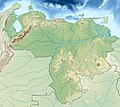 Relief map.
-
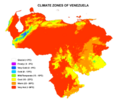 Map of thermal floors.
-
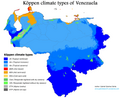


Context and conditions
Venezuela's geographic location corresponds to the Northern Hemisphere, and its southern limit lies very close to the line of the Equator. Its continental territory consists of a compact landmass that extends evenly from east to west and from north to south. Its insular territory comprises a set of archipelagos, islands and islets in the Caribbean Sea. Its geography grants it a great diversity of natural resources, mainly energy and minerals, as well as of species and ecosystems.

The country is located on the northern coast of South America, and occupies most of the South American Caribbean. To the north it has its maritime frontage on the Caribbean Sea and the Atlantic Ocean. On the Caribbean Sea it has an extensive coastline of 2,718 km, while on the Atlantic Ocean it is 556 km.
Its continental shelf is located to the north and northeast of the country; it covers approximately 18% of the total continental surface area, with a maritime presence of 860,000 km². In general, it comprises a wide coastal strip of low relief, between 0 and 100 m a.s.l. It lies between the Caribbean Sea and the Coastal Range. It features three important widened depressions: Lake Maracaibo to the west, the Unare Depression at the central northeastern end, and the Orinoco Delta region to the east, of low and swampy land. The coastal zone is home to the country's most important ports: La Guaira, Maracaibo, Puerto Cabello and Puerto La Cruz.
These extensive territories are expressed in a compact continental surface, whose maximum distance is 1,493 km in an east–west direction and 1,271 km in a north–south direction, which helps facilitate internal integration and cohesion. It is articulated by long coastlines, which on the Caribbean Sea reach a maritime frontage of 2,183 km in length, from Castilletes to the Paria promontory. It is irregular in shape and made up of numerous gulfs and bays, among which the gulfs of Venezuela, Triste, Paria and Cariaco stand out, and more than 314 islands, cays and islets under Venezuelan sovereignty, which reach as far north as Aves Island.[149]
Because it is located in the intertropical zone, Venezuela has a generally warm and rainy climate, but due to the orography, the winds, the influence of the sea and the orientation of the mountain ranges, there are climatic differences. Latitude has some importance in the seasonality and amount of rainfall, but its role is much smaller as regards its effect on temperatures. Altitude, however, is a factor that drastically changes the climate, especially with regard to temperature, reaching very different values depending on the arrangement of the relief in what are known as thermal, biotic or ecological floors.
Borders
Venezuela borders thirteen political units in the Caribbean Sea and the Atlantic Ocean, although it does not have defined marine and submarine area boundaries with all of them. It has borders with resolved delimitations with the United States of America (Puerto Rico and the U.S. Virgin Islands),[n 14][150] the Kingdom of the Netherlands (Aruba, Curaçao and the Caribbean Netherlands),[n 15][151] the Dominican Republic,[n 16][152] France (Guadeloupe and Martinique)[n 17][153] and Trinidad and Tobago.[n 18][154]
Delimitation remains pending with Colombia (430 km), Saint Kitts and Nevis (80 km), the United Kingdom (Montserrat) (45 km), Dominica (80 km), Saint Lucia (10 km), Saint Vincent and the Grenadines (90 km), Grenada (300 km) and Guyana (1,150 km). It has land borders with three countries: to the south with Brazil, with 2,199 km; to the east with Guyana, with 743 km, which may be subject to change;[n 19] and to the west with Colombia, with a length of 2,219 km.[8]
Natural regions
The geographic diversity of the national territory becomes evident when it is divided into natural regions. Specifically, up to eight regions can be distinguished in Venezuela, namely: Los Andes, the Maracaibo Lake Depression, Insular, the Coastal Range, the Eastern Range, the Orinoco River Delta, Los Llanos, Guayana, and the Lara-Falcón Formation.
 |
|
Relief and geology
Ten highest peaks of Venezuela[155][156] Pico Bolívar | |
| Name | Elevation (m a.s.l.) |
|---|---|
| Pico Bolívar | 4,978 |
| Pico Humboldt | 4,940 |
| Pico La Concha | 4,922 |
| Pico Bonpland | 4,883 |
| Pico Espejo | 4,765 |
| Pico Piedras Blancas | 4,748 |
| Pico El León | 4,740 |
| Pico El Toro | 4,727 |
| Pico Pan de Azúcar | 4,643 |
| Pico Mifés | 4,630 |
Venezuelan territory encompasses three large geographic units that follow one another from west to east: the northern Andean and coastal mountain ranges to the north and west; the Venezuelan Llanos, which constitute extensive sedimentary plains forming almost entirely part of the Orinoco Basin north of that river; and the massifs and plateaus of very ancient formation in Venezuelan Guayana, south of the Orinoco River. Its configuration took place during the formation of the South American subcontinent, when it formed a supercontinent with Africa, until their separation in the Paleozoic. Very few countries in the world,[citation needed] except some very large ones,[clarification needed] have this same variety of relief in their territory.
In Venezuela, the northern mountain formations fork into two Andean chains, raised during the Tertiary Era, which begin to individualize in the north of the Colombian Eastern Range. The western chain is made up of the Sierra de Perijá, on the border with Colombia, which rises to 3,750 m. The eastern chain forms the Cordillera de Mérida, which culminates at Pico Bolívar at 4,978 meters,[n 20][156] the highest elevation in the country. These two mountain chains surround the depression of Lake Maracaibo —13,280 km², the largest in South America—,[157] which occupies a wide depression open to the Gulf of Venezuela and which holds large hydrocarbon reserves in its subsoil. Between Lake Maracaibo, the Cordillera de Mérida and the Caribbean Sea rise the ranges and hollows of the Coriano System, formed by three orographic alignments oriented from southwest to northwest.
To the east, the mountainous region continues, skirting the Caribbean coast through the Caribbean Mountain Range, made up of the Coastal Range and the Serranía del Interior, both oriented parallel in an east–west direction, between which lies the depression of Lake Valencia. They are separated by other densely populated longitudinal valleys in which most of the country's economic activity is concentrated. Also present are the dunes, beginning in the city of Coro and extending northward toward the Paraguaná Peninsula, including the Isthmus of Médanos, and the Venezuelan portion of the Guajira Peninsula. Its landscape is of the desert type, with dunes that move continuously by the action of the trade winds blowing from east to west. Finally, to the east of this range rises the Cumaná Massif, which forms the peninsulas of Araya and Paria, between the gulfs of Cariaco and Paria. Thus, the west and the northern coast of Venezuela are dominated by successive mountain chains which, although separated by fertile valleys and hollows, do not lose their structural continuity.
The Orinoco Llanos occupy the central depression that extends between the Andean mountains and the Orinoco Valley, which borders the north of the Guayana Massif. It constitutes an immense plain characterized by its flatness, covered by the sea in past epochs —the origin of the hydrocarbon deposits— and now covered by thick layers of fluvial sediments drained by the Orinoco, which to the south connects with the Amazonia and extends to the Atlantic in the east through a great river delta of more than 40,000 km². They differ from other plains of alluvial formation in their geological constitution and their general appearance, being distinguished into the so-called High or Western Llanos, well drained and covered with vegetation; the Low or Central Llanos, subject to flooding in the rainy season; and the Eastern Llanos or Las Mesas, characterized by tabular relief in the form of plateaus, which descends from the east from the Cumaná Massif to the Orinoco, isolating at its eastern end the llanos of Monagas state.

Finally, southeast of the Orinoco rises the Guiana Shield, whose relief of elevated blocks has been subject to fluvial erosion, until it became a peneplain toward the north and southwest. Toward the southeast, by contrast, erosion has carved deep valleys, creating a secondary relief of small ranges and isolated highlands called tepuis. The formation rises in steps until it forms long mountain chains at the border with Brazil (the Tapirapecó, Parima and Pacaraima ranges). The Roraima Formation, in the southeast of the country, is precisely responsible for the presence of the tepuis, among which the Auyantepuy Plateau stands out. From the western slopes of the Auyantepuy falls the famous Angel Falls, the highest waterfall in the world, with a free fall over the valley of the Churún River. However, the most prominent summit of Venezuelan Guayana is Tepuy Roraima.
The Guiana Shield zone is the oldest, and together with the Brazilian Shield it forms one of the oldest continental formations and blocks on the planet, at more than 3.5 billion years old. Its extent in Venezuela is about 430,000 km², equivalent to almost half the national territory. It is found at depth beneath the sedimentary layer that makes up the Venezuelan llanos, extending toward Guyana, Brazil, Suriname and French Guiana. Its basement contains the oldest rocks on the planet,[citation needed] both igneous —such as granite— and metamorphic —schist, quartzite and gneiss—. To the northeast, by contrast, a relief of hills, ranges and high plateaus takes shape, where the Sierra de Imataca and the Nuria Plateau stand out. Here the soil is made up of ferruginous quartzites or itabirites —rocks with a high iron content—, which explains the existence of abundant reserves of this mineral in the area.
Hydrography
| Main drainage basins | |||
 Orinoco Basin | |||
| Name | Area (km²) | ||
|---|---|---|---|
| Orinoco Basin | 770,000 | ||
| Caribbean Sea | 80,000 | ||
| Lake Maracaibo | 74,000 | ||
| Cuyuni River | 40,000 | ||
| Amazon Basin (Río Negro) | 11,900 | ||
| Lake Valencia | 3,000 | ||
| Source:[158] | |||
The country is made up of three hydrographic slopes: that of the Caribbean Sea, that of the Atlantic Ocean and that of Lake Valencia, which forms an endorheic basin.
Most of Venezuela's river waters drain into the Atlantic slope. The largest basin in this zone is the extensive Orinoco Basin, whose surface area, close to one million km², is greater than that of all of Venezuela, although 65% of it lies within the country. The size of this basin —similar to that of the Danube— makes it the third largest in South America, and it gives rise to a flow of some 33,000 m³/s, making the Orinoco the third largest river in the world by discharge,[159] and also one of the most valuable from the standpoint of renewable natural resources. The Casiquiare River or Branch, for its part, is a unique case in the world, since it is a natural offshoot of the Orinoco which, after some 500 km in length, connects it with the Río Negro, which is in turn a tributary of the Amazon. The Orinoco receives, directly or indirectly, rivers such as the Ventuari, the Caura, the Caroní, the Meta, the Arauca, the Apure and many others. Other Venezuelan watercourses emptying into the Atlantic are the waters of the basins of the San Juan and the Cuyuní. Lastly, there is the basin of the Amazon River, which receives the Guainía, the Negro and others. Other basins are those of the Gulf of Paria and the Essequibo River.
The second most important slope is the Caribbean Sea. The rivers of this region tend to be short, with scant and irregular flow, with some exceptions such as the Catatumbo, which rises in Colombia and drains into the basin of Lake Maracaibo. Among the rivers reaching the Lake Maracaibo basin are the Chama, the Escalante, the Catatumbo, and the contributions of smaller basins of the Tocuyo, Yaracuy, Neverí and Manzanares rivers.
A small amount drains into the basin of Lake Valencia. Of the combined length of the rivers, a total of 5,400 km are navigable. Other rivers worth mentioning are the Apure, the Arauca, the Caura, the Meta, the Barima, the Portuguesa, the Ventuari and the Zulia, among others.
The country's main lakes are Lake Maracaibo —the largest in South America—, open to the sea through a natural channel but of fresh water, and Lake Valencia with its endorheic system. Other notable bodies of water are the Guri Reservoir, the Altagracia Lagoon, the Camatagua Reservoir and the Mucubají Lagoon, in the Andes. Navigation on Lake Maracaibo through the natural channel is useful for moving petroleum resources.
Climate
Because it is located in the intertropical zone, Venezuela has a warm and rainy climate with two seasons: a dry season, running from October to March, and a rainy season, from April to September. Due to the orography, the winds and the sea, there are climatic differences. Latitude has little importance, but altitude drastically changes the climate, especially temperature, which reaches very different values.
According to the Köppen climate classification, the climate types are:[160]
- Tropical or warm rainy (A), the most predominant and characteristic of the country. It maintains temperatures above 18 °C and rainfall for much of the year. The tropical savanna climate (Aw) occurs in the llanos, in northern Guayana, and in part of the Andes and the Coastal Range, such as San Cristóbal and Caracas. It is dry between December and March, with rainfall between 600 and 1,500 mm per year. In Guayana, the Aroa River and Barlovento, the monsoon climate (Am) is typical, with rainfall between 1,600 and 2,500 mm per year and a drought of barely 45 days. In the south of the same region and in the Sierra de Perijá, the tropical rainforest climate (Af) is typical; rainfall exceeds 2,500 mm, with no dry season.
- Dry (B), where evaporation exceeds precipitation. It is typical of the desert and arid zones of the coast, with temperatures well above 18 °C. In Falcón, especially in the Médanos de Coro, and in the Insular Region, the hot desert variety (BWh) occurs, with moderate rainfall and scant vegetation. West of that state, the central coast, the Coastal Range, Paraguaná, Barquisimeto, Maracaibo and part of Margarita Island have the hot steppe or semi-arid climate (BSh).
- Intertropical temperate highland or dry winter (Cw), with temperatures between 14 and 18 °C at the highest elevations of the Coastal Range, such as Colonia Tovar, and at middle altitudes of the Andes, such as Mérida, Tovar and Mucuchíes.
- Cold high mountain (E), with temperatures between below 0 and 10 °C. The tundra climate (ET) is found in the páramos above 2,800 m a.s.l., in Apartaderos and at Pico El Águila. The frozen high mountain climate (EF) is reserved for the highest summits of the Venezuelan Andes, such as the peaks Bonpland, La Concha, Humboldt and Bolívar.
| Climate type | Characteristics | Temperatures | Rainfall | Regions | Image |
|---|---|---|---|---|---|
| Tropical savanna (Aw) | Dry between December and March | > 18 °C | 600 - 1,500 mm per year | Llanos, northern Guayana, part of the Venezuelan Andes, Coastal Range (San Cristóbal, Caracas) | 
|
| Monsoon (Am) | Drought of barely 45 days | > 18 °C | 1,600 - 2,500 mm per year | Guayana, Aroa River, Barlovento | 
|
| Equatorial rainy (Af) | No dry season | > 18 °C | > 2,500 mm per year | Southern Guayana, Sierra de Perijá | 
|
| Hot desert (BWh) | Moderate rainfall, scant vegetation | > 18 °C | - | Falcón (especially the Médanos de Coro), Insular Region | 
|
| Hot steppe or semi-arid (BSh) | - | > 18 °C | - | Western Falcón, central coast, Coastal Range, Paraguaná, Barquisimeto, Maracaibo, part of Margarita Island | 
|
| Intertropical temperate highland or dry winter (Cw) | - | 14 - 18 °C | - | High elevations of the Coastal Range (Colonia Tovar), middle altitudes of the Andes (Mérida, Tovar, Mucuchíes) | 
|
| Cold high mountain (ET) | - | < 0 - 10 °C | - | Páramos above 2,800 m a.s.l. (Apartaderos, Pico El Águila) | 
|
| Frozen high mountain (EF) | - | < 0 °C | - | Highest summits of the Venezuelan Andes (Bonpland, La Concha, Humboldt, Bolívar) |
|
| Contrast between the Sierra Nevada de Mérida, the Gran Sabana, the Sierra de Perijá, and the sand dunes in the Médanos de Coro National Park, examples of the great diversity of ecosystems and habitats. | |||||
Fauna and flora
Venezuela has a diversity of species in its natural habitat. Its main centers of endemism are the Andes and Coastal ranges, the Sierra de Perijá and the Guayana massif within the Orinoco River basin.
It has more than 30,000 species of angiosperms —placing the country eighth in the world—, of which more than 8,000 are endemic (40% of the total). It also ranks fifth in the world in bird species, with approximately 1,420 species (15% of the world total and 45% of South American bird species), 49 of them endemic.[161] There are 390 species of mammals and 400 species of amphibians, ranking ninth in the world in this group.[162] It is estimated that 12% of the 1,300 species of freshwater fish are endemic. Among tropical countries, it ranks fourth in plant species, fifth in mammals and birds, sixth in primates, amphibians and reptiles, and ninth in butterflies.[163]

The vertebrate fauna of Venezuela comprises approximately 2,120 terrestrial species and 1,000 aquatic species. Venezuelan mammals comprise 306 terrestrial and 21 aquatic species, of which 14 are endemic. The avifauna is represented by 1,300 species; 46 of them are endemic and 120 are migratory. There are 254 species of reptiles in the country distributed across 3 orders, 22 families and 105 genera, while continental fish number around 1,000 species.[165] Because of this wide diversity of natural species, the country is part of the group of megadiverse countries, which brings together 18 countries for having the greatest concentration and diversity of species in the world.[166]
The flora of the rainforests of Venezuelan Guayana, for its part, consists of trees up to 40 meters tall, such as the ceiba, the yagrumo, the guamo, the mahogany, lianas, species of bromeliads and other epiphytes. The fauna of these regions is represented by jaguars, pumas, chigüires, anteaters, báquiros, otters and cachicamos. Its avifauna is made up of toucans, parrots and macaws. There are also rattlesnakes and bushmasters, as well as iguanas, morrocoy tortoises and toninas.
In the cloud forests of the Andes and Coastal ranges and in various mountain ranges, the presence of sweet cedar, jarillo or apamate stands out, in addition to various species of palms and orchids such as Cattleya mossiae, the national flower. The fauna inhabiting these regions includes the tapir or danta, the lapa, the kinkajou, the puma and others. Birds such as the guacharaca and hummingbirds can be observed, many snakes such as the famous anaconda, the mapanare and the coral snake, and a great many species of frogs and arachnids.
The Andean regions of Trujillo, Mérida and Táchira, where temperatures are very low, include among their plant species the cardón, the cují, the bucare and the frailejón. Precisely because of the low temperature, fauna tends to be scarce, although rabbits, deer, foxes, porcupines and shrews are present, along with the Andean condor, the black eagle, the golden eagle and the paraulata.
| Main endangered species[167] |
| Jaguar (Panthera onca) |
| Arrau turtle (Podocnemis expansa) |
| Spectacled bear (Tremarctos ornatus) |
| Andean condor (Vultur gryphus) |
| Caribbean manatee (Trichechus manatus) |
| Red siskin (Carduelis cucullata) |
The pardillo, the granadilla, the mahogany and the vera are typical of the tree vegetation of the Barinas and Apure piedmont, although the rest of the vegetation of Los Llanos is lower in height and consists of grasslands and moriche palms associated with bodies of water. There are also chaparros and gallery forests. This region is home to the araguaney, the emblematic tree of the nation. The fauna includes deer, anteaters and others. The most representative birds are hawks, ducks and herons. There is a proliferation of crocodiles, babas, the Orinoco crocodile and various species of snakes, with cachamas, catfish and guabinas found in the bodies of water.
In the desert zones of the coast in the north of the country, the primary vegetation is made up of cacti such as cardones, cujíes and tunas. The animals making up its fauna are rabbits, goats, rabipelados and snakes, as well as cardinals, troupials and hawks.
Meanwhile, in the Orinoco Delta, Margarita Island, Barlovento and in the coastal zones of Zulia, Falcón and the east of the country, species of white, black and red mangrove can be found.
Other species of mammals that can be found in the country's aquatic spaces are the dolphin, the manatee and whales. Lizards such as the chameleon, the tuqueque, the iguana and the mató are some of the best-known species of reptiles in Venezuela.
Among Venezuela's endangered species are the arrau turtle, the jaguar, the spectacled bear, the condor, the manatee, the anteater or palmero, and the red siskin. Also in a critical situation are the tapir, the coastal caiman, the Orinoco crocodile, the perro de agua, the green sea turtle, the hawksbill sea turtle, the Cardón turtle, the loro turtle and the yellow-headed parrot.[168]
Biodiversity

Phytogeographically, Venezuela has a great variety of biomes such as savannas, jungles, forests, páramos, deserts, mangroves and tepuis, among others, with a community of plants and animals of diverse types due in large part to the climatic differences present in its territory. The country has zones that are highly differentiated both by their climate and by the presence of the fauna characteristic of each zone. These biomes are usually easy to classify by their appearance or features, since the vegetation contributes to their observation and classification.
These characteristics have led the country to be recognized as a megadiverse country, ranking seventh among the countries with the greatest biodiversity in the world.[169][170] The country ranks fifth in the world in number of bird species, seventh in the world in species of vascular plants,[171] ninth in the world in amphibians, and fourth in the number of freshwater fish species, and it also figures among the countries with the most species of butterflies.[172] Venezuela currently has two biosphere reserves, namely the Alto Orinoco-Casiquiare biosphere reserve —which occupies a large part of the area of Duida-Marahuaca National Park— and that of the Orinoco Delta.
Economy
| Exports | Imports | ||
|---|---|---|---|
| Destination country | Percentage | Country of origin | Percentage |
| China | 26.3% | China | 31% |
| Turkey | 14.1% | United States | 22% |
| United States | 9.62% | Brazil | 15.4% |
| Netherlands | 5.34% | Colombia | 4.69% |
| Brazil | 5.23% | India | 4.42% |
| Italy | 4.52% | Turkey | 4.24% |
| Lebanon | 4.37% | Canada | 1.89% |
| Guatemala | 3.44% | Spain | 1.53% |
| India | 2.67% | Italy | 1.48% |
| France | 2.22% | Peru | 1.23% |
| Spain | 2.21% | Guyana | 0.92% |
| Rest | 19.98% | Others | 11.2% |
| Source: Observatory of Economic Complexity, 2021[173] | |||
In 2020, the country was the world's 76th largest exporter (US$16.4 million in goods, 0.1% of the world total).[174][175] In 2016, the country was the world's 63rd largest importer: US$33.6 billion.[176] Venezuela has a market economy whose main base is the extraction and refining of petroleum for export and domestic consumption. It is the eighth largest economy in Latin America, after Brazil, Mexico, Argentina, Colombia, Peru, Ecuador and Guatemala, by nominal GDP,[177] and also the seventh by GDP (PPP).[178]
The country's main exports go to China ($843 M), Turkey ($452 M), the United States ($308 M), the Netherlands ($171 M), and Brazil ($168 M), while its main imports come from China ($2.19 billion), the United States ($1.55 billion), Brazil ($1.09 billion), Colombia ($331 M), and India ($312 M).[173]
Throughout the 20th century it positioned itself as the most prosperous economy in the region, precisely because of the oil boom that began in the middle of that period, while its currency was one of the most appreciated against the dollar; but the fall in the price of this resource in the 1980s caused a severe recession and financial problems. The economy showed a significant recovery in 2004, registering growth of 17%, one of the highest in the world according to the International Monetary Fund. At the close of 2008, growth was 4% of gross domestic product.[179] Country risk stood at 961 basis points in September 2012, according to official data.[180] The unemployment rate for 2011 was 8.2%.[181] However, its inflation rate for that same year was 30.9%, the highest in Latin America.[182] At the beginning of 2014, the economy fell back into recession with 3 consecutive half-years of negative data and a contraction of 3.9% at the end of 2014.[183][184] In 2015 inflation closed at 180.9%[185] and GDP shrank by 5.7% compared with the previous year.[186] In 2016, according to preliminary results from the Central Bank of Venezuela reported by Reuters, GDP fell by 18.6% and inflation reached 799.9%, the highest in the world.[187][188] Venezuela also has some subsidiary companies of Petróleos de Venezuela, such as Citgo.
International rankings
Venezuela's position in international ranking systems in different categories. The data used correspond to the indicated year of publication, not necessarily the same year.
| Index | Author / Source | Year of publication |
Countries | Position |
|---|---|---|---|---|
| Press freedom | Reporters Without Borders[189] | 2022 | 180 | 159th |
| Degree of Democracy | The Economist[190] | 2021 | 167 | 151st |
| Tourism Competitiveness | World Economic Forum[191] | 2021 | 117 | 108th |
| Perception of corruption | Transparency International[192] | 2021 | 180 | 177th |
| Economic freedom | The Wall Street Journal and Heritage Foundation[193] | 2022 | 184 | 176th |
| Global Competitiveness | World Economic Forum[194] | 2019 | 141 | 133rd |
| Human development | United Nations Development Programme[195] | 2021 | 195 | 120th |
| Technological Competitiveness | World Economic Forum[196] | 2016 | 139 | 108th |
Agriculture, fishing and forestry
In 2019 Venezuela produced: 4.3 million tonnes of sugarcane; 1.9 million tonnes of maize; 1.4 million tonnes of plantain; 760 thousand tonnes of rice; 485 thousand tonnes of pineapple; 477 thousand tonnes of potato; 435 thousand tonnes of palm oil; 421 thousand tonnes of cassava; 382 thousand tonnes of orange; 225 thousand tonnes of watermelon; 199 thousand tonnes of papaya; 194 thousand tonnes of melon; 182 thousand tonnes of tomatoes; 155 thousand tonnes of mandarin; 153 thousand tonnes of coconut; 135 thousand tonnes of avocado; 102 thousand tonnes of mango (including mangosteen and guava); 56 thousand tonnes of coffee; in addition to small amounts of other agricultural products. Due to internal economic and political problems, sugarcane production fell from 7.3 million tonnes in 2012 to 3.6 million in 2016. Maize production fell from 2.3 million tonnes in 2014 to 1.2 million in 2017. Rice fell from 1.15 million tonnes in 2014 to 498 thousand tonnes in 2016.[197]

In livestock, Venezuela produced, in 2019: 470 thousand tonnes of beef, 454 thousand tonnes of chicken meat, 129 thousand tonnes of pork, 1.7 billion liters of cow's milk, among others. Chicken meat production declined progressively, year after year, from 1.1 million tonnes in 2011 to 448 thousand tonnes in 2017. Pork production fell from 219 thousand tonnes in 2011 to 124 thousand tonnes in 2018. Cow's milk production fell from 2.4 billion liters in 2011 to 1.7 billion liters in 2019.[199]
The Law of Land and Agrarian Development of 1960 made it possible to expand and diversify agricultural production, which was further stimulated by the increase in irrigable land, the emergence of new companies and the introduction of new plant species. These developments helped agriculture benefit, increasing the areas devoted to cultivation in the Llanos, Andean and Zulian regions. The country has some 310,972 hectares of irrigable land, with a net extent of 197,258 hectares.[200]
In 2003, agricultural and livestock activities employed 11% of the country's working population (4% less than in 1990) and contributed 5% of annual GDP. Venezuelan agrarian resources range from subsistence and semi-commercial agriculture, carried out in traditional conucos and small farms where products are grown for domestic consumption, to plantations of various kinds. In recent decades, mechanized and modern annual cropping systems have multiplied, such as those specializing in maize, rice, sorghum, sesame, peanut, sunflower and cotton.

The leading crops in terms of production and trade are sugarcane, maize, rice, cambur, potato, and yuca. The traditional tropical crops are coffee, sugarcane, cacao and tobacco.[203] A major cereal harvest of maize, rice and sorghum has become established in the central-western Llanos region. Maize cultivation accounted for 58.13% of cereal production in 2005, reaching two million tonnes, while rice exceeded 900,000 tonnes.[204] In the production of oilseeds, the oil palm is of great importance (44.41% of the total for that year), along with coconuts, cotton, sisal, soy, sunflower and sesame. The legume group saw an upturn in recent years, and its production is led by caraotas (62.97%) and beans. For their part, roots and tubers began to see an upturn in 1998, led by the potato (50.83% of the area) and yuca, which has stagnated. Among fruits, the most notable are the banana or cambur, the plantain, oranges, pineapples and melons.[204]
Livestock farming is concentrated in the Llanos region, Zulia, Guayana, the Andes, Bajo Motatán and the northwest. Advances can be seen in the mobilization of livestock resources, with improvements in the yields of various types of livestock. In 2005, Venezuela's livestock population numbered 16,300,000 head of cattle, 3,100,000 pigs, 530,000 sheep and 110,000,000 poultry. The Llanos show the most activity, and a prosperous zone of intensive meat and milk production has been established there. The main cattle breeds are Brahman, Santa Gertrudis and Carora, while the main pig breeds are Yorkshire and Landrace, among others.[205] In recent times, Venezuela has imported cattle from Argentina and Uruguay.
Venezuela's fishery resources are made up of a variety of marine species. The most important commercial catches are tuna, sardines, carites, cazón, mullet, prawn, shrimp, trout, snappers, groupers, crabs and others. Shrimp and mussel mariculture has been introduced on the coast, as has the breeding of trout in fish farms in Mérida and Táchira, and river aquaculture in the Llanos, Zulia and Guayana. In 2007, fishery production stood at 311,125 tonnes,[206] with the output of Sucre, Nueva Esparta and Falcón standing out.
For its part, the timber industry has not reached the same magnitude, even though Venezuela is covered by extensive forests and jungles. This is due to the inaccessibility of the areas. Despite this, massive plantations of Caribbean pine have been established for commercial purposes in southern Monagas and Anzoátegui, along the banks of the Orinoco. According to statistics, 5,082,092 m³ of timber were obtained in 2005.
Petroleum and mining
In non-renewable energy, in 2020 the country was the world's 26th largest producer of petroleum, extracting 527 thousand barrels/day.[207] Venezuela recorded a sharp fall in production after 2015 (when it produced 2.5 million barrels/day), falling in 2016 to 2.2 million, in 2017 to 2 million, in 2018 to 1.4 million and in 2019 to 877 thousand, due to lack of investment and to the country's politics.[208] In 2019, the country consumed 356 thousand barrels/day (the world's 39th largest consumer).[209][210] The country was the world's thirteenth largest oil exporter in 2018 (1.2 million barrels/day), when production had not yet collapsed to 527 thousand barrels/day in 2020.[207] In 2015, Venezuela was the 28th largest producer of natural gas, 26 billion m³ per year. In 2017, the country was the 28th largest consumer of gas (37.6 billion m³ per year) and was the world's 45th largest gas importer in 2010: 2.1 billion m³ per year.[211] In the production of coal, the country was the world's 41st largest in 2018: 0.3 million tonnes (in 2014, production was 1.2 million tonnes and has been falling since then).[212] In renewable energy, in 2020 Venezuela produced neither wind energy nor solar energy.[213] In 2014 it was the ninth largest producer of hydroelectric power in the world, with an installed capacity of 15 GW.[214][215][216]
In Venezuela, petroleum, the main source of income,[217] generates around 80% of export earnings. The country is a founding member of the Organization of the Petroleum Exporting Countries and one of the main producing countries on the planet. Deposits of this resource of all types are abundant in much of the territory, giving it the largest reserves in the world. In 2019 oil production in Venezuela stood at 750,000 b/d and in 2020 its monthly average was 450,000 b/d,[218][219][220][221] with most of it exported to the United States, Europe and Latin American countries until before 2014; currently its main consumer is China and, on a smaller scale, Cuba and Iran. By 2019 oil production had decreased too much, and in 2021 Venezuela became an importer of gasoline and diesel.[222]
Extraction takes place mainly in the Lake Maracaibo basin and in the Barinas-Apure and Eastern basins. The flagship company in oil processing is PDVSA, which has subsidiaries operating six refineries of varying size in the country, as well as others in Curaçao, the United States, Germany, Sweden and Belgium. The country is also one of the world's main producers of natural gas: in 2005 production was estimated at 27,530 million m³,[221] along with liquefied gas, butane and propane. Venezuela also has the Orinoco Belt, which is considered the largest accumulation of heavy and extra-heavy crude oil in the world. Original oil in place in the Belt, according to PDVSA, so far amounts to 1.36 trillion barrels.[223]

Other mineral resources are also exploited for commercial purposes, such as iron, bauxite, coal, gold, salt, phosphates and limestones. The iron deposits in the Sierra de Imataca, discovered in the 1940s, were extracted by American companies until the nationalization of 1975 transferred this function to the state-owned Ferrominera del Orinoco, a subsidiary of the Corporación Venezolana de Guayana. The main Guayana deposits are Cerro Bolívar, Cerro San Isidro and Cerro Los Barrancos, most of whose output is exported to Europe, Asia and the United States.
Bauxite has been extracted from Los Pijiguaos since 1987, and it goes to aluminum-producing companies. The coal deposits of Guasare in Zulia, Carbosuroeste in Táchira, and Fila Maestra and Naricual in Anzoátegui State have also been exploited. There is an abundance of gold in Bolívar and Amazonas, and its reserves represent 10% of the world total. It is also an important producer of diamonds, limestone and dolomite. Other exploitations of great interest are the phosphate deposits of Táchira, manganese in Guayana and nickel in Aragua and Miranda. On Margarita Island there are minor reserves of magnesite.
The main institution in the administration and extraction of the country's mining resources is the Corporación Venezolana de Minería (founded 2013), constituted as a subsidiary of Petróleos de Venezuela, whose objectives include delimiting small-scale mining activity and preventing the smuggling of resources abroad.[225][226]
Industry
The World Bank lists the main producing countries each year, according to the total value of production. According to the 2019 list, Venezuela had the world's 31st most valuable industry (US$58.2 billion), broadly based on the petroleum industry.[227] In 2018, Venezuela was the world's 51st producer of vehicles (1.7 thousand), having suffered declines since 2010, when it produced 153 thousand vehicles/year. In steel production, the country is not among the world's 40 largest producers.[228][229][230]
Venezuela was highly industrialized until before 2013, since 51.6% (2003) of its gross domestic product (GDP) came from industry. Special priority has been given to the manufacturing industry since the mid-20th century. The main products of Venezuelan industries are petroleum derivatives, steel, aluminum, fertilizers, cement, tires and motor vehicles. It also handles the processing of food, beverages, textiles, clothing, footwear, and plastic and wood goods. INE data for 2004 put the industrial workforce at 322,907 people.[231] Industrial zones are concentrated in the cities of the Capital and Central Regions. At the end of the 20th century, the location of industries in other regions, such as the Central-Western, Zulian and Guayana regions, became consolidated. In 2007, 4.3 billion tonnes of steel were produced per year; that year the loss of steel production began, and by 2018 barely 50 thousand tonnes were produced per year.[232][233] The aluminum industry came to an end in 2019 with the energy crisis, when its last electrolytic cells were shut down.[234][235] The fertilizer, plastics, footwear and clothing industries have been diminished by the economic crisis the country is going through.
Tourism
Tourism in Venezuela is an underdeveloped industry, even though the country is favored by the wide range of natural environments in its territory. All the natural regions of Venezuela have a large number of tourist attractions, and the low cost of transport, given the low price of gasoline in Venezuela, favors the mobility of tourists.
The country receives fewer foreign visitors than most countries of similar size and even than nearby regions such as Aruba. In 2008 Venezuela had some 301,579 visitors from Europe, followed by South America (227,105), North America (130,257), the Caribbean (39,480), Asia (15,912), Central America (11,377) and the Middle East (10,100).[236] The industry suffered a significant decline due to political instability during the Bolivarian Revolution. According to data from the Ministry of Popular Power for Tourism (MPPT), 435,421 tourists were received in 2003, 47% fewer than in 1998. However, this rate showed an upturn in 2008, with 856,810 foreign tourists visiting the country.[237]

As regards domestic tourism, MPPT data indicate that Venezuelans prefer to travel to various destinations across the national geography during the Holy Week holiday and the Carnival festivities (13.1 and 12.6 million tourists respectively in 2007),[239] as well as during the Christmas and New Year holidays. The main reason for travel within the country throughout the year, according to statistics, is visiting relatives or friends, followed by the desire for recreation typical of the vacation seasons, with professional and business reasons as the third motive.[240]
Given the development of its tourism industry, Margarita Island is the leisure destination par excellence, valued for its beaches, its climate and its culture. Also notable are the Los Roques archipelago and Morrocoy National Park. The Médanos de Coro and the Cueva del Guácharo also attract interest because of their uniqueness.
The Andean region, also attractive for its temperate climate and its landscapes, has Pico Bolívar and the Mérida cable car, as well as the Sierra Nevada. Urban destinations are profitable especially in the historic center of each city, Caracas being the most visited city (about 231 thousand international tourists in 2008).[241]
Venezuela is an especially interesting country for the development of ecotourism or adventure tourism, and its main destinations are Canaima National Park, the Los Llanos Region (which has areas of lush biodiversity), Amazonas State, and the uninhabited La Tortuga Island, among others. These ecotourism destinations are recommended for visitors seeking risk, adventure and experiences different from conventional tourism. The Amazon rainforest has indigenous tribes of great interest, while within Canaima National Park, in southern Venezuela, in Bolívar State, there are views that cannot be found anywhere else in the world. This park has two very different sectors: to the east, the eastern sector, where the Gran Sabana is located, and to the west, the western sector, where Angel Falls and the Canaima Lagoon are located. Canaima National Park extends over 30,000 km² up to the border with Guyana and Brazil; because of its size it is considered the sixth largest national park in the world. About 65% of the park is occupied by rock plateaus called tepuis. These constitute a unique biological environment and are also of great geological interest. Their steep cliffs and waterfalls (including Angel Falls, the highest waterfall in the world, at 1,002 m) form spectacular landscapes.
Energy

In non-renewable energy, in 2020 the country was the world's 26th largest producer of petroleum, extracting 527 thousand barrels/day.[207] Venezuela recorded a sharp fall in production after 2015 (when it produced 2.5 million barrels/day), falling in 2016 to 2.2 million, in 2017 to 2 million, in 2018 to 1.4 million and in 2019 to 877 thousand, due to lack of investment and to the country's politics.[208] In 2019, the country consumed 356 thousand barrels/day (the world's 39th largest consumer).[209][210] The country was the world's thirteenth largest oil exporter in 2018 (1.2 million barrels/day), when production had not yet collapsed to 527 thousand barrels/day in 2020.[207] In 2015, Venezuela was the 28th largest producer of natural gas, 26 billion m³ per year. In 2017, the country was the 28th largest consumer of gas (37.6 billion m³ per year) and was the world's 45th largest gas importer in 2010: 2.1 billion m³ per year.[211]
In the production of coal, the country was the world's 41st largest in 2018: 0.3 million tonnes (in 2014, production was 1.2 million tonnes and has been falling since then).[212] In renewable energy, in 2020 Venezuela produced neither wind energy nor solar energy.[213] In 2014 it was the ninth largest producer of hydroelectric power in the world, with an installed capacity of 15 GW.[214][215][216]
Around 68.13% of electric power is produced in hydroelectric facilities. The state-owned company Corporación Venezolana de Guayana/Electrificación del Caroní (CVG EDELCA) developed in Bolívar the Raúl Leoni hydroelectric plant and the Macagua plant. These have supplied more than 70% of Venezuelan electricity production in recent years. The state-owned Compañía Anónima de Administración y Fomento Eléctrico (CADAFE, founded 1958) has been carrying out since the 1970s the construction of the Uribante Caparo Complex, having built to date only the San Agatón plant, or first development. According to data,[by whom?] 99.2 million kWh of electricity were generated in 2005.[242]
According to INE data for that year, Venezuelan electricity production was able to supply consumption equivalent to 757,000 barrels of oil per day,[243] which has made it possible to carry out the policy, pursued by Venezuela, of replacing thermoelectricity with hydroelectricity,[citation needed] which will save liquid fuels that can be used for export or conserved. The energy generated by the Simón Bolívar plant supplies most of the national territory, including part of Caracas. Of the total produced, a portion is purchased by Brazil to supply part of the north of its territory.
Minimum wage
The minimum wage is set directly by the national government through its publication in the Official Gazette. From December 2015 to January 2020 the minimum wage deteriorated because of the high inflation Venezuela is experiencing; by November 2017 the minimum wage had fallen on average to less than 25 dollars a month, and during that period the government raised wages between four and six times a year to offset their devaluation. As of March 1, 2018, the minimum wage was 392,646.46 Bs.F, which together with the food bonus (915,000 Bs.F) totaled 1,307,546.46 Bs.F, equivalent to 6.12 USD at the black market exchange rate[244] or 32.54 USD according to the official DICOM exchange rate of the Central Bank of Venezuela (BCV).
In August 2018 the Venezuelan currency lost five zeros in its accounting; with a new currency, the sovereign bolívar (Bs.S), the new minimum wage was set at 1,800 sovereign bolívars. Retirees lost part of their acquired benefits due to high inflation. In that month the minimum wage represented 18 dollars, and the government abolished the official dollar system controlled by a Controlled Float exchange system.[245][246][247] In January 2020 the minimum wage rose to 250 thousand sovereign bolívars, equivalent to about 3.5 dollars or about 10,500 Colombian pesos a month.[248] Food bonuses are not included in the calculation when severance is settled at the end of employment or when applying for retirement.
Historically, the official exchange rate assigned by the BCV, by which the equivalent of bolívars in dollars is calculated, had a fixed value from February 5, 2003 (1 USD = 1,600 Bs.) that lasted until February 2005; it was regulated again from March 2005 until January 2010 (1 USD = 2.15 Bs.F or 2,150 Bs.)[249] as a result of exchange controls regulated by CADIVI. On January 11, 2010, the national exchange system was devalued again, setting the dollar at 2.60 Bs.F and creating the oil dollar at 4.30 Bs.F; this dual scheme was eliminated as of January 1, 2011, devaluing both rates to a value of 4.30 Bs.F per dollar.[250]
From June 2010 until mid-2012 there was a third exchange rate called SITME, regulated by the BCV in order to contain the parallel exchange rate, in which the price of the dollar fluctuates around twice the official rate;[251] this scheme did not have a fixed value for the dollar and operated through the purchase and sale of securities in foreign currency. This fixed-value system was eliminated on January 30, 2018.[252] Venezuela has the highest inflation in the world: it closed at 799.9% in 2016,[187][188] and has been considered hyperinflation since November 2017; accumulated inflation in 2018 reached 1,698,488%, and for December 2019, according to the National Assembly, accumulated inflation was estimated at 7,374%.[253][254]
International reserves

International reserves are deposits of foreign currency controlled by central banks and other monetary authorities. Venezuela's totaled 29,633 million dollars in March 2009,[255] rising to 30,434 billion in July,[256] while at the end of July 2012 they stood at 27,210 million dollars.[257] By December 2016 reserves had fallen to 10,868 million dollars.[258] In October 2019 reserves fell to 7,978 million dollars.[259] On January 2, 2020, according to a BCV report, reserves stood at 6,633 million dollars, the lowest figure in the last 25 years.[260]
In official gold reserves, Venezuela has been losing its gold reserves continuously over the last eight years. In 1957, after the Second World War, it managed to accumulate 640 t of gold, being the most thriving economy of the time; in 2010 it ranked first in Latin America and 15th in the world, with 372.9 tonnes,[261] equivalent to 67.7% of its international reserves. By the end of 2016 gold reserves had decreased to 187.5 tonnes, ranking 25th in the world.[258] By June 2019 gold reserves had fallen to 102.4 t, ranking 36th in the world.[262]
Economic crisis

Together with the economic crisis of 1983, which led to industrial restructuring and the establishment of exchange controls,[264] with the oil sector becoming the most important part of the economy, the global economic crisis that began in 2008—taking into account the Venezuelan oil boom of 2008–2011—external indebtedness, uncontrolled public spending, mismanagement and the fall in oil production after 2014 had especially serious consequences in Venezuela.
Initially there was a shortage of basic goods, unemployment, a subsequent stagnation and a new decline starting in the last quarter of 2014. The difficult economic situation led to a fall in tax revenues, a fall in oil production, an increase in certain financial expenses, the maturing of debts and the commitment to deliver oil to China, which led the government of Nicolás Maduro to drastically devalue the currency. This was accompanied by a social, institutional and political crisis, numerous demonstrations, and an increase in poverty and inequality in the country.
The country has been in default since November 2018.[265] The disputes incurred in 2008 over the expropriation of some foreign companies, which the State lost before the International Centre for Settlement of Investment Disputes (ICSID) and the International Chamber of Commerce (ICC), have brought serious consequences for its economy between 2016 and 2019, as it found itself in a hyperinflationary process. The crisis has triggered de facto dollarization. According to Luis Zambrano Sequín of the Institute of Economic and Social Research, 40% of its deposits are in the U.S. currency, making the country a dollarized economy as of September 2018.[266] In addition, approximately 60% of payments in commercial businesses in 2021 were made in dollars.[267]
Special economic zones have recently been established by presidential decree.[268] The SEZs in the decree are Paraguaná (Falcón), Puerto Cabello – Morón (Carabobo), La Guaira (La Guaira), Margarita (Nueva Esparta) and La Tortuga Island (Miranda Insular Territory). It is hoped that in the coming years, with these new economic policies, Venezuela may achieve high levels of economic development and a certain recovery.
Science and technology

Venezuela has had several scientists who have made notable contributions to the natural and medical sciences, as well as to technological progress. The first vaccine for the cure of leprosy and against leishmaniasis was developed by Jacinto Convit, while Baruj Benacerraf carried out demonstrations of immune responses to antigens and their variation in each person, which earned him the Nobel Prize in Physiology or Medicine in 1980. In the field of technology, Humberto Fernández Morán contributed to the development of the electron microscope and the diamond scalpel, the latter of his own invention, and was the first to introduce the concept of cryo-ultramicrotomy.
Historically, the first trace of technology made by Venezuelans is found in the development of the Rincones clamp, which made it possible to recover parts in oil wells.[269] Technological activities in the country would gain new momentum toward the mid-20th century with the creation of new institutes devoted to the promotion and professionalization of scientific and technological activity in the country.[270]
Such institutions, like the National Council for Scientific and Technological Research (CONICIT) and the Venezuelan Institute for Scientific Research, are the main points of reference in these fields. All are attached to the Ministry of Science and Technology. In addition, there is the Llano del Hato National Astronomical Observatory which, at 3,600 m above sea level, is one of the highest-situated in the world.[271] In 2012 the Miranda satellite (VRSS-1) was launched, intended for Earth observation and the taking of high-resolution digital photographs of the national territory.
Demographics
| Year | Pop. | ±% p.a. |
|---|---|---|
| 1950 | 5,094,000 | — |
| 1960 | 7,562,000 | +4.03% |
| 1970 | 10,681,000 | +3.51% |
| 1980 | 15,036,000 | +3.48% |
| 1990 | 19,685,000 | +2.73% |
| 2000 | 24,348,000 | +2.15% |
| 2011 | 28,400,000 | +1.41% |
| 2016 | 31,028,337 | +1.79% |
| 2022 | 28,302,000 | −1.52% |
| [272][273][274][275]
Population Division Source: UN | ||
Venezuela is among the most urbanized countries in Latin America;[276][277][278] the great majority of Venezuelans live in the cities of the north, especially in the capital, Caracas, which is also the most populous city. Around 93% of the population lives in urban areas in the north of the country; 73% live less than 100 kilometers from the coast. Although almost half of Venezuela's land area lies south of the Orinoco, only 5% of Venezuelans live there. The largest and most important city south of the Orinoco is Ciudad Guayana, which is the sixth most populous urban agglomeration.
The population of Venezuela in 2011 exceeded 28 million inhabitants, and it was estimated that it would rise to 42 million by 2050.[279] However, the social, economic and political crisis that the country has experienced during the 2010s has contributed to a mass exodus of the country's population,[280][281] which has led to a significant reduction of the Venezuelan population, which by 2020 had contracted again to 28.5 million citizens.[282]
Despite having a high birth rate,[283] Venezuela at the same time has the highest emigration rate in the entire region. In 2009, it was estimated that more than 1 million Venezuelans had emigrated since Hugo Chávez came to power.[284] Large-scale emigration still continues and increased during the presidency of Nicolás Maduro, with an estimated 6.5 million Venezuelans having left the country since 1999.[285]
Main cities
The Venezuelan population tends to be concentrated mostly in the coastal and mountainous areas, either because of easier access to the ports, in the case of the coast, or because of the more temperate climate, in the case of the mountainous areas. The most important population center outside the coast/mountain zone is Ciudad Guayana, at the confluence of the Orinoco and Caroní rivers, in the east of the country. The main cities of Venezuela in terms of importance, size and number of inhabitants are listed below. The population data come from the latest Population and Housing Census of the National Institute of Statistics for 2011.
| Main cities of Venezuela by population | ||||||||||
|---|---|---|---|---|---|---|---|---|---|---|
| City | State | Population | City | State | Population | |||||
| 1 | Caracas | Capital District | 1,943,901 | 11 | Barinas | Barinas | 355,413 | |||
| 2 | Maracaibo | Zulia | 1,459,448 | 12 | San Cristóbal | Táchira | 263,765 | |||
| 3 | Barquisimeto | Lara | 1,170,329 | 13 | Cabimas | Zulia | 263,056 | |||
| 4 | Valencia | Carabobo | 829,856 | 14 | Punto Fijo | Falcón | 258,017 | |||
| 5 | Ciudad Guayana | Bolívar | 706,736 | 15 | Puerto La Cruz | Anzoátegui | 252,231 | |||
| 6 | Maturín | Monagas | 542,259 | 16 | Guarenas | Miranda | 245,290 | |||
| 7 | Barcelona | Anzoátegui | 421,424 | 17 | Los Teques | Miranda | 230,466 | |||
| 8 | Maracay | Aragua | 407,109 | 18 | Mérida | Mérida | 210,303 | |||
| 9 | Ciudad Bolívar | Bolívar | 362,280 | 19 | Carora | Lara | 208,240 | |||
| 10 | Cumaná | Sucre | 358,919 | 20 | Ciudad Ojeda | Zulia | 185,283 | |||
| INE Venezuela 2011 Census.[286] | ||||||||||


Ethnography
| Race/Ethnicity | Percentage |
|---|---|
| Moreno [sic] | 49.9% |
| White | 42.2% |
| Black | 2.8% |
| Indigenous | 2.7% |
| Other | 1.1% |
| Afro-descendant | 0.7% |
| Source: INE, 2011 Census[287] | |
Venezuelans possess a rich combination of heritages that includes three ethnic families, namely the European, the Amerindian and the African, whose integration began with the establishment of the viceregal period. At the beginning of the 20th century, after the discovery of oil and the periods of war in Europe, Venezuela received a significant mass immigration of Europeans, mainly from Spain, Italy and Portugal, in which the process of mestizaje continued to be important, and today the majority of the population has mixed ancestry or origins. As an important fact, it should be noted that, from the viceregal period until the end of World War II, the flow of immigrants from the Canary Islands was very significant, with a very marked cultural impact on the development of Castilian in the country, its gastronomy and its customs. According to an autosomal DNA genetic study carried out in 2008 by the University of Brasília, the composition of the population of Venezuela is: 60.60% European contribution, 23% Amerindian contribution and 16.30% African contribution.[288]
According to the 14th National Population and Housing Census, when people were asked about their ethnic-racial origin, with the options "Negro" (Black), "Afrodescendiente" (Afro-descendant), "Moreno" [sic], "Blanco" (White) and Other, 49.9% of the population said they were morena (that is, brown-skinned), while 42.2% identified as white. 2.8% said they were black and 0.7% Afro-descendant, while 2.7% declared that they belonged to an original Amerindian group, and the rest (1.1%) said they were of "other races" (referring to other ethnic groups).[287] Among those who self-identified as Amerindian, 58% said they were of the Wayuu ethnic group, 7% Warao, 5% Kariña, 4% Pemón, 3% Piaroa, 3% Jivi, 3% Añu, 3% Cumanagoto, 2% Yukpa, 2% Chaima, 1% Yanomami and other peoples 9%.[289][290][291]
Indigenous peoples

They are a minority group that in 2011 represented 2.7% of the country's total population, with a total of 1,511,329 ethnic persons according to the 2011 Census of Venezuela, of whom small groups located in the most isolated and remote regions of the country keep their culture intact.[292] The indigenous people in contact with the white and mestizo city dweller have undergone a certain assimilation, putting their culture in danger of disappearing due to the influences of neighboring countries. Indigenous influence is limited to the vocabulary of a few words—such as place names—and to gastronomy.[293]
Emigration
The Venezuelan migration crisis,[294] also called the Venezuelan exodus,[295][296][297] is a humanitarian crisis caused by the increased migratory flow from Venezuela[298] dating from 2016. In 2015 there were 697,562 Venezuelans abroad, representing 2.3% of the total population. In 2017 it was almost 5.4% of the country's population, around one million 421 thousand people.[299] In 2018, 2.3 million Venezuelans were outside their country, approximately 7% of the population.[300] Colombia is the country with the largest immigrant population of Venezuelan origin in the world, with 1,626,000 people in 2019.[301] In June 2024 the UN Refugee Agency, citing data from the R4V platform,[302] stated that 7.7 million Venezuelans have now emigrated from the country.[303]
Foreign communities

Venezuela is home to large communities of Italians, Spaniards, Portuguese, Arabs and Chinese, as well as a large number of people from Colombia and also from the Southern Cone and the Caribbean. With the beginning of oil exploitation in 1914, companies and citizens largely from the United States settled in the country. Later, during the postwar period, Venezuela received the third largest wave of European immigration in the Americas.[n 21] Immigrants came mainly from Italy and Spain, and new immigrants from Portugal, the Middle East, Germany, Croatia, Switzerland,[304] the Netherlands, China, Hungary, Turkey, Ukraine,[305] Poland,[306] Armenia and Russia, among others, encouraged in turn by the immigration and settlement program implemented by the Government.[307] This process created large communities, among which the Italo-Venezuelans, the Spanish-Venezuelans and the Luso-Venezuelans stand out. According to official Spanish data, Venezuela is the country with the third largest community of Spaniards in the world.[n 22] It holds the same position in the case of the Italian community, but only at the Latin American level.[n 23][308] The Portuguese community is the second largest after that of Brazil.
During the 1970s, Venezuela received immigration from various countries of Latin America, primarily from Colombia, Peru and Ecuador. To this was added immigration from the Southern Cone of people fleeing dictatorships, who saw in Venezuela a way out of their difficult situation. These continuous migratory waves added to the complex racial mosaic of the country. The Venezuelan population born in other countries represented 4.4% of the national total. The largest immigration comes from Colombia, Spain, Portugal and Italy, among other countries such as Haiti, the Dominican Republic and Trinidad and Tobago, making Venezuela the second country in Latin America with the most immigration from both Europe and the Americas themselves, behind Argentina.[309]
Education


Education has been free and compulsory since June 27, 1870, by decree of President Antonio Guzmán Blanco, while on August 3, 1910, during the government of Juan Vicente Gómez, the Code of Public Instruction of June 25 was published in Official Gazette Nos. 11,068, 11,069 and 11,070, establishing that instruction in Venezuela is divided into public, subsidized and private.[314]
In Venezuela, education is structured into the preschool, basic, diversified and higher levels. It is regulated by the Organic Law of Education, which makes it compulsory from preschool up to the diversified middle level (from ages 6 to 15), and free in schools run directly by the State up to the undergraduate level.[315] In this matter, the State has the power to create the relevant services to facilitate and maintain access to all types of education.
According to official data, for the 2005–2006 academic year a total of 1,010,946 children enrolled in preschool education.[316] Basic education counted approximately 4,885,779 enrolled students for that same period, while 671,140 students were registered in middle or secondary, diversified and vocational education centers.[316] The country likewise had 25,835 schools and educational units for these three levels.[316]
The growth of literacy has been steady and especially rapid during the period 1950–2005. In the 1970s, when Venezuela was experiencing enormous growth due to oil sales, the literacy rate increased from 77% to 93% by 1999, one of the highest literacy rates in the region.[317][318] The literacy rate among inhabitants over 14 years of age went from 52.2% in 1950 to 95.39% in 2015.[319][320] In 2005, Venezuela declared itself a territory free of illiteracy,[321][322] after schooling one and a half million people between 2003 and 2005. This announcement, however, was contradicted by official statistics and projections on the subject.[321][323]
Likewise, in the Human Development Index of the United Nations, Venezuela (0.711) ranks 71st worldwide in terms of average years of schooling and 8th in Latin America; the countries with the best education in Latin America until 2007 were Cuba (0.993), Uruguay (0.955) and Argentina (0.946), although Cuba has not been included in the indicators since then.[324]
Health

The government of Venezuela manages a social security system that covers, among other things, workplace accidents, illnesses and pensions. Life expectancy is 71.5 years for men and 77.8 years for women, according to estimates for 2006.[325]
Most deaths on holidays are caused by accidents induced by the consumption of alcohol, and by failure to comply with safety rules such as seat belts, among others.
Certain diseases are found mostly in rural areas of Venezuela, due to the lack of sanitation in those areas. In the 1940s, an intensive campaign was carried out to fumigate with DDT and eliminate the mosquitoes that transmit malaria, yellow fever and Chagas disease. However, from the 1970s onward, these mosquito-borne diseases increased again.
Since 2007 and 2008, several health indicators have shown significant deterioration. Thus infant mortality grew from 4,747 deaths of children under 1 year of age in 2007 to 11,466 deaths in 2016, and maternal mortality in the same period from 198 maternal deaths to 756. While 31,719 cases of malaria were recorded in 2008, this number rose to 240,613 in 2016.[326][327][328][329]
Languages
| Venezuelan Spanish | |
|---|---|
 Areas of influence | |
| Dialects | |
| Caraqueño • Central • Capitalino | |
| Eastern • Margariteño | |
| Guayanés | |
| Central-Western • Larense • Guaro | |
| Llanero | |
| Andean • Tachirense • Gocho | |
| Zuliano • Marabino • Maracucho | |
The Constitution of Venezuela recognizes Castilian and the languages of the Venezuelan indigenous peoples as official. Spanish is the mother tongue of the majority of Venezuelans. The variety of Spanish used is Venezuelan Spanish, which is in turn divided into several dialects.
The languages of the Venezuelan indigenous peoples are spoken by less than 1% of the total population of Venezuela. Among these languages are Wayuunaiki, Warao, Pemón and others.
Venezuelan Sign Language (LSV) is not constitutionally an official language; however, it is used by the country's deaf culture, and constitutionally the deaf and mute have the right to express themselves and communicate in this language. Venezuelan Sign Language is generally used on television newscasts by interpreters.
Immigrants from other countries use their own languages in addition to Spanish. Among the most widely spoken non-native languages are Arabic, Chinese, English, Italian and Portuguese. English is used as a mother tongue by Venezuelans living in towns near Guyana, such as San Martín de Turumbán.[330] As for dialects, Portuñol is spoken on the border with Brazil, especially in Santa Elena de Uairén. Colonia Tovar German is a German dialect used in Colonia Tovar, in Aragua State.
Religion

The National Constitution establishes freedom of religion. Christians make up more than 80% of the population. Among these, approximately 71% identify as Catholics. Around 17% belong to the evangelical churches, the Anglican Church and other Protestant groups such as Jehovah's Witnesses, The Church of Jesus Christ of Latter-day Saints and the Seventh-day Adventist Church. There are also small communities of Orthodox Christians.
2% of Venezuelans are members of other religions such as Islam, Hinduism, Buddhism and Judaism. Practitioners of religions with pre-Hispanic roots represent another 2% of the population. Atheists are 2% of Venezuelans, while agnostics are 6%. In addition, Santería has followers among the Afro-descendant population.
Among the popular religious expressions of Venezuela is that of the Dancing Devils of Corpus Christi. This expression takes place in various regions of the country by different groups called brotherhoods or confraternities, which celebrate the presence of Christ in the Blessed Sacrament of the Eucharist in accordance with the doctrine of Catholicism.[331] In total there are 11 confraternities bringing together more than five thousand people, the most famous of which is the Dancing Devils of Yare. These expressions were recognized by UNESCO as Intangible Cultural Heritage of Humanity in 2012.[332] Likewise, the Parranda de San Pedro is another religious festivity proclaimed Intangible Cultural Heritage of Humanity by UNESCO.[333]
Crime
Crime in Venezuela is a problem that affects the entire country, although the seriousness of the problem is not known exactly because NGOs handle unofficial information and have no way of verifying official information on crime in Venezuela.[334] Venezuela was ranked as the most unsafe nation in the world according to Gallup polls in 2013 and 2015. In 2013 only 19% of Venezuelans felt safe walking alone at night, with almost a quarter of respondents indicating that they or a member of their family had been robbed in the past year. The situation worsened when barely 14% felt safe in 2015, the lowest percentage recorded globally since 2005.[335][336][337] The country's intentional homicide rate is also one of the highest in the world.[338][339][340]
According to the United Nations, problems of this kind are due to the poor political and economic situation in the country.[335][337] The United States Department of State defines Venezuela as "a source, transit, and destination country for men, women, and children subjected to sex trafficking and forced labor".[341] As a result of the high levels of crime, Venezuelans have been forced to change some of their habits.[342]
Infrastructure
Transportation

Infrastructure in Venezuela had one of its greatest periods of growth under the autocratic government of General Marcos Pérez Jiménez, and later during the oil booms of the following years. The General Rafael Urdaneta Bridge over Lake Maracaibo, 8.7 kilometers long, was at the time of its construction the longest of its type in the world.[344] Historically, to speak of infrastructure in the country was to speak of a set of well-articulated systems that received good maintenance. However, the budget cuts made during the economic crisis of 2013 forced a progressive neglect. This, combined with a problem of insufficiency in recent years, has given rise to recent programs for its recovery.[345] Today the country has important highways, in addition to a vast network of roads covering a high percentage of the national territory, which are used by a large number of bus lines connecting the whole territory, internationally recognized for their low prices. Overall, the country is linked by nine main highways: the Caracas–La Guaira Highway, which connects the country's capital with its main air terminal and with the second Venezuelan seaport; the Gran Mariscal de Ayacucho Highway, which connects the city of Caracas with eastern Venezuela; the Regional del Centro Highway, which connects the country's main roads; the José Antonio Páez Highway, which crosses the heart of Los Llanos from Barinas to Valencia; the Circunvalación Norte of Barquisimeto; the Valencia–Puerto Cabello Highway, which links the main industrial center with the country's leading seaport; the Centro Occidental Highway, which links the city of Barquisimeto with Puerto Cabello; the Barquisimeto–Acarigua Highway, which allows transport between the Central-Western and Los Llanos regions; and the Lara–Zulia Highway, which connects the capitals of those states.
The country has approximately 360 airports, of which 11 are classified as international and two of them rank among the most prominent in Latin America: Simón Bolívar International Airport in Caracas, which carries more than nine million passengers annually, and Santiago Mariño Caribbean International Airport in Porlamar, which carries just over two and a half million passengers. These, together with La Chinita International Airport in Maracaibo, Arturo Michelena International Airport in Valencia, General José Antonio Anzoátegui Eastern International Airport in Barcelona, Manuel Piar International Airport in Ciudad Guayana and Las Piedras Josefa Camejo International Airport in Punto Fijo, are the main ones in the country.[346]

Due to the low cost of motor fuel, the country's railways have traditionally been scarce compared to other countries of the continent. There have been railway projects under various governments, and the latest was taken up again in 2004 by the State Railways Autonomous Institute, through the National Railway System. This system, which is scheduled to be completed in 20 years,[346] is planned to reach around 13,600 km of track. Today the section between Caracas and the Tuy Valleys is in operation, which has the largest railway tunnel in Latin America.
Among the infrastructure expansion projects is the Third Bridge over the Orinoco River between the towns of Cabruta and Caicara del Orinoco, which is the third structure to be built over the Orinoco River, after the Angostura Bridge and the Orinoquia Bridge, which are the longest suspension bridges in Latin America, as well as the Second Bridge over Lake Maracaibo, which would join the Venezuelan towns of Santa Cruz de Mara and Punta de Palmas, located on either side of Lake Maracaibo.
Venezuela resumed the process of building and completing new high-level infrastructure, such as the Caruachi Dam, the railway routes between Caracas and Cúa and between Puerto Cabello and La Encrucijada, and the opening or expansion of metro systems in Maracaibo, Valencia, Los Teques and Guarenas and Guatire. Of those existing so far, the Caracas Metro is the oldest and most developed, reaching 54.2 kilometers in length. In addition, networks of bus rapid transit have been installed, such as Tromerca in Mérida, Transbarca in Barquisimeto, TransMaracay in Maracay, TransBolívar in Ciudad Guayana and BusCaracas in the Capital District, as well as a system of urban aerial tramways such as the Metrocable, designed to transport the inhabitants of the hillside neighborhoods of Caracas, and the Trolcable, which allows better communication between the city of Mérida and its suburbs located in the basin of the Chama River.[348]
Telecommunications
The government body that regulates telecommunications in Venezuela, CONATEL, recorded in its statistics for September 2016 a total of 7,677,354 subscribers to local landline telephony, which is managed throughout Venezuelan territory by CANTV, founded in 1930 under a concession scheme. This company was progressively taken over by the State between 1953 and 1973; it was privatized in 1991 and nationalized again in 2007.
According to the same data presented by the institute, for the same period there was a total of 29,158,082 mobile phone lines, which means that approximately 94 out of every 100 people have a cell phone line.[349] The main companies in that sector are Movilnet, Movistar—formerly known as Telcel—and Digitel, each with its own network.
CANTV also provides Internet services via dial-up connection and broadband. For the third quarter of 2016 there were around 16,624,862 subscribers to the network and a penetration of 18,547,827 users. In September 2016, Internet use had increased by 2.74% compared to the previous year.[350] With this figure, it is estimated that 62 out of every 100 inhabitants are users of the Internet service.[351] The number of websites with a Venezuelan domain reached a total of 145,761 sites in June 2009.[352] Other Internet providers in the country have been companies offering cable television, such as NetUno, Inter—which also provides a landline telephone service—and Supercable. In this last field, 2,165,787 subscribers were counted, with 32 out of every 100 households receiving pay television.[351]
Media
As of 2012, according to the National Telecommunications Commission of Venezuela, 70.36% of radio and television stations are in private hands, 4.58% are state-owned and 25.05% are community media.[353] The media belonging to the Venezuelan State form part of the Bolivarian System of Communication and Information.
The Constitution of Venezuela protects freedom of expression and freedom of the press, establishing that communication is free and plural. Article 57 of the constitution states that
Every person has the right to express freely their thoughts, ideas or opinions orally, in writing or by any other form of expression, and to use for this purpose any means of communication and dissemination, without censorship being established. Anonymity, war propaganda, discriminatory messages, and those that promote religious intolerance are not permitted.[354]
The NGO Reporters Without Borders, in its 2013 annual report, ranked the country 117th out of 179 countries evaluated with respect to the degree of existing press freedom,[355] lowering its rating to 139th out of 180 countries in the 2016 report.[356]
Press

The newspapers with the largest circulation are the morning dailies Últimas Noticias, El Nacional, El Universal, Tal Cual, El Mundo, Economía y Negocios, and the sports dailies Líder and Meridiano. The Correo del Orinoco is a newspaper owned by the Venezuelan State. Outside Caracas there are important local newspapers such as Panorama (Maracaibo, Zulia state); El Carabobeño (Valencia, Carabobo state); El Impulso and El Informador (Barquisimeto, Lara state); El Siglo (Maracay, Aragua); El Tiempo (Puerto La Cruz, Anzoátegui state); Diario Frontera (Mérida, part of Táchira, and the south of Lake Maracaibo); Pico Bolívar (Mérida) and La Nación (San Cristóbal, Táchira). There are also newspapers in other languages, aimed at the foreign communities in the country, such as Correio de Venezuela (Portuguese) and La Voce d’ Italia (Italian).
Television
The free-to-air television networks with the widest coverage of Venezuelan territory are the state-owned Venezolana de Televisión (founded 1964), TVes (Televisora Venezolana Social) (founded 2007) and ViVe (founded 2003), and the private Venevisión (founded 1961) and Televen (founded 1988).
There are free-to-air broadcasters with limited reach but with a presence throughout the country through subscription television, such as the Televisora de la Fuerza Armada Nacional Bolivariana (founded 2014), the news and opinion channel Globovisión (founded 1994), the legislative channel ANTV (founded 2016), Vepaco TV (founded 2015), the sports channel Meridiano Televisión (founded 1996) and the entertainment and variety channel Canal I (founded 2007). Ve Plus, Sun Channel and IVC Networks are TV stations that can only be seen through subscription television. There are also regional television channels such as Ávila TV (Caracas), Televisora Regional del Táchira (San Cristóbal, Táchira State), Telecaribe and Televisora de Oriente (Anzoátegui State), Televisora Andina de Mérida (Mérida State) and PortuTV (Portuguesa State), among others.
Radio
Radio Nacional de Venezuela (RNV) is the main radio network of the Venezuelan State. Other state-owned radio circuits are YVKE Mundial Radio and the Circuito Radial PDVSA. There are private radio networks with national coverage such as Circuito Líder, Rumbera Network, FM Center, Circuito Unión Radio, Circuito Radio Venezuela, Ven fm, Circuito Nacional Belfort and Circuito X, among others. As of February 2014, the Venezuelan Chamber of the Broadcasting Industry brought together more than 400 private stations.[357]
Throughout Venezuela there are many short-range community radio stations. They receive financial and technical support from the Ministry of Popular Power for Communication and Information. These stations are members of the National Circuit of Community Stations. The International Channel of Radio Nacional de Venezuela is the international shortwave service of Radio Nacional de Venezuela. La Radio del Sur aims to integrate, in terms of communication, the countries of Latin America, Africa, Asia and even the United States, Canada and Europe.
Culture

The culture of Venezuela is a melting pot that fundamentally integrates three distinct families: the Indigenous, the African and the European. The first two in turn had differentiated cultures according to their tribes. Transculturation and assimilation, characteristic of cultural syncretism, shaped the path to present-day Venezuelan culture, which is similar in many respects to the rest of Latin America, although the natural environment gives rise to important differences. Indigenous influence is limited to some words of the lexicon and to gastronomy. African influence is likewise limited, in addition to musical instruments such as the drum. Spanish influence was more important and came in particular from the regions of Andalusia and Extremadura, the places of origin of most settlers in the Caribbean area during the viceregal era. Examples of this include buildings, part of the music, the Catholic religion and the language. An evident Spanish influence is bullfighting, along with certain features of the gastronomy. Venezuela was also enriched by other currents of Antillean and European origin in the 19th century, especially of French provenance. More recently, in the large cities and the oil-producing regions, manifestations of American origin burst onto the scene, as did those of the new immigration of Spanish, Italian and Portuguese origin, adding to the already complex cultural mosaic. Thus, for example, from the United States came the influence of a taste for baseball and modern architectural constructions.
Literature
Venezuelan literature began to develop from the viceregal era, with addresses to the new lands and their original inhabitants. Chronicles and various styles of poetry were the main literary manifestations during the 18th century. In this first period the figure of Andrés Bello stands out, a poet, philologist, grammarian and educator of universal renown. Bello produced works such as Alocución a la Poesía (1823) and Silva a la Agricultura de la Zona Tórrida (1826), which were forerunners of the Americanist themes that would later develop in other areas of the continent. Simón Rodríguez represents another example renowned throughout the continent, with works such as Sociedades Americanas (1828), Defensa de Bolívar (1830), Observaciones sobre el terreno de Vincocaya (1830), and Luces y virtudes sociales (1834).

The beginning of the 19th century and Independence saw the birth of a refined political literature, including the autobiography of Francisco de Miranda and the letters of Bolívar, as well as an oratory of great rhetorical and stylistic beauty that would permeate the writings of the most diverse leaders of the emancipation process. After Independence, Venezuelan literature began to diversify, but it only began to evolve rapidly in the era of Guzmán Blanco.
Standing out during the period surrounding the emancipation of Venezuela from Gran Colombia is the life of the Zulian poet, political philologist and historian Rafael María Baralt, the first Latin American to occupy a numbered seat in the Royal Spanish Academy and author of the first book of Historia de Venezuela (1887), in addition to a series of publications that constituted contributions to Hispanic letters, with the first Diccionario Matriz de la Lengua Castellana (1850) and the Diccionario de Galicismos (1855); countless odes such as A Cristóbal Colón (1849) and his most famous Adiós a la Patria (1843); and several political essays.
Romanticism, the first literary genre of importance in Venezuela, developed in the middle of that period, with figures such as Juan Antonio Pérez Bonalde and Eduardo Blanco standing out within this movement. At the end of the 19th century modernism took place, and at the beginning of the 20th century avant-garde movements appeared. Costumbrismo, with Romantic roots, took deep hold in Venezuela at the hands of authors such as Nicanor Bolet Peraza, Daniel Mendoza and Fermín Toro.
From 1880 onward, a literary movement and tradition of broader ambition began to take shape in Venezuela.[360] Cecilio Acosta and Arístides Rojas, among others, marked the transition toward new intellectual and creative positions. In the field of modernism, Manuel Díaz Rodríguez and Luis Urbaneja Achelpohl, among others, stood out.
The year 1910 is usually taken as the starting point of new aesthetic experiences that reacted against modernism and attempted to write about common life, so that a new literary expression of a realist character took shape, in which old essences of costumbrismo reappeared. At this moment in the trajectory of the Venezuelan novel, the names of José Rafael Pocaterra (Memorias de un venezolano de la decadencia), Teresa de la Parra (Ifigenia) and the great figure of Rómulo Gallegos are relevant, the latter having founded the school of Latin American magical realism, with works such as Doña Bárbara (1929), Cantaclaro (1934), and Canaima (1935).
Other renowned Venezuelan authors are Andrés Eloy Blanco, Arturo Uslar Pietri (who introduced the term magical realism into literature), Miguel Otero Silva, Mariano Picón Salas, Guillermo Meneses, Adriano González León, Antonia Palacios, José Antonio Ramos Sucre, Salvador Garmendia, Francisco Lazo Martí, Rafael Cadenas, José Ignacio Cabrujas, and Víctor Bravo, among others. As part of literary activity, Venezuela organizes, biennially, the Rómulo Gallegos Prize for the most outstanding novel of the Spanish-speaking world, an award considered by many to be the most important literary prize of Hispanic America.[361]
Music

Venezuelan music is characterized by blending Spanish and African elements, typical of belonging to a predominantly mestizo people. The most representative genre of the country is llanera music, which uses instruments such as the cuatro, the harp, the maracas, the bandola and the capachos. This rhythm has come to be enshrined as the music of national identity, to the point that abroad Venezuelans are given the name llaneros. This genre originated in the region today comprising the states of Apure, Barinas, Guárico, Cojedes and Portuguesa, where it is cultivated assiduously.[362]

Another genre of great cultural significance is the gaita, originally from Zulia —although it has variants in the east of the country—. Today it is a genre associated with Christmas throughout Venezuela. Among the exponents of the gaita zuliana, the reverential respect for Ricardo Aguirre stands out; he composed what is considered the anthem of the genre, La Grey Zuliana.
The Venezuelan waltz also enjoys recognition, and was developed above all by great masters of the guitar such as Antonio Lauro and Alirio Díaz. Although it is a derivative of the European waltz, it is nourished by the musical characteristics typical of the country, being performed with the classic instruments of llanera music, including the guitar, the tiple, the piano and the clarinet. It has its roots in the central-western region of the country and in the Andean region, where the violin and the mandolin are used.[364]
The musical taste of Venezuelans is very different from that of South American countries; only with Colombia do they share some tastes in common, such as vallenato on the coast and llanera music, as they are neighbors. It is purely Caribbean: salsa and merengue are music to listen to and not only to dance to, as in other countries. Pop and hip hop are also genres that enjoy great popularity among young people.
The most representative dance of the Venezuelan nation is the joropo. It has a fast movement in triple meter, which includes a showy zapateado and a slight reference to the European waltz, and therefore it represents the most genuine expressive form among the manifestations of colonial music.
Given the influence and proximity of the Anglo-American countries, heavy metal, reggae and ska are also produced, as well as other genres of rock and pop, which are listened to above all among the youth communities of the large cities. Likewise, electronic music made in Venezuela has been enjoying greater international recognition.[365]
Among all the exponents of Venezuelan music, the most celebrated is Simón Díaz, whose devotion to and interpretation of llanera music, combined with his personality, have earned him consideration as the most important Venezuelan folklorist of all time. His tonada Caballo viejo has been widely covered and translated into several languages around the world.[366] In 2008 Díaz received an Honorary Grammy Award from the Board of Directors of the Latin Recording Academy.[367]
Likewise, in classical music, Venezuela has stood out in recent years for performances on European stages by the Simón Bolívar Symphony Orchestra, gaining a certain international fame and positioning itself as one of the best orchestras in the world together with its conductor Gustavo Dudamel, who also conducts the Los Angeles Philharmonic.[368]
Visual arts

Venezuelan painting and sculpture have traditionally been influenced by historical themes and by the political process the country lived through in its Independence. Many 19th-century paintings and sculptures often present themselves as depictions of key moments in history, heroic deeds, and allegories of the nation. Those who stood out in this phase were Juan Lovera, Arturo Michelena, Martín Tovar y Tovar, Tito Salas, among others. Nevertheless, Romantic painting had its greatest exponent in Cristóbal Rojas, who largely departed from those generalized themes.[370] Among those who have contributed greatly to kinetic art have been Carlos Cruz-Díez,[371] Jesús Soto and Juvenal Ravelo. This particular trend has become very popular in the country, and there are works of this type in various cultural institutions, and even on highways, in the Metro and in airports such as that of Maiquetía. Abstractionism and symbolism had one of their greatest developers in Armando Reverón, whose work is beginning to be rediscovered and recognized internationally.[372]
In abstractionism and kineticism Alejandro Otero also stood out, while social realism was linked to the work of César Rengifo. Great landscape painters have been Manuel Cabré and Luis Álvarez de Lugo, among others, standing out in the painting of El Ávila mountain. Another name is Pedro León Zapata, renowned as a celebrated caricaturist. In sculpture, Francisco Narváez, Alejandro Colina, Gertrud Goldschmidt and Lía Bermúdez, among others, stand out. Activities and creations in the field of graphic design have also had a special place in the country. Likewise, numerous artists have devoted themselves to the production of contemporary art, figuring on the national and international scene. Notable is the work of Yucef Merhi, a pioneer of digital art,[373] as well as the work of José Antonio Hernández-Díez.
Handicrafts
The history of handicrafts and artisans cannot be separated from antecedents dating back more than 14,000 years, when the first Amerindian settlers inhabited the present territory of Venezuela. They developed techniques typical of hunter-gatherer societies for carving stone and wood, in order to create objects that would favor their interaction with the environment and the use of its resources.[374]
Later, when they acquired the knowledge that allowed them to work other natural resources, such as clay, they managed to capture part of their world and cosmogony in modeled and fired earth. The first ceramic remains come from the middle Orinoco, from the cultural traditions known as Saladoid and Barrancoid. Textiles and basketry were used in a utilitarian way and in sacred festivities. In the Indigenous cemeteries of Quíbor, remains of woven mats that served as supports for corpses have been found. Such baskets were used as urns in which parts of the already dried skeleton were placed to be deposited in other spaces as secondary burials. Some archaeological fragments of pottery show basketry impressions that suggest that certain weavings served as supports for large pots or plates while the pieces were decorated or finished before being fired. Many of the techniques practiced in present-day handicrafts were born in this historical period.
Architecture

Architectural work in the country can be traced back to around 1000 BC, when the first settlers carried out earthworks with a view to agrarian development, also mastering the handling of stone for buildings intended for storage. Later Indigenous architecture developed in aquatic and jungle spaces, its most representative examples being stilt houses, shabonos and churuatas (huts) of collective interest, characterized by a conical top and a circular structure. The latter are the most widespread in the country, have a specificity according to each Indigenous ethnic group, and have become an icon of Venezuelan culture.
With the establishment of the Colony, an architecture characterized above all by sobriety and simplicity was achieved. Given the scant economic-geological value initially perceived in the then Province, there was a preference for economizing on resources allocated to construction, which determined a marked modesty in the buildings of this phase.[377] Houses of bahareque and adobe, with large windows, and built around leafy patios and entrance halls, proliferated until they became the most common of the time. Popular housing is seen to be without much ostentation, and religious architecture also remained attached to that spirit, which continued throughout the 19th century. However, the picturesque and vivid colors with which the exterior walls of the houses are adorned are characteristic of the viceregal architecture of the country, particularly in the warmer cities, such as Coro and Maracaibo.
The 20th century was characterized more by urban development tending toward modernization. Neo-Baroque and Moorish influence were evident in the construction of the National Theater and the Nuevo Circo, at the hands of notable architects such as Alejandro Chataing. Constructions such as the Teresa Carreño Theater and the Simón Bolívar Center Towers, as well as the El Silencio Redevelopment and the University City of Caracas (carried out by Carlos Raúl Villanueva), reveal the impetus given to modernist architecture in the country by the middle of the century. Also notable are the imposing skyscrapers in the capital built during the oil boom, most prominently the Twin Towers of Parque Central.[378]
Gastronomy
The gastronomy of Venezuela is a varied way of preparing foods and drinks made in that country, constituting the result of the cultural and gastronomic mixture coming from Europe (especially Spain, Italy, Germany, France, the Netherlands and Portugal) and Sub-Saharan Africa (mainly through the slave populations), together with the gastronomy of the Indigenous peoples of the country.

Although it has these features universally, Venezuelan gastronomy is as variable and diverse as the territory itself. In the capital region of the country greater diversity is noticeable because it is a point of confluence, since it is the center of the productive zones, and where greater Spanish, Italian and other European influence is received. In the eastern region, being a Caribbean area, a cuisine based on fish, lobsters and seafood with pasta or rice predominates, also revealing the influence of European seafaring foods. In the Llanos the consumption of beef and of hunted animals is well known, as is their large production of cheese and dairy products. Zulia, the west of the country and Guayana do not stray far from those same features, differing in the meat of kid, goat and rabbit, cheeses such as palmita in the first two, and in the presence of maize in the last region, where cheeses such as guayanés and de mano, among others, are produced.[380] In the Andes there is a more European orientation, where more vegetables and tubers, wheat, mutton, farmed trout and dairy products are consumed.[381]
Venezuelan cuisine has other well-known dishes such as the arepa, a kind of round roasted bun made of corn dough that is eaten stuffed with other foods or used as an accompaniment, cachapas, chivo en coco, reina pepiada, carne en vara, asado negro, the parrilla criolla, mondongo soup, pisca andina and bollos pelones, among others. Tequeños, in addition to being a cultural heritage,[382] are the most appreciated type of appetizer in the country, and the preparation of empanadas is also very widespread. Of foreign contribution are fabada (from Spain) and pasticho (from Italy). Among the most widespread drinks are Venezuelan chicha and papelón con limón. Beer is the most consumed alcoholic beverage,[383] and ponche crema is also produced. Venezuelan rums are of great tradition and rank among the best in the world.[384]
Cinema and theater
Venezuelan cinema began its production in 1896, just one year after the first production of the Lumière brothers in France.[citation needed] National cinema also took one of its most important steps in 1934 when the headquarters of the national laboratories and Maracay Films were established in the city of Maracay. In that laboratory El milagro del lago was filmed, the first color documentary made in Venezuela and in Latin America.[385]

Venezuelan cinema in turn has been characterized by irregular production, although it lived a golden age in the 1970s and 1980s with filmmakers such as Mauricio Walerstein, Clemente de la Cerda and Román Chalbaud, the latter being the author of the film considered by many to be the finest exponent of Venezuelan cinema: El pez que fuma (1977). Perhaps the country's most successful filmmaker has been Margot Benacerraf, who won for Venezuela the Palme d'Or at the 1959 Cannes Film Festival with her work Araya. The most representative directors are Fina Torres, Elia Schneider, Alberto Arvelo, José Ramón Novoa and Diego Rísquez. The governing body is the National Autonomous Center of Cinematography.
The five most watched films in the history of Venezuelan cinema are Papita, maní, tostón (2013) by Luis Carlos Hueck (with 1,840,281 million spectators), Homicidio culposo (1984) by César Bolívar (1,335,552), Macu, la mujer del policía (1987) by Solveig Hoogesteijn (1,180,621), Secuestro express (2005) by Jonathan Jakubowicz, and La hora cero (2010) by Diego Velasco.[386]
For their part, Venezuelan theatrical manifestations are poorly documented during the pre-Columbian period, partly due to the Eurocentric vision of the world and to the limited development of the local Indigenous tribes compared with the Aztecs, Maya and Incas. Nevertheless, theater fulfilled an important function in spreading the identity of the tribe, developing more in the Venezuelan Andes, where it was used for educational and religious purposes. The professionalization of theater would arrive during the Viceroyalty, around the 17th century. It has been said that modern Venezuelan theater has been largely influenced by the plays of Tennessee Williams for their treatment of the problems of the human being,[387] and it was popularized through the so-called Holy Trinity of Venezuelan theater: José Ignacio Cabrujas, Isaac Chocrón and Román Chalbaud. Its activity is profuse and seeks to enrich itself with universal works and new stage techniques.[388] There are numerous theater groups such as the National Theater Company, Rajatabla, Theja, and the Cátedra Venezolana de la Escena.
Sports
The origins of sports in Venezuela are traced to the viceregal era, when in the second half of the 16th century cattle were introduced into the country. This would give rise to coleo, an equestrian sport that consists of bringing down a bull by its tail, which arose from agricultural and livestock tasks in the Llanos.[389] From the same date are bolas criollas, a game similar to boccia and pétanque. This latter modality was introduced by Spanish monks in that same historical period, but its popularity would grow in the 20th century. Both practices are of great tradition in the country. Also autochthonous are some martial arts such as garrote tocuyano and karive submission combat.

Baseball is the main sport of the country. The popularity of this sport grew extraordinarily after this South American nation was crowned at the Baseball World Cup in 1941.[390] In this area, Venezuela has stood out notably, taking seven titles of the Caribbean Series, and it has been a gold medalist of the Baseball World Cup on three occasions. The Venezuelan Professional Baseball League, founded in 1945, organizes the main annual competition in this field, and has eight teams. In addition, Venezuela is the second largest exporter of baseball players, surpassed only by the Dominican Republic. In 2008, a total of 729 Venezuelan baseball players held a contract in foreign professional baseball.[391] For the country it is very important to follow the sports careers of Venezuelans in the American baseball league. It should be noted that Venezuela figures as one of the world powers in this sport. It also has a women's baseball team that won the bronze medal at the world baseball championship of that category in 2016.[392]
Basketball is considered one of the most popular sports in the country.[393] This sporting discipline is represented by the Venezuelan Basketball Federation (FVB), affiliated with FIBA. Its activity is divided between the Professional League and the National League. In international events the team participated in the 1992 Barcelona Olympic Games, its only Olympic participation, and in the World Cups of 1990, 2002, 2006 and 2023. It has also qualified for several Tournaments of the Americas (Pre-Olympic), FIBA Americas Championships (Pre-World Cup) and Pan American Games. Several Venezuelans have played in the NBA, the best known being Carl Herrera. The greatest feat of Venezuelan basketball to date has been the gold medal at the 2015 FIBA Americas Championship, and no less important are the three titles of the South American Basketball Championship in 1991, 2014 and 2016.
Football has seen its popularity increase in recent years, to the point of becoming a sport that draws crowds in the country. It is organized by the Venezuelan Football Federation (FVF), affiliated with FIFA. The increase in victories and in the quality of play of the Venezuela national football team since 2001 has stimulated development in this discipline, as well as the attraction of fans. Venezuela hosted a Copa América for the first time in its 42nd edition in 2007, although its best participation in the tournament was in 2011, obtaining fourth place. The greatest achievements of Venezuelan football have been two titles in the South American U-17 Women's Championship in 2013 and 2016 and a runner-up finish in the South American U-17 Championship of 2013. It likewise finished runner-up at the 2017 FIFA U-20 World Cup. In its futsal variation, Venezuela has achieved an important track record, winning the title at the AMF Futsal World Cup in 1997.[394] In motorsports, the most outstanding Venezuelan has been Johnny Cecotto. He became the youngest world champion in the history of motorcycle racing by winning the French Grand Prix in 350cc, adding the 750cc World Championship to his titles. In this discipline Carlos Lavado also stands out, having twice won the 250cc World Championship, as does Pastor Maldonado, a Formula One racing driver and winner of the 2012 Spanish Grand Prix.[395]
On the other hand, among individual sports the most prominent in Venezuela is boxing, with a broad fan base. The country has projected great boxers at the international level, and it is followed with interest by Venezuelans. In winter sports, Venezuela has stood out in Nordic skiing with César Baena. As for athletics, in the triple jump, Venezuela has stood out thanks to Yulimar Rojas, who won the silver medal at the Rio 2016 Olympic Games, and five years later would be crowned Olympic champion at the Tokyo 2020 Olympic Games, setting a world record and Olympic record with a jump of 15.67 m.
In karate, Venezuela is the only country in Latin America that is among the 15 best in the world,[citation needed] specifically in 12th place, having so far won 3 gold medals, 3 silver and 8 bronze for a total of 14 at the World Karate Championships, the most outstanding exponent of this sport being Antonio Díaz. Rugby has also been practiced since the 1950s, introduced into the country by oil workers of British origin. Today it is very popular at the university level.[citation needed]
Beauty pageants
Venezuela is distinguished as a "factory of beauty queens",[396] since it holds the title of Miss Universe —an annual international women's beauty pageant in which integral beauty is judged— 7 times, second only to the United States, which has won it on 9 occasions.[396] In fact, it was Americans who helped introduce the pageant into Venezuela. Miss Venezuela began as a beauty pageant in 1952 sponsored by the airline Pan Am and a company that manufactured swimsuits.[397]
The country has more than 200 modeling academies where girls from the age of 4 are trained in disciplines such as makeup, glamour, public speaking, photo posing and body expression, in addition to other skills, since the pageant industry has become one of the most lucrative and efficient businesses in the country. Hence pageants are part of popular culture in Venezuela, where about 600 beauty pageants are held each year.[396] The writer Raúl Gallegos noted in his 2016 book, "Crude Nation: How Oil Riches Ruined Venezuela", that "oil wealth has nurtured a culture in which appearance is of paramount importance".[397] In turn, Venezuela has one of the highest rates of cosmetic procedures per capita in the world.[397]
Venezuela's fame for producing crown-winning queens has crossed borders, since several candidates from other countries hire the services of this country's modeling agencies to train them and thus have greater chances of winning the pageants in which they participate.[396] The feminist movement in Venezuela has demonstrated over the years against the cult of the pageant.
In 1972, a group of women inspired by the work of Simone de Beauvoir —regarded as the founder of contemporary feminism— gathered at the Municipal Theater of Caracas, where the Miss Venezuela event was being held. They held signs condemning the event and tried to spray-paint the contestants' dresses before the police arrived.[397]
National symbols
In Venezuela, in addition to the flag, the anthem and the coat of arms being recognized as national symbols, other typical elements of the national flora and fauna have been named symbols of the nation.[398] Namely:
- The araguaney (Tabebuia chrysantha) has been the national tree since May 29, 1948.[399] Its name is composed of a word of Indigenous origin and a combination of Greek words meaning golden flower, in allusion to its yellow color.
- The orchid (Cattleya mossiae) was declared the national flower on May 23, 1951.[400] The species mossiae was discovered in Venezuela in the 1830s.
- The turpial (Icterus icterus) has been the national bird since May 23, 1958.[401] It is a bird of about 24 centimeters in wingspan, distinguished by its yellow-orange coloring over its whole body, except for the head and wings, which are black with white parts, and a blue patch around the eyes.
- Alma llanera is a joropo premiered in 1914, whose music was composed by Pedro Elías Gutiérrez based on a text by Rafael Bolívar Coronado.[402] It is considered the second national anthem of Venezuela.
- The liquiliqui is the national typical costume of Venezuela, declared on March 17, 2017.[403] It is mostly used as male attire for parties and social events, as well as for dancing the joropo. It consists of a jacket, trousers and espadrilles. In some places it is being made with trimmings of different colors and worn as a common suit or as a dance costume with espadrilles.
Festivities
Venezuela is the fourth country in Latin America in number of public holidays.[404] There are also festivities that are very important at the regional level for their cultural significance, such as that of the Divina Pastora (January 14) in Lara,[n 24] the Virgin of Consolation (August 15) in Táchira, the Virgen del Socorro (November 13) in Carabobo and the Virgin of Chiquinquirá (November 18) in Zulia, which is celebrated with the Feria de La Chinita.
See also
- List of tallest statues in Venezuela
- List of ISO 3166-2 codes for Venezuela
- Venezuelan passport
- List of World Heritage Sites in Venezuela
- List of Memory of the World Register entries in Venezuela
Notes
- ↑ The phrase officially served as the motto of the State, as it was inscribed on the National Coat of Arms from 1863 until 1930, when the legend was replaced by the official name of the country.
- ↑ Officially, Castilian.
- ↑ Recognized as president by the 5th Legislature of the National Assembly of Venezuela, the Supreme Tribunal of Justice and by 24 countries.
- ↑ Adding the 159,542 km² of Guayana Esequiba, the total area of Venezuela would reach 1,075,987 km².
- ↑ Figure provided by the United Nations Development Programme using as a basis official data supplied by the Government of Venezuela.
- ↑ On October 1, 2021, the bolívar underwent a third monetary reconversion, after which 14 zeros have been removed from the currency and it came to be called the digital bolívar.
- ↑ It previously received the official names of State of Venezuela (1830–1856), Republic of Venezuela (1856–1864), United States of Venezuela (1864–1953), and again Republic of Venezuela (1953–1999).
- ↑ The capital was previously located in Coro (1527–1545) and El Tocuyo (1545–1577). Caracas was designated the official capital in 1577. Maracay (1812), Valencia (1812, 1830 and 1858), and Angostura (today Ciudad Bolívar, 1819–1821) were also provisionally designated as capitals.
- ↑ It is not known whether General Zamora was killed by the enemy side or by his own side. One version states that the author of the shot was a sergeant G. Morón, a bodyguard of Falcón, who had positioned himself in the tower of a church with his rifle. Information in Historia política de los campesinos latinoamericanos, Vol 3. p. 83.
- ↑ Later calculations estimated that the casualties, among civilians and military, ranged between 150,000 and 200,000. In both cases this represented almost 10% of the population at the time.[citation needed]
- ↑ The Constitution of the Roman Republic of 1849 was the first in the history of humanity to abolish the death penalty, but the State disappeared after the French occupation. Venezuela was the next country to take the same measure.
- ↑ In accordance with Amendment No. 1 of the Constitution of the Republic.
- ↑ According to the 1999 National Constitution of Venezuela, Article 11: "The insular space of the Republic comprises the Los Monjes archipelago, the Las Aves archipelago, the Los Roques archipelago, the La Orchila archipelago, La Tortuga Island, La Blanquilla Island, the Los Hermanos archipelago, the islands of Margarita, Cubagua and Coche, the Los Frailes archipelago, La Sola Island, the Los Testigos archipelago, Patos Island and Aves Island; and, in addition, the islands, islets, cays and banks located or emerging within the territorial sea, in the area covering the continental shelf or within the limits of the exclusive economic zone."
- ↑ Defined in the 1978 Treaty between the United States and Venezuela, effective in 1980.
- ↑ Defined in the 1978 Treaty between the Netherlands and Venezuela.
- ↑ Defined in the 1979 Treaty on the delimitation of marine and submarine areas between the Republic of Venezuela and the Dominican Republic.
- ↑ Defined in the Venezuelan–French delimitation Treaty of 1980.
- ↑ Defined in the 1990 Treaty between the Republic of Venezuela and the Republic of Trinidad and Tobago on the delimitation of marine and submarine areas.
- ↑ The figure rises to 1,010 km if the Essequibo River is taken as the boundary line.
- ↑ According to a study carried out by the Geographic Institute of Venezuela, Simón Bolívar University and the University of Zulia.
- ↑ After Argentina and the United States.
- ↑ After France and Argentina.
- ↑ After Argentina and Brazil.
- ↑ The first procession of the Divina Pastora took place in 1856.
References
- ↑ 1.0 1.1 Asamblea Nacional Constituyente (March 24, 2000). "Constitución de Venezuela" (in español). Tribunal Supremo de Justicia. Archived from the original on January 12, 2014. Retrieved January 10, 2014.
Artículo 9. El idioma oficial es el castellano. Los idiomas indígenas también son de uso oficial para los pueblos indígenas y deben ser respetados en todo el territorio de la República, por constituir patrimonio cultural de la Nación y de la humanidad.
{{cite web}}: CS1 maint: numeric names: authors list (link) - ↑ 2.0 2.1 2.2 2.3 2.4 "Report for Selected Countries and Subjects: Venezuela". IMF.org. International Monetary Fund. Retrieved April 28, 2024.
- ↑ ":: Consejo Nacional Electoral ::" (in español). Caracas. Retrieved June 29, 2022.
- ↑ United Nations Development Programme (UNDP), ed. (2022). "Human Development Insights". Retrieved March 26, 2024.
{{cite web}}: CS1 maint: deprecated archival service (link) - ↑ "Constitución de la República Bolivariana de Venezuela" (PDF) (in español). Ministry of Popular Power for Education. December 15, 1999. Archived from the original (PDF) on October 1, 2013. Retrieved March 19, 2013.
- ↑ 6.0 6.1 "Historia de los problemas limítrofes de Venezuela" (PDF) (in español). Radio Fe y Alegría. 2005. Archived from the original (PDF) on October 22, 2013. Retrieved March 19, 2013.
- ↑ 7.0 7.1 "El territorio venezolano". Kalipedia Venezuela (in español). Retrieved March 20, 2013.
- ↑ 8.0 8.1 "Límites y fronteras de Venezuela" (PDF). Radio Fe y Alegría (in español).
- ↑ "Venezuela — El Mar Caribe". The Nature Conservancy.org (in español). Retrieved November 20, 2012.
- ↑ 10.0 10.1 Sea Around Us Project (n.d.). "EEZ Waters of Venezuela". seaaroundus.org. Retrieved November 19, 2012.
- ↑ "Refugio de Fauna Silvestre Isla de Aves". Costas de Venezuela.org (in español). Retrieved November 20, 2012.
- ↑ 12.0 12.1 12.2 12.3 Castillo, Mariano; Hernández, Osmary (March 5, 2013). "Hugo Chávez, el socialista que lideró la revolución bolivariana" (in español). CNN. Retrieved December 25, 2013.
- ↑ "CVP: Venezuela produce entre 600.000 y 640.000 barriles diarios de petróleo". Banca y Negocios (in español). October 18, 2021. «Reinaldo Quintero, presidente de la Cámara Petrolera de Venezuela, afirmó que en el país se están produciendo entre 600 y 640 mil barriles de petróleo»
- ↑ «La geopolítica petrolera del Gobierno está poniendo las bases para salirse del mercado estadounidense» «los contratos de suministros al sistema Citgo que eran a 10 años son reducidos a una vigencia de 1 año, y 1 año de prórroga» "PDVSA MADURA LA SALIDA DE CITGO". ABC de la Semana (in español). November 4, 2010.
- ↑ «La deuda externa en 2013 alcanza los 118.758,40» "DEUDA EXTERNA VENEZOLANA". Economia.com (in español). November 2016.
- ↑ Di Stasio, Alejandro (August 29, 2019). "Deuda pública de Venezuela alcanza los $130 633 millones, según la AN". Efecto Cocuyo (in español). Retrieved July 16, 2020.
- ↑ 17.0 17.1 17.2 "Cómo Venezuela pasó de la bonanza petrolera a la emergencia económica". BBC (in español). February 25, 2016.
- ↑ "¿Cómo explicar la catástrofe económica venezolana? | Nueva Sociedad". Nueva Sociedad | Democracia y política en América Latina (in español). 2018-04-16. Retrieved 2022-02-24.
- ↑ Kevin Voigt (March 6, 2013). "Chavez leaves Venezuelan economy more equal, less stable". CNN. Retrieved March 6, 2013.
- ↑ Corrales, Javier (March 7, 2013). "The House That Chavez Built". Foreign Policy. Retrieved February 6, 2015.
- ↑ Siegel, Robert (December 25, 2014). "For Venezuela, Drop In Global Oil Prices Could Be Catastrophic". NPR. Retrieved January 4, 2015.
- ↑ Scharfenberg, Ewald (February 1, 2015). "Volver a ser pobre en Venezuela" (in español). El País. Retrieved February 3, 2015.
- ↑ Oficina del Alto Comisionado de las Naciones Unidas para los Derechos Humanos, ed. (June 2018). "Violaciones de los derechos humanos en la República Bolivariana de Venezuela: una espiral descendente que no parece tener fin" (PDF) (in español). Retrieved May 24, 2020.
{{cite journal}}: Cite journal requires|journal=(help) - ↑ 24.0 24.1 "500 años del nombre de Venezuela". University of Barcelona (in español). Retrieved January 13, 2009.
- ↑ "Carta de Colón a los Reyes Católicos (La "Tierra de Gracia")" (PDF). Biblioteca Digital desenvolvida em software livre, Governo Federal do Brasil (in español). Retrieved March 10, 2010.
- ↑ "Venezuela" (in español).
- ↑ "Ambrosius Ehinger". Stadt Ulm online: Kultur und Tourismus (in Deutsch). Archived from the original on August 12, 2010. Retrieved March 27, 2010.
- ↑ Juan de Castellanos, Elegías, Madrid, 1589
- ↑ Guillermo Morón (1987). Historia de Venezuela: Tomo I La Creación del Territorio. 4th Edition. Cromotip, Caracas, 467 pp.
- ↑ "Parque Piedra Pintada" (in español). November 1, 2008. Archived from the original on December 16, 2010. Retrieved August 10, 2010.
- ↑ Montaño Fuentes, Tereinés (2008). "IVIC colaboró con la identificación de fósiles de Tigres Dientes de Sable" (PDF). IVIC en Casa (in español). Venezuelan Institute for Scientific Research. Archived from the original (PDF) on July 22, 2011. Retrieved November 8, 2008.
- ↑ "Historia de Venezuela: los tiempos precolombinos" (in español).
{{cite web}}:|archive-url=is malformed: timestamp (help) - ↑ "ROCAS ESFERICAS DE ONOTO (Edo. Anzoategui, Venezuela)" (in español). October 6, 2008. Retrieved August 2, 2021.
- ↑ Siso 1982, p. 104
- ↑ Krispin, Karl (2009). "Los alemanes en Venezuela". Scribd (in español). Retrieved April 3, 2013.
- ↑ DE FILIPINAS A AMÉRICA DEL SUR, VIAJES, ANDANZAS Y FUNDACIONES DE "PADRE PATRICIO ADELL" POR PANAMÁ, VENEZUELA Y TRINIDAD
- ↑ Caracterización de las crónicas de Indias de las órdenes religiosas en la América virreinal (siglos XVI y XVII)
- ↑ Briceño Perozo, Manuel y Pérez Vila, Manuel. (2000). Gran Colombia. En Diccionario de Historia de Venezuela. Disponible en [CD-ROM]. Caracas. Videodacta.
- ↑ Bohórquez Morán, Carmen: Francisco de Miranda, Précurseur des indépendances de l'Amérique latine, p. 258, Editions L'Hamattan, París, 1998.
- ↑ Briceño Perozo, Manuel y Pérez Vila, Manuel. (2000). Gran Colombia. En Diccionario de Historia de Venezuela. Disponible en [CD-ROM]. Caracas. Videodacta.
- ↑ Giménez Landínez, Víctor. (2000). Ley de Libertad de Contratos. En Diccionario de Historia de Venezuela. Disponible en [CD-ROM]. Caracas. Videodacta.
- ↑ remilitari.com (ed.). "De Re Militari - Guerras Civiles de Venezuela" (in español). Retrieved 2013.
{{cite web}}: Check date values in:|access-date=(help) - ↑ Auyantepui.com (ed.). "La Guerra Federal" (in español). Archived from the original on January 19, 2013. Retrieved 2013.
{{cite web}}: Check date values in:|access-date=(help) - ↑ "Academia Nacional de la Historia" (PDF). www.anhvenezuela.org (in español).
- ↑ "Academia Nacional de la Historia" (PDF). www.anhvenezuela.org (in español).
- ↑ La pena de muerte: Lista de países abolicionistas y retencionistas — Website of Amnesty International.
- ↑ "Decreto ordenando la formación del Primer Censo de la República" (PDF) (in español). www.ine.gov.ve: Imprenta Nacional. 1873. Retrieved 2013.
{{cite web}}: Check date values in:|access-date=(help) - ↑ "Falcón y Guzmán, el ejercicio federal (1870 / 1877)". Historia de Venezuela en Imágenes (in español). Fundación Polar. Retrieved September 15, 2008.
{{cite web}}:|archive-url=is malformed: timestamp (help) - ↑ "El cuadro de fin de siglo (1888 / 1899)". Historia de Venezuela en Imágenes (in español). Fundación Polar. Retrieved November 16, 2008.
{{cite web}}:|archive-url=is malformed: timestamp (help) - ↑ Ministry of Popular Power for Communication and Information, ed. (2011). "A 103 años del golpe de Estado de Juan Vicente Gómez contra Cipriano Castro" (in español). Retrieved 2013.
{{cite web}}:|archive-url=is malformed: timestamp (help); Check date values in:|access-date=(help) - ↑ De lo rural a lo urbano — In Kalipedia Venezuela.
- ↑ "Biografía de Juan Vicente Gómez". biografiasyvidas.com (in español). Retrieved March 30, 2022.
- ↑ Caballero 2010, p. 121
- ↑ Caballero 2010, p. 123
- ↑ "El programa del 21 de febrero de 1936" (in español). Efemérides Venezolanas.com. Retrieved April 3, 2013.
- ↑ Peña, Luis. (2000). Programa de Febrero. En Diccionario de Historia de Venezuela. Disponible en [CD-ROM]. Caracas. Videodacta.
- ↑ Olivar, José Alberto (2011). "Prolegómenos de una dictadura militar y su filosofía del poder (1948-1958)". Mirador Latinoamericano (in español) (1).
- ↑ El Nuevo Ideal Nacional, by: Jorge Mier Hoffman
- ↑ Celeste Olalquiaga (May 23, 2019). "Venezuela y la modernidad que apenas fue". Arquine (in español). Retrieved February 2, 2021.
- ↑ Consalvi, Simón Alberto (2007) 1957 El año en que los venezolanos perdieron el miedo, C.A. Editora El Nacional, p. 49.
- ↑ Carrero, Ysrrael (2000). "El puntofijismo" (in español). Analítica.com. Archived from the original on September 19, 2008. Retrieved November 18, 2008.
- ↑ "La revolución democrática de Rómulo Betancourt". Prodavinci (in español). February 4, 2020. Retrieved December 17, 2020.
- ↑ Sanín (Alfredo Tarre Murzi) Venezuela Saudita. Valencia: Vadell Hermanos, Editores, 1978
- ↑ Simón Bolívar y el sueño de una América Unida, John V. Lombardi http://m.redined.mecd.gob.es/xmlui/bitstream/handle/11162/76720/00820093002641.pdf?sequence=1
- ↑ La exportación de la revolución bolivariana hacia América Latina, Leopoldo E. Colmenares G. http://www.offnews.info/downloads/MilitaryReview_20110228_art005SPA.pdf
- ↑ Rondón García, Andrea (2012). "Sobre la ausencia de independencia y autonomía judicial en Venezuela a doce años de vigencia de la Constitución de 1999" (PDF). Colección Estado de Derecho (in español). Retrieved June 20, 2015.
- ↑ "Venezuela: por qué fracasó el golpe" (in español). Caracas, Venezuela: El País. April 17, 2002. Retrieved June 21, 2015.
Se impusieron la derecha y el revanchismo, el sector que redactó un decreto-ley que arrasó con la Constitución Bolivariana y determinó el alejamiento de los militares moderados y del principal sindicato de trabajadores.
- ↑ Fernández, José Manuel (November 24, 2004). "La participación de España y de EE. UU. en el golpe de Estado en Venezuela" (in español). El Mundo. Retrieved June 21, 2015.
- ↑ Kaiser, Patricia (2003), «Estrategias discursivas antichavistas de los medios de comunicación», Revista Venezolana de Economía y Ciencias Sociales 9 (3)
- ↑ "Golpe a un caudillo" (in español). El País. April 13, 2002. Retrieved June 21, 2015.
- ↑ A cuatro años de ese hecho: Solidaridad internacional con el pueblo venezolano PDVSA.com
- ↑ La oposición se retira de las elecciones legislativas en Venezuela — Wikinews.
- ↑ CNE proclama al bloque del No como vencedor del Referendo. El Universal.
- ↑ CNE EMITE NUEVO BOLETÍN CON 99,75% DE ACTAS TRANSMITIDAS CNE 17-02-09
- ↑ "Torino: Deuda externa venezolana representa 186% del PIB" (in español). Banca y negocios. May 5, 2019.
- ↑ "¿En qué consiste la propuesta del gobierno a los bonistas de la deuda externa?" (in español). Finanzas digital. September 25, 2020. Archived from the original on October 4, 2020. Retrieved September 28, 2020.
En 1998 la deuda externa de Venezuela sumó $ 28.000 millones, $ 23.000 millones eran deuda de la República y $ 5.000 millones de Pdvsa
- ↑ "Divulgación Elecciones Presidenciales - 7 de octubre de 2012". Consejo Nacional Electoral (in español). Retrieved August 27, 2015.
- ↑ "Murió Hugo Chávez" (in español). Retrieved August 27, 2015.
- ↑ "Divulgación Elecciones Presidenciales - 14 de abril de 2013". Consejo Nacional Electoral (in español). Retrieved August 27, 2015.
- ↑ País, Ediciones El. "Maduro se atribuye la victoria y Capriles rechaza los resultados" (in español). Retrieved August 27, 2015.
- ↑ "Venezuela's economic nightmare takes an ugly turn". CNN Money. March 14, 2014. Retrieved May 28, 2014.
- ↑ Garreau, Simone (May 12, 2014). "Venezuelan Oil Dynamics: Why The Protests Matter". Forbes. Retrieved May 28, 2014.
- ↑ e.V., Transparency International. "Venezuela 2013 - World's largest opinion survey on corruption - Transparency International". www.transparency.org. Retrieved August 27, 2015.
- ↑ "OVV Informe 2014 – Venezuela termina el año 2014 como el segundo país con más homicidios en el mundo. ‹ OVV – Observatorio Venezolano de Violencia". observatoriodeviolencia.org.ve (in español). Retrieved August 27, 2015.
- ↑ "Venezuela's Economic Fractures". Archived from the original on November 1, 2015. Retrieved August 27, 2015.
- ↑ "Venezuela Economy: Population, GDP, Inflation, Business, Trade, FDI, Corruption". www.heritage.org. Retrieved August 27, 2015.
- ↑ FocusEconomics. "Venezuela: Parallel dollar value remains low amid deteriorating economic situation and increasing capital controls | FocusEconomics". FocusEconomics | Economic Forecasts from the World's Leading Economists. Retrieved August 27, 2015.
- ↑ "Resultados de las Elecciones Parlamentarias 2015" (in español). Archived from the original on October 11, 2012. Retrieved April 5, 2017.
- ↑ "Elecciones a la Asamblea Nacional 2015" (in español). Consejo Nacional Electoral. January 20, 2016. Retrieved April 5, 2017.
- ↑ "El Tribunal Supremo de Justicia declaró 11 leyes inconstitucionales" (in español). Asamblea Nacional. December 26, 2016. Retrieved April 5, 2017.
- ↑ "OBSERVATORIO PARLAMENTARIO" (PDF) (in español). Transparencia Venezuela. March 2017. Retrieved April 5, 2017.
- ↑ 92.0 92.1 "¿Se ha vuelto irrelevante la Asamblea Nacional de Venezuela?" (in español). BBC. October 24, 2016. Retrieved April 5, 2017.
- ↑ "Tribunal Supremo ratifica nulidad de decisiones del Parlamento de Venezuela" (in español). La Nación. September 6, 2016. Retrieved April 5, 2017.
- ↑ Daniel Lozano (January 12, 2017). "El Supremo venezolano anula todas las decisiones del Parlamento" (in español). El Mundo. Retrieved April 5, 2017.
- ↑ 95.0 95.1 95.2 95.3 Luis Almagro (March 14, 2017). "Informe actualizado sobre Venezuela" (PDF) (in español). OAS. Retrieved April 5, 2017.
- ↑ "TSJ declara constitucionalidad del Decreto que prorroga el Estado de Emergencia Económica" (in español). Globovisión. March 20, 2017. Retrieved May 1, 2017.
- ↑ 97.0 97.1 Fanny Mora (October 15, 2016). "TSJ ha dictado 30 sentencias contra la Asamblea Nacional". El Universal (in español). Retrieved May 1, 2017.
- ↑ María Ramírez Cabello (October 12, 2016). "TSJ viola la Constitución y la Ley de Administración Financiera del sector público en caso del presupuesto". Correo del Caroní (in español). Retrieved May 1, 2017.
- ↑ José Ignacio Hernández G. (March 4, 2017). "¿Qué validez tiene la memoria y cuenta presentada por el gobierno ante el TSJ?". Prodavinic.com (in español).
{{cite web}}:|access-date=requires|url=(help); Missing or empty|url=(help) - ↑ "Claves para entender la sentencia del TSJ en Venezuela". teleSUR (in español). March 30, 2017. Retrieved May 1, 2017.
- ↑ Luz Mely Reyes (March 30, 2017). "Con sentencias 155 y 156, TSJ habilita al presidente Maduro a legislar y bloquea a la AN". Efecto Cocuyo (in español). Archived from the original on May 9, 2017. Retrieved May 1, 2017.
- ↑ "¿Qué suprimió el Tribunal Supremo de Justicia de Venezuela de sus sentencias?". ElPais.cr (in español). April 1, 2017. Retrieved May 1, 2017.
- ↑ "Tribunal Supremo deroga decisión de asumir competencias del Parlamento". CanalN.pe (in español). April 1, 2017. Retrieved May 1, 2017.
- ↑ "Consejo Permanente de la OEA adopta resolución sobre sucesos recientes en Venezuela". OEA (in español). April 3, 2017. Retrieved May 1, 2017.
- ↑ ""Alteración inconstitucional del orden democrático" en Venezuela: la resolución de la OEA tras una turbulenta reunión que Bolivia acusó de "ilegal"". BBC (in español). April 4, 2017. Retrieved May 1, 2017.
- ↑ Rafael Mathus Ruiz (April 4, 2017). "Más dura, la OEA le exige a Maduro volver a la vía democrática". LA NACION (in español). Retrieved May 1, 2017.
- ↑ "Consejo Permanente de la OEA acuerda convocar reunión de Consulta de Ministros de Relaciones Exteriores para considerar situación en Venezuela". OEA (in español). April 26, 2017. Retrieved May 1, 2017.
- ↑ "Las razones del gobierno de Venezuela para salir de la Organización de Estados Americanos". BBC (in español). April 27, 2017. Retrieved May 1, 2017.
- ↑ Valentina Lares Martiz (April 27, 2017). "Alegando injerencia, Maduro celebra inicio de salida de la OEA". EL TIEMPO (in español). Retrieved May 1, 2017.
- ↑ "La Asamblea Nacional tacha a Maduro de "usurpador" y asume sus poderes como presidente de Venezuela". www.europapress.es (in español). Europa Press. January 15, 2019. Retrieved March 3, 2019.
- ↑ "Asamblea Nacional arranca proceso para Ley de Transición". www.asambleanacional.gob.ve (in español). Retrieved March 3, 2019.
- ↑ "Crisis en Venezuela: países europeos reconocen a Juan Guaidó como "presidente encargado" y crece la tensión internacional" (in español). BBC News Mundo. February 4, 2019. Retrieved March 3, 2019.
- ↑ Jim, Wyss (February 9, 2019). "Lima Group says it won't recognize Maduro's new term as president of Venezuela". Miami Herald. Retrieved January 14, 2019.
- ↑ Diamond, Jeremy. "Trump recognizes Venezuelan opposition leader as nation's president". CNN. Retrieved March 3, 2019.
- ↑ "Statement on Venezuela". Department of Foreign Affairs and Trade. Retrieved March 3, 2019.
- ↑ "Japan voices clear support for Venezuela opposition leader Guaido". Mainichi Daily News. February 19, 2019. Archived from the original on February 20, 2019. Retrieved March 3, 2019.
- ↑ Sanz, Juan Carlos (January 27, 2019). "Israel reconoce a Guaidó como líder de Venezuela". El País (in español). ISSN 1134-6582. Retrieved February 4, 2019.
- ↑ "China apoya a Venezuela ante injerencia de otras potencias" (in español). HispanTV. January 17, 2019. Retrieved January 23, 2019.
- ↑ Maxim Shemetov (January 23, 2019). "Diputado ruso se pronuncia sobre la situación en Venezuela" (in español). Retrieved January 23, 2019.
- ↑ García Marco, Daniel (2026-01-03). "Trump dice que EE. UU. ha detenido al presidente Nicolás Maduro tras un ataque "a gran escala" en Venezuela". BBC News Mundo (in español). Archived from the original on January 4, 2026. Retrieved 2026-01-03.
- ↑ "Proclaman a Delcy Rodríguez como presidenta de Venezuela tras la detención de Maduro". Clarín (in español). 2026-01-04. Archived from the original on January 4, 2026. Retrieved 2026-01-04.
- ↑ "Nicolás Maduro y Cilia Flores comparecerán ante la justicia de Nueva York el 26 de marzo tras un nuevo aplazamiento". Infobae (in español). February 17, 2026. Archived from the original on February 17, 2026. Retrieved April 3, 2026.
- ↑ 000 Saray González Toro, El Colombiano
- ↑ According to Article 2 of the Constitution of the Bolivarian Republic of Venezuela.
- ↑ According to Article 3 of the Constitution of the Bolivarian Republic of Venezuela.
- ↑ According to Articles 5, 7 and 226 of the Constitution of the Bolivarian Republic of Venezuela.
- ↑ Sistema Jurídico de Venezuela — Organization of American States.
- ↑ "Página no encontrada". www.un.org (in español).
- ↑ "Acuerdo de Ginebra (1966)" (PDF) (in español). Procuraduría General de la República. Archived from the original (PDF) on August 24, 2015. Retrieved 2013.
{{cite web}}: Check date values in:|access-date=(help) - ↑ "A punto de resolverse diferendo limítrofe entre Colombia y Venezuela por áreas marinas y submarinas" (in español). Guía.com.ve. 2007. Retrieved November 22, 2008.
- ↑ "Perfil de la Fuerza Armada Nacional" (in español). Archived from the original on May 13, 2007. Retrieved May 13, 2007.
- ↑ "Misión del Ejército" (in español).
- ↑ "Misión de la Armada" (in español).
- ↑ Misión de la Aviación
- ↑ "Chávez decreta el 27N como nuevo Día de la Aviación". El Universal (in español). Caracas. December 10, 2009. Archived from the original on June 15, 2011. Retrieved July 26, 2020.
- ↑ Misión de la Guardia Nacional
- ↑ http://www.milicia.mil.ve/sitio/web/index.php?option=com_content&view=article&id=71&Itemid=174
- ↑ "Ley de Conscripción y Alistamiento Militar" (in español). Ministerio del Poder Popular para la Defensa. 2009. Retrieved 2013.
{{cite web}}: Check date values in:|access-date=(help) - ↑ "UNES inicia proceso de preinscripción para TSU y Licenciatura II-2022". PCivil (in español). April 21, 2021. Retrieved July 2, 2022.
- ↑ "Fue creada el 13 de febrero de 2009, Unes arriba a sus siete años formando profesionales de la seguridad ciudadana". Correo del Orinoco (in español). February 13, 2016. Retrieved August 6, 2019.
- ↑ "EIU Democracy Index 2017". infographics.economist.com. Retrieved September 28, 2018.
- ↑ "IACHR Annual Report 2008 - Chapter IV". www.cidh.oas.org. Retrieved September 28, 2018.
- ↑ "Venezuela: Human Rights Watch Delegation Expelled". Human Rights Watch. September 19, 2008. Retrieved September 28, 2018.
- ↑ "World Report 2017: Rights Trends in Venezuela". Human Rights Watch. January 12, 2017. Retrieved September 28, 2018.
- ↑ "Violaciones de los derechos humanos en la República Bolivariana de Venezuela: una espiral descendente que no parece tener fin" (PDF) (in español).
- ↑ "Venezuela: Informe de la ONU insta a la rendición de cuentas por crímenes de lesa humanidad". Office of the United Nations High Commissioner for Human Rights (in español). September 16, 2020.
- ↑ Articles 16 to 18 and Article 125 of the National Constitution.
- ↑ Poder Estatal — Gobierno en Línea.com
- ↑ Información sobre Venezuela — UNDP Venezuela.
- ↑ "Ley Aprobatoria del Tratado de Delimitación de Fronteras Marítimas entre la República de Venezuela y los Estados Unidos de América" (PDF). Gaceta Oficial de la República de Venezuela (in español) (2.290 Extraordinario). 1978.
- ↑ "Ley Aprobatoria del Tratado de Delimitación entre Venezuela y el Reino de los Países Bajos" (PDF). Gaceta Oficial de la República de Venezuela (in español) (2.291 Extraordinario). 1978.
- ↑ "Ley Aprobatoria del Tratado sobre Áreas Marinas y Submarinas entre la República de Venezuela y la República Dominicana" (PDF). Gaceta Oficial de la República de Venezuela (in español) (2.642 Extraordinario). 1980.
- ↑ "Ley Aprobatoria del Tratado de Delimitación entre el Gobierno de la República de Venezuela y el Gobierno de la República Francesa" (PDF). Gaceta Oficial de la República de Venezuela (in español) (3.026 Extraordinario). 1982.
- ↑ "Ley Aprobatoria del Tratado entre la República de Venezuela y la República de Trinidad y Tobago sobre la Delimitación de Áreas Marinas y Submarinas" (PDF). Gaceta Oficial de la República de Venezuela (in español) (34.745). 1991.
- ↑ "Determinan altura exacta del pico Bolívar". Instituto Geográfico de Venezuela Simón Bolívar-Boletín Geográfico (in español) (14). 2003.
- ↑ 156.0 156.1 Deiros, Diego; Hernández, José N.; Hoyer, Melvyn; Márques, Víctor; Pérez, Omar J.; Rodríguez, Carlos; Sué, Nicolás; Velandia, José R. (2005). "Alturas del Pico Bolívar y otras cimas andinas venezolanas a partir de observaciones Gps" (PDF). Interciencia (in español). 30 (4): 213–216. ISSN 0378-1844. Archived from the original (PDF) on September 24, 2016. Retrieved September 3, 2016.
- ↑ "Lake Profile - Maracaibo". LakeNet. Retrieved August 10, 2009.
- ↑ "Hidrografía de Venezuela" (in español). Archived from the original on October 6, 2009. Retrieved October 31, 2009.
- ↑ El río Orinoco — Orinoco Online
- ↑ Venezuela Virtual | Tipos Climáticos — Page on MiPunto.com
- ↑ Denis Lepage. "Lista de aves de Venezuela". Listas de aves del mundo (in español). Avibase. Retrieved December 1, 2008.
- ↑ Luis Fernando Potes (2005). "Megadiversidad". ProDiversitas (in español). Retrieved September 3, 2009.
{{cite web}}:|archive-url=is malformed: timestamp (help) - ↑ "Los ricos en megadiversidad". MundoEcología.com (in español).
- ↑ Sociedad Española de Ornitología (SEO), recommended Spanish names of the birds of the world, part 16. Accessed May 16, 2014.
- ↑ Fauna de Venezuela — PDVSA website.
- ↑ "Declaración de Cancún de Países Megadiversos afines" (PDF) (in español). Archived from the original (PDF) on July 17, 2007. Retrieved October 7, 2008.
- ↑ Cumbre Pueblos (ed.). "Animales en peligro de extinción en Venezuela" (in español).
{{cite journal}}: Cite journal requires|journal=(help) - ↑ "Primer Informe de País para la Convención sobre Diversidad Biológica" (PDF) (in español). Ministerio del Ambiente. 2000. Retrieved November 14, 2008.
- ↑ 169.0 169.1 "Venezuela en el top 10 de los países con mayor biodiversidad del planeta" (in español). expomundialsostenible.com.
{{cite web}}: Italic or bold markup not allowed in:|publisher=(help) - ↑ 170.0 170.1 "[Semana de la Biodiversidad] Biodiversidad de Venezuela" (in español).
- ↑ "Countries with the most number of vascular plant species".
- ↑ "Biodiversidad en Venezuela" (in español).
- ↑ 173.0 173.1 OEC - The Observatory of Economic Complexity. "Venezuela (VEN) Exports, Imports, and Trade Partners". Retrieved August 5, 2023.
- ↑ Trade Map - List of exporters for the selected product in 2018 (All products)
- ↑ Market Intelligence: Disclosing emerging opportunities and hidden risks
- ↑ "International Trade Statistics". International Trade Centre. Retrieved 2020-08-25.
- ↑ "Report for Selected Countries and Subjects". www.imf.org.
- ↑ "Report for Selected Countries and Subjects". www.imf.org.
- ↑ Crecimiento económico 2008 cayó 50 % — Guía.com.ve
- ↑ "El riesgo país en Venezuela es el segundo más alto de la región". Banca y Negocios.com (in español). 2012.
- ↑ "Venezuela — Tasa de Desempleo" (in español). IndexMundi.com. Retrieved November 20, 2012.
- ↑ "Venezuela sigue teniendo la inflación más alta". Últimas Noticias (in español). 2012.
- ↑ "Venezuela entra en recesión en 2014 al caer PIB en 3 semestres consecutivos". Lanación (in español). Archived from the original on April 4, 2015. Retrieved February 22, 2015.
- ↑ "Brasil y Venezuela fueron los que menos crecieron en 2014" (in español).
- ↑ "Informe final del BCV indicó que inflación acumulada de 2015 cerró en 180,9%" (in español).
- ↑ "Informe de Gestión 2015" (PDF). Sucrealba.org (in español). Archived from the original (PDF) on June 18, 2017. Retrieved March 7, 2017.
- ↑ 187.0 187.1 "Caída de economía venezolana sería la peor en 13 años y con una inflación récord: documento" (in español). Reuters América Latina. January 20, 2017. Archived from the original on March 19, 2017. Retrieved March 18, 2017.
- ↑ 188.0 188.1 "Inflation Rate". TRADING ECONOMICS. March 18, 2017. Retrieved March 18, 2017.
- ↑ Reporters Without Borders. "Clasificación Mundial de la Libertad de Prensa 2022" (in español). Retrieved December 16, 2022.
- ↑ the Economist Intelligence Unit (EIU) (ed.). "Democracy Index 2021: The China challenge" (PDF). Retrieved 2022-10-29.
- ↑ World Economic Forum (May 2022). "Travel & Tourism Development Index 2021. Rebuilding for a Sustainable and Resilient Future. Insight Report" (PDF). Retrieved 2022-10-29.
- ↑ Transparency International. "Corruption perceptions index 2021". Retrieved 2022-10-29.
- ↑ The Heritage Foundation; The Wall Street Journal. "2022 Index of Economic Freedom. Country Rankings". Retrieved 2022-10-29.
{{cite web}}: CS1 maint: multiple names: authors list (link) - ↑ Schwab, Klaus (ed.). "The Global Competitiveness Report 2019. Insight Report" (PDF). World Economic Forum. Retrieved 2022-10-29.
- ↑ UNDP (2022). "Informe sobre Desarrollo Humano 2021/2022" (PDF) (PDF) (in español). Archived from the original (PDF) on September 9, 2022. Retrieved September 9, 2022.
- ↑ Baller, Silja; Di Battista, Atilop; Dutta, Soumitra; Lanvin, Bruno (2016). Baller, Silja; Dutta, Soumitra; Lanvin, Bruno (eds.). "Insight Report. The Global Information Technology Report 2016. Innovating in the Digital Economy" (PDF). Geneva: World Economic Forum. ISBN 978-1-944835-03-3. Retrieved 2022-10-29.
{{cite journal}}:|chapter=ignored (help); Cite journal requires|journal=(help)CS1 maint: periodical has ISBN (link) - ↑ Venezuela production, by FAO
- ↑ Natacha Sánchez (December 29, 2019). "Uverito: El coloso forestal arrasado por la desidia y la codicia". Crónica Uno (in español). Retrieved September 9, 2020.
- ↑ Producción ganadera en Venezuela, por la FAO
- ↑ Agricultura — Gobierno en Línea.com
- ↑ Revista Iberoamericana de Vicitultura, Agroindustria y Ruralidad (January 2021). Universidad de Santiago de Chile. Instituto de Estudios Avanzados. (ed.). "Cacao, cultura y patrimonio: un hábitat de aroma fino en Venezuela" (in español). Santiago de Chile, Chile.
- ↑ "Cacao venezolano, el mejor del mundo. ¿Quién lo dice?". agrositio.com.ar (in español). September 10, 2021.
- ↑ "Estadísticas de Fedeagro" (in español).
- ↑ 204.0 204.1 Mora, Elba Marina y Rojas López, José (2007). "Los cultivos líderes de la agricultura venezolana (1984-2005)". SciELO Venezuela (in español). Retrieved December 6, 2008.
{{cite web}}: CS1 maint: multiple names: authors list (link) - ↑ Ganadería — GobiernoEnLínea.com. Accessed January 7, 2009.
- ↑ Instituto Nacional de Estadística (2007) Producción Nacional de Pesca, 2003 - 2007. Accessed December 7, 2008.
- ↑ 207.0 207.1 207.2 207.3 Annual petroleum and other liquids production
- ↑ 208.0 208.1 Production of Crude Oil including Lease Condensate 2019
- ↑ 209.0 209.1 Statistical Review of World Energy, June 2020
- ↑ 210.0 210.1 "The World Factbook — Central Intelligence Agency". Archived from the original on October 10, 2017. Retrieved April 23, 2021.
- ↑ 211.0 211.1 "CIA. The World Factbook. Natural gas - production". Archived from the original on March 15, 2016. Retrieved April 23, 2021.
- ↑ 212.0 212.1 Statistical Review of World Energy 2018
- ↑ 213.0 213.1 RENEWABLE CAPACITY STATISTICS 2021
- ↑ 214.0 214.1 "Binge and purge". The Economist. 2009-01-22. Retrieved 2009-01-30.
98-99% of Norway's electricity comes from hydroelectric plants.
- ↑ 215.0 215.1 "2015 Key World Energy Statistics" (PDF). report. International Energy Agency (IEA). Archived from the original (PDF) on 2016-03-04. Retrieved 2016-06-01.
- ↑ 216.0 216.1 "Indicators 2009, National Electric Power Industry". Chinese Government. Archived from the original on 2010-08-21. Retrieved 2010-07-18.
- ↑ "What's New". The Wall Street Journal. April 24, 2009. Retrieved April 24, 2009.
- ↑ "Producción petrolera de Venezuela sigue estancada en niveles de 1934" (in español). Dinero. August 12, 2020.
- ↑ "Exportación representan el promedio más bajo desde principios de 1943, según las cifras del Ministerio de Petróleo de Venezuela." "Exportaciones de PDVSA caen a mínimo histórico" (in español). La Nación (Argentina). November 3, 2020.
- ↑ "Producción llega a 407.000 bpd: OPEP reporta cero taladros activos por segundo mes consecutivo" (in español). Banca y negocios. December 14, 2020.
- ↑ 221.0 221.1 "Venezuela". The World Factbook. CIA. Archived from the original on December 10, 2008. Retrieved March 17, 2017.
- ↑ "Por qué Venezuela se quedó sin gasolina y qué consecuencias tiene en medio de la crisis por el coronavirus". BBC News Mundo (in español). April 6, 2020. Retrieved April 18, 2020.
- ↑ Faja Petrolífera del Orinoco — PDVSA.com
- ↑ "OPEC Share of World Oil Reserves 2010". OPEC. 2011.
- ↑ "Gobierno desarrollará plan para impulsar producción de oro en el país". Agencia Venezolana de Noticias (in español). 2013.
- ↑ "Gobierno crea la Corporación Venezolana de Minería adscrita a Pdvsa". El Mundo, Economía y Negocios (in español). 2013.
- ↑ Manufactura, valor agregado (US $ a precios actuales)
- ↑ World vehicle production in 2019
- ↑ "World crude steel production" (PDF). Archived from the original (PDF) on January 30, 2020. Retrieved April 23, 2021.
- ↑ Global crude steel output increases by 3.4% in 2019
- ↑ INE. Principales indicadores de la industria manufacturera, total nacional 2004. Accessed December 16, 2008.
- ↑ "La única planta activa en Sidor opera a 6,3% de su capacidad". correodelcaroni.com (in español). Archived from the original on October 19, 2019. Retrieved October 19, 2019.
- ↑ "Sidor producía 4,3 millones de toneladas de acero líquido en 2007. En 2008 fue estatizada y hoy en día no hay producción" "Expropiación de Sidor "esfumó" insumos para la industria nacional" (in español). Decifrado.com. November 26, 2019.
- ↑ "Apagón dejó totalmente inoperativas a las empresas básicas Venalum y Alcasa" (in español). Retrieved March 9, 2019.
- ↑ "Apagón liquidó las 73 celdas de reducción de aluminio de Venalum y Alcasa" (in español). Correo del Caroní. March 9, 2019.
Las 59 celdas de reducción de aluminio que estaban en servicio hasta la noche del jueves en la estatal del aluminio Venalum, además de 14 celdas de la estatal Alcasa
- ↑ "Turismo Receptivo - Procedencia de turistas" (XLS). Información Estadística (in español). Ministerio del Poder Popular para el Turismo. Retrieved November 30, 2009.
- ↑ "Total Visitantes internacionales". Información Estadística (in español). Ministerio del Poder Popular para el Turismo. Archived from the original (XLS) on November 22, 2012. Retrieved November 30, 2009.
- ↑ "Los Roques, un paraíso de arena blanca y agua cristalina". voydeviaje.com (in español). Retrieved July 28, 2020.
- ↑ "Turismo Interno". Información Estadística (in español). Ministerio del Poder Popular para el Turismo. Archived from the original on March 14, 2009. Retrieved October 29, 2008.
- ↑ "Total Visitantes internos según motivo" (XLS). Información Estadística (in español). Ministerio del Poder Popular para el Turismo. Retrieved November 30, 2009.
- ↑ "Llegada de Turistas Internacionales a Venezuela (2006 - 2008)" (XLS). Información Estadística (in español). Ministerio del Poder Popular para el Turismo. Retrieved October 29, 2008.
- ↑ Venezuela Electricidad - producción. IndexMundi.com. Accessed December 17, 2008.
- ↑ INE. Consumo final de energía por año, según sector de la economía, 2001-2005. Accessed December 17, 2008.
- ↑ "Estos son los salarios mínimos en Latinoamérica". planoinformativo.com (in español). Retrieved April 17, 2016.
- ↑ "Copia archivada" (in español). Archived from the original on March 6, 2019. Retrieved February 9, 2020.
- ↑ Web, El Nacional (August 17, 2018). "Maduro: Nuevo salario mínimo es de 1800 bolívares soberanos". El Nacional (in español). Retrieved August 18, 2018.
- ↑ "Reconversión monetaria arranca el 20 de agosto con supresión de 5 ceros al bolívar" (html). Banco Central de Venezuela (in español). July 25, 2018. Retrieved July 27, 2018.
El presidente de la República, anunció este miércoles que la reconversión monetaria entrará en vigencia el próximo 20 de agosto con la supresión de cinco (5) ceros al cono monetario vigente. Asimismo, el Jefe del Estado venezolano dio a conocer que el Bolívar Soberano tendrá una base de cambio e intercambio sustentada en la criptomoneda Petro, anclaje que permitirá configurar un nuevo sistema monetario.
{{cite web}}: CS1 maint: deprecated archival service (link) - ↑ "Gaceta Oficial Extraordinaria N° 6.502: Se fija el salario mínimo nacional mensual en doscientos cincuenta mil Bolívares (Bs 250 000), a partir del 1° de enero de 2020". Finanzas Digital (in español). January 11, 2020. Retrieved August 2, 2021.
- ↑ "CADIVI E IMPORTACIONES.: Gobierno decidido a combatir dólar permuta pero no define receta" (in español). Retrieved 2009.
{{cite web}}: Check date values in:|access-date=(help) - ↑ "Anuncian unificación de la tasa de cambio a Bs 4,30". El Universal (in español). 2010.
- ↑ García, Guillermo (2009). "Dólar Cadivi y dólar permuta: lo que debe saber". El Universal (in español).
- ↑ "Reacciones diversas por la eliminación del dólar preferencial a Bs 10 (Dipro)" (in español). January 30, 2018. Retrieved January 5, 2019.
- ↑ "Gobierno nacional decretó nuevo salario a 250 mil bolívares a partir del 1 de enero" (in español). Panorama. January 11, 2020.
- ↑ "Gaceta Oficial Extraordinaria N° 6.502: Se fija el salario mínimo nacional mensual en doscientos cincuenta mil bolivares (Bs. 250 mil bolívares) a partir del 1ro de enero de 2020" (in español). Finanza Digital. January 11, 2020.
- ↑ Reservas Internacionales — Banco Central de Venezuela. Accessed March 9, 2009.
- ↑ "Reservas internacionales crecen 2,10 % para ubicarse en $30 434 millones" (in español). El Universal. Retrieved July 29, 2009.
- ↑ "Reservas Venezuela" (in español). CambioBolívar.com. 2012. Retrieved August 16, 2012.
- ↑ 258.0 258.1 "Quarterly times series on World Official Gold Reserves since 2000". World Gold Council. March 9, 2017. Retrieved March 16, 2017.
- ↑ "Reservas Internacionales cerraron el 1/11/19 en 7.978" (in español). Finanzasdigital. November 1, 2019.
- ↑ "Oliveros: nivel de las reservas Internacionales no significa colapso del régimen de Maduro" (in español). Finanzas digital. January 26, 2020.
- ↑ "Análisis histórico de las reservas de oro venezolano hasta la actualidad" (in español). Oro y Finanzas.com. September 7, 2015.
- ↑ "Valor de reservas en oro de Venezuela caen $ 1000 millones en primer semestre de 2019: Reuters" (in español). Panorama. September 3, 2019. Retrieved January 28, 2020.
- ↑ IMF. "World Database".
- ↑ Hernández Delfino, Carlos. Historia de los controles de cambio en Venezuela (2 de 5).
- ↑ "Cuánta deuda tiene Venezuela y cómo afecta a su posible recuperación económica" (in español). BBC Noticias. November 15, 2018.
- ↑ S.A.S, Editorial La República. "Conozca cómo está funcionando el mercado del cambio de dólares en Venezuela". Diario La República (in español). Retrieved 2022-12-15.
- ↑ S.A.S, Editorial La República. "En Venezuela, 60% de los pagos en locales comerciales se están haciendo en dólares". Diario La República (in español). Retrieved 2022-12-15.
- ↑ "Crean en Venezuela 5 Zonas Económicas Especiales para el desarrollo del país – Consulado General de la República Bolivariana de Venezuela en Barcelona". consuladobarcelona.gob.ve (in español). Retrieved 2024-07-12.
- ↑ Pérez Urbaneja, Elina (2001). "Breve historia del diseño industrial en Venezuela". Analítica.com (in español). Caracas. Archived from the original on September 17, 2008. Retrieved September 10, 2008.
- ↑ Freites, Yajaira (2002). "CIENCIA Y TECNOLOGÍA EN VENEZUELA" (in español). Caracas: Dpto. de la Ciencia del IVIC. Archived from the original on June 10, 2008. Retrieved September 10, 2008.
- ↑ "Centro de Investigaciones Astronómicas C.I.D.A" (in español). Archived from the original on July 17, 2011. Retrieved February 14, 2010.
- ↑ CO2 Emissions from Fuel Combustion Population 1971–2008 IEA.
- ↑ "CO2 EMISSIONS FROM FUEL COMBUSTION Highlights (2011 Edition)" (PDF). International Energy Agency. October 2011. pp. 83–85. Archived from the original (PDF) on January 6, 2012.
- ↑ "Population Division of the Department of Economic and Social Affairs of the United Nations Secretariat, World Population Prospects: The 2010 Revision". Esa.un.org. December 6, 2012. Archived from the original on May 6, 2011. Retrieved April 20, 2013.
- ↑ "World Population Prospects 2022". Department of Economic and Social Affairs - United Nations. July 1, 2022. Retrieved September 22, 2023.
- ↑ Recent study by the United Nations Population Fund. Press release at AHCIET
- ↑ "South America". Encarta. Archived from the original on April 21, 2007. Retrieved March 13, 2007.
- ↑ "Annex tables" (PDF). World Urbanization Prospects: The 1999 Revision. United Nations. Retrieved March 13, 2007.
- ↑ "En 2050 habrá 42 millones de venezolanos" (in español). Caracas, Venezuela: El Nacional. 2007. Archived from the original on June 9, 2012. Retrieved November 18, 2008.
- ↑ "Venezuela: crisis de refugiados y migrantes". Fundación ACNUR Argentina (in español). Retrieved 2021-10-12.
- ↑ "La crisis de los refugiados de Venezuela pronto superará a la de Siria, según la OEA". abc (in español). 2021-07-29. Retrieved 2021-10-12.
- ↑ "Population, total - Venezuela, RB | Data". data.worldbank.org. Retrieved 2021-10-12.
- ↑ "Venezuela - People". The World Factbook. CIA. 2008. Archived from the original on November 24, 2015. Retrieved September 16, 2008.
- ↑ "Venezuela agobiada por la fuga masiva de cerebros". El Nuevo Herald (in español). Retrieved February 15, 2018.
- ↑ "En 2020 habría 6,5 millones de inmigrantes venezolanos en América Latina, según ONU". El Universo (in español). October 28, 2019. Retrieved June 30, 2020.
- ↑ "Población por ciudades" (PDF) (in español). INE. 2011. Archived from the original (PDF) on December 3, 2017. Retrieved February 5, 2020.
- ↑ 287.0 287.1 Instituto Nacional de Estadística (2012). Resultados Básicos del XIV Censo Nacional de Población y Vivienda 2011 (PDF) (in español). p. 15. Archived from the original (PDF) on December 3, 2017. Retrieved March 7, 2019.
- ↑ "O impacto das migrações na constituição genética de populações latino-americanas". Universidade de Brasília.
- ↑ Instituto Nacional de Estadística (2012). Resultados Básicos del XIV Censo Nacional de Población y Vivienda 2011 (PDF) (in español). p. 32. Archived from the original (PDF) on December 3, 2017. Retrieved March 7, 2019.
- ↑ "Censo arrojó datos socioeconómicos nunca antes abordados" (in español). El Aragüeño. August 12, 2012. Retrieved October 9, 2012.
- ↑ Benítez, Deivis. "Poblaciones Indígenas en aumento según censo poblacional 2011" (in español). PRENSA MINPPPI. Retrieved October 10, 2012.
- ↑ Wiedmann, Karl. 1984. Tierra Yanomami. Oscar Todtmann Editores. Caracas. 155p.
- ↑ Wagner, Erika. 1991. Más de Quinientos años de Legado Americano al Mundo. Cuadernos Lagoven, Lagoven, S.A. Caracas. 104p. ISBN 980-259-409-1
- ↑ La crisis migratoria de Venezuela, una de las mayores de los últimos años, UN
- ↑ El éxodo venezolano llega a España, ABC
- ↑ Crisis en Venezuela: aumenta migración, inflación y escasez de productos, biobiochile.cl
- ↑ Ola migratoria venezolana vista desde Cúcuta: 7 puntos cruciales, panampost.com
- ↑ CIDH adopta resolución sobre migración forzada de personas venezolanas, IACHR
- ↑ Venezuela a la Fuga: análisis de la crisis migratoria, El Tiempo
- ↑ El éxodo imparable: ya son 2,3 millones los venezolanos que huyeron por la crisis, La Nación
- ↑ "Todo lo que quiere saber sobre la migración venezolana y no se lo han contado" (in español). Migración Colombia. November 1, 2018. Archived from the original on November 8, 2018. Retrieved November 7, 2018.
- ↑ "Refugiados y migrantes de Venezuela". Plataforma de Coordinación Interagencial para Refugiados y Migrantes de Venezuela (in español). June 3, 2024. Retrieved August 12, 2024.
- ↑ "Situación de Venezuela". ACNUR (in español). Retrieved August 12, 2024.
- ↑ Departamento Federal de Asuntos Exteriores de Suiza, ed. (2009). "Suizos en Venezuela" (in español). Retrieved January 9, 2012.
- ↑ "Ukrainian of Venezuela". Joshua Project.
- ↑ Embajada de la República de Polonia en Venezuela (ed.). "Los polacos en Venezuela – Debate Polonia" (PDF) (in español). Retrieved November 19, 2012.
{{cite web}}:|archive-url=is malformed: timestamp (help) - ↑ Lieuwen 1964, p. 24.
- ↑ Ministerio de Asuntos Exteriores de Italia, ed. (2011). "Capitolo 2 - Attività e Servizi" (PDF). Annuario Statistico 2011 (in italiano). p. 73. Retrieved November 29, 2011.
- ↑ Población nacida en el exterior INE.
- ↑ "Ciudad Universitaria de Caracas". World Heritage List. UNESCO. Retrieved November 27, 2008.
- ↑ UNESCO (1988). "Compendium of statistics on illiteracy" (PDF). Retrieved June 10, 2017.
- ↑ "UIS.Stat". UNESCO INSTITUTE FOR STATISTICS. Retrieved June 10, 2017.
- ↑ Daniel, Ortega; Rodríguez, Francisco (October 2008). "Freed from Illiteracy? A Closer Look at Venezuela's Misión Robinson Literacy Campaign". Economic Development and Cultural Change. 57 (1). University of Chicago Press: 1–30. doi:10.1086/590461. Retrieved June 10, 2017.
- ↑ "1910 - Cronología historia de Venezuela". Fundación Empresas Polar (in español). 2010.
- ↑ Articles 7 and 8 of the Ley Orgánica de Educación Archived February 6, 2009, at the Wayback Machine.
- ↑ 316.0 316.1 316.2 Instituto Nacional de Estadística (2006) Cifras definitivas para la educación
- ↑ Nelson, Brian A. (2009). The silence and the scorpion: the coup against Chávez and the making of modern Venezuela (Online ed.). New York: Nation Books. pp. 1–3. ISBN 978-1568584188.
- ↑ Heritage, Andrew (December 2002). Financial Times World Desk Reference. Dorling Kindersley. pp. 618–21. ISBN 9780789488053.
- ↑ N.F.R. Crafts (July 1996). "The Human Development Index: Some Historical Comparisons" (PDF). London School of Economics &Political Science: Working Papers in Economic History.
- ↑ "Adult literacy rate, population 15+ years, both sexes (%)". World Bank. Retrieved May 26, 2017.
- ↑ 321.0 321.1 Ulrike Hanemann (2015). "The Evolution and Impact of Literacy Campaigns and Programmes 2000-2014" (PDF). UIL Research Series. UNESCO Institute for Lifelong Learning. Retrieved May 26, 2017.
- ↑ "Venezuela será declarada territorio libre de analfabetismo" (in español). Caracas, Venezuela: Agencia Bolivariana de Noticias. 2005. Archived from the original on October 31, 2005. Retrieved May 26, 2017.
- ↑ "Analfabetismo crea dudas sobre cifras oficiales" (in español). Caracas, Venezuela: El Universal. 2007. Retrieved March 13, 2008.
- ↑ "Human development index 2007 and its components: Education Index". UNDP. 2007. pp. Excel. Archived from the original on July 15, 2010. Retrieved July 28, 2010.
Excel file
- ↑ INE. Esperanza de vida al nacer de ambos sexos, 2000 - 2006. Retrieved September 17, 2008.
- ↑ Julio Castro Méndez (May 10, 2017). "Lo que revelan estas dramáticas cifras oficiales del Ministerio de Salud" (in español). Prodavinci.com. Retrieved May 14, 2017.
- ↑ "Boletín Epidemiológico: Semana Epidemiológica N° 52" (in español). Ministerio del Poder Popular para la Salud. December 25–31, 2016. Retrieved May 14, 2017.
- ↑ "Boletín Epidemiológico: Semana Epidemiológica No. 53" (in español). Ministerio del Poder Popular para la Salud. December 28, 2008 – January 3, 2009. Retrieved May 14, 2017.
- ↑ "Boletín Epidemiológico: Semana Epidemiológica No. 52" (in español). Ministerio del Poder Popular para la Salud. December 27, 2008 – January 2, 2009. Retrieved May 14, 2017.
- ↑ "Guyana la frontera del olvido" (in español). El Universal. October 3, 1999. Retrieved April 9, 2014.
- ↑ 331.0 331.1 UNESCO. "Diablos Danzantes de Venezuela" (in español). Retrieved October 26, 2013.
- ↑ Correo del Orinoco. "Los Diablos Danzantes están a punto de ser un patrimonio de la humanidad" (in español). Retrieved October 26, 2013.
- ↑ La Parranda de San Pedro es Patrimonio Inmaterial
- ↑ "Observatorio Venezolano de la Violencia responde a 'Cómo contar nuestros muertos' de Dorothy Kronick « Prodavinci". historico.prodavinci.com (in español). Retrieved May 19, 2018.
- ↑ 335.0 335.1 Sonnenschein, Jan. "Latin America Scores Lowest on Security". Gallup. Gallup. Retrieved August 22, 2014.
- ↑ Ray, Julie (July 26, 2016). "Security Issues Continue to Trouble Latin America". Gallup. Gallup. Retrieved April 19, 2017.
- ↑ 337.0 337.1 "Venezuela es el país más inseguro del mundo, según un estudio" (in español). El Espectador. August 21, 2014. Retrieved August 22, 2014.
- ↑ "Venezuela, one of the most violent countries in the world". El Universal.
- ↑ "Venezuela: the most dangerous place on earth?". Channel 4.
- ↑ "Venezuela Country Specific Information". United States Department of State. Retrieved January 10, 2014.
{{cite web}}:|archive-url=is malformed: timestamp (help) - ↑ Trafficking in Persons Report 2014 (PDF). United States Department of State. June 20, 2014. pp. 407–408. Retrieved June 21, 2014.
- ↑ "Insecurity has changed the way of life". El Tiempo. April 27, 2014. Archived from the original on April 28, 2014. Retrieved April 27, 2014.
- ↑ "Conviasa - El Placer de Volar - Historia". conviasa.aero (in español). Retrieved September 20, 2023.
- ↑ "General Rafael Urdaneta Bridge (Maracaibo, 1962) - Structurae". Structurae.
- ↑ "Puente de Angostura (Bolívar, 1967) - Structurae". Structurae.
- ↑ 346.0 346.1 "Transporte", in Venezuela en datos 2007 (December 2006), Caracas: C.A. Editora El Nacional.
- ↑ "Puente de Angostura en structurae.de". Retrieved February 6, 2010.
- ↑ Perdomo, Alessandra (2007). "Buscaracas: Una propuesta para aliviar el tráfico caraqueño" (in español). Agencia Bolivariana de Noticias. Archived from the original on May 18, 2008. Retrieved September 15, 2008.
- ↑ "Informe Cifras del Sector Telefonía Móvil Tercer Trimestre 2016" (in español). Retrieved July 20, 2017.
- ↑ "Penetración de Internet creció 36,7 % en segundo trimestre en Venezuela" (in español). MSN Latinoamérica. Archived from the original on August 31, 2008. Retrieved August 28, 2008.
- ↑ 351.0 351.1 CONATEL. "Resultados del sector de telecomunicaciones (IV trimestre de 2009)" (PDF) (in español). Retrieved February 25, 2010.
- ↑ Conatel. "NIC.VE registra 145 mil dominios" (in español). Archived from the original on June 20, 2009. Retrieved 2009.
{{cite web}}: Check date values in:|access-date=(help) - ↑ "In depth: Media in Venezuela". BBC News. October 3, 2012. Retrieved October 12, 2014.
- ↑ "Constitución de la República Bolivariana de Venezuela" (in español). Supreme Tribunal of Justice of Venezuela. Archived from the original on October 3, 2014. Retrieved October 12, 2014.
- ↑ Reporters Without Borders (2013). "2013 WORLD PRESS FREEDOM INDEX: DASHED HOPES AFTER SPRING". Press Freedom Index 2013. Archived from the original on February 15, 2013. Retrieved December 2, 2013.
- ↑ "Clasificación Mundial de la Libertad de Prensa 2016" (in español). Reporters Without Borders. 2016. Retrieved March 17, 2017.
- ↑ "Cámara Venezolana de la Industria de la Radiodifusión invita al diálogo" (in español). El Nacional. February 17, 2014. Retrieved October 12, 2014.
- ↑ Caracas - Teresa Carreño — Caracas24.net
- ↑ "Biografía de Andrés Bello". Biblioteca Virtual Miguel de Cervantes (in español). Retrieved September 10, 2021.
- ↑ La Literatura en Venezuela Archived May 13, 2008, at the Wayback Machine — Solo Literatura.com
- ↑ "Premio Internacional de Novela Rómulo Gallegos" (in español). Archived from the original on September 1, 2008. Retrieved March 5, 2010.
- ↑ (1998). "La Música Venezolana", in Atlas de Tradiciones Venezolanas, pp. 122–123.
- ↑ Gómez, Ángel Ricardo. "Venezuela declara al cuatro "Bien de interés cultural de la Nación"" (in español). Retrieved July 15, 2015.
- ↑ "Sonidos del Folklore de Venezuela" (in español). Archived from the original on September 16, 2008. Retrieved September 30, 2007.
- ↑ "Los Dj's venezolanos suenan!" (in español). Dance Latinoamérica. 2008. Retrieved September 9, 2008.
{{cite web}}:|archive-url=is malformed: timestamp (help);|first=missing|last=(help) - ↑ Personajes | Simón Díaz — Page on MiPunto.com
- ↑ "Simón Díaz recibió Grammy honorífico por su trayectoria artística" (in español). Globovision.com. 2008. Retrieved March 21, 2010.
{{cite web}}:|archive-url=is malformed: timestamp (help);|first=missing|last=(help) - ↑ Márquez, Humberto (2007). "La Sinfónica Juvenil Simón Bolívar conquista Europa" (in español). IberArte. Retrieved May 14, 2008.
{{cite web}}:|archive-url=is malformed: timestamp (help) - ↑ Maldonado-Burgoin, Carlos (2018). "Miranda en La Carraca" (in español). El Nacional. Retrieved February 2, 2019.
- ↑ Arte y cultura | Pintura venezolana del siglo XIX Archived August 15, 2011, at the Wayback Machine — Page on MiPunto.com
- ↑ Serafin, Amy (2015). "Cruz control: Carlos Cruz-Diez redefines colour with new work in Washington DC" (HTML). Wallpaper. Retrieved September 5, 2016.
- ↑ Personajes Ilustres | Armando Reverón — Page on MiPunto.com
- ↑ Silvera, Yohana (October 6, 2010). "Yucef Merhi transforma la poesía en objetos". Tal Cual (in español). Archived from the original on May 14, 2013. Retrieved April 29, 2012.
- ↑ Ortega, Miguel Ángel (1998). "Artesanía", in Atlas de Tradiciones Venezolanas, pp. 170–171.
- ↑ "World Heritage List". Coro and ist Port. UNESCO. 1993. Retrieved July 27, 2017.
- ↑ "Coro y su puerto". http://whc.unesco.org/ (in español). UNESCO. 1993. Retrieved September 2, 2016.
{{cite web}}: External link in|website= - ↑ Arellano, s. j. 1988, p. 217-218
- ↑ "Tallest High-rise Buildings by Continent: South America — Emporis.com". Archived from the original on March 15, 2007. Retrieved November 14, 2008.
- ↑ "Pabellón criollo: gastronomía con historia venezolana". Primicia Venezuela (in español). July 22, 2022. Retrieved April 22, 2023.
- ↑ "El estrellato secreto de los quesos venezolanos". El País (in español). March 21, 2023. Retrieved April 22, 2023.
- ↑ (1998). "Dime lo que comes…", in Atlas de Tradiciones Venezolanas, p. 63.
- ↑ "El Tequeño venezolano es Patrimonio Cultural". El Universal (Venezuela) (in español). April 21, 2023. Retrieved April 22, 2023.
- ↑ "Bebida nacional". Revista Producto (in español) (272). 2006.
- ↑ Roa, Carlos (2005). "Petróleo, mujeres y ron". Revista Producto (in español) (260).
- ↑ "1934 - Cronología de historia de Venezuela". Fundación Empresas Polar (in español). 2010.
- ↑ ""Papita, Maní, Tostón" batió otro récord". El Tiempo (in español). 2014.
- ↑ Gómez, Ángel Ricardo (2008). "Tranvía llamado Tennessee" (in español). Caracas, Venezuela: El Universal. Retrieved October 5, 2008.
- ↑ El teatro venezolano - Website of the Universidad Nueva Esparta.
- ↑ El Coleo en Venezuela. MúsicaLlanera.net. Retrieved January 6, 2009.
- ↑ "Deportes en Venezuela" (in español).
- ↑ Serrano, Ignacio (2008). "Exportación de venezolanos alcanza cifra récord en 2008" (in español). Listín Diario. Retrieved October 5, 2008.
- ↑ "Venezuela logró medalla de bronce en mundial de beisbol femenino" (in español).
- ↑ Perdomo, Willians (March 14, 2021). "Venezuela y el deporte: ¿por qué nos llenan de orgullo?". El Nacional (in español). Retrieved March 24, 2023.
- ↑ Venezuela Campeón Mundial de fútbol de salón en México '97 – Video on YouTube.
- ↑ "Histórica victoria del venezolano Pastor Maldonado en F1" (in español). BBC Mundo. May 13, 2012.
- ↑ 396.0 396.1 396.2 396.3 Andrey Alfonso. "Venezuela: Una fábrica de reinas". Vix.com (in español). Retrieved September 8, 2021.
- ↑ 397.0 397.1 397.2 397.3 Tal Abbady (May 28, 2018). "La prostitución del Miss Venezuela". New York Times (in español).
- ↑ "Símbolos Nacionales de Venezuela" (in español). Archived from the original on August 19, 2011. Retrieved January 1, 2020.
- ↑ "Resolución por la cual se declara oficialmente al Araguaney (tecoma chrysanta), como Árbol Nacional de Venezuela" (PDF). Gaceta Oficial de los Estados Unidos de Venezuela (in español) (22.628). 1948. Archived from the original (PDF) on September 24, 2015. Retrieved April 23, 2013.
- ↑ "Resolución por la cual se declara Flor Nacional de Venezuela a la orquídea conocida con el nombre de Flor de Mayo (Cattleya Mossiae)" (PDF). Gaceta Oficial de los Estados Unidos de Venezuela (in español) (23.535). 1951.
- ↑ "Resolución Ejecutiva por la cual es declarado el Turpial como "Ave Nacional de Venezuela."" (PDF). Gaceta Oficial de la República de Venezuela (in español) (25.665). 1958.
- ↑ "Musicallanera.com: Acerca del Alma Llanera" (in español). Archived from the original on March 31, 2008. Retrieved January 1, 2020.
- ↑ "Decreto N° 2.760, mediante el cual se declara que la utilización del Liqui Liqui como Traje Nacional, en tanto símbolo emblemático y representativo de la identidad cultural venezolana" (PDF). Gaceta Oficial de la República Bolivariana de Venezuela (in español) (6.289 Extraoridinario). 2017.
- ↑ Figueredo Rengel, Ninoska (2009). "Venezuela es el cuarto país con más feriados de América Latina". El Sol de Margarita (in español).
Bibliography
- Atlas de Tradiciones Venezolanas (in español). Caracas: Fundación Bigott, C.A. Editora El Nacional. 1998. ISBN 980-6428-62-5.
- Diccionario de Historia de Venezuela de la Fundación Polar (in español). Vol. Vol. 1 al 4 (2nd ed.). 1997.
{{cite encyclopedia}}:|volume=has extra text (help) - Grandes Maravillas de Venezuela (in español). Caracas: Ediciones Editarte, C.A. Editora El Nacional. 2004. ISBN 980-6518-30-6.
- Venezuela en Datos 2007 (in español). Caracas: Ediciones Editarte, C.A. Editora El Nacional. December 2006.
- Carlos Pacheco, Luis Barrera Linares y Beatriz González Stephan, ed. (2006). Nación y literatura: itinerarios de la palabra escrita en Venezuela (in español) (1st ed.). Caracas: Fundación Bigott. ISBN 980-6428-73-0.
- Acosta, José Miguel; Aray, Edmundo; Cisneros, Carmen Luisa; Crespo, Milton; Hernández, Tulio; Herrera, Pedro; Izaguirre, Rodolfo; Marrosu, Ambretta; Miranda, Julio; Molina, Alfonso; Rodríguez, Fernando; Rodríguez, Juan Arcadio; Roffé, Alfredo; Sandoval, Jaime (1997). Panorama histórico del cine en Venezuela (1896-1993) (in español). Caracas: Fundación Cinemateca Nacional. ISBN 980-07-4201-8.
{{cite book}}:|access-date=requires|url=(help) - Arellano, s. j., Fernando (1988). El arte hispanoamericano (in español). Caracas: Editorial Ex Libris. ISBN 980-244-017-5.
- Arráiz Lucca, Rafael (2010). Las constituciones de Venezuela (1811-1999) (in español). Caracas: Editorial Alfa. ISBN 978-980-354-330-3.
- Baralt, Rafael María (1841). Resumen de la historia de Venezuela (in español). Paris: Imprenta de H. Fournier y Compía.
- Bosch, Velia; Calzadilla, Juan; Córdova-Bello, Eleazar; Delgado, Rafael; Denis, Jack; Nucete Sardi, José; Paéz, Rafael; Palacios, Inocente; Ratto-Ciarlo, José; Rojas Jiménez, Oscar (1967). Pintores venezolanos (in español). Caracas: Ediciones Edime. ISBN 84-7156-121-2.
{{cite book}}:|access-date=requires|url=(help) - Caballero, Manuel (2010). Historia de los venezolanos en el siglo XX (in español). Caracas: Editorial Alfa. ISBN 978-980-354-292-4.
- Cartay, Rafael (2010). Entre gustos y sabores: Costumbres gastronómicas de Venezuela (in español). Caracas: Fundación Bigott. ISBN 978-980-7245-17-3.
- Codazzi, Agustín (1841). Resumen de la geografía de Venezuela (in español). Paris: Imprenta de H. Fournier y Compía.
- Cunill Grau, Pedro (1987). Geografía del poblamiento venezolano en el siglo XIX (in español). Caracas: Ediciones de la Presidencia de la República. ISBN 9789800300091.
- Duarte, Carlos F. (1979). Historia de la escultura en Venezuela, época colonial (in español). Caracas: J. J. Castro y Asociados C. A. ISBN 84-499-3171-1.
{{cite book}}:|access-date=requires|url=(help) - Garrido Rovira, Juan (2008). De la Monarquía de España a la República de Venezuela (in español). Caracas: Universidad Monteávila. ISBN 978-980-6769-03-8.
{{cite book}}:|access-date=requires|url=(help) - Gasparini, Graziano (1965). La arquitectura colonial en Venezuela (in español). Caracas: Ediciones Armitano.
{{cite book}}:|access-date=requires|url=(help) - Gil Fortoul, José (1953–1954) [1907–1909]. Historia constitucional de Venezuela (in español). Vol. I-III. Caracas: Ministerio de Educación. Retrieved November 22, 2017.
- González Guinán, Francisco (1954) [1891–1915]. Historia contemporánea de Venezuela (in español). Vol. I-XV. Caracas: Ediciones de la Presidencia de la República de Venezuela. Retrieved September 5, 2016.
- Level de Goda, Luis (1893). Historia contemporánea de Venezuela: política y militar (1858-1886) (in español). Barcelona, Spain: Impr. y lit. de J. Cunill Sala.
{{cite book}}:|access-date=requires|url=(help) - Lieuwen, Edwin (1964). Venezuela (in español). Buenos Aires: Editorial Sudamericana.
{{cite book}}: CS1 maint: publisher location (link) - Naím, Moisés; Piñango, Ramón, eds. (1984). El caso Venezuela: una ilusión de armonía (in español). Caracas: Ediciones IESA. OCLC 11767396.
{{cite book}}:|access-date=requires|url=(help) - Oviedo y Baños, José de (1992) [1723]. Martínez, Tomás Eloy (ed.). Historia de la conquista y población de la Provincia de Venezuela (PDF) (in español) (2nd ed.). Caracas: Biblioteca Ayacucho. ISBN 980-276-377-2. Archived from the original (PDF) on February 19, 2015. Retrieved January 6, 2011.
- Picón Salas, Mariano (1949). Comprensión de Venezuela (in español). Caracas: Ediciones del Ministerio de Educación Nacional.
{{cite book}}:|access-date=requires|url=(help) - Pino Iturrieta, Elías (2001). País archipiélago: Venezuela, 1830-1858 (in español). Caracas: Fundación Bigott. ISBN 980-642-828-5.
{{cite book}}:|access-date=requires|url=(help) - Portillo, Julio (2010). Rafael María Baralt, Bicentenario de su Nacimiento. Biografía Ilustrada e Iconografía (1810-1860) (in español). Caracas: Editorial Arte. ISBN 978-980-6476-31-8.
- Rosenblat, Ángel (1956). El nombre de Venezuela (in español). Caracas: Tipografía Vargas.
{{cite book}}:|access-date=requires|url=(help) - Siso, Carlos (1982). La formación del pueblo venezolano: estudios sociológicos (in español). 2 vol. (6th ed.). Barcelona, Spain: Escritorio Siso. ISBN 843-652-309-1.
{{cite book}}:|access-date=requires|url=(help) - Tejera, Miguel (1875–1877). Venezuela pintoresca e ilustrada: relación histórica (desde el descubrimiento de la América hasta 1870), geográfica, estadística, comercial, é industrial; usos, costumbres y literatura nacional (in español). 2 vol. Paris: Librería Española de E. Denné Schmitz. Retrieved September 25, 2016.
External links


- Office of the President of the Republic (in Spanish)
- Government of the Bolivarian Republic of Venezuela (in Spanish)
- National Assembly of Venezuela (in Spanish)
- Simón Bolívar Geographic Institute of Venezuela (in Spanish)
- Official Site of the Bolivarian National Army (in Spanish)
| Lake Maracaibo Gulf of Venezuela Caribbean Sea Atlantic Ocean |
||
 Colombia |
Venezuela | Guyana |
| Colombia
|
 Brazil |


