| Content from Wikipedia under the CC BY-SA 4.0 license ⇔ Maps from OpenStreetMap under the ODbL license |
Discovery of America
Discovery of America is the name given to the historical event that took place on October 12, 1492, consisting of the arrival in America of a Spanish expedition led by Christopher Columbus by mandate of the Catholic Monarchs, Isabella of Castile and Ferdinand of Aragon. Columbus had departed from the Port of Palos (Spain) two months and nine days earlier and, after crossing the Atlantic Ocean, reached an island of the American continent, Guanahani, believing that he had arrived in India.
This event is one of the fundamental moments of world history and represents a "discovery" of riches, good land, favorable climatic conditions and a population with a cosmology of very different power relations; as well as an encounter of two worlds that had evolved independently since the peopling of the Americas.[1]
Several years after Columbus's arrival, the Spaniards gradually realized that the place they had reached was not connected by land to Europe and the rest of the "known land," as was expected of India, but instead formed a distinct continent. From 1507 onward it began to be called America, after the region was mapped by Amerigo Vespucci. In the centuries following the discovery of the new world, Spain, followed by Portugal and to a lesser extent England, France, Holland, Russia, Denmark-Norway, Sweden and other European powers, competed for the exploration, conquest and colonization of the American continent, and brought in a large number of people from colonial Africa as slaves, because, from very early on, Spanish laws prohibited the enslavement of the natives, but not that of Africans. All this led to processes of dissolution and anomie of millennia-old cultures, as well as to the emergence of new ethnic, cultural and political configurations.
There is controversy over the use of the term "discovery" to refer to the arrival of Columbus's expedition, since, on the one hand and from the point of view of humanity, America was already populated and had been discovered and largely invaded by human beings who reached the continent from Asia. On the other hand, there is evidence of settlements made by the Vikings in the 10th century, although without evidence of contact.
Through the so-called Columbian exchange, numerous agricultural products and species of domestic animals were transferred from the New World (the American continent) to the Old World (Europe, Africa and Asia), and vice versa.[2] A broader definition would also include technological advances, cultural dealings, demography, and even diseases.[3]
The most significant immediate impact of the Columbian exchange was the cultural exchanges and the movement of people (both free and enslaved) between continents. The new contacts among the world's population put into circulation a wide variety of crops and livestock, which contributed to population growth in both hemispheres, although epidemics initially caused a precipitous decline of the Indigenous population in America, mainly because there was no acquired immunity to many of the diseases originating in other parts of the planet.
It is necessary to make a clear distinction between the "very act of discovery," understood as the series of voyages made by Spanish navigators who reached America and the encounter between cultures, and the subsequent historical process known as the Conquest of America that the Europeans carried out afterward.
Background

Owing to the physiognomic features of the Olmec sculptures in Mexico, without knowing their ethnic origin with certainty, they evidently represent a population of African descent with whom they either had contact or who were the inhabitants themselves representing themselves. Although this civilization existed long before the birth of Christ, research is being done into whether in the year 1311 Abubakari II, a mansa who abdicated the throne, may have reached the American coasts in what is today Brazil.[4]
The North American Atlantic coast shows a single Viking settlement in Newfoundland, well attested archaeologically, which was abandoned ten years later without contacts or repercussions. On the Pacific coast there is material and genetic evidence suggesting that small groups of Malayo-Polynesian navigators may have reached the coasts of South America before the arrival of Columbus. However, in neither case did these groups have a permanent impact, which is why in a certain way they are not considered a conscious "discovery" of one civilization by another civilization.
A few years before the discovery of America, the Portuguese sea voyages to India skirting the coast of Africa and following the route eastward across the Indian Ocean served as a stimulus for other European navigators who believed it was possible to reach the regions of eastern Asia by sailing west. Christopher Columbus defended the hypothesis that the diameter of the Earth was so small that Asia could be reached by sailing westward from Europe. In 1492 he obtained the support and financial sponsorship of the monarchs Isabella and Ferdinand of Castile and Aragon, who authorized him to organize a voyage of exploration that took him to the American coast.
The four voyages of Columbus
Christopher Columbus, on behalf of the Catholic Monarchs of Castile and Aragon, Spanish kingdoms, made four famous voyages from Europe to America in 1492, 1493, 1498 and 1502. On the first of them he reached America on October 12, 1492, at an island of the Bahamas called Guanahani.

From Columbus's second voyage onward, discoveries, military conquest and invasion progressed together. During the twenty years between 1499 and 1519, when the enterprise of Ferdinand Magellan began, the so-called "voyages of discovery and trade," "minor voyages" or "Andalusian voyages" took place, contracted by the Spanish Crown with private entrepreneurs, breaking the disputed Columbian monopoly. Amerigo Vespucci took part in the first of these; he has been credited with being the first European to propose that the lands Columbus had reached were not in fact part of Asia, but of a continent unknown to Europeans, and from his first name the name "America" derives.
First voyage
- La Niña, la Pinta and la Santa María
-
 A conjectural replica of La Niña
-
 A conjectural replica of La Pinta
-
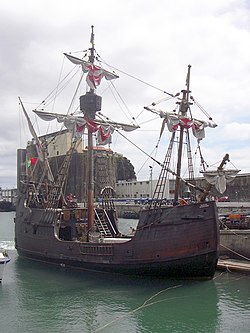 A conjectural replica of La Santa María


On his first voyage (1492–1493) Columbus reached several islands of the Caribbean: Guanahaní (which they named San Salvador), Cuba (Juana) and Santo Domingo (La Española). At La Española his best ship, the "Santa María," ran aground, and with its timber a small fort called "La Navidad" was built. Columbus returned to Spain on the caravel "La Niña."
The Catholic Monarchs, particularly Queen Isabella I of Castile, decided to finance Christopher Columbus in his project of reaching Asia by the west, crossing the Ocean Sea. On April 17, 1492, Columbus signed with the monarchs the Capitulations of Santa Fe, documents by which the expedition of Christopher Columbus to the Indies by sea toward the west was authorized, without being financed. In addition, Columbus was granted a series of privileges and titles, among them: Admiral, Governor, Viceroy and 10% of the riches. Several provisions and decrees were also signed so that he would be assisted in the towns and seaports to which he was heading. One provision was addressed to the town of Palos de la Frontera on account of a penalty imposed on some of the residents of that town.

On May 23, 1492, at the doors of the Church of San Jorge of Palos de la Frontera, in the presence of Christopher Columbus, Friar Juan Pérez and the local authorities, the Royal Provision signed by the Catholic Monarchs was read, in which certain residents of the town of Palos were ordered to place at Columbus's disposal two fully armed and rigged caravels.
Royal Provision of the Catholic Monarchs
ADDRESSED TO CERTAIN RESIDENTS OF PALOS SO THAT THEY DELIVER TWO CARAVELS TO CHRISTOPHER COLUMBUS
Granada, April 30, 1492.
You well know how, for certain things done and committed by you in disservice to us, you were sentenced by those of our Council to be obliged to serve us for two months with two armed caravels at your own cost and expense, whenever and wherever you should be ordered by us, under certain penalties, as is all more fully contained in the said sentence that was given against you. And now, inasmuch as we have ordered Christoval Colón to go with three armed caravels, as our captain of the said three caravels, to certain parts of the Ocean Sea regarding some matters that concern our service, and we wish him to take with him the said two caravels with which you are thus to serve us...
— General Archive of the Indies. Reference: PATRONATO, 295, N.3.[5]
The residents to whom the said provision referred would reply:
... that they were ready to fulfill it in everything and for everything as their Highnesses order...
— Back of the Royal Provision.[5]
but the seamen of the area, who were not bound by the royal provision, were not willing to join the expedition with a stranger, as Columbus was to those men. Regardless of the greater or lesser credibility of Columbus's ideas, the men of Palos would never follow the Genoese unless some navigator respected in the town accompanied him. Faced with the opposition of the residents and the sailors, Columbus resorted to one of the provisions issued by the monarchs in which he was granted permission to recruit sailors from among the imprisoned, although in the end this was not necessary.
He likewise made use of another royal provision, addressed to the towns of the Andalusian coasts:
... the cities and towns and places of the coast of the sea of Andalusia as well as of all our kingdoms and lordships (...) You know that we have ordered Christobal Colon to go with three caravels to certain parts of the Ocean Sea as our captain (...) therefore we order all and each of you in your places and jurisdictions that whenever the said Christobal Colon should need...
— General Archive of the Indies. Reference: PATRONATO, 295, N.4.
He seized two ships in Moguer, in the presence of the Moguer notary Alonso Pardo and by means of a commission addressed to the town of Moguer so that it would comply with the said provision,[6] vessels that were later discarded. But he still failed to enlist the crew needed for the enterprise.
In these circumstances, and thanks to the help of the Franciscans of the Monastery of La Rábida and of Pero Vázquez de la Frontera, an old and respected seaman of the area, Columbus met Martín Alonso Pinzón,[7] a wealthy shipowner and natural leader of the area thanks to his many voyages across both the Atlantic Ocean and the Mediterranean Sea, through which he had amassed fortune and fame. In addition to the encouragement and influence of these friends, the eldest of the Pinzón brothers would also have been convinced by the proposal that, according to the testimony of Alonso Gallego in the Columbian lawsuits, Columbus made to Martín Alonso:
Lord Martín Alonso Pinçón, let us go on this voyage, for if we succeed in it and God reveals lands to us, I promise you by the Royal Crown to share with you as a brother.
Be that as it may, from that moment Martín Alonso began an energetic campaign in favor of the enterprise. He contributed half a million maravedís from his personal fortune, one third of the cash expenses of the enterprise,[8] [9][10][11][12][13][14][15][16] and he convinced his brothers, Francisco and Vicente, and the Niño brothers, a prominent seafaring family of Moguer, with whom it was possible to encourage and enlist all the seamen needed for the enterprise: men from Palos, from neighboring Moguer, from Huelva, from the rest of the district[17][18] and even from outside Andalusia. Seamen who were now indeed willing to risk that voyage, since the fact that Martín Alonso Pinzón, with his brothers and the Niño brothers, were at the head of the said fleet was a guarantee for the men of the Tinto-Odiel area.[19][20]

With the preparations completed, the expedition departed from the Port of Palos on August 3, 1492. Columbus's squadron consisted of the caravels Pinta, Niña and the nao Santa María. La Pinta and La Niña were chosen by the Pinzón brothers and paid for by the Council of Palos, in compliance with the aforementioned royal provision.[21] The crew consisted of approximately 90 men.
The expedition headed for the Canary Islands, where Columbus visited Beatriz de Bobadilla y Ulloa, governor of La Gomera, and on Gran Canaria he also made repairs to the rudder and sails of the Pinta. Once the repairs were finished, he continued his crossing of the Atlantic from the island of La Gomera on September 6.[22]
The arrival in America
Christopher Columbus's voyage was not easy for anyone; in fact there were attempts at mutiny, but thanks to the presence and leadership skills of Martín Alonso Pinzón these situations were resolved. When all the calculations and forecasts made by Columbus had already been exhausted, the famous cry of Rodrigo de Triana, "Land in sight!", was heard from La Pinta, two hours after midnight on October 12.
The summary of Columbus's Diary recounts the moment of arrival at the island of Guanahaní as follows:
Thursday, October 11: Two hours after midnight the land appeared, from which they would be two leagues away; they lowered all the sails and remained with the treo, which is the mainsail without bonnets, and they lay to, waiting until Friday, when they arrived at a small island of the Lucayos, which was called in the language of the Indians Guanahaní. Soon naked people came, and the Admiral went ashore in the armed boat, with Martín Alonso Pinzón and Vicente Yáñez, his brother, who was captain of the Niña. The Admiral brought out the royal banner, and the captains two banners of the Green Cross, which the Admiral carried on all the ships as a sign, with an F and a Y: above each letter its crown, one on one arm of the cross and the other on the other. Once ashore they saw very green trees and many waters and fruits of diverse kinds. The Admiral called the two captains and the others who had gone ashore, and Rodrigo de Escobedo, notary of the whole Armada, and Rodrigo Sánchez de Segovia, and told them to bear faith and witness how he, before all of them, was taking, as in fact he took, possession of the said island for the King and for the Queen his lords, making the declarations that were required, as is more fully contained in the testimonies that were made there in writing. Soon many people of the island gathered there.
The island was inhabited by the Lucayan or Taíno people. The text quoted above marks the first occasion on which Europeans used the term "Indians" to refer generally to the inhabitants of America, a word that derives from the error they made in thinking that the island of Guanahaní was located in the eastern zone of the Asian continent, which the Europeans of that time confused with India. In the logbook, Columbus wrote down his first impression of the natives they found:
Thursday, October 11: What follows are the formal words of the Admiral, in his book of his first voyage and discovery of these Indies. "I," he says, "so that they would feel great friendship toward us, because I knew that they were people who would be better freed and converted to our Holy Faith by love than by force, gave some of them some red caps and some glass beads that they put around their necks, and many other things of little value, with which they were greatly pleased and became so much ours that it was a marvel. They afterward came swimming to the ships' boats where we were, and brought us parrots and cotton thread in skeins and javelins and many other things, and they traded them to us for other things that we gave them, such as little glass beads and hawk's bells. In short, they took everything and gave of what they had with good will. But it seemed to me that they were a people very poor in everything. They all go about naked as their mothers bore them, and the women too, although I saw no more than one, quite a young girl. And all those I saw were young men, for I saw none older than thirty years: very well built, with very handsome bodies and very good faces: their hair coarse, almost like the hairs of a horse's tail, and short: they wear their hair down over their eyebrows, except for a few locks behind that they wear long and never cut. Some of them paint themselves black, and they are the color of the Canarians, neither black nor white, and some of them paint themselves white, and some red, and some with whatever they find, and some paint their faces, and some the whole body, and some only the eyes, and some only the nose. They do not carry arms nor do they know them, for I showed them swords and they took them by the edge and cut themselves out of ignorance. They have no iron: their javelins are rods without iron, and some of them have at the end a fish's tooth, and others other things.
The Taínos had organized a relatively advanced agrarian society, based on the cultivation of maize, cassava and cotton, including other important crops such as peanuts, pepper, pineapple, sweet potato and tobacco. Columbus himself related in his diary that they grew squash and cotton and that they had houses and "orchards of trees."[23]

Taínos and Spaniards exchanged products peacefully, but the former had no possessions of gold, the main product the Spaniards were seeking. The next day the Diary remarked:
Saturday, October 13: I was attentive and worked to learn whether there was gold, and I saw that some of them wore a little piece hanging from a hole they have in the nose. And by signs I was able to understand that, going to the South or going around the island by the South, there was a king there who had great vessels of it, and had very much of it.
However, despite the good relationship between Taínos and Spaniards, Columbus was already thinking, on Guanahaní, of the possibility of enslaving them:
Sunday, October 14: they can all be taken to Castile or held captive on the same island, because with fifty men they will have them all subjugated and will make them do whatever they want.
Columbus's expedition then arrived at the island of Cuba, named Juana, and later at La Española. On December 25 the caravel Santa María ran aground, and with its remains he had the Fort of La Navidad built, in which he left a small garrison.
On January 15, 1493, Columbus made the decision to depart, and on the 16th the caravels Pinta and Niña left La Española bound for Spain. Columbus, in command of the expedition aboard La Niña, carried various objects collected during the expedition, and he was also accompanied by 10 Indians, two of them sons of the cacique Guacanagari. On February 14, 1493, on the return voyage, they encountered a strong storm that nearly wrecked the vessels. In such a difficult situation, Christopher Columbus made the Columbian vow.[24][21] The storms had separated the two caravels. The Pinta was diverted to the port of Bayona, and on March 15 it returned to the port of Palos, with Martín Alonso de Pinzón gravely ill; he finally died on March 31 at La Rábida. Columbus was forced to put in at the Azores islands with La Niña, then returned to the port of Palos on March 15 and afterward went to Moguer, where he fulfilled the vow he had made.[21] He then went to Barcelona to inform the Catholic Monarchs of his discovery.
Second voyage

Christopher Columbus's second voyage set sail from Cádiz on September 24, 1493. The purpose of the expedition was to establish the Spanish presence in the discovered territories and to find the way to India and Cathay. The first island it reached was La Deseada, on November 3; he then discovered Puerto Rico and reached La Española, where he found the Fort of La Navidad destroyed by an offensive of the Carib cacique Caonabo. On the same island he founded Villa Isabela on January 6, 1494. On his second voyage (1493–1496) Columbus discovered the Lesser Antilles (Dominica and Guadeloupe), passed by Puerto Rico (San Juan Bautista) and reached La Española, where he found the small fort of La Navidad destroyed. Very close by, he founded his first city, which he named La Isabela. He then explored Cuba and, sailing south, discovered Jamaica (Santiago).
He continued his voyage of exploration and traveled along the coasts of Juana (Cuba) and Santiago (Jamaica). At the end of 1494 or beginning of 1495 he headed south.
The writings of this voyage recorded some instances of sexual violence against Indigenous women, such as the one related by one of the men of his crew.[25]
After this voyage he devoted himself to consolidating dominion over La Española. In 1496 he returned to Spain, arriving at Cádiz on June 11.
Third voyage


Christopher Columbus's third voyage began on May 30, 1498. Columbus departed from Sanlúcar de Barrameda and reached the island of Trinidad at the end of July. From August 4 to 12 he visited the Gulf of Paria, at the mouth of the Orinoco River, in South America. He named this whole region Tierra de Gracias (Land of Grace), because of the kindness of the natives. He supposed that he had reached a continent because of the great quantity of fresh water. Thus, for the first time, Tierra Firme was reached.
On his third voyage (1498–1500) Columbus discovered the island of Trinidad and the mouth of the Orinoco River in Venezuela (Tierra de Gracia). On returning to La Española he was taken prisoner because of the complaints of Spaniards discontented with his rule. He returned to Spain in chains, where Queen Isabella freed him.
Afterward, he traveled through and explored the three islands of the present-day state of Nueva Esparta; he called the main island Asunción, and the others are the present-day Cubagua and Coche. Later, Cristóbal de la Guerra changed the name of La Asunción to Margarita Island, because of the great quantity of pearls there.
Finally he arrived at La Española. On this island the Spaniards had rebelled because of the lack of the riches they had supposedly been going to find. In one of the negotiations, Columbus proposed to a group of Spaniards that they return to Cubagua for the pearl trade. A pearl-fishing settlement was founded, and later, in 1528, from it arose the first city founded by Spaniards on the American continent, Nueva Cádiz.[26]
Upon the arrival of the royal administrator, Francisco de Bobadilla, Columbus was arrested. He returned to Spain on November 25, 1500, and was set free, but he lost his prestige and his powers.
Fourth voyage


Despite the problems caused by the loss of his powers, Columbus began the fourth and last voyage, although with a series of prohibitions, such as that of landing on La Española. The objective of this voyage was to find a strait, the Strait of Malacca, that would allow him to reach the Indies, to the west of the Antilles, since it was seen that these were not the Indies, although they could not be very far from the lands he had discovered. He left the port of Cádiz with two caravels and two ships: La Capitana, La Gallega, La Vizcaína and the Santiago de Palos, on May 11. Passing through the Canaries, he reached the Indies in 30 days.[27]
On his fourth voyage (1502–1504) Columbus explored the coasts of Central America (Honduras, Nicaragua, Costa Rica and Panama).
Because of the problems that had arisen on La Española, Nicolás de Ovando, the new governor of the colony, did not allow Columbus to land despite an imminent storm, nor to exchange one of his ships for another in better condition. Columbus weathered the storm as best he could and went on to Jamaica, although the storm did not leave him until September 12, 88 days of storm.[28]
Continuing westward, discovering the island of Guanaja, off the coast of Honduras, in Central America, he encountered a vessel with Maya merchants who offered him cacao. At Punta Cajina (today Punta Trujillo) the crew disembarked from their ships to attend the first Catholic Mass celebrated on the mainland of America on August 14.[29] He continued east and was caught by a hurricane; for several weeks the 4 ships were battered by the storm, and on September 12 they rounded a cape. There the storm calmed, and Columbus named it Cabo Gracias a Dios, on the coast of Honduras, saying "Thank God we have finally come out of those depths" (honduras), and from there he sailed south.[30][31]
Several expeditions followed the four Columbian voyages. These were the Minor Voyages, which made it possible to recognize the existence of the American continent and to explore the entire coast of Venezuela.
The minor or Andalusian voyages
In 1499 the Spanish Crown decided to put an end to the monopoly that Columbus held over navigation to the Indies and opened the business to other navigators and entrepreneurs. This gave rise to a series of expeditions called "minor voyages," "voyages of reconnaissance and trade" or also "Andalusian voyages," since all of them were organized in and departed from Andalusia and those who took part in them mostly resided in that region of Spain.[32]
Among the many seamen, the following stood out: Pedro Alonso Niño, discoverer of the coasts of the Gulf of Paria, in Venezuela; Andrés Niño, discoverer of the Central American coasts; Bartolomé Ruiz, discoverer and navigator of the Pacific Ocean who served as pilot on the famous expedition of Francisco Pizarro of the Thirteen of Fame; Friar Antonio de Olivares, founder of the city of San Antonio in Texas; Alonso Vélez de Mendoza, resettler of the island of Santo Domingo; Diego García de Moguer, who took part in the first voyage around the world together with Magellan; Juan Ladrillero, considered the other discoverer of the Strait of Magellan; and Vicente Yáñez Pinzón, discoverer of Brazil,[33][34] Juan Rodríguez Mafra, who took part as pilot of the Nao San Antonio in the voyage of the first trip around the world.[35]
Consequences

The arrival of Christopher Columbus in America is considered one of the most important events in world history because of the consequences it had, and it must be related to the first voyage around the world carried out by the crew of Ferdinand Magellan a few years later, which opened the way to the conquest of the world by Europe.
Long-term consequences

The arrival of Christopher Columbus made possible the beginning of the Conquest of America, whose first campaign was the one the Spaniards undertook in Cuba, under Velázquez. It was followed by the two most important ones: that of the Aztec Empire, by Hernán Cortés, and that of the Inca Empire (by Francisco Pizarro), as well as others until its definitive end after the decrees of King Philip II abolishing conquest. From them began the "colonization of America," in which the Portuguese, English, Dutch and French also took part.
The contagion of the diseases that the Europeans brought with them (smallpox, typhus, yellow fever, etc.) caused a collapse of the Indigenous population of America, with a great impact on mortality. Likewise, diseases came from the Americas, such as the once-feared syphilis, which decimated the European population from the Spanish possessions in Italy in 1494.
Although all the European powers made their languages compulsory in their respective territories, owing to the hegemony that Spain and Portugal exercised over America, the Spanish and Portuguese languages predominated in their respective zones of influence. Spain, however, allowed the use of several Indian languages such as Quechua and Guaraní. For its part, the Catholic religion became official, and the conversion of the natives was one of the causes of the conquest; in addition, a population arose with high levels of genetic and cultural mixing among the original peoples, the Europeans and the sub-Saharan Africans.
The main wealth generated by the Spanish territories in America was the extraction of gold and silver. Initially the Spaniards found mostly gold, and the quantities sent to Spain were small: until 1514 some 40,000 or 50,000 pesos arrived annually from La Española, another 11,000 from San Juan and smaller amounts from Cuba and Tierra Firme.[36] The conquest of the Aztec and Inca empires yielded large hauls of gold on specific occasions. However, it was the opening of silver mines in Mexico and, above all, in Potosí from 1545 onward that multiplied the production and export of precious metals. It has been calculated that up to 1660 some 16,600 tons of silver and 181 tons of gold were sent to Spain, including both private remittances and taxes to the Crown. This unleashed a price revolution in Europe and allowed the Hispanic Monarchy to finance the numerous wars in which it became involved.[37][38] Nevertheless, most of the silver and gold, around 80%, remained in Spanish America.[39]
Another important consequence of the arrival of the Europeans in America was the assimilation and worldwide spread of the foods that had been consumed by the American cultures and that today are estimated to constitute 75% of the food base consumed by Humanity. They are maize, sweet potato, squash, tomato, chocolate, peanuts, vanilla, chili peppers, and avocado, all of them originating in Mesoamerica, rightly named by the conquistadors "the horn of plenty," and the potato (or patata as it is called in Spain), originating among the native peoples of the Andes. Other important products originating in America are rubber and tobacco.[40]
On the other hand, first the Spaniards and later the Europeans brought with them to America such useful animals as the horse, the burro, the ass and other livestock such as the Castilian cow, the ox, the sheep and farm animals such as the pig, the hen/rooster, the rabbit... As well as certain fruit trees, barley, oats, rye and wheat from the Iberian Peninsula and sugarcane from the Canary Islands or Madeira, which was so successful in the Caribbean, or even coffee from the Portuguese colonies in Africa.[41]
Columbus's arrival in America also caused a great expansion of navigation and trade among peoples, which became worldwide.
The English colonists in America ended up organizing, from 1776 onward, a new type of society based on novel concepts such as independence, constitution and federalism, and gave rise to the United States of America, which, in the 20th century, replaced Great Britain as the dominant world power.
Not everything was horror: on the ruins of the pre-Columbian world the Spaniards and the Portuguese raised a grandiose historical construction that, in its broad outlines, is still standing. They united many peoples who spoke different languages, worshipped different gods, made war among themselves or did not know one another. They united them through laws and juridical and political institutions but, above all, through language, culture and religion. If the losses were enormous, the gains have been immense.
To judge fairly the work of the Spaniards in Mexico, it must be emphasized that without them ―I mean: without the Catholic religion and the culture they established in our country― we would not be what we are. We would probably be a collection of peoples divided by different beliefs, languages and cultures.[42]
— Octavio Paz, 1995
The terminological debate
The expression "discovery of America" to refer to the arrival of Christopher Columbus on the American continent is criticized by various sectors, cultures and scholars, giving rise to a broad and passionate debate. This confrontation has been closely linked to the use of the terms Día de la Raza, Día de la Hispanidad, Day of Indigenous Resistance and others created to refer to the same event. The debate became widespread in 1992, on the occasion of the fifth centenary of Columbus's arrival in America.
The Argentine philosopher Santiago Kovadloff said in this regard:
Another October 12 is approaching, and the echoes of the controversy unleashed in 1992 still linger. On the five hundredth anniversary of the arrival of the Spaniards in America, the discussion erupted; until then it had perhaps been less strident, but no less passionate. How should what happened be designated? Discovery? Encounter of cultures? Usurpation? Conquest? A range of interpretive possibilities and impossibilities has been unfolding fervently from then until today. The disagreement encouraged endless confrontations. If the transcendence of the event recalled is indisputable, its characterization, unsatisfactory for one reason or another, proves the difficulty of generating consensus where it is so badly needed. After all, if it falls to names, as Aristotle teaches, to state the properties of things, the disorientation in achieving convergence on this matter shows that, even now, those whom the question concerns are still talking about different things.
— Santiago Kovadloff[43]
Various positions have been developed on how to name the event:
- Traditional position: this is the majority position, used since the end of the 16th century, first in Western culture and later spread throughout the world, which uses the term "discovery of America" to refer exclusively to the act carried out by Columbus on October 12, 1492, upon reaching the island of Guanahaní leading the Spanish expedition embarked on the famous three caravels, on his first voyage. The traditional position has its origin in the "myth of the original pilot," already present in the testimonies of Father Bartolomé de las Casas, later modified by Ferdinand Columbus in the biography of his father, Vida del almirante, published in 1571 (see O'Gorman).
- Expanded traditional position: without abandoning the traditional position, it disputes the original scope and holds that the term should be extended to all of Columbus's voyages to America, that is, to his four voyages, since it understands the term "discovery of America" not as an act but as a stage, the first of Europe's overseas expansion, followed by two other stages: the conquest and the colonization.
- Modified traditional position: it holds that it is incorrect to apply the term "discovery of America" to any of the acts carried out by Columbus and his men, and that this name should be reserved for the moment when the first European "discovered" that Columbus had reached lands unknown until then to the European, African, Asian and Polynesian cultures of the 15th century. This moment is also disputed, but there is a certain consensus in attributing it to the Italian Amerigo Vespucci, from whose name the Europeans called that continent "America."
- Chronological position: it holds that the term "discovery," plain and simple, or "first discovery," should be reserved for the first human being to accomplish it, and in the case under debate, for the first human beings to populate the American continent; it is the position used by some archaeologists, anthropologists and historians, such as William Dancey (of Ohio University),[44] and it admits successive designations such as "first discovery," "second discovery," "third discovery," "fourth discovery" of America, to refer to the arrivals of the first human beings, and then of the Inuit, Vikings/Europeans and Spaniards/Europeans, respectively.
- Modified European Viking chronological position: it rejects the application of the term "discovery of America" to the arrival of Columbus because it holds that the first Europeans to reach America were the Vikings, and the term should be applied to the arrival in America of Leif Eriksson in 985 (c.).
- Modified modern European chronological position: it holds that there were other modern Europeans who discovered America before the arrival of Columbus, such as the hypothesis of Alonso Sánchez de Huelva.
- Modified non-European chronological position: it holds that before any European people there were other non-European peoples who reached America after the Siberians and Inuit. The cases vary among the Chinese, Polynesians, Phoenicians, Egyptians, Mandinkas and Moroccans.
- Ethnological position: it holds that the "discovery" made by each culture or ethnic group under conditions of isolation can be considered a "discovery." In this way, both the original arrival of the Siberians in America and eventually of other ethnic groups, as well as the later arrivals of the Inuit, the Vikings and the Spaniards, meant a "discovery" for each of those ethnic groups or cultures. In this case, it proposes adding to the term "discovery" the ethnic group or culture for which it is significant, speaking of "discovery of America by the Vikings" or "discovery of America by medieval Europeans," etc.[45] An example of this position is the book The American Discovery of Europe, by Jack D. Forbes, 2006. This position also opened the way to the concept of the "discovery of Europe" by the Indigenous cultures, whose existence they also did not know of, a concept used by some historians such as Daniel Richter (University of Pennsylvania, in Native American Discoveries of Europe) or by the State of Chile, which calls October 12 the Day of the Discovery of Two Worlds.
- Pluralist position: it accepts that for various social, ethnic, linguistic and cultural groups, the term "discovery of America" has multiple meanings, without taking sides with any of them.
- Indigenist/anticolonialist position: it is held by several Indigenous American peoples who question the term "discovery of America," considering it a Eurocentric designation that ignores the presence of their ancestors in America at the time of the arrival of the Spaniards, giving priority to the idea of America as "lands" rather than as peoples, in order to culturally legitimize the subsequent domination and colonization to which they were subjected. Sectors opposed to colonialism and neocolonialism, for whom the term is an expression of cultural colonialism, agree with this position. In general they have proposed alternative terms such as "invasion of America" or "Day of Resistance," among others.
- Hispanist position: it rejects as an act of "indigenism" (in a pejorative sense), and considers an attack against Hispanidad, any questioning of the term "discovery of America" that does not mean the arrival of the Spaniards in America with Columbus. For this position, the term and the fact it expresses are linked to the superiority of Hispanic, Western and Christian culture over the others. It was originally linked to the invention in 1915 of the controversial "Día de la Raza" as the Day of Hispanidad and of the Spanish Race, for October 12, although later several countries tempered its meaning to relate it to a supposed mestizo race. It was intensely promoted by some Latin American governments in the seventies.
- Conciliatory position: it proposes reconciling the indigenist/anticolonialist positions with the Hispanist one, holding that rather than placing emphasis on the greater or lesser violence that may have characterized the arrival of the Spaniards in America, what should be highlighted is the fact of the encounter between two groups of human cultures that had lived separated for millennia. It proposes calling the fact of Columbus's arrival in America the "Encounter of Two Worlds" or "Encounter of Two Cultures."[46]
- National positions: these positions have begun to appear as official positions regarding October 12, 1492 and its designation, in many cases rejecting or limiting the designation "discovery of America." In Argentina, for example, for INADI (National Institute against Discrimination), "the idea of discovery and the praise of the Spanish conquest" violates the Convention on the Elimination of All Forms of Racial Discrimination and constitutes an act of discrimination.[47]
Commemorations of the discovery
Until the 19th century the anniversary of the discovery went relatively unnoticed. The first great international official celebration took place in 1892, with the Celebration of the Fourth Centenary of the Discovery of America.
A century later, in 1992, the Celebration of the Fifth Centenary of the Discovery of America took place, bringing together a large number of commemorative events and debates on the meaning and consequences of the event. Spain organized the Universal Exposition of Seville, which coincided in time with the Barcelona Olympics. The Columbian Sites carried out restoration work on their main monuments, and a voyage was made repeating Christopher Columbus's first voyage to America with replicas of the original ships (the Pinta, the Niña and the Santa María) built using traditional methods in the Spanish riverside shipyards of Isla Cristina, Cartagena and Barcelona, respectively.
In 2017 the celebrations of the 525th anniversary of the Discovery of America were held. For this purpose, the Provincial Council of Huelva set up a Commission[48] in charge of developing cultural, sporting, academic, tourist, institutional and civic-awareness activities, under the name 525th anniversary of the encounter between two worlds. In the Columbian Sites the local celebrations are called 525th Anniversary of the Discovery of America and included a multitude of commemorative events, recalling the key participation of Palos de la Frontera, its Monastery of La Rábida and Moguer in the Discovery of America.
See also
- Columbian exchange
- Viking settlements in the Americas
- Letters announcing the discovery of the Indies
- Treaty of Tordesillas
- Conquest of America
- Día de la Raza
- Age of Discovery
- History of the Americas
- Peopling of the Americas
- 1421 hypothesis
References
- ↑ McCartney, A.P. & D.J. Mack (1992) "Iron UtVikings.
- ↑ Crosby, Alfred (2003). The Columbian Exchange: Biological and Cultural Consequences of 1492. Westport, Connecticut: Praeger. p. 184.
- ↑ Nunn, Nathan; Qian, Nancy (2010). "The Columbian Exchange: A History of Disease, Food, and Ideas". Journal of Economic Perspectives. 24 (2): 163–188. doi:10.1257/jep.24.2.163. JSTOR 25703506.
{{cite journal}}: CS1 maint: unflagged free DOI (link) - ↑ Misterios de la Historia - Capítulo 11: África en América (YouTube).
- ↑ 5.0 5.1 Transcripción completa de la Real provisión, dada a Diego Rodríguez Prieto y otros vecinos de Palos. In Old Castilian.
- ↑ Comisión al contino Juan de Peñalosa, para que haga cumplir en la villa de Moguer, una cédula de SS. AA., ordenando se entreguen a Cristóbal Colón, donde y cuando las pidiese, tres carabelas armadas y equipadas. General Archive of Simancas. Reference: RGS,149206,1.
- ↑ Fernández Duro, Cesareo (1883). Colón y Pinzón (in español). Real Academia de la Historia. pp. 91–92.
- ↑ de las Casas, "Volume I. Chapter XXXIV, p. 256."
- ↑ Asensio, José María. Martín Alonso Pinzón: Estudio histórico (in español). La España Moderna, 1892. pp. 66–68.
- ↑ Manzano y Manzano, Juan; Manzano Fernández-Heredia, Ana María (1988). Los Pinzones y el Descubrimiento de América. 3 vols (in español). Madrid: Ediciones de Cultura Hispánica. ISBN 978-84-7232-442-8.
{{cite book}}: CS1 maint: multiple names: authors list (link) - ↑ Ortega 1926, pp. 37–110
- ↑ Rivera, Carlos (1945). Martin Alonso Pinzón (in español). Ayamonte (Huelva): Imprenta Asilio Provincial.
- ↑ "Historia de la navegación: Martín Alonso Pinzón" (in español). www.mgar.net. Retrieved April 23, 2009.
- ↑ Fernández Duro, Cesáreo. "Pinzón, en el descubrimiento de las Índias" (PDF). La ilustración española y americana. Año XXXVI, Núm. III. Madrid 22 de enero de 1892 (in español). Retrieved April 23, 2009.
- ↑ Izquierdo Labrado, Julio. "Martín Alonso Pinzón" (in español). es.geocites.com. Archived from the original on June 6, 2004. Retrieved April 23, 2009.
- ↑ Alonso Pinzón, Marin (1992). "Amputaciones históricas" (in español). México: Ediciones Especiales (Pensylvania: Universidad de Millersville). Archived from the original on April 4, 2009. Retrieved April 23, 2009.
- ↑ Ibarra y Rodríguez, Eduardo (1892). Don Fernando el Católico y el descubrimiento de América (in español). Imprenta de Fortaner, Madrid. pp. 184.
- ↑ Menéndez-Pidal, Gonzalo. "Tres puntos finales, Cristóbal Colón". Hacia una nueva imagen del mundo (in español). Centro de Estudios Políticos y Constitucionales, 2003. ISBN 978-84-259-1245-0.
- ↑ Díaz-Trechuelo Spínola 2006, pp. 77–78
- ↑ Suárez Fernández, Luis (1990). Los reyes católicos (in español). Ediciones Rialp. pp. M1 247. ISBN 9788432125850. Archived from the original on October 28, 2014. Retrieved May 20, 2009.
- ↑ 21.0 21.1 21.2 González Cruz, David (2012). Descubridores de América, Colón, los marinos y los puertos (in español). Silex Ediciones. ISBN 978-84-7737-739-9.
- ↑ Thursday, August 9.
Until Sunday night the Admiral could not make La Gomera, and Martín Alonso remained on that coast of Gran Canaria by order of the Admiral, because he could not sail. Afterward the Admiral returned to Gran Canaria, and they repaired the Pinta very well with much labor and diligence on the part of the Admiral, Martín Alonso and the others; and in the end they came to La Gomera. They saw great fire coming out of the mountain of the island of Tenerife, which is extremely high. They made the Pinta square-rigged, because she was lateen-rigged; he returned to La Gomera on Sunday, September 2, with the Pinta repaired.
— Libro de la primera navegación y descubrimiento de las Indias. Columbus, Christopher. Abridged account by Friar Bartolomé de Las Casas.
- ↑ Keegan, William F. (1992). The People Who Discovered Columbus: The Prehistory of the Bahamas. Gainesville: University Press of Florida. ISBN 978-0-8130-1137-0.
{{cite book}}: CS1 maint: publisher location (link) - ↑ "Diario de a bordo. Cristóbal Colón. Primer viaje América". ArteHistoria (in español). Archived from the original on October 16, 2013. Retrieved July 18, 2013.
- ↑ Michel de Cúneo Cristóbal, and others: Cronistas de Indias: antología. Buenos Aires: Ediciones del Pensamiento Nacional, 1982. ISBN 950-581-020-2.
While I was in the boat, I captured a very beautiful Carib woman, whom the aforementioned Admiral gave to me, and after I had taken her to my cabin, she being naked as is their custom, I felt the desire to take my pleasure with her. I wanted to fulfill my desire, but she did not consent and gave me such treatment with her nails that I would have preferred never to have begun. But seeing this (and to tell you everything to the end), I took a rope and whipped her, after which she let out great screams, such that you would not have believed your ears. Finally we came to such an agreement that I can tell you she seemed to have been raised in a school for whores.
— Michel de Cúneo
- ↑ Cruxent, J. M. (1972). "VI Conferencia Geológica del Caribe. Noticias de Cubagua" (in español). Margarita, Venezuela.
- ↑ Diarios de Colón[dead link]. Study carried out by the Biblioteca Cervantes.
- ↑ Apuntes de Historia y Geografía para uso del 4o grado de primaria, page 6. 1963.
- ↑ Libro Almanaque Escuela Para Todos 2005, page 53.
- ↑ Book of the La Salle Collection, section Historia patria, lesson 7, Cristóbal Colón en Nicaragua, page 79. 1950s.
- ↑ Soler Pascual, Emilio. "Exploradores, cronistas o historiadores españoles o al servicio de España por los territorios del Nuevo Mundo y el Pacífico: Cristóbal Colón" (in español). Biblioteca Virtual Miguel de Cervantes. Archived from the original on August 28, 2010. Retrieved October 14, 2007.
- ↑ Laviana Cuetos, María Luisa. "Los viajes andaluces" (in español). ArteHistoria. Archived from the original on November 30, 2009. Retrieved March 28, 2010.
- ↑ dialnet.unirioja.es. "El descubrimiento del Brasil por Vicente Yáñez Pinzón: el cabo de Santo Agostinho" (in español). Universidad de la Rioja. Retrieved December 25, 2007.
- ↑ "Os espanhóis no Brasil - séculos XV e XVI". www.ibge.gov.br (in português). Ministério do Planejamento, Orçamento e Gestão. Instituto Brasileiro de Geografia e Estatística. Archived from the original on February 11, 2008. Retrieved December 25, 2007.
- ↑ Izquierdo Labrado, Julio. "Juan Rodríguez Mafra. Un piloto de Palos en el viaje de Magallanes" (in español). Archived from the original on May 23, 2004. Retrieved June 5, 2008.
- ↑ Gil, Juan (1984). "Las cuentas de Cristóbal Colón". Anuario de Estudios Americanos (in español) (41): 425–511.
- ↑ Hamilton, Earl J. (May 1929). "Imports of American Gold and Silver Into Spain, 1503-1660" (PDF). The Quarterly Journal of Economics. 43 (3): 436–472. Retrieved August 21, 2016.
- ↑ «Una visión crítica de la conquista», article by Bernardo Veksler on the website Argenpress, 2006.
- ↑ del Rey, Miguel; Canales, Carlos. "El oro de América. Acabar con una leyenda". Clío Historia (in español). año 15 (177): 34–47.
- ↑ Thomas Mann: 1491. Madrid: Taurus, 2006.
- ↑ National Geographic Magazine, February (1992).
- ↑ Octavio Paz: Vislumbres de la India (p. 116). Barcelona: Seix Barral, 1995.
- ↑ «El día del descubrimiento del otro», article by the philosopher Santiago Kovadloff in the Buenos Aires newspaper La Nación of October 1, 2006.
- ↑ William S. Dancey (editor): The first discovery of america: archaeological evidence of the early inhabitants of the Ohio Area. Columbus: The Ohio Archaeological Council, 1994.
- ↑ According to the historian Julio Izquierdo:
... to discover is not only to arrive; it is to take possession, to record names, to leave evidence that one has arrived, to have a notary draw up a record of the event, to know with greater or lesser accuracy where one has arrived, to measure, to map, and, above all, to inform kings, cosmographers, chroniclers, seamen, to name a few occupations, and the general public, in such a way that the lands that have been reached are incorporated into the general knowledge of the culture, of the civilization that sends that expedition. That is discovering.
Julio Izquierdo Labrado: «El descubrimiento del Brasil por Vicente Yáñez Pinzón: el cabo de Santo Agostinho», in Huelva en su Historia, volume 1, pp. 71–94. Universidad de Huelva, 2005. ISSN 1136-6877, X DL: S-122-1997. - ↑ «Ni leyenda negra ni leyenda blanca», article by the Argentine writer Ernesto Sabato in the Madrid newspaper El País of January 2, 1991.
- ↑ «Día de la Raza: el INADI quiere eliminar el feriado nacional del 12 de octubre».
- ↑ "Comité Organizador del 525 Aniversario". Web del 525 aniversario del encuentro entre dos mundos (in español). Retrieved January 18, 2017.
Bibliography
- de las Casas, Bartolomé. Historia de las Indias (in español). Madrid: Imprenta de Miguel Ginesta, 1875. Edición del Marqués de la Fuensanta del Valle.
- Ortega, Fray Ángel (1926). La Rábida. Historia documental crítica (in español). Imprenta y Editorial de San Antonio. ISBN 978-84-500-3860-6.
{{cite book}}: ISBN / Date incompatibility (help) - Manzano Manzano, Juan. Colón descubrió América del Sur en 1494. Caracas: Academia Nacional de la Historia, 1972.
- Röhl, Eduardo. Historia de las ciencias geográficas de Venezuela (1498-1948). Caracas: Héctor Pérez Marchelli, Talleres Gráficos Cromotip, 1990.
- Armillas, «Descubrimiento y contactos con otros mundos», in Floristán, Historia Moderna Universal, Ariel.
- Mann, Thomas (2006). 1491 (in español). Madrid: Taurus. ISBN 84-306-0611-4.
{{cite book}}: CS1 maint: publisher location (link) - Díaz-Trechuelo Spínola, María Lourdes (2006). Cristóbal Colón (in español) (Second ed.). Ediciones Palabra. ISBN 9788498400205.
- Fazio, Mariano (2009). La América ingenua (in español). Ediciones Rialp. ISBN 9788432137198.
- Sánchez González, Antonio (2006). Medinaceli y Colón. El Puerto de Santa María como alternativa del viaje de Descubrimiento (in español). El Puerto de Santa María: Ayuntamiento. ISBN 84-89141-90-8.
External links

- Works about the Discovery of America on Spanish Wikisource.
- El Descubrimiento de América en Historia del Nuevo Mundo. (in Spanish)


