| Content from Wikipedia under the CC BY-SA 4.0 license ⇔ Maps from OpenStreetMap under the ODbL license |
Ferdinand Magellan
Ferdinand Magellan | |
|---|---|
| Error creating thumbnail: Portrait of Ferdinand Magellan. Oil on canvas (72 x 61 cm), anonymous.[lower-alpha 1][1] | |
| Born | February 4, 1480 |
| Died | April 27, 1521 (aged 41) |
| Occupations | Navigator, explorer |
| Signature | |
 | |

Ferdinand Magellan (in Spanish Fernando de Magallanes, also known as Hernando de Magallanes; in Portuguese, Fernão de Magalhães; Sabrosa, February 4, 1480 – Mactan, April 27, 1521)[2] was a Portuguese soldier, explorer, mariner and navigator of noble lineage.
In the service of Charles I, in 1519 he began what is known as the Magellan–Elcano expedition to reach the East Indies by crossing the Pacific Ocean with the purpose of opening a trade route, during which he discovered the natural navigable channel that today bears the name of the Strait of Magellan, making the first navigation of European origin from the Atlantic Ocean to the Pacific Ocean, until then called the South Sea.
This expedition, during which Magellan died in 1521 in the Philippines, became the first circumnavigation of the Earth when one of its naos, captained by Juan Sebastián Elcano, returned to Spain in 1522, after Elcano decided to return by sailing westward across the Indian Ocean and around Africa.[lower-alpha 2]
Biography
Origins and family

Magellan was born in northern Portugal on February 4, 1480, into a Portuguese noble family.[3] His exact place of birth is disputed among the freguesia of Sé in Porto, Vila Nova de Gaia, Ponte da Barca and Sabrosa.[lower-alpha 3]
He was the son of Rui de Magallanes and his first wife Alda de Mesquita. He was the brother of Duarte de Sousa, Diogo de Sousa, Isabel de Magalhães, Genebra de Magalhães and Aires de Magalhães. Ferdinand's father, Rui de Magalhães, was a knight-hidalgo of the household of D. Afonso, Count of Faro, Lord of Aveiro and Alcalde Mayor of Estremoz. Rui was Alcalde of Aveiro, where he is documented in 1486; between 1472 and 1478 he held the offices of ordinary judge, procurator of the council and alderman in Porto. His brother Aires de Magalhães followed an ecclesiastical career, receiving the subdiaconate in Braga in 1509.
Magellan was about ten years old when he entered service as a page at the court of Queen Eleanor, consort of John II of Portugal. In 1515 he married in Seville Beatriz Barbosa, a relative of his, daughter of Diogo Barbosa and María Caldeira, and had two sons: Rodrigo, who died very young in October 1522, and Carlos, who died at birth. Beatriz Barbosa also died shortly afterward, in March 1522.[4]
Early voyages
In March 1505 he enlisted in the Armada of India, in the fleet of twenty ships sent to install Francisco de Almeida as the first Viceroy of India. Although his name does not appear in the chronicles, it is known that he remained there for eight years and that he was in Goa, Cochin and Kilwa. He took part in several military actions, including the naval battle of Cannanore (Kerala), where he was wounded, and the decisive Battle of Diu. In 1509 he set out on the first expedition to Malacca commanded by Diogo Lopes de Sequeira, together with Francisco Serrão, his friend and possibly his cousin.[5] Having arrived at Malacca in September, they fell victim to a conspiracy and the expedition ended in flight, leaving behind nineteen prisoners. Magellan played a crucial role by warning Sequeira and rescuing Serrão, who had gone ashore, acts that earned him honors and a promotion.
In the service of the new Governor, Afonso de Albuquerque, he took part together with Serrão in the conquest of Malacca in 1511. After the conquest of the city, the friends' paths parted: Magellan, promoted, with rich booty and in the company of a slave acquired in Sumatra, Enrique of Malacca, returned to Europe. Serrão left on the first expedition sent to the "Spice Islands", the Moluccas. He remained there and married a woman from Amboina, becoming military adviser to the Sultan of Ternate. His letters to Magellan would be decisive, since from them he obtained information about the location of the spice-producing places.
Meanwhile Magellan, after taking part in the Battle of Azemmour (Morocco), and already on duty in that city, was accused of trading illegally with the Moors; when several of the accusations were proven, offers of employment ceased from May 15, 1514. Later, in 1515, he was offered a place in the crew of a Portuguese ship, but he turned down the offer. Back in Lisbon, he devoted himself to studying the most recent charts, investigating together with the cosmographer Rui Faleiro a passage to the Pacific through the South Atlantic and the possibility that the Moluccas lay in the Spanish zone defined in the Treaty of Tordesillas.
Expedition to the Moluccas
| Ship | Tonnage [6] | Crew [7] |
| Trinidad | 110 | 62 |
| San Antonio | 120 | 57 |
| Concepción | 90 | 44 |
| Victoria | 85 | 45 |
| Santiago | 75 | 33 |
| Total: 239 |
Preparations for the expedition
In 1517 he went to Seville with Rui Faleiro and found in Juan de Aranda, the Factor of the Sevillian Casa de Contratación, an important ally for the project he had conceived: to give Spain the possibility of reaching the Moluccas from the west, without crossing seas reserved to the Portuguese by the Treaty of Tordesillas and, in addition, according to Faleiro, to prove that the "Spice Islands" lay in the Castilian hemisphere. With the influence of Juan Rodríguez de Fonseca, Bishop of Burgos, they obtained the approval of King Charles I.
On March 22, 1518, Charles I appointed Magellan and Faleiro admirals so that they might set out in search of the "Spice Islands", and in July he raised them to the rank of Commanders of the Order of Santiago and granted them a set of privileges:[8]
- The monopoly of the discovered route for a term of ten years.
- Appointment as Governors of the lands and islands that might be found, with five percent of the resulting net profits.
- One twentieth of the profits of the voyage.
- The right to retain one thousand ducats on subsequent voyages, paying only five percent on the surplus.
- The grant of one island to each of them, except among the six richest, of which they would receive no more than one fifteenth.
The slow preparations for the voyage began, and they were plagued by incidents: insufficient funds, maneuvers by the King of Portugal, Manuel I, who sought to have them imprisoned, the distrust of the Castilians toward Magellan and the other Portuguese involved, not to mention Faleiro's difficult character.[9] Through the Bishop of Burgos, they obtained the participation of the merchant Cristóbal de Haro, who supplied part of the funds and the merchandise to be traded for spices. The Portuguese cartographer Diego Ribero, in the service of the Casa de Contratación since 1518, took part in the development of the maps used on the voyage.
After breaking with Faleiro, Magellan continued fitting out the ships that were to depart from Seville. The crew was made up of sailors of very diverse origins, mainly Spaniards from almost every region. Among the few Portuguese sailors were Álvaro de Mezquita, Magellan's first cousin, Duarte Barbosa, cousin of Magellan's wife, Juan Serrano, cousin or brother of Francisco Serrano, and Esteban Gómez. Magellan was also accompanied by his slave Enrique of Malacca,[lower-alpha 4] who according to some sources would be the first person to circumnavigate the planet.[10]
Antonio Pigafetta, a Venetian chronicler and geographer who took part in the expedition at his own expense, wrote a complete diary of the voyage, made possible by the fact that he was one of the few travelers to return alive to Europe. In this way, he bequeathed to posterity a rare and important record from which much of what is known about this episode of history can be drawn.
Start of the voyage
On August 10, 1519, the squadron of five ships, captained by Ferdinand Magellan, departed from Seville and, descending the Guadalquivir, reached Sanlúcar de Barrameda (Cádiz). During the following weeks, the squadron finished being supplied (victualed, in the words of the time) and other matters were resolved. Meanwhile, Magellan himself made his will in Seville on August 24, naming as heirs his son Rodrigo and the children his wife, whom he was leaving pregnant, might bear.[11][12]
On September 20 the expedition finally set sail from Sanlúcar, with the intention of finding the sea passage to the territories of the East Indies and seeking the route that, always crossing Castilian seas (according to the Treaty of Tordesillas), would reach the Spice Islands, which was the so-called westward route that Christopher Columbus had already sought.

Crossing the Atlantic
After calling at the Canary Islands, they passed the islands of Cape Verde and the coasts of Sierra Leone, touching the lands of what is today Rio de Janeiro on December 13, 1519. They continued south, passing the Río de la Plata (already discovered by Juan Díaz de Solís in 1516) in March 1520, and reached the San Julián Bay, which they explored in search of a possible passage. Magellan, in view of the arrival of winter, decided to put in there until spring.
Impact in Brazil
Ferdinand Magellan's expedition remained only a short time in Brazil. The fleet first anchored at Cape of Santo Agostinho, in Pernambuco, on November 29, 1519. This was a brief stay intended to supply its naos. Some time later the expedition reached Guanabara Bay, where it remained for two weeks, from December 13 to 26 of the same year. The stays on the coast of Brazil were brief because they were not authorized to put in at Portuguese territories under the Treaty of Tordesillas. During the passage through Brazil, the sailors maintained contact with the Tupi peoples who inhabited the coast. They established trade relations with the Indians, usually known as barter.[13] They bought fresh and varied produce in exchange for European objects. Some of these transactions were recorded by the chronicler of the expedition, the Venetian Antonio Pigafetta.[14]

Like every global historical event, the first voyage of circumnavigation of the Earth had an impact on the places it passed through, and Brazil was no different. The Brazilian Navy retraced the voyage in the 19th century with the Corvette Vital de Oliveira,[15] beginning the journey in 1879. A few years later, the Navy retraced the route again, but this time with the ship Almirante Barroso (1888–1890), whose objective was to provide instruction to a class of midshipmen formed in 1886. This voyage covered 36,691 nautical miles and was recorded in a book written by its commander. A curious event occurred during the journey. Because of the Proclamation of the Republic in Brazil, the Emperor's grandson, the second Lieutenant of the Imperial Navy, Prince Dom Augusto Leopoldo, who was to be part of the crew, had to disembark in Colombo (Sri Lanka).[16] The Navy has a special interest in the subject, which it reflects in several sections of the Institution, above all in the Directorate of Historical Heritage and Documentation of the Navy (DPHDM). In the Naval Museum of Rio de Janeiro there is a reference to the expedition at the entrance to the permanent exhibition, as well as 16th-century artifacts, including navigational instruments. In addition, articles on the importance of Ferdinand Magellan in the art of navigation, as well as on the later commemorations of his voyage, above all the fourth centenary, were published in the Revista Marítima Brasileira.
The voyage was also retraced by the Schürmann family, famous Brazilian sailors, as part of the Magellan Global Adventure expedition. They set out on November 23, 1997, aboard the sailboat Aysso, covering 32,657 miles over 912 days. The voyage concluded with their arrival in Lisbon in time for the commemorations of the 500th anniversary of the Discovery of Brazil. The adventure was recorded in the documentary The World in Two Laps (O Mundo em Duas Voltas). On the occasion of the family's voyage, the samba school Embaixada Copa Lord, a member of the League of Samba Schools of Florianópolis (LIESF), paid tribute to Magellan's expedition in 2001. The samba theme, titled "Wind in symphony, the Schürmann Family will set sail" (Vento em sinfonia, a Família Schürmann vai zarpar), won second place in the parade.
Ferdinand Magellan also inspired some Brazilian cultural productions, which dealt with his story and his participation in the circumnavigation. A comic book from the "Discovery" series, published in 1959 by Editora EBAL, tells his biography. The collection "Biography in Comics" (Biografias em Quadrinhos) had an educational character, seeking to change the perception that this literary form had until then. Magellan's influence endured in Brazilian society for several decades. He was, for example, honored by "Imperial Hawks" (Gaviões Imperiais), a virtual samba school that presented the theme twice, in 2009 and in 2015. The parade tells the story of the circumnavigation, and its title is "Through seas never before sailed... The dream of Ferdinand Magellan" (Por Mares Nunca Antes Navegados... O sonho de Fernão de Magalhães).[17] The school is a member of the Independent League of Virtual Schools (LIESV).
On the occasion of the commemorations of the 5th Centenary of the voyage, a series of initiatives were carried out in Brazil, above all in Rio de Janeiro. The Portuguese Navy held various events related to the anniversary. The first took place in October 2019, the Maritime History Symposium "For a Maritime History and its prospects in the Brazilian historiographical field" (Por uma História Marítima e suas perspectivas no campo historiográfico brasileiro)[18] held at the Brazilian Historical and Geographical Institute (IHGB). In the same year, Brazil hosted the international seminar on the "5th Centenary of the first voyage around the world: the stay of the fleet in Rio de Janeiro" (5.º Centenário da primeira volta ao mundo: a estadia da frota no Rio de Janeiro). Held at the National Historical Museum, it was attended by Spanish, Portuguese, Brazilian and other Latin American historians. In 2020, a ceremony attended by Portuguese and Brazilian authorities gave the name "Circumnavigation Square" (Praça da Circum-Navegação) to a place near Guanabara Bay, beside the Rio Star, the largest Ferris wheel in Latin America, alluding to the voyage around the world and to the reinforcement of the round nature of the Earth, a result of the voyage of circumnavigation.
Rebellion during the winter in Patagonia
The desire to return from what was considered a failure for not having found the passage to the Moluccas, together with the inhospitable nature of the place and the sailing conditions, provoked discontent among the crew.
They had barely anchored in the port of San Julián when the captains of the other four ships plotted a mutiny to kill the Commander-in-Chief. The conspirators were: Juan de Cartagena, veedor (inspector); Luis de Mendoza, treasurer; Antonio de Coca, accountant; Gaspar de Quesada, Captain of the Concepción. When the plot failed, Magellan sentenced Gaspar de Quesada to death and ordered his corpse to be quartered together with that of Luis de Mendoza, who had died during the revolt. Juan de Cartagena was abandoned ashore, together with the cleric Sánchez de Reina, when the expedition set sail from the port of San Julián on August 21, 1520, and nothing has been known of them since.[19]
On May 22 the Santiago, under the command of Juan Serrano, was wrecked while exploring the southern coast of Patagonia. Magellan appointed Serrano Captain of the Concepción and Duarte Barbosa Captain of the Victoria.[20]
Discovery of the Strait of Magellan
Having reached the mouth of what would be the Strait of Magellan, the ships Concepción and San Antonio were ordered to explore the channel. The ship San Antonio, with Álvaro de Mezquita, went ahead, at which point the pilot Esteban Gómez and the Treasurer Jerónimo Guerra deposed Mezquita in order to retrace the route by night and return to Spain.[21] The ship Concepción, under the command of Captain Juan Serrano, crossed the channel and waited in vain for the ship San Antonio. Crossing it was very difficult, given the complexity of the coasts. Once these painstaking stages were completed, they managed to leave the "labyrinth" for the South Sea.
In the Pacific
Fortune had it that the crossing of the Pacific Ocean, which was given that name (which would endure, causing the earlier name of South Sea to be forgotten) because of its calm, met with no storm. On the other hand, there was the misfortune of not finding land until three months later.
Because the crew of the ship carrying the provisions fled back to Spain, famine and scurvy ravaged the crew, to the point that large sums of money were paid for a mere rat to devour. The water rotted, scurvy appeared, and the men ate even softened leather and sawdust. Antonio Pigafetta relates:
The biscuit we ate was no longer bread but a powder full of worms that had devoured all its substance. Moreover, it had an unbearable fetid smell because it was soaked with rats' urine. The water we drank was putrid and stinking. So as not to die of hunger, we were forced to eat the pieces of leather that covered the main mast so that the ropes would not chafe against the wood... Very often we were reduced to feeding on sawdust; and rats, so repugnant to man, had become such a sought-after food that up to half a ducat was paid for each of them... And that was not all. Our greatest misfortune came when we found ourselves attacked by a kind of disease that swelled our jaws until our teeth were hidden... .
— Antonio Pigafetta. Chronicler of the expedition.
Finally, on March 6, 1521, he found an island where the sailors took the opportunity to rest and gather provisions. Soon numerous natives would come to that island with gifts for these new "visitors"; they had arrived at the Island of Thieves (probably the present-day island of Guam) in the Marianas archipelago.
Death of Magellan in the Philippines
Seeking the Moluccas, Magellan and his men reached the Island of Cebu, belonging to the archipelago that would later be known as the "Philippine Islands" in honor of Philip II. They had reached the Far East, fulfilling the project of Christopher Columbus.
Magellan perished on April 27, 1521, in the Battle of Mactan, fighting against a Cebuano tribe led by the tribal chief Lapulapu, on the Philippine island of Mactan.
Return voyage, captained by Elcano
The expedition after Magellan's death
After Magellan's death in the Philippines, the members of the expedition decided to burn the Concepción, distributing themselves among the other two remaining ships. Gonzalo Gómez de Espinosa was elected head of the expedition and Captain of the nao Trinidad, and Juan Sebastián Elcano was placed as captain at the head of the nao Victoria. After arriving at the Moluccas, the object of the voyage, and loading the spices, the return to Spain was undertaken.
The Trinidad was sailing poorly and had to remain in the port of Tidore to be repaired and return across the Pacific to Panama. Elcano finally took command of the return expedition, choosing to sail westward through Portuguese seas, rounding Africa by known routes with the possibility of taking on water, even though he had to avoid Portuguese ports and fleets. On the way back to Spain they encountered the Muslim Prince of Manila, Rajah Matanda, who was a grandson of Sultan Bolkiah of Brunei. This Prince of Manila was the person whom the Spanish conquistador of Mexico, Miguel López de Legazpi, later met when he conquered Manila.
Arrival in Spain of the ship Victoria captained by Elcano
The expedition arrived back at Sanlúcar de Barrameda with only the Victoria on September 6, 1522, after almost three years of voyage. In total, 216 men perished during the voyage, and only 18, among them Juan Sebastián Elcano, were able to survive. Another four men out of the 55 of the original crew of the Trinidad, which had undertaken a different return route from the Philippines and was captured by the Portuguese, finally returned to Spain in 1525.
After crossing the Indian Ocean and rounding Africa, Juan Sebastián Elcano completed the first circumnavigation of the globe, managing to bring the expedition to its conclusion and reach the port of departure, Seville, on September 8, 1522, aboard the nao Victoria, together with another 17 survivors, which represented the achievement of an imposing feat for the time.
Elcano, eager to reach Seville, barely stopped at Sanlúcar de Barrameda. On the very day of the arrival he took into his service a boat to tow the Victoria up the Guadalquivir to Seville, because of the poor condition the ship was in. The officials of the Casa de Contratación of Seville prepared a launch with 12 oars, loaded with fresh provisions; on the quay waited the authorities of the city and the members of the Casa de Contratación in full, together with a large crowd that watched the arrival of the battered ship.
Thanks to Providence, on Saturday, September 6, 1522, we entered the bay of San Lúcar... From the time we had departed from the bay of San Lúcar until we returned to it, we had covered, by our reckoning, more than fourteen thousand four hundred and sixty leagues, and we had gone around the whole world,.....On Monday, September 8, we cast anchor near the quay of Seville, and we discharged all our artillery”
— First voyage around the globe. Antonio Pigafetta.[22]
The expedition had departed from Sanlúcar de Barrameda on September 20, 1519, initially made up of five ships: Trinidad, the flagship under Magellan's command, Victoria, San Antonio, Concepción and Santiago.
This is the list of the survivors who returned to Sanlúcar after going around the world: {{#lst:Magellan–Elcano expedition|Tabla18}}
Chronology
- 1480: Date of birth of Ferdinand Magellan, in Sabrosa, in northern Portugal.
- 1505: Departs for India in the armada of Francisco de Almeida.
- 1509: Under the command of Diogo Lopes de Sequeira he takes part in the disastrous expedition to Malacca and forms a close friendship with Francisco Serrão.
- 1511: Takes part together with Francisco Serrão, under the command of Afonso de Albuquerque, in the conquest of Malacca.
- 1512: Returns to the Peninsula.
- 1514: Is wounded in combat at Azemmour (Morocco).
- 1517: Goes to Seville to present to Charles I his plan to reach the Spice Islands from the west.
- 1519: Begins what would be the first voyage of circumnavigation; reaches Guanabara Bay.
- 1520: Reaches the estuary of the Río de la Plata; spends the winter in San Julián Bay; puts down a mutiny; discovers and crosses the Strait of Magellan and emerges into the Pacific. For this reason, in Chile today the Magallanes and Chilean Antarctica Region bears his surname.
- 1521: Discovers the Island of Thieves (Mariana Islands); discovers the archipelago of the Philippines and dies in combat.
- 1522: Juan Sebastián Elcano completes the first voyage begun by Ferdinand Magellan.
Eponymy
- Numerous places have been named after him, most notably the Strait of Magellan. The Chilean region of Magallanes and Chilean Antarctica. The lunar crater Magelhaens bears this name in his memory.[23]
- The Martian crater Magelhaens also commemorates his name.[24]
- Likewise, the dwarf galaxies Large Magellanic Cloud and Small Magellanic Cloud were named in his honor.
- Since 1945 there has been in the LPBV (Venezuelan Professional Baseball League) a professional team of this sport called «Navegantes de Magallanes», which has won several local championships and two Caribbean Series.
Monuments
-
 Ferdinand Magellan on the Monument to the Discoveries in Lisbon (Portugal).
-

-
 Statue of Ferdinand Magellan in Punta Arenas (Chile).
-
 Plaque of the monument commemorating Magellan's arrival in Guam.
-
 «League Zero» monument commemorating the first circumnavigation of the world in Sanlúcar de Barrameda (Spain).
-
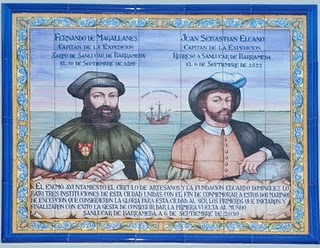 Azulejo tile commemorating the first circumnavigation of the world with the images of Magellan and Elcano in Sanlúcar de Barrameda.
-
 Statue of Magellan in Ponte da Barca (Portugal).


See also
Notes
- ↑ A copy commissioned in 1848 by the Naval Museum of Madrid from an original that, according to Vargas Ponce, was in the house of Felipe Vallejo, canon of the Cathedral of Toledo, in 1787, and from which Fernando Selma would make the engraving that appears in the Relación del último viaje al Magallanes, published in Madrid in 1789. It is possible that all of them originate from a 16th-century painting attributed to the school of Bronzino and belonging to the gallery of the Duke of Florence.
- ↑ Arturo Cruz Corral: Magellan did not complete the first voyage around the world, as he was killed in a skirmish by natives in the Philippines (1521), but the Spaniard Juan Sebastián Elcano (Getaria 1476–1526) did, who was part of the same expedition promoted and financed by the Kingdom of Spain. This is recorded in the work Relación del primer viaje alrededor del mundo (Relazione del primo viaggio intorno al mondo), published in Venice in 1536, by the Italian Antonio Pigafetta, who was also part of the expedition. After the voyage, Pigafetta traveled to Valladolid, where he was received in audience by the Emperor Charles, to whom he gave a copy of his travel diary, which he would later turn into a travel book by adding a prologue and structuring it as a book in order to achieve wider circulation. That is why the first voyage around the world is known as the Magellan–Elcano Expedition, and not only Magellan's.
- ↑ Alexandre Parafita wrote:
Since time immemorial, the vila of Sabrosa was given as the unequivocal origin of Magellan. Contributing to this was the existence of two wills, one from 1504 (when the navigator set out for the oceans) and another from 1580 (by a grandnephew of his exiled in Brazil), reinforced by an official deed of 1798 in which six notaries and four witnesses confirmed the navigator's genealogy as linked to that vila. These documents identify properties actually located in Sabrosa, such as a house (the "Casa da Pereira"), the Soura estate (still existing today opposite Vale da Porca) and the bequest of annual Masses at the altar of the Lord Jesus in the Church of San Salvador, of which traces still exist in the present-day parish church of the vila. The existence in the said house of the coat of arms of the Magellan family with its arms chiseled off and defaced, reflecting a punishment that, in the time of D. Manuel I, was commonly applied to anyone who committed acts considered treason against the homeland, understood as such Magellan's mission in the service of the Crown of Spain, corroborated the same thesis. However, many decades ago now, the veracity of these documents began to be called into question. First, because the first document uses the expression "his majesty" to refer to D. Manuel I, when it is known that at that time this form of address did not exist, but rather "his highness". Although the notarial document of 1798 states that it was "faithfully copied except for some words which, being badly written in Gothic script and the paper eaten away by time, could not be read", there has been no lack of those who seek (...) to discredit these wills, just as there has been no lack of those who have refuted this (...). These doubts allowed other hypotheses of origin to develop. For example, regarding Porto, it is said that there is a declaration alluding to the expression "Vecino de la çibdad del puerto" ("resident of the city of the port"), which would indicate that he was a native of that place. Nevertheless, it is also known that in a will made later in Spain, he declares himself in the same way "vesino q soy desta muy noble e muy leal çibdad de Sevylha" ("resident that I am of this most noble and most loyal city of Seville"). What, then, is the value of this word "vecino" in such documents? (...) It is important to bear in mind that the divergent questions about Magellan's origin arose long after his death, when it was perceived that there would be a considerable fortune to claim from the Crown of Spain, since a portion of the discovered territories was owed to the navigator.
— Parafita, A. Fernão de Magalhães: símbolo inequívoco da tradição de Sabrosa”, in Jornal de Notícias, supplement «Terra de Fernão Magalhães», September 5, 2009.
- ↑ Enrique of Malacca would in all likelihood be the first man to circumnavigate the globe: the expedition took him to the vicinity of the place where he had been captured before being sold to Magellan in 1511.
References
- ↑ Ficha: Núm. de catálogo: 646. Centro Virtual Cervantes/Naval Museum of Madrid. Retrieved August 16, 2015.
- ↑ Barros, Amândio (2009). Edições Afrontamento (ed.). La Naturalidad de Fernando de Magallanes (in português). ISBN 9789723610208. Retrieved March 1, 2020.
- ↑ https://www.biografiasyvidas.com/biografia/m/magallanes.htm
- ↑ Gil, Juan (2009). El exilio portugués en Sevilla de los Braganza a Magallanes (in español). Fundación Cajasol. pp. 180–182. ISBN 9788484553038.
- ↑ Bernstein, J. William J. (2008), A Splendid Exchange: How Trade Shaped the World, pp. 183-5. New York: Atlantic Monthly Press. ISBN 978-0-87113-979-5.
- ↑ Fernández de Navarrete 1837, p. 3
- ↑ Fernández de Navarrete 1837, pp. 12–22
- ↑ Castro 2010, pp. 326–28
- ↑ Castro 2010, pp. 329–32
- ↑ "El viaje de Enrique". www.exlibric.com (in español). Archived from the original on October 20, 2017. Retrieved July 10, 2017.
- ↑ The content of the will is preserved in the General Archive of the Indies, reference PATRONATO,36,R.2; transcription by Cristóbal Bernal. Archived (Date missing) at sevilla.2019-2022.org (Error: unknown archive URL), but a fragment of the original is also preserved in the Provincial Historical Archive of Seville
- ↑ Molina, Margot (October 5, 2019). "La última voluntad de Magallanes". El País (in español).
- ↑ GARCIA, Elisa Frühauf. “Os índios brasileiros na formação do mundo moderno. Alianças, comércio e trocas culturais”. In: Gesteira, Heloísa (org.). Magalhães-Elcano: a primeira viagem ao redor do mundo 1519-1522. Rio de Janeiro: Andrea Jakobsson Estúdio, 2021.
- ↑ PIGAFETTA, Antonio (2006). Primeira viagem ao redor do Mundo. [S.l.]: L&PM POCKET. OCLC 1104049046
- ↑ «Alimentação e saúde na primeira circum-navegação da Marinha Imperial Brasileira | História, Ciências, Saúde – Manguinhos». Retrieved April 27, 2021
- ↑ «Viagens de Circum-navegação | DPHDM». www.marinha.mil.br. Retrieved April 27, 2021
- ↑ «Gaviões Imperiais 2015 | Passarela Virtual – CARNAVAL VIRTUAL». museu.liesv.com.br. Retrieved June 16, 2021
- ↑ «I Simpósio de História Marítima - Praticagem do Brasil». Retrieved April 27, 2021
- ↑ Lucena Salmoral 1982, p. 321
- ↑ Fernández de Navarrete 1837, pp. 38–41
- ↑ Bernal, Cristóbal (January 17, 2015). "Relación de varios acaecimientos sucedidos a la armada de Magallanes cuando iba a la Especiería, y vuelta de la nao San António el 8 de mayo de 1521, que surgió en el puerto de las Muelas" (PDF). Sevilla 2019-2022 (in español). Archived from the original (PDF) on November 12, 2020. Retrieved October 20, 2017.
- ↑ Primer viaje alrededor del globo. Antonio Pigafetta. (with a preliminary study by Prof. Nelson Martínez Díaz). Original title: Primo viaggio in torno al Globo Terracqueo (1800 ed.). Ediciones Orbis, Barcelona, 1986. ISBN 84-7634-527-5. It can be consulted in an electronic version. Last accessed: May 28, 2011
- ↑ Magelhaens. Gazetteer of Planetary Nomenclature.
- ↑ Magelhaens. Gazetteer of Planetary Nomenclature.
Bibliography
- Castro, Xavier de, ed. (2010). Le voyage de Magellan (1519-1522). La relation d'Antonio Pigafetta & autres témoignages. «Magellane» (in français). Paris: Chandeigne. p. 1088.
- Fernández de Navarrete, Martín (1837). Expediciones al Maluco, viage de Magallanes y de Elcano (in español). Imprenta Nacional.
- Lucena Salmoral, Manuel (1982). El Descubrimiento y la fundación de los reinos ultramarinos: hasta fines del siglo XVI (in español). Ediciones Rialp. ISBN 9788432121029. Archived from the original on October 19, 2017. Retrieved October 20, 2017.
- Mollá, Luis (2017). La Flota de las especias (in español). Almuzara.
- Pigafetta, Antonio (1986) [1800]. preliminary study by Prof. Nelson Martínez Díaz (ed.). Primer viaje alrededor del globo [Primo viaggio in torno al Globo Terracqueo] (in español). Barcelona: Ediciones Orbis. ISBN 84-7634-527-5.
- Zweig, Stefan (2005). Magallanes: El hombre y su gesta (in español). Madrid: Editorial Debate. ISBN 84-8306-610-6.
External links

- Biography of Ferdinand Magellan in Spanish
- Ferdinand Magellan and his years in India
- Biography of Magellan
- Crew of the Magellan–Elcano Expedition
- First circumnavigation of the Earth. Chronicle of an odyssey
- Relazione del primo Viaggio intorno al Mondo, by Antonio Pigafetta, radio chronicle in 15 episodes of the first voyage around the world. In French, following Pigafetta's original text. CD-MP3.
- The account of the first voyage around the world, by the Italian traveler Antonio Pigafetta
- Official site of the Nao Victoria museum
- Route of the First Voyage Around the World on Google Maps and Earth


