| Content from Wikipedia under the CC BY-SA 4.0 license ⇔ Maps from OpenStreetMap under the ODbL license |
Middle Ages


The Middle Ages, or medieval period, is the historical period of Western civilization spanning the 5th to the 15th centuries. Conventionally, its beginning is placed in the year 476 with the fall of the Western Roman Empire and its end in 1492 with the discovery of America,[1] or in 1453 with the fall of the Byzantine Empire, a date that has the peculiarity of coinciding with the invention of the printing press—the publication of the Gutenberg Bible—and with the end of the Hundred Years' War.
Today, historians of the period prefer to qualify this break between Antiquity and the Middle Ages, so that for the period between the 3rd and 8th centuries it is usual to speak of Late Antiquity, which would have been a great stage of transition in all spheres: economically, for the replacement of the slave mode of production by the feudal mode of production; socially, for the disappearance of the concept of Roman citizenship and the definition of the medieval estates; politically, for the breakdown of the centralized structures of the Roman Empire, which gave way to a dispersion of power; and ideologically and culturally, for the absorption and replacement of classical culture by the theocentric Christian or Islamic cultures (each in its own sphere).[2]
It is usually divided into two great periods: the Early Middle Ages or Alta Edad Media (5th–10th centuries, without a clear differentiation from Late Antiquity); and the Late Middle Ages (11th–15th centuries), which in turn can be divided into a period of plenitude, the High Middle Ages (11th–13th centuries), and the last two centuries, which witnessed the crisis of the 14th century.
Although there are some examples of earlier use,[Note 1] the concept of the Middle Ages was born as the second age in the traditional division of historical time owed to Christoph Cellarius (Historia Medii Aevi a temporibus Constantini Magni ad Constaninopolim a Turcis captam deducta, Jena, 1688),[3] who considered it an intermediate time, with hardly any value of its own, between Antiquity, identified with the art and culture of the Greco-Roman civilization of classical antiquity, and the cultural renewal of the Modern Age—in which he placed himself—which begins with the Renaissance and Humanism. The popularization of this scheme has perpetuated an erroneous preconception: that of considering the Middle Ages a dark age, sunk in intellectual and cultural regression and a centuries-long social and economic lethargy (which in turn is associated with feudalism in its most obscurantist features, as it was defined by the revolutionaries who fought the Ancien Régime). It would have been a period dominated by isolation, ignorance, theocracy, superstition and millenarian fear fueled by endemic insecurity, violence and the brutality of constant wars and invasions and apocalyptic epidemics.[Note 2]
However, in this long period of a thousand years there were all kinds of events and processes very different from one another, differentiated in time and geography, responding both to mutual influences with other civilizations and spaces and to internal dynamics. Many of them had a great projection into the future, among others those that laid the foundations for the development of the later European expansion, and the development of the social agents that developed an estate-based society of a predominantly rural base, but which witnessed the birth of an incipient urban life and a bourgeoisie that would in time develop capitalism.[4] Far from being a static era, the Middle Ages, which had begun with migrations of entire peoples and continued with great resettlement processes (Repopulation in the Iberian Peninsula, Ostsiedlung in Eastern Europe), saw in their last centuries how the old roads (many of them decayed Roman roads) were repaired and modernized with graceful bridges, and filled with all kinds of travelers (warriors, pilgrims, merchants, students, Goliards, etc.), embodying the spiritual metaphor of life as a journey (homo viator).[5]
New political forms also emerged in the Middle Ages, ranging from the Islamic caliphate to the universal powers of Latin Christendom (the Papacy and the Empire) or the Byzantine Empire and the Slavic kingdoms integrated into Eastern Christendom (acculturation and evangelization by Cyril and Methodius); and on a smaller scale, all kinds of city-states, from the small German episcopal cities to republics that maintained maritime empires, such as Venice; leaving in the middle of the scale the one that had the greatest future projection: the feudal monarchies, which, transformed into authoritarian monarchies, prefigure the modern state.
In fact, all the concepts associated with what has come to be called modernity appear in the Middle Ages, in their intellectual aspects with the very crisis of scholasticism.[6] None of them would be understandable without feudalism itself, whether this is understood as a mode of production (based on the social relations of production around the land of the fief) or as a political system (based on personal relations of power around the institution of vassalage), according to the different historiographical interpretations.[Note 3]
The clash of civilizations between Christianity and Islam, manifested in the breaking of the unity of the Mediterranean (a fundamental milestone of the era, according to Henri Pirenne in his classic Mohammed and Charlemagne[7]), the Spanish Reconquista and the Crusades, also had its share of fertile cultural exchange (Toledo School of Translators, Schola Medica Salernitana) that broadened the intellectual horizons of Europe, until then limited to the remains of classical culture saved by early medieval monasticism and adapted to Christianity.
The Middle Ages achieved a curious combination of diversity and unity. The diversity was the birth of the incipient nations... The unity, or a certain unity, came from the Christian religion, which prevailed everywhere... this religion recognized the distinction between clergy and laity, so that it can be said that... it marked the birth of a lay society. ... All this means that the Middle Ages were the period in which Europe appeared and was built.[8]
That same Western Europe produced an impressive succession of artistic styles (Pre-Romanesque, Romanesque and Gothic), which in the border zones also blended with Islamic art (Mudéjar, Andalusian art, Arab-Norman art) or with Byzantine art.
Medieval science did not follow a modern methodology, but neither had that of the classical authors, who dealt with nature from their own perspective; and in both ages it was unconnected with the world of techniques, which was relegated to the manual labor of artisans and peasants, responsible for slow but constant progress in tools and productive processes. The differentiation between vile and mechanical trades and the liberal professions linked to intellectual study coexisted with a theoretical spiritual valuing of work in the setting of the Benedictine monasteries, a matter that never went beyond being a pious exercise, surpassed by the much more transcendent valuing of poverty, determined by the economic and social structure and expressed in medieval economic thought.
Medievalism is both the quality or character of being medieval,[9] and interest in the medieval era and medieval themes and their study; and a medievalist is a specialist in these subjects.[Note 4] The discrediting of the Middle Ages was a constant throughout the Modern Age, in which Humanism, the Renaissance, Rationalism, Classicism and the Enlightenment asserted themselves as reactions against it, or rather against what they understood it to mean, or against features of their own present that they tried to discredit as medieval survivals. Nevertheless, from the end of the 16th century there were interesting compilations of medieval documentary sources that sought a critical method for historical science. Romanticism and Nationalism in the 19th century revalued the Middle Ages as part of their aesthetic program and as an anti-academic reaction (Romantic poetry and drama, the historical novel, musical nationalism, opera), as well as the only possibility of finding a historical basis for the emerging nations (history painting, historicist architecture, above all Neo-Gothic—the restoring and re-creating work of Eugène Viollet-le-Duc—and Neo-Mudéjar). The Romantic abuses of medieval settings (exoticism) already produced, by the middle of the 19th century, the reaction of realism.[11] Another type of abuse gives rise to an abundant pseudo-historical literature that continues to the present, and which has found the formula for media success by mixing esoteric themes drawn from more or less obscure parts of the Middle Ages (the Vatican Secret Archives, the Templars, the Rosicrucians, the Freemasons and the Holy Grail itself).[Note 5] Some of them were linked to Nazism, such as the German Otto Rahn. On the other hand, there is an abundance of other types of fictional artistic productions of varying quality and orientation inspired by the Middle Ages (literature, cinema, comics). Other medievalist movements have also developed in the 20th century: a serious historiographical medievalism, focused on methodological renewal (fundamentally through the incorporation of the economic and social perspective contributed by historical materialism and the Annales school), and a popular medievalism (medieval spectacles, more or less genuine, as an updating of the past with which the community identifies, what has come to be called historical memory).
It is improper to speak of a Middle Ages in other civilizations

The great migrations of the period of the invasions paradoxically meant a closing off of the West's contact with the rest of the world. Europeans of the medieval millennium (both those of Latin Christendom and those of Eastern Christendom) had very little news that, apart from Islamic civilization, which acted as a bridge but also as an obstacle between Europe and the rest of the Old World,[7] other civilizations were developing. Even a vast Christian kingdom such as that of Ethiopia, having been left isolated, became in the cultural imagination the mythical kingdom of Prester John, barely distinguishable from the Atlantic islands of Saint Brendan and the rest of the marvels drawn in the bestiaries and the scarce, rudimentary and imaginative maps. The markedly autonomous development of China, the most developed civilization of the time (although turned inward and absorbed in its dynastic cycles: Sui, Tang, Song, Yuan and Ming), and the scarcity of contacts with it (the journey of Marco Polo, or the much more important expedition of Zheng He), which stand out precisely for being unusual and for their lack of continuity, do not allow the 5th to 15th centuries of its history to be called medieval history, although this is sometimes done, even in specialized publications, more or less improperly.[12]
The history of Japan (which during this period was taking shape as a civilization, adapting Chinese influences to the native culture and expanding from the southern islands to the northern ones), despite its greater remoteness and isolation, is usually, paradoxically, more associated with the term medieval; although historiography significantly limits that designation to a medieval period located between the years 1000 and 1868, so as to fit the so-called Japanese feudalism prior to the Meiji era (see also shogunate, han and Japanese castle).[13]
The history of India or that of Black Africa from the 7th century onward had a greater or lesser Muslim influence, but followed very different dynamics of their own (the Delhi Sultanate, the Bahmani Sultanate, the Vijayanagara Empire—in India—, the Mali Empire, the Songhai Empire—in Black Africa—). There was even a notable Saharan intervention in the western Mediterranean world: the Almoravid Empire.
Even more clearly, the history of the Americas (which was going through its Classic and Postclassic periods) had no contact whatsoever with the Old World, beyond the arrival of the so-called Viking colonization of America, which was limited to a small and ephemeral presence in Greenland and the enigmatic Vinland, or the possible later expeditions of Basque whalers in similar areas of the North Atlantic, although this fact must be understood in the context of the great development of navigation in the last centuries of the Late Middle Ages, already headed toward the Age of Discovery.
What did occur, and can be considered a constant of the medieval period, was the periodic repetition of occasional Central Asian interferences in Europe and the Near East in the form of invasions by peoples of Central Asia, most notably the Turks (Göktürks, Khazars, Ottomans) and the Mongols (unified by Genghis Khan), whose Golden Horde was present in Eastern Europe and shaped the character of the Christian States that were created, sometimes as vassals and sometimes resisting, in the Russian and Ukrainian steppes. On one rare occasion, the primitive diplomacy of the late medieval European kingdoms even saw the possibility of using the latter as a counterweight to the former: the frustrated embassy of Ruy González de Clavijo to the court of Tamerlane in Samarkand, in the context of the Mongol siege of Damascus, a very delicate moment (1401-1406) in which Ibn Khaldun also took part as a diplomat. The Mongols had already sacked Baghdad in an incursion in 1258.[14]
The beginning of the Middle Ages


Although various dates have been proposed for the beginning of the Middle Ages, of which the most widespread is the year 476, the truth is that we cannot place the beginning so exactly, since the Middle Ages were not born but rather "made" as a consequence of a long and slow process extending over five centuries, which brought about enormous changes at every level in a very profound way, changes whose repercussions reach even to our own day. We can consider that this process begins with the crisis of the 3rd century, linked to the reproduction problems inherent in the slave mode of production, which needed continuous imperial expansion that no longer took place after the fixing of the Roman limes. Climatic factors possibly also converged in the succession of bad harvests and epidemics; and, much more evidently, the first Germanic invasions and peasant uprisings (Bagaudae), in a period in which many brief and tragic imperial reigns followed one another. Since Caracalla, Roman citizenship had been extended to all free men of the Empire, a sign that this status, once so coveted, had ceased to be attractive. The Late Empire took on an increasingly medieval appearance from the beginning of the 4th century with the reforms of Diocletian: a blurring of the differences between slaves, ever scarcer, and the coloni, free peasants but subject to ever greater conditions of servitude, who lost the freedom to change their residence, having always to work the same land; compulsory inheritance of public offices—formerly contested in hard-fought elections—and of artisanal trades, subjected to compulsory corporate membership—a precedent of the guilds—all in order to prevent tax evasion and the depopulation of the cities, whose role as centers of consumption and trade and as articulators of the rural areas was becoming less and less important. At least, the reforms managed to maintain the Roman institutional edifice, although not without intensifying ruralization and aristocratization (clear steps toward feudalism), above all in the West, which became detached from the East with the partition of the Empire. Another decisive change was the establishment of Christianity as the new official religion by the Edict of Thessalonica of Theodosius I the Great (380), preceded by the Edict of Milan (313) with which Constantine I the Great rewarded those who had until then been subversives for their providential help at the Battle of the Milvian Bridge (312), along with other alleged, more temporal concessions whose fraudulent claim (the Pseudo-Donation of Constantine) was a constant of the Papal States throughout the entire Middle Ages, even after the evidence of its refutation by the humanist Lorenzo Valla (1440).

No specific event—despite the abundance and concatenation of catastrophic events—by itself determined the end of Antiquity and the beginning of the Middle Ages: neither the successive sacks of Rome (by the Goths of Alaric I in 410, by the Vandals in 455, by the imperial troops of Ricimer themselves in 472, by the Ostrogoths in 546), nor the terrifying irruption of the Huns of Attila (450-452, with the Battle of the Catalaunian Plains and the strange meeting with Pope Leo I the Great), nor the overthrow of Romulus Augustulus (the last Western Roman emperor, by Odoacer, the chief of the Heruli -476-) were events that their contemporaries considered to be the beginning of a new era. The culmination at the end of the 5th century of a series of long-term processes, among them severe economic dislocation, the invasions and the settlement of the Germanic peoples in the Roman Empire, changed the face of Europe. During the following 300 years, Western Europe maintained a period of cultural unity, unusual for this continent, built upon the complex and elaborate culture of the Roman Empire, which was never completely lost, and the establishment of Christianity. The classical Greco-Roman heritage was never forgotten, and the Latin language, undergoing transformation (Medieval Latin), remained the language of culture throughout Western Europe, even beyond the Middle Ages. Roman law and many institutions remained alive, adapting in one way or another. What took place during that long period of transition (which can be considered completed by the year 800, with the coronation of Charlemagne) was a sort of fusion with the contributions of other civilizations and social formations, especially the Germanic one and the Christian religion. In the following centuries, still in the Early Middle Ages, other contributions would be added, most notably Islam.
Early Middle Ages (5th to 10th centuries)
The Germanic-Roman kingdoms (5th to 8th centuries)
Barbarians
The barbarians spread about in fury... and the scourge of plague causes no less havoc; the tyrannical tax collector robs and the soldier plunders the riches and provisions hidden in the cities; a famine so dreadful reigns that, compelled by it, the human race devours human flesh, and even mothers kill their children and cook their bodies to feed on them. The wild beasts, grown fond of the corpses of those dead by the sword, by hunger and by plague, tear apart even the strongest men and, gorging themselves on their limbs, grow ever fiercer for the destruction of the human race. In this way, with the four plagues raging throughout the world (iron, hunger, plague and wild beasts), the predictions that the Lord made through the mouths of His Prophets are fulfilled. The provinces having been laid waste... by the aforementioned fury of the plagues, the barbarians, resolved by the mercy of the Lord to make peace, divide the regions of the provinces among themselves by lot in order to settle in them.
The text refers specifically to Hispania and its provinces, and the barbarians mentioned are specifically the Suebi, Vandals and Alans, who in 406 had crossed the limes of the Rhine (unusually frozen) near Mainz and around 409 had reached the Iberian Peninsula; but the picture is equivalent at other times and places narrated by the same author, covering the period between 379 and 468.
The Germanic peoples coming from Northern and Eastern Europe were at a stage of economic, social and cultural development obviously inferior to that of the Roman Empire, which they themselves regarded with admiration. In turn, they were perceived with a mixture of contempt, fear and hope (retrospectively captured in the influential poem Waiting for the Barbarians by Constantine Cavafy),[16] and they were even attributed a role as agents of justice (albeit involuntary) from a providentialist point of view by Roman Christian authors (Orosius, Salvian of Marseille and Saint Augustine of Hippo).[17] The name barbarians (βάρβαρος) comes from the onomatopoeia bar-bar with which the Greeks mocked non-Hellenic foreigners, and which the Romans (barbarians themselves, though Hellenized) used from their own perspective. The term "barbarian invasions" was rejected by German historians of the 19th century, a time when the term barbarism designated, for the nascent social sciences, a stage of cultural development inferior to civilization and superior to savagery. They preferred to coin a new term: Völkerwanderung ("Migration of Peoples"),[18] less violent than invasions, since it suggests the complete displacement of a people with its institutions and culture, and even more general than Germanic invasions, since it includes Huns, Slavs and others.
The Germanic peoples, who had distinctive political institutions, specifically the assembly of free warriors (the thing) and the figure of the king, received the influence of the institutional traditions of the Empire and of Greco-Roman civilization, as well as that of Christianity (although not always Catholic or Athanasian Christianity, but rather Arian Christianity); and they gradually adapted to the circumstances of their settlement in the new territories, above all to the alternative between imposing themselves as a ruling minority over a majority of the local population or merging with it.
The new Germanic kingdoms shaped the character of Western Europe during the Middle Ages, evolved into feudal monarchies and authoritarian monarchies, and in time gave rise to the nation-states that were built around them. Socially, in some of these countries (Spain or France), Germanic origin (Gothic or Frankish) became a mark of honor or caste pride flaunted by the nobility as a distinction from the population as a whole.
The transformations of the Roman world

The Roman Empire had gone through terrible external invasions and civil wars in the past, but at the end of the 4th century the situation was apparently under control. Not long before, Theodosius had once again succeeded in unifying both halves of the Empire under a single center (392) and had established a new state religion, Nicene Christianity (Edict of Thessalonica, 380), with the consequent persecution of the traditional pagan cults and Christian heterodoxies. The Christian clergy, turned into a hierarchy of power, ideologically justified an Imperium Romanum Christianum (Christian Roman Empire) and the Theodosian dynasty, as it had already begun to do with the Constantinian dynasty since the Edict of Milan (313).
The ambitions for political prominence of the richest and most influential Roman senators and of the western provinces had been channeled. Moreover, the dynasty had managed to reach agreements with the powerful military aristocracy, in which Germanic nobles enlisted, coming to the service of the Empire at the head of soldiers bound to them by ties of loyalty. When he died in 395, Theodosius entrusted the government of the West and the protection of his young heir Honorius to the general Stilicho, eldest son of a noble Vandal officer, who had married Flavia Serena, niece of Theodosius himself. But when Valentinian III, grandson of Theodosius, was assassinated in 455, a good part of the descendants of those western nobles (nobilissimus, clarissimus) who had trusted so much in the destiny of the Empire seemed now to distrust it, especially when, over the course of two decades, they had come to realize that the imperial government secluded in Ravenna was increasingly prey to the exclusive interests and intrigues of a small group of high officers of the Italic army. Many of these were of Germanic origin and relied more and more on the strength of their armed retinues of conventional soldiers and on the pacts and family alliances they might have with other Germanic chiefs settled on imperial soil together with their own peoples, who increasingly pursued an autonomous policy. The need to adapt to the new situation was made evident by the fate of Galla Placidia, an imperial princess held hostage by the very plunderers of Rome (the Visigoth Alaric I and his cousin Ataulf, whom she eventually married); or by that of Honoria, daughter of the former (by her second marriage, to the emperor Constantius III), who chose to offer herself as a wife to Attila himself, setting herself against her own brother Valentinian.

Needing to maintain a position of social and economic dominance in their regions of origin, their landed estates reduced to provincial dimensions, and aspiring to a political prominence befitting their lineage and their culture, the honestiores (the most honest or honorable, those who have honor), representatives of the late Roman western aristocracies, would have ended up accepting the advantages of recognizing the legitimacy of the government of these Germanic kings, already highly Romanized, settled in their provinces. After all, these kings, at the head of their soldiers, could offer them far greater security than the army of the emperors of Ravenna. Moreover, provisioning these troops was considerably less burdensome than provisioning the imperial ones, since they were largely based on armed retinues dependent on the Germanic nobility and fed at the expense of the provincial landed estates that this nobility had long since appropriated. Less burdensome both for the provincial aristocrats and for the groups of humiliores (the humblest, those lowered to the ground, humus) who gathered hierarchically around these aristocrats and who, ultimately, were the ones who had been bearing the greatest weight of harsh late Roman taxation. The new monarchies, weaker and more decentralized than the old imperial power, were also more willing to share power with the provincial aristocracies, all the more so since the power of these monarchs was very limited within their own peoples by a nobility based on its armed retinues, stemming from its not very distant origin in the assemblies of free warriors, among whom the kings never ceased to be primus inter pares.
But this metamorphosis of the Roman West into a Romano-Germanic West had not been the consequence of an inevitability clearly evident from the start; on the contrary, the road had been hard and zigzagging, with attempts at other solutions, and with moments when it seemed that everything could return to how it had been before. This was the case throughout the 5th century, and in some regions also in the 6th century as a consequence, among other things, of the so-called Recuperatio Imperii or Reconquest of Justinian.
The various kingdoms

The barbarian invasions since the 3rd century had demonstrated the permeability of the Roman limes in Europe, fixed on the Rhine and the Danube. The division of the Empire into East and West, and the greater strength of the eastern or Byzantine empire, meant that it was only in the western half that these peoples settled and became politically institutionalized as kingdoms.
The Visigoths, first as the Kingdom of Toulouse and then as the Kingdom of Toledo, were the first to carry out this institutionalization, taking advantage of their status as federates, having obtained a foedus with the Empire, which entrusted them with the pacification of the provinces of Gaul and Hispania, whose control had been lost in practice after the invasions of 410 by the Suebi, Vandals and Alans. Of the three, only the Suebi achieved a permanent settlement in one area, the Kingdom of Braga, while the Vandals established themselves in North Africa and the islands of the Western Mediterranean, but were eliminated in the following century by the Byzantines during the great territorial expansion of Justinian I (campaigns of the generals Belisarius, from 533 to 544, and Narses, until 554). At the same time, the Ostrogoths managed to settle in Italy by expelling the Heruli, who had in turn expelled the last Emperor of the West from Rome. The Ostrogothic Kingdom also disappeared in the face of the Byzantine pressure of Justinian I.
A second group of Germanic peoples settled in Western Europe in the 6th century, among which the Frankish Kingdom of Clovis I and his Merovingian successors stands out, which displaced the Visigoths from Gaul, forcing them to move their capital from Tolosa (Toulouse) to Toledo. They also defeated the Burgundians and Alemanni, absorbing their kingdoms. Somewhat later the Lombards established themselves in Italy (568–569), but they would be defeated at the end of the 8th century by the same Franks, who would restore the Empire under Charlemagne (year 800).
In Great Britain the Angles, Saxons and Jutes would settle, creating a series of rival kingdoms that would be unified by the Danes (a Nordic people) into what would eventually become the kingdom of England.
Institutions

The Germanic monarchy was originally a strictly temporary institution, closely linked to the personal prestige of the King, who was no more than a primus inter pares (first among equals), elected by the assembly of free warriors (elective monarchy), usually for a specific military expedition or for a particular mission. The migrations to which the Germanic peoples were subjected from the 3rd century to the 5th century (squeezed between the pressure of the Huns to the east and the resistance of the Roman limes to the south and west) progressively strengthened the figure of the King, while they came into ever greater contact with Roman political institutions, which were accustomed to the idea of a political power much more centralized and concentrated in the person of the Roman Emperor. The monarchy became tied to the persons of the kings for life, and the tendency was for it to become a hereditary monarchy, since the kings (just as the Roman emperors had done) sought to secure the election of their successor, most often while still alive and by associating them with the throne. That the candidate should be the eldest son was not a necessity, but it eventually prevailed as an obvious consequence, which was also imitated by the other warrior families, enriched by the possession of land and turned into noble lineages that intermarried with the old Roman nobility, in a process that may be termed feudalization. Over time, the monarchy became patrimonial, even allowing the division of the kingdom among the King's sons.
Respect for the figure of the King was reinforced through the sacralization of his accession (anointing with the holy oils by the religious authorities and the use of distinctive elements such as the orb, scepter and crown, in the course of an elaborate ceremony: the coronation) and the addition of religious functions (presiding over national councils, such as the Councils of Toledo) and thaumaturgical ones (the royal touch of the kings of France for the cure of scrofula). The problem arose when the time came to justify the deposition of a King and his replacement by another who was not his natural successor. The last Merovingians did not govern by themselves, but through the officers of their court, among whom the mayor of the palace stood out. Only after the victory against the Muslim invaders at the Battle of Poitiers did the mayor Charles Martel feel justified in arguing that legitimacy of exercise gave him sufficient merit to found his own dynasty: the Carolingian. On other occasions more imaginative solutions were resorted to (such as forcing the tonsure, the ecclesiastical cutting of the hair, of the Visigothic King Wamba in order to incapacitate him).
The problems of coexistence between the Germanic minorities and the local majorities (Hispano-Roman, Gallo-Roman, etc.) were solved more effectively by the kingdoms with the longest duration (Visigoths and Franks) through fusion, allowing mixed marriages, unifying legislation and converting to Catholicism from their original religion, which in many cases was no longer traditional Germanic paganism, but Arian Christianity acquired during their passage through the Eastern Empire.
Some characteristic features of Germanic institutions were preserved: one of them was the predominance of customary law over the written law characteristic of Roman law. Nevertheless, the Germanic kingdoms produced some legislative codifications, with greater or lesser influence of Roman law or of Germanic traditions, written in Latin from the 5th century on (Theodosian laws, Edict of Theodoric, Code of Euric, Breviary of Alaric). The first code written in a Germanic language was that of King Æthelberht of Kent, the first of the Anglo-Saxons to convert to Christianity (early 6th century). The Visigothic Liber Iudiciorum (Recceswinth, 654) and the Frankish Salic Law (Clovis, 507–511) remained in force for a very long time due to their consideration as sources of law in the medieval monarchies and those of the Ancien Régime.[19]
Latin Christendom and the barbarians

The spread of Christianity among the barbarians, and the establishment of episcopal authority in the cities and of monasticism in rural areas (above all since the rule of Saint Benedict of Nursia, monastery of Monte Cassino, 529), constituted a powerful force for the fusion of cultures and helped to ensure that many features of classical civilization, such as Roman law and Latin, survived in the western half of the Empire, and even spread throughout Central and Northern Europe. The Franks converted to Catholicism during the reign of Clovis I (496 or 499) and, from then on, spread Christianity among the Germanic peoples on the other side of the Rhine. The Suebi, who had become Arian Christians under Remismund (459–469), converted to Catholicism under Theodemar (559–570) through the preaching of Saint Martin of Dumio. In this process they had gotten ahead of the Visigoths themselves, who had previously been Christianized in the East in the Arian version (in the 4th century), and who for a century and a half maintained the religious difference with the Catholic Hispano-Romans, even with internal struggles within the Gothic ruling class, as shown by the rebellion and death of Saint Hermenegild (581–585), son of King Liuvigild. The conversion to Catholicism of Reccared (589) marked the beginning of the fusion of both societies, and of royal protection of the Catholic clergy, made visible in the Councils of Toledo (presided over by the king himself). The following years saw a true Visigothic renaissance[20] with figures as influential as Saint Isidore of Seville (and his siblings Leander, Fulgentius and Florentina, the four saints of Cartagena), Braulio of Zaragoza or Ildefonsus of Toledo, with great repercussions in the rest of Europe and in the future Christian kingdoms of the Reconquista (see Christianity in Spain, monastery in Spain, Hispanic monastery and Hispanic liturgy). The Ostrogoths, on the other hand, did not have enough time to undergo the same evolution in Italy. Nevertheless, the degree of coexistence with the papacy and the Catholic intellectuals was shown by the fact that the Ostrogothic kings raised them to the positions of greatest trust (Boethius and Cassiodorus, both magister officiorum under Theodoric the Great), although so too was the vulnerability of their situation (the former executed in 523 and the latter sidelined by the Byzantines in 538). Their successors in the domination of Italy, the Lombards, also Arians, never came to experience integration with the subject Catholic population either, and their internal divisions meant that the conversion to Catholicism of King Agilulf (603) did not have greater consequences.
Christianity was brought to Ireland by Saint Patrick at the beginning of the 5th century, and from there it spread to Scotland, from where, a century later, it returned via the north to an England abandoned by the Christian Britons to the pagan Picts and Scots (coming from the north of Great Britain) and to the likewise pagan Germanic peoples coming from the continent (Angles, Saxons and Jutes). At the end of the 6th century, under Pope Gregory the Great, Rome also sent missionaries to England from the south, with the result that within a century England became Christian again.
In turn, the Britons had begun an emigration by sea toward the peninsula of Brittany, reaching even places as distant as the Cantabrian coast between Galicia and Asturias, where they founded the Diocese of Britonia. This Christian tradition was distinguished by the use of the Celtic or Scottish tonsure, which shaved the front part of the hair instead of the crown.
The survival in Ireland of a Christian community isolated from Europe by the pagan barrier of the Anglo-Saxons brought about an evolution different from that of continental Christianity, which has been called Celtic Christianity. It preserved much of the ancient Latin tradition, which it was in a position to share with continental Europe as soon as the wave of invasions had temporarily subsided. After its spread to England in the 6th century, the Irish founded monasteries in the 7th century in France, in Switzerland (Saint Gall), and even in Italy, with the names of Columba and Columbanus standing out in particular. For some three centuries the British Isles were the breeding ground of important names for culture: the historian Bede the Venerable, the missionary Boniface of Germany, the educator Alcuin of York, and the theologian John Scotus Eriugena, among others. Such influence even extends to the attribution of legends such as that of Saint Ursula and the Eleven Thousand Virgins, a Breton woman who supposedly made an extraordinary journey between Britannia and Rome only to end up martyred in Cologne.[21]
Other medieval Christianizations

For its part, the spread of Christianity among the Bulgarians and most of the Slavic peoples (Serbs, Moravians and the peoples of Crimea and the Ukrainian and Russian steppes, with Vladimir I of Kiev, in the year 988) came much later, and was carried out by the Byzantine Empire, so that it took place under the Orthodox creed (preaching of Cyril and Methodius, 9th century); while the evangelization of other peoples of Eastern Europe (the rest of the Slavs, namely the Poles, Slovenes and Croats; the Balts; and the Hungarians, with Saint Stephen I of Hungary, around the year 1000) and of the Nordic peoples (Scandinavian Vikings) was carried out by Latin Christianity starting from Central Europe, in an even later period (up to the 11th and 12th centuries); making possible (especially the conversion of Hungary) the first overland pilgrimages to the Holy Land.[22]
It is madness to believe in the gods.
— Hrafnkel's Saga, priest of Freyr (Iceland, composed at the end of the 13th century, but set in pre-Christian times).[23]
Khazars
The Khazars were a Turkic people from Central Asia (where the empire of the Göktürks had formed since the 6th century) who in its western part had given rise to an important state that dominated the Caucasus and the Russian and Ukrainian steppes as far as Crimea in the 7th century. Their ruling class converted mostly to Judaism, a religious peculiarity that made the state an exceptional neighbor between the Islamic caliphate of Damascus and the Christian empire of Byzantium.
The Byzantine Empire (4th to 15th centuries)

The division between East and West was, in addition to a political strategy (initially of Diocletian, in 286, and made definitive under Theodosius I, in 395), a recognition of the essential difference between the two halves of the Empire. The East, itself very diverse (the Balkan Peninsula, the Mezzogiorno, Anatolia, the Caucasus, Syria, Palestine, Egypt and the Mesopotamian frontier with the Persians), was the most urbanized part, with the most dynamic and commercial economy, as opposed to a West undergoing feudalization, ruralized, with a declining urban life, an ever scarcer slave labor force and an aristocracy increasingly alien to the structures of imperial power and secluded in its luxurious self-sufficient villae, cultivated by tenant farmers under a regime similar to serfdom. The lingua franca in the East was Greek, as opposed to Latin in the West. In the establishment of the Christian hierarchy, the East had all the patriarchates of the Pentarchy except that of Rome (Alexandria, Antioch and Constantinople, to which Jerusalem was added after the Council of Chalcedon of 451); even Roman primacy (the pontifical see of Saint Peter) was a disputed matter, because the Byzantine State operated according to caesaropapism (begun by Constantine I[24] and theologically grounded by Eusebius of Caesarea).[25]

The survival of Byzantium did not depend on the fate of the West, while the reverse did: in fact, the eastern emperors chose to sacrifice Rome (which was no longer even the western capital) when they considered it convenient, abandoning it to its fate or even diverting the Germanic peoples toward it (Heruli, Ostrogoths and Lombards), which hastened its fall. However, the Eternal City, which had symbolic value, was reconquered and included in the short-lived Exarchate of Ravenna.
Justinian's imperial restoration
Justinian I consolidated the Danube frontier and, from 532, achieved a balance on the frontier with Sasanian Persia, which allowed him to shift Byzantine efforts toward the Mediterranean, rebuilding the unity of the Mare Nostrum: in 533, an expedition of the general Belisarius annihilated the Vandals (battles of Ad Decimum and of Tricamarum), incorporating the province of Africa and the islands of the Western Mediterranean (Sardinia, Corsica and the Balearic Islands). In 535 Mundus occupied Dalmatia and Belisarius Sicily. Narses eliminated the Ostrogoths from Italy in 554–555. Ravenna once again became an imperial city, where the sumptuous mosaics of San Vitale would be preserved. Liberius only managed to displace the Visigoths from the southeastern coast of the Iberian Peninsula and from the province of Baetica.
In Constantinople two ambitious and prestigious programs were undertaken in order to establish imperial authority: one of legislative compilation, the Corpus iuris civilis, directed by Tribonian (promulgated between 529 and 534), and another of construction, the church of Hagia Sophia, by the architects Anthemius of Tralles and Isidore of Miletus (built between 532 and 537). One symbol of classical civilization was closed: the Academy of Athens (529).[Note 6] Another, the quadriga races, remained a popular entertainment that aroused passions. In fact, they were used politically, with the color of each team expressing religious divergences (an early example of popular mobilizations using political colors). The Nika revolt (534) almost caused the Emperor to flee, which was prevented by the Empress Theodora with her famous phrase royalty is a glorious shroud.[Note 7]
Crisis, survival and Hellenization of the Empire

The 7th and 8th centuries represented for Byzantium a dark age similar to that of the West, which also included strong ruralization and feudalization in social and economic terms and a loss of prestige and effective control by the central power. To the internal causes was added the renewal of the war with the Persians, in no way decisive but especially exhausting, followed by the Muslim invasion, which deprived the Empire of its richest provinces: Egypt and Syria. Nevertheless, in the Byzantine case, the decline in intellectual and artistic production was also due to the particular effects of the iconoclast controversy, which was not a simple theological debate between iconoclasts and iconodules, but an internal confrontation unleashed by the patriarchate of Constantinople, supported by the Emperor Leo III, which sought to put an end to the concentration of power and political and religious influence of the powerful monasteries and their territorial support (its importance can be imagined by seeing how Mount Athos, founded more than a century later, in 963, has survived to the present day).

The recovery of imperial authority and the greater stability of the following centuries also brought with it a process of Hellenization, that is, the recovery of Greek identity as opposed to the official Roman character of the institutions, something more feasible at that time given the geographical limitation and homogenization produced by the loss of the provinces, and which allowed a militarized and more easily manageable territorial organization: the themes (themata), with the soldiers settled in them bound to the land, which produced forms similar to Western feudalism.
The period between 867 and 1056, under the Macedonian dynasty, is known as the Macedonian Renaissance, in which Byzantium once again became a Mediterranean power and projected itself toward the Slavic peoples of the Balkans and toward the north of the Black Sea. Basil II Bulgaroktonos, who occupied the throne in the period 976–1025, brought the Empire to its greatest territorial extent since the Muslim invasion, occupying part of Syria, Crimea and the Balkans up to the Danube. The evangelization of Cyril and Methodius would secure a Byzantine sphere of influence in Eastern Europe that culturally and religiously would have a great future projection through the spread of the Cyrillic alphabet (an adaptation of the Greek alphabet to represent Slavic phonemes, which is still in use today), as well as that of Orthodox Christianity (predominant from Serbia to Russia).
However, the second half of the 11th century would witness a new Islamic challenge, this time led by the Seljuk Turks, and the intervention of the Papacy and of the Western Europeans, through the military intervention of the Crusades, the commercial activity of the Italian merchants (Genoese, Amalfitans, Pisans and above all Venetians)[27] and the theological controversies of the so-called Schism of the East or Great Schism of East and West, so that the theoretical Christian aid proved as harmful as, or more harmful than, the Muslim threat for the Eastern Empire. The process of feudalization intensified as the Komnenian emperors were forced to make territorial grants (called pronoia) to the aristocracy and to members of their own family.[28]
The expansion of Islam (from the 7th century)

In the 7th century, following the preaching of Muhammad and the conquests of the first caliphs (at once political and religious leaders, in a religion, Islam, that does not recognize distinctions between laity and clergy), the unification of Arabia and the conquest of the Persian Empire and of a good part of the Byzantine Empire had taken place. In the 8th century they reached the Iberian Peninsula, India and Central Asia (battle of the Talas, 751, an Islamic victory over China after which they did not penetrate further into that Empire, but which allowed greater contact with its civilization, taking advantage of the knowledge of the prisoners). In the West the Muslim expansion was halted after the battle of Poitiers (732) against the Franks and the mythologized battle of Covadonga against the Asturians (722). The presence of the Muslims as an alternative rival civilization settled in the southern half of the Mediterranean Basin, whose maritime traffic they came to control, forced Western Europe to close in on itself for several centuries, and for some historians it marked the true beginning of the Middle Ages.[29]

From the 8th century there was a slower spread of Islamic civilization to places as distant as Indonesia and the African continent, and from the 14th century to Anatolia and the Balkans. Relations with India were also very close during the rest of the Middle Ages (although the imposition of the Mughal Empire did not take place until the 16th century), while the Indian Ocean became almost an Arab Mare Nostrum, the setting for the adventures of Sinbad the Sailor (one of the tales of The Thousand and One Nights from the time of Harun al-Rashid).[30] Commercial traffic on the sea and caravan routes linked the Indian Ocean with the Mediterranean through the Red Sea or the Persian Gulf and the desert caravans. This so-called spice route (prefigured by the incense route in Antiquity) was essential for fragments of the science and culture of the Far East to reach the West. In the north, the Silk Road fulfilled the same function, crossing the deserts and mountain ranges of Turkestan. Chess, Indo-Arabic numerals and the concept of zero, as well as some literary works (Calila e Dimna), were among the Hindu and Persian contributions. Paper, engraving and gunpowder were among the Chinese ones. The role of the Arabs, and of the Arabized Persians, Syrians, Egyptians and Spaniards (not only Muslims, since many kept their Christian or Jewish religion, and fewer the Zoroastrian one), was far from being mere transmission, as witnessed by the influence of the reinterpretation of classical philosophy that reached Western Europe through Arabic texts from the Latin translations of the 12th century onward, and the spread of crops and agricultural techniques throughout the Mediterranean region. At a time when they were practically absent from the European economy, commercial practices and monetary circulation stood out in the Islamic world, stimulated by the exploitation of gold mines as distant as those of sub-Saharan Africa, together with other types of activity, such as the slave trade.

The initial unity of the Islamic world, which had already been called into question in religious terms with the separation of Sunnis and Shias, was also broken politically with the replacement of the Umayyads by the Abbasids at the head of the caliphate in 749, who moreover replaced Damascus with Baghdad as capital. Abd al-Rahman I, the last Umayyad survivor, managed to found in Córdoba an independent emirate for al-Andalus (Arabic name of the Iberian Peninsula), which his descendant Abd al-Rahman III turned into an alternative caliphate in 929. Shortly before, in 909, the Fatimids had done the same in Egypt. From the 11th century very important changes took place: the challenge to Arab hegemony as the dominant ethnic group within Islam by the Islamized Turks, who would come to control various areas of the Middle East (Mamluks, Ottomans), or by Kurds such as Saladin; the irruption of the Latin Christians at three key points of the Mediterranean (Christian kingdoms of the Reconquista in al-Andalus, Normans in southern Italy and crusaders in Syria and Palestine); and that of the Mongols from Central Asia.
Scholars such as al-Biruni, al-Jahiz, al-Kindi, Abu Bakr Muhammad al-Razi, Ibn Sina, al-Idrisi, Ibn Bajja, Omar al-Khayyam, Ibn Zuhr, Ibn Tufail, Ibn Rushd, al-Suyuti, and thousands of other scholars were not an exception, but the general rule in Muslim civilization. The Muslim civilization of the classical period was remarkable for the large number of polymath scholars it produced. It is a sign of the homogeneity of Islamic philosophy regarding science, and of its emphasis on synthesis, interdisciplinary research and the multiplicity of methods.[31]
Al-Andalus (8th to 15th centuries)

Carolingian Empire (8th and 9th centuries)
Emergence and rise

By the 8th century, the European political situation had stabilized. In the East, the Byzantine Empire was strong again, thanks to a series of competent emperors. In the West, some kingdoms ensured relative stability for various regions: Northumbria for England, the Visigothic Kingdom for Spain, the Lombard Kingdom for Italy and the Frankish Kingdom for Gaul and Germany. In reality, the Frankish Kingdom was a composite of three kingdoms: Austrasia, Neustria and Aquitaine.
The Carolingian Empire arose from the foundations laid by Charlemagne's predecessors from the beginning of the 8th century (Charles Martel and Pepin the Short). The projection of its borders across a large part of Western Europe allowed Charles to aspire to rebuild the extent of the old Western Roman Empire, making it the first political entity of the Middle Ages that was in a position to become a continental power. Aachen was chosen as capital, in a central location and sufficiently far from Italy, which, despite being freed from the rule of the Lombards and from theoretical Byzantine claims, retained a great autonomy that amounted to temporal sovereignty with the grant of incipient Papal States (the Patrimonium Petri or Patrimony of Saint Peter, which included Rome and a good part of central Italy). As a result of the close bond between the papacy and the Carolingian dynasty, which had been mutually legitimizing and defending each other for three generations, Pope Leo III recognized Charlemagne's imperial pretensions with a coronation in strange circumstances, on Christmas Day of the year 800.

Marches were created to fix the borders against external enemies (Arabs in the Hispanic March, Saxons in the Saxon March, Bretons in the Breton March, Lombards, until their defeat, in the Lombard March, and Avars in the Avar March; later one was also created for the Hungarians: the March of Friuli). The interior territory was organized into counties and duchies (unions of several counties or marches). The officials who governed them (counts, marquesses and dukes) were supervised by temporary inspectors (the missi dominici, envoys of the lord), and efforts were made to prevent these offices from being inherited so that they would not become the patrimony of a family (something that, over time, could not be avoided). The assignment of lands together with the offices was intended above all to maintain the costly heavy cavalry and the new warhorses (destriers, introduced from Asia in the 7th century, which were used in a completely different way from ancient cavalry, with stirrups, elaborate saddles, and which could bear armor).[32] This process lay at the origin of the birth of the fiefs that had to be granted to each soldier according to his rank, down to the basic unit: the knight who acted as lord over a territory, kept for his maintenance a seigneurial reserve and left the manses to his serfs, who were obliged to cultivate the reserve with unpaid labor services in exchange for military protection and the maintenance of order and justice, which were the functions of the lord. Logically, fiefs at their different levels underwent the same patrimonial transformation as marches and counties, establishing a pyramidal network of loyalties that is the origin of feudal vassalage.
Charlemagne negotiated as an equal with other great powers of the time, such as the Byzantine Empire, the Emirate of Córdoba and the Abbasid Caliphate. Although he himself, already in adulthood, could not write (something common at the time, when only some clerics could), Charlemagne pursued a policy of cultural prestige and a remarkable artistic program. He sought to surround himself with a court of scholars and to initiate an educational program based on the trivium and the quadrivium, for which he summoned the intellectuals of his time to his domains, promoting, with the collaboration of Alcuin of York, the so-called Carolingian Renaissance. As part of this educational effort he ordered his nobles to learn to write, something he himself attempted, although he never managed to do so fluently.[33]
Division and collapse

After Charlemagne died in 814, his son Louis the Pious took power. Louis's sons, Charles the Bald (West Francia), Louis the German (East Francia) and Lothair I (the eldest and heir to the imperial title), fought each other militarily over the different territories of the empire, which, beyond aristocratic alliances, displayed distinct personalities that can be interpreted from a protonational perspective (different languages: to the south and west the Romance languages, which were beginning to differentiate themselves from Vulgar Latin, prevailed, and to the north and east the Germanic languages, as witnessed by the earlier Oaths of Strasbourg; and their own customs, traditions and institutions, Roman toward the south and Germanic toward the north). This situation did not end even in 843 with the Treaty of Verdun, since the subsequent division of Lothair's Kingdom among his sons (Lotharingia, a central strip from the Low Countries to Italy, passing through the Rhine region, Burgundy and Provence) led their uncles (Charles and Louis) to another partition (the Treaty of Meerssen of 870) that simplified the borders (leaving only Italy and Provence in the hands of their nephew the Emperor Louis II the Younger, whose office implied no more than honorary primacy), but did not lead to a greater concentration of power in the hands of these monarchs, who were weak and at the mercy of the territorial nobility. In some regions, the agreement was no more than a fiction, since the coast of the North Sea was occupied by the Vikings. Even in the theoretically controlled areas, the later inheritances and internal struggles among the successive Carolingian kings and emperors subdivided and reunified the territories in an almost random manner.
The division, added to the institutional process of decentralization inherent in the feudal system in the absence of strong central powers, and to the preexisting weakening of social and economic structures, meant that the next wave of barbarian invasions, above all those carried out by Hungarians and Vikings, plunged Western Europe once again into the chaos of a new dark age.
-
 Charles the Bald, King of West Francia.
-
 Height of the Carolingian Empire around 814.
-

-
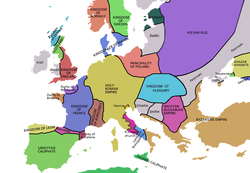 Europe around 998.


The feudal system
Use of the term "feudalism"
The failure of Charlemagne's centralizing political project led, in the absence of that counterweight, to the formation of a political, economic and social system that historians have agreed to call feudalism, although in reality the name was born as a pejorative used by its Enlightenment critics to designate the Ancien Régime. The French Revolution solemnly abolished "all feudal rights" on the night of August 4, 1789, and "definitively the feudal regime" with the decree of August 11.
The generalization of the term allows many historians to apply it to the social formations of the whole Western European territory, whether or not they belonged to the Carolingian Empire. Supporters of a restricted use, arguing the need not to confuse concepts such as fief, villae, tenure or lordship, limit it both in space (France, western Germany and northern Italy) and in time: a "first feudalism" or "Carolingian feudalism" from the 8th century to the year 1000 and a "classical feudalism" from the year 1000 to 1240, in turn divided into two periods, the first up to 1160 (the most decentralized, in which each castle lord could consider himself independent, and the process called incastellamento took place); and the second, that of the "feudal monarchy"). There would even be "imported feudalisms": Norman England from 1066 and the Latin states of the East created during the Crusades (12th and 13th centuries).[34]
Others prefer to speak of a "feudal regime" or "feudal system", to subtly differentiate it from strict feudalism, or of a feudal synthesis, to mark the fact that features of classical antiquity survive in it mixed with Germanic contributions, involving both institutions and productive elements, which constituted the specificity of Western European feudalism as an economic and social formation compared with others that were also feudal, with momentous consequences for later historical development.[Note 8] There are more difficulties in using the term the further away we go: Eastern Europe underwent a process of "feudalization" from the end of the Middle Ages, precisely when in many areas of Western Europe peasants were freed from the legal forms of serfdom, so that people usually speak of Polish or Russian feudalism. The Ancien Régime in Europe, medieval Islam and the Byzantine Empire were urban and commercial societies, with a variable degree of political centralization, although the exploitation of the countryside was carried out with social relations of production very similar to medieval feudalism. Historians who apply the methodology of historical materialism (Marx defined the feudal mode of production as the intermediate stage between the slave and the capitalist ones) do not hesitate to speak of a "feudal economy" to refer to it, although they also recognize the need not to apply the term to just any non-slave pre-industrial social formation, since throughout history and geography there have existed other modes of production also foreseen in the Marxist model, such as the primitive mode of production of little-evolved, homogeneous societies with scant social division (such as those of the Germanic peoples themselves before the invasions) and the Asiatic mode of production or hydraulic despotism (Pharaonic Egypt, the kingdoms of India or the Chinese Empire), characterized by the payment of tribute by peasant villages to a highly centralized state.[35] In even more distant places the term feudalism has been used to describe an era. Such is the case of Japan and so-called Japanese feudalism, given the undeniable similarities and parallels that the European feudal nobility and its world have with the samurai and theirs. It has also been applied to the historical situation of the intermediate periods of the history of Egypt, in which, following a millennial cyclical rhythm, central power and city life decline, military anarchy breaks the unity of the lands of the Nile, and the temples and local lords who manage to control a sphere of power govern it independently over peasants obliged to work.
Vassalage and the fief

Two institutions were key to feudalism: on the one hand, vassalage as a legal-political relationship between lord and vassal, a synallagmatic contract (that is, between equals, with requirements on both sides) between lords and vassals (both free men, both warriors, both nobles), consisting of the exchange of mutual support and loyalty (the grant of offices, honors and lands, the fief, by the lord to the vassal, and the commitment of auxilium et consilium, aid or military support and counsel or political support), which, if not fulfilled or if broken by either party, gave rise to felony, and whose hierarchy became complicated in pyramidal form (the vassal was in turn lord of vassals); and on the other hand, the fief as an economic unit and a unit of social relations of production between the lord of the fief and his serfs, not an egalitarian contract, but a violent imposition ideologically justified as a do ut des of protection in exchange for labor and submission.
Therefore, the reality expressed as feudal-vassalic relations is really a term that includes two types of social relation of completely different nature, although the terms that designate them were used at the time (and are still used) ambiguously and with great terminological confusion between them:
Vassalage was a pact between two members of the nobility of different rank. The knight of lower rank became the vassal (vassus) of the more powerful noble, who became his lord (dominus), by means of Homage and Investiture, in a ritualized ceremony that took place in the keep of the lord's castle. Homage (homage), from the vassal to the lord, consisted of prostration or humiliation (usually on the knees), the osculum (kiss), the inmixtio manum (the vassal's hands, joined in a praying position, were taken between those of the lord), and some phrase acknowledging that he had become his man. After the homage came the investiture, from the lord to the vassal, which represented the handing over of a fief (depending on the rank of vassal and lord, it could be a county, a duchy, a march, a castle, a town, or a simple salary; or even a monastery if the vassalage was ecclesiastical) through a symbol of the territory or of the sustenance that the lord owes the vassal (a little earth, grass or grain) and the accolade, in which the vassal receives a sword (and some blows with it on the shoulders), or a crosier if he was a religious.
The commendation, entrustment or patronage (patrocinium, commendatio, although it was common to use the term commendatio for the act of homage or even for the whole institution of vassalage) were theoretical pacts between the peasants and the feudal lord, which could also be ritualized in a ceremony or, more rarely, give rise to a document. The lord received the peasants into his fief, which was organized into a seigneurial reserve that the serfs had to work compulsorily (sernas or corvées) and the set of small family holdings (manses) assigned to the peasants so that they could subsist. The lord's obligation was to protect them if they were attacked, and to maintain order and justice in the fief. In exchange, the peasant became his serf and came under the double jurisdiction of the feudal lord: in the terms used in the Iberian Peninsula in the Late Middle Ages, the territorial lordship, which obliged the peasant to pay rents to the noble for the use of the land; and the jurisdictional lordship, which made the feudal lord the ruler and judge of the territory in which the peasant lived, so that he obtained feudal rents of very different origins (taxes, fines, monopolies, etc.). The distinction between property and jurisdiction was not clear under feudalism, since in fact the very concept of property was confused, and jurisdiction, granted by the King as a favor, put the lord in a position to obtain his rents. There were no jurisdictional lordships in which all the plots belonged to the lord as property, various forms of allod among the peasants being very widespread. In later periods of depopulation and refeudalization, such as the crisis of the 17th century, some nobles tried to have a lordship considered completely depopulated of peasants in order to free themselves from all kinds of restrictions and turn it into a coto redondo convertible to another use, such as livestock farming.[36]
Together with the fief, the vassal receives the serfs on it, not as slave property, but not in a regime of freedom either, since their servile condition prevents them from leaving it and obliges them to work. The obligations of the lord of the fief include the maintenance of order, that is, civil and criminal jurisdiction (mero e mixto imperio in the legal terminology reintroduced with Roman law in the Late Middle Ages), which gave even greater opportunities to obtain the productive surplus that the peasants might obtain after their labor obligations (corvées or sernas on the seigneurial reserve) or the payment of rent (in kind or in money, which circulated very scarcely in the Early Middle Ages, but was more widespread in the last medieval centuries, as the economy became more dynamic). The exploitation of forests and hunting, roads and bridges, mills, taverns and shops usually remained a seigneurial monopoly. All of these were further opportunities to obtain more feudal rent, including traditional rights, such as the ius primae noctis or right of the first night, which became a tax on marriages, a clear sign that it is from the surplus that feudal rent is extracted by extra-economic means (in this case, from the evidence that a peasant community is growing and prospering).
The feudal orders

Over time, following the trend set since the Late Roman Empire, which was consolidated in the classical period of feudalism and survived throughout the Ancien Régime, a society organized by estates took shape, in the so-called estates or ordines (orders): nobility, clergy and common people (or Third Estate): bellatores, oratores and laboratores, the men who wage war, those who pray and those who work, according to the vocabulary of the time. The first two are privileged, that is, the common law is not applied to them, but rather a separate jurisdiction of their own (for example, they have different penalties for the same crime, and their form of execution is different), and they cannot work (the vile and mechanical trades are forbidden to them), since that is the condition of the non-privileged. In medieval times, the feudal orders were not closed and blocked estates, but maintained a permeability that allowed, in extraordinary cases, social ascent through merit (for example, through a demonstration of exceptional valor); such cases were so rare that they were not experienced as a threat, something that did happen from the great social upheavals of the last centuries of the Late Middle Ages onward, when the privileged were forced to institutionalize their position by trying to close access to their estates to the non-privileged (in which they were not entirely effective either). Completely inappropriate would be the comparison with the caste society of India, in which warriors, priests, merchants, peasants and pariahs belonged to different castes understood as disconnected lineages whose mixing was forbidden.
The functions of the feudal orders were ideologically fixed by political Augustinianism (De Civitate Dei, 426), in search of a society that, although as an earthly one it could not cease to be corrupt and imperfect, could aspire to be at least a shadow of the image of a perfect "City of God" with Platonic roots[Note 9] in which everyone had a role in its protection, its salvation and its maintenance. This idea was reformulated and refined throughout the Middle Ages, successively by authors such as Isidore of Seville (630), the school of Auxerre (Haymo of Auxerre, 865, in the Burgundian abbey where Heiric of Auxerre and his disciple Remigius of Auxerre worked, following the tradition of Scotus Eriugena), Boethius (892), Wulfstan of York (1010), Gerard of Cambrai (1024) or Adalbero of Laon; and it was used in legislative texts such as the so-called Compilation of Huesca of the Fueros of Aragon (James I), and the Siete Partidas (Alfonso X the Wise, 1265).[37]
The bellatores or warriors were the nobility, whose function was physical protection, the defense of all against aggression and injustice. It was organized pyramidally from the emperor, through the kings and descending without interruption down to the last squire, although according to rank, power and wealth it can be classified into two distinct parts: the high nobility (marquesses, counts and dukes), whose fiefs are the size of regions and provinces (although most often not territorially continuous, but scattered and diffuse, full of enclaves and exclaves); and the lower nobility or knights (barons, infanzones), whose fiefs are the size of small districts (at the municipal scale or smaller), or who directly possess no territorial fiefs, living in the castles of more important lords, or in cities or towns where they exercise no jurisdiction (although they may exercise its regimiento, that is, take part in its municipal government on behalf of the noble estate). At the end of the Middle Ages and in the Early Modern Age, the nobility no longer exercised its military function, as was the case of the Spanish hidalgos, who invoked their estate privileges to avoid paying taxes and to obtain some social advantage, boasting of their patent of nobility or their coat of arms and ancestral home, but who, lacking sufficient feudal rents to maintain the noble way of life, ran the risk of losing their status by contracting an unequal marriage or by earning their living through work:
For the blood of the Goths,
and the lineage and nobility
so exalted,
by how many ways and means
its great loftiness is lost
in this life!
Some, through little worth,
how low and downcast
they are held;
others who, for lack of means,
by unbecoming trades maintain themselves.
— Stanza X of the Coplas a la muerte de su padre by Jorge Manrique
In addition to religious legitimation, the ideological legitimation of the way of life, the social function and the values of the nobility was disseminated socially through lay culture and art (the epic of the cantares de gesta and the lyric of courtly love of the Provençal troubadours).[38]


The oratores or clerics were the clergy, whose function was to facilitate the spiritual salvation of immortal souls: some formed a powerful elite called the high clergy (abbots, bishops), and others, humbler, the lower clergy (village priests or the lay brothers of a monastery). The spread and organization of Benedictine monasticism through the Order of Cluny, closely linked to the organization of the centralized and hierarchical episcopal network, with the Pope of Rome at its apex, established the double feudal pyramid of the secular clergy, devoted to the administration of the sacraments (which controlled the entire life course of the population, from birth to death); and the regular clergy, set apart from the world and subject to a monastic rule (usually the Benedictine rule). The three monastic vows of the regular clergy (poverty, obedience and chastity), as well as the ecclesiastical celibacy that was gradually imposed on the secular clergy, functioned as an effective mechanism linking the two privileged estates: the younger sons of the nobility entered the clergy, where they were maintained without hardship thanks to the numerous foundations, donations, dowries and testamentary bequests; but they did not dispute inheritances with their brothers, who could keep the family patrimony concentrated. Church lands remained in mortmain, whose function was to guarantee the masses and prayers stipulated by the donors, so that the sons prayed for the souls of the parents. The whole system guaranteed the maintenance of the social prestige of the privileged, who attended Mass in prominent places while they lived and were buried in principal places of churches and cathedrals when they died.[Note 10] Confrontations were not lacking: the evidence of simony and nicolaism (appointments to ecclesiastical offices interfered with by the civil authorities, or their outright purchase and sale) and the use of the principal religious threat to temporal power, equivalent to a civil death: excommunication. The Pope even claimed the authority to release a vassal from the fealty owed to his lord and to claim it for himself, which was used on several occasions to found kingdoms that became vassals of the Pope (for example, the independence that Afonso Henriques obtained for the county turned into the Kingdom of Portugal from the Kingdom of León).
The laboratores or workers were the common people, whose function was the maintenance of bodies, the ideologically lowest and humblest function (humiliores were those close to the humus, the earth, while their superiors were honestiores, those who could maintain honor).[Note 11] They were necessarily the most numerous, and the vast majority of them were devoted to agricultural tasks, given the extremely low productivity and agricultural yield characteristic of the pre-industrial age and of the very limited technical level (hence the identification in Castilian of laborator with labrador, farmer). They were generally subject to the other estates. The common people consisted overwhelmingly of peasants, whether serfs of the feudal lords or free peasants (villeins), and of artisans, who were few and lived either in the villages (those of lesser specialization, who usually shared in agricultural tasks: blacksmiths, saddlers, potters, tailors) or in the few small cities (those of greater specialization and of products of less pressing need or in demand by the upper classes: jewelers, goldsmiths, chandlers, coopers, weavers, dyers). The self-sufficiency of the fiefs and monasteries limited their market and capacity to grow. The building trades (stonemasonry, bricklaying, carpentry) and the profession of master builder or architect itself are a notable exception: obliged by the nature of their work to travel to the place where the building was being constructed, they became a nomadic guild that moved along the roads of Europe, communicating technical or ornamental innovations transformed into trade secrets, which lies at the origin of their distant and mythologized link with the secret society of Freemasonry, which from its origin regarded them as the primitive masons.[Note 12]
Areas without intermediate dependence on noble or ecclesiastical lords were called realengo (crown lands) and usually prospered more, or at least they usually considered it a misfortune to come to depend on a lord, to the point that on some occasions they managed to avoid it by making payments to the King; or the repopulation of frontier or depopulated areas was encouraged (as happened in the Astur-Leonese kingdom with the depopulated Duero Plateau), where mixed figures could appear, such as the commoner knight (who could maintain at least one warhorse with his own holding and arm and defend himself) or the behetrías, which elected their own lord and could change from one to another if it suited them; or with the offer of a fuero or settlement charter that granted a town its own collective lordship. The initial privileges were not enough to prevent most of them from falling into feudalization over time.
The three feudal orders were not yet closed estates in the Middle Ages: they were the basic consequence of the social structure that had been created slowly but inexorably with the transition from slavery to feudalism since the crisis of the 3rd century (ruralization and the formation of latifundia and villae, the reforms of Diocletian, the disintegration of the Roman Empire, the invasions, the establishment of the Germanic kingdoms, the institutions of the Carolingian Empire, its disintegration and a new wave of invasions). The feudal lords were a continuation of the clientelist lines of the Carolingian counts, and some can be traced back to the Roman landowners or the Germanic retinues, while the peasantry came from the former slaves or tenant farmers, or from free peasants who were forced to commend themselves, sometimes receiving part of their own former lands in the form of a manse "granted" by the lord. The peasant inherited his servile condition and his attachment to the land, and rarely had the opportunity to rise in level other than by fleeing to a city or by an even more extraordinary event: his ennoblement for an outstanding feat of arms or service to the King, which under normal conditions were completely closed to him. The same can be said of the artisan or the merchant (who in some cases could accumulate a fortune, but not alter his humble origin). The noble was generally so by inheritance, although on occasion someone could become ennobled as a soldier of fortune after a victorious military career (as was the case, for example, of Robert Guiscard). The clergy, for its part, was recruited by co-option, with different access depending on social origin: assured for the younger sons of the noble houses and restricted to the lower levels of the lower clergy for those of the common people; but in particular or outstanding cases, advancement in the ecclesiastical hierarchy was open to intellectual merit. All this gave the feudal system an extraordinary stability, in which there was "a place for every man, and every man in his place," and at the same time an extraordinary flexibility, because it allowed political and economic power to become atomized throughout Europe, from Spain to Poland.
The year 1000
The legendary year 1000, the end of the first millennium, which is conventionally used for the passage from the Early to the Late Middle Ages, is in reality only a round number in the reckoning of the Christian era, which was not in universal use: the Muslims used their own lunar Islamic calendar, which begins with the Hijra (622); in some parts of Christendom local eras were used (such as the Hispanic era, which counts from 38 BC). But certainly, millenarianism and predictions of the end of times were present; even the pope at the turn of the millennium himself, Sylvester II, the Frenchman Gerbert of Aurillac, interested in all kinds of knowledge, earned an esoteric reputation.[40] Astrology could always find extraordinary celestial phenomena on which to base its prestige (such as eclipses), but certainly other events of the time were among the most spectacular in history: Halley's Comet, which approaches the Earth periodically every eight decades, reached its maximum brightness on its visit of 837,[41] bid farewell to the first millennium in 989 and arrived in time for the Battle of Hastings in 1066; even more visible, the supernovae SN 1006 and SN 1054, which bear the number of the year in which they were recorded, were reflected in greater detail in Chinese, Arab and even Native American sources than in the scant European ones (even though that of 1054 coincided with the battle of Atapuerca).
The whole 10th century, more because of real conditions than imaginary ones, can be considered part of a dark, pessimistic, insecure age dominated by fear of all kinds of dangers, real and imaginary, natural and supernatural: fear of the sea, fear of the forest, fear of witches and demons and of everything that, without falling within the Christian supernatural, was relegated to the inexplicable and to the concept of the marvelous, attributed to beings of dubious or perhaps possible existence (dragons, goblins, fairies, unicorns). The fact was in no way unique: a thousand years later, the 20th century gave birth to comparable fears: of nuclear holocaust, of climate change (contemporary versions of the end of the world); of communism (the witch hunt with which McCarthyism was identified), of freedom (Fear of Freedom is the basis of fascism in the interpretation of Erich Fromm), a comparison that has been highlighted by historians[42] and interpreted by sociologists (Risk Society by Ulrich Beck).
The Middle Ages firmly believes that all things in the universe have a supernatural meaning, and that the world is like a book written by the hand of God. All animals have a moral or mystical meaning, as do all stones and all herbs (and this is what the bestiaries, lapidaries and herbals explain). Positive or negative meanings thus come to be attributed to colors as well... For medieval symbolism a thing can even have two opposite meanings depending on the context in which it is considered (hence the lion sometimes symbolizes Jesus Christ and sometimes the devil).
The conjuncture of the year 1000
In the historical conjuncture of the year 1000, the strongest political structures of the previous period were proving to be very weak: Islam had broken up into caliphates (Baghdad, Cairo and Córdoba), which by the year 1000 were proving unable to contain the Christian kingdoms, especially the Kingdom of León, in the Iberian Peninsula (final failure of Almanzor), and the Byzantine Empire in the Eastern Mediterranean. The Bulgarian Empire also suffered Byzantine expansion and was destroyed. French, Polish and Hungarian national particularisms traced protonational borders that, curiously, are very similar to those of the year 2000. By contrast, the Carolingian Empire had dissolved into ungovernable feudal principalities, which the Ottonians set out to include in a second Restauratio Imperii (Otto I, in 962), this time on Germanic foundations.[44]
The persistence of fear and the function of laughter
Nel mezzo del cammin di nostra vita
mi ritrovai per una selva oscura
chè la diritta via era smarrita.In the middle of the journey of our life
I found myself in a dark forest
because I had strayed from the straight path.

Fears and insecurity did not end with the year 1000, nor was it necessary to wait for the terrible Black Death and the flagellants of the 14th century to find them again. Even in the medieval optimum of the expansive 13th century, the most common thing was to find texts like Dante's, or like the following:
This hymn by an unknown author, attributed to very diverse figures (Pope Gregory, who might be Gregory the Great, to whom Gregorian chant is also attributed, or another of that name; the founder of the Cistercians, Saint Bernard of Clairvaux; the Dominican monks Umbertus and Frangipani; and the Franciscan Thomas of Celano) and incorporated into the liturgy of the Mass:
- Dies iræ, dies illa,
- Solvet sæclum in favilla,
- Teste David cum Sibylla !
- Quantus tremor est futurus,
- quando judex est venturus,
- cuncta stricte discussurus !
- ...
- Confutatis maledictis,
- flammis acribus addictis,
- voca me cum benedictis.
- Oro supplex et acclinis,
- cor contritum quasi cinis,
- gere curam mei finis.
- Lacrimosa dies illa,
- qua resurget ex favilla
- judicandus homo reus.
- Huic ergo parce, Deus.
- Day of wrath; that day
- on which the ages are reduced to ashes;
- with King David and the Sibyl as witnesses.
- How much terror there will be in the future
- when the judge is to come
- to judge all things strictly!
- ...
- Having confounded the accursed
- cast into the devouring flames,
- have me called among the blessed.
- I beg you, suppliant and on my knees,
- my heart grieving, almost turned to ashes:
- take charge of my destiny.
- A day of tears will that day be
- on which, from the dust, will rise again
- for judgment, guilty man.
- Him, then, spare, O God.

But this other one, coming from a completely opposite milieu, collected in a compilation of goliard poems (monks and students of disorderly life), also shares the same pessimistic conception of the world:[45]
- O Fortuna
- velut luna
- statu variabilis,
- semper crescis
- aut decrescis;
- vita detestabilis
- nunc obdurat
- et tunc curat
- ludo mentis aciem
- egestatem,
- potestatem
- dissolvit ut glaciem.
- Sors immanis
- et inanis,
- rota tu volubilis,
- status malus,
- vana salus
- semper dissolubilis,
- obumbrata
- et velata
- O Fortune,
- like the Moon
- changeable,
- you wax without ceasing
- or vanish.
- Detestable life!
- first it dulls
- and then it sharpens,
- as a game, the keenness of the mind.
- poverty
- and power
- melt like ice.
- Monstrous
- and empty fate,
- a turning wheel is what you are,
- if it is badly placed
- health is vain,
- it can always be dissolved,
- eclipsed
- and veiled
— Fortuna imperatrix mundi: Fortune, empress of the world (Carmina Burana)
The supernatural was present in everyone's daily life as a constant reminder of the brevity of life and the imminence of death, whose radical egalitarianism acted, in counterpoint to the inequality of conditions, as a source of social cohesion, as did the promise of eternal life. The imagination was excited by the most morbid images of what would happen at the Last Judgment, of the torments of hell, and of the merits that the saints had earned through their ascetic lives and their martyrdoms (which, well administered by the Church, could spare the temporal punishments of purgatory). This did not operate only on the frightened illiterate, who had only the gospel in stone of the churches; most educated readers gave full credence to the gruesome scenes that filled the martyrologies and to the implausible stories of the Golden Legend by Jacopo da Voragine.
Fear was inherent in the permanent structural violence of feudalism, which, even if channeled through socially acceptable mechanisms and establishing a theoretically perfect order of estates, was a permanent reminder of the possibility of the subversion of order, periodically renewed by wars, invasions and internal uprisings. In particular, the satires against the rustic were manifestations of the mixture of contempt and distrust with which clerics and nobles viewed the serf, reduced to a deformed, ignorant and violent monster, capable of the greatest atrocities, especially when gathered in groups.[46]
A furia rusticorum libera nos, Domine
From the fury of the peasants, deliver us, Lord.
— Addition to the ecclesiastical liturgy of the Litany of the Saints.[47]
But at the same time it was maintained, as an essential part of the ideological edifice (it was the justification of papal election), that the voice of the people was the voice of God (Vox populi, vox Dei). The medieval spirit had to accept the contradiction of promoting public displays of piety and devotion while at the same time allowing generous concessions to sin. Carnivals and other grotesque parodies (the feast of the ass or the charivari) allowed all kinds of license, even blasphemy and mockery of the sacred, inverting hierarchies (kings of fools, boy bishops or bishops of the feast were elected), making everything triumph that for the rest of the year was forbidden, considered ugly, unpleasant or frightening, as a healthy reaction to the daily terror of the hereafter and a guarantee that, once the excesses of the feast were over, people would return docilely to work and obedience. Seriousness and sadness were the prerogatives of those who practiced a sacred optimism (one must suffer, for eternal life awaits us afterward), while laughter was the medicine of those who lived a miserable and difficult life with pessimism.[48] In contrast to the greater rigorism of early Christianity, medieval theologians speculated about whether or not Christ laughed (the Epistle of Lentulus, one of the apocryphal gospels, maintained that he did not; while some Church Fathers defended the right to a holy joy), which justified comic ecclesiastical texts such as the Coena Cypriani and the Joca monachorum.[49]
High Middle Ages (11th to 13th centuries)

The name High Middle Ages is given to the period of the History of Europe spanning the 11th to the 13th centuries. These High Middle Ages, or Height of the Medieval Period, would end in the crisis of the 14th century or crisis of the Middle Ages, in which "decadent" processes can be observed, and it is common to describe that period as a twilight or autumn. Nevertheless, the last medieval centuries are full of dynamic events and processes, with enormous repercussions and projections into the future, although logically these are the events and processes that can be understood as "new," which prefigure the new times of modernity. At the same time, the events, processes, social agents, institutions and values characterized as medieval have clearly entered into decline; they survive, and will survive for centuries, largely thanks to their institutionalization (for example, the closing of the privileged estates or the adoption of the mayorazgo), which is nonetheless a symptom that it was then, and not before, that it was considered necessary to defend them so strongly.

The justification for this name lies in the exceptional nature of the economic, demographic, social and cultural development of Europe that took place in this period, coinciding with a very favorable climate (there has been talk of the "medieval optimum") that allowed vines to be grown in England. There has also been talk, specifically for the 12th century, of the revolution of the 12th century or renaissance of the 12th century.
The symbolic year 1000 (whose millenarian terrors are a frequently exaggerated historiographical myth) means nothing in itself, but from then on the Dark Age of the invasions of the Early Middle Ages is considered over: the Magyars and Normans were by then settled and integrated into Latin Christendom. The Europe of the High Middle Ages was also expansive in the military sphere: the Crusades in the Near East, the Angevin domination of Sicily and the advance of the Christian kingdoms in the Iberian Peninsula (once the Caliphate of Córdoba had disappeared) threatened to reduce the Islamic space to the southern shore of the Mediterranean Basin and the interior of Asia.
The feudal mode of production developed without, for the moment, encountering limits to its extension (as would happen with the crisis of the 14th century). The feudal rent was distributed by the lords outside the countryside, where it originated: cities and the bourgeoisie grew with the increasing demand for craft products and for long-distance trade; fairs, overland and maritime trade routes and institutions such as the Hansa were born and developed. Central and Northern Europe entered the heart of Western civilization. The Byzantine Empire held on between Islam and the crusaders, its cultural influence extending through the Balkans and the Russian steppes, where the Mongol onslaught was resisted.
Romanesque art and early Gothic art were sponsored by the religious orders and the secular clergy. Cluny and Cîteaux filled Europe with monasteries. The Way of Saint James linked the Iberian Peninsula with Europe. The universities were born (Bologna, Sorbonne, Oxford, Cambridge, Salamanca, Coimbra). Scholasticism reached its peak with Thomas Aquinas, after receiving the influence of translations from Arabic (Averroism). The rediscovery of Roman law (Bartolus de Saxoferrato, Baldus de Ubaldis) began to influence kings, who saw themselves as emperors in their own kingdom.
Conflicts grew along with society: heresies, peasant and urban revolts, the savage repression of all of them, and the no less savage feudal wars were constant.
The expansion of the feudal system
Internal dynamism: economic, social, technological and intellectual

Far from being an ossified social system (the closing of access to the estates is a process that occurred as a conservative reaction of the privileged, after the final crisis of the Middle Ages, already in the Ancien Régime), medieval feudalism showed enough flexibility to allow the development of two processes that fed back into each other, favoring rapid expansion. On the one hand, assigning a place to each person within the system allowed the expulsion of all those for whom there was no place, sending them as settlers and military adventurers to lands not yet won for Western Christendom, thus brutally expanding its limits. On the other, it ensured a certain order and social stability for the agrarian world after the end of the period of invasions; although wars by no means came to an end —they were inherent to the feudal system— the usual level of violence in times of war tended to be controlled by the institutions themselves —code of honor, Truce of God, seeking sanctuary— and in normal periods tended to become ritualized —challenges, duels, rieptos, jousts, tournaments, passages of arms—, although it did not disappear either in international relations or within the kingdoms, with cities that based their security and pax urbana on their strong walls, their curfews and their summary justice, and unsafe countryside in which lords of gallows and knife imposed their prerogatives and even abused them (feudal evildoers), not without meeting the anti-seigneurial resistance of the serfs,[50] sometimes mythologized (Robin Hood). Unlike the slave mode of production, the feudal mode of production placed on the producer —the peasant— the responsibility for increasing production: whether the harvest was good or bad, he had to pay the same rents. That is why the system by itself stimulated work and the adoption of whatever experience showed to be good agricultural practices, even the adoption of new techniques that improved the yield of the land. If the increase in production was permanent and not circumstantial (a single good harvest for climatic reasons), the one who would begin to receive incentives would be the feudal lord, who would detect that increase in the surpluses whose extraction was the basis of his feudal rent (greater use of the mill, more traffic on the roads and bridges, greater consumption in shops and taverns; on all of which he levied taxes or would aspire to do so), and would even be driven to raise the rent. When what happened was that the peasants, pushed by the growth of their families, pressed against the limits of the manses by clearing previously uncultivated land (wastelands, pastures, forests, drainable wetlands), the lord could impose new conditions, or even prevent it, because those lands formed part of his demesne or of his monopolistic uses (hunting, fodder for his horses).

This dynamic of class struggle between serfs and lords invigorated the economy and made possible the beginning of a concentration of wealth accumulated from agricultural rents; but never in a way comparable to the capital accumulation characteristic of capitalism, since that wealth was not used for productive investment (as would have happened had the peasants had the use of the surplus), but for hoarding in the hands of the nobility and clergy. This, ultimately, through building programs (castles, monasteries, churches, cathedrals, palaces) and sumptuary spending on luxury products —horses, sophisticated weapons, jewelry, works of art, quality cloth, dyes, silks, tapestries, spices— could not fail to stimulate rudimentary long-distance trade, monetary circulation and urban life; in short, the economic revival of Western Europe. Ironically, both processes would end up undermining the foundations of feudalism and leading it toward its destruction.[Note 13] Nevertheless, one should not imagine that anything resembling the agricultural revolution that preceded the Industrial Revolution took place: the fact that neither peasants nor lords could turn the surplus into capital (the former because it was extracted from them and the latter because their social position was incompatible with economic activities) made any innovation slow and costly, in addition to the fact that any innovation clashed with ideological prejudices and a strongly traditionalist mentality, both characteristic of pre-industrial society. Only over the course of centuries, and owing to the trial and error of the good craftsmanship of anonymous blacksmiths and saddlers with no connection whatsoever to scientific research, were few but decisive technical improvements adopted, such as the horse collar (which made possible the efficient use of the strength of draft horses, which began to replace oxen) or the moldboard plow (which replaced the Roman plow in the damp, heavy soils of northern Europe, but not in the dry, light soils of the south). Alternate-year fallow remained the most widely used cultivation method; crop rotation was unknown, fertilizing was an exceptional resource, given the scarcity of animals, whose manure was the only fertilizer available; irrigation was limited to some of the Mediterranean areas of Islamic culture; the use of iron in tools and farm implements was skimped on, given its cost, which the peasants could not afford; the technical level, in general, was precarious. The windmill was a technology transfer that, like so many others in other fields (gunpowder, paper, compass, printmaking), came from Asia. Even with its limited scope, the set of innovations and changes was concentrated especially in a period that some historians have come to call the "Renaissance" of the 12th century or the Revolution of the 12th century, a moment in which economic and social dynamism, starting from the main engine, which is the countryside, produced the awakening of an urban world that until then had been marginal in Western Europe, and the emergence of intellectual phenomena such as the medieval university and scholasticism.
The university

Following the precedent of the Carolingian organization of palace, cathedral and monastic schools (owed to Alcuin of York -787-), rather than that of other similar institutions existing in the Islamic world,[Note 14] the first universities of Christian Europe were founded for the study of law, medicine and theology. The core of the teaching involved the study of the preparatory arts (called liberal arts because they were mental or spiritual and freed one from the manual labor characteristic of the crafts, which were considered vile and mechanical trades); these liberal arts were the trivium (grammar, rhetoric and logic) and the quadrivium (arithmetic, geometry, music and astronomy). Afterward, the student came into contact with more specific studies. Besides being centers of teaching, they were also the place of research and production of knowledge, and a focus of vigorous debates and controversies, which at times even required interventions by the civil and ecclesiastical authorities, despite the fueros with which they were endowed and which made them independent institutions, well funded economically with a patrimonial base of lands and buildings. The cultural transformation brought about by the universities has been summed up as follows: In 1100, the school followed the master; in 1200, the master followed the school.[53] The most prestigious received the name of Studium Generale, and their fame spread throughout Europe, requiring the presence of their masters, or at least correspondence by letter, which initiated a fruitful intellectual exchange facilitated by the common use of the learned language, Latin.
Between 1200 and 1400, 52 universities were founded in Europe; 29 of them of papal foundation, the rest of imperial or royal foundation. The first was possibly Bologna (specializing in Law, 1088), followed by Oxford (before 1096), from which its rival Cambridge split off (1209), Paris, from the mid-12th century (one of whose colleges was the Sorbonne, 1275), Salamanca (1218, preceded by the Studium Generale of Palencia of 1208), Padua (1222), Naples (1224), Coimbra (1308, moved from the Studium Generale of Lisbon of 1290), Alcalá de Henares (1293, refounded by Cardinal Cisneros in 1499), La Sapienza (Rome, 1303), Valladolid (1346), Charles University (Prague, 1348), the Jagiellonian University (Kraków, 1363), Vienna (1365), Heidelberg (1386), Cologne (1368) and, already at the end of the medieval period, Leuven (1425), Barcelona (1450), Basel (1460) and Uppsala (1477). In medicine, the Schola Medica Salernitana, with Arab roots, dating from the 9th century, enjoyed great prestige; and in 1220 the Montpellier Faculty of Medicine began to rival it.
Scholasticism
Scholasticism was the dominant theological-philosophical current of medieval thought, after the patristics of Late Antiquity, and was based on the coordination of faith and reason, which in any case always implied the clear submission of reason to faith (Philosophia ancilla theologiae -philosophy is the handmaid of theology-). But it is also a method of intellectual work: all thought had to submit to the principle of authority (Magister dixit -the Master said it-), and teaching could in principle be limited to the repetition or gloss of ancient texts, and above all of the Bible, the main source of knowledge, since it represents Divine revelation; in spite of all this, scholasticism encouraged speculation and reasoning, since it involved submitting to a rigid logical framework and a schematic structure of discourse that had to be exposed to refutations and prepare defenses. From the beginning of the 9th century to the end of the 12th, debates centered on the problem of universals, which pitted the realists led by William of Champeaux against the nominalists represented by Roscelin and the conceptualists (Peter Abelard). In the 12th century came the reception of texts by Aristotle previously unknown in the West, at first indirectly through Jewish and Muslim philosophers, especially Avicenna and Averroes, but soon directly translated from Greek into Latin by Saint Albertus Magnus and by William of Moerbeke, secretary of Saint Thomas Aquinas, the true summit of medieval thought, who was raised to the rank of Doctor of the Church. The apogee of scholasticism coincides with the 13th century, when the universities were founded and the mendicant orders arose: the Dominicans (who followed an Aristotelian tendency -those mentioned above-) and the Franciscans (characterized by Platonism and the patristic tradition -Alexander of Hales or Saint Bonaventure-). Both orders would monopolize the chairs and the life of the university colleges, and from them would come most of the theologians and philosophers of the time.
The 14th century would represent the crisis of scholasticism through two British Franciscans: the doctor subtilis John Duns Scotus and William of Ockham. The precedent of both would be the Oxford school (Robert Grosseteste and Roger Bacon), centered on the study of nature, defending the possibility of an experimental science supported by mathematics, against the dominant Thomism. The controversy over universals ended up tipping in favor of the nominalists, which left room for philosophy beyond theology.

Ergo Domine, qui das fidei intellectum, da mihi, ut, quantum scis expedire, intelligam, quia es sicut credimus, et hoc es quod credimus. Et quidem credimus te esse aliquid quo nihil maius cogitari possit. An ergo non est aliqua talis natura, quia "dixit insipiens in corde suo: non est Deus" ?
Therefore, Lord, you who give understanding to faith, grant me to understand, as much as you consider good, that you are as we believe and what we believe. And indeed, we believe that you are something than which nothing greater can be thought. Now, is there perhaps no such nature, because "the fool hath said in his heart: there is no God"?
— Anselm of Canterbury, beginning of the ontological argument to prove the existence of God.
Proslogion, chapter II (1078). The phrase in quotation marks is a biblical quotation (Psalms 13:1).[55]
Dicitur Exodi III, ex persona Dei, ego sum qui sum.
Deum esse quinque viis probari potest... Quinta via sumitur ex gubernatione rerum. Videmus enim quod aliqua quae cognitione carent, scilicet corpora naturalia, operantur propter finem, quod apparet ex hoc quod semper aut frequentius eodem modo operantur, ut consequantur id quod est optimum; unde patet quod non a casu, sed ex intentione perveniunt ad finem. Ea autem quae non habent cognitionem, non tendunt in finem nisi directa ab aliquo cognoscente et intelligente, sicut sagitta a sagittante. Ergo est aliquid intelligens, a quo omnes res naturales ordinantur ad finem, et hoc dicimus Deum.
It is said in Exodus 3:14 of the person of God: "I am who am."
The existence of God can be proved in five different ways... The fifth is deduced from the ordering of things. For we see that there are things that have no knowledge, such as natural bodies, and that act for an end. This can be verified by observing how they always or often act in the same way to achieve what is best. From which it is deduced that, to reach their goal, they do not act by chance, but intentionally. Things that have no knowledge do not tend toward an end without being directed by someone with knowledge and intelligence, as the arrow by the archer. Therefore, there is someone intelligent by whom all things are directed to their end. We call him God.
— Thomas Aquinas, the fifth of the Five Ways (Quinquae viae) to prove the existence of God.
Summa Theologiae (Summa Theologica, 1274), Quaestio 2, Articulus 3.[56]
Compare with present-day arguments about intelligent design.
The rise of the bourgeoisie

The bourgeoisie is the new social agent formed by the artisans and merchants who arose in the surroundings of the cities, either in the old Roman cities that had declined, or in new settlements created around castles or crossroads -the properly so-called burghs (burgos)-. Many of these cities incorporated that name - Hamburg, Magdeburg, Freiburg, Strasbourg; in Spain Burgo de Osma or Burgos-.
The bourgeoisie was interested in pressing the political power (the empire, the papacy, the different monarchies, the local feudal nobility or the ecclesiastical institutions -dioceses or monasteries- on which their cities depended) to facilitate the economic opening of the closed spaces of the towns, to reduce toll duties and to guarantee forms of safe trade and a centralization of the administration of justice and uniformity of rules over wide territories that would allow them to carry on their work, as well as guarantees that those who violated these rules would be punished with equal severity in the different territories.
Those cities that opened their gates to trade and to greater freedom of movement saw the wealth and prosperity of their inhabitants and of their lord increase, so the model spread, reluctantly but steadily. Alliances between lords became more common, no longer so much for war as to allow the economic development of their respective territories, and the King was the unifying element of those alliances.
The burghers can be considered free men insofar as they were partially outside the feudal system, which literally besieged them -cities have been compared to islands in a feudal ocean-,[57] because they did not participate directly in feudal-vassalic relations: they were neither feudal lords, nor peasants subjected to serfdom, nor churchmen. Subjection as a subject of the political power was similar to a bond of vassalage, but rather as a collective lordship that made the city respond as a whole to the demands for military and political support of the King or ruler to whom it was bound, and that in turn made it participate in the feudal exploitation of the surrounding countryside (the alfoz in Spain).
The German expression Stadtluft macht frei, "City air gives freedom," or "makes you free"[Note 15] (a paraphrase of the Gospel phrase "the truth shall make you free"),[59] indicated that those who could settle in the cities, sometimes literally fleeing the subjection of serfdom. The runaway serf was considered free from returning to his lord if he managed to establish residence in an urban corporation for a year and a day.[60] had a whole new world of opportunities to exploit, though not under a regime of liberty, understood in its contemporary form. Subjection to guild rules and urban laws could be even harsher than those of the countryside: the pax urbana meant rigidity in the application of justice, which kept the roads and entrance gates lined with the corpses of the executed, and a strict curfew, with gates closed at nightfall and watch patrols. But it did grant the burghers the opportunity to exercise a share of power, including the use of arms in the urban militia (such as the Castilian brotherhoods that were unified into the Santa Hermandad in the 15th century), which on more than a few occasions were used against the feudal hosts, with the approval of the emerging authoritarian monarchies. The earliest and most spectacular case was that of the Italian communes, which became de facto independent of the Holy Roman Empire after the Battle of Legnano (1176).

Many new social institutions arose in the burghs. The development of trade brought with it that of the financial system and accounting. Artisans joined in associations called guilds, leagues, corporations, confraternities, or arts, depending on the geographical location. The internal operation of the guild workshops involved an apprenticeship of several years for the apprentice under a master (the owner of the workshop), which entailed his passage to the status of journeyman when he showed that he knew the trade, which meant his being regarded as a wage-earning worker, a condition in itself foreign to the feudal world that even carried over to the countryside (at first marginally) with the day laborers who had no land of their own nor land granted by the lord. The association of workshops in guilds operated in a manner completely contrary to the capitalist free market: every possible trace of competition was avoided by fixing prices, qualities, hours and working conditions, and even the streets where workshops could be located. The opening of new workshops and the passage from the rank of journeyman to that of master were highly restricted, so that in practice inheritance and endogamous marriages within the guild were encouraged. The goal was to achieve the survival of all, not the success of the best.
Trade showed more openness. The peddlers who went from village to village, and the few adventurers who dared to make longer journeys, were the most common merchants of the Early Middle Ages, before the year 1000. In three centuries, by the beginning of the 14th century, the Champagne fairs and the fairs of Medina had created stable and more or less safe overland routes that (on the backs of mules or with carts at best) crossed Europe from north to south (in the Castilian case following the transhumant cañadas of the Mesta, in the French case linking the Flemish and northern Italian emporia through the prosperous Burgundian and Rhenish regions, all of them dotted with cities). The Hansa or Hanseatic League in turn established maritime routes of similar stability and safety (with greater cargo capacity, in ships of innovative technology) that joined the Baltic and the North Sea through the Scandinavian straits, connecting territories as distant as Russia and Flanders, and river routes that connected all of northern Europe (rivers such as the Rhine and the Vistula), allowing the development of cities such as Hamburg, Lübeck and Danzig, and establishing commercial consulates called kontor.[61] In the Mediterranean they were called Consulate of the Sea: the first in Trani in 1063 and then Pisa, Messina, Cyprus, Constantinople, Venice, Montpellier, Valencia (1283), Majorca (1343) and Barcelona (1347).[62] When the Strait of Gibraltar was safe, the two Europes could be connected by sea, with routes between the Italian cities (above all Genoa), Marseille, Barcelona, Valencia, Seville, Lisbon, the ports of the Cantabrian Sea (Santander, Laredo, Bilbao), those of the French Atlantic and those of the English Channel (English and Flemish, above all Bruges and Antwerp). The ever more fluid contact among people of different nations (as the groupings of merchants of nearby geographical origin who understood each other in the same vernacular language began to be called, as also happened in the sections of the military orders) ended up making both institutions function, de facto, as primitive international organizations.
All of this developed an incipient merchant capitalism (see also History of capitalism) with the growth or ex novo emergence of the money economy and banking (credit, loans, insurance, bills of exchange), activities that always aroused moral misgivings (the sin of usury for all those that meant undue profit, and which only Jews could commit when lending to others not of their religion, a trade forbidden to both Christians and Muslims). The appearance of rich burghers and a poor urban plebs gave rise to a new kind of social tension, which produced urban revolts.[63] As for the ideological aspects, the expression of bourgeois nonconformity with its marginal place in feudal society lies at the origin of the heresies throughout the Late Middle Ages (Cathars, Waldensians, Albigensians, Dulcinians, Hussites, Wycliffites). The Church's attempts to respond to these demands of the urban world, as well as to control them and, where necessary, repress them, produced the appearance of the mendicant orders (Franciscans and Dominicans) and of the Inquisition. At times, the impossibility of achieving control led to opting for extermination, as happened in Béziers in 1209, following the answer of the papal legate Arnaud Amaury:[64]
– How shall we distinguish the heretics from the Catholics? – Kill them all, for God will know His own


The rivalry between seigneurial castles had its urban correlate in the rivalry between fortified houses, with defiant towers, which have survived in the spectacular ensembles of San Gimignano or Cáceres. Much more widespread was the rivalry of the cathedrals, whose construction dragged on for centuries, developing organically, without the original plans being completed, so that the final result was usually the sum of very different styles. Veritable races for prestige came about, such as the one that went on for hundreds of years between those of Siena and Florence. The extraordinary dimensions of both made it impossible for them to be finished before the late medieval crisis, which led the Sienese (left: Siena Cathedral Duomo di Santa María) to settle for what had been built until then (so that it could be used from the start, work always began with the apse, allowing the altar to be consecrated and worship to be held while construction continued). The aim was to turn the existing main arm into the lesser one, and to build a truly colossal main arm (a project of 1339 that had to be abandoned; the initial design dated from 1215–1263). Meanwhile, the Florentines (right: Florence Cathedral Duomo di Santa María dei Fiori), humiliated at being unable to cover the gigantic central space of the crossing (a disproportionate raised octagonal drum), had to wait until Filippo Brunelleschi managed to solve the technical challenge with an impressive dome that opened the era of the Renaissance (competition of 1419 and construction between 1420 and 1436). See also Cathedrals of Spain.In the Middle Ages, the opposition between high and low "is projected in space": very tall, highly visible towers and walls are built, to show that one wishes to escape from the "low"... the high and height designate what is great and beautiful... it is expressed in the construction of castles and cathedrals... That opposition is the correlate of the one that exists between heaven and earth.
(...)
Then, light was sought, and God even came to be identified with light. Technical progress, the search for open spaces and the ever more sophisticated use of iron and various metals gave birth, between the 11th and 13th centuries, to the great cathedrals.[65]
New political entities
Universal powers, feudal monarchies and city-states
In the High Middle Ages a great disparity could be observed in the scale at which political power was exercised: the universal powers (Papacy and Empire) continued to claim their primacy over the feudal monarchies, which in practice functioned as independent states. At the same time, entities much smaller in extent proved to be very dynamic in international relations (the Italian city-states and the free cities of the Germanic Empire), and municipalism proved to be a force very much to be reckoned with in all the territories of Europe.[66]
The rediscovery of Justinian's Digest (Digestum Vetus) allowed the autonomous study of Law (Pepo and Irnerius) and the emergence of the School of the Glossators and of the University of Bologna (1088). This event, which would allow the gradual rediscovery of Roman law, would lead to the formation of the so-called Corpus Juris Civilis and to the possibility of proposing a Ius commune (common law), and of justifying the concentration of power and regulatory capacity in the imperial institution, or in the monarchs, each of whom would begin to regard himself as imperator in regno suo ("emperor in his kingdom" -definitions of Bartolus de Saxoferrato and Baldus de Ubaldis-).
Rex superiorem non recognoscens in regno suo est Imperator: The King recognizes no superiors; in his kingdom he is emperor.
— Decretal Per Venerabilem of Innocent III, 1202.[67]
The difficult coexistence of Papacy and Empire (regnum et sacerdocium) over the centuries gave rise, between 1073 and 1122, to the Investiture Controversy. Various ideological formulations (doctrine of the two swords, Plenitudo potestatis, Dictatus papae, condemnations of simony and nicolaism) made up an edifice built up over centuries by which the Pope sought to establish the supremacy of religious authority over civil power (what has come to be called political Augustinianism), while the Emperor sought to assert the legitimacy of his office, which he claimed to derive from the ancient Roman Empire (Translatio imperii), as well as the material fact of his military capacity to impose his territorial power and even to oversee religious life (both in its institutional and its dogmatic aspects), in the manner of his counterpart in the East. The accession of different dynasties to the imperial dignity weakened the power of the emperors, subject to an electoral system that made them dependent on a delicate game of alliances among the dignitaries who attained the title of prince-elector, some lay (territorial princes, independent in practice) and others ecclesiastical (bishops of free cities). Nevertheless, there were periodic attempts to recover imperial power (Otto III and Henry II among the last Ottonians), which at times led to spectacular confrontations (Henry IV, of the Salian dynasty, or Frederick I Barbarossa and Frederick II of the Hohenstaufen dynasty). The opposition between Guelphs and Ghibellines, each associated with one of the contending powers (pope and emperor), dominated the political life of Germany and Italy from the 12th century until well into the Late Middle Ages.
Both claims were far from becoming effective, exhausted in their own debate and overtaken by the greater political effectiveness of the urban entities and the kingdoms of the rest of Europe.[68]
Parliamentarism
Parliamentarism appeared, a form of political representation that over time became the precedent of the separation of powers inherent to the democracy of the Contemporary Age. Primacy in time belongs to the Icelandic Alþingi (930), which followed the model of the things or assemblies of Germanic warriors; but from the end of the 11th century a new institutional model gradually took shape, derived from the feudal obligation of consilium, which involved the three feudal orders, and it spread throughout Western Europe: the Cortes of León (1188), the English Parliament (1258) -previously the power relations between King and nobility had been regulated in Magna Carta, 1215, or the Provisions of Oxford, 1258- and the French Estates General (1302).
The Gregorian Reform and the monastic reforms

Hildebrand of Tuscany, already from his position under the pontificates of Leo IX and Nicholas II, and later as Pope Gregory VII (thus covering the entire second half of the 11th century), undertook a program of centralization of the Church, with the help of the Benedictines of Cluny, who spread throughout Western Europe, involving the feudal monarchies (notably in the Christian kingdoms of the Peninsula, through the Way of Saint James).
The subsequent monastic reforms, such as the Carthusian (Saint Bruno) and above all the Cistercian (Saint Bernard of Clairvaux), would mean further strengthening of the ecclesiastical hierarchy and its dispersed establishment throughout European territory as an impressive social and economic force tied to feudal structures, linked to noble families and royal dynasties and with a base of landed and real-estate wealth, to which was added the collection of the Church's own dues (tithes, first fruits, stole fees, and other local charges, such as the vow of Santiago in northwestern Spain).
The strengthening of papal power intensified the political and ideological tensions with the Germanic Empire and with the Eastern Church, which in the latter case would end up leading to the Schism of the East.
The Crusades brought as a consequence the creation of a special kind of religious order which, in addition to submitting to a monastic rule (usually the Cistercian, including the theoretical fulfillment of the monastic vows), required of its members a military rather than ascetic life: these were the military orders, founded after the capture of Jerusalem in 1099 (Knights of the Holy Sepulchre, Templars -1104- and Hospitallers -1118-). They were also established in other geographical contexts (Spanish military orders and Teutonic Knights).
Adaptation to the thriving urban life of the 12th and 13th centuries would be the mission of a new cycle of foundations within the regular clergy: the mendicant orders, whose members were not monks, but friars (Franciscans of Saint Francis of Assisi and Dominicans of Saint Dominic de Guzmán, followed by others, such as the Augustinians); and of new institutions: the universities and the Inquisition.
Dogmatic and devotional innovations

From the 11th and 12th centuries onward, dogmatic and devotional innovations of great significance were introduced into Latin Christianity:
The imposition of the Roman Rite over the previous multiplicity of liturgies (Hispanic Rite, Bracarense Rite, Ambrosian Rite, etc.)
The imposition of priestly celibacy at the Lateran Council (1123).
The discovery of the role of purgatory as an intermediate stage of souls between heaven and hell, which would intensify the intermediary function of the Church through prayers and masses and the merits of the Communion of Saints administered by it.
Mariology
The intensification of the role of the Virgin Mary, who became a co-redemptrix with attributes investigated by Mariology and not yet defined as dogma (Immaculate Conception, Assumption of the Virgin), with new devotions and prayers (Hail Mary -a juxtaposition of Gospel texts introduced in the West in the 11th century-, Salve Regina -adopted by Cluny in 1135-, Rosary -introduced by Saint Dominic against the Albigensians-), a fever of foundations of churches in her name, and very extensive artistic treatment. In the age of courtly love, devotion to the Virgin could hardly be distinguished, at least in its forms, from that which the knight felt for his lady.[Note 16]
Mariology had been born in Late Antiquity with patristics, and the popular cult of the Virgin was one of the key factors in the smooth transition from paganism to Christianity, which is usually interpreted as an adaptation of the patriarchal monotheism of Judaism to the matriarchal pantheon of the virgin-mother goddesses of the classical Mediterranean: the Canaanite Astarte, the Babylonian Ishtar, the Greek Rhea and Gaia, the Phrygian Cybele, the Artemis of Ephesus, the Demeter of Eleusis, the Egyptian Isis, etc., although "there are two fundamental differences between the Christian cult of Mary and the pagan cults: the clear awareness of the absolute transcendence of God, which operates as a factor that eliminates any idolatrous tendency, and Christianity's opposition to a divinization of life that would endanger the absolutely free character of God's creative decision."[Note 17] The Christotokos-Theotokos controversy (Mary as "Mother of Christ" or "Mother of God"), and its extensive treatment in Byzantine art, had characterized the Eastern Church. The prominence of the Virgin was amply offset by the misogyny in the treatment of other female figures, notably Eve, the Magdalene and Saint Mary of Egypt. The renunciation of the body (the flesh, enemy of the soul) and of riches, which gives the opportunity for repentance and redemption (and entrusts its management to Mother Church), was usually the most prominent aspect in the lives of other female saints and martyrs as well.[70]
Sacraments and social cohesion. Religious minorities

Finally, the institutionalization of the sacraments, especially penance and Easter communion, which were set out as annual formalities that the faithful had to fulfill before their parish priest and confessor. The communal experience of the sacraments, above all those that marked life changes (baptism, marriage, extreme unction), and funeral rituals, strongly bound together local societies, both village and urban, above all when they faced coexistence with other religious communities -Jews throughout Europe and Muslims in Spain-.
The celebration of holy days on different days (Friday for Muslims, Saturday for Jews, Sunday for Christians), the different food taboos (pork, alcohol, slaughter rituals that required separate butcher shops) and the physical separation of the communities -ghettos, aljamas or Jewish quarters and Moorish quarters- created a situation that, even with religious tolerance, was far from equal treatment. The Jews fulfilled a social function as scapegoat that gave an outlet to social tensions at certain moments, with the outbreak of pogroms (anti-Jewish riots, which after the mass conversions gave way to anti-converso revolts) or with policies of expulsion (England -1290-, France -1394- and Spain -1492- and Portugal in 1496). The existence of religious minorities within Christianity, on the other hand, could not be accepted, since the political community was identified with unity in the faith. Those defined as heretics, therefore, were persecuted by every means.
Crime, sin and sex
As for deviations of behavior that did not amount to challenges of opinion but to crimes or sins (concepts that were identifiable with each other and impossible to separate), their treatment fell under civil jurisdiction (which applied the corresponding fuero, the legislation of the kingdom or the common law) and religious jurisdiction (which applied Canon Law in ordinary matters, or the inquisitorial procedure when necessary), whose coordination was at times complex, as happened with deviations from sexual conduct considered correct (masturbation, homosexuality, incest, estupro, concubinage, adultery and other matrimonial matters).[71] In any case, the experience of sexuality and the nakedness of the body received very different treatment in each period and place, and different expectations for each social level (a bestial, that is, natural, behavior was considered characteristic of peasants, while nobles and clerics were expected to have more willpower to control their instincts).
Customs such as bathing (known since the Roman baths and reintroduced by the Arabs) and practices such as prostitution were also the object of moral criticism and more or less permissive regulations, leading in the case of baths progressively to prohibition (they were accused of being immoral and of causing the effeminacy of warriors), and in the case of prostitution to confinement in certain neighborhoods, the obligation to wear certain garments and the suspension of its activities on certain dates (Holy Week). The eradication of prostitution was not conceived as possible, given the inevitability of sin, and its role as a lesser evil that prevented the unbridled desire of men from going against the honor of maidens and respectable women. In general, historians tend to agree that the period of the High Middle Ages was a stage of greater freedom of customs that did not have to wait for The Decameron (1348), and that in some matters, such as the condition of women, it meant a real advancement, compared both with the Early Middle Ages and with the Early Modern Age;[72] although the widespread myth that it was ever doubted whether women had a soul is a philological error.[73]
Geographical expansion of feudal Europe

The geographical expansion was carried out, or at least attempted, in several directions, following not so much a purpose determined by nationalist conceptions, which did not exist at the time, as the dynamics of the feudal houses themselves. The Normans, Vikings settled in Normandy, gave rise to one of the most expansive feudal houses of Europe, which spread through France, England and Italy, linked with those of Anjou-Plantagenet and Aquitaine. The houses of Navarre and Castile (Jiménez dynasty), France, Burgundy and Flanders (Capetians, House of Burgundy -spread through the Iberian Peninsula-, Valois) and Austria (House of Habsburg) are other good examples, and all of them were bound together by alliances, marriage ties and succession or territorial conflicts, inherent to feudal-vassalic relations and an expression of the violence inherent to feudalism.[74] In the spatial context of Nordic and Central-Eastern Europe, the Danish House of Sweyn Estridsson, the Norwegian Bjälbo and the Swedish Sverker and Erik had a similar development; and later the Jogaila or Jagiellonian dynasty (Hungary, Bohemia, Poland and Lithuania).
In Spain, simultaneously with the dissolution of the Caliphate of Córdoba (in civil war since 1010 and extinguished in 1031), a power vacuum was created which the Christian Hispanic feudal kingdoms of Castile, León, Navarre, Portugal and Aragon (dynastically merged with the County of Barcelona) tried to take advantage of, expanding at the expense of the Muslim taifa kingdoms in the so-called Reconquista. In the British Isles, the kingdom of England repeatedly tried to invade Wales, Scotland and Ireland, with greater or lesser success.

In Northern Europe, once the Viking invasions had ended, the wealth they had plundered served to acquire Western products and services, creating in the Baltic Sea a prosperous commercial network that drew the Scandinavians into Western civilization, while their expansion westward across the Atlantic (Iceland and Greenland) did not go beyond the mythical Vinland (failed settlement in North America, around the year 1000). The Eastern Vikings (Varangians) founded numerous kingdoms in European Russia and reached as far as Constantinople. The Western Vikings (Normans) settled in Normandy, England, Sicily and the south of present-day Italy, creating centralized and efficient kingdoms (Rollo, William the Conqueror and Roger I of Sicily). In the east, in the year 955, Otto the Great defeated the Magyars at the Battle of the Lech River and reincorporated Hungary into the West, while the Germanization of Poland, pagan until then, began. Later, from the time of Henry the Lion (12th century), the Germans made their way through the lands of the Wends, as far as the Baltic Sea, in a process of colonization known as Ostsiedlung (which would later be mythologized with the romantic name of Drang nach Osten, or Drive toward the East, which served to justify the Nazi theory of German living space, Lebensraum). But without a doubt, the most spectacular movement of expansion, though ultimately a failed one, was the Crusades, in which select members of the Western warrior nobility crossed the Mediterranean Sea and invaded the Middle East, creating short-lived kingdoms.

The Crusades
The Crusades were expeditions undertaken, in fulfillment of a solemn vow, to liberate the Holy Land from Muslim domination. The origin of the word goes back to the cross made of cloth and worn as an insignia on the outer garments of those who took part in these undertakings, following the request of Pope Urban II and the preaching of Peter the Hermit. The successive crusades took place between the 11th and 13th centuries. They were motivated by the expansionist interests of the feudal nobility, control of trade with Asia and the papacy's hegemonic ambitions over the churches of the East.
Assessment of the geographical expansion

The result of this expansion was spectacular, compared with the vulnerability of the dark preceding era: after half a century of Carolingian institutions, around 843 (Treaty of Verdun), the territories that could be more or less closely identified with them (what might be called a Western Christian social formation) extended over France, western and southern Germany, southern Great Britain, the northern mountains of Spain and northern Italy. A century later, at the time of the Battle of the Lech River (955), there was no region of Western Europe safe from the new waves of barbarian invaders, which seemed to be leading to a new crisis of civilization.[Note 18]
However, in the two centuries following the fateful year 1000 the picture had changed completely: by the time of the Battle of Las Navas de Tolosa (1212), there had been incorporated into European civilization all of Italy as far as Sicily, non-English Great Britain (Scotland and Wales), Scandinavia (which was expanding across the North Atlantic as far as Greenland), a good part of Eastern Europe (Poland, Bohemia, Moravia and Hungary, with the Slavic peoples of the Balkans and Russia remaining in the orbit of Eastern Christianity and institutionalizing their own kingdoms) and half of the Iberian Peninsula (in the course of the 13th century the whole of it would be, except for the tributary Nasrid Kingdom of Granada, with Christian predominance over the Strait of Gibraltar being definitively established with the Battle of the Salado -1340-). Other peripheral territories (such as Lithuania or Ireland) were subjected to ever greater military pressure from the central kingdoms of Latin Christendom. Beyond the limits of Western Europe, the military incursions of Latin hosts of very varied composition had placed in their hands places as distant as Constantinople and the duchies of Athens and Neopatras, or Jerusalem and the Crusader States.
Christians, Muslims and Jews in the Iberian Peninsula


Late Middle Ages (14th and 15th centuries)

The Late Middle Ages (in Spanish, Baja Edad Media, literally "Low Middle Ages") is a term that sometimes causes confusion, because it comes from an etymological misunderstanding between German and Spanish: baja does not mean decadent but recent, as opposed to the alta ("high") of the Alta Edad Media (Early Middle Ages), which means ancient (in German alt: old, ancient).[75] Nevertheless, it is true that from certain historiographical perspectives the medieval period as a whole can be seen as the cycle of birth, development, peak and inevitable fall of a civilization, an interpretive model that Gibbon initiated for the Roman Empire (where the opposition between the High Empire and the Low Empire is more obvious) and that has been applied with greater or lesser success to other historical and artistic contexts.[Note 19]
The astronomical simile of ocaso (sunset, twilight), which Johan Huizinga turns into otoño (autumn), is used very frequently in historiography, with an analogical value that, rather than a decline in economic or intellectual terms, reflects a clear exhaustion of specifically medieval traits in the face of their modern substitutes.[76]
The crisis of the 14th century
The end of the Middle Ages comes with the beginning of the transition from feudalism to capitalism, another centuries-long period of transition between modes of production that would not end until the end of the Ancien Régime and the beginning of the Contemporary Age, so that both this last medieval period and the entire Modern Age fulfill a similar role and cover a similar time span (500 years) to what Late Antiquity meant for the beginning of the Middle Ages.
The law of diminishing returns began to show its effects as the dynamism of the peasants forced the clearing of marginal lands, and slow technical improvements could not follow one another at a similar pace. The climatic conditions changed, bringing an end to the so-called medieval optimum that had allowed the colonization of Greenland and the cultivation of vines in England. Bad harvests led to famines that physically weakened populations, preparing the ground for the Black Death of 1348 to be a demographic catastrophe in Europe. The successive repetition of epidemics characterized a centuries-long cycle.
Consequences of the crisis

The consequences were not negative for everyone. The survivors unexpectedly accumulated capital in the form of inheritances, which in some cases could be invested in commercial enterprises, or unexpectedly accumulated noble estates. The changes in the market prices of products, subjected to never-before-seen pressures of supply and demand, changed the way economic relations were perceived: wages (a concept which, like that of monetary circulation, was in itself corrosive of the traditional economy) rose at the same time that feudal rents became insecure, forcing the lords into difficult decisions. Alternately, at first they tended to be more understanding with their serfs, who were at times in a position to impose a new relationship, freed from serfdom; while at a second stage, especially after some failed and harshly repressed peasant revolts, they imposed in some areas a new refeudalization, or changes in productive strategy such as the shift from agriculture to livestock farming (expansion of the Concejo de la Mesta).[4]
The wool business produced curious international and inter-estate alliances (livestock-owning lords, wool merchants, cloth artisans) that gave rise to veritable trade wars (in this sense the shifting alliances and internal divisions between England, France and Flanders during the Hundred Years' War have been interpreted, in which Castile became involved in its own civil war).[77] Only the most capable nobles (demonstrated most of the time by the dispossession of less capable nobles) were able to become a high nobility or aristocracy of great noble houses, while the petty nobility grew poorer, reduced to mere survival or to the search for new types of income in the growing administration of the monarchies, or to the traditional ones of the Church.
In the institutions of the clergy a gulf also gradually opens between the high clergy of bishops, canons and abbots and the priests of poor parishes; and the low clergy of friars or wandering clerics, of diffuse theological opinions, or else materialist survivors in practice, goliards or students with neither trade nor benefice.
In the cities, the high bourgeoisie and the low bourgeoisie go through a similar process of diverging fortunes, which makes it impossible to maintain that an apprentice, or even a journeyman or a poor master craftsman, has anything in common with a merchant enriched by the long-distance trade of the Hansa or the fairs of Champagne and of Medina, or with a physician or a jurist who came out of the university to enter high society. The possibility (previously unheard of) gradually gains ground that social status may depend more on economic capacity (not necessarily always tied to land) than on family origin.
In contrast to the medieval world of the three orders, based on an agrarian economy and firmly tied to the possession of land, there emerges a world of cities based on a commercial economy. The centers of power shift toward the new burgs. These rebalancings were reflected on the battlefields, since feudal knights began to be surpassed by the development of military techniques such as the longbow,[78] a weapon the English used to sweep away the French at the Battle of Agincourt in 1415, or the pike, used by the infantry of Swiss mercenaries. It is in this period that the first professional armies appear, made up of soldiers bound to their lord not by a pact of vassalage but by pay. From the 13th century onward the first uses of gunpowder are recorded in the West, a Chinese invention spread from India by the Arabs, but in a very discontinuous way. Roger Bacon describes it in 1216) and there are accounts of the use of firearms in the Muslim defense of Seville (1248) and Niebla (1262, see Cannon in the Middle Ages). Over time, the military profession becomes debased, devaluing the functions of the nobility along with those of cavalry and castles, which become obsolete. The rising costs and the tactics of battles and sieges would bring as a consequence an increase in the power of the King over the aristocracy. War comes to depend not on feudal hosts but on growing taxes, paid by the non-privileged.


New ideas
The new religious ideas—better suited to the way of life of the bourgeoisie than to that of the privileged—had already been in the ferment of the heresies that had arisen previously, from the 12th century onward (Cathars, Waldensians), and which had found an effective response in the new mendicant religious orders, embedded in the urban environment; but in the last medieval centuries Hussitism or Wycliffism have a greater projection toward what would become the Protestant Reformation of the 16th century. The millenarianism of the flagellants coexisted with the mysticism of a Thomas à Kempis and with the disorders and corruption of morals in the Church that culminated in the Western Schism. The impact on Western Christendom of the spectacle of two (and even three) popes excommunicating one another (and emperors, kings and bishops, and with them all their priests and faithful) was devastating: one in the so-called Avignon captivity to which the King of France (fille ainée de l'Eglise—eldest daughter of the Church—) subjected him, another in Rome, and a third elected by the Council of Pisa (1409). The situation was not entirely set right even by the Council of Constance (1413), which, had the conciliarist theses prevailed, would have become a kind of supranational European parliament, quasi-sovereign and competent in all kinds of matters. Even humble Peñíscola became for some time the center of the Christian world—for the few followers of Papa Luna.
Attempts to give greater rationality to Catholicism had already been present since the peak of scholasticism in the 12th and 13th centuries with Peter Abelard, Thomas Aquinas or Roger Bacon; but now that scholasticism faced its own crisis and internal questioning, with William of Ockham or John Duns Scotus. The theocentric mentality was slowly giving way to a new anthropocentric one, in a process that would culminate in the humanism of the 15th century, in what can already be called the Modern Age. This change was not limited solely to the intellectual elites: extravagant personalities, such as Joan of Arc, became popular heroes (with the counterpoint of other terrible ones, such as Gilles de Rais—Bluebeard—);[79] the social mentality gradually moves away from fearful conformism to embrace other conceptions that imply a new way of facing the future and novelty:
Today let us eat and drink and sing and make merry, for tomorrow we shall fast.
— Villancico by Juan del Encina
The consciously sought anonymity in which generations lived silently for centuries
Non nobis, Domine, non nobis,
sed nomini tuo da gloriam
Not to us, O Lord, not to us,
but to your name give glory!
— Psalms 115:1, set to music and used very frequently for liturgical purposes. It was adopted as the motto of the Templars and appears in Shakespeare's Henry V.[80]
and which would remain the situation of the humble during the following centuries, gives way to the pursuit of fame and personal glory, not only among the nobles but in all social spheres: artisans begin to sign their products (from works of art to craftsmen's marks), and it becomes less and less exceptional for any act of life to leave its documentary trace (parish registers, mercantile registers, scriveners, notarial records, legal acts).
The challenge to the economic, social, political and intellectual monopoly of the privileged slowly created new spaces of power for the benefit of the kings, as well as an ever wider place for the bourgeoisie. Although most of the population remained peasant, the truth is that momentum and novelty no longer came from the castle or the monastery, but from the Court and the city. Meanwhile, courtly love (originating in 11th-century Provence) and the chivalric ideal were revitalized and became a justifying ideology of the noble way of life just as it was beginning to be called into question,[81] living through a golden age, obviously decadent, centered in the period of splendor of the Duchy of Burgundy, which Johan Huizinga portrayed in his masterful The Autumn of the Middle Ages.
The end of the Middle Ages in the Iberian Peninsula
While for the Eastern Mediterranean the end of the Middle Ages meant the unstoppable advance of the Islamic Ottoman Empire, at the western end the expanding Christian kingdoms of the Iberian Peninsula, after a period of crisis and slowdown of their centuries-long advance southward, simplified the political map with the marital union of the Catholic Monarchs (Ferdinand II of Aragon and Isabella I of Castile), their agreements with the King of Portugal (the Treaty of Alcáçovas, which meant the division of spheres of influence over the Atlantic) and the conquest of Granada. Navarre, divided by a civil war between factions oriented toward and intervened by the French and the Aragonese, would be annexed for the most part to the growing Catholic Monarchy in 1512.
-

-
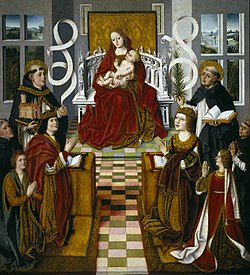 The Virgin of the Catholic Monarchs, Master of the Virgin of the Catholic Monarchs (anonymous Hispano-Flemish painter), 1491 - 1493, Museo del Prado.
-
 Manueline portal of the church of Golega. The twisting of the columns imitates that of the thick hawsers of ships, in a seafaring nation devoted to the Age of Discovery.
-
 Alhambra Decree by which the Jews were expelled from Spain, the same year that Granada was conquered, America was discovered and Nebrija published his Gramática Castellana: 1492. It is the end of the Middle Ages and the beginning of the Modern Age, with a religious unity that accompanied the union of the kingdoms of the Catholic Monarchy.


See also
- Medieval archaeology
- Medieval art
- Cantar de gesta
- Medieval science
- Medieval city
- Timeline of the Middle Ages
- Medieval history of Spain
- Medieval dance
- Medieval epic
- Medieval military strategy
- Medieval philosophy
- Medieval cuisine
- Medieval clothing
- Medieval literature
- Medievalism
- Medieval music
- Medieval economic thought
- Renaissance
- Saga
- Medieval theater
- Medieval technology
- Islamic contributions to Medieval Europe
Notes
- ↑ Although the first to point out the existence of unity in the period between the 5th and 15th centuries was the humanist Flavio Biondo, the glory of having used the term Middle Ages before anyone else belongs to the Bishop of Alesia, Giovanni Andrea dei Bussi. In a letter of his from the year 1469 the following is expressly stated:
That media tempestas was the outline of some "middle times," which served as a bridge between glorious classical antiquity, which was mythologized, and the new times, which had turned their eyes toward that period of splendor. Expressions such as medium aevum, media tempestas, media aetas, etc., appear in historians or philologists from the beginning of the 16th century. Thus, for example, they were used by Joaquin de Wat, in 1501, or Juan de Heerwagen, in 1532. Later in the century, in 1575, we find them in Marco Welser and Adriano Junius. The use of these expressions can likewise be traced throughout the 17th century: Conisius, in 1601; Goldats, in 1604; Vossius, in 1662; etc. Du Cange, in his famous Glossary, which appeared in 1678, spoke of the «mediae et infimae latinitatis». It can be said that the term Middle Ages had been fully accepted, even though its origin was not properly the work of historians, but of philologists. Nevertheless, in that same 17th century some clarifications of great importance were made regarding the "middle times." In 1665, Jorge Horn, in a work titled Arca Noé, called the period between the years 300 and 1500 «medium aevum». Shortly afterward, in 1688, a book appeared that was to play an outstanding role in fixing the concept of the Middle Ages. This was the Historia medii aevi a temporibus Constantini Magni ad Constantinopolim a Turcis captam, whose author was Cristóbal Keller, professor at the German university of Halle. It was Keller, whose chronological clarifications on the Middle Ages are very significant, who was the starting point for the spread and generalization of the expression Middle Ages. Valdeón, op. cit., vol 11 pg. 11.«sed mediae tempestatis tum veteris, tum recentiores usque ad nostra tempora».
- ↑ Even today the Middle Ages are judged to have been a bad or "ugly" time, at once violent, dark and ignorant. We now know that this image is false, although there was a Middle Ages of violence, and not only that of conflicts and wars between groups and between countries, but also the violence against the Jews, with the beginning of antisemitism, and the repression of those who rebelled against the doctrine of the Church... Evidently, the Crusades are also part of the negative balance.
But the Middle Ages were equally, and I think even above all, a great creative period. This can be seen in the field of art, of institutions, of course primarily in the cities (for example with the universities), or even of thought, in which the philosophy that has been called "scholastic" reached high summits of knowledge... the Middle Ages created commercial and festive "meeting places" (fairs, markets and festivals), from which we continue to draw inspiration. Le Goff, op. cit., pgs. 115-116.
In this period, night is lived in dimly lit surroundings: in huts lit at most by the fire of the hearth, in the vast rooms of castles illuminated by torches or in a monk's cell by the weak light of an oil lamp, and the streets of towns and cities were dark (as well as unsafe). Nevertheless, this is also a characteristic of the Renaissance, of the Baroque and—later still—of the period that extends at least until the discovery of electricity. On the other hand, medieval man is seen—or at least represented in poetry and painting—in a very luminous setting. What is striking about medieval miniatures is that, although they were perhaps made in dark surroundings barely lit by a single window, they are full of light, even of a special luminosity, produced by the proximity of pure colors: red, blue, gold, silver, white and green, without nuances or chiaroscuro.
— Umberto Eco, Historia de la Belleza, pg. 99-100
Le Goff, Héroes, maravillas y leyendas de la Edad Media, Paidós, 2010; Georges Duby La época de las catedrales cited by Guillermo Altares Robin Hood y la actualidad de la Edad Media, El País, December 26, 2010
- ↑ The debate between the different conceptions of feudalism is one of the classic disagreements between the institutionalist or restrictive school (François-Louis Ganshof Qu'est-ce que la féodalité? -What is feudalism-, 1947); and the materialist school (Georges Duby Señores y Campesinos). For the Spanish case this text by Salustiano Moreta (1978) is very illustrative Señores contra labradores: el malhechor feudal en la literatura:
With respect to Castilian feudalism, given that official and academicist historiography started from positivist theoretical-methodological premises and from a juridical-political idea of feudalism, there was no hesitation in asserting "without risk of error, that the feudal system did not reach its complete development in the States of the Reconquista and that the social and political structure of the greater part of Christian Spain never came to be constituted according to the political forms of the feudal States" (Luis García de Valdeavellano, Las instituciones feudales en España, p. 231). Along this same line, starting from the consideration of feudalism as an essentially political and superstructural phenomenon, a mystifying distinction would be formulated between the feudal regime and the seigneurial regime as mutually exclusive and opposed categories (Luis García de Valdeavellano, op. cit; Grassotti, Las instituciones feudo-vasalláticas en León y Castilla. Starting from positivist premises, Salvador de Moxó has revealed some of the limitations of the causes and reasons adduced by the two previous authors to maintain the non-feudalization of Castile. Sociedad, estado y feudalismo, pp. 193-202.). Fortunately, the academic-official vision of feudalism in general and of Castilian feudalism in particular is becoming less and less unassailable and its critical questioning is under way, precisely from the theoretical-methodological perspectives derived—in some cases simply invoked and in others assumed directly and consciously, though with uneven success and rigor—from the other conception of feudalism: feudalism understood as a mode of production (Despite not yet having a single rigorous monograph on feudalism in Castile analyzed from the categories and methods derived from its consideration as a "mode of production," some works have already been published and certain observations and problems pointing in that direction are gradually being tried out: Bartolomé Clavero, Mayorazgo: propiedad feudal en Castilla (1369-1836), pp. 60 ff.; Señorio y hacienda a finales del antiguo régimen en Castilla; Julio Valdeón Baruque, Prólogo in El modo de producción feudal, Akal, pp. 7-14; Sebastiá Domingo, Crisis de los factores mediatizantes del regimen feudal; Reyna Pastor de Togneri, Del islam al cristianismo, pp. 12 ff.)
- ↑ Person versed in the knowledge of the medieval.[10]
- ↑ See everything related to The Da Vinci Code.
- ↑ Not so that of Alexandria, which survived even the murder of Hypatia (415). The Museum of Alexandria and the Library of Alexandria had suffered many vicissitudes, such as fires and earthquakes, and the Serapeum was ordered torn down by the patriarch Theophilus in 391, although its holdings, looted and scattered, survived until the Muslim invasion (634), when the caliph Omar committed another famous offense: "The books of the library either contradict the Quran, and then they are dangerous, or they agree with the Quran, and then they are redundant," cited in Curiosidades de la ciencia by Leonardo Moledo[26]
- ↑ Or beautiful shroud, or good shroud. Procopius, in his Secret History, reproduces Theodora's words as follows:
(Cited by Pilar Benejam, Horizonte, p. 106Whoever has received sovereign power must not live if he lets it be taken from him. You, Caesar, if you wish to flee, nothing is easier... as for me, God forbid that I should abandon the purple and appear in public without being greeted as empress. I greatly value this ancient saying: "The purple is a glorious shroud."
- ↑ This is the main thesis of Perry Anderson, op. cit.. It is discussed and criticized by Gregory Elliott (2004) Perry Anderson: El laboratorio implacable de la historia Universitat de València, ISBN 8437059356 p. 144. The expression feudal synthesis is commonly used in that sense: Bisso et al. Occidente y su legado. Una historia. Volumen I. Desde las primeras civilizaciones a la crisis del mundo medieval ISBN 9879164806 review
- ↑ Plato, following a triadic scheme of Indo-European tradition, proposes in his dialogues (for example in Phaedrus and in the Republic) a society in which the workers (representing the cardinal virtue of temperance) sustain the warriors who defend them (fortitude) and the philosophers who govern them (prudence), and their whole in harmony ultimately produces justice.
- ↑ The identification between clergy and nobility as privileged, and the key role of the vows, was evident at the moment of their suppression during the French Revolution, and was made explicit in the debates of the Assembly (decree of February 13, 1790), discussed in De la convocación a la revolución. La Constitución francesa de 1791 by Chantal López and Omar Cortés. The same occurred in the Spanish case: Secularización: Estado e iglesia en tiempos de Gómez Farias, by Anne Staples, Estudios de Historia Moderna y Contemporánea de México, Álvaro Matute (editor), Mexico, Universidad Nacional Autónoma de México, Instituto de Investigaciones Históricas, v. 10, 1986, p. 109-123
- ↑ Etymologically, humilior means the humblest, the poorest. Humilis, -e Adjetivo. Humilde; pobre. Breve vocabulario latín-castellano: H. The humilior is the one who is lowered to the ground (ad humun). To humble oneself is to lower oneself because the earth is supposed to be the lowest thing (infima) in the world. Humor (humility) has the same origin,[39]
- ↑ Ken Follett's novel The Pillars of the Earth reflects that atmosphere.
- ↑ Whether the cities and the bourgeoisie are a contradiction inherent to the feudal system in its dynamism, or something foreign and external to the feudal mode of production, is a classic debate in materialist historiography, set out in Rodney Hilton, op. cit.. An ironic view of this dynamic can be found in the parody of a study in economic history The role of spices (and of pepper in particular) in the economic development of the Middle Ages[51]
- ↑ From the 9th century onward, the bimaristans granted medical diplomas to students who completed hospital training in order to practice professionally as physicians. John Bagot Glubb Quotations on islamic civilization:
In the time of Mamun, the medical schools were extremely active in Baghdad. The first free public hospital was opened in Baghdad during the caliphate of Harun al-Rashid. As this system developed, physicians and surgeons were required to give lectures at the medical school, and they granted diplomas to those whom they considered qualified to practice medicine. The first hospital in Egypt was opened in 872, and from then on they sprang up throughout the length and breadth of the Empire, from Al-Andalus to Persia.
The University of Al Karaouine (Fez, Morocco, 859) is considered the oldest in the world.[52] The first complete university would be Al-Azhar University (Cairo, Egypt, 10th century), which offered a wide variety of academic degrees, including postgraduate studies.
- ↑ An example of this use is offered by those who quote (taking its historical circumstances out of context) the well-known German saying, "City air will make you free," as corroboration of the ideological thesis that attributes to the city, in general, the capacity to enable a subject of the human species to attain freedom, that is, without taking into account that the quoted saying was formulated in the process of transformation of the feudal system into the system constituted by the bourgeois cities of the late Middle Ages.[58]
- ↑ For the whole section, Le Goff, op. cit., pgs. 80-87; the quotation in italics is from Agustín Rico Mansilla En torno a Gonzalo de Berceo: Los "milagros de Nuestra Señora" y el culto a la Virgen, from which this quotation also comes:
Almost all the historians who have studied the subject agree on one point: In Europe, the 12th and 13th centuries marked the rise of one of the most interesting phenomena of Christianity, the cult of the Virgin Mary (Gerli, 1988). Until that moment, devotion to the Virgin, while it existed, had been something of minor importance in the Church. Hilda Graef (1967), from the strictest Catholic orthodoxy, considers the 12th century the golden age of Mariology. And Atienza (1991) holds that the cult of Mary in the Christian West burst forth massively at the end of the 11th century, expanded throughout the 12th and 13th centuries and stabilized, but with an ever broader popular implantation, from the 14th century onward.
See also a more traditionalist perspective in the article Devoción a la Santísima Virgen María of the Catholic Encyclopedia.
- ↑ Juan Martín Velasco Diccionario de Mariología Pp. 580-582: Paganismo y devoción a María; also Agustín Rico Mansilla op. cit.
it seems almost certain that the Church's consideration and acceptance of the Marian role in the mystery of the Incarnation evolved progressively from the 2nd century to the 5th (Council of Ephesus), but it cannot be stated with certainty that it spread among the great mass of the faithful and, still less, that it was the object of a generalized cult. On the other hand, it should be remembered that the Catholic liturgy replaced the primitive pre-Christian cults very slowly, and these took several centuries to be forgotten; they can still be traced in many present-day festivals of pagan origin. We have seen that the study of the festivities dedicated to Mary provides some data: In the Eastern Church there is record of only one feast prior to the 5th century: the "Commemoration of Saint Mary"; and, at the beginning of the 6th century, that of the "Dormition of the Virgin." Surprisingly, in the Roman Church no Marian feasts are known until the 7th century, which leads one to think that the evolution was considerably slower.
- ↑ This is the thesis defended by the historian Kenneth Clark in Civilisation, a prestigious television documentary by the BBC, of which a book was also published.
- ↑ Based on a theory of Eugenio D'Ors, this idea has been applied to the periods of Greek art: constructive=archaic, full=classical and decadent=Hellenistic; and he saw parallels in the Renaissance: Quattrocento-Cinquecento-Mannerism; or in other periods: Tenebrist Baroque-Triumphant Baroque-Rococo; Neoclassicism-Romanticism
References
- ↑ Middle Ages 476-1492 (LibraryThing).
- ↑ Perry Anderson, op. cit.
- ↑ Riu, Manuel (1978): Prólogo a la edición española in La historia del mundo en la Edad Media (The Shorter Cambridge Medieval History, The Later Roman Empire To The Twelfth Century). Madrid, Sopena, tomo I pg. XXIV.
- ↑ 4.0 4.1 Rodney Hilton, op. cit.
- ↑ Le Goff, op. cit., pg. 63-64
- ↑ Romano and Tenenti, op. cit.
- ↑ 7.0 7.1 Pirenne, op. cit.
- ↑ Le Goff, op. cit., pgs. 116-117
- ↑ DRAE
- ↑ DRAE
- ↑ Honoré de Balzac The public is fed up with Spain, the Orient and the history of France in the manner of Walter Scott.
- ↑ Wolfram Eberhard (1952) Conquerors and Rulers. Social Forces in Medieval China ISBN 978-90-04-00515-0; Early Medieval China Archived 2006-07-19 at the Wayback Machine, historiographical journal devoted to the Han dynasty and the beginning of the Tang; Bao Gan, Gabriel García-Noblejas Sánchez-Cendal, Ning Yao (2000) Cuentos Extraordinarios De La China Medieval, Madrid: Lengua de Trapo, ISBN 84-89618-47-X
- ↑ Sociedad en el Japón medieval Archived 2008-05-11 at the Wayback Machine, in Artehistoria.
- ↑ Literatura granadina (reference to the embassy of Ibn Khaldun at the court of Castile in 1363 and at that of Tamerlane in 1401). Ibn Jaldún: Auge y decadencia de los Imperios Archived 2007-03-10 at the Wayback Machine (on Ibn Khaldun and his parallel with Ruy González de Clavijo). Vida y hazañas del Gran Tamorlán, con la descripción de las tierras de su imperio y señorío, by Ruy González de Clavijo (modern Spanish) in Cervantesvirtual.
- ↑ Text selected by Claudio Sánchez Albornoz and Aurelio Viñas (1929) Lecturas de Historia de España, Madrid, p. 24 Archived July 9, 2008, at the Wayback Machine, cited in Cervantesvirtual.
- ↑ Text of the poem Archived August 13, 2011, at the Wayback Machine. The theme was turned into a novel by John Maxwell Coetzee. Esperando a los bárbaros (translated by Concha Manella and Luis Martínez Victorio), Debolsillo: Barcelona, 2004 Commentary on the novel.
- ↑ José Marín Riveros El problema bárbaro.
- ↑ Marco Bussagli Comprender la arquitectura Madrid: Susaeta, ISBN 84-305-4483-6 p. 116
- ↑ Anderson, Perry (1986) Transiciones de la Antigüedad al Feudalismo, Madrid: Alianza ISBN 84-323-0355-0; Fernández, Llorens, Ortega and Roig (1986) Occidente, Barcelona: Vicéns Vives ISBN 84-316-2407-8
- ↑ Jean Daniélou et al. (1982) Nueva historia de la Iglesia Ediciones Cristiandad, ISBN 84-7057-038-2 p. 542. In the Hispanic sphere, the studies of Manuel Díaz y Díaz on the transformations in the education of the elites and on the Visigothic renaissance are already classics (in Gerardo Rodríguez, review of Rosamond McKitterick (ed.) (2002) La alta Edad Media. Europa 400-1000, Barcelona, Crítica; in Temas Mediev. v.13 n.1 Buenos Aires Jan./Dec. 2005.
- ↑ Santa Úrsula y las Once Mil Vírgenes
- ↑ Hóman, B. and Szekfű, Gy. (1935). Magyar Történet. Budapest, Hungary: Király Magyar Egyetemi Nyomda.
- ↑ Pálsson, Hermann (1971). Pinguin Classics (ed.). Hrafnkel's Saga and Other Icelandic Stories. ISBN 0-14-044238-3.
- ↑ Ch. Pietri, La nascita di una cristianità (250-430), Rome, 2000, pp. 301–324.
- ↑ José María Blázquez Martínez, «Religión y Estado en el monacato oriental. Muhammad», Gerión, 2007, 25, no. 1, pp. 501–534.
- ↑ La Biblioteca de Alejandría Destrucción Hipatia Resumen Historia
- ↑ Arnold J. Toynbee (1971) Ciudades en marcha, Madid: Alianza p. 64 ISBN 84-206-9253-0
- ↑ La Pronoia, in Imperio bizantino. Historia de Bizancio enfocada principalmente en el período de los Comnenos.
- ↑ Pirene, op. cit.
- ↑ Cf. Las mil y una noches on Wikisource
- ↑ Ziauddin Sardar, Science in islamic philosophy
- ↑ Le Goff, op. cit., pp. 25-27
- ↑ Berta Raposo Fernández, Textos alemanes primitivos: La edad media temprana alemana en sus testimonios literarios, Universitat de València, 1999, p. 12. ISBN 978-84-370-4049-3
- ↑ Guy Fourquin (1977), Señorío y feudalismo en la edad media, Madrid: EDAF. ISBN 8471663473
- ↑ Witold Kula Teoría económica del sistema feudal; Perry Anderson, op. cit.
- ↑ Entries coto redondo, señorío and serna, in Diccionario Temático of the Enciclopedia de historia de España, Miguel Artola (dir.), pp. 370-371 and 1086-1089
- ↑ See the texts cited in Estate. Sources: De consolatione Philosophiae, cited by CONSTABLE, G.,The orders of society. Three Studies in Medieval Religious and Social Thought. Cambridge, 1995, pp 267 ff. Institutes of Polity (1008-1010), cited by NICCOLI, O.. I sacerdoti, i guerrieri, i contadini. Storia di un'immagine della società. Milan, 1979, p. 13. GELABERT GONZÁLEZ, Juan Eloy. El control de la economía, p. 591, ch. 7 of Historia de Europa, dir. ARTOLA, Miguel, Espasa-Calpe, Madrid, 2007. ISBN 978-84-670-2630-6. On the origin of the division between oratores, bellatores and laboratores (in French) leforumcatholique. Gesta episcoporum cameracensium (1024). Carmine ad Robertum regem (1027-1031). SERVERAT, Vincent: La Pourpre et la glèbe. Rhétorique des états de la société dans l'Espagne médiévale (ELLUG: Grenoble, 1997), especially pp. 75-124.; same author: Sobre algunas tríadas sociales en la Hispania medieval: de Isidoro de Sevilla a Rodrigo Sánchez de Arévalo, Revista de Literatura Medieval 19 (2007), especially pp. 208-218. ALVARADO PLANAS, Javier: De la ideología trifuncional a la separación de poderes (UNED: Madrid, 1993). Partida 2, title XXI, introduction.
- ↑ Arnold Hauser Historia social de la literatura y el arte
- ↑ Marcus Terentius Varro, De Lingua Latina, translated by Manuel Antonio Marcos Casquero, Anthropos 1990 ISBN 84-7658-238-2 P. 19. Honestior means the most honest, the most honorable: Honestior, -ius Adjetivo en grado comparativo de “honestus”. Honestus, -a, -um Adjetivo. Honesto, honrado. Breve vocabulario latín-castellano: H
- ↑ Pierre Riché, Gerbert d'Aurillac, le pape de l'an mil, Paris, 1987. Riché, Pierre (1990). Gerberto, el Papa del año mil (in español). Editorial Nerea. ISBN 978-84-86763-45-9.
- ↑ Donald K. Yeomans (1998). "Great Comets in History". Jet Propulsion Laboratory. Retrieved March 15, 2007.
- ↑ Le Goff, op. cit., especially p. 20 and chapter 7 El imaginario religioso de la Edad Media. Ángeles y demonios, santas y santos, lo maravilloso, dragones y hadas, pp. 95-105
- ↑ Umberto Eco (2004) Historia de la Belleza, Barcelona:Lumen, ISBN 84-264-1468-0, p. 121
- ↑ Georges Duby (1987) Atlas histórico mundial, Madrid: Debate, ISBN 84-7444-349-0
- ↑ Two translations into Spanish: http://web.archive.org/20020302204634/www.geocities.com/Vienna/Choir/7652/carmina/texto.htmhttp://webs.ono.com/jgarciailla/doc/carmina.pdf
- ↑ Sátiras contra el rústico y fiestas carnavalescas, in Umberto Eco (2007) Historia de la Fealdad, Barcelona: Lumen ISBN 978-84-264-1634-6, p. 137.
- ↑ Cited by E. Pablo Molina El latido impetuoso de la letra. Violencia y Literatura en algunos textos hispanoamericanos Archived September 6, 2007, at the Wayback Machine
- ↑ Umberto Eco, op. cit. pp. 137 and 140.
- ↑ Umberto Eco op. cit., p. 135. The theme of laughter in the Middle Ages has also been treated by Eco in his novel The Name of the Rose.
- ↑ Salustiano Moreta (1978) Malhechores feudales. Violencia, antagonismos y alianzas de clases en Castilla, siglos XIII-XIV Madrid: Catedra, ISBN 8437601290. A selection of the text in Señores contra labradores: el malhechor-feudal en la literatura. El ascenso de la nobleza. Resistencia antiseñorial. in Artehistoria. Duby also develops the idea, op. cit.
- ↑ Carlo Cipolla (1988). Allegro ma non troppo (in español). Crítica. ISBN 847423509X.
- ↑ The Guinness Book Of Records. Published. 1998. p. 242. ISBN 0-553-57895-2.
- ↑ HASKINS, Charles H., Rennaisance of the twelfth Century, 1927, p. 358
- ↑ Thomas Woods, How the Catholic Church Built Western Civilization (Washington, DC: Regenery, 2005), ISBN 0-89526-038-7
- ↑ Latin text
- ↑ Latin text. Spanish text.
- ↑ island in the sea of feudalism is quoted -without indicating the source- by R. J. A. White (1967) A Short History of England Cambridge University Press, ISBN 0-521-09439-9, pg. 53
- ↑ Gustavo Bueno, Sobre la educación para la ciudadanía democrática, in catobeplás.
- ↑ John 8:32
- ↑ R. J. A. White, op. cit., pg 54
- ↑ La liga hanseática in Proa a la mar, no. 135.
- ↑ Other consulates, such as Perpignan and Malta, were opened in the 17th century. Enciclopedia General del Mar. Ediciones Garriga Barcelona (1957)
- ↑ Michel Mollat and Philippe Wolff (1970) Spanish edition of 1979 Uñas azules, Jacques y Ciompi. Las revoluciones populares en Europa en los siglos XIV y XV, Madrid: Siglo XXI ISBN 84-323-0232-5
- ↑ Eugenia Rico La tierra de los cátaros, El Mundo, travel special, December 2002. The scene novelized by Sophy Burnham (2003) El Tesoro de Montsegur México: Ediciones B ISBN 84-666-1096-0 pg. 43
- ↑ Le Goff, op. cit., pgs. 40-41 and pg. 50
- ↑ Toynbee op. cit.
- ↑ Francisco Tomás y Valiente and others (1996) Autonomía y soberanía. Una consideración histórica, Madrid: Marcial Pons; cited in Revista de estudios histórico-jurídicos no. 21, Valparaíso 1999 ISSN 0716-5455
- ↑ Valdeón, op. cit, especially La época de las ideas universales. El pontificado y el imperio. Las Cruzadas. Capetos y Angevinos, pg. 131-157.
- ↑ Latin text in the Nova Vulgata.
- ↑ Georges Duby (1996) Damas del siglo XII, Madrid, Alianza; especially María Magdalena (published as an offprint: ISBN 84-206-4699-7)
- ↑ Martine Charageat and Miguel Ángel Motis Dolader Sexo. Edad Media y Renacimiento. Diferentes maneras de vivir el matrimonio y la sexualidad en las comunidades cristianas y en las hebreas, in Florilegio medieval, Biblioteca Gonzalo de Berceo.
- ↑ Adeline Rucqoi La mujer en la Edad Media. El renacimiento terminó con las conquistas femeninas de los siglos XI al XIII in Florilegio Medieval, Biblioteca Gonzalo de Berceo.
- ↑ Uta Ranke-Heinemann La mujer según Tomás de Aquino, in Florilegio Medieval, Biblioteca Gonzalo de Berceo.
- ↑ Duby, op. cit.
- ↑ Fernando Garcés, Historia del mundo sin los trozos aburridos, Ariel, 2009 ISBN 84-344-8807-8, p. 114. He also cites Jacques Le Goff (see, for example, En busca de la edad media, Paidós, 2003, ISBN 84-493-1477-1, p. 43
- ↑ Huizinga op. cit.. Aragonés y castellano en el ocaso de la Edad Media ISSN 0213-2486, No. 10-11, 1993, pp. 51-84 Promotores, arquitectos y talleres en el ocaso de la Edad Media María Victoria Herráez Ortega, Gerardo Boto Varela, 2004, ISBN 84-9773-161-1). In the Historia De Las Ideas Políticas by Jean Touchard this periodization is given a comparative value with the others: Capítulo III: La Alta Edad Media: un empirismo hierocrático (siglos V a X). Capítulo IV: La Edad Media: el poder pontificio entre los antiguos (siglos XI a XIII). Capítulo V: El ocaso de la Edad Media (siglos XIV y XV). Review of the 6th edition (2006) ISBN 84-309-4355-2.
- ↑ Santos Madrazo Madrazo (1969) Las dos Españas. Burguesía y nobleza, los orígenes del precapitalismo español Editorial Z Y X.
- ↑ Arqueros en la Edad Media Archived 2007-10-25 at the Wayback Machine
- ↑ Ernesto Ferrero Barbablú. Gilles de Rais y el ocaso de la Edad Media. La historia verdadera que anticipó en cuatrocientos años las fantasias más perversas del marqués de Sade.
- ↑ Liber Psalmorum 115:1 at Vatican.va. Excerpt from the film Henry V by Kenneth Branagh (French subtitles).
- ↑ Arnold Hauser Historia social de la literatura y el arte.
Bibliography
- Anderson, Perry (1979). Transiciones de la Antigüedad al Feudalismo (in español). Madrid: Siglo XXI. ISBN 84-323-0355-0.
{{cite book}}: CS1 maint: publisher location (link) - Duby, Georges (1976). Guerreros y Campesinos. Desarrollo inicial de la economía europea (500-1200) (in español). Trotta. ISBN 84-323-0229-5.
- Fourquin, Guy (1977). Señorío y feudalismo en la edad media (in español). Madrid: EDAF. ISBN 84-7166-347-3.
{{cite book}}: CS1 maint: publisher location (link) - Gilson, Étienne (2007). La filosofía en la Edad Media: desde los orígenes patrísticos hasta el fin del siglo XIV (in español). Spanish version by Arsenio Pacios and Salvador Caballero. Madrid: Gredos. ISBN 978-84-249-2861-2.
- Le Goff, Jacques (2007). La Edad Media explicada a los jóvenes (in español). Barcelona: Paidos. ISBN 978-844-93-1988-4.
{{cite book}}: CS1 maint: publisher location (link) - Heers, Jacques (2000). La invención de la Edad Media (in español). Trotta. ISBN 978-84-8432-032-6.
- Hilton, Rodney (ed., articles by Maurice Dobb, Karl Polanyi, R. H. Tawney, Paul Sweezy, Kohachiro Takahashi, Christopher Hill, Georges Lefebvre, Giuliano Procacci, Eric Hobsbawm and John Merrington) (1976, 1977 in Spanish). La transición del feudalismo al capitalismo (in español). Barcelona: Crítica. ISBN 84-7423-017-9.
{{cite book}}: Check date values in:|year=(help)CS1 maint: multiple names: authors list (link) CS1 maint: publisher location (link) CS1 maint: year (link) - Huizinga, Johan (2006). El otoño de la Edad Media (in español). Torre de Goyanes. ISBN 978-84-95101-36-5.
- Manchester, William (1993 [1992]). A World Lit Only by Fire. The Medieval Mind and the Renaissance: Portrait of An Age (2nd ed.). Boston: Little, Brown & Company. pp. 322. ISBN 0-316-54556-2.
{{cite book}}: Check date values in:|year=(help)CS1 maint: year (link) - Pernoud, Régine (1986). ¿Qué es la Edad Media? (in español). Magisterio Español. ISBN 978-84-265-2512-3.
- Pirenne, Henri. Mahoma Y Carlomagno (in español). Madrid: Alianza. ISBN 978-84-206-2214-9.
{{cite book}}: CS1 maint: publisher location (link) - Romano, Ruggiero and Tenenti, Alberto (1971). Los fundamentos del mundo moderno. Edad Media tardía, Renacimiento, Reforma (in español). Madrid, Siglo XXI. Depósito Legal M. 23.301-1970.
{{cite book}}: CS1 maint: multiple names: authors list (link) - Valdeón Baruque, Julio and García de Cortázar, José Ángel, in Fernández Álvarez, Manuel; Avilés Fernández, Miguel and Espadas Burgos, Manuel (eds.) (1986). Gran Historia Universal (volúmenes 11, 12 y 13) (in español). Barcelona: Club Internacional del Libro. ISBN 84-7461-654-9.
{{cite book}}:|author=has generic name (help)CS1 maint: multiple names: authors list (link) CS1 maint: publisher location (link)
External links
Research centers
- Departament d'Història Medieval, Paleografia i Diplomàtica. Universitat de Barcelona. (in Catalan)
- Cuadernos de Historia Medieval. Universidad Autónoma de Madrid. Área de Historia Medieval.
- Links to websites of interest. Departamento de Historia Medieval. Universidad Complutense de Madrid.
- Seminario de Estudios Medievales y Renacentistas. Universidad de Salamanca.
- Departamento de Historia Medieval. Universidad de Sevilla
- Revista d'Història Medieval, Departamento de Historia Medieval. Universidad de Valencia.
- Departamento de Estudios Medievales. CSIC.
- Instituto de Historia Antigua y Medieval "Prof. José Luis Romero", Facultad de Filosofía y Letras, Universidad de Buenos Aires.
- Edad Media: Revista de Historia, Departamento de Historia Antigua y Medieval, Universidad de Valladolid.
Artehistoria
- Alta Edad Media.
- Plena y Baja Edad Media.
- Vida cotidiana en la Alta Edad Media.
- Vida cotidiana en la Plena y Baja Edad Media.
Gonzalo de Berceo Library
- Main page
- Florilegio medieval
- Vida cotidiana en la Edad Media (Actas VIII Semana de Estudios Medievales, Nájera 1997)
Liceus
- Repertorio de fuentes de la Edad Media
- Bibliografía general sobre la edad media
- Bibliografía sobre economía medieval
- Bibliografía sobre el mundo rural en la edad media
- Bibliografía sobre concejos y ciudades
- Bibliografía sobre señoríos y feudalismo
- Bibliografía sobre sociedad medieval
- Bibliografía sobre cultura medieval
- Bibliografía sobre derecho medieval
- Bibliografía sobre la Iglesia en el medievo
- Bibliografía sobre instituciones medievales
- Bibliografía sobre pueblos germánicos
- Bibliografía sobre Al-Andalus
Forums and blogs
- Sociedad Española de Estudios Medievales (SEEM)
- MedWeb
- Medievalismo.org
- Medievalum.com
- The Middle Ages Trust (in English)
Maps
Other
- Course "Historia Urbana Medieval" OCW Universidad de Cantabria
- Course "Historia de la Baja Edad Media" OCW Universidad de Cantabria


