| Content from Wikipedia under the CC BY-SA 4.0 license ⇔ Maps from OpenStreetMap under the ODbL license |
Costa Rica
Republic of Costa Rica República de Costa Rica | |
|---|---|
 Flag
 Coat of arms
| |
| Motto: [¡Vivan siempre el trabajo y la paz!] Error: {{Lang}}: text has italic markup (help) ("Long live work and peace forever!") | |
| Anthem: Himno Nacional Costarricense ("Costa Rican National Anthem") File:Costa Rica National Anthem.ogg | |
 | |
| Capital | San José  (pop. 322,155) |
| Largest city | San José |
| Official languages | Spanish1 |
| Spoken languages | Languages of Costa Rica |
| Demonyms | Costa Rican Tico, Tica |
| Government | Presidential republic |
| Carlos Alvarado Quesada | |
| Epsy Campbell Barr | |
| Marvin Rodríguez Cordero | |
| Independence from the Spanish Empire | |
• Declared | September 15, 1821 |
• Concord | December 1, 1821 |
| November 22, 1824 | |
• Free | November 14, 1838 |
| August 31, 1848 | |
| November 8, 1949 | |
| Area | |
• Total | 51,100 km2 (19,700 sq mi) (129th) |
• Water (%) | 0.7 |
| Population | |
• 2018 estimate | 5,003,000[1] (119th) |
• Density | 97.9/km2 (253.6/sq mi) |
| GDP (PPP) | 2019 estimate |
• Total | US$92,415 million[2] (87th) |
• Per capita | US$18,182 (2019)[3] |
| GDP (nominal) | 2019 estimate |
• Total | US$60,469 million[4] (80th) |
• Per capita | US$11,895 (2019)[5] |
| HDI (2018) |  0.794[6] Error: Invalid HDI value (63rd) |
| Currency | Costa Rican colón (₡) (CRC) |
| Time zone | UTC−6 (Central) |
| Calling code | +506 |
| ISO 3166 code | CR |
| Internet TLD | .cr |
Borders: 516 km Coastline: 1,412 km National holiday: September 15 (National Independence) Radio call sign prefix: TIA-TIZ, TEA-TEZ Aircraft registration prefix: TI- ISO code: 188 / CRI / CR Member of: UN, OAS, OECD, ODECA, SICA, Pacific Alliance, G-77, CIN, OEI, ASALE, IADB, INTERPOL, GL, Rio Group, IDB, ACS, OLADE, CELAC, Latin Union, Parlatino. 1 Article 76 of the Political Constitution of the Republic of Costa Rica of 1949 recognizes only Spanish as the official language of the country. | |
Costa Rica, officially the Republic of Costa Rica, is a sovereign nation, organized as a unitary presidential republic made up of 7 provinces. Located in Central America, it has a territory with a total area of 51,100 km². It borders Nicaragua to the north, the Caribbean Sea to the east, Panama to the southeast and the Pacific Ocean to the west. In terms of maritime borders, it adjoins Panama, Nicaragua, Colombia and Ecuador.[7][8] It has 5,003,393 inhabitants according to its latest demographic projection.[9] Its capital and political and economic center is San José, and its official language is Spanish.[10]
With a solid and long-standing democracy, among the most functional in the world,[11][12][13] and an effective capacity for social mobility that allows it to achieve a high level of overall progress relative to the distribution and size of its economy,[14] Costa Rica is one of the most stable countries in the Americas, rated relatively well in all development and competitiveness indices.[15][16][17][18][19][20][21] In addition, it has been a demilitarized nation by its own choice since 1948[22] and has a number of pioneering environmental policies which,[23][24][25] combined with a set of favorable socioeconomic factors, give it a high level of prosperity according to the Legatum Institute,[26] as well as its being considered the most sustainable and happiest society in the whole world for a decade according to the New Economics Foundation.[27]
At the same time, the country currently faces major challenges in its development related to the dismal state and capacity for improvement of its road and transport infrastructure, a high fiscal deficit, the sustainability and effectiveness of its welfare state, stagnation in poverty and unemployment, the upward trend in its crime and inequality, and deep ecological problems related to harmful agricultural practices, poor waste management and pollution of bodies of water.[28][29][30][31]
Toponymy


The name Costa Rica to designate the national territory first appeared in a royal decree dated December 17, 1539[32] and sent to the Audiencia of Panama in 1543, in which the Spanish King Charles V granted a special permit to Diego Gutiérrez y Toledo to carry out the conquest and colonization of the Costa Rican territory, which from then on was called "New Cartago and Costa Rica".[33]
As to the reason for this term, two hypotheses have been put forward. The first and most widespread is that it lies in Columbus's arrival in the country. Christopher Columbus reached Costa Rican territory on September 25, 1502, on his fourth voyage.[33] Impressed by the abundance of jewelry and by the gold ornaments of the natives, Columbus thought that great riches existed in these lands. In the diaries written by Columbus to the Catholic Monarchs of Spain, he describes that there was a great deal of gold in the territory, a subject he stressed in document 9, compiled in the Libro copiador de Colón, called the Letter from Jamaica. In that document, Columbus notes on his visit to the land of Cariay (present-day Limón):
I reached the land of Cariay, where I stopped to repair the ships and provisions, and to give heart to the people, who came very sick. I, who, as I said, had many times come close to death, there learned of the gold mines of the province of Ciamba, which I was seeking. Two Indians took me to Carambaru, where the people go about naked and with a mirror of gold at the neck, but they would not sell it nor give it in barter. They named for me many places on the seacoast, where they said there was gold and mines; the last was Veragua...
Then, further on:
... there they say that there is infinite gold, and that they wear corals on their heads, and bracelets on their feet and arms of it, and quite thick; and with it they adorn and cover chairs, chests and tables. They also said that the women there wore necklaces hanging from the head to the back.
And finally:
... and it is that I saw in this land of Veragua, in the first two days, a greater sign of gold than in Hispaniola in four years,...
This important fact may have influenced the later attribution of the name "Costa Rica" among the Spanish explorers who entered the territory years later, to distinguish it from the region of Veragua. That fame regarding the supposed riches of the country was what spurred adventurers to undertake further explorations and served as a pole of attraction for European colonizers and immigrants. It is believed that by that time, the name Costa Rica had spread among the Spanish explorers to designate the until then impregnable territory, based on what Columbus had said about it.
The second hypothesis was put forward by Dionisio Cabal Antillón, whose premise was that Costa Rica was the Castilianization of an indigenous word of Huetar origin (at the arrival of the Spaniards, the most numerous native group in the country) with which this people designated the country or an important settlement within it. According to Cabal, Costa Rica would derive from a Huetarism (an indigenous word), possibly Coquerrica, Coquerrique or Cotaquerrique, which the Spaniards simplified under the term Costarrica; that is, the Spaniards pronounced in that way, in their language, the name that the natives already gave to their own country, in a manner similar to what happened with other American countries, such as Mexico (Mexico-Tenochtitlan), Nicaragua (Nicarao) or Chile (Chili). To support his hypothesis, Cabal maintained that the case of "Costarrica", with a double r and in a single word, was the same as that of other Huetar place names currently used in the country: Tucurrique, Turrialba, Turrujal, Suerre, Siquirres, Curridabat, Aserrí, Ujarrás, and words in everyday use such as turruja, yigüirro, yurro, curré, etc.[34] However, this hypothesis has been considered unlikely because it has no linguistic or historical foundation on which to rest.[35]
History
Pre-Columbian period


The oldest evidence of human occupation in Costa Rica is associated with the arrival of groups of hunter-gatherers around 12,200 years ago, with the discovery in the Siquirres Canton of 66 human settlements where funerary elements, petroglyphs, house foundations, causeways, stone tools, earthenware and pottery were recovered; these date from the Paleo-Indian period and correspond to the Cabécar people, making it the oldest archaeological site in Central America.[36] Ancient archaeological evidence (the manufacture of stone tools) located in the Valley of Turrialba dates from 10,000 to 7000 BC, with the presence of spear points of the Clovis type (North American) and the fishtail type (South American).[37] Incipient agriculture appears around 5000 BC, mainly involving tubers and roots. By the first and second millennia BC there were already small, scattered, sedentary agricultural communities.[38] Around 2000–3000 BC, the oldest known use of pottery appears, with fragments of pots, cylindrical vessels, platters, tecomates and other vessel forms, decorated with techniques such as incision or grooving, stamping and modeling.[39]
Between 300 BC and 500 AD there was a change from a tribal organization to a chiefdom society, with the construction of foundations of river cobbles, mounds, ovens, storage pits and statuary. Maize became consolidated as the main crop in some regions, while in others there was a mixed system, in addition to the use of coastal resources (fishing) and hunting.[40] In this period the production and use of artifacts of jade and other green stones, ceremonial metates, stone mace heads and special pottery appear, and the use of metal objects (copper and gold) begins.[41] The so-called flying-panel tripod metates are an outstanding and unique manifestation of Costa Rican pre-Columbian art, decorated with animal and human elements. Their manufacture began in the late part of this period (0–500 BC).[42] Between 300 and 800 AD the first complex chiefdoms appeared, with large villages and infrastructure works (foundations, causeways and burial mounds). There was a hierarchy of settlements, with principal villages and secondary towns, the formation of lineages of hereditary power and the specialization of labor, with a cacique in the principal village and secondary caciques in subordinate villages.[43]
From 800 AD until the arrival of the Spanish in the 16th century, there was an increase in the size and complexity of the internal layout of villages, and regional differences became more pronounced. The presence of numerous cemeteries, both simple and complex, massive infrastructure works, a diversity of domestic and luxury goods, the development of goldsmithing, regional exchange and conflicts between chiefdoms over territories and resources are characteristic elements of this era. The social hierarchy included principal individuals such as the cacique and the shaman, and the common people made up of artisans and farmers. Gold replaced jade as a symbol of rank, especially in the Central and Diquís regions.[44] In the Diquís Valley Region, the stone spheres distinctive of the region were made, in the delta of the Térraba and Sierpe rivers; it is postulated that they were used as symbols of rank and territorial markers. Other stone works include sculptures in the round of human and animal forms, jaguar-shaped metates and anthropomorphic statues.[45] The southern and Atlantic zones of the country had South American influence, due to the presence of groups speaking Chibchan languages. The present-day Province of Guanacaste became the southern frontier of Mesoamerica with the arrival of the Chorotega in the period between the years 900 and 1000 AD.[46] Human settlements in pre-Hispanic Costa Rica served as a cultural bridge between the South and the North of the continent, and goldsmithing and polychrome clay craftsmanship underwent wide development and achieved very beautiful results.[46]
Exploration and conquest – 16th century

Christopher Columbus reached the Atlantic coast of Costa Rica on September 25, 1502, on his fourth voyage, visiting Uvita Island (called Quiribrí by the natives and named La Huerta by Columbus), and the settlement of Cariay.[33] According to the journals written by Columbus, there was much gold in the territory,[33] which spurred adventurers to undertake other explorations and served as a pole of attraction for the colonizers. The initial expeditions of Diego de Nicuesa and Alonso de Ojeda along the Atlantic coast were followed by that of Vasco Núñez de Balboa, who discovered the Pacific Ocean in 1513 after crossing the Isthmus of Panama.[47] In 1519, Gaspar de Espinosa, together with Juan de Castañeda, Alonso Martín de Don Benito and Hernán Ponce de León, discovered the Golfo Dulce and the Gulf of Nicoya.[48] Gil González Dávila traveled along the Costa Rican Pacific coast, arrived at Nicoya and continued on toward Nicaragua, where he was richly presented with gifts by the cacique Nicarao.
The riches found by González Dávila led the governor of Panama, Pedrarias Dávila, to send a mission under the command of Francisco Hernández de Córdoba, who, skirting the Pacific coast, landed at the Grande de Tárcoles River and founded the Villa de Bruselas in 1524, this being the first colonial settlement in Costa Rican territory.[49] In 1534 Felipe Gutiérrez obtained permission to conquer the Governorate of Veragua, and in 1538 Hernán Sánchez de Badajoz became Adelantado and Marshal of Costa Rica; he founded the short-lived City of Badajoz in Talamanca and the port of San Marcos. In 1540, Diego de Gutiérrez traveled along the Caribbean coast until reaching the San Juan River. He founded the settlements of Santiago and San Francisco in the territory of Cartago. He then seized the caciques Camaquire and Cocorí to demand a ransom (even though he had been well received by the natives), and after venturing into the plains of Santa Clara to come out at the Central Cordillera, he was ambushed and killed. After this, there were no more expeditions to the country for a span of ten years.[49]
In January 1561, Juan de Cavallón traveled through Nicoya and entered the Central Valley, where he founded Castillo de Garcimuñoz, the first settlement of the Central Valley. Juan de Cavallón is considered the first conqueror of Costa Rica,[49] although he was unable to exercise absolute control over the indigenous population and became embroiled in a struggle against the cacique Garabito, king of the Huetares, in order to obtain provisions. Garabito's kingdom extended from the Virilla River to the Pacific coasts (Jacó and Tilarán) and from the Central Volcanic Cordillera to the San Juan River, and his influence in the country was enormous, even among his enemies the Chorotega, who controlled Nicoya. Garabito, a symbol of Huetar resistance, did not confront the Spanish openly, but instead used guerrilla tactics, with ambushes and swift raids on Spanish camps and settlements.[50]
In 1562, Juan Vázquez de Coronado traveled through all four sides of Costa Rican territory and took part in two expeditions: the first, entering Nicoya from Nicaragua, as far as Garcimuñoz, then Quepos and Coto, in the Central Pacific. He was appointed Alcalde Mayor of Costa Rica and Nueva Cartago that year.[51] On the second expedition, he traveled from the mouth of the Grande de Térraba River to the Cordillera de Talamanca, reached the Caribbean plains and then Garcimuñoz, which he moved to the Guarco Valley in 1564 and renamed Cartago.[52] Vázquez de Coronado is known as the true conqueror of Costa Rica for the pacifying role he played alongside the natives, winning their trust and support, using dialogue instead of violence and fostering friendship between Spaniards and natives; in addition, he was the one who had the greatest knowledge of Costa Rican territory.[53] He was later appointed Governor and Adelantado of the Province of Costa Rica, but did not take office, as he died in the wreck of his ship in 1565. In his absence, the Spanish soldiers began the repression of the natives,[51] who rose up throughout the country and besieged Cartago in 1566,[52] so a new governor was appointed, Perafán de Rivera, who liberated Cartago in 1568, and a year later subjected the natives to the encomienda and distributed the land among the conquerors, thus beginning the viceregal period.[54]
Viceregal period (1573–1821)


From 1574, Costa Rica was the southernmost dependency of the Captaincy General of Guatemala, part of the Viceroyalty of New Spain, a situation in which it remained until its independence. Its distance from the city of Guatemala, the small number of government officials and representatives of the Church, and its lack of agricultural or mineral wealth caused it to be left in total neglect by the Spanish authorities, which allowed it to develop with much greater autonomy than other provinces of Central America. The relative interest the colonizers showed in this region modified some of the characteristic situations that arose in other nations, giving Costa Rica certain peculiarities. Some scholars maintain that part of the national character was formed during this viceregal era,[55] in which material privations were common to all, and since there was no large indigenous and African labor force, everyone from the Provincial Governor to the humblest of peasants, slaves and Amerindians had to look after their own livelihood and that of their families, thus creating a more egalitarian society less governed by castes. Other studies show that in colonial Costa Rica, and above all from the 17th century onward, a marked social differentiation began to take hold, with a commercial and landowning elite that pulled the strings of the economy and internal politics at will.[55]

In order to concentrate an increasingly dispersed population, the civil and ecclesiastical authorities ordered the founding of churches, oratories and parishes in the Central Valley: Villa Vieja (1707, present-day Heredia); Villa Nueva de la Boca del Monte (1738, present-day San José); Villa Hermosa (1782, present-day Alajuela). On the Pacific, Esparza (Costa Rica) was the most important city; it became depopulated because of pirate attacks, so much of the population moved to the Bagaces valley, giving rise to the settlement of Cañas in 1751. Around the second half of the 18th century, activity began at the port of Puntarenas, mainly for the tobacco trade, but it was not officially declared a port until 1814. In Nicoya, cattle ranching with Nicaragua allowed that province to exert a strong influence over the whole region as far as the Tempisque valley, which nevertheless had a dispersed population; therefore in 1769 a chapel was founded at an important crossroads, which gave rise to the city of Liberia.[56]

In 1812, while Tomás de Acosta y Hurtado de Mendoza was governor, the presbyter Florencio del Castillo was appointed deputy to the Cortes of Cádiz for the Province of Costa Rica and the Partido de Nicoya, since the population of both dependencies was too small for each to appoint its own representative. During this period, coffee was introduced into the Central Valley, which would be vital for the future development of the state after independence.
Independence and Republic: Patriarchal State (1821–1848)

Costa Rica became independent from the Spanish Empire on September 15, 1821, together with the rest of the Captaincy General of Guatemala. After receiving the pronouncement of the city of León, set out in the "Acta de los Nublados",[57] the town council of Cartago issued the act of October 29, declaring independence, and on December 1 a Junta of Legates promulgated the Pact of Concord, the first Constitution, in which the country established its own form of government, under a Superior Governing Junta; the civil rights of the inhabitants were recognized, slavery was abolished and freedom of trade was proclaimed.[58] Costa Rica was part of the Federal Republic of Central America (1823), but its participation (1823–1842) was rather marginal. Costa Rica sought to solve its problems on its own: by 1825 it had its own currency, Head of State, Legislative Assembly and Supreme Court of Justice. Between 1825 and 1833, while the Federal Republic struggled amid political anarchy and civil war (1826–1829), Costa Rica lived through a period of relative political stability. The State gained territory with the annexation of the Partido de Nicoya to the country on July 25, 1824, but also lost territory with the 1836 occupation of Bocas del Toro by the Republic of New Granada.

On March 3, 1823, the first Congress was formed with deputies from the four principal cities of the Central Valley. Localism led to a struggle for power between the conservative cities of Cartago and Heredia, which favored joining the First Mexican Empire, and the liberal and republican cities of San José and Alajuela. The Battle of Ochomogo (April 5, 1823) resulted in the victory of the republicans, led by Gregorio José Ramírez, and the transfer of the capital to San José.[58] Ramírez returned power a few days later, and a new Governing Junta was appointed which governed until 1824, the year in which the first Head of State was appointed, Juan Mora Fernández (1824–1833), a liberal from San José with extensive administrative experience, under whose government the printing press was introduced, the first mint was established and the Casa de Enseñanza de Santo Tomás, considered the first university of Costa Rica, was reorganized; a new constitution was promulgated, the Fundamental Law of the Free State of Costa Rica (1825), as well as the Ley Aprilia, which gave the country autonomy within the Federal Republic.[59]

Mora was succeeded in 1833 by José Rafael de Gallegos, under whose government the Ley de la Ambulancia came into force, rotating the country's capital among the four principal cities of the Central Valley.[60] This law was repealed by his successor, Braulio Carrillo (1835–1837, 1838–1842), which triggered the War of the League, the second civil war of Costa Rica, in which the victory of San José secured the city as capital.[61] Carrillo imposed order on the country: he strengthened public institutions, created the payment of taxes, promoted the cultivation of coffee, and promulgated the Law Against Vagrancy and respect for the authorities. Defeated by Manuel Aguilar Chacón in the 1837 elections, Carrillo overthrew him in 1838. In his second term, he established penal, civil and procedural codes, fundamental for the country, and promulgated the Decree of Bases and Guarantees, in which he proclaimed himself Head for Life.[61] On November 15, 1838, he definitively separated the country from the Federal Republic and proclaimed it a free, sovereign and independent state.[61] In 1842, Carrillo's political adversaries called Francisco Morazán to the country, and he overthrew Carrillo. Morazán tried to use Costa Rica as a military base to rebuild the Federal Republic, dissolved in 1839, for which he was deposed and executed by firing squad in San José on September 15, 1842.[62] He was succeeded by José María Alfaro (1842–1844, 1846–1847),[63] and after him Francisco María Oreamuno (1844–1846), the first Head of State elected by direct suffrage.
In 1847, José María Castro Madriz (1847–1849, 1866–1868) was elected, a doctor of laws who came to preside over all three branches of government of the Republic. A cultured man, he promoted the education of women, freedom of the press and the efforts to create the first diocese in Costa Rica in 1850, with Monsignor Anselmo Llorente y Lafuente as the first Bishop of Costa Rica. On August 31, 1848, he promulgated a new constitution in which he declared Costa Rica a sovereign nation independent of any other state, definitively naming it the Republic of Costa Rica. On September 29, 1848, he gave the country its first tricolor flag, the work of his wife, Pacífica Fernández, and the basis of the current coat of arms. The Constitution of 1848 established a strong Executive Power vis-à-vis the Legislative, allowing the country agility in appointing public officials, accelerating the centralization of power and opening the way for the country's transformation into a modern State.[63]
Oligarchic State (1849–1870)


In 1849 Juan Rafael Mora Porras (1849–1859) came to power; under his administration the country experienced a great economic and social boom, resulting from the establishment of an agro-export model based on coffee, which allowed the formation and strengthening of a coffee oligarchy with great influence over the affairs of state. The economic bonanza made it possible to import new technologies; communication routes were opened, roads and ports were improved, the central power of the State was strengthened and localism eliminated, the army was strengthened and modernized, and important public infrastructure works were built such as the National Palace, the San Juan de Dios Hospital, the building of the University of Santo Tomás, the first Faculty of Medicine, the first national bank, the first theater and the National Liquor Factory; the music of the current National Anthem was composed, the work of Manuel María Gutiérrez Flores,[64] and the border with Nicaragua was delimited through the Cañas–Jerez Treaty.[65]
National Campaign of 1856–1857
The greatest threat to the political and cultural stability of the country came with the rise to power in neighboring Nicaragua of the American filibuster William Walker, who arrived in Nicaragua during that country's civil war and had himself named president, after which he issued a colonization decree and another on slavery. His presence posed a danger to the territorial integrity of Costa Rica, mainly because of his claims over the transit route along the San Juan River, so President Mora called the Costa Rican people to arms. The army marched toward Nicaragua on March 4, with 4,000 troops under the command of José Joaquín Mora Porras, the President's brother, and General José María Cañas. The Costa Rican victory at the Battle of Santa Rosa on March 20, 1856, was followed by the clash at Rivas, Nicaragua, on April 11, 1856, a long and bloody battle, with great losses for both sides and many displays of heroism: the most remembered is that of the soldier from Alajuela Juan Santamaría.[66]
After the victory at Rivas, the Costa Rican army was forced to withdraw from the city because of the appearance of an epidemic of cholera morbus, which ended up costing the lives of 10,000 Costa Ricans (10% of the national population at the time), as the infection spread with the army's return to the country. It was not until 1857 that Costa Rica re-entered the war, now allied with the rest of the Central American armies, with the decisive Campaign of the Transit Route, in which it took the San Juan River to cut off the supply route of the filibuster armies, forcing Walker to surrender on May 1, 1857. The epilogue of the National Campaign was bloody: in 1859, Mora was overthrown and exiled by his political enemies. In 1860, he tried to regain power by force. Defeated at the Battle of La Angostura, he was executed by firing squad, together with General Cañas, in the city of Puntarenas.[66]
Mora's fall brought a period of political instability dominated by the military, led by Generals Máximo Blanco and Lorenzo Salazar, who installed and removed rulers according to their own interests and those of the economic oligarchy. Mora was succeeded by José María Montealegre Fernández (1859–1863), Jesús Jiménez Zamora (1863–1866 and 1868–1870) and José María Castro Madriz (1866–1868). During this period there were some milestones such as the founding of the Banco Anglo Costarricense (1864), the creation of the first telegraph line (1866) and the declaration of basic education as free and compulsory. In 1868, Jiménez managed to remove the military men Blanco and Salazar from power, but he in turn would be overthrown in 1870 by Tomás Guardia Gutiérrez.
Liberal State (1870–1940)


The transformation of the state began under the dictatorship of Tomás Guardia Gutiérrez (1870–1882), followed by the governments of Próspero Fernández (1882–1885) and Bernardo Soto (1885–1889), with the introduction of liberalism, which deepened in all aspects of national life, from the economic to the cultural and educational. Public administration expanded, institutions matured and were consolidated, and a circle of reform-minded politicians and intellectuals took shape, with the purpose of modernizing the State and society. A new Constitution was promulgated in 1871, along with new penal, civil and fiscal codes; civil marriage and divorce were introduced, cemeteries were secularized, the registry of births and deaths was inaugurated, free and compulsory secular education was established, changes were made to the health system and the death penalty was abolished. Liberal ideas defined the country economically, socially and institutionally. The State became the guarantor and protector of the most cherished values of bourgeois society: property and liberty, while at the same time the separation of Church and State took place. Economically, it was characterized by an agro-export economy based on the twin crops of coffee and bananas.[67] The country grew economically, banks with national capital were founded and the colón was established as the national currency (1900). The construction of the railroad to the Atlantic (1870–1890) and the railroad to the Pacific (1897–1910) allowed demographic growth and cultural diversification with the arrival of Jamaican, Chinese, Italian and other immigrants, as well as the establishment in the country of the United Fruit Company, whose presence would carry significant weight during the first half of the 20th century.
In 1889, an attempt to disregard the electoral victory of José Joaquín Rodríguez Zeledón provoked the popular uprising of November 7, considered the origin of democratic practices in Costa Rica. Democracy, after the authoritarian administrations of Rodríguez and Rafael Yglesias (1894–1902), experienced important advances. The direct vote was introduced in 1913 and the secret ballot between 1925 and 1927, despite which there were irregularities at the polls and secret pacts. In 1917, the reformist government of President Alfredo González Flores (1914–1917) was overthrown by Federico Tinoco (1917–1919), whose dictatorship was deposed in 1919 after a civic movement, a victory that accelerated the decline of the army, as was reflected in the Coto War against Panama in 1921.
The presidency, during the first four decades of the 20th century, was dominated by Cleto González Víquez (1906–1910 and 1928–1932) and Ricardo Jiménez Oreamuno (1910–1914, 1924–1928 and 1932–1936). The world economic crisis of 1929 and the capitalist diversification of the economy brought social conflict, which made room for the birth of non-traditional political parties of a socialist bent, such as the Reformist Party (1923) of Jorge Volio and the Communist Party (1931) of Manuel Mora Valverde. Social unrest was reflected especially in the sit-down strike of 1934 against the United Fruit Company. The economy did not begin to recover until 1936, with the financing of a great number of public works during the government of León Cortés Castro (1936–1940); however, the outbreak of the Second World War, with the closing of the European market, redirected national exports toward the United States.
Reformist State (1940–1948)

The struggles of workers to improve their living and working conditions bore fruit in 1940, when President Rafael Ángel Calderón Guardia undertook an ambitious project of social reforms, with the support of the Catholic Church, in the figure of its archbishop Víctor Manuel Sanabria Martínez, and of the communist leader Manuel Mora Valverde, which allowed the promulgation of the Social Guarantees in the Political Constitution and the Labor Code, as well as the creation of the University of Costa Rica, the Costa Rican Social Security Fund and the National Symphony Orchestra.[68] In addition, the Echandi Montero–Fernández Jaén boundary treaty was signed,[69] which delimits the border with Panama.
The alliance between Calderón and the communists meant a polarization of Costa Rican politics, since, although it laid the foundations of the welfare State, it stirred political instability.[70] There was also growing discontent among a group of important capitalists who opposed Calderón's social reforms. The geopolitical changes after 1945, with the end of the Second World War and the beginning of the Cold War, produced an increase in the interest of the United States in the region because of the growing presence of leftist guerrillas, but Costa Rica was one of the few countries in the world where democracy did not collapse in the 1930s, and where the communist party remained legal and successful at the polls, an exception in Central America.[70] There was, however, a deterioration of confidence in the electoral system due to fraudulent practices, and the anti-Calderonist opposition denounced the victory of the pro-government Teodoro Picado in 1944 as fraud.[71] In a radio speech given on July 8, 1942, José Figueres Ferrer denounced irregular acts and corruption on the part of the government, for which reason he was expelled from the country, to which he returned in 1944. During his exile, Figueres gained allies who enabled him to acquire weapons and form a rebel army.[72]
Civil War of 1948

The Costa Rican Civil War was triggered primarily by the annulment of the 1948 elections,[73] with the aim of defending the transparency of suffrage against an alleged fraud, although in reality the causes are diverse and complex, with internal[74] and external[75] causes that had been brewing over the course of a decade. It is the last civil war in Costa Rican history, and the last time constitutional government was interrupted in the country's history.
The electoral campaign of 1948 took place in a climate of extreme polarization.[76] The elections, directed for the first time in history by an electoral tribunal,[77] clearly favored the opposition candidate Otilio Ulate Blanco,[78] but the losing side denounced an alleged fraud.[79] The Congress of the Republic, with a majority of Republican and communist deputies, was convened in extraordinary session on March 1. At the end of a heated session, the presidential elections were declared void, but, paradoxically, not the elections of deputies.[77]
On March 12, Figueres rose in arms at his farm "La Lucha" at the head of the National Liberation Army. In a short time, his forces defeated the official Army and took the cities of Cartago and San Isidro del General, preparing to confront the pro-government militias in San José, the so-called "mariachis". Puerto Limón was taken by assault by the Caribbean Legion, which had previously bombed strategic points of the city with light aircraft.[80][81] The communists took part in the armed struggle as allies of the Picado government and the Calderonists, but withdrew after Figueres and Manuel Mora agreed on a pact to maintain the social guarantees. The government's diplomatic corps met with Figueres in Cartago, who demanded unconditional surrender, but Picado rejected the proposal. A second meeting at the embassy of Mexico achieved the signing of a pact to end hostilities.[81] On April 20, 1948, Picado handed power to Santos León Herrera, and on April 27, José Figueres entered the capital city victorious. Calderón Guardia went into exile in Nicaragua and later in Mexico.[81][80] The Civil War was fought between March 12 and April 19, 1948, and it is estimated that there were some 4,000 dead throughout the country.[82]
Second Republic and Welfare State (1949–1979)

After the war, a junta was organized that assumed the Executive and Legislative powers until 1949, headed by José Figueres Ferrer. During the following two years, a vast program of institutional change began: the army was abolished (December 1, 1948), banking was nationalized, the social reforms were strengthened, the National Electoral Tribunal was formed, and the right to vote was granted to women and to the Afro-Caribbean population. The drafting of the current Political Constitution in 1949 marked the birth of the Second Republic.

The international landscape was framed by the Cold War, in which the country practiced a more active foreign policy, close to the United States (break with Cuba in 1961), but at the same time critical of that country's support for military dictatorships in Latin America.[83] The domestic political landscape also had periods of instability: attempted invasions by supporters of former president Calderón Guardia in 1948 and 1955, as well as a failed coup attempt in 1949. After 1950, there was persecution and exile for communists and Calderonists. A general amnesty was promulgated by the government of Mario Echandi Jiménez (1958–1962), but even so there were conflicts over the concentration of agricultural land in few hands, as well as growing rural migration to the cities. On April 24, 1970, thousands of students and workers stoned the Legislative Assembly over the transfer of land to the mining transnational Alcoa. From 1948, two camps alternated in power: the Figuerist camp, represented by the National Liberation Party, and the Calderonist camp, represented by various parties and coalitions, among them the National Union Party, the National Unification Party, the Unity Coalition and the Social Christian Unity Party. From the founding of the PUSC in 1983, the Costa Rican two-party system took shape, which prevailed from then until 2002, in which the two majority parties alternating in power, the PLN and the PUSC, held hegemony over national politics.
Economic crisis of 1980 and change of development model (late 20th century)


The country experienced a severe economic crisis during the 1980s, driven by multiple factors both internal and external.[84][85] This produced social unrest, with violent acts in 1981, and protests and strikes in 1983 and 1985.[86] The government of Rodrigo Carazo (1978–1982) signed two agreements with the International Monetary Fund, but its recommendations, of neoliberal ideology, implied unacceptable social costs, so a moratorium on debt payments was declared and the government broke with the IMF.[87] The foreign debt increased but the political system did not collapse.[88] Luis Alberto Monge Álvarez (1982–1986) stabilized the economy by changing the economic model, to which were added the approval of the Caribbean Basin Initiative by the United States, as well as the economic contribution of the Agency for International Development (AID), nearly 1,300 million dollars between 1982 and 1990.[88] Ronald Reagan's intention to militarize the country to confront the Sandinista revolution in Nicaragua led Monge to declare the Law of Perpetual Neutrality (1984), with massive popular support,[86] and made the pacification of Central America the axis of the foreign policy of Óscar Arias Sánchez (1986–1990).[89] Reagan's military policy in Central America failed and in 1987 Arias received the Nobel Peace Prize after the signing of the Esquipulas Agreement by the five presidents of Central America.[89] The changes produced by the disintegration of the Soviet Union (1989) caused the United States to lose interest in Central America, which led to a reduction in U.S. aid to Costa Rica, partly offset by the rise in foreign direct investment, which reached 542 million dollars in 2004.[90]
The neoliberal model deepened in the subsequent governments (Óscar Arias, 1986–1990; Rafael Ángel Calderón Fournier, 1990–1994; José María Figueres Olsen, 1994–1998; Miguel Ángel Rodríguez, 1998–2002), with policies reducing state support for agricultural producers, the signing of the Figueres–Calderón Pact to accelerate the neoliberal adjustment and reduce the functions of the State,[91] the signing of structural adjustment programs with the World Bank and the IMF,[92] and attempts to privatize state assets, such as the ICE.[93] These changes caused strong protests by peasants and farmers (1987), a rise in informal employment and school dropout, and an increase in poverty (27 to 32% between 1990 and 1991, with a brief economic recovery and reduction in poverty in 1994–2005);[91][94] 89 work stoppages and strikes between 1990 and 1993, citizen protests and vast popular demonstrations, such as the national protest movement in 2000, with road blockades, work stoppages and acts of civil disobedience that forced the government to withdraw that bill.[92]
By the end of the 20th century, Costa Rica was economically transformed: it diversified its economy with non-traditional products, the arrival of high-technology companies led by the transnational Intel (1996),[95] the promotion of ecotourism taking advantage of the country's exceptional biodiversity,[96] and an economy based on the service sector. Civil rights were strengthened with the creation of the Constitutional Chamber (1989) and the Ombudsman of the Inhabitants (1992), and the State increased the opportunities of specific segments of the population,[97] while the turn toward the market increased the number of private entities in the fields of education, health and security.[98] Politically, the rise of neoliberalism dismantled the social and cultural vanguards of the country, to which were added the weakening of trade unionism and the internal disputes of the parties of the left,[99] which meant a deterioration of labor rights.[100] However, challenging neoliberalism proved electorally advantageous, which fostered the rise of new political parties that would play a leading role at the beginning of the 21st century.[97]
The new millennium – 21st century

The Costa Rica of the 21st century poses great challenges for the Costa Rican people and their rulers, with questions raised about its democratic model. The erosion of bipartisanship, heightened by political and corruption scandals, has been compounded by a long crisis of national governability, questioning of the policies used on issues such as the environment, infrastructure,[101][102] human rights, public safety,[103] the increase in organized crime, problems in health services, employment and housing, and crises in the finances of public institutions,[104] which has resulted in citizens' disenchantment. This has driven the emergence of new political organizations, which is reflected in a multiparty makeup of the Legislative Assembly, which has been the norm since 2002; it was necessary to hold a second round to elect the President in the elections of 2002, 2014 and 2018, something unprecedented until then; in 2006, Óscar Arias (2006–2010) attained his second term by winning the elections by barely 1% of the valid votes over his rival Ottón Solís of the PAC, in a highly polarized election with high abstention,[105] a situation that would be reflected again in the referendum on the FTA with the United States (2008);[106] in 2010, a woman was elected head of state for the first time (Laura Chinchilla Miranda, 2010–2014), and in 2014, for the first time since 1948, a ruler from a political force other than the PLN or the PUSC was elected (Luis Guillermo Solís of the PAC, 2014–2018).


The country was affected by the Economic crisis of 2008–2015. In addition, it has seen an increase in its fiscal deficit between 2006 and 2018, which has prompted discussion on the approval of fiscal reforms, while government spending on collective bargaining agreements, high salaries in state institutions and luxury pensions has been called into question. During 2014 and 2015 the country increased its economic ties with Europe,[107][108] and reached an agreement with Germany on cooperation in education.[109] In 2015 the FAO awarded Costa Rica for having reduced hunger, which fell from 5% to half that figure according to United Nations calculations.[110] It also became the country with the highest employment outlook in Latin America according to a survey by the American firm Manpower.[111]

Internationally, a diplomatic conflict with Nicaragua[112] over the incursion of Nicaraguan troops onto the Costa Rican Calero Island[113] had to be resolved at the International Court of Justice,[114] which in 2015 recognized Costa Rica's sovereignty over the island,[115][116] and in 2018 the Court defined the maritime boundaries of both countries, under which Costa Rica obtains around 10,000 km² in the Pacific Ocean and in the Caribbean Sea. In the same ruling, the Court characterized the incursion of Nicaraguan troops as a violation of Costa Rican sovereignty, and determined that, for environmental damage caused on Calero Island in 2010, Nicaragua must pay $378,890[117] in compensation to Costa Rica.[118]
Human rights were the main issue during the 2018 Costa Rican presidential elections when, in January of that year, following a consultation previously submitted by the Government of Costa Rica in May 2016, the Inter-American Court of Human Rights, headquartered in San José, indicated that Costa Rica and the other nations party to the Inter-American Court must guarantee equal marriage for same-sex couples in order to ensure their protection.[119] This ruling divided the country and shaped the election process, in which the candidates Fabricio Alvarado, of the conservative evangelical party National Restoration, opposed to the measure, and Carlos Alvarado, of the governing Citizens' Action party, who endorsed the Inter-American Court's ruling, advanced to a second electoral round after neither reached the 40% of votes required.[120] Finally, Carlos Alvarado was elected the 48th President of Costa Rica after winning the second round with 60% of the valid votes.
On August 8, the Constitutional Chamber (Sala IV) of the Supreme Court of Justice declared the ban on equal marriage unconstitutional and set a period of eighteen months (until 2020) for it to be legally implemented.[121]
The Costa Rica of the 21st century poses great challenges for the Costa Rican people and their rulers, with questions raised about its democratic model. The erosion of bipartisanship, heightened by political and corruption scandals, has been compounded by a long crisis of national governability, questioning of the policies used on issues such as the environment, infrastructure,[101][102] human rights, public safety,[122] the increase in organized crime, problems in health services, employment and housing, and crises in the finances of public institutions,[104] which has resulted in citizens' disenchantment. This has driven the emergence of new political organizations, which is reflected in a multiparty makeup of the Legislative Assembly, which has been the norm since 2002; it was necessary to hold a second round to elect the President in the elections of 2002, 2014 and 2018, something unprecedented until then; in 2006, Óscar Arias (2006–2010) attained his second term by winning the elections by barely 1% of the valid votes over his rival Ottón Solís of the PAC, in a highly polarized election with high abstention,[123] a situation that would be reflected again in the referendum on the FTA with the United States (2008);[124] in 2010, a woman was elected head of state for the first time (Laura Chinchilla Miranda, 2010–2014), and in 2014, for the first time since 1948, a ruler from a political force other than the PLN or the PUSC was elected (Luis Guillermo Solís of the PAC, 2014–2018).
Internationally, a diplomatic conflict with Nicaragua[112] over the incursion of Nicaraguan troops onto the Costa Rican Calero Island[113] had to be resolved at the International Court of Justice,[114] which in 2015 recognized Costa Rica's sovereignty over the island,[115][125] and in 2018 the Court defined the maritime boundaries of both countries, under which Costa Rica obtains around 10,000 km² in the Pacific Ocean and in the Caribbean Sea. In the same ruling, the Court characterized the incursion of Nicaraguan troops as a violation of Costa Rican sovereignty, and determined that, for environmental damage caused on Calero Island in 2010, Nicaragua must pay $378,890[126] in compensation to Costa Rica.[127]
In the 2022 Costa Rican presidential election, party pluralism in Costa Rica was confirmed, when the candidate Rodrigo Cháves Robles (of the Social Democratic Progress Party) defeated former president José María Figueres Olsen (of the National Liberation Party) in the second round.
Government and politics

Costa Rica is governed by the Political Constitution of November 7, 1949, which establishes a presidential system and a unitary state.
Executive Branch
Executive power is exercised by the President of the Republic, who is elected by direct, secret and universal popular vote for a term of 4 years. The President's powers include appointing the presidents of the Autonomous Institutions, appointing or dismissing Costa Rican ministers and diplomats, vetoing laws, signing decrees, granting pardons, and declaring national holidays and national mourning. The Presidency is currently held by Carlos Alvarado Quesada, since May 8, 2018. He is accompanied by two vice presidents, also elected by popular vote: Epsy Campbell Barr and Marvin Rodríguez Cordero, both also since May 8, 2018.
Legislative Branch

Legislative power rests with the Legislative Assembly of Costa Rica, a unicameral body with 57 deputies, responsible for approving, amending or repealing laws and decrees. Legislators are elected by direct, secret and universal popular vote for a term of 4 years and represent the provinces. Its current President is Carlos Ricardo Benavides.
Judicial Branch

It is made up of the Supreme Court of Justice.
The Court is composed of 22 magistrates elected by the Legislative Assembly for a term of 8 years. Its current president is Magistrate Fernando Cruz Castro.
The Supreme Court of Justice is responsible for appointing the Magistrates who make up the Supreme Electoral Tribunal.
Electoral Branch

In Costa Rica, general elections (President and Deputies to the Legislative Assembly) are held every four years, and municipal elections (Mayors, Aldermen, Trustees, District Councilors and Intendants, where the latter office is to be elected) have been held every 4 years since 2016, but not coinciding with the general elections (two years after them). They are organized by the Supreme Electoral Tribunal of Costa Rica,[128] created in 1949 by the current Political Constitution. The Supreme Electoral Tribunal is the highest Constitutional Body in electoral matters and is therefore responsible for the organization, direction and supervision of all acts relating to suffrage. It enjoys independence in the performance of its duties.
Political parties
The parties with parliamentary representation in the country are (in alphabetical order of their Spanish names): Acción Ciudadana (in government), Frente Amplio, Liberación Nacional, Integración Nacional, Republicano Social Cristiano, Restauración Nacional and Unidad Social Cristiana. In total there are 19 parties at the national level, 18 at the provincial level and 55 at the cantonal level, for a total of 161 registered political parties.[129]
Democracy Index
The Democracy Index is the ranking prepared by the Intelligence Unit of The Economist, through which it seeks to determine the degree of democracy in 167 countries.[130]
Costa Rica is—together with Uruguay—the only country in Latin America considered a full democracy, ranking among the 20 best democratic systems on the planet and achieving high scores in several categories of the study, higher than those of most countries of the European Union.[131]
| Rank | Score | Electoral process and pluralism |
Functioning of government |
Political participation |
Political culture |
Civil liberties |
|---|---|---|---|---|---|---|
| 20 | 8.07 | 9.58 | 7.50 | 6.67 | 7.50 | 9.12 |
| 2006 | 2008 | 2010 | 2011 | 2012 | 2013 | 2014 | 2015 | 2016 | 2017 | 2018 |
|---|---|---|---|---|---|---|---|---|---|---|
| 8.04 (25) | 8.04 (27) | 8.04 (24) | 8.10 (20) | 8.10 (22) | 8.03 (24) | 8.03 (24) | 7.96 (24) | 7.88 (26) | 7.88 (23) | 8.07 (20) |
| Full democracy (8.01 to 10.00) | Flawed democracy (6.01 to 8.00) | Hybrid regime (4.01 to 6.00) | Authoritarian regime (0.00 to 4.00) |
Foreign relations

Costa Rica is a founding member of the United Nations and maintains diplomatic relations with almost every country in the Americas and Europe. It has been a member of the United Nations Security Council on three occasions: 1974–1975, 1997–1998 and 2008–2009. It is not a member of the Central American Parliament.
Costa Rica faces very different realities in its diplomatic relations with its two neighboring countries. The most complicated situation is the long dispute it maintains with Nicaragua over navigation rights on the San Juan River. With Panama, both countries have cordial and friendly relations, and an open border.
Relations with the United States, its main trading partner, date back to 1851. The country has been visited by seven presidents of the United States: Hoover (1928), Kennedy (1963), Johnson (1968), Reagan (1982), Bush (1989), Clinton (1997) and Obama (2013).[132] Relations with Mexico date back to 1831, and with Brazil to 1907. Relations with Cuba were interrupted for political reasons between 1961 and 2009. The embassy in Havana was reopened in 2009,[133] and in 2015 Luis Guillermo Solís became the first president to make an official visit to Cuba since relations were broken off. The country had to face the 2015–2016 Cuban migrant crisis, which led to its political withdrawal from SICA, although it maintained its commercial and economic responsibilities.
Security

Costa Rica has no army, as it was abolished on December 1, 1948, an abolition that was made permanent in Article 12 of the Political Constitution of 1949. That same article provides for the formation of an army either by continental agreement or for national defense, which shall always be subordinate to civilian power. Since 1983, Costa Rica has had a Law of Neutrality that prevents it from taking part in armed conflicts, in a perpetual, active and unarmed manner, and in 2014 it approved a Law Proclaiming Peace as a Human Right and Costa Rica as a Neutral Country, which establishes that the country must take a neutral position in international armed conflicts, and which also obliges the State to include in its educational programs content that cultivates a culture of peace.[134]
The country's public safety rests with the Ministry of Public Security, which is also responsible for the defense of national sovereignty should it become necessary, although the country's foreign policy in the event of international conflicts has been oriented toward international law. The Ministry of Public Security is divided into several Directorates: Public Force, National Coast Guard Service, Air Surveillance, Drug Control Police, National Police School, Armament, Reserve, and Private Security Services. Costa Rica allocates 0.69% of its Gross Domestic Product (US$29,240 million), and 0.03% of the national budget, to national security.
Human rights
| Instrument | Status |
|---|---|
| International Covenant on Economic, Social and Cultural Rights (CESCR) | Signed and ratified |
| Optional Protocol to the International Covenant on Economic, Social and Cultural Rights (CESCR-OP) | Signed and ratified |
| International Covenant on Civil and Political Rights (CCPR) | Signed and ratified |
| First Optional Protocol to the International Covenant on Civil and Political Rights (CCPR-OP1) | Signed and ratified |
| Second Optional Protocol to the International Covenant on Civil and Political Rights, aiming at the abolition of the death penalty (CCPR-OP2) | Signed and ratified |
| International Convention on the Elimination of All Forms of Racial Discrimination (CERD) | Signed and ratified |
| International Convention for the Protection of All Persons from Enforced Disappearance (CED) | Signed and ratified |
| Convention on the Elimination of All Forms of Discrimination against Women (CEDAW) | Signed and ratified |
| Optional Protocol to the Convention on the Elimination of All Forms of Discrimination against Women (CEDAW-OP) | Signed and ratified |
| Convention against Torture and Other Cruel, Inhuman or Degrading Treatment or Punishment (CAT) | Signed and ratified |
| Optional Protocol to the Convention against Torture (CAT-OP) | Signed and ratified |
| Convention on the Rights of the Child (CRC) | Signed and ratified |
| Optional Protocol to the Convention on the Rights of the Child on the involvement of children in armed conflict (CRC-OP-AC) | Signed and ratified |
| Optional Protocol to the Convention on the Rights of the Child on the sale of children, child prostitution and child pornography (CRC-OP-SC) | Signed and ratified |
| International Convention on the Protection of the Rights of All Migrant Workers and Members of Their Families (MWC) | Signed and ratified |
| Convention on the Rights of Persons with Disabilities (CRPD) | Signed and ratified |
| Optional Protocol to the Convention on the Rights of Persons with Disabilities (CRPD-OP) | Signed and ratified |
Territorial organization
The territorial division of Costa Rica comprises 7 provinces divided into 82 cantons, which are in turn subdivided into 485 districts[135]
 |
Province | Capital | Cantons | Districts | Area (km²) | Population* | |
|---|---|---|---|---|---|---|---|
| 1 | San José Province | San José | 20 | 118 | 4,965.90 | 1,633,282 | |
| 2 | Alajuela Province | Alajuela | 16 | 108 | 9,757.53 | 876,073 | |
| 3 | Cartago Province | Cartago | 8 | 48 | 3,124.67 | 510,727 | |
| 4 | Heredia Province | Heredia | 10 | 46 | 2,656.98 | 449,257 | |
| 5 | Guanacaste Province | Liberia | 11 | 59 | 10,140.71 | 280,488 | |
| 6 | Puntarenas Province | Puntarenas | 11 | 57 | 11,265.69 | 368,827 | |
| 7 | Limón Province | Limón | 6 | 27 | 9,188.52 | 444,884 | |
| * 2011 Census[136] | |||||||
Geography

Costa Rica is located on the Central American isthmus, between latitudes 8° and 12°N and longitudes 82° and 86°W. It borders the Caribbean Sea to the east and the Pacific Ocean to the west, with a total of 1290 km of coastline: 212 km on the Caribbean coast and 1,016 km on the Pacific coast.
Costa Rica also borders Nicaragua to the north (309 km of border) under the Cañas–Jerez Treaty of 1858 and the Cleveland Award of 1888, and Panama to the southeast (639 km of border) under the Echandi–Fernández Treaty of 1941. As for maritime boundaries, Costa Rica borders Ecuador in the Pacific Ocean under the Gutiérrez–Terán Treaty of 1985; Colombia in the Caribbean Sea under the Facio–Fernández Treaty of 1977 and in the Pacific Ocean under the Gutiérrez–Lloreda Treaty of 1984; and Panama under the Calderón–Ozores Treaty of 1980. In total, Costa Rica comprises 51,100 km2 plus 589,000 km2 of territorial waters.
Relief
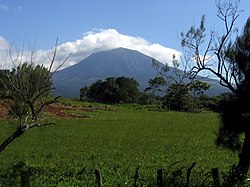
Costa Rica is a very mountainous country, and most of its territory consists of elevations of between 900 and 1800 meters above sea level. There are four main mountain systems: the Guanacaste Volcanic Mountain Range, the Tilarán Mining Range, the Central Volcanic Mountain Range and the Talamanca Mountain Range. There are also four secondary mountain systems: the Nicoya hills, located in the Province of Guanacaste; the Fila Brunqueña or Fila Costera, which runs through the Province of Puntarenas parallel to the coast; and the Sierra de Osa, in the South Pacific, a series of mountains that extend into Panama, with heights between 600 and 1500 m above sea level. The highest point in the country is Cerro Chirripó (3820 m above sea level), the fifth highest peak in Central America. The highest volcano is the Irazú Volcano (3432 m above sea level). The country has about 200 volcanoes, of which five are active: Irazú, Poás, Arenal, Rincón de la Vieja and Turrialba. The most important eruptive cycles in historical times have been those of Irazú (1963), Arenal (1968–2004), Turrialba (2014–2016) and Poás (2016–2017). Costa Rica is a highly seismic country: most earthquakes are produced by the interaction of the Cocos and Caribbean plates, in addition to local faulting. Some of the most significant earthquakes have been: the Santa Mónica or Cartago earthquake (1910), Alajuela (1990), Limón (1991), Parrita (2004), Cinchona (2009)[137] and Nicoya (2012).
The country's central mountain axis gives rise to lowlands toward the northern Caribbean and the Pacific, formed by the accumulation of sedimentary materials. The most extensive are the Northern and Caribbean plains, crossed by long, high-flowing rivers that form meanders. They take different names depending on the area: Guatusos, San Carlos, Sarapiquí, Tortuguero, Santa Clara, Pacuare, Matina and Estrella, in addition to the Sixaola and Talamanca valleys. The Caribbean coastal plain has a low altitude and is partially covered by tropical forests. Its soils are used for banana and cacao plantations, and for beef and dairy cattle farming. The Tortuguero canal, 112 km long, connects Moín with the border with Nicaragua. In the North Pacific, the largest plain, known as the pampa, is located in Guanacaste, where it reaches 75 km in width. In the Central Pacific the plain narrows due to the presence of the Fila Brunqueña, and widens again to 50 km in the South Pacific. The Guanacaste pampa extends from the Santa Rosa Plateau to the Gulf of Nicoya, and is made up of alluvial plains and layers of volcanic ash. The central strip has two marine terraces, interrupted by some hills no higher than 100 m in altitude. The Parrita valley extends to Punta Uvita and is formed by sedimentary and volcanic material originating from the Talamanca Mountain Range. The South Pacific has a peninsular plain on Osa, in addition to the Diquís and Coto Brus valleys, formed by marine, fluvial and volcanic materials. The Pacific lands are well suited to agriculture, have greater tourist infrastructure, and most of the country's fishing activity takes place along their coasts.
In the center of the country lies the Central Valley, a tectonic plateau characterized by its fertility and abundance of water sources, surrounded by mountains and volcanoes. It has a very pleasant climate, and most of the country's population lives here, approximately 60% of the inhabitants. The only province that does not border the Province of San José is the Province of Guanacaste.
Costa Rica has many islands. In the Caribbean, the river islands stand out, such as Calero Island, which is also the largest island in the country at 151.6 km². Another important Caribbean island is Uvita Island, located off the port of Limón. In the Pacific Ocean lie the islands of the Gulf of Nicoya archipelago, many of them inhabited (Chira, Venado, Caballo), some important for tourism (San Lucas, Tortuga) and others that are biological reserves (Guayabo, Pájaros, Negritos). In Salinas Bay lies Bolaños Island, which is also a wildlife refuge. In the South Pacific, Caño Island is of ecological and archaeological importance. Cocos Island (24 km²) is Costa Rica's best-known island internationally. Located in the Pacific Ocean, 500 km from the port of Puntarenas, it stands out for its distance from the continental shelf. It is of great importance for its biodiversity and has been declared a World Heritage Site.
About 25% of the national territory is protected by SINAC (National System of Conservation Areas), which oversees all of the country's protected areas. Costa Rica has the highest density of species in the world.[138]
- Volcanoes and mountains of Costa Rica
-

-
-

-

-

-

-

-

-

-

-

-


Hydrography


Costa Rica has an extensive river network, distributed across three watersheds, naturally delimited by the country's mountain system, and classified according to where they drain into the northern, Caribbean and Pacific watersheds.[139]
The rivers of the northern watershed flow into Lake Nicaragua or the San Juan River; they are generally short and have a torrential regime. Some rise on the slopes of the volcanoes. The most important rivers of this watershed are: the Sapoá (32 km), Frío (70 km), Haciendas and San Carlos (125 km). The latter is joined by the Tenorio, Arenal, Coto and La Muerte rivers to form the river system that waters the plains of San Carlos and Los Guatusos. The other river system of this watershed is formed by the Sucio, Toro, Toro Amarillo, Blanco and Cuarto rivers, which join to form the Sarapiquí River (103 km), which is navigable for more than half of its course.
The rivers of the Caribbean watershed have a constant flow throughout the year, related to the abundant rainfall of the Atlantic region. The most important is the Reventazón River (110 km), the second longest in the country and the one with the greatest capacity for hydroelectric power generation in Central America. Together with the Parismina River (92 km) it forms the country's third largest river basin. The Sixaola River (76 km) forms a natural boundary with Panama; it rises on the slopes of the Talamanca Mountain Range and is navigable. Also notable are the Colorado (navigable), Chirripó Norte (96 km), Tortuguero (85 km), Pacuare (133 km), Jiménez, Matina and Chirripó Atlántico (92 km), Moín, Limón, Banano, Bananito and La Estrella (52 km) rivers.
The rivers of the Pacific watershed tend to be calm, with a less torrential flow, and rise on the slopes of the volcanoes. The most important river is the Tempisque River, 144 km long, which is navigable and forms a large river system composed of rivers such as the Liberia, Bolsón, Salto, Potrero, Piedras Blancas, Tenorio, Corobicí, Cañas and Lajas, which irrigate the important agricultural region of Guanacaste. On the Nicoya Peninsula, the Morote, Nosara, Lajas and Bongo rivers stand out.
In the Central Pacific Region lie the Jesús María and Grande de Tárcoles rivers, whose waters come from the Western Central Valley; their tributaries are the Río Grande and the Virilla, whose basins lie in the provinces of San José, Heredia and Alajuela. The basin of the Grande de Tárcoles River (111 km) is very important for the country, given that it provides all the wealth of its natural resources. It has an area of 2,121 km², a precipitation of 2,456 mm and a flow of 48 liters per second per square kilometer. The Guacimal, Abangares, Aranjuez and Barranca rivers rise in the Sierra de Tilarán, and their flow decreases during the dry season.
The Parrita or Pirrís (82 km), Naranjo and Savegre rivers empty into the country's South Pacific. The Río Grande de Térraba (or Díquis, its aboriginal name), formed by the General and Coto Brus rivers, is the longest (186 km) and highest-flowing river in the country. It is navigable only in its lower course (22 km), where it runs through an extensive area planted with African palm. It flows into the Golfo Dulce through a broad delta covered with mangroves.
Climate
Costa Rica lies in the Neotropical region, and therefore has a tropical climate without great annual variations in temperature and with two well-defined seasons: the dry season, from early December to late April (also called summer), and the rainy season, from early May to late November (called winter). However, the country's topography is very varied, with mountains, valleys and plains within a small area, which contributes to the existence of different and very heterogeneous climatic landscapes throughout the territory. Being located in the northern hemisphere, the country is affected during the change of seasons, in the month of December, when temperatures tend to drop considerably due to northerly winds in the highest parts of the country. Day length is affected during the solstices and equinoxes. The country's mountain structure gives rise to three large climatic regions with distinct characteristics: Atlantic, Pacific and Central.
- Bioclimatic landscapes of Costa Rica
-

-

-

-

-

-

-

-

-

-


Biodiversity and natural resources

With only 0.03% of the world's land surface, Costa Rica possesses approximately 6% of the planet's biodiversity. As of 2013, 52.4% of the country's total continental surface was covered by forests and jungles, showing a 12% increase in the recovery of forest cover over the previous 17 years.[140][141] Approximately 25% of the territory is protected. Between 2005 and 2010, the country showed a reduction in its deforestation rate.[142]
Costa Rica has a greater maritime than continental area, given that its oceanic zone is approximately 589,000 km²,[143] which includes Cocos Island, located about 480 km southwest of the Osa Peninsula, off the coast of the Pacific Ocean. This island was declared a Natural World Heritage Site by UNESCO in 1997.[144]
The country has more than 1000 species of orchids, with Monteverde being the region with the highest density of orchids on the planet. In total, Costa Rica is home to more than 10,000 species of plants. In addition, Costa Rica earns about $1 million a year from the export of more than 900,000 chrysalises of 150 species of butterflies, such as the Morpho—one of the largest, and intensely blue in color.[145]
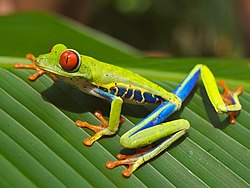
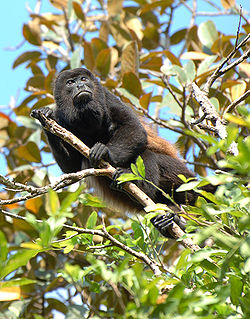
This country is a true paradise known for the diversity of its fauna. It is home to 232 species of mammals, 838 species of birds, 183 species of amphibians, 258 species of reptiles and 130 species of freshwater fish. Among the most outstanding species living in the country are the puma, the jaguar, the deer, the monkey, the coyote, the armadillo and several species of birds, among which the quetzal, the yigüirro and the hummingbird stand out. Fourteen of the 149 known species of glass frogs are found in the country. Since 1973, no new species of translucent frog had been found.[146] Costa Rica is the first country in the Americas to ban the hunting of animals for sport.[147]
- Fauna and flora of Costa Rica
-

-
-

-

-

-

-

-

-

-

-

-

-

-

-

-

-
-

-

-

-

-

-

-

-

-

-

-


Economy

Costa Rica has a mixed economy,[148] which has undergone a strong evolution, moving from an eminently agricultural country to a service economy. According to the Global Competitiveness Index of the World Economic Forum, in 2018 Costa Rica ranked fourth among the best economies of Latin America and the Caribbean, behind Chile, Mexico and Uruguay.[15]
Tourism is the fastest-growing industry, and since the early 2000s it has generated more foreign currency than any of the main agricultural export products.[149]
Traditional agricultural exports of bananas, sugar, cacao and pineapple are also of great importance, as are flowers and mini vegetables in recent years. Notable is the production of high-quality Costa Rican coffee and its export to the United States market, where it is highly prized.[150][151][152]

Likewise, the production of medical and surgical supplies, high technology and electronic components;[153] as well as software development, financial and customer services, and outsourcing operations, contribute increasingly to the economy.[154][155][156][157]
The country's economy grew 8.8% in 2006, 6.8% in 2007 and a meager 3% in 2008. By the end of 2015, the country's economic activity grew 4.3%, the best year-end close of the previous four years.[158] In 2014, year-on-year GDP rose 3.5% compared with 2013.[159] The country has the sixth highest inflation rate in the Hemisphere.[160] During 2015, the country experienced deflation.[161]
According to data from the National Institute of Statistics and Census, average household income was 1,034,362 colones per month in 2017 (approximately US$1,815 per month). It showed growth of 0.7% compared with 2016. Poverty is estimated at 16.5%, which places the country third among the countries of Latin America with the least poverty, according to ECLAC.[162] According to the National Household Survey of the National Institute of Statistics and Census, that figure stood at 21.7% in 2015.[163]
Tourism
Tourism is the main source of foreign currency income for the Costa Rican economy.[164] The tourism sector directly employs 130,000 people.[164] Costa Rica currently offers 45,531 hotel rooms.[164] With annual revenue of US$2,636 million in 2014,[165] Costa Rica's tourism industry obtained 30% of the tourism revenue of the Central American region, and stands out as the most visited destination on the isthmus, since in 2014 the country reached a new historical record of 2,526,817 tourists.[164] In 2015, the number of visitors grew by 5.5%, to 2,665,608 visitors.[166] With around 500 visitors per thousand inhabitants, Costa Rica has one of the highest rates of tourists per capita in the Caribbean Basin. In the 2017 Travel and Tourism Competitiveness Index ranking, Costa Rica reached 38th place, ranking fourth among the countries of Hispanic America.[167]
Most foreign visitors come from the United States and Canada (67.5%)[164] and from countries of the European Union (16%),[165] which allows it to receive on average approximately between US$1,300 and $1,400 per visitor,[168] a value per visit among the highest in Hispanic America. In 2005 tourism contributed 8.1% of the country's GDP, and accounted for 13.3% of direct and indirect jobs. Since the early 2000s, tourism has generated more foreign currency income for the country than banana and coffee exports combined.[149]
The country offers sun, beach, jungle, mountain, city, adventure, ecotourism and community-based rural tourism, and has potential in the areas of sports, wellness and health, fashion and meetings tourism.[164] Ecotourism is extremely popular among foreign tourists, who visit the large number of national parks and protected areas found throughout the country. Costa Rica was one of the pioneers of ecotourism and is recognized as one of the few international destinations with genuine ecological tourism options.[169]
- Tourism in Costa Rica
-

-

-
 Papagayo marina on Culebra Bay, Guanacaste.
-

-
 Sunset in Manuel Antonio National Park.
-
 Cloud forest and hanging bridges of Monteverde.
-

-

-

-

-

-
 Canopy tour in Arenal.
-

-
 Surfing at Roca Bruja, Guanacaste.
-

-
 Cruise ships in Puntarenas.


Agriculture


The Costa Rican economy has historically been based on agriculture, and even today it remains an important sector in generating foreign currency. Coffee stands out for having been the economic engine of the country for much of its history,[170][171][172] forming, together with bananas, the basis of the agro-export model at least until 1980.[173] It is currently the third agricultural export product, behind pineapple and bananas. Associated with coffee cultivation, there is an entire parallel industry based on the production of refined (gourmet) coffee, coffee tours, and the production of handicrafts and products related to the bean.
Likewise, the country is the seventh largest producer of bananas in the world, exporting 100 million boxes per year (1.8 million metric tons), which represented sales of 903 million dollars in 2014.[174][175] In 2014, banana exports accounted for 8% of the country's total exports.[175] The main destinations are the European Union (48.5%) and the United States (40.5%).[175] In addition, Costa Rica has been the world's leading exporter of pineapple since 2013, generating 27,000 direct jobs and 110,000 indirect jobs.[176]
Other important crops are cacao, which stands out among the best in the world,[177] sugarcane, African palm, and various types of flowers and vegetables.
Infrastructure
Transportation

The Ministry of Public Works and Transport (MOPT) is the public institution responsible for the construction and maintenance of the country's road, airport and port infrastructure, traffic regulation, the preparation of maps and geographic charts of the country, and the handling of calamities and disasters affecting the national infrastructure. This institution was created in 1860 as the General Directorate of Public Works, attached to one of the Secretariats of State. From 1870 it became the Department of Public Works, and in 1948 it became the Ministry of Public Works, which was later renamed the Ministry of Transport (1963), and finally took its current name in 1971.
Costa Rica's railway system has 278 km and is run by the Costa Rican Railway Institute (INCOFER). Costa Rica has a total of 151 airports and airstrips, of which 36 have paved runways.[178] Of these, there are four international airports: Juan Santamaría International Airport, located in the City of Alajuela; Daniel Oduber Quirós International Airport, in the city of Liberia, Guanacaste; Limón International Airport, in that Caribbean Province; and Tobías Bolaños International Airport, in San José. Juan Santamaría is considered the country's main airport.
Costa Rica's two main ports are Puerto Limón, on the Caribbean, and Puerto Caldera, on the Pacific, through which the country's maritime exports and imports pass.
Media
The Political Constitution of Costa Rica guarantees freedom of expression and of the press in its Article 29.[179] According to the organization Reporters Without Borders, Costa Rica is the highest-rated country in Latin America for press freedom, and in 2018 it ranked tenth worldwide.[180]
Print press
Costa Rica has a great journalistic tradition. There have been publications on every subject: political, religious and protest alike. Journalism in Costa Rica as such was created on November 25, 1824, by Decree 23 of the Collection of Laws of that year, during the government of Juan Mora Fernández, which invited citizens to establish handwritten newspapers. The printing press was introduced to Costa Rica in 1830, imported by Miguel Carranza Fernández, and was called La Paz.[181] The first print medium in Costa Rica was created by Joaquín Bernardo Calvo (who is considered the «Father of Costa Rican journalism») when, on January 4, 1833, the first issue of the weekly El Noticioso Universal circulated.[182] Today several printed daily newspapers circulate in the country, the main ones being La Nación, La República, Semanario Universidad, The Tico Times and Diario Extra, which also have digital editions. There are also some independent Internet newspapers, such as CRHoy, La Prensa Libre, El Mundo CR, Nuestro País and AMPrensa.com.
Television
The history of television in Costa Rica begins on May 9, 1960, when businessmen René Picado and Carlos Manuel Reyes created the first television company in the country, called Televisora de Costa Rica (Teletica), more popularly known as Canal 7. Televisora de Costa Rica began broadcasting several series bought from the United States, such as The Munster Family, Mister Ed and others. Live broadcasts began later. The first to premiere this format was the visit of the then President of the United States, John F. Kennedy, to Costa Rica in 1963. Another memorable early live broadcast via microwave and satellite was the arrival of the first man on the moon on July 20, 1969. At that time 600 million people around the world watched the spectacle.
In the 1970s the broadcasting of national television series began, which has continued to the present day. The most prominent presenters at that time were Rodrigo Sánchez and Santiago Ferrando.[citation needed] Then came the first newscast in the history of Costa Rica, called Telenoticias.
It was not until the late 1980s that the sale of cable broadcasting began, increasing the options for watching sporting events, entertainment series, cultural and educational programs, and even scientific ones.
In November 1994 the company Representaciones Televisivas S.A., better known as Repretel, appeared. As its launch, it acquired Canal 9, which belonged to Multivisión. Months later, by May 1995, Repretel acquired the frequency that for several years had belonged to Telecentro, Canal 6.
In 1996, Canal 11 was acquired, which would begin broadcasting programming aimed at young children and the general public. In 2000, Canal 9 was returned to its concessionaire, and broadcasting immediately began on Canal 4 (which also belonged to Multivisión, a network that years later was organized as a cooperative society).
Public broadcaster
- Canal 13 (belonging to the National Radio and Television System).
Private broadcasters
Radio
Costa Rica is one of the pioneering countries in Latin America in radio broadcasting. In 2012, a total of 125 radio stations were reported broadcasting from across the national territory, on both amplitude modulation and frequency modulation, most of them grouped in the National Chamber of Broadcasting (CANARA).[184] They range from large radio groups such as Central de Radios-Repretel, Cadena Radial Costarricense, Cadena de Emisoras Columbia, Grupo Radiofónico Omega and Prisa Radio-Multimedios Radio to small independent broadcasters. Programs deal with subjects of the most diverse kinds: sports, radio news, music, youth, children's, religious, comedy, political and others. Among the country's main radio stations are: Monumental, Columbia, Omega, Sinfonola, Fides, Faro del Caribe, EXA, Los 40 Principales, Musical, WAO, La mejor FM, Zeta FM, Bahía Puntarenas, Bésame, 95.5 Jazz, Malpaís, 959, 103 FM, Radio U, Momentos Reloj, 106.3 Pura Vida, 94.7, Radio Dos, 91.5 Teletica Radio and many others.
Energy and electricity production

Five sources of energy are exploited in Costa Rica, in order of importance: hydro, thermal, geothermal, wind and solar. In Latin America, Costa Rica stands out as a leader in the production of renewable energy, mainly due to its production of hydroelectric power, according to the report Leaders in Clean Energy by the organization World Wildlife Fund (WWF).[185][186]
The country's first hydroelectric plant, Aranjuez, located in the center of San José, went into operation in 1884, making the Costa Rican capital at that time the third city in the world lit by electricity, after New York and Paris. Following that event, various electricity generation works continued to be built in several places in the country, as the result of initiatives by municipalities and private entrepreneurs, both national and foreign.
Electricity production in Costa Rica is the responsibility of the Costa Rican Electricity Institute (ICE, 1949), a state-owned company that also provides telecommunications services. The functions of the ICE include:
- Building electricity generation plants.
- Unifying all installed capacity into a single system.
- Expanding services through the construction of distribution networks.

The development of the country's electricity coverage over the years, as a result of the work carried out by the ICE and other electricity distribution companies, has been extremely rapid in the three areas that make up an electrical system: Generation, Transmission and Distribution. When the Institute was created, approximately 15% of the continental national territory had electricity coverage. Fifty-one years later, in 2000, that percentage reached 94.4%. By 2009, the percentage of energy coverage reached 98.6% of the country, a percentage comparable to that of developed countries. In 2014, the Costa Rican electricity service was rated the second best in Latin America, surpassed only by Uruguay, according to a study by the Inter-American Federation of the Construction Industry (FIIC).[187]
In 2015, Costa Rica closed the year with 99% of its electricity generated from renewable sources, without using hydrocarbons. This earned the country recognition at the 21st Conference on Climate Change (COP21) held in Paris, when the emblematic Eiffel Tower was lit with the slogan "100 % Pura Vida", in allusion to Costa Rica, as part of the "One Heart, One Tree" campaign.[188] On September 16, 2016, the ICE put the Reventazón Hydroelectric Project into full operation: the largest hydroelectric plant in Central America, the largest infrastructure project ever built in the country's history, and the second largest construction in the region after the Panama Canal, with an installed capacity of 305.5 megawatts and an investment of US$1,400 million.[189][190] Costa Rica is the third country in the Americas with the highest production of geothermal energy, after the United States and Mexico.[191]
Demographics
According to the National Institute of Statistics and Censuses, the population of Costa Rica in July 2017 reached 5,003,393 inhabitants.[192][193][194]
As for its growth, the population increases annually at the high rate of 1.4%. This is due to a moderately high birth rate, 16.5 per 1,000, and a low mortality rate, 4.8 (5) per 1,000 inhabitants; however, that figure varied by 5 thousandths more from 2017 to 2018.
Ethnography


The Costa Rican population is diverse and multicultural, originating in the broad and unending mixing among its native inhabitants (belonging to the Mesoamerican and Intermediate areas), various European groups, Sephardim of Mediterranean origin, Asians and Africans.[195][196][197][198] Currently the country is home to more than 3.5 million descendants of Spaniards, 1 million descendants of Italians, half a million people of African descent and more than 100,000 descendants of Chinese, among many others; according to the last census, carried out in 2011, they self-identify as 83% white and mestizo, 6.72% mulatto, 2.42% indigenous, 2% black and 5.95% other groups.[199][200]
Migration
Costa Rica is the Latin American country with the largest proportion of immigrants.[201] According to the International Organization for Migration, as of 2017, 414,148 foreigners lived in Costa Rican territory, close to 9% of the total population.[202] This figure rises to 12 or 13%, according to a study carried out by the University of Costa Rica in mid-2017.[203]
The entry of economic immigrants and political refugees predominates in the country. Currently the largest foreign communities are those from Nicaragua (70.9%), Colombia (5%), El Salvador (3.3%) and the United States (3%). A further 17.8% corresponds to more than 150 other nationalities, with significant communities of Panamanians (12,000), Cubans and Venezuelans (5,000 each), and Hondurans and Mexicans (3,000 each).[202] For several years there has been a notable migratory movement of Canadians, Europeans (especially Spaniards, Britons, Germans, Swiss, Swedes and Italians) and Asians (Chinese, Taiwanese and Japanese), who settle in the country attracted by its general stability.[204]
In addition, Costa Rica has the lowest emigration rate in Central America, with 143,465 Costa Ricans living abroad, representing 2.8% of the population.[202]
Language

■ Spanish. (spoken throughout the country)
■ Limonese Creole English.
■ Quaker English.
■ Indigenous languages.
■ Chinese.
■ Coto Brus Italian.
■ Sarapiquí German.
There is great linguistic variety in the country: the Spanish language is constitutionally recognized as official, but five autochthonous languages are also spoken, namely Maleku, Cabécar, Bribri, Guaymí and Bocotá. In parallel, in the Caribbean zone of the country Mekatelyu, or Limonese Creole English, is spoken; it could be defined as a combination of patois (Jamaican Creole English) with "tico" (Costa Rican Spanish). This name is a sort of onomatopoeia formed from the pronunciation of the phrase "May I tell you" in this variety of English. A distinct English-speaking dialect is spoken in Monteverde, where Quaker English predominates.
On the other hand, in the southeast of the country, in San Vito and other communities of the region, there are numerous Italian-speaking colonies, mostly Sardinian and Sicilian. However, the passage of time and Costa Rican migration to the south have created a local hybrid dialect that mixes Castilian with Italic languages. In the public schools of this area, standard Italian is even taught as a compulsory subject and may be chosen as an examination subject for the bachillerato. On the other side of the territory, in the northern zone, there are numerous colonies of Germans and Mennonites of German ancestry who speak the German language and—the latter—a dialect derived from old German called Plautdietsch. Also notable is the presence of the Chinese language, in its Mandarin and Cantonese varieties, spoken in the country by the large community of Chinese immigrants and their descendants since the 19th century.
Other languages with a significant presence in Costa Rica are: French, which is a compulsory subject in several schools and in the Third Cycle of Basic Education, besides being spoken by the large French community in the country and its descendants and being promoted by dozens of cultural institutions; the Arabic language also has a presence owing to immigration from Lebanon and other Levantine countries; Hebrew is also used by around 1,000 Israelis living in the country and by the extensive Jewish Costa Rican community; finally, the Portuguese language counts on the presence of 1,500 Brazilians living in the country, and it is a language increasingly promoted and taught in various schools and high schools.
Religion

The official religion is Catholicism according to the current Constitution, making it the only confessional state in the Americas. However, the Constitution recognizes freedom of worship. Catholics represent 57% of the population.[205] Protestants of the various denominations represent 25% of the population, and people with no religion are about 15%; these last two groups have been growing continuously for several decades to the detriment of the Catholic Church.[205] Buddhists, among Asian immigrants and converts, number some 100,000 people, or 2%; there are some 3,500 adherents of the Jewish faith, some 500 Muslims,[206] as well as more modest communities of Orthodox Christians, Hindus, Baháʼís, Jains,[207] Neopagans (mostly Wiccans and Ásatrúar),[208][209] Rastafarians,[210] Taoists,[211] Sikhs,[212][213] and Luciferians[214] The indigenous peoples preserve their beliefs, particularly the Bribri.
Health


The health system is in the charge of various state institutions: the Ministry of Public Health, the Costa Rican Social Security Fund (CCSS), the Costa Rican Institute of Aqueducts and Sewers (AyA) and the National Insurance Institute. In 2014, Costa Rica invested 9.3% of its GDP in health.[215] This places it among the twelve countries in the world that invest the most in health and the one that invests the most in Latin America, according to the OECD.[216] The country's social security system, run by the CCSS, is universal.
Costa Rica is the country with the highest life expectancy in Latin America (80 years),[217] and it contains one of the five longevity blue zones on the planet, the only one in Latin America: the Nicoya Peninsula.[218] In 2015 it reported a crude birth rate of 14.86 and a mortality rate of 4.35.[219] The annual fertility rate hovers around 1.76,[220] with some 80,000 births per year, of which 13% occur among adolescents.[221] Since 2011, the infant mortality rate has been falling continuously, reaching historic levels in 2015: 7.8 deaths per 1,000 live births.[222] The maternal mortality ratio was 2.65 per 10,000 births in 2015.[223] Abortion in Costa Rica is permitted only as therapeutic abortion, when the health of the pregnant person is at risk,[224] although various proposals to change its status are under continuous debate: from a technical standard to decriminalization.
According to FAO data, Costa Rica has the lowest percentage of undernourishment in Central America (5.6%), below the average for Latin America, but it also shows a significant increase in levels of overweight and obesity.[225] The country shows a progressive decline in mortality rates from infectious, reproductive and perinatal diseases and from nutritional deficiencies, while its general causes of death are similar to those of developed countries: cardiovascular diseases, tumors and injuries.[226] The incidence rate of diabetes was 10.5% in 2014.[227] As of 2016, the country recorded around 10,000 people living with HIV/AIDS.[228]
Costa Rica's health system has been rated on several occasions as one of the best in the world by various international institutions and organizations,[229][230][231][231][232] although for decades questions have arisen concerning its difficult upkeep, internal corruption and saturation of services.[233]
Education
General basic education is compulsory, free and paid for by the nation. It is supervised by the Ministry of Public Education. Primary school coverage is practically universal, while secondary coverage is around 70%. Education in Costa Rica is quite good;[234] the population has access to one of the best educational systems in the Americas, and for that reason the country has a literacy rate of 94.9%,[235] one of the highest in the world. It also has an enrollment rate of 115.3% in primary education, 114.6% in secondary education and 50% in higher education, the highest in the region. In the country, around 90% of the population has completed basic education, 30% the secondary bachillerato and 23% university, the highest rate in Latin America.[236]
- Educational institutions in Costa Rica
-
 The Metal Building, home of the Buenaventura Corrales School.
-

-

-

-
 Colegio San Luis Gonzaga
-

-


Main cities
| Most populous cities of Costa Rica | |||||||||
| No. | City | Province | Pop. | No. | City | Province | Pop. | ||
| 1st | San José |
San José | 322,155 | 5th |  Puntarenas |
 122,335 | ||
| 2nd |  Alajuela |
 276,794 | 6th |  Limón |
 96,314 | ||
| 3rd |  Cartago |
 151,744 | 7th |  Liberia |
Guanacaste | 64,797 | ||
| 4th |  Heredia |
 128,550 | 8th |  San Isidro de El General |
San José | 45,773 | ||
| Source: 2011 National Census - INEC.[237] | |||||||||


Culture

The culture of Costa Rica manifests itself as the syncretic blending and cohesion of the diverse customs of its inhabitants, originating in intense immigration, racial mixing and the multicultural coexistence of a country that is a natural bridge and ethnic melting pot.[238][239][240] This unique and distinctive abundance, preserved at the family, cantonal and national levels, makes it possible to define the roots of the Costa Rican character through all kinds of traditions, folklore, culinary customs, music, dances, beliefs and superstitions, as well as a characteristic popular speech.
Costa Rican identity
National identity is the mosaic of characteristics that define the Tico personality, originating in a broad accumulation of experiences, customs, triumphs, milestones, legends and sociopolitical structures that lead the Costa Rican population to identify itself as such, to feel rooted in its surroundings and to be proud of its origins.[241]
Art

In the country's artistic expressions a common thread can be recognized across more than 8,000 years, identifiable in its myths, heroes, legends and popular expressions. A multitude of techniques and styles are practiced in the country, and there is diversity in themes and in the use of materials. Costa Rican art has developed in accordance with the social behaviors and aesthetic demands of particular historical periods through which Costa Rican society has passed, receiving its first impetus from the State, such as the founding of the National Academy of Fine Arts (1897) and the University of Costa Rica (1940), and from 1980 onward also from private enterprise.
Sculpture has solid ancestral roots going back to the pre-Hispanic era, whose epitome is the stone spheres for their formal synthesis. The colonial master image-makers produced a great quantity of religious art, and from their workshops emerged the first secular sculptors educated in the European academic tradition. Painting emerged in the late 19th and early 20th centuries, mainly among high society and under the influence of foreign painters settled in the country, such as Emil Span, Tomás Povedano and Aquiles Bigot. From 1930 onward, a new generation of artists would create a national artistic identity with a more vernacular art: in painting, a criollo style influenced by the European avant-gardes but centered on the rural landscape and autochthonous culture, especially the adobe house as the country's cultural icon, and a school of watercolor became consolidated; and in sculpture, works close to indigenous roots, using autochthonous materials such as volcanic stone instead of marble. From there, national artists would explore new styles such as muralism (1940–1950), abstractionism (1960–1970) and figurative art (1970–1980), until reaching creative freedom.
Among the great Costa Rican visual artists are Juan Ramón Bonilla, Juan Rafael Chacón, Ezequiel Jiménez Rojas, Enrique Echandi, Francisco Zúñiga, Teodorico Quirós, Manuel de la Cruz, Francisco Amighetti, Juan Manuel Sánchez, Néstor Zeledón Varela, Fausto Pacheco, Max Jiménez, Margarita Bertheau, César Valverde, Rafael Ángel García, Lola Fernández, Néstor Zeledón Guzmán, Hernán González Gutiérrez, Ana Griselda Hine, Luis Daell, Rafa Fernández, Gonzalo Morales Sáurez, Leonel González Chavarría, Isidro Con Wong, Rafael Sáenz Rodríguez, Ibo Bonilla Oconitrillo and Jorge Jiménez Deredia.
Architecture

The architecture of Costa Rica responds to the needs the country has had throughout its history, being a biological and cultural bridge, receiving multiple external influences from all over the world and developing along a millennia-old common thread that begins with its native inhabitants and continues today through its setting as an active developing country.[242][243][242][243]
Cinema

Cinema holds an important place in Costa Ricans' preferences, and attendance at movie theaters is high. However, Costa Rica's film production is modest, with documentaries, short films and the advertising industry predominating. The making of feature films is rather scarce, although from the second decade of the 21st century the production of new fiction films has been increasing, mainly independent productions, which face the problems of a small market, lack of financing with high production costs, public apathy and competition from commercial cinema from elsewhere. There is a steady production of documentaries, many of them commissioned by non-governmental organizations, and a vast advertising industry that employs a good number of audiovisual professionals. In Costa Rica it is common for advertising campaigns to be made for the rest of Central America, and many American, European and South American productions use the country as a location. A single private university offers a degree in film. The University of Costa Rica graduates audiovisual producers through its School of Collective Communication Sciences, and the National Learning Institute has the Image Center, a technical school for video and television.
The Ministry of Culture has an office specialized in overseeing the development of Costa Rican cinema. The Costa Rican Center for Film Production is the state office with the smallest budget in comparison with the entire state apparatus as a whole. Nevertheless, co-production efforts take place between this office and independent producers. In addition, for 15 years the Costa Rican Film and Video Showcase has been held, a festival that brings together the bulk of national production in fiction, documentary and video art.
With an audience mostly accustomed to watching big Hollywood productions, the Costa Rican cultural landscape also has an audience accustomed to watching auteur cinema and alternative cinema, sponsored mainly by the Sala Garbo, which specializes in alternative and auteur film, and by the efforts of some universities, peripheral cultural centers and even video rental stores to offer such productions within thematic series (gay, Latin American, human rights, auteur, etc.).
Theater

In the field of the performing arts, the country's theatrical activity is very dynamic; it has a state company (the National Theater Company), and the discipline is taught professionally at two state universities, in several private institutes and at the National Theater Workshop. Fourteen independent theaters operate, as well as three state venues and some regional ones, where everything from classical theater to vaudeville can be seen, which has produced an audience with varied theatrical tastes. Amateur theater groups are common in some communities. Although theater has existed in Costa Rica since the 19th century, it was with the founding of the University Theater and the Teatro Arlequín (1950), the founding of the National Theater Company and the School of Dramatic Arts, and above all thanks to the contribution of renowned Argentine and Chilean actors and directors—who left their countries in the 1970s, fleeing the military regimes established in the Southern Cone—that Costa Rican theatrical activity experienced a boom in the 1970s and solid professional training was fostered. El Teatro Carpa, la familia Catania, the Grupo Zurco and el Teatro del Ángel were the main exponents during the decades between the mid-1970s and the late 1980s. In addition, three important Costa Rican playwrights emerged in the second half of the 20th century: Alberto Cañas, Daniel Gallegos and Samuel Rovinski. Current dramaturgy is oriented toward examining the events of the past as a way of explaining today's social disenchantment, staging works that portray the social marginalization of the working class or of women, as well as social conflicts, with playwrights such as Juan Fernando Cerdas, Rubén Pagura, Lupe Pérez, Leda Cavallini, Melvin Méndez, Arnoldo Ramos, Linda Berrón, Jorge Arroyo and Ana Istarú.
Dance and classical ballet
Dance also has state sponsorship, but it has not achieved the level of popular reach of theater. One of its foremost performers has been the teacher Cristina Gigirey; internationally, the independent group "Losdenmedium", directed by Jimmy Ortiz, achieved some prominence in the 1990s with dancers of recognized careers such as Doris Campbell, Florencia Chaves, David Calderón, Rodolfo Seas, Daniel Marenco and Andrea Catania, among others. The Young Choreographers Festival brings together many of the great figures of national dance, and the choreographies are often of great quality. However, as in theater, original works are characterized by thematic reductionism (which they try to disguise by changing the title of the work) and the homogenization of bodily expression, all of which contributes to a sense of monotony. The public resents this, and support for this art is limited.
Classical ballet in Costa Rica does not yet have a national company, but there are ballet academies that bring this art to the stage. The Costa Rican Youth Ballet, the Higher Academy of Russian Classical Ballet, the Ballet Atelier, Danza Libre, Magnificat and others are the main ballet organizations in the country, mounting extensive stagings of classical works such as The Sleeping Beauty, Swan Lake, The Little Mermaid, Coppélia, Don Quixote, La Bayadère, The Firebird, A Midsummer Night's Dream, among other works. They have an international presence at ballet festivals and gatherings worldwide. The School of Dance of the National University is one of the main institutions teaching this discipline in the country, with undergraduate and graduate programs and open training courses.
The National Theater closes its season every year by presenting the classical ballet The Nutcracker, which has been a box-office success and a showcase for the level of Costa Rican classical ballet dancers. It has been presented in December since 2004 and has featured principal dancers of the Cuban National Ballet, American Ballet Theatre and Saint Petersburg Classic Ballet Theatre. It has been directed on four occasions by the Cuban Pedro Martín Boza, director of the Costa Rican Youth Ballet, the group that was the first to premiere the work in the country, with great success. It has also been directed by María Amalia Pendones and Patricia Carreras, and by the American Peggy Willis.
Music

The National Symphony Orchestra of Costa Rica, founded in 1940, is one of the most renowned orchestras in the Americas. Its current conductor, since 2013, is the American Carl St.Clair.[244] This orchestra lies at the base of a commendable cultural project born in the early 1970s on the initiative of the then Minister of Culture, Guido Sáenz, which consisted of the creation of the Youth Symphony Orchestra, for which the then President, José Figueres Ferrer, invited the American conductor Gerald Brown to the country.
Within the framework of classical music, mention should also be made of the National Symphonic Choir, the National Lyric Company and the General Directorate of Bands. An important center of secondary music education is the Castella Conservatory, a secondary institution unique of its kind in Central America. The great majority of the country's musicians have graduated from this conservatory since its founding in 1953, among them Eddie Mora Bermúdez, Allen Torres Castillo, Francisco Piedra Vargas and Fidel Gamboa Goldemberg, among others.[245]
In the area of rock music there are bands such as Gandhi, Evolución and Café con Leche. In the latter, the musician José Capmany Ulacia stood out; he is considered the father of national rock. In heavy metal there are bands such as Acero, Kronos, Höwler and Heresy. They generally show influences from the thrash metal and groove metal subgenres, from the NWOBHM, and from bands such as Iron Maiden, Metallica or Megadeth. Traditionally, tropical music holds a privileged place in Costa Rican tastes owing to their fondness for dancing. The rhythms of salsa, merengue and reggae can be heard in many of the most unexpected corners of this country. Many groups have paraded across the national stages, among them Los Brillanticos, La Selección and Orquesta Explosión. It is interesting to note that there are musicians of the National Symphony Orchestra of Costa Rica who also play either in the alternative scene or in tropical music groups, which completes the circle, a sign of broad openness to all themes and styles.[246]
Among local rhythms, notable are the swing criollo, a very popular dance in the country, and the music known as "chiqui-chiqui", which had its heyday in the 1980s with musical groups such as Los Hicsos, Taboga, Sus Diamantes, La Banda, La Pandilla, Marfil, La Nota, Jaque Mate, Manantial, Papel y Lápiz, Pura Vida, Los Alegrísimos and others.
It is important to note that, with the passage of time, access to new technologies and the fact that Costa Rica has positioned itself as the Central American stop on the world tours of many bands and contemporary singers and as the host of important festivals, the musical taste of the Costa Rican public has diversified to encompass genres as varied as heavy metal, punk rock, funk, ska, alternative rock, independent music, reggae, dancehall and various types of electronic music, in Spanish and English as well as in other languages, with musical offerings from the Americas, Europe, Asia and Oceania, which have come to occupy a privileged place in Costa Rican tastes. Owing to its strategic position on the continent and its stability, the country has received visits as diverse as Depeche Mode,[247] Iron Maiden,[248] Pearl Jam,[249] Maroon 5,[250] Björk,[251] The Smashing Pumpkins,[252] Shakira,[253] Lady Gaga,[254] Slayer, The Flaming Lips, Major Lazer,[255] Red Hot Chili Peppers,[256] Paul McCartney[257] and Roger Waters, among hundreds of bands, singers and other live musical performances. This has translated into a diversification of the Costa Rican public's musical taste in recent years, giving way to an ever larger local music scene that is beginning to gain international projection, even without greater support from the governments of recent decades.
Literature

violentas y salvajes,
para arrancar fronteras una a una
y dejar de frontera solo el aire.
(I would like to have enormous hands, / violent and savage, / to tear out borders one by one / and leave only the air as a border.)
- Nocturno sin patria. Jorge Debravo.
Costa Rican literature emerged in the late 19th and early 20th centuries. At first costumbrismo predominated, with authors such as Aquileo Echeverría and Manuel González Zeledón, coexisting with the Modernismo of poets such as Roberto Brenes Mesén and Lisímaco Chavarría. The first literary avant-gardes appeared in 1900 with the creation of the magazine Repertorio Americano by Joaquín García Monge, author of the first Costa Rican novel, El Moto (1900). The 1940s were prolific in writers, mainly realists, of great importance for national literature, with themes focused on the social: Carmen Lyra, Carlos Luis Fallas, Joaquín Gutiérrez, Fabián Dobles, Yolanda Oreamuno and Carlos Salazar Herrera. Costa Rican literature stands out for its poets (Isaac Felipe Azofeifa, Julián Marchena, Jorge Debravo, Eunice Odio and Julieta Dobles, among others), its historians (Cleto González Víquez, Rafael Obregón Loría, Ricardo Fernández Guardia and Carlos Meléndez Chaverri) and its essayists (Moisés Vincenzi, León Pacheco, Rodrigo Facio, Carlos Monge Alfaro, etc.). In the 1960s, a new generation of writers introduced urban themes into national literature: Alberto Cañas, José León Sánchez and Carmen Naranjo. More recent generations have devoted their work to expressing their disenchantment with the system: Rafael Ángel Herra, Fernando Contreras, Fernando Durán, Tatiana Lobo and Anacristina Rossi. The 21st century introduced themes such as the exploration of complex issues of present-day society (feminism, abortion, suicide, pedophilia, sexual exploitation, drugs), as well as science fiction, epic fantasy, crime fiction and horror, with authors such as Catalina Murillo Valverde, Mirta González Suárez and Alí Víquez, among others.
Gastronomy

Costa Rican criollo gastronomy is a mestizo cuisine of intensely tropical and Mediterranean character, with aboriginal,[258] European,[259] Sephardic and African culinary influences, plus the strong gastronomic contribution of the many immigrants who have arrived en masse in the territory, such as Spaniards, Italians, Afro-Caribbeans, Chinese, Germans, French and Arabs, as well as people from all parts of the Americas.[260][261]
Thus the signature dishes of this great food syncretism—and of Costa Rican cuisine itself—are gallo pinto (a popular breakfast that combines the aboriginal bean and Asian rice introduced by the Spaniards with other European products such as cured sausages and dairy, while its combination and preparation are the fruit of African cooking),[262] the casado (a traditional lunch combining Eurasian rice with the pre-Columbian bean and Italian pasta, accompanied by Andalusian picadillo, a choice of meat, Afro-Caribbean fried plantain and salad),[263] olla de carne (a direct heir of the Iberian stew olla podrida, with autochthonous vegetables such as tacaco),[264] picadillos (stews of Andalusian origin that mix meat, chorizo or chicken with vegetables, spices and achiote),[265] fresh and dried pasta (spaghetti, lasagna, gnocchi, cannelloni, ravioli),[266] empanadas (a type of filled pastry, which may be sweet or savory)[267] and various rice dishes (with pork, with chicken, with seafood, paella, with heart of palm, with tuna, Cantonese, with almonds); as well as countless cured sausages, soups, stews, dairy products and tosteles.[268] During the Christmas season, traditional fare includes tamales (an indigenous corn dish blended with Mediterranean olives, European pork and Asian rice), leg of pork, rompope, Christmas cake, the roscón and panettone.
Among desserts are cajetas (nougat-like sweets made from milk, fruit, coffee or chocolate), cakes (plain, upside-down with fruit, tres leches, traditional with dulce de leche), ice creams (sorbetera ice cream, Neapolitan, nieves and various flavors), atoles (chocolate, oat, cornstarch), mazamorra, rice pudding, bread pudding, granizados and fruit salad.[269] Likewise, the most typical beverages of the country are natural, cold frescos, made with water or milk. Also very popular are Costa Rican coffee, aguadulce and hot chocolate with milk, and among alcoholic beverages, guaro, rum,[270] beer and mistelas.
Folklore
Folk music

The folk music of Costa Rica is the product of the interaction of several cultural groups, from indigenous music and European traditions to Afro-Antillean rhythms. Its musical rhythms combine with other cultural expressions, such as dance, bombas and retahílas, traditional dress and musical instruments. This music and its rhythms are usually associated with civic, religious and popular holidays. Among the most recognizable musical genres are the punto guanacasteco, the national dance; the tambito, popular in the Central Valley and Guanacaste; the Limonese calypso, an Afro-Antillean rhythm declared national heritage; and the aire nacional, in which some songs considered national anthems have been composed, such as Caña dulce and Guaria morada. Musical rhythms from other countries were also adopted and fused with local styles to give rise to new musical expressions: the mazurka, the polka, the waltz, the pasillo, the corrido, the ballad, the bolero, etc. Many musical instruments are a legacy of the pre-Columbian past, the Spanish colonial period and Afro-Antillean immigration: the marimba; the quijongo, of African legacy, which has two distinct traditions in the provinces of Guanacaste and Limón, of colonial heritage in the former and a product of Caribbean immigration in the case of the latter; instruments of indigenous origin such as ocarinas; and European instruments such as the guitar, the mandolin, the piano, the accordion, etc.[271] Among the most important composers, musicians and lyricists of Costa Rican folk music are Héctor Zúñiga Rovira, Jesús Bonilla, Mario Chacón Segura, Walter Ferguson, Aníbal Reni, Manuel Monestel, Lorenzo «Lencho» Salazar and Carlos Guzmán Bermúdez, among many others.
Traditional costumes

Traditional costumes are a fundamental part of the civic and folkloric activities of every town in the country. They are worn at commemorative events, national holidays and cultural events such as the celebrations of Independence, the Annexation of the Partido de Nicoya or April 11. Each region and province of the country has its own festive or work costume, with folklore and history behind it and specific details, such as the indigenous costume of the Ngäbe people or the one corresponding to Limón Province, which reveals Afro-Antillean and British influence. Several factors influence the manner of dress: geographic, climatic, economic and social conditions. The best-known traditional costume is the one recalling the peasant of the Central Valley, in which the woman wears a white blouse and a showy, long skirt with wide flounces and bright colors, her hair in a braid, made up and with flowers at her ear, while the man wears a white shirt, white or dark trousers, a small-brimmed hat known as a "chonete", a machete at his belt, and a kerchief, carried in the hand or knotted at the neck or waist, which may be red or blue. Both the skirt and the kerchief bear decorations reminiscent of the traditional painted oxcarts.
Legends, superstitions and traditions

Costa Rican legends have been transmitted orally since pre-Columbian and colonial times. Within the system of indigenous beliefs, the most studied correspond to the worldview and mythologies of the indigenous peoples that persist to this day, such as the Bribri, Cabécar and Maleku. After the arrival of the Spaniards and Afro-Antilleans, Costa Rican mythology was enriched by the cultural syncretism that came with the contact between the beliefs of these ethnic groups. The legends of Costa Rica have been classified into three groups: legends of the land, specific to some particular geographic area of the country (legends of the volcanoes, indigenous legends, etc.); legends of religion, associated with the Catholic religion (the most influential being that of the apparition of the Virgin of the Angels in Cartago); and legends of magic, which are stories of ghostly specters with a moralizing function (La Llorona, the Cegua, the Cadejo, the headless priest, the oxcart without oxen, etc.).[272] As in other countries of the world, the Costa Rican people have their own system of superstitions, such as belief in witchcraft and in talismans or magical objects known as agüizotes (from the Nahuatl «ahuitzotl»), as well as the practice of white and black magic and belief in folk saints.

Among Costa Rican traditions are festivities that combine indigenous and Spanish influence, religious festivities, civic festivities and popular festivities. Some celebrations reflect the indigenous heritage, one of the most important being the Game of the Little Devils of Boruca in Rey Curré, celebrated at year's end in Buenos Aires de Puntarenas. Some religious festivals reflect syncretism between indigenous beliefs and the Catholic tradition, such as the Dance of the Little Mare in Nicoya, celebrated in honor of the Virgin of Guadalupe. For those who profess the Catholic religion, the pilgrimage to Cartago to visit La Negrita is important. Another notable celebration is that of the Black Christ of Esquipulas in Alajuelita and Santa Cruz. The Christmas Eve gathering on December 24 and the religious processions of Holy Week are other festivities with a religious background traditionally celebrated in the country.
Among celebrations of a folkloric and popular nature, the Zapote Festivities and the festivities of Palmares stand out. Each town has its own local festivities, with some distinctive feature specific to each community, for example, the Tamale Festival in Aserrí, the Chicharronada in Puriscal, the Mule Race in Parrita, the Oxherd Festival in Escazú,[273] the Carnivals of Puntarenas or Limón, etc. These festivals share activities such as the traditional Costa Rican masquerade, the cimarronas, the topes and horseback parades, carnivals, bullfights "a la tica", bull riding, ribbon races and turnos. Other celebrations of national importance are Mother's Day (August 15); the lantern parade on September 14 (the eve of Independence Day); the decoration of traditional oxcarts, the village pulperías, etc.
Popular expressions

Costa Rican expressions are a set of words, sayings and ways of speaking specific to the popular slang of the Tico, which strengthen the collective feeling of being Costa Rican.[274] [275] [276] [277] The origin or etymology of each is much debated and there seems to be no certainty of finding them, but some of the expressions most deeply rooted among Ticos, which they make their own and by which foreigners recognize them, are: pura vida, ticos, tuanis, mae and en la lucha tenaz de fecunda labor, among others.
World Heritage
Costa Rica currently has two elements inscribed as World Heritage: the oxherding and oxcart tradition as Intangible Cultural Heritage,[278] and four archaeological sites (Finca 6, Batambal, El Silencio and Grijalba-2) containing pre-Columbian stone spheres.
Oxherding and oxcart tradition

The traditional oxcart, painted in a characteristic way, is the most famous type of handicraft in Costa Rica. From the mid-19th century, oxcarts were used to transport coffee beans from the Central Valley of Costa Rica, in the mountains, to Puntarenas on the Pacific coast, from where they were exported abroad, on a journey fraught with danger that could last between 10 and 15 days. During the 19th century and much of the 20th century, coffee was the main engine of national economic development. Oxcarts are characterized by disc-shaped wheels without spokes, so as to advance through the mud without getting stuck. In many cases, the oxcart was a family's only means of transport and symbolized its social status.
The tradition of painting and adorning the carts began in the early 20th century. Its art is characterized by decoration with geometric figures and star points. Originally, each region of Costa Rica had its own design, which made it possible to identify the oxherd's place of origin by the motifs painted on the wheels. In the early 20th century, flowers, faces and miniature landscapes began to appear alongside the motifs representing pointed stars. Annual contests were organized to reward the most creative artists, a custom that continues today. On the second Sunday of March, the National Day of the Costa Rican Oxherd and Oxcart is celebrated in the canton of Escazú.
The oxherding tradition and the traditional Costa Rican oxcart have been a Masterpiece of the Oral and Intangible Heritage of Humanity of UNESCO since November 24, 2005. The oxcart is one of the national symbols of Costa Rica, since it represents the culture of peace and work of Costa Ricans, as well as the humility, patience, sacrifice and perseverance of the Costa Rican people in striving to achieve the goals they set.
Stone spheres

In Costa Rica 45 stone sphere sites have been identified, one in the northern Pacific, six in the Central Region, and the rest in the southern Pacific,[279] specifically in the Diquís subregion, where some 200 spheres have been documented, ranging in size from a few centimeters up to 2.5 meters and in weight from several kilos up to 30 tons, and characterized by the refinement of their production techniques. These spheres began to be made around 300 to 800 AD, the oldest sites being Bolas in Buenos Aires de Puntarenas and Piedra Pintada in San Vito de Coto Brus. The region of Palmar Sur is an important archaeological site where these spheres are found. Their manufacture continued until the period of the late chiefdoms, especially in the area of the delta formed by the Térraba and Sierpe rivers, and they are considered distinctive of the so-called Diquís culture;[279] today, they are symbols of national identity. On June 23, 2014, four Costa Rican archaeological sites containing stone spheres, located in the southern zone of the country, were declared World Heritage by UNESCO,[280] and on July 16, 2014 they were declared a national symbol of Costa Rica.[281] Particularities such as the lack of information from either the pre-Columbian or the colonial period giving any account of these spheres, the perfection of their shape, their great size, the absence of the material used in the area where they were originally located, the rugged topography of the region, the lack of evidence of the tools used to make them and the specialization of their manufacturing techniques have led to theories about their existence, most of them without any scientific basis to support them. Along these speculative lines, it has been postulated that they are symbols of power,[279] that they have religious connotations, that they are related to the agricultural cycle, that they are mythological representations of the stars and constellations, that they form part of astronomical calendars, that they were used in navigation, and even that they have magical and esoteric meanings.
National heritage
Nicoyan pottery

The making of ceramic objects in Guanacaste Province, whose origin dates back to pre-Columbian times, has been intangible cultural heritage of this province since August 14, 2013, by Executive Decree No. 37824-C. The tradition was begun by the pre-Columbian cultures that inhabited this region, and it was even used as a prized good for trade with other regions of Mesoamerica, South America and within the national territory. It is considered the most representative art of the culture of Greater Nicoya. These objects are handcrafted pieces of polychrome pottery with Chorotega motifs, made by hand with natural elements mixed with water and clay to obtain their characteristic colors.
The techniques for making Nicoyan pottery have persisted to the present day and are used by Guanacastecan artisans to make the modern pieces, which since 2017 have been considered the only handicrafts with a registered protected designation of origin in Central America.[282] This millennia-old tradition remains alive mainly in the Guanacastecan communities of Guaitil in Santa Cruz, and in the Nicoyan villages of Las Pozas and San Vicente.[283]
Holidays

| Date | Holiday | Local name |
|---|---|---|
| January 1 | New Year's Day | Año Nuevo |
| March - April | Maundy Thursday | Jueves Santo |
| Good Friday | Viernes Santo | |
| Easter Sunday | Domingo de Resurrección | |
| March 20 | Battle of Santa Rosa | Batalla de Santa Rosa |
| April 11 | Battle of Rivas | Día de Juan Santamaría |
| May 1 | Labor Day | Día del Trabajador |
| June 17 | Father's Day | Día del Padre |
| July 25 | Annexation of the Partido de Nicoya to Costa Rica | Anexión del Partido de Nicoya a Costa Rica |
| August 2 | Day of the Virgin of the Angels | Día de la Virgen de los Ángeles |
| August 15 | Mother's Day | Día de la Madre |
| August 24 | National Parks Day | Día de los Parques nacionales |
| September 9 | Children's Day | Día del Niño (a) |
| September 15 | Independence Day | Día de la Independencia |
| October 12 | Day of the Encounter of Cultures. Hispanic Day | Día del encuentro de las Culturas |
| December 1 | Day of the Abolition of the Army | Día de la Abolición del Ejercito |
| December 25 | Nativity of the Lord | Navidad |
Science and technology

Scientific and technological development in Costa Rica has been an important contribution to national identity. Many Costa Rican scientific and technological research projects are carried out at the national universities, mainly the University of Costa Rica and the Costa Rica Institute of Technology, as well as at various private entities that develop high technology, largely for export.[284] At the state level, the country has the Ministry of Science, Technology and Telecommunications (MICITT) and a National Council for Scientific and Technological Research that promotes scientific research. According to Scopus, Costa Rica ranks 92nd worldwide in scientific publications, eleventh in Hispanic America and first in Central America.[285] Among the scientific disciplines, biology and many of its branches have developed strongly, such as zoology, botany, ecology, ethology and conservation, as well as genetics, nanotechnology and biotechnology.
Sports

The most popular sport in the country is football, followed by athletics and cycling. Costa Rica first took part in the Olympic Games in 1936, and has attended the summer games without interruption since 1964. The greatest achievements of Costa Rican sport have been in swimming, with 4 Olympic medals: one gold medal (Atlanta 1996 Olympic Games) and two bronze medals (Sydney 2000 Olympic Games), won by Claudia Poll Ahrens, and one silver medal (Seoul 1988 Olympic Games) won by Sylvia Poll Ahrens.


Professional football is regulated by the Costa Rican Football Federation. The Costa Rica national football team has attended five World Cups: Italy 1990, Korea-Japan 2002, Germany 2006, Brazil 2014, its most outstanding participation (eighth), and Russia 2018. The Under-20 team has qualified for 7 World Cups, with its best position at Egypt 2009 (fourth). The Under-17 team has qualified for 9 World Cups and the Olympic team has done so on 3 occasions. The Costa Rica women's national football team is one of the powers in the region. It has qualified for 5 World Cups (4 youth and one senior): New Zealand 2008, Germany 2010, Costa Rica 2014, which it hosted,[286] Canada 2014 and Canada 2015.


The most practiced sport in the country is athletics. Among Costa Rica's historic athletes, notable are Rafael Ángel Pérez Córdoba (long distance),[287] José Luis Molina Núñez (long distance), Zoila Rosa Steward (sprint), Nery Brenes (sprint), Gabriela Traña (long distance), Leonardo Chacón (triathlon), Roberto Sawyers (hammer throw), Sharolyn Scott (sprint), Ana María Porras (heptathlon), César Lizano (long distance) and Andrea Vargas (sprint). Costa Rica hosted the Qualifying Championship for the 2015 World Athletics Championships.[288]
Cycling is practiced in the road, track, mountain biking and BMX disciplines, in men's and women's categories, at amateur and professional level. The FECOCI organizes the Vuelta a Costa Rica every year in December, the most important competition in the country in this discipline. There are other notable competitions such as the Vuelta Femenina a Costa Rica, the Vuelta Internacional a Higuito, the Vuelta a Guanacaste, the AMPM Cross Country Cup and the Ruta de los Conquistadores, the latter a grueling mountain biking race that crosses the country from coast to coast along rural roads, through rivers and mountains. Costa Rica has produced important cyclists such as Andrey Amador Bikkazakova, Evangelista Chavarría, Carlos Alvarado, Juan de Dios Castillo, José Manuel Soto Delgado, Andrés Brenes, Henry Raabe, Federico Ramírez, Juan Carlos Rojas, Joseph Chavarría, Román Urbina,[289] José Adrián Bonilla, Luis Morera, Gregory Brenes, and others.

The towering figure of Costa Rican boxing is Jesús Tuzo Portuguez, member of the Galería Costarricense del Deporte, of the World Boxing Committee and of the Hall of Fame of the World Boxing Council. Among the notable historic boxers are Isaac Marín, Álvaro Rojas Delgado, Orlando Hernández Bonilla and Humberto Aranda. In 2015, Bryan Tiquito Vázquez was interim world champion at 130 pounds of the WBA.[290] In women's boxing, Costa Rica has won world championships with Hanna Gabriel (147 and 154 pounds of the WBO, 2009 and 2010), and Yokasta Valle (102 and 105 pounds of the IBF, 2016 and 2019 respectively).[291][292] In amateur boxing, David Medallita Jiménez won the bronze medal at the World Amateur Boxing Championships Kazakhstan 2013, the only medal of its kind for the country in this discipline.[293]

The main venue for baseball is the Estadio Antonio Escarré, followed by the Estadio Big Boy in Limón and La Sabana Metropolitan Park. The teams that have won the most championships are the nines of Limón (7), U.I.A (7) and Glidden (4). The most notable historic ballplayer is Donald Hawling Shaw, a pitcher from Limón who played professionally in the United States with the Dodgers (1950) and Buffalo, and is considered the best baseball player in the nation's history.
In chess, the country has had two international grandmasters: Alejandro Ramírez Álvarez and Bernal González Acosta.[294] Costa Rica hosts the Copa del Café, a grade 1 tennis tournament played every January in San José. It is the oldest ITF Junior Tournament in Hispanic America and every year receives entries from more than 40 countries.
Surfing has shown significant growth. Costa Rica was proclaimed world champion of this sport by winning the 2015 World Surfing Games of the International Surfing Association.[295][296] Notable surfers from Costa Rica are Noe Mar McGonagle (2015 men's world champion),[297] Leilani McGonagle and Carlos «Cali» Muñoz. Costa Rica hosted this same tournament in 2016, held in Jacó,[298] in which it won the team bronze medal.
See also
- List of international rankings of Costa Rica
- Presidents of Costa Rica
- Languages of Costa Rica
- Literature of Costa Rica
- History of the corregimientos of Costa Rica
- Public Force of the Republic of Costa Rica
- National symbols of Costa Rica
References
- ↑ "Estimaciones y Proyecciones de Poblacion" (in español). INEC. Retrieved July 22, 2018.
- ↑ "Report for Selected Countries and Subjects". imf.org. Retrieved May 30, 2019.
- ↑ "Report for Selected Countries and Subjects". imf.org. Retrieved May 30, 2019.
- ↑ "Report for Selected Countries and Subjects". Retrieved May 30, 2019.
- ↑ "Report for Selected Countries and Subjects". Retrieved May 30, 2019.
- ↑ UNDP (September 14, 2018). "Informe sobre Desarrollo Humano 2017". Stockholm, Sweden: hdr.undp.org. Retrieved September 14, 2018.
- ↑ "Costa Rica" (in español). Cámara Oficial Española de Comercio e Industria en Costa Rica. Archived from the original on May 24, 2013. Retrieved May 17, 2013.
- ↑ "Convenio sobre delimitación de áreas marinas y submarinas entre Costa Rica y Ecuador" (in español). Ministerio de Relaciones Exteriores de Costa Rica. Retrieved April 10, 2014.
- ↑ "Página oficial del Instituto Nacional de Estadísticas y Censos de Costa Rica" (in español). Retrieved June 17, 2017.
- ↑ "Título VII: La educación y la cultura". Constitución Política de la República de Costa Rica (in español). con reformas hasta el 2003. 1949.
Artículo 76.- El español es el idioma oficial de la Nación.
{{cite book}}:|access-date=requires|url=(help)CS1 maint: others (link) - ↑ Hola Chamy, Constanza (2015). "¿Qué países de América Latina son los más y los menos democráticos?" (in español). BBC. Retrieved October 8, 2016.
- ↑ "Costa Rica, el país más democrático de la región" (in español). El Heraldo. April 26, 2014. Retrieved October 8, 2016.
- ↑ Zúñiga Guardián, Carlos Iván (2004). "Costa Rica y su democracia ejemplar" (in español). La Prensa. Retrieved October 8, 2016.
- ↑ "Costa Rica es el país de mejor desempeño relativo del mundo en Progreso Social" (in español). Deloitte. April 9, 2015. Retrieved December 16, 2018.
- ↑ 15.0 15.1 "The Global Competitiveness Report 2018" (PDF). World Economic Forum. October 17, 2018. Retrieved October 17, 2018.
- ↑ "Clasificación Mundial de la Libertad de Prensa 2015" (in español). Reporteros sin Fronteras. 2015. Retrieved February 6, 2016.
- ↑ Jeffry Garza (August 24, 2015). "Costa Rica, segundo más libre de América Latina" (in español). La República. Retrieved August 10, 2017.
- ↑ Mora, Andrea (June 15, 2016). "Costa Rica ocupa el primer lugar centroamericano en el Índice de Paz Global". Diario Digital Nuestro País (in español). Retrieved June 17, 2016.
- ↑ "Calidad de vida, educación y ambiente destacan a Costa Rica en el mundo" (in español). October 19, 2013. Archived from the original on October 19, 2013. Retrieved February 8, 2017.
- ↑ Julián Belinque (July 27, 2017). "Chile, Costa Rica, Uruguay y Argentina encabezan Índice de Progreso Social" (in español). Travel2 LATAM. Retrieved August 10, 2017.
- ↑ Barquero, Karla (October 9, 2017). "Costa Rica posee los mejores índices de salud y educación de Latinoamérica". La República (in español). Retrieved October 29, 2017.
- ↑ El Espíritu del 48. "Abolición del Ejército" (in español). Retrieved March 9, 2008.
{{cite web}}: CS1 maint: numeric names: authors list (link) - ↑ Yale Center for Environmental Law & Policy / Center for International Earth Science Information Network at Columbia University. "2010 EPI Rankings". Archived from the original on January 30, 2012. Retrieved January 25, 2012.
{{cite web}}:|author=has generic name (help) - ↑ Alana Herro (March 12, 2007). "Costa Rica Aims to Become First "Carbon Neutral" Country". Worldwatch Institute. Retrieved April 27, 2009.
- ↑ Alejandro Vargas (February 21, 2007). "País quiere ser primera nación con balance neutro de carbono" (in español). La Nación. Archived from the original on February 16, 2009. Retrieved April 27, 2009.
- ↑ "Rankings :". Legatum Prosperity Index 2018. Retrieved December 31, 2018.
- ↑ New Economics Foundation (2016). "Costa Rica - Happy Planet Index". Perfil de Costa Rica en el HPI. Retrieved August 3, 2016.
- ↑ Barquero, Karla (October 30, 2017). "Carreteras ticas en el tercer lugar de las peores en América" (in español). La República. Retrieved December 16, 2018.
- ↑ Araya, Jorge (June 3, 2015). "Costa Rica es el consumidor más voraz de plaguicidas en el mundo" (in español). Semanario Universidad. Retrieved December 16, 2018.
- ↑ Monge, Bernal (July 24, 2018). "Costa Rica en el Top 10 de la desigualdad" (in español). El Financiero. Retrieved December 16, 2018.
- ↑ Núñez, María (September 18, 2018). "Déficit fiscal de Costa Rica destaca por encima de países de la región" (in español). Semanario Universidad. Retrieved December 16, 2018.
- ↑ Santos, Ignacio (December 17, 2013). "Hoy en la historia" (in español). Archived from the original on December 19, 2013. Retrieved December 19, 2013.
- ↑ 33.0 33.1 33.2 33.3 Enciclopedia de Costa Rica 2002, p. 209
- ↑ Cabal, Dionisio (May 11, 2008). "Costa Rica, nombre indígena". Diario La Nación (in español). Retrieved July 27, 2012.
- ↑ Quesada Pacheco, Miguel Ángel (March 19, 2017). "¿Son 'Costa Rica 'y 'upe' de origen huetar?". Diario La Nación (in español). Retrieved March 19, 2017.
- ↑ Rojas Corrales, María José (March 16, 2016). "Descubren en Costa Rica sitio arqueológico de hace 12.200 años, el más antiguo de Centroamérica". Amelia Rueda.com (in español). Retrieved March 16, 2016.
- ↑ Botey Sobrado 2002, pp. 30–31
- ↑ Botey Sobrado 2002, p. 32
- ↑ Botey Sobrado 2002, p. 32–33
- ↑ Botey Sobrado 2002, p. 35–36
- ↑ Botey Sobrado 2002, p. 36
- ↑ Botey Sobrado 2002, p. 38
- ↑ Botey Sobrado 2002, p. 41
- ↑ Botey Sobrado 2002, pp. 47–48
- ↑ Botey Sobrado 2002, p. 55
- ↑ 46.0 46.1 Meléndez Chaverri 2010, p. 176
- ↑ Enciclopedia de Costa Rica 2002, p. 210
- ↑ Enciclopedia de Costa Rica 2002, p. 211
- ↑ 49.0 49.1 49.2 Enciclopedia de Costa Rica 2002, p. 212
- ↑ Enciclopedia de Costa Rica 2002, pp. 216–217
- ↑ 51.0 51.1 Enciclopedia de Costa Rica 2002, p. 214
- ↑ 52.0 52.1 Enciclopedia de Costa Rica 2002, p. 215
- ↑ Enciclopedia de Costa Rica 2002, p. 214–215
- ↑ Enciclopedia de Costa Rica 2002, p. 216
- ↑ 55.0 55.1 Siermann, Carlos Meléndez Chaverri (2010). Historia de Costa Rica - Tomo 3 (in español). p. 176. ISBN 978-9968-553-89-6.
{{cite book}}:|access-date=requires|url=(help) - ↑ González Víquez, Cleto (1987). San José y sus comienzos: documentos fundamentales (in español). San José de Costa Rica: Conmemoración nacional de conmemoraciones históricas. p. 12.
{{cite book}}:|access-date=requires|url=(help) - ↑ Molina & Palmer 2011, p. 52
- ↑ 58.0 58.1 Molina & Palmer 2011, p. 53
- ↑ Botey Sobrado 2002, p. 238–239
- ↑ Sáenz Carbonell 1989, p. 55
- ↑ 61.0 61.1 61.2 Botey Sobrado 2002, p. 242–248
- ↑ Fernández Guardia 2005, p. 85–86
- ↑ 63.0 63.1 Botey Sobrado 2002, p. 253
- ↑ Molina & Palmer 2011, p. 64–65
- ↑ Sibaja Chacón, Luis Fernando (2006). Del Cañas-Jerez al Chamorro-Bryan: las relaciones limítrofes entre Costa Rica y Nicaragua en la perspectiva histórica, 1858-1916 (in español). Costa Rica: Museo Histórico Cultural Juan Santamaría, Ministerio de Cultura, Juventud y Deportes. ISBN 9977-953-62-7.
{{cite book}}:|access-date=requires|url=(help) - ↑ 66.0 66.1 Obregón Loría 1991, p. 130
- ↑ Vega Carballo (1986, p. 236). "Costa Rica. El golpe de Tomás Guardia (1870) y la etapa liberal (1871- 1940)" (in español). Retrieved August 1, 2012.
{{cite web}}: CS1 maint: numeric names: authors list (link) - ↑ Molina & Palmer 2011, p. 102–103
- ↑ Araya Pochet, Carlos (2005). La historia del derecho constitucional costarricense (in español). ISBN 9968-31-387-4.
{{cite book}}:|access-date=requires|url=(help) - ↑ 70.0 70.1 Molina & Palmer 2011, p. 103
- ↑ Molina & Palmer 2011, p. 108
- ↑ Molina & Palmer 2011, p. 112–113
- ↑ Aguilar Bulgarelli 2004, p. 173
- ↑ Aguilar Bulgarelli 2004, p. 20–172
- ↑ Aguilar Bulgarelli 2004, p. 174–187
- ↑ Molina & Palmer 2011, p. 110
- ↑ 77.0 77.1 Oconitrillo García 2004, p. 133
- ↑ Oconitrillo García 2004, p. 131–133
- ↑ Oconitrillo García 2004, p. 132
- ↑ 80.0 80.1 "La Guerra Civil de Costa Rica" (in español). Retrieved August 1, 2012.
- ↑ 81.0 81.1 81.2 Eduardo Mora Alfaro. "La última guerra civil en Costa Rica" (in español). Retrieved August 1, 2012.
- ↑ Molina & Palmer 2011, p. 114
- ↑ Molina & Palmer 2001, p. 128
- ↑ Molina & Palmer 2011, p. 146
- ↑ Molina & Palmer 2011, p. 147
- ↑ 86.0 86.1 Molina & Palmer 2011, p. 151
- ↑ Molina & Palmer 2011, p. 148–149
- ↑ 88.0 88.1 Molina & Palmer 2011, p. 148
- ↑ 89.0 89.1 Molina & Palmer 2011, p. 152
- ↑ Molina & Palmer 2011, p. 153
- ↑ 91.0 91.1 Molina & Palmer 2011, p. 155
- ↑ 92.0 92.1 Molina & Palmer 2011, p. 157
- ↑ Molina & Palmer 2011, p. 156
- ↑ Molina & Palmer 2011, p. 154
- ↑ Molina & Palmer 2011, p. 158
- ↑ Molina & Palmer 2011, p. 159
- ↑ 97.0 97.1 Molina & Palmer 2011, p. 166
- ↑ Molina & Palmer 2011, p. 167–168
- ↑ Molina & Palmer 2011, p. 165
- ↑ Molina & Palmer 2011, p. 164
- ↑ 101.0 101.1 La Nación (March 27, 2011). "Vía Caldera se construyó sin controles, pese a riesgos" (in español). Archived from the original on October 5, 2011. Retrieved January 24, 2012.
- ↑ 102.0 102.1 La Nación (August 17, 2011). "Incierta capacidad de puente de la "platina" para resistir sismos" (in español). Archived from the original on September 20, 2011. Retrieved January 24, 2012.
- ↑ La Nación (August 12, 2010). "Nada les preocupa más a los ticos que la inseguridad" (in español). Retrieved January 24, 2012.
- ↑ 104.0 104.1 Ross, Amy; Díaz, Luis E: Primer día de huelga le costó a Caja ¢400 millones[1]. La Nación, July 20, 2010. Accessed August 18, 2010
- ↑ La Nación (February 22, 2006). "Oscar Arias gana las elecciones presidenciales de Costa Rica" (in español). Retrieved January 24, 2012.
- ↑ La Nación (October 23, 2007). "Triunfo del SÍ ya es oficial" (in español). Retrieved January 24, 2012.
- ↑ "Dos europas reciben el acuerdo de asociación con Costa Rica" (in español)..
- ↑ "Presidente Solís pide a la Unión Europea ratificar Acuerdo de Asociación con Centroamérica" (in español). Archived from the original on June 14, 2015. Retrieved June 13, 2015.
- ↑ "Solís y Merkel acuerdan apoyo del Gobierno alemán para crear vínculo entre educación y trabajo en Costa Rica" (in español). Archived from the original on June 13, 2015. Retrieved June 13, 2015.
- ↑ "FAO premia a Bolivia, Costa Rica y R. Dominicana por reducir hambre" (in español).
- ↑ "Costa Rica lidera la creación de empleos en América Latina" (in español).
- ↑ 112.0 112.1 La Nación (March 8, 2011). "Cronología de la disputa fronteriza entre Costa Rica y Nicaragua" (in español). Archived from the original on October 10, 2011. Retrieved January 24, 2012.
- ↑ 113.0 113.1 La Nación (November 1, 2010). "País solicita a OEA verificar incursión militar de Nicaragua" (in español). Archived from the original on December 25, 2011. Retrieved January 24, 2012.
- ↑ 114.0 114.1 La Nación (March 9, 2011). "Corte de La Haya ordena despejar isla Calero de militares y policías" (in español). Archived from the original on December 29, 2011. Retrieved January 24, 2012..
- ↑ 115.0 115.1 Sequeira, Aaron (December 16, 2015). "Costa Rica logra victoria en La Haya: Corte reconoce soberanía sobre isla Calero". La Nación (in español). Retrieved December 17, 2015.
- ↑ López, Ismael. "Nicaragua pierde casi 2.5 km² de humedales y debe pagar a Costa Rica". La Prensa (in español). Retrieved December 17, 2015.
- ↑ "Corte de La Haya: Nicaragua debe pagar ¢216,7 millones a Costa Rica por daños en isla Calero". La Nación, Grupo Nación (in español). Retrieved February 10, 2018.
- ↑ "Fallo de La Haya: Costa Rica salva bloques petroleros que Nicaragua pretendía explotar". La Nación, Grupo Nación (in español). Retrieved February 10, 2018.
- ↑ "Corte IDH: Costa Rica debe garantizar matrimonio igualitario - Semanario Universidad". Semanario Universidad (in español). January 9, 2018. Retrieved February 10, 2018.
- ↑ "Costa Rica decidirá su nuevo presidente en una segunda ronda entre los dos Alvarado | Teletica". www.teletica.com (in español). Retrieved February 10, 2018.
- ↑ Madrigal, Luis Manuel (August 8, 2018). "Sala IV da 18 meses para aprobar matrimonio igualitario o aplicará lo dicho por Corte IDH". Delfino.cr (in español). Retrieved August 22, 2018.
- ↑ La Nación (August 12, 2010). "Nada les preocupa más a los ticos que la inseguridad" (in español). Archived from the original on October 5, 2011. Retrieved January 24, 2012.
- ↑ La Nación (February 22, 2006). "Oscar Arias gana las elecciones presidenciales de Costa Rica" (in español). Retrieved January 24, 2012.
- ↑ La Nación (October 23, 2007). "Triunfo del SÍ ya es oficial" (in español). Retrieved January 24, 2012.
- ↑ López, Ismael. "Nicaragua pierde casi 2.5 km² de humedales y debe pagar a Costa Rica". La Prensa (in español). Retrieved December 17, 2015.
- ↑ "Corte de La Haya: Nicaragua debe pagar ¢216,7 millones a Costa Rica por daños en isla Calero". La Nación, Grupo Nación (in español). Retrieved February 10, 2018.
- ↑ "Fallo de La Haya: Costa Rica salva bloques petroleros que Nicaragua pretendía explotar". La Nación, Grupo Nación (in español). Retrieved February 10, 2018.
- ↑ Gobierno de Costa Rica. "Página web oficial del Tribunal Supremo de Elecciones" (in español). Retrieved 24 January 2012.
- ↑ Barrantes, César (7 January 2019). "Más de 160 partidos participarían en elecciones municipales" (in español). SINART. Retrieved 30 January 2019.
- ↑ "Democracy Index 2018". The Economist. 2019. Retrieved 10 January 2019.
- ↑ Democracy Index 2018
- ↑ "Copia archivada" (in español). Archived from the original on 22 December 2015. Retrieved 22 December 2015.
- ↑ "Costa Rica restablece relaciones diplomáticas con Cuba" (in español). La Nación digital. 18 March 2009. Archived from the original on 21 March 2009. Retrieved 18 March 2009.
- ↑ "Por ley, Costa Rica no puede participar en guerras". La prensa libre (in español). 8 April 2017. Retrieved 9 April 2017.
- ↑ "Copia archivada" (in español). Archived from the original on 10 January 2014. Retrieved 18 March 2014.
- ↑ Instituto Nacional de Estadísticas y Censo de Costa Rica (2011). "Cifras preliminares: Población y vivienda" (PDF) (in español). Retrieved 24 January 2012. [dead link]
- ↑ La Nación (20 May 2009). "Daños por terremoto de Cinchona superaron los ¢280.000 millones" (in español). Retrieved 24 January 2012.
- ↑ "Estado de la biodiversidad de Costa Rica" (in español). Retrieved 24 January 2012.
- ↑ Enciclopedia de Costa Rica 2002, pp. 34–36
- ↑ Rojas, Pablo (2 January 2015). "Recuperación boscosa de Costa Rica ya comienza a asombrar en otras partes del mundo". CRHoy.com (in español). Retrieved 3 January 2015.
- ↑ Gillis, Justin (2 January 2015). "Restored Forests Breathe Life Into Efforts Against Climate Change". The New York Times. Retrieved 3 January 2015.
- ↑ "Costa Rica Deforestation Rates and Related Forestry Figures". Retrieved 2011.
{{cite web}}: Check date values in:|access-date=(help) - ↑ "Biodiversidad en Costa Rica" (in español). Retrieved 2009.
{{cite web}}: Check date values in:|access-date=(help) - ↑ UNESCO. "Lista del Patrimonio Mundial" (in español). Archived from the original on 21 September 2014. Retrieved 24 January 2012.
- ↑ Alejandra Vargas, diario La Nación. "Mariposas ticas generan $1 millón al año" (in español). Retrieved 31 March 2013.
- ↑ "Descubren en Costa Rica una nueva especie de rana de cristal". es.noticias.yahoo.com (in español). Retrieved 31 December 2018.
- ↑ Diario electrónico El País. "Costa Rica: Aprobadas reformas a Ley de Vida Silvestre, propuestas por iniciativa ciudadana" (in español). Retrieved 3 October 2012.
- ↑ Tacsan Chen 2016, p. 34
- ↑ 149.0 149.1 José Enrique Rojas (29 December 2004). "Turismo, principal motor de la economía durante el 2004" (in español). La Nación. Retrieved 13 April 2008. [dead link]
- ↑ Revista Veja (31 July 2008). "Os melhores grãos do mundo" (in português). Editora Abril. Archived from the original on 5 August 2008. Retrieved 29 July 2008. Edition 2071. Print edition p. 140
- ↑ Betty Fussell (5 September 1999). "The World Before Starbucks". The New York Times. Retrieved 29 July 2008.
{{cite journal}}: Cite journal requires|journal=(help) - ↑ Florence Fabricant (2 September 1992). "Americans Wake Up and Smell the Coffee". The New York Times. Retrieved 29 July 2008.
{{cite journal}}: Cite journal requires|journal=(help) - ↑ "IIndustria de dispositivos médicos asume un rol protagónico en Costa Rica" (in español). El financiero. 22 February 2015. Retrieved 31 March 2017.
- ↑ "Intel supone el 4,9 por ciento del PIB de Costa Rica" (in español). El Economista. 6 October 2006. Retrieved 13 April 2008.
- ↑ "Intel fabrica el procesador "más veloz del mundo" en Costa Rica" (in español). La Vanguardia. 13 November 2007. Retrieved 13 April 2008.
- ↑ Rodríguez, Óscar (21 January 2016). "Intel Costa Rica asegura que gasto en planilla ya supera al de su anterior planta de manufactura". La nación (in español). Retrieved 28 August 2016.
- ↑ Cordero, Mónica (28 June 2016). "Sancho". El financiero (in español). Retrieved 28 August 2016.
- ↑ Cisneros, María Fernanda (11 February 2016). "Actividad económica de Costa Rica creció 4,3% a diciembre, el mejor cierre de los últimos cuatro años". El Financiero (in español). Retrieved 12 February 2016.
- ↑ "Costa Rica: El PIB ascendió un 3,5%" (in español). Diario digital Expansión. Retrieved 2016.
{{cite web}}: Check date values in:|access-date=(help) - ↑ "CIA - The World Factbook - Country Comparison:: Inflation rate (consumer prices)". Retrieved 22 October 2009.
- ↑ Cisneros, María Fernanda (6 November 2015). "Costa Rica suma cuatro meses de deflación". El Financiero (in español). Retrieved 12 February 2016.
- ↑ Giraldo López, Johnny (14 January 2019). "Cepal: Chile y Costa Rica tienen los niveles más bajos de pobreza" (in español). La República.co. Retrieved 25 January 2019.
Según los índices de pobreza, Chile con 13,7%, Costa Rica con 16,5% y Panamá con 17% son los países con menor pobreza en la región.
- ↑ Leitón, Patricia; Esteban Ramírez (22 October 2015). "Pobreza en Costa Rica afecta al 21,7% de los hogares". El Financiero (in español). Retrieved 16 July 2016.
- ↑ 164.0 164.1 164.2 164.3 164.4 164.5 Luis Ramírez Salazar (22 January 2015). "Visitas de turistas al país incrementó 4,1 % el año anterior" (in español). Amelia Rueda.com. Retrieved 22 January 2015.
- ↑ 165.0 165.1 Barquero, Marvin (22 January 2015). "Ingresos por turismo subieron un 8% en el 2014". La Nación (in español). Retrieved 23 January 2015.
- ↑ Luis Ramírez Salazar (16 January 2016). "139 mil turistas más visitaron Costa Rica el año anterior en comparación al 2014" (in español). Amelia Rueda.com. Retrieved 16 January 2016.
- ↑ "The Travel & Tourism Competitiveness Report 2017" (PDF). World Economic Forum. Retrieved 11 April 2017.
- ↑ Barquero, Marvin (22 January 2015). "Costa Rica busca atraer turistas con poder adquisitivo". La Nación (in español). Retrieved 23 January 2015.
- ↑ Honey, Martha (1999), Ecotourism and Sustainable Development: Who Owns Paradise?, Island Press; 1 edition, Washington, D.C., p. 5, ISBN 1-55963-582-7
- ↑ Molina & Palmer 2011, p. 77
- ↑ Molina & Palmer 2011, pp. 100–102
- ↑ Molina & Palmer 2011, p. 120
- ↑ Molina & Palmer 2011, p. 145
- ↑ "La Unión Europea reconoce la indicación geográfica del banano de Costa Rica". Diario El País.cr (in español). EFE. 2 September 2015. Retrieved 2 September 2015.
- ↑ 175.0 175.1 175.2 "Página web de la Corporación Bananera Nacional" (in español). Archived from the original on 8 September 2015. Retrieved 6 September 2015.
- ↑ Barquero, Marvin (21 December 2011). "Costa Rica se mantiene como el mayor exportador mundial de piña". La Nación (in español). Retrieved 6 September 2015.
- ↑ Ramírez Salazar, Luis (5 September 2015). "Producción de chocolate es el sustento de 95 familias de mujeres indígenas de Talamanca". AmeliaRueda.com (in español). Retrieved 6 September 2015.
- ↑ The World Factbook
- ↑ "Constitución Política de Costa Rica". Costa Rica web.com (in español). Retrieved 8 July 2018.
- ↑ "Costa Rica: un caso aparte en el continente". Reporteros sin fronteras (in español). Retrieved 8 July 2018.
- ↑ "Museo Nacional de Costa Rica - primera imprenta". www.museocostarica.go.cr (in español). Retrieved 31 December 2018.
- ↑ "HISTORIA DEL PERIODISMO EN COSTA RICA" (PDF). www.sinabi.go.cr (in español). Retrieved 31 December 2018.
- ↑ "La televisión en Costa Rica" (in español). Archived from the original on 24 March 2011. Retrieved 17 April 2011.
- ↑ "¿Cuántas radios hay?". Radios libres.net (in español). Retrieved 21 March 2016.
- ↑ Soto M, Michelle (13 January 2015). "Costa Rica destaca como líder en energía limpia". La Nación (in español). Retrieved 25 March 2015.
- ↑ "Costa Rica será líder latinoamericano con energía 100% renovable en 2021". El Financiero (in español). 24 March 2015. Retrieved 25 March 2015.
- ↑ "Servicio eléctrico costarricense es segundo en Latinoamérica". Diario CR Hoy (in español). 7 June 2014. Retrieved 8 June 2014.
- ↑ Castillo Robinson, David (30 November 2015). "La Torre Eiffel luce 'Pura Vida'". La nación (in español). Retrieved 23 December 2015.
- ↑ Murillo, Álvaro (18 June 2016). "Costa Rica abre la planta hidroeléctrica más grande de Centroamérica". La nación (in español). Retrieved 18 June 2016.
- ↑ Vizcaíno, Irene; Lara S, Juan Fernando (16 September 2016). "Gobierno recibe obras de gran planta hidroeléctrica Reventazón". La nación (in español). Retrieved 16 September 2016.
- ↑ "Costa Rica tercer lugar de América en producción de energía geotérmica". El País (in español). 12 August 2016. Retrieved 13 August 2016.
- ↑ "En Costa Rica viven 4,3 millones de personas, según el Censo 2011 - ECONOMÍA - La Nación". web.archive.org (in español). February 9, 2012. Retrieved December 31, 2018.
- ↑ "Inec Costa Rica" (in español). Archived from the original on March 27, 2012. Retrieved 2009.
{{cite web}}: Check date values in:|access-date=(help) - ↑ Arias, Juan Pablo. "Costa Rica tiene 4,6 millones de habitantes, según corrección del Censo 2011". El Financiero, Grupo Nación (in español). Retrieved December 31, 2018.
- ↑ Arroyo, Franklin (October 12, 2009). "Costa Rica es mosaico racial e imán de extranjeros". Al día (in español). Retrieved September 18, 2016.
- ↑ Meléndez Chaverri & Duncan 2012, p. 36
- ↑ Meléndez Chaverri & Duncan 2012, p. 99
- ↑ Mata Blanco, Alonso (September 28, 2014). "La vida privada de los chinos de minisúper". La nación (in español). Retrieved September 18, 2016.
- ↑ Campos, A; Guillén, F; d'Onofrio, S (October 12, 2016). "Multiculturalidad en Costa Rica: los inmigrantes y sus descendientes" (in español). Sicultura. Retrieved December 16, 2018.
- ↑ Araya, Daniela (June 7, 2012). "Costa Rica es multirracial, último censo lo pone en evidencia". CR Hoy (in español). Retrieved April 23, 2017.
- ↑ Alejandro Fernández Sanabria. "Costa Rica es el país con mayor porcentaje de inmigrantes en América Latina". El Financiero, Grupo Nación (in español). Retrieved December 31, 2018.
- ↑ 202.0 202.1 202.2 "World Migration". Aplicación interactiva de flujos migratorios mundiales. Organización Internacional para las Migraciones. 2017. 2017 World Migration Stock v.2. Retrieved January 23, 2019.
- ↑ Centro Centroamericano de Población (CCP) (July 28, 2017). "Más del 12% de la población en Costa Rica está excluida" (in español). Universidad de Costa Rica. Retrieved January 23, 2019.
- ↑ "Copia archivada" (in español). Archived from the original on November 20, 2015. Retrieved February 18, 2016.
- ↑ 205.0 205.1 "Latinobarómetro 1995 - 2017: El Papa Francisco y la Religión en Chile y América Latina" (PDF) (in español). January 2018. Retrieved August 30, 2018.
- ↑ Rivera, Arnoldo (February 1, 2015). "El islam en la tierra del gallo pinto". La Nación (in español). Retrieved February 1, 2015.[dead link]
- ↑ "Religiones no cristianas en Costa Rica" (PDF). PROLADES (in español). 2008. Retrieved December 17, 2017.
- ↑ Muñoz Solano, Daniela (November 10, 2015). "Festival de la Alianza Pagana: ritos y tradiciones para derribar estereotipos" (in español). Semanario Universidad.
{{cite news}}:|access-date=requires|url=(help) - ↑ Hernández A., Lysalex (September 21, 2012). "Disfrute del Festival de Paganos" (in español). La Nación. Retrieved December 17, 2017.
- ↑ Bezanilla, Alfonso. "El reducto rastafari de Costa Rica" (in español). La Tercera. Retrieved December 17, 2017.
- ↑ "Sobre la Asociación de Tai Chi Taoísta en Costa Rica" (in español). Retrieved December 17, 2017.
- ↑ "KirtanXchange in Costa Rica". Sikh Dharma. Retrieved December 17, 2017.
- ↑ "Sikhs in Latin America: Travels Amongst the Sikh Diaspora – Review by Gurbachan Jandu". The Sikh Foundation. Retrieved December 17, 2017.
- ↑ Solís, Alessandro (March 6, 2016). "Religión a la carta: El luciferismo llega a Costa Rica" (in español). La Nación. Retrieved March 6, 2016.
- ↑ "Perfil de Costa Rica en página web de la OMS". Organización Mundial de la Salud (in español). Retrieved August 13, 2016.
- ↑ Jeffry, Garza (November 30, 2015). "Costa Rica entre los que más invierten en salud". La República (in español). Retrieved August 12, 2016.
- ↑ Claudia Contreras (January 22, 2015). "El país con mejores condiciones de vida es Costa Rica, según el estudio de población del 2014 de Population Reference Bureau (PRB)" (in español). Retrieved January 22, 2015.
- ↑ Howell, Robert (March 6, 2015). "¿Acaso esta playa paradisíaca posee el secreto de la longevidad?". CNN en español (in español). Retrieved August 13, 2016.
- ↑ "Estadísticas del Instituto Nacional de Estadística y Censos". INEC (in español). Retrieved August 13, 2016.
- ↑ "Costa Rica registra tasa de fecundidad más baja de su historia". Teletica (in español). March 29, 2014. Archived from the original on October 21, 2017. Retrieved May 10, 2017.
- ↑ "Embarazo de adolescentes". La nación (in español). August 5, 2016. Retrieved May 10, 2017.
- ↑ Ávalos, Ángela (March 31, 2016). "Costa Rica logra baja histórica de mortalidad infantil: 7,8 muertes por cada 1000 bebés nacidos vivos". La nación (in español). Retrieved August 12, 2016.
- ↑ Ávalos, Ángela (April 17, 2016). "Rafael Salazar Portuguez, coordinador de la Comisión Nacional de Mortalidad Infantil y Materna: 'Es un reto difícil de manejar'". La nación (in español). Retrieved May 10, 2017.
- ↑ Código penal de Costa Rica
- ↑ "Centroamérica en Cifras: Datos de Seguridad Alimentaria y Nutricional". Organización de las Naciones Unidas para la Alimentación y la Agricultura (in español). December 9, 2014. Retrieved April 30, 2017.
- ↑ "Estudio Carga de Enfermedad Costa Rica". Ministerio de Salud de Costa Rica (in español). Dirección de Vigilancia Epidemiológica, Proyecto BID-MS. 2010.
- ↑ Rodríguez, Irene (November 16, 2014). "Costa Rica ocupa octavo lugar de América Latina con casos de diabetes". La nación (in español). Retrieved May 11, 2017.
- ↑ "Costa Rica registra unos 10 000 casos de VIH/SIDA". Teletica.com (in español). December 2, 2016. Archived from the original on December 3, 2016. Retrieved May 11, 2017.
- ↑ Quality Solutions Network S.A. "Servicios Migratorios en Costa Rica" (in español). Retrieved August 20, 2011.
- ↑ "These 5 Countries Provide The Best Health Care In The World". The Huffington Post. Retrieved February 21, 2014.
- ↑ 231.0 231.1 Montero, Soledad (February 21, 2014). "Costa Rica arriba en ranking de salud pública". Diario La República (in español). Retrieved February 21, 2014.
- ↑ "Estos son los países más saludables del mundo, según ranking de Bloomberg". CNN en español (in español). November 3, 2015. Retrieved August 13, 2016.
- ↑ Ávalos, Ángela (April 21, 2017). "Desorden, impunidad y mala gestión carcomen a la CCSS" (in español). La Nación. Retrieved January 24, 2019.
- ↑ "El Sistema Educativo en Costa Rica" (PDF) (in español). Archived from the original (PDF) on November 17, 2012. Retrieved January 24, 2012.
- ↑ http://www.indexmundi.com/es/costa_rica/tasa_de_alfabetizacion.html
- ↑ Karla Barquero (August 20, 2018). "Costa Rica encabeza países latinoamericanos con más universitarios" (in español). La República. Retrieved October 17, 2018.
- ↑ "Censo del 2011" (in español). Instituto Nacional de Estadística y Censo. Archived from the original on November 20, 2015. Retrieved May 31, 2016.
- ↑ Botey Sobrado 2002, p. 25
- ↑ Murillo, Álvaro (August 25, 2015). "Constitución Política ya reconoce que Costa Rica tiene muchas etnias". La nación (in español). Retrieved August 26, 2015.
- ↑ Botey Sobrado 2002, p. 26
- ↑ Definition of regional identity by Ibo Bonilla in a lecture at the Architecture Congress of Loja, Ecuador, 2010
- ↑ 242.0 242.1 Elena Troyo; et al. (1998). Historia de la arquitectura en Costa Rica (in español). Fundación Museos del Banco Central. ISBN 9968-9795-4-6.
{{cite book}}: Explicit use of et al. in:|author=(help) - ↑ 243.0 243.1 [2] |Junta de Andalucía: Guía de arquitectura y paisaje de Costa Rica. id=ISBN 978-84-7595-283-3
- ↑ Miranda, Yendry (September 14, 2012). "Carl St. Clair, un maestro a la cabeza de la Sinfónica". La Nación (in español). Retrieved May 6, 2014.
- ↑ "Historia Coro Sinfónico Nacional" (in español). Archived from the original on April 3, 2011. Retrieved April 17, 2011.
- ↑ GONZÁLEZ V., GERARDO. "La música tropical se apodera del país en abril" (in español). Archived from the original on February 17, 2011. Retrieved April 17, 2011.
- ↑ "Depeche Mode en Costa Rica" (in español). Archived from the original on July 27, 2014. Retrieved May 6, 2014.
- ↑ "Iron Maiden en Costa Rica". La Nación (in español). Retrieved May 6, 2014.
- ↑ "Tras 20 años de espera, Costa Rica se rindió ante el rock de Pearl Jam". El País (in español). Retrieved May 6, 2014.
- ↑ Ross, Amy (March 24, 2012). "Maroon 5 se ganó los gritos del público femenino". La Nación (in español). Archived from the original on March 28, 2012. Retrieved May 6, 2014.
- ↑ González, Gerardo (March 24, 2012). "Björk llegó ayer y se fue de una vez para la playa". La Nación (in español). Archived from the original on March 25, 2012. Retrieved May 6, 2014.
- ↑ "The Smashing Pumpkins en Festival Imperial Costa Rica 2008". Costa Rica online (in español). February 21, 2008. Retrieved May 6, 2014.
- ↑ Molina, Melvin (April 10, 2011). "Con el Waka waka Shakira se despidió de Costa Rica". La Nación (in español). Retrieved May 6, 2014.
- ↑ Corella, Randall (November 5, 2012). "Mamá Monstruo dejó a miles de 'hijos' encantados en Costa Rica". La Nación (in español). Archived from the original on February 13, 2013. Retrieved May 6, 2014.
- ↑ Castro, Olman (March 24, 2012). "Major Lazer cierra primer día del Imperial a puro brinco". La Nación (in español). Archived from the original on March 25, 2012. Retrieved May 6, 2014.
- ↑ Rodríguez, Rodolfo (December 25, 2011). "10 mejores conciertos en Costa Rica". Al Día (in español). Retrieved May 6, 2014.
- ↑ Solís, Alessandro (May 3, 2014). "¿Fue el de Paul McCartney el mejor concierto facturado en Costa Rica?". La Nación (in español). Retrieved May 6, 2014.
- ↑ Ross 2001, p. 36
- ↑ Ross 2001, p. 49-52
- ↑ Ross 2001, p. 32
- ↑ "Gastronomía Centroamericana" (in español). Visit Centroamérica.org. November 2, 2018.
- ↑ Ross 2001, p. 62
- ↑ Ross 2001, p. 113-115
- ↑ Ross 2001, p. 50
- ↑ Ross 2001, p. 107-108
- ↑ Ross 2001, p. 69
- ↑ Ross 2001, p. 88
- ↑ Ross 2001, p. 70
- ↑ "Recetas típicas: postres" (in español). Cocina de Costa Rica. Retrieved December 28, 2018.
- ↑ González, Gerardo (July 21, 2016). "Ron Centenario da prestigio mundial a Costa Rica". La Nación. Retrieved December 1, 2017.
- ↑ Salazar Salvatierra 1992, p. 39-42
- ↑ Zeledón Cartín 1998, p. 9-11
- ↑ Solano, Gabriela. Un domingo para el folclor. Escazú vivió ayer el Día Nacional del Boyero. Diario Al día. March 13, 2005. Retrieved September 19, 2011.
- ↑ "Libro de refranes rescata sabiduría popular de los costarricenses - ALDEA GLOBAL - nacion.com". wvw.nacion.com (in español). Retrieved December 31, 2018.
- ↑ "Dichos pura vida de origen muy tuanis - PROA - La Nación". web.archive.org (in español). March 15, 2013. Retrieved December 31, 2018.
- ↑ "La muerte del "pura vida" - OPINIÓN - La Nación". web.archive.org (in español). January 2, 2013. Retrieved December 31, 2018.
- ↑ "Costarriqueñismos | DENNIS MELÉNDEZ HOWELL" (in español). Retrieved December 31, 2018.
- ↑ UNESCO (2005). "La tradición del boyeo y las carretas" (in español). Retrieved January 24, 2012.
- ↑ 279.0 279.1 279.2 Botey Sobrado 2002, p. 55
- ↑ Román, José Pablo; Mora, Andrea (June 24, 2014). "¡Esferas de piedra ya son Patrimonio a la Humanidad!". El País (in español). Retrieved June 28, 2014.
- ↑ Cambronero, Natasha (July 16, 2014). "Esferas precolombinas son declaradas símbolo nacional". La Nación (in español). Retrieved August 3, 2014.
- ↑ Esquivel, Noelia (December 1, 2017). "Artesanos de Guaitil y San Vicente logran el primer sello centroamericano de artesanías" (in español). La Voz de Guanacaste. Archived from the original on December 30, 2017. Retrieved December 29, 2017.
- ↑ Solano B., Andrea (August 17, 2013). "Legado artesanal chorotega es patrimonio inmaterial" (in español). Diario La Nación. Retrieved August 17, 2013.
- ↑ "CRDigital - Is this the moment for your digital transformation?". crdigital.org. Retrieved April 29, 2019.
- ↑ "SJR - International Science Ranking". www.scimagojr.com. Retrieved December 31, 2018.
- ↑ FIFA. "Costa Rica seleccionada para ser Sede del Campeonato Mundial Sub-17" (in español). Archived from the original on March 6, 2011. Retrieved January 24, 2012.
- ↑ "La Nación Digital - 100 Años de Deportes". wvw.nacion.com (in español). Retrieved December 31, 2018.
- ↑ "¡Es una realidad! Costa Rica será sede del Campeonato Clasificatorio de Atletismo | Crhoy.com". CRHoy.com | Periodico Digital | Costa Rica Noticias 24/7 (in español). Retrieved December 31, 2018.
- ↑ Villarreal, Juan Diego (August 4, 2016). "Creador de la Ruta de Conquistadores fue elevado al Salón de la Fama del 'mountain bike'". La Nación (in español). Retrieved September 18, 2016.
- ↑ Umaña, Johan (May 29, 2015). "Bryan 'Tiquito' Vásquez perdió por decisión unánime pelea por el título superpluma" (in español). La Nación. Retrieved May 29, 2015.
- ↑ Atenas 2004, Juan Diego Villarreal Egresado de la Universidad Federada Entre sus coberturas destacan los Juegos Olímpicos de. "Yokasta Valle se coronó campeona del mundo". La Nación, Grupo Nación (in español). Retrieved December 31, 2018.
{{cite web}}: CS1 maint: numeric names: authors list (link) - ↑ Jiménez, Daniel. / "Boxeadora Yokasta Valle logra triunfo histórico y es campeona mundial". La Nación, Grupo Nación (in español). Retrieved August 4, 2019.
{{cite web}}: Check|url=value (help) - ↑ Calvo, Rodrigo (November 1, 2013). "La histórica medalla de "Medallita" Jiménez". La Nación (in español). Archived from the original on November 4, 2013. Retrieved November 3, 2013.
- ↑ "Felicitaciones al GM Bernal González Acosta". www.federaciondeajedrez.com (in español). Retrieved December 31, 2018.
- ↑ "2017 ISA World Surfing Games - Biarritz, France. May 20-28". 2017 ISA World Surfing Games. Retrieved December 31, 2018.
- ↑ "Copia archivada" (in español). Archived from the original on June 14, 2015. Retrieved June 7, 2015.
- ↑ "Copia archivada" (in español). Archived from the original on June 14, 2015. Retrieved June 7, 2015.
- ↑ Villarreal, Juan Diego (August 10, 2016). "Carlos Muñoz y Noe Mar McGonagle están en cuartos de final del Mundial de Surf". La nación (in español). Retrieved September 18, 2016.
Bibliography
- Aguilar Bulgarelli, Óscar (2004). Costa Rica y sus hechos políticos de 1948: Problemática de una década (in español). EUNED. pp. 441 pages. ISBN 9968-313-50-5. Retrieved August 18, 2011.
- Botey Sobrado, Ana María (2002). Costa Rica: desde las sociedades autóctonas hasta 1914 (in español). Editorial de la Universidad de Costa Rica. pp. 496 pages. ISBN 9977-67-694-1.
{{cite book}}:|access-date=requires|url=(help) - Gispert, Carlos (2002). Carlos Gispert (ed.). Enciclopedia de Costa Rica (in español). Editorial Océano. pp. 363 pages. ISBN 84-494-1881-X.
{{cite book}}:|access-date=requires|url=(help) - Keller, Marius; Niestroy, Ingeborg; García Schmidt, Armando; Esche, Andreas (2013). "Costa Rica: Pioneering Sustainability", in: Bertelsmann Stiftung (ed.): Winning Strategies for a Sustainable Future. Reinhard Mohn Prize 2013. Verlag Bertelsmann Stiftung, Gütersloh. pp. 81-102. ISBN 978-3-86793-491-6.
{{cite book}}: External link in|title= - Meléndez Chaverri, Carlos (2010). Historia de Costa Rica - Tomo 3 (in español). Editorial Siermann. ISBN 978-9968-553-89-6.
{{cite book}}:|access-date=requires|url=(help) - Meléndez Chaverri, Carlos; Duncan, Quince (2012). El negro en Costa Rica (in español) (12th ed.). San José, Costa Rica: Editorial Costa Rica. ISBN 9789977239668.
- Molina, Iván (2002). Costarricense por dicha: identidad nacional y cambio cultural en Costa Rica durante los siglos XIX y XX (in español). Editorial Universidad de Costa Rica. pp. 168 pages.
{{cite book}}:|access-date=requires|url=(help) - Molina, Iván; Palmer, Steven (2011). Historia de Costa Rica (in español) (2nd ed.). San José, Costa Rica: Editorial de la Universidad de Costa Rica. p. 222. ISBN 978-9968-46-024-8.
- Obregón Loría, Rafael (1991). Costa Rica y la guerra contra los filibusteros (in español). Museo Histórico Cultural Juan Santamaría. ISBN 9977-953-13-9.
{{cite book}}:|access-date=requires|url=(help) - Oconitrillo García, Eduardo (2004). Cien años de política costarricense: 1902-2002, de Ascensión Esquivel a Abel Pacheco (in español). EUNED. pp. 353 pages. ISBN 9968-313-60-2.
{{cite book}}:|access-date=requires|url=(help)[3] - Quesada Soto, Álvaro (2008). Breve historia de la literatura costarricense (in español). Editorial Costa Rica. pp. 148 pages. ISBN 9977-23-893-6.
- Rivas Ríos, Francisco (2010). Historia de Costa Rica. Tomo 2 (in español). Editorial Siermann. ISBN 978-9968-553-91-9.
{{cite book}}:|access-date=requires|url=(help) - Ross, Marjorie (2001). Entre el comal y la olla: fundamentos de gastronomía costarricense (in español). EUNED. pp. 270 pages. ISBN 9968-31-128-6.
{{cite book}}:|access-date=requires|url=(help) - Salazar Salvatierra, Rodrigo (1992). Instrumentos musicales del folclor costarricense (in español). Editorial Tecnológica de Costa Rica. pp. 228 pages. ISBN 9977-660-506.
{{cite book}}:|access-date=requires|url=(help) - Tacsan Chen, Rodolfo (2016). Elementos de Macroeconomía (in español) (7th ed.). San José, Costa Rica: Universidad Estatal a Distancia. p. 286. ISBN 9968-31-171-5.
- Zamora Acosta, Elías[4] (1980). Etnografía Histórica de Costa Rica, 1561-1615 (in español). University of Seville, Publicaciones del Seminario de Antropología Americana. pp. 164 pages. ISBN 978-84-7405-176-6.
{{cite book}}: External link in|first= - Zeledón Cartín, Elías (1998). Leyendas costarricenses (compilación) (in español). Editorial de la Universidad Nacional. pp. 286 pages. ISBN 9977-65-13-37.
{{cite book}}:|access-date=requires|url=(help)
Further reading
- Rojas Chaves, Carmen. "La enseñanza de las lenguas indígenas en Costa Rica" (PDF) (in español). Sede Costarricense de la UNESCO. Archived from the original (PDF) on August 16, 2011.
- Fallas Saborío, Carlos E. (2001). "Sistema eléctrico, fuentes energéticas e historia de la electrificación en Costa Rica" (in español). Fundación CIENTEC. Retrieved May 26, 2007.
- "Cultura de Costa Rica" (in español). Conoce el Mundo. 2006. Retrieved September 26, 2009.
- Instituto Nacional de Biodiversidad. (n.d.). Biodiversidad en Costa Rica. Retrieved from http://www.inbio.ac.cr/es/biod/bio_biodiver.htm [Accessed April 25, 2014]
- Pacheco, A. and Raventós H. (2004). Genética de la esquizofrenia: avances en el estudio de genes candidatos. Revista Biología Tropical. 52 (3), 467-473. Retrieved from http://www.scielo.sa.cr/scielo.php?pid=S0034-77442004000300007&script=sci_arttext [Accessed April 25, 2014]
- Coalición Costarricense de Iniciativas de Desarrollo. (2013). Biotecnología. Retrieved from http://www.cinde.org/es/sectores-de-inversion/biotecnologia [Accessed April 25, 2014]
- Asociación Preservacionista de Flora y Fauna Silvestre. (n.d.) Labor de Educación Ambiental APREFLOFLAS. Retrieved from https://web.archive.org/web/20141001033810/http://www.apreflofas.or.cr/spa/educacion_ambiental.html [Accessed April 25, 2014]
- Costa Rican Trails. (2008). Noticias de Costa Rica Fundación Neotrópica Educación Ambiental para los NiÑos. Retrieved from http://www.costaricantrails.com/espanol/costa_rica_newsletters/Ene2008/news-article-15 [Accessed April 25, 2014]
- Ministerio de Ambiente y Energía. (2014). Leyes. Retrieved from http://www.minae.go.cr/index.php/2012-06-08-20-19-22/marco-juridico/14-leyes [Accessed April 25, 2014]
- Bustos-Monteiro, D. (2007). Evolución de la bioética en Costa Rica: una historia reciente. Centro Universitario São Camilo. BIOETHIKOS. (2) 1, 39-44. Retrieved from http://www.saocamilo-sp.br/pdf/bioethikos/57/Evolucion_de_la_bioetica_en_Costa_Rica.pdf
External links


- Presidency of the Republic of Costa Rica
- Educ@Tico Educational Portal, Ministry of Public Education[dead link]
- Digital Government of Costa Rica
- Costa Rican Tourism Institute
- Ministry of Public Education
- Ministry of Environment, Energy and Telecommunications
- Ministry of Health
- Ministry of the Interior, Police and Public Security
- Supreme Electoral Tribunal and Civil Registry
| Pacific Ocean |  Nicaragua |
Caribbean Sea |
| Pacific Ocean | Costa Rica | Caribbean Sea |
| Pacific Ocean | Pacific Ocean | Panama |


