| Content from Wikipedia under the CC BY-SA 4.0 license ⇔ Maps from OpenStreetMap under the ODbL license |
Second Spanish Republic
Spain Spanish Republic | |||||||||||||
|---|---|---|---|---|---|---|---|---|---|---|---|---|---|
| 1931–1939 | |||||||||||||
 Flag
 Coat of arms
| |||||||||||||
| Motto: Plus Ultra (Latin: 'Further beyond') | |||||||||||||
| Anthem: Himno de Riego File:National-Anthem-of-Spain- 1931-1939 -Himno-de-Riego.ogg | |||||||||||||
 Territories and colonies of Spain during the Second Republic | |||||||||||||
| Capital | Madrid[lower-alpha 1] | ||||||||||||
| Common languages | Castilian[lower-alpha 2][lower-alpha 3] | ||||||||||||
| Membership | LN | ||||||||||||
| Government | Republic | ||||||||||||
| President of the Republic | |||||||||||||
• 1931–1936 | Niceto Alcalá-Zamora | ||||||||||||
• 1936 | Diego Martínez Barrio (acting) | ||||||||||||
• 1936–1939 | Manuel Azaña | ||||||||||||
| President of the National Defense Council | |||||||||||||
• 1939 | José Miaja | ||||||||||||
| Legislature | Cortes | ||||||||||||
| Historical era | Interwar | ||||||||||||
| 14 April 1931 | |||||||||||||
| December 1931 | |||||||||||||
| October 1934 | |||||||||||||
| February 1936 | |||||||||||||
| 1936–1939 | |||||||||||||
| 1 April 1939 | |||||||||||||
| Population | |||||||||||||
• 1936 estimate | 24,693,000 | ||||||||||||
| Currency | Peseta | ||||||||||||
| |||||||||||||
| |||||||||||||


The Second Spanish Republic was the democratic regime that existed in Spain between 14 April 1931, the date of its proclamation, replacing the monarchy of Alfonso XIII, and 1 April 1939, the date of the end of the Civil War, which gave way to the Francoist dictatorship.
After the period of the Provisional Government (April–December 1931), during which the Constitution of 1931 was approved and the first reforms were begun, the history of the Second Spanish Republic "in peace" (1931–1936) is usually divided into three stages. A first biennium (1931–1933), during which the republican-socialist coalition presided over by Manuel Azaña carried out various reforms that sought to modernize the country.
A second biennium (1933–1935), called the Black biennium by the left, during which the right governed, with the Radical Republican Party of Alejandro Lerroux, supported in parliament by the Catholic right of the Spanish Confederation of Autonomous Right-wing Groups (CEDA), which sought to "rectify" the leftist reforms of the first biennium. During this biennium the most serious event of the period took place: the anarchist and socialist insurrection known as the Revolution of 1934, which in Asturias became a genuine social revolution and which was finally suppressed by the Government with the intervention of the army.
The third stage is marked by the triumph of the left-wing coalition known by the name of Popular Front in the general election of 1936, which was only able to govern in peace for five months because of the coup d'état of 17 and 18 July promoted by a part of the Army, which led to the Spanish Civil War.
During the Second Spanish Republic at war (1936–1939) three governments succeeded one another: the one presided over by the left-wing republican José Giral, although during his short mandate (from July to September 1936) real power was in the hands of the hundreds of committees that were formed when the Spanish social revolution of 1936 broke out; the next government was presided over by the socialist Francisco Largo Caballero, the leader of one of the two trade unions—the Unión General de Trabajadores (UGT), together with the Confederación Nacional del Trabajo (CNT)—that had led the revolution; and the third government was presided over by the also socialist Juan Negrín, as a consequence of the fall of Largo Caballero after the May Days, and he governed until the beginning of March 1939, when the coup d'état of Colonel Casado took place, which put an end to republican resistance, giving way to the victory of the rebel faction headed by General Franco.
From then on the republic ceased to exist on Spanish territory; but its institutions were maintained in exile, since most of its members had fled Spain.
Proclamation
After the resignation of General Miguel Primo de Rivera in January 1930, Alfonso XIII attempted to return the weakened monarchical regime to the constitutional and parliamentary path, despite the weakness of the dynastic parties. To that end, he appointed General Dámaso Berenguer President of the Government, but the latter failed in his attempt to return to "constitutional normality". In February 1931 King Alfonso XIII put an end to the "dictablanda" of General Berenguer and offered the government to Alba (leader of the Liberal Party), but he refused, so the King then gave it to Sánchez Guerra, who went to the Modelo prison, where the participants in the Jaca uprising were imprisoned, and offered them ministerial portfolios. Finally the King appointed Admiral Juan Bautista Aznar as the new President, whose government of "monarchical concentration" included old leaders of the dynastic liberal and conservative parties, such as the Count of Romanones, Manuel García Prieto, Gabriel Maura Gamazo (son of Antonio Maura) and Gabino Bugallal.[1] The Government proposed a new electoral calendar: first municipal elections would be held on 12 April, and afterwards elections to Cortes which would have the character of Constituent Cortes, so that they could proceed to the revision of the powers of the Powers of the State and the precise delimitation of the area of each one (that is, to reduce the prerogatives of the Crown) and to an adequate solution to the problem of Catalonia.[2]

The municipal elections of Sunday 12 April 1931 yielded, at the moment of the proclamation of the new regime, partial results of 22,150 monarchist councillors—from the traditional parties—and barely 5,875 councillors for the various republican initiatives, with 52,000 seats still undetermined. Despite the greater number of monarchist councillors, the elections meant a broad defeat for the Crown in the urban centers: the republican current had triumphed in 41 provincial capitals. In Madrid, the republican councillors outnumbered the monarchists three to one and, in Barcelona, four to one. If the elections had been called as a test to gauge support for the monarchy and the possibilities of modifying the electoral law before the calling of general elections, the supporters of the republic regarded such results as a plebiscite in favor of its immediate establishment. The Marquis of Hoyos would go so far as to say that "the news from the important towns was, like that from the provincial capitals, disastrous".[3] Depending on the authors, there are different interpretations of the results. The reason why the results in the main urban centers represented the defeat of the monarchy can be found in the fact that, in those centers, the vote was less adulterated, since the presence of caciques, the immense majority of whom were supporters of the monarchy, was smaller. This showed that the crown was completely discredited, since it had drawn too close to the dictatorial regime of Primo de Rivera.[4]
At half past ten in the morning of Monday 13 April, the President of the Council of Ministers, Juan Bautista Aznar-Cabañas, entered the Palacio de Oriente in Madrid to hold the Council of Ministers. Asked by journalists whether there would be a government crisis, Aznar-Cabañas replied:[5]
Whether there will be a crisis? What greater crisis do you want than that of a country that goes to bed monarchist and wakes up republican?

At the meeting of the Government, the Minister of Development, Juan de la Cierva y Peñafiel, defended resistance: "A government of force must be formed, censorship imposed and resistance offered". Two other ministers supported him: Gabino Bugallal, Count of Bugallal, and Manuel García Prieto, Marquis of Alhucemas. The rest of the ministers, headed by the Count of Romanones, thought that everything was lost, above all as the hesitant replies arrived from the captains general to the telegram that the Minister of War, General Dámaso Berenguer, had sent them hours earlier, in which he had advised them to follow "the course imposed on them by the supreme national will".[5]
In the early hours of the morning of Tuesday 14 April, General Sanjurjo, director of the Civil Guard, went to the house of Miguel Maura, where the members of the revolutionary committee who were neither exiled in France nor in hiding were gathered: Niceto Alcalá-Zamora, Francisco Largo Caballero, Fernando de los Ríos, Santiago Casares Quiroga and Álvaro de Albornoz. As soon as he entered the house, General Sanjurjo stood to attention before Maura and said to him: "At your orders, Minister".[5] For his part, King Alfonso XIII asked the Count of Romanones, an old acquaintance of Niceto Alcalá-Zamora, to get in touch with him so that, as President of the revolutionary committee, he would guarantee the peaceful departure from Spain of the King and his family. At half past one in the afternoon the meeting took place at the house of Doctor Gregorio Marañón, who had been the King's physician and who now supported the republican cause. The Count of Romanones proposed to Alcalá-Zamora the creation of a kind of transitional government or even the abdication of the King in favor of the Prince of Asturias. But Alcalá-Zamora demanded that the King leave the country "before the sun sets". And he warned him: "If the republic has not been proclaimed before nightfall, the violence of the people may provoke catastrophe".[5]
The Monarch left for exile on the night of that same 14 April 1931; a few hours before his departure, a conspiratorial meeting of right-wing personalities was held at the home of the Count of Guadalhorce with the purpose of laying the foundations of a monarchist political party and, at the same time, trying to define a counterrevolutionary strategy that could overthrow the nascent democratic regime.[6] On 16 April the following manifesto was made public, drafted in the name of the King by the Duke of Maura, brother of the political leader Miguel Maura, and which on the 17th was published only by the newspaper ABC, on its front page, accompanied by a "Note from the provisional government":
The elections held on Sunday clearly reveal to me that I do not today have the love of my people. My conscience tells me that this estrangement will not be definitive, because I always endeavored to serve Spain, with my sole concern placed on the public interest even in the most critical junctures. A King may err, and no doubt I erred at some time; but I know well that our homeland has at all times shown itself generous toward faults without malice.
I am the king of all Spaniards, and also a Spaniard. I would find ample means to maintain my royal prerogatives, in effective struggle with those who oppose them. But, resolutely, I wish to keep away from anything that would set one compatriot against another in fratricidal civil war. I do not renounce any of my rights, because more than mine they are a deposit accumulated by History, for whose custody it will one day demand a rigorous account of me.
I await knowledge of the authentic and adequate expression of the collective conscience, and while the nation speaks I deliberately suspend the exercise of the Royal Power and withdraw from Spain, thus recognizing her as the sole mistress of her destinies.
Now too I believe I am fulfilling the duty dictated to me by my love for the homeland. I ask God that the other Spaniards may feel it and fulfill it as deeply as I do.[7]

Alfonso XIII left the country without formally abdicating and moved to Paris, later settling his residence in Rome. In January 1941 he abdicated in favor of his third son, Juan de Borbón. He died on 28 February of the same year.
The towns of Sahagún (León), Eibar (Gipuzkoa) and Jaca (Huesca) were the only three towns that proclaimed the republic one day before the official date, on 13 April 1931. The Government of the Second Spanish Republic would later grant them the title of Most Illustrious Cities. The first town in which the tricolor flag was raised was Eibar, at half past six in the morning of 14 April, and on the afternoon of that same day the main Spanish capitals followed, including Valencia, Barcelona and Madrid, in which the republican candidacies obtained very comfortable majorities.
The Eibar writer Toribio Echeverría recalls, in his book Viaje por el país de los recuerdos, the proclamation of the Second Republic in Eibar in this way:
...and before six in the morning the people had gathered in the square that was to be called the Square of the Republic, and the councillors elected on Sunday, for their part, having presented themselves at the Town Hall with the intention of asserting their investiture from that very moment, constituted themselves in solemn session, agreeing unanimously to proclaim the Republic. Immediately afterwards the tricolor flag was raised on the central balcony of the town hall, and from there Juan de los Toyos announced to the assembled people that from that hour on we Spaniards were living in a Republic. (Toribio Echeverría, Viaje por el país de los recuerdos)
Constitution of 1931

Fundamental principles of the Constitution of 1931
|
After the proclamation of the republic, power was taken by a provisional government presided over by Niceto Alcalá-Zamora from 14 April until 14 October 1931, the date on which he submitted his resignation owing to his opposition to the way in which the secularism of the State was set out in Article 26 of the new Constitution, being replaced by Manuel Azaña. On 10 December 1931 Niceto Alcalá-Zamora was elected President of the Republic, by 362 votes of the 410 deputies present (the Chamber was composed of 446 deputies). He remained in this office until 7 April 1936, when the new majority of the Popular Front Cortes removed him for having called general elections twice in the same mandate, which could be regarded as an overstepping of his prerogatives, being replaced by Manuel Azaña.
The Parliament resulting from the constituent elections of 28 June 1931 had as its mission to draft and approve a constitution, which it did on 9 December of the same year.
The republican Constitution represented a notable advance in the recognition and defense of human rights by the Spanish legal order and in the democratic organization of the State: it devoted almost a third of its articles to setting out and protecting individual and social rights and freedoms, extended the right of active and passive suffrage to citizens—of both sexes from 1933—over the age of 23, and vested legislative power in the people, who exercised it through a unicameral body that received the name of Cortes or Congress of Deputies. In addition, it established that the head of State would henceforth be elected by a college composed of deputies and electors, who in turn were appointed in general elections.
Symbols of the new State

The history of the tricolor flag responds to an essentially popular sentiment. Purple had been used by the liberal and, later, progressive or exalted movements since the times of the Liberal Triennium (1820–1823), through the influence of the myth of the purple banner of Castile, which held that the comuneros of the 16th century rose up with an ensign of that color against Charles I because of his policy of giving Flemish men the most important posts in the Castilian administration. Be that as it may, in 1931 the purple or violet color had a kind of popular tradition, which led to its definitive inclusion in the new national flag, in an improvised impulse to differentiate in its most necessary symbols the new regime that was beginning after the votes of 12 April.
The union of red, yellow and purple in three stripes of equal size was made official in the decree of 27 April 1931:
Article 2: The flags and standards... shall be formed by three horizontal bands of equal width, the upper being red, the central yellow and the lower dark purple. In the center of the yellow band shall appear the coat of arms of Spain, adopting as such the one that appears on the reverse of the five-peseta coins minted by the Provisional Government in 1869 and 1870.[8]
It was ratified in the first article of the Constitution of 1931. The said decree explained the inclusion of the Castilian color alongside the traditional Aragonese ones: "Today the flag adopted as national in the mid-19th century is folded. Of it the two colors are preserved and a third is added which tradition admits as the insignia of an illustrious region, the backbone of nationhood, so that the emblem of the Second Spanish Republic, thus formed, more fittingly sums up the harmony of a great Spain". The same decree explained the new meaning of the tricolor flag: "The Republic shelters all. So does the flag, which signifies peace, collaboration among citizens under the rule of just laws. It signifies even more: the fact, new in the History of Spain, that the action of the State has no other motive than the interest of the country, nor any other norm than respect for conscience, for freedom and for work".

The origins of this new ensign go back to 1820. In that year General Riego, after "re-proclaiming" the Constitution of Cádiz in Las Cabezas de San Juan, brought about for a brief span of time—barely three years—the liberal opening of the regime of Ferdinand VII. During this period the National Militia was founded, to which purple flags with the arms of Castile and León were assigned. That ensign lasted only a short time, since that same year it was replaced by a red-and-yellow one with the motto "Constitution" on its central stripe.
In 1823 the return of Ferdinand VII to absolutism also put an end to the National Militia itself. In 1843, under the reign of Isabella II, the unification of the national flag was decreed for the first time, on 13 October. In that regulatory decree the regiments that previously had purple flags were permitted the use of three cravats—the cords that hang from the upper ends of flags—with the colors red, yellow and purple. This is the main antecedent of the tricolor.
After the banishment of Isabella II, the Provisional Government of 1868–1871 changed the monarchical coat of arms, replacing the royal crown on it with the mural crown and eliminating the inescutcheon of Bourbon-Anjou. The republican coat of arms would follow the model of that of said period. The brief reign of Amadeo I concluded with the proclamation of the First Spanish Republic. The flag planned during this regime emulated the revolutionary colors of France: red, white and blue, a modification that was not carried out because of its short duration[citation needed] and, with the Restoration, the flag recovered its elements of 1843.

During the Restoration, the Federal Party adopted the colors of the National Militia of 1820 as a symbol of the anti-dynastic faction and of rejection of the established system. The tricolor flag began to be seen in casinos, newspapers and centers of republican affiliation. So strong was the bond of these colors with the idea of republicanism, of change and of progress, during the reign of Alfonso XII, the regency of Maria Christina, the reign of Alfonso XIII and the dictatorships of Primo de Rivera and Berenguer, that, in a burst of spontaneity, once the first results of the votes of 12 April 1931 were known, especially in Madrid, the people poured into the street carrying insignia, cockades and flags with the three colors.
For it the coat of arms chosen in 1868 by the Provisional Government of 1868–1871 was adapted: quartered of Castile, León, Aragon and Navarre, with Granada in base, ensigned with a mural crown and between the two Pillars of Hercules. As a novelty, its smaller size stands out, the same measurement for the three stripes and the gold fringes on the edges of those belonging to the army. Coins were also minted with the new coat of arms.
<phonos file="Himno_Riego.ogg">Himno de Riego</phonos>
<phonos file="Canto Rural a España.ogg">Canto rural proposed in 1931</phonos>
Similarly, an attempt was made to choose as national anthem the one popularly known during a large part of the 19th century as the Himno de Riego, replacing the official one until then, the Marcha Real. However, despite popular belief, it was never officially the anthem of the Republic; in 1931, shortly after its proclamation, a great controversy arose over its validity as a national anthem in which numerous politicians, intellectuals and musicians intervened: among others, an article by Pío Baroja against it was famous, since he considered it too much of the street and unbecoming of the ideals of the new regime. Perhaps in response to those complaints, the famous composer Óscar Esplá, together with the Andalusian poet Manuel Machado, proposed a completely new anthem, the Canto rural a la República Española, which was finally rejected.[citation needed]
Social and economic context
| Main cities of the Second Spanish Republic (1930 census) | |||||||
|---|---|---|---|---|---|---|---|
| Rank | City | Population | |||||
| 1st | Barcelona | 1,005,565 | |||||
| 2nd | Madrid | 952,832 | |||||
| 3rd | Valencia | 320,195 | |||||
| 4th | Seville | 228,729 | |||||
| 5th | Málaga | 188,010 | |||||
| 6th | Zaragoza | 173,987 | |||||
| 7th | Bilbao | 161,987 | |||||
| 8th | Murcia | 158,724 | |||||
| 9th | Granada | 118,179 | |||||
| 10th | Córdoba | 103,106 | |||||
The intentions of the Republic came up against the harsh reality of a world economy sunk in the Great Depression, from which the world did not recover until after the Second World War. In terms of social forces, the Second Republic arose because the officers of the Army did not support the King, with whom they were annoyed for having accepted the resignation of Primo de Rivera, and from a climate of growing demands for freedoms, rights for workers and rising unemployment rates, which resulted in some cases in street clashes, anarchist revolts, murders by extremist groups of one side or the other, military coups d'état and revolutionary strikes.

In Spain political agitation also took on a particular character, the Church being a frequent target of the revolutionary left, which saw in the privileges it enjoyed one more cause of the social unrest being experienced, which many times translated into the burning and destruction of churches. The conservative right, also deeply rooted in the country, felt profoundly offended by these acts and increasingly saw the good position it enjoyed endangered by the growing influence of the revolutionary left groups. From the point of view of international relations, the Second Republic suffered severe isolation, since foreign investor groups pressured the governments of their countries of origin not to support the new regime, fearful that the socialist tendencies gaining importance within it would end up imposing a policy of nationalizations on their businesses in Spain. To understand this it is clarifying to know that the Telefónica company was a monopoly owned by the American International Telephone and Telegraph (ITT), that the railways and their operators were fundamentally in the hands of French capital, while the electricity companies and the city tramways belonged to various companies (mostly British and Belgian). As a consequence, there was not a single nationalization during the republican period, but, nevertheless, the backing of the fascist powers encouraged many conservative generals to plan military insurrections and coups d'état. Their intentions would materialize first in "La Sanjurjada" of 1932 and in the failed coup of 1936, whose uncertain outcome led to the Spanish Civil War. For their part, the Western democracies did not support the republican regime for fear of an armed confrontation, except at very specific junctures, which did not serve, in the end, to prevent the Second World War.

Spanish society in the 1930s was fundamentally rural: 45.5% of the working population was employed in agriculture, while the rest was divided in equal parts between industry and the service sector. These figures describe a society that had not yet experienced the Industrial Revolution. As for trade unions and political parties, the Spanish Socialist Workers' Party (PSOE), whose list received the most votes in the constituent elections of 1931, had 23,000 members; its sister organization, the Unión General de Trabajadores (UGT) trade union, already had 200,000 members in 1922; the anarchist trade union Confederación Nacional del Trabajo (CNT) had some 800,000 members in September 1931. Other organizations, such as the Communist Party of Spain (PCE), had a nominal presence and did not gain strength until the beginning of the Civil War. As for nationalisms, the Lliga Regionalista de Catalunya, led by Francesc Cambó, had openly supported the dictatorship of Primo de Rivera, and for that reason remained on the margins of politics during the Republic, while other Catalan political parties, leaning more toward the left or toward separatism, were the ones that had the greatest prominence; in the case of the Basque Country and Navarre, it is worth mentioning that the rupture between the Basque Nationalist Party (PNV) and the Traditionalist Communion (CT), the latter made up of the Carlists, had not yet been consummated.
Regarding the initiatives for socioeconomic change of the republican governments, worth highlighting are the increases in the wages of agricultural workers carried out during the social-Azañist biennium, later reversed during the radical-CEDA biennium, aimed at improving living conditions in rural areas. Other initiatives were the land occupations and illegal expropriations in the initial moments of the Civil War as a way of obtaining income and popular support from the peasantry.
The republican Ministers of Finance, without ideological distinctions, regarded the budget deficit as one of the most urgent problems to be solved, together with the depreciation of the peseta, in order to tackle Spain's economic problems. Sharing, like their contemporaries, the principles of classical orthodoxy in public finance, they tried to achieve a balanced budget, considering that the financial activity of the public sector should not harm private consumption and investment.[9]
Stages of the Republic
Provisional Government or constituent period (April–December 1931)
The Provisional Government of the Second Spanish Republic held political power in Spain from the fall of the monarchy of Alfonso XIII and the proclamation of the republic on April 14, 1931 until the approval of the Constitution of 1931 on December 9 and the formation of the first ordinary government on December 15. Until October 15, 1931, the provisional government was presided over by Niceto Alcalá-Zamora, and after his resignation over the wording that had been given to Article 26 of the Constitution, which dealt with the religious question, he was succeeded at the head of the government by Manuel Azaña.
But the republican-socialist coalition did not come to power at the best of possible times. The economic depression that was battering Europe and the United States, although less severe in Spain, did affect construction and the small complementary industries. As a consequence, unemployment grew in the cities, and indirectly underemployment increased in the countryside, since day laborers could no longer migrate to the cities, where work was once again scarce. In addition, the sense of insecurity grew among workers who had jobs. Moreover, the economic crisis coincided with the enormous expectations of an improved life that the change of political regime had kindled among the popular sectors, among workers and peasants, before the republic had had time to settle and spread a democratic political culture. It was in these circumstances of economic crisis and growing popular expectations that the republican-socialist coalition began to govern.[10]
- Public order policy
On April 15 the Gaceta de Madrid published a decree establishing the Legal Statute of the Provisional Government, which was the supreme legal norm by which the Provisional Government was governed until the approval of the new Constitution and in which it proclaimed itself a "Government of full powers." The most controversial aspect of the "Legal Statute" is the contradiction observed on the question of liberties and citizens' rights, since their recognition is accompanied by the possibility of their suspension by the Government, without judicial intervention, "if the health of the Republic, in the judgment of the Government, so requires."[11] This contradictory policy of the republic regarding public order culminated in the approval by the Constituent Cortes of the Law for the Defense of the Republic of October 21, 1931, which provided the Provisional Government with an emergency instrument outside the courts of justice to act against those who committed "acts of aggression against the Republic," becoming, even after the approval of the Constitution of 1931, "the fundamental norm in shaping the legal regime of public liberties during almost two years of republican regime" during which it was in force (until August 1933).[12] Spending on Citizen Security (Police and Civil Guard) grew very significantly under the Governments of the Second Republic, with an average annual increase of 14%. Edward Malefakis,[13] referring to the "enormous increase in police forces that occurred during the first year of the Republic," details that the Civil Guard, which had some 26,500 members during the decade before the change of regime, increased its strength to 27,817. To this was added the new corps of Assault Guards, which by 1932 came to number 11,698 police officers.
The "regional question"
The most immediate problem the Provisional Government had to face was the proclamation of the Catalan Republic made by Francesc Macià in Barcelona on that same day, April 14. Three days later, three ministers of the Provisional Government met with Francesc Macià in Barcelona, reaching an agreement under which Republican Left of Catalonia renounced the Catalan Republic in exchange for the Provisional Government's commitment that it would present to the future Constituent Cortes the statute of autonomy that Catalonia decided upon, previously "approved by the Assembly of Catalan Town Councils," and for the recognition of the Catalan Government, which would cease to be called the Council of Government of the Catalan Republic and take the name Government of the Generalitat of Catalonia, thus recovering "the name of glorious tradition" of the centuries-old institution of the principality that had been abolished by Philip V in the Nueva Planta decrees of 1714.[14] The draft statute for Catalonia, called the Statute of Núria, was endorsed on August 3 by the people of Catalonia by an overwhelming majority,[15] but it corresponded to a federal model of State and exceeded, both in denomination and in powers, what had been approved in the Constitution of 1931 (since the "Integral State" responded to a unitary, not federal, conception), although it conditioned the parliamentary debates on the "Integral State," which was finally approved.[16]
In the case of the Basque-Navarrese Country, the process of obtaining a statute of autonomy began almost at the same time as that of Catalonia. An assembly of Basque-Navarrese town councils meeting in Estella on June 14 approved a statute based on the restoration of the Basque fueros abolished by the Law of 1839, together with the Navarrese Compromise Law of 1841.[17] The Statute of Estella was presented to the Constituent Cortes on September 22, 1931, but it was not taken into consideration because the draft clearly lay outside the Constitution that was being approved, among other reasons because of its federalist conception and the declaration of confessional status of the "Basque State."[18]
The "religious question"
The first decisions of the Provisional Government on the secularization of the State were very moderate. Article 3 of the Legal Statute of the Provisional Government proclaimed freedom of worship, and in the following three weeks the Government approved some secularizing measures, such as the decree of May 6 declaring religious education voluntary.[19] On April 24 the Nuncio Federico Tedeschini sent a telegram to all the bishops conveying to them the "wish of the Holy See" that they "recommend to the priests, the religious and the faithful of their dioceses that they respect the constituted powers and obey them for the maintenance of order and for the common good."[20] Alongside the Nuncio, the other member of the ecclesiastical hierarchy who embodied this conciliatory attitude toward the republic was the Cardinal Archbishop of Tarragona, Francisco Vidal y Barraquer.[21] However, a large sector of the episcopate was made up of integrist bishops who were not willing to compromise with the republic, which they considered a misfortune, and whose visible head was the Cardinal Primate and Archbishop of Toledo, Pedro Segura. On May 1 he made public a pastoral letter in which, after addressing the Spanish situation in a catastrophist tone, he offered grateful praise of the monarchy and of the dethroned Monarch Alfonso XIII, "who, throughout his reign, knew how to preserve the ancient tradition of faith and piety of his forebears."[22] The press and the republican parties interpreted the pastoral letter as a kind of declaration of war on the Republic, and the Provisional Government presented a note of "serene and energetic" protest to the Nuncio and asked that he be removed from his post.[23]
Ten days later came the events known as the burning of convents, whose trigger was the incidents that took place on Sunday, May 10, on the occasion of the inauguration in Madrid of the Independent Monarchist Circle,[24] during which a rumor spread through the city that a republican taxi driver had been murdered by some monarchists. A crowd then gathered in front of the headquarters of the monarchist daily ABC, where the Civil Guard had to intervene, firing on those who were trying to storm and burn the building, causing several injuries and two deaths, one of them a child.[25] In the early hours of the following day, Monday, May 11, while the provisional government was in session, it received news that the Jesuits' Casa Profesa was on fire. The Minister of the Interior, Miguel Maura, tried to bring the Civil Guard out onto the streets to restore order but met with the opposition of the rest of the cabinet and especially of Manuel Azaña, who, according to Maura, went so far as to state that "all the convents of Madrid are not worth the life of a single republican" and threatened to resign "if there is a single person injured in Madrid because of this stupidity."[26] The government's inaction allowed the rioters to burn more than a dozen religious buildings. In the afternoon, at last, the Government declared a state of war in Madrid, and as the troops occupied the capital, the fires ceased. The following day, Tuesday, May 12, while Madrid was regaining calm, the burning of convents and other religious buildings spread to other towns in the east and south of the peninsula (the most serious events took place in Málaga).[27] Around one hundred religious buildings burned totally or partially throughout Spain, and several people died and others were injured during the incidents.[28]
The Provisional Government's response to the burning of convents was to suspend publication of the Catholic daily El Debate and the monarchist ABC,[29] and it also agreed on May 17 to expel from Spain the integrist Bishop of Vitoria, Mateo Múgica, for refusing to cancel the pastoral journey he had planned to Bilbao, where the Government feared that his visit would give rise to incidents between the Carlists and clerical Basque nationalists, on the one hand, and the anticlerical republicans and socialists, on the other.[30] It also approved some measures aimed at ensuring the separation of church and state without waiting for the Constituent Cortes to meet, such as the one ordering the removal of crucifixes from classrooms where there were pupils who did not receive religious instruction.[31]

The Catholic Church criticized all these laicist measures, but once again the most radical reaction came from Cardinal Segura, who on June 3 in Rome, where he had been since May 12, made public a pastoral letter expressing "the very painful impression that certain governmental provisions had produced in them."[32] When Cardinal Segura unexpectedly returned to Spain on June 11, he was arrested by order of the government, and on the 15th he was expelled from the country.[33]
Two months later a new incident occurred that further clouded relations between the Republic and the Catholic Church, and in which Cardinal Segura was once again the protagonist. On August 17, among the documents seized from the vicar of Vitoria, Justo Echeguren, who had been arrested three days earlier at the Spanish-French border by the police, instructions from Cardinal Segura to all the dioceses were found, empowering the bishops to sell ecclesiastical property in case of need and advising the Church to transfer its real estate to laymen and to place its movable assets in foreign debt securities, all of this to evade a possible expropriation by the State.[34] The immediate response of the Provisional Government was the publication on August 20 of a decree suspending the powers to sell and alienate property and rights of all kinds belonging to the Catholic Church and the religious orders.[35]
The "military question"
The two main objectives of the military reform of Manuel Azaña were to try to achieve a more modern and effective army, and to subordinate "military power" to civil power. One of his first decrees, of April 22, obliged commanders and officers to pledge loyalty to the Republic.[36] To try to resolve one of the problems the Spanish army had, namely the excessive number of officers, commanders and generals, the Provisional Government, at Azaña's proposal, approved on April 25, 1931, a decree of extraordinary retirements offering Army officers who so requested the possibility of voluntarily leaving active service with full pay. Almost 9,000 officers (among them 84 generals) took advantage of the measure, approximately 40% of the officer corps, and thanks to this Azaña was then able to undertake the reorganization of the Army.[37] Another issue Azaña tackled was the contentious matter of promotions, enacting decrees in May and June annulling a large part of those granted during the Dictatorship for "war merits," which meant that some 300 officers lost one or two ranks, and that others suffered a sharp setback on the seniority list, as in the case of General Francisco Franco.[38] Azaña's military reform was fiercely opposed by a sector of the officer corps, by conservative political circles and by the military organs of expression La Correspondencia Militar and Ejército y Armada. Manuel Azaña was accused of wanting to "crush" the Army.[39]
As for the second objective of the military reform of Manuel Azaña, to "civilianize" political life by putting an end to military interventionism and returning the military to the barracks, the most important measure was the repeal of the Law of Jurisdictions of 1906 (which during the monarchy had placed under military jurisdiction civilians accused of crimes against the fatherland or the Army).[38] However, the repeal of the Law of Jurisdictions did not mean that under the Republic military jurisdiction ceased to be used for the maintenance of public order without the need to resort to the suspension of constitutional guarantees or to declaring a state of emergency.[40] Military power continued to occupy a good part of the organs of State administration related to public order, from the police headquarters, those of the Civil Guard (whose character as a militarized corps was maintained) and of the Assault Guard (the new public order force created by the Republic), up to the Directorate General of Security.[41]
The "agrarian question"

One of the most urgent problems the Provisional Government had to resolve in the spring of 1931 was the serious situation being endured by the day laborers, above all in Andalusia and Extremadura, where the previous winter the number of unemployed had exceeded 100,000 and abuses in hiring and low wages kept them in misery.[42] Thus, to alleviate the situation of the day laborers of the southern half of Spain, the Provisional Government approved, at the proposal of the Minister of Labor, Francisco Largo Caballero, seven agrarian decrees of the Provisional Government that had an enormous impact, especially the Decree of Municipal Boundaries of April 20, 1931, which gave the unions greater control of the labor market by preventing the hiring of day laborers from outside the municipality until those of the locality had work,[43] and the Mixed Juries decree of May 7, which created these bodies made up of 6 employers, 6 workers and 1 secretary appointed by the Ministry of Labor to regulate working conditions in the countryside. Thanks to these decrees, wages in the agricultural season rose substantially (from 3.5 pesetas they went to more than 5 pesetas a day).
The application of the agrarian decrees of the Provisional Government proposed by the socialist minister Largo Caballero met with the strong opposition of the landowners, who relied on the town councils, mostly monarchist, and on recourse to the Civil Guard to confront the representatives of the National Federation of Land Workers (FNTT) of the UGT and the socialist Casas del Pueblo, which functioned as the general headquarters of the unionized workers of the different localities. Thus "in the towns and villages, inevitably, the first weeks of the Republic produced a certain atmosphere of class war."[44] Not only did the Institute of Agrarian Reform (IRA) receive public funding clearly insufficient for the proclaimed objectives of settling peasants, but its budgetary management of what it received was also notably inefficient. Malefakis[45] is surprised that, having received State subsidies of 158 million pesetas, at the end of 1935 the IRA still had 96 million (60%) left unspent, all the more so since most of the lands obtained had not needed to be expropriated, as they belonged to the Grandees. In Malefakis's opinion,[46] in the Spanish republican left, with its urban base and European vocation, its anticlerical, antimilitarist and antimonarchist orientation historically prevailed, and it did not become deeply involved in agrarian reform. They were aware of the revolutionary implications of the Agrarian Reform Law and feared that an excessively rapid application of it would produce massive resistance from the landowners or chaotic assaults on the large estates.
The "social question"
Largo Caballero also undertook a reform of labor relations that consisted of creating a legal framework to regulate them, strengthening the power of the trade unions, especially of the UGT (the socialist union of which Largo Caballero was one of the leaders), in the negotiation of labor contracts and in monitoring compliance with them.[47]
The two basic pieces of the project were the Law of Labor Contracts and the Law of Mixed Juries, laws approved under the presidency of Manuel Azaña. The Law of Labor Contracts, of November 21, 1931, regulated collective agreements (negotiated by representatives of employers' organizations and unions for minimum periods of two years and binding on both parties) and set the conditions for the suspension and termination of contracts. In addition, it established for the first time the right to paid vacations (seven days a year) and protected the right to strike, which, under certain conditions, could not be grounds for dismissal.[48] For its part, the Law of Mixed Juries, of November 27, 1931, extended the system of mixed juries (approved in May for the agricultural sector) to industry and services. Its composition was the same, and so was its mission: to mediate in labor disputes by issuing a conciliatory ruling in each case.[48]
The Provisional Government hoped these measures would reduce the number of strikes, but social peace did not come about because of the impact of the economic recession, and above all because of the refusal of the CNT to use the official conciliation mechanisms, which it identified with the corporatism of the Dictatorship of Primo de Rivera.[49] The CNT radically opposed the law of labor contracts and the mixed juries and launched into direct action in order to obtain by other means the monopoly of labor negotiation.[50] The business owners also opposed them, because they were not willing to accept the decisions of the Mixed Juries when they benefited the workers.[51]
Chronology
- April 14: after the municipal elections the Second Republic is proclaimed in Spain, and the Revolutionary Committee that emerged from the Pact of San Sebastián becomes the Provisional Government.[52] Several dozen members of the Socialist Youth are deployed at the Palacio de Oriente to guarantee the safety of the royal family, still inside.[52] On learning the results, Francesc Macià proclaims the Catalan State and invites the other regions to organize a federal State, although shortly afterward he will collaborate with Madrid, prioritizing the stability of the new regime.[52] The financial world received the change of regime badly. A private Dutch loan of sixty million dollars granted to the last government of the monarchy was canceled, there was capital flight, and the value of the peseta depreciated by 20% during the first month of the Republic. Indalecio Prieto, Minister of Finance, threatened those involved in capital flight with fines and confiscations, negotiated the purchase of foreign currency and concluded a treaty for the purchase of gasoline from the Soviet Union at a price considerably cheaper than those offered by the British and American companies.[52]
- April 28: the Provisional Government issues its first important decree aimed at combating agricultural unemployment. The reforms, promoted by Francisco Largo Caballero, would continue in the following months against the opposition of most mayors and landowners, who were loyal to the monarchy.[52]
- May 1: the clergy is divided in its acceptance of the republican regime between those who recommend obedience to the authorities (but without recognizing the republic as a legitimate government) and those openly hostile, such as Cardinal Segura, Cardinal Primate of Toledo, who launches an anti-laicist diatribe in his pastoral letter of May 1, 1931.[52]
- May 6: religious education in public schools ceases to be compulsory and becomes voluntary.[52]
- May 10: causing great controversy, the Monarchist Circle is inaugurated in Madrid. Amid rumors that a fanatical monarchist[53] had murdered a taxi driver who refused to shout "Long live the King," a group of people provoked a disturbance at the doors of that institution.[52]
- May 11: some twenty-four convents, schools and Catholic centers nationwide are set on fire.[52]
- May 12: the events of the previous day wreck Prieto's efforts to revive the Dutch loan. Consequently, deposits are made in the Bank of France.[52]
- May 13: the government declares the Cardinal Primate Pedro Segura persona non grata as a provocateur and for his criticisms of the system addressed to the faithful.[52]
- May 22: the government proclaims religious freedom.[52] In addition, it is decreed that the Ministry of Public Instruction is free to remove works of art kept in religious buildings if it is deemed that they are in danger of being damaged.[52]
- May 26: Azaña begins the reform of the Army. The number of divisions is reduced from sixteen to eight; compulsory military service is limited to one year. In addition, the rank of captain general is eliminated; the captaincies were an institution capable of seizing the Government in situations of tension. The functions of the division generals would be reduced to strictly military ones, and an attempt would be made to reduce the number of officers from 26,000 to 8,300. To achieve this, officers who voluntarily resigned would be offered retirement on full pay, something the high command saw as a bribe even though the necessity of the reform was understood. Nevertheless, thousands of officers took advantage of the measure.[52]
- May 29: by decree of the Minister of Public Instruction, Marcelino Domingo, the Board of the Pedagogical Missions is created, with the aim of "spreading general culture, modern teaching orientation and civic education in hamlets, towns and villages, with special attention to the spiritual interests of the population." A Central Commission in Madrid, in collaboration with the University of Madrid and other commissions created for the purpose in the provinces, will organize, among a great many other activities, film screenings, theater and the circulation of traveling libraries through the most remote villages of Spain.[54]
- June 3: the Spanish bishops protest to the President of the Government against his intention to separate Church and State.[52]
- Elections to the Constituent Cortes of June 28, 1931. Majority of left-wing parties in Parliament.
| Party | Seats | % Seats | Diff. | |||
| Socialist Party (PSOE) | 115 | 24.5 | - | |||
| Radical Republican Party (PRR) | 94 | 20.2 | - | |||
| Radical Socialist Republican Party (PRRS) | 59 | 12.5 | - | |||
| Republican Left of Catalonia (ERC) | 31 | 6.5 | - | |||
| Republican Action | 28 | 5.9 | - | |||
| Agrarians (predecessors of the Agrarian Party) | 26 | 5.5 | - | |||
| Progressives | 22 | 4.6 | - | |||
| Federalists | 17 | 3.6 | - | |||
| Galician Republican Federation | 16 | 3.4 | - | |||
| Basque-Navarrese | 15 | 3.2 | - | |||
| Group at the Service of the Republic | 13 | 2.8 | - | |||
| Lliga Regionalista | 4 | 0.8 | - | |||
| Unió Socialista de Catalunya | 4 | 0.8 | - | |||
| Partit Català Republicà | 2 | 0.4 | - | |||
| Liberal Democratic Party | 2 | 0.4 | - | |||
| Galicianist Republicans | 1 | 0.2 | - | |||
| Liberal Monarchists | 1 | 0.2 | - | |||
| Independents | 20 | 4.2 | - | |||
| TOTAL | 470 | 100.00 | - | |||
- July 4: the Telefónica strike and the general strike called by the anarchist union Confederación Nacional del Trabajo (CNT) take place.[55]
- July 14: the General Military Academy of Zaragoza is closed, unleashing the anger of the most anti-republican officers.[56]
- August 3: the draft Statute of Catalonia is approved in a referendum with 75% turnout and virtually all votes in favor.
- September 22: the draft Basque Statute, supported by Carlists and Basque nationalists, is rejected in the Constituent Cortes for exceeding constitutional limits.

- October 14: Niceto Alcalá-Zamora resigns as President of the Government over his disagreement with the approval of Article 26 of the Constitution, which prohibits the Catholic Church from engaging in teaching. He is replaced by Manuel Azaña, who will form the Second Provisional Government of the Second Spanish Republic.
- October 29: the Law for the Defense of the Republic is promulgated.[56]
- October: Ramiro Ledesma Ramos and Onésimo Redondo found the JONS, a fascist organization. Although politically a marginal group, it receives occasional donations from Juan March, Antonio Goicoechea and some Basque bankers.[57]
- December 9: approval by the Cortes of the Constitution of the Spanish Republic of 1931.
First biennium or Social-Azañista biennium (1931–1933)
The first biennium of the Second Spanish Republic or Social-Azañista biennium, also known as the reformist biennium or transformative biennium, is the stage of the Second Republic in which the coalition government of left-wing republicans and socialists presided over by Manuel Azaña, formed on December 15, 1931, after the approval of the Constitution of 1931 and after the Radical Republican Party refused to participate in it because it disagreed with the socialists remaining in government, deepened the reforms begun by the Provisional Government, whose purpose was to modernize Spain's economic, social, political and cultural reality. The new government was formed after the election of Niceto Alcalá Zamora as President of the Republic, who confirmed Manuel Azaña as President of the Government.
But the whole broad range of reforms met with great resistance from the social and corporate groups that the reforms sought to "unseat" from their acquired positions: the landowners, the big businessmen, financiers and employers, the Catholic Church, the religious orders, Catholic opinion, monarchist opinion, "Africanist" militarism.[58] And there was also resistance to republican reformism of the opposite sign: that of all-out revolutionism, led by the anarchist organizations (the CNT and the FAI) and by a sector of socialism, the one linked to the UGT union. For them the republic represented the "bourgeois order" (without much difference from the previous political regimes, the dictatorship and the monarchy) that had to be destroyed in order to achieve "libertarian communism," according to the former, or "socialism," according to the latter.[59]
The "religious question" and education policy
Following the approval of the Constitution of 1931, the republican-socialist government promulgated a series of decrees and presented laws for approval by the Cortes that would make the non-confessional status of the State effective and allow it to assume those administrative and social functions that the Catholic Church had performed until then. The first measure it took was the Decree of January 23, 1932, which implemented the provisions of Article 26 of the Constitution: the dissolution of the order of the Jesuits and the nationalization of most of its property (schools and residences, especially), which came to be managed by a Board.[60]
Fulfilling another constitutional mandate, seven days later the decree of January 30, 1932, secularized cemeteries, which became the property of the town councils.[61] A few days later, on February 2, 1932, the Cortes approved the divorce law.[62]
The moment of greatest confrontation between the Azaña government and the Catholic Church came over the Law of Religious Confessions and Congregations, which was debated in the Cortes in the first months of 1933. The Spanish cardinals and bishops, headed by the new Cardinal Primate Isidro Gomá y Tomás, published an episcopal letter that considered the law "a grave outrage against the divine rights of the Church" and called for the mobilization of Catholics. On June 3, the day after the law was promulgated, an encyclical of Pope Pius XI (Dilectissima Nobis)[63] was made public, in which he condemned the "anti-Christian spirit" of the Spanish regime, affirming that the law of Congregations "can never be invoked against the imprescriptible rights of the Church."
What the law of Congregations did was to develop Articles 26 and 27 of the Constitution: it regulated public Catholic worship; it abolished the State's funding for "worship and clergy"; it nationalized part of the ecclesiastical patrimony (churches, monasteries, seminaries, etc.), although these remained at the disposal of the Church; and finally, it established the closure of Catholic secondary schools by October 1 and of primary schools by December 31, 1933.[64]
- Education policy
One of the priorities of the Provisional Government had already been the construction of public primary schools, to put an end to one of the scourges of Spanish society, the still high rate of illiteracy (in 1931 estimates ranged between 30 and 50% of the total population). It was calculated that to serve the more than one and a half million children who did not attend school, the State would need to build some 27,000 new schools, at a rate of 5,000 per year. At the end of 1932 the Minister of Public Instruction, the socialist Fernando de los Ríos, informed the Cortes that almost 10,000 schools had been built or fitted out, but the planned program could not be fulfilled for lack of resources, owing to the fall in Public Treasury revenues as a result of the economic depression and to the policy of budgetary balance decided upon by the government.[65]
The need for state primary schools increased even further when the law of Congregations was approved, which had established the closure of religious primary schools by December 31, 1933, and the ministry's calculation was that in order to serve the 350,000 children in those schools it would be necessary to build some 7,000 more schools in great haste.[66]
In the summer of 1933 the Azaña government launched "the most notable of its" educational "experiments": the Pedagogical Missions. It was an initiative of the art critic Manuel Bartolomé Cossío, linked to the Institución Libre de Enseñanza, who wanted to bring "the breath of progress" to the most isolated and backward villages of Spain. Thus teachers and students, most of them from the University of Madrid, went to the villages with reproductions of famous paintings and with records and films, and on improvised stages they performed plays by Lope de Vega and Calderón de la Barca. They also brought books and medicines and helped build schools. The theater group La Barraca, created by Federico García Lorca, also took part in this project.[67]
A sign of the government's firm determination in education policy was the increase in the budgets of the Ministry of Instruction, although on many occasions they proved insufficient. The promotion of coeducation, in addition to religion ceasing to be a compulsory subject, sharpened the confrontation with the Church. There were also interesting projects in the educational field, building on the precedent of the work of the Institución Libre de Enseñanza and the Junta de Ampliación de Estudios (modernization of the University, expansion of secondary school centers and students), and important achievements in the cultural field (traveling libraries, Pedagogical Missions). It was, then, the most determined action in the country's history up to that time to improve Spanish education. And this was not only in investment, but also in trying to introduce pedagogical improvements and giving way to the new currents in this field.

The library policy coordinated by Teresa Andrés Zamora brought public reading and the Cultura Popular libraries to the organizations of the popular front and, with the outbreak of the war, took them to the trenches and hospitals, as well as to schools and town councils. It remained active until the very last moment, when all the staff were dismissed and the seizure of libraries was decreed. Shortly before, the Central Library for Consultation and Reading was inaugurated, installed in the Residencia de Estudiantes.[68]
The Francoist Dictatorship destroyed the republican library action, but it re-emerged in Hispanic America, where the exiled library staff were able to shape "a second cultural renaissance in exile."[69]
The "social question"
The first reforms in this field were agreed upon by the Provisional Government at the proposal of the Minister of Labor, the socialist Francisco Largo Caballero, leader of the UGT, who remained in the same post in the Azaña government.[70] The two basic pieces of his project to regulate labor relations, the Law of Labor Contracts and the Law of Mixed Juries, were strongly contested both by the CNT and by the employers.
The number of strikes and of violent incidents resulting from them (which created serious problems of public order) increased throughout the first biennium of the Republic, fundamentally because of the CNT's refusal to use the official conciliation mechanisms.[49] What was at stake were two trade union models, socialist and anarcho-syndicalist, almost opposed to each other, which moreover continued to have a different presence in the various regions: while the socialists were predominant in Madrid, Asturias and the Basque Country, the anarchists were so in Andalusia, Valencia and Catalonia.[50]
The employers also mobilized against Largo Caballero's socio-labor reform. Thus at the end of January 1933, in the midst of the political crisis over the events of Casas Viejas, the Spanish Employers' Confederation addressed an open letter to Azaña pointing out the "dizzying speed" with which the new social legislation was being approved and complaining about the mixed juries, which practically always ruled in favor of the workers thanks to the vote of the Minister of Labor's representative, who broke ties. The Economic Union, which grouped businessmen and economists, expressed itself in similar terms, complaining of the Government's "socialist" tendencies. These mobilizations converged in an economic-social assembly held in Madrid in July 1933, which called for the socialists to leave the government, holding them responsible for the "ruin of the economy" due to the increase in costs (because of wage increases) and to worker intervention ("cold socialization," they called it), and for their ineffectiveness in stopping and reducing the number of strikes and guaranteeing social peace.[51]
The "military question"
When Azaña's second government was formed in December 1931, the military reform was already under way. It had been the work of Azaña himself, who in the Provisional Government held the Ministry of War, a post he had combined since October 1931 with that of President of the Government.[37] The decrees on promotions were confirmed by the Cortes through a Law on Recruitment and Promotions of Officers of September 12, 1932, which also established a scale for promotions in which seniority and professional qualification prevailed. This law also unified career officers and those who had risen from the ranks into a single list.[38]
The officers who had generally opposed the military reform of Manuel Azaña also protested when a law of September 1932 required candidates for admission to the officers' academies to serve in the army for six months and to take a certain number of courses at a university. "In their opinion, the requirement of university studies was an attempt to dilute the military spirit of a new generation of officers... In reality the Government intended to break down the old caste barriers and mutual ignorance by putting future officers in contact, during part of their education, with the future members of the liberal professions."[71]
In March 1932 the Cortes approved a law authorizing the Minister of War, that is, Manuel Azaña, to transfer to the reserve those generals who had not received any posting for six months. It was a covert way of getting rid of those generals whose loyalty to the Republic the government doubted.[72] The same law provided that officers who had accepted the retirement established in the decree of May 1931 would lose their pensions if they were found guilty of defamation under the Law for the Defense of the Republic. This last measure raised a heated debate in the Cortes, since both Miguel Maura and Ángel Ossorio y Gallardo denounced the injustice of which the roughly 5,000 recently retired officers could be victims if at any given moment they criticized the Government. Azaña replied that it would be intolerable for the republic to have to pay its "enemies."[73]
Likewise, in December 1931 the corps of non-commissioned officers was created, with the possibility of joining the Officers' Corps in the Reserve List, and in addition 60% of places in the military academies were reserved for them. In this way the aim was to democratize the social and ideological base of the Army's commanders.[72] The aim was also to narrow the professional gap between officers and non-commissioned officers.[73]
As for compulsory military service, it was reduced to twelve months (four weeks for secondary school graduates and university students), but cash redemption from military service was maintained, although it could only be applied after six months of serving in the ranks.[72]
Finally, the application of military jurisdiction to civilians on grounds of public order was maintained, since the Constitution of 1931 kept within its competence "military crimes" and "the services of arms and the discipline of all armed institutes," a concept the latter that covered not only the Armed Forces "that defended the national territory," but also the forces charged "only with maintaining Public Order" (Civil Guard, Carabineros and any other possible new militarized corps). That is, courts-martial were competent, for example, to try civilians who had expressed criticism of the Armed Forces or the Civil Guard.[74] They were also competent to try those who had threatened public order, as happened in the anarchist insurrections of Alto Llobregat of January 1932 and the one throughout Spain in January 1933. As the socialist Juan Simeón Vidarte pointed out:[75]
Although it may seem strange, the Code of Military Justice was never modified, and in all the clashes that occurred between the people and the Civil Guard, the courts-martial continued to intervene
The coup attempt led by General Sanjurjo in August 1932 was an expression of the discontent of part of the Army for reasons that were not strictly political. "The very strong campaign unleashed by conservative circles against the reform, personalized in the figure of Azaña, also contributed to turning the prime minister into the true bête noire of many military men."[76]
The "regional question"

- The Statute of Catalonia
Between January and April 1932 a committee of the Cortes adapted the draft Statute of Catalonia (the so-called Statute of Núria) to the Constitution of 1931, and even so it met with enormous opposition in the chamber to its approval, especially among the Agrarian Minority and the deputies of the Traditionalist Communion, who had already separated from the PNV deputies in the Basque-Navarrese Minority, and this included a broad "anti-separatist" street mobilization. "Manuel Azaña risked the life of his government and his personal prestige on the approval of the Statute."[77] After four months of interminable debates, only General Sanjurjo's failed coup of August 1932 led to the discussion of the Statute being accelerated, and it was finally approved on September 9 by 314 votes in favor (all the parties supporting the government, plus most of the deputies of the Radical Republican Party) and 24 against. The Statute was less than the Catalan nationalists had hoped for (the final version eliminated all the phrases implying sovereignty for Catalonia; the federal formula was rejected; the Castilian and Catalan languages were declared equally official, etc.), "but when the President of the Council of Ministers went to Barcelona for the presentation ceremony, he was received with a tremendous ovation."[78] The first elections to the Parlament took place two months later (in November 1932) and were won by Republican Left of Catalonia, followed at a great distance by the Lliga Regionalista. Francesc Macià was thus confirmed as President of the Generalitat.[79]
Through the Statute, Catalonia became an autonomous region, to be governed by its own government, the Generalitat of Catalonia, made up of a president, a parliament and an executive council. The Generalitat would have legislative and executive powers in finance, economy, education and culture, transport and communications; the Government of the republic would take care of foreign relations and the army.
- The Statute of the Basque Country

After the rejection of the Statute of Estella because of its clear incompatibility with the Constitution of 1931, in December 1931 the Cortes commissioned the provisional Managing Committees of the Provincial Councils, dominated by republicans and socialists, to draw up a new draft Statute, which in the end was agreed with the PNV. An Assembly of Town Councils held in Pamplona in June 1932 approved the draft, but the Carlists rejected it, and since they had the majority in Navarre, they left this territory out of the scope of the future "autonomous region." This required a new wording of the draft excluding Navarre and a new delay. A further obstacle arose when, at the mandatory referendum on the "Statute of the Managing Committees" held on November 5, 1933, in the middle of the campaign for the elections to the Cortes, the favorable votes in Álava did not reach a majority of the electoral roll, again because of the opposition of the Carlists (Álava was a province that, like Navarre, had a weaker Basque nationalist identity due to the strong implantation of Carlism).[80]
- The Statute of Galicia.
As for Galicia, the first initiative, by the town council of Santiago de Compostela, was taken later, in April 1932. But only nine months later, in December, the first phase of the process established by the Constitution of 1931 had already been completed, with the majority of Galician town councils having approved a draft statute, which was largely inspired by the Catalan Statute that the Cortes had just approved. However, as in the Basque case, the triumph of the center-right in the elections of November 1933 paralyzed the process.[81]
The "agrarian question": the Agrarian Reform Law
During the first biennium the agrarian decrees of the Provisional Government approved at the proposal of the Minister of Labor, the socialist Francisco Largo Caballero, continued to be applied, and the opposition of the landowners also continued; they relied on the town councils, mostly monarchist, and on recourse to the Civil Guard to confront the representatives of the National Federation of Land Workers (FNTT) of the UGT. The latter grew a great deal during this time, going from some 100,000 members in 1931 to nearly 450,000 in the summer of the following year (coming to constitute almost half of the members of the whole UGT), the majority of the new members being landless peasants who felt grateful to the socialists because they had given them their first opportunity to make their voices heard when negotiating with the landowners.[82] The same happened with the agrarian landowners' organizations, since the old National Catholic-Agrarian Confederation was joined in 1931 by the Association of Owners of Rural Estates, and in March 1933 by the Spanish Agricultural Employers' Confederation (whose founding manifesto stated: "socialism is the enemy; it and its allies; it and its collaborators"). Many of the leaders of the future CEDA would come out of these organizations.[83]
- The Agrarian Reform Law
After the rejection of two preliminary drafts of the agrarian reform law, in March 1932 a third, drawn up by the team of the Ministry of Agriculture of the radical-socialist Marcelino Domingo, was taken as the basis for the debate in the Cortes.[84] But the discussion of the bill dragged on and would have lasted even longer had it not been for the coup attempt led by General Sanjurjo on August 10, 1932, whose defeat gave the government the definitive impetus for the approval of the Law (the failure of Sanjurjo's coup d'état also unblocked the debate on the Statute of Autonomy of Catalonia).[85]
The agrarian reform finally approved consisted of the expropriation (with compensation, except for the lands of the nobility who were "Grandees of Spain" because of their alleged involvement in the "Sanjurjada") of the lands of latifundist Spain (Andalusia, Extremadura, the south of La Mancha and the province of Salamanca) included in the categories indicated by Base 5 of the Law, which contemplated four types of expropriable land: jurisdictional lordships, poorly cultivated lands, those systematically leased, and those that were in irrigation zones and had not been converted into irrigated land.[86]
Thus the Agrarian Reform Law established the expropriation with compensation of large estates not directly cultivated by their owners, as well as uncultivated lands and irrigable lands that were not irrigated, to be distributed among peasant families or among collectives of farmers. To carry out the redistribution of the land, the Institute of Agrarian Reform (IRA) was created, on which the provincial boards and the peasant communities depended. The Institute was granted an annual credit of 50 million pesetas, and it was planned to settle 60 to 75 thousand peasants annually. The mechanism of action was as follows: the expropriated or confiscated lands became the property of the Institute, which transferred them to the provincial boards, which in turn handed them over to the peasant communities for collective or individual exploitation, as the peasants had previously decided. The problems that arose in carrying out this work were numerous and serious: apart from the opposition of the expropriated or confiscated landowners, the excessively bureaucratic character of the Institute, the lack of data to identify the lands belonging to a single owner, the lack of prior studies on the quality and yields of the land, and the exclusion of pasture lands, which marginalized livestock farming. Despite everything, it represented the first effort to distribute land among the peasants.
However, and despite the great expectations it had raised, the effects of the Agrarian Reform Law were very limited: by the end of 1933 only 24,203 hectares had been occupied, distributed among 4,339 peasants, to whom another three or four thousand should be added on the lands previously expropriated from the Grandees. The main reason for this failure in application was that the Institute of Agrarian Reform (IRA), the body responsible for applying the law, was endowed with insufficient human and financial resources, due to the lack of money in the Public Treasury and to the boycott carried out by private banking (linked by family and economic ties to the landowners) against the National Bank of Agricultural Credit, created by the Law to finance the reform.[87]
An attempt was made to remedy the slowness in applying the law with a complementary measure, the Decree on Intensification of Crops of October 22, 1932, which allowed the temporary occupation of estates with arable land that had ceased to be leased to cultivators and had been devoted solely to livestock farming in the southern half of Spain (Extremadura, fundamentally). The measure affected 1,500 estates in 9 provinces (some 125,000 hectares) and gave work to 40,108 families, above all from Extremadura, whose members were unemployed.[88]
The failure of the agrarian reform was one of the main causes of the acute social unrest of the 1933–34 period, because the announcement of the reform led many day laborers to believe in a rapid handover of land, which ultimately did not take place, so that they soon felt disappointed. This led to the radicalization of the National Federation of Land Workers (FNTT) of the UGT, thus coinciding with the CNT, which from the beginning had fought an agrarian reform that, according to it, consolidated the capitalist model in the rural world and made it impossible for a "true" revolution to take place.[88]
At the other end of the political spectrum, the agrarian reform united the traditional dominant social sectors in the countryside and contributed, to a degree similar to or even greater than the "religious question," to consolidating them as a bloc of opposition to the republican regime. As early as August 1931 they created the National Association of Owners of Rural Estates, in defense of the "legitimate right of property," and making use of the old caciquist networks and continual appeals for the intervention of the Civil Guard, they boycotted the application of the "agrarian decrees." Likewise, in the Cortes the Agrarian Minority carried out a spectacular obstruction of the debates on the law, which contributed notably to the delay in its approval.[89]
The opposition to the reforms
- The monarchist right

The Alfonsist monarchists, unlike the Carlists, whose Traditionalist Communion kept growing and organizing its requeté militias, did not set out to form a mass movement but acted on three fronts: the cultural one, updating traditionalist and conservative discourse through a group of intellectuals gathered around the journal Acción Española; the political one, founding their own party, called Renovación Española, which would try to form an anti-republican front with nascent Spanish fascism, the Carlists and the less "accidentalist" sector of the CEDA; and above all the insurrectionary one, seeking the collaboration of the sectors of the Spanish Army that remained loyal to the monarchy (despite having sworn loyalty to the Republic) and of those others discontented with Azaña's military reform.[90]
- General Sanjurjo's coup attempt in August 1932

Although General Sanjurjo at first did not show much interest in leading a military pronunciamiento to overthrow the Azaña government, his opinion changed when in January 1932 he was dismissed from his post as director of the Civil Guard, following the events of Arnedo, and appointed director general of Carabineros, a less prominent post.[91]
The coup attempt took place on August 10, 1932. In Madrid a group of armed military men and civilians under the command of Generals Barrera and Cavalcanti tried to take the Ministry of War, where Azaña was, but several units of the Civil Guard and the Assault Guard quelled the rebellion, in which nine rebels died and several were wounded.[92] In Seville, on the other hand, where General Sanjurjo had set up his headquarters, he did succeed in getting the garrison to support the coup, and a state of war was declared, although Sanjurjo kept the troops confined to barracks. He published a manifesto in which he announced that he was not rising against the republic as such (which disappointed some of the monarchists who had supported him), but against the current "illegitimate" Cortes, convened by a "regime of terror," which had brought Spain to the brink of "ruin, iniquity and dismemberment." The unions immediately called a general strike in the city, and in the absence of support from other garrisons General Sanjurjo fled toward Portugal, but he was arrested in Huelva near the border.[93]
Sanjurjo was sentenced to death by a court-martial, although the sentence was commuted to life imprisonment by a decree of the President of the Republic.[94] Almost all the repressive measures provided for by the Law for the Defense of the Republic fell upon the military men and monarchist civilians who had taken part in or supported the coup: 145 commanders and officers were arrested and deported to Villa Cisneros in the Spanish colony of Western Sahara, as had been done with 104 anarchists a few months earlier on the occasion of the anarchist insurrection of Alto Llobregat; their most prominent press organs, the daily ABC and the journal Acción Española, were suspended; many political and cultural headquarters were closed; the properties of the "Grandee of Spain" nobility (accused of financing the coup) were expropriated of their lands without compensation by a law approved by Parliament, etc.[95]
- The fascists
After the failure of Sanjurjo's coup, the monarchists began to support financially the small fascist groups that had emerged in the previous two years, pressing them to unify into a single organization. In 1931, Ramiro Ledesma Ramos and Onésimo Redondo had merged their respective groups to form the Juntas de Ofensiva Nacional Sindicalista (JONS), organized into "squads" on the model of the "squadre d'azione" of Italian fascism. Another small fascist group was led by the lawyer José Antonio Primo de Rivera, son of the dictator General Primo de Rivera, who together with the journalist and writer Rafael Sánchez Mazas and the aviator Julio Ruiz de Alda had founded the Spanish Syndicalist Movement (MES), which the "jonsistas" considered not very "revolutionary." The MES was joined by the philo-fascist Spanish Front, headed by Alfonso García Valdecasas, a former follower of José Ortega y Gasset and a member with him of the Group at the Service of the Republic.[96] The decisive impetus for the MES group came thanks to the signing in August 1933 of the so-called "Pact of El Escorial," by which the Alfonsist monarchists of Renovación Española undertook to finance the movement in exchange for its adopting a large part of their postulates. On October 29, 1933, the MES held a rally in the Teatro de la Comedia in Madrid, a kind of refounding of the movement, which came to be called Falange Española.[97] At the beginning of 1934 the Falangists and jonsistas would merge into Falange Española de las JONS, which until the spring of 1936 remained a tiny organization.[98]
- The "accidentalist" Catholic right of the CEDA

The hostility of the Catholic Church and of the sectors that supported it toward the declaration of the State's non-confessional status and toward the radical secularizing policy undertaken by the republican-socialist government presided over by Azaña gave birth to political Catholicism, which, starting from Acción Nacional (from March 1932 called Acción Popular), succeeded in building a great mass party, the Spanish Confederation of Autonomous Right-wing Groups (CEDA), although this would not have happened without the leadership, ideological discourse and organizational resources of the Catholic Church. This confederation of parties brought together not only the oligarchies of the old regime but thousands of middling and poor farmers politically led by members of the urban middle classes, who in turn felt harmed by the reformist policies of the left-wing coalition, such as certain professional and civil-service sectors, both civilian and military, or intellectual circles linked to the conservative tradition. And all of them viewed the laicism of the State with horror and the rise of the working class with fear. "The new Catholic party began its activity seeking direct confrontation with the government on the two points that could serve to attract greater membership: the republicans were described as cold persecutors of the Church and, consequently, enemies of the Fatherland, and the socialists were presented as enemies of property, of the family and of order. It was thus that Acción Popular, and from its founding congress of February and March 1933, the CEDA, gained a mass audience by linking the defense of the Catholic religion to the struggle for property as the foundation of the social order."[99] The CEDA was led by the young lawyer José María Gil-Robles, professor at the Faculty of Law of the University of Salamanca, and at the time of its founding it claimed 600,000 members, which made it the largest party of the Second Republic.
- The CNT

The CNT opposed the Provisional Government first, and the Social-Azañista government afterward, as it saw how governmental repressive measures fell heavily on it (as in the days of the Dictatorship of Primo de Rivera) and as the new and extensive labor legislation of Largo Caballero was promulgated, which sought to impose the "corporative" union model of the UGT by way of decree, and which the CNT considered an attempt to reduce its influence over the working class and a "betrayal" of the true "social revolution."[97]
The policy of confrontation with the republic also had internal repercussions within the CNT, because it strengthened the strictly anarchist tendency (identified with the Iberian Anarchist Federation, FAI) against the syndicalist tendency led by Juan Peiró and Ángel Pestaña, who went so far as to disseminate their theses opposed to insurrectionism in a manifesto called "of the Thirty" in August 1931. Many of these "treintistas" would be expelled from the CNT over the course of 1932.[100]
The first important display of the CNT's policy of confrontation was the calling in July 1931 of a strike by the employees of the National Telephone Company of Spain, which gave rise to bloody incidents in Seville, with a toll of 30 dead and some 200 wounded. "The anarchists discovered that a Republic could treat them with the same severity as a monarchist Government."[101] This strike was followed by others, culminating in the anarchist insurrection of Alto Llobregat in January 1932,[102] during which "libertarian communism" was proclaimed and the republican flags were replaced by the red and black flags of the CNT.[103] The Army had to intervene to put an end to the insurrection.[104] There were many arrests, and some two hundred CNT leaders had the Law for the Defense of the Republic applied to them, so that they were deported without a judicial order to the colonies in Africa. With this matter of the deportees, the confrontation between the CNT and the republican-socialist government became even more radical.[105]

Exactly one year later there was a new insurrectionary movement in January 1933, this time general, which provoked serious incidents in Catalonia, Aragon, Valencia and Andalusia, expeditiously repressed by the government forces, who caused numerous deaths. The most serious events took place in the village of Casas Viejas (Cádiz), where the intervention of the public order forces led to a massacre. The events were used by the opposition to attack the government (the false news was spread that Azaña himself had given the guards the order to shoot), and although it was able to overcome the crisis, in the medium term "Casas Viejas" would be enormously damaging to it.[106]
In the Cádiz locality of Casas Viejas, the guards under the command of Captain Manuel Rojas entered the village shooting, set fire to the house where some peasants had taken refuge, among them Francisco Cruz Gutiérrez, known as "Seisdedos," who died burned alive along with other residents when his hut was set on fire by the Assault Guard, and then proceeded to a series of arrests: shooting participants, suspects, residents and their relatives at random, a total of fourteen residents were executed.
The crisis of the republican-socialist coalition: the end of the Azaña government
Against all forecasts, 1933 turned out to be a very complicated year for the Azaña government. It began with the anarchist insurrection of January 1933, which ended in the massacre of Casas Viejas and undermined republican credibility; the opposition's criticisms were exemplified in the famous expression of the radical deputy Martínez Barrio, "blood, mud and tears," to refer to the government, which was used from then on as a slogan by the Republic's detractors (even during Francoism).[107] Bad news about the economy and unemployment converged with the offensive of the employers' organizations against the system of mixed juries, the irruption of Catholicism as a mass political movement with the founding of the CEDA, and the harassment of the Radical Republican Party.[108]
The opposition of the Radical Republican Party to the socialists remaining in government once the Constitution of 1931 had been approved lay fundamentally in the fact that an important part of its social base consisted of the urban and rural middle classes, merchants, shopkeepers and small businessmen who rejected the socio-labor reforms approved by the socialist Francisco Largo Caballero. The leader of the radicals, Alejandro Lerroux, thus became the spokesman for all those who hated the socialists, and he pressed Niceto Alcalá Zamora to withdraw his support from the Azaña government. "That the socialists should go became the unanimous cry of businessmen and employers in the spring and summer of 1933, when the economic crisis and unemployment were reaching their highest point and the CNT was focusing its strikes and mobilizations against the mixed juries."[109]
The key point in the breakup of the coalition of left-wing republicans and socialists, however, was not the "external" pressures or the loss of support but the intense internal debate experienced by Spanish socialism over the advisability of remaining in government. Discontent was growing among the socialist rank and file in the countryside, disillusioned by the scope and pace of the agrarian reform, and there had already been bloody clashes, such as those of the events of Castilblanco (Badajoz) or the events of Arnedo (Logroño), between day laborers of the FNTT-UGT and the Civil Guard, which was under the orders of a government that included three socialist ministers. In the cities the economic crisis was worsening, unemployment was rising and the employers' organizations were radicalizing their opposition to the socio-labor regulations. All this widened the gap between the socialist rank and file and "their" government.[110] On the other hand, the UGT leaders observed the faster growth of their CNT rivals and attributed it to the fact that the latter had not compromised themselves by collaborating with a "bourgeois" Government.[111] The events of Casas Viejas were what finally made the idea prevail among the socialists that the time had come to abandon the alliance with the republican bourgeoisie.[112]
Finally, it was the pressure of the Catholics mobilized by the newly created CEDA on the presidency of the republic over the debate on the Law of Congregations that provoked the first crisis of the Azaña government. Alcalá Zamora and his scruples of conscience as a Catholic led him to delay until the last day the legal deadline for sanctioning the Law of Congregations, approved by the Cortes on May 17 but not promulgated until June 2. The following day Alcalá Zamora withdrew his confidence from the government, and it had to resign.[113] The President of the republic was convinced that public opinion was leaning to the right.[114]
However, Alcalá Zamora had no choice but to reappoint Azaña, because he found no other candidate who could obtain the backing of a majority of the deputies. Thus on June 13 Azaña's third government was formed, with a composition very similar to the second (the socialists kept their three ministers), although it broadened its parliamentary support by including a minister of the Federal Democratic Republican Party, José Franchy Roca, the new Minister of Industry and Commerce, and Lluís Companys, of Republican Left of Catalonia, as Minister of the Navy.[39]
The new opportunity to dismiss Azaña came to Alcalá-Zamora at the beginning of September 1933. On the 3rd, elections had been held for the fifteen members of the Court of Constitutional Guarantees whom the town councils were entitled to elect, and during them the opposition parties, the CEDA and the Radical Republican Party, mobilized, the CEDA obtaining six seats and the Radical Republican Party four, while the republican-socialists obtained only five. Azaña sought a vote of confidence from the Cortes and obtained it, but the following day, September 7, the President withdrew his own confidence for the second time, and Azaña had to resign.[115]
Alcalá Zamora entrusted the formation of a new government to Alejandro Lerroux, but his government of "republican concentration" (with the socialists outside the Executive, who declared that "all the commitments made between the republicans and the socialists had been broken") lasted only three weeks, because the left-wing republicans, the socialists and Marcelino Domingo's "independent" radical-socialists did not grant it their confidence. Consequently, the President of the republic appointed as the new President of the Government the radical Diego Martínez Barrio, whose sole mission would be to organize new elections, with the first round on November 19 (and the second on December 3). It would be the first time in the history of Spain, and one of the first in that of Europe, that women would vote (six million were registered).[116]
Chronology
1931
- December 16: republican-socialist coalition government, presided over by Azaña.
- December 20: the Federation of Land Workers calls a peaceful demonstration to demand work. In the small Extremaduran village of Castilblanco, the Civil Guard prevents the demonstration without firing on the crowd as was customary. The Federation, in response, calls a two-day general strike. More demonstrations are called, and the mayor sends a group of civil guards to the casa del pueblo to negotiate. A group of women begins to taunt them, whereupon one of the guards fires a warning shot. Immediately afterward, a group of people rushes upon them and lynches them. Public opinion and the political class are shaken, and the ringleaders of the lynching are sentenced to life imprisonment.[56]
- Other projects initiated first by the Minister of Public Instruction Marcelino Domingo and his successor Fernando de los Ríos include the investment of 400 million pesetas of the time in the mass construction of primary schools[117] (under the director of Primary Education Rodolfo Llopis, 7,000 are erected in the first ten months of the new government, out of a total of 27,000 foreseen by the Ministry as necessary for all the children of Spain to have access to Primary school), adaptation courses for thousands of civil servants of both sexes who held the title of Teacher but worked in other areas of the State for lack of posts, and a 15 percent salary increase for educators. The more conservative town councils do not believe in the initiative from the start and, from the end of 1932, the monarchist and Catholic deputies openly torpedo it until it ends up being lost in the background of the discussion of the religious question.[56]
1932
- January 5: as at the end of December, peasants and the Civil Guard clash in Arnedo, La Rioja. The guards, unlike in Castilblanco, open indiscriminate fire on a group of peasants who were going to a negotiation with the employers, killing four women and a child and wounding sixteen people. Public opinion is scandalized once again, and the incident will lead a month later to the dismissal of the director general of the Civil Guard, José Sanjurjo, and his replacement by Miguel Cabanellas.[56]
- January 10: a Carlist rally takes place. On leaving it, some members confront young socialists who had come to hold a counter-demonstration and open fire, killing three people and wounding an undetermined number, as well as a civil guard.[57] The investigation discovered that some shots had come from the convent of the Reparatrix Mothers, which was therefore closed. In addition, the Sacred Heart school was fined when a cache of weapons was found inside during a search.
- January 24: the government, applying Article 26 of the Constitution, orders the dissolution of the Society of Jesus and the confiscation of all its property in Spain, including its investments in Telefónica and in the electricity and transport companies, but it proves difficult to trace its network of shell companies. The decree entails the exclaustration of the Jesuits who ran teaching institutions, which has different consequences for the centers: some, such as the University of Comillas,[118] managed to maintain their activity, but others had to cease. Among those affected were centers of higher education such as the Comillas Pontifical University, the Chemical Institute and the Biological Laboratory of Sarrià, the Catholic Institute of Arts and Industry of Madrid, the School and Mercantile Center of Valencia, the observatories of Roquetas and Granada, the Faculties of Letters and the Commercial University of Deusto, at that time the only Faculty of Economic Sciences in Spain, which would not reopen its classrooms until well into Francoism. In some cases these centers became State property, so that their degrees at last received the official recognition they had not had during the monarchy. In other cases the Jesuits continued to run them as if they were any private company, and the ownership of some residences was discovered to have rested for years with the residents themselves, even though the Society appeared as the titleholder.[56][119]
- January 30: the Assault Guard is created to replace the urban police corps. In the following months it will be provided with personnel and means to deal with sporadic strikes and clashes between street gangs.[57]
- February 24: the Divorce Law is approved. Although the measure did not bring a flood of divorces, rivers of ink did flow over the divorces of some prominent people, such as Constancia de la Mora Maura, granddaughter of the conservative Antonio Maura. The influential Catholic Church considered the measures taken by the Azaña Government to be illegal and offensive acts.[56]
- March: it is decided to transfer to the reserve all those generals who do not receive an appointment within six months. With this measure the aim is, on the one hand, to slim down the officer corps and, on the other, to force the retirement of generals who might pose a risk to the democratic system. Among those affected are Emilio Mola and Millán Astray.[56]
- April: a clash between socialists and Carlists in Pamplona ends with two dead and eight wounded by firearms. Sporadic political violence and strikes or attempted strikes, however, did not endanger the stability of the government.[57]
- May 13: the CASE (Auxiliary Subordinate Corps of the Army) is created with the intention of regularizing the situation of the Army's civilian employees, such as caretakers, typists, mechanics or draftsmen.[120]
- June 27: Carabanchel incident. Generals Villegas, Caballero and Goded mobilize three infantry regiments of the Madrid garrison toward Carabanchel as part of military exercises with cadets. After a series of speeches critical of the Government's policy and appealing to the traditional interventionist view of the Army in civilian life, Goded ends his speech with a Long live Spain... and nothing more, deliberately omitting the Long live the Republic! that he is obliged by law to utter. Immediately afterward, Lieutenant Colonel Julio Mangada, known for his liberal ideas, reproaches him for his attitude, to which Goded responds by ordering his arrest. It is publicly known that some generals and high-ranking officers of the army such as Villegas and Goded are monarchists[121] and they are believed to be involved in anti-republican conspiracies,[122] so Azaña takes advantage of the incident to relieve the main people involved of their posts.[123]
- August 10: failed coup d'état of General Sanjurjo (the Sanjurjada). Sanjurjo is arrested in Huelva while trying to flee to Portugal. Tried and sentenced to death, the President of the republic commutes his sentence to life imprisonment. Among those arrested as organizers of the Coup are other high-ranking commanders such as Goded, Cavalcanti and Barrera, up to a total of 145 collaborators.[56]
- September 9: rapid approval of the Catalan Statute in Parliament. After the failed Coup of the previous month, most of the speakers agree that becoming embroiled in internal struggles over minor issues endangers the stability of the Republic.[56] Since the approval of the Statute in referendum, the parties had argued at length over the Catalan question, its role within the State and the territorial organization of the nascent Republic, and the discussions were at a standstill after more than a year of meetings, plenary sessions and media noise. However, Sanjurjo's Coup made the political class aware that there were a certain number of well-placed people determined to put an end to the system and establish a dictatorship or restore the monarchy.
- September 9: for the same reasons, the Law of Bases for Agrarian Reform is approved in Parliament, the most ambitious project of the Second Republic in its economic and social scope, which, however, will not yield the desired results. It will be replaced by the Agrarian Counter-Reform Law in the following biennium.[124]
- September: during the month, the Institute of Agrarian Reform (IRA) is created for inventory and expropriation. Azaña continues to carry out reforms in the Army: a Train Corps is created and the budget for aviation is increased. The specialist academies are reduced from five to two, and it is established as a requirement that all officer candidates must study a certain number of hours of liberal arts at university level. In addition, military courts cease to have their own jurisdiction and are subordinated to the civil courts. The first two measures are applauded by the military establishment, but the other measures, decreed with the aim of bringing the army closer to civil society and ending its sense of independence and superiority over successive governments, are generally received coldly.[56]
1933
- January 8: nationwide anarchist uprising (the so-called Revolution of January 1933). Anarchists throughout Spain rebel with the aim of establishing libertarian communism. Several provincial town halls are set on fire, and in Barcelona workers and police clash, leaving a toll of 37 dead and 300 wounded in three days.[57] In some places, such as Valencia or Seville, a state of war is declared and the workers' unions are closed.[125]
- January 11: the events of Casas Viejas fill the front pages of the newspapers. The Assault Guard clashes with the peasants in Casas Viejas, Cádiz, and orders the ringleader of the rebellion in the village, who is shut up in his house, to surrender. Upon his refusal, the agents open fire, killing all the occupants of the house, and then set fire to the place. At the same time, a squad of the Assault Guard irregularly shoots fourteen prisoners,[126] and amid the uproar their commanding officer, Captain Rojas, claims to have received direct orders from Manuel Azaña and attributes to him the phrase "Shots to the belly." However, Azaña denied having given that kind of order, and after the investigation his involvement in the events could never be proven. Alejandro Lerroux presents a motion of censure, but withdraws it in view of the conclusions.[57] Several deputies from different parties contact Azaña to propose a Dictatorship to him as a means of ending social instability.[57][126]
- January: the monarchists found Renovación Española under José Calvo Sotelo.
| Program of the Spanish Confederation of Autonomous Right-wing Groups (January 1933) 1. Acceptance of the constituted Power, according to the teaching of the Church.- |
- March 4: a group of moderate Catholics founds the CEDA using Acción Popular as its nucleus, although from its birth the new party also brings together Carlists and Alfonsists. They are more in favor of a traditional monarchy than of one in the Italian style.[57]
- April 23: April 1933 Spanish municipal elections; for the first time in the history of Spain women can vote in an election. Their mass incorporation into electoral life has the expected results, since it was also the first occasion on which republican candidates stood in hundreds of rural municipalities.[57] Rural society, much more conservative than urban society, causes the number of monarchist or extreme-right councillors to exceed the 4,000 mark nationwide, compared with somewhat more than 7,500 who declare themselves republicans.[127]
- May 18: the Law of Congregations turns all the property of the Church into public property, not only the churches, but also movable property (including priests' vestments, images and objects of common use).[citation needed]
- July: pastoral letter of Pope Pius XI, who advises Spanish Catholics to abide by the civil powers, without renouncing sending their children to schools of Catholic tradition.[57]
- August 4: the Law for the Defense of the Republic of 1931 is repealed.[128] Shortly afterward, the Azaña Government would fall and Alcalá-Zamora would entrust Alejandro Lerroux with forming a government.
- September: elections for the Court of Constitutional Guarantees. The Court, voted for mainly by the councillors elected in the April municipal elections, is dominated by the conservatives, who win 70% of the seats. Some of the elected members are Juan March, then in prison for smuggling, and José Calvo Sotelo, a monarchist, former minister of Primo de Rivera and in exile at the time of his election.[57]
- October 9: given Lerroux's inability to achieve a majority that would guarantee governability, the Cortes are dissolved and new elections are called.
- October 29: founding of Falange Española by José Antonio Primo de Rivera. Despite the sympathies its founder arouses among university students because of his youth, Falange refuses to stand in the general elections. José Antonio peremptorily rejects any idea having to do with sitting in a Parliament.[57]
- November 19: general elections in which the conservative CEDA, led by José María Gil-Robles, becomes the largest party. In second place are the radicals of Alejandro Lerroux, the main beneficiaries of the breakup of the Republican-Socialist Conjunction. These were the first elections in the history of Spain in which women could vote. As in the first legislature, the winning parties are overrepresented in Parliament because of the electoral rules. The results of the other parties barely vary from those of two years earlier.[57]
Second biennium or Radical-Cedista biennium (1934–1936)
The second biennium of the Second Spanish Republic, also called the black biennium, or rectifying biennium, or conservative biennium, is the period between the general elections of November 1933 and those of February 1936, during which the parties of the republican center-right governed, headed by the Radical Republican Party of Alejandro Lerroux, allied with the Catholic right of the CEDA and the Agrarian Party, first from parliament and then participating in the government. It was precisely the entry of the CEDA into the government in October 1934 that triggered the most important event of the period: the Revolution of 1934, a failed socialist insurrection that only took hold in Asturias for a couple of weeks (the only place where the CNT also took part), although it too was finally put down by the intervention of the army (Asturian Revolution). Unlike the relative political stability of the first biennium (with the two governments presided over by Manuel Azaña), the second was a period in which the governments presided over by the Radical Republican Party had an average lifespan of three months (eight governments were formed in two years) and three different presidents took turns (Alejandro Lerroux, Ricardo Samper and Joaquín Chapaprieta), and the last two governments of the biennium, those presided over by the "centrist" Portela Valladares, lasted even less.[129]
The radical governments of Alejandro Lerroux and Ricardo Samper (December 1933–October 1934)
The result of the elections of November 1933, in which women voted for the first time (6,800,000 registered),[130] was the defeat of the left-wing republicans and the socialists and the triumph of the right and the center-right, fundamentally because the parties of that tendency stood united in coalitions, while the left stood divided. The coalition of the non-republican right obtained around 200 deputies (of whom 115 were from the CEDA), while the center-right and the center obtained some 170 deputies (102 the Radical Republican Party), and the left saw its representation reduced to barely a hundred parliamentarians (59 the PSOE). There had been a spectacular turnaround with respect to the Constituent Cortes.[131] The distribution of votes was as follows: of the 8,535,200 votes cast, 3,365,700 went to right-wing parties, 2,051,500 to center parties and 3,118,000 to left-wing parties.[132]
The leader of the Radical Party, Alejandro Lerroux, was entrusted by the President of the republic, Alcalá-Zamora, with forming a "purely republican" government, but in order to win the confidence of the Cortes he needed the parliamentary support of the CEDA, which remained outside the cabinet (it still made no public declaration of adherence to the Republic), and of other center-right parties (the agrarians and the liberal democrats, who entered the Government with one minister each).[133] "Backed by his electoral triumph, José María Gil Robles set out to put into practice the [three-phase] tactic he had enunciated two years earlier: to lend his support to a Government presided over by Lerroux and then to take a step forward by demanding entry into the government, in order later to receive the commission to preside over it."[134]
The CEDA's support for the Lerroux government was considered a "betrayal" by the Alfonsist monarchists of Renovación Española and by the Carlists, who therefore began contacts with the Fascist Italy of Mussolini so that it would provide them with money, weapons and logistical support to overthrow the republic and restore the monarchy.[135] For their part, the left-wing republicans and the socialists considered the radical-cedista pact a "betrayal of the Republic" and tried to get the President of the republic to call new elections before the newly elected Cortes could be constituted. The socialists of the PSOE and UGT went even further and agreed that they would unleash a revolution if the CEDA entered the government.[134]
The aim of the Lerroux government was to "rectify" the reforms of the first biennium, not to annul them, with the objective of incorporating into the republic the "accidentalist" right (which did not openly proclaim itself monarchist, although its sympathies were with the monarchy, nor republican either) represented by the CEDA and the Agrarian Party.[136]
On April 20, 1934, the Cortes approved the Amnesty Law (one of the three points of the CEDA's "minimum program," and which also appeared in the electoral program of the Radical Republican Party), which meant the release from prison of all those involved in the coup of 1932 (the Sanjurjada).[137] The problem that arose was the opposition of the President of the republic, Niceto Alcalá-Zamora, to the law, and Lerroux, on realizing that he had lost the President's confidence, resigned. The solution to the crisis was to find a new radical leader to preside over the government. This was the Valencian Ricardo Samper.[138]
The first problem the radical governments had to face was the anarchist insurrection of December 1933, which, like the two previous ones of the first biennium, also proved a complete failure.[139] The toll of the seven days of the insurrection was 75 dead and 101 wounded among the insurgents, and 11 civil guards and 3 assault guards dead and 45 and 18 wounded, respectively, among the public order forces.[140]
As for the reforms of the first biennium, Azaña's military reform was maintained, although the radical governments gave their management an orientation markedly contrary to that of the Azaña period, trying to win over the discontented military.[138]
Regarding the "religious question," the Lerroux government approved a bill under which clergy working in parishes of fewer than 3,000 inhabitants and who were over 40 years of age in 1931 would receive two-thirds of their 1931 salary. But when the Government took it to Parliament in January 1934, the left accused it of putting into practice an "anti-republican" policy. The second measure taken by the Lerroux government was to extend the deadline for the closure of religious schools, which for primary education was set for December 1933, until enough public schools had been built to accommodate all the pupils of the Catholic Church's schools.[141] However, the radical governments failed in their attempt to reach an agreement with the Holy See, because it demanded the revision of the Constitution of 1931.[142]
As for the "social question," the socio-labor reforms of Largo Caballero were partially "rectified" under pressure from the employers' organizations;[72] however, the "labor counter-reform" demanded by businessmen was not carried out because the unions still retained a great capacity for mobilization, which translated into a growing wave of strikes throughout 1934, which for the first time since the proclamation of the republic were called by joint committees of the UGT and the CNT.[143]
Regarding the "agrarian question," the minister Cirilo del Río Rodríguez respected the planned pace of application of the Agrarian Reform Law, so that in 1934 more peasants were settled than during the entire previous biennium, with four times as many properties expropriated, although the Amnesty Law approved in April 1934 returned to the "Grandee of Spain" nobility part of the lands that the Azaña government had confiscated from it because of the involvement of some of its members in the Sanjurjada.[144] But the main objective of his policy was to dismantle "socialist power" in the countryside, to which end he annulled or substantially modified the agrarian decrees of the Provisional Government. Furthermore, in February 1934 the Decree on Intensification of Crops was not extended, so that some 28,000 families were evicted from the plots they cultivated on estates that kept land uncultivated.[144] The de facto repeal of the Decree of Municipal Boundaries and the reform of the agrarian Mixed Juries (whose presidents, appointed by the government, leaned increasingly in favor of the employers) allowed the landowners once again to enjoy almost complete freedom to hire the day laborers they needed and to take reprisals against their organizations.[145] As a consequence of all this, agricultural wages, which had risen during the first biennium, fell again.[143] This policy of "uprooting socialist power" in the countryside responded to the offensive of the rural landowners, who had interpreted the victory of the right and center-right in the November elections as a triumph over the day laborers and tenants. Some of them used the expression "Eat the Republic!" when the day laborers asked them for work or when they evicted the tenants.[143]
The union response was the calling by the FNTT of a general strike of agricultural day laborers for the beginning of June, even without the approval of the national executive of the UGT (which was preparing a nationwide revolutionary general strike).[146][147] The government ended up supporting the hard line of the Minister of the Interior, Salazar Alonso, who considered the strike a "revolutionary movement" and declared the harvest to be of "national interest," giving instructions to prevent the peasant organizations from acting.[145] Thus "the largest agrarian strike in history" gave rise to a repression unprecedented under the Republic. There were more than 10,000 arrests, and some 200 left-wing town councils were removed and replaced by right-wing administrators appointed by the government.[146] The clashes between strikers and the public order forces (and with strikebreakers) caused thirteen deaths and several dozen wounded.[147] As a consequence of Salazar Alonso's disproportionate action, agrarian trade unionism was practically dismantled.[145]
As for the "regional question," the governments of the Radical Republican Party neutralized the statutory impulse characteristic of the Integral State defined in the Constitution of 1931 (which according to the CEDA posed a danger of "disintegration of the fatherland"), which provoked serious tensions where autonomy processes were already under way, as in Catalonia and the Basque Country.[148] The processing of the Statute of Autonomy of the Basque Country was paralyzed, and on June 12 the PNV deputies withdrew from the Cortes in protest.[149] In the summer of 1934 another conflict arose over the Basque Economic Agreement, which provoked an institutional rebellion by the town councils, which called elections (without the approval of the Cortes) in order to appoint a Commission to negotiate the defense of the Economic Agreement, and which the government tried to prevent by every means (it arrested and prosecuted more than a thousand mayors and councillors and replaced numerous town councils with governmental managing commissions).[150] On September 2 the Basque parliamentarians held an assembly in Zumárraga in solidarity with the municipalities.[151]
The conflict with the Generalitat of Catalonia concerned the promulgation on April 14, 1934, of the Law of Cultivation Contracts approved by the Catalan parliament, which enabled tenants of vineyards (rabassaires) to purchase the plots after cultivating them for fifteen years. The landowners protested and, with the support of the Lliga Regionalista, got the Government to take the law before the Court of Constitutional Guarantees, which declared it unconstitutional.[152] The response of the Generalitat of Catalonia was to withdraw from the Cortes Generales the 18 deputies of Republican Left of Catalonia, accompanied by the 12 of the PNV, and to propose to the Parliament of Catalonia an identical law, which was approved on June 12, constituting a serious challenge to the government and to the Court of Constitutional Guarantees. From that moment, the Samper government tried to negotiate with that of the Generalitat throughout the summer in an attempt to reach an agreement, but the CEDA accused it of a lack of energy on the "rabassaire question" and ended up withdrawing its support, which would open the crisis of October 1934.[153]
The Revolution of October 1934
After the CEDA's announcement that it was withdrawing its parliamentary support from the government of Ricardo Samper and demanding entry into it, the Government resigned, and the President of the republic, Niceto Alcalá Zamora, again proposed Alejandro Lerroux as president of a government that would include three ministers of the CEDA. As soon as the composition of the new government was made public, the socialists carried out their threat that they would unleash the "social revolution" if the CEDA entered the government, and called the "revolutionary general strike," which would begin at 0:00 hours on October 5. "Nothing would be the same after October 1934."[154]
The radicalization of the socialists was due to the fact that, since their "expulsion" from the government in September 1933 and especially after their defeat in the elections of November 1933, they abandoned the "parliamentary road" to achieving socialism and opted for the insurrectionary road to seize power.[146] "That decision was reinforced by the activism of the socialist youth and by the events of February 1934 in Austria, when the social-Christian chancellor [the equivalent of the Spanish CEDA] Dollfuss crushed a socialist rebellion by bombarding the workers' districts of Vienna, events interpreted by the Spanish socialists as a warning of what might await them if the CEDA came to power."[155] The socialist sector that decided on the change of strategy was the one headed by Francisco Largo Caballero, who from January 1934 combined the posts of president of the PSOE and secretary general of the UGT, in addition to being the leader most acclaimed by the Socialist Youth.[156]
The announced "revolutionary general strike" began on October 5 and was followed in practically almost all the cities (not so in the countryside, which had just emerged from its own strike), but the armed insurrection was reduced, except in Asturias, to some exchanges of gunfire, and no important town fell into the hands of the revolutionaries.[157] In the Basque Country, where the nationalists did not support the uprising, the strike held out in some places until October 12, and the hardest armed clashes took place in the mining zone of Biscay. At least 40 people died, most of them strikers shot down by the guards.[158] In Eibar and Mondragón the violent actions of the insurgents caused several victims, among them a prominent traditionalist leader and deputy, Marcelino Oreja.[159]

Without any connection to the socialist insurrectionary strike, the President of the Generalitat of Catalonia, Lluís Companys, proclaimed "the Catalan State within the Spanish Federal Republic" at around 8 in the evening of Saturday, October 6, as a measure against "the monarchist and fascist forces... that had seized power."[153] Companys then invited the formation of a "Provisional Government of the Republic" that would have its seat in Barcelona.[160] But the Catalan rebellion, lacking any planning and the support of the main workers' force in Catalonia, the CNT, was quickly put down on October 7 by the intervention of the Army headed by General Domingo Batet, whose moderate action prevented there being many more victims (eight soldiers and thirty-eight civilians died).[160] The President and the Councillors of the Generalitat were imprisoned, and the Statute of Autonomy of Catalonia of 1932 was suspended (although the monarchist right demanded its definitive repeal).[153]
In Asturias, unlike in the rest of Spain, a genuine attempt at social revolution did take place: the "Red October." The reasons for the "Asturian difference" are to be found in the fact that there the CNT did join the Workers' Alliance proposed by the socialist workers' organization (PSOE-UGT), hegemonic in Asturias (the Communist Party of Spain joined very late after having fought the Alliance for months), and in the fact that the insurrection was meticulously prepared, with prior general strikes called, and the stockpiling of weapons and dynamite obtained through small thefts in the factories and mines, in addition to the training of militia groups.[161] For nearly two weeks the workers' militias, made up of some 20,000 workers, mostly miners, took control of the basins of the Nalón and the Caudal, and then seized Gijón and Avilés and entered the capital, Oviedo, although they could not occupy it completely (in the center of the city there was violent fighting between the forces of order and the revolutionaries).[162] A "revolutionary committee," led by the socialist deputy Ramón González Peña, coordinated the local committees that sprang up in all the towns and tried to maintain "revolutionary order," although it could not prevent the wave of violence unleashed against property owners, right-wing people and religious. Of the latter, 34 were murdered (something that had not happened in Spain since 1834–1835), and in addition 58 churches and convents were set on fire, as were the episcopal palace, the Seminary and the Cámara Santa of the Cathedral of Oviedo, which was dynamited.[163] To subdue the "Asturian Commune," the government had to resort to colonial troops (legionnaires and Regulares from Africa, under the command of Colonel Yagüe), while from Galicia a column under the command of General Eduardo López Ochoa reached Oviedo. The entire operation was being directed from Madrid by General Franco, at the express request of the Minister of War, Diego Hidalgo. On October 18 the insurgents surrendered.[162] The toll of victims was some 1,100 dead and 2,000 wounded among the insurgents, and some 300 dead among the security forces and the army.[164]
The Spanish right (both the monarchist right of Renovación Española and the "accidentalist" right of the CEDA) interpreted the "October Revolution" as the work of the "Anti-Spain," of the "anti-fatherland," in a "mythical-symbolic" vision in which Good was identified with the Fatherland, Spain, which was defined according to the values and ideas of the right.[165] This idea of Spain was embodied in its relationship with the Army, as the leader of Renovación Española, José Calvo Sotelo, expressed it in a famous speech in which he said that the army was "the backbone" of the fatherland.[166] On the other hand, the repressive action of the troops that quelled the uprising was barely mentioned by the right-wing parties or by their press, such as ABC or El Debate.[167] Moreover, the anti-republican right took advantage of the insurrection of the left to incite an "authentic and saving revolution for Spain."[168] Thus "October reaffirmed in the right, and especially in the monarchists, the conviction that if the State had reacted in time on this occasion, it had not been because of the effectiveness of the [republican democratic] political institutions, but because of the determination of the Armed Forces to act quickly and forcefully. The Army—backbone of the fatherland, as José Calvo Sotelo then called it—thus constituted the last guarantee, the reserve of the traditional forces against revolutionary change, which the parliamentary regime seemed incapable of averting."[169]
The governmental repression of the "October Revolution" was very harsh. Some thirty thousand prisoners were taken throughout the country, and the Asturian mining basins in particular were subjected to very harsh repression, first military (there were summary executions of alleged insurgents) and then by the civil guard, the latter headed by Commander Lisardo Doval, who would be transferred by order of the government. Detainees were tortured, and several of them died as a result.[169] Numerous left-wing leaders were also arrested, among them the socialist revolutionary committee headed by Francisco Largo Caballero, and the military courts handed down twenty death sentences, although only two were carried out, thanks to the President of the republic, Niceto Alcalá Zamora, commuting them to life imprisonment, resisting the pressure of the CEDA and Renovación Española, which were demanding a much harsher repression.[169]
The former President of the Government Manuel Azaña was also arrested in Barcelona, where he had gone to attend the funeral of a friend, unjustly accused of having taken part in the Catalan insurrection.[170] He was initially held on the ship "Ciudad de Cádiz," anchored in the port of Barcelona and requisitioned by the government as a prison, and afterward he was confined on two ships of the Republican Navy, where every day he received hundreds of letters and telegrams of solidarity and support.[171] A group of intellectuals even signed an open letter to the Government denouncing the "persecution" to which Azaña was being subjected.[172] Finally, on December 24, the Supreme Court dismissed the accusation against Azaña for lack of evidence and ordered his immediate release. Azaña's dubiously legal detention had lasted ninety days.[173]
The radical-cedista governments (October 1934–December 1935)
Although for the left the failure of the "October Revolution," from which both socialists and anarchists emerged split and greatly weakened, made it abandon the "insurrectionary road,"[174] "October" increased the right's fear that in a future attempt the "Bolshevik revolution" (as they called it) would end up triumphing. This intensified its pressure on its government partner, the Radical Party, to carry out a more decidedly "anti-reformist" ("counterrevolutionary," they said) policy, which did not fail to produce growing tensions between the republican center-right and the "accidentalist" Catholic right of the CEDA and the Agrarian Party (cheered on from outside by the monarchist right and the fascists).[169] And ultimately "October" convinced the CEDA that it was necessary to attain the presidency of the government in order to be able to make the "authoritarian turn" that the regime needed. The defeat of the "October Revolution" had shown the way: it was enough to provoke continual government crises in order to advance positions.[175]
The most serious crisis provoked by the CEDA occurred at the beginning of April 1935, when the three ministers of its party refused to approve the commutation of the death sentences of two of the socialist leaders of the "Asturian Revolution" (the deputies Ramón González Peña and Teodomiro Menéndez). Lerroux sought a way out by forming a government that left the CEDA out, but the government he formed did not obtain the parliamentary support necessary to govern, which finally forced him to accept the right's demands: the CEDA would go from three to five ministers, one of them the CEDA leader himself, José María Gil Robles, who demanded the Ministry of War for himself. Thus in the new Lerroux government formed on May 6, 1935, the majority was no longer held by the center-right republicans, but by the non-republican right (the CEDA and the Agrarian Party).[136] "The 'rectification' of the Republic then truly began, with the radicals, who had burned all possible bridges with the left-wing republicans and the socialists, subjected to the will of the CEDA and to the revanchist demands of the employers and landowners."[176]
In relation to the "agrarian question," an end was put to the reformist policy launched from October 1934 to April 1935 by the liberal cedista Manuel Giménez Fernández (whose most ambitious project had been the Law of Yunteros, which extended the occupation of land by the Extremaduran peasants, for which he was branded a "white Bolshevik" by the landowners' organizations and by his own party colleagues),[177] and the new Minister of Agriculture, Nicasio Velayos Velayos, a member of the Agrarian Party and a great landowner, immediately began a clearly "counter-reformist" policy. The first thing he did on taking over the ministry was not to renew the Law of Yunteros, so that thousands of families were immediately expelled from the lands they cultivated, and then on July 3 he presented the Law for the Reform of the Agrarian Reform, which was approved on August 1, 1935, and which meant the definitive freezing of the reform begun in the first biennium.[178] Likewise, the socialist organizations of day laborers were completely dismantled, the mixed juries in the countryside ceased to function, and more than 2,000 socialist and left-wing republican town councils were replaced by managing commissions appointed by the government. All this resulted in a notable deterioration of the living conditions of the day laborers, who had to accept lower wages if they wanted to have work.[179]
Regarding the "social question," a "socio-labor counter-reform" was launched. The Mixed Juries were suspended, and a decree was approved declaring "abusive strikes" illegal (those that were not strictly labor-related or did not have governmental authorization).[72] Thousands of workers were dismissed on the pretext of having taken part in the strikes of the "October Revolution" or simply for belonging to a union.[176] The consequences of the "socio-labor counter-reform" were the freezing of wages, and even their reduction in certain sectors, and the lengthening of the working day in others. If to this is added the increase in unemployment as a consequence of the economic depression, the difficult situation experienced by the working classes in those years will be understood.[72]
As for the "military question," Gil Robles intensified the policy begun by minister Diego Hidalgo of strengthening the role of military men of dubious loyalty toward the Republic. Thus the most prominent of them occupied the key posts in the military leadership: General Fanjul held the undersecretaryship of the Ministry; General Franco was chief of the Central General Staff; General Emilio Mola held the command of the Army of Morocco; General Goded, the directorate general of Aeronautics. All these generals would be the ones who would lead the uprising of July 1936 that began the Spanish Civil War. On the other hand, the military men most loyal to the republic were removed from their posts, and officers considered "leftist" suffered professional reprisals.[180]
One of the agreements reached among the four parties that made up the new Lerroux government formed in May 1935 (CEDA, Agrarian Party, Liberal Democratic Republican Party and Radical Republican Party) was to present a project for the "revision" of the Constitution (which was the most important point of the "minimum program" with which the CEDA had stood in the elections). At the beginning of July 1935 they reached an agreement in principle, and Lerroux presented to the Cortes a preliminary draft proposing the change or deletion of 41 articles, but the debates dragged on endlessly because the draft did not fully satisfy any party.[181]

These disagreements over the scope of the reform of the Constitution and the question of returning to the Generalitat of Catalonia some of the powers that had been suspended on account of the "October Revolution" opened a crisis in the government.[182] Lerroux was replaced as head of the executive by a man trusted by the President of the Republic, Alcalá Zamora, the liberal financier Joaquín Chapaprieta, who maintained the radical-cedista alliance with Lerroux and Gil Robles in the government, and included a minister of the Lliga Regionalista to broaden its parliamentary base. But this government, formed on September 25, was affected by the outbreak of the Estraperlo scandal, which caused the departure of Lerroux from the cabinet on October 29, along with the rest of the radical ministers, and later by the Nombela affair, which was the final blow to the Radical Republican Party, from which it would not recover.[182]
The collapse of the radicals convinced Gil Robles that the moment had come to launch the third phase of his strategy for attaining power, and he withdrew his support from the Chapaprieta government, on the pretext of his disagreement with the tax reform project. On December 9, 1935, the day on which the Constitution of 1931 turned four years old (so that from that moment a two-thirds majority of the deputies was no longer necessary to amend the Constitution, but an absolute majority was sufficient), he demanded the presidency of the Government for himself.[183] But the President of the Republic, Alcalá Zamora, refused to hand power to an "accidentalist" force that had not proclaimed its loyalty to the republic and entrusted the formation of a government to an independent he trusted. On December 15, Manuel Portela Valladares formed a center-right republican cabinet excluding the CEDA, but it soon became clear that this option did not have sufficient backing in the Cortes, and in the end Alcalá Zamora dissolved Parliament on January 7 and called elections for February 16, 1936, the first round, and March 1, the second.[184]
Popular Front (1936–1939)
The formation of the coalition of the republican and socialist left headed by Manuel Azaña
| Program of the Popular Front (January 1936) The republican parties Republican Left, Republican Union and the Socialist Party, on behalf of itself and of the General Union of Workers; National Federation of Socialist Youth, Communist Party, Syndicalist Party, Workers' Party of Marxist Unification, without prejudice to safeguarding the postulates of their doctrines, have come to commit to a common political plan that will serve as the foundation and banner of the coalition of their respective forces in the imminent electoral contest and as the norm of government that the left-wing republican parties will have to carry out, with the support of the workers' forces, in the event of victory
The republicans do not accept the principle of nationalization of the land and its free handover to the peasants, requested by the delegates of the socialist party |
The proposal to return to the republican-socialist alliance of the first biennium arose on the initiative of the leader of the left-wing republicans, Manuel Azaña, who after his arrest over the October Revolution had become a "political martyr" and a symbol for the left. Azaña traveled the country giving three massive rallies: at the Mestalla ground (Valencia) on May 26; at Baracaldo (Biscay) on July 14; and at Comillas (Madrid) on October 20, with the aim of achieving a "republican understanding" that would restore the regime's democratic values.[185]
In April 1935, Azaña had reached a "Republican Conjunction" pact between his own party (Republican Left), the Republican Union of Diego Martínez Barrio, which had split in 1934 from Lerroux's Radical Republican Party, and the National Republican Party of Felipe Sánchez Román. In mid-November 1935 Azaña offered the PSOE the formation of an electoral coalition based on the agreement of conjunction of the forces of the republican left.[185]
While the socialist sector headed by Indalecio Prieto defended the agreement, the sector headed by Francisco Largo Caballero was reluctant about it, and to strengthen the "workers'" part of the coalition it imposed the inclusion of the Communist Party of Spain (PCE), which led Sánchez Román's party to leave the "Republican Conjunction." The PCE, for its part, had changed its position with respect to the socialists (whom until then it had considered "enemies" of the revolution) after the 7th Congress of the Third International held in Moscow in the summer of 1935, where Stalin had launched the new watchword of forming "antifascist fronts." The signing of the electoral coalition pact between the left-wing republicans and the socialists took place on January 15, 1936. When the PSOE affixed its signature, it also did so on behalf of the PCE and of other workers' organizations (the Syndicalist Party of Ángel Pestaña and the POUM).[185]
The program of the coalition, which began to be called the "Popular Front," even though that term did not appear in the document signed on January 15 and was a name that Azaña never accepted,[186] was that of the left-wing republicans (and only the aspirations of the "workers'" forces with which the left-wing republicans did not agree were mentioned). The program included, first of all, an amnesty for "political and social" crimes (the release from prison of all those detained over the "October Revolution"), the continuation of the reformist legislation of the first biennium and the resumption of the autonomy processes of the "regions." The government would be formed exclusively by left-wing republicans, and the socialists would give it their support from parliament to fulfill the agreed program. Thus the alliance of 1936 was circumstantial, limited to the elections, and therefore quite different from that of 1931.[187]
The elections of February 1936
Faced with the electoral coalition of the left, the right could not oppose, as in 1933, a homogeneous front, because the CEDA, in its attempt to obtain power and prevent the triumph of the left, allied in some constituencies with the anti-republican forces (Alfonsist monarchists, Carlists) and in others with the republican center-right (radicals, liberal democrats, progressive republicans), so it was impossible to present a common program. What Gil Robles intended to form was a "National Anti-revolutionary Front" or a "Front of the Counterrevolution," based more on "anti" slogans than on a concrete government program ("Against the revolution and its accomplices" was one of its slogans; "For God and for Spain!" was another; and he framed the campaign as a battle between "Catholic Spain... and the frightful, barbaric, atrocious revolution").[188][189]
A third "centrist" option also stood in the elections, headed by the President of the government, Portela Valladares, and sponsored by the man who had appointed him, the President of the republic, Niceto Alcalá-Zamora, which sought to consolidate a republican center that would overcome the bipolarization arising from the October Revolution.[188]
The elections recorded the highest turnout of the three general elections held during the Second Republic (72.9%), which was attributed to the workers' vote, which did not follow the usual abstentionist slogans of the anarchists. According to the study of the elections carried out by the historian Javier Tusell, still considered today the best analysis of them, the result was a very balanced distribution of votes with a slight advantage for the left (47.1%) over the right (45.6%), while the center was limited to 5.3%, but since the electoral system favored the winners, this translated into a comfortable majority for the "Popular Front" coalition.[190] In total, the "Popular Front" had 263 deputies (including the 37 of the "Front d'Esquerres" of Catalonia), the right had 156 deputies (among them only one fascist, who belonged to the Spanish Nationalist Party, since Falange Española did not want to join the coalitions of the right because they offered it few places), and the center-right parties (including among them the nationalists of the Lliga Regionalista and the PNV, and the Center Party that Portela Valladares had quickly formed with the support of the Presidency of the Republic) totaled 54 deputies.[191] "In the Popular Front, the top places on the lists were almost always occupied by the republicans of Azaña's party, and on the right they went to the CEDA, which does not confirm, contrary to what has sometimes been said, the triumph of the extremes. The communist candidates were always in last place on the Popular Front lists, and the 17 deputies obtained, after winning only one in 1933, were the fruit of having managed to join that coalition and not the result of their real strength. The Falange obtained only 46,466 votes, 0.5% of the total."[191]
The Government of the Popular Front (February–July 1936)
As soon as the victory of the "Popular Front" in the elections became known, there was a first attempt at a "show of force" by the right to try to stop the handover of power to the victors. It was Gil Robles himself who first tried, without success, to get the acting President of the government, Manuel Portela Valladares, to declare a "state of war" and annul the elections. He was followed by General Franco, still chief of the Army General Staff, who went ahead and gave the relevant orders to the military commanders to declare a state of war (which according to the Public Order Law of 1933 meant that power passed to the military authorities), but he was overruled by the still head of government Portela Valladares and by the Minister of War, General Nicolás Molero.[192]
The result of the attempted "show of force" was exactly the opposite of what was intended. The acting President of the government handed power to the winning coalition ahead of time, without waiting for the second round of the elections to be held (scheduled for March 1). Thus on Wednesday, February 19, Manuel Azaña, the leader of the "Popular Front," formed a government which, in accordance with what had been agreed, was made up only of left-wing republican ministers (nine from Republican Left and three from Republican Union).[193] One of the first decisions taken by the new government was to remove the most anti-republican generals from the centers of power: General Goded was posted to the Military Command of the Balearic Islands; General Franco, to that of the Canary Islands; General Mola to the military governorship of Pamplona. Other prominent generals, such as Orgaz, Villegas, Fanjul and Saliquet, were left unassigned.[194]
The most urgent measure the new government had to take was the amnesty of those convicted for the events of October 1934, something that was clamorously demanded in the demonstrations that followed the electoral triumph, and which had already led to the opening of several prisons, from which not only "political" but also "social" prisoners emerged. The amnesty freed some 30,000 "political and social" prisoners.[195] Another of the urgent measures was to restore to their posts the mayors and councillors elected in 1931 and suspended during the "black biennium" by the radical-cedista governments, which had replaced them with right-wing managing committees.[196] And on February 28 the government decreed not only the readmission of all workers dismissed for political and union reasons related to the events of 1934, but, under pressure from the unions, ordered the companies to compensate these workers for unpaid wages.[197]
The release from prison of the members of the government of the Generalitat of Catalonia, beneficiaries of the amnesty, was immediately accompanied by a Decree of March 1 that resumed the functions of the Parlament and restored Lluís Companys to his post as President of the Generalitat, along with his councillors.[195] The Azaña government also decided to restore to their functions the Basque town councils suspended in 1934.[195]
The "agrarian question" was another problem the new government had to address urgently because of the intense peasant mobilization that was taking place with the determined support of the restored local authorities and which threatened to provoke serious conflicts in the countryside.[198] "A few days after the elections, some eighty thousand Andalusian, La Mancha and Extremaduran peasants, called upon by the [socialist] FNTT, set out to occupy the estates from which they had been evicted in the winter of 1934–35 [by the radical-cedista governments]. A fait accompli was thus produced, which forced the Ministry of Agriculture to adopt appropriate measures to bring the legislation of the first biennium back into force."[199] The most spectacular movement of estate occupations was the one organized by the FNTT from March 26 in the province of Badajoz, in which some 60,000 day laborers took part, invading some two thousand properties and beginning to plow them.[198] On April 19 the Minister of Agriculture, Mariano Ruiz Funes, presented several bills, among them one repealing the Law for the Reform of the Agrarian Reform of August 1935, which became law on June 11, so that the Agrarian Reform Law of 1932 was again fully in force. Thanks to several decrees and to this law, between March and July 1936 some 115,000 peasants were settled, more than in the three previous years.[200] However, the high level of conflict in the countryside continued, due above all to the attitude of the landowners and the radicalization of the peasant organizations, all of which resulted in violent incidents. The most serious case occurred in Yeste (Albacete), where at the end of May 1936 "the arrest of some peasants who were trying to cut down trees on a private estate led to a bloody confrontation between the Civil Guard and the day laborers, in which one guard and 17 peasants died, several of them murdered in cold blood by the agents."[201]

On April 3, once the heated discussion of the parliamentary credentials had been resolved, the left presented an initiative to remove the President of the Republic, accusing him of having breached Article 81 of the Constitution.[202] Four days later, on April 7, by 238 votes to 5 (the right abstained, having supported the measure), Alcalá Zamora was removed by parliament. On April 26 the elections of compromisarios established by the Constitution were held, and Manuel Azaña, the candidate of the left, obtained 358 mandates, and the opposition 63, part of which had abstained from standing in the elections. Thus on May 10, 1936, he was invested as the new President, establishing his residence in the Quinta de El Pardo, where conspiratorial elements went so far as to plan his kidnapping.[203] However, Azaña's plan to appoint the socialist Indalecio Prieto as his successor at the head of the government did not come to fruition because of the opposition of the "caballerista" wing of the PSOE and the UGT, which reaffirmed its decision to stay out of the cabinet, and on May 13 the presidency of the government was taken up by one of Azaña's most loyal collaborators, Santiago Casares Quiroga,[204][205] after other names had been considered and after the candidate proposed by all the groups of the Popular Front, Diego Martínez Barrio, had declined to take up the post a day earlier.[206]

The new Casares Quiroga government continued the reformist policy already begun by the Azaña government, which consisted fundamentally of bringing back into force the decrees that had been repealed or modified during the second biennium (the left called it the "black biennium"), to which some others were added.[207]
One of the problems the government had to face was the wave of strikes, declared and sustained many times by joint CNT/UGT committees, in many of which there was talk of revolution,[208] but neither the UGT nor the CNT was preparing any insurrectionary movement after the failures of 1932, 1933 and 1934, and the only possibility of one occurring would be as a response to an attempted military coup.[209]
Another of the problems of the Casares Quiroga government was the internal division of the PSOE, the most important party of the Popular Front, which was supposed to support the government, as well as the increasingly marked shift of the CEDA toward anti-republican positions. "In this way, the government was left unassisted by its natural allies and harassed from the right by an emboldened monarchist opposition that was already strongly dragging the Catholics along with it, and from the left by a sector of the PSOE which, if it had renounced revolution, was waiting impatiently for the hour to replace the republican government with an exclusively socialist one."[210] As for the socialists, the differences between the "prietista" and "largocaballerista" sectors grew sharper, since Largo Caballero, who dominated the UGT and the PSOE parliamentary group, continued to oppose the socialists' entry into the government and to defend understanding among the "workers' organizations" in order to await the moment when the failure of the "republican bourgeois" would facilitate the conquest of power by the working class. Largo Caballero also had the unconditional support of the Socialist Youth, who called him the "Spanish Lenin." This increasingly radicalized youth organization ended up merging with the Communist Youth of the PCE to form, in June 1936, the Unified Socialist Youth, under the leadership of the young socialist Santiago Carrillo.[211] As for the CEDA, the sector headed by José María Gil Robles leaned increasingly toward boycotting the republican institutions and toward supporting the path advocated by the monarchist right of the National Bloc of José Calvo Sotelo, which openly advocated the violent rupture of the constitutional order by means of a military coup, in whose preparation they were already collaborating (for their part, the Carlist monarchists accelerated the formation of their requeté militias with a view to the military uprising, with whose leaders they maintained contacts).[212]

Another of the problems was the increase in political violence provoked by the "strategy of tension" deployed by the fascist party Falange Española. After the triumph of the Popular Front and catastrophic results for FE de las JONS in the elections, this group continued the escalation of violence in the confrontation it was already waging with socialists and communists[n. 1] and registered an avalanche of young right-wingers joining.[214] The first important attack they committed was the one perpetrated on March 12 against the socialist deputy and "father" of the Constitution of 1931, Luis Jiménez de Asúa, in which he was unhurt but his bodyguard, the policeman Jesús Gisbert, died.[215] The response of the Azaña government was to ban the party, arrest on March 14 its top leader, José Antonio Primo de Rivera, and other members of its "Political Junta," and close its newspaper Arriba. But going underground did not prevent it from continuing to perpetrate attacks and take part in brawls with young socialists and communists.[214][216] It also continued to carry out a campaign of violence and intimidation against the elements of the institutional order of the Republic. On the night of April 13, two Falangist gunmen murdered in the street Manuel Pedregal, a judge of the Supreme Court, in reprisal for having acted as rapporteur in the trial for the attempted murder of Jiménez de Asúa. The judge had already received death threats for this reason. Several of those involved fled to France in a plane piloted by the then collaborator of Falange, Juan Antonio Ansaldo.[217][218][219] In fact, Falange circulated blacklists of judges in order to intimidate them, and its clandestine bulletin No Importa threatened judges such as Ursicino Gómez Carbajo or Ramón Enrique Cardónigo, who had taken part in cases with rulings unfavorable to its interests.[220]
The most significant incidents occurred on April 14 and 15. On the 14th a military parade took place on the Paseo de la Castellana in Madrid to commemorate the fifth anniversary of the republic, and next to the main stand, occupied by the acting President of the republic, Diego Martínez Barrio, and by the President of the government, Manuel Azaña, a device exploded and several shots were then fired, which killed Anastasio de los Reyes, a second lieutenant of the Civil Guard who was there in civilian clothes, and wounded several spectators. Right-wingers and left-wingers accused each other of the attack. The following day the funeral of the second lieutenant was held, which turned into an anti-republican demonstration attended by the deputies Gil Robles and Calvo Sotelo, army officers and armed Falangists. Shots were fired at the procession from various places and were returned, resulting in a toll of six dead and three wounded. One of the dead was the student Andrés Sáenz de Heredia, a Falangist and first cousin of José Antonio Primo de Rivera.[216] The death of Sáenz de Heredia was attributed by the right to the members of the section of the Assault Guard commanded by Lieutenant Castillo, instructor of the militias of the Unified Socialist Youth. A young Carlist medical student named José Llaguno Acha was also wounded. In the first hours there were more than 170 arrests for crimes such as public disorder, use of firearms or resisting authority, most of those arrested being members of Falange.[221]
Between April and July the attacks and brawls carried out by Falangists caused more than fifty victims among the organizations of the workers' left, most of them in Madrid. Some forty members of Falange died in those actions or in reprisal attacks by the left-wing organizations.[216] These were directed both against businessmen and militants of right-wing parties, such as the former minister and deputy of the Liberal Democratic Republican Party, Alfredo Martínez[citation needed], shot in Oviedo on March 22 and dying three days later (according to the family the crime was prepared by right-wing elements, within the framework of the daily destabilization of the republican institutions, although it remained unsolved),[222] and against the headquarters and newspapers of anti-republican organizations, such as the Madrid daily La Nación. Religious buildings were also targets of the violence (a hundred churches and convents were attacked and set on fire),[223] although among the victims of political violence from February to July there was no member of the clergy.[224]
This "strategy of tension" carried out by the Falangist gunmen, which was answered by the left-wing organizations, together with the growth of paramilitary youth organizations both on the right (Falangist militias, Carlist requetés) and on the left (militias of the socialist, communist and anarchist youth), and among the Basque and Catalan nationalists (militias of Republican Left of Catalonia and militias of the PNV), although they were not armed and their main activity was parading, created the perception among part of public opinion, especially conservative opinion, that the Popular Front government was not capable of maintaining public order, which served as a justification for the military "show of force" that was being prepared.[225] This perception was also fed by the Catholic and extreme-right press, which incited rebellion against the "disorder" it attributed to the "tyrannical Government of the Popular Front," "enemy of God and of the Church," taking advantage of the fact that the confrontation between clericalism and anticlericalism returned to the forefront after the February elections, with continual disputes over symbolic matters, such as the ringing of bells or manifestations of worship outside churches, such as processions or Catholic funerals.[224] Likewise, in parliament the deputies of the right, notably José Calvo Sotelo and José María Gil Robles, accused the government of having lost control of public order, although the minister Casares Quiroga once replied to Calvo Sotelo as follows: "The absolute order recorded throughout Spain on May 1 (1936) has created great resentment on the right, and they are doing everything necessary to disturb it. In searches carried out by the police in right-wing homes, even explosive dum-dum bullets have been found. In Granada thirteen thousand weapons have been collected and seven thousand in Jaén, all in the possession of extreme-right persons and organizations."[226] On the other hand, in the session of June 17, 1936, Gil-Robles denounced the disorders that had occurred, according to him, from February 1 to June 15: "160 churches destroyed, 251 assaults on churches, fires put out, damage, attempted assaults. 269 dead. 1,287 wounded of varying severity. 215 personal assaults foiled or whose consequences are not recorded. 69 private and political centers destroyed, 312 buildings assaulted. 113 general strikes, 228 partial strikes. 10 newspapers totally destroyed, all of the right. 83 assaults on newspapers, attempted assaults and damage. 146 bombs and explosive devices. 38 collected unexploded."
- Statutes of autonomy.
In 1931 a Statute of Autonomy of the Balearic Islands is proposed.
The proposed Statute of Autonomy for Galicia is submitted to a plebiscite four years later, on June 28, 1936, in accordance with the rules of a decree of the presidency of the State of May 1933. The draft Statute of Autonomy of Galicia was delivered to the Cortes on July 15, 1936, together with the Preliminary Draft Statute of Autonomy of Aragon, and was forwarded to the Congress of Deputies to be admitted for consideration.
In Old Castile and in the Region of León, during the Second Republic, above all in 1936, there was great regionalist activity in favor of a region of eleven provinces (Ávila, Burgos, León, Logroño, Palencia, Salamanca, Santander, Segovia, Soria, Valladolid and Zamora), and bases for a statute of autonomy were even drawn up and published in El Norte de Castilla. The Diario de León advocated the formalization of this initiative and the constitution of an autonomous region in these words: "to unite León and Old Castile in one personality around the great basin of the Duero, without now falling into parochial rivalries" (Diario de León, May 22, 1936). In the end, the civil war put an end to the aspirations of autonomy for the two regions.[227]
A national Assembly intended to debate and modify the preliminary draft and approve the draft Statute of Autonomy of Andalusia is scheduled for the last Sunday of September 1936. On October 1, 1936, the Cortes approve by acclamation the Statute of the Basque Country.
On February 1, 1938, the Cortes admit for consideration the Statute of Autonomy of Galicia, which is neither rejected nor approved.
In Asturias a statute of autonomy was drafted by the Avilés-born professor of law Sabino Álvarez Gendín, which never came to be processed.
A Draft Statute of Autonomy for Cantabria was presented on June 5, 1936, in the Town Council of Santander, and dated June 8 in the Provincial Council.
The military conspiracy
The military conspiracy to unleash a "show of force" (as the conspirators called it) to overthrow the government was set in motion as soon as the "Popular Front" triumphed in the elections of February 1936, relying initially on the coup networks that had been rebuilt after the failure of the Sanjurjada.[228] The day after the Azaña government was formed, the newspaper of the Traditionalist Communion, El Pensamiento Alavés, was already asserting "that it would not be in Parliament that the last battle would be fought, but on the ground of armed struggle," and that this struggle would start from "a new Covadonga that, in the face of the revolution, would serve as a refuge for those fleeing from it and would undertake the Reconquista of Spain."[229]
On March 8 a meeting was held in Madrid, at the house of a friend of Gil Robles, of several generals (Emilio Mola, Luis Orgaz Yoldi, Villegas, Joaquín Fanjul, Francisco Franco, Ángel Rodríguez del Barrio, Miguel García de la Herrán, Manuel González Carrasco, Andrés Saliquet and Miguel Ponte, together with Colonel José Enrique Varela and Lieutenant Colonel Valentín Galarza, as the man of the UME), at which they agreed to organize a "military uprising" that would overthrow the newly constituted Popular Front government and "restore order at home and Spain's international prestige." It was also agreed that the government would be exercised by a Military Junta presided over by General Sanjurjo, who at that time was in exile in Portugal.[230]
The political character of the "military movement" was not agreed upon, but for its organization they would resort to the clandestine structure of the UME, made up of conservative and anti-Azaña officers, and they even set the date of the coup for April 20, but the government's suspicions and the arrest of Orgaz and Varela, confined in the Canary Islands and in Cádiz, respectively, forced them to postpone the date. In addition, the government had already decided to "disperse" the suspect generals and had posted Goded to the Balearic Islands, Franco to the Canary Islands and Mola to Pamplona.[231]
From the end of April, it was General Mola who took charge of the coup plot (thus shifting the center of the conspiracy from Madrid to Pamplona), adopting the code name "The Director." He continued with the plan to constitute a Military Junta presided over by General Sanjurjo, and began to draft and circulate a series of circulars or "Reserved Instructions" in which he gradually outlined the complex plot that would carry out the coup.[231]
He issued the first of the five "reserved instructions" on May 25, and in it the idea already appeared that the coup would have to be accompanied by a violent repression:[232]
It will be borne in mind that the action must be extremely violent in order to subdue as soon as possible the enemy, which is strong and well organized. Of course all the leaders of the political parties, societies and unions not loyal to the Movement will be imprisoned, with exemplary punishments applied to these individuals in order to strangle movements of rebellion or strikes

Mola managed to get republican generals such as Gonzalo Queipo de Llano (head of the carabineros) and Miguel Cabanellas to join the conspiracy.[231] With the latter, who was the head of the 5th Organic Division, he held a meeting in Zaragoza on June 7, at which they agreed on the measures to overcome the opposition "that the great syndicalist mass would put up" and on the organization of the "columns that were to prevent the Catalans from invading Aragonese territory."[233]
Mola managed to commit numerous garrisons to the coup, thanks also to the clandestine network of the UME directed by Colonel Valentín Galarza (whose code name was "The Technician"), but Mola could not count on all of them, and in particular he had doubts about the success of the coup in the fundamental place, Madrid, and also about Catalonia, Andalusia and Valencia.[231]
Thus the problem for the military men involved was that, unlike the coup of 1923, they now did not have the entire Army (nor the Civil Guard nor the other security forces) to back it. "The divisions that had appeared within the army itself since the Dictatorship... had reached a singular degree of virulence during the Republic with the creation of military unions confronting each other over the question of the political regime [the UME, the monarchist Spanish Military Union; and the republican Antifascist Republican Military Union, UMRA, with much more limited influence]."[234]
Nor could they count, as in 1923, on the connivance of the head of State (King Alfonso XIII then, and the President of the republic Manuel Azaña now). A third difference with respect to 1923 was that the attitude of the workers' and peasants' organizations would not be one of passivity toward the military coup, as in 1923, but, as they had announced, they would unleash a revolution. For these reasons the date of the military coup was postponed again and again, and for that reason, moreover, General Mola, "the Director," sought the support of the militias of the anti-republican parties (requetés and Falangists) and the financial backing of the right-wing parties.[235] But the participation of these civilian paramilitary forces was set aside for the time being, because the main Carlist leader, Manuel Fal Conde, wanted to give "traditionalism" a leading role in the coup, even contacting General Sanjurjo directly, something the military were not willing to allow, and because the leader of Falange, José Antonio Primo de Rivera, imprisoned in Alicante, who in principle had declared himself willing to collaborate, demanded his share of power, which was not accepted by the conspiring generals either.[231]
News of what was being plotted reached the Casares Quiroga government from various sources, but it did not act forcefully against the conspirators because, according to the historian Julio Aróstegui, "Azaña and many elements of his party, and Casares Quiroga himself, head of the government, did not believe that, after having easily neutralized Sanjurjo's coup in 1932, the army had the capacity to prepare a serious action, believing moreover that they had the possible ringleaders under control and that should that rebellion occur it would be easy to abort it."[236] On May 1, 1936, at a rally held in Cuenca, the socialist Indalecio Prieto warned that a military uprising led by Franco was being prepared;[237] on May 12 it would be the mayor Juan Quintero Guerra, of the town council of Candelaria (Tenerife), who urged that municipal corporation to adopt the resolution of requesting from the Government of the Republic the urgent and immediate removal of the military commander Francisco Franco, as well as to reiterate to the civil governor of the province the Corporation's support for his energetic and resolute attitude in defense of civil power.

At the beginning of July 1936 the preparation of the military coup was almost complete, although General Mola acknowledged that "enthusiasm for the cause has not yet reached the necessary degree of exaltation" and accused the Carlists of continuing to create difficulties by still demanding "inadmissible concessions." The plan of General Emilio Mola, "the Director," was a coordinated uprising of all the committed garrisons, which would impose a state of war in their districts, beginning with the Army of Africa, which between July 5 and 12 carried out maneuvers in the Llano Amarillo, where the details of the uprising in the Protectorate of Morocco were finalized. As it was foreseen that in Madrid it would be difficult for the coup to succeed on its own (the uprising in the capital would be under the command of General Fanjul), it was planned that from the north a column led by Mola himself would head toward Madrid to support the uprising of the capital's garrison. And in case all that failed, it was also planned that General Franco (who on June 23 had sent a letter to the President of the government, Casares Quiroga, in which he said that the government's suspicions that a military coup was being forged were not true—when he himself was one of the generals involved—claiming that "those who present the Army to you as disaffected from the Republic are not telling the truth; those who simulate plots tailored to their murky passions are deceiving you"), after raising the Canary Islands in revolt, would go from there to the Protectorate of Morocco aboard the Dragon Rapide aircraft, chartered in London on July 6 by the correspondent of the daily ABC, Luis Bolín, with money provided by Juan March, in order to put himself at the head of the colonial troops, cross the Strait of Gibraltar and advance on Madrid from the south and the west.[238]
Once the capital was under control, the President of the republic and the Government would be deposed, the Cortes would be dissolved, the Constitution of 1931 would be suspended, all the leaders and prominent militants of the parties and organizations of the left would be arrested and tried, as would the military men who had not wanted to join the uprising, and finally a military Directorate would be constituted under the leadership of General Sanjurjo (who would fly from Lisbon to Spain). But what would happen next was never clear, since nothing had been agreed on the form of State, either republic or monarchy (for example, nothing was decided about which flag would be used, whether the bicolor of the monarchy instead of the tricolor of the Republic, since a rapid and forceful action was envisaged). The objective was to establish a military dictatorship following the model of the Dictatorship of Primo de Rivera, at the head of which the exiled General Sanjurjo would be placed.[239]
Thus what the conspiring military men were about to set in motion was not a pronunciamiento in the nineteenth-century style (since in those cases the regime or the political system was generally not called into question; they only sought to force certain partisan "situations"), but something that went much further. The problem lay in the fact that the military and the political forces that supported them (fascists, Alfonsist monarchists, Carlists, Catholics of the CEDA) defended different political projects, although all agreed that the "future situation" would not be democratic, nor liberal either, because the underlying social meaning of the conspiracy was unequivocal: "counterrevolution," even though it was against a revolution that in practice did not exist. "The insurgents carried out their action claiming that they were rising against a revolution absolutely non-existent at the time they acted; they invented false documents, composed by Tomás Borrás, which spoke of a Soviet government that was being prepared, and in fact what they represented was the defense of the positions of the old dominant classes, the struggle against the social reforms, more or less profound, that the Popular Front set in motion once again."[240]
On the afternoon of Sunday, July 12, the lieutenant of the Assault Guard José del Castillo Sáez de Tejada, a military instructor of the socialist militias, was murdered on a central street in Madrid by extreme-right gunmen (apparently of the Traditionalist Communion). In reprisal, his fellow police officers, led by a captain of the Civil Guard, Fernando Cortés, kidnapped from his own home and murdered in the early hours of the following day José Calvo Sotelo, the leader of the "Alfonsist" monarchists (who had had nothing to do with the murder of Lieutenant Castillo), and left the body in the morgue of the Almudena cemetery. At Calvo Sotelo's funeral the monarchist leader Antonio Goicoechea solemnly swore "to consecrate our life to this threefold task: to imitate your example, to avenge your death and to save Spain." For his part, the leader of the CEDA, José María Gil Robles, told the deputies of the left in the Cortes that "the blood of Señor Calvo Sotelo is upon you" and accused the government of bearing the "moral responsibility" for the crime by "sponsoring violence."[241]
The murder of Calvo Sotelo accelerated the commitment of the Carlists, and also of the CEDA, to the uprising, and finished convincing the military men who had doubts. In addition, Mola decided to take advantage of the commotion the double crime had caused in the country, and on the 14th he brought forward the date of the uprising, which was set for July 17 and 18, 1936.[242]
The Second Republic at war
The government's reaction to the military uprising

On the afternoon of Friday, July 17, it became known in Madrid that a military uprising had begun in the Protectorate of Morocco. The following day the uprising spread to the peninsula, and the workers' organizations (CNT and UGT) demanded "arms for the people" to put an end to it, which the government of Santiago Casares Quiroga refused.[243]
On the night of that Saturday, July 18, Casares Quiroga presented his resignation to the President of the republic, Manuel Azaña, and the latter entrusted Diego Martínez Barrio, President of the Cortes and leader of Republican Union, with forming a government that would manage to "halt the rebellion" without resorting to the armed support of the workers' organizations. Martínez Barrio included in his cabinet moderate politicians willing to reach some kind of agreement with the insurgent military[244] and in the early hours between Saturday the 18th and Sunday the 19th of July he spoke by telephone with General Emilio Mola, "The Director" of the uprising, but the latter flatly refused any kind of compromise. Thus Martínez Barrio's "government of conciliation" resigned, and on that same Sunday, July 19, Azaña appointed as the new President of the government a man of his own party, José Giral, who formed a government made up solely of left-wing republicans, although with the explicit support of the socialists, which took the decision to hand over arms to the workers' organizations, something Martínez Barrio had also refused to do because, like Casares Quiroga, he considered that this act crossed the threshold of the constitutional and "legal" defense of the Republic.[245]
Because of this decision to "hand over arms to the people," the republican State lost its monopoly of coercion, so that it could not prevent a social revolution from beginning, since the workers' organizations did not take to the streets "exactly to defend the Republic... but to make the revolution. (...) A counterrevolutionary coup d'état, which sought to halt the revolution, ended up unleashing it."[246]
The social revolution of 1936 and the government of José Giral (July–September 1936)

The handover of arms to the workers' parties and organizations led them to rapidly constitute "armed militias to confront the rebellion on the military terrain and to proceed to a profound social revolution (ignoring the republican authorities, whom they did not overthrow): they seized and collectivized agricultural holdings and industrial and commercial enterprises to ensure the continuity of the production and distribution of goods, and took charge of maintaining the main functions within the competence of the State. Production, supplying the population, surveillance, repression, communications and transport, and health care were left in the hands of union committees, which in not a few localities abolished money and replaced it with vouchers. In the face of the collapse of the mechanisms of public power ["a government that hands out arms is a government that has been left without instruments to guarantee public order and impose its authority"], a new workers' power arose in the summer of 1936, which was at once military, political, social and economic."[247] "In the Basque Country, however, where the PNV had rejected a coalition with the CEDA in the elections of February 1936 and had supported the left in the processing of the Statute of Autonomy, finally approved on October 1, 1936, there was no social revolution, and a Catholic and nationalist party remained until June 1937 at the head of an autonomous government with power over little more than the territory of Biscay."[248]
The committees that sprang up everywhere were autonomous and recognized no limits to their actions,[249] but the paradox was that at the same time the revolution did not do away with the republican State, but simply ignored it and reduced it to ineffectiveness. In Catalonia the Central Committee of Antifascist Militias was constituted, but the government of the Generalitat was not dismissed and remained in place. In Valencia the Popular Executive Committee appeared. In Málaga and Lérida, Committees of Public Safety arose in each. In Cantabria, Gijón and Jaén, provincial committees of the Popular Front. In Biscay, a Defense Junta. In Madrid a National Committee of the Popular Front was constituted, which organized militias and the life of the city, but alongside it the government of José Giral, formed only by left-wing republicans, continued to exist.[250]
But the Giral government, although real power was not in its hands, did not cease to act, especially on the international level. It was this government that requested the sale of arms from the Popular Front government of France and, not obtaining them, then from the Soviet Union, for which it made use of the gold reserves of the Bank of Spain. Domestically it dismissed the officials suspected of supporting the uprising and issued the first measures to try to control the indiscriminate, arbitrary and extrajudicial "executions" of "fascists" carried out by dozens of "revolutionary tribunals," also known as "checas," set up by the workers' organizations and parties that had imposed the "red terror" in Madrid and other places. Thus the Giral government created special courts "to try the crimes of rebellion and sedition and those committed against the security of the State." However, these "popular tribunals" did not end the activities of the "checas," which continued murdering "fascists" by means of "paseos" (illegal arrests that ended with the murder of the detainee, whose body was thrown into a ditch or beside a cemetery wall) or "sacas" (removals of prisoners from jail who supposedly were going to be released but in reality were taken to the execution wall).[251]
When on September 3, 1936, the insurgent Army of Africa took Talavera de la Reina (already in the Province of Toledo, after having occupied Extremadura), and Irún also fell into the hands of the insurgents (whereby the north was isolated from the rest of the Republican zone), José Giral presented his resignation to the President of the republic, Manuel Azaña.[252]
The government of Largo Caballero (September 1936–May 1937)
After Giral's resignation, the President of the republic, Manuel Azaña, entrusted the formation of a "coalition government" to Francisco Largo Caballero, the socialist leader of the UGT, one of the two trade union confederations that were leading the revolution. Largo Caballero, who in addition to the presidency took on the key Ministry of War, understood this government as a great "antifascist alliance," and so he brought into the cabinet the greatest possible number of representatives of the parties and unions fighting against the "fascist" rebellion (as the workers' organizations called the military uprising of July). But the government was not really complete until two months later, when on November 4 (at the moment when the insurgent troops were already on the outskirts of Madrid) four ministers of the CNT joined it, among them the first woman to be a minister in Spain, Federica Montseny.[253]
The new Largo Caballero government, self-proclaimed the "government of victory," soon concluded that priority had to be given to the war, hence the political program it immediately put into effect, whose main measure was the creation of a new army and the unification of the direction of the war (which included the incorporation of the militias into the Mixed Brigades and the creation of the corps of political commissars). Thus the union leaders of the UGT and CNT, in accepting and promoting this program, "agreed that the establishment of libertarian communism, to which the CNT aspired, or of the socialist society, which the UGT sought, had to wait for military victory."[254]
But all these measures did not manage to halt the advance of the Army of Africa toward Madrid, and on November 6 it was already on the point of entering the capital. That day the government decided to abandon Madrid and move to Valencia, entrusting the defense of the city to General Miaja, who was to form a Defense Junta of Madrid. "A hasty departure, kept secret, about which no public explanation whatsoever was given."[255] "Those who stayed in Madrid could only interpret these events as a shameful flight... above all because the people of Madrid were capable of organizing their defense. Madrid withstood the first onslaught and repelled the following ones, thus halting the advance of the rebel army."[256]
The second great objective of the Largo Caballero government was to restore the authority of the government and of the powers of the State.[257] But the tensions with the governments of the "autonomous regions" of Catalonia and the Basque Country were not resolved, nor with the regional councils that had arisen in other places. In Catalonia, the government of the Generalitat, which on September 26 incorporated several councillors of the CNT and the POUM, whereupon the Committee of Antifascist Militias was dissolved, organized its own army and on October 24 approved the decree on collectivities, both matters that exceeded the scope of its powers. As for the Basque Country, on October 1 the Cortes approved the Statute of Autonomy of Euskadi, and the Basque nationalist José Antonio Aguirre was invested "lehendakari" of the Basque government, among whose members he did not include any representative of the CNT (in the Basque Country there had been no social revolution and hardly any anticlerical violence, and the churches remained open). Aguirre built a "quasi-sovereign" State over the Basque territory that had not yet been occupied by the insurgent side, which was practically reduced to Biscay. In addition to a Basque police force, the Ertzaña, he created his own army and did not accept the command of the general sent by the Madrid government to take charge of the Army of the North. As for the Council of Aragon, dominated by the anarchists, the Largo Caballero government had no choice but to legalize it.[258]
In the spring of 1937, after the decision of "Generalissimo" Franco to put an end for the time being to the attempt to take Madrid following the republican victory at the Battle of Guadalajara, the prospect of a long war opened up, and a crisis soon broke out among the political forces supporting the Republic.[259] The fundamental conflict was the one that pitted the anarchists of the CNT, who defended the compatibility of the revolution with the war,[260][261] against the communists of the Communist Party of Spain (PCE) and of the PSUC in Catalonia, who understood that the best way to halt the military uprising was to restore the republican State and bring together all the forces of the political left, including the parties of the petty and middle bourgeoisie, for which reason the social revolution had to be halted and priority given to the war. However, Santos Juliá asserts, contrary to the opinion of other historians, that in the spring of 1937, among the forces supporting the Largo Caballero government, "the dividing line ran not between war and revolution but between parties and unions," because the priority given to the war had already been decided on September 4 when the Largo Caballero government was formed, which two months later was joined by the four anarchist ministers.[262]
The crisis broke out over the clashes that began in Barcelona on Monday, May 3, 1937, when a detachment of the Assault Guard, by order of the Generalitat, tried to regain control of the Telefónica building in the Plaza de Cataluña, in the hands of the CNT since the "glorious" days of July 1936. Several anarchist groups responded with arms, and the POUM joined the fight. On the other side, the Generalitat and the communists and socialists unified in Catalonia under a single party (the PSUC) confronted the rebellion, which they themselves had provoked, and the fighting lasted several days. On Friday, May 7, the situation was brought under control by the public order forces sent by the Largo Caballero government from Valencia, aided by militants of the PSUC, although the Generalitat paid the price of having its powers over public order withdrawn.[263] The confrontation in the streets of Barcelona was recounted by the Briton George Orwell in his Homage to Catalonia.
The events of May 1937 in Barcelona had an immediate repercussion on the Largo Caballero government. The crisis was provoked on May 13 by the two communist ministers, who threatened to resign if Largo Caballero did not leave the Ministry of War (the PCE, especially since the fall of Málaga on February 8, held him responsible for the continual republican defeats) and did not dissolve the POUM. In this attack on Largo Caballero they had the support of the socialist faction of Indalecio Prieto, which controlled the leadership of the PSOE and which, like the communists, wanted to remove the trade union organizations, the UGT and the CNT, from the government and rebuild the Popular Front. Largo Caballero refused to accept the communists' two conditions and, not finding sufficient support for his government, resigned on May 17. President Manuel Azaña, who also disagreed with the presence of the two trade union confederations in the government, appointed a "prietista" socialist, Juan Negrín, as the new head of government. The following day the CNT organ Solidaridad Obrera declared in its editorial: "A counterrevolutionary government has been constituted."[264]
The government of Juan Negrín (May 1937–March 1939)
The new government formed by the socialist Juan Negrín in May 1937 followed the model of the Popular Front coalitions: three socialist ministers occupying the fundamental positions (Negrín himself, who kept the Finance portfolio he had already held in the Largo Caballero government; Indalecio Prieto, on whom fell all the responsibility for conducting the war, being placed at the head of the new Ministry of Defense; and Julián Zugazagoitia at the Interior), two left-wing republicans, two communists, one from the PNV and another from Republican Left of Catalonia.[265] According to Santos Juliá, behind this government was Manuel Azaña, who wanted "a government capable of defending itself at home and of not losing the war abroad. (...) With Prieto in charge of a unified Ministry of Defense, it would be possible to defend itself; with Negrín in the presidency, there could be hopes of not losing the war abroad."[266]
The policy of the new government had five fundamental axes, some already begun by Largo Caballero: the completion of the formation of the Popular Army[267] and the development of the war industry (which led the government to move from Valencia to Barcelona in November 1937 in order, among other reasons, "to bring the Catalan war industry into full production");[268] the continuation of the recovery by the central government of all powers, on the justification that the conduct of the war so required (the Council of Aragon, the last bastion of the CNT, was dissolved; the move of the government from Valencia to Barcelona to "definitively establish the authority of the government in Catalonia" relegated the Generalitat government of Lluís Companys to a secondary role);[269] the maintenance of public order and legal security (with Zugazagoitia at the Interior and Irujo at Justice, "extrajudicial" executions and the activities of the "checas" were reduced, but in the "disappearance" of the leader of the POUM the government let the communists and the Soviet agents of the NKVD do as they pleased);[270] guarantees were given to small and medium property;[271] and an attempt was made to change the "non-intervention" policy of Britain and France into one of mediation in the conflict, so that they would pressure Germany and Italy to cease their support for the insurgents, with the final objective of achieving a "negotiated peace," but nothing was achieved.[272] The great loser of this political line was trade unionism, both that of the UGT and that of the CNT.[273] On the contrary, those who came out most strengthened were the communists, hence the accusation leveled against Negrín of being a "crypto-communist."

The defeats of the republic in the Battle of Teruel and in the Aragon Offensive provoked the crisis of March 1938. Azaña and Prieto considered that what had happened showed that the republican army could never win the war and that a surrender had to be negotiated with Franco-British support. Opposite them, Negrín and the communists were firm supporters of continuing to resist. The crisis opened when Negrín tried to get Prieto to change ministries (having declared his conviction that the war was lost, Prieto was the worst possible Minister of Defense), but Azaña backed Prieto, as did the rest of the left-wing republicans and the nationalists of Esquerra and the PNV. However, they did not manage to put together any alternative to Negrín, and he ended up emerging strengthened from the crisis, with the consequent departure of Prieto from the government.[274]
Negrín reshuffled the government on April 6, personally taking on the Ministry of Defense and bringing the two unions, the UGT and the CNT, into the cabinet. In addition, José Giral was replaced at the Ministry of State by the socialist Julio Álvarez del Vayo.[275] The positions of the new government with a view to possible peace negotiations were set out in its "Declaration of the 13 points," made public on the significant date of May 1. In it, "the government announced that its war aims consisted of ensuring the independence of Spain and establishing a democratic republic whose legal and social structure would be approved in a referendum; it affirmed its respect for legitimately acquired property, the need for an agrarian reform and for advanced social legislation, and it announced a broad amnesty for all Spaniards who wished to cooperate in the immense task of reconstruction and aggrandizement of Spain. In his attempt to appear before the foreign powers with the internal situation under control, Negrín began fruitless negotiations with the Vatican to restore diplomatic relations and open the churches for worship."[276]
Negrín was aware that the survival of the republic depended not only on the strengthening of the Popular Army and on maintaining the will to resist of the civilian population in the rearguard, but also on France and Britain putting an end to the policy of "non-intervention," or at least pressuring the fascist powers so that they in turn would convince "Generalissimo" Franco to accept a negotiated end. Negrín believed that his policy was the only one possible. As he said in private, "nothing else can be done." Thus his idea was to resist in order to negotiate an armistice that would avoid the "reign of terror and bloody vengeance" (the reprisals and executions by the victors upon the vanquished) that Negrín knew Franco was going to impose, as indeed ended up happening.[277]
Furthermore, Negrín, General Vicente Rojo Lluch, chief of the General Staff, and the communists believed it possible that the republican army was still capable of one last offensive, which began on July 24, 1938, thus starting the Battle of the Ebro, the longest and most decisive of the civil war. But after three months of hard fighting, there was a new defeat of the republican army, which had to return to its initial positions, "with tens of thousands of casualties and a considerable loss of war materiel that could no longer be used to defend Catalonia against the decisive Francoist offensive."[278]
Shortly before the end of the Battle of the Ebro, another event occurred that was also decisive for the defeat of the Republic, this time coming from abroad. On September 29, 1938, the Munich Agreement was signed between Britain and France, on the one hand, and Germany and Italy, on the other, which closed off any possibility of intervention by the democratic powers in favor of the Republic. Just as that agreement meant handing Czechoslovakia over to Hitler, it also meant abandoning the Spanish republic to the allies of the Nazis and fascists.[278] It was of no avail that, in a last desperate attempt to obtain foreign mediation, Negrín announced before the League of Nations on September 21, a week before the Munich agreements were signed, the unilateral withdrawal of the foreign combatants fighting in republican Spain, accepting (without waiting for the "nationals" to do the same) the resolution of the Non-Intervention Committee proposing a Plan for the withdrawal of foreign volunteers from the War in Spain. On November 15, 1938, the day before the end of the Battle of the Ebro, the International Brigades paraded in farewell along the Avenida Diagonal in Barcelona. In the rebel camp, for its part, in October 1938, already sure of their military superiority and that victory was near, they decided to reduce the Italian forces by a quarter.[279]
The last military operation of the war was the Catalonia campaign, which ended in a new disaster for the Republic. On January 26, 1939, Franco's troops entered Barcelona practically without a fight. On February 5 they occupied Gerona.[280] Four days earlier, "on February 1, 1939, at the sessions held by what remained of the Congress in the castle of Figueras, [Negrín] reduced the 13 points to the three guarantees that his government presented to the democratic powers as conditions for peace: the independence of Spain, that the Spanish people should determine what its regime and its destiny would be, and that all persecution and reprisals should cease in the name of a patriotic task of reconciliation. A few days later, he let the French and British ambassadors know that he was prepared to order an immediate cessation of hostilities if his government obtained guarantees that there would be no reprisals. But he did not receive them."[281]
On February 6, the main republican authorities, headed by President Azaña, crossed the border, followed by an immense exodus of republican civilians and soldiers going into exile. On February 9 the President of the government, Juan Negrín, did the same, but in Toulouse he took a plane to return to Alicante on February 10, accompanied by some ministers, with the intention of reactivating the war in the center-south zone. The only support Negrín still had, apart from part of his own party (the PSOE was divided between "negrinistas" and "antinegrinistas"), was the communists.[280]
Casado's coup and the collapse of the republic (March 1939)

In the territory still in the hands of the republic, a last battle broke out between those who considered it useless to continue fighting and those who still thought that "to resist is to win" (hoping that tensions in Europe would end up exploding and that Britain and France would at last come to the aid of the Spanish republic, or that at least they would impose on Franco a peace without reprisals),[282] but war weariness and the hunger and subsistence crisis devastating the republican zone were undermining the population's capacity to resist.[278] But the problem for Negrín was how to end the war without fighting in a way other than unconditional surrender.
On February 24 Negrín left Madrid after holding a cabinet meeting and set up his headquarters at the El Poblet estate in the Alicante town of Petrel (whose code name was "Position Yuste"). Three days later, on February 27, France and Britain recognized Franco's government in Burgos as the legitimate government of Spain, and on February 28, in view of this international recognition, the resignation of Manuel Azaña from the presidency of the republic was made official, along with his provisional replacement by the President of the Cortes, Diego Martínez Barrio (both were in France). After all these events Negrín's position was untenable.[283]
Meanwhile, the military and political conspiracy against the Negrín government was well advanced, led by the head of the Army of the Center, Colonel Segismundo Casado, who had made contact through the "fifth column" with the General Headquarters of "Generalissimo" Franco for a surrender of the republican army "without reprisals" in the manner of the "embrace of Vergara" of 1839 that put an end to the First Carlist War (including the retention of military posts and positions). Something to which General Franco's emissaries never committed themselves. Casado obtained the support of several military commanders, prominent among whom was the anarchist Cipriano Mera, head of the IV Army Corps, and of some important politicians, such as the socialist Julián Besteiro, who had also maintained contact with the "fifth columnists" of Madrid. All of them criticized Negrín's strategy of resistance and his "dependence" on the Soviet Union and the PCE.[284]
On March 5 Colonel Casado mobilized his forces (convinced that "it would be easier to liquidate the war through an understanding between military men") and seized the nerve centers of Madrid, and then announced the formation of a National Defense Council presided over by General Miaja and made up of two republicans, three socialists (among them Julián Besteiro) and two anarchists. The Council issued a manifesto by radio addressed to "antifascist Spain" in which the Negrín government was deposed, but it said nothing at all about peace negotiations. The military units controlled by the communists put up resistance in Madrid and its surroundings but were defeated (there were nearly 2,000 dead). On March 6, finally, Juan Negrín, his government and other prominent figures of the republic such as Dolores Ibárruri (la Pasionaria) and Rafael Alberti set out from the El Poblet estate where they were installed in the Alicante town of Petrel to the El Fondó airfield in Monóvar, from where they left Spain and departed into exile in four planes to avoid being captured by the "casadistas" and by the possible Francoist repression that would take place after the defeat; shortly afterward the main communist leaders did the same.[285]
Once Casado's coup had been carried out, General Franco refused to accept a new "embrace of Vergara" and granted Casado "none of the guarantees implored almost on their knees by his emissaries [who met with members of the General Headquarters], and he replied to the British and French, eager to act as intermediaries in the surrender of the republic in order thus to contain German and Italian influence over the new regime, that he did not need them, that the spirit of generosity of the victors constituted the best guarantee for the vanquished."[286]
Franco would accept only an "unconditional surrender," so all that remained was to prepare the evacuation of Casado and the National Defense Council. They embarked with their families at Gandía on March 29 on the British destroyer that took them to Marseille (Julián Besteiro decided to stay). A day earlier the "national" troops had made their entry into Madrid, and the insurgents rapidly occupied, practically without a fight, the whole center-south zone that had remained under the authority of the republic throughout the war. In Alicante, from March 29, some 15,000 people, among them military commanders, republican politicians, combatants and civilians who had fled from Madrid and other places, crowded into the port waiting to board some British or French ship, but most did not manage to do so and were captured by the Italian troops of the Littorio Division, under the command of General Gastone Gambara. On April 1, 1939, the radio of the rebel side ("Radio Nacional de España") broadcast the last war report of the Spanish Civil War.[287]
The Republic in exile
Chronological list of the last acts of the last government and the first acts in exile:
- January 23, 1939: the Government of the Republic proclaims a state of war.
- February 1: last meeting of the Cortes, in Figueres.
- February 12: meeting of the Council of Ministers in Madrid.
- February 27: France and the United Kingdom recognize the Francoist Government.
- February 28, 1939: Manuel Azaña resigns. Provisional replacement by Diego Martínez Barrio (President of the Cortes) under Article 74 of the Constitution of 1931.
- March 3: first meeting of the Standing Committee of the Cortes in Exile (Paris). Confirmation of Martínez Barrio as Interim President.
- March 5 (night of the 4th to the 5th): coup d'état of Colonel Casado; resistance by military units aligned with the PCE in Madrid.
- April 1: the insurgent military declare the war over.
- The Evacuation Service for Spanish Refugees (SERE) (PC) is created.
- April 5: second meeting of the Standing Committee of the Cortes in Exile (Paris), after which Diego Martínez Barrio resigns.
- July 27, 1939: the Permanent Deputation of the Cortes affirms the dissolution of the Government of the Republic.
- November 24, 1939: the Board of Aid to Spanish Republicans (JARE) (CDN) is created in Paris.
- Summer of 1940: the Spanish Democratic Alliance (ADE) (CDN) is created in London.
- November 1942: the Spanish National Union (UNE) (PC) is created in France.
- November 1943: the Spanish Liberation Board (JEL) (PSOE) is created in Mexico.
- September 1944: the National Alliance of Democratic Forces (ANFD) (former Popular Front) is created in Toulouse.
- October 1944: the ANFD joins the JEL.
- January 1945: first meeting of the Cortes in Exile (Mexico) at the initiative of the JEL.
- June 1945: third meeting of the Standing Committee of the Cortes in Exile (Mexico).
- Juan Negrín resigns (August 1945).
- September 1945: creation of the Government of the Republic in Exile.
Although the Civil War forced an end to the Republican Government in Spain, various Republican institutions continued to function until 1977, and several countries such as Mexico and Yugoslavia continued to recognize the Government in exile as the legitimate government.
List of presidents

Presidents of the Republic (heads of State):

Heads of Government:
- Niceto Alcalá-Zamora from April 14, 1931 to October 14, 1931.
- Manuel Azaña from October 14, 1931 to September 12, 1933 (1st term); from February 19, 1936 to May 10, 1936 (2nd term).
- Alejandro Lerroux from September 12, 1933 to October 8, 1933 (1st term); from December 16, 1933 to April 28, 1934 (2nd term); from October 4, 1934 to September 25, 1935 (3rd term).
- Diego Martínez Barrio from October 8, 1933 to December 16, 1933 (1st term); and a few hours on July 19, 1936 (2nd term).
- Ricardo Samper from April 28, 1934 to October 4, 1934.
- Joaquín Chapaprieta from September 25, 1935 to December 14, 1935.
- Manuel Portela Valladares from December 14, 1935 to February 19, 1936.
- Augusto Barcia Trelles from May 10, 1936 to May 13, 1936.
- Santiago Casares Quiroga from May 13, 1936 to July 19, 1936.
- José Giral from July 19, 1936 to September 4, 1936.
- Francisco Largo Caballero from September 4, 1936 to May 17, 1937.
- Juan Negrín from May 17, 1937 to March 6, 1939.
- National Defense Council chaired by General José Miaja, constituted after the coup of Colonel Casado of March 5, 1939, which remained in office until the defeat of the Republic.
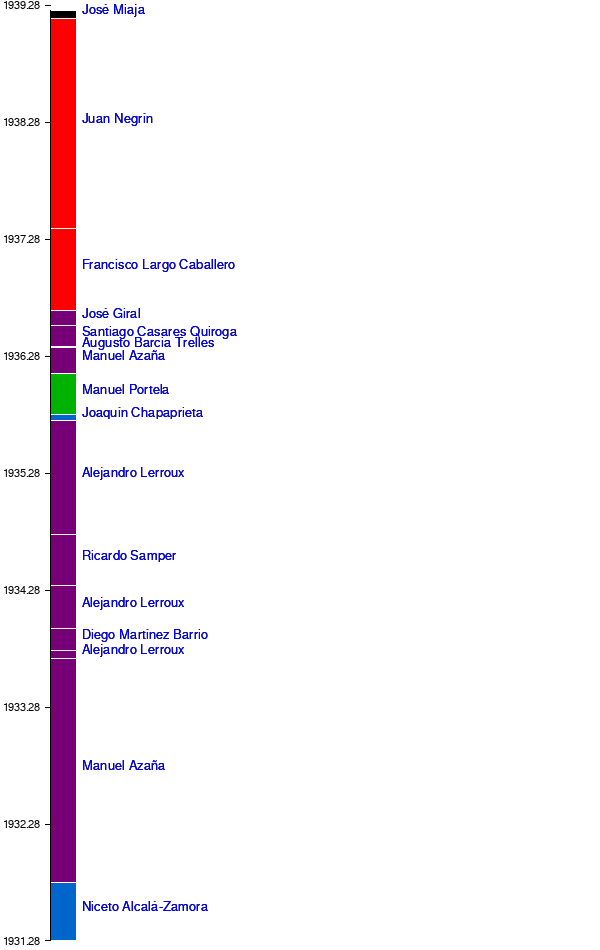
See also
- Portal:Second Spanish Republic
- Second Spanish Republic in exile
- Pact of San Sebastián
- Jaca uprising
- CEDA
- Popular Front (Spain)
- Manuel Azaña
- José María Gil-Robles
- Governments of the Second Spanish Republic
- Niceto Alcalá-Zamora
- Elections in Madrid during the Second Spanish Republic
- Elections in the Basque Country during the Second Spanish Republic
- Viva la República (documentary)
- List of ships of the Navy of the Second Spanish Republic
- List of naval units of the Navy of the Second Spanish Republic
- Spanish Civil War
- Pavilion of the Spanish Republic
- Republican nostalgia
Notes
- ↑ They were the ones attacked in the first place, but in response to their own previous actions, as specialists in provocations, which created reactions from those attacked.[213] According to Eduardo González Calleja, "although it is true that the Falangist deaths preceded their involvement in homicidal violence of a terrorist character, it is no less true that the first 'fallen' after the elections occurred in a growing dynamic of provocations."[213]
References
- ↑ García Queipo de Llano, Genoveva (1997). El reinado de Alfonso XIII. La modernización fallida (in español). Madrid: Historia 16. p. 130. ISBN 84-7679-318-9.
- ↑ Juliá 2009, pp. 27–28
- ↑ Jorge Hernández Aliques (director), Historia de España, ed. Espasa Calpe, volume 11, page 476, ISBN 84-239-8959-3
- ↑ According to the Statistical Yearbook of 1931, of the total of 81,099 councillors elected, the result was 26,257 monarchist councillors and 24,731 republicans, including 4,813 socialist councillors and 15 communists. To these figures must be added those corresponding to the councillors elected on 5 April by application of Article 29, that is, by single candidacy; these figures had already been offered by the Ministry of the Interior before 12 April without anyone disputing them. These figures were 14,018 monarchist councillors and only 1,832 republicans. The Statistical Yearbook published by the republic acknowledges almost exactly the first of these figures, but raises the second, which the republicans did not object to at first, after the rectification of the records by a commission of the Congress, declaring that the electoral process in the corresponding localities had been illegitimate, as caciquism had been accustomed to doing since the end of the First Spanish Republic. In "Elecciones y partidos políticos en España, 1808-1931", published by Miguel Martínez Cuadrado in 1969, the totality of the councillors is recounted, resulting in 19,035 inclined toward Alfonso XIII, 39,568 republicans, and 15,198 traditionalists, integrists, Basque nationalists, independents, etc., who cannot be placed exactly in either of the two opposing camps. For Javier Tusell, the monarchists obtained 40,324, the undefined 1,207, the communists 67, the republicans 34,688 and the socialists 4,813. Ricardo de la Cierva considers it proven that the Yearbook is manipulated, and that the monarchist victory was probably even greater than that acknowledged in its counts. But since that manipulation cannot be corrected for lack of data, he accepts the Yearbook's figure for the councillors elected by contest and the figure of the Ministry of the Interior for those proclaimed before 12 April. Once the sums are made, the result is 40,275 monarchist councillors and 26,563 republican-socialists.
- ↑ 5.0 5.1 5.2 5.3 Suárez, Eduardo (2006). "Tres días de abril que revolucionaron España". La Aventura de la Historia (in español) (90). ISSN 1579-427X.
- ↑ González Calleja 2011, pp. 28–30 harvnb error: multiple targets (2×): CITEREFGonzález_Calleja2011 (help)
- ↑ "Al País". ABC (in español) (8833). Madrid: 3. 17 April 1931.
{{cite journal}}: CS1 maint: date and year (link) - ↑ Juliá 2009, pp. 146–148
- ↑ Martín-Aceña (2004): 386-388
- ↑ Juliá 1999, pp. 84–86
- ↑ Juliá 2009, p. 30
- ↑ Ballbé 1983, p. 324
- ↑ Malefakis (1970): 303
- ↑ Juliá 2009, p. 33
- ↑ Jackson 1976, p. 81
- ↑ Gil Pecharromán 1997, p. 28
- ↑ Gil Pecharromán 1997, p. 30
- ↑ Gil Pecharromán 1997, pp. 30–31
- ↑ De la Cueva Merino 1998, pp. 224–225
- ↑ De la Cueva Merino 1998, p. 215
- ↑ De la Cueva Merino 1998, p. 216: "Both knew that the installation of the republicans in power meant that they, sooner or later, would have to carry out the anticlerical policy they had always advocated. Both trusted in prudence, deference and negotiation, rather than confrontation, to reduce the effects of that policy to a minimum."
- ↑ Casanova 2007, p. 23
- ↑ Álvarez Tardío 2002, p. 97
- ↑ González Calleja 2011, pp. 28–30 harvnb error: multiple targets (2×): CITEREFGonzález_Calleja2011 (help)
- ↑ Álvarez Tardío 2002, pp. 100–101
- ↑ De la Cueva Merino 1998, pp. 219–222
- ↑ Álvarez Tardío 2002, p. 104
- ↑ Álvarez Tardío 2002, pp. 105–106
- ↑ Álvarez Tardío 2002, p. 103
- ↑ De la Cueva Merino 1998, p. 224
- ↑ Álvarez Tardío 2002, p. 115
- ↑ Álvarez Tardío 2002, p. 116
- ↑ Casanova 2007, p. 24
- ↑ De la Cueva Merino 1998, p. 225
- ↑ Álvarez Tardío 2002, pp. 143–145
- ↑ Casanova 2007, p. 40
- ↑ 37.0 37.1 Gil Pecharromán 1997, p. 44
- ↑ 38.0 38.1 38.2 Gil Pecharromán 1997, p. 45
- ↑ 39.0 39.1 Casanova 2007
- ↑ Ballbé 1983, pp. 347–348
- ↑ Casanova 2007, p. 42
- ↑ Gil Pecharromán 1997, p. 52
- ↑ Juliá 1999, p. 85
- ↑ Jackson 1976, p. 47
- ↑ Malefakis (1970): 360. Note 47
- ↑ Malefakis (1970): 254–257
- ↑ Gil Pecharromán 1997, pp. 48–49
- ↑ 48.0 48.1 Gil Pecharromán 1997, p. 50
- ↑ 49.0 49.1 Gil Pecharromán 1997, pp. 50–51
- ↑ 50.0 50.1 Casanova 2007, pp. 46–47
- ↑ 51.0 51.1 Jackson 1976, p. 107
- ↑ 52.00 52.01 52.02 52.03 52.04 52.05 52.06 52.07 52.08 52.09 52.10 52.11 52.12 52.13 52.14 Jackson, Gabriel (1985). «Los primeros días de la República». La República Española y la Guerra Civil (1931-1939). Madrid: Orbis. ISBN 84-7530-947-X
- ↑ According to some sources, this was the director of ABC, Juan Ignacio Luca de Tena. [1])
- ↑ Las Misiones Pedagógicas: educación y tiempo libre en la Segunda República (PDF) Archived March 28, 2010, at the Wayback Machine, Francisco Canes Garrido (Accessed September 13, 2010)
- ↑ Jackson, Gabriel (1985). «La redacción de una Constitución». La República Española y la Guerra Civil (1931-1939). Madrid: Orbis. ISBN 84-7530-947-X
- ↑ 56.00 56.01 56.02 56.03 56.04 56.05 56.06 56.07 56.08 56.09 56.10 Jackson, Gabriel (1985). «La política del Gobierno Azaña». La República Española y la Guerra Civil (1931-1939). Madrid: Orbis. ISBN 84-7530-947-X
- ↑ 57.00 57.01 57.02 57.03 57.04 57.05 57.06 57.07 57.08 57.09 57.10 57.11 57.12 Jackson, Gabriel (1985). «La derrota de las izquierdas». La República Española y la Guerra Civil (1931-1939), Madrid: Orbis. ISBN 84-7530-947-X
- ↑ Aróstegui 1997, pp. 13–14
- ↑ Gil Pecharromán 1997, pp. 64–68
- ↑ Gil Pecharromán 1997, p. 40
- ↑ Gil Pecharromán 1997, pp. 40–42
- ↑ Gil Pecharromán 1997, p. 42
- ↑ "Encíclica Dilectissima Nobis de Pío XI" (in español). Retrieved March 31, 2017.
- ↑ Jackson 1976, p. 109
- ↑ Jackson 1976, pp. 73–74
- ↑ Jackson 1976, p. 7
- ↑ Jackson 1976, pp. 111–112
- ↑ Romá Seguí i, Frances (2011). "Teresa Andrés y la Organización Cultura Popular: una propuesta de coordinación bibliotecaria (1936-1938)" (in español). II (2). doi:10.5557/IIMEI12-N3-127154.
{{cite journal}}:|access-date=requires|url=(help); Cite journal requires|journal=(help) - ↑ San Segundo Manuel, Rosa (2000). "La actividad bibliotecaria durante la Segunda República Española". Cuadernos de documentación (in español) (10). ISSN 1575-9733.
- ↑ Gil Pecharromán 1997, pp. 48–49
- ↑ Jackson 1976, pp. 53, 77
- ↑ 72.0 72.1 72.2 72.3 72.4 72.5 Gil Pecharromán 1997, p. 88
- ↑ 73.0 73.1 Jackson 1976, p. 76
- ↑ Ballbé 1983, p. 355
- ↑ Ballbé 1983, pp. 357–358
- ↑ Gil Pecharromán 1997
- ↑ Jackson 1976, p. 83
- ↑ Jackson 1976, p. 85
- ↑ Gil Pecharromán 1997, pp. 28–29
- ↑ Gil Pecharromán 1997, pp. 31–32
- ↑ Gil Pecharromán 1997, pp. 32–33
- ↑ Jackson 1976, p. 87
- ↑ Jackson 1976, pp. 47–48
- ↑ Gil Pecharromán 1997, p. 54
- ↑ Casanova 2007, p. 51
- ↑ Casanova 2007, pp. 51–52
- ↑ Gil Pecharromán 1997, pp. 54–55
- ↑ 88.0 88.1 Gil Pecharromán 1997, p. 56
- ↑ Gil Pecharromán 1997, p. 57
- ↑ Gil Pecharromán 1997, p. 60
- ↑ Casanova 2007, pp. 87–88
- ↑ Casanova 2007, pp. 88–89
- ↑ Jackson 1976, p. 84
- ↑ Casanova 2007, p. 88
- ↑ Gil Pecharromán 1997, p. 62
- ↑ Gil Pecharromán 1997, pp. 62–63
- ↑ 97.0 97.1 Gil Pecharromán 1997, p. 64
- ↑ Casanova 2007, pp. 95–96
- ↑ Juliá 1999, pp. 96–97
- ↑ Gil Pecharromán 1997, p. 66
- ↑ Jackson 1976, pp. 58–59
- ↑ Casanova 2007, pp. 53–54
- ↑ Casanova 2007, pp. 65–66
- ↑ Casanova 2007, pp. 67
- ↑ Casanova 2007, pp. 67–68
- ↑ Gil Pecharromán 1997, p. 68
- ↑ Ansó, Mariano (1976). Yo fui ministro de Negrín. Memorias ineludibles (in español). Planeta. p. 52. ISBN 84-320-5621-9.
- ↑ Casanova 2007, p. 92
- ↑ Casanova 2007, pp. 99–100
- ↑ Gil Pecharromán 1997, pp. 72–73
- ↑ Jackson 1976, pp. 114–116
- ↑ Gil Pecharromán 1997, p. 74
- ↑ Juliá 1999, p. 90
- ↑ Jackson 1976
- ↑ Casanova 2007, pp. 104–105
- ↑ Casanova 2007, pp. 105–106
- ↑ El Sol, August 10, 1932, Page 4.
- ↑ "Seminario y Universidad Pontificia de Comillas 1892-1968" (in español). Retrieved March 31, 2017.
- ↑ Manuel Azaña, Obras Completas, vol. IV, pp. 273 and 492; Stanley Payne, La primera democracia española, Paidós, Barcelona, 1995, p. 112; Hugh Thomas, La guerra civil española, Grijalbo, Barcelona, 1976, pp. 77 and 126; Alfredo Verdoy, Los bienes de los jesuitas. Disolución e incautación de la Compañía de Jesús durante la II República, Trotta, Madrid, 1995, p. 30 ff.
- ↑ Blog of the Corps of Specialists of the Army, El CASE, el comienzo de nuestro cuerpo. Accessed August 6, 2010.
- ↑ As an example, Ortega y Gasset's comment in the Cortes regarding General Villegas (Diario El Sol, June 29, 1932, page 3 (PDF):
[...] General Villegas has a marked shade of monarchism, a monarchism that he carries to the incomprehensible extreme and display of still wearing on his chest the crosses, insignia and decorations with the monarchist colors, and of wearing on his sash the crown of the Monarchy, external signs that may be puerile and trivial, but that reveal a whole way of thinking [...]
- ↑ La Vanguardia, June 28, 1932, page 20 (PDF) (see also the news on General Cavalcanti and Captain Barrera).
- ↑ Diario ABC, June 29, 1932, pages 15 and 16.
- ↑ Jackson, Gabriel (1985). «Problemas económicos durante la época de Azaña». La República Española y la Guerra Civil (1931-1939). Madrid: Orbis. ISBN 84-7530-947-X
- ↑ El Sol, January 11, 1933 (PDF)
- ↑ 126.0 126.1 Apparently, as a reprisal after several rebels shot an officer of the same corps. La Guerra Civil Española, mes a mes, volumen 1: (1931-1936) Así llegó España a la Guerra Civil (2005)
- ↑ Historiaelectoral.com (Accessed September 13, 2010).
- ↑ El Sol, August 4, 1933, page 2 (PDF)
- ↑ Casanova 2007, p. 112
- ↑ Casanova 2007, p. 107
- ↑ Gil Pecharromán 1997, p. 77
- ↑ "A 75 años de la Revolución española (II)" (in español). Retrieved March 31, 2017.
- ↑ Gil Pecharromán 1997, p. 78
- ↑ 134.0 134.1 Juliá 1999, p. 101
- ↑ Gil Pecharromán 1997, p. 132
They negotiated a pact by which the fascist authorities promised... [that] they would place at the disposal of the conspirators a million and a half pesetas, ten thousand rifles, 200 machine guns and abundant ammunition, and a certain number of traditionalist requetés would be trained on Italian soil
- ↑ 136.0 136.1 Gil Pecharromán 1997, p. 84
- ↑ Casanova 2007, pp. 122–123
- ↑ 138.0 138.1 Gil Pecharromán 1997, p. 80
- ↑ Casanova 2007, pp. 112–116
- ↑ Casanova 2007, p. 117
- ↑ Townson 2009, pp. 79–81
- ↑ Townson 2009, pp. 87–90
- ↑ 143.0 143.1 143.2 Juliá 1990, p. 103
- ↑ 144.0 144.1 Gil Pecharromán 1997, pp. 84–85
- ↑ 145.0 145.1 145.2 Gil Pecharromán 1997, p. 85
- ↑ 146.0 146.1 146.2 Juliá 1999, p. 104
- ↑ 147.0 147.1 Casanova 2007, p. 125
- ↑ Gil Pecharromán 1997, p. 90
- ↑ Fusi Aizpurúa 1985, p. 178
- ↑ Fusi Aizpurúa 1985, pp. 178–180
- ↑ Fusi Aizpurúa 1985, p. 179
- ↑ Gil Pecharromán 1997, pp. 91–92
- ↑ 153.0 153.1 153.2 Gil Pecharromán 1997, p. 92
- ↑ Casanova 2007, pp. 127–128
- ↑ Juliá 1999, pp. 104–105
- ↑ Casanova 2007, p. 119
- ↑ Gil Pecharromán 1997, pp. 93–94
- ↑ Gil Pecharromán 1997, p. 94
- ↑ Casanova 2007, p. 128
- ↑ 160.0 160.1 Casanova 2007, p. 129
- ↑ Casanova 2007, p. 130
- ↑ 162.0 162.1 Gil Pecharromán 1997, pp. 95–96
- ↑ Casanova 2007, p. 131
- ↑ Casanova 2007, p. 133
- ↑ Calero 1985, pp. 165–167
- ↑ Calero 1985, p. 168
- ↑ Calero 1985, p. 169
- ↑ Calero 1985, pp. 174–176
- ↑ 169.0 169.1 169.2 169.3 Gil Pecharromán 1997, p. 96
- ↑ Juliá 1990, pp. 351–373
- ↑ Juliá 1990, pp. 365–373
- ↑ Juliá 1990, pp. 389–390
- ↑ Juliá 1990, pp. 372–374
- ↑ Casanova 2007, pp. 136
After October 1934, the left tried to restore democratic political activity, win at the ballot box and overcome the insurrectionary disasters
- ↑ Juliá 1999, p. 106
- ↑ 176.0 176.1 Casanova 2007, p. 143
- ↑ Gil Pecharromán 1997, pp. 85–86
- ↑ Gil Pecharromán 1997, pp. 86–87
- ↑ Casanova 2007, p. 145
- ↑ Gil Pecharromán 1997, pp. 87–88
- ↑ Gil Pecharromán 1997, p. 89
- ↑ 182.0 182.1 Gil Pecharromán 1997, p. 82
- ↑ Juliá 1999, p. 108
- ↑ Gil Pecharromán 1997, pp. 82–84
- ↑ 185.0 185.1 185.2 Gil Pecharromán 1997, p. 97
- ↑ Casanova 2007, p. 150
- ↑ Juliá 1999, p. 109
- ↑ 188.0 188.1 Gil Pecharromán 1997, p. 116
- ↑ Juliá 1999, p. 110
- ↑ Gil Pecharromán 1997, pp. 116–117
- ↑ 191.0 191.1 Casanova 2007, pp. 154–155
- ↑ Gil Pecharromán 1997, p. 118
- ↑ Casanova 2007, p. 156
- ↑ Gil Pecharromán 1997, pp. 122–123
- ↑ 195.0 195.1 195.2 Gil Pecharromán 1997, p. 120
- ↑ Casanova 2007, p. 157
- ↑ Gil Pecharromán 1997, pp. 120–121
- ↑ 198.0 198.1 Casanova 2007, p. 160
- ↑ Gil Pecharromán 1997, p. 121
- ↑ Gil Pecharromán 1997, p. 122
- ↑ Gil Pecharromán 1997, p. 130
- ↑ Gil Pecharromán 1997, pp. 123–124
- ↑ Ansó, Mariano (1976). Yo fui ministro de Negrín. Memorias ineludibles (in español). Planeta. p. 115. ISBN 84-320-5621-9.
- ↑ Gil Pecharromán 1997, pp. 124–125
- ↑ Casanova 2007, pp. 166–168
- ↑ Ansó, Mariano (1976). Yo fui ministro de Negrín. Memorias ineludibles (in español). Planeta. p. 115. ISBN 84-320-5621-9.
- ↑ Gil Pecharromán 1997, p. 123
- ↑ Juliá 1999, p. 114
- ↑ Casanova 2007, pp. 162–163
- ↑ Juliá 1999, pp. 112–116
- ↑ Gil Pecharromán 1997, pp. 126–127
- ↑ Gil Pecharromán 1997, pp. 127–128
- ↑ 213.0 213.1 Thomàs 2019, p. 162.
- ↑ 214.0 214.1 Gil Pecharromán 1997, p. 128
- ↑ Casanova 2007, p. 164
- ↑ 216.0 216.1 216.2 Casanova 2007, p. 165
- ↑ Vidarte, Juan-Simeón (1973). Todos fuimos culpables (in español). Fondo de Cultura Económica. p. 86.
- ↑ "Anoche fue muerto a tiros el magistrado del Supremo Don Manuel Pedregal". ABC (in español). April 14, 1936. p. 27.
- ↑ "El magistrado de la Sala Segunda del Supremo, Señor Pedregal, muerto a balazos por dos desconocidos". Ahora (in español). No. Núm. 1654. April 14, 1936. p. 3.
- ↑ González Calleja, Eduardo (2011). Contrarrevolucionarios: Radicalización violenta de las derechas durante la Segunda República, 1931-1936 (in español). Alianza Editorial. p. 318. ISBN 978-84-206-6455-2.
- ↑ "Al verificarse el entierro del muerto el pasado martes en la Plaza de Colón se produjeron incidentes". Ahora (in español). April 17, 1936. p. 11-12.
- ↑ Vidarte, Juan-Simeón (1973). Todos fuimos culpables (in español). Fondo de Cultura Económica. p. 53.
- ↑ Gil Pecharromán 1997, pp. 129–130
- ↑ 224.0 224.1 Casanova 2007, p. 171
- ↑ Gil Pecharromán 1997, pp. 130–131
- ↑ Vidarte, Juan-Simeón (1973). Todos fuimos culpables (in español). Fondo de Cultura Económica. p. 113.
- ↑ El regionalismo en Castilla y León Julio Valdeón Baruque. Universidad de Valladolid
The reality was that, with the din of the fratricidal war, all the regionalist attempts, of whatever sign they were, disappeared completely.
- ↑ Gil Pecharromán 1997, pp. 131–136
- ↑ Casanova 2007, p. 170
- ↑ Casanova 2007, p. 173
- ↑ 231.0 231.1 231.2 231.3 231.4 Gil Pecharromán 1997, p. 136
- ↑ Casanova 2007, pp. 173–174
- ↑ Casanova 2007, p. 174
- ↑ Juliá 1999, p. 115
- ↑ Juliá 1999, pp. 115–116
- ↑ Aróstegui 1997, p. 25
- ↑ Juan Francisco Fuentes. "Indalecio Prieto: un socialista atípico". revistadelibros.com (in español). Retrieved December 11, 2019.
- ↑ Gil Pecharromán 1997, p. 174
- ↑ Gil Pecharromán 1997, p. 138
- ↑ Aróstegui 1997, p. 32
- ↑ Casanova 2007, p. 175
- ↑ Gil Pecharromán 1997, pp. 138–139
- ↑ Aróstegui 1997, pp. 97–101
- ↑ Aróstegui 1997, pp. 97–102
- ↑ Aróstegui 1997, pp. 100–103
- ↑ Casanova 2007, pp. 204–205
- ↑ Juliá 1999, p. 124
- ↑ Juliá 1999, pp. 118–119
- ↑ Juliá 1999, p. 125
- ↑ Casanova 2007, pp. 302
- ↑ Casanova 2007, pp. 303–304
- ↑ Casanova 2007, p. 304
- ↑ Casanova 2007, pp. 304–308
- ↑ Juliá 1999, p. 126
- ↑ Casanova 2007, p. 309
- ↑ Juliá 1999, p. 128
- ↑ Casanova 2007, p. 313
- ↑ Casanova 2007, pp. 313–315
- ↑ Aróstegui 1997, pp. 69–70
- ↑ La guerra civil española, Dir. Edward Malefakis, ch. 6.
- ↑ As the anarchist fighter and thinker Errico Malatesta said: "I am a communist, I am in favor of agreement, and I believe that with intelligent decentralization and a continuous exchange of information the necessary exchanges of products could be organized and the needs of all satisfied without resorting to the symbol money. Like every good communist I aspire to the abolition of money, and like every good revolutionary I believe it will be necessary to disarm the bourgeoisie, devaluing all the signs of wealth that can serve to live without working."
- ↑ Juliá 1999, pp. 126–129
- ↑ Casanova 2007, pp. 318–321
- ↑ Casanova 2007, pp. 317, 323–324
- ↑ Casanova 2007, p. 326
- ↑ Juliá 1999, p. 132
- ↑ Juliá 1999, p. 133
- ↑ Casanova 2007, p. 332
- ↑ Casanova 2007, pp. 328, 332
- ↑ Casanova 2007, pp. 329–331
- ↑ Casanova 2007, p. 329
- ↑ Juliá 1999, p. 137
- ↑ Aróstegui 1997, p. 98
- ↑ Casanova 2007, pp. 333–334
- ↑ Casanova 2007, pp. 334–335
- ↑ Juliá 1999, pp. 139–140
- ↑ Casanova 2007, pp. 335–336
- ↑ 278.0 278.1 278.2 Casanova 2007, p. 336
- ↑ Bahamonde Magro, Ángel; Cervera Gil, Javier (1999). Así terminó la guerra de España (estudios) (in español). p. 77.
Es verdad que España estuvo "invadida" de presencia extranjera en los dos bandos, pero fue más la que se observó del lado del gobierno de Burgos y, sobre todo, ésta persistió hasta el final. Y es indudable que el argumento que esgrimía Negrín de que el bando nacional no era español, sin ser ni mucho menos verdad, tenía mucha más razón de ser que cuando Burgos afirmaba que la España republicana era prácticamente un satélite de Stalin
- ↑ 280.0 280.1 Casanova 2007, pp. 403–405
- ↑ Juliá 1999, p. 142
- ↑ Aróstegui 1997, p. 117
- ↑ Casanova 2007, p. 405
- ↑ Casanova 2007, p. 337
- ↑ Casanova 2007, pp. 337, 405
- ↑ Juliá 1999, p. 143
- ↑ Casanova 2007, pp. 405–407
Bibliography
- Álvarez Tardío, Manuel (2002). Anticlericalismo y libertad de conciencia. Política y religión en la Segunda República Española (in español). Madrid: Centro de Estudios Políticos y Constitucionales. ISBN 84-259-1202-4.
- Aróstegui, Julio (1997). La Guerra Civil. La ruptura democrática (in español). Madrid: Historia 16.
- Bahamonde, Ángel; Cervera Gil, Javier (1999). Así terminó la Guerra de España (in español). Madrid: Marcial Pons. ISBN 84-95379-00-7.
- Ballbé, Manuel (1983). Orden público y militarismo en la España constitucional (1812-1983) (in español). Madrid: Alianza Editorial. ISBN 84-206-2378-4.
- Calero, Antonio Mª (1985). "Octubre visto por la derecha". In Gabriel Jackson; et al. (eds.). Octubre 1934. Cincuenta años para la reflexión (in español). Madrid: Siglo XXI. ISBN 84-323-0515-4.
{{cite book}}: Explicit use of et al. in:|editor=(help) - Casanova, Julián (2007). República y Guerra Civil. Vol. 8 de la Historia de España, dirigida por Josep Fontana y Ramón Villares (in español). Barcelona: Crítica/Marcial Pons. ISBN 978-84-8432-878-0.
- De la Cueva Merino, Julio (1998). "El anticlericalismo en la Segunda República y la Guerra Civil". In Emilio La Parra López and Manuel Suárez Cortina (ed.). El anticlericalismo español contemporáneo (in español). Madrid: Biblioteca Nueva. ISBN 84-7030-532-8.
- Fusi Aizpurúa, Juan Pablo (1985). "Nacionalismo y revolución: Octubre de 1934 en el País Vasco". In Gabriel Jackson; et al. (eds.). Octubre 1934. Cincuenta años para la reflexión (in español). Madrid: Siglo XXI. ISBN 84-323-0515-4.
{{cite book}}: Explicit use of et al. in:|editor=(help) - Gil Pecharromán, Julio (1997). La Segunda República. Esperanzas y frustraciones (in español). Madrid: Historia 16. ISBN 84-7679-319-7.
- González Calleja, Eduardo (2011). Contrarrevolucionarios. Radicalización violenta de las derechas durante la Segunda República (in español). Madrid: Alianza Editorial. pp. 28–30. ISBN 978-84-206-6455-2.
- Helen Graham. La República española en guerra. 1936-1939, Debate, 2006.
- Jackson, Gabriel (1976) [1965]. Princeton (ed.). The Spanish Republic and the Civil War, 1931-1939 [La República Española y la Guerra Civil, 1931-1939] (in español) (2nd ed.). Barcelona: Crítica. ISBN 84-7423-006-3.
- Gabriel Jackson (2005). La República española y la guerra civil (in español). RBA Coleccionables S.A. ISBN 84-473-3633-6.
- Juliá, Santos (1990). Manuel Azaña, una biografía política. Del Ateneo al Palacio Nacional (in español). Madrid: Alianza Editorial. ISBN 84-206-9606-4.
- Juliá, Santos (1999). Un siglo de España. Política y sociedad (in español). Madrid: Marcial Pons. ISBN 84-9537903-1.
- Juliá, Santos (2009). La Constitución de 1931 (in español). Madrid: Iustel. ISBN 978-84-9890-083-5.
- Edward Malefakis (1982). Reforma agraria y revolución campesina en la España del siglo XX. Barcelona: Ariel.
- Malefakis, Edward (1970), Agrarian Reform and Peasant Revolution in Spain, New Haven (Connecticut) and London: Yale University Press
- López Martínez, Mario (1995). Orden público y luchas agrarias en Andalucía, 1931-1936 Madrid: Ediciones Libertarias.
- Martín-Aceña, Pablo (2004), "La economía española de los años treinta", in Juliá, Santos (coord.), República y Guerra Civil, Volume XL of Historia de España Menéndez Pidal, Madrid: Espasa-Calpe
- Miguel Martorell Linares and Francisco Comín (2002). "La Hacienda republicana", Hacienda Pública Española, special issue. pp. 105-127.
- Stanley G. Payne (2005). El colapso de la República. Madrid: La Esfera de los Libros.
- Stanley G. Payne (1995). La primera democracia española. La Segunda República, 1931-1936. Barcelona: Paidós.
- Josep Pla. La segunda República española. Crónicas parlamentarias 1931-1936, Destino, 2006.
- Paul Preston. La destrucción de la democracia en España. Reforma, reacción y revolución en la Segunda República, Madrid, Alianza Universidad, 1986.
- Townson, Nigel (2009). "¿Vendidos al clericalismo? La política religiosa de los radicales en el segundo bienio, 1933-1935". In Julio de la Cueva and Feliciano Montero (ed.). Laicismo y catolicismo. El conflicto político-religioso en la Segunda República (in español). Alcalá de Henares: Universidad de Alcalá de Henares. ISBN 978-84-8138-848-0.
- Sinova Garrido, Justino (2006). Prensa en la Segunda República: historia de una libertad frustrada (in español). Editorial Debate. ISBN 978-84-8306-673-7.
- Thomàs, Joan Maria (2019). "José Antonio Primo de Rivera y el Frente Popular". Historia y Política (in español) (41). Madrid: CEPC; UCM; UNED: 153–174. doi:10.18042/hp.41.06. ISSN 1575-0361.
- Manuel Tuñón de Lara (1976). La II República. Madrid: Siglo XXI.
- Javier Tusell (1971). Las elecciones del Frente Popular en España. Madrid: Edicusa.
- Javier Tusell (1982). Las Constituyentes de 1931: unas elecciones de transición. Madrid: CIS.
External links

- Constitución de la República Española de 1931 (historical document on Spanish Wikisource).
- Quotations about the Second Spanish Republic on Spanish Wikiquote.
- Special feature of the newspaper "Público" on the Second Spanish Republic on its 80th anniversary.
- «La reforma del sistema educativo con la II República».
- Paul Preston, «La República en la paz como en la guerra», Letras Libres, May 2003.
- Special program on the Second Republic on Popular TV-Grupo COPE: Tirado en la City
- Images of the Second Spanish Republic.
- Booklet of the Spanish Constitution of 1931.


