| Content from Wikipedia under the CC BY-SA 4.0 license ⇔ Maps from OpenStreetMap under the ODbL license |
Juan Sebastián Elcano
Juan Sebastián Elcano | |
|---|---|
 Engraving from the 1850s showing the mariner Juan Sebastián Elcano. | |
| Born | c. 1486 |
| Died | August 3[1] or August 6, 1526[2][3] |
| Occupations | Sailor, navigator and explorer |
| Spouse | María Hernández Hernialde |
| Children | Domingo Elcano |
| Parent(s) | Catalina del Puerto Domingo Sebastián Elcano |

Juan Sebastián Elcano[n 1] (Getaria, around 1486[3][4]–Pacific Ocean, August 3[1] or 6, 1526[2][3]) was a Spanish mariner who made the first known voyage around the world.[n 2]
In 1519 he enlisted in an expedition of five naos to the Spice Islands under the command of Ferdinand Magellan. They sailed westward, passing by South America. Magellan died in 1521 in a battle in the Philippines. Elcano became Captain of the nao Victoria, which was the only nao that completed the voyage around the world sailing westward. In 1525 he set sail again on another expedition to the Spice Islands, led by García Jofre de Loaísa, as Captain of the nao Santi Spiritus and chief pilot of the expedition, and he died in the Pacific Ocean in 1526.
Biography
Origins and family
The historians José Antonio Azpiazu and Javier Elorza Maiztegi believe that his father's family may have come from an area of farmsteads called Elcano,[5] in the municipal district of Getaria, province of Gipuzkoa, Basque Country, Spain. This area of farmsteads borders the municipalities of Aia and Zarautz.[6]
The paternal surname was written as "del Cano". In 1485 a document mentions the inheritance of a certain Sebastián del Cano.[5] The mariner himself signed as Juan Sebastián del Cano in the 16th century.[7] Nevertheless, he is widely known as Juan Sebastián Elcano.[3][4] In recent times, the Bilbao-born historian Enrique Santamaría Urtiaga and Basque organizations have preferred to write the surname as "Elkano".[5][8]
Juan Sebastián Elcano was born around 1486, since in a document written in Seville on August 9, 1519, he said that he was "thirty-two years old, a little more or less".[4] He said in his will that he was born in Getaria.[9] Local tradition says that he was born in a tower house on the Calle de San Roque,[10] and that it was destroyed in the battle of Getaria against the French in 1638.[11]
His father, Juan Domingo Sebastián Elcano, was one of the richest men in Getaria. His mother, Catalina del Puerto, belonged to one of the traditional lineages of that same place[5] and her family included clerics and notaries.[12] They had eight children. The first, Sebastián, was born in 1481.[5] He was probably followed by Catalina, who married Rodrigo de Gainza, also from Getaria, and they had a son who became a priest and who, in the future, would be in charge of administering the family's legacy.[5] The next offspring was Domingo Elcano, who became parish priest of the town's Church of San Salvador.[5] The fourth child was Juan Sebastián Elcano. His younger siblings were Martín Pérez, Martín Ochoa (also referred to as Ochoa Martínez),[13] Inés (who married Sebastián de Guevara) and Antón Martínez.[5]
It is known that the father died after 1500 and that the mother outlived her husband and Juan Sebastián, dying at some date after 1538.[14]
Martín Pérez, Antón Martínez and Martín Ochoa were sailors like Juan Sebastián and took part with him in the expedition of García Jofre de Loaísa.[15] Martín Pérez was pilot of the nao Santi Spiritus on that expedition.[12]
Juan Sebastián had a son with Mari Hernández de Hernialde, a resident of Getaria.[16] This son was named Domingo.[17]
Elcano said in his will of 1526 that he had a daughter in Valladolid with María de Vidaurreta, although he does not give her name. Elcano made visits to Valladolid between 1522 and 1525.[18] According to the historian Francisco de Borja de Aguinagalde Olaizola, this daughter was named María.[19] In 1538, when María de Vidaurreta gave power of attorney to Juan Fernández de Paredes to sue Catalina del Puerto, nothing is mentioned about the daughter, so it is possible that she had died before that date.[20]
According to the historian Aguinagalde, Juan Sebastián Elcano's children died as children,[21] but according to the historian Santamaría Urtiaga there is no proof of this.[22]
Juan Sebastián Elcano provided in his will of 1526 that his children should be his heirs but that his mother, Catalina del Puerto, should hold the usufruct of his property for as long as she lived.[17]
When he was about twenty years old he was master and owner of a nao of two hundred tuns and served Charles I in the Spanish Levant and in Africa. As the King did not pay him for his services, he had to sell the nao to some merchants who were subjects of the Duke of Savoy. At that time, selling a ship to foreigners was a crime. He was pardoned when he returned from going around the world in 1522.[23]
In 1515, probably after selling his nao, he was part of a Getaria militia assembled to confront the French. This local militia was made up of twelve men under the command of Domingo Uzarraga, who in 1522 became Mayor of Getaria. The militia was posted first to San Sebastián and then to Hondarribia, although there is no record of it entering combat. In this military body he coincided with a certain Iohan de Elcano and with Martín Íñiguez de Carquizano, who would in the future be Chief Constable (Alguacil Mayor) of the Loaísa expedition.[24]
In 1517 he was in Getaria and appears as a witness on a letter of debt of a resident of this municipality.[25]
First circumnavigation of the globe

Preparations for the expedition
Captain Ferdinand Magellan had the project of reaching the Spice Islands, the Moluccas, in the South Sea, through a passage in South America. He arrived in Seville from Portugal in October 1517 and was well received by the warden of the Alcázar and the Shipyards, as well as by the Factor of the Casa de Contratación de Indias. He went to Valladolid in 1518, where he presented his project to King Charles I, reaching an agreement (capitulaciones) for the expedition. He then moved back to Seville to prepare the voyage with the officials of the Casa de Contratación.[26]
In 1518 Juan Sebastián Elcano was in Seville.[27]
The King had undertaken to fit out five ships for the expedition, which were named Trinidad, San Antonio, Concepción, Victoria and Santiago.[26] These ships were moved to Seville to be rigged.[28] The ships were provided with six flags bearing the Cross of Saint James.[29]
In January 1519 Juan Sebastián Elcano was hired as boatswain of the nao Victoria. In February he moved to the Concepción with the same rank, at a master's salary. The office of master was officially recognized to him in March.[27] At that time, the office of pilot was absorbing functions of the office of master, so Elcano on some occasions described himself as a pilot.[30] On the Concepción the captain was Gaspar de Quesada, the pilot was the Portuguese Juan López de Carvalho and the boatswain was Juan de Acuario.[26]
The masters were those who handled the ships during navigation, and the captain was the representative of the king.[31] Masters earned a salary of 36 000 maravedíes a year, higher than that of the boatswains and the pilots.[32]
Juan de Cartagena, captain of the San Antonio,[26] was also the royal inspector (veedor) and had the mission of supervising the expedition and taking decisions together with Magellan.[33] Magellan was the captain general[34] of the fleet and captain of the Trinidad.[26]
The fleet had a total cost of 8 334 335 maravedís. The Crown, through the Casa de Contratación de Indias, financed 6 454 209, and the Burgos magnate Cristóbal de Haro contributed 1 880 126. Approximately 247 men were recruited, although there were problems hiring Spanish sailors because they did not trust Magellan, as he was Portuguese, and because they were paid little.[35] For this reason, foreigners were also accepted. About three fifths of the crew were from the Kingdom of Castile, a couple of people were from the Kingdom of Aragon, 28 were Portuguese, 27 were Italians (mostly Genoese), 15 were French, 8 were Greek, 5 were Flemish, 3 were German, one was English and another was Malay (Enrique of Malacca).[36]
Beginning of the voyage
On August 10, 1519, the five ships departed from the Muelle de las Muelas in Seville.[37] They descended the Guadalquivir River until they reached Sanlúcar de Barrameda, Province of Cádiz, a port that opens onto the Atlantic Ocean.[38] During the following weeks the squadron was provisioned and other matters were resolved. Magellan made his will in Seville on August 24.[39]
They remained 41 days in Sanlúcar de Barrameda equipping the ships. The reason for this delay may have been a strategy of Magellan's to avoid a Portuguese squadron that was departing for India and that could intercept them, or that an important figure had yet to embark.[37] There are indications that Juan de Cartagena embarked in Sanlúcar de Barrameda.[40]
Cristóbal de Haro sent a caravel to the Canary Islands to prepare everything for the arrival of Magellan's fleet. The fleet set sail from Sanlúcar de Barrameda on September 20 and six days later reached the Canary island of Tenerife.[41] On this island four more people embarked and one man left for unknown reasons.[42] They stayed there between three and six days.[41]
According to Juan López de Recalde, chief accountant of the Casa de Contratación de Indias, Magellan kept hidden from the crew the route by which they were going to go to the Spice Islands, and it was in the Canaries that Juan de Cartagena and other officers confronted Magellan and demanded that he give them the route to follow, and in the end Magellan gave it to them.[43]
The fleet sailed south, near the African coast, until reaching approximately the latitude of Sierra Leone. Then they set course westward, toward Brazil.[44] While they were still near the African coast there came a lack of wind that lasted about fifteen days.[34]
According to Juan López de Recalde, when they moved away from the African coast Juan de Cartagena noticed that they were departing from the route to the Spice Islands that Magellan had communicated to him.[44]
When they were near the African coast, the master of the nao Victoria, Antón Salomón, was caught raping a ship's boy, Antonio Ginovés. To punish him, a council of captains was convened on the Trinidad and the master was sentenced to death, although the execution of the sentence was postponed until they reached the mainland.[45]
At the council of captains, Magellan clashed with Cartagena over the route they were following. Magellan ended up arresting him with his feet in the stocks and placed him in the charge of the Treasurer Luis de Mendoza.[46] Many did not approve of his arresting the royal Veedor, since they considered that this went against the wishes of Charles I.[46]

During the navigation across the Atlantic Ocean the ships were caught by strong storms and by a meteorological phenomenon called St. Elmo's fire.[46]
Search for the passage
They reached the Brazilian coast at the end of November but did not land until December 19, in a bay that they named Santa Lucía, which according to most sources was Guanabara Bay, although it may also have been the nearby Sepetiba Bay, both in the State of Rio de Janeiro.[47] At that point a mestizo son of Joao Lopes Carvalho, whom he had fathered on an earlier voyage, joined the crew.[47] They stayed in the Bay of Santa Lucía for two weeks, provisioning the ships and maintaining good relations with the natives.[48]
On January 10, 1520, they reached the mouth of the Río de la Plata and Magellan entered with his ships thinking that it might be a passage to the South Sea. However, after a while they tasted the water and it turned out to be fresh, which indicated that it was only a river. Then Magellan ordered the nao Santiago to go up the Uruguay River to look for the passage, and it returned after 25 days without results.[48]
They continued south through unexplored territories and reached a gulf that they named San Matías, having discovered it on that saint's day: February 24. Then they continued to Golfo Nuevo, which they surveyed for five days.[49]
Traveling south along the coast of Argentina, the crew hunted sea lions and saw penguins for the first time.[50]
Another storm caught them, which ceased when St. Elmo's fire appeared again. On March 31, 1520, they reached a place that they named Puerto San Julián, and Magellan decided that the fleet would stop there for a season.[51] As the expedition did not seem to be following a path toward the Spice Islands and they remained uselessly lost in cold lands, discontent began to spread.[52]
On April 1, 1520, Palm Sunday, a Mass was celebrated at Puerto San Julián, the first on Argentine territory. The Captain of the Concepción, Gaspar de Quesada, did not attend the Mass. Afterwards, the crew returned to the ships and Quesada freed Juan de Cartagena. Quesada and Cartagena went to the nao San Antonio with 30 armed men and arrested its substitute Captain, Álvaro de Mezquita, a cousin of Magellan, and the pilot Juan Rodríguez de Mafra. Quesada stabbed and wounded the Master Juan de Lorriaga. At this point, Elcano entered the San Antonio as master and directed operations in which the ship was armed with lombards. The naos San Antonio, Concepción and Victoria, the last captained by Luis de Mendoza, came under the control of the mutineers.[53]
In 1522 Elcano justified the mutiny against Magellan before the Alcalde de Casa y Corte Sancho Díaz de Leguizamo with the following words:[54]
The other captains, together with the said Cartagena, required the said Magellan to take counsel with his officers, and to give the course to where he wished to go, and not to go about thus lost, and not to put into a port where they would winter and eat up the provisions, and that they should travel as far as they could endure the cold so that, if there were a way, they would go on ahead; and since the said Fernando de Magallanes held the said Joan de Cartagena prisoner, all the captains and the other people were afraid that he would take them prisoner, and on account of the many Portuguese and people of other nations there were in the fleet; and for this Juan de Cartagena and Gaspar de Quesada required this witness, as master, to obey the commands of the King, and to give them favor and help to have the commands of the King carried out, as he ordered in his instructions.[54]
Magellan sent to the nao Victoria a group of five or six men under the command of the Chief Constable, Gonzalo Gómez de Espinosa. Luis de Mendoza let them board so that they could hand him a letter from Magellan, but while he was reading the letter he was stabbed to death by Espinosa. According to Elcano, Magellan rewarded this behavior by giving Espinosa twelve ducats. Then Magellan sent fifteen more people to the Victoria and the ship came back under his control. The San Antonio tried to leave, but the current sent it alongside the Trinidad. Gaspar de Quesada wanted to parley, but the Trinidad opened fire on the San Antonio. Then the San Antonio and the Concepción decided to surrender.[55]
In reprisal, Magellan ordered the corpse of Luis de Mendoza to be quartered and Gaspar de Quesada to be beheaded and quartered. He then ordered Juan de Cartagena to be arrested again and also arrested the cleric Pedro Sánchez Reina for telling him that he was going to burn in hell.[56]
On April 27, 1520, the ship's boy Antonio Genovés, of the nao Victoria, drowned while trying to escape after being accused of sodomy by a lad.[57]
Juan de Lorriaga died in July from the stab wounds that Gaspar de Quesada had inflicted on him.[58]
At the beginning of May, Magellan sent the nao Santiago, under the command of Juan Rodríguez Serrano, to explore further south while he and the rest of the ships waited at Puerto San Julián. The Santiago sank while exploring a river, at a place they called Puerto Santa Cruz. All the crew members were saved except for a black slave named Juan. Two or three men managed to cross the river in a boat built from planks and then walked 120 kilometers to Puerto San Julián to alert Magellan. When he was alerted, a group was organized that rescued the castaways. These men were then distributed among the rest of the naos, and Juan Rodríguez Serrano was appointed Captain of the Concepción.[59]
They spent two months at Puerto San Julián without seeing anyone until they encountered a man of Patagonia who was very tall.[60] Then came further encounters with these gigantic men. Magellan fed six of these men when they visited them days later. Then four more came and Magellan captured two to take them to Castile.[61]
Magellan sent a group of men, with the pilot Joao Lopes Carvalho, to look for inhabitants of the region who might give them fresh meat, and forbade them to harm the natives. They came upon seven Patagonians in a hut and, when they tried to get one of them to go to the ships, they were attacked with arrows, and Diego de Barrasa was killed. Magellan sent a punitive expedition for this death, but they did not find the natives at the place.[61]
On August 11 Magellan marooned Juan de Cartagena and Pedro Sánchez Reina in Patagonia.[61]
On August 24 they departed from Puerto San Julián.[61] On August 25 they stopped at the Santa Cruz River and remained there, where fish were abundant.[62]
They departed on October 18, 1520,[62] and on October 21 they reached a cape that they called the Cape of the Eleven Thousand Virgins.[63] They came upon a strait and went through a strong squall that caused them to temporarily lose sight of the naos Concepción and San Antonio.[63] Then Magellan ordered a group of men, headed by Joao Lopes Carvalho, to go ashore and climb a hill to see whether it was indeed a passage, and they saw some land in the distance, so they came back without a conclusive answer. Magellan decided to advance to a bay with some islands.[64]
For the first time, Magellan asked the opinion of the other officers on whether to continue or return to Spain. The pilot Esteban Gómez said that the supplies might not be sufficient if they found a great ocean on the other side. The pilot Andrés de San Martín was of the opinion that, since they had arrived where no one had arrived before, the best thing was to go on and make sure that this was the strait they were looking for, but that they had to leave that latitude to avoid the cold and possible squalls, and that they should return to Spain if they took too long traversing the strait.[65]
Magellan made the decision to continue, but the strait forked in two. He then ordered the San Antonio and the Concepción to go one way while he, with the Trinidad and the Victoria, went the other, and that they would meet again at the junction after three days. After this the nao San Antonio deserted and returned to Seville,[65] arriving on May 6, 1521.[66]
The crews of the naos Concepción, Trinidad and Victoria searched for the San Antonio for several days, without success, leaving crosses on the coast and pots with notes as signals.[67]
When they resigned themselves to the loss of the San Antonio, they continued sailing through the strait and saw fires in the distance, so they called the region Tierra del Fuego. They found a river that they named the River of the Sardines, for the great quantity of these fish that they were able to catch.[68]
They then decided to press on, sending boats ahead as an advance party to report whether the strait continued. On November 18, 1520, they reached the end of the strait, between two capes that they called Hermoso and Deseado, and they called the ocean they found the Pacific.[69]
Crossing of the Pacific and arrival in the Philippines and Borneo
They went north as far as the 38th parallel south, where the climate was milder.[70] Then they went west and, after a month on the ocean, deaths from disease began to occur on the high seas.[71]
Antonio Pigafetta wrote of the following hardships concerning food on this crossing of the Pacific:[72]
The biscuit we ate was no longer bread, but a powder mixed with worms that had devoured all its substance, and which moreover had an unbearable stench from being soaked in rats' urine. The water we were forced to drink was likewise putrid and stinking. So as not to die of hunger, we were even forced to eat pieces of the cowhide with which the main yard had been covered to prevent the wood from wearing through the ropes. This hide, always exposed to the water, the sun and the winds, was so hard that it was necessary to soak it for four or five days in the sea to soften it a little; to eat it we then put it on the embers. Often we were even reduced to feeding on sawdust, and even rats, so repulsive to man, had become such a delicacy that half a ducat was paid for each one[72]
Antonio Pigafetta and Ginés de Mafra say that in these times many sailors suffered from scurvy, a potentially fatal disease caused by a lack of vitamin C.[73]
They reached two small islets where they were unable to stop: the Puka Puka atoll (which they named San Pablo) and Flint Island (which they named Island of the Sharks).[74]
On March 6, 1521, they landed on the island of Guam.[75] The natives stole things from the ships. At one point many climbed aboard the naos, especially the Trinidad, and its boatswain slapped one of them. That provoked a minor skirmish between the natives and the Europeans. Three days later the natives stole the Trinidad's boat and Magellan sent forty men to punish them. They burned forty or fifty houses and many canoes and killed seven natives, after which they recovered the boat. Magellan deemed it advisable to leave the island, which they named Island of the Thieves.[76]
Magellan and his men arrived on March 16 at the Island of Suluan, in an archipelago that they named the Islands of San Lázaro and that would later be renamed the Philippines by Ruy López de Villalobos in honor of Philip II.[77]
They subsequently landed on a larger nearby island called Homonhon, where they stayed nine days. Some natives came by boat from another island and gave them food.[78]
They then stayed on the Island of Mazaua, which is probably the island of Limasawa, although there is a tradition that says they arrived at Batúan.[79] On March 31, 1521, Easter Sunday, a Mass was celebrated at this place, the first in the history of the Philippines.[80] Magellan set up a cross and explained to the King of the natives that this cross would protect them, because it signified that they were a friendly people.[81]
On April 7 they arrived at the city of Cebu, which was very populous. The local Monarch, Humabón, asked Magellan for a tax for anchoring in his port, but he refused and threatened war.[82] The following day Humabón and Magellan held a ceremony to seal their friendship.[83]
-
-
 Magellan's Cross in Cebu


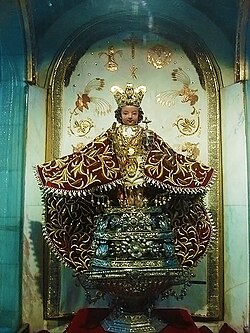
Magellan placed emphasis on evangelizing the natives, and Pigafetta wrote that eight hundred ended up being baptized,[84] including the King of Cebu and his wife, who took the name Juana. On the day of the King's baptism, April 15, a wooden cross was erected in the square of Cebu, which has remained there to the present day. A priest showed the queen an image of the Virgin Mary and another of the Child Jesus. The Queen asked for the image of the Child Jesus and kept it. In 1565 the Spaniards discovered that the natives had preserved this image and, today, it is the object of great devotion in the Philippines.[85][86]
The King of Cebu told Magellan that on the neighboring Island of Mactan there were natives ruled by Lapulapu who were at enmity with those of Cebu and who looked unfavorably on the presence of the expeditionaries. Magellan decided to subdue them by force and refused the help that Humabón offered him for this.[87]
On April 27, 1521, Magellan went to Mactan with a group of men (40 according to Ginés de Mafra and 60 according to Pigafetta) aboard boats.[88] The Spaniards were defeated in this battle and Magellan died in combat.[89] In 1522 Elcano declared before the Alcalde de Casa y Corte Díaz de Leguizamo that another 7 men also died in combat and 27 were wounded.[90]
Duarte Barbosa became Captain General and captain of the Trinidad.[91] Enrique of Malacca, who had been Magellan's slave, began to behave idly, and Barbosa called him a "dog" and said that he was not free, but would pass into the charge of Magellan's wife. He also told him that he would have him flogged if he did not go ashore to do tasks. According to Pigafetta, Enrique went to speak with the King of Cebu and proposed to him that they kill the Europeans to seize their ships and belongings. Then the Malay returned to the fleet and behaved more industriously than ever.[92] According to Ginés de Mafra, it was not Enrique who instigated the King of Cebu against the Spaniards, but Lapulapu.[93]
On May 1 Humabón invited the expeditionaries to a banquet. They suspected that it might be an ambush, but Barbosa decided to attend so as not to appear cowardly. While they were at the meal, native warriors appeared and put many to the knife. The sailors later made a list of 27 men they had lost in the event, among whom were Barbosa[94] and Enrique.[95] Nevertheless, they thought that perhaps not all of the missing were dead.[96]
The ships left Cebu hastily without being sufficiently loaded with provisions.[97]
Joao Lopes Carvalho became Captain General of the expedition[98] and Captain of the Trinidad, with Juan Bautista de Poncevera as master of this ship. Gonzalo Gómez de Espinosa, who had begun the voyage as Chief Constable, became Captain of the Victoria with Elcano as master.[99]
The crew now consisted of only 116 or 117 men, which made it impossible to handle the three ships. They headed for the island of Bohol and burned the nao Concepción.[98]
They sailed south and reached the island of Mindanao. Pigafetta relates that he went ashore and maintained good relations with the King of the place but did not obtain provisions.[98] The King of Mindanao explained to them how to reach the island of Borneo and, on the way, they stopped at the island of Palawan.[100] Juan de Campos won the friendship of the natives of Palawan and they sold them rice.[101]
They stayed a month in Palawan. The natives were unable to tell them how to reach the Spice Islands, and Carvalho decided to continue to Borneo with some local guides.[101]
On July 8, 1521, they arrived at the City of Brunei, on the island of Borneo, where the Muslim rajah Siripada resided.[101] The rajah asked the Europeans to visit him. Gonzalo Gómez de Espinosa and Juan Sebastián Elcano went ashore and went to see him, while Carvalho remained on the nao Trinidad. According to Ginés de Mafra, Elcano and Espinosa were accompanied by the Greek sailors Juan Gorfo and Mateo Griego. Pigafetta, for his part, narrates the reception in great detail, so it can be deduced that he also attended. Pigafetta relates that the Europeans were attended to for two days, and Ginés de Mafra relates that they were detained for fifteen days.[102] Another who went was Carvalho's Brazilian son, with objects to trade that were not his but belonged to the ship owners or to the Spanish Crown.[103]
Espinosa and Elcano were taken to see the rajah on two elephants and, since he would not allow himself to be seen, they had to speak with him through a tube through a wall.[102]
While Espinosa and Elcano were ashore, two junks came alongside the two naos. A sailor spotted a fleet of more than two hundred sails approaching in the distance. Carvalho decided to board the junks, which were taken without difficulty. They let the native crew members return to land with the message that they would continue attacking the junks that approached until their companions returned. After this, they went on to burn four junks in succession. Then another junk approached, whose Captain said it belonged to the King of the island of Luzon. This junk was boarded and Carvalho let him go in exchange for some jewels he was carrying. Finally, Elcano and Espinosa returned to the ships.[104]
The two Greek sailors stayed in Brunei, without it being known with certainty whether this was voluntary or not.[102] As for Carvalho's son, the natives told Espinosa and Elcano that he had died, but they could not verify this because they had been kept apart, and nothing more was heard of him.[103]
Through Elcano and Espinosa, they learned that the Captain of the Luzon junk was in fact the son of the King of Luzon, who had gone to Brunei to marry a daughter of the rajah.[105]
The European sailors did not approve of Carvalho's behavior, since according to them they should have held the man from Luzon until their companions returned instead of releasing him in exchange for some jewels.[105] Carvalho also kept three native women for himself.[106]
On July 29, 1521, the two naos left Brunei.[107]
Elcano, captain of the nao Victoria


The rajah of Brunei told them that in Mindanao there would be guides to take them to the Spice Islands (the Moluccas), and they set course for that place.[108]
Near the northernmost cape of the Island of Borneo one of the ships ran aground, suffering material damage. On August 15, 1521, they stopped to repair this nao on an island located between Borneo and Palawan which was called Cimbombón and which they named Nuestra Señora de Agosto (Our Lady of August).[109]
On September 17, while on this island, it was decided to remove Carvalho because of his behavior and to appoint Gonzalo Gómez de Espinosa as Captain General, who would exercise his office from the Trinidad. As Espinosa had until then been Captain of the other ship, Elcano was appointed Captain of the nao Victoria.[110]
On September 26 they set sail from the Island of Nuestra Señora de Agosto.[111] After this they encountered a vessel carrying the lord of the Island of Palawan and governor of the City of Brunei. They decided to seize the Lord and his family and to demand a ransom in provisions, and they let the rest of the native crew go to Palawan.[111]
During his captivity the Lord of Palawan became friends with the Europeans. The inhabitants of Palawan gave more provisions than the Europeans had demanded as ransom. After this, the native lord signed an act of vassalage to Charles I. This agreement is related in the Libro de las Paces del Maluco of the notary Martín Méndez.[112]
On October 7 they took leave of the Lord of Palawan and continued sailing. After this, it is known from the testimonies of Elcano, Francisco Albo and Hernando de Bustamante that they seized several Chinese junks and took cotton and silk cloths, axes, knives and porcelain.[113]
They went through the Sulu Sea and visited a couple of villages on the Island of Mindanao. They stayed two days on the island and bought 17 pounds of cinnamon. On October 27 there was a great storm and St. Elmo's fire appeared for two hours.[114]
Near Mindanao a parao approached them and there was a naval combat. Seven of the 18 natives from Magindanao who were on the parao died. The Sevillian armorer Pedro Sánchez and the French gunner Juan Bautista also died of their wounds. After this, one of the men from the parao said he was the brother of the King of Magindanao and, since he knew the way to the Moluccas, they took him and his son, among others, to guide them.[115]
Following the instructions of this king's brother they reached Sarangani and seized two more guides. With their directions, they went south through the Celebes Sea. When they passed by Sangir Island, one of the guides from Sarangani and the brother of the King of Magindanao with his son escaped by swimming, and the son drowned. They were left with only one guide and continued the voyage with his directions.[116]
On November 7, 1521, they sighted the Moluccas.[116]
On November 8 they landed on the island of Tidore and were received by King Almansur, who treated them with great hospitality.[117] Espinosa and Elcano exchanged gifts with Almansur. Subsequently, they handed over to this king the hostages from the parao and the guide from Sarangani so that he could send them back to their lands, as well as the three native women.[118]
Almansur gathered all the clove he could from Tidore, as well as from the islands of Maquian and Motil, to fill the Spanish naos, and had good words for King Charles I. The Spaniards gave cloth in exchange. They remained in Tidore for a month, and other neighboring kings came to make friendship agreements with the Spaniards.[118]
During their stay in Tidore they were informed that eight months earlier the Portuguese Francisco Serrano had died on the nearby island of Ternate. According to Pigafetta, he had been a companion of Magellan when he was in Malacca and had communicated to him by letter the location of the Moluccas, motivating him to undertake the expedition.[119]

One of those who came to Tidore to see the Spaniards was the son of the King of Ternate, accompanied by the widow and children of Francisco Serrano and by a native named Manuel, a servant of the Portuguese Pedro Alfonso de Lorosa, who was in Ternate. Manuel informed them that Lorosa wished to enter the service of Charles I, and the Spaniards told him to let him know so that he could come with them.[121]
Lorosa arrived in Tidore and informed the Spaniards that the Portuguese had reached the Moluccas ten years before but had kept it secret. He also told them that a year earlier the Portuguese Captain Tristán de Meneses had been in the Moluccas and had informed him that the King of Portugal had tried to thwart the voyage of Magellan's five ships to the Spice Islands by sending ships to the African capes of Good Hope and Santa María and by ordering his Captain of the Indies, Diego Lopes Sequeira, to send six ships to the Moluccas. This last fleet had to be diverted to Aden to fight against another that the Turks had sent to attack Malacca. Subsequently, Lorosa and his wife joined the Spaniards.[121]
The Spaniards were aware that the Portuguese could appear at any moment to attack them and, as they had already loaded the holds of the ships with clove, they decided to leave quickly. Almansur was greatly saddened by the fact that the expeditionaries were leaving so quickly and gave so many signs of loyalty and fidelity to the King of Spain that the Spaniards decided to stay fifteen more days.[121]
The King of Ternate, Chechili de Roix, tried to get Lorosa to stay with him. There is in the National Archive of Torre do Tombo a letter written in Jawi from the King of Ternate, a friend of the Portuguese Captain of Malacca, to the Portuguese informing them that the Spaniards had arrived and that they had maintained good relations with the King of Tidore.[122]
They went to the Island of Gilolo or Halmahera, where they bought many thick canes filled with fresh water.[123] They had so much clove that they could not load it all onto the two naos. For this reason, they built a storehouse on the island and left it in the charge of five men.[123]
The King of Bachian gave them two dead birds of paradise, which were delivered by Elcano at the court in Valladolid.[123]
On December 18 everything was ready to set sail from Tidore. The Spaniards painted the Cross of Saint James on the sails. The King of Tidore, the King of Gilolo, the King of Bachian and the son of the King of Ternate also embarked to accompany them as far as the Island of Mare. Almansur had ordered firewood to be prepared on the Island of Mare for the Spaniards to take with them.[123]
When they set sail the Trinidad had difficulty sailing, and they decided to return to Tidore. They unloaded this nao and Almansur placed at their service native divers who examined the ship and discovered that the keel was broken and that there was a large hole next to it. Almansur placed carpenters at the disposal of the Spaniards, but repairing a problem of this kind could take months. However, the Portuguese could appear at any moment, and it was decided that the nao Victoria would continue alone.[124]
It was decided that, when the Trinidad was repaired, it would cross the Pacific Ocean to the American region of Darién. Then the crew was to carry the clove overland to the Caribbean and from there return to Spain.[125]
Elcano decided to continue westward with the nao Victoria, crossing territory granted to the Portuguese under the Treaty of Tordesillas. On this route they would have to avoid ports, because there they might run into the Portuguese.[126]
On December 21, 1521, the nao Victoria set sail from Tidore[127] with 47 expeditionaries.[128]
Almansur gave them some native guides to take them first to Timor,[129] since it was the monsoon season.[130] On the Victoria, the pilot Francisco Albo and the Master Miguel de Rodas, both Greeks, did not take the monsoon into account and wanted to pass through Malacca, but Elcano opposed this.[126]
Elcano decided to go through the south of the Indian Ocean toward the Cape of Good Hope. The officers Francisco Albo and Miguel Rodas were of the opinion that they should stop at the Maldive Islands, but Elcano opposed this so as not to fall into Portuguese hands.[131]
A crew member of the Victoria, Jorge Morisco, an Arabic interpreter who had been Magellan's slave, devoted himself to making a palm of clove and thread for Magellan's widow, Beatriz Barbosa. Jorge died on the voyage and it was Elcano who delivered this object to Beatriz.[132]
They crossed the Archipelago of the Moluccas, with many islands, and had to shorten sail at night to avoid running aground. They stopped briefly at some of these islands to collect samples of spices.[129]
As they passed through the Banda Sea a very strong storm struck them and the hull of the ship was damaged.[129] They stopped for fifteen days on the island of Wetar to repair the nao.[133]
They arrived in Timor on January 25, 1522, and stayed on the island for eleven days. They took advantage of their stay on the island to buy sandalwood.[133]
The 16th-century writers Gonzalo Fernández de Oviedo and Francisco López de Gómara say that in Timor several men were beheaded for crimes and that there was a mutiny with a fight in which many of the nao's crew died. Pigafetta, for his part, only says that there were men executed during the voyage. However, the list of those who died during the expedition does not indicate this.[128]
For unknown reasons, when the ship was next to the port of Batutara in Timor, the ship's boy Martín de Ayamonte and the man-at-arms Bartolomé de Saldaña jumped into the sea at night and swam away.[133]
The nao Victoria set sail from Timor on February 7, 1522. By then the ship was battered and was taking in a lot of water, so it was necessary to pump it out twelve times during the day and twelve times during the night.[128]
Shortly after the nao Victoria left Timor, a Portuguese ship arrived at the island to buy sandalwood and found Martín de Ayamonte and Bartolomé Saldaña in the possession of a native of Luzon who had also come to the island. The Portuguese interrogated Martín de Ayamonte, who told them of the voyage they had made and that his intention in fleeing had been to return to Tidore with one of the guides to meet a relative of his on the Trinidad, who was probably Francisco de Ayamonte.[133]
The nao Victoria sailed parallel to the coast of Australia, only 500 kilometers away.[134] On March 18 they saw what was later called Amsterdam Island. They spent two days looking for a place to anchor but did not find one and had to continue their voyage.[134]
They went south as far as the 40th parallel, traveling through the Roaring Forties, a belt of strong winds that would later be traveled eastward by the English to reach Australia. In April they spent eight days with sails shortened amid strong squalls. On April 21 the wind began to shift and they were able to advance. Elcano then decided to head northwest and leave that parallel.[135]
On May 4 they came to think that they had already passed the Cape of Good Hope and were in the Atlantic, so they headed northwest. To their great disappointment, they came upon the east coast of South Africa. They concluded that they were at the latitude of the Infante River, now known as the Great Fish River. They were probably able to identify the place because they carried copies of Portuguese maps, since the Spaniards had never sailed in that area.[136] They decided to return to the open sea to avoid being captured by the Portuguese.[137]
When they reached the Cape of Good Hope, then called the Cape of Storms, they ran into a storm that broke the foremast and the fore yard. They even considered throwing the cargo of clove overboard to gain safety but, in the end, they did not do so. Between May 17 and 19, off the Cape of Good Hope, they had to face the storm while making almost no progress.[138] Around this time Pedro Gascón, Lorenzo de Iruña, Juan de Safelices, Bernal Manrio and Juan de Ortega died of disease.[138]
According to the chronicle of the Portuguese Gaspar Correa, after rounding the Cape of Good Hope they stopped at Saldanha Bay. According to this same chronicle they crossed paths with a Portuguese ship under the command of Pedro Cuaresma, and the Captain of the Victoria spoke with him and both went on their way. This episode narrated by Correa must be erroneous, since he says that the Captain of the Victoria was the Portuguese Juan de la Rosa (as he called Pedro Alfonso de Lorosa) instead of Elcano.[139]
At the latitude of Namibia the nao reached great speed. From May 25 to 26 it advanced 560 km, which indicates that they were then going at 12.60 knots. As food was scarce and meals had to be limited to little more than rice boiled in seawater, deaths from disease began to follow one after another. On June 1 Machín Vizcaíno died, on June 7 Domingo de Rubillán, on June 8 Lope Navarro and on June 9 Cristóbal de Jerez.[140]
If they continued like this they were all going to die in a short time, so Elcano was forced to go ashore to take on provisions. They approached the coast of Guinea, but the mangroves prevented them from anchoring. They traveled along the Guinean coast between June 14 and July 1 without managing to find a place to dock. Around this time Domingo Bautista, Diego García, Pedro de Valpuesta and Martín de Magallanes also died.[141]
On July 1 Elcano put to a vote among the crew whether to go on or to stop at the Portuguese islands of Cape Verde. The majority decided to go to Cape Verde.[142] On July 9 the nao Victoria arrived at the port of Cidade Velha on the Island of Santiago in this archipelago. Thirteen crew members went ashore in a boat. They said that they were coming from America and, according to Albo, the Portuguese were not suspicious and gave the Spaniards everything they asked for.[142]
In the port of Cidade Velha the Spaniards believed it was July 10, but the Portuguese informed them that it was July 9. This is because the Spaniards had gained a day by going around the world and had not realized it.[143]
The thirteen Spaniards who had gone ashore tried to use three quintals of clove to buy goods and slaves to work the water pump. Then the Portuguese authorities discovered that they were coming from the Spice Islands and arrested them.[144]
The other Spaniards kept sailing with the nao Victoria around the Island of Santiago while awaiting the return of the boat. On July 15, after several days without news of those who had gone ashore, they decided to go into the port. A Portuguese vessel approached them and informed them that their companions had been arrested and that they must surrender the nao Victoria. Elcano then made the decision to set sail and escape.[145]
Around then the ship's boy Andrés Blanco died.[146]
The nao continued toward the Iberian Peninsula and did not stop at the nearby Spanish islands of the Canaries, passing to the west of them, because in that direction were the constant northeast trade winds and a basic sailing ship could not follow that route.[147]
It had to pass by the Portuguese Azores without stopping at them. On August 8 the last death of the voyage occurred, that of the French sailor Esteban Villón.[147] A few days later the Azores High left them without wind and becalmed for a week.[147]
Arrival in Spain
On September 6, 1522, the 18 expeditionaries arrived at Sanlúcar de Barrameda with at least three natives of the Moluccas, out of the thirteen who had embarked at Tidore nine months before.[148] That same day, Elcano wrote aboard the Victoria a letter to Charles I informing him of his voyage and of his arrival in the peninsula. Several contemporary copies of this letter have been preserved.[7][149]
It is recorded that the Casa de Contratación de Indias paid 525 maravedís to Pedro Sordo, a resident of Sanlúcar de Barrameda, for bringing the nao Victoria into the port of this municipality, which was difficult to access because of a sandbar.[150]
It is not known whether the sailors went ashore in Sanlúcar de Barrameda, but it is recorded that the Casa de Contratación paid for 12 arrobas of wine, 75 loaves of bread and ring-shaped rolls, a quarter of beef and melons for them at this place.[150]
On September 7 the Casa de Contratación bought a large boat with six oars for 15 ducats to tow the nao Victoria up the Guadalquivir River. Fifteen men were also sent to Sanlúcar to assist the expeditionaries on the nao, and a resident of this municipality, Gaspar García, lent help with his boat.[151]
The nao Victoria arrived with its crew in Seville on September 8. The crew asked for candles and went down together to give thanks to the Virgin of La Victoria at the convent of the same name and at the chapel of the Virgin of La Antigua in the cathedral.[152][153]
Thanks to Providence, on Saturday, September 6, 1522, we entered the bay of San Lúcar [...] From the time we departed from the bay of San Lúcar until we returned to it we traveled, by our reckoning, more than fourteen thousand four hundred and sixty leagues, and we went around the entire world, [...] On Monday, September 8, we cast anchor near the quay of Seville, and unloaded all our artillery.
In the hold of the nao Victoria there were 27 tons of clove.[152] This merchandise brought in 8 680 051 maravedís. The expedition had cost 8 334 335 maravedís, so it made a profit of 346 216.[155]
Laborers were paid for bailing water out of the nao Victoria between September 14 and October 9, 1522.[150]
Elcano's letter to Charles I was delivered to the King in Valladolid by Luis de Castellanos. Charles I gave Luis 50 gold ducats for having brought him the good news. The King replied to Elcano giving him "infinite thanks" and asking him to come to see him with two people who had taken part with him in the expedition. He also told him that he would take care of the matter of the thirteen Spaniards captured in Cape Verde.[156]
Elcano went to see Charles I in Valladolid with several Spaniards and three natives of the Moluccas.[156] He brought a box with all the types of spices they had collected, gifts from the kings who had given him signs of friendship, the birds of paradise given by the King of Tidore and a message saying that the Moluccas lay within the Spanish demarcation of the Treaty of Tordesillas. He also brought his notes and books, which he handed over to Juan de Sálamo, secretary of the Council of the Indies, and which are currently missing.[157]
The Historical Archive of the Basque Country, in Bilbao, holds another letter from Elcano to Charles I, from between September and October 1522, speaking of his arrival and asking him for various favors. The letter was received in Valladolid on November 5, 1522.[158] This document includes the reply of the secretary Francisco de los Cobos in the margin. The document, handwritten by Elcano, was found in 2016 and is part of the holdings coming from the tower of Laurgain in the Gipuzkoan town of Aia.[159][160][161] In his letter, Elcano asked to be appointed Chief Captain of any fleet that the King might send to the Spice Islands and to be made a knight of the Order of Santiago, although the King did not grant him these requests.[158]
On January 23, 1523, Charles I signed an albalá (royal warrant) for Elcano granting him 500 ducats a year for life.[162] These were to be paid to him by the Casa de la Especiería, newly created in La Coruña to monopolize trade with the Moluccas. The King reminded the Casa de la Especiería of this obligation with a royal decree (real cédula) issued in Madrid on April 15, 1525, ordering that Elcano be paid what he was owed when he returned from the Loaísa expedition.[14] Elcano, in his will made in 1526 during the Loaísa expedition, said that the king owed him 1 750 ducats at the Casa de la Especiería, which was equivalent to a total of 656 250 maravedís.[162]
On May 20, 1523, Charles I granted Juan Sebastián Elcano and his descendants a coat of arms.[163] This coat of arms is divided into two parts: the upper has a gold castle on a gules field, and the lower has two cinnamon sticks crossed in saltire flanked by three nutmegs and twelve cloves on a gold field. As a crest, at the top, there is a closed helmet and, above it, a globe with the Latin motto "Primus circumdediste me" (You were the first to circumnavigate me).[14]
Charles I wished to benefit the crew members who had returned and the thirteen who remained in Cape Verde by renouncing in their favor a quarter of the royal fifth, and he exempted from taxes whatever the expeditionaries had brought in their chests.[164]
The Portuguese claimed the Moluccas. To resolve the dispute, in March 1524 a junta was created made up of Hernando Colón, Simón Alcazaba, Sancho de Salaya, Pedro Ruiz Villegas, Tomás Durán, Juan Sebastián Elcano, Pedro Manuel, Hernando Barrientos and Cristóbal Vázquez de Acuña, as well as Portuguese members. The meetings took place between April and May 1524 on a bridge over the Caya River, in the chapter house of the Main Church of San Juan in Badajoz, in the Chamber of Yelbes and in the Council Houses of Badajoz.[165] Hernando encouraged everyone to bring their arguments in writing and, to set an example, brought his positions in writing. As it was then impossible to measure the degrees of geographic coordinates precisely, Hernando introduced at this junta a system of his own invention, which consisted of transferring the degrees by means of clocks.[166]
Survivors of the expedition
{{#lst:Magellan–Elcano expedition|Tabla18}}
Second expedition to the Moluccas
A second expedition to the Moluccas was organized with the aim of settling the territory and incorporating it into the Spanish Crown. Charles I appointed García Jofre de Loaísa, Commander of the Order of Saint John, as Captain General of this fleet and Governor of the Spice Islands. Elcano was appointed chief pilot of the fleet, and his task was to get the ships to these islands.[167]
Elcano helped the Casa de la Especiería of La Coruña organize the expedition and was congratulated for his good work.[168]
The fleet consisted of seven ships: Santa María de la Victoria (captained by Loaísa, and a different ship from the nao Victoria of the first voyage around the world), Santi Spiritus (captained by Juan Sebastián Elcano),[12] Anunciada (captained by Pedro de Vera), San Gabriel (captained by Rodrigo de Acuña), Santa María del Parral (captained by Jorge Manrique de Nájera), San Lesmes (captained by Francisco de Hoces) and Santiago (captained by Santiago de Guevara).[2]
Three of Juan Sebastián Elcano's brothers enlisted for the expedition: Martín Pérez, Antón Martínez and Martín Ochoa.[15] Of those who had gone around the world, Hernando de Bustamante, Roldán de Argote and Master Hans enlisted.[168] Also taking part, as pilot of the ship Santa María de la Victoria, was Rodrigo Bermejo,[12] who may have been the one who sighted land on the first voyage of Christopher Columbus to America.[168] A young Andrés de Urdaneta was aboard the Santi Spiritus.[2]
The fleet carried a total of 450 people, most of whom were men-at-arms.[2]
The fleet set sail from La Coruña on July 24, 1525. On August 1 they stopped at the Canary island of La Gomera, where they took on firewood and provisions. Elcano decided to depart directly for the Strait of Magellan, indicating that, if any ship got lost, it would be waited for 20 days in the Bay of All Saints in Brazil and, if it did not arrive, a cross and a pot with a message giving the route they were going to follow would be left as a signal. They left this island on August 14.[2]
On August 18 there was rough sea and the mast of the Santa María de la Victoria broke. On August 19, when this ship collided with the Santa María del Parral, it wrecked the latter's stern and brought down its mizzenmast. These incidents required repairs.[2]
On September 5 they reached the latitude of Sierra Leone and came upon a ship that they believed to be French. At that time France was at war with Charles I, and they decided to pursue it until midnight. Then Loaísa fired a cannon shot as a signal to stop the pursuit. The ship San Gabriel and the patache Santiago did not hear it or ignored it, and the Santiago managed to capture the ship, which was Portuguese. The captain of the San Gabriel wanted to claim the credit for the capture and the captain of the Santiago denied it to him. Finally, they decided to let the Portuguese ship go.[2]
On October 15 they arrived at the island of San Mateo (Annobón), a slave-trading enclave that had been abandoned by the Portuguese after a slave rebellion. On this island they took the opportunity to eat oranges, palm hearts, eggs and birds and to fish. They caught a large fish that made the crew very ill, although none of them died.[2]
At San Mateo they repaired the ships. The captain of the San Gabriel was arrested and kept so for two months, being replaced in the post by Martín de Valencia. Some hidalgos who were opposed to being commanded by Elcano, arguing that he was of lower social status than they were, were also arrested and punished.[2]
They then crossed the Atlantic Ocean. During the crossing the Santi Spiritus became separated for a couple of days. On December 5 they sighted American land. On December 28, while sailing south, the weather grew so violent that they had to furl the sails. Shortly afterwards the ship Santa María de la Victoria, carrying Loaísa, and the San Gabriel became separated. Elcano then took command of the fleet and searched for Loaísa for three days without success. He thought that perhaps the Santa María de la Victoria had gone on ahead and decided to continue.[2]
On January 12, 1526, Elcano arrived with the five ships at the Santa Cruz River. He wanted to anchor there, but the rest of the captains opposed it. He then decided to send the patache Santiago to leave a cross with a pot as a signal at the agreed place and to go and anchor with the rest of the ships in the Strait of Magellan.[2]
They took the wrong way and ran aground in the Gallegos River, managing to get out of there thanks to the rising tide. They then headed for the Cape of the Virgins, where a storm drove the Santi Spiritus aground beyond saving. The other three ships stayed afloat by throwing their artillery and other objects overboard. The castaways of the Santi Spiritus encountered the natives of Tierra del Fuego. They were then rescued and went to other ships. On January 17 the storm grew violent again. After this, the ships Santa María de la Victoria and San Gabriel arrived, as did the patache Santiago. Afterwards came a rough sea that threatened to break up the flagship.[2]
On February 10 the Anunciada separated from the other ships. In theory it was to reach the Moluccas via the Cape of Good Hope, but it disappeared forever. Around this time the San Gabriel deserted. It encountered three French ships in Brazil and the captain, Acuña, was captured when he went to parley. The San Gabriel managed to escape and arrived at Bayona on May 28.[2]
On May 26 the fleet reached the other side of the Strait of Magellan.[2] On May 31 the rough sea in the Pacific separated the ships. The patache Santiago reached the Gulf of Tehuantepec on July 25, 1526. The nao San Lesmes disappeared. The Santa María del Parral ended up in the Sangihe Islands, where the natives killed some and enslaved the rest.[2]
The ship Santa María de la Victoria carried some 145 men, including Juan Sebastián Elcano. He made his will on board on July 26, 1526.[169] Scurvy began to take hold of the ship's crew. Some 40 people of the ship's crew died during the crossing of the Pacific. Urdaneta narrates it as follows:[2]
All these people who passed away died from their gums swelling so much that they could not eat anything, and besides that from a pain in the chest; I saw a man remove from his gums a piece of flesh as thick as a finger, and the next day have them as swollen as if nothing had been done to him[2]
Loaísa died on July 30 and Juan Sebastián Elcano on August 3[1] or August 6.[2][170]
The survivor Juan de Mazuecos recounted that Loaísa and other leading men of the expedition died forty days after eating a particular meal together. Gonzalo Fernández de Oviedo wrote that one day a fish resembling a twenty-pound salmon was caught and eaten at the table of Captain General Loaísa, and that everyone fell ill. Another survivor, the cleric Juan de Areizaga, told Fernández de Oviedo that this fish had teeth. For this reason, it is possible that Elcano fell ill from eating this fish.[171]
The ship Santa María de la Victoria later reached the Moluccas.[2]
Will
On July 26, 1526,[169] Elcano made his will aboard the nao Santa María de la Victoria, in the middle of the Pacific Ocean, during the Loaísa expedition. The scribe of the vast majority of the will was Andrés de Urdaneta, who was also one of the witnesses. A very small part was written by another witness: Andrés de Gorostiaga.[172] The document is signed by the ship's notary, who attested to it, Ortés de Perea,[173] as well as by Elcano.[174] The original is held in the General Archive of the Indies in Seville.[170]
The will records that Elcano had two books, an almanac in Latin and a book of astrology, which he asked to be given to the royal pilot and cosmographer of the Casa de Contratación de Indias of Seville, Andrés de San Martín.[175] It also contains 25 pious bequests.[29] The most substantial of them was the legacy of 40 gold ducats to the Sanctuary of Our Lady of Itziar in Deba.[176] He also provided for bequeathing 12 gold ducats to the Church of San Martín in Getaria, 10 to the Franciscan monastery of Sasiola in Deba,[177] 6 to the Church of San Salvador in Getaria,[176] another 6 to the Sanctuary of the Virgin of Guadalupe in Hondarribia[177] and another 6 to the Cathedral of Santiago de Compostela.[178] He also assigned two ducats each to three religious orders for them to use in ransoming captives: the Trinitarian, the Mercedarian and the Franciscan Tertiary.[179] Other testamentary instructions of his were to give one ducat to the lazaretto of Getaria and two ducats to the local hospital, and that tunics be given to thirty poor people of this municipality.[180]
In his will he states that he had promised to go on pilgrimage to the monastery of the Holy Veronica in Alicante and that, before departing with Loaísa's fleet, he had arranged with the Monastery of San Francisco in La Coruña for a Mass of the Immaculate Conception every day, and for them to pray for him and the rest of the members of the expedition. For the latter, he executed a deed in La Coruña with the notary Cristóbal de Polo to give this Franciscan monastery 60 ducats in three installments.[181]
Eponyms

- The training ship of the Spanish Navy Juan Sebastián Elcano, from 1927, bears his name. The ship's emblem is the coat of arms granted to this mariner by Charles I.[182]
- The think tank Elcano Royal Institute also takes its name from the Spanish navigator.[183]
- A cape located in the southwestern part of the small Amsterdam Island, at the geographic coordinates 37°52′20.91″S 77°32′10.65″E / 37.8724750°S 77.5362917°E, is named Cape Elcano.
Monuments and other memorials
In 1800 a sculpture by the sculptor Alfonso Girardo Bergaz was erected in the main square of Guetaria. It was destroyed during the siege the town suffered in 1836 during the First Carlist War.[184][185]
Guetaria has two statues of Juan Sebastián Elcano: one in Elcano Square, made in 1861 by Antonio Palao, and another in Gudaris Square, the work of Ricardo Bellver, dating from 1888.[186]
In 1919 a plaque commemorating the first circumnavigation of the world was placed on the exterior of the former Convent of Los Remedios in Seville, near where the Muelle de las Muelas dock once stood.[187][188]
In 1922 Agustín Aguirre and José de Azpiroz were chosen to build a monument to Juan Sebastián Elcano in Guetaria. The design was in the Art Deco style. The monument was built on a bastion of the town wall. On the staircase there is a bas-relief by Victorio Macho depicting Elcano. In the center there is a cross and an inscription referring to it that reads "Esta es la vera figura de nuestra buena ventura" ("This is the true figure of our good fortune"). On the frontispiece of the door there is another inscription that reads "Primus circumdediste me". Atop the monument stands a winged Victory. On the terrace of the ensemble there is a stone tablet bearing the names of the 18 men who completed the first circumnavigation of the world in 1522.[186][189]
In the Monastery of the Santa Faz in Alicante there is a text from 1944 written on tiles, giving thanks for the 24 gold ducats that Elcano donated to the monastery in 1526, although it was not until 1944 that the Spanish Navy donated 15,000 pesetas to fulfill what had been stipulated in the will.[190][191]
On the exterior of the Municipal Library of Sanlúcar de Barrameda there are five tile panels about the first circumnavigation of the world, placed in 1956, 1960 (a gift from the ambassador of the United States after the round-the-world voyage of the American submarine Triton that year), 2010, 2011 and 2016 respectively.[192]
In 1972 a monument to Juan Sebastián Elcano, made by Antonio Cano Correa, was inaugurated in the Glorieta de los Marineros Voluntarios in Seville.[193]
In 1992 the Rotary Club placed a monolith with a plaque, dedicated to a round-the-world sailing voyage that took place in 1990, known as the Elcano 90 Expedition, in the Plaza de Cuba in Seville. This square is near where the Muelle de las Muelas dock once stood.[194]
In 2010 a monument called "Milla Cero" ("Mile Zero"), dedicated to the first circumnavigation, was placed in the Plaza de Cuba in Seville.[195]
Also in 2010 a plaque was placed on San Roque Street in Guetaria, where the house in which Juan Sebastián Elcano was born is said to have stood.[11]
In 2011 a monument called "Legua Cero" ("League Zero"), dedicated to the Magellan–Elcano expedition, was inaugurated in Sanlúcar de Barrameda.[196]
Also in 2011 a plaque honoring those who completed the first circumnavigation of the world was placed in the Chapel of the Virgen de la Antigua in the Cathedral of Seville.[188]
In 2013 a stone relief depicting the sailors who completed the first circumnavigation of the world was placed on the exterior of the former Jesuit convent of Sanlúcar de Barrameda.[197]
In 2019 a monument to Magellan and Elcano was placed in Vigo.[198]
In 2022 a monument to Juan Sebastián Elcano was inaugurated on Guetaria Street in Madrid.[199]
Also in 2022 a monument to Juan Sebastián Elcano was inaugurated in Cartagena.[200]
In 2023 a monument dedicated to Juan Sebastián Elcano was inaugurated on the Muelle de Nueva York in Seville.[201]
-
 Statue of Elcano in Guetaria, from 1861.
-
 Statue of Elcano in Guetaria, from 1888.
-
 Monument to Elcano in Guetaria, from 1922.
-
 Monument to Elcano in Seville, from 1972
-
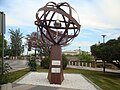 "Milla Cero" monument in Seville, from 2010.
-
 "Legua Cero" monument in Sanlúcar de Barrameda, from 2011.
-
 Monument to Elcano in Cartagena, from 2022.
-
 Monument to Elcano in Seville, from 2023.


See also
Notes
- ↑ His surname also appears written as "de Elcano", "del Cano" or "de El Cano".
- ↑ It has been speculated that Enrique of Malacca, a slave who traveled on that same expedition, may have been born in the Philippines. If so, he would have gone around the world before Elcano.
References
- ↑ 1.0 1.1 1.2 Santamaría Urtiaga 2022, p. 109The "Relación escrita…" preserved in the Archivo de Indias states: "… the said Captain Loaysa died on the thirtieth of July, fifteen hundred and twenty-six, and from there they elected Juan Sebastián as captain, who died four days later…", that is, on August 3. However, the "Relación del Viaje…" preserved in the library of the Royal Palace of Madrid says: "Monday, the 6th day of August, the magnificent lord Juan Sebastián de Elkano, the captain general and governor, died".
- ↑ 2.00 2.01 2.02 2.03 2.04 2.05 2.06 2.07 2.08 2.09 2.10 2.11 2.12 2.13 2.14 2.15 2.16 2.17 2.18 2.19 Agustín Ramón Rodríguez González (2009). "La expedición de Loaysa: una guerra en las antípodas" (PDF). V Centenario del Nacimiento de Andrés de Urdaneta. XXXVII Jornadas de Historia Marítima. Ciclo de conferencias. Enero de 2009. Cuaderno monográfico número 58 (in español). Madrid: Instituto de Historia y Cultura Naval. ISBN 978-84-9781-526-0.
{{cite journal}}: CS1 maint: periodical has ISBN (link) - ↑ 3.0 3.1 3.2 3.3 "Juan Sebastián Elcano" (in español). Real Academia de la Historia. Retrieved May 1, 2023.
Elcano, Juan Sebastián. Guetaria (Guipúzcoa), c. 1487 – Océano Pacífico, 6.VIII.1526 [...] Nació en Guetaria, pero no se ha encontrado su partida de bautismo. Un documento del Archivo de Simancas indica que tenía treinta y dos años en agosto de 1519
- ↑ 4.0 4.1 4.2 Salvador Bernabéu Albert (2019). "Juan Sebastián Elcano: la hazaña de la incertidumbre" (PDF). Andalucía en la historia (in español) (63): 22–27. ISSN 1695-1956.
la información la proporciona un documento fechado en Sevilla, el 9 de agosto de 1519, donde declaró ser "de treinta e dos años poco más o menos"
- ↑ 5.0 5.1 5.2 5.3 5.4 5.5 5.6 5.7 Santamaría Urtiaga 2022, p. 14.
- ↑ Iñigo Susaeta Córdoba (June 2009). "Juan Sebastián de Elcano, primus circundedisti me: crónica de la travesía. Marín 17 de julio - Cádiz 21 de julio 2008". Revista general de marina (in español). 256: 877–886. ISSN 0034-9569.
- ↑ 7.0 7.1 "Carta de Juan Sebastián de Elcano al emperador dándole breve relación de su viaje en la armada de Magallanes y de su regreso en la nao "Victoria"". La primera vuelta al mundo (in español). Miraguano Ediciones. Ediciones Polifemo: 9–12. 2012. ISBN 978-84-7813-389-5.
se han conservado tres copias: una en el Código Magliabechano XIII 81 c. 93; otra en el Archivo de Módena, enviada al duque de Ferrara por su embajador en España, Benedetto Fantini, el 27 de octubre de 1522; y la tercera enviada por Gaspar Contarini, representante del dux veneciano Antonio Grimani en España, fechada el 24 de septiembre de ese mismo año
{{cite journal}}: CS1 maint: periodical has ISBN (link) - ↑ "La Fundación" (in español). Elkano Fundazioa. Retrieved April 25, 2023.
- ↑ "Notable documento. El testamento de Juan Sebastián Elcano". Euskal Erria (in español). 56: 160–174. 1907.
- ↑ Jesús J. Hernández (July 6, 2019). "Getaria espera con expectación la llegada del 'Juan Sebastián Elcano'" (in español). El Correo.
- ↑ 11.0 11.1 "Elcano´s plot". Getaria Turismoa. Ayuntamiento de Guetaria. Retrieved April 25, 2023.
- ↑ 12.0 12.1 12.2 12.3 Romero Tallafigo 2020, p. 375.
- ↑ Romero Tallafigo 2020, p. 376.
- ↑ 14.0 14.1 14.2 Salvador Bernabéu Albert (2019). "Mitos y verdades sobre Elcano: hacia una nueva biografía". Congreso Internacional de Historia "Primus Circumdedisti Me". Valladolid. 20-22 de marzo de 2018 (in español): 111–124. ISBN 978-84-9091-390-1.
{{cite journal}}: CS1 maint: periodical has ISBN (link) - ↑ 15.0 15.1 Romero Tallafigo 2020, pp. 374–377.
- ↑ Romero Tallafigo 2020, p. 360.
- ↑ 17.0 17.1 Romero Tallafigo 2020, p. 368.
- ↑ Romero Tallafigo 2020, pp. 362–363.
- ↑ Santamaría Urtiaga 2022, p. 112.
- ↑ Romero Tallafigo 2020, p. 364.
- ↑ Francisco de Borja de Aguinagalde Olaizola (2019). "La Getaria de Juan Sebastián de Elcano. Una encuesta genealógica y de cartografía social (1430-1530)". Congreso Internacional de Historia "Primus Circumdedisti Me". Valladolid. 20-22 de marzo de 2018 (in español): 125–150. ISBN 978-84-9091-390-1.
{{cite journal}}: CS1 maint: periodical has ISBN (link) - ↑ Santamaría Urtiaga 2022, p. 111.
- ↑ Santamaría Urtiaga 2022, pp. 15–16.
- ↑ Santamaría Urtiaga 2022, pp. 17–18.
- ↑ Santamaría Urtiaga 2022, p. 18.
- ↑ 26.0 26.1 26.2 26.3 26.4 Enrique Martínez Ruiz (August–September 2019). "Las Capitulaciones de Valladolid. Génesis, financiación y misión de la expedición". Revista general de marina. Ejemplar dedicado a: V Centenario de la Primera Vuelta al Mundo de Magallanes y Elcano (in español). 277: 229–239. ISSN 0034-9569.
- ↑ 27.0 27.1 Santamaría Urtiaga 2022, p. 19.
- ↑ Mazón Serrano 2020, p. 36.
- ↑ 29.0 29.1 Romero Tallafigo 2020, p. 346.
- ↑ Santamaría Urtiaga 2022, p. 21.
- ↑ Santamaría Urtiaga 2022, pp. 22–23.
- ↑ Santamaría Urtiaga 2022, p. 23.
- ↑ Mazón Serrano 2020, p. 37.
- ↑ 34.0 34.1 Mazón Serrano 2020, p. 52.
- ↑ Mazón Serrano 2020, p. 41.
- ↑ Mazón Serrano 2020, p. 42.
- ↑ 37.0 37.1 Mazón Serrano 2020, p. 45.
- ↑ Colección de los viajes y descubrimientos que hicieron por mar los españoles desde fines del siglo XV: Expediciones al Maluco, viage de Magallanes y de Elcano. Volume 4: Con varios documentos inéditos concernientes á la historia de la marina castellana y de los establecimientos españoles en Indias. Martín Fernández de Navarrete. Imprenta Nacional, 1837. p. LIII.
- ↑ Fernández de Navarrete, op. cit., p. LIV. Citing the work Viage alrededor del mundo por el caballero Antonio Pigafetta, gentilhombre de Vicencia, publicado por la primera vez en italiano según el manuscrito de la Biblioteca Ambrosiana de Milán, con notas, por Carlos Amoretti, uno de los bibliotecarios y doctores del colegio Ambrosiano &c. y traducido en francés por él mismo. Printed in Paris in the year 9, in large octavo, book I, pp. 6 ff.
- ↑ Mazón Serrano 2020, pp. 45–46.
- ↑ 41.0 41.1 Mazón Serrano 2020, p. 46.
- ↑ Mazón Serrano 2020, p. 47.
- ↑ Mazón Serrano 2020, p. 50.
- ↑ 44.0 44.1 Mazón Serrano 2020, pp. 51–52.
- ↑ Mazón Serrano 2020, pp. 52–53.
- ↑ 46.0 46.1 46.2 Mazón Serrano 2020, p. 53.
- ↑ 47.0 47.1 Mazón Serrano 2020, p. 54.
- ↑ 48.0 48.1 Mazón Serrano 2020, p. 55.
- ↑ Mazón Serrano 2020, pp. 57–58.
- ↑ Mazón Serrano 2020, p. 58.
- ↑ Mazón Serrano 2020, p. 59.
- ↑ Mazón Serrano 2020, pp. 61–62.
- ↑ Mazón Serrano 2020, pp. 63–64.
- ↑ 54.0 54.1 Mazón Serrano 2020, p. 62.
- ↑ Mazón Serrano 2020, pp. 65–66.
- ↑ Mazón Serrano 2020, p. 67.
- ↑ Mazón Serrano 2020, p. 69.
- ↑ Mazón Serrano 2020, p. 70.
- ↑ Mazón Serrano 2020, pp. 70–72.
- ↑ Mazón Serrano 2020, p. 72.
- ↑ 61.0 61.1 61.2 61.3 Mazón Serrano 2020, p. 73.
- ↑ 62.0 62.1 Mazón Serrano 2020, p. 74.
- ↑ 63.0 63.1 Mazón Serrano 2020, p. 75.
- ↑ Mazón Serrano 2020, p. 76.
- ↑ 65.0 65.1 Mazón Serrano 2020, p. 78.
- ↑ Mazón Serrano 2020, p. 80.
- ↑ Mazón Serrano 2020, p. 86.
- ↑ Mazón Serrano 2020, p. 87.
- ↑ Mazón Serrano 2020, p. 88.
- ↑ Mazón Serrano 2020, pp. 89–91.
- ↑ Mazón Serrano 2020, p. 91.
- ↑ 72.0 72.1 Mazón Serrano 2020, p. 92.
- ↑ Mazón Serrano 2020, pp. 92–93.
- ↑ Mazón Serrano 2020, p. 93.
- ↑ Mazón Serrano 2020, p. 95.
- ↑ Mazón Serrano 2020, pp. 96–97.
- ↑ Mazón Serrano 2020, p. 97.
- ↑ Mazón Serrano 2020, pp. 97–98.
- ↑ Mazón Serrano 2020, pp. 98–99.
- ↑ Mazón Serrano 2020, p. 101.
- ↑ Mazón Serrano 2020, p. 102.
- ↑ Mazón Serrano 2020, pp. 102–103.
- ↑ Mazón Serrano 2020, p. 103.
- ↑ Beatriz Vitar (2020). "Gentes y sucesos en Filipinas según la Crónica de Antonio Pigafetta. Una aproximación etnohistórica". A 500 Años de la primera vuelta al mundo: una mirada histórica a la expedición Magallanes-Elcano (in español): 233–250. ISBN 978-84-472-3074-7.
{{cite journal}}: CS1 maint: periodical has ISBN (link) - ↑ Mazón Serrano 2020, pp. 103–105.
- ↑ Blas Sierra de la Calle (2019). "El Santo Niño de Cebú y la evangelización de Filipinas". Congreso Internacional de Historia "Primus Circumdedisti Me". Valladolid. 20-22 de marzo de 2018 (in español): 319–344. ISBN 978-84-9091-390-1.
{{cite journal}}: CS1 maint: periodical has ISBN (link) - ↑ Mazón Serrano 2020, p. 105.
- ↑ Mazón Serrano 2020, pp. 106–107.
- ↑ Mazón Serrano 2020, pp. 108–109.
- ↑ Mazón Serrano 2020, pp. 110–111.
- ↑ Mazón Serrano 2020, p. 114.
- ↑ Mazón Serrano 2020, p. 112.
- ↑ Mazón Serrano 2020, p. 113.
- ↑ Mazón Serrano 2020, pp. 113–115.
- ↑ Mazón Serrano 2020, p. 115"Enrique, interpreter, servant of Captain Fernando de Magallanes" AGI Patronato, 34, R. 11, folios 3v-4r.
- ↑ Mazón Serrano 2020, p. 116.
- ↑ Mazón Serrano 2020, p. 118.
- ↑ 98.0 98.1 98.2 Mazón Serrano 2020, p. 119.
- ↑ Carla Rahn Phillips (2019). "La expedición de Magallanes-Elcano". Congreso Internacional de Historia "Primus Circumdedisti Me". Valladolid. 20-22 de marzo de 2018 (in español): 151–163. ISBN 978-84-9091-390-1.
{{cite journal}}: CS1 maint: periodical has ISBN (link) - ↑ Mazón Serrano 2020, p. 120.
- ↑ 101.0 101.1 101.2 Mazón Serrano 2020, p. 121.
- ↑ 102.0 102.1 102.2 Mazón Serrano 2020, pp. 122–123.
- ↑ 103.0 103.1 Mazón Serrano 2020, p. 128.
- ↑ Mazón Serrano 2020, pp. 124–125.
- ↑ 105.0 105.1 Mazón Serrano 2020, p. 125.
- ↑ Mazón Serrano 2020, p. 127.
- ↑ Mazón Serrano 2020, p. 132.
- ↑ Mazón Serrano 2020, pp. 135 y 140.
- ↑ Mazón Serrano 2020, pp. 135–136.
- ↑ Mazón Serrano 2020, pp. 136–137.
- ↑ 111.0 111.1 Mazón Serrano 2020, p. 140.
- ↑ Mazón Serrano 2020, p. 140-141.
- ↑ Mazón Serrano 2020, pp. 141–142.
- ↑ Mazón Serrano 2020, p. 142.
- ↑ Mazón Serrano 2020, pp. 142–143.
- ↑ 116.0 116.1 Mazón Serrano 2020, p. 143.
- ↑ Mazón Serrano 2020, p. 144.
- ↑ 118.0 118.1 Mazón Serrano 2020, pp. 145–146.
- ↑ Mazón Serrano 2020, p. 147.
- ↑ "Casa Olano" (in català). Inventari del Patrimoni Arquitectònic de Catalunya. Generalidad de Cataluña. Retrieved May 3, 2023.
- ↑ 121.0 121.1 121.2 Mazón Serrano 2020, pp. 148–149.
- ↑ Mazón Serrano 2020, pp. 150–151.
- ↑ 123.0 123.1 123.2 123.3 Mazón Serrano 2020, p. 151.
- ↑ Mazón Serrano 2020, pp. 152–153.
- ↑ Mazón Serrano 2020, p. 154.
- ↑ 126.0 126.1 Mazón Serrano 2020, pp. 156–157.
- ↑ Mazón Serrano 2020, p. 185.
- ↑ 128.0 128.1 128.2 Mazón Serrano 2020, p. 189.
- ↑ 129.0 129.1 129.2 Mazón Serrano 2020, p. 187.
- ↑ Mazón Serrano 2020, p. 156.
- ↑ Mazón Serrano 2020, p. 186.
- ↑ Mazón Serrano 2020, pp. 160–61.
- ↑ 133.0 133.1 133.2 133.3 Mazón Serrano 2020, p. 188.
- ↑ 134.0 134.1 Mazón Serrano 2020, p. 190.
- ↑ Mazón Serrano 2020, pp. 190–191.
- ↑ Mazón Serrano 2020, pp. 191–192.
- ↑ Mazón Serrano 2020, p. 192.
- ↑ 138.0 138.1 Mazón Serrano 2020, p. 193.
- ↑ Mazón Serrano 2020, p. 194.
- ↑ Mazón Serrano 2020, pp. 194–195.
- ↑ Mazón Serrano 2020, p. 195.
- ↑ 142.0 142.1 Mazón Serrano 2020, p. 196.
- ↑ Mazón Serrano 2020, p. 197.
- ↑ Mazón Serrano 2020, p. 198.
- ↑ Mazón Serrano 2020, p. 199.
- ↑ Mazón Serrano 2020, p. 200.
- ↑ 147.0 147.1 147.2 Mazón Serrano 2020, p. 207.
- ↑ Mazón Serrano 2020, p. 208.
- ↑ Mazón Serrano 2020, p. 210.
- ↑ 150.0 150.1 150.2 Mazón Serrano 2020, p. 209.
- ↑ Mazón Serrano 2020, pp. 210–211.
- ↑ 152.0 152.1 Mazón Serrano 2020, p. 211.
- ↑ Juan Sebastián de Elcano, Antonio Pigafetta, Maximiliano Transilvano, Francisco Albo, Ginés de Mafra y otros (2012). La Primera Vuelta al Mundo (in español) (2nd ed.). Madrid: Miraguano Ediciones y Ediciones Polifemo. pp. 324–325.
{{cite book}}: CS1 maint: multiple names: authors list (link) - ↑ Primer viaje alrededor del globo. Antonio Pigafetta. (with a preliminary study by Prof. Nelson Martínez Díaz). Original title: Primo viaggio in torno al Globo Terracqueo (1800 edition). Ediciones Orbis, Barcelona, 1986. ISBN 84-7634-527-5. Available in an electronic version. Accessed May 28, 2011.
- ↑ Mazón Serrano 2020, p. 214-215.
- ↑ 156.0 156.1 Mazón Serrano 2020, p. 212.
- ↑ Mazón Serrano 2020, p. 213.
- ↑ 158.0 158.1 Mazón Serrano 2020, pp. 251–252.
- ↑ "Carta de Elcano a Carlos I" (in español). Archivo Histórico de Euskadi. Visor Badator. Dokuklik. Archived from the original on November 20, 2021. Retrieved May 1, 2023.
- ↑ Hermoso, Borja (September 21, 2017). "Lo que Elcano se atrevió a pedir al emperador Carlos I". EL PAÍS (in español). Retrieved September 21, 2017.
- ↑ Olaizola, Borja Aguinagalde. ""Las dos "cartas" que escribió el capitán Juan Sebastián de Elcano a su regreso", en La primera vuelta al mundo. Edición conmemorativa del V Centenario del viaje de Magallanes y Elcano, 1519-1522, Taverna Libraria, Madrid, 2019, pgs. 145-176" (in español). Retrieved 2021-11-22.
{{cite journal}}: Cite journal requires|journal=(help) - ↑ 162.0 162.1 Romero Tallafigo 2020, p. 390.
- ↑ Romero Tallafigo 2020, p. 39.
- ↑ Mazón Serrano 2020, p. 214.
- ↑ María Belén Bañas Llanos (2021). "La Extremadura, del Reino de León, en la primera circunnavegación (1519-1524)" (PDF). Carlos V y el mar: el viaje de circunnavegación de Magallanes-Elcano y la era de las especias (in español): 239–294. ISBN 978-84-121898-3-4.
{{cite journal}}: CS1 maint: periodical has ISBN (link) - ↑ Delgado Pérez 2004, pp. 76–77.
- ↑ Mazón Serrano 2020, pp. 252–253.
- ↑ 168.0 168.1 168.2 Mazón Serrano 2020, p. 253.
- ↑ 169.0 169.1 Romero Tallafigo 2020, p. 306.
- ↑ 170.0 170.1 Robarts - University of Toronto (1842). Colección de documentos inéditos papa la historia de España (in español). Madrid Impr. de J. Perales y Martínez [etc.] pp. 253–271. Retrieved 2021-11-21.
- ↑ Mazón Serrano 2020, p. 255.
- ↑ Romero Tallafigo 2020, pp. 146–148.
- ↑ Romero Tallafigo 2020, p. 150.
- ↑ Santamaría Urtiaga 2022, p. 204.
- ↑ Romero Tallafigo 2020, p. 534.
- ↑ 176.0 176.1 Romero Tallafigo 2020, p. 347.
- ↑ 177.0 177.1 Romero Tallafigo 2020, p. 357.
- ↑ Romero Tallafigo 2020, p. 345.
- ↑ Romero Tallafigo 2020, p. 352.
- ↑ Romero Tallafigo 2020, p. 356.
- ↑ Romero Tallafigo 2020, pp. 344–345.
- ↑ "Buque Escuela "Juan Sebastián de Elcano" (A-71)" (in español). Armada. Retrieved May 3, 2023.
- ↑ "Quiénes somos" (in español). Real Instituto Elcano. Retrieved April 28, 2023.
- ↑ Robarts - University of Toronto (1842). Colección de documentos inéditos papa la historia de España (in español). Madrid Impr. de J. Perales y Martínez [etc.] Retrieved 2021-11-21.
- ↑ "MONUMENTO A ELCANO". fotoszarauz (in español). Retrieved 2021-11-21.
- ↑ 186.0 186.1 "Monumento a Elcano" (in español). Euskadi. Gobierno Vasco. Retrieved May 2, 2023.
- ↑ "El navegante que ganó la gloria con el precio de su vida" (in español). Diario de Sevilla. April 25, 2021.
- ↑ 188.0 188.1 "La primera vuelta al mundo contada en placas" (in español). Diario de Sevilla. August 8, 2019.
- ↑ "MONUMENTO FUNERARIO A ELCANO" (in español). Euskadi. Gobierno Vasco. Retrieved May 2, 2023.
- ↑ "ABC MADRID 21-04-1944 página 7 - Archivo ABC". abc (in español). 2019-08-05. Retrieved 2021-11-22.
- ↑ "Microhistorias sobre la primera vuelta al mundo". primeravueltalmundo (in español). Retrieved 2021-11-22.
- ↑ "Azulejos Conmemorativos de la Primera Vuelta al Mundo" (in español). Sanlúcar y al I Vuelta al Mundo. Ayuntamiento de Sanlúcar de Barrameda. Retrieved May 3, 2023.
- ↑ "Inauguración del Monumento a Juan Sebastián Elcano" (in español). ABC de Sevilla. October 28, 1972. p. 59.
- ↑ "Monolito a la Expedición Elcano 90" (in español). ABC de Sevilla. November 18, 1992. p. 7.
- ↑ "Un monumento marca la 'milla 0' del viaje de Magallanes y Elcano" (in español). El Mundo. September 23, 2010.
- ↑ "Reloj solar Legua Cero" (in español). Fundación Puerta de América. Retrieved May 2, 2023.
- ↑ "Retablo pétreo de la Primera Vuelta al Mundo" (in español). Sanlúcar I Vuelta al Mundo. Ayuntamiento de Sanlúcar de Barrameda. Retrieved May 3, 2023.
- ↑ Santi M. Amil (January 18, 2019). "El Puerto pone una estatua a Magallanes y Elcano" (in español). La voz de Galicia.
- ↑ "Usera rinde homenaje a Elcano en el 500 aniversario de la primera circunnavegación" (in español). Ayuntamiento de Madrid. September 30, 2022.
- ↑ "El Puerto de Cartagena acoge el martes la Conmemoración del V Centenario de la llegada a España de Elcano" (in español). Europa Press. September 4, 2022.
- ↑ "La nueva escultura de Elcano se talló en el taller de Paco Parra en el Pasaje Mallol de Sevilla" (in español). Diario de Sevilla. March 21, 2023.
Bibliography
- Santamaría Urtiaga, Enrique (2022). La vuelta de Elkano. El molesto triunfo de la gente corriente (in español). Eusko Ikaskuntza. ISBN 978-84-8419-301-2.
- Romero Tallafigo, Manuel (2020). Testamento de Juan Sebastián Elcano (1526). Palabras para un autorretrato (in español). Universidad de Sevilla y Junta de Andalucía. ISBN 978-84-472-2964-2.
- Mazón Serrano, Tomás (2020). Elcano. Viaje a la historia (in español). Encuentro. ISBN 978-84-1339-203-9.
{{cite book}}: Check|isbn=value: checksum (help) - Delgado Pérez, María Mercedes (2004). Hernando Colón: decurso histórico de un hombre y su biblioteca (in español). Ayuntamiento de Sevilla. ISBN 849609829X.
External links
- List of 107 of the 234 who embarked (in Spanish).
- Painting of the landing and list of the 18 at the Centro Virtual Cervantes (in Spanish).
- MAGALLANES El hombre y su gesta Stefan Zweig (in Spanish)
- Portrait of Juan Sebastián Elcano, with an epitome of his life, included in the book Retratos de Españoles ilustres, published in 1791 (in Spanish).
- Route of the First Circumnavigation of the World on Google Maps and Earth (in Spanish)
- Cátedra Internacional CEU Elcano. Primera Vuelta al Mundo (in Spanish)
- Juan Sebastián Elcano, episode of the TVE series Paisaje con figuras (in Spanish).


