| Content from Wikipedia under the CC BY-SA 4.0 license ⇔ Maps from OpenStreetMap under the ODbL license |
Francis Xavier
Saint Francis Xavier | |
|---|---|
 Confessor, missionary, priest and religious of the Society of Jesus. Detail of a work by Guercino (1626). | |
| Apostle of the Indies | |
| Born | Francisco Jaso Azpilicueta April 7, 1506  Castle of the Jasso family, Kingdom of Navarre |
| Died | December 3, 1552 (December 3, 1552 (aged 46)) Island of Sanchón, Ming Empire |
| Venerated in | Catholic Church, Anglican Church and Lutheran Church |
| Beatified | October 25, 1619 by Paul V |
| Canonized | March 12, 1622 by Gregory XV |
| Feast | December 3 |
| Attributes | Crucifix, flaming heart |
| Patronage |
|
Tradition or genre | Society of Jesus |
| Parent(s) | Juan de Jasso and María Azpilicueta |

Francisco de Jaso y Azpilicueta, better known as Francis Xavier (Francisco Javier), or also as Francisco Xavier, Francisco de Javier or Francés de Jaso (April 7, 1506 – December 3, 1552), was a Navarrese religious and missionary of the Society of Jesus, born in the town of Javier (Kingdom of Navarre) and who died on Shangchuan Island (China). He was canonized by the Catholic Church under the name of Saint Francis Xavier.[1]
As for the forms of his name that he used, he appears as Francisco de Jasso in the lease he made in Burguete on behalf of his mother, and as Francisco de Jasso y de Xabier in his proof of nobility; but as a Jesuit he did not use his paternal surname. He signed his letters as Francisco de Xabier, or rather, simply as Francisco, with the exception of the Francés de Xabier in the letter that Ignatius of Loyola personally delivered to his brother Juan de Azpilicueta in 1535.
Francis Xavier was a Jesuit missionary of the first rank, a member of the founding group of the Society of Jesus and a close collaborator of its founder, Ignatius of Loyola. He stood out for his missions, which took place in East Asia and in Japan. He received the nickname Apostle of the Indies.
Historical circumstances of his birth
Born as Francisco Jasso Azpilicueta Atondo y Aznárez, Lord of Javier, better known as Francis Xavier, he was born in 1506 in the Castle of Javier, in the Kingdom of Navarre. His father, Juan de Jasso, Lord of Javier, was President of the Royal Council of the Monarchs of Navarre Juan de Albret and Catalina de Foix.
Six years later, in 1512, on the occasion of the pact of the Kingdom of Navarre with France, the conquest of Navarre began by Castilian-Aragonese troops under the command of Fadrique Álvarez de Toledo, Duke of Alba, by order of Ferdinand the Catholic, already King of Aragon and Castile. A large part of the strongholds of the Kingdom of Navarre were occupied, with the support of the descendants of the Beaumontese nobleman Luis de Beaumont, exiled in Castile, the so-called Beaumontese, who had confronted the Agramontese in a long civil conflict that had ended at the beginning of the 16th century. After the partial invasion of the Kingdom of Navarre by the Castilian-Aragonese troops, with a strong Gipuzkoan presence, there were several counteroffensives by those loyal to the Albrets, in this case with strong French support, struggles that lasted until 1530.
In 1516, his father having died in exile a year earlier, Francisco's brothers took part in an unsuccessful offensive with the pro-French King of Navarre Juan de Albret, as a result of which Francisco's family was dispossessed of its properties, and the castle was razed by order of the Governor, Cardinal Cisneros.
In 1521, a French invasion that would penetrate as far as Castile allowed those loyal to Juan de Albret to briefly regain almost total control of the Kingdom, although it lasted only a short time, and they lost the part south of the Pyrenees, Upper Navarre, in 1524 (with the fall of the Navarrese stronghold of Fuenterrabía), while Lower Navarre, north of the Pyrenees, would remain loyal to Juan de Albret within the French orbit.
In 1530, with Charles I as King of Spain, he abandoned his aspirations to occupy the rest of the Kingdom of Navarre, which would remain a semi-independent kingdom and finally, through marriage ties, would be united with the French Crown under the title of Kings of France and Navarre. The part of Upper Navarre south of the Pyrenees, with which the Crown of Spain was completed (the term understood according to current usage, that is, without including Portugal), would retain its institutions, privileges and designation as a Kingdom until the 19th century, when it was transformed into a chartered province. The part that remained in France, Lower Navarre, would retain its status as a Kingdom until the abolition of the privileges of the territories of the French monarchy, after the French Revolution at the end of the 18th century.
Francisco had embraced the ecclesiastical career and went in 1528 to Paris, to the University of the Sorbonne, where he met Ignatius of Loyola, with whom he would later found the Society of Jesus. Although at first he felt no sympathy for Ignatius of Loyola, he ended up being his best friend and collaborator. Indeed, it so happened that in 1521, before beginning his ecclesiastical vocation, Saint Ignatius, at that time Íñigo de Loyola, had fought with the imperial Gipuzkoan troops against the French troops of the Duke of Foix (who supported Juan de Albret), among whom, together with other Navarrese, the brothers of Saint Francis Xavier were fighting, Ignatius being wounded in the siege of Pamplona.
Biography
Francis Xavier was born in the Castle of Javier, located in what is today the town of Javier, Navarre, northern Spain, on April 7, 1506, into a noble family. His father, Juan de Jasso, was President of the Royal Council of the King of Navarre Juan III de Albret. His mother was María de Azpilicueta, who belonged to a noble family that included Martín de Azpilicueta, the so-called doctor navarrus. He was the youngest of five siblings: Magdalena, Ana, Miguel, Juan and himself.
His childhood was marked by the historical events that led to the conquest of the Kingdom of Navarre by the Kingdom of Castile, given that his family was deeply involved in the defense of the independence of the former. His birthplace was a meeting place for the supporters of the Albrets and suffered retaliation for the defeat. His brothers, members of the army of Juan III, were imprisoned by that army. These circumstances may have been the cause of Francisco's resolve toward religious study.
Studies in Paris
In 1524 Francis Xavier had made the decision to go to study in Paris, at the Sorbonne. Before that he had studied in various Navarrese cities, completing his studies in Pamplona.
In September 1528 he went to study in Paris, where he met the man who would be his best friend, Íñigo de Loyola, later Saint Ignatius of Loyola, who never left him alone in difficult moments in Paris and always helped him, for example, when Francisco suffered financial problems.
It was there that, with five other companions, what would be the embryo of the Society of Jesus was formed. On August 15, 1534, having finished their studies, they swore vows of charity and chastity, while at the same time promising to travel to the Holy Land, in the Crypt of the Martyrdom of Montmartre. Francisco remained in Paris another two years studying Theology, after taking part in the Spiritual Exercises together with Ignatius of Loyola.
In 1537 he joined Ignatius of Loyola to travel to Italy. In Rome they visited Pope Paul III to ask for his blessing before undertaking the journey to the Holy Land, a journey that could not be carried out because Venice had gone to war with Turkey. They arrived in Venice and he was ordained a priest on June 24. During his stay in Venice, while waiting for the ship to go to the Holy Land, he devoted himself, together with his companions, to preaching in the surrounding area. Given the delay of the journey, they returned to Rome and offered themselves to the Pope to be sent anywhere else. From there he left for Lisbon in 1540, where the most important stage of his life would begin: that of missionary. The journey to Portugal was due to the request of the Portuguese ambassador in Rome, Pedro de Mascarenhas, who asked Ignatius of Loyola, on behalf of John III of Portugal, for some of his men to send to the East Indies. For that journey Francisco was named by the Pope his legate in the lands of the Red Sea, the Persian Gulf and Oceania, on either side of the Ganges.
His missionary journeys
The journey to Lisbon was overland, and he stopped in Azpeitia (Gipuzkoa) to deliver letters from Ignatius of Loyola to his family. They stayed in Lisbon for a time, until Francisco was designated to be the one sent to the Indies. During that time they did not stop preaching the gospel to the poor of the city.
On April 7, 1541, the day he turned 35, the expedition set out, and it arrived on September 22 in Mozambique. He stayed there until February of the following year. During that stay he helped in the hospital and perceived the reality of the treatment given to Black people, which led him to have his first confrontations.
After making stops at Melinde and Socotora, he arrived at Goa (a city that would later be the capital of Portuguese India) on May 6, 1542. He prepared an instructional text based on the catechism of Juan Barros and began to preach Catholic doctrine throughout the city, while at the same time attending the dying, visiting prisoners and helping the poor.
To achieve a closer rapport, he devoted himself to learning the language of the country. After turning down the post of director of the seminary of Saint Paul, he set sail, in October 1542, for the Fishery islands, where he remained for more than a year.

He evangelized the Parava Indians and traveled through the cities of Tuticorin, Trichendur, Manapar and Combuture. He encountered the opposition of the Brahmins, who lived in the pagodas of the region.
He learned Tamil and translated into that language part of the Christian texts and a talk on heaven and hell.
In November 1543 he met his companions Micer Paulo and Mansilla in Goa and had an interview with the Bishop of the city, Juan de Alburquerque, to ask him for missionaries. The Bishop assigned 6 priests to that work. With the new collaborators he returned once again to the Fishery Coast. During the journey he wrote several letters to his companions in Rome; in one of them he says:
many Christians fail to be made in these parts, for lack of people to occupy themselves with evangelization. Many times I am moved by thoughts of going to those Universities, crying out like a man who has lost his mind, and principally to the University of Paris, saying in the Sorbonne to those who have more learning than will to dispose themselves to bear fruit with it: how many souls fail to go to glory and go to hell through their negligence! So great is the multitude of those who are converted to the faith of Christ in these parts, in this land where I go about, that many times it seems to me that my arms are tired from baptizing, and that I cannot speak from having said so many times the Creed and the commandments in their language and the other prayers.
On the Pearl Fishery Coast he established a system of assigning territories to a person in charge, who was to keep him informed of the progress of the mission. Once he had organized that territory, he left for Manapar and the southern district. He remained for a month with the Makuas, baptizing more than 10,000 people.
During 1544 he made more than twenty evangelizing journeys. Upon news of the execution of Christians in Ceylon, Francisco returned to Goa and spoke with the governor, in order to accompany the troops that were to be sent to punish the actions that the King of Jaffnapatam had carried out against the Christians. For various reasons that action was never carried out.
In 1545 he left for the Moluccas in the company of Juan Eiro, arriving at Malacca shortly afterward. Over three months Francis Xavier learned a minimum of the language and became familiar with the local culture; he also translated, with the help of knowledgeable people, the basic part of the texts of Catholic doctrine. That same year he wrote to the King of Portugal about the injustices and abuses imposed on them by Your Majesty's own officials.

He set out for the Islands of Amborio and Ternate in January 1546, after preparing the Instructions for the Catechists of the Society of Jesus. He reached his destination after a month and a half. He traveled through various islands of the region, and in Baranula (Ceram), according to tradition, a crab returned to him the crucifix he had lost during a storm.
In June he arrived at Ternate, a rich commercial center for spices and the last Portuguese possession, remaining there for three months. From there he went to the islands of the Moro, where he spent another three months. From the islands of the Moro he undertook the return journey to Cochin, where he would arrive on January 13, 1548.
After carrying out work of reorganization and supervision of the missions established in India and the Moluccas, where he felt disappointed by the deterioration they had suffered, as shown in his letters, he left for Japan, together with his companions Cosme de Torres and Juan Fernández and the translator Anjirō, on Palm Sunday of 1549, arriving on Japanese soil on August 15. They landed at Kagoshima, then capital of the Southern Kingdom of Japan. He remained in this city for a year and in Japanese lands for two years and three months. In collaboration with his companion Pablo de Santa Fe he evangelized in Japanese lands and had the work Declaration of the Articles of the Faith translated, which he learned by heart and used to recite on street corners. To answer the questions that passersby asked, he made use of an interpreter. Given the failure of the mission, he thought of meeting with the King of the area in the hope that if he converted to Catholicism, the people would also do so. In 1550 he headed north with this intention. He founded a small Christian community in Hirado. He reached Yamaguchi, then Sakai and, finally, Meaco, where he tried, without success, to be received by the Emperor.
He moved to Yamaguchi again and obtained from the Prince a guarantee of respect for converts to Christianity. With that prospect he carried out, together with his two companions, an intense work of preaching that bore fruit in the creation of a small Catholic community. Many of the converts were samurai. The opposition of the local clergy, the bonzes, was always strong.

In September 1551 he was summoned by the Prince of Bungo, who allowed him to preach in those islands. A month later, leaving some converts behind, Francis Xavier returned to India, alerted by the news that reached him. The return journey was made on the carrack Santa Cruz, captained by Diego de Pereira, who gave him the idea of organizing an embassy to China on behalf of the King of Portugal to open peace negotiations. When he arrived in Malacca he learned that India had been made a Jesuit province independent of Portugal and that he was its provincial.
On January 24, 1552 he arrived at Cochin and on February 18 at Goa. After resolving some problems of the missions and preparing the journey to China, he set out for that country on April 14. Accompanying him on the venture were the priest Gago, Brother Álvaro de Ferreira, Antonio de Santa Fe (who was of Chinese origin) and an Indian servant named Cristóbal, and they embarked on the Santa Cruz captained by Pereira.
When they arrived in Malacca they had problems with the Captain of the Seas, Álvaro de Ataide, who delayed the journey by two months and prevented Pereira from remaining in command of the ship. They reached Shangchuan Island at the end of August 1552, moved, it seems, by the assertions of the Japanese, who valued nothing that had not taken root earlier in China, and with the idea of evangelizing in China so that this would later influence Japan. This island was the meeting place between Chinese and Portuguese merchants.
They remained awaiting the arrival of a Chinese ship that was to bring them, clandestinely, onto the mainland. On December 3 of that year Francis Xavier died, at the age of 46.
His body was taken to Goa, where it arrived in the spring of 1554, and was buried in that city.
Canonization, patronage and feast days
He was canonized by Pope Gregory XV in 1622 together with Saint Ignatius of Loyola, Saint Teresa of Jesus, Saint Isidore the Laborer and Saint Philip Neri.
He has been named patron saint of various places and works:
- In 1748 he was named patron of all lands east of the Cape of Good Hope.
- In 1904 he was named patron of the Work of the Propagation of the Faith.
- In 1927 Pope Pius XI named him Patron of the Missions together with Saint Thérèse of the Child Jesus.
- In 1952 Pope Pius XII proclaimed him patron of tourism.
- He is also patron of the Rover branch within the Catholic Scout Movement.
He is co-patron of Navarre together with Saint Fermin of Amiens[2] and Santa María la Real. His feast day is celebrated on December 3, coinciding with the day of his death. In 1949, the Society of Basque Studies also chose December 3 to celebrate the international day of the Basque language. Every year, in the first days of March, a massive pilgrimage in his memory is held to the Castle of Javier, known as the javieradas.
Iconography and works
Many works have depicted the Apostle of the Indies in painting and sculpture. Celebrated artists, such as Murillo, Rubens, Van Dyck, Luca Giordano, André Reinoso and Goya, have immortalized the Saint of Javier with their brushes.
From the 16th century onward, Francis Xavier became an ideal to follow as a missionary in pagan lands. This has given rise to a very abundant body of works dealing with his figure. Works of all kinds, especially epistolary, since he was considered an example to be followed by the members of the Society of Jesus. It was Xavier who created the first seminary in Goa and who promoted vocations to the priesthood among the natives, while at the same time proposing direct catechization and the translation of liturgical texts into local languages.
The written work of Francis Xavier centers on the correspondence he maintained with his companions and those responsible for evangelization. There are also known short catechetical writings, such as the small catechism (1542), the great catechism (1546) and the Instructions for the Catechists of the Society of Jesus (1545).
Paintings in the church of Saint-Sulpice in Paris, France.
-
 "Miracle of Saint Francis Xavier, raising of a dead man in Coulan (India)".
-
 "Translation of the body of Saint Francis Xavier to Goa (Portuguese India), miracles take place along its way".
-
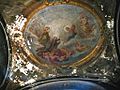 Ceiling of the chapel of Saint Francis Xavier.


Eponymous institutions
- Religious buildings dedicated to Francis Xavier:
- Church of Saint Francis Xavier,
 disambiguation
- Church of Saint Francis Xavier,
- Pontifical Xavierian University
- Colegio San Francisco Javier
- Royal and Pontifical Major University of Saint Francis Xavier of Chuquisaca (founded in 1624)
- Xavier University
- Pious Society of Saint Francis Xavier for Foreign Missions Xaverian Missionaries
- Parish of San Francisco Javier de Lezama, Guárico - Venezuela. Founded in 1717.
- Xaverian Institution

See also
- El divino impaciente, a play by José María Pemán dealing with part of the life of the saint.
Bibliography
- Fernández Gracia, Ricardo (2006). Gobierno de Navarra. Departamento de Cultura y Turismo (ed.). San Francisco Javier Patrono de Navarra: fiesta, religiosidad e iconografía (in español). Pamplona: Institución Príncipe de Viana. p. 312. ISBN 9788423528981.
- Añoveros Trías de Bes, Xabier (2006). "La vida de un santo contada a través de los siglos". In Gobierno de Navarra (ed.). San Francisco Javier en las artes (in español). Pamplona: Fundación Caja Navarra. pp. 50–73. ISBN 84-96506-11-8.
References
- ↑ http://www.santopedia.com/santos/san-francisco-javier/ San Francisco Javier
- ↑ Molins Mugueta, José Luis (2006). "Copatrono del Reino de Navarra". In Gobierno de Navarra (ed.). San Francisco Javier en las artes (in español). Pamplona: Fundación Caja Navarra. pp. 323–345. ISBN 84-96506-11-8.
External links

- Enciclopedia Auñamendi. Publisher, Auñamendi. 1986 edition. ISBN 84-7025-223-2
- Biography of Saint Francis Xavier in the Catholic Saints' Calendar of www.divinavoluntad.net (in Spanish)
- www.sanfranciscojavier.com (in Spanish)
- La huella universal de Francisco de Javier (Exposición itinerante) (in Spanish)
- Vida y mundo de San Francisco Javier (in Spanish)
- «La Javierada» (in Spanish)
- Toda su vida (in Spanish)
- Vocaciones Jesuitas (in Spanish)
- Devocionario católico "San Francisco Javier" (in Spanish)
- Institución Javeriana (in Spanish)
- Francisco de las Indias Journalistic chronicle on the veneration of his relics in the City of Panjim, Goa (India), published in the Uruguayan weekly Brecha. (in Spanish)


