| Content from Wikipedia under the CC BY-SA 4.0 license ⇔ Maps from OpenStreetMap under the ODbL license |
Real de a ocho
| Real de a ocho | |
|---|---|
| Peso duro or peso fuerte | |
 | |
| Countries | Catholic Monarchy |
| Subdivision | 8 reales = 272 maravedís. 1 real de a ocho = 1 duro. 2 reales de a 8 = 1 escudo |
| Coins | ½, 1, 2, 4, 8, 16 maravedís ¼, ½, 1, 2, 4 reales 1 real de a ocho 1, 2, 4, and 8 escudos |
| Exchange rate | 1 real de a ocho = 5 ESP |
| Replaced by | Peseta (1869) |
The real de a 8, peso de ocho, peso fuerte or peso duro, known in the English-speaking world as the Spanish dollar (in English: piece of eight) or Carolus,[1] is a silver coin worth eight reales minted by the Catholic Monarchy after the monetary reform of 1497 that established the Spanish real. Thanks to its widespread use in the late 18th century in Europe, all of America and the Far East, it became the first currency in worldwide use. It was the first legal tender in the United States until an 1857 law withdrew its authorization. Many current currencies took their respective names from the real de a 8, such as the dollar, the yuan or the peso.[2]
Today the term "peso" is still sometimes used to refer to the historical real de a 8. This is because pesos had a weight and diameter similar to the real de a 8. However, the term "peso" does not appear in the Spanish monetary system until 1864, and it is more accurate to refer to the real de a 8 within the earlier monetary system.
In the English-speaking world in general, and in the United States in particular, the real de a 8 was known as the Spanish dollar, pieces of eight or eight real coin. There are various theories holding that the dollar symbol "$" originates in the bands and Pillars of Hercules of the Spanish coat of arms that appears on the reverse of the real de a 8. The Mexico City Mint stamped on the ingots and coins transported in the Fleets of the Indies bound for the Royal Treasury a shield composed of two vertical bars representing the Pillars of Hercules (in reference to the Strait of Gibraltar), originally intertwined by a band bearing the motto "Non Plus Ultra".
Origin
The first 8-real coins were instituted in the Crown of Castile by the monetary reform of 1497, carried out by the Catholic Monarchs.

After the conquest of Mexico and Peru, reales de a 8 were minted in America under the denomination of Spanish real and were shipped in bulk to Spain, making this transport a tempting target for pirates and privateers at sea.
Moreover, their use also spread throughout Southeast Asia, since the Manila galleon periodically carried silver in coins from Mexico to Manila, in the Philippines, where it was to be exchanged for Chinese and Philippine goods, as silver was the only foreign commodity that China accepted as payment. In the Eastern trade, Spanish reales de a 8 were often stamped with Chinese characters indicating that they were genuine coins.
Owing to the enormous silver deposits discovered mainly in Potosí, in present-day Bolivia, and to a lesser extent in Mexico (for example in Taxco and Zacatecas), the mints of Bolivia, Mexico and Peru began minting coins from the 16th century, so that millions of reales de a 8 were minted during the several centuries of Spanish presence.
Peak and spread

Although the Monarchy prevented free trade between its territories and the rest of the world, smuggling of various products became common from the 17th century between Spanish territories and ships from Great Britain and Holland; this allowed the coins minted at the mints of the Hispanic Monarchy to circulate in places outside Spanish jurisdiction. The British Thirteen Colonies in North America soon came to use reales de a 8 because of the fineness of their silver content and their relative abundance on the market, greater than the coinage of their own mother country.
Spanish trade with China, using the Philippines as a base, also caused the real de a 8 to spread in Southeast Asia. At a time when the value of a coin was determined by its intrinsic content of silver or gold, the fineness of the real de a 8 made this piece unofficially become the medium of exchange for the international trade carried on in East Asia. The arrival of American merchants in China at the end of the 18th century further boosted the use of the Spanish dollar, as the real de a 8 was called in English.
The real de a 8 thus became the most widely circulated currency during the colonial period in America, and because of its high intrinsic value as well as its fineness, it continued to be used in North America and in Southeast Asia until the 19th century. When these silver coins reached Europe, they were compared with the large silver coins minted by Austria: the thaler (rendered in Spanish as tálero). Despite its fame in Europe, the Austrian thaler did not have the worldwide circulation of the real de a 8, but its name in French and in English (thaller and daller) led to the real de a 8 being called the Spanish daller in the United States, from which the name Spanish dollar later derived, later shortened simply to dollar.

A United States law of 1792 on the monetary system created the United States Mint, although the first United States dollars were not as popular as the Spanish dollars, since the latter were heavier and made of finer silver. A real de a 8 had a nominal weight of 550.209 Spanish grains, which are 27.468 grams in the metric system; with a purity of 93.055%, this meant that the real de a 8 contained 25.560 grams of silver, although its weight and purity varied significantly among the different mints over the centuries. By contrast, the aforementioned United States law of 1792 specified that the U.S. dollar would weigh 27 grams, of which only 24.1 grams were silver.
Reales de a 8 had a face value of 8 reales in Spain and its colonies, but the need for fractional currency often caused the pieces to be physically cut into four or eight pieces to obtain smaller change. Outside the Spanish universal monarchy it was very difficult to obtain Spanish silver coins in denominations smaller than the real de a 8, so physically dividing the coin was the only way to obtain fractions and later countermark them for use,[3] something that also happened during the wars of independence of the Spanish colonies when the pieces fell into the hands of the insurgents.[4][5]
The Spanish coin was legal tender in the United States until its use was prohibited in 1857, and while it circulated in the U.S. the real de a 8 had the value of one dollar. As a curiosity, it is worth noting, for example, that the pricing of shares on the United States stock market in eighths of a dollar lasted until June 24, 1997, when the New York Stock Exchange converted that denomination to sixteenths of a dollar, although shortly afterward it switched to decimal notation.
Monetary conversions
There were several pieces of the original real de a ocho to facilitate exchanges. There was the real coin, as well as coins of two reales, four reales and eight reales de a ocho.
There were gold and silver reales, the value ratio between the two metals being:
1 of gold to 16 of silver. At the time the real de a ocho was created, the real already existed, a coin so named because it was issued by the King and not by a feudal lord, bishop or merchant.
The real was worth 34 maravedís. A silver real de a ocho was worth 8 × 34 = 272 maravedís, a gold escudo was worth 16 × 34 = 544 maravedís (or 16 reales), and a gold doubloon was worth 2 escudos: 16 × 34 × 2 = 1088 maravedís (or 32 reales).
Gallery of countermarks
-
 8 reales of Charles IV from 1796 with a countermark of Sudan.
-
 Obverse of an 8-real coin (silver) of Charles III from 1780 with a countermark of Ceylon.
-
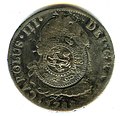 Obverse of an 8-real coin (silver) of Charles III with a countermark of Burma.
-
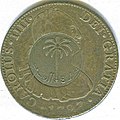 Obverse of an 8-real coin (silver) of Charles IV from 1797 with a countermark of Saudi Arabia.
-
 Obverse of an 8-real coin (silver) of Charles IV from 1804 with a countermark of Thailand.
-
 Obverse of an 8-real coin (silver) of Charles IV from 1808 with a countermark of Zanzibar.
-
 Obverse of an 8-real coin (silver) of Ferdinand VII from 1821 with a countermark of Bahrain.


See also
- Spanish real
- Spanish dollar
- Columnario
- Mexican peso
- Potosí (coin)
- Doubloon
- Trade dollar
- Silver and Gold of Potosí
- Casa de la Moneda de Bolivia
- Debasement
- List of coins minted in the Viceroyalty of New Spain
- REAL8 (Cryptocurrency)
References
- ↑ "'Carolus' el dólar español que dominó las finanzas internacionales en el XVIII". ELMUNDO (in español). October 2, 2015. Retrieved August 1, 2020.
- ↑ "¿Cuál es la diferencia entre el Yuan y Renminbi chino?". Oro y Finanzas (in español). June 28, 2015.
- ↑ David C. Harper, 2009 North American Coins & Prices, Krause Publications, ISSN 1935-0562, ISBN 978-0896897052, pages 419–420.
- ↑ David C. Harper, 2009 North American Coins & Prices, Krause Publications, 2009, ISSN 1935-0562, ISBN 978-0896897052, pages 468, 471.
- ↑ Catálogo de monedas de México 1536-2009, Editorial A.G.R., page 20.
External links

- Historia del Real de a ocho (in Spanish).
- Information on Columnarios.
- The Colonial Coinage of Spanish America: an introduction by Daniel Frank Sedwick.
- "Las marcas utilizadas en la ceca de Potosí", article by José A. Fuertes (in Spanish).
- Dólares antiguos con imágenes de monedas españolas — Reales de a ocho (in Spanish).


