| Content from Wikipedia under the CC BY-SA 4.0 license ⇔ Maps from OpenStreetMap under the ODbL license |
Canarian Aborigines
 | |
| Population | At the time of the conquest there are estimated to have been around 160,000 Aborigines in the whole of the Canary Islands. |
|---|---|
| Settlements | Extinct |
| Language | Berber languages of the Canary Islands |
| Religion | Animism (Guanche mythology) |
| Related ethnic groups | Berbers |
Canarian Aborigines is a term applied generically to the various peoples of Berber origin who inhabited the Canary Islands before the conquest and colonization by the Castilian Crown, which took place between 1402 and 1496.
They are described as "aborigines" although it is believed that they must have come from North Africa. They are also known as the ancient Canarians, and most commonly as Guanches, even though the term originally referred only to the inhabitants of Berber ethnicity on the island of Tenerife.[1][2] Another name of minority usage is Indigenous Canarians.[3]
It is believed that the Guanches of the Canary Islands were the only people to reach the Macaronesian region before the Europeans, since in the Azores, Cape Verde, Madeira and the Savage Islands no culture has been found prior to the arrival of the Europeans in these archipelagos.
Specific terms for the Canarian Aborigines of each island
Various sources maintain that the aboriginal inhabitants of each island used specific autonyms.[1][4] However, Dr. José Farrujia asserts that these terms are modern or "idioms" without historical character.[citation needed]
- El Hierro - Bimbaches or bimbapes.
- La Palma - Benahoaritas or auaritas.
- La Gomera - Gomeritas or Gomeros.
- Tenerife - Guanches.
- Gran Canaria - Canarios.
- Fuerteventura and Lanzarote - Majos.
Origin of the ancient population of the Canary Islands
According to the most widely accepted theories, the first Canarian Aborigines must have arrived from North Africa between the 5th century BC and the beginning of the Christian era. Recent archaeological finds suggest that the first settlement may have taken place much earlier, in the 10th century BC.[5] In Tenerife, specifically, the Archaeological Zone of the Cueva de los Guanches in Icod de los Vinos has provided the oldest chronologies in the Canary Islands, with datings around the 6th century BC.[6]
The circumstances in which this arrival took place are unknown for the moment, although it has been theorized that the arrival may have been motivated by the expansion of other civilizations, such as the Phoenician - Punic or the Latin, in the area of the present-day Maghreb; they may have been North African tribes rebelling against the Roman occupation, or else populations transferred to the islands to trade with them. Nor can it be ruled out for now that these populations reached the Canary Islands by their own means, although this might seem contradictory with the insular isolation and the lack of knowledge of navigation that the Europeans apparently found at the time of the conquest. In any case, for almost two thousand years, the so-called Canarian Aborigines populated the islands and sought to adapt to their environmental particularities, thereby creating their own cultural and adaptive forms, as well as associating their religious, social, political and economic universe with the geographical and natural reality of the islands. This distinct evolution, which would end up defining seven island cultures clearly differentiated from one another (one per island), continued until the Conquest of the Canary Islands took place, begun in Lanzarote in 1402 and completed in Tenerife in 1496, on the initiative of the Crown of Castile.[7]
At present, the hypothesis of the Berber origin of the first inhabitants of the Canary Islands appears to be fully accepted. This theory has been reinforced by evidence in material culture, which links the Canarian Aborigines with the native North African cultures, as well as by their magical-religious universe, related to the religiosity of the ancient Amazigh. From a genetic point of view, 55% of aboriginal maternal lineages have their closest counterparts in the Maghreb. However, these do not include haplogroup U6b1, so the precise origin of the first settlers still raises certain doubts.[8] Further evidence of the Berber origin of the Canarian Aborigines are the remains of writing, catalogued as Libyco-Berber (as in Garafía or El Julan), identical to others found in Libya or Algeria. Likewise, the words recorded by the conquistadors, the toponymy and the numbering system show a clear kinship of the language of the Canarian Aborigines with the Berber languages (see the Zanata Stone, one of the most important pieces of Canarian and North African protohistory). For Guanche proper (the language of Tenerife), some further numerals are known: 11 benirmarago, 12 linirmarago, 13 amieratmarago, 14 acodatmarago, 15 simusatmarago. The forms in -t are feminine forms, which are the ordinary forms used for counting (the masculine ones would be used as determiners of masculine nouns).
On the basis of their physical characteristics, the Canarian Aborigines have been classified into two racial subgroups: the Cro-Magnoids, with a broader and more robust face and shorter stature, and the Mediterranoids, with a finer and straighter face and greater body height.
The colonization of the islands by North Africans probably occurred in several migrations, to which the desertification of the Sahara and the pressure of the Phoenician and Roman settlements in North Africa contributed. They imported domestic animals (goats, sheep, pigs and dogs), which completely changed the fragile ecology of the islands, and introduced wheat, peas and barley.
It is known that the arrival of the Aborigines in the archipelago caused the extinction of some large island reptiles and mammals, such as the giant lizard Gallotia goliath (which could reach up to a meter or more), Canariomys bravoi (the Tenerife giant rat) and Canariomys tamarani (the Gran Canaria giant rat), among others.
Aboriginal place names

Many of the aboriginal place names can be interpreted on the basis of continental Berber. Usually, in Berber, masculine nouns and adjectives begin with a- (sometimes i- or u-), while feminine nouns begin with t- [citation needed]:
- El Hierro: Eceró or Heró (*Ezarūh, 'rocky wall')[9]
- La Palma: Benahoare (*Wen-ahūwwār, 'place of the ancestor (Ahuwwara)')[10]
- La Gomera: Ghomara (*Qumār/Ghumār, 'notable, chief')[11]
- Tenerife: Achinech, Achineche or Chineche (*Ašenšen/Ašinišen, 'resonance, rumbling')[12]
- Gran Canaria: Tamarán or Canaria (*Tamāran, 'great, valiant')[13]
- Fuerteventura: Maxorata or Erbania (*Mahār-at, 'the children of the country')[14]
- Lanzarote: Tyterogaka or Titeroygatra (*Titerôqqak, 'one all yellow')[15]


Organization and material culture
Social structure
Canarian aboriginal society was patriarchal and matrilineal, and was divided into strata defined by wealth, especially in heads of livestock. Each island was divided into territories whose king was the guanarteme (Gran Canaria) or mencey (Tenerife). The class system was also different on each of the islands, and has only been clearly identified for the cases of Gran Canaria and Tenerife, where it can be summarized with the categories of nobles (there being several categories within this one) and commoners. Purity of blood among high-ranking nobles was absolute, and to become mencey one had to demonstrate such purity. For the specific case of Tenerife, according to Juan Núñez de la Peña, three social groups were distinguished:
- Achimencey > *ašimenzey, 'successor of the mencey' - noble, hidalgo
- Cichiciquitzo > *šičizikkičo, 'opulent quality' - soldier servant
- Achicaxna > *ašikkasnay, 'shorn, humble quality' - villein
Note that the terms by which the different categories are identified are similar to those existing in Europe in the Late Middle Ages. This is because the chroniclers extrapolated the terminology of the social organization of medieval Europe to the island case.
The Guanarteme or Mencey possibly owned most of the livestock. The possibility has also been raised that the mencey also owned the quarries for extracting raw material for lithic production.
To maintain this hierarchy, dependent on the service of others, the Guanches taught their children through stories that explained the reason for social inequalities, which were held to be of divine origin. From what has been recovered, it is said that the story was that God created individuals to whom He provided the necessary livestock, but after deciding to create more people, He saw that these lacked livestock. Therefore, when the new individuals asked God for it, He told them "Serve the others and they will give you food."[16] From this would come the villein.
Justice was administered in the public square ('tagoror' in Tenerife, 'sabor' in Gran Canaria) by a group of notables, and according to the first visitors to the islands it was extremely harsh.
Evidence of female infanticide and polyandry has been found on several islands. This has been interpreted as a cultural adaptation to the scarcity of resources in the form of population control. Their cultural structure was very similar to that of other ancient peoples who remained isolated for centuries, such as the Māori of New Zealand or the Aboriginal Australians in Australia.
Technological and cultural development


According to the classic historical classification, which takes the technological development of peoples as its reference, the Canarian Aborigines have been defined as Neolithic peoples ("new stone," or polished stone). However, this cultural horizon is determined by the circumstances of the natural environment that the first settlers of the Canary Islands found on their arrival in the islands, since, among other things, the islands lack metals owing to their volcanic origin. Despite this, the aboriginal peoples are characterized by an advanced cultural development, corresponding to a protohistoric cultural horizon. They were peoples with cultural traits characteristic of the North African Berber sphere, probably influenced by the Phoenician - Punic and even Latin cultures, given the contact of these civilizations with the natives of North Africa at the time of Phoenician and Roman expansion.
There is also evidence of the existence of rock engravings featuring alphabetiform signs that have been identified as traits of Libyco-Berber writing, as well as another form of writing that is difficult to classify and has been called "Libyco-Canarian." In any case, this archaeological evidence presents us with peoples who knew writing, so that despite their poor technological development, determined by the scarcity of raw materials, they had an advanced cultural development, surely imported from North Africa.
The indigenous societies of the archipelago oriented and aligned some sanctuaries and observation points, places of worship, temples and even necropolises astronomically. The relationship between the rising and setting of the Sun, the Moon and some planets and stars and elements of the islands' landscape and their orographic profile over the ocean allowed them to establish calendars and to organize food-producing activities, social practices and their beliefs. Examples include the complex of El Julan on El Hierro, the rock art station of Masca on Tenerife, the almogaren of Bentayga, the great tumulus of La Guancha, Cuatro Puertas and Artenara on Gran Canaria, the site of La Fortaleza, Alto de Garajonay and the Toscas del Guirre on La Gomera, the Lomo de las Lajitas on La Palma and Tindaya on Fuerteventura.[17]
Unlike most ancient cultures that arose in the setting of isolated oceanic islands, such as the South Pacific, no archaeological or documentary evidence of the existence of seagoing vessels or knowledge of navigation has been found in the Canary Islands. The chronicles of the first Europeans to arrive in the Canary Islands record the fact that the Guanches had completely lost their knowledge of navigation, so that the various islands remained isolated from one another for centuries, developing different cultural ways.
Nevertheless, a source by the military engineer Leonardo Torriani tells us that on occasion the natives of Gran Canaria built boats to fish or to commit pillage on other islands:
...they made boats from the dragon tree, which they hollowed out whole, and then they put stone ballast in it, and they sailed with oars and with a palm sail around the coasts of the island; and they also had the custom of crossing to Tenerife and to Fuerteventura and robbing [Torriani (1590) 1978: 113].
Habitat
The Canarian Aborigines lived mainly in natural caves or in volcanic tubes, although there were also stone shelters, huts and villages on the surface, with notable differences in the type of habitat depending on the island. Thus, for example, on Lanzarote the dwellings, which formed villages, were generally built of dry stone and roofed with a false vault, following a construction scheme similar to that of the "casas hondas" ("deep houses") documented in the area of the Middle Atlas. Meanwhile, on Gran Canaria we find both villages of houses built on the surface, as can be seen in the archaeological park of the Cueva Pintada in Gáldar, and dwellings in caves, either natural or carved into the rock, as in the case of Ansite or Guayadeque. On the remaining islands the most common habitat was the natural cave.
Economy and subsistence
The aboriginal economy was based fundamentally on livestock farming, with the exception of Gran Canaria, where the development of agriculture was more important. Owing to the virtual absence of mammals native to the Canary Islands, the livestock the first islanders had was brought from their areas of origin in North Africa and adapted to the environmental characteristics of the Archipelago. It consisted fundamentally of goats and a type of smooth-skinned, woolless sheep, similar to the type of sheep that for millennia populated North Africa and whose descendants still inhabit the Sahel region today.[18] Goats and sheep played a fundamental role in subsistence, their meat, milk and butter all being used, as well as their skins for making clothing ("tamarco"-type garments and others), their bones for an important bone industry (making awls, needles, decorative elements, etc.) and their horns (manufacture of types of hand plows). Pigs were also present on the various islands, although to a lesser extent, as were dogs.
Agriculture was fundamentally based on cereals, with species of wheat and barley being grown, as well as peas and other legumes. One of the main uses of cereals was the making of the traditional gofio.
Subsistence on the islands was completed by the gathering of wild plant species; the hunting of animals, mainly birds and large reptiles; fishing, using rudimentary methods to catch fish in intertidal zones, pools and shallow areas; and shellfish gathering, with large concentrations of mollusc remains being common at various sites in the Canary Islands.
Impact on the environment of the islands
For a long time it was believed that the Canarian Aborigines had little influence on the Canarian environment; however, archaeological sites show that they affected it negatively, both directly and indirectly.
On Tenerife, evidence (pollen remains) has been found that in the past there existed at least two species of trees that do not currently appear in its forests: an oak (Quercus Sp) and a hornbeam (probably Carpinus betulus). These species appear to have begun to decline at the time the first settlers established themselves on the island, so it is possible that their disappearance was due to selective felling, burning, grazing and the agricultural development carried out by them.[19] This may explain the scientific name of the species Quercus canariensis, described by Willdenow in 1809 on the basis of material collected by Augusto Broussonet years earlier. The label of the herbarium sheet stated that the material came from Tenerife. As this taxon had never been found again in the Canary Islands, the most widespread idea is that the place where the samples were collected was confused.[20]
On the island of Fuerteventura there is evidence of wooded areas that have now disappeared, formed by species now extinct on that island, such as the viñátigo (Persea indica) or the Canary strawberry tree (Arbutus canariensis), as well as others that survive only residually, such as the laurel (Laurus azorica) or the paloblanco (Picconia excelsa). These species, which require high levels of humidity, are identified in the charcoal remains of fires lit by the Aborigines between the 4th and 7th centuries, and disappear in subsequent stages, when the charcoal is identified with shrub species better adapted to aridity. This seems to indicate that the disappearance of these forests was due to intense deforestation by the Aborigines to obtain firewood and create pastures. The predation of the seeds of these trees by the house mouse, introduced by the Aborigines, may also have helped to eradicate these forest stands.[21] The find of (Turdus sp.) at the site of El Bebedero could indicate that wooded areas existed on the island of Lanzarote in the past, since the common blackbird (Turdus merula cabrerae) inhabits this type of habitat.[22] In Las Cañadas del Teide (Tenerife), the charcoal from archaeological sites shows a change in vegetation, from being dominated by forests of Canary Island pine (Pinus canariensis) and Canary Island juniper (Junipiterus cedrus) to being formed by shrub species such as the Teide broom (Spartocytisus supranubius) or the escobón (Chamaecytisus proliferus). This is probably also due to felling. Also at sites on the northern slope of the island of El Hierro there is evidence of very intense exploitation of the Canary Island pine, which has today disappeared from the area.[21] At some sites on La Gomera the presence of Canary Island pines has also been documented; today they are confined solely to a few inaccessible cliffs on the island. This may be an indication that in the past the pine forest was more widespread on the island, and that felling is responsible for its near extinction there.[21]
Evidence that some areas suffered soil erosion due to overgrazing or agricultural use has also been confirmed at places such as the settlement of Cendro, on Gran Canaria, and in various areas of Lanzarote.[21]
The Aborigines also influenced the fauna through predation. It is known that they consumed various animal species that are now extinct: the lava shearwater (Puffinus olsoni), the Canary Islands quail (Coturnix gomerae), the giant lizard (Gallotia goliath), and the giant rats of Tenerife and Gran Canaria (Canariomys bravoi and Canariomys tamarani).[21] In the case of the dune shearwater (Puffinus holeae), there is no archaeological evidence that it was consumed by the first inhabitants of the islands, but the datings of the most recent remains are similar to the estimated date of the Aborigines' arrival in the islands, so it is likely that they became extinct upon their arrival as a result of being consumed.[23] There is also evidence of the presence of seabirds of the genus Pterodroma in the Canary Islands, thanks to some remains discovered on El Hierro.[23][24] They are apparently very recent remains. It is possible that predation by the Aborigines and the animals they introduced caused their disappearance.[23] Remains of the hawk Accipiter gentilis also appeared at the same site, which suggests that this may be another case of extinction due to human colonization.[24] Similarly, there are remains of sea eagles (Haliaeetus sp.) at two sites on Fuerteventura and one on El Hierro. These birds, which usually feed on birds and fish, are common in island ecosystems where there are no mammals, feeding on prey roughly the size of the yellow-legged gull (Larus cachinnans). Data from other archipelagos suggest that their disappearance is usually related to the arrival of human beings on those islands. It is believed that in the Canary Islands their disappearance was very recent, since there are even records by early ornithologists that could be related to this genus.[23]
Other animals were also exploited but without becoming extinct, such as the Gran Canaria giant lizard (Gallotia stehlini), the El Hierro giant lizard (Gallotia simonyi) and the monk seal (Monachus monachus), which, although it disappeared from the island of Fuerteventura due to hunting, still persisted on the islet of Lobos at the arrival of the conquistadors.[21] The La Palma giant lizard (Gallotia auaritae), a species possibly extinct but considered critically endangered, was also frequently consumed, as shown by its burned and cut remains at some sites such as that of Cueva Chica.[25] In the case of the red-billed chough (Pyrrhocorax pyrrhocorax), whose last stronghold in the archipelago is currently the island of La Palma, it is known that it also inhabited Tenerife, La Gomera and possibly El Hierro in the past, having appeared in the fossil record associated with human settlements. However, it cannot be stated with certainty what the cause of these local extinctions was, nor when they occurred.[26]
Another animal species, the lava mouse (Malpaisomys insularis), native to the islands of Fuerteventura and Lanzarote, became extinct during this period, almost certainly because of the introduction of the house mouse (Mus musculus) by the Aborigines.[23]
There is also evidence that the agricultural and livestock activities of the first inhabitants of the islands allowed some introduced plant species to establish themselves. These reached the archipelago in the form of seeds mixed with those of the crops or in the droppings of domestic livestock. They are plants that settle in plowed land where the original plant cover has been destroyed. The following have been identified at the site of Belmaco (La Palma): nettleleaf goosefoot (Chenopodium murale), amaranths (Amaranthus sp.), mallows (Malva sp.), fumitories (Fumaria sp), black nightshade (Solanum nigrum) and cagalerones (Patellifolia procumbens). Similar evidence has also appeared at other sites on the islands.[21] At the Gran Canaria site of La Cerera, mallow (Malva sp.), amaranth (Amaranthus sp.) and canary grass (Phalaris sp.) appear.[27]
The marine environment was also exploited by the Aborigines, who practiced fishing and shellfish gathering. The presence at archaeological sites of species that are currently rare on the coasts of the Archipelago, such as Dentex canariensis, a species that today is found only in the waters close to the African coasts, together with the variation in length of Sparisoma cretense (known locally as "vieja"), may be indicating to us that the pressure exerted on the marine environment may have caused variations in size, a reduction in the number of individuals, etc.[24]
Aboriginal languages
Although before the 1990s it was always assumed that no written texts had been produced in the Canary Islands by the Aborigines of the archipelago, it is now known that these ideas were mistaken. Thus, the existence is known of various inscriptions of Libyco-Berber origin in the western islands and of Neo-Punic inscriptions in the eastern islands and in some areas of Tenerife and La Palma. Although the most widespread idea among historians and the public in general is that all the Aborigines were of Berber origin, among other things owing to the DNA analysis of aboriginal bones that have been found, the Aborigines of the eastern islands were probably subjugated linguistically by the Punics, who must have exported the Berbers to those areas. The aboriginal languages must have been an evolved development of the aforementioned languages; hence their kinship with those languages. Some of these inscriptions have been deciphered using continental vocabulary as a reference to reconstruct the original language.[28] The direction of reading of the signs may have been from top to bottom or from left to right.[29]
Territorial division
- The island of La Palma was divided into 12 demarcations or cantons (Tagalguén, Tijarafe, Aceró, Aridane, Tihuya or Tajuya, Tamanca, Abenguareme, Tigalate, Tedote, Tenagua, Adeyahamen and Tagaragre). The twelfth canton is the one corresponding to La Caldera. They called this canton "Aceró," which means "strong and invulnerable place," and its chief was called Tanausú. Unlike Tenerife or Gran Canaria, on La Palma there was no superstructure above these units. In fact, this system of power was not permanent, and these units or segments could be divided into smaller ones (the 16th century sources themselves refer to other units such as the "bando de Gazmira").
- La Gomera into 4 (Agana, Mulagua, Orone and Hipalan).
- The island of Tenerife was divided into nine "kingdoms" or menceyatos, governed by segmentary lineages. These were: the menceyato of Daute, menceyato of Abona, menceyato of Taoro, menceyato of Adeje, menceyato of Anaga, menceyato of Icode, menceyato of Güímar, menceyato of Tegueste and the menceyato of Tacoronte. The court of the menceyes in Tenerife was Adeje or Adexe in the south of Tenerife, until each of the sons of Tinerfe the Great divided the island among themselves into nine kingdoms; it should be noted that he also had an illegitimate son (Aguahuco), who was granted the territory of Punta del Hidalgo (La Laguna), whence comes the present-day name; at the time of the conquest it was governed by the achimencey Zebenzuí.
- On Gran Canaria, there were originally 10 guanartematos (Gáldar, Telde, Agüimes, Tejeda, Aquexata, Agaete, Tamaraceite, Artebirgo, Artiacar and Arucas), but they would be united into a single kingdom (Gáldar) owing to the campaign of unification and conquest of the island promoted by the chieftain Gumidafe of Gáldar together with his soothsayer wife Andamana; shortly before the Castilian conquest, Taghoter Semidán, grandson of Gumidafe, divided the kingdom between his two sons: Guanache Semidán obtained the guanartemato of Gáldar or Agaldad, and Bentanguaire Semidán the guanartemato of Telde.
- Fuerteventura, at the time of the conquest, was divided into two aboriginal cantons, Maxorata in the north, ruled by Guize, and Jandía in the south, under the command of Ayoze. The territories of these tribes were separated by a wall, of which remains are still preserved, on the isthmus of La Pared. The ancient name of the island, Herbania, refers to this wall.
- On Lanzarote and El Hierro there was no internal territorial division. Guadarfía was the last king to rule the island of Lanzarote at the end of the 14th century, at the arrival of the Normans of Béthencourt. On El Hierro, the prince Armiche ruled before the Norman conquest.
-
 Territorial division of La Palma in pre-Hispanic times
-
 Division of the island of La Gomera into cantons
-
 Territorial map of Tenerife prior to the conquest
-
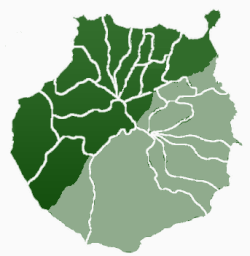 Location of the Guanartematos in relation to the present-day municipalities (Dark Green-Guanartemato of Gáldar. Light Green-Guanartemato of Telde)
-
 Cantons of Jandía and Maxorata


It should be noted, however, that not all these territorial demarcations correspond to the same type of political-social organization. Thus, while on islands such as La Palma the so-called "kingdoms" correspond to a type of social formation close to the "tribe," on Gran Canaria they corresponded to a type of proto-state organization. [citation needed]
At the time of the conquest it is estimated that there were between 35,000 and 40,000 Aborigines on Gran Canaria; on Tenerife there were between 30,000 and 35,000, on La Palma there were 4,000, on La Gomera 2,000, on El Hierro 1,000, and Fuerteventura and Lanzarote together had some 900 indigenous people [citation needed]
Settlements

The Canarian Aborigines generally lived in caves near aboriginal sanctuaries or near cave-palaces.
There were settlements where the Europeans later founded cities and towns, for example, on Tenerife: Añazo (Santa Cruz de Tenerife), Aguere (San Cristóbal de La Laguna) and Candelaria. On Gran Canaria: Agaldar (Gáldar), Telde and Agüimes, among others.
Notable on the island of Tenerife are the Archaeological Zone of the Cueva de los Guanches, where the oldest settlements on Tenerife have been found and which has provided the oldest chronologies in the archipelago,[30] with datings from the 3rd century BC, and the so-called Cuevas de Don Gaspar, owing to the discovery of plant remains in the form of charred seeds,[31] which confirms the practice of agriculture on Tenerife in the time of the Guanches.[30] Both sites are located in the municipality of Icod de los Vinos. Other important settlements were those located next to the Cueva de Chinguaro (Güímar) and next to the Cueva de Achbinico (Candelaria). These last two appear to have had a settlement-religious function, since in these two caves the Guanches venerated the Virgin of Candelaria as their goddess Chaxiraxi.
On the island of Gran Canaria, the main center of settlement was Agaldar, present-day Gáldar, until the division of this guanartemato with the creation of the guanartemato of Telde. Important was the figure of the Guanarteme Thenesor Semidán (baptized as Fernando de Guanarteme), a Canarian aboriginal leader of the island of Gran Canaria. He negotiated with the Crown of Castile a treaty valid for all the islands of the archipelago. He was probably born around 1420 on the island of Gran Canaria, of whose kingdom, the Guanartemato of Gáldar, he was ruler at the arrival of the Castilians. In the Guanartemato of Telde, an important figure was Doramas (*Durar-ammas, which means "broad nose"), a Gran Canarian warrior at the end of the 15th century, a member of the aboriginal resistance on the island of Gran Canaria against the invasion by the Crown of Castile undertaken by the Catholic Monarchs; he was probably guaire (district chief) of Arucas, and was seen as an athletic man and dangerous to the conquistadors. He died in the battle of Arucas from a sword wound, and his head was carried on a pike to the camp of the Castilians (Real de Las Palmas).
On Tenerife it is also important to highlight the mencey Tinerfe the Great and his father the mencey Sunta, who ruled the unified island from the Menceyato of Adeje, before the sons of Tinerfe divided it among themselves into nine kingdoms.
-

-
-
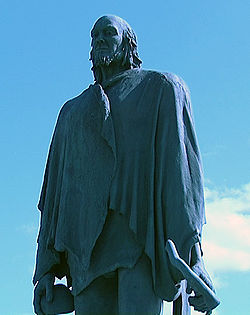
 Sculpture of the Mencey Añaterve in Candelaria, Canary Islands. Sculptor: José Abad.
-


Canarian aboriginal mythology
Canarian aboriginal mythology had its own gods, different on each island, but none in common (except perhaps the god Magec), although it did have common concepts. The main religious festival of the Guanches was the Beñesmer, the harvest festival. Especially linked to their beliefs were the mummies of the Canarian Aborigines.


- On El Hierro they had two important divinities, the god Eraorahan (*Era-uraɣan) and his consort Moneiba (*Mənəy-ibba), as benign gods, and another, malign one to whom they prayed in times of despair, called Aranfaybo.
- On La Gomera they worshipped a creator god called Orahan (*Uraɣan) and on the other hand Hirguan (*Iruggʷăn), the evil god, with the appearance of a thick-haired dog, sometimes bipedal.
- On La Palma they believed in Abora (*Abōra), the solar god, as well as in a malign god in the form of a woolly dog, Iruene (*Iruwwăn, cognate of Hirguan). Offerings were also made to a rock called Idafe, the support of the sky, located inside La Caldera de Taburiente (canton of Aceró), so that it would not fall and thereby bring about the end of the world.
- On Tenerife they believed in Achamán (*Aššaman, 'the Celestial One'). He was the supreme god, of fortune and benevolence. On the other hand there was Guayota (*Wayəwta or Wa-yewta), the demon, who lived inside Echeide (hell), identified with the Teide. Magec (the sun) was one of the principal gods. The term mago, by which the Castilian landowners disparagingly referred to farmers of Guanche origin after the conquest, has its origin in the worship that these farmers paid to him in order to obtain good harvests. The Guanches of Tenerife also worshipped an image of the Virgin Mary under the name of the goddess Chaxiraxi (*Ta-ahɣir-ahɣi), which translated into Spanish would mean "She who bears the firmament." Canarians still venerate her today, conveniently converted by the Catholic tradition following the colonization into the Virgin of Candelaria (Patroness of the Canary Islands). On Tenerife, as on other islands, there are also signs of an ancestor cult of "ancestral spirits," a cult known above all through the mummification of corpses. They also believed in lesser divinities or domestic genii guarding specific places (maxios), and malign entities such as the Jucancha, a fearsome woolly dog, or the goat Guañajé, protective spirit of the goat herds.
- On Gran Canaria the supreme god and solar god was called Acoran, but there were many other gods of lesser importance and mystical elements such as ancestral spirits, demons and genii like the maragullos (malign goblins) or the Tibicenas, demon dogs similar to the Jucanchas of Tenerife.
- On Fuerteventura, they worshipped Mount Tindaya, where gifts were offered in a solar-type cult. A series of rock engravings, the so-called podomorphs, have also been found on this mountain.
- On Lanzarote, it is practically unknown. However, figurines of idols have been found, as on all the other islands.
Sacrifices
This is a very little-known trait of the Canarian Aborigines, but it has been confirmed both archaeologically and through the chronicles that they performed both animal sacrifices[32] and human sacrifices.[32]
Thus on Tenerife, during the summer solstice (the month of June), the Guanches had the custom of slaughtering part of the livestock and throwing it onto a bonfire until the smoke rose to the sky.[32] Béthencourt Alfonso asserted, however, that the young goats were thrown onto the bonfire alive with their legs tied so that their bleating would be heard by the divinity. Animals were also sacrificed on the other islands.[32]
As for human sacrifices, Béthencourt Alfonso already speaks of how "there was a time when they immolated human victims on the island altars," mentioning the occurrence of the sacrifice of a child during the summer solstice.[32] In fact, the Guanches of Tenerife had the custom of throwing a live child from Punta de Rasca just at sunrise on the summer solstice. On occasion these infants came from any menceyato on the island, even from the menceyato farthest from Punta de Rasca, that of Anaga. From this it is deduced that it was a custom common to the whole island.[32]
Also on Tenerife, other types of human sacrifice are known that were associated with the death of the mencey or king, in which adult men threw themselves into the sea.[32] The embalmers who prepared the mummies also had the custom of throwing themselves into the sea one year after the death of the mencey.[32]
On Gran Canaria, children's bones have been found mixed with those of lambs and young goats, and on Tenerife amphorae have appeared with the remains of children inside. This suggests another type of ritual infanticide different from that of those who were thrown into the sea.[33]
Despite these practices, children were also sacrificed in other cultures, above all in the Mediterranean setting. Among them were cultures such as those of Carthage (present-day Tunisia) and Ugarit in present-day Syria. Also in Cyprus, Crete, Greece and ancient Rome, among others.[33]
-

-
 Roque Idafe on La Palma.
-
 Mount Tindaya, considered sacred by the ancient inhabitants of Fuerteventura.
-
 Roque Bentayga, meeting place of the ancient inhabitants of Tejeda.


Rites and celebrations
Among the Canarian Aborigines, especially among the Guanches of Tenerife, the month of August was called Beñesmer or Beñesmen, which was also the name of the harvest festival celebrated in this month.[34][35]
Interaction with Christianity
In 2019, a cross engraved in the rock and oriented toward the sun was found at a Guanche site in the municipality of Buenavista del Norte in northwestern Tenerife. It has been proposed that the find could reveal the supposed knowledge that the ancient Canarians had of Christianity. However, this symbol was found on a megalith used for fertility rituals and as a solar calendar.[36]
The Canarian Aborigines and the Castilian conquest


The conquest of the Canary Islands lasted almost one hundred years, from 1402 to 1496, and brought about the disappearance of a large part of the elements of aboriginal culture on all the islands, conversion to Christianity, and intermixing between settlers and the local population.
On the one hand, it took place through religious and cultural penetration resulting from the introduction of settlers, above all from the south of the Peninsula, in stable settlements.[37] The relations of production in the settlements took the forms of a hybrid seigneurial regime.
On the other hand, the destruction of the aboriginal production system itself and the consequent attacks on the settlers led to military conquest.[38] This began with the commission granted by Henry III of Castile to the Normans Juan de Bethencourt and Gadifer de la Salle and concluded with the Catholic Monarchs.
The decline in the population of the islands, already decimated[37] by the incursions and raids of pirates and slave hunters from Africa, was aggravated by the diseases that arrived from Europe and led the colonizers to seek slave labor in Barbary (Maghreb). These slaves were called moriscos, unrelated to the peninsular Moriscos, and they too ended up merging with the population of Aborigines and settlers that survived. Historians such as Aznar Vallejo speak of one third of the population of the Canary Islands at the beginning of the 16th century being aboriginal, while others, such as Macías, estimate it at 40%. However, Dominik Wölfel reverses the proportion and estimates some 2/3 indigenous people after the conquest, and various data from anthropology and genetics partially refute the thesis of the extinction and reduction to a minority of the ancient Canarian populations. The situation during this century, after the end of the conquest, continued to worsen with the incursions of the Barbary pirates Calafact (1569), Dogalí (1571) and above all Amurat the Moor or Morato Arráez, who in the massacre of 1586 exterminated practically the entire population of Teguise.[39][40]
On the Island of La Gomera a larger pre-Hispanic population survived, with European resettlement (mainly Portuguese and Castilian) being in the minority[citation needed].
The genetics of the Aborigines in the Canarian population

A 2003 genetic research article published in the European Journal of Human Genetics and written by Nicole Maca-Meyer compared the aboriginal mitochondrial genome (collected from Canarian archaeological sites) with that of present-day Canarians and concluded that, despite the continuous changes the Canarian population has undergone since the 15th century, when the archipelago was conquered by Spain (Spanish colonization, the slave trade), indigenous mitochondrial DNA represents a significant percentage [42 - 73%] in the Canary Islands. According to this article, both percentages are obtained from two estimation methods; however, according to the study itself, the percentage that might be more reliable is 73%.[41] According to the historical and anthropological data obtained on the islands, since the end of the 16th century at least two thirds of the Canarian population have an indigenous substratum. Maca-Meyer states that the historical evidence is compatible with the explanation of "strong sexual asymmetry." According to her, matings between European men and indigenous women were frequent, following the significant aboriginal male mortality during the conquest. Genetics therefore suggests that native men decreased considerably in number due to the war, a large number of Spanish men remained on the islands and married local women, the Canarians adopted Spanish first names and surnames, language and religion, and in this way the Canarians were Hispanicized. It should be remembered, however, that although it was the Spaniards who conquered the Canary Islands, they were not the entirety of its colonizers. The Canary Islands were resettled by Spaniards, Portuguese (whose number exceeded that of the Spaniards during the 16th century[42]), French, Flemish and Italians (especially Genoese), who, after learning Castilian, gradually mixed with the population.
According to a study carried out in 2005, despite the geographical proximity between the Canary Islands and Morocco, the male genetic lineage of the people of the Canary Islands is mainly of European origin. In fact, almost 67% of the haplogroups derive from people of Eurasia. As was to be expected, the Spanish conquest brought the European genetic base to the present-day male population of the Canary Islands. However, the second most important family of haplogroups is that of North Africa and the Near and Middle East. Y-DNA haplogroup E (14% if the 7% of haplogroup E-M81, which the Berber population has in general, is included), E1b1a (2%), J (10%) and T (3%). These haplogroups are present on the islands in a proportion of 27%. Even if part of these "Eastern" haplogroups were introduced by the Spaniards, we can assume that a good part of this rate was already there at the time of the conquest.[43][44] According to the studies by Fregel in 2009, the presence of E-M81 lineages, and of other relatively abundant markers (E-M78 and the subgroup M267-J) native to North Africa found in the Canarian indigenous population, points strongly to that area [North Africa] as the most likely origin of the ancestors of the Canarian Aborigines. In this study, Fregel estimates that, based on the frequency of the Y chromosome and on mitochondrial DNA, the contribution of Guanche women and men to the present-day populations of the Canary Islands was 41.8% and 16.1% respectively.[45]
The Canarian Aborigines, Puerto Ricans and Dominicans
A group of scholars from Puerto Rican universities carried out a study of mitochondrial DNA that revealed that the present-day population of Puerto Rico has a high Canarian aboriginal component, especially from the Guanches who inhabited the island of Tenerife.[46] This type of Guanche genes has also been detected in the Dominican Republic. [47]
Links with Anatolia
According to an international investigation whose results were released in 2017 and in which the Complutense University of Madrid participated, a small part of the Canarian Aborigines were related to the first European farmers originating in Anatolia (present-day Turkey).[48] This fact was discovered thanks to analysis of the genome, which also confirms that the great majority of the Canarian Aborigines came from North Africa.[48]
The results, published in the scientific journal Current Biology, also reveal that the Aborigines present a mixture of various ancestors, and specifically with populations related to the first European farmers, whose genetic signal was introduced into Europe from Anatolia by means of the migrations of farmers during the Neolithic expansion, around 7,000 years ago.[48] A study in 2018 confirmed that, like the Guanches, both ancient (Late Neolithic) and modern North Africans are related in part to Anatolia/Europe.[49]
Nuclear DNA
The first genome-wide data from pre-Hispanic inhabitants, spanning from the 7th to the 11th century, show that the Aborigines were genetically similar over time and that they present the greatest genetic affinity with existing Northwest Africans, which supports the hypothesis of a Berber origin. They also estimate that the Aborigines have contributed 16–31% autosomal ancestry to the modern inhabitants of the Canary Islands.[50]
Genetic results were also obtained that allow inferences about the phenotype of one of the individuals, revealing that this individual was probably lactose intolerant and had brown eyes, dark hair and light or medium skin color. These results are similar for the other individuals for whom information is available, albeit with lower coverage, which suggests that, at least for this sample of Aborigines, the dominant phenotype was lactose intolerance, dark hair, light or medium skin color and brown eyes.[50]
Another recent study, which took as its reference 400 adult men and women from all the islands except La Graciosa, and which sought to determine the relationships of Canarian genetic diversity with the most frequent complex pathologies in the archipelago, found that Canarian DNA presents a distinctive genetic profile, the result of variables such as the geographical isolation of the islands, the adaptation of their inhabitants to the environment, and the historical mixing of the pre-Hispanic population of the archipelago (originating in North Africa) with European and sub-Saharan individuals. Specifically, it estimated that the Canarian population, at the autosomal level, is 75% European, 22% North African and 3% sub-Saharan.[51]
Below is the average per island of North African and sub-Saharan autosomal DNA respectively.[52]
| North African | North African | North African | Sub-Saharan | Sub-Saharan | Sub-Saharan | |
|---|---|---|---|---|---|---|
| Min. | Mean | Max. | Min. | Mean | Max. | |
| Fuerteventura | 0.218 | 0.255 | 0.296 | 0.011 | 0.027 | 0.046 |
| Lanzarote | 0.214 | 0.254 | 0.296 | 0.014 | 0.032 | 0.057 |
| Gran Canaria | 0.155 | 0.200 | 0.264 | 0.005 | 0.032 | 0.082 |
| Tenerife | 0.149 | 0.208 | 0.255 | 0.002 | 0.015 | 0.057 |
| La Gomera | 0.160 | 0.221 | 0.289 | 0.013 | 0.048 | 0.092 |
| La Palma | 0.170 | 0.200 | 0.245 | 0.000 | 0.013 | 0.032 |
| El Hierro | 0.192 | 0.246 | 0.299 | 0.005 | 0.020 | 0.032 |
Source: Genomic Ancestry Proportions (from ADMIXTURE, K-4) in Canary Islanders (Guillen-Guio et al. 2018)
Aboriginal mummies

This custom was intended to preserve the body of the deceased by means of embalming techniques very similar to those carried out in other ancient civilizations. Its purpose, linked to their religious beliefs, was to protect the corpse and also to mark its social importance. Contrary to what might be thought, mummification was not practiced on all the islands, but mainly on the island of Tenerife, where the mummification technique attained greater perfection,[53] and it is also the best known and most studied. On Gran Canaria there is currently a debate about the true nature of the mummies of the island's ancient inhabitants, since researchers point out that there was no real intention to mummify the deceased and that the good preservation of some of them is due rather to environmental factors.[54] On La Palma they were preserved through these environmental factors, and on La Gomera and El Hierro the existence of mummification has not been confirmed. On Lanzarote and Fuerteventura this practice is ruled out.
It should be noted that aboriginal mummification is in many respects similar to that practiced by the ancient Egyptians. To prevent corruption of the corpses they took great care over the process and the body, and above all they kept a special memory of and honor for the dead. Mummification, or mirlado as the first Spanish chroniclers of the "Fortunate Isles" (Canary Islands) called it, was not in general use among the aboriginal population, there being several processes showing a certain gradation in funerary practice that corresponds to a social and economic difference between the different castes of their society. Logically, the mummies of their kings (Guanartemes and Menceyes) were those that received the greatest care in mummification. The Aborigines of Tenerife, like the ancient Egyptians, sometimes kept the viscera of their kings, the "menceyes."
In 1933 the largest aboriginal necropolis found to date in the Canary Archipelago was discovered: the Guanche necropolis of Uchova in the municipality of San Miguel de Abona in the south of the island of Tenerife. This site was almost entirely looted; it is estimated that it contained between 74 and 60 Guanche mummies. The study of this burial cave revealed particularities of aboriginal mortuary rites that had been unknown until then, such as the placement of the corpses and the preparation of their beds.[55]
Archaeological sites
The main and most significant archaeological sites on each island are:[56]
- Lanzarote: Village of Zonzamas
- Fuerteventura: Mount Tindaya
- Gran Canaria: Cueva Pintada
- Tenerife: Masca Solar Station
- La Gomera: Fortaleza de Chipude
- La Palma: Cueva de Belmaco
- El Hierro: Archaeological zone of El Julan
Museums

Many of the island museums hold in their collections archaeological material and human remains from the prehistory of the archipelago and from the History of the Canary Islands. Some of the most important are:
- Museum of Nature and Man, which holds the largest collection on Guanche culture in the world. Santa Cruz de Tenerife.
- Museo Canario (Las Palmas de Gran Canaria).
- Cueva Pintada Museum and Archaeological Park (Gáldar).
- Archaeological Museum of Puerto de la Cruz in (Puerto de la Cruz).
- Museum of History and Anthropology of Tenerife (Casa Lercaro, San Cristóbal de La Laguna).
- Benahoarita Archaeological Museum (Los Llanos de Aridane, La Palma).


See also
- Letter of Calatayud
- Canarian aboriginal mythology
- Cueva Pintada
- Zanata Stone
- Guanche languages
- Guanche
- Canarii
- Majo
- Bimbache
- Benhaorita
- Gomerita
- Canarian people
References
- ↑ 1.0 1.1 Reyes, Ignacio (January 2007). "Gentilicios". Mundo Guanche (in español). Los Realejos, Santa Cruz de Tenerife: Asociación Mundo Guanche. Retrieved September 12, 2014.
En torno a 1590, un historiador que firmó su obra con el pseudónimo de Juan de Abreu Galindo (III, 13) recogió ese gentilicio expresado de manera inequívoca en lengua amazighe: «Esta ysla de Tenerife se llama en su comun hablar Chíneche, y alos naturales llamaban Bincheni». Un siglo más tarde, el médico y también historiador Tomás Marín de Cubas (1694: 26v, 50) reportó el mismo dato, pero esta vez bajo una forma ligeramente distinta: «[a] los naturales le[s] llaman Guanchini». Las diferencias obedecen a que un autor apuntó el plural y otro, el singular: wanshen, pl. winshen. Porque el enunciado guarda relación con el nombre de la Isla, Ashenshen (o Ašenšen), rematado por la reduplicación expresiva del tema que se pierde en el gentilicio. De aquí derivan todas las variantes que hoy conocemos, la más famosa de las cuales es la voz 'guanche'.
[Around 1590, a historian who signed his work with the pseudonym Juan de Abreu Galindo (III, 13) recorded that demonym, expressed unequivocally in the Amazigh language: "This island of Tenerife is called in their common speech Chíneche, and the natives they called Bincheni." A century later, the physician and also historian Tomás Marín de Cubas (1694: 26v, 50) reported the same fact, but this time in a slightly different form: "[the] natives are called Guanchini." The differences are due to one author noting the plural and the other the singular: wanshen, pl. winshen. Because the term is related to the name of the Island, Ashenshen (or Ašenšen), completed by the expressive reduplication of the stem, which is lost in the demonym. From this derive all the variants we know today, the most famous of which is the word 'guanche'.] - ↑ Abréu Galindo, Juan de (1940) [1632]. "Capítulo XII". Historia de la conquista de las siete islas de Gran Canaria (pdf). Biblioteca Canaria (in español). Vol. III. Santa Cruz de Tenerife: Valentín Sanz. p. 221. Retrieved September 12, 2014.
- ↑ For more on the use of the term indígena (indigenous) as opposed to aborigen (aboriginal), see the article by Farrujia de la Rosa, José (January 4, 2009). "La identidad de los indígenas canarios". La Opinión de Tenerife (in español). Retrieved March 19, 2014.
- ↑ Abréu Galindo, Juan de (1940) [1632]. "Capítulo I". Historia de la conquista de las siete islas de Gran Canaria (pdf). Biblioteca Canaria (in español). Vol. III. Santa Cruz de Tenerife: Valentín Sanz. p. 188. Retrieved September 12, 2014.
Pero los naturales llamaban a esta isla en su lenguaje Benahoare, que en castellano quiere decir mi patria, o mi tierra; porque como los nombres sean los que distinguen las cosas, y los gentiles no tenían noticia de otra tierra, no la distinguían de otra con otro nombre que supiesen, más de llamarla mi tierra o mi patria.
[But the natives called this island in their language Benahoare, which in Castilian means my homeland, or my land; for since names are what distinguish things, and the gentiles had no knowledge of any other land, they did not distinguish it from another by any other name they knew, other than calling it my land or my homeland.] - ↑ Yacimiento obliga a reescribir la historia de Canarias. Diario La Provincia (in Spanish)
- ↑ Arco Aguilar, Marcelino J. del; Arco Aguilar, María del Carmen del; Arco Aguilar, María Mercedes del; Atiénzar Armas, Emilio; González Hernández, Cecilia; Rosario Adrián, María Candelaria (2000). "El menceyato de Icod en el poblamiento de Tenerife. D. Gaspar, Las Palomas y Los Guanches. Sobre el poblamiento y las estrategias de alimentación vegetal entre los guanches" (PDF). Eres. Arqueología/Bioantropología (in español) (9). Santa Cruz de Tenerife: Museo Arqueológico de Tenerife: 67–129. ISSN 1130-6572.
- ↑ Estudio demográfico de la población guanche de Tenerife (in Spanish)
- ↑ Thesis: Composición genética de poblaciones históricas y prehistóricas humanas de las Islas Canarias [dead link] by Maca Meyer, Nicole (in Spanish)
- ↑ Nombre indígena de Hierro [dead link] (in Spanish)
- ↑ Nombre indígena de La Palma Archived October 21, 2013, at the Wayback Machine (in Spanish)
- ↑ Nombre indígena de Gomera [dead link] (in Spanish)
- ↑ Nombre indígena de Tenerife Archived October 21, 2013, at the Wayback Machine (in Spanish)
- ↑ Nombre indígena de Gran Canaria Archived October 21, 2013, at the Wayback Machine (in Spanish)
- ↑ Nombre indígena de Fuerteventura Archived October 21, 2013, at the Wayback Machine (in Spanish)
- ↑ Nombre indígena de Lanzarote Archived October 21, 2013, at the Wayback Machine (in Spanish)
- ↑ Natura y Cultura de las Islas Canarias (in español) (3rd ed.). TAFOR. 1979. p. 193. ISBN 84-400-5294-4.
- ↑ EFE (January 23, 2013). "Los guanches orientaban sus lugares de culto hacia los astros". Diario de Avisos (in español). Archived from the original on March 17, 2014. Retrieved March 17, 2014.
- ↑ La ganadería. Revista Mundo Guanche: http://www.mundoguanche.com/portada/articulo.php?id_articulo=134 (in Spanish)
- ↑ Connor, Simon E. (2009). Robert Whittaker (ed.). "Human impact – the last nail in the coffin for ancient plants?". J. Biogeogr. 36: 485–486.
- ↑ Salas Pascual, Marcos; Cácerez Lorenzo, Mª Teresa (2000). "Datos Históricos de la Presencia de Fitónimos Relacionados con el Género Quercus L. en Canarias" (PDF). Vegueta (in español) (5): 341–7. Archived from the original (PDF) on April 10, 2010. Retrieved January 1, 2013.
- ↑ 21.0 21.1 21.2 21.3 21.4 21.5 21.6 Morales Mateos, Jacob; Rodríguez Rodríguez A, Alberto Barroso V, Machado Yanes MC, Criado Hernández C. (2007). "El Impacto de las Actividades Humanas sobre el Medio Ambiente en Canarias durante la Prehistoria" (PDF). El Indiferente (in español) (19).
{{cite journal}}: CS1 maint: multiple names: authors list (link) - ↑ Atoche Peña, Pablo (2003). "Fenómenos de Intensificación Económica y Degradación Medioambiental en la Protohistoria Canaria". Zephyrvs (in español) (56): 183–206. ISSN 0514-7336.
- ↑ 23.0 23.1 23.2 23.3 23.4 Rando, Juan Carlos (January 2003). "Protagonistas de una Catástrofe Silenciosa. Los Vertebrados Extintos de Canarias". El Indiferente (in español) (14).
- ↑ 24.0 24.1 24.2 Machado Yanes, María del Carmen (January 2007). "Una Visión de las Islas Afortunadas a Partir de los Restos Arqueológicos" (PDF). Tabona (in español) (15): 71–90. Archived from the original (PDF) on July 14, 2014. Retrieved July 2, 2014.
- ↑ Mateo, J. A. (2009). "Lagarto gigante de La Palma – Gallotia auaritae". In Carrascal, L. M., Salvador, A. (ed.). Enciclopedia Virtual de los Vertebrados Españoles (in español). Museo Nacional de Ciencias Naturales, Madrid.
{{cite book}}: CS1 maint: multiple names: editors list (link) - ↑ Blanco, Guillermo; Fargallo, Juan A.; País, Jorge L.; Laiolo, Paola; Lemus, Jesús A.; Banda, Eva; Montoya, Raymundo. Potti, Jaime. "Islas Protegidas dentro de las Islas: Importancia del Parque Nacional de la Caldera de Taburiente en la Conservación de la Chova Piquirroja (Phyrrhocorax phyrrocorax) en La Palma, Islas Canarias". Proyectos de investigación en parques nacionales: 2003-2006 (in español): 245–260.
{{cite journal}}: CS1 maint: multiple names: authors list (link) - ↑ Becerra Romero, B.; Castro-Reino, S.F.; Criado Hernández, C.; González Quintero, P.; Hansen Machín, A.; Hernández Padrón, A.J.; Jiménez Medina, A.M.; Machado Yánez, C.; Mendoza Medina, F.A. (2009). El Yacimiento Arqueológico de la Cerera. Un Modelo de Ocupación en la Isla de Gran Canaria (in español). p. 294. ISBN 978-84-8103-600-8.
- ↑ Guanche languages
- ↑ Inscripciones guanches. (in Spanish)
- ↑ 30.0 30.1 Protohistoria de Tenerife (in Spanish)
- ↑ Cueva de Don Gaspar (in Spanish)
- ↑ 32.0 32.1 32.2 32.3 32.4 32.5 32.6 32.7 Sacrificios entre los Aborígenes canarios (in Spanish)
- ↑ 33.0 33.1 Aparición de sacrificios de niños entre los Aborígenes Canarios (in Spanish)
- ↑ Abréu Galindo, Juan de (1848) [1632]. Historia de la conquista de las siete islas de Gran Canaria (in español). Santa Cruz de Tenerife: Imprenta, Litografía y Librería Isleña.
- ↑ Torriani, Leonardo (1959) [1590]. Descripción e historia del reino de las Islas Canarias: antes Afortunadas, con el parecer de sus fortificaciones (in español). Santa Cruz de Tenerife: Goya Ediciones.
- ↑ Santana, Yaiza (May 3, 2019). "Encuentran una cruz cristiana en un yacimiento de culto guanche en Canarias". ABC (in español). Retrieved May 4, 2019.
- ↑ 37.0 37.1 Breve síntesis de la historia de Lanzarote by León Hernández, José. Latitud 28º, Arrecife, 2004 (in Spanish)
- ↑ "The next day the companions who remained in the old castle learned how the new king had attacked Andernac and the other companions. Then they seized a Canarian whom they held and cut off his head on a high mountain and placed it on a very tall pole, so that all might see it. And from then on the war began between them and us. And we have taken and killed a great number of them and we have taken women and children, and the rest are in such a condition that they go hiding in the caves and none dares to show himself... and the intention is, if we find no other remedy, that we kill the men of defense of the country, and we have already begun it; and we will keep the women and children and have them baptized and we will live as they do, until God disposes otherwise." (Gadifer de la Salle, Le Canarien, p.80; Cioranescu, Alexandre 1965 Crónicas francesas de la conquista de canarias - Le Canarien: 46; Fourth edition, Santa Cruz de Tenerife: Ediciones Idea.). Pierre Bontier and Jean Le Verrier wrote the first documentation on the conquest of the Canary Islands and the only information available on the way of life of the natives of Lanzarote and Fuerteventura at the arrival of the first conquistadors.
- ↑ Las dos Guatizas. Agustín de la Hoz, Guatiza ayer y hoy (in Spanish)
- ↑ On Lanzarote, the incursions would continue during the 17th century, especially those of Sir Walter Raleigh, who in 1617, during his last expedition in search of El Dorado, razed Arrecife; and of Soliman, who in 1618 invaded and razed the entire island (León Hernández, 2004, op. cit.). From then until the present day no further invasions from the African coast have been recorded.
- ↑ Ancient mtDNA analysis and the origin of the Guanches (in English)
- ↑ Canarias: Emigración portuguesa. Accessed November 12, 2010, at 19:50 (in Spanish)
- ↑ Y-chromosome STR haplotypes in the Canary Islands population (Spain), Zurita et al. 2005 (in English)
- ↑ Ancient Y chromosomes from the Canary Islands (in English)
- ↑ Fregel et al. 2009, Demographic history of Canary Islands male gene-pool: replacement of native lineages by European (in English)
- ↑ Estudio del genoma Taíno y Guanche (in Spanish)
- ↑ Un estudio descubre la presencia de genes guanches en la República Dominicana (in Spanish)
- ↑ 48.0 48.1 48.2 Una pequeña parte de los guanches eran parientes de agricultores de Turquía (in Spanish)
- ↑ Fregel et al. 2018, Ancient genomes from North Africa evidence prehistoric migrations to the Maghreb from both the Levant and Europe (in English)
- ↑ 50.0 50.1 Genomic Analyses of Pre-European Conquest Human Remains from the Canary Islands Reveal Close Affinity to Modern North Africans (in English)
- ↑ Cuatro apellidos canarios, un bisabuelo peninsular y otro africano (in Spanish)
- ↑ Beatriz Guillen-Guio et al. 2018, Genomic Analyses of Human European Diversity at the Southwestern Edge: Isolation, African Influence and Disease Associations in the Canary Islands (in English)
- ↑ Momificación en Canarias Archived November 8, 2014, at the Wayback Machine (in Spanish)
- ↑ Conrado Rodríguez-Maffiote: “Estamos en uno de los mejores momentos en cuanto a la investigación sobre la cultura guanche” (in Spanish)
- ↑ Un estudio recuerda el expolio de la mayor necrópolis guanche jamás hallada (in Spanish)
- ↑ Las manifestaciones artísticas prehispánicas y su huella (in Spanish)
External links
- Teorías población aborigen canaria (in Spanish)
- Docs historia aborigen canaria Archived March 4, 2016, at the Wayback Machine (in Spanish)
- Organismo Autónomo de Museos y Centros de Tenerife (in Spanish)
- Museum of Nature and Man, Santa Cruz de Tenerife, on YouTube
- Inscripciones rupestres indican que Canarias fue poblada a parti (in Spanish)


