| Content from Wikipedia under the CC BY-SA 4.0 license ⇔ Maps from OpenStreetMap under the ODbL license |
Autonomous University of Santo Domingo
| Acronym | UASD |
|---|---|
| Motto | Neo Mundi Decanatus (in Latin) |
| Type | Public |
| Established | University of Saint Thomas Aquinas (predecessor institution): 1538/1558 – 1823 Autonomous University of Santo Domingo: November 16, 1914 |
| Founder | Dominican Order |
| Address | Av. Alma Mater |
| City | University Zone, Santo Domingo |
| Country | Dominican Republic |
| Campuses | Santo Domingo, Barahona, Bonao, Duvergé, Hato Mayor, Higüey, La Vega, La Romana, Santa Cruz de Mao, Nagua, Neiba, Puerto Plata, San Francisco de Macorís, San Juan de la Maguana, Santiago, San Pedro de Macorís, San Cristóbal, Santiago Rodríguez |
| Mascot | Eagle |
| Colors | Blue and white |
| Rector | Dr. Emma Polanco[1] |
| Vice-rectors |
|
| Officials |
|
| Website | www |

The Autonomous University of Santo Domingo (UASD) is a public university of the Dominican Republic, and the only state university in the country. Its main seat is in the capital, Santo Domingo, and it has campuses, centers and sub-centers in 18 of the 31 provinces.
The Autonomous University of Santo Domingo has agreements in force with universities on all 5 continents, through which faculty and student exchanges and scholarships are established and joint research is promoted. The General Directorate of Cooperation and International Relations provides information through its website.
History
The Autonomous University of Santo Domingo was created by decree by José Gabriel García and Emiliano Tejera on December 31, 1866, under the name Instituto Profesional (Professional Institute), receiving its current name in 1914.
In the Dominican Republic it is regarded as the heir of the Studium Generale of the Dominican Convent of 1518, and of the University of Saint Thomas Aquinas, which was created by the papal bull In Apostolatus Culmine on October 28, 1538.
This "continuity" of the Autonomous University of Santo Domingo with respect to the University of Saint Thomas Aquinas (closed decades earlier), as well as the view held in the Dominican Republic that it is the primate university of the Americas, is a subject of debate.
With this bull, Pope Paul III established the first university on the new continent, although it did not receive recognition from the Kingdom of Spain until two decades later. This is the reason why there is a controversy over the first university in the Americas.[3][4]
The University of Saint Thomas Aquinas formed, together with the first cathedral, the first hospital and the first customs office, the group of primate institutions of the Americas established in the city of Santo Domingo de Guzmán.[5][6]
The university ceased to be a Studium Generale, run by the Dominican congregation, to become the center of education in the New World. By means of the aforementioned bull, this General Study, which the Dominicans had directed since 1518, was raised to the rank of University in 1538.[7][8]
The nascent university took the University of Alcalá de Henares as its model, and as such was a standard-bearer of the Renaissance ideas that were arising out of the medieval world, from which the Spain of the days of the conquest was emerging.

It is said that the Jesuits schemed to conceal the General Sanction of the Council of the Indies in order to seize the monopoly on granting Vatican degrees, a fundamental characteristic of a university. This was to the detriment of the University of Santo Domingo, established by the faction of the Church of the Dominican Convent.
However, even if the General Sanction did not exist in 1538 (even though it did exist, it was only made official 28 years later by a committee reviewing old documents, something common in a historical context in which the historical records took decades to be brought up to date. In those days there was no defined written law requiring a viceregal seal in order to put a papal bull into effect.[9] Evidently the University of Santo Domingo granted academic degrees well before 1551, which categorizes it as a "university," in the modern sense of the term, well before the universities in Mexico or Peru.[10] On the other hand, there are controversies surrounding its legitimacy in the Spanish Empire and its historical continuity as the University of Saint Thomas Aquinas. The Autonomous University of Santo Domingo was founded, as such, on November 16, 1914, with the aim of bringing about the reopening of the University of Saint Thomas Aquinas, founded by papal bull on October 28, 1538; this fact generates controversy among several historians about its continuity. [11][12]
Controversy over the first university in the Americas
There is a controversy over the classification of the National University of San Marcos (UNMSM) as the oldest institution of higher education in the Americas. San Marcos's arguments are two: being the first university created by mandate of the Spanish Crown (royal provision) and being the only one of those founded during the 16th century that has operated without interruption to the present day. The latter is relevant because many universities in the Americas were closed during the wars of independence or, later, due to internal conflicts.
The Autonomous University of Santo Domingo argues its priority among the universities of the Americas on the basis of the bull In Apostolatus Culmine of Paul III of October 28, 1538, which did not have the pase regio of King Charles I of Spain, that is, royal approval, which is why it is considered that, legally, it had no effect.[11] San Marcos also turns to the General Archive of the Indies, which contains documents from the Spanish colonial period from the 16th century to the 18th century, where there are no official documents prior to 1551 recognizing a university or institution of higher education earlier than the UNMSM.[11]
Faculties and Schools


|
|
Institutes
- Institute of Criminology
- Institute of Philosophy
- Institute of History
- Institute of Languages
- Institute of Gender and Family
- University Seismological Institute
- Institute of Anthropological Research
- Institute of Psychology
- Institute of Agriculture and Livestock
- Study of Zoonotic Diseases
- Dairy Training Center (CAL)
- Marine Biology Research (CIBIMA)
- Institute of Physics (IF)
- University Geographic Institute (IGU)
- Institute of Botanical and Zoological Research (IIBZ)
- Institute of Mathematics (INSMAD)
- Microbiology and Parasitology (IMPA)
- Institute of Chemistry (IQUASD)
- Institute of Energy
- Institute of Urban Planning
Vicissitudes
In 1801, as a consequence of the Haitian occupation of the country, the University interrupted its operation, because the Dominicans who ran it abandoned the colony. It reopened in 1815, when the colony returned to Spanish sovereignty, but from then on it took on a secular character.[13]

Between 1815 and 1821 it operated under the rectorship of Dr. José Núñez de Cáceres. The University closed its doors again in 1822 because a large number of its students were conscripted into Military Service by order of the Haitian regime that governed the nation.[13] With the achievement of the Independence of the Republic in 1844, the desire to reestablish the University, a symbol of cultural tradition and of the distinctive character of the newly acquired nationhood, was reborn among Dominicans.
In response to this demand, on June 16, 1859, President Pedro Santana enacted a law reestablishing the old University of Santo Domingo, with an academic composition similar to that of medieval universities (four faculties: Philosophy, Jurisprudence, Medical Sciences and Sacred Letters) and as a dependency of the central government through the General Directorate of Public Instruction and the corresponding Secretariat of State.

But owing to political contingencies, that provision was not carried out and the University did not reopen. Hence there is a debate about the continuity of the University of Santo Domingo; for some historians, after the Haitian invasion the University of Santo Domingo disappeared as such, a case similar to what happened with the Royal and Pontifical University of Mexico.[12]
After 40 years without an operating university, José Gabriel García and Emiliano Tejera created by decree, on December 31, 1866, the Professional Institute, which operated in place of and as a substitute for the old University of Santo Domingo. The Professional Institute had its premises in the Casa del Sacramento and in the Casa de los Presidentes in the Colonial Zone of Santo Domingo until 1947, when it moved to the University City thanks to the initiatives of rector Julio Ortega Frier.[14][15]
On May 10, 1891, the Professional Institute closed its doors, until August 16, 1895, when it reappeared under the rectorship of Archbishop Meriño.
On November 16, 1914, the President of the Republic, Dr. Ramón Báez, who was also Rector of the Professional Institute, transformed the Professional Institute by decree into the University of Santo Domingo.[13]
From 1916 to 1924, the University had to interrupt its operation as a consequence of the North American military intervention.[13]
During the 31 years of the tyranny of the dictator Rafael Leónidas Trujillo Molina, the University of Santo Domingo, like the other institutions of the country, was deprived of the most elementary freedoms needed to fulfill its high mission, coming to be an instrument of political control and of the propagation of totalitarian slogans, against whose harms the scant material progress the Institution achieved in those years of despotic government, such as the acquisition of land and the construction of the University City, counted for nothing.[citation needed]
Autonomy and University Privilege
Law No. 5778 of December 31, 1961, granted Autonomy to the University, by President Dr. Joaquín Balaguer. From that moment it began to struggle to achieve institutional balance and a climate of coexistence that would allow it to develop all its creative faculties. But after three decades subjected to the iron will of a regime opposed to any form of human communication that did not serve its interests, it was initially unable to use its newly acquired freedom and self-government to carry out its mission of service for the cultural and economic betterment of our people.
On February 17, 1962, the first authorities under the regime of autonomy were elected.
University Seismological Institute
The Institute was created by resolution No. 244 of the Honorable University Council dated September 18, 1981. In accordance with Law 147-02, it is part of the National System for Disaster Prevention, Mitigation and Response. At present the ISU has a team of 20 people distributed as follows: 13 scientific and technical staff, 5 belonging to the administrative or support area, and 2 BET. This staff includes 3 researchers and two research assistants.[16]
Pedro Mir Library

The building of the UASD's Pedro Mir Library was conceived with the aim of serving as a Learning and Research Resource Center (CRAI) at the service of the UASD and the country. To be a means of consultation for national and international researchers interested in the problems of the Hispanic world and the Caribbean.
The first level contains the reception area of the project and its formal and spatial integration with the campus. Located there are the entrance esplanade, auditoriums and administrative offices.
The second and third levels contain the reading rooms and multipurpose rooms for graduate teaching.
The fourth level is devoted to research and outreach, an expression of self-education and in-depth study. The specialized rooms and the spaces intended for research are located on this level.
The central body (collections repository), notable for its volumetric strength and its privileged location, is highlighted by a mural, becoming the focal point of attraction as a synthesis of the expression of the building's content.[17]
Child Care Center
The Jardín Infantil Progresando Educational Development Center, or child care center for boys and girls, is a center located within the university campus, under the care and supervision of a specialized team of professionals in the field.
This program provides supervision, care and stimulation of the areas of psychological development for boys and girls from three months to six years of age, children of low-income student mothers at the university.[18]
University Press
The Editora Universitaria (University Press) is the administrative service unit intended to centralize, promote, direct and carry out the editing and printing of texts and other publications by professors, researchers and students, works that the University requires to fulfill its functions of teaching, research, outreach and graduate studies. [19]
Regional Campuses
- UASD - Baní
- UASD - Barahona
- UASD - Bonao
- UASD - Duvergé
- UASD - Hato Mayor
- UASD - Higüey
- UASD - La Romana
- UASD - La Vega
- UASD - Nagua
- UASD - Neiba
- UASD - Puerto Plata
- UASD - Samaná
- UASD - San Cristóbal
- UASD - San Francisco de Macorís
- UASD - San Juan de la Maguana
- UASD - San Pedro de Macorís
- UASD - Santiago
- UASD - Santiago Rodríguez
- UASD - Mao
Campuses in Santo Domingo
- AB: Máximo Aviles Blonda
- JJ: Juan Isidro Jimenes
- OD: Institutional Guidance
- UP: Pan American Union
- LE: Experimental High School
- IM: Cristo de los Milagros
- CL: Los Clavelines
Antonio de la Masa
- AN: Activo 20-30
Albert Thomas
- AO: Las Caobas Subcenter (Prolongación 27 de Febrero)
- BL: Bioanalysis laboratory
University campus
- CD: Sports field
- CJ: Legal science
- CO: Olympic center
Authorities
- Rector: Dr. Emma Polanco
- Academic Vice-Rector: Alejandro Ozuna Morla
- Administrative Vice-Rector: Pablo Valdez
- Vice-Rector for Research and Graduate Studies: Dr. Mauro Canario
- Vice-Rector for Outreach: Antonio Medina Calcaño
- Secretary General: Juan Antonio Cerda Luna
Notable Alumni
-
 Joaquín Balaguer, President of the Dominican Republic. Class of 1929.
-
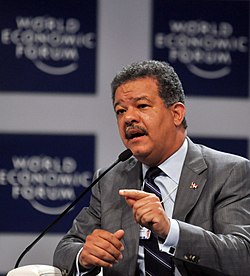 Leonel Fernández, President of the Dominican Republic. Class of 1978.
-
Hatuey de Camps, leader of the Dominican Revolutionary Party. President of the Chamber of Deputies (1979–1982). Minister of the Presidency (1982–1986).
-
 José Tomás Pérez, leader of the Dominican Liberation Party. Ambassador of the Dominican Republic to the United States (2014–present)
-
Geovanny Vicente Romero, lawyer and international consultant. CNN columnist. National Youth Award. Class of 2009.
-
 Miguel Cocco, leader of the Dominican Liberation Party.
-
Gustavo Montalvo, leader of the Dominican Liberation Party and Minister of the Presidency (2012–2020).
-
 Freddy Beras Goico, broadcaster and television presenter.
-
 Marcio Veloz Maggiolo, writer and novelist.
-
 Juan Luis Guerra, singer-songwriter.
-
Marino Vicente Rosado, lawyer and judge of the Republic.


Politicians
- Joaquín Balaguer
- Leonel Fernández
- Danilo Medina
- Salvador Jorge Blanco
- Margarita Cedeño
- Milagros Ortiz Bosch
- Rafael Alburquerque
- José Francisco Peña Gómez
- Reinaldo Pared Pérez
- Cristina Lizardo
- Francisco Javier García (politician)
- Temístocles Montás
- Hatuey de Camps
- Franklin García Fermín
- Mateo Aquino Febrillet
- Gustavo Montalvo
- Geovanny Vicente Romero
- Carlos Amarante Baret
- Amín Abel Hasbún
- Miguel Cocco
- José Tomás Pérez
- Hugo Tolentino Dipp
- Félix Bautista
- Euclides Gutiérrez Félix
- Fello Suberví
- Manolo Tavárez Justo
- Franklin Domínguez
- Henry Molina
- Narciso Isa Conde
- Héctor García Godoy
- Melanio Paredes
- Radhamés Jiménez
Economists
Sociologists
Musicians and composers
Businesspeople
Writers
- Emilio Rodríguez Demorizi
- Marcio Veloz Maggiolo
- Federico Henríquez y Carvajal
- Roberto Cassá
- Frank Moya Pons
- Freddy Beras-Goico
- Mariano Lebrón Saviñón
- Pedro Mir
- Freddy Gatón Arce
- José del Castillo Pichardo
Broadcasters
Filmmakers
References
- ↑ http://hoy.com.do/primera-mujer-rectora-uasd-asume-cargo-con-promesas-de-cambios-y-transparencia/
- ↑ http://uasd.edu.do/index.php/secretaria-general
- ↑ La Historia de las Universidades Hispanoamericanas: Período Hispano. Rodríguez Cruz, Águeda María. Bogotá, Colombia, Instituto Caro Y Cuervo, 1973.
- ↑ Diccionario: Pequeño Larousse Ilustrado 2008. México DF, México, Ediciones Larousse S. A., 2008.
- ↑ Santo Domingo Ciudad Primada: Sus Orígenes Y Evolución Histórica. Mejía Ricart, Tirso. Santo Domingo, República Dominicana, Editora Alfa & Omega, 1992.
- ↑ United Nations Educational, Scientific and Cultural Organization (UNESCO). "Dominican Republic". Archived from the original on December 5, 2008. Retrieved September 6, 2009.
- ↑ "Diccionario enciclopédico Santillana", Edición de "El Comercio" de Lima, 2008. Tomo 16, pág 200 ISBN 9972-00-378--7
- ↑ Yahoo Viajes. "Historia de Santo Domingo" (in español). Archived from the original on December 21, 2008. Retrieved September 6, 2009.
- ↑ La bula "In Apostolatus Culmine" Erectora de la Universidad de Santo Domingo, Primada de América: Su autenticidad y Legitimidad. Rodríguez Cruz, Águeda María. Santo Domingo, República Dominicana, Editora Universitaria UASD, 2002
- ↑ La bula "In Apostolatus Culmine" Erectora de la Universidad de Santo Domingo, Primada de América: Su autenticidad y Legitimidad. Rodríguez Cruz, Águeda María. Santo Domingo, República Dominicana, Editora Universitaria UASD, 2002.
- ↑ 11.0 11.1 11.2 Carlos Daniel Valcárcel. "Fundación de la Universidad de Santo Domingo" (in español). Retrieved May 2, 2008.
Controversia sobre la universidad más antigua de América.
- ↑ 12.0 12.1 Bibliotecas virtuales. "Universidades" (in español). Archived from the original on September 26, 2008. Retrieved September 6, 2008.
- ↑ 13.0 13.1 13.2 13.3 Unión de Universidades de América Latina y el Caribe (UDUAL). "Orígenes Y Evolución de la UASD" (PDF) (in español). Archived from the original (PDF) on December 21, 2008. Retrieved September 6, 2009.
- ↑ Vetilio Alfau Duran. "Escritos y apuntes y históricos: La Casa del Sacramento" (in español). p. 223-224.
- ↑ "Hace 70 años que la UASD amplió su campus al pueblo dominicano" (in español).
- ↑ http://www.uasd.edu.do/index.php/2013-08-05-16-56-21/sismologico-universitario-isu
- ↑ http://www.uasd.edu.do/index.php/biblioteca
- ↑ "Copia archivada" (in español). Archived from the original on February 16, 2016. Retrieved February 9, 2016.
- ↑ "Copia archivada" (in español). Archived from the original on February 16, 2016. Retrieved February 9, 2016.


