| Content from Wikipedia under the CC BY-SA 4.0 license ⇔ Maps from OpenStreetMap under the ODbL license |
Propaganda in the Spanish–American War

The Spanish–American War is considered a turning point both in the history of propaganda and in the beginning of the practice of yellow journalism.
It was the first armed conflict in which military action was precipitated by the intervention of the media. The war arose from the interest of the U.S. in fomenting a revolutionary struggle between the Spaniards and the citizens of their colony in Cuba. Several American newspapers fanned the flames by fabricating atrocities on the Spanish side, aimed at justifying the American intervention and subsequent annexation of a series of Spanish colonies spread throughout the world.
Press magnates such as William Randolph Hearst, the owner of the New York Journal, and Joseph Pulitzer of the New York World published sensationalist articles about the conflict and sent correspondents to Cuba to cover it. Unable to obtain reliable reports, these correspondents ended up inventing most of the stories, relying largely on informants of dubious origin.
Context and background
The United States had shown its interest in acquiring Cuba on several occasions. Prompted by John L. O'Sullivan, President James Polk made an offer to purchase Cuba for 100 million dollars in 1848, but it was rejected by Spain. O'Sullivan continued raising money on his own to pay for filibuster expeditions, which eventually brought him legal trouble.[1]
Filibustering continued to be a problem afterward. Presidents Zachary Taylor and Millard Fillmore tried to eliminate the expeditions, but after Democratic President Franklin Pierce took office in 1852, John A. Quitman's filibuster attempt to invade Cuba received tentative support. Pierce eventually withdrew his support for Quitman and offered 130 million dollars for the island. After the Ostend Manifesto was made public, in which the U.S. claimed the power to seize Cuba by force if Spain refused to sell it, private efforts to obtain the island disappeared. The public now associated expansion into Cuba with slavery; if "manifest destiny" had been popular until then, it was no longer so much. The American Civil War in 1860 temporarily put an end to all these expansionist efforts, but after the war the term "manifest destiny" regained public favor. In 1892 the Republican Party proclaimed in its electoral platform: "We reaffirm our approval of the Monroe Doctrine and believe in the achievement of the manifest destiny of the Republic in its broadest sense."[2] The Republicans won the elections and for the following 16 years remained faithful to the Monroe Doctrine, frequently mentioning "manifest destiny."
The weeks before the Spanish–American War were very tense. Both the American public, which had been inflamed by manipulated news about the war in Cuba, and the army were in favor of intervention. They were convinced that they were going to help the "native" peoples of Cuba and the Philippines free themselves from the Spanish oppressor; for context, one must remember the treatment the U.S. was giving the natives of its own country at that very time: the Wounded Knee Massacre took place in 1890.[3] The declaration of war connected with the Black Legend and the idea that the Spaniards were not true Christians: "the abhorrent conditions which have existed for more than three years in the island of Cuba, so near our own borders, have shocked the moral sense of the people of the United States, have been a disgrace to Christian civilization."[3]
Propaganda in the media
File:Shooting Captured Insurgents - Spanish-American War.ogv Before the sinking of the USS Maine, several American media correspondents stationed in Cuba had already expressed their opinion that the American people were being greatly deceived by the reporters sent to cover the revolution.
The vast majority of the stories were obtained through third-hand information, often relayed by Cuban interpreters and paid informants who sympathized with the revolution and distorted the facts to cast the revolution in a positive light. Small skirmishes would routinely be turned into great battles, and the oppression of Cuba was depicted through inhumane treatment, torture, rape and mass looting by the Spanish forces. These stories reported large numbers of dead, including women and children left abandoned in roadside ditches.
The correspondents rarely bothered to confirm the facts; instead they simply passed the stories on to their editors in their respective newsrooms, where they were published after being spiced up with new and false statements. This kind of journalism, known as yellow journalism, spread throughout the nation, and its propaganda effect helped greatly to precipitate the military action of the United States in Cuba and other Spanish overseas colonies.
Hearst and Pulitzer

William Randolph Hearst and Joseph Pulitzer were locked in a struggle for greater circulation of their newspapers in New York. Pulitzer was the owner of the New York World and Hearst of the New York Journal. Both shared an absolute contempt for ethical and responsible journalism, and both are credited with creating a new style of defamatory journalism that would come to be known as yellow journalism.
Their manipulation of news stories was decisive in making U.S. public opinion believe that the Cuban people were being unjustly persecuted and mistreated by the Spaniards, and that the only way for the Cubans to achieve their freedom was through American military intervention. Hearst and Pulitzer often embellished the stories in their newspapers by providing completely false names, dates and places of skirmishes and atrocities committed by the Spaniards, and they never published any correction, even when the stories were proven false.

The Olivette incident was one of those stories: in 1897 a young, innocent-looking woman named Clemencia Arango was detained by Spanish officials aboard a ship bound for New York, on suspicion of carrying letters to the Cuban rebel leaders stationed in that city. She was taken to a private room and searched by a matron. Hearst distorted the incident in his newspaper to the point of accusing the Spanish police officials of sexual harassment. The headlines were as follows: "Does Our Flag Protect Women?", "Indignities Practiced by Spanish Officials on Board American Vessels" and "Refined Young Woman Stripped and Searched by Brutal Spaniards While Under Our Flag on the Olivette". Hearst had initially even managed to gain support among American women's groups, but he soon found himself in serious trouble when Arango set out to tell the truth, making clear that she had been treated with the utmost respect at all times. Hearst never bothered to publish any correction or apology in his newspapers, although he was forced to print a letter explaining that his article had not actually said that policemen had searched the woman, since in fact the search had been carried out by a police matron with no man present, even though the illustration that appeared on the front page accompanying the article implied exactly the opposite.
Although all these false stories greatly fueled the animosity of the American people toward the Spaniards, they were not enough to provoke an outright war. It would be the sensationalism following the sinking of the USS Maine that would accomplish this task.[4]
The sinking of the USS Maine

Frederic Remington, an artist hired by Hearst to provide illustrations to accompany a series of articles on the Cuban Revolution, soon grew bored in Cuba amid the prevailing calm and cabled the following message to Hearst in January 1897:
Everything is quiet. There is no trouble. There will be no war. I wish to return.
Hearst's reply was:[5]
Please remain. You furnish the pictures and I'll furnish the war.
In the days following the sinking of the USS Maine, Hearst published a story with the caption "The warship Maine was split in two by an enemy's secret infernal machine." The story told how the Spaniards had planted a torpedo beneath the ship and detonated it from the shore. Hearst soon followed this article with another containing diagrams and plans of the secret torpedo used by Spain.
The story was republished throughout the country, blaming the Spanish military for the destruction of the USS Maine. The lie struck a nerve with the American people, stirring up public opinion to the point of provoking a frenzy among the population, the great majority of whom wanted to attack Spain and remove it from power in many of its colonies near the U.S. In the end the effect of yellow journalism prevailed, and American soldiers were sent to Cuba.
Subsequently, the Spanish–American War took place, and the U.S. ended up annexing Puerto Rico, the Philippines and other Spanish possessions to its territories, using the same "liberating" excuse and the same propaganda methods.
Film
What may be considered the first war film in history, Tearing Down the Spanish Flag (1897),[6] is a propaganda short film showing the lowering of the Spanish flag and the raising of the American flag, with Morro Castle in Havana Harbor in the background. This short, released a year before the war broke out, was an enormous success and managed to inflame nationalist sentiment in the U.S. In 1899 Thomas A. Edison's company filmed an almost identical film, titled Raising Old Glory Over Morro Castle, which the magazine The Phonoscope commented on as follows:[3]
The Spanish flag comes down and up float the Stars and Stripes. The symbol of tyranny and oppression that has ruled in the New World for four hundred years falls, and the Flag of Liberty rises. In the distance are the towers and battlements of the Morro, Spain's last fortress in America.[3]
The success of these short films, which were shown before the main feature, led to the filming of various other war-related documentaries, all in 1898, such as Burial of the Maine Victims, Embarking at San Francisco, Morro Castle, Havana Harbor and Wreck of the "Vizcaya". They also filmed what are called "reenactments," reconstructions or recreations of war situations, always from a patriotic and propagandistic point of view, which the public often took to be real. For example, the naval battle of Santiago de Cuba was recreated in a bathtub or a pond using scale models. Other examples are the shorts called Cuban Ambush and Shooting Captured Insurgents. In many of these films both Cubans and Spaniards were portrayed in a rather racist way.[3]
This tradition would continue in the following years with films such as Romance of a war nurse (1908), a love story between a nurse and a soldier returning from the Spanish–American War; The dawn of freedom (1910), about the Cuban insurgency; His Unknow Girl (1914), also set in the Spanish–American War; Masters of men (1923); Across the Pacific (1926); etc. The tradition extends at least as far as the miniseries Rough Riders (1997).[3]
-
 "The USS Indiana coaling at Dry Tortugas"
Shorts like this one sought to show the American public the power of its fleet. -
Wreck of the "Vizcaya" (1898)
Shows the wreck of the armored cruiser Vizcaya, sunk in the naval battle of Santiago de Cuba -
Shooting Captured Insurgents (1898)
Reenactment, probably filmed in New Jersey, of a supposed line of Spanish soldiers shooting Cuban rebels against a wall. -
 Love and War (1899)
A film with a plot similar to Romance of a war nurse (1908), both set in the Spanish–American War
Music
The refrain "Remember the Maine! To hell with Spain!" became popular songs:
-
 Remember the Maine (1898)
Lyrics by Jesse M. Soper; music by Horace R. Basler; the full score can be seen on Commons. -
 Remember the Maine (1898)
Lyrics by N. A. Jennings; music by W. A. Phillips; the full score can be seen on Commons. -
 The darkey volunteer (1898)
by Fred Hylands


Cartoons
-
 "She is getting too weak to hold them," Puck (1896)
The Queen of Spain, Maria Christina, grips two rebellious children, "Cuba" and "Philippines," who are trying to break free. -
 "The Cuban melodrama," Puck (1896)
Spain on the left, dressed in black and wearing a cape; the U.S. on the right, standing, places a hand on the head of Cuba, depicted as a kneeling woman begging for help. -
 Editorial cartoon, Judge (February 2, 1897)
Depicts Cuba, bloodied and bound in chains, atop a Spanish castle labeled "Spanish methods of the 16th century," trying to reach the arms of liberty; the U.S. beside her, bound hand and foot. -
 "School Begins," Puck (January 25, 1899)
Cartoon in which the Philippines, Hawaii, Puerto Rico and Cuba are depicted as unruly, uneducated dark-skinned children who must be educated with a firm hand; compare the position of the U.S. states (white children), the black child cleaning the window, the Indian child reading a book upside down and the Chinese or Asian child at the door. -
 "Uncle Sam's new class in the art of self-government," cover of Harper's Weekly (August 27, 1898)
Cartoon similar to the previous one, in which Uncle Sam strikes with a rod two fighting children, "Cuban ex-patriot" and "guerrilla," while the Cuban general Máximo Gómez sits beside him reading a book; Emilio Aguinaldo in a dunce cap stands on a chair in the background; Hawaii and Porto [sic] Rico are off to one side reading. -
"The White Man's Burden" (1898), The Journal, Detroit.
A white man, possibly Roosevelt, carries a Filipino native to take him to school. -
 "The Spanish brute adds mutilation to murder," cover of Judge (July 9, 1898)
A typical Spaniard depicted as a hairy beast, similar to a gorilla, with a bloodstained knife and a murdered sailor of the Maine in the background, with signs reading "mutilated soldier." -
 "War is Hell, but Peace in Cuba under Spanish Rule is Worse than Hell," Judge (1898)
Cartoon similar to the previous one, including a sign, "500,000 starved to death by the Spaniards," over a pile of skulls. -
 "Spain sees the writing on the wall," The Valentine Democrat (August 4, 1898)
A Spaniard dressed as a bullfighter is frightened by the text on the back wall, "thy days are numbered, no longer shalt thou make humanity miserable"; on the wall to the left, a portrait of General Weyler, beneath it "ideal Spanish general"; in the book, various elements of the Black Legend: the Inquisition, the Duke of Alba, Cortez, American genocide, etc. -
 "Remember the Maine! And Don't Forget the Starving Cubans!," Judge (May 7, 1898)
Uncle Sam in the center, with pictures of the Maine before and after the explosion on the left; on the right, starving Cubans, probably from General Valeriano Weyler's "Reconcentration." -
 "Unlucky '13'," Judge (1898)
Shows King Alfonso XIII playing with toy boats in Cuba, about to suffer "just punishment." -
 1898 reissue of the Brevísima by Bartolomé de las Casas under the title "An historical and true account of the cruel massacre and slaughter of 20,000,000 people in the West Indies by the Spaniards: horrible atrocities of the Spaniards in Cuba"
-
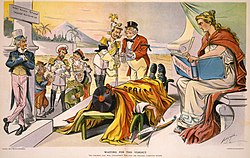 "Waiting for the verdict — the coroner's jury will undoubtedly find that the deceased committed suicide," Puck (1898)
Cartoon showing Uncle Sam, with John Bull and the personifications of Germany, Italy, Russia, Austria and France, conferring at Spain's deathbed. The razor near Spain's hand reads "stupidity." The personification of History looks on with a frown, waiting to write the verdict.


See also
References
- ↑ Crocker III, H. W. (2006). Don't Tread on Me. New York: Crown Forum. pp. 150. ISBN 978-1-4000-5363-6.
- ↑ Alexander Kelly McClure (1970). Our presidents, and how we make them. Ayer Publishing. p. 342. ISBN 978-0-8369-5532-3.
- ↑ 3.0 3.1 3.2 3.3 3.4 3.5 Vicente Boisseau, Esteban (24 April 2019). La imagen de la presencia de España en América (1492-1898) en el cine británico y estadounidense (in español). Ministerio de Defensa. Secretaría General Técnica. ISBN 978-84-9091-404-5. Retrieved 3 September 2020.
- ↑ David R. Spencer. The Yellow Journalism USA: Northwestern UP, 2007. ISBN 9780810123311
- ↑ McCullough, David, Brave companions: portraits in history (Volume 1992, Part 2, Page 80) ISBN 0671792768
- ↑ "Arriando la bandera española · Tearing down the Spanish flag". filosofía.org (in español). 2018. Retrieved 4 September 2020.


