| Content from Wikipedia under the CC BY-SA 4.0 license ⇔ Maps from OpenStreetMap under the ODbL license |
Leiden University
| Leiden University | |
|---|---|
| Universiteit Leiden | |
 | |
 Rectorate | |
| Acronym | LEI |
| Motto | Libertatis Præsidium |
| Motto in English | Bastion of Liberty |
| Established | January 6, 1575 |
| Founder | Philip II |
| Type | Public |
| Affiliations | Coimbra Group, Europaeum, LERU, IAU |
| Rector | Hester Bijl |
| Academic staff | 3,244 |
| Students | 25,800 (2015–2016) |
| Academic colors | Dark blue |
| City | Leiden & The Hague |
| Country |  Netherlands |
| Website | Leiden University |
Leiden University (Dutch: Universiteit Leiden) is a university located in Leiden, in the province of South Holland, in the Netherlands.
Originally founded by Philip II on January 6, 1575,[1] who placed William of Orange in charge of it, it is the oldest university in the Netherlands. However, according to Dutch historiography, the University was founded by William of Orange himself on February 8, 1575, and that is the officially recognized date, although this would imply annulling the legal Founding Charter by which the University was created.
Known for its historical foundations and its emphasis on the social sciences, the university gained particular prominence during the Dutch Golden Age, when it competed with the Catholic University of Leuven to attract scholars from all over Europe. During this time, Leiden hosted eminent figures from different fields such as Carolus Clusius, René Descartes, Rembrandt, Christiaan Huygens, Hugo Grotius, Baruch Spinoza, Angelus Silesius, Willebrord Snel van Royen, Ludolph van Ceulen, Jan Swammerdam, and Thomas Browne.
Until 1998 the official name of Leiden University was Rijksuniversiteit Leiden (RUL).
The University has seven faculties (six in Leiden and one in The Hague), which served more than 34,000 enrolled students in 2021.[2]
It is a member of the Coimbra Group and the Europaeum, and a founding member of the League of European Research Universities.
Sixteen alumni of Leiden University have received Nobel Prizes.[3] Its alumni also include members of the Dutch royal family and ten prime ministers of the Netherlands. American President John Quincy Adams also studied at the university.
Since its creation, the University, the students and the student houses have been a predominant factor in the image of the City of Leiden.
History

Leiden University was originally founded by Philip II on January 6, 1575,[4] as can be read in the Founding Charter of the University, all under the wax seal of the King:[5]
"Philip, by the Grace of God King of both Castiles, León, Aragon, Navarre...
Count of Holland and Zeeland, Friesland and Utrecht
[...] founds a University in the City of Leiden"
In this way the King approved the program that had been submitted on January 2, 1575, consisting of studies in Latin, Hebrew, Greek, Theology, Philosophy, Mathematics and Law. In the Spanish Empire, newly founded universities usually received allocations of funds for their establishment and operation, as part of the efforts to promote education and cultural development in the territories controlled by Spain, which suggests that Leiden University was probably no exception and must have received Spanish aid in its beginnings.
It is known, for example, that at first it made use of buildings belonging to the Catholic clergy, such as the Abbey of Saint Adalbert (which was destroyed by the Sea Beggars), or the Monastery of Saint Barbara, and that in 1577 it moved to the Faliede Bagijnhof on the Rapenburg, before ending up in 1581 in the confiscated monastery of the White Dominican Nuns on the other side of the canal,[6] which was closed in 1616. It was destroyed by a fire, but rebuilt. This building still serves as the Academy Building of Leiden University. It has undergone several renovations, the most recent in 2007–2009.
The City of Leiden played an important role in the Eighty Years' War. In 1572 the city was taken by the anti-Spanish rebels. The Governor of the Netherlands, Luis de Requesens, besieged the city in 1574. The Siege of Leiden lasted from May until October 3, 1574, when the rebels managed to break the siege thanks to the destruction of the dikes, thus making possible the access of boats carrying weapons and provisions.
Legend has it that, as a reward for the resistance put up against the siege, the city was granted a University in 1575, after the inhabitants of Leiden were offered the choice between the university and a certain exemption from taxes. The University was officially inaugurated in the Pieterskerk on February 8, 1575.
In response to the recurring attacks directed against Spanish ecclesiastical and governmental institutions, on March 26, 1582, Philip II issued a public edict establishing that any individual who pursued university studies would be classified as a heretic, or at least as a suspect of heresy, and would thus be barred from holding offices or dignities.[7] Similar measures were taken by the Dutch rulers toward Catholics and supporters of the former Spanish regime. Under the government of William of Orange and later during the Republic of the Seven United Provinces, laws were enacted that restricted the religious freedom of Catholics.[8] These measures included the prohibition of practicing their faith openly, the closure of Catholic churches and the exclusion of Catholics from public and academic offices; Catholics were forced to seek and pursue higher education in institutions more tolerant of their beliefs, such as the Catholic University of Leuven (historical).
16th to 19th centuries


The presence of scholars such as Justus Lipsius, Josephus Justus Scaliger, Franciscus Gomarus, Hugo de Groot, Jacobus Arminius, Daniël Heinsius, Snellius and Gerard Vossius gave Leiden University great European prestige, and students came from all over Europe to enjoy the education, and renowned scholars to teach there.[9] This position was maintained until the end of the 18th century thanks to the reputation of scholars such as Herman Boerhaave.
At the beginning of the 19th century, the university declined somewhat in international reputation, as foreign universities, especially in the emerging German-speaking region, managed to attract many renowned scholars. However, in the Netherlands, "Leiden" remained one of the leading universities. Well-known 19th-century alumni were Johan Rudolph Thorbecke, founder of the Dutch Constitution, and Matthias de Vries, father of Dutch linguistics.
In 1860, Robert Fruin became the first holder of the Chair of National History, marking the beginning of the professional practice of history in the Netherlands.
19th and 20th centuries
The University is associated with ten leaders and prime ministers of the Netherlands, such as the current Prime Minister Mark Rutte, nine international leaders, among them the sixth President of the United States John Quincy Adams, two Secretaries General of NATO, a President of the International Court of Justice and sixteen Nobel Prize laureates (including the renowned physicists Albert Einstein and Enrico Fermi). The University is also known for its many breakthroughs, including its famous Leyden jar, a capacitor made from a glass bottle, invented in Leiden by Pieter van Musschenbroek in 1745 (it was actually invented simultaneously by Ewald Georg von Kleist in Germany, but the name "Leyden jar" prevailed).
Another breakthrough was in cryogenics: Heike Kamerlingh Onnes (winner of the Nobel Prize in Physics in 1913) liquefied helium for the first time (1908) and subsequently managed to reach a temperature of less than one degree above absolute zero. Three other professors received the Nobel Prize for research carried out at the Universiteit Leiden: Hendrik Antoon Lorentz and Pieter Zeeman received the Nobel Prize for their pioneering work in the field of optical and electronic phenomena, and the physiologist Willem Einthoven for his invention of the string galvanometer, which, among other things, made possible the development of electrocardiography.
These Nobel laureates, but also the physicists Albert Einstein and Paul Ehrenfest, the Arabist and expert on Islam Christiaan Snouck Hurgronje, the jurist Cornelis van Vollenhoven and the historian Johan Huizinga, were among those who propelled the university to a place of international relevance during the 1920s and 1930s. In 2005, Einstein's manuscript on the quantum theory of the monatomic ideal gas (the Einstein-Bose condensation) was discovered in one of the Leiden libraries.[1]
Daniel de León, co-founder of the International Workers of the World union and one of the leading figures in the Socialist Labor Party of America.
Recently the university has begun a process of expansion into the neighboring city of The Hague, where new buildings intended mainly for international study programs will be located.
Leiden University has an excellent international reputation and is one of the best universities in Europe and the world. In the 2021 THE-QS university rankings, the university ranked 15th worldwide.
Early 21st century

The University Library, which holds more than 5.2 million books and fifty thousand journals, also possesses several internationally renowned special collections of Western and Eastern manuscripts, printed books, archives, prints, drawings, photographs, maps and atlases. It houses the world's largest collections on Indonesia and the Caribbean. The research activities of the Scaliger Institute focus on these special collections and concentrate particularly on the various aspects of the transmission of knowledge and ideas through texts and images from antiquity to the present day.
In 2005, Einstein's manuscript on the quantum theory of the monatomic ideal gas (the Einstein-Bose condensation) (condensate) was discovered in one of the Leiden libraries.[10]
The portraits of many famous professors from the earliest times hang in the university hall, one of the most memorable places, as Niebuhr called it, in the history of science.
In 2012, Leiden entered into a strategic alliance with Delft University of Technology and Erasmus University Rotterdam so that the universities could increase the quality of their research and teaching. The university is also the unofficial seat of the Bilderberg Group, a meeting of high-level political and economic figures from North America and Europe.
Leiden University partnered with Duke University School of Law starting in 2017 to offer a joint summer program on global and transnational law from the campus in The Hague.
The institution
The university does not have a central campus; its buildings are spread throughout the city. Some buildings, such as the Gravensteen (which currently houses the Leiden International Office), are very old, while buildings such as the Lipsius and the Gorlaeus are much more modern. The university is divided into nine main faculties offering approximately 50 bachelor's degree programs and more than 100 postgraduate programs.
Notable institutions affiliated with the university include the KITLV or Royal Netherlands Institute of Southeast Asian and Caribbean Studies (founded in 1851); the observatory (1633); the natural history museum, with a very complete anatomical cabinet; the museum of antiquities (Museum van Oudheden), with especially valuable Egyptian and Indian departments; a museum of Dutch antiquities from the most remote times; and three ethnographic museums, whose core consisted of the Japanese collections of P. F. von Siebold. The university's anatomy and pathology laboratories are modern, and the geology and mineralogy museums have been restored.
The Hortus Botanicus (botanical garden) is the oldest botanical garden in the Netherlands. For more than four centuries, experts have been growing plants from all over the world here. The Clusius garden (a reconstruction), the 18th-century orangery with its monumental tub plants, the rare collection of historic trees hundreds of years old, the Von Siebold Memorial Japanese garden symbolizing the historical link between East and West, the tropical greenhouses with their world-class plant collections, and the central square and the Conservatory displaying exotic plants from South Africa and southern Europe.
Research at Leiden is highly developed. There are many university research institutes, and Leiden participates in more than forty national research schools, twelve of which are located in the heart of Leiden.
| Faculties | |
|---|---|
| Mathematics and Natural Sciences | Website |
| Philosophy | Website |
| Arts | Website |
| Law | Website |
| Theology | Website |
| Archaeology | Website |
| Social and Behavioral Sciences | Website |
| Medicine | Website |
| Performing and Creative Arts | Website |
The Faculty of Creative and Performing Arts is a cooperation between Leiden University and the Royal Conservatory and the Royal Academy of Art. The university has never had a faculty of economics, business or management, since throughout all these decades it has been thought that this would not fit with its tradition. However, in 2002 the Leiden University School of Management (LUSM) was founded,[11] which offered six professional MBA programs. However, these programs were closed in 2006 and the LUSM is developing other business management activities more closely related to the activities of the faculties. It currently maintains a cooperation with the Faculty of Mathematics with the MSc in ICT in Business.
Gallery
-
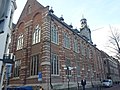 Rapenburg, the Academy Building of Leiden University.
-
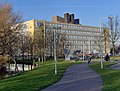 Faculty of Social Sciences of Leiden University.
-
 Kamerlingh Onnes Laboratory 7007, currently the Faculty of Law.
-
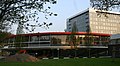 Gorlaeus Building.
-
 Lipsius.
-
 LUMC building, Hospital, Medical Centre and Faculty.
-
 The Academy Building in 1614.
-
 The anatomy hall in the 17th century, from an engraving by Willem Swanenburgh after a drawing by Jan Cornelisz.
-
 The Leiden University Library in 1610.


References
- ↑ "Foundation documents". Leiden University. Retrieved 2023-07-07.
- ↑ Leiden University Annual Report 2021
- ↑ Leiden Nobel Prizes
- ↑ "Foundation documents". Leiden University. Retrieved 2023-07-07.
- ↑ Founding Charter, Leiden University.
- ↑ C. Postma (bew.), Holland in vroeger tijd, Europese Bibliotheek, Zaltbommel (1964). Bewerkte heruitgave van De tegenwoordige staat van Holland, Isaak Tirion, Amsterdam, 1742.
- ↑ Edict of Philip II prohibiting assistance to the schools of the rebellious provinces, published on March 26, 1582, in Doornik.
- ↑ Régimen jurídico de libertad religiosa en Holanda
- ↑ See for example The Land of Rembrand by Conrad Busken Huet.
- ↑ BBC NEWS | Europe | Student unearths Einstein paper.
- ↑ "The Leiden School of Management (LUSM)". Archived from the original on April 15, 2007. Retrieved July 28, 2006.
Bibliography
- W. Otterspeer: The Bastion of Liberty. Leiden University Today and Yesterday. Amsterdam University Press, 2008. ISBN 978-90-8728-030-7
- Th. Lunsingh Scheurleer & G.H.M. Posthumus Meyjes (ed.): Leiden University in the seventeenth century. An exchange of learning. Leiden, Brill, 1975. ISBN 90-04-04267-9
External links

- Official website of Leiden University
- Leiden:Lecciones de Ciencia y Universidad by Fernando Bartolomé
Bibliography
- Otterspeer, Willem (2008). The Bastion of Liberty. Leiden University Today and Yesterday. Amsterdam University Press. ISBN 978-90-8728-030-7. Online version: The Bastion of Liberty - (Open Access) (in English)
- Willem Otterspeer: Good, gratifying and renowned. A concise history of Leiden University. Transl. by John R.J. Eyck. Leiden, 2015. ISBN 978-90-8728-235-6 (in English)
- Th. Lunsingh Scheurleer & G.H.M. Posthumus Meyjes (ed.) (1975). Leiden University in the seventeenth century: an exchange of learning. ISBN 90-04-04267-9.
{{cite book}}:|author=has generic name (help) (in English) - Heinz Schneppen: Niederländische Universitäten und deutsches Geistesleben. Von der Gründung der Universität Leiden bis ins späte 18. Jahrhundert, Münster 1960. Neue Münstersche Beiträge zur Geschichtsforschung Bd. 6, (in Dutch)


